
Remotely Operated Vehicle Market By Offering (Hardware, Services, & Software), By Vehicle Class (Work Class, Observation Class, Micro, Mini, & Other), By Depth Rating (Shallow Water (0-300m), Mid Depth (301-3,000m), Deepwater (3,001-6,000m), & Ultra Deepwater (>6,000m)), By Propulsion System (Electric, Hydraulic, & Hybrid), By Sales Channel (Direct OEM, Distributor and Dealer, Project Contractor, Online, & Other Channel), and Others – Global Analysis & Forecast, 2025-2035
Industry: ICT & Media | Publishing Date: April 20, 2026 | Last Updated: September 30, 2026 | No of Pages: N/A | No. of Tables: N/A | No. of Figures: N/A | Format: PDF | Report Code: IC4518
Industry Outlook
The global Remotely Operated Vehicle Market size was valued at USD 3.04 billion in 2025, and is expected to be valued at USD 3.42 billion by the end of 2026. The industry is projected to grow, hitting USD 9.95 billion by 2035, with a CAGR of 12.6% between 2026 and 2035.
Remotely Operated Vehicle Market Size & Forecast
|
Parameters |
Details |
|
Market Size in 2026 |
USD 3.42 Billion |
|
Revenue Forecast in 2035 |
USD 9.95 Billion |
|
Growth Rate |
CAGR of 12.6% from 2026 to 2035 |
|
Analysis Period |
2025–2035 |
|
Base Year Considered |
2025 |
|
Forecast Period |
2026–2035 |
|
Market Size Estimation |
Billion (USD) |
|
Companies Profiled |
20 |
|
Countries Covered |
33 |
|
Market Share |
Available for 10 companies |
The remotely operated vehicle market is witnessing robust growth, driven by expanding offshore subsea infrastructure and the accelerated deployment of renewable energy projects. NMSC’s analysis indicates that demand for work-class, inspection, and modular ROV systems is rising as operators seek safe, efficient, and cost-effective solutions for subsea inspection, maintenance, and installation. The integration of AI-driven autonomy, high-resolution imaging, and hybrid tethered-wireless architectures is enabling precise, real-time operations even in deepwater and ultra-deepwater environments. These technological advancements reduce downtime and enhance safety, reinforcing ROVs as critical assets across oil & gas, offshore wind, and subsea infrastructure sectors.
In parallel, emerging applications in scientific research, environmental monitoring, aquaculture, and municipal underwater inspections are creating new growth avenues for ROV manufacturers and service providers. Through our assessment, we observed that modular payloads, specialised sensors, and multi-mission adaptability are expanding the ROV ecosystem beyond traditional energy markets. However, high capital expenditure, operational complexity, and maintenance requirements for work-class and deepwater systems remain key constraints. At the same time, long-term opportunities lie in cross-industry adoption and recurring service-based revenue models, which are expected to strengthen market resilience and support sustainable growth over the next five to six years.
What Are the Key Remotely Operated Vehicle Industry Trends?
How Is Integration of AI and Autonomy Transforming the Remotely Operated Vehicle Market?
The integration of artificial intelligence and autonomy is fundamentally transforming ROV operations across inspection, maintenance, and intervention tasks. Based on our interviews with system integrators, we found that AI-enabled ROVs now execute pre-programmed mission paths, detect obstacles, and adapt in real time to environmental changes, reducing reliance on continuous human input. This not only improves operational efficiency and safety but also expands the capability envelope into deepwater and ultra-deepwater environments. Through our discussions, we further found that autonomous features also allow for predictive maintenance and data-driven decision-making, enhancing operational reliability and lowering long-term lifecycle costs for operators.
How Are High-Resolution Imaging Technologies Enhancing ROV Inspection and Survey Capabilities?
From our primary research, we noticed that the incorporation of high-resolution imaging, such as HD, 4K, low-light cameras, multi-beam sonar, and LIDAR, has become a critical differentiator for ROV effectiveness in inspection and survey missions. Operators report that enhanced imaging enables precise mapping, anomaly detection, and real-time assessments even in turbid or low-visibility subsea conditions. Further, improved imaging not only accelerates inspection tasks but also reduces rework and operational risk. These advancements are driving increased adoption of mid- and work-class ROVs, particularly in offshore oil & gas, renewable energy, and infrastructure projects requiring detailed underwater analytics.
How Are Modular and Hybrid ROV Systems Influencing Operational Flexibility?
Modular designs and hybrid tethered-wireless architectures are transforming ROV deployment strategies. Modular systems enable operators to quickly configure ROVs for diverse missions, including inspection, construction support, and intervention, without the need to procure entirely new units. Hybrid connectivity further extends operational reach while simplifying tether management, particularly in congested or sensitive subsea environments. Our technical evaluation indicates that this flexibility not only optimises capital expenditure but also shortens deployment timelines, supports multi-mission adaptability, and fosters broader adoption among small and medium-sized operators with varied application requirements.
Ecosystem Analysis of the Remotely Operated Vehicle Industry
The infographic illustrates the ecosystem of the remotely operated vehicle market, reflecting the collaboration between technology developers, system integrators, component suppliers, service providers, and regulatory bodies that collectively enable underwater robotic operations across industries.
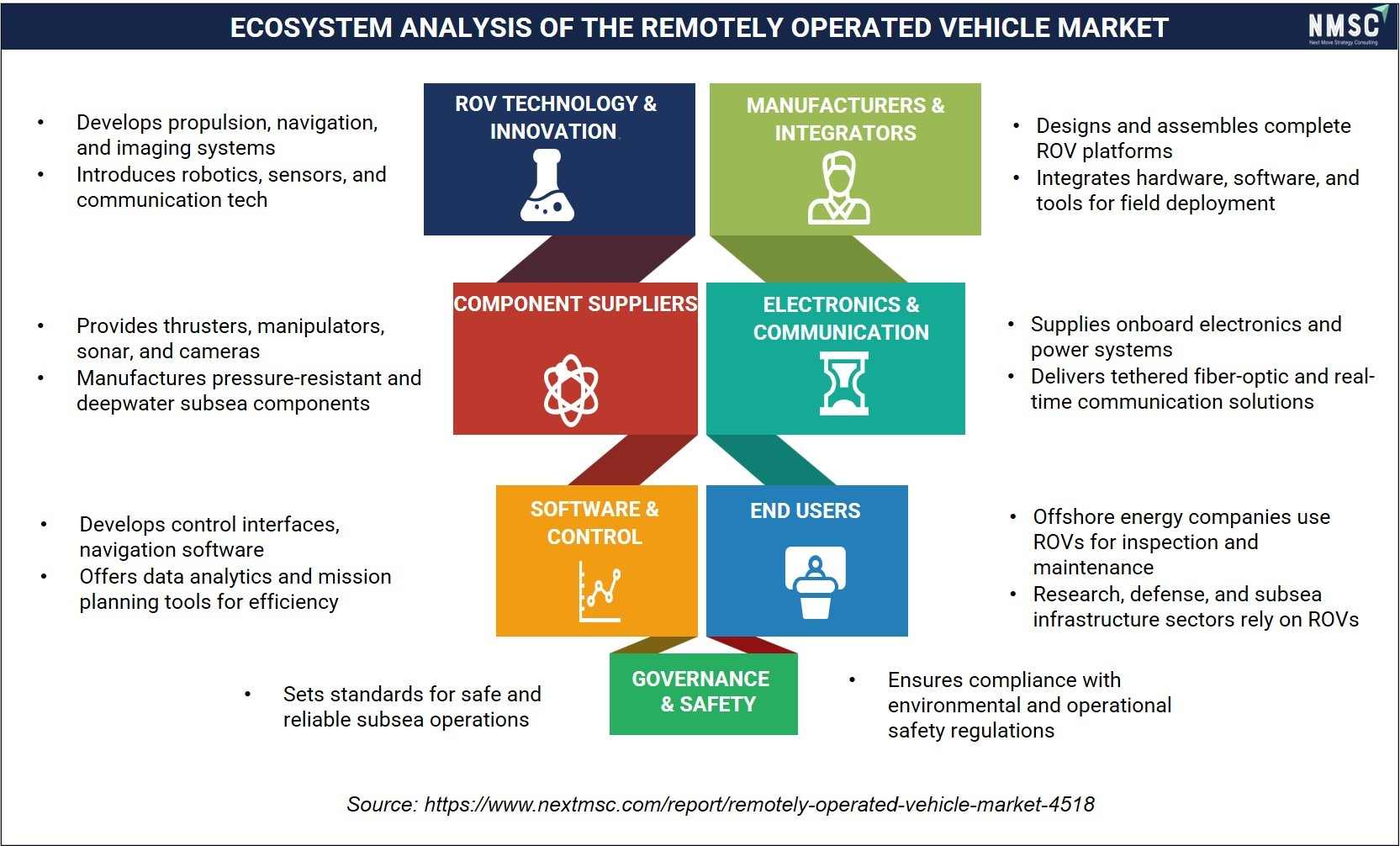
The above infographic illustrates the ecosystem shaping the remotely operated vehicle market, highlighting how different stakeholders interact. We noticed that technology developers drive innovation in propulsion, underwater sensors, robotics software, and high-bandwidth communications, which in turn enables advanced ROV capabilities for deep-sea inspection, maintenance, and exploration. Building on these innovations, manufacturers and system integrators assemble the technologies into operational platforms, while component suppliers provide thrusters, cameras, manipulators, and control electronics that are essential for vehicle performance. Consequently, end-use industries, including offshore energy, defense, marine research, and subsea infrastructure, fuel adoption by increasing demand for safe and precise underwater operations. Finally, regulatory standards and safety frameworks ensure reliability, operational compliance, and sustainable deployment across global marine environments.
What Are the Key Market Drivers, Breakthroughs, And Investment Opportunities That Will Shape the Remotely Operated Vehicle Market in the Next Decade?
Growth Catalyst & Risk Assessment Matrix
|
Drivers/Trends/ Restraints |
(+/-) % Impact On CAGR Forecast |
Geographic Relevance |
Impact Timeline |
|
Expansion of offshore subsea infrastructure driving ROV demand for inspection, maintenance, and installation |
4.26% |
U.S., North Sea (UK & Norway), Middle East, Southeast Asia |
Medium to Long term (3–6 years) |
|
Growth of offshore renewable energy projects increasing need for inspection and support ROVs |
3.58% |
Global, with focus on U.S., Europe, Japan, China |
Medium to Long term (3–6 years) |
|
Expansion of emerging sectors such as environmental monitoring, scientific research, and subsea infrastructure inspection |
2.34% |
Europe, U.S., Asia-Pacific, Middle East |
Medium term (2–4 years) |
|
High capital expenditure and operational complexity of deepwater and work-class ROV deployment |
-3.12% |
Global, particularly deepwater oil & gas operations |
Medium to Long term (3–6 years) |
From our evaluation, we observed that the remotely operated vehicle market is being shaped by a combination of offshore infrastructure expansion, renewable energy development, technological advancements in subsea robotics, and evolving regulatory compliance requirements. The primary growth driver stems from increasing investment by oil & gas operators and offshore wind developers in work-class and inspection ROVs for subsea inspection, maintenance, and installation tasks. In parallel, the rising adoption of advanced ROV technologies, including AI-assisted navigation, high-resolution imaging sensors, and autonomous features, is accelerating the deployment of ROVs across deepwater and ultra-deepwater operations, enabling safer, faster, and more cost-efficient subsea interventions.
However, our operational research indicates that market growth remains constrained by the high capital expenditure required for work-class ROVs, specialised support vessels, trained pilots, and lifecycle maintenance, particularly for deepwater deployments where operational complexity increases operational risk and maintenance demands. At the same time, our research highlights a significant long-term opportunity in the expansion of emerging sectors such as offshore renewables, subsea environmental monitoring, scientific research, and underwater infrastructure inspection. These applications are expected to provide recurring demand for ROV systems, components, and associated services, thereby strengthening the overall ROV ecosystem and supporting strategic growth for manufacturers and service providers.
Growth Drivers:
How is the Expansion of Offshore Subsea Infrastructure Driving Remotely Operated Vehicle Market Growth?
NMSC’s assessment indicates that the rapid expansion of off-shore subsea infrastructure, including energy, telecommunications, and underwater utilities, remains a primary growth driver for the remotely operated vehicle market. Our market analysis of offshore sector installations reveals that the growing need for frequent inspection, maintenance, repair, and installation of subsea assets such as pipelines, wellheads, and cable networks is sustaining demand for ROV deployments, particularly work-class and inspection variants. By enhancing safety and operational efficiency in environments that are inaccessible or hazardous to human divers, ROVs are driving procurement and modernisation investments by energy companies and subsea contractors alike. These dynamics collectively reinforce ROV adoption across deepwater and ultra-deepwater operations worldwide.
How is Renewable Energy Growth Accelerating the ROV Market?
The accelerated build-out of offshore renewable energy infrastructure, especially wind, tidal, and emerging marine energy systems, is broadening the addressable market for ROV technology. Through our interviews with project developers, we have observed that offshore wind farms require extensive subsea inspection, cable laying, foundation checks, and long-term maintenance, tasks that ROVs are uniquely capable of performing with precision and repeatability. Market evidence further indicates that government targets for offshore renewables, and associated regulations for asset integrity and safety, are driving operators to adopt advanced ROV systems as a standard tool in their engineering toolkits. This shift not only enhances uptime and lowers risk but also creates recurring demand for inspection and support services over the lifecycle of renewable installations.
Growth Inhibitor:
How does the High Cost of Deployment and Operation Restrain Remotely Operated Vehicle Market Adoption?
Market data indicates that a key restraint limiting broader ROV adoption is the substantial capital required for acquisition, deployment, and ongoing operation, particularly for work-class and deepwater capable systems. In our assessment of procurement behaviours across service providers, we noticed that the high upfront cost of ROV units, specialised support vessels, trained pilots, and associated maintenance infrastructure has been repeatedly cited by operators as a barrier to entry, especially among smaller contractors and research institutions with tighter budgets. Further, the total cost of ownership, including spare parts, lifecycle upgrades, and insurance, extends payback periods and constrains discretionary investment in fleet expansion. This economic pressure slows market penetration in cost-sensitive regions and in lower volume applications, shaping buying practices and competitive strategies across the ecosystem.
Growth Opportunity:
How is Environmental Monitoring and Emerging Sector Demand Creating Remotely Operated Vehicle Market Opportunity?
From our market assessment, we observed that a compelling opportunity shaping the remotely operated vehicle market arises from expanding requirements for environmental monitoring, scientific research, and emerging subsea applications. Interviews with regulatory agencies indicate a growing emphasis on real-time, high-resolution underwater data to support ecosystem assessments, pollution tracking, and climate-related studies. As regulatory frameworks tighten around marine conservation and blue economy initiatives gain traction, specialised ROVs equipped with advanced sensors and imaging systems are experiencing increasing demand beyond traditional energy sectors. Additionally, emerging applications, such as deep-sea mineral assessment, archaeological exploration, and freshwater infrastructure inspection, further broaden the addressable use cases for ROVs. Collectively, this trend signals diversification of revenue streams for manufacturers and service providers while supporting sustainable long-term market growth.
How Is the Remotely Operated Vehicle Industry Segmented in This Report, And What Are the Key Insights from the Segmentation Analysis?
Market Highlights & Strategic Insights - Remotely Operated Vehicle Market:
|
Segments |
Key Takeaways |
|
Vehicle Class |
Work-class units dominate heavy offshore tasks today. Observation-class, micro, and mini ROVs are expected to grow faster for portable, precision, and emerging subsea applications. |
|
Components |
Imaging & sensors are critical for situational awareness and dominate revenue. Robotic arms and propulsion units are expected to drive growth for complex interventions and automated operations. Electronics, LARS, and power solutions enhance reliability and deployment efficiency |
|
Depth |
Shallow-water ROVs dominate inspections, aquaculture, and renewable energy today. Ultra-deep ROVs are growing for deepwater exploration, defense, and scientific missions where complexity and high-value operations drive adoption. |
|
Application |
Inspection & survey dominate current demand due to ongoing monitoring and industrial needs. Research and construction & installation are expected to grow faster with offshore renewables, subsea infrastructure expansion, and exploration initiatives. |
|
End-User |
Oil & gas and defense currently account for the largest revenue due to capital-intensive and complex subsea operations. Renewables, research, and aquaculture are emerging growth sectors as technology adoption expands. |
By Vehicle Class Insights
Is Vehicle Class Driving Growth in the Remotely Operated Vehicle Market in 2025?
On the basis of vehicle class, the remotely operated vehicle market is segmented into work-class ROVs, observation-class ROVs, micro ROVs, mini ROVs, and others.
Our market evaluation indicates that work-class ROVs dominate the vehicle class segment of the global remotely operated vehicle market in 2025, with the highest share and deepest penetration in key revenue-driving industries like offshore oil & gas and renewable energy. Their advanced manipulation capabilities, high payload capacity, and suitability for deepwater tasks give them a competitive edge over smaller classes. Other segments like observation-class, micro, and mini, show robust growth potential, driven by demand for cost-effective inspection, environmental monitoring, and specialised tasks. Competitive differentiation increasingly depends on technological enhancements such as improved sensor suites and modular tooling systems that expand applicability across operational theatres.

By Propulsion Insights
Is Propulsion Type Influencing Growth in the Remotely Operated Vehicle Market in 2025?
Based on propulsion, the remotely operated vehicle market is segmented into electric ROVs, hydraulic ROVs, and hybrid ROVs.
Electric ROVs lead the propulsion segment in the global remotely operated vehicle market in 2025, driven by their high efficiency, lower life cycle costs, and adaptability across a range of missions from inspection to mid-depth exploration. We found that hydraulic ROVs remain indispensable in power-intensive tasks typical of heavy subsea construction and deepwater operations, while hybrid systems are gaining traction for their versatility in mixed profile missions. This dynamic underscore how propulsion choice increasingly aligns with specific operational demands and cost-performance trade-offs.
By Connectivity Insights
Is Connectivity Type Shaping Remotely Operated Vehicle Market Dynamics in 2025?
Based on the connectivity, the remotely operated vehicle market is segmented into tethered ROVs, wireless ROVs, and hybrid.
Our market assessment indicates that tethered ROVs remain the leading connectivity type in 2025 due to their dependability and unmatched data/power transmission capabilities in demanding deep-sea and industrial environments. Wireless connectivity, while still emerging due to underwater propagation limitations, is expanding in niche use cases where mobility and quick deployment matter. Hybrid systems are poised for future growth as innovations in communication tech and autonomy reduce reliance on tethers without sacrificing performance.

By Application Insights
Which Application is Driving Adoption in the Remotely Operated Vehicle Market in 2025?
Based on application, the remotely operated vehicle market is segmented into inspection & survey, maintenance & repair, construction & installation, scientific & research activities, monitoring & surveillance, search & rescue, and others.
Based on our evaluation, we observed that inspection & survey dominate the market alongside maintenance & repair in the Remotely Operated Vehicle Industry in 2025, driven by the ongoing need for subsea asset integrity and operational safety in energy, infrastructure, and marine sectors. Inspection and IRM activities capture a significant share because they are repeatable, regulated, and mission-critical, requiring regular deployment of advanced ROV systems. Construction/installation and scientific research follow as high-growth areas, supported by expanding offshore energy projects and increased research investment in ocean sciences.
Regulatory Framework Impacting the Remotely Operated Vehicle Market
The infographic below outlines the regulatory framework of the remotely operated vehicle market, comprising the policies, standards, and oversight mechanisms governing safe and compliant subsea robotic operations.
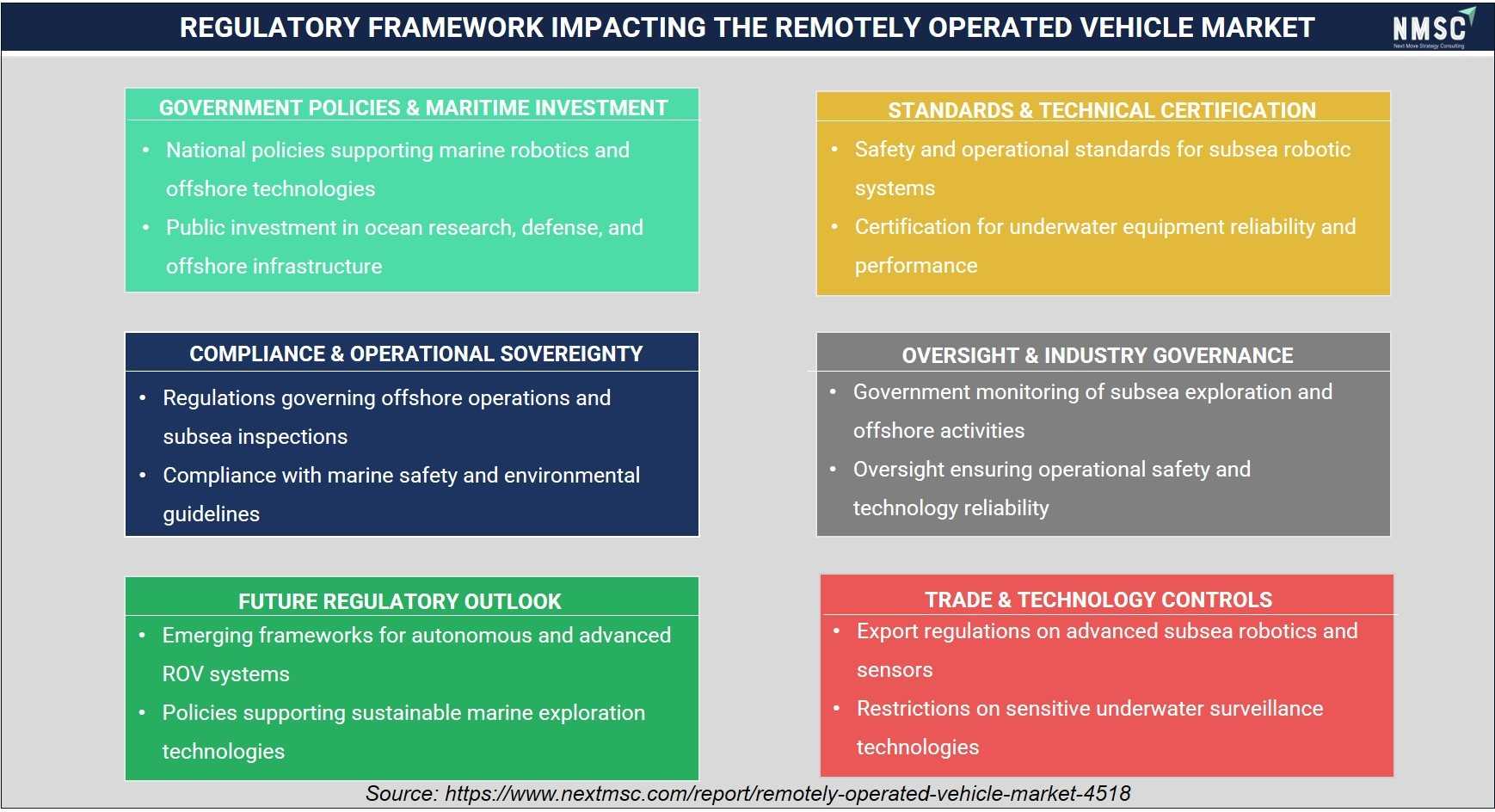
This infographic illustrates the regulatory framework influencing the remotely operated vehicle market and the policies governing its development and deployment. We found that governments establish national policies and investment initiatives to support marine robotics innovation and the advancement of offshore technologies. In addition, technical standards and certification requirements ensure that ROV systems meet safety, reliability, and operational performance criteria in subsea environments. Furthermore, compliance regulations guide offshore operations, environmental protection, and responsible underwater exploration, while oversight bodies monitor subsea activities to maintain transparency and manage operational risk. Finally, trade regulations and technology controls influence global market dynamics by governing the export and transfer of advanced robotic systems, sensors, and surveillance technologies, shaping both the competitive landscape and long-term growth prospects of the ROV industry.
Regional Outlook:
Geographic Performance Snapshot:
|
Regions |
Key Takeaways |
|
North America |
North America leads the remotely operated vehicle market, driven by offshore oil & gas, defense, and renewable energy sectors. Investment in advanced work-class and inspection ROVs, coupled with AI-assisted autonomy and high-resolution imaging, supports efficient deepwater operations. Strong operator ecosystems, robust service networks, and established regulatory frameworks enable safe, scalable ROV deployment across commercial, defense, and research applications |
|
Europe |
Europe is a mature and regulation-intensive ROV market, with the UK, Norway, Germany, and the Netherlands leading adoption for offshore energy, subsea infrastructure, and environmental monitoring. Compliance with safety and inspection standards, government-backed renewable projects, and a focus on modular and hybrid ROV systems shape steady growth. National programs supporting offshore wind and subsea asset management further accelerate ROV demand. |
|
Asia-Pacific |
Asia-Pacific is the fastest-growing remotely operated vehicle market, led by China, Japan, India, and South Korea. Expansion of offshore oil & gas fields, large-scale wind farms, and subsea cable projects drives adoption. National initiatives to deploy advanced inspection and work-class ROVs, combined with rising technical expertise and domestic innovation in sensors and autonomous systems, are fueling rapid market penetration. |
|
Middle East & Africa (MEA) |
Gulf countries, including the UAE, Saudi Arabia, and Qatar, are adopting ROVs for oil & gas, defense, and offshore infrastructure projects. Broader African adoption is constrained by limited subsea infrastructure and technical expertise, though pilot projects and targeted deployments in renewable energy and environmental monitoring indicate early growth potential. |
|
Latin America (LATAM) |
LATAM is an emerging ROV market led by Brazil, Mexico, and Chile. Adoption focuses on offshore oil & gas inspection, aquaculture, and infrastructure monitoring. Market growth is limited by infrastructure gaps, regulatory maturity, and availability of skilled operators, though ongoing subsea exploration projects and research initiatives are creating future expansion opportunities. |
The remotely operated vehicle market is geographically studied across North America, Europe, Asia Pacific, the Middle East & Africa, and Latin America (LATAM), and each region is further studied across countries.
Remotely Operated Vehicle Market in North America
NMSC’s findings suggest that North America is a market leader for ROV adoption, anchored by mature oil & gas operations in the Gulf of Mexico, growing offshore wind programs, and robust defense procurement. Based on our interviews with U.S. operators and system integrators, we observe persistent demand for work-class and high-payload inspection ROVs to support deepwater drilling, subsea construction, and integrity work. In addition, we found that technology adoption, AI-assisted autonomy, hybrid tether architectures and high-resolution imaging have accelerated retrofits and fleet upgrades among service companies seeking to reduce vessel time and diver exposure. Commercial dynamics are shaped by an established service-vessel fleet, well-developed supply chains for components, and a local vendor ecosystem that supports rapid after-sales service.
Remotely Operated Vehicle Market in the United States
The United States represents the region’s largest demand center for advanced ROV systems, driven by deepwater activity in the Gulf of Mexico, pipeline integrity projects, and an expanding offshore wind pipeline along the Atlantic Coast. Capital budgets are prioritised for higher-capacity work-class ROVs, modular payload integration, and data analytics platforms that accelerate survey-to-action cycles. We also observed increasing government and defense applications, including naval inspection, port security, and unmanned trials, broadening the market beyond commercial energy. Operationally, the U.S. benefits from a dense network of support vessels, experienced pilots, and component suppliers, although procurement cadence remains closely linked to macro energy spending and regulatory permitting for new offshore projects. In our assessment, the U.S. continues to serve as an innovation testbed for advanced sensor suites and autonomy packages that later scale globally.
Remotely Operated Vehicle Market in Canada
Canada’s remotely operated vehicle market is maturing around offshore Atlantic projects, Arctic trials, and freshwater infrastructure inspections. In particular, our interviews with Canadian service firms indicate that demand is concentrated on inspection and mid-work-class systems for pipeline tie-ins, rig support, and environmental monitoring in colder, high-latency environments. To meet these challenges, operators prioritise robust cold-weather engineering, tether management suitable for ice-prone seas, and integrated ROV–AUV workflows that enable extended surveys. Moreover, public-sector research and indigenous community programs are increasingly funding scientific and ecological missions, thereby creating niche demand for portable and mini ROVs. Although the overall fleet remains smaller than that of U.S. peers, Canada’s procurement is highly strategic, emphasising reliability, regulatory compliance, and multi-mission capability, which makes the market attractive for suppliers offering ruggedised platforms and end-to-end project services.
Remotely Operated Vehicle Market in Europe
Industry analysis suggests that Europe is a technologically progressive and regulation-intensive market for ROVs, driven by North Sea oil & gas, large offshore wind build-outs, and stringent asset integrity requirements. Consequently, inspection-grade ROVs and modular work-class systems are in strong demand for routine integrity management, decommissioning, and wind-farm cable inspections. Moreover, European procurement decisions are shaped by compliance frameworks and lifecycle cost assessments, leading operators to increasingly favour modular payloads and remote monitoring to meet rigorous inspection cadences. Additionally, we observed significant R&D investment across Europe in low-emissions thrusters and hybrid architectures, with OEMs aiming to reduce vessel hours and automate inspection pipelines. Overall, our assessment indicates that Europe continue to lead in renewable-driven ROV applications while sustaining steady IRM demand in legacy oil & gas fields.
Remotely Operated Vehicle Market in the United Kingdom
The United Kingdom represents a pivotal European market due to dense North Sea infrastructure, a mature supply chain, and ambitious offshore wind targets. Accordingly, consultations with UK regulatory authorities indicate that routine inspection and decommissioning workloads generate recurring demand for both inspection and medium-work-class ROVs. To address these requirements, operators are increasingly adopting automated inspection toolchains that combine high-resolution sonar, photogrammetry, and AI analytics, enabling compliance with stricter integrity reporting while reducing vessel time. Furthermore, the UK’s Crown Estate leasing activity and coastal policies governing wind and cable maintenance further incentivise investment in specialised ROV tooling and IRM capabilities. From an industrial perspective, UK customers prioritise proven system reliability, digital reporting packages, and local service availability, shaping procurement toward integrated solutions offered by OEMs and system integrators.
Remotely Operated Vehicle Market in Germany
Germany’s ROV market is increasingly driven by offshore wind expansion and subsea cable projects, combined with industrial underwater infrastructure inspection needs. From our engagements with German operators, we found that demand emphasises precision inspection ROVs with advanced sensor suites, as well as hybrid vessels that reduce mobilisation costs. German procurement is influenced by strong environmental compliance, safety standards, and a preference for electrification and efficiency. This, in turn, is boosting interest in low-emission thruster systems and modular payloads designed for repeatable survey tasks. In our assessment, German demand is characterised by high technical standards and a push for domestic technology partners that deliver predictable performance across complex offshore installations and inland waterway infrastructure projects.
Remotely Operated Vehicle Market in France
Our evaluation indicates that France’s ROV adoption is anchored in a combination of offshore energy operations, maritime research institutions, and naval procurement. As a result, we observed steady demand for inspection and medium-work-class ROVs used in pipeline surveys, platform maintenance, and scientific mapping missions. Additionally, government research programs and defense exercises sustain a pipeline of niche procurement for specialised vehicles. French customers also prioritise integrated software suites for mission planning and data analysis, enhancing the value proposition for ROV vendors that bundle imaging, analytics, and service contracts. Overall, France’s market presents opportunities for collaborative R&D projects and targeted deployments in marine science, infrastructure integrity, and defense modernisation.
Remotely Operated Vehicle Market in Italy
NMSC’s assessment indicates that Italy’s remotely operated vehicle market is pragmatic and project-driven, with demand primarily arising from Mediterranean offshore services, port authorities, and archaeological research. In particular, notable activity in shallow-water inspection, salvaging, and pipeline support has led to a focus on compact observation ROVs and portable systems. Consequently, infrastructure inspection, port management, sea defenses, and coastal energy installations have driven rising interest in integrated inspection packages that combine sonar and HD imaging. Furthermore, Italian operators prioritise cost-efficient rental solutions and localised service support, meaning the market favours fleet rental models and multi-mission ROV platforms that minimise upfront capital outlay while satisfying regulatory and conservation requirements.
Remotely Operated Vehicle Market in Spain
Market data indicates that Spain’s ROV market is centred on offshore energy servicing, Mediterranean infrastructure inspection, and emerging aquaculture applications. In particular, consultations with port authorities indicate that demand is divided between inspection-grade ROVs for port and coastal asset surveys and mid-work-class systems for subsea cable and pipeline maintenance. Moreover, Spain’s growing focus on offshore renewables and marine research initiatives is creating additional niches for environmental monitoring ROVs. Procurement patterns further reflect a preference for flexible deployment options and compatibility with Mediterranean operating conditions, with lighter, portable systems for shallow water and robust mid-class vehicles for deeper Atlantic projects. As a result, the market favours OEMs and integrators that provide both hardware and turnkey service packages.
Remotely Operated Vehicle Market in the Nordics
NMSC’s assessment shows that the Nordic countries, including Norway, Denmark, Sweden, Finland, and Iceland, exhibit advanced ROV adoption, driven by deepwater oil & gas integrity programs, major offshore wind initiatives, and a strong engineering base. Significant investment in automation, reliability engineering, and green propulsion solutions supports compliance with stringent environmental standards. Specifically, Norway’s field integrity policies and mandatory inspection regimes generate long-term IRM demand, while Denmark and Sweden concentrate on wind-farm cable monitoring and decommissioning. Across the region, buyers prioritise durable systems backed by robust service SLAs and local technical support. Overall, our assessment indicates that the Nordic market serves as a testing ground for sustainability-oriented ROV innovations and represents a strategic opportunity for vendors focused on premium reliability and lifecycle services.
Remotely Operated Vehicle Market in the Asia-Pacific
From our regional analysis, we found that Asia-Pacific is the fastest-growing ROV region, driven by offshore oil & gas expansion, rapid offshore wind deployments, and large subsea cable projects. This growth is supported by aggressive fleet expansion, localised component manufacturing, and increasing adoption of inspection automation to enhance cost efficiency. The regional landscape is highly heterogeneous, where China’s scale drives volume procurement and domestic OEM development, Japan focuses on high-reliability systems for complex seafloor topography, and Australia emphasises deepwater capability for resource projects. Additionally, emerging Southeast Asian markets are investing in ROVs for pipeline integrity and port security, with growing interest in rental contracts and local service partnerships to mitigate capital expenditure constraints.
Remotely Operated Vehicle Market in China
From our engagement with Chinese OEMs, we evaluated that China is rapidly China is emerging as a high-volume remotely operated vehicle market, fueled by offshore oil & gas development, expanding offshore wind farms, and subsea cable infrastructure. In particular, there is strong emphasis on locally manufactured inspection and work-class ROVs, leveraging China’s electronics, shipbuilding, and automation capabilities to reduce costs and accelerate deployment timelines. Operational efficiency is further enhanced by integrating AI-assisted autonomy and modular payloads, enabling fleets to perform multi-mission tasks across both shallow and deepwater projects. Regionally, demand for high-capacity work-class systems is concentrated in the South China Sea and East China Sea, while inspection and micro ROVs are gaining traction for nearshore renewable and subsea research projects. Overall, our assessment indicates that China continue to be both a major consumer and an emerging exporter of competitively priced ROV platforms, generating ripple effects across the broader Asia-Pacific market.
Remotely Operated Vehicle Market in Japan
Our evaluation indicates that Japan’s ROV market prioritises high reliability, precision, and integration with manned subsea operations. Accordingly, we observed strong demand for advanced sensor fusion, compact work-class tooling, and autonomous adjunct systems to support long-duration inspections in complex seabed environments. Commercial activity spans pipeline surveys, port maintenance, and tsunami-resilient infrastructure monitoring, while grant-funded research programs foster the development of specialised payloads. In this context, Japanese operators emphasise supplier partnerships that ensure long-term service, high-quality data capture, and seamless software integration. Overall, our assessment highlights Japan as a high-value market for technologically advanced ROV platforms that combine precision engineering, autonomy, and robust field support.
Remotely Operated Vehicle Market in India
India is currently in a growth-acceleration phase for ROV adoption, driven by offshore energy exploration, subsea cable expansion, and marine research initiatives. In this context, procurement patterns favour versatile inspection ROVs and mid-class vehicles for pipeline integrity and port surveillance, often delivered through rental or project-based contracting models due to budget sensitivity. Additionally, local assembly and component sourcing are improving, although gaps remain in operator skills and technical infrastructure. Overall, India presents a significant opportunity for OEMs offering modular, cost-efficient ROV platforms paired with strong local support and training programs, enabling scalable deployment across commercial and research applications.
Remotely Operated Vehicle Market in South Korea
Through our market evaluations, we found that South Korea’s ROV market is technology-driven and export-oriented, leveraging the country’s strong shipbuilding, offshore engineering, and defense sectors. In particular, there is a focus on high-reliability work-class systems, advanced sensor suites, and hybrid deployment architectures that support both domestic projects and international exports. Additionally, local suppliers are competitive in propulsion and thruster technologies, and turnkey IRM service offerings are becoming increasingly common. Overall, our assessment indicates that South Korea continues to serve as a center of engineering excellence for robust ROV platforms, while also acting as a regional hub for service and after-sales support across East and Southeast Asia.
Remotely Operated Vehicle Market in Taiwan
NMSC analysis indicates that Taiwan’s remotely operated vehicle market is rapidly emerging, driven by offshore wind development, port modernisation, and academic research initiatives. In particular, demand is concentrated on inspection ROVs with modular payloads to support cable inspections and turbine foundation surveys. Moreover, Taiwan’s strong electronics manufacturing base enables efficient local sourcing of imaging and control components, accelerating adoption. Although the market size remains smaller than that of regional peers, Taiwan presents attractive opportunities for OEMs offering compact, high-resolution inspection systems with reliable local service, supporting both renewable energy and infrastructure projects.
Remotely Operated Vehicle Market in Indonesia
Current market evaluation indicates that Indonesia is an emerging ROV market, expanding due to oil & gas exploration, subsea cable deployment, and increasing port security needs. In particular, demand is concentrated on portable inspection ROVs and mid-class systems for pipeline integrity, seabed surveys, and cable route clearance. Given the logistical challenges across the archipelago and limited local technical capacity, rental and turnkey project contracting models dominate procurement. Overall, Indonesia presents significant growth potential for international OEMs and service providers that combine equipment supply with operator training and local partnerships, enabling scalable and cost-efficient ROV operations.
Remotely Operated Vehicle Market in Australia
From our evaluation, we found that Australia’s remotely operated vehicle market is shaped by deepwater oil & gas projects, subsea cable initiatives, and a robust scientific research community. Accordingly, there is substantial demand for deep-rated inspection and work-class ROVs supporting offshore energy, mining, seabed surveys, and cable route assessments. Moreover, geographic remoteness drives a preference for highly reliable systems, comprehensive spare-parts logistics, and operator training programs. Overall, our assessment indicates that Australia represents a high-value market for premium ROV systems, long-term service contracts, and integrated survey solutions, with additional recurring demand emerging from environmental monitoring and renewable energy support missions.
Remotely Operated Vehicle Market in Latin America
Based on our regional analysis, we observed that the Latin American remotely operated vehicle market is emerging, with Brazil, Mexico, and Chile leading adoption in offshore energy exploration, subsea inspection, and research. In particular, industry insights indicate that mid-class work and inspection ROVs dominate procurement, typically delivered through rental or project-based contracts due to infrastructure and budget constraints. Additionally, early adoption of modular ROV systems, supported by international OEMs, is improving operational efficiency across the region. Overall, our assessment suggests that Latin America presents growth opportunities for vendors offering scalable, cost-effective ROV platforms, complemented by operator training and turnkey services.
Remotely Operated Vehicle Market in the Middle East & Africa
MEA adoption is concentrated in the Gulf region, including the UAE, Saudi Arabia, and Qatar, with use cases in oil & gas, defense, and regulated subsea projects. Operational analysis indicates that work-class and inspection ROVs are procured via turnkey service contracts and supported with OEM training. Broader adoption across Africa is constrained by infrastructure gaps and limited local expertise, though pilot programs in renewables and subsea research indicate early growth potential. Overall, MEA represents strategic opportunities for vendors combining high-value equipment supply with capacity building, training, and integrated service solutions to accelerate adoption.
Competitive Landscape
Competitive Dynamics & M&A Landscape:
|
Key Takeaways |
|
Based on our assessment, we found that the the remotely operated vehicle market is led by Oceaneering International, Inc., Forum Energy Technologies, Inc., TechnipFMC plc, Saab Seaeye Ltd, Soil Machine Dynamics Ltd., Exail SAS, VideoRay LLC, Deep Trekker Inc., International Submarine Engineering Limited, Kystdesign AS, Seatools B.V., Deep Ocean Engineering, Inc., SEAMOR Marine Ltd., Shark Marine Technologies Inc.M, Boxfish Robotics Limited, Blueye Robotics AS, Blue Robotics Inc., Outland Technology, Inc., JW Fishers Mfg., and IROV Technologies Pvt. Ltd.. These companies dominate through scale, specialised ROV solutions, and global subsea service networks. |
|
From our competitive evaluation, we noticed that leading companies differentiate via work-class, inspection, and micro ROVs, modular system architectures, advanced propulsion technologies, sensor integration, and digital control systems. Operational scale, deepwater deployment capabilities, and regional service reach allow them to secure large inspection, maintenance, and subsea installation contracts globally. |
|
Recent advancements include autonomous navigation, hybrid electric/hydraulic propulsion, advanced imaging and sonar systems, AI-assisted inspection, and modular platform upgrades. Companies like Deep Trekker and Boxfish Robotics focus on compact, lightweight ROVs for inspection and defense, while TechnipFMC and Saab Seaeye optimise work-class ROVs for offshore energy applications. |
|
Companies are pursuing acquisitions and joint ventures to enhance capabilities and expand regional footprints. Notable moves include Chouest Group’s 2025 acquisition of Kystdesign AS, strengthening deepwater ROV design and manufacturing expertise. Such inorganic growth supports technological diversification and reinforces competitive positioning across global subsea markets. |
Which Companies Dominate the Remotely Operated Vehicle Market and How Do They Compete?
Based on our analysis of global ROV deployments and contract awards, we noticed that companies such as Oceaneering International, Inc., Forum Energy Technologies, Inc., TechnipFMC plc, Saab Seaeye Ltd, Soil Machine Dynamics Ltd., Exail SAS, VideoRay LLC, Deep Trekker Inc., International Submarine Engineering Limited, Kystdesign AS, Seatools B.V., Deep Ocean Engineering, Inc., SEAMOR Marine Ltd., Shark Marine Technologies Inc.M, Boxfish Robotics Limited, Blueye Robotics AS, Blue Robotics Inc., Outland Technology, Inc., JW Fishers Mfg., and IROV Technologies Pvt. Ltd. lead the competitive landscape by scale, service breadth, and technological depth. Oceaneering secured a significant USD 180 million subsea robotics contract with Petrobras in August 2025, reinforcing its leadership in offshore inspection, maintenance, and intervention across Brazil’s deepwater fields. Similarly, Deep Ocean Engineering maintains specialisation in modular deep-sea platforms and customised survey tooling, appealing to high-end and bespoke subsea missions. In our evaluation, these players compete through a blend of contract scale, technological differentiation, and global operations.
Market Dominated by Remotely Operated Vehicle Giants and Specialists
From our competitive assessment, we evaluated that the ROV market balances dominance by established offshore giants with growth from niche and specialist providers. Large incumbents like Oceaneering and TechnipFMC leverage deep service networks, extensive vessel support infrastructure, and long‑term IRM contracts to retain market share. At the same time, specialists such as Soil Machine Dynamics Ltd. and EyeROV are gaining traction in regionally specific and defense‑oriented use cases. For example, recent industry reporting notes contracts between the Indian Navy and EyeROV in 2025 for deep inspection ROVs in the Asia‑Pacific markets. Exail and Blue Robotics Inc. bring differentiated products, compact, high‑frequency survey and modular sensing ROVs, to scientific and commercial segments. In parallel, international partnerships and extended service offerings enable mid‑tier players to compete for project‑based and rental contracts. Market concentration remains buoyed by global energy demand, while specialisation allows tailored competition across segments.
Innovation and Adaptability Drive Market Success
Our current market assessment indicates that innovation remains a critical competitive separator in the remotely operated vehicle market, with advancements in autonomy, energy efficiency, and sensor integration increasingly shaping procurement decisions. Market indicators show a growing deployment of AI-assisted navigation and smart control systems, which improve operational efficiency while reducing dive durations and intervention requirements. In line with these technological trends, TechnipFMC’s focus on sustainable deep-sea exploration platforms reflects broader industry priorities around decarbonization and operational modernisation, while Saab Seaeye’s electric propulsion systems and hybrid AUV/ROV designs enhance mission flexibility and reduce maintenance cycles. At the same time, smaller innovators such as Blue Robotics and Boxfish Robotics Limited are gaining traction through modular, lightweight platforms optimised for nearshore operations and inspection tasks. Collectively, these developments are accelerating the integration of real-time 3D mapping, autonomy, and sensor fusion in modern ROV platforms, enabling advanced subsea analytics and digital twin capabilities that support faster and safer data-driven decision-making in complex underwater environments.
Market Players to Opt for Merger & Acquisition Strategies to Expand Their Presence
In our assessment of competitive expansion strategies, we noticed that M&A activities and strategic acquisitions are shaping capabilities and geographic reach. A notable transaction in March 2025 saw Chouest Group acquire Kystdesign AS, bolstering its subsea robotics portfolio and enhancing innovation pipelines for deepwater ROV design and production. Such consolidation increases access to engineering talent and design IP while expanding operational footprints in Europe and North America. While larger OEMs use both organic growth and alliances to scale, mid-tier players pursue acquisitions to fill capability gaps and accelerate product diversification. Through these strategic moves, companies enhance competitiveness by combining ROV hardware with advanced software, services, and multi-mission support infrastructures. These developments collectively underscore a dynamic market where scale, specialisation, and inorganic growth shape long-term positioning.
List of Key Remotely Operated Vehicle Companies
-
Oceaneering International, Inc.
-
Forum Energy Technologies, Inc.
-
TechnipFMC plc
-
Saab Seaeye Ltd
-
Soil Machine Dynamics Ltd.
-
Exail SAS
-
VideoRay LLC
-
Deep Trekker Inc.
-
International Submarine Engineering Limited
-
Kystdesign AS
-
Seatools B.V.
-
Deep Ocean Engineering, Inc.
-
SEAMOR Marine Ltd.
-
Shark Marine Technologies Inc.
-
Boxfish Robotics Limited
-
Blueye Robotics AS
-
Blue Robotics Inc.
-
Outland Technology, Inc.
-
JW Fishers Mfg.
-
IROV Technologies Pvt. Ltd.
What Are the Latest Key Industry Developments?
-
April 2026 – Forum Energy Technologies, Inc. introduced its new Model 6000 (M6000) Launch and Recovery System (LARS), designed as a compact and integrated solution for inspection-class and light work-class ROV operations. The system combines a hydraulic winch, A-frame, and control cabin into a single modular package, helping offshore operators reduce deck space requirements and simplify deployment for subsea inspection and intervention activities.
-
February 2026 – Oceaneering International, Inc. highlighted expansion of its autonomous underwater robotics and electric ROV portfolio during its annual business update. The company emphasized investments in AI-enabled predictive maintenance, advanced subsea inspection technologies, and autonomous maritime mobility systems aimed at strengthening its position across offshore energy, defense, and government applications.
-
January 2026 – Deep Trekker Inc. announced strategic enhancements to its REVOLUTION ROV platform, including the integration of a 1,000-meter DPK fiber tether system to improve deepwater operational capability. The company also introduced leadership changes focused on accelerating adoption within defense, infrastructure inspection, and underwater security markets.
SWOT Analysis of the Remotely Operated Vehicle Market
This infographic presents a SWOT analysis of the remotely operated vehicle market, highlighting the key internal capabilities and external factors shaping the ecosystem.
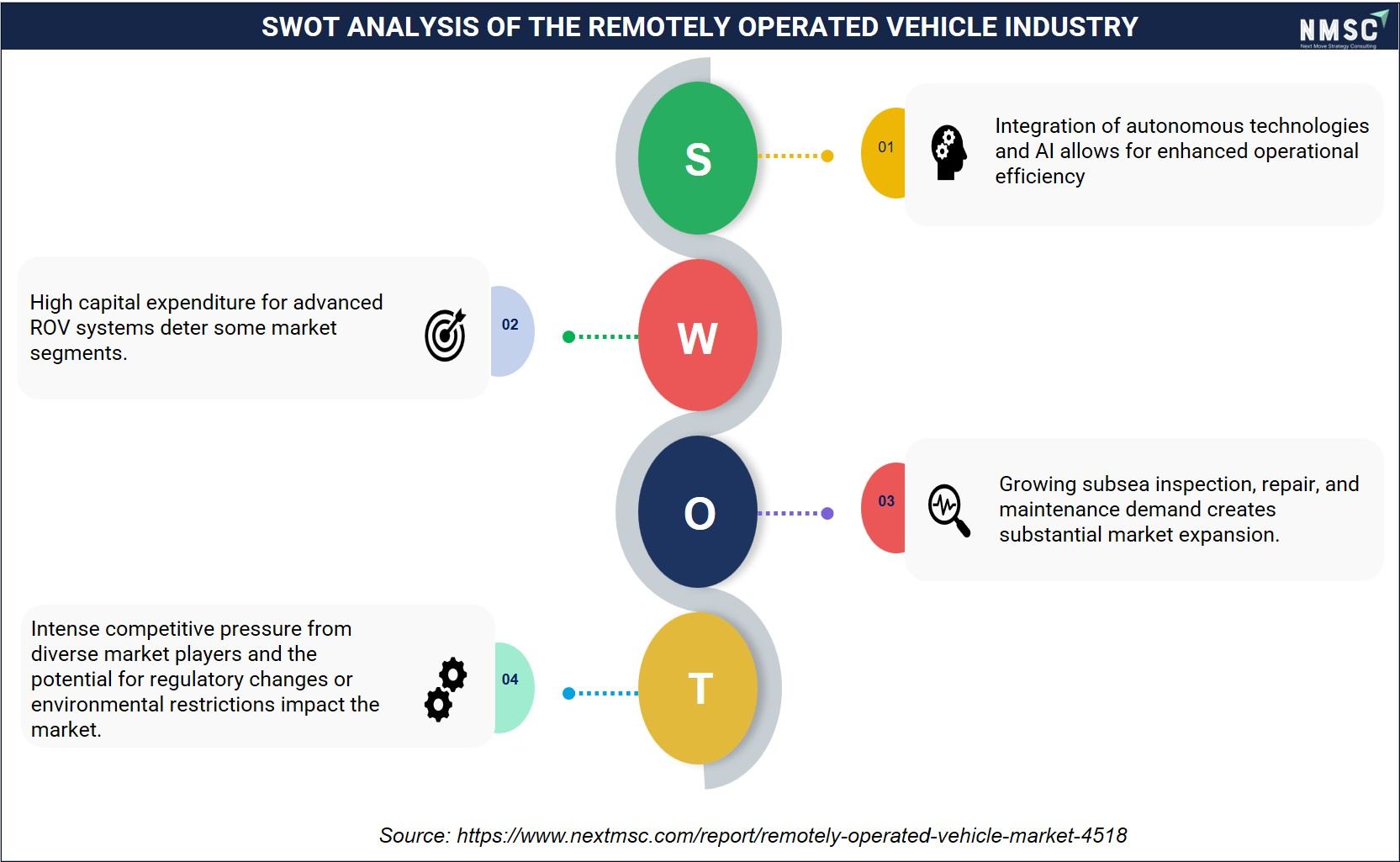
From our strategic analysis, we observed that the above infographic shows the SWOT analysis of the remotely operated vehicle market, illustrating the strategic factors shaping the industry as it moves toward more autonomous, data-centric subsea operations. Specifically, strengths include high-precision remote intervention capabilities that enhance safety in hazardous environments. Conversely, weaknesses involve the high capital expenditure and technical challenges associated with deploying advanced subsea systems. Meanwhile, opportunities are driven by the growth of offshore renewable energy projects and increasing subsea infrastructure needs. Finally, threats arise from intensifying competition from market players and complex regulatory frameworks that challenge the traditional tethered ROV model.
What Are the Key Factors Influencing Investment Analysis & Opportunities in the Remotely Operated Vehicle Market?
Investment activity in the remotely operated vehicle market is increasingly influenced by technological differentiation and subsea infrastructure expansion. Based on our assessment, we found that funding is concentrated on companies demonstrating leadership in autonomy, modular designs, and advanced sensor integration across inspection and work-class applications. Investors prioritise firms capable of delivering both hardware and integrated digital solutions, as these enable recurring revenue through software licensing, analytics, and long-term service contracts. Valuations are higher for entities combining mechanical reliability with software-enabled mission intelligence, reflecting investor confidence in scalable, multi-mission platforms that meet evolving offshore energy, subsea renewables, and defense requirements.
From our market intelligence, we assessed that regional investment hotspots include North America and Europe due to mature offshore projects, regulatory rigour, and developed service ecosystems, while Asia-Pacific is emerging rapidly with offshore wind, localised manufacturing, and interest in autonomous systems. Strategic opportunities are expanding into adjacent subsea domains such as environmental monitoring, aquaculture inspection, and defense robotics. Companies that integrate autonomy, AI-assisted analytics, and predictive maintenance into their ROV offerings are attracting premium capital and partnerships, reflecting strong investor focus on adaptability, multi-mission capabilities, and ecosystem integration.
Key Benefits for Stakeholders:
Next Move Strategy Consulting (NMSC) provides a comprehensive and evidence-based research of the remotely operated vehicle market trends, covering historical developments from 2020 to 2025 and offering forward-looking forecasts through 2035. Our study assesses the market at global, regional, and country levels, combining quantitative outlooks with qualitative insights into key growth drivers, adoption constraints, technology evolution, and investment dynamics across major Remotely Operated Vehicle segments.
The remotely operated vehicle market generates distinct strategic, economic, and operational benefits for different groups. Investors gain access to high-value, technology-driven subsea ventures with scalable recurring revenue through software, services, and long-term maintenance contracts, while premium valuations accrue to companies offering multi-mission platforms and autonomous capabilities. Operators and customers, including offshore energy firms, defense agencies, and research institutions, benefit from enhanced operational efficiency, risk mitigation, and cost savings by reducing manual underwater interventions and accelerating inspection, maintenance, and installation cycles. Additionally, regulatory and policy frameworks in key markets provide incentives for compliance-driven technology adoption, such as environmentally safe operations, data-driven asset monitoring, and integration with national digital infrastructure programs, enabling both value creation and long-term strategic advantage across the ROV ecosystem.
|
Parameters |
Details |
|
Customization Scope |
Free customisation (equivalent to up to 80 analyst-working hours) after purchase. Addition or alteration to country, regional & segment scope. |
|
Pricing and Purchase Options |
Avail customised purchase options to meet your exact research needs. |
|
Approach |
In-depth primary and secondary research; proprietary databases; rigorous quality control and validation measures. |
|
Analytical Tools |
Porter's Five Forces, SWOT, value chain, and Harvey ball analysis to assess competitive intensity, stakeholder roles, and relative impact of key factors. |
Remotely Operated Vehicle Market Key Segments
By Offering
-
Hardware
-
Vehicle Systems
-
Work Class ROVs
-
Observation Class ROVs
-
Micro ROVs
-
Mini ROVs
-
Other Vehicle Systems
-
-
Subsystems and Components
-
Control and Communications
-
Imaging and Sensors
-
Power and Propulsion
-
Tooling and Manipulators
-
LARS and Tethers
-
Other Subsystems
-
-
-
Services
-
Contract Operations
-
Rental and Leasing
-
Maintenance and Repair
-
Training and Support
-
Data Services
-
Other Services
-
-
Software
-
Mission Control
-
Autonomy and Navigation
-
Analytics and Digital Twin
-
Fleet Management
-
Other Software
-
By Vehicle Class
-
Work Class
-
Observation Class
-
Micro
-
Mini
-
Other
By Depth Rating
-
Shallow Water (0-300m)
-
Mid Depth (301-3,000m)
-
Deepwater (3,001-6,000m)
-
Ultra Deepwater (>6,000m)
By Propulsion System
-
Electric
-
Hydraulic
-
Hybrid
By Sales Channel
-
Direct OEM
-
Distributor and Dealer
-
Project Contractor
-
Online
-
Other Channel
By Application
-
Inspection and Survey
-
Maintenance and Repair
-
Construction and Installation
-
Research and Monitoring
-
Search and Recovery
-
Security and Defense
-
Other Application
By End User Industry
-
Oil and Gas
-
Offshore Renewables
-
Defense and Security
-
Research and Academia
-
Aquaculture
-
Infrastructure and Utilities
-
Other Industries
Geographical Breakdown
-
North America: U.S., Canada, and Mexico.
-
Europe: UK, Germany, France, Italy, Spain, Sweden, Denmark, Finland, the Netherlands, and the Rest of Europe.
-
Asia Pacific: China, India, Japan, South Korea, Taiwan, Indonesia, Vietnam, Australia, Philippines, Malaysia and the rest of APAC.
-
Middle East & Africa (MEA): Saudi Arabia, UAE, Egypt, Israel, Turkey, Nigeria, South Africa, and the rest of MEA.
-
Latin America: Brazil, Argentina, Chile, Colombia, and the rest of LATAM.
Conclusion & Recommendations
Based on our comprehensive market analysis, we observe that the remotely operated vehicle market is entering a phase of accelerated innovation, driven by advances in autonomy, modular design, and integrated sensing technologies. Leading players are leveraging work-class, inspection, and micro ROV platforms to address diverse applications across offshore energy, defense, scientific research, and infrastructure inspection. We found that technological differentiation, ecosystem partnerships, and the ability to deliver multi-mission, scalable solutions are becoming critical determinants of market leadership. Looking ahead, the market is poised for continued growth as operators and governments adopt AI-assisted inspection, digital twin integration, and environmentally sustainable subsea operations, creating new revenue streams and long-term strategic value.
In our evaluation, executives should prioritise investments in ROV platforms that offer adaptability, modularity, and integrated digital services to enhance operational efficiency and strengthen customer retention. Simultaneously, investors can capitalise on high-value opportunities in software-enabled ROV solutions, service contracts, and emerging subsea applications, where recurring revenue models contribute to higher valuations. Furthermore, policymakers should consider frameworks that promote technology adoption, safety compliance, and sustainable underwater operations, enabling both private-sector innovation and effective public-sector oversight. By aligning strategy with these insights, stakeholders can drive value creation, accelerate market deployment, and reinforce leadership in this rapidly evolving subsea technology ecosystem.


About the Author
 Mayurima Roy
— Mayurima Roy is Research Analyst at Next Move Strategy Consulting, where she has spent 4 years working across the firm's full industry coverage rather than a single fixed vertical. Her work centers on structured research, ongoing trend tracking, competitive assessment, and insight-led content development, translating complex market data into clear, decision-ready narratives that support informed client decision-making across diverse global industries, market sectors, and world regions every day.
Mayurima Roy
— Mayurima Roy is Research Analyst at Next Move Strategy Consulting, where she has spent 4 years working across the firm's full industry coverage rather than a single fixed vertical. Her work centers on structured research, ongoing trend tracking, competitive assessment, and insight-led content development, translating complex market data into clear, decision-ready narratives that support informed client decision-making across diverse global industries, market sectors, and world regions every day.
About the Reviewer
 Supradip Baul
— Supradip Baul is an accomplished business consultant and strategist with over a decade of rich experience in market intelligence, strategy, technology, and business transformation. His work has included rigorous qualitative and quantitative analysis across multiple industries, helping clients shape investment decisions and long-term roadmaps. Earlier in his career, he was associated with Gartner, where he contributed to industry-leading reports and market share analyses. He has worked with leading global companies and holds an MBA with a dual specialization in Marketing and Finance.
Supradip Baul
— Supradip Baul is an accomplished business consultant and strategist with over a decade of rich experience in market intelligence, strategy, technology, and business transformation. His work has included rigorous qualitative and quantitative analysis across multiple industries, helping clients shape investment decisions and long-term roadmaps. Earlier in his career, he was associated with Gartner, where he contributed to industry-leading reports and market share analyses. He has worked with leading global companies and holds an MBA with a dual specialization in Marketing and Finance.
At Next Move Strategy Consulting, we understand that insightful market research is the cornerstone of successful business decisions. That's why we employ a robust and multifaceted approach, combining various methodologies to deliver the most accurate and actionable data for our clients.

Research Landscape
We navigate the world of research with two primary approaches:
Qualitative Approach
Our qualitative research methodologies involve immersive techniques such as in-depth interviews, focus groups, and observational studies. By engaging directly with individuals and stakeholders, we uncover valuable insights that quantitative data alone may overlook.

Quantitative Research
In tandem with qualitative methodologies, NMSC leverages the power of Quantitative Research to provide a robust foundation of numerical insights. Through systematic data collection and analysis, we quantify patterns, preferences, and market trends, offering a comprehensive view of the business landscape.
Our quantitative research approach employs diverse tools, including surveys, experiments, and statistical modelling. These methodologies enable us to gather data from a large and representative sample, ensuring the statistical significance of our findings. By employing structured questionnaires and standardized data collection methods, we guarantee the reliability and validity of the information we present to our clients.
Quantitative research is particularly effective in measuring the prevalence of trends, assessing market size, and gauging the impact of various factors on consumer behavior. The numerical precision attained through this approach equips our clients with actionable insights, facilitating data-driven decision-making and strategy formulation.


Our Specialized Toolbox for Industry-Specific Market Research
We deploy a specialized arsenal of techniques tailored to meet your unique requirements. Here's a glimpse into our comprehensive toolbox:

Information Procurement
The stage entails acquiring market data or relevant information through various sources and methodologies.


Market Research Approach
We utilize both top-down and bottom-up approaches in market research analysis to achieve a comprehensive understanding of the market dynamics, leveraging the broad perspective of industry trends and macroeconomic factors alongside detailed insights from specific segments and individual companies.

Porters Five Forces Analysis
We conduct Porter's Five Forces analysis to evaluate the competitive landscape of an industry, providing us with insights into factors that affect profitability and strategic positioning.

SWOT Analysis

Forecasting
We utilize a forecasting model to predict future consumption by considering parameters like population, economics, regulations, market competition, drivers, constraints, technology, and pricing. We also employ statistical techniques such as multilinear regression, exponential smoothing, moving average, ARIMA, and Monte Carlo simulations for accurate predictions. In econometric forecasting, we analyzed short-term and long-term event impacts, attributing values based on regulatory frameworks, economic factors, and market events.





 Speak to Our Analyst