Hydrogen Water Bottle Market

Hydrogen water bottle market size is estimated at USD 10.67 billion in 2026, projected to reach USD 17.58 billion by 2035, growing at a CAGR of 5.70% from 2026 to 2035. Key drivers include rising consumer wellness spending, electrolysis technology miniaturization, and expanding e-commerce distribution, with Asia-Pacific leading the market and Middle East & Africa registering the fastest growth.

Download Free Sample PDF
Base Year (2025)
$9.90 Billion
Forecast (2035)
$17.58 Billion
CAGR (2026-2035)
5.7%
Top Country
Asia-Pacific

What Is the Hydrogen Water Bottle Market Size?
The global hydrogen water bottle market size was valued at USD 9.90 billion in 2025 and is estimated at USD 10.67 billion in 2026, forecast to reach USD 17.58 billion by 2035, expanding at a 5.70% CAGR between 2026 and 2035. Asia-Pacific leads with approximately 46% share, while electrolysis-based generation dominates all other technology types with approximately 60% share.

We observed that growth is broad-based across every segmentation axis, with electrolysis miniaturization and app-connected smart hydration devices driving the most pronounced structural shifts through 2035.

Hydrogen Water Bottle Market Revenue Forecast

Values in USD Billion

2025 $9.90 Billion
2025
2026 $10.67 Billion
2026
2027 $11.28 Billion
2027
2028 $11.92 Billion
2028
2029 $12.60 Billion
2029
2030 $13.32 Billion
2030
2031 $14.08 Billion
2031
2032 $14.88 Billion
2032
2033 $15.73 Billion
2033
2034 $16.63 Billion
2034
2035 $17.58 Billion
2035

Key Takeaways

By Hydrogen Generation Technology: Electrolysis held the largest share of approximately 60% (USD 5.94 Billion) in 2025; Other Generation Technology is the fastest-growing sub-segment at 8.6% CAGR from 2026–2035.

By Hydrogen Delivery Mode: On-Demand Generation held the largest share of approximately 68% (USD 6.73 Billion) in 2025; Stored Hydrogen is the fastest-growing sub-segment at 7.1% CAGR from 2026–2035.

By Hydrogen Concentration Output: Medium Output (0.50 to 1.00 Parts/Million) held the largest share of approximately 47% (USD 4.65 Billion) in 2025; High Output (>1.00 Parts/Million) is the fastest-growing sub-segment at 8.2% CAGR from 2026–2035.

By Bottle Capacity: 500 to 999 Milliliters held the largest share of approximately 41% (USD 4.06 Billion) in 2025; 1000 Milliliters and Above is the fastest-growing sub-segment at 9.0% CAGR from 2026–2035.

By Primary Vessel Material: Single Material held the largest share of approximately 71% (USD 7.03 Billion) in 2025; Multi-Material is the fastest-growing sub-segment at 8.4% CAGR from 2026–2035.

By Power Architecture: Rechargeable Battery held the largest share of approximately 74% (USD 7.33 Billion) in 2025; No Electrical Power is the fastest-growing sub-segment at 7.9% CAGR from 2026–2035.

By Smart Connectivity: Basic held the largest share of approximately 52% (USD 5.15 Billion) in 2025; App-Connected is the fastest-growing sub-segment at 10.1% CAGR from 2026–2035.

By First Sale Channel: Direct E-Commerce held the largest share of approximately 29% (USD 2.87 Billion) in 2025; Distributor and Wholesale is the fastest-growing sub-segment at 7.4% CAGR from 2026–2035.

By First Buyer: Consumer held the largest share of approximately 76% (USD 7.52 Billion) in 2025; Institution is the fastest-growing sub-segment at 9.3% CAGR from 2026–2035.

By Primary Use Case: General Hydration held the largest share of approximately 39% (USD 3.86 Billion) in 2025; Healthcare and Wellness is the fastest-growing sub-segment at 8.8% CAGR from 2026–2035.

Dominant Region: Asia-Pacific dominated with approximately 46% revenue share (USD 4.55 Billion) in 2025.

Fastest-Growing Region: Middle East & Africa is expected to register the highest CAGR of 6.9% during 2026–2035.

Dominant Country: China led with approximately USD 2.15 Billion in 2025.

Fastest-Growing Country: India is the fastest-growing country at approximately 10.4% CAGR from 2026–2035.

What Does the Hydrogen Water Bottle Market Encompass?
The hydrogen water bottle market encompasses portable devices that infuse drinking water with dissolved molecular hydrogen through electrolysis or chemical reaction cells housed inside a rechargeable, refillable vessel. Our assessment indicates that the scope spans generation technology, delivery mode, concentration output, bottle capacity, vessel material, power architecture, and connectivity tiers sold to consumers, retailers, distributors, and institutions across wellness-conscious economies worldwide. The category has evolved from a niche Asian wellness accessory into a broader global consumer electronics and hydration category, driven by rising disposable income, direct-to-consumer e-commerce reach, and growing scientific interest in molecular hydrogen as an antioxidant supplement.

We observed that regulatory attention from national consumer product safety and electrical appliance authorities increasingly shapes battery safety, water-contact material compliance, and labeling claims, while direct e-commerce and online marketplace channels increasingly inform brand positioning. NMSC's analysis indicates that technology adoption is shifting toward PEM electrolysis cells and app-connected controls that improve hydrogen concentration precision, a structural shift redefining sourcing criteria across the hydrogen water bottle market.

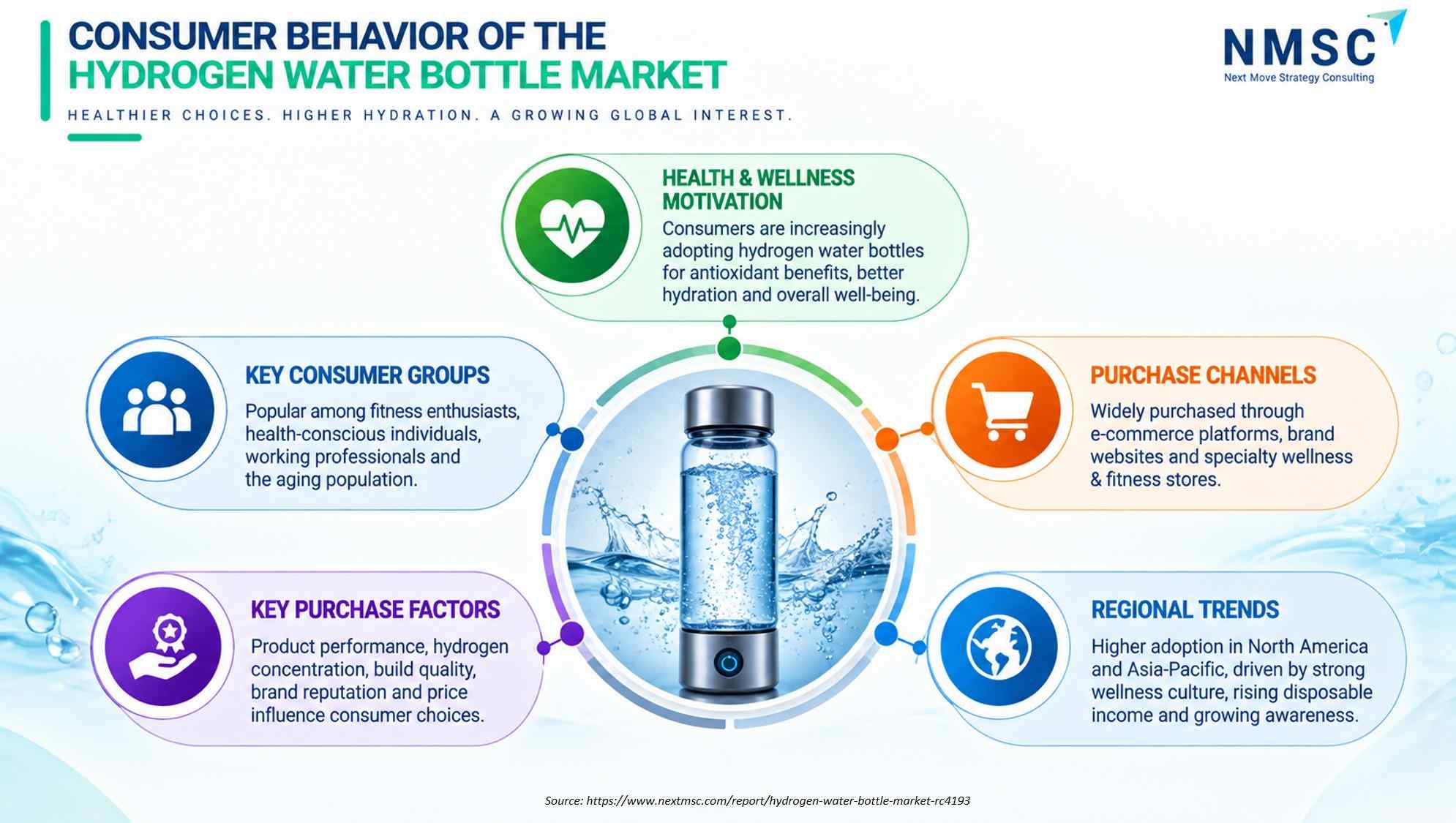
Consumer Behaviour of the Hydrogen Water Bottle Market
Consumer Behaviour of the Hydrogen Water Bottle Market
This infographic presents the Consumer Behavior of the Hydrogen Water Bottle Market, highlighting health and wellness motivations, key consumer groups, purchase channels, key buying factors, and regional trends. It emphasizes growing interest among fitness enthusiasts, health-conscious consumers, working professionals, and aging populations, while identifying e- commerce, brand websites, and specialty wellness stores as important channels. Product performance, hydrogen concentration, quality, brand reputation, and price are shown as key factors influencing consumer purchasing decisions.

Market Drivers & Dynamics

Interactive Dataset
Rising consumer wellness and antioxidant supplement spending driver +1.4% Global 2026–2035
Expanding direct e-commerce and online marketplace reach driver +1.1% Global 2026–2035
Growing scientific research on molecular hydrogen benefits driver +0.9% Asia-Pacific, North America 2026–2032
Rising app-connected wearable and hydration tracking adoption driver +0.8% Global 2026–2032
Expanding hospitality and workplace wellness procurement driver +0.6% North America, Europe 2026–2035
Growing institutional and healthcare wellness channel adoption driver +0.5% Global 2026–2032
High device cost relative to conventional water bottles restraint −0.8% Global 2026–2032
Limited third-party clinical validation of health claims restraint −0.6% North America, Europe 2026–2035
Battery and electrical safety compliance burden for exporters restraint −0.4% Global 2026–2032
Source: Next Move Strategy Consulting

Growth Drivers

What Is the Primary Growth Driver of the Hydrogen Water Bottle Market?

Rising consumer wellness and antioxidant supplement spending is the primary driver of the market. The U.S. Food and Drug Administration continues to monitor dietary supplement and water-contact device claims under its general food and cosmetic safety authority, while national consumer affairs bodies across Asia-Pacific track rising household spending on personal wellness devices. We observed that this consumption trajectory, reinforced by expanding e-commerce reach, continues to anchor demand for hydrogen water bottles across developed and emerging markets alike.

How Is E-Commerce Expansion Driving Hydrogen Water Bottle Market Growth?
Direct e-commerce and online marketplace expansion is accelerating growth by lowering customer acquisition cost for device makers. National postal and trade statistics agencies across major economies report sustained growth in cross-border small-parcel e-commerce shipments, a channel structure well suited to compact hydration devices. Our assessment indicates that this distribution pathway is compressing go-to-market timelines for hydrogen water bottle brands serving both domestic and international direct-to-consumer channels.

Growth Inhibitors

What Is Restraining Hydrogen Water Bottle Market Expansion?
High device cost relative to conventional water bottles restrains market expansion, particularly in price-sensitive mass retail segments. National consumer protection authorities in several jurisdictions have issued public guidance urging buyers to evaluate health claims critically given limited independent clinical validation. We found that manufacturers lacking transparent concentration testing face particular exposure, as unsubstantiated marketing claims invite regulatory scrutiny compared with brands publishing verified output data.

What Are the Growth Opportunities?

How Can Institutional Wellness Procurement Unlock Value for Healthcare Buyers?

Institutional wellness procurement presents a whitespace opportunity for suppliers serving healthcare and corporate wellness buyers. Manufacturers that commercialize bulk-configurable, app-connected bottle fleets stand to capture recurring replacement and service contracts as hospitals and employers seek to integrate hydration devices into structured wellness programs.

Where Does Multi-Material Premium Demand Create New Demand in Hospitality?

Multi-material premium bottle design represents an underpenetrated opportunity for suppliers targeting hospitality operators seeking branded, guest-facing amenities. Providers that package metal-and-glass construction with private-label OEM services can secure long-term hotel and resort contracts, benefiting from recurring replacement revenue tied to guest turnover.

How Can Replaceable Cartridge Subscriptions Benefit Distributor Networks?

Replaceable chemical cartridge subscription models create an opportunity for suppliers serving distributor and wholesale networks seeking recurring consumable revenue. Early movers that bundle cartridge replenishment with device sales can differentiate ahead of broader consumer wellness subscription investment through 2035.

Segmentation Analysis

2025 (USD Billion)
2035 (USD Billion)
Electrolysis
PEM
SPE
PEM and SPE
Other Electr
Segment Item 2025 (USD Billion) 2035 (USD Billion) CAGR
Electrolysis $10.0 USD Billion $40.0 USD Billion 14.0%
PEM $17.1 USD Billion $51.1 USD Billion 8.0%
SPE $24.2 USD Billion $62.2 USD Billion 14.0%
PEM and SPE Hybrid $31.3 USD Billion $73.3 USD Billion 20.0%
Other Electrolysis $38.4 USD Billion $84.4 USD Billion 27.0%

Segment-wise data is locked

Unlock complete segment-wise numbers for By Hydrogen Generation Technology.

Unlock Full Data

Which Hydrogen Generation Technology Dominates the Hydrogen Water Bottle Market?

Electrolysis, spanning PEM, SPE, and hybrid cell architectures, led the market with USD 5.94 billion in 2025, supported by brand preference for precise, consumable-free hydrogen output. We observed that Other Generation Technology is the fastest-growing category, expanding at an 8.6% CAGR from 2026 to 2035, as emerging catalytic and nanobubble methods attract early-stage device makers seeking differentiation.

2025 (USD Billion)
2035 (USD Billion)
On-Demand Ge
Stored Hydro
Pressurized
Externally G
Other Delive
Segment Item 2025 (USD Billion) 2035 (USD Billion) CAGR
On-Demand Generation $10.0 USD Billion $40.0 USD Billion 14.0%
Stored Hydrogen $17.1 USD Billion $51.1 USD Billion 24.0%
Pressurized Hydrogen Water $24.2 USD Billion $62.2 USD Billion 22.0%
Externally Generated Hydrogen Storage $31.3 USD Billion $73.3 USD Billion 12.0%
Other Delivery Mode $38.4 USD Billion $84.4 USD Billion 27.0%

Segment-wise data is locked

Unlock complete segment-wise numbers for By Hydrogen Delivery Mode.

Unlock Full Data
2025 (USD Billion)
2035 (USD Billion)
Low Output (
Medium Outpu
High Output
Segment Item 2025 (USD Billion) 2035 (USD Billion) CAGR
Low Output (<0.50 Parts/Million) $10.0 USD Billion $40.0 USD Billion 24.0%
Medium Output (0.50 to 1.00 Parts/Million) $17.1 USD Billion $51.1 USD Billion 22.0%
High Output (>1.00 Parts/Million) $24.2 USD Billion $62.2 USD Billion 20.0%

Segment-wise data is locked

Unlock complete segment-wise numbers for By Hydrogen Concentration Output.

Unlock Full Data
2025 (USD Billion)
2035 (USD Billion)
Below 300 Mi
300 to 499 M
500 to 999 M
1000 Millili
Segment Item 2025 (USD Billion) 2035 (USD Billion) CAGR
Below 300 Milliliters $10.0 USD Billion $40.0 USD Billion 25.0%
300 to 499 Milliliters $17.1 USD Billion $51.1 USD Billion 11.0%
500 to 999 Milliliters $24.2 USD Billion $62.2 USD Billion 25.0%
1000 Milliliters and Above $31.3 USD Billion $73.3 USD Billion 11.0%

Segment-wise data is locked

Unlock complete segment-wise numbers for By Bottle Capacity.

Unlock Full Data

Which Bottle Capacity Segment Leads Hydrogen Water Bottle Market Demand?
500 to 999 Milliliters units remained the dominant capacity segment across the market, reaching USD 4.06 billion in 2025 due to their fit for daily commuting and workplace hydration routines. Our findings suggest that 1000 Milliliters and Above is the fastest-growing capacity segment, registering a 9.0% CAGR from 2026 to 2035, as fitness and outdoor use cases scale among active consumer demographics.

2025 (USD Billion)
2035 (USD Billion)
Single Mater
Stainless St
Glass
Plastic
Titanium
Segment Item 2025 (USD Billion) 2035 (USD Billion) CAGR
Single Material $10.0 USD Billion $40.0 USD Billion 23.0%
Stainless Steel $17.1 USD Billion $51.1 USD Billion 9.0%
Glass $24.2 USD Billion $62.2 USD Billion 19.0%
Plastic $31.3 USD Billion $73.3 USD Billion 13.0%
Titanium $38.4 USD Billion $84.4 USD Billion 10.0%

Segment-wise data is locked

Unlock complete segment-wise numbers for By Primary Vessel Material.

Unlock Full Data
2025 (USD Billion)
2035 (USD Billion)
Rechargeable
External Wir
No Electrica
Other Power
Segment Item 2025 (USD Billion) 2035 (USD Billion) CAGR
Rechargeable Battery $10.0 USD Billion $40.0 USD Billion 21.0%
External Wired Power $17.1 USD Billion $51.1 USD Billion 23.0%
No Electrical Power $24.2 USD Billion $62.2 USD Billion 25.0%
Other Power Architecture $31.3 USD Billion $73.3 USD Billion 15.0%

Segment-wise data is locked

Unlock complete segment-wise numbers for By Power Architecture.

Unlock Full Data
2025 (USD Billion)
2035 (USD Billion)
Basic
Display
App-Connecte
Segment Item 2025 (USD Billion) 2035 (USD Billion) CAGR
Basic $10.0 USD Billion $40.0 USD Billion 9.0%
Display $17.1 USD Billion $51.1 USD Billion 23.0%
App-Connected $24.2 USD Billion $62.2 USD Billion 9.0%

Segment-wise data is locked

Unlock complete segment-wise numbers for By Smart Connectivity.

Unlock Full Data
2025 (USD Billion)
2035 (USD Billion)
Direct E-Com
Online Marke
Specialty Re
Mass Retail
Pharmacy Ret
Segment Item 2025 (USD Billion) 2035 (USD Billion) CAGR
Direct E-Commerce $10.0 USD Billion $40.0 USD Billion 27.0%
Online Marketplace $17.1 USD Billion $51.1 USD Billion 9.0%
Specialty Retail $24.2 USD Billion $62.2 USD Billion 19.0%
Mass Retail $31.3 USD Billion $73.3 USD Billion 17.0%
Pharmacy Retail $38.4 USD Billion $84.4 USD Billion 18.0%

Segment-wise data is locked

Unlock complete segment-wise numbers for By First Sale Channel.

Unlock Full Data

Which First Sale Channel Drives the Hydrogen Water Bottle Market?

Direct E-Commerce remained the leading first sale channel within the market, valued at USD 2.87 billion in 2025 on sustained brand-owned online storefront adoption. Based on research conducted by NMSC, we found that Distributor and Wholesale is the fastest-growing channel among the largest segments, registering a 7.4% CAGR from 2026 to 2035, as brand owners expand institutional and cross-border wholesale partnerships alongside direct retail.

2025 (USD Billion)
2035 (USD Billion)
Consumer
Retailer
Distributor
Brand Owner
Institution
Segment Item 2025 (USD Billion) 2035 (USD Billion) CAGR
Consumer $10.0 USD Billion $40.0 USD Billion 23.0%
Retailer $17.1 USD Billion $51.1 USD Billion 21.0%
Distributor $24.2 USD Billion $62.2 USD Billion 15.0%
Brand Owner $31.3 USD Billion $73.3 USD Billion 9.0%
Institution $38.4 USD Billion $84.4 USD Billion 10.0%

Segment-wise data is locked

Unlock complete segment-wise numbers for By First Buyer.

Unlock Full Data
2025 (USD Billion)
2035 (USD Billion)
General Hydr
Fitness and
Travel and O
Workplace
Hospitality
Segment Item 2025 (USD Billion) 2035 (USD Billion) CAGR
General Hydration $10.0 USD Billion $40.0 USD Billion 24.0%
Fitness and Sports $17.1 USD Billion $51.1 USD Billion 18.0%
Travel and Outdoor $24.2 USD Billion $62.2 USD Billion 8.0%
Workplace $31.3 USD Billion $73.3 USD Billion 26.0%
Hospitality $38.4 USD Billion $84.4 USD Billion 25.0%

Segment-wise data is locked

Unlock complete segment-wise numbers for By Primary Use Case.

Unlock Full Data

Growth Opportunities

Three forward-looking whitespace opportunities stand out for suppliers positioning ahead of 2035 demand across the hydrogen water bottle market.

How Can Institutional Wellness Procurement Unlock Value for Healthcare Buyers?

Institutional wellness procurement presents a whitespace opportunity for suppliers serving healthcare and corporate wellness buyers. Manufacturers that commercialize bulk-configurable, app-connected bottle fleets stand to capture recurring replacement and service contracts as hospitals and employers seek to integrate hydration devices into structured wellness programs.

Where Does Multi-Material Premium Design Create New Demand in Hospitality?

Multi-material premium bottle design represents an underpenetrated opportunity for suppliers targeting hospitality operators seeking branded, guest-facing amenities. Providers that package metal-and-glass construction with private-label OEM services can secure long-term hotel and resort contracts, benefiting from recurring replacement revenue tied to guest turnover.

How Can Replaceable Cartridge Subscriptions Benefit Distributor Networks?

Replaceable chemical cartridge subscription models create an opportunity for suppliers serving distributor and wholesale networks seeking recurring consumable revenue. Early movers that bundle cartridge replenishment with device sales can differentiate ahead of broader consumer wellness subscription investment through 2035.

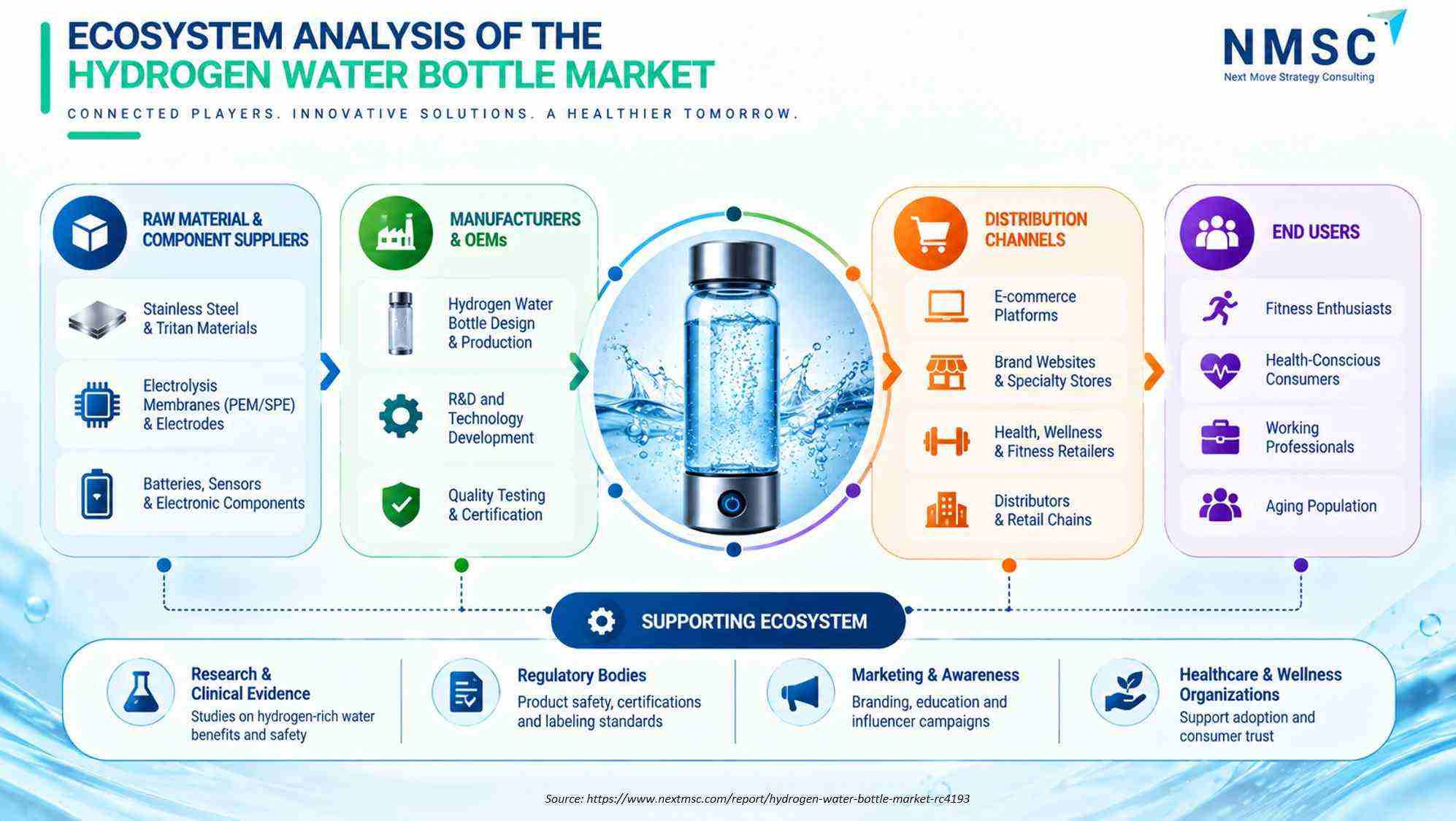
Ecosystem Analysis of the Hydrogen Water Bottle Market
This infographic presents the Ecosystem Analysis of the Hydrogen Water Bottle Market, illustrating the interconnected value chain from raw material and component suppliers to manufacturers, OEMs, distribution channels, and end users. It highlights key inputs such as electrolysis membranes, electrodes, batteries, and electronic components, along with manufacturing, R&D, certification, e-commerce, specialty retail, fitness, wellness, and consumer segments. Supporting stakeholders include research organizations, regulatory bodies, marketing networks, and healthcare and wellness organizations.

Regional Outlook

2025 (USD Billion)
2035 (USD Billion)
North Americ
Europe
Asia-Pacific
Middle East
Latin Americ
Region 2025 (USD Billion) 2035 (USD Billion) CAGR (%)
North America $10.0 USD Billion $40.0 USD Billion 9.0%
Europe $17.1 USD Billion $51.1 USD Billion 27.0%
Asia-Pacific $24.2 USD Billion $62.2 USD Billion 25.0%
Middle East & Africa $31.3 USD Billion $73.3 USD Billion 23.0%
Latin America $38.4 USD Billion $84.4 USD Billion 12.0%

Regional data is locked

Unlock complete regional numbers for this market.

Unlock Full Data

Competitive Landscape

We observed that the hydrogen water bottle market features a moderately fragmented competitive landscape, with established Asian device manufacturers competing alongside emerging North American and European wellness brands on generation technology, connectivity, and channel reach. Dimension | Assessment Market Structure | Moderately fragmented; leading companies profiled in this report account for a meaningful share of Industry revenue, while numerous regional distributors and private-label assemblers serve fragmented national retail demand. Innovation Focus | PEM electrolysis precision, app-connected controls, and single-material stainless steel construction dominate current innovation pipelines across leading suppliers. M&A Activity | Selective consolidation through component supply partnerships and manufacturing capacity expansion among Asia-based device manufacturers. Source: www.nextmsc.com

Key Market Players

Our assessment indicates that the following 20 companies are actively shaping product innovation, generation technology, and channel expansion within the global hydrogen water bottle market.

Olansi Healthcare Co., Ltd. Guangzhou TESRAN Purification Equipment Manufacturing Co., Ltd. Xiamen Phyflow Intelligent Technology Co., Ltd. Shenzhen Gosoit Technology Co., Ltd. Dongguan Liry Technology Co., Ltd. EHM Group Limited H2FACTORY Inc. Echo Technologies LLC KB Company LLC H2 Life International LLC Micro Research Institution Inc. BioTech Industries Shenzhen AlkaVoda Technology Co., Ltd. Adivaa Smart Powering Solutions Pvt. Ltd. Hydrogen Health Pty Ltd Osmio Solutions Ltd PIURIFY LLC PUREPEBRIX LLC Evolv Wellness LLC Nixcer LLC

How Do Companies Compete in the Hydrogen Water Bottle Market?

Companies compete primarily on generation technology precision, connectivity depth, and channel reach across the Industry . Established Chinese manufacturers such as Olansi Healthcare and Guangzhou TESRAN Purification Equipment Manufacturing leverage integrated component supply chains to serve global private-label demand, while North American and European brands such as Echo Technologies and Osmio Solutions compete on direct e-commerce positioning and wellness-focused brand storytelling.

Which Competitive Archetypes Dominate the Hydrogen Water Bottle Market?

Two archetypes dominate the market: established Asia-based device manufacturers with deep electrolysis and injection- molding manufacturing experience, and emerging direct-to-consumer wellness brands offering hydrogen water bottles as part of broader personal wellness product lines. Xiamen Phyflow Intelligent Technology and Shenzhen Gosoit Technology exemplify the manufacturing specialist archetype, while KB Company and H2 Life International exemplify the direct-to-consumer wellness brand archetype.

How Are Companies Differentiating Through Innovation in Hydrogen Water Bottles?

Innovation and differentiation strategy increasingly center on PEM electrolysis efficiency and app-connected hydration tracking. Companies including EHM Group and Adivaa Smart Powering Solutions demonstrate how manufacturers differentiate through verified concentration output and compact smart-enabled design. Our analysis shows that suppliers unable to demonstrate credible concentration testing risk exclusion from specialty retail and institutional procurement shortlists.

What M&A and Expansion Activity Is Shaping the Hydrogen Water Bottle Market?

Strategic partnerships, component supply agreements, and geographic distribution expansion continue to shape capabilities within the Industry . Manufacturers including Dongguan Liry Technology and Micro Research Institution have expanded contract manufacturing capacity to serve rising private-label demand from North American and European brand owners, illustrating how specialized suppliers pursue rapid capacity scaling through OEM partnership models.

Latest Developments

We found that recent product developments within the hydrogen water bottle market are concentrated on app-connected launches and expanded electrolysis capacity, reflecting the industry's broader premiumization trend.

Date Event
January 2026 PUREPEBRIX announced a redesigned glass hydrogen water bottle featuring larger capacity, catalytic membrane technology, and reinforced borosilicate construction. The company stated independently verified hydrogen concentrations can reach 4,500 ppb, positioning the product around durability, portability, and higher-performance hydrogen generation.
August 2025 Echo partnered with The Vitamin Outlet to launch the Echo Flask in Australia. The app-connected bottle uses PEM technology and was promoted with hydrogen generation of up to 8 ppm, a 350 ml format, smart controls, and hydration tracking, expanding Echo’s portable hydrogen-water presence into the Australian market.

Expert Insights

Josh Carr

Josh Carr

CEO | Echo

"“Hydrogen health is growing fast—and that growth has attracted a swarm of pseudo-scientific influencers using fear, not facts, to push products.”"

Analyst Interpretation

The statement highlights consumer trust and scientific credibility as important considerations in the expanding hydrogen water bottle market. As hydrogen-water products gain visibility across wellness and hydration markets, manufacturers may increasingly need to support product claims with transparent specifications, independent testing and credible scientific evidence. This is particularly relevant because many hydrogen-water products are marketed around health and wellness benefits, making evidence quality an important factor in consumer decision-making and long-term category development.

Investment Opportunities

What Capital Inflows Are Targeting the Hydrogen Water Bottle Market?

Capital inflows into the hydrogen water bottle market are increasingly directed toward electrolysis technology refinement and direct-to-consumer brand scaling. We observed that strategic investors continue to fund manufacturing capacity expansion among Asia-based device makers serving global private-label demand. Investors favor manufacturers demonstrating validated concentration output credentials, viewing transparent testing as a proxy for long-term retail shelf access.

How Is Infrastructure Investment Supporting Hydrogen Water Bottle Manufacturing?

Infrastructure investment is expanding manufacturing capacity across China's Guangdong and Fujian provinces to serve rising global residential and institutional demand. Our findings suggest that manufacturers are scaling injection molding and electrolysis cell assembly lines to improve export responsiveness for distributors and OEM partners across North America and Europe.

What ESG Considerations Are Shaping Hydrogen Water Bottle Investment Decisions?

Environmental, social, and governance considerations are increasingly central to investment decisions across the Industry , with rechargeable battery recyclability and food-grade material sourcing as key criteria. We found that investors increasingly favor manufacturers demonstrating measurable reductions in single-use plastic componentry, treating it as a governance indicator alongside manufacturing labor and product safety compliance.

Key Benefits for Stakeholders

How Does This Report Benefit Enterprise and Industry Leaders?

Enterprise and industry leaders gain access to validated segmentation, competitive benchmarking, and regional demand forecasts that support sourcing and vendor-selection decisions across the hydrogen water bottle Industry. Our analysis shows that detailed generation technology, capacity, and channel breakdowns help procurement teams align specifications with consumer safety and connectivity requirements while identifying underserved use case and buyer segments for portfolio expansion.

How Does This Report Benefit Investors and Financial Analysts?

Investors and financial analysts benefit from consistent, single-point market size and CAGR estimates that support valuation and capital-allocation decisions across the hydrogen water bottle supply chain. We observed that the report's regional and segment-level growth differentials help identify which manufacturers are best positioned to capture above-market growth in app-connected and Asia-Pacific categories through 2035.

How Does This Report Benefit Technology Vendors and Product Teams?

Technology vendors and product teams gain insight into emerging design requirements, including PEM electrolysis integration and app-connected controls, that are reshaping the Industry . Our findings suggest that this analysis helps R&D teams prioritize development roadmaps around concentration output verification and smart connectivity features increasingly required by specialty retail and institutional procurement processes.

Key Market Segments Evaluated

By Hydrogen Generation Technology

  • Electrolysis
  • Chemical Reaction
  • Other Generation Technology

By Hydrogen Delivery Mode

  • On-Demand Generation
  • Stored Hydrogen
  • Pressurized Hydrogen Water
  • Externally Generated Hydrogen Storage
  • Other Delivery Mode

By Hydrogen Concentration Output

  • Low Output (<0.50 Parts/Million)
  • Medium Output (0.50 to 1.00 Parts/Million)
  • High Output (>1.00 Parts/Million)

By Bottle Capacity

  • Below 300 Milliliters
  • 300 to 499 Milliliters
  • 500 to 999 Milliliters
  • 1000 Milliliters and Above

By Primary Vessel Material

  • Single Material
  • Stainless Steel
  • Glass
  • Plastic
  • Titanium
  • Other Single Material
  • Multi-Material
  • Metal and Glass
  • Metal and Plastic
  • Plastic and Elastomer
  • Other Multi-Material

By Power Architecture

  • Rechargeable Battery
  • External Wired Power
  • No Electrical Power
  • Other Power Architecture

By Smart Connectivity

  • Basic
  • Display
  • App-Connected

By First Sale Channel

  • Direct E-Commerce
  • Online Marketplace
  • Specialty Retail
  • Mass Retail
  • Distributor and Wholesale
  • Pharmacy Retail
  • Direct Business to Business
  • OEM or Private Label
  • Other Channel

By First Buyer

  • Consumer
  • Retailer
  • Distributor
  • Brand Owner
  • Institution
  • Other Buyer

By Primary Use Case

  • General Hydration
  • Fitness and Sports
  • Travel and Outdoor
  • Workplace
  • Hospitality
  • Healthcare and Wellness
  • Other Commercial

Conclusion & Recommendations

The long-term outlook for the hydrogen water bottle market remains positive, supported by a USD 6.91 billion absolute dollar opportunity between 2026 and 2035 and sustained Asia-Pacific wellness momentum. NMSC's analysis indicates that manufacturers combining PEM electrolysis technology with app-connected controls will be best positioned to capture the market's projected growth from USD 10.67 billion in 2026 to USD 17.58 billion by 2035.

What Strategic Positioning Should Suppliers Pursue in the Hydrogen Water Bottle Market?

Suppliers should prioritize verified concentration output testing to secure long-term access to specialty retail and institutional procurement channels. Our assessment indicates that manufacturers investing early in single-material construction and app-connected features, alongside expanded direct e-commerce capacity, will be best positioned to capture premium pricing within the hydrogen water bottle market as consumer scrutiny of health claims intensifies.

How Attractive Is the Hydrogen Water Bottle Market for New Investment?

The hydrogen water bottle Industry presents an attractive investment case, supported by a USD 6.91 billion absolute dollar opportunity between 2026 and 2035 and above-average growth in Middle East & Africa and institutional buyer categories. We found that investment attractiveness is highest for manufacturers combining validated concentration compliance with scaled direct e-commerce distribution, positioning them to serve both mature North American and emerging Asia-Pacific segments simultaneously.

What Market Shifts and Key Risks Should Stakeholders Monitor?

Stakeholders should monitor consumer health-claim scrutiny, battery safety compliance costs, and competitive pressure from conventional filtered water bottle incumbents as key risks to the hydrogen water bottle market. Our analysis shows that manufacturers unable to substantiate concentration output risk losing market access to competitors with certified, transparently tested product lines, particularly within increasingly scrutinized North American and European markets.

What Are the Key Growth Pathways for the Hydrogen Water Bottle Market?

Key growth pathways include expanding app-connected and multi-material premium portfolios, scaling institutional wellness procurement, and deepening penetration into Middle East & Africa specialty retail channels. NMSC's analysis indicates that manufacturers pursuing these pathways while maintaining cost competitiveness in entry-level chemical reaction devices will be best positioned to capture the hydrogen water bottle market's projected growth through 2035.

FAQs

About the Author

Liza Phukan

Liza Phukan

Liza Phukan is Research Associate at Next Move Strategy Consulting, where she has covered emerging industries and market research across sectors for 3.5 years. Her work includes analyzing industry developments, validating market data, and developing structured business content from research findings. She uses secondary research and data-validation practices to turn complex market information into clear decision-useful market analysis for business audiences and support report development and B2B.

About the Reviewer

Supradip Baul

Supradip Baul

Supradip Baul is an accomplished business consultant and strategist with over a decade of rich experience in market intelligence, strategy, technology, and business transformation. His work has included rigorous qualitative and quantitative analysis across multiple industries, helping clients shape investment decisions and long-term roadmaps. Earlier in his career, he was associated with Gartner, where he contributed to industry-leading reports and market share analyses. He has worked with leading global companies and holds an MBA with a dual specialization in Marketing and Finance.

Download Free Sample

Semih Kavaklioglu

SEMIH KAVAKLIOGLU

Co-Founder &amp; Sales Manager

Decortie

I work a lot in the marketing industry and I know that research is an essential part of any campaign. I have used Market research reports for my own products and I found them to be very informative and well-researched. The team here produces insightful reports for a good price

Mohit Agarwal

MOHIT AGARWAL

Chief Manager

DryChem India Pvt. Ltd.

Next Move Strategy Consulting is an amazing team of consultants. We required a market study report for our investors on top priority and the team went above and beyond our expectations to deliver the same with ample supporting data within a short time span enabling us to secure the investments and keep our project timeline maintained. Their professionalism, attention to detail, and timely delivery of actionable recommendations have left a lasting impression on our organization.

Melanie Samko

MELANIE SAMKO

Director of Marketing

TOSOH BIOSCIENCE, INC.

The information provided by NMSC is incredibly valuable, thank you so much for such a excellent work. I really appreciate it. I will make sure to reference all of it, in my summary document.

Rishabh Jogani

RISHABH JOGANI

Strategy Analyst

Accenture Japan

We are incredibly impressed with the market report on the real estate market in India provided by Next Move Strategy Consulting. The report was thorough, insightful, and well-structured, offering deep analysis and actionable recommendations. It not only captured the current trends and dynamics but also provided a forward-looking perspective that has been invaluable for our strategic planning. Their team demonstrated exceptional professionalism, attention to detail, and a profound understanding of the industry. The data-driven insights and clarity of presentation exceeded our expectations, making complex market trends easy to understand. We highly recommend Next Move Strategy Consulting to anyone looking for reliable and comprehensive market research services. Their expertise has given us the confidence to navigate the complexities of the Indian real estate market with clarity and foresight.

Gaurav Jaiswal

GAURAV JAISWAL

Founder & CEO

Yano Charge Private Limited

The EV Charging market research report provided by the NextMSC was exceptionally detailed and insightful. It offered a comprehensive analysis that proved to be a game-changer for our strategic planning. Truly a testament to the NextMSC’s expertise and thoroughness in EV market landscape & analysis.

Custom Market Research Services

We will customize the research for you if the listed report does not fully match your requirements.

Get 30% Free Customization

Select License

This website uses cookies to ensure you get the best experience on our website. Learn more

✖