Drinking Water Market Size, Share, Growth & Forecast by Product Type (Natural Still: Spring Water, Mineral Water; Natural Sparkling; Engineered Still: Reverse-Osmosis Water, Distilled Water; Engineered Sparkling; Enhanced: Flavored, Functional), Packaging Format (Single-Serve: PET Bottles, Glass Bottles, Cans, Cartons; Bulk: Glass Carafes, PET/Gallon Jugs, Bag-in-Box/Pouches), Distribution Channel — Global Analysis 2025–2035
Industry: Retail and Consumer | Publishing Date: June 26, 2026 | Last Updated: June 26, 2026 | No of Pages: N/A | No. of Tables: N/A | No. of Figures: N/A | Format: PDF | Report Code: RC4825
Drinking Water Market Size & Forecast
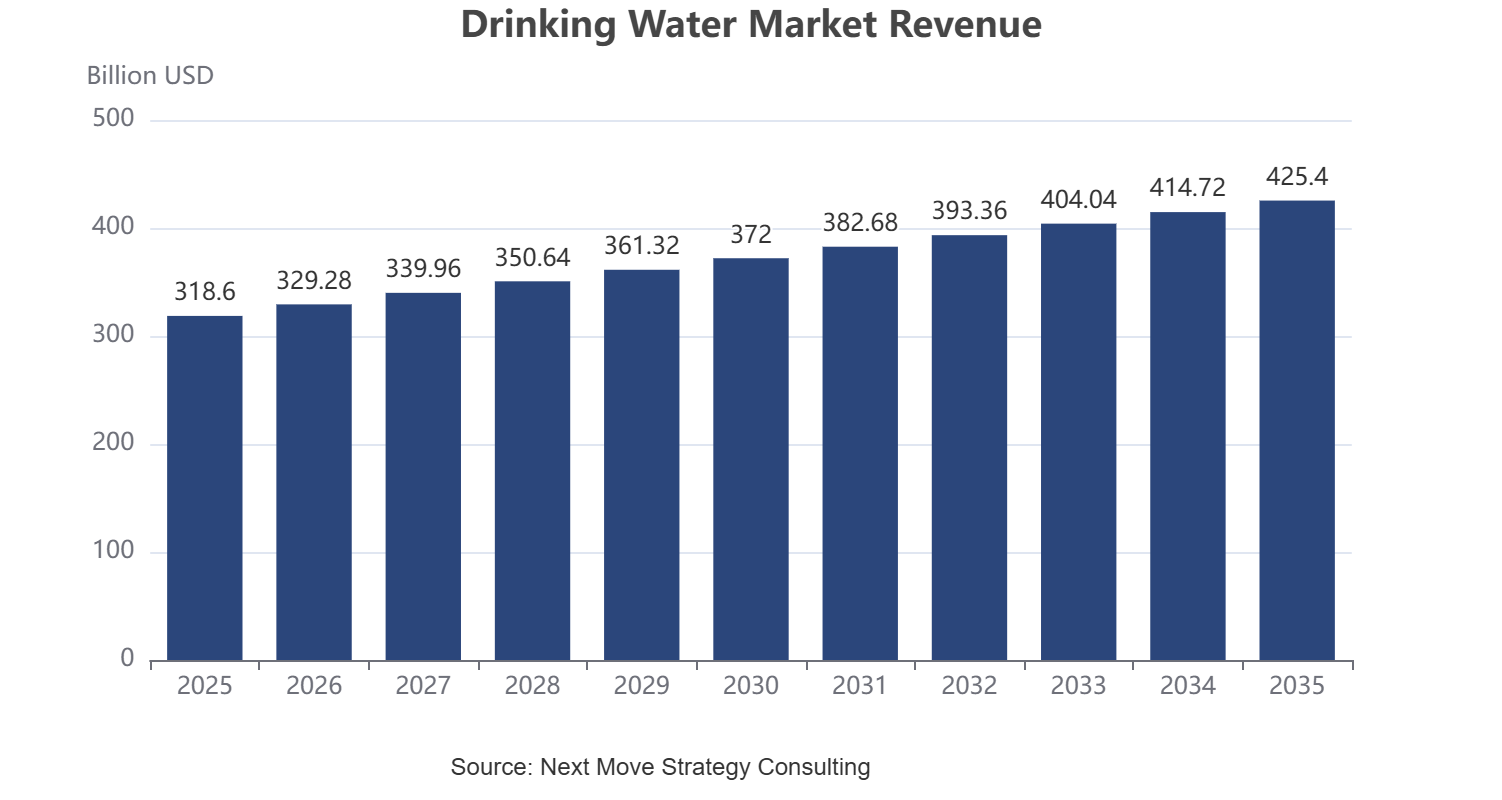
The global Drinking Water Market was valued at USD 318.6 billion in 2025 and is expected to reach USD 328.8 billion in 2026. Sustained population growth, rising health awareness, and the global shift away from sugary beverages are projected to propel the market to USD 425.4 billion by 2035, advancing at a CAGR of 3.2% from 2026 to 2035. Key growth drivers include increasing consumer preference for premium and functional water products, rapid urbanization across emerging economies, the expansion of modern retail and e-commerce distribution channels, and growing concerns about tap water quality.
|
Parameters |
Details |
|
Market Size in 2025 |
USD 318.6 Billion |
|
Market Size in 2026 |
USD 328.8 Billion |
|
Revenue Forecast in 2035 |
USD 425.4 Billion |
|
Growth Rate |
CAGR of 3.2% from 2026 to 2035 |
|
Analysis Period |
2025–2035 |
|
Base Year Considered |
2025 |
|
Forecast Period |
2026–2035 |
|
Market Size Estimation |
USD Billion |
|
Companies Profiled |
20 |
|
Countries Covered |
33 |
|
Market Share |
Top 10 |
Drinking Water Market Overview
What Is the Drinking Water Market?
The Drinking Water Market encompasses the commercial production, packaging, and distribution of water intended for human consumption, including natural still water (spring and mineral), natural sparkling water, engineered still water (reverse-osmosis and distilled), engineered sparkling water, and enhanced water (flavored and functional). Through our market assessment, we observed that the market operates across multiple distribution channels including modern retail, e-commerce, food service, and vending infrastructure, catering to both consumer and commercial end users worldwide.
How Has the Drinking Water Market Evolved?
The Drinking Water Market has evolved through three distinct phases of development. The first phase concentrated on municipal water access and basic bottled water availability in glass and early PET formats. The second phase introduced the premium water category, with brands like FIJI Water and VOSS building aspirational positioning around source authenticity and packaging design. NMSC's analysis indicates that the current phase centers on functional enhancement, sustainability-driven packaging innovation, and digital-first distribution strategies, driven by consumer demand for health-oriented hydration and growing regulatory scrutiny around single-use plastic packaging.
How Do Regulations Influence the Drinking Water Market?
Regulatory frameworks governing the Drinking Water Market vary significantly across geographies but share a common emphasis on product safety, labeling transparency, and packaging compliance. The U.S. Food and Drug Administration (FDA) regulates bottled water as a packaged food product under the Federal Food, Drug, and Cosmetic Act, setting standards for source protection, contaminant limits, and Current Good Manufacturing Practice (cGMP). The European Union's Directive 2009/54/EC governs natural mineral water labeling and compositional requirements. From our research, we found that plastic packaging regulations, including the EU Single-Use Plastics Directive and extended producer responsibility (EPR) frameworks, are compelling manufacturers to accelerate shifts toward recyclable PET, glass, aluminum cans, and Tetra Pak alternatives.
How Is Technology Adoption Expanding Across the Drinking Water Market?
Technology adoption across the Drinking Water Market is accelerating across both production and distribution dimensions. Advanced filtration technologies, including reverse osmosis, UV sterilization, and membrane separation, are enabling producers to consistently deliver premium-quality engineered water at scale. Based on NMSC's research, we found that IoT-enabled vending machines and smart dispensing infrastructure are transforming on-premise hydration access in offices, gyms, and public facilities. E-commerce and direct-to-consumer subscription platforms are also disrupting traditional retail distribution, with major brands investing in proprietary digital storefronts and last-mile delivery optimization.
|
Key Takeaways |
|
Natural Still Water, led by Spring Water and Mineral Water sub-segments, dominated the Drinking Water Market in 2025 with an estimated revenue of USD 148.2 billion, reflecting entrenched consumer preference for source-authenticated hydration globally. |
|
Enhanced Water is the fastest-growing product type in the Drinking Water Market, advancing at a CAGR of 6.8% from 2026 to 2035, with Functional Water (electrolyte-enhanced, vitamin-infused, and alkaline variants) driving premium-tier growth among health-conscious consumers. |
|
Single-Serve packaging led with USD 196.4 billion in 2025, anchored by PET Bottles (0.3–1 L) which remain the most widely distributed format globally across retail, vending, and food service channels. |
|
Cartons (Tetra Pak) represent the fastest-growing single-serve packaging format at a CAGR of 5.4%, driven by sustainability mandates and growing institutional demand from schools, airlines, and healthcare facilities. |
|
Retail (Off-Trade) accounted for the largest share of the Drinking Water Market at USD 218.6 billion in 2025, with Supermarkets & Hypermarkets comprising the highest-volume sub-channel. |
|
E-commerce is the fastest-growing distribution sub-channel at a CAGR of 8.2% from 2026 to 2035, as consumers increasingly purchase water subscriptions and multipacks through online platforms and quick-commerce apps. |
|
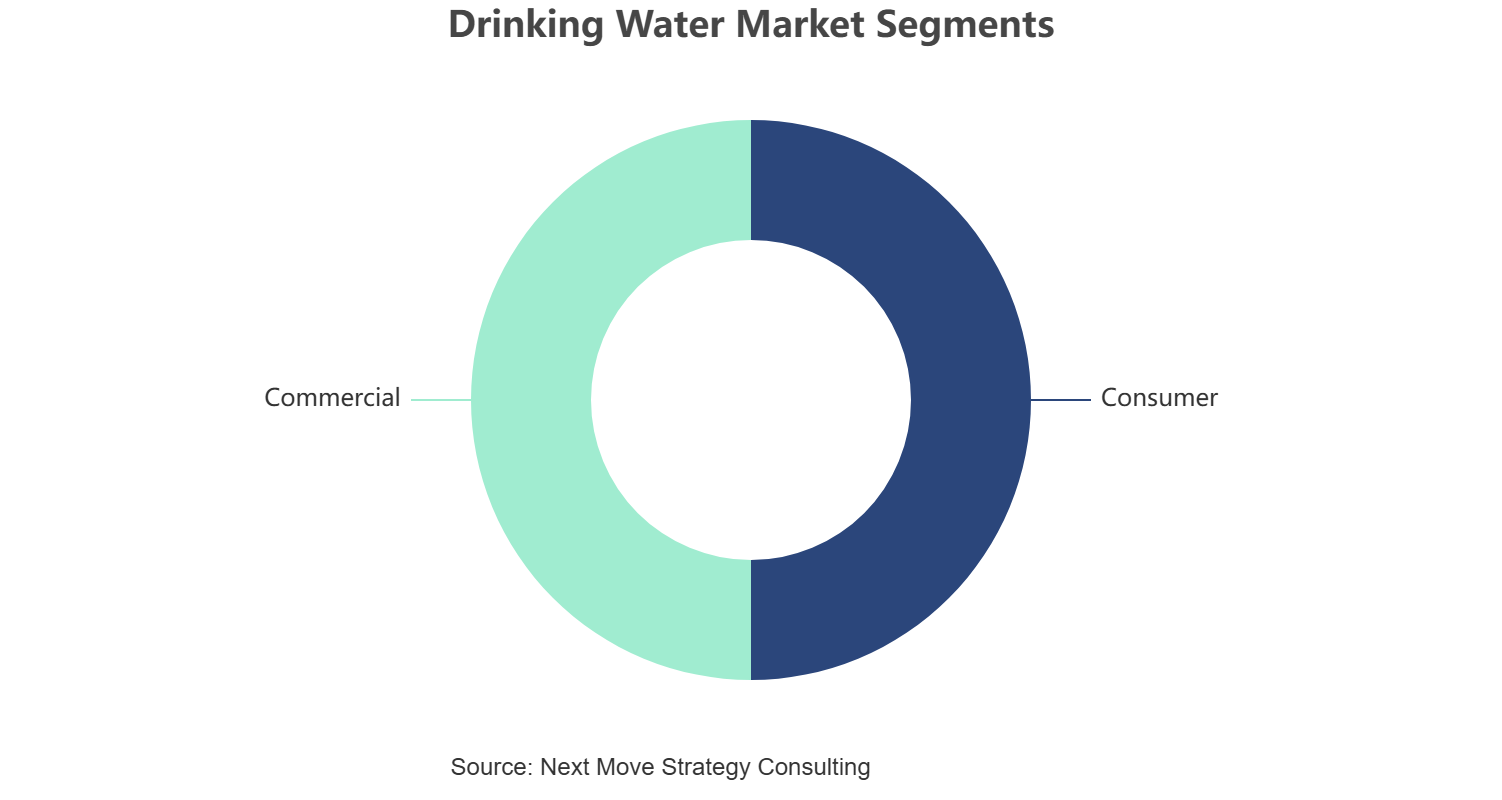
Consumer end users accounted for the dominant share of the Drinking Water Market at approximately 74% of total revenue in 2025, underpinned by at-home hydration demand and impulse purchase behavior at retail outlets. |
|
The Commercial end-user segment is the fastest-growing at a CAGR of 4.1% from 2026 to 2035, driven by HoReCa expansion in emerging markets and growing workplace hydration infrastructure investment. |
|
Asia-Pacific dominated the Drinking Water Market with USD 112.8 billion in 2025, underpinned by China's vast packaged water consumption base, India's expanding middle-class demand, and rapid urbanization across Southeast Asia. |
|
Middle East & Africa (MEA) is the fastest-growing region in the Drinking Water Market at a CAGR of 5.1%, driven by acute tap water quality concerns, rising per capita income, and strong brand investment in Saudi Arabia and the UAE. |
|
China is the single largest national market in the Drinking Water Market, generating an estimated USD 68.4 billion in 2025, supported by dominant domestic players including Nongfu Spring, Wahaha, and Master Kong. |
|
India is the fastest-growing major national market in the Drinking Water Market at a CAGR of 6.8% from 2026 to 2035, propelled by water safety concerns, rising disposable incomes, and rapid expansion of modern retail infrastructure. |
Key Emerging Trends in the Drinking Water Market
How Is the Functional Water Movement Reshaping Consumer Preferences in the Drinking Water Market?
Functional water products, including electrolyte enhanced, alkaline, hydrogen infused, and vitamin fortified variants, are reshaping consumer preferences within the Drinking Water Market. Consumers are increasingly seeking beverages that provide benefits beyond basic hydration, such as improved recovery, energy support, immune health, and overall wellness. This shift has encouraged manufacturers to expand their portfolios with value added water products that target specific health and lifestyle needs. Functional water products also allow brands to differentiate themselves in a competitive marketplace while commanding premium pricing. As health consciousness continues to rise globally, demand for enhanced hydration solutions is expected to remain a key driver of category growth.
What Role Is Sustainable Packaging Playing in the Transformation of the Drinking Water Market?
Sustainable packaging has become a major strategic focus across the Drinking Water Market as environmental concerns increasingly influence consumer purchasing decisions and corporate sustainability initiatives. Manufacturers are investing in recyclable materials, recycled content packaging, lightweight bottle designs, and alternative packaging formats to reduce environmental impact. Growing regulatory pressure surrounding plastic waste management is further accelerating the adoption of more sustainable packaging solutions. In addition, consumers are increasingly favoring brands that demonstrate environmental responsibility through packaging innovation and circular economy practices. As sustainability becomes a core purchasing consideration, packaging innovation is expected to play a critical role in shaping future market competitiveness.
How Is E-commerce and Direct-to-Consumer Distribution Disrupting the Drinking Water Market?
E-commerce and direct to consumer distribution channels are transforming traditional sales and delivery models within the Drinking Water Market. Online platforms provide consumers with convenient access to a wide range of bottled water products, subscription services, and bulk purchasing options that may not be readily available through conventional retail channels. Direct to consumer strategies also enable brands to strengthen customer relationships, gather consumer insights, and offer personalized promotions and loyalty programs. In addition, rapid delivery services and digital ordering platforms are making water purchases more convenient for urban consumers. As digital commerce adoption continues to grow globally, these channels are expected to become increasingly important drivers of market expansion.
How Is the Premiumization of Natural Mineral Water Driving Revenue Growth in the Drinking Water Market?
Premiumization remains one of the most influential trends shaping revenue growth in the Drinking Water Market, particularly within natural mineral water and premium bottled water categories. Consumers are increasingly willing to pay higher prices for products perceived as offering superior quality, natural sourcing, unique mineral composition, and enhanced brand prestige. Premium water brands are strengthening their market position through distinctive packaging, source authenticity, sustainability credentials, and lifestyle oriented marketing strategies. Demand from upscale hospitality venues, fine dining establishments, premium retail outlets, and affluent consumers further supports category growth. As consumer preferences continue shifting toward premium beverage experiences, premium water products are expected to contribute disproportionately to market value growth.
What Are the Key Market Drivers, Breakthroughs, and Investment Opportunities that Will Shape the Drinking Water Market Industry in the Next Decade?
Growth Catalyst & Risk Assessment Matrix
|
DRIVERS / TRENDS / RESTRAINTS |
(+/-) % IMPACT ON CAGR FORECAST |
GEOGRAPHIC RELEVANCE |
IMPACT TIMELINE |
|
Rising Health & Wellness Awareness |
+0.7% |
Global (led by North America, Europe) |
2025–2035 |
|
Tap Water Quality Concerns |
+0.5% |
Asia-Pacific, MEA, Latin America |
2025–2035 |
|
Premiumization & Functional Water |
+0.4% |
North America, Europe, Asia-Pacific |
2026–2035 |
|
E-commerce Distribution Expansion |
+0.3% |
Global |
2025–2030 |
|
Sustainable Packaging Mandates |
+0.2% |
Europe, North America |
2025–2030 |
|
Single-Use Plastic Regulation |
-0.4% |
Europe, North America, APAC |
Ongoing |
|
Commoditization & Price Competition |
-0.3% |
Global |
Ongoing |
|
Water Scarcity & Source Risk |
-0.2% |
MEA, Asia-Pacific, Latin America |
2026–2035 |
|
Functional Enhancement Innovation |
+0.5% |
North America, Asia-Pacific |
2026–2035 |
|
Emerging Market Infrastructure Growth |
+0.3% |
India, Africa, Southeast Asia |
2025–2035 |
What Are the Growth Drivers of the Drinking Water Market?
How Are Rising Health Consciousness and the Shift Away from Sugary Beverages Driving Demand in the Drinking Water Market?
Growing health awareness and changing consumer preferences are among the most important drivers of the Drinking Water Market. Consumers are increasingly reducing their intake of sugar-sweetened beverages due to concerns about obesity, diabetes, cardiovascular disease, and overall wellness. As a result, drinking water is increasingly viewed as the preferred hydration option because it contains no calories, sugar, or artificial additives. Public health campaigns, nutrition education initiatives, and increasing awareness of healthy lifestyles have further encouraged this transition. In addition, younger consumers are actively seeking clean-label and naturally healthy beverage options, supporting sustained demand for bottled and packaged drinking water across both developed and emerging markets.
How Do Tap Water Quality Concerns and Urbanization Fuel Drinking Water Market Growth?
Concerns regarding water quality, contamination risks, and aging water infrastructure continue to drive demand in the Drinking Water Market. Many consumers perceive packaged drinking water as a safer and more reliable alternative to municipal water supplies, particularly in regions where water treatment infrastructure is inadequate or inconsistent. Rapid urbanization further strengthens this demand by increasing population density and placing additional pressure on existing water systems. As cities expand, consumers often seek convenient and readily available hydration solutions that fit fast-paced urban lifestyles. These factors collectively contribute to the growing adoption of packaged drinking water across residential, commercial, and on-the-go consumption occasions.
How Is Urbanization and Income Growth in Emerging Economies Expanding the Drinking Water Market Demand?
Urbanization and rising disposable incomes across emerging economies are significantly expanding the Drinking Water Market. As populations migrate toward urban centers, access to organized retail channels, convenience stores, supermarkets, and e-commerce platforms increases, making packaged drinking water more widely available. Simultaneously, growing middle-class populations are demonstrating greater willingness to spend on premium, hygienic, and branded beverage products. Improvements in living standards, changing consumption habits, and increasing awareness of health and hygiene are further supporting market growth. As economic development continues across Asia-Pacific, Latin America, the Middle East, and Africa, demand for packaged drinking water is expected to increase steadily.
What Are the Growth Inhibitors of the Drinking Water Market?
How Do Single-Use Plastic Regulations and Environmental Scrutiny Constrain Drinking Water Market Expansion?
Environmental concerns surrounding plastic waste and sustainability represent a major challenge for the Drinking Water Market. Governments, regulators, and environmental organizations are increasingly implementing measures to reduce plastic consumption and encourage recycling, reusable packaging, and circular economy practices. Bottled water manufacturers face growing pressure to reduce their environmental footprint through sustainable packaging innovations and responsible waste management initiatives. Compliance with evolving regulations can increase production and operational costs while requiring significant investment in alternative packaging materials. As consumer awareness of environmental issues continues to grow, companies must balance sustainability objectives with product affordability and convenience.
How Does Price Competition and Market Commoditization Restrain Revenue Growth in the Drinking Water Market?
Intense price competition remains a significant constraint on revenue growth within the Drinking Water Market. Drinking water is often perceived as a highly standardized product, making it difficult for brands to differentiate solely on basic hydration benefits. Retail private-label offerings and numerous regional brands frequently compete on price, creating downward pressure on profit margins across the industry. In many markets, consumers can easily switch between brands based on availability, convenience, or promotional pricing. This competitive environment challenges manufacturers seeking premium pricing strategies and requires ongoing investment in branding, packaging innovation, product differentiation, and distribution capabilities to maintain market share.
What Are the Growth Opportunities in the Drinking Water Market?
How Does the Growth of Functional and Enhanced Water Create a High-Value Opportunity in the Drinking Water Market?
Functional and enhanced water products represent one of the most attractive growth opportunities within the Drinking Water Market. Consumers are increasingly seeking beverages that offer benefits beyond hydration, including electrolyte replenishment, vitamin fortification, mineral supplementation, and wellness support. This trend has encouraged manufacturers to develop premium products tailored to fitness enthusiasts, health-conscious consumers, and individuals seeking convenient nutritional solutions. Functional water enables brands to differentiate themselves in a competitive marketplace while achieving higher margins than traditional bottled water products. As consumers continue prioritizing preventive health and wellness, demand for value-added hydration solutions is expected to grow substantially.
How Is Investment in Water Purification Infrastructure Across Developing Markets Creating Demand in the Drinking Water Market?
Investments in water purification, treatment, and distribution infrastructure across developing economies are creating significant Drinking Water Market opportunities. As governments and development organizations work to improve access to safe drinking water, consumer awareness regarding water quality and hygiene continues to increase. Improved infrastructure often encourages higher standards of water safety and promotes greater attention to hydration and health. At the same time, expanding urban populations and rising incomes support demand for premium packaged drinking water products. These combined factors are creating favorable conditions for both bottled water manufacturers and companies involved in water treatment, purification, and related technologies.
How Does Smart Packaging and Digital Hydration Tracking Represent an Emerging Opportunity in the Drinking Water Market?
Digital technologies and smart packaging solutions are creating emerging opportunities within the Drinking Water Market, particularly in premium product segments. Manufacturers are increasingly using QR codes, digital authentication systems, and interactive packaging to provide consumers with information about water sources, mineral composition, sustainability initiatives, and product traceability. At the same time, growing adoption of wearable devices and health-monitoring applications is increasing consumer interest in hydration tracking and personalized wellness management. These trends create opportunities for brands to strengthen customer engagement, enhance transparency, and differentiate their products through technology-driven experiences that align with broader digital health and wellness ecosystems.
How Is the Drinking Water Market Segmented in This Report, and What Are the Key Insights from the Segmentation Analysis?
How Does Product Type Segmentation Reflect the Diversity of Consumer Hydration Preferences in the Drinking Water Market?
|
Product Type Segment |
2025 (USD Bn) |
2035 (USD Bn) |
|
Natural Still (Spring Water) |
98.6 |
122.4 |
|
Natural Still (Mineral Water) |
49.6 |
62.8 |
|
Natural Sparkling |
28.4 |
38.2 |
|
Engineered Still (RO Water) |
52.8 |
68.4 |
|
Engineered Still (Distilled) |
18.4 |
22.6 |
|
Engineered Sparkling |
14.2 |
20.4 |
|
Enhanced (Flavored) |
32.6 |
52.4 |
|
Enhanced (Functional) |
24 |
38.2 |
Based on our analysis of global consumer beverage consumption trends, the Drinking Water Market is segmented across Natural Still, Natural Sparkling, Engineered Still, Engineered Sparkling, and Enhanced Water categories, each serving distinct consumer and commercial needs. Natural Still Water, comprising Spring Water and Mineral Water, commands the largest product share, valued at approximately USD 148.2 billion in 2025, driven by consistent consumer demand for source authenticated, unadulterated hydration. From our market assessment, we observed that Spring Water benefits from broad retail availability and mass market appeal, while Mineral Water dominates the premium dining and HoReCa segments due to its distinct mineral composition. Enhanced Water, encompassing Flavored Water and Functional Water subtypes, represents the fastest growing product category as health conscious consumers increasingly seek beverages that offer benefits beyond hydration, including electrolyte replenishment, vitamin enrichment, and improved wellness support.
How Does Packaging Format Shape Consumer Purchase Behavior and Distribution Economics in the Drinking Water Market?
|
Packaging Segment |
2025 (USD Bn) |
2035 (USD Bn) |
|
PET Bottles (0.3–1 L) |
148.4 |
182.6 |
|
Glass Bottles |
22.8 |
30.4 |
|
Cans |
12.4 |
22.6 |
|
Cartons (Tetra) |
12.8 |
22.8 |
|
Glass Carafes |
8.4 |
11.2 |
|
PET/Gallon Jugs |
72.4 |
90.6 |
|
Bag-in-Box / Pouches |
39.4 |
65.2 |
Through our market evaluation, the Drinking Water Market packaging formats are structured across Single Serve (PET Bottles, Glass Bottles, Cans, and Cartons) and Bulk (Glass Carafes, PET Gallon Jugs, and Bag in Box/Pouches) formats. Single Serve PET Bottles (0.3–1 L) maintain dominant volume leadership, valued at USD 148.4 billion in 2025, due to their convenience, portability, and widespread availability across retail outlets and vending channels globally. Glass Bottles command a premium position in fine dining, luxury retail, and HoReCa settings, particularly for natural mineral and sparkling water brands. Aluminum Cans are the fastest growing single serve format, with a projected CAGR of 6.2%, as brands such as Liquid Death have successfully positioned canned water as an environmentally preferred and lifestyle oriented alternative. Bulk packaging, particularly Bag in Box solutions and PET Gallon Jugs, serves commercial and institutional end users seeking cost efficient hydration solutions.
How Do Distribution Channel Dynamics Influence Revenue Realization Across the Drinking Water Market?
|
Distribution Channel |
2025 (USD Bn) |
2035 (USD Bn) |
|
Convenience Stores |
42.8 |
52.4 |
|
E-commerce |
28.6 |
54.8 |
|
Supermarkets & Hypermarkets |
147.2 |
182.6 |
|
HoReCa |
52.4 |
72.6 |
|
Offices & Public Facilities |
22.4 |
32.8 |
|
Vending Machines |
25.2 |
30.2 |
NMSC's analysis indicates that the Drinking Water Market distribution landscape is segmented into Retail (Off-Trade) and Food Service (On-Trade) channels, each with distinct sub-channel dynamics. Supermarkets & Hypermarkets remain the dominant distribution channel, accounting for USD 147.2 billion in 2025, as bulk purchase formats and private-label water proliferation reinforce their central role in consumer water spending. Convenience Stores serve impulse and on-the-go consumption demand, particularly for single-serve formats in urban environments. E-commerce is the standout fastest-growing channel at an estimated CAGR of 8.2%, as subscription delivery, quick-commerce, and multi-pack purchasing behavior accelerate, particularly in North America, China, and Western Europe. Within Food Service, HoReCa remains a critical premium channel, driving high-value glass bottle and natural sparkling water sales.
How Do Consumer and Commercial End-User Dynamics Shape Demand Patterns in the Drinking Water Market?
|
End User Segment |
2025 (USD Bn) |
2035 (USD Bn) |
|
Consumer |
235.8 |
302.4 |
|
Commercial |
82.8 |
123 |
Based on our analysis of global hydration demand patterns, the Drinking Water Market is segmented into Consumer and Commercial end user categories. The Consumer segment retains the dominant market position, valued at USD 235.8 billion in 2025, reflecting at home, on the go, and impulse driven water purchase behavior by individual buyers across retail, e-commerce, and vending channels. The Commercial segment, encompassing offices, healthcare facilities, educational institutions, hospitality businesses, and food service operators, is the faster growing end user category, registering a CAGR of 4.1%, driven by increasing corporate wellness initiatives, expansion of the hospitality sector in emerging markets, and ongoing investments in workplace hydration infrastructure.
Regional Outlook
Geographic Performance Snapshot
|
Region |
2025 (USD Bn) |
2035 (USD Bn) |
CAGR (%) |
Key Driver |
|
Asia-Pacific |
112.8 |
154.2 |
3.2% |
Urbanization, tap water safety concerns |
|
Europe |
72.4 |
92.8 |
2.5% |
Premium & sparkling water, sustainability |
|
North America |
68.6 |
88.2 |
2.8% |
Health trends, e-commerce, premiumization |
|
Latin America |
32.4 |
46.2 |
3.6% |
Infrastructure gaps, income growth |
|
Middle East & Africa |
32.4 |
44 |
3.1% |
Tap water quality, population growth |
North America Drinking Water Market
North America is the third-largest global region in the Drinking Water Market, valued at USD 68.6 billion in 2025 and forecast to reach USD 88.2 billion by 2035 at a CAGR of 2.8%. The region's growth is driven by health and wellness trends replacing carbonated soft drink consumption, e-commerce expansion, functional water innovation, and infrastructure-driven demand in Mexico. NMSC's analysis indicates that regulatory oversight from the U.S. FDA and EPA, Canada's Health Canada framework, and Mexico's COFEPRIS creates a well-structured compliance environment that supports premium brand investment and packaging innovation.
U.S. Drinking Water Market
Based on our engagements, the United States is the largest national market within North America for the Drinking Water Market. The U.S. FDA regulates bottled water under 21 CFR Part 165, setting standards for source protection, allowable contaminants, and current Good Manufacturing Practice. Our findings suggest that BlueTriton Brands (Poland Spring, Deer Park, Zephyrhills), Primo Brands Corporation, Nestlé's water portfolio, Danone, and PepsiCo's Aquafina and Coca-Cola's Dasani dominate the mainstream market. Premium imported brands including FIJI Water, Evian, and VOSS serve the premium retail and fine-dining segment. Functional and alkaline water brands are the fastest-growing sub-segment in the U.S. market.
Canada Drinking Water Market
Through our analysis, Canada's Drinking Water Market is a mature and health-conscious environment with strong demand for premium and domestic spring water brands. Health Canada and the Canadian Food Inspection Agency (CFIA) jointly regulate bottled water under the Food and Drugs Act and the Safe Food for Canadians Act. From our market assessment, we observed that Canadian consumers exhibit strong preference for domestic spring water brands, with Quebec's Laurentian region providing a prominent natural source. Sustainability regulations, including provincial EPR programs for plastic beverage packaging, are influencing packaging strategy across major brands.
Mexico Drinking Water Market
According to evaluation, Mexico is the fastest-growing North American Drinking Water Market and ranks among the world's highest per capita packaged water consumers due to significant tap water quality concerns across major urban centers. The Comisión Federal para la Protección contra Riesgos Sanitarios (COFEPRIS) regulates packaged water safety and labeling. From our research, we found that Bonafont (Danone), Ciel (Coca-Cola), E-Pura (PepsiCo), and Garrafón (large-format refillable jugs) dominate the market. AJE Group is expanding its affordable packaged water offering through regional distribution networks.
Asia-Pacific Drinking Water Market
Asia-Pacific dominates the global Drinking Water Market, valued at USD 112.8 billion in 2025 and forecast to reach USD 154.2 billion by 2035 at a CAGR of 3.2%. The region's market maturity varies significantly: China and Japan represent highly developed packaged water economies with strong brand ecosystems, while India, Vietnam, Indonesia, and the Philippines are high-growth emerging markets. From our assessment, we found that tap water quality concerns, rapid urbanization, and expanding modern retail infrastructure are the primary demand drivers. Regulatory frameworks are evolving across the region, with stricter packaging standards being introduced in China, Australia, and India.
China Drinking Water Market
Based on our engagements with market participants, China is the world's largest national packaged water market, valued at approximately USD 68.4 billion in 2025. Domestic champions including Nongfu Spring, Wahaha Group, and Master Kong (Tingyi) command dominant market share. Market demand is driven by widespread distrust of tap water quality in many Chinese cities, convenience culture, and the rapid expansion of online grocery and quick-commerce platforms. The State Administration for Market Regulation (SAMR) enforces national standards for bottled water composition and labeling. E-commerce through Alibaba's Taobao/Tmall and JD.com represents an increasing share of total distribution.
India Drinking Water Market
Through our analysis, India is the fastest-growing major national market in the Drinking Water Market at a CAGR of 6.8% from 2026 to 2035. Rising per capita incomes, acute groundwater contamination across multiple states, and rapid modern retail expansion are structural demand drivers. The Food Safety and Standards Authority of India (FSSAI) regulates packaged drinking water under the Food Safety and Standards (Food Products Standards and Food Additives) Regulations. From our market assessment, we observed that Bisleri International maintains the highest brand recognition, while Nestlé Pure Life, PepsiCo's Aquafina, and Coca-Cola's Kinley compete for urban modern trade share.
Japan Drinking Water Market
According to evaluation, Japan represents a highly mature, high-value packaged water market characterized by strong domestic brands and sophisticated consumer preferences. Suntory Beverage & Food's Suntory Tennensui is the market leader. Japanese consumers exhibit strong preference for domestic natural mineral water from sources including Mount Fuji and Rokko. The Ministry of Health, Labour and Welfare regulates bottled water under the Food Sanitation Act. Premiumization and small-format single-serve PET bottles are the dominant consumption patterns, with vending machine distribution playing a disproportionately important role in total market reach.
South Korea Drinking Water Market
From our assessment, South Korea's Drinking Water Market is a developed, competitive environment where domestic mineral water brands and global premium brands coexist. The market is characterized by high per capita consumption, sophisticated packaging preferences, and strong e-commerce penetration. The Ministry of Food and Drug Safety regulates bottled water quality under the Drinking Water Management Act. K-beauty and wellness trends are driving growth in alkaline and functional water segments among younger urban consumers.
Australia Drinking Water Market
Based on our engagements, Australia's Drinking Water Market is driven by health awareness, sports and outdoor activity culture, and increasing premium and sparkling water adoption. The Australian Competition and Consumer Commission (ACCC) and state environmental protection agencies enforce strict packaging and labeling compliance. Sustainability is a defining strategic imperative, with state-level single-use plastic bans accelerating PET substitution toward aluminum cans, glass, and Tetra Pak formats. Domestic brands including Mount Franklin (Coca-Cola) and Pump (Coca-Cola) lead the convenience retail segment.
Taiwan Drinking Water Market
Through our analysis, Taiwan is a mature packaged water market with strong domestic production and competitive pricing across all product tiers. The Food and Drug Administration of Taiwan (TFDA) sets compositional and labeling standards. Taiwan's highly developed convenience store network — among the densest globally per capita (7-Eleven, FamilyMart) — serves as the primary distribution channel, giving single-serve PET formats dominant market penetration. Premium and functional water segments are expanding among health-conscious urban professionals.
Indonesia Drinking Water Market
Based on our engagements, Indonesia is one of the highest-growth markets in Asia-Pacific's Drinking Water Market, driven by a population exceeding 280 million, widespread groundwater contamination, and expanding modern trade infrastructure. AQUA (Danone) is the dominant brand with longstanding consumer trust. The Badan Pengawas Obat dan Makanan (BPOM) regulates packaged drinking water labeling and safety. Our findings suggest that bulk PET gallon formats remain the primary consumption method for lower-income urban households, while premium single-serve and functional formats are growing among the emerging middle class.
Vietnam Drinking Water Market
According to evaluation, Vietnam is a rapidly growing Drinking Water Market driven by urbanization in Ho Chi Minh City and Hanoi, improving retail infrastructure, and consumer awareness of waterborne disease risks. The Ministry of Health regulates bottled water through national technical standards (QCVN 6-1:2010). Domestic brands including LaVie (Nestlé) and Vital compete with regional players. Our assessment indicates that growth is supported by expanding modern trade (Circle K, Vinmart) and growing food service sector demand as Vietnam's hospitality industry expands.
Philippines Drinking Water Market
From our assessment, the Philippines' Drinking Water Market is shaped by persistent tap water quality concerns across Metro Manila and provincial cities, creating structural baseline demand for packaged water. The Food and Drug Administration Philippines (FDA Philippines) enforces standards under the Philippine National Standards (PNS) for drinking water. From our research, we found that sachet and small-format water remains the most affordable segment, while multi-gallon jugs serve household and commercial refilling station demand. Premium segment growth is driven by expanding upper-middle-class urban consumption.
Malaysia Drinking Water Market
Based on our engagements, Malaysia is a mid-growth packaged water market benefiting from expanding urban middle-class demand, robust modern trade infrastructure, and a well-developed HoReCa sector. The Ministry of Health Malaysia regulates packaged drinking water under the Food Act and Food Regulations. Spritzer and Cactus brand (both domestic producers) dominate the mainstream market, while international brands including Evian and VOSS serve premium retail and hotel channels. Sustainability trends are influencing packaging transitions in key supermarket and hypermarket channels.
Europe Drinking Water Market
Europe is the second-largest region in the global Drinking Water Market, valued at USD 72.4 billion in 2025 and forecast to reach USD 92.8 billion by 2035 at a CAGR of 2.5%. The European market is distinguished by its highly developed natural mineral water and sparkling water culture, with per capita consumption in countries such as Germany, Italy, and France significantly exceeding global averages. NMSC's analysis indicates that regulatory requirements under EU Directive 2009/54/EC, the Single-Use Plastics Directive, and Extended Producer Responsibility (EPR) frameworks are actively reshaping packaging strategies across the region.
UK Drinking Water Market
Based on our engagements, the United Kingdom is a mature packaged water market where health trends, premium sparkling water adoption, and sustainability-driven packaging investment are the primary growth catalysts. The Food Standards Agency (FSA) regulates bottled water under the Natural Mineral Water, Spring Water and Bottled Drinking Water Regulations 2010. Highland Spring Group leads the domestic still water segment, while Fever-Tree and San Pellegrino (Nestlé) dominate premium sparkling. E-commerce and subscription delivery models are expanding, particularly for bulk PET formats serving household and office hydration needs.
Germany Drinking Water Market
Through our analysis, Germany represents the largest national packaged water market in Europe, characterized by the world's highest per capita sparkling water consumption and a deeply entrenched preference for natural mineral water. Gerolsteiner Brunnen is the dominant premium sparkling brand. The Bundesamt für Verbraucherschutz und Lebensmittelsicherheit (BVL) enforces strict water quality and labeling standards. From our market assessment, we observed that Germany's deposit return system (Pfand) for PET and glass bottles maintains high recycling rates and influences consumer packaging preferences toward reusable containers.
France Drinking Water Market
According to evaluation, France is among Europe's largest and most premium packaged water markets, underpinned by iconic global brands including Evian, Volvic, Vittel (all Danone), and Perrier, Contrex (Nestlé). French consumers exhibit sophisticated water preferences, with strong sparkling and mineral water categories alongside mass-market still. The Direction Générale de la Concurrence, de la Consommation et de la Répression des Fraudes (DGCCRF) enforces labeling standards. From our research, we found that Danone and Nestlé's commitment to 100% recyclable packaging and rPET targets is reshaping competitive positioning in the French market.
Italy Drinking Water Market
Based on our engagements, Italy is Europe's second-largest per capita packaged water consumer, with a strong cultural preference for natural sparkling and lightly sparkling mineral water served with meals. Ferrarelle Società Benefit, S.Pellegrino, and ACQUA PANNA (both Nestlé) are the dominant premium brands. The Ministero della Salute regulates mineral water through national licensing and compositional standards. NMSC's analysis indicates that Italy's HoReCa sector serves as a critical high-value channel, with glass bottle still and sparkling formats dominating restaurant and fine-dining distribution.
Spain Drinking Water Market
Through our analysis, Spain is a large and growing European Drinking Water Market, driven by warm climate conditions, high per capita consumption, and a robust HoReCa sector anchored by tourism. Aquabona (Coca-Cola), Bezoya (Aguas de Cabreiroá), and Lanjarón (Danone) lead the mainstream market. The Agencia Española de Seguridad Alimentaria y Nutrición (AESAN) enforces bottled water safety and labeling standards. From our market assessment, we observed that sparkling and flavored water formats are gaining market share among younger consumers, while sustainability packaging transitions are accelerating across major retail chains.
Sweden Drinking Water Market
Based on our engagements, Sweden's Drinking Water Market is characterized by high tap water quality confidence — among the highest globally — which limits packaged water growth relative to other European markets. Premium sparkling water and functional water variants are the key growth segments, driven by health-conscious consumer behavior. Swedish environmental consciousness is driving strong preference for aluminum cans and refillable glass formats over single-use PET. Regelverket under Livsmedelsverket (Swedish Food Agency) governs natural mineral water and spring water standards.
Denmark Drinking Water Market
Through our analysis, Denmark shares characteristics with Sweden in terms of high tap water confidence, which constrains mass-market packaged water demand. Premium and functional water, particularly in HoReCa and premium retail settings, represent the primary growth opportunity. The Danish Veterinary and Food Administration (Fødevarestyrelsen) regulates bottled water composition and labeling. From our research, we found that sustainability mandates under Denmark's deposit return scheme reinforce consumer preference for returnable packaging formats.
Finland Drinking Water Market
According to evaluation, Finland has an exceptionally high-quality tap water infrastructure, which limits packaged water market scale relative to population. However, premium sparkling mineral water, functional water, and on-the-go single-serve formats are growing in convenience retail and food service channels. The Finnish Food Authority (Ruokavirasto) enforces packaged water regulations under EU Directive 2009/54/EC. Our assessment indicates that Finnish environmental policy is among the most progressive in Europe, incentivizing sustainable packaging investments by both domestic and international brands operating in the market.
Netherlands Drinking Water Market
Based on our engagements, the Netherlands maintains high tap water quality standards, with the Dutch Drinking Water Act (Drinkwaterwet) ensuring rigorous source protection and treatment. The packaged water market is driven by premium mineral and sparkling water in HoReCa and premium retail, alongside functional water innovation. The Netherlands Food and Consumer Product Safety Authority (NVWA) enforces bottled water standards. From our market assessment, we observed that the Dutch retail market — dominated by Albert Heijn and Jumbo — provides strong distribution infrastructure for both domestic and international premium brands.
Latin America Drinking Water Market
Latin America is the fourth-largest region in the Drinking Water Market, valued at USD 32.4 billion in 2025 and forecast to reach USD 46.2 billion by 2035 at a CAGR of 3.6%. The region's above-average growth is driven by persistent tap water quality challenges, population growth, rising disposable incomes, and expanding modern retail infrastructure. NMSC's analysis indicates that Brazil and Colombia are the highest-growth individual markets, while Argentina's market is constrained by macroeconomic volatility. AJE Group's affordable BIG brand has successfully democratized packaged water access across multiple Latin American markets.
Brazil Drinking Water Market
Based on our engagements, Brazil is the largest packaged water market in Latin America, driven by a population exceeding 215 million, significant regional water quality disparities, and rapidly expanding modern trade retail infrastructure. The Agência Nacional de Vigilância Sanitária (ANVISA) regulates bottled water under Resolution RDC 173/2006. Our assessment indicates that domestic brands including Crystal (Coca-Cola) and Minalba (Grupo Edson Queiroz) lead the market, while international players invest through local manufacturing and distribution partnerships. Bulk garrafão (5-gallon jug) formats remain the primary consumption vehicle for lower-income households.
Argentina Drinking Water Market
Through our analysis, Argentina's Drinking Water Market operates within a challenging macroeconomic environment characterized by currency instability and high inflation, which constrain premium packaged water spending. The Servicio Nacional de Sanidad y Calidad Agroalimentaria (SENASA) oversees bottled water safety. From our market assessment, we observed that mass-market still water in PET formats dominates due to affordability constraints. However, growing health awareness among urban middle-class consumers in Buenos Aires is supporting demand for mineral and sparkling water at the premium tier.
Chile Drinking Water Market
According to evaluation, Chile is a relatively mature Latin American Drinking Water Market with high per capita packaged water consumption in urban centers. The Instituto de Salud Pública de Chile (ISP) enforces packaged water regulations. From our research, we found that Chile's relatively high household income levels and advanced retail infrastructure support premium and sparkling water demand. Andean mountain spring water provenance is a compelling marketing narrative for domestic premium brands. Sustainability packaging trends are gaining traction among environmentally conscious Chilean consumers.
Colombia Drinking Water Market
Based on our engagements, Colombia is one of the fastest-growing packaged water markets in Latin America, driven by urbanization in Bogotá, Medellín, and Cali, improving retail coverage, and rising consumer income. The Instituto Nacional de Vigilancia de Medicamentos y Alimentos (INVIMA) regulates bottled water safety and composition standards. NMSC's analysis indicates that domestic brands and AJE Group's BIG water compete aggressively on price and distribution reach, while Coca-Cola's and Nestlé's local operations serve the mass and emerging premium market segments respectively.
Middle East & Africa (MEA) Drinking Water Market
The MEA region accounts for USD 32.4 billion in 2025 and is forecast to reach USD 44.0 billion by 2035 at a CAGR of 3.1%. The region is characterized by extreme water scarcity conditions that make packaged water a critical consumer necessity rather than a discretionary purchase. From our research, we found that Saudi Arabia, UAE, and Egypt are the largest MEA markets, with significant government investment in desalination infrastructure. Major GCC players including Al Ain Water and Rayyan Mineral Water compete alongside international brands. Population growth and rising per capita income across Sub-Saharan Africa create significant long-term growth potential.
Saudi Arabia Drinking Water Market
Based on our engagements, Saudi Arabia is the largest packaged water market in the MEA region, underpinned by near-total dependence on desalination and packaged water due to extreme natural water scarcity. The Saudi Food and Drug Authority (SFDA) enforces strict bottled water production and labeling standards. Vision 2030's diversification agenda is attracting investment in premium water brands and sustainable packaging infrastructure. Al Ain Food & Beverages and Rayyan Mineral Water serve the domestic institutional and retail market, while VOSS, Evian, and Perrier maintain premium HoReCa positioning.
UAE Drinking Water Market
Through our analysis, the UAE's Drinking Water Market is a high-value, premium-skewed market driven by an affluent resident and expatriate population, world-class hospitality infrastructure, and near-zero natural freshwater availability. The Emirates Authority for Standardization and Metrology (ESMA) regulates bottled water quality and safety. From our market assessment, we observed that both premium international brands and domestic desalinated water producers compete vigorously across retail, HoReCa, and direct commercial channels. The UAE's advanced e-commerce infrastructure supports strong growth in digital water subscription and delivery services.
Egypt Drinking Water Market
According to evaluation, Egypt is a large and growing packaged water market driven by a population exceeding 105 million, Nile River water quality concerns in urban areas, and expanding modern retail infrastructure. The Egyptian Food Safety Authority regulates bottled water composition and labeling. Our assessment indicates that Nestlé's Baraka and PepsiCo's Aquafina are among the market-leading brands, alongside domestic producers. Mass-market affordability and distribution reach are the primary competitive dimensions, with premium growth occurring within Cairo's expanding affluent consumer segment.
Israel Drinking Water Market
Based on our engagements, Israel's Drinking Water Market features a mature consumer base with high awareness of water quality and strong desalination infrastructure. The Ministry of Health (Misrad HaBriut) oversees bottled water safety standards. Israeli consumers exhibit preference for still and lightly sparkling natural mineral waters. From our research, we found that the market is supported by a developed modern retail network, and premium water brands targeting Israel's HoReCa and health-conscious consumer segments are expanding their share within the domestic market.
Turkey Drinking Water Market
Through our analysis, Turkey is a growing Drinking Water Market with per capita packaged water consumption above the global average, driven by concerns over tap water quality in major cities and hot climate conditions. The Ministry of Agriculture and Forestry regulates bottled water under Turkish Food Codex standards. From our market assessment, we observed that domestic brands dominate due to well-established production infrastructure across Anatolia's natural spring regions. International brands serve premium retail and luxury hospitality channels. Turkey's young, urbanizing population supports sustained packaged water demand growth.
Nigeria Drinking Water Market
According to evaluation, Nigeria is the largest packaged water market in Sub-Saharan Africa, driven by a population exceeding 220 million, pervasive tap water supply failures, and rapid urban growth in Lagos, Abuja, and Port Harcourt. The National Agency for Food and Drug Administration and Control (NAFDAC) enforces bottled and sachet water safety standards. Our assessment indicates that sachet water (pure water) represents the dominant format due to affordability, while PET bottles serve middle-income consumers. Premium and branded still water segments are growing among Nigeria's expanding urban middle class.
South Africa Drinking Water Market
Based on our engagements, South Africa's Drinking Water Market is a developed sub-Saharan African market with growing premium and functional water segments. The Department of Health's Foodstuffs, Cosmetics and Disinfectants Act regulates bottled water composition. From our research, we found that Valpré (Coca-Cola South Africa) and Nestlé's Pure Life lead the mainstream market, while international premium brands serve the country's affluent consumer and luxury hospitality sectors. South Africa's water scarcity challenges highlighted by Cape Town's 2018 Day Zero crisis have sustainably elevated consumer awareness of water value and quality.
Competitive Landscape
Competitive Dynamics and M&A Landscape
|
Key Takeaways |
Details |
|
Market Structure |
The Drinking Water Market features multi-tiered competition among global FMCG conglomerates (Nestlé, Danone, Coca-Cola, PepsiCo), specialized water companies (Primo Brands, BlueTriton Brands, Highland Spring), regional Asian champions (Nongfu Spring, Wahaha, Master Kong), and premium niche brands (FIJI Water, VOSS, Gerolsteiner), each competing on source quality, brand positioning, and distribution reach. |
|
Innovation Focus |
Innovation in the Drinking Water Market centers on functional water formulations (electrolyte, alkaline, vitamin-infused), sustainable packaging technologies (rPET, aluminum, Tetra Pak), smart packaging (QR provenance tracking), e-commerce direct-to-consumer platforms, and water-on-demand dispensing systems for commercial applications. |
|
M&A Activity |
BlueTriton Brands' continued integration of North American spring water brands (Poland Spring, Deer Park, Arrowhead) following the 2021 Nestlé water portfolio acquisition represents the most significant recent structural transaction. Danone's ongoing portfolio review and Primo Brands' integration of ReadyRefresh characterize active market reshaping, with private equity consolidation of regional water brands continuing across MEA and APAC. |
How Do Companies Compete in the Drinking Water Market?
The Drinking Water Market is characterized by multi-tiered competition shaped by geographic dominance, brand equity, source differentiation, and distribution infrastructure. Global FMCG conglomerates including Danone, Nestlé, Coca-Cola, and PepsiCo leverage their existing retail distribution networks, marketing budgets, and manufacturing scale to maintain broad market presence. Our analysis shows that specialized water companies compete through source authentication, premium packaging design, and premium HoReCa channel presence. Asian regional champions including Nongfu Spring, Wahaha, and Master Kong defend home market dominance through deep local distribution and price competitiveness.
Which Kind of Companies Dominate the Drinking Water Market?
Three distinct company categories dominate the Drinking Water Market. First, global FMCG conglomerates including Nestlé (via brands like Pure Life and Perrier), Danone (Evian, Volvic, Bonafont), The Coca-Cola Company (Dasani, SmartWater, regional mineral brands), and PepsiCo (Aquafina, Lifewtr) leverage existing retail infrastructure, brand management expertise, and global manufacturing networks. Second, specialized water companies such as Primo Brands Corporation, BlueTriton Brands, Highland Spring Group, Gerolsteiner, Ferrarelle, and VOSS compete on source provenance, premium positioning, and category expertise. Third, regional Asian leaders including Nongfu Spring, Wahaha, and Master Kong dominate their large domestic markets through cost-effective local production and unmatched distribution depth.
AI-Native Differentiation and Open Standards Drive Market Success in the Drinking Water Market
Innovation leadership in the Drinking Water Market increasingly centers on three strategic dimensions. Brands investing in functional enhancement, adding clinically substantiated electrolytes, vitamins, or alkalinity claims, are achieving measurable pricing premiums and distribution prioritization in premium retail. Packaging sustainability investment, specifically commitments to 100% rPET content, aluminum transition, or Tetra Pak adoption, is becoming a prerequisite for premium retail shelf placement across European and North American markets. Digital capabilities, including DTC e-commerce infrastructure, subscription management platforms, and QR code-enabled brand storytelling, are emerging as a meaningful competitive differentiator for brands targeting affluent and health-conscious consumer segments.
Market Players to Opt for Merger and Acquisition Strategies to Expand Their Presence in the Drinking Water Market
Merger and acquisition activity continues to reshape competitive dynamics within the Drinking Water Market. BlueTriton Brands' 2021 acquisition of Nestlé's North American water brands (Poland Spring, Deer Park, Arrowhead, Zephyrhills, Ozarka, Ice Mountain, Splash) created a formidable independent spring water company in North America. Primo Brands Corporation has pursued strategic acquisitions to expand its water delivery and exchange infrastructure. Private equity consolidation of regional water brands, particularly in MEA, South and Southeast Asia, and Eastern Europe, is creating new mid-market competitors. From our research, we found that further consolidation is expected among premium sparkling water brands and functional water startups as major FMCG companies seek category expansion.
SWOT Analysis of the Drinking Water Market
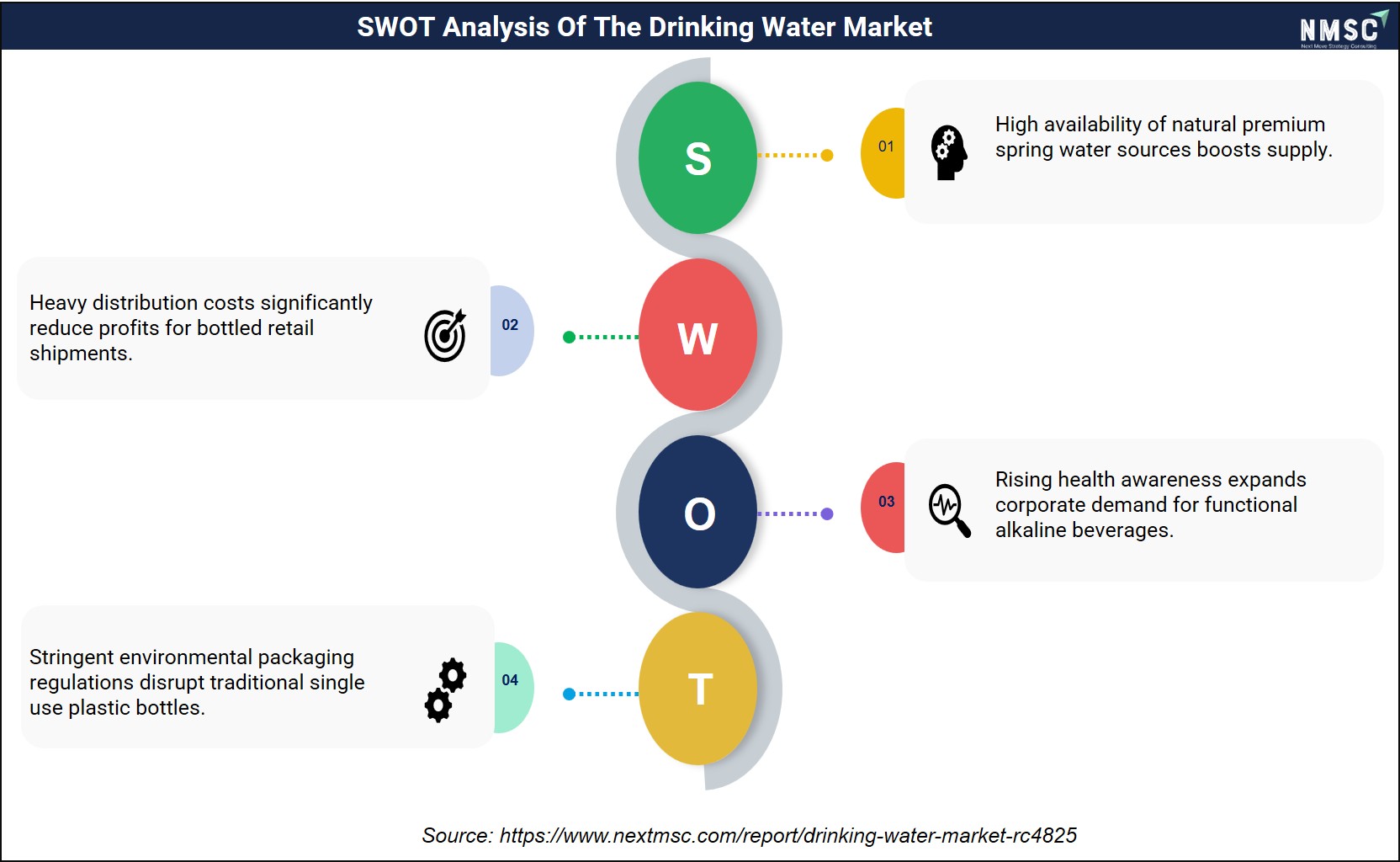
The drinking water market benefits from strong consumer demand driven by growing health awareness, increasing preference for safe and premium hydration products, and the availability of natural water sources. Opportunities continue to emerge through rising demand for functional, alkaline, and enhanced drinking water products among health-conscious consumers. However, the market faces challenges related to high transportation and distribution costs, which can impact profitability. Additionally, stringent environmental regulations targeting single-use plastic packaging present a significant challenge, encouraging manufacturers to invest in sustainable packaging solutions and environmentally responsible practices.
Who Are the Key Market Players in the Drinking Water Market?
-
Nestlé S.A.
-
Danone S.A.
-
The Coca-Cola Company
-
PepsiCo, Inc.
-
Primo Brands Corporation
-
Nongfu Spring Co., Ltd.
-
Tingyi (Cayman Islands) Holding Corp. (Master Kong)
-
Hangzhou Wahaha Group Co., Ltd.
-
FIJI Water Company LLC
-
Bisleri International Pvt. Ltd.
-
Suntory Beverage & Food Limited
-
Gerolsteiner Brunnen GmbH & Co. KG
-
Ferrarelle Società Benefit S.p.A.
-
Highland Spring Group Ltd.
-
VOSS of Norway AS
-
AJE Group S.A.
-
BlueTriton Brands, Inc.
-
National Beverage Corp.
-
Al Ain Food & Beverages PJSC
-
Rayyan Mineral Water Company Q.P.S.C.
What Are the Latest Developments in the Drinking Water Market Industry?
|
Date |
Event |
|
March 2026 |
PepsiCo announced it achieved its 2025 water goals, including 100% water replenishment and Alliance for Water Stewardship (AWS) certification across company-owned facilities in high water-risk areas. |
|
October 2025 |
Coca-Cola HBC acquired Coca-Cola Beverages Africa, creating one of the largest Coca-Cola bottling operations globally. The transaction strengthens distribution for beverage and packaged water brands across Africa. |
What Are the Investment Opportunities in the Drinking Water Market?
Capital Inflows and Venture Activity
The Drinking Water Market is attracting diversified capital across multiple investment themes. Private equity consolidation of regional spring water brands — particularly in MEA, South and Southeast Asia, and Eastern Europe — continues to create platform-building opportunities. Venture capital is flowing into functional water startups addressing specific health claims in electrolyte, alkaline, and nootropic water categories. Our findings suggest that the U.S. natural and specialty beverage sector has consistently attracted VC investment, with functional water brands achieving exit multiples supported by their premium revenue profiles and expanding distribution. Strategic M&A is accelerating as global FMCG companies seek to expand their premium water portfolios to offset declining carbonated soft drink revenues.
Infrastructure Investment
Infrastructure investment represents a critical growth enabler for the Drinking Water Market, particularly in emerging economies. The United Nations Environment Programme (UNEP) and World Bank have committed significant development finance toward water access infrastructure across Sub-Saharan Africa, South Asia, and Southeast Asia under the SDG 6 framework. From our research, we found that as municipal water infrastructure improves, it paradoxically drives premium packaged water adoption by raising consumer awareness of water quality standards and safety. In GCC markets, government-funded desalination capacity expansion directly underpins the production cost advantage of domestic packaged water brands.
ESG Considerations
Environmental, Social, and Governance (ESG) factors are increasingly central to investor evaluation of Drinking Water Market participants. Water stewardship — defined by the Alliance for Water Stewardship and assessed through the CDP Water Security questionnaire — is now a standard institutional investment screening criterion for beverage sector holdings. Our assessment indicates that brands with verifiable water source stewardship programs, measurable rPET content commitments, and carbon reduction roadmaps command preference among ESG-oriented institutional investors. Nestlé, Danone, and Coca-Cola's publicly disclosed water replenishment and packaging sustainability targets reflect growing investor pressure for quantifiable ESG performance in the water category.
Digital Transformation
Digital transformation is creating new investment opportunities across the Drinking Water Market's distribution and consumer engagement dimensions. DTC e-commerce platforms, subscription water delivery services, and IoT-enabled commercial water dispensing systems are generating recurring revenue streams with attractive unit economics. Our analysis shows that investment in digital hydration tracking applications integrated with branded water products represents an emerging loyalty and data monetization opportunity for premium brands. The broader digitization of HoReCa procurement — through platforms that enable restaurants and hotels to manage water brand ordering and inventory — is creating additional technology-layer investment opportunity.
Private Equity and Strategic M&A Activity
Private equity activity in the Drinking Water Market is concentrated in mid-market platform building, regional brand consolidation, and functional water brand investment. Based on our market evaluation, we noticed that the successful BlueTriton Brands acquisition model — assembling a portfolio of regional spring water brands under unified operations — is being replicated across multiple geographies. Strategic acquirers including The Coca-Cola Company, Danone, and PepsiCo continue to evaluate premium water and functional hydration bolt-on acquisitions to strengthen portfolio premiumization. The functional water startup ecosystem, particularly in the U.S. and UK, represents a pipeline of acquisition targets for established players seeking category expansion without organic development timelines.
Key Benefits for Stakeholders
For Brands and Manufacturers
Brands and manufacturers operating in the Drinking Water Market gain comprehensive, vendor-neutral market intelligence covering all product types, packaging formats, distribution channels, and end-user segments across 37 countries and five regions. This intelligence supports product portfolio strategy, packaging investment decisions, and channel expansion planning. Our segmentation analysis enables marketing and commercial teams to identify the fastest-growing sub-categories — specifically functional water and e-commerce distribution — and align innovation pipelines with demonstrated consumer demand shifts across global markets.
For Investors and Financial Analysts
Investors and financial analysts access a structured, data-rich assessment of the Drinking Water Market's growth trajectory, competitive dynamics, M&A pipeline, and segment-level revenue forecasts through 2035. The CAGR analysis by product type, packaging format, distribution channel, end user, region, and country enables precise portfolio construction and valuation modeling for publicly listed and private market water sector investments. Detailed profiling of all 20 covered companies, combined with latest development tracking and competitive dynamics analysis, provides an early-signal framework for identifying consolidation targets and emerging premium brand leaders.
For Retailers and Distributors
Retailers and distributors operating within the Drinking Water Market benefit from detailed channel analysis that illuminates the evolving competitive dynamics between modern trade, convenience retail, e-commerce, and food service distribution. Our distribution channel segmentation reveals the accelerating shift toward e-commerce and the structural importance of HoReCa for premium brand revenue realization. Regional and country-level insights enable retailers to optimize category management, assortment planning, and private-label strategy based on documented market maturity and growth projections across target geographies.
For Government and Regulatory Bodies
Government agencies and regulatory bodies gain a structured analysis of how national water safety frameworks, packaging regulations (EU Single-Use Plastics Directive, EPR schemes), and sustainable development policies are influencing Drinking Water Market structure and investment patterns. Country-level insights provide policymakers with evidence-based perspectives on how regulatory design choices affect water market access, brand investment attraction, and consumer health outcomes. The regional analysis offers direct relevance to water access infrastructure planning, public health hydration strategy, and plastic packaging waste management policy development.
Drinking Water Market Key Segments
By Product Type
-
Natural Still
-
Spring Water
-
Mineral Water
-
-
Natural Sparkling
-
Engineered Still
-
Reverse-Osmosis Water
-
Distilled Water
-
-
Engineered Sparkling
-
Enhanced
-
Flavored
-
Functional
-
By Packaging Format
-
Single-Serve
-
PET Bottles (0.3–1 L)
-
Glass Bottles
-
Cans
-
Cartons (Tetra)
-
-
Bulk
-
Glass Carafes
-
PET/Gallon Jugs
-
Bag-in-Box / Pouches
-
By Distribution Channel
-
Retail (Off-Trade)
-
Convenience Stores
-
E-commerce
-
Supermarkets & Hypermarkets
-
-
Food Service (On-Trade)
-
HoReCa
-
Offices & Public Facilities
-
Vending Machines
-
By End User
-
Consumer
-
Commercial
By Region
-
North America (U.S., Canada, Mexico)
-
Europe (UK, Germany, France, Italy, Spain, Sweden, Denmark, Finland, Netherlands, Rest of Europe)
-
Asia-Pacific (China, India, Japan, South Korea, Taiwan, Indonesia, Vietnam, Australia, Philippines, Malaysia, Rest of APAC)
-
Middle East & Africa (Saudi Arabia, UAE, Egypt, Israel, Turkey, Nigeria, South Africa, Rest of MEA)
-
Latin America (Brazil, Argentina, Chile, Colombia, Rest of LATAM)
Consumer Behavior Analysis of the Drinking Water Market
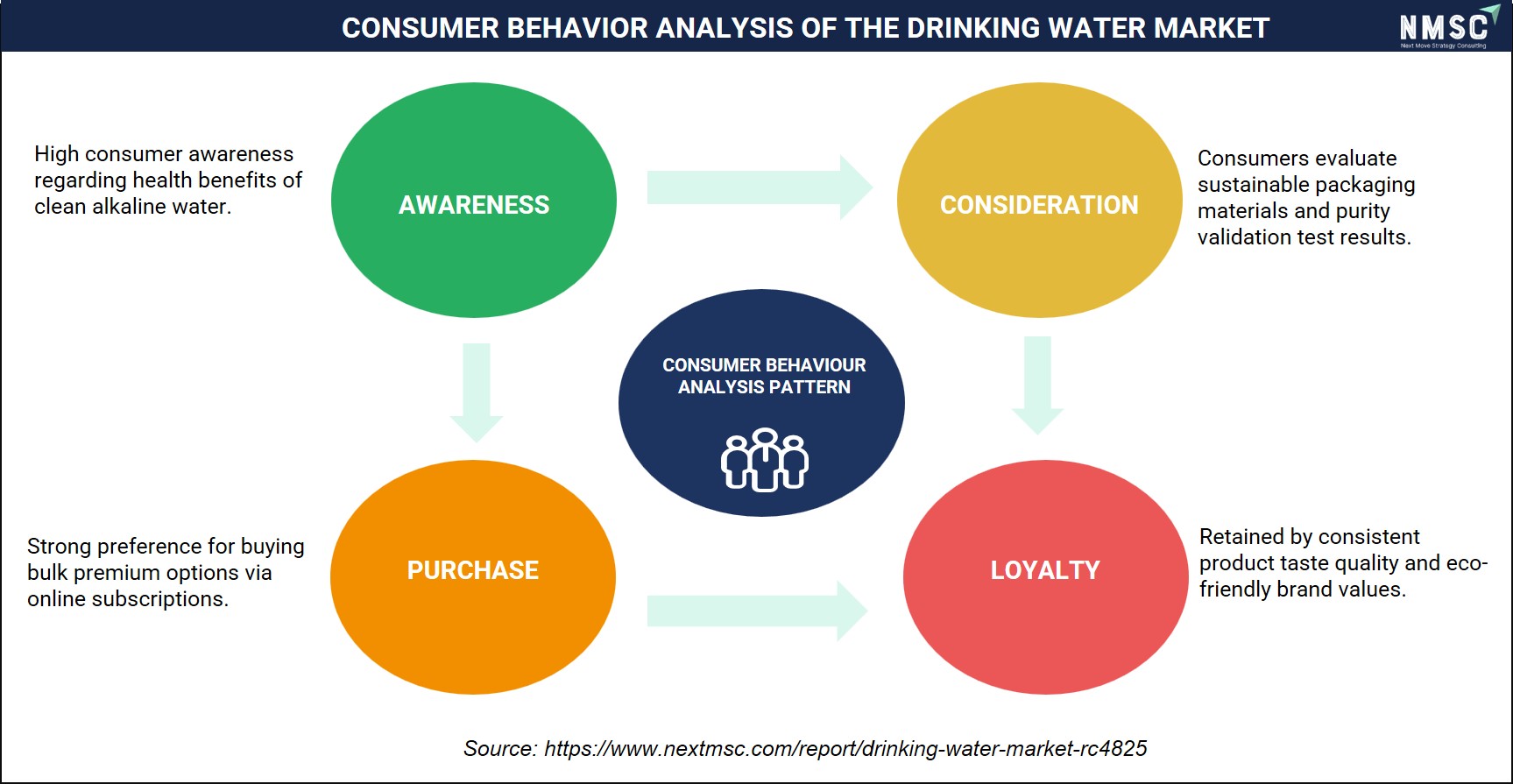
The drinking water market is increasingly shaped by health-conscious consumers who prioritize water quality, purity, and wellness benefits when making purchasing decisions. Consumer behavior typically progresses from awareness of health and safety concerns to evaluating product quality, sustainability, and packaging attributes before purchase. Brand loyalty is often driven by consistent taste, trusted quality standards, and environmentally responsible practices. Additionally, the growing popularity of premium bottled water, subscription-based delivery services, and eco-friendly packaging solutions continues to influence purchasing patterns and long-term consumer preferences.
Conclusion and Recommendations
Long-Term Outlook
The Drinking Water Market is entering a decade of stable, structurally supported growth driven by the convergence of health and wellness mega-trends, urbanization in emerging economies, tap water quality concerns, and premiumization in developed markets. The market is forecast to grow from USD 328.8 billion in 2026 to USD 425.4 billion by 2035, at a CAGR of 3.2%. Our analysis shows that this growth reflects both expanding volume consumption across developing world populations and increasing revenue per unit captured through functional enhancement, premium source positioning, and sustainable packaging differentiation across mature markets.
Strategic Positioning Recommendations
Brand operators should prioritize three strategic pillars for sustained competitive advantage within the Drinking Water Market. First, functional water investment is non-negotiable for premium tier participation, as electrolyte, alkaline, and vitamin-enriched formulations are capturing consumer wallet share previously held by carbonated soft drinks. Second, packaging sustainability investment — specifically rPET content commitments, aluminum format expansion, and Tetra Pak channel development — is becoming a prerequisite for premium retail access in Europe and North America. Third, digital and e-commerce capability development, including subscription infrastructure and DTC engagement platforms, is essential for capturing the fastest-growing distribution channel in the global market.
Investment Attractiveness
The Drinking Water Market represents an attractively defensive investment environment with durable secular growth drivers, highly recurring consumption patterns, and multiple premium tier expansion opportunities. Based on NMSC's research, we found that the highest-conviction investment themes include functional and enhanced water (CAGR of 6.8%), e-commerce distribution channel growth (CAGR of 8.2%), MEA regional expansion (CAGR of 3.1% with significant upside from population growth), and India as the fastest-growing major national market (CAGR of 6.8%). Investors should monitor consolidation activity around premium mineral water brands and functional water startups in North America and Europe.
Market Shifts and Key Risks
The most significant market shift underway is the migration of consumer spending from commodity still water toward premium, functional, and enhanced water, which is reshaping competitive intensity and margin dynamics at all tiers. This benefits premium-positioned brands and specialized water companies at the expense of undifferentiated commodity producers. Key risks for the Drinking Water Market include regulatory escalation of single-use plastic restrictions reducing market accessibility through PET formats, water source scarcity events (droughts, aquifer depletion) threatening supply chain continuity for spring water brands, macroeconomic pressure reducing discretionary premium water spending in emerging markets, and reputational risk from water stewardship concerns in high-media-scrutiny environments.
Growth Pathways
Stakeholders seeking to maximize value from the Drinking Water Market should pursue a three-horizon strategy. In the near term (2025–2027), prioritize distribution channel diversification toward e-commerce and subscription delivery platforms and begin functional water product development. In the mid-term (2027–2031), invest in sustainable packaging infrastructure (rPET supply chains, aluminum lines, Tetra Pak capacity) and expand geographic presence into high-growth MEA and South Asian markets. In the long term (2031–2035), position for digital hydration ecosystem integration — connecting packaged water brands with health tracking platforms, workplace wellness programs, and smart dispensing infrastructure — as a differentiated consumer engagement and loyalty model.
About the Author
 Tushmi Dutta
— Tushmi Dutta is a focused researcher specializing in detailed analysis and insight-driven research across diverse business landscapes. She supports strategic initiatives through structured data interpretation, thorough validation, and clear communication of findings that aid informed decision-making. With a strong interest in writing, she enjoys presenting research insights in an engaging and accessible manner. Beyond work, she enjoys traveling, reading, painting, and continuously learning new skills that contribute to her creative and professional growth.
Tushmi Dutta
— Tushmi Dutta is a focused researcher specializing in detailed analysis and insight-driven research across diverse business landscapes. She supports strategic initiatives through structured data interpretation, thorough validation, and clear communication of findings that aid informed decision-making. With a strong interest in writing, she enjoys presenting research insights in an engaging and accessible manner. Beyond work, she enjoys traveling, reading, painting, and continuously learning new skills that contribute to her creative and professional growth.
About the Reviewer
 Supradip Baul
— Supradip Baul is an accomplished business consultant and strategist with over a decade of rich experience in market intelligence, strategy, technology, and business transformation. His work has included rigorous qualitative and quantitative analysis across multiple industries, helping clients shape investment decisions and long-term roadmaps. Earlier in his career, he was associated with Gartner, where he contributed to industry-leading reports and market share analyses. He has worked with leading global companies and holds an MBA with a dual specialization in Marketing and Finance.
Supradip Baul
— Supradip Baul is an accomplished business consultant and strategist with over a decade of rich experience in market intelligence, strategy, technology, and business transformation. His work has included rigorous qualitative and quantitative analysis across multiple industries, helping clients shape investment decisions and long-term roadmaps. Earlier in his career, he was associated with Gartner, where he contributed to industry-leading reports and market share analyses. He has worked with leading global companies and holds an MBA with a dual specialization in Marketing and Finance.
At Next Move Strategy Consulting, we understand that insightful market research is the cornerstone of successful business decisions. That's why we employ a robust and multifaceted approach, combining various methodologies to deliver the most accurate and actionable data for our clients.

Research Landscape
We navigate the world of research with two primary approaches:
Qualitative Approach
Our qualitative research methodologies involve immersive techniques such as in-depth interviews, focus groups, and observational studies. By engaging directly with individuals and stakeholders, we uncover valuable insights that quantitative data alone may overlook.

Quantitative Research
In tandem with qualitative methodologies, NMSC leverages the power of Quantitative Research to provide a robust foundation of numerical insights. Through systematic data collection and analysis, we quantify patterns, preferences, and market trends, offering a comprehensive view of the business landscape.
Our quantitative research approach employs diverse tools, including surveys, experiments, and statistical modelling. These methodologies enable us to gather data from a large and representative sample, ensuring the statistical significance of our findings. By employing structured questionnaires and standardized data collection methods, we guarantee the reliability and validity of the information we present to our clients.
Quantitative research is particularly effective in measuring the prevalence of trends, assessing market size, and gauging the impact of various factors on consumer behavior. The numerical precision attained through this approach equips our clients with actionable insights, facilitating data-driven decision-making and strategy formulation.


Our Specialized Toolbox for Industry-Specific Market Research
We deploy a specialized arsenal of techniques tailored to meet your unique requirements. Here's a glimpse into our comprehensive toolbox:

Information Procurement
The stage entails acquiring market data or relevant information through various sources and methodologies.


Market Research Approach
We utilize both top-down and bottom-up approaches in market research analysis to achieve a comprehensive understanding of the market dynamics, leveraging the broad perspective of industry trends and macroeconomic factors alongside detailed insights from specific segments and individual companies.

Porters Five Forces Analysis
We conduct Porter's Five Forces analysis to evaluate the competitive landscape of an industry, providing us with insights into factors that affect profitability and strategic positioning.

SWOT Analysis

Forecasting
We utilize a forecasting model to predict future consumption by considering parameters like population, economics, regulations, market competition, drivers, constraints, technology, and pricing. We also employ statistical techniques such as multilinear regression, exponential smoothing, moving average, ARIMA, and Monte Carlo simulations for accurate predictions. In econometric forecasting, we analyzed short-term and long-term event impacts, attributing values based on regulatory frameworks, economic factors, and market events.





 Speak to Our Analyst