Hyperloop Transportation Market Size, Share, Trends and Growth Analysis, By Component (Capsule and Pod Systems, Tube and Guideway Infrastructure, Propulsion and Levitation Systems, & Others), By Application (Government-Funded Test Infrastructure, Corporate Research and Development Programs, & Others), By Transportation Type (Passenger & Freight and Cargo Transportation), By Investment Source, and Region — Global Industry Report and Forecast, 2026–2035
Industry: Automotive & Transportation | Publishing Date: August 8, 2026 | Last Updated: August 8, 2026 | No of Pages: N/A | No. of Tables: N/A | No. of Figures: N/A | Format: PDF | Report Code: AT5642
What Is the Hyperloop Transportation Market Size?
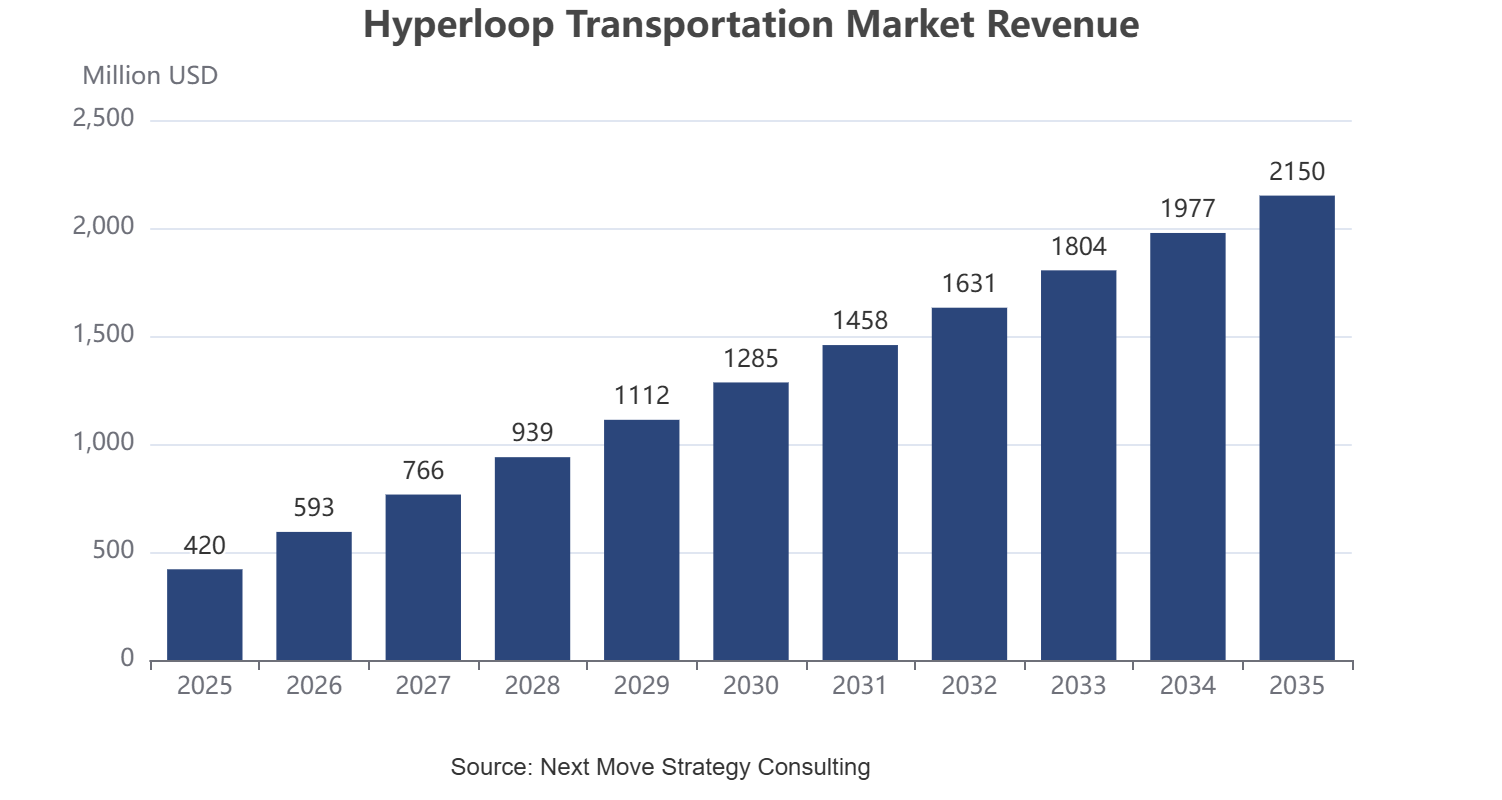
The global Hyperloop Transportation Market size was valued at USD 420 Million in 2025 and is estimated at USD 480 Million in 2026, forecast to reach USD 2,150 Million by 2035, expanding at an 18.1% CAGR between 2026 and 2035. Asia-Pacific leads with approximately a 40% share, while Tube and Guideway Infrastructure dominate all other component categories with approximately a 38% share.
We observed that this pre-commercial market reflects R&D, test-track, and feasibility-study investment rather than passenger or freight service revenue, as no hyperloop transportation system has entered commercial operation anywhere in the world as of 2026, following the 2023 shutdown of Hyperloop One and subsequent 2026 insolvencies at two other prominent developers.
|
Key Takeaways |
|
By Component: Tube and Guideway Infrastructure held the largest share of approximately 38% (USD 159.6 Million) in 2025; Control and Safety Systems is the fastest-growing sub-segment at 20.5% CAGR from 2026–2035. |
|
By Application: Government-Funded Test Infrastructure held the largest share of approximately 46% (USD 193.2 Million) in 2025; Feasibility and Corridor Studies is the fastest-growing sub-segment at approximately 21.0% CAGR from 2026–2035. |
|
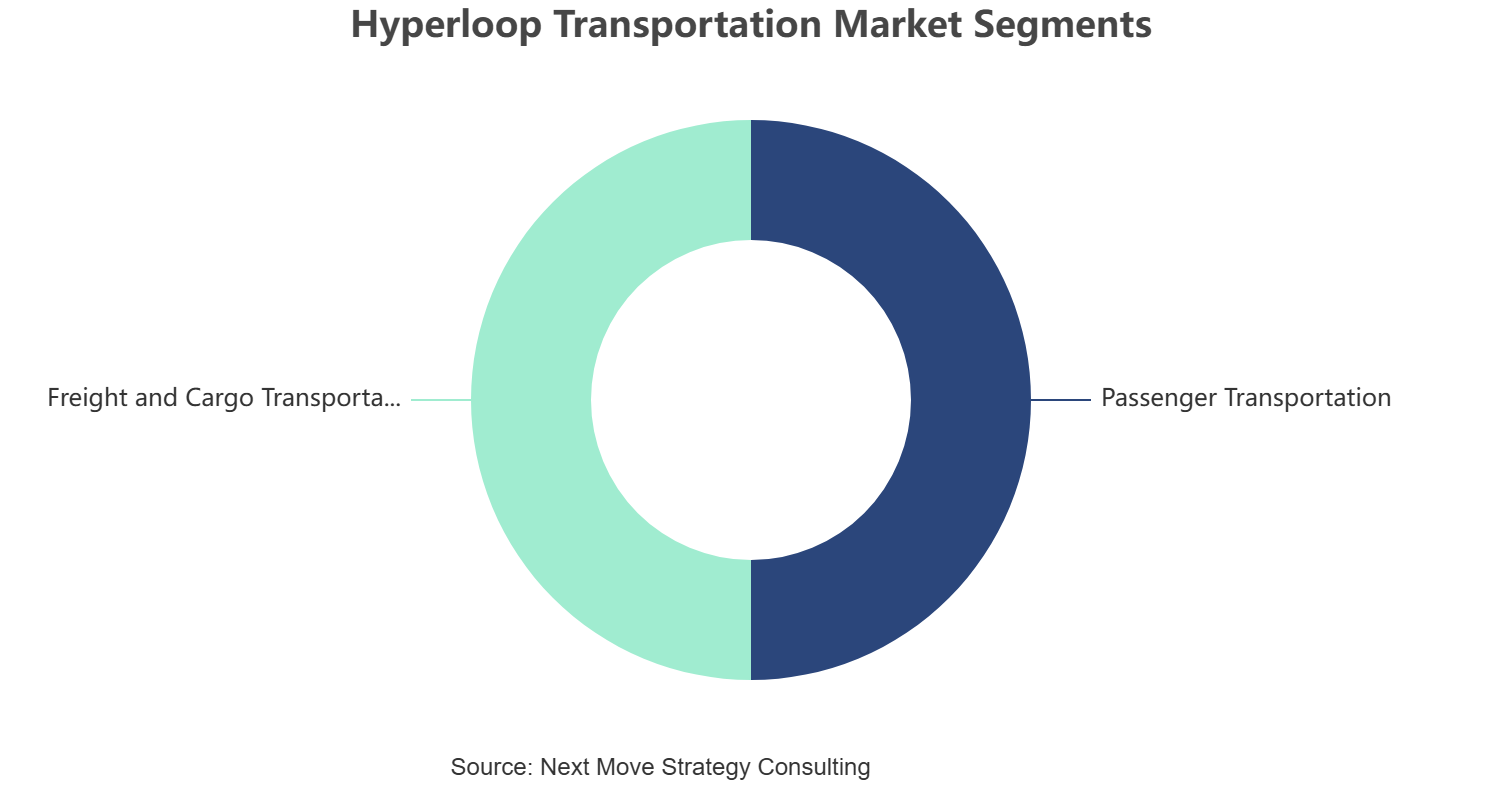
By Transportation Type: Passenger Transportation held the largest share of approximately 64% (USD 268.8 Million) in 2025; Freight and Cargo Transportation is the fastest-growing sub-segment at approximately 20.5% CAGR from 2026–2035. |
|
By Investment Source: Government and Public Sector Funding held the largest share of approximately 58% (USD 243.6 Million) in 2025; Private Venture Investment is the fastest-growing sub-segment at approximately 19.5% CAGR from 2026–2035, off a smaller post-2023 base. |
|
Dominant Region: Asia-Pacific dominated with approximately 40% revenue share (USD 168.0 Million) in 2025. |
|
Fastest-Growing Region: Asia-Pacific is also expected to register the highest CAGR of 22.0% during 2026–2035. |
|
Dominant Country: India led with approximately USD 92.4 Million in 2025. |
|
Fastest-Growing Country: India is also the fastest-growing country at approximately 25.0% CAGR from 2026–2035. |
Market Opportunity: The Hyperloop Transportation Market is expected to create an absolute dollar opportunity of USD 1,670 Million between 2026 and 2035, presenting investment potential concentrated in government-backed test infrastructure and feasibility studies rather than near-term commercial deployment.
According to NMSC analysis, capital and technical leadership in this market have shifted decisively toward government-anchored programs, particularly India's IIT Madras-led test infrastructure, as venture-funded developers that dominated the 2015-2023 period have largely exited following Hyperloop One's 2023 closure and subsequent 2026 insolvencies elsewhere in the sector.
What Does the Hyperloop Transportation Market Encompass?
The Hyperloop Transportation Market encompasses the design, testing, and infrastructure development of ultra-high-speed transportation systems that move pods or capsules through low-pressure tubes using magnetic levitation and electric propulsion. Our assessment indicates that the scope, as it stands in 2026, spans capsule and pod engineering, tube and guideway infrastructure, propulsion and levitation systems, and control and safety systems developed for test tracks, feasibility studies, and pilot corridors, since no hyperloop system has entered commercial passenger or freight service anywhere in the world.
The market's structural evolution has been volatile. Hyperloop One, the most heavily funded venture-backed developer, ceased operations in December 2023 after raising roughly USD 450 million, while two additional prominent developers filed for bankruptcy or became insolvent in early 2026. We observed that technology and capital leadership have consequently shifted toward government-anchored programs, particularly India's Ministry of Railways-backed test infrastructure at IIT Madras. NMSC's analysis indicates that this transition favors high-speed rail-adjacent, publicly funded corridor studies over the speculative, privately funded pilot projects that characterized the market through 2023.
|
Parameter |
Details |
|
Market Size in 2025 |
USD 420 Million |
|
Market Size in 2026 |
USD 480 Million |
|
Revenue Forecast in 2035 |
USD 2,150 Million |
|
Growth Rate |
CAGR of 18.1% from 2026 to 2035 |
|
Analysis Period |
2025–2035 |
|
Base Year Considered |
2025 |
|
Forecast Period |
2026–2035 |
|
Market Size Estimation |
USD Million |
|
Companies Profiled |
10 |
|
Countries Covered |
38 |
|
Market Share |
Available for Top 10 Companies |
Key Emerging Trends
Based on research conducted by NMSC, we found that four structural trends are reshaping technology development, funding models, and stakeholder engagement across the industry.
How Is Government-Backed Test Infrastructure Replacing Venture Capital Funding?
Government-anchored test infrastructure is replacing venture capital as the primary funding mechanism following the sector's 2023-2026 contraction. We observed that the Indian Institute of Technology Madras unveiled India's first hyperloop test track in February 2025, a 422-meter facility built with Indian Railways, ArcelorMittal, L&T, and Hindalco support. Stakeholders across the remaining developer base are positioning public-private partnerships as the primary viable path to sustained funding after multiple venture-backed failures.
Why Are International Competitions Becoming Central to Technology Validation?
International student and industry competitions are emerging as a central technology validation mechanism given reduced private commercial testing activity. Our findings suggest that IIT Madras hosted its Global Hyperloop Competition 2.0 in January 2026 on an upgraded 422-meter test track, drawing international teams to advance pod design and magnetic levitation engineering. This trend reflects the sector's shift toward academic and competitive validation as a lower-cost alternative to full commercial-scale demonstration projects.
How Is Sector Consolidation Concentrating Remaining Developer Activity?
Sector consolidation is concentrating remaining developer activity among a small number of surviving companies following multiple exits. We observed that Hardt Hyperloop filed for bankruptcy and Zeleros became insolvent in early 2026, following Hyperloop One's December 2023 shutdown, leaving TransPod, HyperloopTT, and government-backed Indian programs as the most active remaining developers. This trend reflects the broader capital-intensive technology sector's tendency to consolidate rapidly after early speculative funding proves insufficient for physical infrastructure buildout.
What Role Does Propulsion Technology Pivoting Play in Developer Survival?
Propulsion technology pivoting toward adjacent, more commercially proven systems is emerging as a survival strategy for remaining developers. Our analysis shows that Nevomo, a Polish hyperloop developer, has shifted primary technical focus toward MagRail, a magnetic levitation upgrade for existing rail infrastructure rather than full vacuum-tube hyperloop systems. This trend reflects growing recognition that adjacent, incrementally deployable technology offers a more viable commercial pathway than full-scale hyperloop development alone.
Growth Drivers and Restraints
Growth Catalyst and Risk Assessment Matrix
|
Factors |
Type |
(+/-) % Impact on CAGR |
Geographic Relevance |
Impact Timeline |
|
Government-backed test infrastructure investment in India |
Driver |
+5.2% |
Asia-Pacific |
2026-2035 |
|
Demand for low-emission ultra-high-speed intercity transport |
Driver |
+3.4% |
Global |
2026-2035 |
|
International competitions accelerating technology validation |
Driver |
+2.1% |
Asia-Pacific, Europe |
2026-2032 |
|
Rising interest in freight-focused hyperloop corridors |
Driver |
+1.6% |
North America, Europe |
2026-2035 |
|
Propulsion technology pivots to adjacent maglev rail systems |
Driver |
+1.2% |
Europe |
2026-2032 |
|
Venture capital exit following high-profile developer failures |
Restraint |
-4.8% |
North America, Europe |
2026-2032 |
|
Unresolved vacuum-tube engineering and safety certification challenges |
Restraint |
-3.6% |
Global |
2026-2035 |
|
Extremely high capital cost of full-scale corridor construction |
Restraint |
-2.9% |
Global |
2026-2035 |
|
Absence of any operational commercial precedent globally |
Restraint |
-2.2% |
Global |
2026-2032 |
|
Regulatory uncertainty for novel ultra-high-speed transport modes |
Restraint |
-1.4% |
Global |
2026-2032 |
What Is the Primary Growth Driver of the Hyperloop Transportation Market?
Government-backed test infrastructure investment in India is the primary driver of the market. The Indian Institute of Technology Madras, supported by the Ministry of Railways and industrial partners including ArcelorMittal, L&T, and Hindalco, completed a 422-meter hyperloop test track at its Thaiyur campus in February 2025. We observed that this public-sector-anchored funding model has become the dominant source of sector investment, following the near-total withdrawal of venture capital after 2023.
How Is International Competition Activity Driving Market Growth?
International student and industry competitions are sustaining market activity despite reduced commercial development. IIT Madras hosted the Global Hyperloop Competition 2.0 in January 2026 on its upgraded test track, drawing participating teams from the United States, Europe, and Turkey. Our assessment indicates that this competition-driven model is compressing technology iteration cycles at substantially lower cost than the venture-funded, full-scale demonstration projects that characterized the market before 2023.
What Is Restraining Hyperloop Transportation Market Expansion?
Venture capital exit following high-profile developer failures represents the most significant restraint on the market. Hyperloop One ceased operations in December 2023 after raising approximately USD 450 Million and completing only one human passenger test, while Hardt Hyperloop and Zeleros both exited the sector through bankruptcy or insolvency in early 2026. We found that this pattern of failure has severely constrained private venture capital availability for remaining developers, leaving government funding as the primary viable capital source through the forecast period.
Segmentation Analysis
Segment Sizing: By Component
|
Segment |
2025 (USD Million) |
2035 (USD Million) |
CAGR% (2026-2035) |
|
Tube and Guideway Infrastructure |
159.6 |
795.5 |
17.4% |
|
Capsule and Pod Systems |
121.8 |
623.5 |
17.8% |
|
Propulsion and Levitation Systems |
79.8 |
408.5 |
17.7% |
|
Control and Safety Systems |
58.8 |
322.5 |
20.5% |
|
Total |
420.0 |
2,150.0 |
18.1% |
Which Component Segment Dominates the Hyperloop Transportation Market?
Tube and Guideway Infrastructure, covering the low-pressure tube segments and physical corridor construction required for any test facility, led the market with USD 159.6 Million in 2025, reflecting that civil infrastructure represents the single largest cost component of any hyperloop test project. We observed that Control and Safety Systems is the fastest-growing component, expanding at a 20.5% CAGR from 2026 to 2035, as remaining developers prioritize certifiable safety validation following the sector's prior safety and engineering setbacks.
Segment Sizing: By Transportation Type
|
Segment |
2025 (USD Million) |
2035 (USD Million) |
CAGR% (2026-2035) |
|
Passenger Transportation |
268.8 |
1,322.5 |
17.2% |
|
Freight and Cargo Transportation |
151.2 |
827.5 |
20.5% |
|
Total |
420.0 |
2,150.0 |
18.1% |
Which Transportation Type Leads Hyperloop Development Activity?
Passenger Transportation remained the leading transportation type within the market, valued at USD 268.8 Million in 2025, as most test infrastructure, including IIT Madras's Thaiyur track, is designed around intercity passenger corridor concepts. Our findings suggest that Freight and Cargo Transportation is the fastest-growing transportation type, registering a 20.5% CAGR from 2026 to 2035, as remaining developers, including TransPod explore freight rail-adjacent cargo applications viewed as carrying lower near-term safety certification hurdles than passenger service.
Segment Sizing: By Investment Source
|
Segment |
2025 (USD Million) |
2035 (USD Million) |
CAGR% (2026-2035) |
|
Government and Public Sector Funding |
243.6 |
1,268.5 |
18.0% |
|
Corporate and Strategic Investment |
96.6 |
494.5 |
17.7% |
|
Private Venture Investment |
79.8 |
387.0 |
19.5% |
|
Total |
420.0 |
2,150.0 |
18.1% |
Which Investment Source Is Most Widely Relied Upon in the Hyperloop Market?
Government and Public Sector Funding remained the dominant investment source across the market, reaching USD 243.6 Million in 2025 due to India's Ministry of Railways-backed test infrastructure and comparable public programs elsewhere. Based on research conducted by NMSC, we found that Private Venture Investment, while the smallest source following the sector's 2023-2026 contraction, is the fastest-growing at a 19.5% CAGR from 2026 to 2035, reflecting a gradual, cautious return of specialized investors following the sector's most severe failures.
PESTEL Analysis of the Hyperloop Transportation Industry
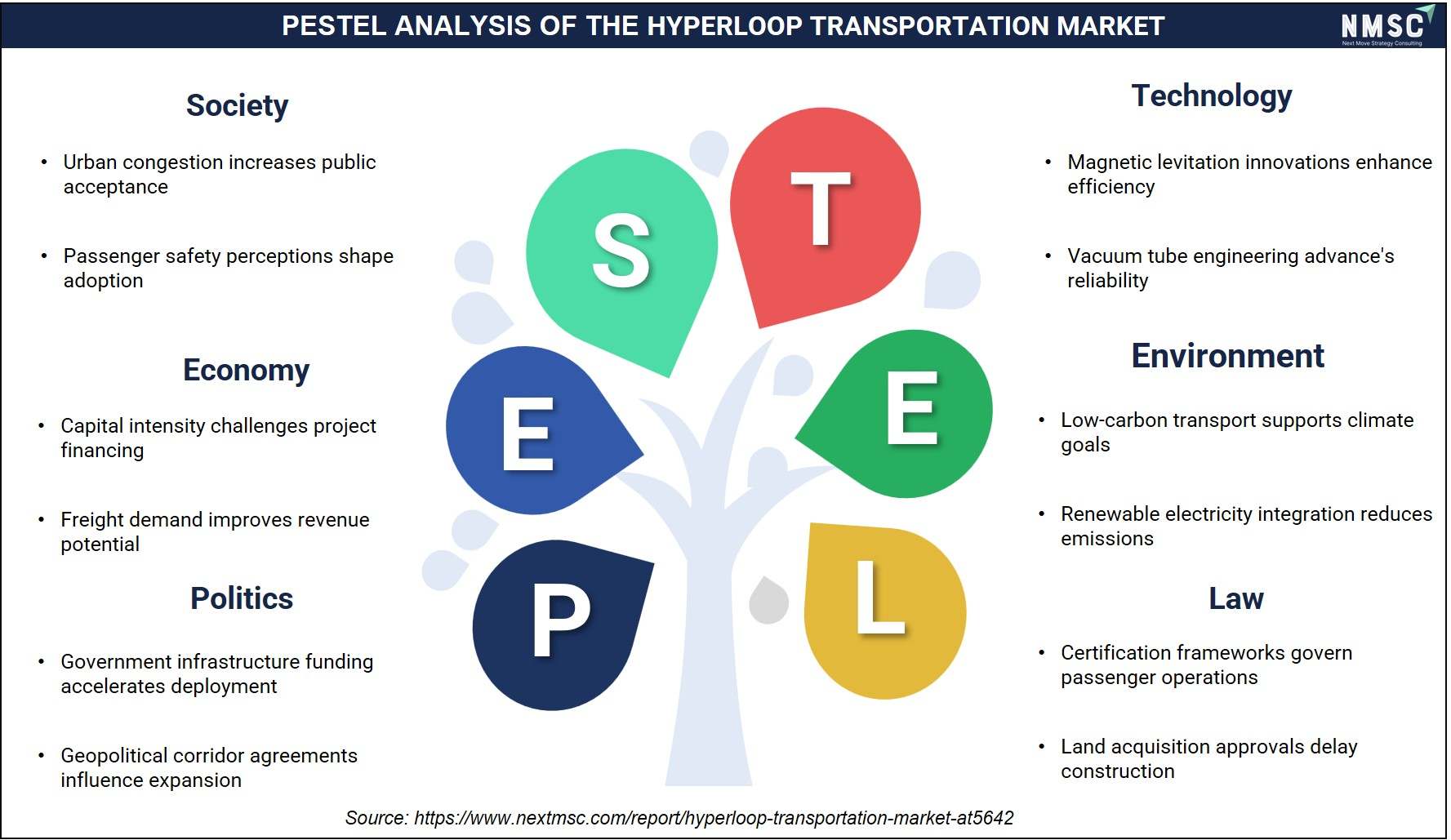
The above infographic presents a PESTEL analysis of the hyperloop transportation market, highlighting the key external factors shaping its development. Government funding and geopolitical agreements are accelerating project deployment, while economic viability is supported by freight demand and revenue potential. Technological advancements in vacuum tube engineering and renewable energy integration are further improving efficiency, and environmental benefits such as low-carbon emissions are strengthening the investment case. These developments are underpinned by legal frameworks governing safety, land acquisition, and certification. Looking ahead, we observed that these interconnected factors are collectively influencing the market's growth trajectory across the global transportation landscape.
Growth Opportunities
Our analysis shows that three forward-looking opportunities stand out for stakeholders positioning within the Hyperloop Transportation Market over the 2026-2035 forecast period, each concentrated in pre-commercial technology validation rather than immediate service deployment.
How Can Government-University Partnerships Unlock Sustained Funding?
Structured partnerships between national railway authorities and academic institutions present a whitespace opportunity to sustain hyperloop development funding beyond volatile venture capital cycles. Programs modeled on IIT Madras's Ministry of Railways-backed test track offer a replicable framework for other governments seeking lower-risk, publicly anchored technology validation pathways within the Government and Public Sector Funding segment.
Where Does Freight-Only Development Reduce Near-Term Certification Risk?
Freight and cargo-focused hyperloop development represents an underexplored opportunity to sidestep the stringent passenger safety certification requirements that have stalled full commercial deployment. Developers that prioritize cargo corridors ahead of passenger service can capture freight rail-adjacent demand within the Freight and Cargo Transportation segment while building an operational track record before pursuing passenger certification.
How Can Propulsion Technology Pivots Benefit Adjacent Rail Modernization?
Developers pivoting core propulsion and levitation technology toward adjacent, incrementally deployable rail upgrades represent an opportunity to generate near-term revenue while continuing longer-term hyperloop research. Nevomo's shift toward MagRail illustrates how magnetic levitation technology developed for hyperloop applications can find earlier commercial application within the Propulsion and Levitation Systems segment through existing rail infrastructure upgrades.
Regional Outlook
|
Region |
2025 (USD Million) |
2035 (USD Million) |
CAGR% (2026-2035) |
Key Driver |
|
Asia-Pacific |
168.0 |
1,193.5 |
22.0% |
India's government-backed IIT Madras test infrastructure |
|
North America |
117.6 |
494.5 |
16.0% |
Residual private developer activity following sector contraction |
|
Europe |
84.0 |
365.5 |
16.5% |
Propulsion technology pivots and academic research programs |
|
Middle East & Africa |
29.4 |
64.5 |
8.5% |
Early-stage feasibility studies for regional corridors |
|
Latin America |
21.0 |
32.0 |
4.5% |
Limited, early-stage feasibility interest |
|
Total |
420.0 |
2,150.0 |
18.1% |
— |
Asia-Pacific
Asia-Pacific leads the Hyperloop Transportation Market, anchored decisively by India's government-backed test infrastructure program at IIT Madras. We observed that the Ministry of Railways' continued support for test track expansion reflects sustained public-sector commitment uncommon elsewhere in the sector. Regulatory influence remains supportive, technology adoption is advancing through structured competitions, and strategic outlook favors continued public investment even as private developer activity remains limited regionally.
North America
North America's Hyperloop Transportation Market reflects the residual activity of developers that survived the sector's 2023 contraction following Hyperloop One's shutdown. Our findings suggest that TransPod and HyperloopTT continue development work despite neither having delivered an operational test track or vehicle after roughly a decade of activity. Regulatory influence remains underdeveloped for this novel transport mode, and technology adoption is proceeding cautiously given the region's history of high-profile developer failures.
Europe
Europe's Hyperloop Transportation Market has contracted sharply following the bankruptcy of Dutch developer Hardt Hyperloop and the insolvency of Spain's Zeleros in early 2026. We found that Swisspod Technologies in Switzerland remains among the few actively operating developers regionally, alongside Poland's Nevomo, which has pivoted primary focus toward maglev rail upgrades. Regulatory influence remains developing, and strategic outlook is cautious given the concentration of recent regional developer failures.
Middle East & Africa
The Hyperloop Transportation Market in Middle East & Africa remains at an early feasibility stage, with prior regional interest, including a previously proposed Abu Dhabi-Dubai corridor, unrealized following Hyperloop One's 2023 exit. Our analysis shows that regional investment activity has slowed considerably, with any remaining interest limited to preliminary feasibility discussions. Regulatory influence remains minimal, and strategic outlook depends heavily on renewed international developer engagement.
Latin America
Latin America's Hyperloop Transportation Market remains the smallest and least developed regionally, with activity limited to early-stage feasibility interest rather than active test infrastructure. We observed that no confirmed developer presence or government-backed program has emerged regionally as of 2026. Regulatory influence remains effectively absent, and technology adoption is not expected to advance meaningfully without external developer or government partnership during the forecast period.
U.S.
Based on our estimates, the U.S. market was valued at approximately USD 96.6 Million in 2025 and is projected to reach USD 395.0 Million by 2035, growing at a 15.5% CAGR. Demand structure reflects residual activity from HyperloopTT and The Boring Company following Hyperloop One's 2023 exit from the same domestic market. Regulatory influence from federal transportation authorities remains limited, and competitive intensity is low given the small number of remaining active developers.
Canada
The market in Canada reached roughly USD 21.0 Million in 2025 and is forecast to hit USD 99.5 Million by 2035 at a 16.9% CAGR. Demand structure centers almost entirely on TransPod, the country's sole prominent developer, which has advanced FluxJet propulsion concepts without yet delivering an operational test track. Technology penetration remains limited, and competitive intensity is minimal given the absence of alternative domestic developers.
UK
As per our estimate, the UK market stood at about USD 12.6 Million in 2025, advancing toward USD 52.5 Million by 2035 at a 15.5% CAGR. Demand remains limited to academic and early feasibility research rather than active developer test infrastructure. Regulatory influence from UK transport authorities remains minimal for this novel transport mode, and competitive intensity is negligible given the absence of a UK-headquartered hyperloop developer.
Germany
According to our analysis, Germany's market was valued at near USD 16.8 Million in 2025 and is set to reach USD 71.5 Million by 2035, expanding at a 15.7% CAGR. Demand structure reflects academic research interest rather than active commercial development following the broader European sector contraction. Regulatory influence remains limited, while technology penetration is confined largely to feasibility and engineering research programs.
France
Based on our estimates, France's market reached approximately USD 12.6 Million in 2025, projected to climb to USD 52.0 Million by 2035 at a 15.2% CAGR. Demand is supported by residual academic and engineering research interest following the closure of earlier French hyperloop demonstration efforts. Regulatory influence remains limited, and competitive intensity is minimal given the absence of an actively operating French hyperloop developer.
China
The market in China stood at roughly USD 58.8 Million in 2025 and is forecast to reach USD 402.0 Million by 2035, registering a 21.2% CAGR. Demand is fueled by state-backed research interest in ultra-high-speed ground transportation as a complement to the country's extensive high-speed rail network. Regulatory influence is developing under national transport research programs, and technology penetration remains centered on feasibility and engineering research rather than active pilot infrastructure.
India
As per our estimate, India's market was valued at about USD 92.4 Million in 2025, projected to reach USD 697.0 Million by 2035 at a 25.0% CAGR, the fastest among covered countries. Demand structure reflects the Ministry of Railways' sustained backing of IIT Madras's test track program, alongside domestic developers Dinclix GroundWorks and TuTr Hyperloop. Regulatory influence is comparatively supportive, and technology penetration is advancing quickly through structured government-academic partnership.
Japan
According to our analysis, Japan's market reached close to USD 12.6 Million in 2025 and is expected to hit USD 53.0 Million by 2035, growing at a 15.4% CAGR. Demand is supported by preliminary feasibility interest linked to the country's advanced high-speed rail heritage rather than active developer test infrastructure. Regulatory influence remains minimal, and competitive intensity is negligible given the absence of a domestic hyperloop developer.
South Korea
Based on our estimates, South Korea's market stood at approximately USD 8.4 Million in 2025, forecast to reach USD 34.5 Million by 2035 at a 15.2% CAGR. Demand structure reflects limited, early-stage academic interest in ultra-high-speed transport research. Technology penetration remains minimal, and competitive intensity is negligible given the absence of an actively operating domestic hyperloop developer.
Australia
The Hyperloop Transportation Market in Australia reached about USD 4.2 Million in 2025 and is projected to reach USD 16.5 Million by 2035, expanding at a 14.7% CAGR. Demand is supported by minimal, preliminary feasibility interest rather than active developer or government test infrastructure. Regulatory influence remains negligible, and competitive intensity is effectively absent given the lack of domestic developer presence.
UAE
As per our estimate, the UAE market was valued at USD 12.6 Million in 2025, projected to reach USD 28.0 Million by 2035 at an 8.3% CAGR. Demand structure reflects residual interest from the previously proposed Abu Dhabi-Dubai hyperloop corridor, which remains unrealized following Hyperloop One's 2023 exit. Regulatory influence remains limited, and competitive intensity is minimal absent renewed international developer engagement.
Saudi Arabia
According to our analysis, Saudi Arabia's market reached roughly USD 10.5 Million in 2025 and is expected to hit USD 23.0 Million by 2035, growing at an 8.2% CAGR. Demand is driven by Vision 2030-linked interest in novel transportation infrastructure, though no active hyperloop test program has been confirmed domestically. Regulatory influence remains limited, and technology penetration is confined to preliminary feasibility discussions.
South Africa
Based on our estimates, South Africa's market stood at about USD 2.1 Million in 2025, forecast to reach USD 4.5 Million by 2035 at an 8.0% CAGR. Demand structure reflects minimal, early-stage regional interest with no confirmed active test infrastructure. Regulatory influence remains effectively absent, and competitive intensity is negligible given the lack of domestic developer presence.
Brazil
The market in Brazil reached approximately USD 12.6 Million in 2025 and is projected to reach USD 19.5 Million by 2035, registering a 4.5% CAGR. Demand is underpinned by limited, early-stage feasibility interest rather than confirmed developer or government test programs. Regulatory influence remains minimal, and technology penetration is negligible given the absence of active regional hyperloop development.
Argentina
As per our estimate, Argentina's market was valued at near USD 4.2 Million in 2025, projected to reach USD 6.5 Million by 2035 at a 4.5% CAGR. Demand structure remains minimal, reflecting only preliminary regional feasibility interest without confirmed developer or government backing. Regulatory influence remains effectively absent, and competitive intensity is negligible given the lack of any domestic hyperloop program.
Strategic Analysis of the Hyperloop Transportation Industry
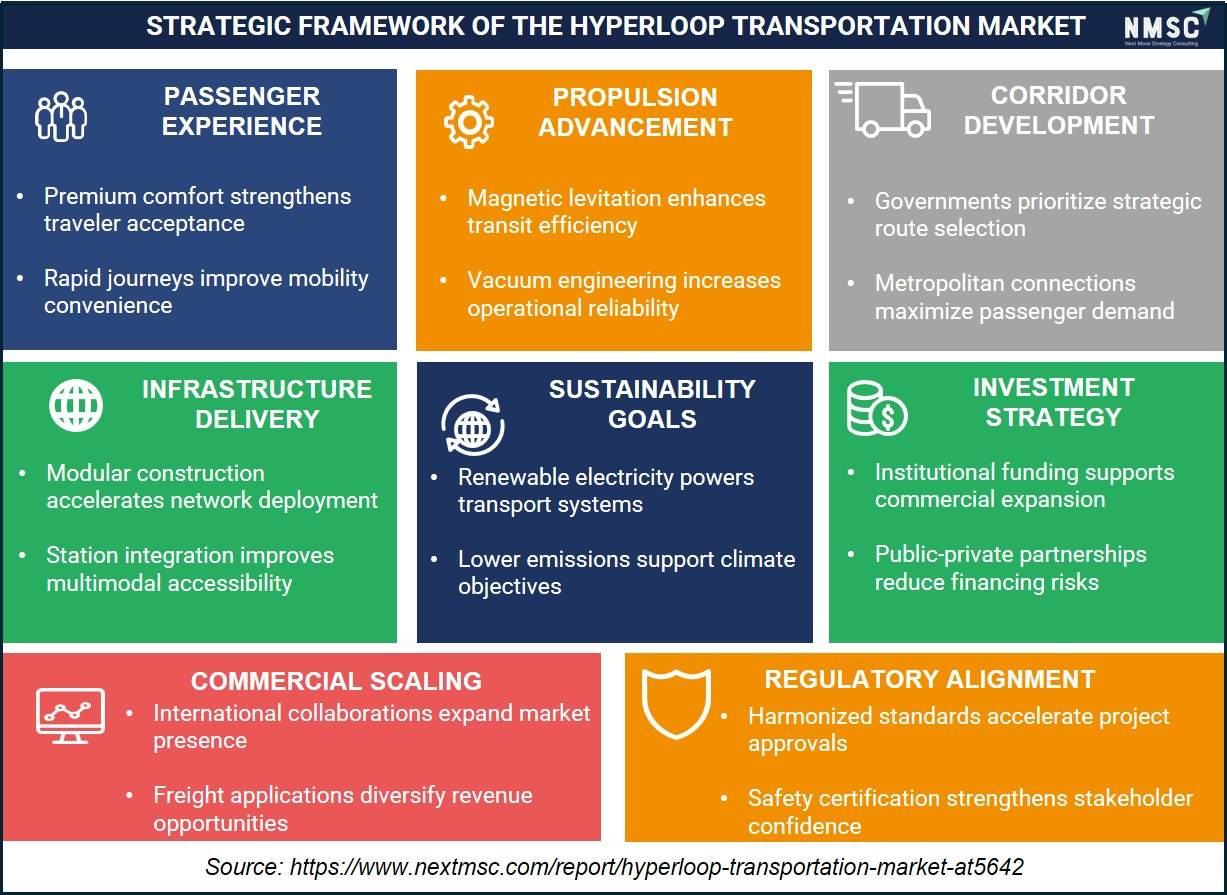
The above infographic presents a strategic framework of the hyperloop transportation market, where premium comfort and rapid journeys are enhancing traveler acceptance, while magnetic levitation and vacuum engineering are driving operational efficiency. Governments are prioritizing strategic routes, and modular construction is enabling faster deployment. Renewable energy and institutional funding support sustainability and commercial scaling, while international collaborations and safety standards accelerate market expansion. Looking ahead, we observed that freight applications and multimodal connectivity will further strengthen the ecosystem's long-term viability.
Competitive Landscape
We observed that the Hyperloop Transportation Market features a highly fragmented, sharply contracted competitive landscape, with a small number of surviving developers competing alongside government-anchored academic programs following multiple high-profile industry exits.
|
Dimension |
Description |
|
Market Structure |
Highly fragmented and contracted; only eight companies met this report's verified, currently active eligibility criteria, following the 2023 shutdown of Hyperloop One and the early-2026 bankruptcy or insolvency of two other prominent developers, Hardt Hyperloop and Zeleros. |
|
Innovation Focus |
Tube and guideway engineering, propulsion and levitation systems, and safety certification research dominate current innovation activity among remaining developers and government-backed academic programs. |
|
M&A Activity |
Minimal conventional M&A; sector activity instead reflects developer exits through bankruptcy and insolvency, alongside strategic technology pivots such as Nevomo's shift toward MagRail rail-based propulsion systems. |
How Do Companies Compete in the Hyperloop Transportation Market?
Companies compete primarily on demonstrated test infrastructure progress and access to stable, non-venture funding sources across the industry. Government-backed programs such as IIT Madras benefit from Ministry of Railways funding stability unavailable to purely venture-funded developers, while surviving private companies including TransPod and HyperloopTT compete on proprietary propulsion technology despite neither having delivered an operational full-scale system.
Which Competitive Archetypes Dominate the Hyperloop Transportation Market?
Two archetypes dominate the market, which is government-anchored academic and public infrastructure programs, and residual venture-backed private developers. India's IIT Madras program exemplifies the government-anchored archetype through stable, multi-stakeholder public funding, while TransPod and HyperloopTT exemplify the residual private archetype, continuing technology development despite the sector-wide capital withdrawal that followed Hyperloop One's 2023 closure.
How Are Companies Differentiating Through Innovation in Hyperloop Development?
Innovation and differentiation strategy increasingly center on incremental, certifiable engineering milestones rather than ambitious full-corridor announcements that characterized the pre-2023 sector. IIT Madras's test track progression from an initial 410-meter facility to an upgraded 422-meter track for its 2026 competition illustrates measured, verifiable progress. Our analysis shows that developers unable to demonstrate tangible physical infrastructure milestones risk further erosion of stakeholder and investor confidence following the sector's recent failures.
What M&A and Exit Activity Is Shaping the Hyperloop Transportation Market?
Exit activity, rather than conventional consolidation, has defined recent market structure. Hyperloop One's December 2023 dissolution, followed by Hardt Hyperloop's bankruptcy and Zeleros's insolvency in early 2026, collectively removed three of the sector's most prominent venture-backed developers. We found that this pattern of exits, rather than acquisition-driven consolidation typical of maturing transportation technology sectors, reflects the hyperloop market's continued pre-commercial, high-risk technology stage.
Key Market Players
Our assessment indicates that the following companies represent the verified and currently active set of hyperloop developers.
-
TransPod Inc.
-
Hyperloop Transportation Technologies, Inc.
-
The Boring Company
-
Swisspod Technologies SA
-
Nevomo Sp. z o.o.
-
Dinclix GroundWorks Private Limited
-
TuTr Hyperloop Private Limited
-
AECOM
-
Company 9
-
Company 10
Latest Developments
We found that recent developments within the Hyperloop Transportation Market are dominated by developer exits alongside continued government-backed test infrastructure progress, reflecting the industry's ongoing structural contraction.
|
Date |
Event |
|
November 2025 |
Swisspod announced a major milestone by unveiling the world's largest hyperloop test track in Pueblo, Colorado, introducing its first hyperloop capsule model, Aerys 1, and achieving a record speed of 65 mph (102 km/h) |
|
October 2025 |
TransPod announced a strategic partnership with Algoma Steel and Supreme Steel to support the development of the Edmonton–Calgary TransPod Line. The collaboration is intended to strengthen Canada's steel supply chain and accelerate construction of the country's first ultra-high-speed transportation corridor |
|
February 2025 |
IIT Madras inaugurated its Global Hyperloop Competition 2025 at its 422-meter operational student-run hyperloop test tube and track at the Discovery Campus in Thaiyur, developed with support from Indian Railways, ArcelorMittal, L&T, and HindalCo. |
Expert Insights

“We are demonstrating real hyperloop technology, operating at the largest test track in the world. We had a great test and in the coming weeks, we’ll increase power, push the system harder, and advance at a pace this industry has never seen. It’s how real transportation systems are developed.”
— Denis Tudor, Co-founder & CEO, Swisspod Technologies
Statement made during the announcement of Swisspod's record-breaking hyperloop demonstration at the world's largest hyperloop test track in the United States.
Market Interpretation
The statement underscores the Hyperloop Transportation Market's transition from conceptual development to large-scale technology validation. Continued investments in full-scale testing infrastructure, propulsion systems, and commercial prototypes indicate growing industry confidence in hyperloop as a next-generation high-speed transportation solution. As developers increasingly focus on real-world testing and system validation, the market is expected to advance toward commercial deployment for both passenger and freight transportation.
Investment Opportunities
What Capital Inflows Are Targeting the Hyperloop Transportation Market?
Capital inflows into the Hyperloop Transportation Market have contracted sharply and shifted decisively toward government sources following the sector's 2023-2026 developer failures. We observed that India's Ministry of Railways continues funding IIT Madras's test infrastructure expansion, while private venture investment remains a small fraction of pre-2023 levels. Investors that remain active favor developers demonstrating incremental, physically verifiable infrastructure progress over ambitious, unproven corridor announcements.
How Is Infrastructure Investment Supporting Hyperloop Test Programs?
Infrastructure investment is concentrated in test-track and pilot-facility construction rather than commercial corridor deployment. Our findings suggest that IIT Madras expanded its Thaiyur test facility from 410 meters to 422 meters ahead of its January 2026 Global Hyperloop Competition, funded jointly by Indian Railways and industrial partners. This scale of publicly anchored infrastructure investment remains the most active funding channel in the market as of 2026.
What ESG Considerations Are Shaping Hyperloop Investment Decisions?
Environmental, social, and governance considerations in the Hyperloop Transportation Market center on the technology's theoretical low-emission, high-speed transport potential relative to aviation and road travel. Proponents position hyperloop as a lower-carbon alternative to short-haul flights, though this benefit remains unrealized given the absence of any operational system. We found that investors increasingly weigh this unproven sustainable transportation potential against the sector's demonstrated execution risk following multiple high-profile developer failures.
Key Benefits for Stakeholders
How Does This Report Benefit Government and Infrastructure Leaders?
Government and infrastructure leaders gain access to validated segmentation, developer viability assessment, and regional investment activity that support funding and partnership decisions across the Hyperloop Transportation industry. Our analysis shows that detailed component, application, and investment source breakdowns help public transportation authorities distinguish sustainable, government-anchored programs from the volatile, venture-funded model that produced multiple high-profile failures between 2023 and 2026.
How Does This Report Benefit Investors and Financial Analysts?
Investors and financial analysts benefit from consistent, single-point market size estimates and transparent developer viability assessment that support risk-aware capital-allocation decisions across the Hyperloop Transportation supply chain. We observed that the report's explicit accounting for the sector's 2023-2026 contraction, rather than presenting inflated pre-failure projections, helps investors calibrate exposure to this pre-commercial, high-risk technology category appropriately.
How Does This Report Benefit Technology Vendors and Product Teams?
Technology vendors and product teams gain insight into which propulsion, levitation, and safety certification approaches have demonstrated physical progress rather than remaining theoretical. Our findings suggest that this analysis helps R&D teams prioritize development roadmaps around incrementally deployable, verifiable milestones similar to IIT Madras's test track progression, rather than pursuing the ambitious, unproven full-corridor announcements that preceded the sector's recent failures.
Key Market Segments
By Component
-
Tube and Guideway Infrastructure
-
Capsule and Pod Systems
-
Propulsion and Levitation Systems
-
Control and Safety Systems
By Application
-
Government-Funded Test Infrastructure
-
Corporate Research and Development Programs
-
Feasibility and Corridor Studies
-
Academic and Competition-Based Development
By Transportation Type
-
Passenger Transportation
-
Freight and Cargo Transportation
By Investment Source
-
Government and Public Sector Funding
-
Corporate and Strategic Investment
-
Private Venture Investment
By Region
-
North America: U.S., Canada, Mexico
-
Europe: UK, Germany, France, Italy, Spain, Sweden, Denmark, Finland, Netherlands, Rest of Europe
-
Asia-Pacific: China, India, Japan, South Korea, Taiwan, Indonesia, Vietnam, Australia```html , Philippines, Malaysia, Rest of APAC
-
Middle East & Africa: Saudi Arabia, UAE, Egypt, Israel, Turkey, Nigeria, South Africa, Rest of MEA
-
Latin America: Brazil, Argentina, Chile, Colombia, Rest of LATAM
Conclusion and Recommendations
What Is the Long-Term Outlook for the Hyperloop Transportation Market?
The long-term outlook for the market remains cautiously positive but pre-commercial, with global R&D and test infrastructure investment projected to expand roughly fivefold from USD 420 Million in 2025 to USD 2,150 Million by 2035 at an 18.1% CAGR. We observed that this growth reflects continued government-backed test infrastructure investment, particularly in India, rather than any near-term transition to commercial passenger or freight service, given that no hyperloop system has entered commercial operation anywhere in the world as of 2026.
What Strategic Positioning Should Hyperloop Developers Pursue in the Hyperloop Transportation Market?
Developers should prioritize government and academic partnership models over pure venture funding to secure stable, long-term development capital. Our assessment indicates that companies pursuing incremental, physically verifiable test-track milestones, similar to IIT Madras's measured infrastructure progression, will be better positioned to sustain stakeholder confidence than those repeating the ambitious, unproven corridor announcements that preceded the sector's 2023-2026 failures.
How Attractive Is the Hyperloop Transportation Market for New Investment?
The Hyperloop Transportation industry presents a highly speculative, early-stage investment case, supported by a USD 1,670 Million absolute dollar opportunity between 2026 and 2035 concentrated in test infrastructure rather than commercial revenue. We found that investment attractiveness remains highest for government-anchored programs with demonstrated public funding stability, while private venture investment carries substantial execution risk following the exit of three prominent developers between 2023 and 2026.
What Market Shifts and Key Risks Should Stakeholders Monitor?
Stakeholders should monitor unresolved vacuum-tube engineering and safety certification challenges, extremely high capital costs for full-scale corridor construction, and the absence of any operational commercial precedent globally as key risks to the Hyperloop Transportation Market. Our analysis shows that the sector's 2023-2026 pattern of high-profile developer failures, including Hyperloop One, Hardt Hyperloop, and Zeleros, underscores the substantial execution risk that remains unresolved across the industry.
What Are the Key Growth Pathways for the Hyperloop Transportation Market?
Key growth pathways include expanding government-university test infrastructure partnerships, prioritizing freight applications to reduce near-term safety certification hurdles, and pivoting propulsion technology toward incrementally deployable rail upgrades. NMSC's analysis indicates that developers and governments pursuing these lower-risk pathways, rather than repeating the full-corridor ambitions of the pre-2023 sector, will be best positioned to sustain the Hyperloop Transportation Market's projected growth through 2035.
About the Author
 Mayurima Roy
— Mayurima Roy is Research Analyst at Next Move Strategy Consulting, where she has spent 4 years working across the firm's full industry coverage rather than a single fixed vertical. Her work centers on structured research, ongoing trend tracking, competitive assessment, and insight-led content development, translating complex market data into clear, decision-ready narratives that support informed client decision-making across diverse global industries, market sectors, and world regions every day.
Mayurima Roy
— Mayurima Roy is Research Analyst at Next Move Strategy Consulting, where she has spent 4 years working across the firm's full industry coverage rather than a single fixed vertical. Her work centers on structured research, ongoing trend tracking, competitive assessment, and insight-led content development, translating complex market data into clear, decision-ready narratives that support informed client decision-making across diverse global industries, market sectors, and world regions every day.
About the Reviewer
 Supradip Baul
— Supradip Baul is an accomplished business consultant and strategist with over a decade of rich experience in market intelligence, strategy, technology, and business transformation. His work has included rigorous qualitative and quantitative analysis across multiple industries, helping clients shape investment decisions and long-term roadmaps. Earlier in his career, he was associated with Gartner, where he contributed to industry-leading reports and market share analyses. He has worked with leading global companies and holds an MBA with a dual specialization in Marketing and Finance.
Supradip Baul
— Supradip Baul is an accomplished business consultant and strategist with over a decade of rich experience in market intelligence, strategy, technology, and business transformation. His work has included rigorous qualitative and quantitative analysis across multiple industries, helping clients shape investment decisions and long-term roadmaps. Earlier in his career, he was associated with Gartner, where he contributed to industry-leading reports and market share analyses. He has worked with leading global companies and holds an MBA with a dual specialization in Marketing and Finance.
At Next Move Strategy Consulting, we understand that insightful market research is the cornerstone of successful business decisions. That's why we employ a robust and multifaceted approach, combining various methodologies to deliver the most accurate and actionable data for our clients.

Research Landscape
We navigate the world of research with two primary approaches:
Qualitative Approach
Our qualitative research methodologies involve immersive techniques such as in-depth interviews, focus groups, and observational studies. By engaging directly with individuals and stakeholders, we uncover valuable insights that quantitative data alone may overlook.

Quantitative Research
In tandem with qualitative methodologies, NMSC leverages the power of Quantitative Research to provide a robust foundation of numerical insights. Through systematic data collection and analysis, we quantify patterns, preferences, and market trends, offering a comprehensive view of the business landscape.
Our quantitative research approach employs diverse tools, including surveys, experiments, and statistical modelling. These methodologies enable us to gather data from a large and representative sample, ensuring the statistical significance of our findings. By employing structured questionnaires and standardized data collection methods, we guarantee the reliability and validity of the information we present to our clients.
Quantitative research is particularly effective in measuring the prevalence of trends, assessing market size, and gauging the impact of various factors on consumer behavior. The numerical precision attained through this approach equips our clients with actionable insights, facilitating data-driven decision-making and strategy formulation.


Our Specialized Toolbox for Industry-Specific Market Research
We deploy a specialized arsenal of techniques tailored to meet your unique requirements. Here's a glimpse into our comprehensive toolbox:

Information Procurement
The stage entails acquiring market data or relevant information through various sources and methodologies.


Market Research Approach
We utilize both top-down and bottom-up approaches in market research analysis to achieve a comprehensive understanding of the market dynamics, leveraging the broad perspective of industry trends and macroeconomic factors alongside detailed insights from specific segments and individual companies.

Porters Five Forces Analysis
We conduct Porter's Five Forces analysis to evaluate the competitive landscape of an industry, providing us with insights into factors that affect profitability and strategic positioning.

SWOT Analysis

Forecasting
We utilize a forecasting model to predict future consumption by considering parameters like population, economics, regulations, market competition, drivers, constraints, technology, and pricing. We also employ statistical techniques such as multilinear regression, exponential smoothing, moving average, ARIMA, and Monte Carlo simulations for accurate predictions. In econometric forecasting, we analyzed short-term and long-term event impacts, attributing values based on regulatory frameworks, economic factors, and market events.





 Speak to Our Analyst