India GaN Charger Market By Power Output (Up to 30W, 31W to 65W, 66W to 100W, and Above 100W), By Product Type (Wall Chargers, Desktop Chargers, Power Banks, and Car Chargers), By Device Compatibility (Smartphones, Tablets, Laptops, Multi-device, and Other Electronics), By Number of Ports (Single Port, Dual Port, and More than 2 Ports), By Sales Channel (Online and Offline), By End User (Consumer, Commercial, and Industrial) – Opportunity Analysis and Industry Forecast, 2025–2035
Industry: Semiconductor & Electronics | Latest Edition: September 30, 2026 | No of Pages: 176 | No. of Tables: 72 | No. of Figures: 60 | Format: PDF | Report Code: SE1399
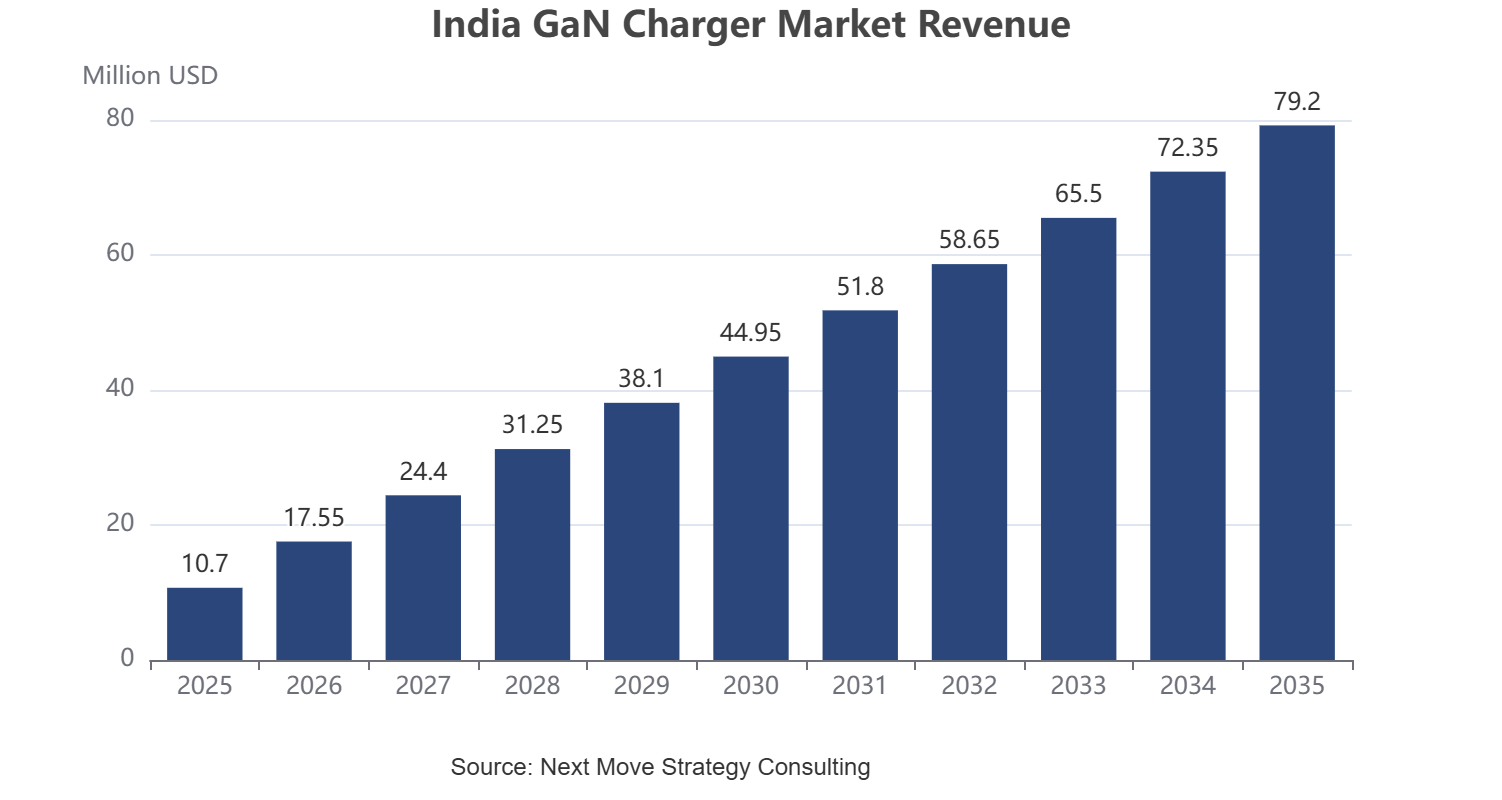
India GaN Charger Market Size & Forecast 2025–2035
|
Parameters |
Details |
|
Market Size in 2025 |
USD 10.7 Million |
|
Market Size in 2026 |
USD 14.5 Million |
|
Revenue Forecast in 2035 |
USD 79.2 Million |
|
Growth Rate |
CAGR of 20.78% from 2026 to 2035 |
|
Market Volume in 2025 |
298 Thousand Units |
|
Market Volume in 2026 |
417 Thousand Units |
|
Volume Forecast in 2035 |
2,640 Thousand Units |
|
Growth Rate |
CAGR of 22.76% from 2026 to 2035 |
|
Analysis Period |
2025–2035 |
|
Base Year Considered |
2025 |
|
Forecast Period |
2026–2035 |
|
Market Size Estimation |
Million (USD) |
|
Companies Profiled |
14 |
|
Market Share |
Available for 10 Companies |
Industry Outlook
The India GaN Charger Market was valued at USD 10.7 million in 2025 and reached USD 14.5 million in 2026. Looking ahead, the market is projected to experience strong growth, reaching USD 79.2 million by 2035, registering a CAGR of 20.78% from 2026 to 2035. In terms of volume, the market recorded 298 thousand units in 2025, with forecasts indicating growth to 417 thousand units by 2026 and further to 2,640 thousand units by 2035, reflecting a CAGR of 22.76% over the same period.
What Are the Key Market Drivers, Emerging Trends, and Investment Opportunities That Will Shape the India GaN Charger Market in the Next Decade?
Growth Catalyst & Risk Assessment Matrix
|
Drivers / Trends / Restraints |
(+/-) % Impact on CAGR Forecast |
Geographic Relevance |
Impact Timeline |
|
Rising smartphone and laptop penetration supported by growing disposable incomes is accelerating demand for compact, fast-charging GaN chargers across India |
+2.1% |
Delhi NCR, Mumbai, Bengaluru, Hyderabad |
Short to medium term (1-5 years) |
|
Government Production Linked Incentive schemes for electronics manufacturing are encouraging domestic assembly and lowering GaN charger component costs |
+1.7% |
Pan India, Uttar Pradesh, Tamil Nadu |
Medium term (2-7 years) |
|
Rapid expansion of e-commerce and organized retail is improving access to GaN chargers across tier two and tier three cities |
+1.5% |
Tier 2 and Tier 3 cities, Pan India |
Medium to long term (3-8 years) |
|
High component costs and strong price sensitivity among consumers continue to limit adoption of premium GaN chargers in India |
-1.5% |
Pan India |
Short to medium term (1-5 years) |
|
Rising demand for multi-device charging and growing domestic electronics manufacturing are creating new opportunities for GaN charger brands |
+1.4% |
Pan India, Maharashtra, Karnataka |
Long term (4-10 years) |
Through our market assessment, we observed that the India GaN Charger Market is experiencing significant growth, driven by rising smartphone and laptop penetration, growing domestic electronics manufacturing under government incentive schemes, and increasing consumer preference for fast-charging accessories. However, high component costs and price sensitivity among Indian consumers continue to restrain broader market penetration. At the same time, expanding e-commerce infrastructure and rising demand for premium charging accessories are expected to create substantial long-term growth opportunities for GaN charger manufacturers across India.
Growth Drivers
How Is Rising Smartphone and Laptop Penetration Driving the India GaN Charger Market?
Our market assessment indicates that the rapid rise in smartphone and laptop ownership across India, supported by growing disposable incomes and digital adoption, is a major factor driving demand for GaN chargers. Consumers increasingly prefer compact, fast-charging accessories capable of supporting multiple device types. GaN technology enables higher power density, reduced heat generation, and improved charging efficiency, making it an increasingly attractive alternative to conventional silicon-based chargers for Indian consumers across metro and non-metro markets.
How Are Government Manufacturing Incentives Fueling the India GaN Charger Market?
Based on our market evaluation, government initiatives such as the Production Linked Incentive scheme for electronics manufacturing are encouraging domestic assembly and component sourcing for charging accessories in India. This is gradually reducing import dependency, lowering landed costs, and enabling manufacturers to price GaN chargers more competitively. The growing presence of contract manufacturers and component suppliers within India is further supporting faster product localization and expanding the availability of GaN charging solutions nationwide.
How Is E-Commerce Expansion Supporting Market Development Across India?
According to NMSC research, the rapid expansion of e-commerce platforms and organized retail across India is significantly improving access to premium charging accessories, including GaN chargers, beyond metro cities. Rising internet penetration and smartphone-led online shopping behavior are enabling consumers in tier two and tier three cities to access fast-charging technology previously limited to urban markets. This is expected to broaden the addressable customer base and strengthen market growth across India.
Growth Inhibitor:
How Do High Component Costs and Price Sensitivity Restrain Market Growth?
Despite strong growth prospects, the India GaN Charger Market continues to face challenges related to the relatively high cost of GaN semiconductor components compared to conventional silicon-based alternatives. Through our market analysis, we observed that price sensitivity among a large segment of Indian consumers can slow adoption of premium charging accessories. Additionally, the presence of low-cost, unbranded chargers in the unorganized retail sector continues to pose a competitive challenge to established GaN charger brands.
Growth Opportunity:
How Are E-Commerce Expansion and Multi-Device Demand Creating New Growth Opportunities?
Through NMSC's assessment, we found that expanding e-commerce infrastructure, rising smartphone replacement cycles, and growing demand for multi-device charging solutions are creating significant opportunities for GaN charger manufacturers in India. Increasing adoption of laptops and tablets for remote work and education is further supporting demand for higher-wattage chargers. Furthermore, growing investments in domestic electronics manufacturing are expected to generate substantial long-term opportunities for GaN charger brands and component suppliers across India.
PAIN POINT ANALYSIS OF THE INDIA GAN CHARGER MARKET
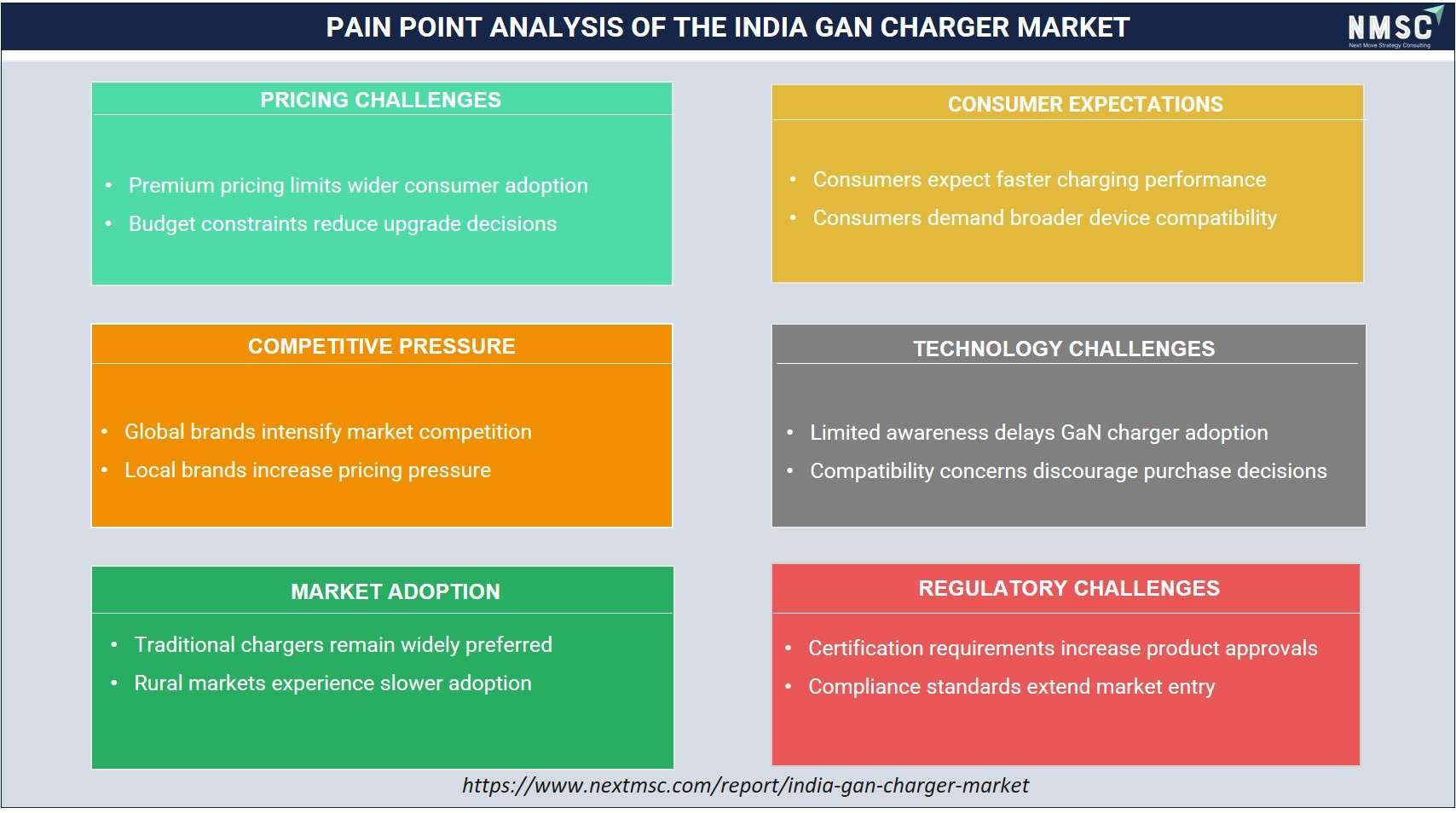
The infographic outlines the major pain points influencing the market. Key challenges include premium pricing, strong competition from global and local brands, limited consumer awareness, device compatibility concerns, and slower adoption in rural areas. Consumers also expect faster charging performance and wider device compatibility, while regulatory requirements and certification processes can delay product approvals and market entry. Addressing these issues is essential for accelerating GaN charger adoption across India.
How Is the India GaN Charger Market Segmented in This Report, and What Are the Key Insights from the Segmentation Analysis?
By Power Output Insights
How Is Power Output Influencing Demand Across the India GaN Charger Market?
Based on power output, the market is segmented into Up to 30W, 31W to 65W, 66W to 100W, and Above 100W.
Based on our analysis, we observed that power output remains a critical factor influencing purchasing decisions in the market. Chargers offering up to 30W are widely preferred for smartphones and budget devices due to their affordability, which remains a key purchase driver in India. The 31W to 65W segment is gaining traction for smartphones and lightweight laptops, while 66W to 100W and above 100W chargers are increasingly adopted among professionals and students requiring multi-device charging capability.
By Product Type Insights
How Is Product Type Shaping Growth in the India GaN Charger Market?
Based on product type, the market is segmented into Wall Chargers, Desktop Chargers, Power Banks, and Car Chargers.
Based on our evaluation, we identified that product innovation and evolving consumer charging habits are shaping the market. Wall chargers continue to lead the market given their widespread use for everyday charging of smartphones and laptops across households and offices. Desktop chargers are gaining traction among multi-device users, while GaN-enabled power banks are witnessing rising demand for travel and commute use. Car chargers are also seeing steady uptake with growing vehicle ownership across India.
Competitive Landscape Overview
The market is characterized by a competitive and rapidly evolving landscape, supported by the presence of global consumer electronics brands, regional accessory manufacturers, and component suppliers. Market growth is driven by rising demand for fast-charging consumer electronics, expanding domestic manufacturing capacity, and growing consumer awareness of GaN technology benefits. Continuous product innovation, competitive pricing strategies, and the expansion of e-commerce and organized retail channels are strengthening the positioning of market participants across India.
Key Players
-
Lenovo India Private Limited
-
Targus India Private Limited
-
Nomad Goods Inc.
-
ACCO Brands India Private Limited
-
Xiaomi Technology India Private Limited
-
Acer India Private Limited
-
Momax Technology Hong Kong Limited
-
Alogic India Private Limited
-
Buffalo Inc.
-
Minix Technology Limited
-
D-Link India Limited
-
Nothing Technology India Private Limited
-
Honor Device India Private Limited
NMSC's analysis indicates that competitive dynamics in the market are shaped by advancements in gallium nitride semiconductor technology, competitive pricing, and expanding retail reach. Key companies such as Lenovo India, Dell India, Targus India, Nomad Goods, ACCO Brands India, Xiaomi Technology India, Acer India, Momax Technology, Alogic India, Buffalo, Minix Technology, D-Link India, Nothing Technology India, and Honor Device India are strengthening market positions through product innovation, localization, and expansion of energy-efficient GaN charging portfolios across India.
Key Segments
By Power Output
-
Up to 30W
-
31W to 65W
-
66W to 100W
-
Above 100W
By Product Type
-
Wall Chargers
-
Desktop Chargers
-
Power Banks
-
Car Chargers
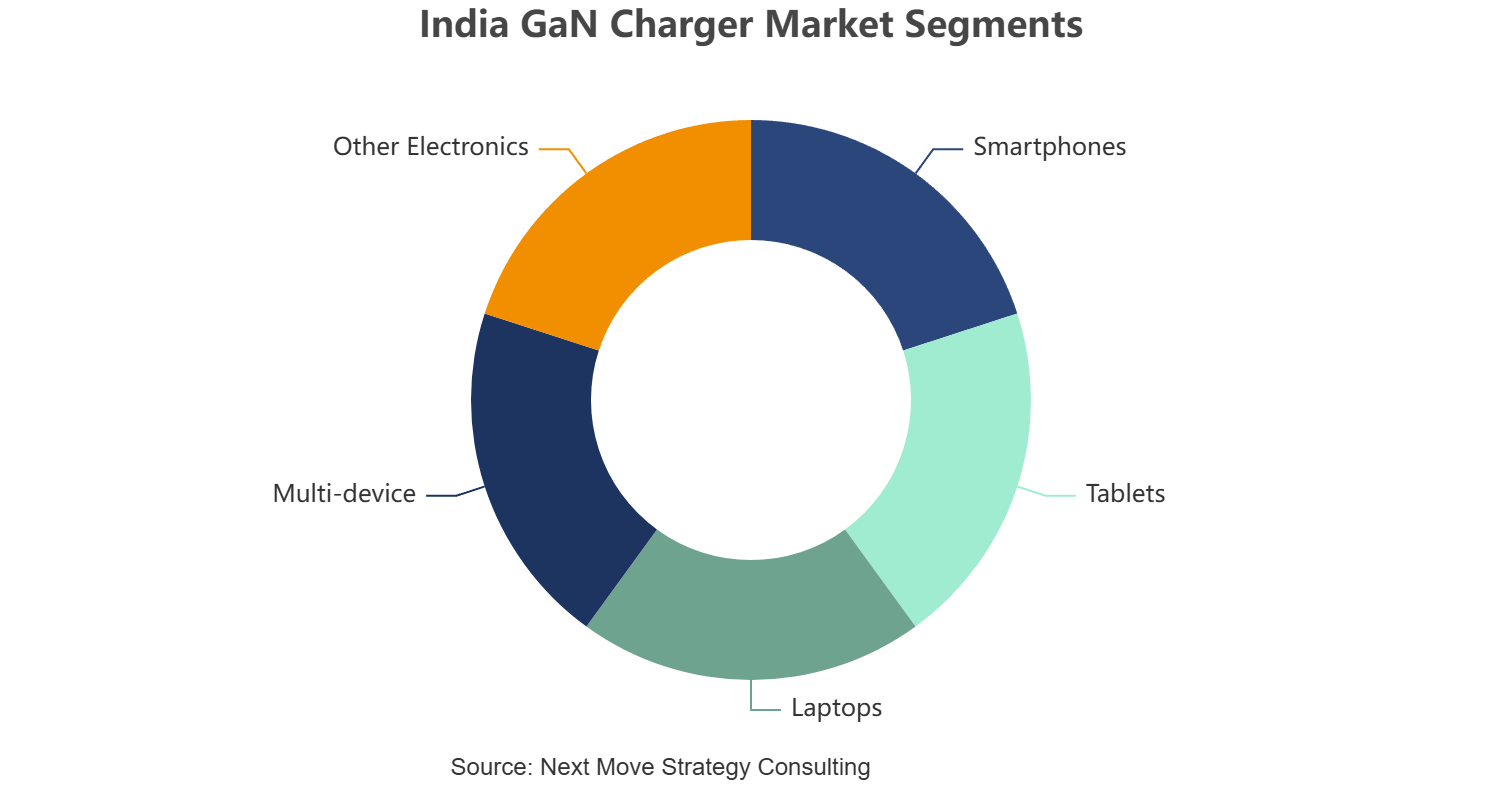
By Device Compatibility
-
Smartphones
-
Tablets
-
Laptops
-
Multi-device
-
Other Electronics
By Number of Ports
-
Single Port
-
Dual Port
-
More than 2 Ports
By Sales Channel
-
Online
-
Offline
By End User
-
Consumer
-
Commercial
-
Industrial
CONSUMER BEHAVIOR ANALYSIS OF THE INDIA GAN CHARGER MARKET
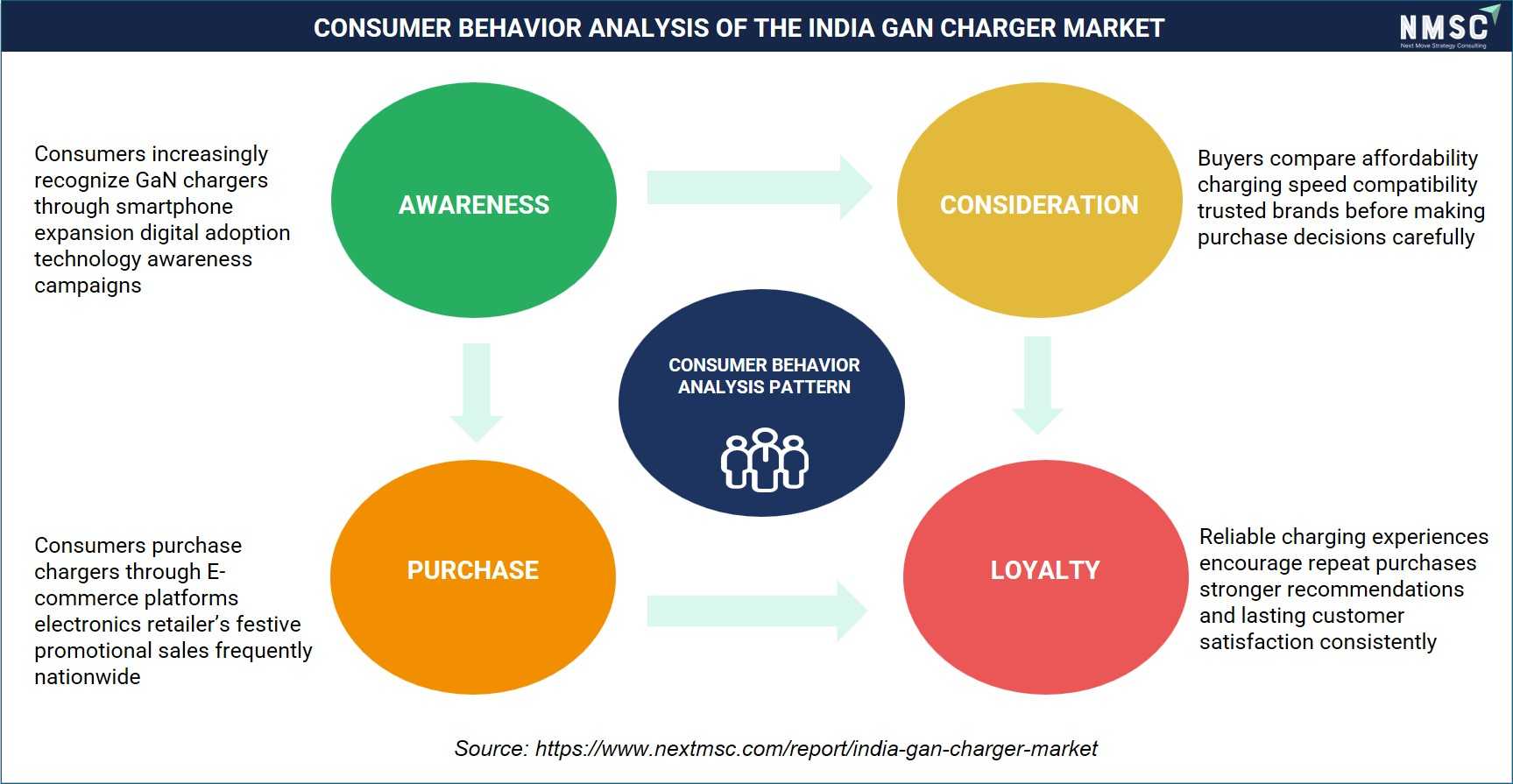
The infographic highlights the four key stages of consumer behavior in the market: Awareness, Consideration, Purchase, and Loyalty. Consumers first become aware of GaN chargers through smartphone adoption, digital marketing, and technology campaigns. They then evaluate factors such as price, charging speed, compatibility, and brand reputation before purchasing through e-commerce platforms and retail stores. Positive charging experiences encourage repeat purchases, customer satisfaction, and long-term brand loyalty.
Key Benefits for Stakeholders
Next Move Strategy Consulting (NMSC) presents a comprehensive analysis of the market, covering historical developments from 2020 to 2025 and providing forecasts through 2035. Our study evaluates the market across key Indian states and metro and non-metro regions, delivering quantitative market outlooks alongside qualitative insights into GaN charger adoption, fast-charging technology trends, power output innovations, and advancements in gallium nitride semiconductor technology relevant to domestic manufacturers, distributors, and retailers.
Investors benefit from expanding opportunities in high-performance charging solutions and domestic electronics manufacturing, while GaN semiconductor manufacturers, charger manufacturers, consumer electronics brands, component suppliers, distributors, retailers, and enterprise users benefit from increasing demand for compact, high-speed, and energy-efficient charging solutions across India. Policymakers and industry associations also gain insights into regulatory trends, manufacturing incentives, and competitive dynamics shaping the India GaN charger ecosystem going forward.
|
Parameters |
Details |
|
Customization Scope |
Free customization (equivalent to up to 80 analyst-working hours) after purchase. |
|
Pricing and Purchase Options |
Avail customized purchase options to meet your exact research needs. |
|
Approach |
In-depth primary and secondary research; proprietary databases; rigorous quality control and validation measures. |
|
Analytical Tools |
Porter's Five Forces, SWOT, value chain, and Harvey ball analysis to assess competitive intensity, stakeholder roles, and relative impact of key factors. |
Conclusion
The market is positioned for robust growth through 2035, expanding from USD 10.7 million in 2025 to a projected USD 79.2 million, registering a CAGR of 20.78% during the forecast period. This growth is driven by rising smartphone and laptop penetration, expanding domestic electronics manufacturing, and growing e-commerce access to premium charging accessories. Although price sensitivity may restrain expansion in the short term, government manufacturing incentives and rising demand for multi-device charging are expected to create long-term opportunities, while product innovation strengthens competitive dynamics across India.
About the Author
 Liza Phukan
— Liza Phukan is Research Associate at Next Move Strategy Consulting, where she has covered emerging industries and market research across sectors for 3.5 years. Her work includes analyzing industry developments, validating market data, and developing structured business content from research findings. She uses secondary research and data-validation practices to turn complex market information into clear decision-useful market analysis for business audiences and support report development and B2B.
Liza Phukan
— Liza Phukan is Research Associate at Next Move Strategy Consulting, where she has covered emerging industries and market research across sectors for 3.5 years. Her work includes analyzing industry developments, validating market data, and developing structured business content from research findings. She uses secondary research and data-validation practices to turn complex market information into clear decision-useful market analysis for business audiences and support report development and B2B.
About the Reviewer
 Supradip Baul
— Supradip Baul is an accomplished business consultant and strategist with over a decade of rich experience in market intelligence, strategy, technology, and business transformation. His work has included rigorous qualitative and quantitative analysis across multiple industries, helping clients shape investment decisions and long-term roadmaps. Earlier in his career, he was associated with Gartner, where he contributed to industry-leading reports and market share analyses. He has worked with leading global companies and holds an MBA with a dual specialization in Marketing and Finance.
Supradip Baul
— Supradip Baul is an accomplished business consultant and strategist with over a decade of rich experience in market intelligence, strategy, technology, and business transformation. His work has included rigorous qualitative and quantitative analysis across multiple industries, helping clients shape investment decisions and long-term roadmaps. Earlier in his career, he was associated with Gartner, where he contributed to industry-leading reports and market share analyses. He has worked with leading global companies and holds an MBA with a dual specialization in Marketing and Finance.
At Next Move Strategy Consulting, we understand that insightful market research is the cornerstone of successful business decisions. That's why we employ a robust and multifaceted approach, combining various methodologies to deliver the most accurate and actionable data for our clients.

Research Landscape
We navigate the world of research with two primary approaches:
Qualitative Approach
Our qualitative research methodologies involve immersive techniques such as in-depth interviews, focus groups, and observational studies. By engaging directly with individuals and stakeholders, we uncover valuable insights that quantitative data alone may overlook.

Quantitative Research
In tandem with qualitative methodologies, NMSC leverages the power of Quantitative Research to provide a robust foundation of numerical insights. Through systematic data collection and analysis, we quantify patterns, preferences, and market trends, offering a comprehensive view of the business landscape.
Our quantitative research approach employs diverse tools, including surveys, experiments, and statistical modelling. These methodologies enable us to gather data from a large and representative sample, ensuring the statistical significance of our findings. By employing structured questionnaires and standardized data collection methods, we guarantee the reliability and validity of the information we present to our clients.
Quantitative research is particularly effective in measuring the prevalence of trends, assessing market size, and gauging the impact of various factors on consumer behavior. The numerical precision attained through this approach equips our clients with actionable insights, facilitating data-driven decision-making and strategy formulation.


Our Specialized Toolbox for Industry-Specific Market Research
We deploy a specialized arsenal of techniques tailored to meet your unique requirements. Here's a glimpse into our comprehensive toolbox:

Information Procurement
The stage entails acquiring market data or relevant information through various sources and methodologies.


Market Research Approach
We utilize both top-down and bottom-up approaches in market research analysis to achieve a comprehensive understanding of the market dynamics, leveraging the broad perspective of industry trends and macroeconomic factors alongside detailed insights from specific segments and individual companies.

Porters Five Forces Analysis
We conduct Porter's Five Forces analysis to evaluate the competitive landscape of an industry, providing us with insights into factors that affect profitability and strategic positioning.

SWOT Analysis

Forecasting
We utilize a forecasting model to predict future consumption by considering parameters like population, economics, regulations, market competition, drivers, constraints, technology, and pricing. We also employ statistical techniques such as multilinear regression, exponential smoothing, moving average, ARIMA, and Monte Carlo simulations for accurate predictions. In econometric forecasting, we analyzed short-term and long-term event impacts, attributing values based on regulatory frameworks, economic factors, and market events.





 Speak to Our Analyst