India Glass Hardware Market By Product (Discrete Components, Engineered Systems, and Smart & Automated Hardware), By Material (Stainless Steel, Aluminum, Brass & Bronze, Zinc Alloy, Engineered Polymers, & Others), By Distribution Channel (Direct to Contractor, Direct to Project Owner, Distributor & Wholesaler, Brick & Mortar Retail, E‑commerce, & OEM), By End-User Industry (Residential, Commercial Office, Hospitality, Institutional, & Others) – Analysis & Forecast, 2025-2035
Industry: Materials and Chemical | Publishing Date: April 17, 2026 | Last Updated: September 30, 2026 | No of Pages: N/A | No. of Tables: N/A | No. of Figures: N/A | Format: PDF | Report Code: MC4515
Industry Outlook
The India Glass Hardware Market size was valued at USD 240.7 million in 2025 and is expected to be valued at USD 256.9 million by the end of 2026. The industry is projected to grow, hitting USD 461.9 million by 2035, with a CAGR of 6.73% between 2026 and 2035.
India Glass Hardware Industry Size & Forecast
|
Parameters |
Details |
|
Market Size in 2026 |
USD 256.9 million |
|
Revenue Forecast in 2035 |
USD 461.9 million |
|
Growth Rate |
CAGR of 6.73% from 2026 to 2035 |
|
Analysis Period |
2025–2035 |
|
Base Year Considered |
2025 |
|
Forecast Period |
2026–2035 |
|
Market Size Estimation |
Million (USD) |
|
Companies Profiled |
20 |
|
Countries Covered |
33 |
|
Market Share |
Available for 10 companies |
The India glass hardware market is currently positioned as a mid-scale, steadily expanding segment within the broader building materials and architectural fittings industry. NMSC’s analysis indicates that demand is primarily driven by residential and commercial construction, where biometric patch locks is extensively used in applications such as frameless doors, shower enclosures, balustrades, partitions, and façade systems. Based on our interactions with product managers and contractors, we observed a clear shift toward precision-engineered components and aesthetically refined fittings, particularly in urban projects where design, durability, and ease of installation are critical decision factors.
Looking ahead, the market is set to witness sustained growth, supported by evolving architectural preferences, increasing adoption of modular systems, and a gradual shift toward premium finishes and localized manufacturing. While cost sensitivity remains a limiting factor in certain segments, demand for higher-value engineered solutions is expanding across commercial and high-end residential projects. Moreover, manufacturers focusing on innovation, supply chain efficiency, and product standardisation gain a competitive advantage, positioning the market for stable, long-term expansion.
What Are the Key India Glass Hardware Market Trends?
How Is Design-Led Minimalism and Frameless Architecture Transforming the India Glass Hardware Market?
The growing preference for minimalist, design-led interiors is significantly influencing digital lock for glass doors demand in India. Our technical evaluation indicates that architects and developers are increasingly prioritising frameless glass installations, concealed fittings, and sleek finishes to achieve modern aesthetic standards. Moreover, the demand is shifting toward low-visibility hardware such as patch fittings, slim hinges, and recessed tracks, particularly in premium residential and commercial spaces. This trend is not only elevating product specifications but also encouraging manufacturers to innovate in precision engineering and finish quality.
How Is Standardisation and Modularisation Reshaping Product Development?
NMSC’s analysis indicates that the market is gradually shifting toward standardised and modular hardware systems to enhance installation efficiency and scalability. Consequently, pre-engineered kits for sliding doors, shower enclosures, and railing systems are gaining traction, as they reduce on-site customisation requirements. Furthermore, technical evaluation shows that modular systems streamline procurement, lower installation time, and minimise errors, particularly in large-scale commercial projects. As a result, this transition is enabling suppliers to expand across geographies while maintaining consistent product quality, thereby strengthening overall operational efficiency across the value chain.
How Is the Shift Toward Premium Finishes and Surface Treatments Influencing Market Dynamics?
Our research suggests that increasing demand for premium finishes such as matte black, brushed gold, and anti-corrosion coatings is redefining product differentiation in the India glass hardware market. Consumers and designers are placing greater emphasis on visual appeal and long-term durability, especially in high-humidity environments like bathrooms and coastal regions. As a result, manufacturers are investing in advanced surface treatment technologies, including PVD coating and anodization, to enhance both aesthetics and performance. This trend is therefore, driving higher average selling prices and enabling brands to position themselves in premium segments.
Ecosystem Analysis of the India Glass Hardware Market
The chart illustrates the key structural components and interdependencies shaping the India glass hardware market across its value chain.
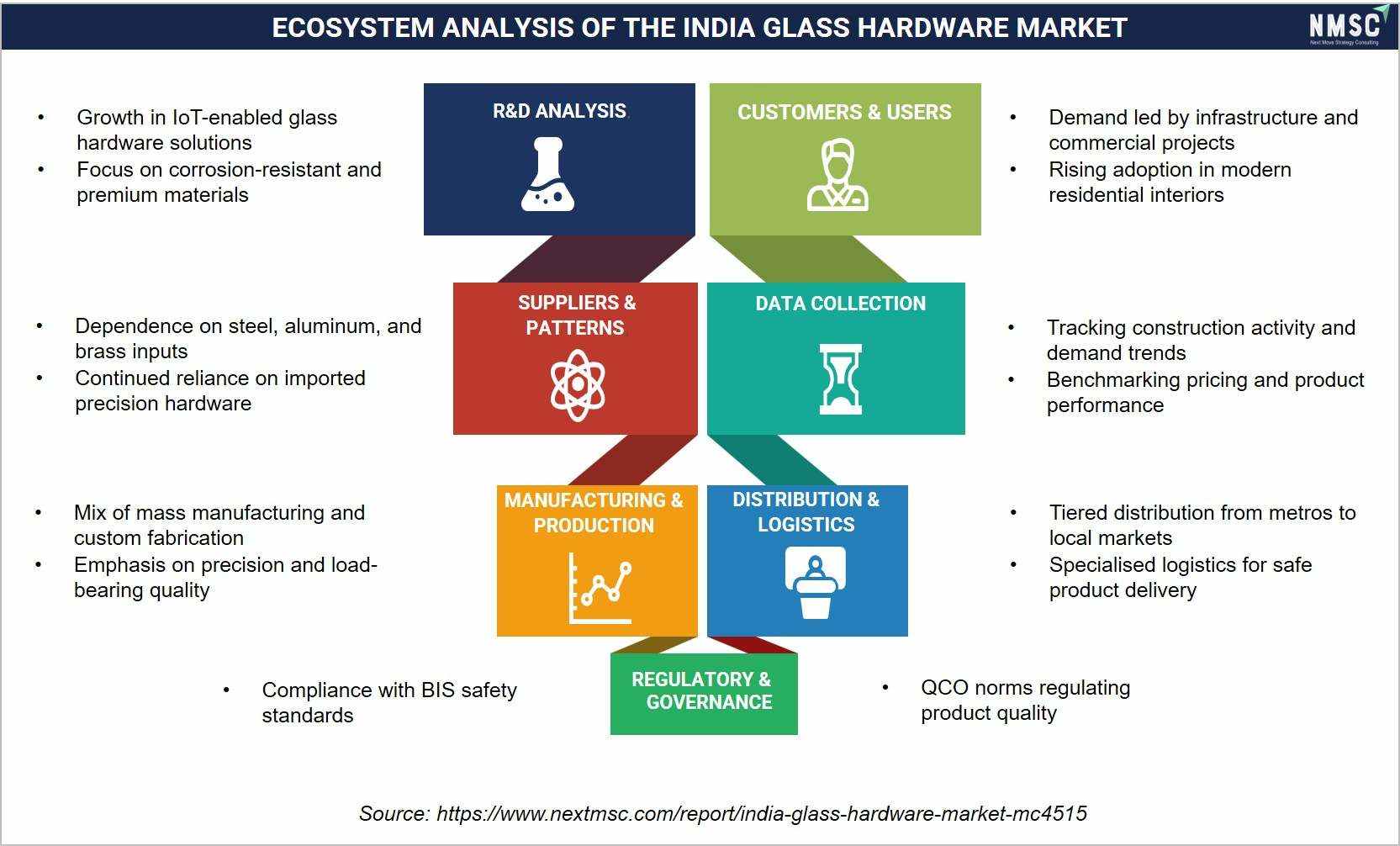
Based on our analysis, we found that the chart captures how innovation, material sourcing, manufacturing capabilities, and distribution networks collectively define market dynamics. It highlights the role of R&D in enabling smart and durable hardware, while demand is driven by infrastructure projects and evolving residential preferences. Supplier dependencies and import reliance indicate global linkages, whereas localised manufacturing and tiered distribution ensure market reach. Regulatory frameworks further reinforce quality and standardisation. Overall, the chart demonstrates how coordinated interactions across stakeholders are transforming the market into a more organized, technology-driven, and value-focused industry.
What Are the Key Market Drivers, Breakthroughs, And Investment Opportunities That Will Shape the India Glass Hardware Market in the Next Decade?
Growth Catalyst & Risk Assessment Matrix
|
DRIVERS/TRENDS/ RESTRAINTS |
(+/-) % IMPACT ON CAGR FORECAST |
GEOGRAPHIC RELEVANCE |
IMPACT TIMELINE |
|
Rapid urbanization and expansion of residential and commercial construction driving demand for glass hardware |
+2.92% |
India- Tier 1 and Tier 2 cities |
Medium to Long term (3-6 years) |
|
Adoption of smart and automated hardware solutions accelerating premium segment growth |
+2.57% |
India- Metropolitan and high-end commercial projects |
Medium term (2-4 years) |
|
Increasing focus on premium and sustainable building materials supporting engineered systems and high-value installations |
+1.68% |
India- Commercial, institutional, and high-end residential segments |
Medium to Long term (3-5 years) |
|
Cost sensitivity and price fluctuations in raw materials limiting adoption in mid-tier and smaller projects |
-2.13% |
India- Tier 2/Tier 3 residential projects and small commercial installations |
Medium term (2-5 years) |
Our assessments shows that the India glass hardware market is primarily propelled by the rapid growth of residential and commercial construction, alongside increasing adoption of premium and engineered glass hardware solutions. Developers, architects, and project owners are increasingly specifying high-quality materials such as stainless steel, aluminum, and engineered polymers, while also integrating smart and automated systems to enhance security, aesthetics, and operational efficiency. Furthermore, the expansion of digital procurement channels and e-commerce platforms is improving market accessibility and enabling faster distribution to contractors and end-users. However, cost sensitivity, particularly in mid-tier residential and smaller commercial projects, alongside price fluctuations in raw materials, remains a key restraint, challenging the adoption of higher-value engineered and smart solutions.
Growth Drivers:
How Is Rapid Urbanization and Construction Activity Accelerating the India Glass Hardware Market?
Based on our market assessment, we found that India’s ongoing urbanization, coupled with sustained growth in residential and commercial construction, is a primary accelerator of the glass hardware market. As a result, new housing projects, high-rise commercial buildings, and large-scale infrastructural developments are increasingly specifying glass facades, frameless doors, and engineered systems to meet both aesthetic and functional requirements. Moreover, project specifications now prioritise premium materials and advanced fittings, such as stainless-steel hinges and automated door systems, which significantly elevate per-unit revenue. Consequently, this sustained demand is creating predictable procurement cycles and incentivising suppliers to expand capacity, directly supporting overall market growth.

The above infographic illustrates the steady rise in India’s urban population, increasing from approximately 32% in 2014 to an estimated 36% in 2024, reflecting heightened construction and infrastructure activity across cities. As urban centers expand, demand grows for contemporary architectural solutions such as glass doors, windows, and partitions, with developers emphasizing aesthetics, safety, and efficient space utilization. This upward urbanization trend not only broadens the potential customer base but also drives adoption of premium and innovative glass hardware, presenting suppliers with opportunities to customize offerings for both established metropolitan hubs and emerging urban markets.
How Are Technological Advancements and Smart Hardware Adoption Driving India Glass Hardware Market Expansion?
The integration of smart and automated hardware solutions, including electronic locks, automated door operators, and sensor-based access systems, is a critical driver of market growth. Based on our discussions with industry consultants, we found that developers and institutional clients are increasingly adopting IoT-enabled glass hardware to enhance security, energy efficiency, and user experience. These solutions command higher margins compared to traditional fittings and encourage repeat installations in commercial, hospitality, and high-end residential segments. Further, early adoption by leading developers is accelerating technology diffusion, establishing a long-term trajectory for premium hardware demand.
Growth Inhibitor:
How Are High Costs and Price Sensitivity Limiting the India Glass Hardware Market Growth?
The relatively high cost of engineered glass hardware and smart systems remains a significant restraint on market expansion. Our analysis indicates that while developers and institutional clients are willing to invest in premium fittings, price-sensitive residential buyers and small-scale contractors tend to prefer cost-effective alternatives, such as conventional metal or composite fittings. As a result, this cost barrier limits penetration in mid-tier and budget construction projects, particularly in Tier 2 and Tier 3 cities. Unless suppliers optimise production and supply chain efficiencies, price sensitivity could continue to moderate adoption rates, especially for high-margin engineered systems and smart hardware components.
Growth Opportunity:
How Is the Growing Focus on Premium and Sustainable Building Solutions Creating India Glass Hardware Market Opportunities?
Our assessments suggests that the rising emphasis on premium, sustainable, and energy-efficient buildings is creating significant growth opportunities for glass hardware suppliers. Consequently, architects and developers are increasingly specifying stainless steel, aluminum, and engineered polymer components that support both durability and design flexibility. Furthermore, NMSC’s evaluation indicates that sustainability-driven demand, including low-maintenance finishes and recyclable materials, enables suppliers to differentiate their offerings and capture higher-value segments. Notably, early entrants focusing on integrated smart solutions and environmentally conscious materials are likely to gain a strategic advantage, thereby expanding both their product portfolio and long-term market share within India’s growing construction ecosystem.
How Is the India Glass Hardware Market Segmented in This Report, And What Are the Key Insights from the Segmentation Analysis?
Market Highlights & Strategic Insights - India Glass Hardware Market:
|
Segments |
Key Takeaways |
|
Products |
Product segmentation defines value concentration in the market, with discrete components dominating volume due to widespread usage across residential and small commercial projects. Engineered systems contribute higher revenue through premium installations such as frameless doors and railings, while smart and automated hardware is emerging rapidly, driven by demand for security, convenience, and integrated building solutions. |
|
Material |
Material choice significantly influences durability and pricing, with stainless steel leading due to strength and corrosion resistance. Aluminum offers cost efficiency and lightweight benefits, while brass and bronze cater to premium aesthetics. Zinc alloy supports mass-market applications, and engineered polymers are gaining traction in specialised, design-driven use cases. |
|
Distribution Channel |
The market is largely project-driven, with direct sales to contractors and project owners dominating large installations. Distributors and wholesalers ensure widespread availability, while retail and e-commerce channels support smaller buyers. OEM partnerships remain important for integrated systems and large-scale developments. |
|
End-User Industry |
Residential, followed by commercial office segments, account for the majority of demand, driven by urban construction and modern interior preferences. Hospitality and institutional sectors focus on durability and design, while retail and infrastructure projects create niche demand for high-performance and visually appealing hardware solutions. |
By Products Insights
Is Product Segmentation Driving Value Differentiation in the India Glass Hardware Market?
On the basis of products, the India glass hardware market is segmented into discrete components, engineered systems, and smart & automated hardware.
Based on our assessment, we observed that discrete components dominate the India glass hardware market in terms of volume due to their widespread use across residential and small-scale commercial applications. However, engineered systems contribute a disproportionately higher share of revenue, supported by increasing demand for façade systems, frameless installations, and modular solutions in large projects. Smart and automated hardware, although currently a smaller segment, is expected to register the fastest growth due to rising adoption of smart building technologies and premium infrastructure development. Industry evidence further suggests that value is gradually shifting from basic components toward integrated and high-performance systems, reflecting broader construction and architectural trends in India.
By Material Insights
Is Material Selection Driving Performance and Premiumization in the India Glass Hardware Market?
Based on material, the India glass hardware market is segmented into stainless steel, aluminum, brass & bronze, zinc alloy, engineered polymers, other materials.
Our market assessment identifies that stainless steel dominates the India glass hardware market due to its durability, corrosion resistance, and widespread applicability across residential, commercial, and infrastructure projects. Aluminum follows as a strong second due to its cost efficiency and suitability for modular systems. Brass and bronze cater to premium aesthetic applications, while zinc alloy supports mass-market affordability. On the other hand, engineered polymers and other materials remain niche but are gaining importance in specialised use cases. Industry patterns indicate a gradual shift toward performance-driven and aesthetically refined materials, aligning with evolving construction and architectural trends in India.
By End-User Industry Insights
Is End-User Demand Shaping Growth Patterns in the India Glass Hardware Market?
Based on end-user industry, the India glass hardware market is segmented into residential, commercial office, hospitality, institutional, retail & display, infrastructure.
We observed that the residential segment dominates the India glass hardware market due to the sheer scale of housing construction and renovation activities across urban centers. Our observations also indicates that commercial office and hospitality sectors follow closely in terms of value contribution, driven by demand for premium and engineered glass systems. Institutional and infrastructure segments provide stable long-term demand supported by government investments in public facilities. Meanwhile, retail and display applications create niche opportunities driven by aesthetic considerations. As India’s urbanisation and commercial development accelerate, demand across multiple end-user sectors continue expanding steadily.

Regional Outlook:
Our primary research indicates that the glass hardware market in India shows varied regional demand patterns, as the North and West regions dominate due to rapid urbanisation and extensive commercial and residential construction in hubs like Delhi–NCR, Mumbai, and Ahmedabad. The South is emerging as a growth hotspot, fuelled by industrial and IT-driven infrastructure in Bengaluru, Chennai, and Hyderabad. In contrast, the East exhibits lower market penetration, though ongoing infrastructure projects are gradually increasing adoption. Regional growth is primarily driven by construction activity, rising safety and aesthetic standards, and increased awareness of modern architectural hardware solutions.
Price Point Analysis of the India Glass Hardware Market
The infographic illustrates the price point analysis illustrates how cost structures, material selection, and product positioning influence pricing dynamics across the India glass hardware market.

We noticed that the chart highlights a clear stratification between mass-market, mid-range, and premium segments driven primarily by material quality, design complexity, and brand positioning. Entry-level products, using zinc alloys and basic finishes, cater to cost-sensitive residential demand, while mid-range offerings balance durability and aesthetics for commercial applications. Premium segments, dominated by stainless steel and engineered systems, command higher margins due to precision engineering, imported components, and brand value. Industry evidence suggests that pricing is further shaped by project-based procurement, customisation requirements, and fluctuating raw material costs, making value engineering and supplier relationships critical for maintaining competitive pricing strategies.
Competitive Landscape
Competitive Dynamics & M&A Landscape:
|
Key Takeaways |
|
The market is led by global access solution providers such as dormakaba, ASSA ABLOY, Allegion plc, and domestic leaders including Ozone Overseas, Hardwyn India, Dorset Industries, as well as specialists like Q-railing and Bohle AG targeting premium architect-driven projects. |
|
Global players focus on integrated access systems, automation, and premium positioning, while domestic firms leverage cost efficiency, local distribution strength, and customization capabilities. Specialists differentiate via high-end façade and railing solutions. |
|
Companies are innovating in smart integration, modular systems, automated glass door systems, sensor-based and access-controlled technologies, with design and material advancements driving differentiation. Firms like GEZE India, ASSA ABLOY, Ebco, Transparent lead these initiatives. |
Which Companies Dominate the India Glass Hardware Market and How Do They Compete?
We found that the India glass hardware market is highly competitive, led by global access solution providers such as dormakaba, ASSA ABLOY, and Allegion plc, alongside strong domestic players including Ozone Overseas Pvt. Ltd., Hardwyn India Limited, and Dorset Industries Private Limited. Moreover, global firms compete through integrated access systems, automation, and premium positioning, while Indian manufacturers leverage cost efficiency, local distribution strength, and customisation capabilities. Specialist firms such as Q-railing and Bohle AG differentiate through high-end façade and railing solutions, targeting architect-driven projects and premium infrastructure developments.
Market Dominated by India Glass Hardware Giants and Specialists
Industry analysis indicates that the market reflects a dual structure where multinational corporations and niche specialists coexist across different value segments. Companies such as Hafele India, Hettich India Pvt. Ltd., and SUGATSUNE KOGYO INDIA PRIVATE LIMITED dominate premium interior and architectural hardware, focusing on precision engineering and design-led applications. In contrast, firms like Kinlong India Hardware Pvt Ltd and IPSA Business India Pvt.Ltd. cater to large-scale construction and infrastructure demand through volume-driven offerings. We noticed that regional players and import-driven brands further intensify competition, particularly in price-sensitive segments, creating a fragmented yet highly dynamic ecosystem.
Innovation and Adaptability Drive Market Success
Innovation is increasingly centred around smart integration, modular systems, and material advancements. We observed that companies such as GEZE India Private Limited and ASSA ABLOY are advancing automated glass door systems with sensor-based and access-controlled technologies, aligning with smart building trends. At the same time, Ebco Private Limited and Transparent (Kich Architectural Products Private Limited) are focusing on design innovation and modular glass fittings for interior applications. Furthermore, adaptability in offering customisable, easy-to-install, and aesthetically aligned solutions is becoming a key differentiator across both residential and commercial segments.
Market Players to Opt for Merger & Acquisition Strategies to Expand Their Presence
Market trends indicate that while large-scale acquisitions are more prominent at the global level, their impact is strongly reflected in India through expanded product portfolios and distribution networks. Companies like dormakaba, Allegion plc, and ASSA ABLOY leverage global acquisitions to introduce advanced technologies and integrated solutions into the Indian market. Meanwhile, we found that domestic firms such as Godrej Enterprises and Kolf International Pvt. Ltd. focus on partnerships, dealer network expansion, and portfolio diversification to strengthen their presence. This combination of global consolidation and local strategic expansion is enabling companies to scale efficiently while addressing diverse market needs.
List of Key India Glass Hardware Companies
-
Ozone Overseas Pvt. Ltd.
-
Hafele India
-
GEZE India Private Limited
-
Godrej Enterprises
-
Kinlong India Hardware Pvt Ltd
-
Allegion plc
-
Hettich India Pvt. Ltd
-
Hardwyn India Limited
-
Dorset Industries Private Limited
-
Transparent (Kich Architectural Products Private Limited)
-
Q-railing
-
Ebco Private Limited
-
Taiton Hardware India Private Limited
-
SUGATSUNE KOGYO INDIA PRIVATE LIMITED
-
Kolf International Pvt. Ltd.
-
Bohle AG
-
IPSA Business India Pvt.Ltd.
-
Saint-Gobain Glass India
What Are the Latest Key Industry Developments?
Companies such as dormakaba, ASSA ABLOY, Hafele India, Godrej Enterprises, and Ozone Overseas Pvt. Ltd. collectively shape the India glass hardware market through product innovation, localisation, and integrated system offerings. Our analysis indicates that their investments in smart access solutions, modular glass systems, and distribution expansion are elevating product standards and accelerating adoption across residential and commercial sectors. These players also influence pricing benchmarks, channel dynamics, and technology adoption, thereby strengthening India’s position as both a high-growth consumption market and an emerging manufacturing hub.
Expert Insights
 “This is not just about Make in India, it’s about building India for the world.”
Schloeder, Managing Director of Hafele South Asia
Statement made in the context of industry discussions on quality control norms and domestic manufacturing standards in India’s hardware and fittings sector.
Market Interpretation
The statement highlights the growing emphasis on quality standardisation across India’s architectural and glass hardware ecosystem. Stronger regulatory frameworks and quality control measures are improving product reliability, safety, and performance, critical factors in glass applications such as facades, railings, and frameless systems. Such developments are encouraging domestic manufacturing while enhancing trust among architects, developers, and contractors. As demand shifts toward premium and system-integrated solutions, consistent quality benchmarks are becoming essential for market scalability. This dynamic is reinforcing long-term market credibility and supporting the transition toward higher-value, design-driven glass hardware solutions.
SWOT Analysis of the India Glass Hardware Market
The SWOT chart highlights the key internal strengths and weaknesses alongside external opportunities and threats shaping the India Glass Hardware Market.

The above infographic reflects a market supported by strong construction-led demand and growing adoption of modern glass applications, while also facing structural challenges such as import dependence. It underscores significant opportunities emerging from smart and automated hardware adoption in premium segments, driven by evolving design and technology preferences. At the same time, external risks such as raw material price volatility and the presence of low-cost, substandard imports continue to influence competitive dynamics. Overall, the chart presents a balanced view of growth potential and risk factors impacting long-term market development.
What Are the Key Factors Influencing Investment Analysis & Opportunities in the India Glass Hardware Market?
NMSC’s primary research indicates that investment activity in the India Glass Hardware Market is increasingly aligned with the broader construction, premium fittings, and architectural hardware ecosystem. Consequently, investors are favouring companies with integrated portfolios spanning glass fittings, smart locking systems, and engineered solutions, as these segments offer higher margins and scalability. For instance, growth capital infusion into Ozone Overseas Pvt. Ltd. highlights strong investor confidence in expanding manufacturing capacity, strengthening brand positioning, and pursuing acquisition-led growth strategies.
Furthermore, investment hotspots remain concentrated in urban clusters such as Mumbai, Bengaluru, and the National Capital Region, where premium real estate and commercial construction demand is strongest. Market trends indicate that both global and domestic players are accelerating localisation efforts, supported by policy frameworks such as Make in India, which promote domestic manufacturing and supply chain resilience. Additionally, rising investor interest in smart and design-led hardware is evident, with a focus on companies integrating automation, modular systems, and premium finishes. As a result, strategic opportunities are emerging in backward integration, digital distribution expansion, and partnerships with developers, enabling long-term value creation and competitive differentiation.
Key Benefits for Stakeholders:
Next Move Strategy Consulting (NMSC) provides a comprehensive and evidence-based analysis of the India Glass Hardware Market, covering historical developments from 2020 to 2025 and offering forward-looking forecasts through 2035. Our study assesses the market at global, regional, and country levels, combining quantitative outlooks with qualitative insights into key growth drivers, adoption constraints, technology evolution, and investment dynamics across major India glass hardware segments.
Market evidence suggests that the India Glass Hardware Market creates differentiated value for both investors and customers through its alignment with construction growth, premiumization, and design-led demand. Investors benefit from opportunities in scalable manufacturing, integrated product portfolios, and localisation strategies supported by policy initiatives such as Make in India, which enhance cost competitiveness and supply chain resilience. At the same time, customers, including contractors, developers, and end users, gain from improved product availability, modular solutions, and aesthetically advanced hardware that enhances functionality, safety, and design outcomes. Based on our interactions with industry stakeholders, we observed that increasing standardisation, digital procurement, and innovation in smart and engineered systems are collectively driving long-term value creation, enabling both stakeholders to capitalise on efficiency gains and evolving architectural trends
|
Parameters |
Details |
|
Customization Scope |
Free customization (equivalent to up to 80 analyst-working hours) after purchase. Addition or alteration to country, regional & segment scope. |
|
Pricing and Purchase Options |
Avail customized purchase options to meet your exact research needs. |
|
Approach |
In-depth primary and secondary research; proprietary databases; rigorous quality control and validation measures. |
|
Analytical Tools |
Porter's Five Forces, SWOT, value chain, and Harvey ball analysis to assess competitive intensity, stakeholder roles, and relative impact of key factors. |
India Glass Hardware Market Key Segments
By Products
-
Discrete Components
-
Clamps & Connectors
-
Hinges & Pivots
-
Handles & Pulls
-
Rollers & Tracks
-
Locks & Latches
-
Fasteners & Anchors
-
Seals & Gaskets
-
Other Discrete Components
-
-
Engineered Systems
-
Balustrade & Railing Systems
-
Frameless Door Systems
-
Sliding Door Systems
-
Shower Enclosure Systems
-
Point-Fixed & Glazing Systems
-
Other Engineered Systems
-
-
Smart & Automated Hardware
-
Automated Door Operators
-
Electronic Locks & Access Control
-
Smart Sensors & Integration Modules
-
Other Smart Hardware
-
By Material
-
Stainless Steel
-
Aluminum
-
Brass & Bronze
-
Zinc Alloy
-
Engineered Polymers
-
Other Materials
By Distribution Channel
-
Direct to Contractor
-
Direct to Project Owner
-
Distributor & Wholesaler
-
Brick & Mortar Retail
-
E-commerce
-
OEM
By End-User Industry
-
Residential
-
Commercial Office
-
Hospitality
-
Institutional
-
Retail & Display
-
Infrastructure
Conclusion & Recommendations
The India glass hardware market is transitioning from a volume-driven, component-focused industry toward a more value-oriented ecosystem centred on engineered systems, premium finishes, and integrated solutions. NMSC’s evaluation indicates that evolving architectural preferences, increasing standardization, and the gradual adoption of smart hardware are reshaping competitive dynamics. Consequently, manufacturers focusing on product innovation, modular design, and localized supply chains are better positioned to capture long-term demand. Industry evidence suggests that differentiation will increasingly depend on design capabilities, quality consistency, and the ability to efficiently serve both project-based and retail-driven demand.
Looking ahead, the market is expected to evolve in tandem with India’s construction and infrastructure expansion, with a stronger emphasis on sustainability, durability, and digital procurement. Furthermore, companies investing in technology integration, channel diversification, and strategic partnerships with developers are likely to gain a competitive edge. For executives and investors, the key priority lies in scaling manufacturing capabilities, expanding into high-value engineered segments, and leveraging policy support such as Make in India to strengthen domestic capabilities. Ultimately, this approach enables stakeholders to capitalize on emerging opportunities while building resilient, future-ready business models.


About the Author
 Mayurima Roy
— Mayurima Roy is Research Analyst at Next Move Strategy Consulting, where she has spent 4 years working across the firm's full industry coverage rather than a single fixed vertical. Her work centers on structured research, ongoing trend tracking, competitive assessment, and insight-led content development, translating complex market data into clear, decision-ready narratives that support informed client decision-making across diverse global industries, market sectors, and world regions every day.
Mayurima Roy
— Mayurima Roy is Research Analyst at Next Move Strategy Consulting, where she has spent 4 years working across the firm's full industry coverage rather than a single fixed vertical. Her work centers on structured research, ongoing trend tracking, competitive assessment, and insight-led content development, translating complex market data into clear, decision-ready narratives that support informed client decision-making across diverse global industries, market sectors, and world regions every day.
About the Reviewer
 Supradip Baul
— Supradip Baul is an accomplished business consultant and strategist with over a decade of rich experience in market intelligence, strategy, technology, and business transformation. His work has included rigorous qualitative and quantitative analysis across multiple industries, helping clients shape investment decisions and long-term roadmaps. Earlier in his career, he was associated with Gartner, where he contributed to industry-leading reports and market share analyses. He has worked with leading global companies and holds an MBA with a dual specialization in Marketing and Finance.
Supradip Baul
— Supradip Baul is an accomplished business consultant and strategist with over a decade of rich experience in market intelligence, strategy, technology, and business transformation. His work has included rigorous qualitative and quantitative analysis across multiple industries, helping clients shape investment decisions and long-term roadmaps. Earlier in his career, he was associated with Gartner, where he contributed to industry-leading reports and market share analyses. He has worked with leading global companies and holds an MBA with a dual specialization in Marketing and Finance.
At Next Move Strategy Consulting, we understand that insightful market research is the cornerstone of successful business decisions. That's why we employ a robust and multifaceted approach, combining various methodologies to deliver the most accurate and actionable data for our clients.

Research Landscape
We navigate the world of research with two primary approaches:
Qualitative Approach
Our qualitative research methodologies involve immersive techniques such as in-depth interviews, focus groups, and observational studies. By engaging directly with individuals and stakeholders, we uncover valuable insights that quantitative data alone may overlook.

Quantitative Research
In tandem with qualitative methodologies, NMSC leverages the power of Quantitative Research to provide a robust foundation of numerical insights. Through systematic data collection and analysis, we quantify patterns, preferences, and market trends, offering a comprehensive view of the business landscape.
Our quantitative research approach employs diverse tools, including surveys, experiments, and statistical modelling. These methodologies enable us to gather data from a large and representative sample, ensuring the statistical significance of our findings. By employing structured questionnaires and standardized data collection methods, we guarantee the reliability and validity of the information we present to our clients.
Quantitative research is particularly effective in measuring the prevalence of trends, assessing market size, and gauging the impact of various factors on consumer behavior. The numerical precision attained through this approach equips our clients with actionable insights, facilitating data-driven decision-making and strategy formulation.


Our Specialized Toolbox for Industry-Specific Market Research
We deploy a specialized arsenal of techniques tailored to meet your unique requirements. Here's a glimpse into our comprehensive toolbox:

Information Procurement
The stage entails acquiring market data or relevant information through various sources and methodologies.


Market Research Approach
We utilize both top-down and bottom-up approaches in market research analysis to achieve a comprehensive understanding of the market dynamics, leveraging the broad perspective of industry trends and macroeconomic factors alongside detailed insights from specific segments and individual companies.

Porters Five Forces Analysis
We conduct Porter's Five Forces analysis to evaluate the competitive landscape of an industry, providing us with insights into factors that affect profitability and strategic positioning.

SWOT Analysis

Forecasting
We utilize a forecasting model to predict future consumption by considering parameters like population, economics, regulations, market competition, drivers, constraints, technology, and pricing. We also employ statistical techniques such as multilinear regression, exponential smoothing, moving average, ARIMA, and Monte Carlo simulations for accurate predictions. In econometric forecasting, we analyzed short-term and long-term event impacts, attributing values based on regulatory frameworks, economic factors, and market events.





 Speak to Our Analyst