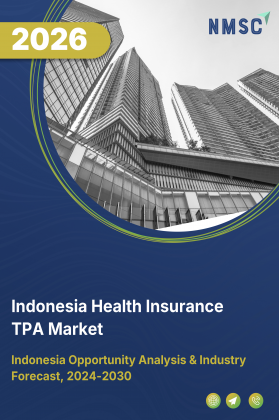
Indonesia Health Insurance TPA Market By Insurance Type (Group Health Insurance, Individual Health Insurance, and Others), By Service Type (Claim Processing, Cashless Service, and Others), By Deployment Model (In-House TPAs and Outsourced TPAs), By Sales Channel (Direct Selling, Agents, and Broker), By Enterprise Size (SMEs and Large Enterprise), By End-Users (Insurance Companies, Hospitals & Healthcare Providers, Corporate Sector, and Others) – Analysis & Forecast, 2025–2030
Industry: BFSI | Latest Edition: September 30, 2026 | No of Pages: 142 | No. of Tables: 37 | No. of Figures: 31 | Format: PDF | Report Code: BF4466
Industry Outlook
The Indonesia Health Insurance TPA Market size was valued at USD 3.26 billion in 2024 and is expected to reach USD 3.66 billion by 2025. Looking ahead, the market is projected to expand steadily, reaching USD 5.59 billion by 2030, at a CAGR of 8.83% from 2025 to 2030.
The Indonesia health insurance TPA market is expanding as insurers, employers, and healthcare funds increasingly outsource administrative services to manage rising medical costs and navigate complex reimbursement processes. TPAs support essential functions such as claims processing, benefits administration, provider network coordination, and compliance with national health insurance regulations under BPJS Kesehatan. Market growth is driven by the increasing uptake of private health insurance, rising corporate health benefit programs, and a growing need for efficient, transparent claims management. Digital transformation, including automated claims engines, online platforms, and data analytics, is enhancing accuracy and operational efficiency. As demand for cost-effective administrative solutions rises, TPAs are becoming more integral to Indonesia’s healthcare landscape.
Expanding Digital Health Ecosystem and Modern Claims Automation Drive Indonesia Health Insurance TPA Market Growth
Indonesia’s health insurance TPA market is experiencing strong market growth supported by rapid digital transformation across the healthcare and insurance sectors. Government initiatives such as SATUSEHAT (Indonesia’s national health data platform), digital hospital programs, and telemedicine expansion are enabling more efficient data sharing between healthcare providers and insurers. TPAs are increasingly adopting automated claims verification systems, AI-powered adjudication tools, and cloud-based administrative platforms to manage rising claim volumes from the country’s large and geographically dispersed population. Improved connectivity, growth in digital health startups, and expanding mobile health adoption further strengthen administrative efficiency. These advancements collectively drive market expansion, positioning Indonesia as one of Southeast Asia’s fastest-evolving health insurance TPA markets with growing reliance on technology-driven solutions.
Rising Private Insurance Utilization, Corporate Health Benefits, and Middle-Class Expansion Strengthen Market Drive
Growing demand for private health insurance, driven by expanding middle-class income, increased health awareness, and rising healthcare costs, is shaping major market trends in Indonesia. As public healthcare services experience capacity constraints, consumers increasingly opt for private insurance to access faster and higher-quality treatments. Corporations are also adopting comprehensive employee health benefit programs, preventive care services, and wellness initiatives to improve workforce productivity and retention. Insurers rely on TPAs to streamline hospitalisation approvals, coordinate cashless services, and manage claims across diverse hospital networks. These structural changes significantly reinforce market drive, elevating the importance of TPAs in Indonesia’s rapidly expanding health insurance ecosystem.
Regulatory Complexity, Fragmented Healthcare Infrastructure, and Data Compliance Challenges Limit Indonesia Health Insurance TPA Market Expansion
Indonesia’s health insurance TPA market faces notable limitations due to evolving regulatory frameworks, fragmented healthcare infrastructure, and rising data privacy requirements. Compliance with OJK (Financial Services Authority) regulations, BPJS Health policies, and emerging national data protection laws increases operational complexity for TPAs. Variations in documentation standards, inconsistent digital readiness across healthcare providers, and regional disparities in healthcare service delivery slow claims processing and increase administrative burden. Integration challenges between public BPJS programs, private insurers, and TPA systems further complicate coordination and settlement timelines. These factors collectively restrict market growth, particularly for smaller TPAs lacking the resources to manage regulatory and infrastructural constraints effectively.
Expansion of Telemedicine Networks, Digital Wellness Platforms, and Preventive Health Programs Creates Growth Opportunities
Indonesia’s rapidly expanding telemedicine services, digital wellness platforms, and employer-supported preventive health initiatives present significant market expansion opportunities for TPAs. Virtual consultation platforms, remote monitoring tools, mobile health apps, and digital diagnostic services are gaining widespread acceptance among consumers seeking convenient and affordable care options. Employers and insurers are increasingly investing in preventive care programs, lifestyle management tools, and chronic disease management solutions to reduce long-term medical costs and improve employee well-being. TPAs offering integrated digital claims workflows, real-time benefit coordination, and advanced analytics for patient engagement are well-positioned to capture emerging demand. These innovations unlock diverse growth avenues and strengthen Indonesia’s long-term potential as a digitally driven health insurance TPA market.
Competitive Landscape
Several key players operating in the industry include PT Administrasi Medika (AdMedika), PT Fullerton Health Indonesia (Fullerton Health Indonesia), PT Prima Sarana Jasa, HealthMetrics Indonesia, PT Medilink Digital Medika, PT Teknologi Pamadya Analitika (Meditap), Sedgwick Indonesia, Charles Taylor, AP Companies Group, PT Sentana Persada Indonesia, ESIS Inc. (a Chubb subsidiary), Global Excel Management Inc., Gallagher Re, and others.
Indonesia Health Insurance TPA Market Key Segments
By Insurance Type
-
Group Health Insurance
-
Individual Health Insurance
-
Others
By Service Type
-
Claim Processing
-
Cashless Service
-
Pre-Authorization
-
Customer Support
-
Hospital Network Management
By Deployment Model
-
In-House TPAs
-
Outsourced TPAs
By Sales Channel
-
Direct Selling
-
Agents
-
Broker
By Enterprise Size
-
Small and Medium Size Enterprise (SME)
-
Large Enterprise
By End-Users
-
Insurance Companies
-
Hospitals & Healthcare Providers
-
Corporate Sector
-
Others
Key Players
-
PT Administrasi Medika (AdMedika)
-
PT Fullerton Health Indonesia (Fullerton Health Indonesia)
-
PT Prima Sarana Jasa
-
HealthMetrics Indonesia
-
PT Medilink Digital Medika
-
PT Teknologi Pamadya Analitika (Meditap)
-
Sedgwick Indonesia
-
AP Companies Group
-
PT Sentana Persada Indonesia
-
ESIS Inc. (Chubb Subsidiary)
-
Global Excel Management Inc.
-
Gallagher Re
-
American International Group, Inc.
-
PT MEDICAL ADMINISTRATION
Report Scope and Segmentation
|
Parameters |
Details |
|
Market Size in 2025 |
USD 3.66 Billion |
|
Revenue Forecast in 2030 |
USD 5.59 Billion |
|
Growth Rate |
CAGR of 8.83% from 2025 to 2030 |
|
Base Year Considered |
2024 |
|
Forecast Period |
2025–2030 |
|
Market Size Estimation |
Billion (USD) |
|
Growth Factors |
|
|
Companies Profiled |
15 |
|
Market Share |
Available for 10 companies |
|
Customization Scope |
Free customization (equivalent up to 80 working hours of analysts) after purchase. Addition or alteration to country, regional, and segment scope. |
|
Pricing and Purchase Options |
Avail customized purchase options to meet your exact research needs. |


About the Author
 Mayurima Roy
— Mayurima Roy is Research Analyst at Next Move Strategy Consulting, where she has spent 4 years working across the firm's full industry coverage rather than a single fixed vertical. Her work centers on structured research, ongoing trend tracking, competitive assessment, and insight-led content development, translating complex market data into clear, decision-ready narratives that support informed client decision-making across diverse global industries, market sectors, and world regions every day.
Mayurima Roy
— Mayurima Roy is Research Analyst at Next Move Strategy Consulting, where she has spent 4 years working across the firm's full industry coverage rather than a single fixed vertical. Her work centers on structured research, ongoing trend tracking, competitive assessment, and insight-led content development, translating complex market data into clear, decision-ready narratives that support informed client decision-making across diverse global industries, market sectors, and world regions every day.
About the Reviewer
 Supradip Baul
— Supradip Baul is an accomplished business consultant and strategist with over a decade of rich experience in market intelligence, strategy, technology, and business transformation. His work has included rigorous qualitative and quantitative analysis across multiple industries, helping clients shape investment decisions and long-term roadmaps. Earlier in his career, he was associated with Gartner, where he contributed to industry-leading reports and market share analyses. He has worked with leading global companies and holds an MBA with a dual specialization in Marketing and Finance.
Supradip Baul
— Supradip Baul is an accomplished business consultant and strategist with over a decade of rich experience in market intelligence, strategy, technology, and business transformation. His work has included rigorous qualitative and quantitative analysis across multiple industries, helping clients shape investment decisions and long-term roadmaps. Earlier in his career, he was associated with Gartner, where he contributed to industry-leading reports and market share analyses. He has worked with leading global companies and holds an MBA with a dual specialization in Marketing and Finance.
At Next Move Strategy Consulting, we understand that insightful market research is the cornerstone of successful business decisions. That's why we employ a robust and multifaceted approach, combining various methodologies to deliver the most accurate and actionable data for our clients.

Research Landscape
We navigate the world of research with two primary approaches:
Qualitative Approach
Our qualitative research methodologies involve immersive techniques such as in-depth interviews, focus groups, and observational studies. By engaging directly with individuals and stakeholders, we uncover valuable insights that quantitative data alone may overlook.

Quantitative Research
In tandem with qualitative methodologies, NMSC leverages the power of Quantitative Research to provide a robust foundation of numerical insights. Through systematic data collection and analysis, we quantify patterns, preferences, and market trends, offering a comprehensive view of the business landscape.
Our quantitative research approach employs diverse tools, including surveys, experiments, and statistical modelling. These methodologies enable us to gather data from a large and representative sample, ensuring the statistical significance of our findings. By employing structured questionnaires and standardized data collection methods, we guarantee the reliability and validity of the information we present to our clients.
Quantitative research is particularly effective in measuring the prevalence of trends, assessing market size, and gauging the impact of various factors on consumer behavior. The numerical precision attained through this approach equips our clients with actionable insights, facilitating data-driven decision-making and strategy formulation.


Our Specialized Toolbox for Industry-Specific Market Research
We deploy a specialized arsenal of techniques tailored to meet your unique requirements. Here's a glimpse into our comprehensive toolbox:

Information Procurement
The stage entails acquiring market data or relevant information through various sources and methodologies.


Market Research Approach
We utilize both top-down and bottom-up approaches in market research analysis to achieve a comprehensive understanding of the market dynamics, leveraging the broad perspective of industry trends and macroeconomic factors alongside detailed insights from specific segments and individual companies.

Porters Five Forces Analysis
We conduct Porter's Five Forces analysis to evaluate the competitive landscape of an industry, providing us with insights into factors that affect profitability and strategic positioning.

SWOT Analysis

Forecasting
We utilize a forecasting model to predict future consumption by considering parameters like population, economics, regulations, market competition, drivers, constraints, technology, and pricing. We also employ statistical techniques such as multilinear regression, exponential smoothing, moving average, ARIMA, and Monte Carlo simulations for accurate predictions. In econometric forecasting, we analyzed short-term and long-term event impacts, attributing values based on regulatory frameworks, economic factors, and market events.





 Speak to Our Analyst