Insecticides Industry Analysis and Forecast (2026-2035)

Insecticides Market size was USD 24.87 Billion in 2025 and is estimated at USD 26.44 Billion in 2026, projected to reach USD 40.54 Billion by 2035, growing at a CAGR of 4.87% from 2026 to 2035. Key drivers include rising global food demand and advanced insecticide formulations, with Asia-Pacific leading the market and Middle East & Africa registering the fastest growth.
Download Free Sample PDF
Base Year (2025)
$24.87 Billion
Forecast (2035)
$40.54 Billion
CAGR (2026-2035)
4.9%
Top Region
Asia-Pacific

What does the Insecticides Market Encompass?

The Insecticides Market covers chemical and biological active ingredients formulated to control, repel, or eliminate insect pests across agricultural crops, non-crop environments, and public health applications. Products range from synthetic organophosphates, pyrethroids, neonicotinoids, organochlorines, and carbamates to biological and fermentation derived biopesticides. The value chain spans active ingredient synthesis, formulation manufacturing, regulatory registration, and distribution through crop retailers, distributors, and direct to grower programs. Agricultural insecticides account for the dominant revenue share, while non-agricultural segments covering urban pest management, public health vector control, and structural pest control represent a rapidly growing secondary base.

Structurally, the market has evolved from a chemistry-dominated discipline focused on broad spectrum efficacy into a multi-mode science integrating resistance management, integrated pest management protocols, and biological active ingredient platforms. Regulatory frameworks including the European Union's Farm-to-Fork Strategy restricting high-risk pesticide use, U.S. EPA registration review processes for neonicotinoids and organophosphates, and India's Central Insecticides Board notification systems directly shape active ingredient registrations, label expansions, and phaseout timelines. Growing adoption of digital agriculture platforms is enabling precision insecticide application that reduces per-hectare volume while maintaining efficacy, expanding adoption across cost-sensitive smallholder markets.

Based on research conducted by NMSC, we found that four structural trends are redefining how insecticide manufacturers, regulatory agencies, and growers approach pest management investment through 2035.

How Is Biopesticide Adoption Disrupting the Conventional Insecticides Market?

Biopesticide adoption is structurally disrupting the conventional insecticide space by providing resistance-breaking active ingredients derived from microorganisms, plant extracts, and fermentation processes that align with integrated pest management requirements. Syngenta announced in June 2025 its ambition to become a global leader in biologicals, noting that the market value of agricultural biologicals is expected to exceed USD 20 billion by 2030, signalling that established insecticide players are now committing capital toward biopesticide platform acquisitions and internal pipeline expansion.

What Role Is Insect Resistance Management Playing in Driving Next-Generation Chemistry?

Accelerating insect resistance to neonicotinoids, pyrethroids, and organophosphates is compressing active-ingredient lifespans and driving demand for novel modes-of-action chemistries across both developed and emerging markets. Syngenta's FY 2025 financial report highlighted that volume growth was driven by higher-value product innovations including new active ingredient launches, with 1,800 new product registrations during 2025 alone, reflecting the industry's investment intensity required to stay ahead of documented resistance evolution across major pest species.

How Are Neonicotinoid Restrictions Reshaping Product Mix Globally?

Regulatory restrictions on neonicotinoids including the European Union's near-total outdoor use ban are accelerating substitution toward pyrethroids, diamides, and biopesticides, reshaping product mix away from the historically dominant neonicotinoid class. This regulatory pressure is simultaneously creating export market disruptions and innovation incentives, benefiting manufacturers with broad-spectrum next generation insecticide portfolios across both diamide and biological active ingredient categories.

Why Is Seed Treatment Insecticide Demand Growing Relative to Foliar Spray Applications?

Seed treatment insecticides are gaining share relative to foliar spray applications because they deliver targeted early season pest protection with lower active ingredient volumes per crop cycle, reducing environmental exposure and supporting regulatory compliance with decreasing field-application rate limits. Syngenta confirmed that its Seed care biologicals business reached double digit growth in 2025, reflecting the structural preference shift among large commercial grain and oilseed operations toward systemic seed-applied insecticide protection as the foundational crop protection application event.
Growth Drivers & Restraints
Growth Catalyst & Risk Assessment Matrix
Factors Type (+/−) % Impact on CAGR Geographic Relevance Impact Timeline
Rising global food demand requiring higher crop production intensification and insect pest management Driver +1.8% Global 2026–2035
Documented insect resistance driving demand for next-generation and novel mode-of-action insecticides Driver +1.2% Global 2026–2033
Expansion of biopesticide and biological insecticide platforms within integrated pest management programs Driver +0.9% North America, Europe, Asia-Pacific 2026–2035
Growing public health vector control demand for insecticides targeting mosquitoes and disease vectors Driver +0.7% MEA, Latin America, Asia-Pacific 2026–2035
Increasing seed treatment adoption reducing foliar volumes while expanding insecticide total addressable market Driver +0.5% North America, Europe, Asia-Pacific 2026–2032
Neonicotinoid restrictions and high-risk pesticide phaseout mandates reducing addressable active ingredient base Restraint −1.1% Europe, North America 2026–2030
Generic and off-patent insecticide price competition compressing branded product margins Restraint −0.7% Asia-Pacific, Latin America 2026–2035
Rising regulatory compliance costs for new active ingredient registration constraining pipeline size Restraint −0.5% Global 2026–2033
Consumer and retailer residue-limit requirements tightening maximum residue limits on exported produce Restraint −0.3% Europe, North America, Asia-Pacific 2026–2031
Source: www.nextmsc.com

What Is the Primary Growth Driver in the Insecticides Market?

The primary growth driver is rising global food demand requiring higher agricultural productivity and intensified insect pest management across both irrigated and rainfed cropping systems. According to the U.S. Department of Agriculture Economic Research Service, global agriculture must expand output by approximately 70% by 2050 to meet projected food demand, sustaining persistent investment in crop protection inputs including insecticides that protect yield potential against insect-caused crop losses across all major crop categories.

How Is Insect Resistance Development Driving Insecticides Market Growth?

Our analysis shows that documented resistance to one or more insecticide classes in more than 600 arthropod pest species worldwide is structurally shortening active ingredient product lifecycles, forcing growers to rotate across chemical classes and driving volume and value uplift in premium novel mode-of-action products. Industry derived estimates indicate that each documented resistance event in a major pest species typically accelerates branded next generation insecticide volume uptake by 15 to 25 percent in the affected geography within two seasons of widespread resistance confirmation.

What Is Restraining the Insecticides Market?

We found that the primary restraint is the progressive regulatory restriction of neonicotinoids and organochlorine class insecticides across the European Union and North America, which is eliminating a combined market volume share estimated at more than 20% of total European insecticide sales and requiring costly reformulation and label extension programs. The U.S. Environmental Protection Agency's ongoing registration review of chlorpyrifos and clothianidin exemplifies the active-ingredient discontinuation risk that constrains medium term product portfolio planning for manufacturers dependent on these compound classes.

Segmentation Analysis

2025 (USD Billion)
2035 (USD Billion)
Pyrethroids 2025: $6.47 Billion | 2035: $10.00 Billion
Pyrethroids
Organophosphates 2025: $5.47 Billion | 2035: $7.90 Billion
Organophosph
Neonicotinoids 2025: $4.97 Billion | 2035: $6.57 Billion
Neonicotinoi
Carbamates 2025: $2.49 Billion | 2035: $3.64 Billion
Carbamates
Organochlorines 2025: $1.24 Billion | 2035: $1.42 Billion
Organochlori
Biopesticides 2025: $2.49 Billion | 2035: $5.38 Billion
Biopesticide
Others 2025: $1.74 Billion | 2035: $5.63 Billion
Others
Pyrethroids $6.47 Billion $10.00 Billion 4.4%
Organophosphates $5.47 Billion $7.90 Billion 3.7%
Neonicotinoids $4.97 Billion $6.57 Billion 2.8%
Carbamates $2.49 Billion $3.64 Billion 3.8%
Organochlorines $1.24 Billion $1.42 Billion 1.4%
Biopesticides $2.49 Billion $5.38 Billion 8.2%
Others $1.74 Billion $5.63 Billion 13.0%

Which Type Dominates the Insecticides Market?

Pyrethroids lead at USD 6.47 Billion in 2025, expanding to USD 10.00 Billion by 2035, reflecting their broad-spectrum efficacy, low mammalian toxicity profile, and regulatory acceptance relative to phased out organochlorine and increasingly restricted neonicotinoid classes. Biopesticides is the fastest-growing type at an 8.2% CAGR, driven by regulatory preferences for bioderived active ingredients, integrated pest management protocol requirements, and grower demand for residue compliant products for export-oriented fruit and vegetable production.

2025 (USD Billion)
2035 (USD Billion)
Emulsifiable
Wettable Pow
Suspension C
Granules
Aerosols
Segment Item 2025 (USD Billion) 2035 (USD Billion) CAGR
Emulsifiable Concentrate $10.0 USD Billion $40.0 USD Billion 17.0%
Wettable Powder $17.1 USD Billion $51.1 USD Billion 11.0%
Suspension Concentrate $24.2 USD Billion $62.2 USD Billion 25.0%
Granules $31.3 USD Billion $73.3 USD Billion 11.0%
Aerosols $38.4 USD Billion $84.4 USD Billion 24.0%

Segment-wise data is locked

Unlock complete segment-wise numbers for By Formulation.

Unlock Full Data

Which Formulation Leads and Which Grows Fastest?

Emulsifiable Concentrate leads formulation demand at USD 7.46 Billion in 2025, growing to USD 12.16 Billion by 2035, reflecting its established compatibility with existing spray equipment and wide applicability across crop types and geographies. Suspension Concentrate is the fastest-growing formulation at a 6.5% CAGR, driven by its superior active ingredient stability, lower solvent content, favourable residue profile, and compatibility with precision spray technologies being adopted across commercial farming operations.

2025 (USD Billion)
2035 (USD Billion)
Cereals and
Fruits and V
Oilseeds and
Plantation C
Non-Crop App
Segment Item 2025 (USD Billion) 2035 (USD Billion) CAGR
Cereals and Grains $10.0 USD Billion $40.0 USD Billion 11.0%
Fruits and Vegetables $17.1 USD Billion $51.1 USD Billion 13.0%
Oilseeds and Pulses $24.2 USD Billion $62.2 USD Billion 15.0%
Plantation Crops $31.3 USD Billion $73.3 USD Billion 17.0%
Non-Crop Applications $38.4 USD Billion $84.4 USD Billion 18.0%

Segment-wise data is locked

Unlock complete segment-wise numbers for By Crop Application.

Unlock Full Data
2025 (USD Billion)
2035 (USD Billion)
Agricultural
Non-Agricult
Segment Item 2025 (USD Billion) 2035 (USD Billion) CAGR
Agricultural $10.0 USD Billion $40.0 USD Billion 15.0%
Non-Agricultural $17.1 USD Billion $51.1 USD Billion 13.0%

Segment-wise data is locked

Unlock complete segment-wise numbers for By End Use.

Unlock Full Data

Which End Use Dominates and Which Grows Fastest?

Agricultural end use dominates at USD 20.89 Billion in 2025, growing to USD 33.65 Billion by 2035, reflecting the foundational role of insecticides in protecting crop yield potential across cereals, fruits, vegetables, and plantation crops globally. Non-Agricultural is the fastest growing end use at a 6.9% CAGR, driven by expanding urban pest management programs, public health vector control campaigns targeting dengue and malaria, and structural pest management investment in food processing, hospitality, and commercial infrastructure across emerging economies. Growing awareness about crop protection chemicals further supports this transition.

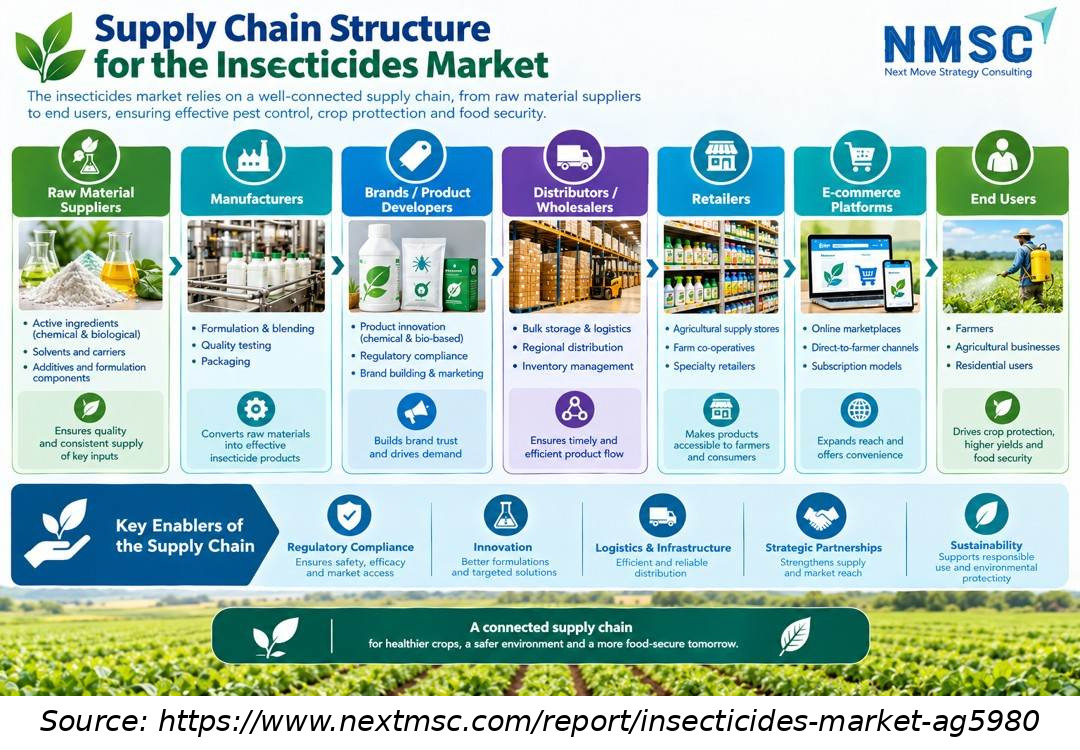
Supply Chain Structure for the Insecticides Market

The infographic outlines the Supply Chain Structure of the Insecticides Market, highlighting the flow from raw-material and active-ingredient suppliers through manufacturers, product developers, distributors, retailers, e-commerce platforms, and agricultural end users. It emphasizes how regulatory compliance, formulation innovation, logistics, strategic partnerships, and sustainability support product availability, effective crop protection, market access, and long-term industry growth.
Which Type Dominates the Insecticides Market?
Pyrethroids lead at USD 6.47 Billion in 2025, expanding to USD 10.00 Billion by 2035, reflecting their broad-spectrum efficacy, low mammalian toxicity profile, and regulatory acceptance relative to phased out organochlorine and increasingly restricted neonicotinoid classes. Biopesticides is the fastest-growing type at an 8.2% CAGR, driven by regulatory preferences for bioderived active ingredients, integrated pest management protocol requirements, and grower demand for residue compliant products for export-oriented fruit and vegetable production.

Segment Sizing: By Formulation

Segment 2025 (USD Bn) 2035 (USD Bn) CAGR% (2026–2035)
Emulsifiable Concentrate 7.46 12.16 5.0%
Wettable Powder 4.48 7.09 4.7%
Suspension Concentrate 4.23 7.98 6.5%
Granules 3.98 6.32 4.7%
Aerosols 2.24 3.64 5.0%
Others 2.48 3.35 3.0%
Total 24.87 40.54 4.87%
Source: www.nextmsc.com

Which Formulation Leads and Which Grows Fastest?

Emulsifiable Concentrate leads formulation demand at USD 7.46 Billion in 2025, growing to USD 12.16 Billion by 2035, reflecting its established compatibility with existing spray equipment and wide applicability across crop types and geographies. Suspension Concentrate is the fastest-growing formulation at a 6.5% CAGR, driven by its superior active ingredient stability, lower solvent content, favourable residue profile, and compatibility with precision spray technologies being adopted across commercial farming operations.

Segment Sizing: By End Use

Segment 2025 (USD Bn) 2035 (USD Bn) CAGR% (2026–2035)
Agricultural 20.89 33.65 4.8%
Non-Agricultural 3.98 6.89 6.9%
Total 24.87 40.54 4.87%
Source: www.nextmsc.com

Which End Use Dominates and Which Grows Fastest?

Agricultural end use dominates at USD 20.89 Billion in 2025, growing to USD 33.65 Billion by 2035, reflecting the foundational role of insecticides in protecting crop yield potential across cereals, fruits, vegetables, and plantation crops globally. Non-Agricultural is the fastest growing end use at a 6.9% CAGR, driven by expanding urban pest management programs, public health vector control campaigns targeting dengue and malaria, and structural pest management investment in food processing, hospitality, and commercial infrastructure across emerging economies. Growing awareness about crop protection chemicals further supports this transition.

Growth Opportunities

Our analysis shows that three whitespace opportunities are positioned to generate disproportionate value for insecticide manufacturers, technology companies, and investors through 2035.

Can Novel Mode-of-Action Insecticides Capture Resistance-Driven Replacement Demand?

Manufacturers launching active ingredients with IRAC Group 28 (diamide), Group 30, or Group 31 modes-of-action can capture structurally accelerating resistance-replacement demand across pyrethroid and neonicotinoid dependent grower bases, benefiting the Biopesticides and Others type segments as documented resistance events in South and Southeast Asian rice, corn, and vegetable systems create predictable product substitution cycles every 3 to 5 years.

Does Vector Control Program Expansion Create a New Non-Agricultural Insecticide Platform?

National vector control programs in tropical and subtropical MEA, Latin American, and Asia-Pacific markets represent the highest growth non-crop insecticide demand pool, enabling manufacturers with Who approved public health insecticide registrations to access government procurement channels independent of agricultural commodity price cycles, benefiting the non-agricultural end use segment at its 6.9% CAGR well above the overall market average.

Can Precision Application Technology Unlock Premium Insecticide Adoption Among Smallholders?

Drone enabled and AI-guided precision insecticide application platforms are reducing per-application volumes by 30 to 50 percent while maintaining field efficacy, enabling premium biopesticide and suspension concentrate formulations to compete economically on a cost-per treated area basis with lower cost emulsifiable concentrate generic alternatives, benefiting the Suspension Concentrate formulation segment and Biopesticides type segment in price-sensitive India, Indonesia, Vietnam, and Philippines markets.

Ecosystem Analysis

Regional Outlook

2025 (USD Billion)
2035 (USD Billion)
Asia-Pacific
North Americ
Europe
Latin Americ
Middle East
Region 2025 (USD Billion) 2035 (USD Billion) CAGR (%)
Asia-Pacific $10.0 USD Billion $40.0 USD Billion 9.0%
North America $17.1 USD Billion $51.1 USD Billion 27.0%
Europe $24.2 USD Billion $62.2 USD Billion 25.0%
Latin America $31.3 USD Billion $73.3 USD Billion 23.0%
Middle East & Africa $38.4 USD Billion $84.4 USD Billion 12.0%

Regional data is locked

Unlock complete regional numbers for this market.

Unlock Full Data

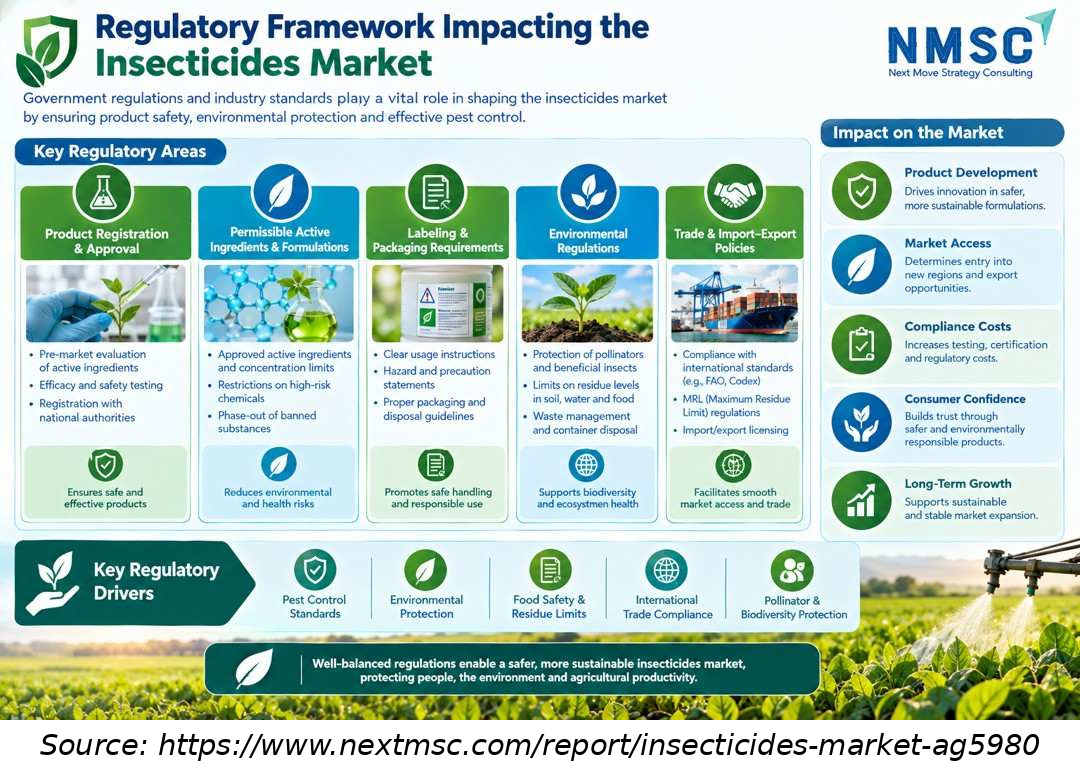
Regulatory Framework Impacting the Insecticides Market

The infographic outlines the Regulatory Framework Impacting the Insecticides Market, highlighting key areas including product registration, active ingredient approvals, labelling, environmental protection, residue limits, and trade regulations. It shows how regulatory requirements influence product development, compliance costs, market access, safety, sustainability, and long-term industry growth.

Latest Developments

We found that recent corporate and regulatory activity in the Insecticides Market reflects continued innovation investment, biologicals expansion, and active pipeline registration activity from leading manufacturers in 2025.

Date Event
September 2026 PI Industries launched CARVINT (Flometoquin 10% SC), a next-generation insecticide designed to control thrips and diamondback moth in crops including chilli, cabbage, and cauliflower.
September 2026 ADAMA launched Ravari in Latin America, a dual-mode-of-action insecticide for fruit and vegetable growers exporting produce to the United States.

Expert Insights

Dr. Seva Rostovtsev

Dr. Seva Rostovtsev

Executive Vice President & Chief Technology Officer | FMC Corporation

"Innovation in crop protection is about finding new ways to help growers manage pests safely, effectively and sustainably."

Analyst Interpretation

The statement highlights the movement toward next-generation insect-control technologies that combine efficacy with sustainability. RNA based biological solutions can expand the insecticide pipeline beyond conventional chemistries, while targeted biological mechanisms may support resistance management strategies and reduce potential impacts on beneficial organisms. This indicates increasing investment in precision biological approaches within the insecticides market.

Investment Opportunities

Where Are Capital Inflows Concentrating in the Insecticides Market?

Capital is concentrating in biopesticide platform development and novel mode of action synthetic insecticide discovery programs, exemplified by Syngenta's June 2025 commitment to leading the USD 20+ billion agricultural biologicals market by 2030. Private equity and strategic investors are also targeting Indian and Asian generic insecticide manufacturers with established EPA and EU registration capacity, as these assets offer dual access to cost competitive commodity chemistry supply and growing domestic consumption markets with minimal regulatory overhang.

How Is Infrastructure Investment Shaping Long-Term Insecticide Production Capacity?

Our findings suggest that infrastructure investment is shifting toward precision fermentation and controlled bioprocess facilities for biological insecticide active ingredient manufacturing, as well as suspension concentrate formulation plants capable of producing next generation water-dispersible products aligned with evolving EU and U.S. formulation standards. This shift benefits manufacturers with existing quality certified production sites that can be upgraded for biological active ingredient compatibility without full greenfield capital expenditure.

What ESG Considerations Are Influencing Insecticides Market Investment Decisions?

Environmental, Social, and Governance considerations in this market centre on pollinator toxicity, soil organism safety, aquatic environment impact, and residue management each subject to intensifying disclosure and regulatory action across major economies. We found that investors are increasingly applying screening criteria that penalize portfolio companies with high neonicotinoid or organochlorine revenue exposure, while favouring companies demonstrating documented transition toward novel mode of action and agrochemicals portfolios with measurable pollinator safety improvements relative to restricted predecessor compounds.

Key Benefits for Stakeholders

How Does This Report Benefit Agrochemical Manufacturers and Formulators?

Agrochemical manufacturers and formulators gain segment level revenue forecasts and CAGR benchmarks across all four segmentation axes type, formulation, crop application, and end use enabling portfolio investment and product registration priority decisions grounded in the same 2025–2035 figures applied consistently throughout this report. The competitive landscape analysis identifies the dominant archetypes and M&A deal patterns that are consolidating market share within the biologicals and novel mode of action insecticide tiers.

How Does This Report Benefit Investors and Financial Analysts?

Investors and financial analysts gain a reconciled market sizing model anchored by official company filings and regulatory databases, plus a quantified Growth Catalyst & Risk Assessment Matrix that supports insecticide sector valuation and capital allocation decisions. The country level granularity across 38 markets enables comparative opportunity assessment across both mature North American and European markets and high growth Asia-Pacific, Latin American, and MEA insecticide demand centres.

How Does This Report Benefit Regulatory Bodies and Agricultural Agencies?

Regulatory bodies and government agricultural agencies gain a market level view of active ingredient category growth trajectories, resistance-event impact on product substitution patterns, and the adoption curve of biopesticide and novel chemistry alternatives, informing risk proportionate registration review timelines and integrated pest management policy design that minimizes supply disruption during active-ingredient phaseout cycles.

Key Market Segments Evaluated

By Type

  • Pyrethroids
  • Organophosphates
  • Neonicotinoids
  • Carbamates
  • Organochlorines
  • Biopesticides
  • Others

By Formulation

  • Emulsifiable Concentrate
  • Wettable Powder
  • Suspension Concentrate
  • Granules
  • Aerosols
  • Others

By Crop Application

  • Cereals and Grains
  • Fruits and Vegetables
  • Oilseeds and Pulses
  • Plantation Crops
  • Non-Crop Applications

By End Use

  • Agricultural
  • Non-Agricultural

By Region

  • North America 
    • U.S.
    • Canada
    • Mexico.
  • Europe 
    • UK
    • Germany
    • France
    • Italy
    • Spain
    • Sweden
    • Denmark
    • Finland
    • Netherlands
    • Rest of Europe.
  • Asia-Pacific 
    • China
    • India
    • Japan
    • South Korea
    • Taiwan
    • Indonesia
    • Vietnam
    • Australia
    • Philippines
    • Malaysia
    • Rest of APAC.
  • Middle East & Africa 
    • Saudi Arabia
    • UAE
    • Egypt
    • Israel
    • Turkey
    • Nigeria
    • South Africa
    • Rest of MEA.
  • Latin America 
    • Brazil
    • Argentina
    • Chile
    • Colombia
    • Rest of LATAM.

Conclusion & Recommendations

The long-term outlook is structurally positive, with the market expanding from USD 26.44 Billion in 2026 to USD 40.54 Billion by 2035 at a 4.87% CAGR, supported by food security demand, resistance driven product substitution cycles, and biopesticide platform growth. We observed that this trajectory is underpinned by three independent demand engines agricultural crop protection, public health vector control, and non-agricultural urban pest management that provide structural revenue diversification across economic cycle volatility.

What Strategic Positioning Do We Recommend?

Our assessment indicates that manufacturers should prioritize novel mode-of-action insecticide registrations and biopesticide platform development to capture resistance replacement demand at premium price points, while managing legacy neonicotinoid and organochlorine revenue exposure through active label transition programs. Companies without established biological active ingredient capability should pursue targeted biopesticide acquisitions rather than attempting organic program development given the multi-year validation timelines required for novel biological active ingredient field registration.

How Attractive Is the Insecticides Market for Investment?
Investment attractiveness is highest in biopesticide platforms, novel mode-of-action synthetic active ingredient pipelines, and Indian and Asian generic manufacturing assets with global registration capability. We found that Middle East & Africa and Latin America offer the superior CAGR profiles at 6.2% and 5.7%, while Asia-Pacific provides the largest absolute revenue pool at USD 9.95 Billion in 2025. Non-Agricultural end use at 6.9% CAGR represents the highest-growth sub-market independent of agricultural commodity cycles.

What Are the Key Market Shifts and Risks?

Key risks include accelerated neonicotinoid phaseout extending beyond Europe to North American markets, generic pricing pressure from Chinese active ingredient manufacturers compressing originator margins on commodity chemistries, and the potential for resistance events to outpace novel active ingredient pipeline development timelines. Our analysis shows that companies managing more than 30% of insecticide revenue through a single active ingredient class face above market revenue disruption risk during regulatory review cycles.

What Are the Primary Growth Pathways Through 2035?

Primary growth pathways include biopesticide platform commercialization, public health vector control program expansion across MEA and Asia-Pacific, and precision application technology integration enabling premium suspension concentrate and biopesticide adoption among price sensitive smallholder markets. We observed that companies combining novel mode of action active ingredient portfolios with precision digital agronomy service platforms are best positioned to capture disproportionate share of the USD 14.10 Billion absolute investment opportunity created between 2026 and 2035.

FAQs

Market Size & Forecast

Insecticides Industry Analysis and Forecast (2026-2035) Revenue Forecast

Values in USD Billion

2025 $24.87 Billion
2025
2026 $26.08 Billion
2026
2027 $27.35 Billion
2027
2028 $28.68 Billion
2028
2029 $30.08 Billion
2029
2030 $31.55 Billion
2030
2031 $33.08 Billion
2031
2032 $34.69 Billion
2032
2033 $36.38 Billion
2033
2034 $38.15 Billion
2034
2035 $40.54 Billion
2035

Key Takeaways

By Type — Dominant: Pyrethroids led at USD 6.47 Billion in 2025, forecast to reach USD 10.00 Billion by 2035; Biopesticides is the fastest-growing type at 8.2% CAGR (2026–2035)

By Type — Fastest-Growing: Biopesticides is the fastest-growing type at 8.2% CAGR from 2026–2035, reaching USD 5.38 Billion by 2035

By Formulation — Dominant: Emulsifiable Concentrate led at USD 7.46 Billion in 2025, expanding to USD 12.16 Billion by 2035

By Formulation — Fastest-Growing: Suspension Concentrate is fastest-growing formulation at 6.5% CAGR from 2026–2035

By End Use — Dominant: Agricultural end use dominated at USD 20.89 Billion in 2025, projected to reach USD 33.65 Billion by 2035

By End Use — Fastest-Growing: Non-Agricultural is the fastest-growing end use at 6.9% CAGR from 2026–2035

Dominant Region: Asia-Pacific dominated with approximately 40% revenue share in 2025 (USD 9.95 Billion)

Fastest-Growing Region: Middle East & Africa is expected to register the highest CAGR of 6.2% during 2026–2035

Dominant Country: China leads the market, anchored by large-scale paddy, corn, and vegetable production requiring intensive insect pest management

Fastest-Growing Country: India is the fastest-growing country, driven by PM-PRANAM, crop diversification, and rising export-oriented horticulture

Market Opportunity: The market presents an absolute investment opportunity of approximately USD 14.10 Billion between 2026 and 2035, calculated as the difference between the 2035 forecast of USD 40.54 Billion and the 2026 estimate of USD 26.44 Billion, positioning next-generation insecticide developers and biopesticide platform companies as high conviction beneficiaries of an accelerating chemistry-transition cycle.

According to NMSC analysis, accelerating insect resistance development across more than 600 documented pest species is structurally shortening active ingredient lifecycle from approximately 20 years to under 12 years, compressing the return window for conventional chemistry and materially strengthening the R&D investment case for novel modes of action insecticide candidates.

Competitive Landscape

Dimension Description
Market Structure Highly consolidated at originator level; top 6 multinationals hold estimated 60–65% of branded market share; generic and biopesticide specialists compete intensely on remaining volume
Innovation Focus Novel mode-of-action chemistries (IRAC Groups 28–31), biological insecticide platform acquisitions, suspension concentrate formulation technology, seed treatment integration, and precision application compatibility
M&A Activity Biopesticide platform acquisitions and strategic biologicals partnerships dominating recent deal flow; Syngenta committed to leadership in biologicals announced June 2025; targeted mid-size biopesticide developers being absorbed by originator companies

How Do Companies Compete in the Insecticides Market Industry?

Companies compete primarily on active ingredient novelty, mode of action diversity within resistance management programs, regulatory registration breadth across key geographies, and the strength of their agronomic field trial data supporting label claims. We found that originators maintaining pipelines of novel active ingredients backed by global registration programs hold structural advantages over formulators of off patent chemistries, as resistance-driven demand for new modes of action concentrates volume premium at the branded innovation tier.

Which Competitive Archetypes Dominate the Insecticides Market Industry?

Diversified agrochemical originators such as Syngenta Group, Bayer AG, BASF SE, and Corteva Agriscience dominate through fully integrated discovery-to-market platforms spanning synthetic and biological active ingredients. Dedicated biopesticide specialists including Certis USA and Koppert Biological Systems differentiate on biocontrol platform breadth and IPM protocol integration. Chinese generic manufacturers including Jiangsu Yangon Chemical compete on cost-efficient organophosphate and pyrethroid supply, maintaining price pressure on commodity chemistry pricing globally.

What Innovation and Differentiation Strategies Are Companies Pursuing?

We observed that leading companies are investing in novel mode of action insecticide discovery and biologicals platform build out Syngenta's June 2025 announcement of its ambition to become a global biologicals leader exemplifies the strategic pivot toward bioderived and fermentation based active ingredients. Differentiation increasingly rests on integrated resistance management program design, where manufacturers supply multiple unrelated modes of action in coordinated rotation programs that maximize active ingredient lifecycle value across commercial grower customers.

What M&A Activity Is Shaping the Insecticides Market?

Recent M&A activity is concentrated in biopesticide platform acquisitions and strategic biologicals partnerships rather than large conventional chemistry company mergers, reflecting the industry's recognition that biological active ingredient capability cannot be built organically within competitive R&D timelines. Our analysis shows that originator companies are prioritizing bolt on acquisitions of validated biopesticide manufacturers with existing WHO and EPA registrations over large scale agrochemical company consolidation in the current regulatory environment.

Key Market Players

Syngenta Group (Nl) B.V. Bayer AG BASF SE Corteva Agriscience FMC Corporation UPL Limited Sumitomo Chemical Co., Ltd. Nufarm Limited Adama Agricultural Solutions Ltd. Jiangsu Yangnong Chemical Co., Ltd. Nihon Nohyaku Co., Ltd. Lanxess AG Rentokil Initial plc Coromandel International Limited PI Industries Limited Certis USA, LLC W. Neudorff GmbH KG Koppert Biological Systems McLaughlin Gormley King Company Sulphur Mills Limited

Market Drivers & Dynamics

Interactive Dataset
Rising global food demand requiring higher crop production intensification and insect pest management driver +1.8% Global 2026–2035
Documented insect resistance driving demand for next-generation and novel mode-of-action insecticides driver +1.2% Global 2026–2033
Expansion of biopesticide and biological insecticide platforms within integrated pest management programs driver +0.9% North America, Europe, Asia-Pacific 2026–2035
Growing public health vector control demand for insecticides targeting mosquitoes and disease vectors driver +0.7% MEA, Latin America, Asia-Pacific 2026–2035
Increasing seed treatment adoption reducing foliar volumes while expanding insecticide total addressable market driver +0.5% North America, Europe, Asia-Pacific 2026–2032
Neonicotinoid restrictions and high-risk pesticide phaseout mandates reducing addressable active ingredient base restraint −1.1% Europe, North America 2026–2030
Generic and off-patent insecticide price competition compressing branded product margins restraint −0.7% Asia-Pacific, Latin America 2026–2035
Rising regulatory compliance costs for new active ingredient registration constraining pipeline size restraint -0.5% Global 2026–2033
Consumer and retailer residue-limit requirements tightening maximum residue limits on exported produce restraint −0.3% Europe, North America, Asia-Pacific 2026–2031
Source: Next Move Strategy Consulting

Growth Drivers

What Is the Primary Growth Driver in the Insecticides Market?

The primary growth driver is rising global food demand requiring higher agricultural productivity and intensified insect pest management across both irrigated and rainfed cropping systems. According to the U.S. Department of Agriculture Economic Research Service, global agriculture must expand output by approximately 70% by 2050 to meet projected food demand, sustaining persistent investment in crop protection inputs including insecticides that protect yield potential against insect-caused crop losses across all major crop categories.

How Is Insect Resistance Development Driving Insecticides Market Growth?

Our analysis shows that documented resistance to one or more insecticide classes in more than 600 arthropod pest species worldwide is structurally shortening active ingredient product lifecycles, forcing growers to rotate across chemical classes and driving volume and value uplift in premium novel mode-of-action products. Industry derived estimates indicate that each documented resistance event in a major pest species typically accelerates branded next generation insecticide volume uptake by 15 to 25 percent in the affected geography within two seasons of widespread resistance confirmation.

Growth Inhibitors

What Is Restraining the Insecticides Market?

We found that the primary restraint is the progressive regulatory restriction of neonicotinoids and organochlorine class insecticides across the European Union and North America, which is eliminating a combined market volume share estimated at more than 20% of total European insecticide sales and requiring costly reformulation and label extension programs. The U.S. Environmental Protection Agency's ongoing registration review of chlorpyrifos and clothianidin exemplifies the active-ingredient discontinuation risk that constrains medium term product portfolio planning for manufacturers dependent on these compound classes.

What Are the Growth Opportunities?

Can Novel Mode-of-Action Insecticides Capture Resistance-Driven Replacement Demand?

Manufacturers launching active ingredients with IRAC Group 28 (diamide), Group 30, or Group 31 modes-of-action can capture structurally accelerating resistance-replacement demand across pyrethroid and neonicotinoid dependent grower bases, benefiting the Biopesticides and Others type segments as documented resistance events in South and Southeast Asian rice, corn, and vegetable systems create predictable product substitution cycles every 3 to 5 years.

Does Vector Control Program Expansion Create a New Non-Agricultural Insecticide Platform?

National vector control programs in tropical and subtropical MEA, Latin American, and Asia-Pacific markets represent the highest growth non-crop insecticide demand pool, enabling manufacturers with Who approved public health insecticide registrations to access government procurement channels independent of agricultural commodity price cycles, benefiting the non-agricultural end use segment at its 6.9% CAGR well above the overall market average.

Can Precision Application Technology Unlock Premium Insecticide Adoption Among Smallholders?

Drone enabled and AI-guided precision insecticide application platforms are reducing per-application volumes by 30 to 50 percent while maintaining field efficacy, enabling premium biopesticide and suspension concentrate formulations to compete economically on a cost-per treated area basis with lower cost emulsifiable concentrate generic alternatives, benefiting the Suspension Concentrate formulation segment and Biopesticides type segment in price-sensitive India, Indonesia, Vietnam, and Philippines markets.

About the Author

Liza Phukan

Liza Phukan

Liza Phukan is Research Associate at Next Move Strategy Consulting, where she has covered emerging industries and market research across sectors for 3.5 years. Her work includes analyzing industry developments, validating market data, and developing structured business content from research findings. She uses secondary research and data-validation practices to turn complex market information into clear decision-useful market analysis for business audiences and support report development and B2B.

About the Reviewer

Supradip Baul

Supradip Baul

Supradip Baul is an accomplished business consultant and strategist with over a decade of rich experience in market intelligence, strategy, technology, and business transformation. His work has included rigorous qualitative and quantitative analysis across multiple industries, helping clients shape investment decisions and long-term roadmaps. Earlier in his career, he was associated with Gartner, where he contributed to industry-leading reports and market share analyses. He has worked with leading global companies and holds an MBA with a dual specialization in Marketing and Finance.

Download Free Sample

Nishant Awate

NISHANT AWATE

Business Development Global Sales

Zehnder Group Deutschland GmbH

Our experience working with Next Move Strategy Consulting was positive. The team was responsive, professional, and open to incorporating our specific requirements throughout the project. The India AHU market study was comprehensive and well structured, covering market value and volume forecasts, product and application segments, and key industry trends. The inclusion of both AHU and residential MVHR market insights made the study particularly relevant for our strategic market assessment. Overall, the report provides a solid foundation for evaluating market potential, identifying priority segments, and supporting business-development decisions in India.

Gustaf Hummel Burstrom

GUSTAF HUMMEL BURSTROM

Founder

Revline Tools AB

Joseph and the team at Next Move Strategy Consulting have been excellent to work with, in supplying us with relevant market data and forecasts for our specific category. We had some special requirements and they were able to do a custom package to suit our needs. We would definitely recommend them to any other company needing market data and forecasts

Pratyush Kumar Das

PRATYUSH KUMAR DAS

Assistant Manager

Polycab India Limited

We would like to express our appreciation for the data and insights provided by nextmsc. We are very pleased with the quality and depth of the information, which has proven to be highly valuable and beneficial for our business decision-making.

Mohit Agarwal

MOHIT AGARWAL

Chief Manager

DryChem India Pvt. Ltd.

Next Move Strategy Consulting is an amazing team of consultants. We required a market study report for our investors on top priority and the team went above and beyond our expectations to deliver the same with ample supporting data within a short time span enabling us to secure the investments and keep our project timeline maintained. Their professionalism, attention to detail, and timely delivery of actionable recommendations have left a lasting impression on our organization.

Henri Knyphausen

HENRI KNYPHAUSEN

Partner at Singulier [Ex-BCG]

Singulier

I recently engaged NEXTMSC.com for a commercial due diligence project within the intralogistics sector, and I am pleased to provide a reference based on my experience. In utilizing NEXTMSC.com's services, I found their report to offer valuable insights into market dynamics and key industry players. The initial report provided a solid foundation for our analysis. However, as we were investigating a smaller target in the market, and I had specific customization requests requiring additional research. These requests included detailed information on product portfolios of various players and sub-market sizes, both inclusive and exclusive of certain product categories. NEXTMSC.com demonstrated commendable responsiveness and agility in accommodating these customization requests. Within a timeframe of 1-2 weeks, they delivered a revised report that met our specific needs. Furthermore, they were receptive to my follow-up inquiries, ensuring clarity and understanding of the data provided. The final deliverable significantly contributed to our due diligence efforts. One of NEXTMSC.com's notable strengths lies in their qualitative research capabilities. However, for future engagements, I would recommend the inclusion of a quantified market model in Excel format. Such a model would offer the ability to conduct in-depth analyses and explore various market segments, including country-specific data and subcomponent breakdowns. Based on my positive experience, I would not hesitate to work with NEXTMSC.com again. Their responsiveness, willingness to accommodate customization requests, and commitment to delivering actionable insights make them a reliable partner for commercial research projects.

Custom Market Research Services

We will customize the research for you if the listed report does not fully match your requirements.

Get 30% Free Customization

Select License

This website uses cookies to ensure you get the best experience on our website. Learn more

✖