IoT Security Market

IoT security market was USD 46.2 billion in 2025, projected to reach USD 424.6 billion by 2035 at a 24.8% CAGR from 2026 to 2035, per this market report.

Download Free Sample PDF
Base Year (2025)
$46.20 Billion
Forecast (2035)
$424.60 Billion
CAGR (2026-2035)
24.8%
Top Region
North America

What Is the IoT Security Market Size?

The global IoT security market size was valued at USD 46.2 billion in 2025 and is estimated at USD 58.8 billion in 2026, forecast to reach USD 424.6 billion by 2035, expanding at a 24.8% CAGR between 2026 and 2035. North America leads with approximately 34% share, while Solutions dominate all other components with approximately 66% share.

We observed that growth is broad-based across every segmentation axis, with cloud security and small and medium enterprise adoption driving the dominant structural shifts through 2035.

IoT Security Market Revenue Forecast

Values in USD Billion

2025 $46.20 Billion
2025
2026 $57.66 Billion
2026
2027 $71.96 Billion
2027
2028 $89.80 Billion
2028
2029 $112.07 Billion
2029
2030 $139.87 Billion
2030
2031 $174.55 Billion
2031
2032 $217.84 Billion
2032
2033 $271.87 Billion
2033
2034 $339.29 Billion
2034
2035 $424.60 Billion
2035

Key Takeaways

By Component: Solutions held the largest share of approximately 66% (USD 30.49 billion) in 2025; Services is the fastest-growing sub-segment at 26.6% CAGR from 2026–2035.

By Security Type: Network Security held the largest share of approximately 30% (USD 13.86 billion) in 2025; Cloud Security is the fastest-growing sub-segment at 29.3% CAGR from 2026–2035.

By Deployment Mode: On-Premises held the largest share of approximately 58% (USD 26.80 billion) in 2025; Cloud is the fastest-growing sub-segment at 29.6% CAGR from 2026–2035.

By Organization Size: Large Enterprises held the largest share of approximately 63% (USD 29.11 billion) in 2025; SMEs is the fastest-growing sub-segment at 27.8% CAGR from 2026–2035.

By Application: Industrial IoT and Manufacturing held the largest share of approximately 20% (USD 9.24 billion) in 2025; Automotive and Transportation is the fastest-growing sub-segment at 26.4% CAGR from 2026–2035.

Dominant Region: North America dominated with approximately 34% revenue share (USD 15.71 billion) in 2025.

Fastest-Growing Region: Asia-Pacific is expected to register the highest CAGR of 27.1% during 2026–2035.

Dominant Country: U.S. led with approximately USD 13.51 billion in 2025.

Fastest-Growing Country: India is the fastest-growing country at approximately 29.2% CAGR from 2026–2035.

Market Opportunity: The IoT security market is expected to create an absolute dollar opportunity of USD 365.8 billion between 2026 and 2035, presenting significant investment potential across the cloud security and industrial IoT value chain.

According to Next Move Strategy Consulting analysis, enterprises are increasingly consolidating IoT security procurement with vendors capable of unifying network, endpoint, and cloud protection under a single platform, a shift that favors diversified cybersecurity vendors over point-solution specialists as regulatory scrutiny of connected devices intensifies through 2035.

What Does the IoT Security Market Encompass?

The IoT security market encompasses solutions and services that protect connected devices, networks, and data from unauthorized access, malware, and denial-of-service attacks across the Internet of Things ecosystem. Our assessment indicates that the scope spans network security, endpoint security, application security, and cloud security offerings deployed across large enterprises and small and medium enterprises. The category has evolved from device-level authentication add-ons into comprehensive platforms combining threat detection, identity management, and blockchain-based device attestation as connected-device volumes accelerate across industrial, healthcare, and automotive environments.
Regulatory frameworks such as the U.S. IoT Cybersecurity Improvement Act and the European Union's Cyber Resilience Act increasingly mandate baseline security requirements for connected devices sold into regulated markets, while sector-specific rules shape adoption across healthcare and critical infrastructure. We observed that technology adoption is shifting toward artificial intelligence-driven threat detection and zero trust architectures that continuously verify device identity rather than relying on perimeter-based defenses. Next Move Strategy Consulting's analysis indicates that this structural shift, combined with rising connected-device density, is redefining vendor selection criteria across the IoT security market.

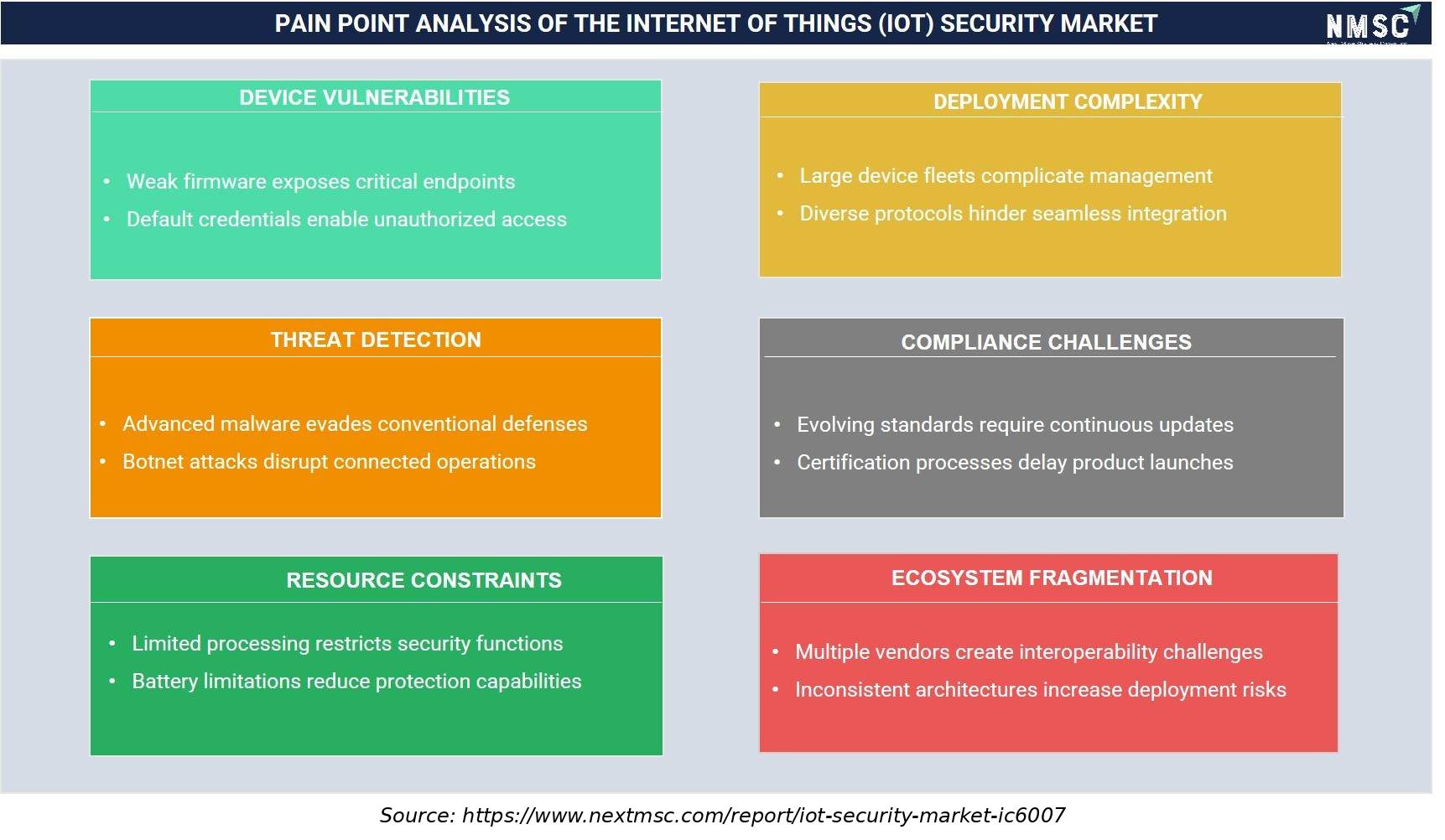
PAIN POINT ANALYSIS OF THE INTERNET OF THINGS (IOT) SECURITY MARKET

PAIN POINT ANALYSIS OF THE INTERNET OF THINGS (IOT) SECURITY MARKET
The image highlights the major pain points shaping the Internet of Things (IoT) Security Market, including device vulnerabilities, deployment complexity, advanced threat detection challenges, evolving regulatory compliance requirements, resource-constrained IoT devices, and ecosystem fragmentation. These issues increase cybersecurity risks and operational complexity, driving demand for AI-enabled threat detection, Zero Trust architectures, secure device management, firmware protection, and interoperable IoT security solutions across connected industries.

Market Drivers & Dynamics

Interactive Dataset
Rising frequency of IoT-targeted malware and DDoS attacks driver +3.1% Global 2026-2035
EU Cyber Resilience Act and U.S. IoT Cybersecurity Improvement Act driver +2.4% North America, Europe 2026-2035
Expansion of connected industrial and healthcare device fleets driver +2.6% Global 2026-2035
Artificial intelligence-driven threat detection adoption driver +2.0% Global 2026-2032
Rising cloud migration of enterprise IoT workloads driver +2.2% Global 2026-2035
Government-funded critical infrastructure security programs driver +1.5% North America, Asia-Pacific 2026-2033
Shortage of skilled IoT cybersecurity professionals restraint -1.6% Global 2026-2035
Fragmented device standards complicating unified security deployment restraint -1.3% Global 2026-2032
High integration cost for legacy operational technology environments restraint -1.0% Global 2028-2035
Data-sovereignty restrictions limiting cross-border cloud security deployment restraint -0.7% Asia-Pacific, MEA 2026-2030
Source: Next Move Strategy Consulting

Growth Drivers

What Is the Primary Growth Driver of the IoT Security Market?

The rising frequency of IoT-targeted malware and distributed denial-of-service attacks is the primary driver of the market. Regulatory bodies including the U.S. Cybersecurity and Infrastructure Security Agency continue to document escalating attack volumes against unmanaged connected devices. We observed that this threat environment, reinforced by expanding industrial and healthcare device fleets, continues to anchor baseline demand for network and endpoint security solutions across developed and emerging economies alike.

How Is Regulation Driving IoT Security Market Growth?

The European Union's Cyber Resilience Act and the U.S. IoT Cybersecurity Improvement Act are accelerating market growth by mandating baseline security requirements for connected devices. The European Commission's cybersecurity framework increasingly compels manufacturers to embed security-by-design principles before market entry. Our assessment indicates that this regulatory pressure, combined with sector-specific healthcare and critical-infrastructure rules, is compressing adoption timelines for zero trust and cloud security architectures across Europe and North America.

Growth Inhibitors

What Is Restraining IoT Security Market Expansion?

A persistent shortage of skilled IoT cybersecurity professionals restrains implementation speed across the industry. Fragmented device communication standards complicate unified security deployment across heterogeneous device fleets, particularly in legacy operational technology environments. We found that smaller enterprises face particular exposure, as limited in-house security expertise reduces their ability to evaluate and deploy increasingly sophisticated zero trust and artificial intelligence-driven detection platforms.

Segmentation Analysis

2025 (USD Billion)
2035 (USD Billion)
Solutions 2025: $30.49 Billion | 2035: $254.76 Billion
Solutions
Services 2025: $15.71 Billion | 2035: $169.84 Billion
Services
Solutions $30.49 Billion $254.76 Billion 23.4%
Services $15.71 Billion $169.84 Billion 26.6%

Which Component Segment Dominates the IoT Security Market?

Solutions, encompassing network, endpoint, application, and cloud security software, led the market with USD 30.49 billion in 2025, supported by enterprises prioritizing platform-based protection over point deployments. We observed that Services are the fastest-growing component, expanding at a 26.6% CAGR from 2026 to 2035, as enterprises increasingly outsource IoT security monitoring and incident response to managed security service providers facing internal skills shortages.

2025 (USD Billion)
2035 (USD Billion)
Network Secu
Endpoint Sec
Application
Cloud Securi
Others
Segment Item 2025 (USD Billion) 2035 (USD Billion) CAGR
Network Security $10.0 USD Billion $40.0 USD Billion 19.0%
Endpoint Security $17.1 USD Billion $51.1 USD Billion 9.0%
Application Security $24.2 USD Billion $62.2 USD Billion 27.0%
Cloud Security $31.3 USD Billion $73.3 USD Billion 17.0%
Others $38.4 USD Billion $84.4 USD Billion 10.0%

Segment-wise data is locked

Unlock complete segment-wise numbers for By Security Type.

Unlock Full Data

Which Security Type Segment Leads IoT Security Market Demand?

Network Security remained the leading security type within the market, valued at USD 13.86 billion in 2025 on sustained perimeter and device-communication protection spending. Our findings suggest that Cloud Security is the fastest-growing security type, registering a 29.3% CAGR from 2026 to 2035, as enterprises migrate IoT data processing and device management workloads to cloud platforms requiring dedicated posture-management protection.

2025 (USD Billion)
2035 (USD Billion)
Cloud
On-Premises
Segment Item 2025 (USD Billion) 2035 (USD Billion) CAGR
Cloud $10.0 USD Billion $40.0 USD Billion 24.0%
On-Premises $17.1 USD Billion $51.1 USD Billion 26.0%

Segment-wise data is locked

Unlock complete segment-wise numbers for By Deployment Mode.

Unlock Full Data
2025 (USD Billion)
2035 (USD Billion)
Large Enterp
SMEs
Segment Item 2025 (USD Billion) 2035 (USD Billion) CAGR
Large Enterprises $10.0 USD Billion $40.0 USD Billion 19.0%
SMEs $17.1 USD Billion $51.1 USD Billion 21.0%

Segment-wise data is locked

Unlock complete segment-wise numbers for By Organization Size.

Unlock Full Data
2025 (USD Billion)
2035 (USD Billion)
Smart Home a
Industrial I
Healthcare
Automotive a
BFSI
Segment Item 2025 (USD Billion) 2035 (USD Billion) CAGR
Smart Home and Consumer Electronics $10.0 USD Billion $40.0 USD Billion 15.0%
Industrial IoT and Manufacturing $17.1 USD Billion $51.1 USD Billion 21.0%
Healthcare $24.2 USD Billion $62.2 USD Billion 11.0%
Automotive and Transportation $31.3 USD Billion $73.3 USD Billion 21.0%
BFSI $38.4 USD Billion $84.4 USD Billion 14.0%

Segment-wise data is locked

Unlock complete segment-wise numbers for By Application.

Unlock Full Data

Which Application Segment Leads IoT Security Market Demand?

Industrial IoT and Manufacturing remained the leading application within the market, valued at USD 9.24 billion in 2025 on sustained factory-automation and industrial control system protection spending. Our analysis shows that Automotive and Transportation is the fastest-growing application, registering a 26.4% CAGR from 2026 to 2035, as connected-vehicle platforms increasingly require embedded security to satisfy tightening automotive cybersecurity regulation.

Growth Opportunities

Our analysis shows that three forward-looking opportunities stand out for stakeholders positioning within the IoT security market over the 2026-2035 forecast period.

How Can Managed Security Providers Capture the Skills-Gap Opportunity?

The persistent shortage of skilled IoT cybersecurity professionals presents a whitespace opportunity for managed security service providers offering outsourced monitoring and incident response. Vendors that commercialize turnkey managed detection and response for IoT fleets stand to capture recurring subscription revenue as small and medium enterprises seek to close internal skills gaps without building dedicated security teams.

Where Does Automotive Cybersecurity Regulation Create Whitespace?

Tightening automotive cybersecurity regulation creates an underpenetrated opportunity for security vendors specializing in connected-vehicle protection. Suppliers that develop validated, regulation-compliant embedded security platforms can secure long-term original equipment manufacturer contracts, benefiting from recurring software-update revenue tied to expanding connected-vehicle production volumes.

How Can Cloud Security Vendors Benefit from IoT Workload Migration?

Enterprises migrating IoT data processing to cloud platforms create an opportunity for vendors offering cloud security posture management tailored to device-scale telemetry. Early movers that integrate device identity verification with cloud workload protection can differentiate with industrial and healthcare customers pursuing unified security architectures across hybrid on-premises and cloud environments.

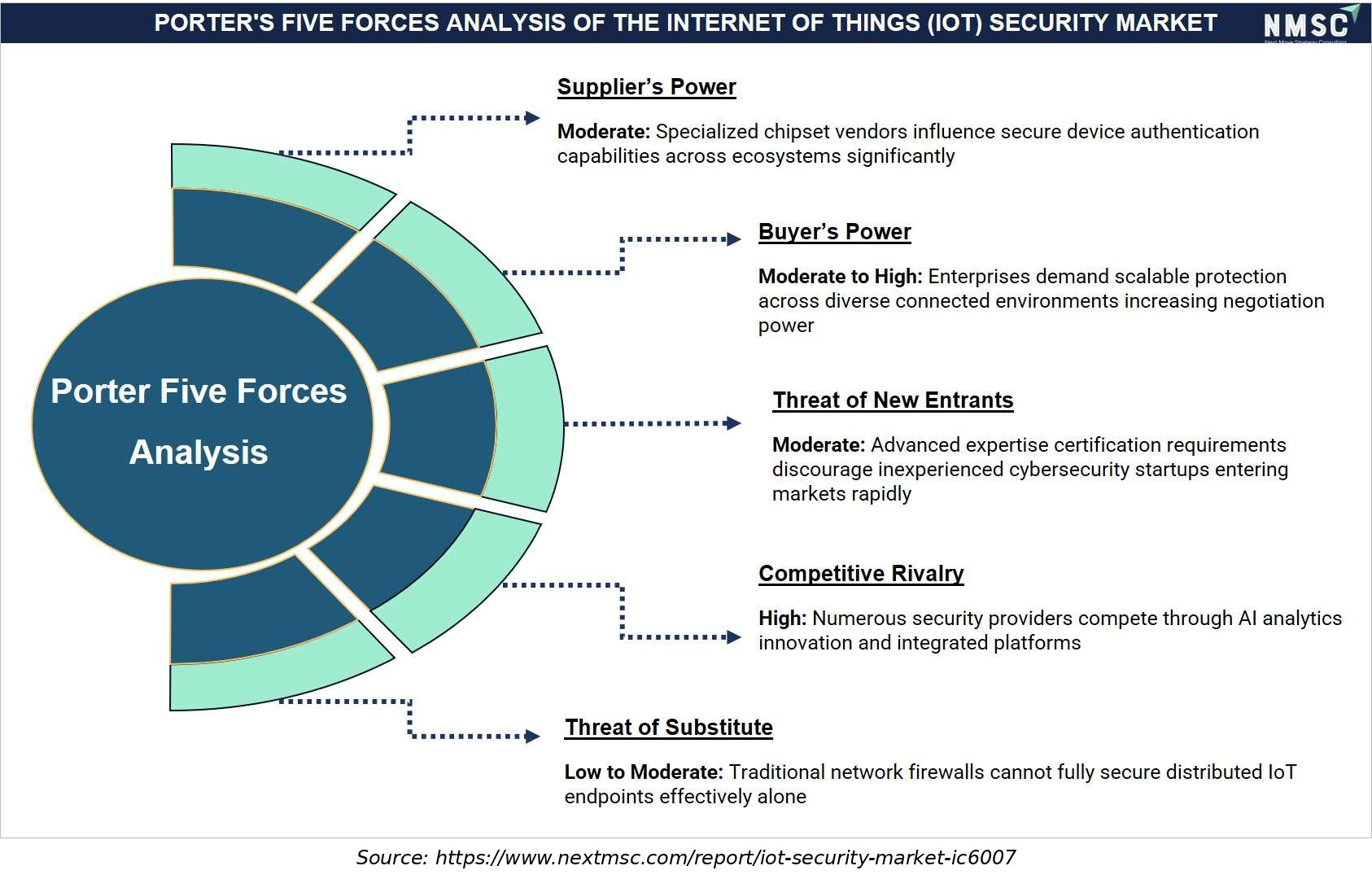
PORTER'S FIVE FORCES ANALYSIS OF THE INTERNET OF THINGS (IOT) SECURITY MARKET

The image presents Porter's Five Forces Analysis of the Internet of Things (IoT) Security Market, evaluating the competitive landscape through the bargaining power of buyers and suppliers, the threat of new entrants and substitute solutions, and industry rivalry. The framework highlights how technological innovation, regulatory compliance, cybersecurity requirements, vendor competition, and evolving customer demands influence market attractiveness, strategic positioning, and long-term growth opportunities for IoT security solution providers.

Regional Outlook

2025 (USD Billion)
2035 (USD Billion)
North Americ
Europe
Asia-Pacific
Middle East
Latin Americ
Region 2025 (USD Billion) 2035 (USD Billion) CAGR (%)
North America $10.0 USD Billion $40.0 USD Billion 9.0%
Europe $17.1 USD Billion $51.1 USD Billion 27.0%
Asia-Pacific $24.2 USD Billion $62.2 USD Billion 25.0%
Middle East & Africa $31.3 USD Billion $73.3 USD Billion 23.0%
Latin America $38.4 USD Billion $84.4 USD Billion 12.0%

Regional data is locked

Unlock complete regional numbers for this market.

Unlock Full Data

Competitive Landscape

We observed that the market features a moderately consolidated competitive landscape, with global cybersecurity leaders competing alongside semiconductor and industrial technology vendors on platform breadth, innovation, and regulatory compliance.

Dimension Description
Market Structure Moderately consolidated; the top companies profiled in this report collectively account for a majority of global IoT security market revenue, while numerous regional managed security providers serve cost-sensitive small and medium enterprise demand.
Innovation Focus Artificial intelligence-driven threat detection, zero trust architecture, and blockchain-based device attestation dominate current innovation pipelines across leading vendors.
M&A Activity Selective consolidation through platform acquisitions continues to broaden vendors' network, endpoint, and cloud security capabilities into unified IoT protection suites.

How Do Companies Compete in the IoT Security Market?

Companies compete primarily on platform breadth, artificial intelligence detection accuracy, and regulatory certification across the industry. Global cybersecurity leaders such as Palo Alto Networks and Cisco leverage broad network and cloud security portfolios to serve multinational enterprises, while semiconductor vendors compete on embedded device-level security for original equipment manufacturer customers supplying industrial and automotive markets.

Which Competitive Archetypes Dominate the IoT Security Market?

Two archetypes dominate the market: diversified cybersecurity platform vendors offering unified network, endpoint, and cloud protection, and specialized semiconductor and industrial technology vendors embedding security at the device level. Palo Alto Networks and Fortinet exemplify the diversified platform archetype, while Infineon Technologies and NXP Semiconductors exemplify the embedded device-security archetype serving original equipment manufacturer demand.

How Are Companies Differentiating Through Innovation in IoT Security?

Innovation and differentiation strategy increasingly center on artificial intelligence-driven detection and zero trust architecture validated against real-world attack telemetry. Palo Alto Networks' 2026 operational technology security research, conducted jointly with Siemens and the Idaho National Laboratory, exemplifies how vendors combine threat intelligence with industrial domain expertise. Our analysis shows that vendors unable to demonstrate validated detection performance risk exclusion from enterprise request-for-proposal shortlists.

What M&A and Expansion Activity Is Shaping the IoT Security Market?

Mergers, acquisitions, and geographic expansion continue to consolidate IoT security capabilities within the industry. Broadcom's integration of Symantec's enterprise security portfolio broadened its endpoint and network security breadth, while semiconductor vendors including Infineon and NXP continue expanding embedded security partnerships with automotive and industrial original equipment manufacturers to strengthen device-level protection across global supply chains.

Key Market Players

Our assessment indicates that the following 20 companies are actively shaping product innovation, platform expansion, and regulatory compliance strategy within the global IoT security market.

Cisco Systems, Inc. Palo Alto Networks, Inc. Fortinet, Inc. Check Point Software Technologies Ltd. International Business Machines Corporation Broadcom Inc. Trend Micro Incorporated CrowdStrike Holdings, Inc. Zscaler, Inc. Microsoft Corporation Amazon.com, Inc. Intel Corporation Infineon Technologies AG NXP Semiconductors N.V. Thales Group Honeywell International Inc. Siemens AG Robert Bosch GmbH AT&T Inc. Verizon Communications Inc.

Latest Developments

We found that recent product and research activity within the IoT security market is concentrated on operational technology visibility and artificial intelligence-driven detection, reflecting the industry's broader convergence with critical infrastructure protection.

Date Event
November 2025 Palo Alto Networks released six predictions for AI-era cybersecurity in 2026, forecasting a shift toward autonomous, AI-driven defense across enterprise and IoT environments.

Expert Insights

Dr. May Wang

Dr. May Wang

CTO, IoT Security | Palo Alto Networks

"“AI is a perfect match for ingesting IoT data, as the devices generate such huge amounts of data that we couldn't access before, or we couldn't access in real time... It's very hard for a human being to really scale up a solution to these billions of IoT devices, but AI is really, really good at it.”"

Analyst Interpretation

The insight highlights one of the most significant growth drivers in the IoT Security Market the integration of AI into IoT threat detection and device management. As enterprises deploy billions of connected devices across manufacturing, healthcare, utilities, and smart cities, conventional security tools cannot analyse device behaviour at scale. AI-powered IoT security platforms are becoming essential for real-time anomaly detection, automated threat response, and continuous asset visibility, accelerating demand for intelligent IoT security solutions worldwide.
Investment Opportunities

What Capital Inflows Are Targeting the IoT Security Market?

Capital inflows into the IoT security market are increasingly directed toward artificial intelligence-driven detection platforms and managed security service capacity. Strategic acquirers continue to fund platform consolidation, as seen in Broadcom's integration of Symantec's enterprise security portfolio. We observed that investors favor vendors demonstrating validated detection performance, viewing threat-intelligence depth as a proxy for long-term enterprise contract retention.

How Is Infrastructure Investment Supporting IoT Security Deployment?

Infrastructure investment is expanding cloud security posture management and managed detection capacity across North America and Asia-Pacific to serve rising enterprise and government demand. Our findings suggest that vendors are investing in automated security operations centers to improve response consistency across network, endpoint, and cloud security formats, supporting the scale required for large enterprise and government deployments.

What ESG Considerations Are Shaping IoT Security Investment Decisions?

Environmental, social, and governance considerations are increasingly central to investment decisions, with data-governance transparency and supply-chain device provenance as key criteria. The European Commission's Cyber Resilience Act continues to inform enterprise governance disclosures. We found that investors increasingly favor vendors with validated security-by-design credentials, treating it as a governance indicator alongside data-privacy compliance.

Key Benefits for Stakeholders

How Does This Report Benefit Enterprise and Industry Leaders?

Enterprise and industry leaders gain access to validated segmentation, competitive benchmarking, and regional demand forecasts that support procurement and platform-consolidation decisions across the IoT security industry. Our analysis shows that detailed component, security type, and deployment mode breakdowns help procurement teams align specifications with regulatory requirements while identifying underserved application segments for portfolio expansion.

How Does This Report Benefit Investors and Financial Analysts?

Investors and financial analysts benefit from consistent, single-point market size and CAGR estimates that support valuation and capital-allocation decisions across the IoT security supply chain. We observed that the report's regional and segment-level growth differentials help identify which vendors and integrators are best positioned to capture above-market growth in cloud security and automotive categories through 2035.

How Does This Report Benefit Technology Vendors and Product Teams?

Technology vendors and product teams gain insight into emerging design requirements, including zero trust architecture, artificial intelligence-driven detection, and blockchain-based device attestation, that are reshaping the industry. Our findings suggest that this analysis helps research and development teams prioritize roadmaps around regulatory certification and detection performance increasingly required by enterprise request-for-proposal processes.

Key Market Segments Evaluated

By Component

  • Solutions
  • Services

By Security Type

  • Network Security
  • Endpoint Security
  • Application Security
  • Cloud Security
  • Others

By Deployment Mode

  • Cloud
  • On-Premises

By Organization Size

  • Large Enterprises
  • SMEs

By Application

  • Smart Home and Consumer Electronics
  • Industrial IoT and Manufacturing
  • Healthcare
  • Automotive and Transportation
  • BFSI
  • Energy and Utilities
  • Government and Defense
  • Retail and Others

Conclusion & Recommendations

The long-term outlook for the market remains positive, with global revenue projected to expand from USD 46.2 billion in 2025 to USD 424.6 billion by 2035 at a 24.8% CAGR. We observed that sustained regulatory pressure, connected-device proliferation, and artificial intelligence-driven detection innovation will continue underpinning demand across industrial, healthcare, and automotive applications through the forecast period.

What Strategic Positioning Should IoT Security Suppliers Pursue?

Suppliers should prioritize unified platform architectures and artificial intelligence-driven detection capability while pursuing regulatory certification to secure long-term enterprise contracts. Our assessment indicates that vendors investing early in zero trust and cloud security posture management will be best positioned to capture premium pricing within the market.

How Attractive Is the IoT Security Market for New Investment?

The IoT security industry presents an attractive investment case, supported by a USD 365.8 billion absolute dollar opportunity between 2026 and 2035 and above-average growth in Asia-Pacific and cloud security categories. We found that investment attractiveness is highest for vendors combining validated detection credentials with scaled managed service capacity, positioning them to serve both large enterprise and small and medium enterprise segments simultaneously.

What Market Shifts and Key Risks Should Stakeholders Monitor?

Stakeholders should monitor the skilled cybersecurity talent shortage, fragmented device standards, and competitive pressure from bundled cloud-platform security offerings as key risks to the market. Our analysis shows that vendors unable to adapt to unified platform expectations risk losing enterprise share to competitors with integrated network, endpoint, and cloud offerings, particularly within Europe's increasingly regulated device environment.

What Are the Key Growth Pathways for the IoT Security Market?

Key growth pathways include expanding managed security service portfolios, scaling artificial intelligence-driven detection capacity, and deepening penetration into automotive and healthcare compliance channels. Next Move Strategy Consulting's analysis indicates that suppliers pursuing these pathways while maintaining cost competitiveness in standard network security categories will be best positioned to capture the IoT security market's projected growth through 2035.

FAQs

About the Author

Liza Phukan

Liza Phukan

Liza Phukan is Research Associate at Next Move Strategy Consulting, where she has covered emerging industries and market research across sectors for 3.5 years. Her work includes analyzing industry developments, validating market data, and developing structured business content from research findings. She uses secondary research and data-validation practices to turn complex market information into clear decision-useful market analysis for business audiences and support report development and B2B.

About the Reviewer

Supradip Baul

Supradip Baul

Supradip Baul is an accomplished business consultant and strategist with over a decade of rich experience in market intelligence, strategy, technology, and business transformation. His work has included rigorous qualitative and quantitative analysis across multiple industries, helping clients shape investment decisions and long-term roadmaps. Earlier in his career, he was associated with Gartner, where he contributed to industry-leading reports and market share analyses. He has worked with leading global companies and holds an MBA with a dual specialization in Marketing and Finance.

Download Free Sample

Ross J Mckenzie

ROSS J MCKENZIE

Business Insight Manager

Staysure Group

“Next MSC have been incredibly helpful in providing detailed & robust information on our market, alongside quantifying growth by different segments. The process to procure was simple and easy, with sample reports and regular contact to ensure we had what we needed. Succinct detail on their sources & methodologies is also greatly received, allowing transparency in this respect helps build trust in the detail you pay for. Joseph in particular was fantastic, and helped ensure efficient provision of the insight pack – thank you NMSC!”.

Diana Trejo

DIANA TREJO

Assistant Manager

Sumitomo Corporation de Mexico, S.A. de C.V.

Recently, we purchased a report on the Mexico Data Center Market from Next Move Strategy Consulting. The service has been excellent, with support that is always timely and thoroughly professional. The information provided is interesting, highly useful, and delivered with clarity. I would highly recommend NextMSC for anyone seeking insightful and dependable analysis.

Semih Kavaklioglu

SEMIH KAVAKLIOGLU

Co-Founder & Sales Manager

Decortie

I work a lot in the marketing industry and I know that research is an essential part of any campaign. I have used Market research reports for my own products and I found them to be very informative and well-researched. The team here produces insightful reports for a good price

Pratyush Kumar Das

PRATYUSH KUMAR DAS

Assistant Manager

Polycab India Limited

We would like to express our appreciation for the data and insights provided by nextmsc. We are very pleased with the quality and depth of the information, which has proven to be highly valuable and beneficial for our business decision-making.

Kevin Coker

KEVIN COKER

Founder, CEO and Board Diector

Proxima Clinical Research

I have been using Next MSC reports for product positioning in a new geography for a long time. They have by far the best reports I have found and the price is reasonable too!

Custom Market Research Services

We will customize the research for you if the listed report does not fully match your requirements.

Get 30% Free Customization

Select License

This website uses cookies to ensure you get the best experience on our website. Learn more

✖