ISR Drones Market

ISR drones market size was USD 7.15 billion in 2025, projected to reach USD 24.42 billion by 2035 at a 13.1% CAGR from 2026 to 2035, per this market report.

Download Free Sample PDF
Base Year (2025)
$7.15 Billion
Forecast (2035)
$24.42 Billion
CAGR (2026-2035)
13.1%
Top Region
North America

What Is the ISR Drones Market Size?

The global ISR drones industry size was valued at USD 7.15 billion in 2025 and is estimated at USD 8.05 billion in 2026, forecast to reach USD 24.42 billion by 2035, expanding at a 13.1% CAGR between 2026 and 2035. North America leads with approximately 39% share, while Medium-Altitude Long-Endurance (MALE) ISR Drones hold the largest share among platform classes with approximately 44% share.

We observed that the growth is broad-based across every segmentation axis, with AI-enabled autonomous mission systems and proliferating tactical ISR drone deployments driving the dominant structural shifts through 2035.

ISR Drones Market Revenue Forecast

Values in USD Billion

2025 $7.15 Billion
2025
2026 $8.09 Billion
2026
2027 $9.15 Billion
2027
2028 $10.34 Billion
2028
2029 $11.70 Billion
2029
2030 $13.23 Billion
2030
2031 $14.97 Billion
2031
2032 $16.93 Billion
2032
2033 $19.14 Billion
2033
2034 $21.65 Billion
2034
2035 $24.42 Billion
2035

Key Takeaways

By Platform Class: MALE ISR Drones held the largest share of approximately 44% (USD 3.15 billion) in 2025; Small/Mini ISR Drones is the fastest-growing sub-segment at 19.7% CAGR from 2026–2035.

By Component: Airframe/Platform held the largest share of approximately 40% (USD 2.86 billion) in 2025; Software and Analytics is the fastest-growing sub-segment at 19.1% CAGR from 2026–2035.

By Application: Battlefield and Tactical Reconnaissance held the largest share of approximately 38% (USD 2.72 billion) in 2025; Signals Intelligence (SIGINT) Collection is the fastest-growing sub-segment at 15.65% CAGR from 2026–2035.

By Range: Medium Range held the largest share of approximately 46% (USD 3.29 billion) in 2025; Long Range/BVLOS is the fastest-growing sub-segment at 16.8% CAGR from 2026–2035.

By Payload Type: Electro-Optical/Infrared (EO/IR) held the largest share of approximately 48% (USD 3.43 billion) in 2025; Multi-Sensor/Multi-INT is the fastest-growing sub-segment at 17.5% CAGR from 2026–2035.

By End User: Army held the largest share of approximately 42% (USD 3.00 billion) in 2025; Homeland Security and Coast Guard is the fastest-growing sub-segment at 17.82% CAGR from 2026–2035.

Dominant Region: North America dominated with approximately 39% revenue share (USD 2.79 billion) in 2025.

Fastest-Growing Region: Asia-Pacific is expected to register the highest CAGR of 14.8% during 2026–2035.

Dominant Country: U.S. led with approximately USD 2.29 billion in 2025.

Fastest-Growing Country: India is the fastest-growing country at approximately 18.9% CAGR from 2026–2035.

Market Opportunity: The ISR drones market is expected to create an absolute dollar opportunity of USD 16.37 billion between 2026 and 2035, presenting significant investment potential across the persistent surveillance and multi-domain intelligence value chain.

According to Next Move Strategy Consulting analysis, defense ministries are increasingly favoring government-to-government acquisition structures paired with local co-production and sustainment commitments, a shift that favors diversified prime contractors with established maintenance, repair, and overhaul infrastructure over single-platform niche suppliers as procurement programs scale through 2035.

What Does the ISR Drones Market Encompass?

The ISR drones market encompasses unmanned aerial systems, sensor payloads, ground control infrastructure, and mission software designed to collect, process, and disseminate intelligence, surveillance, and reconnaissance data for military and homeland security operations. Our assessment indicates that the scope spans high-altitude long-endurance, medium-altitude long-endurance, tactical, and small/mini platform classes supplied to army, navy, air force, and homeland security customers across battlefield reconnaissance, maritime surveillance, signals intelligence, and counter-terrorism missions worldwide.
Regulatory frameworks such as U.S. export control regimes administered through the Department of Defense and national airspace integration rules shape cross-border technology transfer and operational deployment of ISR platforms, while NATO interoperability standards increasingly guide sensor and data-link architecture. We observed that technology adoption is shifting toward AI-enabled autonomous mission systems that reduce the sensor-to-decision cycle. Next Move Strategy Consulting's analysis indicates that this structural shift, combined with expanding government-to-government co-production programs, is redefining procurement criteria across the ISR drones sector.

Market Drivers & Dynamics

Interactive Dataset
Rising global defense budgets amid geopolitical tensions driver +2.8% Global 2026-2035
Expanding demand for persistent battlefield ISR following recent conflicts driver +2.3% Global 2026-2035
Government-to-government MALE/HALE ISR drone acquisition programs driver +1.9% Asia-Pacific, Middle East & Africa 2026-2035
Integration of AI-enabled autonomous ISR mission systems driver +1.4% Global 2026-2032
Growing homeland security and border surveillance investment driver +1.1% North America, Europe 2026-2035
Expansion of maritime domain awareness programs driver +0.9% Asia-Pacific, Middle East & Africa 2026-2035
Export control and technology transfer restrictions on advanced ISR platforms restraint -1.3% Global 2026-2035
High unit cost and long procurement cycles for HALE/MALE platforms restraint -1.0% Global 2026-2035
Vulnerability of ISR drones to electronic warfare and counter-UAS systems restraint -0.7% Global 2026-2032
Source: Next Move Strategy Consulting

Growth Drivers

What Is the Primary Growth Driver of the ISR Drones Market?

Rising global defense budgets amid geopolitical tensions is the primary driver of the market. The U.S. Department of Defense continues to prioritize unmanned intelligence, surveillance, and reconnaissance capability within its annual budget requests, sustaining demand for both new platform procurement and sensor payload modernization. We observed that this budgetary momentum, combined with expanding NATO interoperability requirements, continues to anchor baseline demand for medium-altitude and tactical ISR platforms across allied defense establishments.

How Is Persistent Battlefield ISR Demand Driving ISR Drones Market Growth?

Expanding demand for persistent battlefield intelligence, surveillance, and reconnaissance following recent regional conflicts is accelerating procurement of attritable tactical and small/mini ISR platforms. The North Atlantic Treaty Organization continues to emphasize persistent unmanned surveillance as a core interoperability requirement across member state defense modernization programs. Our assessment indicates that this operational pressure, combined with expanding co-production agreements in Asia-Pacific and the Middle East, is compressing acquisition timelines for both frontline tactical drones and long-endurance strategic ISR platforms.

Growth Inhibitors

What Is Restraining ISR Drones Market Expansion?

Export control and technology transfer restrictions on advanced ISR platforms restrain market expansion, particularly for high-altitude long-endurance systems carrying sensitive sensor and communications technology. The U.S. Government Accountability Office has continued to review foreign military sales approval timelines for unmanned aircraft systems, highlighting the multi-year review cycles that can delay delivery to allied nations. We found that these compliance requirements, combined with high unit costs for premium HALE and MALE platforms, limit near-term penetration among budget-constrained defense forces outside major allied procurement programs.

What Are the Growth Opportunities?

How Can Co-Production Partnerships Unlock Value in Emerging Defense Markets?

Co-production and local assembly partnerships present a whitespace opportunity for manufacturers pursuing large government-to-government ISR programs in Asia-Pacific and the Middle East. Suppliers that establish domestic manufacturing, payload integration, and sustainment ecosystems stand to capture recurring maintenance and training revenue, particularly among nations pursuing strategic autonomy alongside platform acquisition, such as India's Make in India-linked MQ-9B assembly program.

Where Does Maritime Domain Awareness Create New ISR Demand?

Coastal and island nations represent an underpenetrated opportunity for maritime-configured ISR drones capable of extended overwater endurance and radar-based surface surveillance. Manufacturers that develop validated maritime patrol variants can secure long-term procurement contracts with navies and coast guards, benefiting from recurring replacement-cycle revenue tied to expanding exclusive economic zone monitoring programs.

How Can Modular Multi-Mission Payloads Benefit Homeland Security Agencies?

Homeland security and border agencies seeking multi-mission flexibility create an opportunity for suppliers offering modular electro-optical, radar, and signals intelligence payload configurations on a shared airframe. Early movers that deliver rapidly reconfigurable payload bays can differentiate with border and counter-terrorism agencies pursuing cost-efficient platform consolidation across their surveillance portfolios.

Segmentation Analysis

2025 (USD Billion)
2035 (USD Billion)
MALE ISR Drones 2025: $3.15 Billion | 2035: $9.77 Billion
MALE ISR Dro
Tactical ISR Drones 2025: $1.86 Billion | 2035: $5.86 Billion
Tactical ISR
HALE ISR Drones 2025: $1.29 Billion | 2035: $3.66 Billion
HALE ISR Dro
Small/Mini ISR Drones 2025: $0.85 Billion | 2035: $5.13 Billion
Small/Mini I
MALE ISR Drones $3.15 Billion $9.77 Billion 11.94%
Tactical ISR Drones $1.86 Billion $5.86 Billion 12.13%
HALE ISR Drones $1.29 Billion $3.66 Billion 10.86%
Small/Mini ISR Drones $0.85 Billion $5.13 Billion 19.69%

Which Platform Class Dominates the ISR Drones Market?

Medium-Altitude Long-Endurance ISR drones, encompassing platforms such as the MQ-9B family, led the market with USD 3.15 billion in 2025, supported by their balance of endurance, payload capacity, and multi-mission versatility for army, navy, and air force customers. We observed that Small/Mini ISR drones are the fastest-growing platform class, expanding at a 19.7% CAGR from 2026 to 2035, as armed forces scale procurement of low-cost, attritable platforms for persistent frontline reconnaissance following recent regional conflicts.

2025 (USD Billion)
2035 (USD Billion)
Airframe/Pla
Sensors and
Electro-Opti
Synthetic Ap
Signals Inte
Segment Item 2025 (USD Billion) 2035 (USD Billion) CAGR
Airframe/Platform $10.0 USD Billion $40.0 USD Billion 13.0%
Sensors and Payload $17.1 USD Billion $51.1 USD Billion 19.0%
Electro-Optical/Infrared (EO/IR) Sensors $24.2 USD Billion $62.2 USD Billion 13.0%
Synthetic Aperture Radar (SAR) Sensors $31.3 USD Billion $73.3 USD Billion 11.0%
Signals Intelligence (SIGINT/ELINT) Sensors $38.4 USD Billion $84.4 USD Billion 12.0%

Segment-wise data is locked

Unlock complete segment-wise numbers for By Component.

Unlock Full Data

Airframe/Platform held the largest share of approximately 40% (USD 2.86 billion) in 2025; Software and Analytics is the fastest-growing sub-segment at 19.1% CAGR from 2026–2035.

2025 (USD Billion)
2035 (USD Billion)
Battlefield
Border and M
Signals Inte
Homeland Sec
Others
Segment Item 2025 (USD Billion) 2035 (USD Billion) CAGR
Battlefield and Tactical Reconnaissance $10.0 USD Billion $40.0 USD Billion 18.0%
Border and Maritime Surveillance $17.1 USD Billion $51.1 USD Billion 16.0%
Signals Intelligence (SIGINT) Collection $24.2 USD Billion $62.2 USD Billion 22.0%
Homeland Security and Counter-Terrorism $31.3 USD Billion $73.3 USD Billion 12.0%
Others $38.4 USD Billion $84.4 USD Billion 19.0%

Segment-wise data is locked

Unlock complete segment-wise numbers for By Application.

Unlock Full Data

Which Application Segment Leads ISR Drones Market Demand?

Battlefield and Tactical Reconnaissance remained the leading application, valued at USD 2.72 billion in 2025 on sustained army and air force demand for frontline situational awareness platforms. Our findings suggest that Signals Intelligence Collection is the fastest-growing application, registering a 15.65% CAGR from 2026 to 2035, as defense forces increasingly specify electronic intelligence and communications intelligence payloads to counter contested electromagnetic environments across active conflict theaters.

2025 (USD Billion)
2035 (USD Billion)
Short Range
Medium Range
Long Range/B
Segment Item 2025 (USD Billion) 2035 (USD Billion) CAGR
Short Range $10.0 USD Billion $40.0 USD Billion 19.0%
Medium Range $17.1 USD Billion $51.1 USD Billion 9.0%
Long Range/BVLOS $24.2 USD Billion $62.2 USD Billion 19.0%

Segment-wise data is locked

Unlock complete segment-wise numbers for By Range.

Unlock Full Data

Medium Range held the largest share of approximately 46% (USD 3.29 billion) in 2025; Long Range/BVLOS is the fastest-growing sub-segment at 16.8% CAGR from 2026–2035.

2025 (USD Billion)
2035 (USD Billion)
Electro-Opti
Synthetic Ap
Signals Inte
Multi-Sensor
Segment Item 2025 (USD Billion) 2035 (USD Billion) CAGR
Electro-Optical/Infrared (EO/IR) $10.0 USD Billion $40.0 USD Billion 17.0%
Synthetic Aperture Radar (SAR) $17.1 USD Billion $51.1 USD Billion 15.0%
Signals Intelligence (SIGINT/ELINT) $24.2 USD Billion $62.2 USD Billion 9.0%
Multi-Sensor/Multi-INT $31.3 USD Billion $73.3 USD Billion 27.0%

Segment-wise data is locked

Unlock complete segment-wise numbers for By Payload Type.

Unlock Full Data

Electro-Optical/Infrared (EO/IR) held the largest share of approximately 48% (USD 3.43 billion) in 2025; Multi-Sensor/Multi-INT is the fastest-growing sub-segment at 17.5% CAGR from 2026–2035.

2025 (USD Billion)
2035 (USD Billion)
Army
Air Force
Navy
Homeland Sec
Others
Segment Item 2025 (USD Billion) 2035 (USD Billion) CAGR
Army $10.0 USD Billion $40.0 USD Billion 26.0%
Air Force $17.1 USD Billion $51.1 USD Billion 16.0%
Navy $24.2 USD Billion $62.2 USD Billion 18.0%
Homeland Security and Coast Guard $31.3 USD Billion $73.3 USD Billion 8.0%
Others $38.4 USD Billion $84.4 USD Billion 23.0%

Segment-wise data is locked

Unlock complete segment-wise numbers for By End User.

Unlock Full Data

Which End User Segment Is the Fastest-Growing in the ISR Drones Market?

Army remained the largest end user category, valued at USD 3.00 billion in 2025, reflecting sustained ground force demand for tactical and medium-altitude reconnaissance platforms across active and contested theaters. Based on research conducted by Next Move Strategy Consulting, we found that Homeland Security and Coast Guard represent the fastest-growing end user segment at a 17.82% CAGR from 2026 to 2035, driven by expanding border and maritime domain awareness investment among coastal and border-sensitive nations.

Growth Opportunities

Our analysis shows that three forward-looking opportunities stand out for stakeholders positioning within the ISR drones market over the 2026–2035 forecast period.

How Can Co-Production Partnerships Unlock Value in Emerging Defense Markets?

Co-production and local assembly partnerships present a whitespace opportunity for manufacturers pursuing large government-to-government ISR programs in Asia-Pacific and the Middle East. Suppliers that establish domestic manufacturing, payload integration, and sustainment ecosystems stand to capture recurring maintenance and training revenue, particularly among nations pursuing strategic autonomy alongside platform acquisition, such as India's Make in India-linked MQ-9B assembly program.

Where Does Maritime Domain Awareness Create New ISR Demand?

Coastal and island nations represent an underpenetrated opportunity for maritime-configured ISR drones capable of extended overwater endurance and radar-based surface surveillance. Manufacturers that develop validated maritime patrol variants can secure long-term procurement contracts with navies and coast guards, benefiting from recurring replacement-cycle revenue tied to expanding exclusive economic zone monitoring programs.

How Can Modular Multi-Mission Payloads Benefit Homeland Security Agencies?

Homeland security and border agencies seeking multi-mission flexibility create an opportunity for suppliers offering modular electro-optical, radar, and signals intelligence payload configurations on a shared airframe. Early movers that deliver rapidly reconfigurable payload bays can differentiate with border and counter-terrorism agencies pursuing cost-efficient platform consolidation across their surveillance portfolios.

Regulatory Framework Impacting the ISR Drones Market

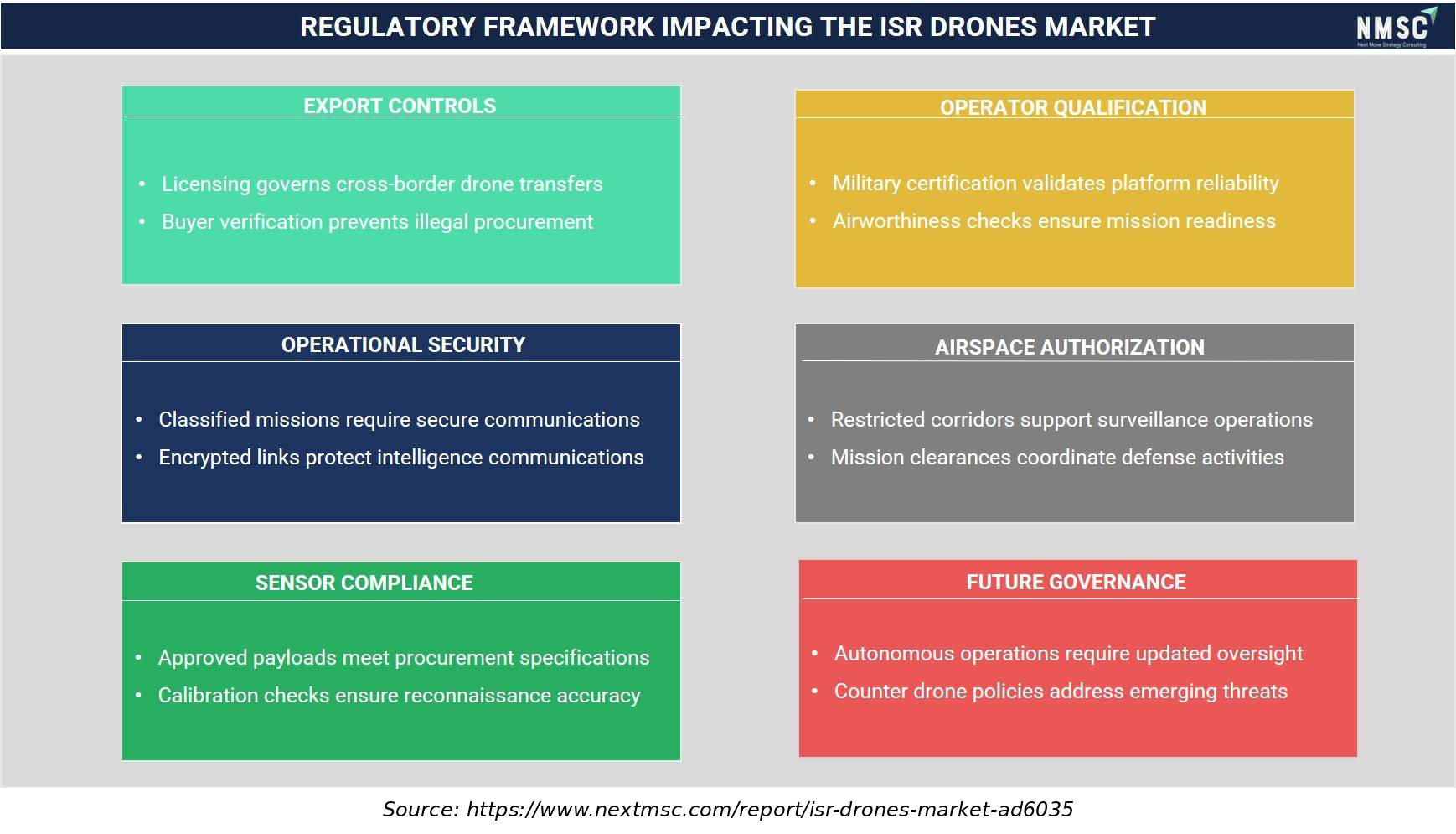
The ISR drones market operates within a stringent regulatory environment governing export controls, operator certification, airspace authorization, operational security, and sensor compliance. These frameworks ensure mission safety, secure intelligence operations, and responsible technology deployment while supporting interoperability and cross-border compliance. Evolving regulations for autonomous operations and counter-drone measures are expected to shape future market development and procurement strategies.

Regional Outlook

2025 (USD Billion)
2035 (USD Billion)
North Americ
Europe
Asia-Pacific
Middle East
Latin Americ
Region 2025 (USD Billion) 2035 (USD Billion) CAGR (%)
North America $10.0 USD Billion $40.0 USD Billion 9.0%
Europe $17.1 USD Billion $51.1 USD Billion 27.0%
Asia-Pacific $24.2 USD Billion $62.2 USD Billion 25.0%
Middle East & Africa $31.3 USD Billion $73.3 USD Billion 23.0%
Latin America $38.4 USD Billion $84.4 USD Billion 12.0%

Regional data is locked

Unlock complete regional numbers for this market.

Unlock Full Data

Competitive Landscape

Our analysis shows that the competitive landscape is consolidating around established defense prime contractors offering integrated platform, sensor, and sustainment packages tailored to government-to-government procurement cycles.

Dimension Description
Dimension Assessment
Market Structure The market remains moderately concentrated, with the top 10 companies accounting for an estimated 65% of 2025 revenue amid growing new entrant activity from autonomy-focused defense technology firms.
Innovation Focus Innovation centers on AI-enabled autonomous mission systems, multi-domain sensor fusion, and modular payload architectures adaptable across ISR, maritime patrol, and airborne early warning roles.
M&A Activity Consolidation continues as sensor and software specialists partner with platform manufacturers to deliver integrated ISR mission packages, exemplified by General Atomics' 2025 partnership agreement with Saab for MQ-9B radar integration.

How Do Companies Compete in the ISR Drones Market?

Companies compete primarily on platform endurance, sensor payload sophistication, and depth of sustainment and training support offered alongside platform sales. We observed that defense ministries increasingly favor prime contractors offering bundled platform, payload, ground control, and lifecycle sustainment packages over component-only suppliers, as procurement programs prioritize single-vendor accountability for multi-decade fleet support commitments.

Which Competitive Archetypes Dominate the ISR Drones Market?

Three competitive archetypes dominate: established HALE and MALE platform primes such as General Atomics Aeronautical Systems and Northrop Grumman that build proprietary large-endurance systems; diversified defense conglomerates such as Elbit Systems, Thales, and Leonardo that supply ISR platforms across multiple product lines; and emerging autonomy-focused entrants such as Anduril Industries and Shield AI that differentiate through software-defined mission autonomy. Our assessment indicates that autonomy-focused entrants are gaining share in tactical and small platform categories.

How Are Companies Differentiating Through Innovation?

Manufacturers are differentiating through mission autonomy software, modular multi-sensor payloads, and platform designs capable of multi-role conversion between ISR, maritime patrol, and airborne early warning missions. We found that General Atomics' MQ-9B airborne early warning configuration with Saab's LoyalEye radar exemplifies this multi-role platform strategy. Continued investment in AI-driven target recognition and secure data-link resilience is expected to remain the primary innovation battleground through 2035.

What M&A and Geographic Expansion Activity Is Shaping the ISR Drones Market?

Merger and acquisition activity is consolidating sensor, software, and autonomy capabilities under established platform manufacturers, with General Atomics' partnership with Saab exemplifying the trend toward integrated multi-mission ISR offerings. Geographic expansion is concentrated in Asia-Pacific and the Middle East, where manufacturers are establishing co-production, assembly, and sustainment facilities to support growing government-to-government procurement pipelines and localized industrial offset requirements.

Key Market Players

Our assessment identifies the following companies, ranked by market-specific revenue and scale of operations, as the leading participants shaping the ISR drones market through 2026.

General Atomics Aeronautical Systems, Inc. Northrop Grumman Corporation AeroVironment, Inc. Elbit Systems Ltd. Israel Aerospace Industries Ltd. Textron Inc. The Boeing Company Thales S.A. Leonardo S.p.A. BAE Systems plc Turkish Aerospace Industries, Inc. Baykar Makina Sanayi ve Ticaret A.Ş. L3Harris Technologies, Inc. Teledyne FLIR LLC Saab AB Airbus SE Rafael Advanced Defense Systems Ltd. KratosDefense& Security Solutions, Inc. Anduril Industries, Inc. Shield AI, Inc.

Ecosystem Analysis of the ISR Drones Market

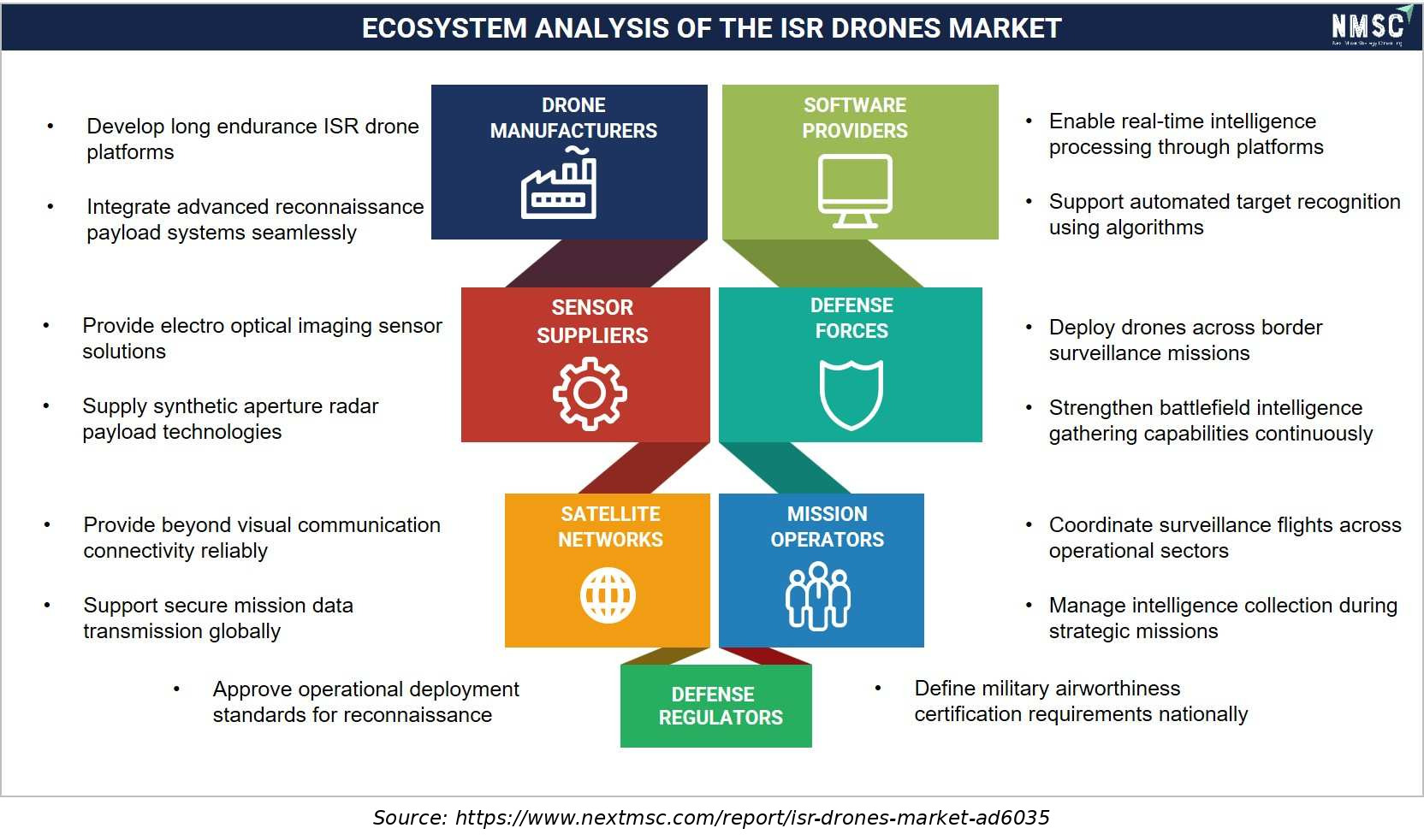
The ISR drones market ecosystem comprises drone manufacturers, sensor suppliers, software providers, satellite network operators, mission operators, defense forces, and regulatory authorities. Effective collaboration among these stakeholders enables secure intelligence collection, real-time data processing, and mission execution. Continuous technological innovation and regulatory coordination are strengthening operational capabilities and driving the adoption of advanced ISR drone solutions across defense applications.

Latest Developments

We observed the following verified developments shaping competitive positioning across the ISR drones market.

Date Event
May 2026 Saab AB's official release confirmed the first flight of its LoyalEye airborne early warning sensor integrated with GA-ASI's MQ-9B unmanned aircraft.
May 2026 GA-ASI separately confirmed that its MQ-9B flew for the first time with Airborne Early Warning pods provided through its partnership with Saab. The flight initiated a development program intended to deliver persistent air-surveillance, early-warning, and long-range detection and tracking capabilities.

Investment Opportunities

How Are Capital Inflows Shaping the ISR Drones Market?

Defense-focused venture and government capital continues to flow into autonomy-oriented ISR platform developers, with Anduril Industries and Shield AI attracting substantial private investment alongside expanding government contract awards. We observed that established primes are simultaneously reinvesting in sensor and autonomy research and development to defend market position against faster-moving technology entrants. Investor interest is concentrated among companies combining proprietary autonomy software with scaled manufacturing and sustainment capability.

What Infrastructure Investment Is Required to Scale ISR Drones Market Coverage?

Scaling ISR drone fleet coverage requires sustained investment in satellite and beyond visual line of sight communication infrastructure, secure ground control stations, and regional maintenance, repair, and overhaul facilities. Our findings suggest that nations pursuing large acquisition programs increasingly require local MRO investment as a condition of contract award, as demonstrated by General Atomics' commitment to establish MRO infrastructure in India alongside its MQ-9B delivery program.

What ESG Considerations Are Relevant to ISR Drones Market Investment?

Environmental, Social, and Governance considerations for defense-sector ISR investment center on responsible use governance, technology transfer compliance, and workforce development commitments tied to co-production agreements. We observed that local training and skills-transfer programs accompanying major platform acquisitions are becoming a differentiating governance factor for government customers evaluating long-term supplier relationships. Social considerations also extend to disaster response and border security applications that indirectly support civilian safety outcomes.

Key Benefits for Stakeholders

How Does This Report Benefit Defense Industry Leaders?

Defense industry leaders gain a structured view of platform capabilities, competitive positioning, and procurement pathways across competing ISR drone providers. Our analysis shows that benchmarking data on platform class, component, and end user segmentation supports more informed strategic planning aligned with allied procurement cycles, while regional regulatory insights help suppliers anticipate export control and co-production requirements.

How Does This Report Benefit Investors and Financial Analysts?

Investors and financial analysts gain access to segmentation-level revenue forecasts, competitive positioning analysis, and identified whitespace opportunities across the ISR drones market. We found that the report's regional and country-level growth projections support portfolio allocation decisions, while the competitive landscape section clarifies which archetypes are best positioned to capture long-term defense procurement spending through 2035.

How Does This Report Benefit Technology Vendors and Product Teams?

Technology vendors and product teams gain visibility into segmentation trends, emerging application demand, and regional regulatory drivers that inform product roadmap prioritization. Our findings suggest that granular data on payload type, range, and component-level demand helps engineering and product teams align development investment with the fastest-growing sub-segments, particularly autonomy software and multi-sensor payload integration.

Key Market Segments Evaluated

By Platform Class

  • MALE ISR Drones
  • Tactical ISR Drones
  • HALE ISR Drones
  • Small/Mini ISR Drones

By Component

  • Airframe/Platform
  • Sensors and Payload
  • Electro-Optical/Infrared (EO/IR) Sensors
  • Synthetic Aperture Radar (SAR) Sensors
  • Signals Intelligence (SIGINT/ELINT) Sensors
  • Ground Control Station
  • Communication and Data Link Systems
  • Software and Analytics

By Application

  • Battlefield and Tactical Reconnaissance
  • Border and Maritime Surveillance
  • Signals Intelligence (SIGINT) Collection
  • Homeland Security and Counter-Terrorism
  • Others

By Range

  • Short Range
  • Medium Range
  • Long Range/BVLOS

By Payload Type

  • Electro-Optical/Infrared (EO/IR)
  • Synthetic Aperture Radar (SAR)
  • Signals Intelligence (SIGINT/ELINT)
  • Multi-Sensor/Multi-INT

By End User

  • Army
  • Air Force
  • Navy
  • Homeland Security and Coast Guard
  • Others

Conclusion & Recommendations

The long-term outlook remains strongly positive, with the market projected to nearly triple from USD 8.05 billion in 2026 to USD 24.42 billion by 2035 at a 13.1% CAGR. Our analysis shows that sustained global defense budget growth, combined with expanding government-to-government co-production programs, will continue to support broad-based growth across nearly every segmentation axis through the forecast period.

What Strategic Positioning Recommendations Apply to Manufacturers?

Manufacturers should pursue integrated platform, sensor, and sustainment positioning to meet defense ministries' preference for single-vendor lifecycle accountability. We observed that suppliers combining proprietary autonomy software with local co-production capacity are best positioned to navigate export control frameworks while capturing share from nations prioritizing strategic autonomy alongside operational capability.

How Attractive Is the ISR Drones Market for New Investment?

The ISR drones industry presents an attractive investment case, supported by a USD 16.37 billion absolute dollar opportunity between 2026 and 2035 and above-average growth in Asia-Pacific and small/mini platform categories. We found that investment attractiveness is highest for manufacturers combining regulatory compliance expertise with scaled sustainment infrastructure, positioning them to serve both established allied and emerging co-production markets simultaneously.

What Market Shifts and Key Risks Should Stakeholders Monitor?

Stakeholders should monitor export control tightening, electronic warfare vulnerability, and elevated attrition rates among tactical platforms as key risks to the market. Our analysis shows that suppliers unable to demonstrate resilient, jam-resistant data-link architecture risk losing procurement competitions to competitors with proven contested-environment performance records, particularly within active conflict-adjacent regions.

What Are the Key Growth Pathways for the ISR Drones Market?

Key growth pathways include expanding co-production and local assembly partnerships, scaling multi-role HALE platform conversions into airborne early warning missions, and deepening signals intelligence payload integration as electromagnetic spectrum contestation intensifies. Next Move Strategy Consulting's analysis indicates that suppliers pursuing these pathways while maintaining cost competitiveness in tactical and small/mini platform categories will be best positioned to capture the ISR drones market's projected growth through 2035.

FAQs

About the Author

Mihul Sharma

Mihul Sharma

Mihul Sharma is Research Associate at Next Move Strategy Consulting, where he has covered technology, industrial, and healthcare markets for 3 years. His work applies structured business research, market analysis, and secondary-source review to assess market trends, competitive developments, and growth opportunities. He supports report development by fully synthesizing industry data, company information, and market signals into concise findings for strategy and investment-focused research teams.

About the Reviewer

Supradip Baul

Supradip Baul

Supradip Baul is an accomplished business consultant and strategist with over a decade of rich experience in market intelligence, strategy, technology, and business transformation. His work has included rigorous qualitative and quantitative analysis across multiple industries, helping clients shape investment decisions and long-term roadmaps. Earlier in his career, he was associated with Gartner, where he contributed to industry-leading reports and market share analyses. He has worked with leading global companies and holds an MBA with a dual specialization in Marketing and Finance.

Download Free Sample

Robert Sean Trevino

ROBERT SEAN TREVINO

Sr. Director, Head of Strategic Insights & Analytics

Foundation Medicine

I realized that it was a reliable source of information. These days, there are many people who are looking for authentic data, and this is one of the only sources that can offer them with what they need;

Pratyush Kumar Das

PRATYUSH KUMAR DAS

Assistant Manager

Polycab India Limited

We would like to express our appreciation for the data and insights provided by nextmsc. We are very pleased with the quality and depth of the information, which has proven to be highly valuable and beneficial for our business decision-making.

Mohit Agarwal

MOHIT AGARWAL

Chief Manager

DryChem India Pvt. Ltd.

Next Move Strategy Consulting is an amazing team of consultants. We required a market study report for our investors on top priority and the team went above and beyond our expectations to deliver the same with ample supporting data within a short time span enabling us to secure the investments and keep our project timeline maintained. Their professionalism, attention to detail, and timely delivery of actionable recommendations have left a lasting impression on our organization.

Melanie Samko

MELANIE SAMKO

Director of Marketing

TOSOH BIOSCIENCE, INC.

The information provided by NMSC is incredibly valuable, thank you so much for such a excellent work. I really appreciate it. I will make sure to reference all of it, in my summary document.

Nishant Awate

NISHANT AWATE

Business Development Global Sales

Zehnder Group Deutschland GmbH

Our experience working with Next Move Strategy Consulting was positive. The team was responsive, professional, and open to incorporating our specific requirements throughout the project. The India AHU market study was comprehensive and well structured, covering market value and volume forecasts, product and application segments, and key industry trends. The inclusion of both AHU and residential MVHR market insights made the study particularly relevant for our strategic market assessment. Overall, the report provides a solid foundation for evaluating market potential, identifying priority segments, and supporting business-development decisions in India.

Custom Market Research Services

We will customize the research for you if the listed report does not fully match your requirements.

Get 30% Free Customization

Select License

This website uses cookies to ensure you get the best experience on our website. Learn more

✖