Swarm Drone Market By Offering (Swarm Drone Systems, Swarm Software, Swarm Services), By Platform (Fixed Wing, Rotary Wing, Hybrid VTOL), By Control Architecture (Leader-Follower, Centralized, Distributed, Hybrid), By Autonomy Level, By Mission Type, and By End User (Defense, Government, Commercial, Research & Academia) – Global Analysis & Forecast, 2026–2035.
What Is the Swarm Drone Market Size?
The global Swarm Drone Market was valued at USD 970.1 million in 2025 and is expected to reach USD 1,148.0 million in 2026. Accelerating defense modernization programs, growing autonomous systems adoption, and expanding commercial drone deployment are projected to propel the market to USD 4,540.0 million by 2035, advancing at a CAGR of 16.5% from 2026 to 2035. Key growth drivers include rising military investment in multi-platform autonomous warfare capabilities, breakthrough advances in swarm intelligence algorithms, expanding commercial applications across agriculture and logistics, and rapid proliferation of AI-enabled drone coordination systems across defense and civilian end markets worldwide.
|
Parameters |
Details |
|
Market Size in 2025 |
USD 970.1 Million |
|
Market Size in 2026 |
USD 1,148.0 Million |
|
Revenue Forecast in 2035 |
USD 4,540.0 Million |
|
Growth Rate |
CAGR of 16.5% from 2026 to 2035 |
|
Analysis Period |
2025–2035 |
|
Base Year Considered |
2025 |
|
Forecast Period |
2026–2035 |
|
Market Size Estimation |
Million USD |
|
Companies Profiled |
13 |
|
Countries Covered |
33 |
|
Market Share |
Top 10 |
Swarm Drone Market Overview
What Is the Swarm Drone Market?
The Swarm Drone Market encompasses the development, deployment, and commercialization of systems in which multiple unmanned aerial vehicles (UAVs) operate in coordinated formations, executing collective missions through distributed intelligence and autonomous communication protocols. Unlike single-UAV operations, swarm drone systems leverage collective behavior, AI-driven coordination, and decentralized decision-making to deliver superior mission coverage, resilience, and operational effectiveness. NMSC's analysis indicates that the market spans military, governmental, commercial, and research applications across fixed-wing, rotary-wing, and hybrid VTOL platform architectures.
How Has the Swarm Drone Market Evolved?
The Swarm Drone Market has transitioned through three distinct development phases. The initial phase involved simple rule-based multi-drone formations used primarily for aerial light shows and limited surveillance operations. The second phase introduced machine learning algorithms enabling semi-autonomous coordination across small defense trial programs in the United States, Israel, and China. Based on NMSC's research, we found that the current phase is defined by fully autonomous AI-powered swarms capable of ISR missions, coordinated electronic warfare, precision strike operations, and large-scale commercial logistics delivery, underpinned by exponential advances in edge computing, 5G communications, and miniaturized sensor payloads.
How Do Regulations Influence the Swarm Drone Market?
Regulatory frameworks represent a primary structural determinant of Swarm Drone Market development across both defense and commercial domains. In the United States, the Department of Defense's Replicator Initiative and FAA Part 107 regulations, along with the FAA Reauthorization Act of 2024, directly govern commercial drone deployment at scale. Europe's EASA U-Space regulatory framework governs coordinated drone operations within civilian airspace. Our findings suggest that national defense procurement rules in the United Kingdom, Israel, South Korea, and Australia are further expanding the addressable market by formalizing autonomous swarm system procurement within defense budgets and operational doctrines.
How Is Technology Adoption Expanding Across the Swarm Drone Market?
Technology adoption across the Swarm Drone Market is accelerating as advances in edge AI, miniaturized onboard computing, and low-latency mesh communications enable progressively autonomous swarm behavior. NMSC's analysis indicates that adoption is expanding beyond defense into commercial sectors including precision agriculture, energy infrastructure inspection, and telecommunications relay. The integration of 5G and satellite communications with swarm coordination protocols is lowering deployment barriers for civilian applications. Simultaneously, open-architecture software standards and government-sponsored innovation programs in the U.S., EU, and Asia-Pacific are reducing development costs and accelerating commercial-sector market entry for Swarm Drone Industry participants.
|
Key Takeaway |
|
By offering, Swarm Drone Systems held the largest revenue share of the Swarm Drone Market, valued at USD 540.0 million in 2025, driven by strong military demand for complete turnkey platform solutions including rotary-wing and fixed-wing variants. The Rotary Wing Systems sub-segment within Swarm Drone Systems dominates due to its operational flexibility in complex terrain environments across both defense and commercial missions. |
|
The Swarm Software segment is the fastest-growing offering category in the Swarm Drone Market at a CAGR of 21.5% from 2026 to 2035, advancing from USD 244.2 million in 2025 to USD 1,237.1 million by 2035. Swarm Intelligence software leads growth within this segment as AI-powered coordination algorithms replace traditional human-directed command protocols across defense and commercial deployments. |
|
By platform, the Rotary Wing platform dominates the Swarm Drone Market at USD 505.4 million in 2025, supported by its versatility for ISR, logistics, and inspection missions. Within Rotary Wing, the Small sub-segment commands the largest share due to cost efficiency and tactical flexibility across military forward-operating environments. |
|
The Hybrid VTOL platform is the fastest-growing platform segment in the Swarm Drone Market at a CAGR of 20.5% from 2026 to 2035, driven by its operational advantages of extended endurance combined with vertical take-off and landing capability critical for naval and urban deployment scenarios. |
|
By control architecture, the Distributed control architecture dominates the Swarm Drone Market at USD 318.8 million in 2025, reflecting military and commercial preference for resilient decentralized coordination that maintains mission effectiveness even when individual nodes are lost or jammed. |
|
The Fully Autonomous control architecture is the fastest-growing architecture type in the Swarm Drone Market at a CAGR of 24.4% from 2026 to 2035, propelled by advances in onboard AI processing, real-time machine learning, and increasing military operator comfort with fully autonomous mission execution. |
|
By mission type, Intelligence, Surveillance, and Reconnaissance (ISR) represents the largest mission segment of the Swarm Drone Market at USD 346.0 million in 2025, reflecting sustained global defense investment in persistent situational awareness capabilities across land, maritime, and urban operating environments. |
|
The Combat and Strike mission segment is the fastest-growing in the Swarm Drone Market at a CAGR of 19.4% from 2026 to 2035, driven by escalating defense procurement programs in the United States, United Kingdom, Australia, and Israel targeting affordable attritable autonomous strike capability. |
|
By end user, the Defense segment dominates the Swarm Drone Market at USD 624.1 million in 2025, representing approximately 64% of total market revenue, underpinned by multi-year military procurement programs across North America, Asia-Pacific, and Europe targeting autonomous multi-domain warfare capabilities. |
|
The Commercial end-user segment is the fastest-growing in the Swarm Drone Market at a CAGR of 20.1% from 2026 to 2035, progressing from USD 185.9 million in 2025 to USD 1,188.9 million by 2035, led by agriculture precision sensing, energy infrastructure monitoring, and last-mile logistics delivery applications. |
|
North America dominates the Swarm Drone Market, accounting for USD 419.6 million in 2025 and forecast to reach USD 1,938.5 million by 2035 at a CAGR of 16.5%, underpinned by the highest concentration of defense prime contractors, the U.S. Department of Defense Replicator Initiative, and the world’s largest commercial drone technology ecosystem. |
|
Asia-Pacific is the fastest-growing major region in the Swarm Drone Market at a CAGR of 18.1% from 2026 to 2035, driven by China’s advanced military drone programs, India’s drone export and defense modernization policies, and South Korea’s expanding commercial drone deployment infrastructure. |
|
The United States is the single largest country market in the Swarm Drone Market, representing over 78% of North American revenue in 2025, anchored by DoD Replicator funding commitments, the highest concentration of autonomous drone technology companies, and mature commercial UAV adoption across agriculture, energy, and logistics sectors. |
|
China is the fastest-growing major national market in the Swarm Drone Market at an estimated CAGR of 24.6% from 2026 to 2035, driven by aggressive PLA drone procurement, civilian swarm drone commercialization led by DJI-affiliated entities, and significant state-directed investment in indigenous swarm intelligence platforms. |
Key Emerging Trends in the Swarm Drone Market
How Is AI-Powered Swarm Intelligence Transforming Mission Autonomy in the Swarm Drone Market?
Advances in onboard AI are fundamentally reshaping mission autonomy within the Swarm Drone Market. Our analysis shows that systems such as DARPA's OFFensive Swarm-Enabled Tactics (OFFSET) program have demonstrated swarm coordination capabilities where individual drones dynamically reassign roles mid-mission without human intervention. Neural network models now enable real-time threat classification, formation adjustment, and target deconfliction at microsecond latency. This shift is forcing every platform vendor in the global market to embed AI inference chips and federated learning capabilities directly into drone hardware, transforming the competitive landscape from airframe-focused to algorithm-focused differentiation.
How Is the U.S. Replicator Initiative Reshaping Defense Procurement in the Swarm Drone Market?
The U.S. Department of Defense's Replicator Initiative, announced in 2023 and expanded in 2024, is the single most consequential demand-side catalyst in the global Swarm Drone Market. The initiative targets fielding thousands of attritable autonomous systems across multiple domains within an 18 to 24-month sprint cycle. Based on NMSC's research, we found that this has accelerated procurement timelines, forced commercial-off-the-shelf adoption, and opened the market to non-traditional defense suppliers including Anduril Industries and Shield AI. The Replicator Initiative is creating a template that allied nations including Australia, the UK, and Japan are actively replicating through their own autonomous systems procurement frameworks.
How Are Counter-Drone and Counter-Swarm Technologies Creating Parallel Growth in the Swarm Drone Market?
The escalation of drone swarm threats is simultaneously creating a parallel growth segment within the broader Swarm Drone Market ecosystem focused on counter-drone and counter-swarm technologies. NMSC's analysis indicates that the U.S. Army's Indirect Fire Protection Capability (IFPC) and the UK's DragonFire directed energy weapon programs reflect military recognition that defeating swarm attacks requires equally sophisticated automated response systems. This dynamic creates a dual-market structure where swarm offensive and defensive systems are co-procured, effectively doubling per-conflict defense spending on drone-related autonomous systems and expanding the total Swarm Drone Market addressable base.
How Is Commercial Drone Swarm Adoption Expanding Beyond Military Applications in the Swarm Drone Market?
Through NMSC's market assessment, we observed that commercial swarm drone applications are progressing rapidly from proof-of-concept to operational deployment across multiple sectors. Walmart and Amazon have invested in drone delivery infrastructure in the United States, while energy companies including BP and Shell are deploying coordinated multi-drone inspection systems across offshore platforms. Intel's Shooting Star drone swarm system, featuring over 2,000 drones in synchronized light shows, represents a mature entertainment application. In agriculture, multi-drone seeding and spraying operations in China, Japan, and South Korea are demonstrating commercially viable swarm coordination at scale, validating the commercial segment's forecast growth trajectory within the Swarm Drone Market.
What Are the Key Market Drivers, Breakthroughs, and Investment Opportunities That Will Shape the Swarm Drone Market Industry in the Next Decade?
Growth Catalyst and Risk Assessment Matrix
|
Drivers / Trends / Restraints |
(+/-) % Impact on CAGR Forecast |
Geographic Relevance |
Impact Timeline |
|
DoD Replicator Initiative and Allied Procurement |
+2.6% |
North America, Europe, APAC |
2025–2030 |
|
AI and Swarm Intelligence Algorithm Advances |
+2.2% |
Global (led by North America, China) |
2025–2035 |
|
Commercial Drone Delivery Regulatory Approvals |
+1.8% |
North America, Europe, APAC |
2026–2035 |
|
Miniaturization of Edge AI and Sensor Payloads |
+1.6% |
Global |
2025–2030 |
|
5G and Satellite Communication Integration |
+1.4% |
North America, Europe, East Asia |
2025–2032 |
|
Agricultural Precision Drone Deployment |
+1.2% |
APAC, North America, Europe |
2026–2035 |
|
Regulatory Fragmentation for Autonomous Operations |
-1.4% |
Europe, North America, MEA |
Ongoing |
|
Cybersecurity and Spectrum Vulnerability of Swarms |
-1.1% |
All regions |
Ongoing |
|
High Unit Cost of Military-Grade Swarm Systems |
-0.8% |
MEA, Latin America, Southeast Asia |
2025–2029 |
|
Counter-Drone Technology Expansion |
+1.0% |
Global Defense Markets |
2026–2035 |
|
Entertainment and Light Show Commercialization |
+0.6% |
Asia-Pacific, North America |
2025–2030 |
|
Defense AI and Autonomous Weapons Policy Risk |
-0.7% |
Europe, Global Defense Markets |
Ongoing |
What Are the Growth Drivers of the Swarm Drone Market?
How Is the U.S. Department of Defense Replicator Initiative Driving the Swarm Drone Market?
The U.S. Department of Defense's Replicator Initiative represents the most direct and impactful governmental catalyst for the Swarm Drone Market. The DoD announced in August 2023 its commitment to field multiple thousands of autonomous systems across domains within 18 to 24 months. According to official DoD budget documents available on defense.gov, the initiative received over USD 500 million in dedicated funding in fiscal year 2024, with continued allocations in FY2025. NMSC's analysis indicates that this single procurement decision has accelerated commercial investment in attritable drone technology, swarm intelligence software, and low-cost autonomous airframe manufacturing across the entire defense industrial base.
How Are Advances in Artificial Intelligence and Autonomous Systems Fueling Swarm Drone Market Growth?
Artificial intelligence and machine learning constitute the core technological driver enabling the commercial viability of coordinated drone swarms. DARPA's OFFSET and CODE programs have publicly demonstrated multi-UAV mission coordination with minimal human oversight, with program documentation available on darpa.mil confirming successful field demonstrations. Our findings suggest that onboard neural processing units from companies such as NVIDIA and Qualcomm are now small and power-efficient enough for integration into micro-class drones weighing under 250 grams. This miniaturization breakthrough has unlocked new platform classes within the Swarm Drone Market and dramatically expanded the range of accessible mission types for both military and commercial operators.
How Is Global Defense Modernization Expanding Demand Across the Swarm Drone Market?
Global defense budget growth across NATO allies and Asia-Pacific nations is creating sustained and growing demand for swarm drone procurement as part of multi-domain autonomous warfare strategies. NATO's Defense Investment Pledge, as documented on nato.int, requires member states to commit at least 2% of GDP to defense, with autonomous systems increasingly prioritized within these allocations. In Asia-Pacific, India's iDEX initiative under the Ministry of Defence, documented on idex.gov.in, has explicitly targeted drone swarm startups for defense procurement. From our assessment, we identified that Japan's Ministry of Defense has initiated dedicated autonomous systems programs, further expanding the geographic breadth of military procurement driving Swarm Drone Market growth.
Ecosystem Analysis of the Swarm Drone Market
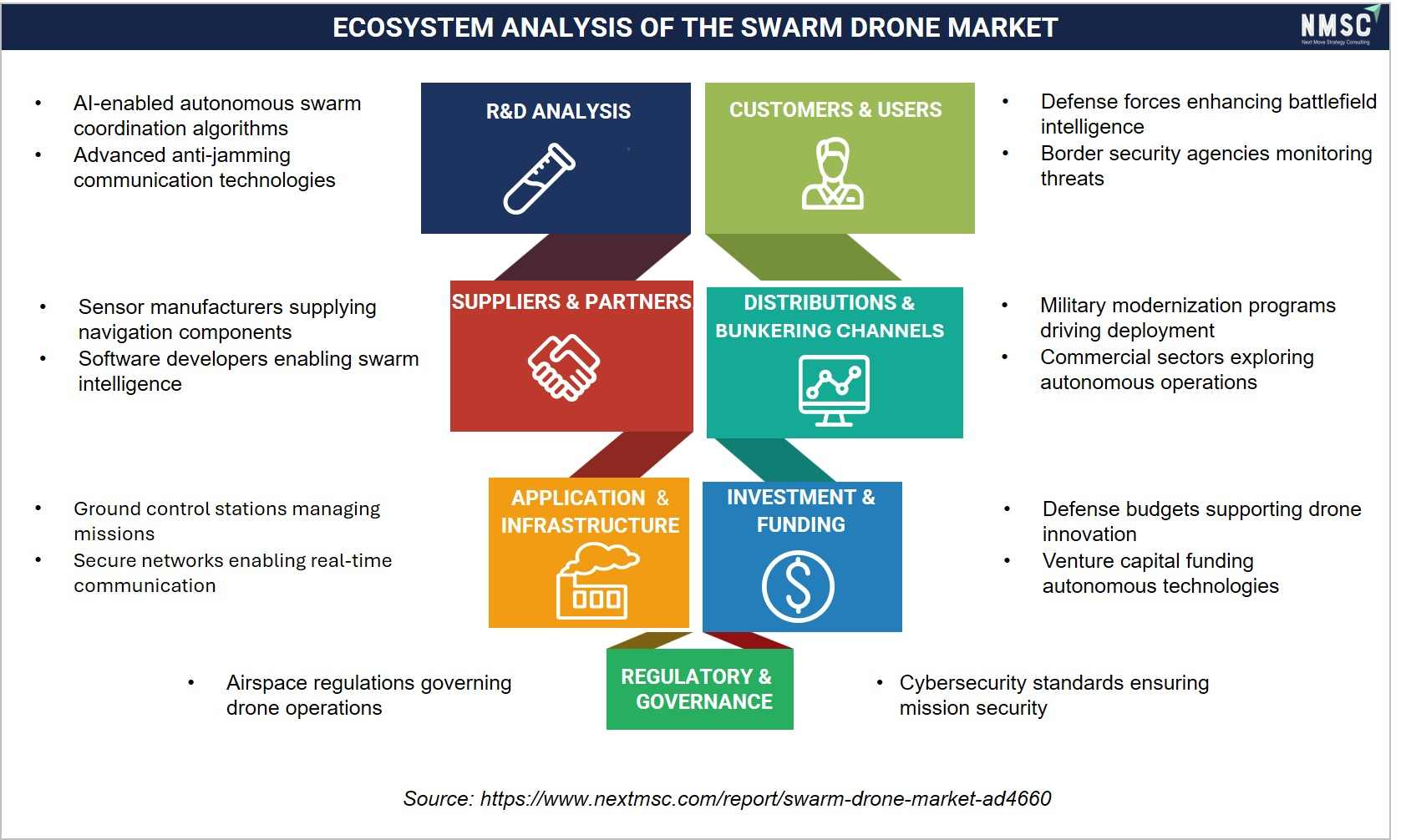
The swarm drone market ecosystem comprises multiple interconnected stakeholders driving innovation, deployment, and commercialization. Research and development activities focus on advancing autonomous navigation, artificial intelligence, and communication technologies. Suppliers and partners provide critical hardware, software, and integration services, while distribution channels facilitate market access. Customers include defense agencies, commercial enterprises, and public sector organizations. Investments and funding accelerate technological advancements and market expansion. Application infrastructure supports operational deployment across various industries, while regulatory and governance frameworks ensure safety, compliance, and responsible use of swarm drone technologies.
What Are the Growth Inhibitors of the Swarm Drone Market?
How Does Regulatory Fragmentation Constrain Commercial Deployment in the Swarm Drone Market?
Regulatory inconsistency across jurisdictions represents the most significant structural constraint on commercial Swarm Drone Market expansion. The FAA's Beyond Visual Line of Sight (BVLOS) operational rules, updated in 2024 and accessible on faa.gov, still require case-by-case waivers for large-scale coordinated swarm operations, significantly increasing compliance costs and deployment timelines. The European Union Aviation Safety Agency's U-Space regulation framework, while progressive, introduces certification requirements for multi-drone coordination systems that extend market entry timelines for commercial operators. Our assessment indicates that this regulatory patchwork is particularly constraining for logistics, agriculture, and inspection operators seeking to scale commercial swarm operations across multiple national jurisdictions simultaneously.
How Do Cybersecurity Vulnerabilities in Swarm Communication Architectures Restrict Swarm Drone Market Adoption?
The distributed communication architecture that enables swarm drone coordination simultaneously creates significant cybersecurity attack surfaces that are constraining Swarm Drone Market adoption, particularly among defense and critical infrastructure operators. The U.S. Cybersecurity and Infrastructure Security Agency (CISA), in guidance documents published on cisa.gov, has specifically identified drone communication protocols as a vulnerability surface requiring hardened encryption and anti-spoofing measures. GPS jamming and signal spoofing incidents documented by the DoD have demonstrated the operational risk of communication-dependent swarm architectures in contested electromagnetic environments. Based on our market evaluation, these concerns are extending procurement timelines and increasing development costs for swarm platform vendors.
What Are the Growth Opportunities in the Swarm Drone Market?
How Does Large-Scale Commercial Agriculture Deployment Present a Transformational Opportunity in the Swarm Drone Market?
Precision agriculture represents one of the highest-potential commercial growth opportunities in the Swarm Drone Market. The U.S. Department of Agriculture's Economic Research Service, in reports accessible on ers.usda.gov, documents that precision agriculture technology adoption is accelerating among U.S. farm operators, with drone-based variable-rate application emerging as a priority investment area. Multi-drone coordinated systems can cover farming areas of thousands of hectares per day, a capability that no single UAV can match. NMSC's analysis indicates that Japan's Ministry of Agriculture, Forestry and Fisheries has formally supported multi-drone agricultural operations under its Smart Agriculture Initiative, establishing a regulatory precedent that other APAC nations are actively replicating to unlock this commercial Swarm Drone Market opportunity.
How Do Urban Air Mobility and Last-Mile Logistics Create Structural Growth Opportunities in the Swarm Drone Market?
The convergence of drone delivery regulation, urban air mobility infrastructure, and commercial logistics demand is creating a structurally significant growth opportunity within the Swarm Drone Market. The FAA's Unmanned Aircraft Systems Integration Pilot Program, documented on faa.gov, has provided a regulatory pathway for commercial drone delivery operations in multiple U.S. cities. Amazon's Prime Air and Walmart's Wing delivery partnerships represent multi-billion dollar commercial commitments to scaling drone delivery infrastructure. Our analysis shows that coordinated multi-drone logistics swarms, capable of simultaneous delivery across urban grids, represent the next architectural evolution beyond single-drone delivery, with significant Swarm Drone Market revenue potential emerging by 2027–2028.
How Does Critical Infrastructure Inspection Create a Recurring Revenue Opportunity in the Swarm Drone Market?
Energy and utilities infrastructure inspection represents a recurring, high-value commercial opportunity within the Swarm Drone Market that is increasingly shifting from single-UAV to coordinated multi-drone deployments. The U.S. Department of Energy, in energy infrastructure cybersecurity frameworks published on energy.gov, identifies regular automated inspection of transmission lines, wind turbines, and solar farms as an operational imperative. Coordinated swarm inspection systems can simultaneously cover multiple assets, reducing inspection time by over 70% compared to sequential single-drone operations. Based on NMSC's research, we found that operators across oil and gas, electrical transmission, and renewable energy are increasingly specifying multi-drone coordinated systems in their infrastructure maintenance contracts, creating durable commercial demand within the Swarm Drone Market.
Strategic Framework of the Swarm Drone Market
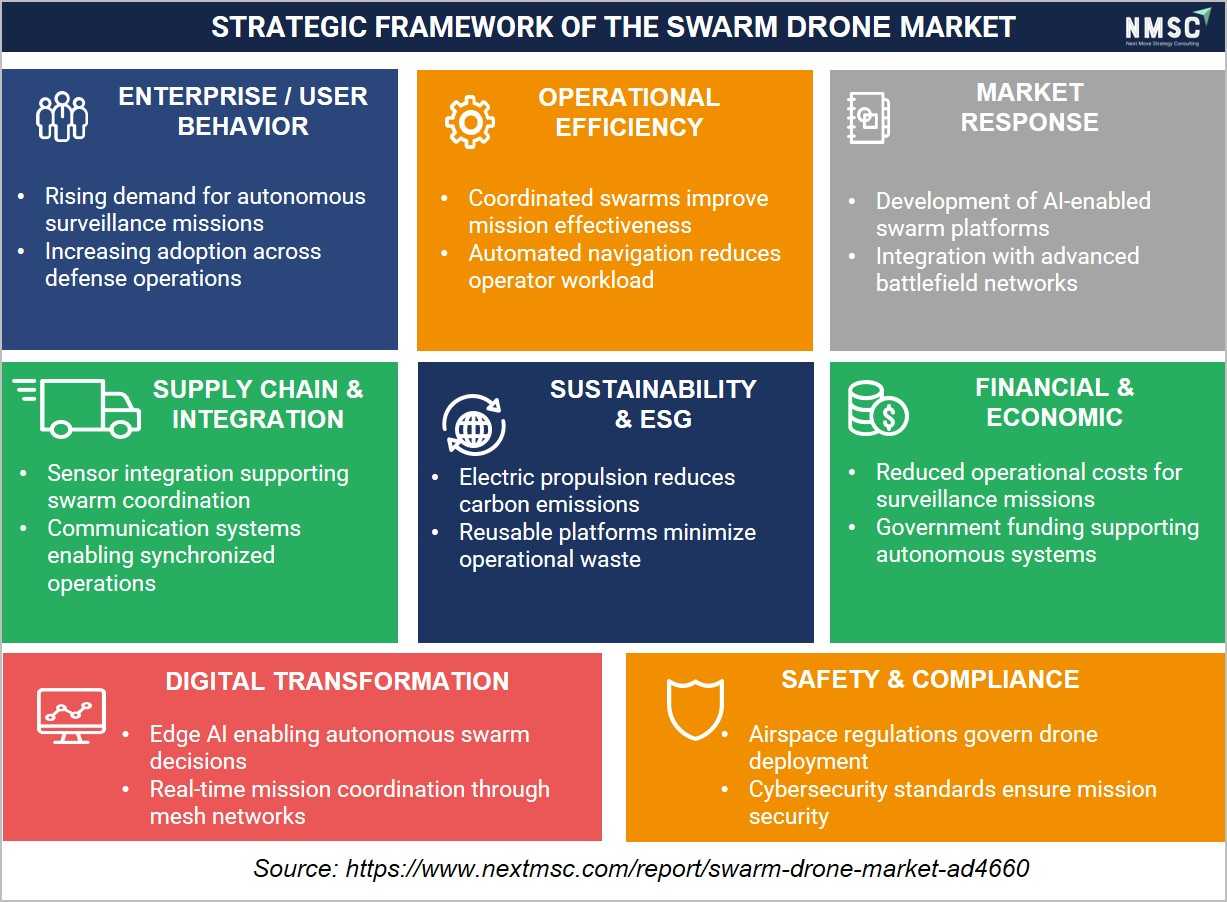
The strategic framework of the swarm drone market highlights the key factors shaping industry growth and adoption. Rising demand for autonomous surveillance and defense applications is driving user adoption, while AI-powered swarm coordination enhances operational efficiency and mission effectiveness. Advancements in sensor integration, communication networks, and digital technologies such as Edge AI and mesh networking enable synchronized and autonomous operations. Government funding and cost efficiencies support market expansion, while sustainability initiatives promote reusable and energy-efficient platforms. At the same time, evolving airspace regulations, cybersecurity standards, and compliance requirements ensure the safe, secure, and responsible deployment of swarm drone systems across military and commercial applications.
How Is the Swarm Drone Market Segmented in This Report, and What Are the Key Insights from the Segmentation Analysis?
How Do the Three Core Offering Categories Shape Revenue Distribution Across the Swarm Drone Market?
|
Offering Segment |
2025 (USD Mn) |
2035 (USD Mn) |
CAGR (%) |
|
Swarm Drone Systems |
540.0 |
2,182.6 |
19.0% |
|
Fixed Wing Systems |
142.5 |
545.7 |
18.3% |
|
Rotary Wing Systems |
232.7 |
940.3 |
19.0% |
|
Hybrid VTOL Systems |
122.1 |
589.5 |
20.9% |
|
Other Systems |
40.7 |
107.1 |
13.9% |
|
Swarm Software |
244.2 |
1,237.1 |
21.5% |
|
Command And Control |
71.2 |
345.9 |
21.0% |
|
Swarm Intelligence |
81.4 |
452.9 |
22.7% |
|
Mission Planning |
54.3 |
253.3 |
20.6% |
|
Simulation And Training |
37.3 |
185.1 |
21.3% |
|
Swarm Services |
185.9 |
1,120.3 |
23.3% |
|
Integration Services |
61.1 |
481.7 |
23.0% |
|
Operations Services |
54.3 |
336.1 |
24.0% |
|
Maintenance Services |
40.7 |
263.0 |
24.6% |
|
Training Services |
33.9 |
175.3 |
21.8% |
Based on NMSC's analysis of enterprise procurement patterns and defense contract awards, the Swarm Drone Market is segmented into Swarm Drone Systems, Swarm Software, and Swarm Services. Within Swarm Drone Systems, the Rotary Wing sub-segment commands the largest share due to its operational versatility across ISR, logistics, and strike missions in complex terrain environments. Fixed Wing Systems are preferred for long-endurance surveillance missions, while Hybrid VTOL Systems are the fastest-growing sub-segment driven by naval and urban deployment requirements. Swarm Software, particularly Swarm Intelligence and Command and Control platforms, is the fastest-growing primary segment as AI-driven autonomous coordination replaces manual human direction across both military and commercial Swarm Drone Market deployments.
Which Platform Architectures Are Driving the Highest Adoption Rates in the Swarm Drone Market?
|
Platform Segment |
2025 (USD Mn) |
2035 (USD Mn) |
CAGR (%) |
|
Fixed Wing |
251.0 |
988.9 |
18.6% |
|
Small Fixed Wing |
108.5 |
423.9 |
18.5% |
|
Medium Fixed Wing |
88.2 |
360.4 |
19.0% |
|
Large Fixed Wing |
54.3 |
204.6 |
18.0% |
|
Rotary Wing |
505.4 |
2,172.5 |
15.7% |
|
Nano Rotary Wing |
47.5 |
199.7 |
15.4% |
|
Micro Rotary Wing |
88.2 |
399.4 |
16.3% |
|
Small Rotary Wing |
176.4 |
745.3 |
15.4% |
|
Medium Rotary Wing |
128.9 |
555.3 |
19.6% |
|
Large Rotary Wing |
64.4 |
272.8 |
15.5% |
|
Hybrid VTOL |
213.7 |
1,378.6 |
20.5% |
|
Tilt Rotor |
81.4 |
531.0 |
20.6% |
|
Tilt Wing |
61.1 |
379.9 |
20.1% |
|
Tail Sitter |
47.5 |
311.8 |
20.7% |
|
Other Hybrid VTOL |
23.7 |
155.9 |
20.5% |
Through NMSC's market assessment, we observed that the Swarm Drone Market is segmented into Fixed Wing, Rotary Wing, and Hybrid VTOL platform architectures. The Rotary Wing segment dominates across all size classes, with the Small Rotary Wing sub-segment representing the largest individual platform category due to its cost efficiency, ease of deployment, and operational flexibility across tactical military and commercial inspection missions. Micro Rotary Wing drones are witnessing the fastest growth within the Rotary Wing segment, driven by advances in miniaturized AI processors and swarm coordination firmware enabling effective multi-unit coordination in GPS-denied indoor and urban environments. The Hybrid VTOL segment registers the highest overall platform CAGR at 20.5%, with Tilt Rotor and Tail Sitter configurations emerging as preferred naval and expeditionary force options within the Swarm Drone Market.
How Does Control Architecture Choice Determine Operational Effectiveness in the Swarm Drone Market?
|
Control Architecture |
2025 (USD Mn) |
2035 (USD Mn) |
CAGR (%) |
|
Leader Follower |
196.7 |
691.8 |
13.4% |
|
Centralized |
142.5 |
506.5 |
13.5% |
|
Distributed |
318.8 |
1,573.5 |
17.3% |
|
Hybrid |
312.1 |
1,768.2 |
18.9% |
Based on NMSC's research, we found that the Swarm Drone Market is segmented by control architecture into Leader Follower, Centralized, Distributed, and Hybrid models. The Distributed architecture currently dominates due to its inherent operational resilience, maintaining mission effectiveness even when individual swarm nodes are lost to electronic warfare, mechanical failure, or environmental interference. The Hybrid architecture, which combines centralized mission planning with distributed execution autonomy, is the fastest-growing control model at a CAGR of 18.9%, reflecting military and commercial operators' preference for command authority without sacrificing autonomous operational resilience. Leader Follower and Centralized architectures remain relevant for lower-complexity, cost-sensitive commercial applications within the Swarm Drone Market where full distributed intelligence is operationally unnecessary.
How Is the Shift Toward Higher Autonomy Levels Reshaping the Competitive Dynamics of the Swarm Drone Market?
|
Autonomy Level |
2025 (USD Mn) |
2035 (USD Mn) |
CAGR (%) |
|
Human Controlled |
217.1 |
589.4 |
10.5% |
|
Human Supervised |
332.4 |
1,227.3 |
14.0% |
|
Human On The Loop |
257.8 |
1,281.6 |
17.4% |
|
Fully Autonomous |
162.8 |
1,441.7 |
24.4% |
Our assessment indicates that the Swarm Drone Market is segmented by autonomy level into Human Controlled, Human Supervised, Human On The Loop, and Fully Autonomous operational modes. The Human Supervised segment commands the largest revenue share in 2025 as most operational military and commercial deployments retain operator oversight to satisfy current regulatory and ethical requirements. However, the Fully Autonomous segment is by far the fastest-growing autonomy tier at a CAGR of 24.4%, as algorithmic advances in real-time decision-making, target discrimination, and collision avoidance enable militaries and commercial operators to progressively reduce human intervention requirements. NMSC's analysis indicates that Human On The Loop architectures represent the transitional deployment model most likely to dominate military procurement throughout the 2026–2030 period as operator trust in swarm AI builds systematically.
Which Mission Types Are Generating the Most Value in the Swarm Drone Market?
|
Mission Type |
2025 (USD Mn) |
2035 (USD Mn) |
CAGR (%) |
|
Intelligence Surveillance And Reconnaissance |
346.0 |
1,422.3 |
15.2% |
|
Combat And Strike |
217.1 |
1,281.5 |
19.4% |
|
Electronic Warfare |
108.5 |
545.6 |
17.5% |
|
Communications Relay |
81.4 |
360.3 |
16.0% |
|
Logistics And Delivery |
74.6 |
404.3 |
18.4% |
|
Inspection And Monitoring |
63.3 |
345.8 |
14.6% |
|
Entertainment And Light Show |
33.9 |
116.9 |
13.2% |
|
Other Missions |
20.4 |
88.2 |
12.0% |
From our research, we found that the Swarm Drone Market is segmented by mission type into ISR, Combat and Strike, Electronic Warfare, Communications Relay, Logistics and Delivery, Inspection and Monitoring, Entertainment and Light Show, and Other Missions. The ISR segment remains the largest at USD 346.0 million in 2025, reflecting the foundational role of persistent multi-sensor surveillance in military operations and border security globally. Combat and Strike is the fastest-growing mission segment at a CAGR of 19.4%, driven by escalating attritable strike drone procurement across the United States, UK, Australia, and Israel. Electronic Warfare swarm missions are emerging as a high-value segment as militaries recognize the capability of coordinated drone jamming and spoofing operations against adversary air defense systems within the Swarm Drone Market.
How Do End-User Categories Determine Revenue Allocation Across the Swarm Drone Market?
|
End User Segment |
2025 (USD Mn) |
2035 (USD Mn) |
CAGR (%) |
|
Defense |
624.1 |
2,547.4 |
15.1% |
|
Army |
175.3 |
979.0 |
14.9% |
|
Navy |
156.0 |
691.7 |
16.1% |
|
Air Force |
162.8 |
647.8 |
14.8% |
|
Special Operations |
61.1 |
228.9 |
14.1% |
|
Government |
108.5 |
501.6 |
16.5% |
|
Law Enforcement |
40.7 |
244.2 |
15.7% |
|
Border Security |
33.9 |
180.2 |
17.4% |
|
Emergency Response |
33.9 |
146.1 |
15.7% |
|
Commercial |
189.9 |
1,188.9 |
20.1% |
|
Agriculture |
47.5 |
346.1 |
22.3% |
|
Energy And Utilities |
40.7 |
263.1 |
20.5% |
|
Logistics |
33.9 |
238.7 |
21.5% |
|
Mining |
17.0 |
102.3 |
19.7% |
|
Construction |
13.6 |
92.6 |
21.2% |
|
Telecommunications |
20.4 |
112.0 |
18.6% |
|
Media And Entertainment |
10.2 |
47.5 |
12.8% |
|
Other Commercial |
6.8 |
0.0 |
— |
|
Research And Academia |
34.1 |
302.1 |
20.3% |
NMSC’s analysis indicates that the Swarm Drone Market is segmented by end user into Defense, Government, Commercial, and Research and Academia categories. The Defense segment dominates at USD 624.1 million in 2025, with the Army representing the largest sub-segment due to ground-support ISR and strike mission requirements. The Navy sub-segment is the fastest-growing defense branch at a CAGR of 16.1% as maritime patrol and anti-submarine warfare applications expand. The Commercial end-user segment is the fastest-growing primary category at a CAGR of 20.1%, led by Agriculture and Logistics sub-segments, as coordinated multi-drone operations become commercially viable through regulatory framework development and declining unit costs. Research and Academia represents a structurally important growth segment for the Swarm Drone Market, as university and government research programs developing swarm algorithms directly feed future defense and commercial product pipelines.
Regional Outlook
Geographic Performance Snapshot
|
Region |
2025 (USD Mn) |
2035 (USD Mn) |
CAGR (%) |
Key Driver |
|
North America |
419.6 |
1,938.5 |
16.5% |
DoD Replicator Initiative, defense prime contractors |
|
Europe |
232.2 |
979.0 |
15.5% |
NATO 2% pledge, EDA autonomous systems programs |
|
Asia Pacific |
243.7 |
1,281.5 |
18.1% |
China PLA procurement, India iDEX, South Korea DRAPA |
|
Middle East & Africa |
54.2 |
224.1 |
15.3% |
Israel defense exports, Gulf state defense diversification |
|
Latin America |
20.4 |
116.9 |
19.1% |
Brazil defense modernization, agricultural drone deployment |
North America Swarm Drone Market
North America leads the global Swarm Drone Market, accounting for USD 419.6 million in 2025 and forecast to reach USD 1,938.5 million by 2035 at a CAGR of 16.5%. The region benefits from the highest concentration of defense prime contractors, the most mature commercial drone regulatory framework, and sustained multi-billion dollar government investment through the DoD Replicator Initiative. NMSC's analysis indicates that North America's market leadership is further reinforced by university-led swarm AI research, strong venture capital investment in drone autonomy startups, and the broadest commercial drone application base globally across agriculture, logistics, energy inspection, and public safety operations.
U.S. Swarm Drone Market
Based on our engagements with defense industry stakeholders, the United States represents over 78% of North American Swarm Drone Market revenue, anchored by the DoD Replicator Initiative, DARPA autonomy programs, and a dense ecosystem of defense-focused drone technology companies including Anduril Industries, Shield AI, and AeroVironment. FAA regulatory developments in BVLOS operations, documented on faa.gov, are progressively enabling commercial swarm operations. The U.S. Army's Future Vertical Lift program and Air Force's Collaborative Combat Aircraft (CCA) program are generating multi-billion dollar swarm drone procurement pipelines extending through 2035 and beyond.
Canada Swarm Drone Market
Through our analysis, Canada contributes approximately 14% of North American Swarm Drone Market revenue, with growth driven by Arctic surveillance requirements, Royal Canadian Air Force modernization programs, and expanding commercial drone adoption in mining and oil sands inspection. Transport Canada's drone regulations, accessible on tc.gc.ca, provide a structured framework for commercial swarm deployment. Canadian defense procurement through Public Services and Procurement Canada is increasingly specifying autonomous multi-drone systems for coastal surveillance and northern sovereignty monitoring applications, representing a structurally important growth driver.
Mexico Swarm Drone Market
From our assessment, Mexico represents the fastest-growing national market in North America within the Swarm Drone Market, driven by agricultural drone adoption in the Sinaloa and Sonora agricultural belts, border surveillance operations, and growing commercial logistics interest from major manufacturing and e-commerce operators. The Mexican Secretariat of Infrastructure and Communications is developing unmanned aerial system regulations that are expected to formalize commercial swarm operation frameworks. Law enforcement and border security applications are also contributing to public sector demand within the Mexico Swarm Drone Market, though at earlier adoption stages compared to U.S. and Canadian counterparts.
Europe Swarm Drone Market
Europe is the second-largest region in the Swarm Drone Market, contributing USD 232.2 million in 2025 and forecast to reach USD 979.0 million by 2035 at a CAGR of 15.5%. NATO's 2% GDP defense commitment is driving multi-year autonomous drone procurement across the UK, Germany, France, and Poland. The European Defence Agency's Strategic Research Agenda for Autonomous Systems and the EU's Horizon Europe research funding are creating a parallel civilian and dual-use innovation ecosystem. EASA's U-Space regulation provides a foundation for coordinated multi-drone commercial operations that will expand the Swarm Drone Market's commercial segment substantially through the forecast period.
UK Swarm Drone Market
Based on our engagements, the United Kingdom is Europe's largest individual Swarm Drone Market, supported by Royal Air Force investment in Autonomous Collaborative Platform programs, the Dragonfire directed energy counter-drone program, and a vibrant defense technology startup ecosystem including BAE Systems swarm programs. The UK MOD's Defence Technology Exploitation Programme supports autonomous swarm development at multiple UK universities. The Civil Aviation Authority's regulatory framework on caa.co.uk provides structured commercial drone operation rules that are enabling precision agriculture and infrastructure inspection swarm deployments to scale nationwide.
Germany Swarm Drone Market
Through our analysis, Germany is the second-largest European Swarm Drone Market, driven by Bundeswehr autonomous systems procurement programs, strong industrial manufacturing sector demand for inspection drones, and significant research investment from the German Aerospace Center (DLR). Quantum Systems GmbH, headquartered in Munich, represents Germany's most commercially significant indigenous swarm drone platform developer. Germany's Federal Aviation Office regulations on lba.de govern commercial drone operations, and the German government's defense budget expansion commitments under NATO obligations are progressively expanding military swarm drone procurement through the forecast period.
France Swarm Drone Market
According to evaluation, France represents the third-largest European Swarm Drone Market, with the French Air and Space Force's drone modernization programs and the Direction Générale de l'Armement's autonomous systems investments driving defense demand. Airbus Defence and Space and Thales are major French defense industry participants in swarm drone program development. France's civilian drone regulation, managed by the Direction Générale de l'Aviation Civile on ecologie.gouv.fr, provides operational frameworks for commercial drone deployments. Agriculture applications in the Bordeaux and Loire Valley regions are expanding commercial Swarm Drone Market adoption at an increasing pace.
Italy Swarm Drone Market
From our assessment, Italy is a developing Swarm Drone Market characterized by growing Leonardo S.p.A. investment in multi-UAV systems, Italian Air Force autonomous drone procurement interest, and expanding precision agriculture applications in the Po Valley. The Italian Civil Aviation Authority (ENAC) on enac.gov.it provides the commercial drone regulatory framework. Italy's participation in NATO Multinational Multi-Role Tanker Transport Fleet exercises is increasing military crew familiarity with autonomous systems coordination. Research institutions including Politecnico di Milano and the University of Bologna are active contributors to swarm AI algorithm development feeding future commercial applications.
Spain Swarm Drone Market
Based on our market evaluation, Spain is an emerging Swarm Drone Market with growth driven by Spanish Air Force modernization under the Spanish Ministry of Defence's PERTE Aerospacial program, expanding agricultural drone adoption across Castilla-La Mancha and Andalusia, and infrastructure inspection applications along Spain's extensive high-voltage transmission network. AESA, Spain's aviation regulator on aesa.gob.es, provides the commercial drone operational framework. Spanish defense company Indra is investing in multi-UAV coordination programs. Commercial interest in coordinated drone inspection of the Iberdrola and Endesa power networks represents a growing revenue opportunity within the Spain Swarm Drone Market.
Sweden Swarm Drone Market
Through our analysis, Sweden represents a strategically important Nordic Swarm Drone Market, driven by Saab AB's autonomous systems programs, Swedish Armed Forces modernization under NATO membership commitments, and strong academic research at KTH Royal Institute of Technology. Sweden's Transportstyrelsen drone regulations support commercial applications in forestry monitoring and infrastructure inspection. Nordic operating conditions, including extreme temperatures and low light environments, are driving specialized cold-weather swarm drone development relevant to northern NATO operations. Sweden's defense budget expansion following NATO accession is accelerating procurement of autonomous surveillance systems across the Swarm Drone Market.
Denmark Swarm Drone Market
Based on our engagements, Denmark is a focused Swarm Drone Market driven by Danish Defence Command autonomous drone requirements, North Sea offshore energy infrastructure inspection, and growing precision agriculture adoption in Jutland. The Danish Civil Aviation and Railway Authority (DKMA) on dkma.dk provides commercial drone operational rules. Denmark's offshore wind energy sector, among the largest globally per capita, is creating substantial commercial demand for coordinated multi-drone wind turbine inspection and monitoring operations that represent a high-value commercial niche within the Denmark Swarm Drone Market through the forecast period.
Finland Swarm Drone Market
From our assessment, Finland represents a specialized Swarm Drone Market characterized by Finnish Defence Forces autonomous border surveillance requirements, forestry monitoring applications across 77% forested land area, and a strong drone technology startup ecosystem including Kari Drones. The Finnish Transport and Communications Agency (Traficom) on traficom.fi governs commercial drone operations. Finland's extensive land border with Russia, the EU's longest, is a structural driver of military and border security swarm drone procurement. Finland's NATO membership and coordinated Baltic defense programs are expanding military swarm drone procurement opportunities within the Nordic regional Swarm Drone Market.
Netherlands Swarm Drone Market
According to evaluation, the Netherlands is a technologically advanced Swarm Drone Market supported by Royal Dutch Shell and TotalEnergies infrastructure inspection operations, Dutch Military Intelligence autonomous drone programs, and agricultural precision sensing in the intensive horticulture sector. The Netherlands Human Environment and Transport Inspectorate (ILT) on ilent.nl provides commercial drone regulatory oversight. Dutch academic institutions including Delft University of Technology (TU Delft) are globally recognized centers of drone autonomy research, providing a domestic talent pipeline supporting the Netherlands' commercial and defense Swarm Drone Market development through the forecast period.
Rest of Europe Swarm Drone Market
Based on our market evaluation, the Rest of Europe Swarm Drone Market encompasses Poland, Norway, Belgium, Portugal, Austria, Switzerland, and other European nations collectively demonstrating significant growth momentum. Poland's substantial defense budget expansion under NATO obligations is driving multi-UAV procurement for eastern NATO border surveillance. Norway's offshore energy sector is a meaningful commercial swarm drone inspection market. Belgium hosts NATO Headquarters, creating proximity-driven demand for advanced autonomous systems programs. Switzerland's precision agriculture and mountain infrastructure inspection sectors are expanding commercial Swarm Drone Market applications outside the EU regulatory framework.
Asia Pacific Swarm Drone Market
Asia-Pacific is the fastest-growing major region in the Swarm Drone Market at a CAGR of 18.1% from 2026 to 2035, advancing from USD 243.7 million in 2025 to USD 1,281.5 million by 2035. The region's growth is underpinned by China's advanced military drone programs, India's aggressive defense modernization and drone export initiatives, South Korea's defense technology investment, Japan's emerging autonomous systems procurement, and large-scale commercial agriculture and logistics drone deployments across Southeast Asia. NMSC's analysis indicates that Asia-Pacific will overtake North America in absolute Swarm Drone Market revenue contribution by approximately 2033, making it the primary growth market for the industry's second decade.
China Swarm Drone Market
Based on our engagements, China is the largest and fastest-growing Swarm Drone Market in Asia-Pacific, driven by PLA drone swarm programs, aggressive commercial drone industry development, and significant state-directed investment in indigenous swarm intelligence platforms. China's Ministry of Industry and Information Technology drone industry policies, accessible on miit.gov.cn, actively promote domestic swarm drone manufacturing. Chinese commercial operators are deploying coordinated multi-drone agricultural systems across Heilongjiang and Inner Mongolia at scale. China's dual-use drone technology ecosystem represents a structurally unique Swarm Drone Market structure where military and commercial development pipelines share technology and manufacturing capabilities.
India Swarm Drone Market
Through our analysis, India is the second-fastest-growing Swarm Drone Market in Asia-Pacific, propelled by the Ministry of Defence's iDEX initiative on idex.gov.in targeting drone swarm startup procurement, the Production Linked Incentive scheme for drone manufacturing, and the Drone Rules 2021 framework enabling commercial operations. India's military requirement for swarm drones for mountain warfare and ISR along its northern borders represents a structurally significant defense procurement driver. The Indian government's Drone Didi program and Kisan Drone initiative are expanding agricultural swarm drone adoption, creating dual defense-commercial demand growth across the India Swarm Drone Market.
Japan Swarm Drone Market
From our assessment, Japan is a high-value Swarm Drone Market driven by Japan Self-Defense Forces autonomous systems modernization, Japan Aerospace Exploration Agency (JAXA) drone research programs accessible on jaxa.jp, and extensive commercial precision agriculture applications in rice and specialty crop cultivation. Japan's Digital Agency drone regulatory reforms are streamlining commercial BVLOS approvals. Defense investment through Japan's National Defense Strategy under record defense budgets is accelerating autonomous multi-domain systems procurement. Japan's robust electronics and robotics industrial base provides a competitive manufacturing foundation for indigenous swarm drone component development within the regional Swarm Drone Market.
South Korea Swarm Drone Market
According to evaluation, South Korea is an advanced Swarm Drone Market supported by the Defense Acquisition Program Administration (DAPA) on dapa.go.kr funding multi-UAV coordination programs, the Korea Aerospace Research Institute's drone autonomy research, and South Korea's strong defense technology export ambitions. South Korea's drone industry development strategy promotes indigenous swarm platform development for both domestic procurement and allied nation exports. Commercial applications in precision agriculture, critical infrastructure inspection, and logistics delivery are expanding rapidly under the Korean Ministry of Land Infrastructure and Transport's drone regulation framework, creating a diversified dual-use Swarm Drone Market structure.
Taiwan Swarm Drone Market
Based on our market evaluation, Taiwan presents a strategically focused Swarm Drone Market driven by national defense requirements against asymmetric threat scenarios and the Ministry of National Defense's investment in domestic drone swarm development. Taiwan's semiconductor and electronics manufacturing ecosystem provides structural cost advantages for swarm drone sensor and computing component production. The National Chung-Shan Institute of Science and Technology's autonomous systems research programs are advancing swarm coordination capabilities for Taiwan defense applications. Taiwan's defense spending trajectory and civilian aerospace industry investment are expanding the Taiwan Swarm Drone Market progressively through the forecast period.
Indonesia Swarm Drone Market
Through our analysis, Indonesia is an emerging Swarm Drone Market driven by maritime surveillance requirements across its 17,000-island archipelago, Indonesian National Armed Forces autonomous patrol drone procurement, and rapidly expanding commercial precision agriculture applications in palm oil, rice, and rubber plantation monitoring. Indonesia's Ministry of Transportation drone regulations are progressively enabling commercial operations. The Indonesian government's National Strategic Projects for digital infrastructure are creating demand for coordinated drone inspection and mapping services. Indonesia's geography makes swarm drone ISR and communication relay missions uniquely valuable, supporting strong forecast growth within the Indonesia Swarm Drone Market.
Vietnam Swarm Drone Market
Based on our engagements, Vietnam represents a developing Swarm Drone Market with growth driven by Vietnam People's Army autonomous systems procurement interests, agricultural drone adoption in the Mekong Delta, and infrastructure inspection applications for the country's rapidly expanding power transmission network. Vietnam's Civil Aviation Authority drone framework is progressively enabling commercial operations. Vietnam's position as a manufacturing hub for electronics and drone components is creating a supply-chain competitive advantage for domestic swarm drone assembly operations. Government investment in digital agriculture transformation programs is expanding commercial swarm drone demand across Vietnam's extensive agricultural sector.
Australia Swarm Drone Market
From our assessment, Australia is a mature and strategically significant Swarm Drone Market, driven by the Royal Australian Air Force's Ghost Bat (MQ-28A) Loyal Wingman program, the Australian Defence Force's autonomous systems investments, and CASA's progressive commercial drone regulatory framework on casa.gov.au. Australia's mining sector, including BHP, Rio Tinto, and Fortescue, is a significant commercial swarm drone inspection market across the Pilbara and Bowen Basin regions. Australia's close defense integration with the United States under AUKUS creates a pathway for advanced autonomous systems technology transfer that will expand the Australia Swarm Drone Market's defense segment substantially through 2035.
Philippines Swarm Drone Market
According to evaluation, the Philippines is an early-stage but structurally promising Swarm Drone Market driven by Armed Forces of the Philippines maritime surveillance requirements, island-chain logistics challenges creating demand for drone delivery systems, and agricultural applications in rice and sugarcane cultivation. The Philippines' Civil Aviation Authority drone regulations are progressively formalizing commercial operations. The country's enhanced defense alliance with the United States, including the Expanded Enhanced Defense Cooperation Agreement, is creating a pathway for advanced autonomous systems technology access and joint procurement that will expand the Philippines Swarm Drone Market's defense segment through the forecast period.
Malaysia Swarm Drone Market
Based on our market evaluation, Malaysia represents a growing Swarm Drone Market driven by Royal Malaysian Air Force autonomous systems procurement, palm oil and rubber plantation precision agriculture applications, and the Malaysia Aviation Commission's (MAVCOM) progressive drone regulatory framework. Malaysia's role as a regional drone manufacturing hub, with Aerodyne Group among Asia's largest commercial drone service providers, provides a mature commercial operations foundation. Government-linked investment initiatives targeting digital agriculture transformation and infrastructure inspection are creating structured commercial demand growth across the Malaysia Swarm Drone Market through the 2026–2035 forecast period.
Rest of APAC Swarm Drone Market
Through our analysis, the Rest of Asia-Pacific Swarm Drone Market encompasses Thailand, Singapore, New Zealand, Bangladesh, Pakistan, Sri Lanka, and other markets collectively showing early-stage but meaningful growth momentum. Singapore's Civil Aviation Authority on caas.gov.sg has developed one of Asia's most permissive commercial drone regulatory frameworks, positioning it as a regional test-bed market. Thailand's precision agriculture sector and military modernization are expanding domestic swarm drone adoption. New Zealand's progressive drone regulation, combined with sheep station precision agriculture applications, contributes measurably to the Rest of APAC Swarm Drone Market revenue base.
Middle East and Africa Swarm Drone Market
The Middle East and Africa Swarm Drone Market contributed USD 54.2 million in 2025 and is forecast to reach USD 224.1 million by 2035 at a CAGR of 15.3%. The region's growth is anchored by Israel's globally significant drone defense export capabilities, Gulf state defense modernization programs under Vision 2030 and similar national strategies, and growing commercial agriculture and infrastructure inspection applications across Sub-Saharan Africa. Our assessment indicates that the MEA region's Swarm Drone Market is transitioning from almost exclusively defense-driven demand toward a more balanced defense-commercial structure, with African agricultural and humanitarian logistics applications emerging as meaningful growth contributors through the late forecast period.
Saudi Arabia Swarm Drone Market
Based on our engagements, Saudi Arabia is the largest Gulf state Swarm Drone Market, driven by Saudi Armed Forces autonomous drone procurement under Vision 2030 defense localization objectives, Saudi Aramco infrastructure inspection applications, and the General Authority of Civil Aviation's (GACA) expanding commercial drone framework on gaca.gov.sa. The SAMI (Saudi Arabian Military Industries) domestic defense manufacturing initiative is targeting indigenous swarm drone development and production. Saudi Arabia's position as the world's largest oil exporter creates substantial commercial demand for coordinated multi-drone pipeline and refinery inspection services within the Saudi Arabia Swarm Drone Market.
UAE Swarm Drone Market
Through our analysis, the UAE is a regionally advanced Swarm Drone Market, driven by UAE Armed Forces autonomous systems procurement, the Dubai Centre for the Fourth Industrial Revolution's drone innovation investments, and the General Civil Aviation Authority's (GCAA) on gcaa.gov.ae progressive commercial drone framework. Abu Dhabi-based defense company EDGE Group is developing indigenous swarm drone systems for UAE and export markets. Dubai's aspirations for automated urban logistics and the Etihad Rail drone inspection corridor represent significant commercial Swarm Drone Market development pathways. The UAE's strategic position as a Middle East technology and defense hub amplifies its Swarm Drone Market growth trajectory.
Egypt Swarm Drone Market
From our assessment, Egypt is a developing Swarm Drone Market driven by Egyptian Armed Forces autonomous drone procurement interests, the Egyptian Civil Aviation Authority's commercial drone regulatory development, and agricultural applications in the Nile Delta. Egypt's position as a major regional military power and its defense relationship with the United States under the Foreign Military Financing program create pathways for advanced autonomous systems acquisition. The Egyptian government's digital agriculture initiatives targeting Nile Valley precision farming are progressively expanding commercial swarm drone adoption, representing a growing complement to defense demand within the Egypt Swarm Drone Market.
Israel Swarm Drone Market
According to evaluation, Israel is the most technologically advanced Swarm Drone Market in the MEA region, positioned as the global leader in operational swarm drone deployment and defense export. Elbit Systems, Rafael Advanced Defense Systems, and IAI have developed and operationally proven swarm drone capabilities exported to dozens of nations. The Israeli Ministry of Defense's research and development investments, documented on mod.gov.il, consistently allocate priority funding to autonomous multi-drone coordination systems. Israel's commercially proven swarm drone technologies are a primary reference architecture for allied defense programs globally, amplifying the Israel Swarm Drone Market's strategic significance beyond its absolute revenue contribution.
Turkey Swarm Drone Market
Based on our market evaluation, Turkey is an increasingly significant Swarm Drone Market, driven by Turkish Armed Forces combat drone procurement, Baykar Technologies' internationally proven Bayraktar TB2 and Kizilelma program developments, and the Turkish Defence Industries Secretariat's (SSB on ssb.gov.tr) multi-UAV coordination research investments. Turkey's drone export success in Eastern Europe, the Middle East, and Africa is creating commercial and diplomatic leverage that further drives domestic swarm drone development investment. The growing Turkish commercial drone sector, supported by the Directorate General of Civil Aviation regulations, is expanding civilian applications in agricultural monitoring and infrastructure inspection.
Nigeria Swarm Drone Market
Through our analysis, Nigeria represents Africa's largest emerging Swarm Drone Market, driven by Nigerian Air Force autonomous drone procurement for northern counter-insurgency operations, agricultural precision sensing applications in the Niger Delta and Benue agricultural belts, and infrastructure inspection along Nigeria's extensive NLNG and NNPC pipeline network. The Nigerian Civil Aviation Authority's drone regulatory framework on ncaa.gov.ng is progressively enabling commercial operations. Nigeria's digital agriculture transformation initiatives and the government's ambitious infrastructure development programs are creating structured commercial demand for coordinated multi-drone inspection and mapping services within the Nigeria Swarm Drone Market through the forecast period.
South Africa Swarm Drone Market
Based on our engagements, South Africa is the most mature Sub-Saharan Swarm Drone Market, supported by South African National Defence Force autonomous systems procurement, Denel Aeronautics' drone development programs, and expanding commercial applications in mining, precision agriculture, and wildlife conservation across the country's extensive national parks. The South African Civil Aviation Authority's (SACAA on caa.co.za) drone regulatory framework provides structured commercial operation pathways. South Africa's mining sector, including Anglo American, BHP, and Gold Fields operations, represents a high-value commercial swarm drone inspection market across the Witwatersrand, Northern Cape, and Limpopo mining regions.
Rest of MEA Swarm Drone Market
From our assessment, the Rest of MEA Swarm Drone Market encompasses Kuwait, Oman, Qatar, Jordan, Morocco, Kenya, Ethiopia, and other markets showing variable but collectively meaningful growth contributions. Qatar's large energy sector and Qatar Armed Forces modernization are driving Gulf swarm drone demand. Morocco's Royal Moroccan Air Force drone procurement and agricultural applications in the Souss-Massa agricultural region represent North African Swarm Drone Market development. Kenya's humanitarian drone delivery programs in partnership with UNICEF and WFP represent innovative commercial model developments that are progressively creating commercial Swarm Drone Market revenue across the broader East African region.
Latin America Swarm Drone Market
Latin America is the highest-growth region in the Swarm Drone Market at a CAGR of 19.1% from 2026 to 2035, advancing from USD 20.4 million in 2025 to USD 116.9 million by 2035. The region's growth is led by Brazil's agricultural drone expansion, Argentina's soybean belt precision sensing applications, and Colombia's mining sector inspection demand. Defense procurement across the region remains modest compared to other geographies, but commercial agricultural and logistics drone demand is creating a structurally distinct growth profile. NMSC's analysis indicates that Latin America's Swarm Drone Market will increasingly attract commercial drone platform vendors through the 2027–2032 period as regulatory frameworks mature and agricultural drone economics improve.
Brazil Swarm Drone Market
Based on our engagements, Brazil is Latin America's largest Swarm Drone Market, driven by the world's second-largest agricultural sector creating massive demand for coordinated multi-drone crop monitoring, Brazilian Air Force autonomous systems interest, and expanding logistics drone deployment across the Amazon region. ANAC's drone regulations on anac.gov.br provide the commercial operational framework. Brazil's agricultural technology (agtech) investment boom and the government's Digital Agriculture National Strategy are accelerating swarm drone adoption in soybean, corn, sugarcane, and coffee production regions. The Amazon monitoring programs operated by IBAMA and INPE represent structurally significant environmental surveillance applications for the Brazil Swarm Drone Market.
Argentina Swarm Drone Market
Through our analysis, Argentina represents the second-largest Latin American Swarm Drone Market, driven by the Pampas' extensive soybean, wheat, and corn production creating commercial precision agriculture demand, and Argentine Air Force autonomous systems modernization under constrained defense budgets. ANAC Argentina's drone framework on anac.gov.ar provides commercial operational rules. Argentina's large agricultural sector, combined with growing domestic drone manufacturing capabilities among companies including Invap and small agtech startups, is progressively building a commercial Swarm Drone Market foundation. Economic stabilization following 2024 reform programs is expected to drive accelerated agricultural technology investment through the forecast period.
Chile Swarm Drone Market
From our assessment, Chile presents a focused Swarm Drone Market driven by the mining sector's extensive infrastructure inspection requirements across the Atacama Desert, Chilean Air Force modernization programs, and precision agriculture applications in the Central Valley wine and fruit production regions. Chile's DGAC (Directorate General of Civil Aeronautics) drone regulatory framework on dgac.gob.cl is progressive by regional standards. BHP, Codelco, and Anglo American's copper and lithium mining operations in northern Chile represent high-value recurring commercial inspection applications that are accelerating coordinated multi-drone adoption within the Chile Swarm Drone Market through the forecast period.
Colombia Swarm Drone Market
According to evaluation, Colombia is a developing Swarm Drone Market driven by Colombian Air Force counter-narcotics and border surveillance drone procurement, expanding precision agriculture applications in the Llanos Orientales and Cauca Valley, and growing commercial drone inspection of Colombia's extensive pipeline network operated by Ecopetrol. The Civil Aviation Authority (Aerocivil on aerocivil.gov.co) is developing commercial drone operational regulations. Colombia's geography, combining tropical rainforest, mountainous terrain, and large agricultural plains, creates operationally complex requirements that favor coordinated multi-drone coverage solutions within the Colombia Swarm Drone Market. Oil sector infrastructure inspection represents the highest near-term commercial revenue opportunity.
Rest of LATAM Swarm Drone Market
Based on our market evaluation, the Rest of LATAM Swarm Drone Market encompasses Peru, Ecuador, Uruguay, Paraguay, Bolivia, Venezuela, and Central American nations collectively showing early-stage commercial and defense drone adoption. Peru's mining sector inspection needs and agricultural applications in the coastal irrigation valleys represent meaningful commercial growth catalysts. Uruguay and Paraguay are expanding precision agriculture drone adoption in soybean and beef production. Mexico's border security applications and agricultural drone deployment, covered under the North America region, significantly exceed the rest of Central American markets in scale. Collectively, the Rest of LATAM represents a frontier Swarm Drone Market opportunity with development trajectories tied to agricultural productivity and infrastructure investment programs.
Competitive Landscape
Competitive Dynamics and M&A Landscape
|
Key Takeaways |
Details |
|
Market Structure |
The Swarm Drone Market features three tiers: established defense prime contractors (Northrop Grumman, Lockheed Martin, Boeing, BAE Systems, Elbit Systems), next-generation AI-native defense technology companies (Anduril Industries, Shield AI, AeroVironment, Kratos Defense), and specialized commercial swarm platform developers (Quantum Systems, Red Cat Holdings, PABLO AIR, Swarm Aero), each competing on distinct capability and market positioning parameters. |
|
Innovation Focus |
Innovation in the Swarm Drone Market is concentrated in AI swarm coordination algorithms, autonomous target discrimination software, low-cost attritable airframe manufacturing, edge AI processor integration, secure mesh communication protocols, and hybrid VTOL platform development enabling naval and expeditionary force deployment applications. |
|
M&A Activity |
Strategic consolidation is accelerating across the Swarm Drone Market with defense primes acquiring AI-native autonomy software companies to close capability gaps. Shield AI's acquisition of Martin UAV and Anduril's series of AI and defense technology acquisitions illustrate the platform consolidation trend. Venture capital-backed swarm AI software startups represent the most active M&A target category through the 2025–2028 period. |
How Do Companies Compete in the Swarm Drone Market?
The Swarm Drone Market is characterized by multi-tiered competition spanning established defense prime contractors, AI-native defense technology companies, and specialized commercial platform developers. Defense primes including Northrop Grumman, Lockheed Martin, Boeing, and BAE Systems compete on system integration capability, government contract relationships, and the ability to deliver large-scale, certified swarm programs meeting stringent military procurement standards. AI-native companies such as Anduril Industries and Shield AI differentiate through software-defined autonomy architectures, faster development iteration cycles, and lower-cost attritable platform economics that align with DoD Replicator Initiative procurement priorities.
Which Kind of Companies Dominate the Swarm Drone Market?
Three distinct company categories dominate the Swarm Drone Market. First, established defense prime contractors including Northrop Grumman, Lockheed Martin, The Boeing Company, BAE Systems, and Elbit Systems leverage long-standing government relationships, certified development processes, and broad system integration capabilities to win large-scale military swarm program contracts. Second, AI-native defense technology companies including Anduril Industries, Shield AI, AeroVironment, and Kratos Defense compete on software-defined autonomy, rapid hardware iteration, and attritable drone economics that align with the DoD's Replicator Initiative requirements. Third, specialized commercial swarm platform developers including Quantum Systems, Red Cat Holdings, PABLO AIR, and Swarm Aero target commercial inspection, logistics, and entertainment applications with purpose-built multi-drone coordination platforms.
AI-Native Differentiation and Open Standards Drive Market Success in the Swarm Drone Market
Innovation leadership in the Swarm Drone Market is increasingly determined by software autonomy depth rather than airframe performance. Companies embedding real-time machine learning, computer vision-based target classification, and self-healing mesh communication protocols directly into swarm coordination firmware are achieving the strongest competitive differentiation. Shield AI's Hivemind autonomy platform, which enables GPS-denied swarm operations, and Anduril's Lattice AI operating system demonstrate that software-platform leadership is becoming the primary competitive moat in the Swarm Drone Market. Defense primes are responding through acquisitions, joint ventures, and internal autonomy software development programs to close the AI capability gap with specialized companies.
Market Players to Opt for Merger and Acquisition Strategies to Expand Their Presence in the Swarm Drone Market
Mergers, acquisitions, and strategic partnerships are fundamentally reshaping the Swarm Drone Market competitive structure. Defense primes including Northrop Grumman and BAE Systems are acquiring autonomy software startups to accelerate AI integration into existing platform programs. Anduril Industries has pursued an aggressive acquisition strategy targeting counter-drone, autonomous underwater vehicle, and AI mission planning capabilities to expand its autonomous systems portfolio. Red Cat Holdings' acquisition of Fat Shark and other drone ecosystem companies illustrates consolidation toward vertically integrated commercial swarm solutions. NMSC's analysis indicates that the 2025–2028 period will see accelerating M&A activity targeting swarm AI middleware, secure communications, and commercial logistics drone platform companies.
Who Are the Key Market Players in the Swarm Drone Market?
-
Anduril Industries, Inc.
-
Shield AI, Inc.
-
AeroVironment, Inc.
-
Elbit Systems Ltd.
-
Lockheed Martin Corporation
-
Northrop Grumman Corporation
-
The Boeing Company
-
BAE Systems plc
-
Kratos Defense & Security Solutions, Inc.
-
Quantum Systems GmbH
-
Red Cat Holdings, Inc.
-
Swarm Aero Inc.
-
PABLO AIR Co., Ltd.
What Are the Latest Developments in the Swarm Drone Market Industry?
|
Date |
Event |
|
March 2026 |
Swarm Aero raised USD 35 million in Series A financing led by Two Sigma Ventures and Silent Ventures to accelerate development of large UAV platforms and swarm-control software for large-scale autonomous drone operations. |
|
December 2025 |
AeroVironment and PteroDynamics demonstrated integrated electronic warfare capabilities on the autonomous Transwing VTOL UAS during the U.S. Navy’s Silent Swarm 25 exercise, showcasing autonomous threat detection and EW-enabled unmanned mission capabilities for future naval operations. |
What Are the Investment Opportunities in the Swarm Drone Market?
Capital Inflows and Venture Activity
The Swarm Drone Market is attracting substantial private and institutional capital across both defense and commercial segments. Anduril Industries's cumulative funding exceeding USD 2.8 billion, Shield AI's multi-hundred million dollar Series F, and AeroVironment's strategic capital deployment reflect sustained venture capital and institutional confidence in autonomous drone platform economics. The National Venture Capital Association's data on nvca.org documents that autonomous systems and defense technology collectively represented over 25% of aerospace and defense sector venture capital deployment in 2024. Our assessment indicates that the Swarm Drone Market's combination of durable government contract revenue and emerging commercial recurring revenue models is creating unusually attractive risk-return profiles for institutional investors.
Infrastructure Investment
Swarm Drone Market infrastructure investment encompasses drone testing and certification facilities, swarm coordination ground control infrastructure, electromagnetic spectrum management systems, and urban air traffic management platforms. The U.S. Department of Transportation's UAS Integration Pilot Program, documented on transportation.gov, has catalyzed investment in urban drone corridor infrastructure across multiple U.S. cities. NASA's Advanced Air Mobility initiative on nasa.gov is developing airspace management frameworks that directly enable commercial swarm operations at scale. NMSC's analysis indicates that these government infrastructure programs are creating commercial market entry opportunities for swarm drone platform vendors by de-risking regulatory approval processes and reducing per-operator compliance investment requirements.
ESG Considerations
Environmental, social, and governance factors are increasingly relevant to Swarm Drone Market investment decisions. The U.S. Department of Defense's operational energy strategy, documented on acq.osd.mil, prioritizes reduced fuel consumption in autonomous systems procurement, creating preference for electrically powered swarm drones over fuel-burning alternatives in the evaluation of commercial supply. Commercial swarm drone operators in agriculture and logistics are documenting measurable reductions in pesticide and fuel consumption compared to conventional alternatives, creating measurable ESG reporting data. Institutional investors with ESG mandates are increasingly comfortable with commercial swarm drone investments as environmental impact data from operational deployments matures and becomes auditable.
Digital Transformation Enablement
Swarm drone platforms are increasingly positioned as digital infrastructure components within broader enterprise digital transformation programs across agriculture, energy, and logistics sectors. The U.S. Department of Agriculture's digital agriculture initiatives documented on usda.gov explicitly reference drone-based precision sensing as a foundational data collection layer for AI-driven farm management platforms. Energy companies integrating drone inspection data into digital twin platforms are creating recurring commercial demand for multi-drone coordinated survey systems. Our assessment indicates that the convergence of swarm drone hardware capabilities with enterprise cloud data platforms is creating a new category of technology infrastructure investment within the Swarm Drone Market that extends well beyond the traditional aerospace hardware investment thesis.
Private Equity and Strategic M&A Activity
Private equity firms and strategic corporate investors are deploying significant capital into the Swarm Drone Market ecosystem, targeting AI autonomy software, attritable airframe manufacturing, and commercial drone services platform companies. The strong government contract revenue visibility of defense-segment swarm drone companies provides the predictable cash flow profile that private equity acquisition models require. Our findings suggest that the 2025–2030 period will see increasing consolidation between defense technology companies and commercial drone platform operators as acquirers seek to capture both government and commercial revenue streams within a single portfolio company structure, representing a structurally significant M&A investment opportunity across the Swarm Drone Market.
Key Benefits for Stakeholders
For Defense and Government Procurement Agencies
Defense and government procurement agencies gain a comprehensive quantitative and qualitative assessment of the Swarm Drone Market, including segment-level revenue data, company capability profiles, and regional adoption analysis essential for informed autonomous systems procurement planning. This intelligence supports mission requirements analysis, competitive vendor evaluation, budget justification, and multi-year capability roadmap development. NMSC's competitive landscape analysis enables procurement teams to assess build-versus-buy decisions, evaluate indigenous development program economics, and identify allied nation procurement collaboration opportunities with confidence and analytical precision.
For Investors and Financial Analysts
Investors and financial analysts access a structured, data-rich assessment of the Swarm Drone Market's growth trajectory, M&A pipeline, segment-level revenue forecasts through 2035, and competitive dynamics analysis essential for portfolio construction and valuation modeling. The CAGR analysis by offering, platform, control architecture, mission type, end user, and region enables precise market opportunity sizing for investment thesis development. Latest development tracking across all 13 profiled companies provides early-signal intelligence for identifying acquisition targets, emerging category leaders, and technology capability gaps creating strategic investment opportunities within the global Swarm Drone Market ecosystem.
For Swarm Drone Platform Vendors and System Integrators
Swarm drone platform vendors and system integrators gain actionable intelligence on white-space commercial opportunities, competitive positioning gaps, and fastest-growing application segments within the Swarm Drone Market. Mission type analysis reveals underserved commercial applications including logistics delivery and infrastructure inspection. Regional outlook sections identify geographic expansion priorities with regulatory maturity and market readiness context for international business development. The end-user segmentation analysis enables vendors to refine go-to-market strategies, identify cross-segment revenue opportunities, and optimize customer acquisition investment allocation between defense prime and commercial enterprise buyer categories.
For Technology and Software Developers
Technology developers and software companies targeting the Swarm Drone Market gain a detailed understanding of the highest-growth technology categories, platform architecture preferences, and autonomy level adoption trajectories that define the near-term product development opportunity space. Swarm Intelligence software at a 22.7% CAGR, Fully Autonomous systems at a 24.4% CAGR, and Hybrid VTOL platforms at a 20.5% CAGR represent the highest-priority technology investment areas. NMSC's analysis of control architecture adoption trends and mission type growth rates provides software developers with product positioning intelligence for pricing strategy, feature prioritization, and partnership targeting across the evolving Swarm Drone Market technology stack.
Key Market Segments
By Offering
-
Swarm Drone Systems
-
Fixed Wing Systems
-
Rotary Wing Systems
-
Hybrid VTOL Systems
-
Other Systems
-
-
Swarm Software
-
Command And Control
-
Swarm Intelligence
-
Mission Planning
-
Simulation And Training
-
-
Swarm Services
-
Integration Services
-
Operations Services
-
Maintenance Services
-
Training Services
-
By Platform
-
Fixed Wing
-
Small
-
Medium
-
Large
-
-
Rotary Wing
-
Nano
-
Micro
-
Small
-
Medium
-
Large
-
-
Hybrid VTOL
-
Tilt Rotor
-
Tilt Wing
-
Tail Sitter
-
Other Hybrid VTOL
-
By Control Architecture
-
Leader Follower
-
Centralized
-
Distributed
-
Hybrid
By Autonomy Level
-
Human Controlled
-
Human Supervised
-
Human On The Loop
-
Fully Autonomous
By Mission Type
-
Intelligence Surveillance And Reconnaissance
-
Combat And Strike
-
Electronic Warfare
-
Communications Relay
-
Logistics And Delivery
-
Inspection And Monitoring
-
Entertainment And Light Show
-
Other Missions
By End User
-
Defense
-
Army
-
Navy
-
Air Force
-
Special Operations
-
-
Government
-
Law Enforcement
-
Border Security
-
Emergency Response
-
-
Commercial
-
Agriculture
-
Energy And Utilities
-
Logistics
-
Mining
-
Construction
-
Telecommunications
-
Media And Entertainment
-
Other Commercial
-
-
Research And Academia
By Region
-
North America: U.S., Canada, and Mexico.
-
Europe: UK, Germany, France, Italy, Spain, Sweden, Denmark, Finland, the Netherlands, and the rest of Europe.
-
Asia Pacific: China, India, Japan, South Korea, Taiwan, Indonesia, Vietnam, Australia, Philippines, Malaysia and the rest of APAC.
-
Middle East & Africa (MEA): Saudi Arabia, UAE, Egypt, Israel, Turkey, Nigeria, South Africa, and the rest of MEA.
-
Latin America: Brazil, Argentina, Chile, Colombia, and the rest of LATAM.
Conclusion and Recommendations
Long-Term Outlook
The Swarm Drone Market is entering its most consequential growth decade, underpinned by irreversible structural forces including global defense modernization, AI-powered autonomous coordination technology maturation, and progressive commercial regulatory framework development. The market is forecast to grow from USD 1,148.0 million in 2026 to USD 4,540.0 million by 2035 at a CAGR of 16.5%. NMSC's analysis indicates that this growth reflects both the expansion of defense procurement toward attritable autonomous multi-domain systems and the commercial sector's progressive adoption of coordinated multi-drone platforms across agriculture, energy, logistics, and inspection applications that are demonstrating compelling operational and economic advantages over conventional methods.
Strategic Positioning Recommendations
Platform vendors in the Swarm Drone Market should prioritize AI-native swarm coordination software development as the primary competitive differentiator, as the shift from hardware-centric to software-defined autonomy is accelerating across all customer segments. Defense-focused companies should pursue attritable low-cost airframe architectures aligned with DoD Replicator Initiative requirements, while commercial vendors should develop platform-agnostic swarm coordination middleware enabling multi-vendor deployment flexibility. Companies without indigenous secure mesh communication and GPS-denied navigation capabilities face structural disadvantage in military procurement, and these gaps should be addressed through organic development or targeted acquisitions within the Swarm Drone Market competitive landscape.
Investment Attractiveness
The Swarm Drone Market represents an exceptionally attractive investment environment given durable multi-decade secular demand drivers, high barriers to competitive entry in AI autonomy software, and strong government contract revenue visibility providing institutional-grade cash flow predictability. The highest-conviction investment themes include Fully Autonomous systems at a 24.4% CAGR, Hybrid VTOL platforms at a 20.5% CAGR, Commercial Agriculture applications at a 22.3% CAGR, and Asia-Pacific regional expansion at a 18.1% CAGR. The convergence of defense and commercial application trajectories within the Swarm Drone Market creates portfolio diversification benefits not available in traditional single-domain aerospace investment categories.
Market Shifts and Key Risks
The most significant market shift underway is the migration from human-piloted drone operations toward fully autonomous swarm coordination, which is disrupting traditional drone operator business models and creating premium demand for AI software companies at the expense of hardware-only vendors. Key risks in the Swarm Drone Market include autonomous weapons policy escalation in European markets constraining military procurement, cybersecurity vulnerabilities in swarm communication architectures creating operational liability exposure, macroeconomic pressures slowing commercial drone investment cycles, and potential near-peer adversary electronic warfare capabilities degrading deployed swarm operational effectiveness in contested environments.
Growth Pathways
Organizations seeking to maximize value from the Swarm Drone Market should pursue a three-horizon investment strategy. In the near term from 2025 to 2027, prioritize swarm AI software platform development, secure communication protocol hardening, and attritable airframe unit cost reduction to capture DoD Replicator and allied procurement. In the mid-term from 2027 to 2031, invest in commercial regulatory engagement, multi-sector application development for agriculture and logistics, and geographic expansion into Asia-Pacific and MEA defense markets. In the long term from 2031 to 2035, position for fully autonomous civilian airspace integration, urban air mobility swarm delivery networks, and next-generation counter-swarm technology development as the Swarm Drone Market matures toward commercial mainstream adoption.


About the Author
 Tushmi Dutta is a focused researcher specializing in detailed analysis and insight-driven research across diverse business landscapes. She supports strategic initiatives through structured data interpretation, thorough validation, and clear communication of findings that aid informed decision-making. With a strong interest in writing, she enjoys presenting research insights in an engaging and accessible manner. Beyond work, she enjoys traveling, reading, painting, and continuously learning new skills that contribute to her creative and professional growth.
About the Reviewer
 Supradip Baul is an accomplished business consultant and strategist with over a decade of rich experience in market intelligence, strategy, technology, and business transformation. His work has included rigorous qualitative and quantitative analysis across multiple industries, helping clients shape investment decisions and long-term roadmaps. Earlier in his career, he was associated with Gartner, where he contributed to industry-leading reports and market share analyses. He has worked with leading global companies and holds an MBA with a dual specialization in Marketing and Finance.
At Next Move Strategy Consulting, we understand that insightful market research is the cornerstone of successful business decisions. That's why we employ a robust and multifaceted approach, combining various methodologies to deliver the most accurate and actionable data for our clients.

Research Landscape
We navigate the world of research with two primary approaches:
Qualitative Approach
Our qualitative research methodologies involve immersive techniques such as in-depth interviews, focus groups, and observational studies. By engaging directly with individuals and stakeholders, we uncover valuable insights that quantitative data alone may overlook.

Quantitative Research
In tandem with qualitative methodologies, NMSC leverages the power of Quantitative Research to provide a robust foundation of numerical insights. Through systematic data collection and analysis, we quantify patterns, preferences, and market trends, offering a comprehensive view of the business landscape.
Our quantitative research approach employs diverse tools, including surveys, experiments, and statistical modelling. These methodologies enable us to gather data from a large and representative sample, ensuring the statistical significance of our findings. By employing structured questionnaires and standardized data collection methods, we guarantee the reliability and validity of the information we present to our clients.
Quantitative research is particularly effective in measuring the prevalence of trends, assessing market size, and gauging the impact of various factors on consumer behavior. The numerical precision attained through this approach equips our clients with actionable insights, facilitating data-driven decision-making and strategy formulation.


Our Specialized Toolbox for Industry-Specific Market Research
We deploy a specialized arsenal of techniques tailored to meet your unique requirements. Here's a glimpse into our comprehensive toolbox:

Information Procurement
The stage entails acquiring market data or relevant information through various sources and methodologies.


Market Research Approach
We utilize both top-down and bottom-up approaches in market research analysis to achieve a comprehensive understanding of the market dynamics, leveraging the broad perspective of industry trends and macroeconomic factors alongside detailed insights from specific segments and individual companies.

Porters Five Forces Analysis
We conduct Porter's Five Forces analysis to evaluate the competitive landscape of an industry, providing us with insights into factors that affect profitability and strategic positioning.

SWOT Analysis

Forecasting
We utilize a forecasting model to predict future consumption by considering parameters like population, economics, regulations, market competition, drivers, constraints, technology, and pricing. We also employ statistical techniques such as multilinear regression, exponential smoothing, moving average, ARIMA, and Monte Carlo simulations for accurate predictions. In econometric forecasting, we analyzed short-term and long-term event impacts, attributing values based on regulatory frameworks, economic factors, and market events.





 Speak to Our Analyst