Drones for Emergency Responder Market Size, Share, Trends and Growth Analysis, By Type (Multirotor Drones, Fixed-Wing Drones, VTOL Drones, and Others), By Component (Hardware, Software, and Services), By Application (Search and Rescue, Disaster Response and Damage Assessment, Firefighting Support, Medical Supply and Casualty Delivery, Law Enforcement and Crowd Monitoring, and Others), By Range, By Payload Capacity, By End User, and Region — Global Industry Report and Forecast, 2026–2035
Industry: Aerospace & Defense | Publishing Date: July 31, 2026 | Last Updated: September 4, 2026 | No of Pages: N/A | No. of Tables: N/A | No. of Figures: N/A | Format: PDF | Report Code: AD5506
What Is the Drones for Emergency Responder Market Size?
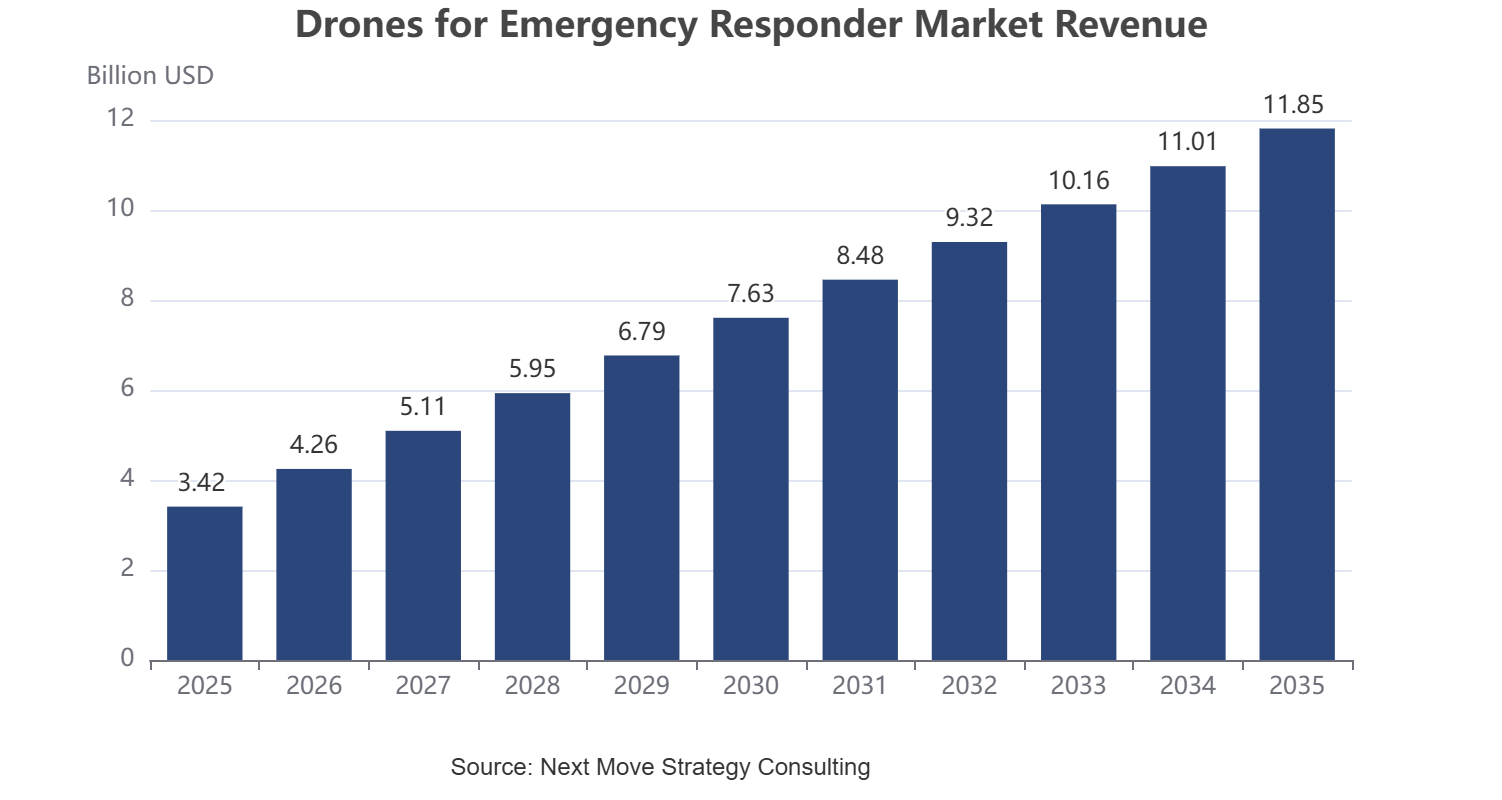
The global drones for emergency responder market size was valued at USD 3.42 billion in 2025 and is estimated at USD 3.87 billion in 2026, forecast to reach USD 11.85 billion by 2035, expanding at a 13.2% CAGR between 2026 and 2035. North America leads with approximately 42% share, while multirotor drones dominate all other types with approximately 58% share.
We observed that the growth is broad-based across every segmentation axis, with autonomous drone as first responder programs and beyond visual line of sight operations driving the dominant structural shifts through 2035.
|
Key Takeaways |
|
By Type: Multirotor Drones held the largest share of approximately 58% (USD 1.98 billion) in 2025; VTOL Drones is the fastest-growing sub-segment at 18.7% CAGR from 2026–2035. |
|
By Component: Hardware held the largest share of approximately 65% (USD 2.22 billion) in 2025; Software is the fastest-growing sub-segment at 16.4% CAGR from 2026–2035. |
|
By Application: Law Enforcement and Crowd Monitoring held the largest share of approximately 36% (USD 1.23 billion) in 2025; Medical Supply and Casualty Delivery is the fastest-growing sub-segment at 20.5% CAGR from 2026–2035. |
|
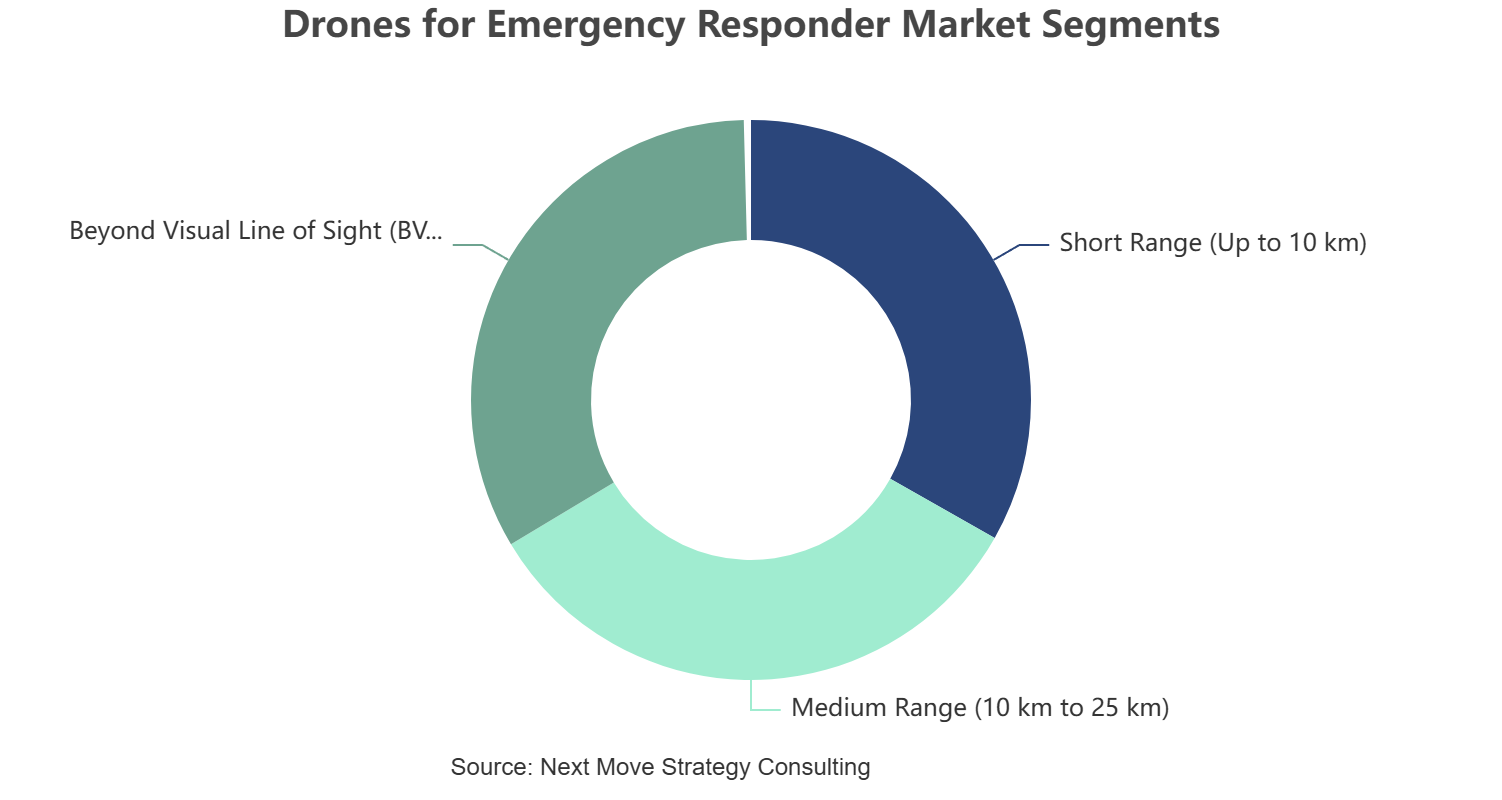
By Range: Short Range held the largest share of approximately 47% (USD 1.61 billion) in 2025; Beyond Visual Line of Sight (BVLOS) Range is the fastest-growing sub-segment at 17.9% CAGR from 2026–2035. |
|
By Payload Capacity: Below 5 kg held the largest share of approximately 54% (USD 1.85 billion) in 2025; 5 kg to 25 kg is the fastest-growing sub-segment at 15.8% CAGR from 2026–2035. |
|
By End User: Law Enforcement Agencies held the largest share of approximately 38% (USD 1.30 billion) in 2025; Emergency Medical Services is the fastest-growing sub-segment at 17.7% CAGR from 2026–2035. |
|
Dominant Region: North America dominated with approximately 42% revenue share (USD 1.44 billion) in 2025. |
|
Fastest-Growing Region: Asia-Pacific is expected to register the highest CAGR of 16.3% during 2026–2035. |
|
Dominant Country: U.S. led with approximately USD 1.12 billion in 2025. |
|
Fastest-Growing Country: India is the fastest-growing country at approximately 19.5% CAGR from 2026–2035. |
Market Opportunity: The drones for emergency responder market is expected to create an absolute dollar opportunity of USD 7.98 billion between 2026 and 2035, presenting significant investment potential across the autonomous public safety and disaster response value chain.
According to Next Move Strategy Consulting analysis, public safety agencies are increasingly consolidating drone procurement with vertically integrated hardware, software, and service providers to simplify FAA waiver compliance and evidentiary chain-of-custody requirements, a shift that favors full-stack manufacturers over component-only suppliers as beyond visual line of sight authorizations expand through 2035.
Ecosystem Analysis of the Drones for Emergency Responder Market
The ecosystem analysis of the Drones for Emergency Responder Market highlights the collaborative roles of drone manufacturers, software providers, sensor suppliers, emergency response agencies, communication network providers, training organizations, and aviation regulators. These stakeholders work together to enhance aerial situational awareness, enable real-time data sharing, improve operational efficiency, and support safe, compliant deployment during emergency response operations.
What Does the Drones for Emergency Responder Market Encompass?
The drones for emergency responder market encompasses unmanned aerial systems, associated payloads, ground control software, and support services deployed by fire, law enforcement, emergency medical, and disaster management agencies to accelerate situational awareness during time-critical incidents. Our assessment indicates that the scope spans multirotor, fixed-wing, and vertical take-off and landing platforms equipped with thermal imaging, high-zoom optics, and two-way communication payloads, supplied to public safety agencies, humanitarian organizations, and civil defense authorities across search and rescue, firefighting, disaster response, and medical delivery missions worldwide.
Regulatory frameworks such as the U.S. Federal Aviation Administration's Part 91 waiver process for drone as first responder operations and the European Union Aviation Safety Agency's specific category rules shape beyond visual line of sight authorizations, while the International Civil Aviation Organization's remotely piloted aircraft system framework increasingly guides cross-border standards. We observed that technology adoption is shifting toward dock-based autonomous launch systems that eliminate on-site pilot staffing requirements. Next Move Strategy Consulting's analysis indicates that this structural shift, combined with real-time crime center integration, is redefining procurement criteria across the drones for emergency responder market.
|
Parameters |
Details |
|
Market Size in 2025 |
USD 3.42 Billion |
|
Market Size in 2026 |
USD 3.87 Billion |
|
Revenue Forecast in 2035 |
USD 11.85 Billion |
|
Growth Rate |
CAGR of 13.2% from 2026 to 2035 |
|
Analysis Period |
2025–2035 |
|
Base Year Considered |
2025 |
|
Forecast Period |
2026–2035 |
|
Market Size Estimation |
Revenue (USD Billion) |
|
Companies Profiled |
20 |
|
Countries Covered |
33 |
|
Market Share |
Available for Top 10 Companies |
Key Emerging Trends
Based on research conducted by Next Move Strategy Consulting, we found that four structural trends are reshaping platform design, procurement, and stakeholder engagement across the industry.
How Is Drone as First Responder Technology Transforming Police Dispatch?
Autonomous drone as first responder programs are replacing manual dispatch triage by launching aircraft directly from rooftop docks within seconds of a 911 call. We observed that Skydio's DFR Command platform has processed more than 10 million calls for service across U.S. public safety agencies, illustrating the scale of operational adoption. Police departments are increasingly using drone footage to clear low-priority calls without dispatching a patrol unit, reducing officer exposure while accelerating situational awareness ahead of first responder arrival.
Why Is Beyond Visual Line of Sight Authorization Expanding Coverage Areas?
Regulatory streamlining of beyond visual line of sight waivers is extending drone coverage radius well beyond traditional visual observer limits. We found that the Federal Aviation Administration issued a substantially higher volume of Part 91 waivers to public safety agencies after streamlining its approval process in April 2025, enabling automated operations. This expansion is allowing single docked drones to cover multiple jurisdictions simultaneously, improving cost efficiency for medium-sized fire and police departments that previously could not justify dedicated aviation units.
How Is Sensor Fusion Elevating Public Safety Payload Capability?
Manufacturers are integrating high-zoom optical cameras, thermal imaging, and license plate reader capability into single gimbaled payloads to maximize situational data per flight. Our findings suggest that Flock Safety's Alpha platform, unveiled in October 2025, combines multi-sensor payloads marketed as delivering more onboard sensing than competing drone as first responder aircraft. This convergence is pushing rival manufacturers to accelerate payload roadmaps to remain competitive for law enforcement contracts.
What Role Are Medical Delivery Drones Playing in Emergency Response?
Medical supply and casualty delivery drones are expanding beyond humanitarian logistics into mainstream emergency medical services, delivering defibrillators, blood products, and trauma supplies ahead of ground units. We observed that Zipline International and Wingcopter continue to scale fixed-wing and hybrid delivery platforms for emergency medical logistics partnerships with hospital networks. This trend is elevating demand for long-range, weather-resilient platforms capable of consistent last-mile delivery performance.
Regulatory Framework Impacting the Drones for Emergency Responder Market
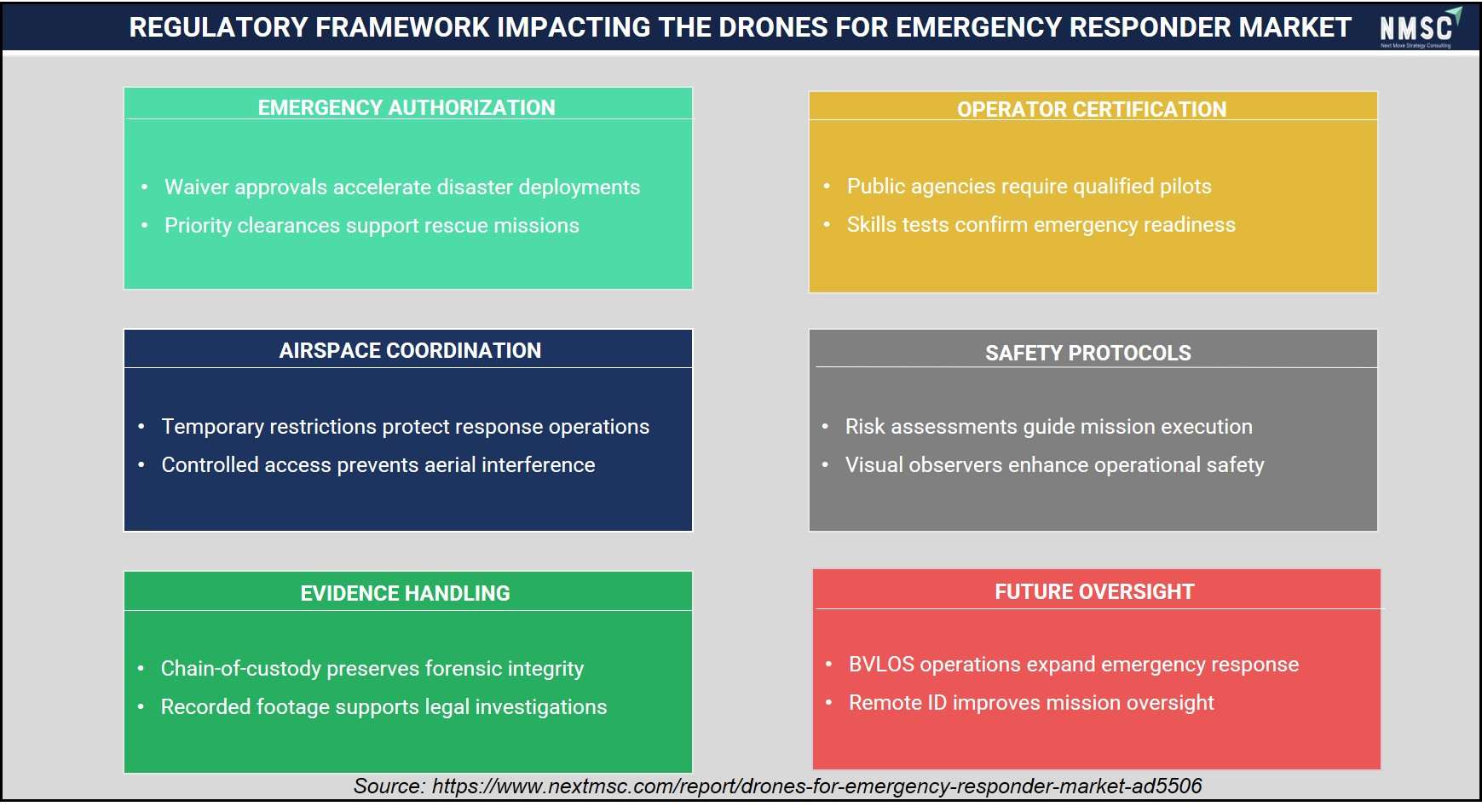
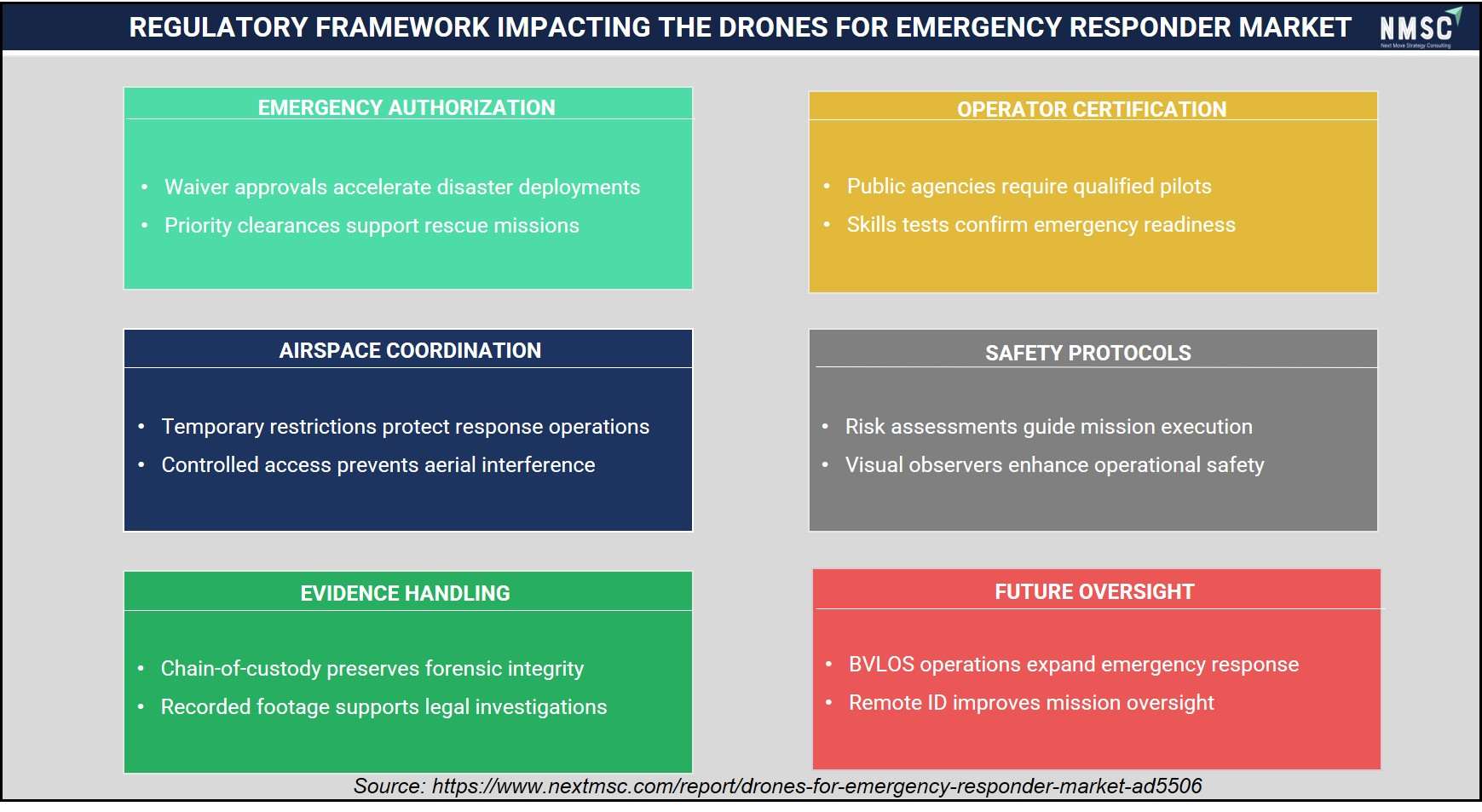
The regulatory framework impacting the Drones for Emergency Responder Market outlines the standards governing safe and effective drone deployment in public safety operations. It covers emergency flight authorizations, operator certification, airspace coordination, safety protocols, evidence management, and evolving regulations such as BVLOS operations and Remote ID, ensuring compliance, operational reliability, and mission effectiveness.
Growth Drivers and Restraints
Growth Catalyst and Risk Assessment Matrix
|
Factors |
Type |
(+/−) % Impact on CAGR |
Geographic Relevance |
Impact Timeline |
|
Expanding drone as first responder adoption by police agencies |
Driver |
+2.6% |
North America |
2026-2035 |
|
FAA and EASA regulatory streamlining for BVLOS operations |
Driver |
+2.1% |
North America, Europe |
2026-2035 |
|
Rising frequency of natural disasters and climate emergencies |
Driver |
+1.7% |
Global |
2026-2035 |
|
Government investment in smart city and public safety infrastructure |
Driver |
+1.5% |
Asia-Pacific, Middle East & Africa |
2026-2035 |
|
Integration of AI-powered autonomy and real-time crime centers |
Driver |
+1.3% |
Global |
2026-2032 |
|
Growth of medical supply and casualty delivery logistics |
Driver |
+1.0% |
Global |
2026-2035 |
|
High acquisition and total cost of dock-based autonomous systems |
Restraint |
-1.1% |
Global |
2026-2035 |
|
Airspace restrictions and scrutiny of foreign-made drone hardware |
Restraint |
-0.9% |
North America |
2026-2032 |
|
Data privacy and community surveillance concerns |
Restraint |
-0.6% |
North America, Europe |
2026-2035 |
What Is the Primary Growth Driver of the Drones for Emergency Responder Market?
Expanding drone as first responder adoption by police agencies is the primary driver of the market. The U.S. Federal Aviation Administration reported that public safety agencies holding Part 91 waivers for automated drone operations surpassed 1,000 nationwide as of February 2026, reflecting a sharp acceleration after the agency streamlined its approval process. We observed that this regulatory momentum, combined with real-time crime center integration, continues to anchor baseline demand for docked multirotor platforms across metropolitan and suburban jurisdictions alike.
How Is Disaster Frequency Driving Drones for Emergency Responder Market Growth?
Rising frequency of climate-linked natural disasters is accelerating demand for damage assessment and search and rescue platforms. The Federal Emergency Management Agency continues to expand guidance on unmanned aircraft system integration into disaster response operations following successive major disaster declarations. Our assessment indicates that this operational pressure, combined with expanding civil defense budgets across disaster-prone Asia-Pacific economies, is compressing adoption timelines for ruggedized, all-weather emergency response drones.
What Is Restraining Drones for Emergency Responder Market Expansion?
High acquisition and total cost of ownership for dock-based autonomous systems restrains adoption among smaller and volunteer fire and rescue departments. The Federal Aviation Administration's continuing visual observer staffing requirements in select waiver categories add operational overhead that further increases total program cost. We found that budget-constrained agencies frequently rely on lower-cost consumer-grade platforms instead, limiting near-term penetration of premium full-stack drone as first responder programs outside well-funded metropolitan jurisdictions.
Segmentation Analysis
Segment Sizing: By Type
|
Segment |
2025 (USD) |
2035 (USD) |
CAGR% (2026–2035) |
|
Multirotor Drones |
USD 1.98 Billion |
USD 5.45 Billion |
10.4% |
|
Fixed-Wing Drones |
USD 0.62 Billion |
USD 2.37 Billion |
14.6% |
|
VTOL Drones |
USD 0.58 Billion |
USD 3.08 Billion |
18.7% |
|
Others |
USD 0.24 Billion |
USD 0.95 Billion |
14.9% |
|
Total |
USD 3.42 Billion |
USD 11.85 Billion |
13.2% |
Which Type Segment Dominates the Drones for Emergency Responder Market?
Multirotor drones, encompassing quadcopter and hexacopter platforms optimized for vertical takeoff from rooftop docks, led the market with USD 1.98 billion in 2025, supported by their maneuverability within dense urban environments and rapid launch capability. We observed that VTOL drones are the fastest-growing type, expanding at an 18.7% CAGR from 2026 to 2035, as agencies extend coverage radius through hybrid fixed-wing and rotor designs capable of both vertical launch and long-range cruise flight.
Segment Sizing: By Application
|
Segment |
2025 (USD) |
2035 (USD) |
CAGR% (2026–2035) |
|
Law Enforcement and Crowd Monitoring |
USD 1.23 Billion |
USD 4.03 Billion |
12.6% |
|
Search and Rescue |
USD 0.82 Billion |
USD 2.49 Billion |
11.6% |
|
Disaster Response and Damage Assessment |
USD 0.55 Billion |
USD 1.78 Billion |
12.5% |
|
Firefighting Support |
USD 0.41 Billion |
USD 1.42 Billion |
13.3% |
|
Medical Supply and Casualty Delivery |
USD 0.27 Billion |
USD 1.66 Billion |
20.5% |
|
Others |
USD 0.14 Billion |
USD 0.47 Billion |
13.2% |
|
Total |
USD 3.42 Billion |
USD 11.85 Billion |
13.2% |
Which Application Segment Leads Drones for Emergency Responder Market Demand?
Law Enforcement and Crowd Monitoring remained the leading application, valued at USD 1.23 billion in 2025 on sustained drone as first responder deployments by U.S. metropolitan police departments. Our findings suggest that Medical Supply and Casualty Delivery is the fastest-growing application, registering a 20.5% CAGR from 2026 to 2035, as hospital networks and emergency medical services increasingly specify fixed-wing and hybrid platforms to deliver defibrillators, blood products, and trauma supplies ahead of ground ambulance arrival.
Segment Sizing: By End User
|
Segment |
2025 (USD) |
2035 (USD) |
CAGR% (2026–2035) |
|
Law Enforcement Agencies |
USD 1.30 Billion |
USD 4.15 Billion |
12.2% |
|
Fire and Rescue Departments |
USD 0.92 Billion |
USD 3.08 Billion |
12.8% |
|
Disaster Management and Civil Defense Agencies |
USD 0.62 Billion |
USD 1.90 Billion |
11.8% |
|
Emergency Medical Services |
USD 0.41 Billion |
USD 2.02 Billion |
17.7% |
|
Others |
USD 0.17 Billion |
USD 0.71 Billion |
15.5% |
|
Total |
USD 3.42 Billion |
USD 11.85 Billion |
13.2% |
Which End User Segment Is the Fastest-Growing in the Drones for Emergency Responder Market?
Law Enforcement Agencies remained the largest end user category, valued at USD 1.30 billion in 2025, reflecting widespread drone as first responder rollout across U.S. and European metropolitan police forces. Based on research conducted by Next Move Strategy Consulting, we found that Emergency Medical Services represent the fastest-growing end user segment at a 17.7% CAGR from 2026 to 2035, driven by integration of unmanned aircraft into hospital-linked rapid medical logistics networks.
Growth Opportunities
Our analysis shows that three forward-looking opportunities stand out for stakeholders positioning within the drones for emergency responder market over the 2026–2035 forecast period.
How Can Dock-Based BVLOS Networks Unlock Value for Mid-Sized Agencies?
Dock-based beyond visual line of sight networks present a whitespace opportunity for mid-sized police and fire departments unable to fund dedicated aviation units. Suppliers that commercialize shared regional dock infrastructure stand to capture recurring subscription revenue as neighboring jurisdictions pool coverage costs, particularly among suburban and county-level agencies seeking drone as first responder capability without large upfront capital outlays.
Where Do Medical Delivery Partnerships Create New Demand?
Hospital networks and emergency medical services represent an underpenetrated opportunity for long-range fixed-wing and hybrid delivery drones engineered for trauma supply logistics. Manufacturers that develop validated, weather-resilient delivery platforms can secure long-term procurement contracts with hospital systems and blood banks, benefiting from recurring replacement-cycle revenue tied to emergency medical logistics programs.
How Can AI-Powered Analytics Benefit Disaster Management Agencies?
Disaster management and civil defense agencies seeking faster damage assessment create an opportunity for software vendors offering AI-powered image analytics layered onto existing drone fleets. Early movers that integrate automated debris mapping and flood extent detection can differentiate with civil defense agencies pursuing faster federal disaster declaration documentation across their jurisdictional response portfolios.
Regional Outlook
Geographic Performance Snapshot
|
Region |
2025 (USD) |
2035 (USD) |
CAGR% (2026–2035) |
Key Driver |
|
North America |
USD 1.44 Billion |
USD 4.50 Billion |
12.0% |
Widespread drone as first responder adoption and FAA waiver streamlining |
|
Europe |
USD 0.68 Billion |
USD 2.02 Billion |
11.2% |
EASA specific category rules and civil protection modernization |
|
Asia-Pacific |
USD 0.89 Billion |
USD 3.91 Billion |
16.3% |
Disaster-prone geography and smart city public safety investment |
|
Middle East & Africa |
USD 0.24 Billion |
USD 0.83 Billion |
13.3% |
Vision 2030-linked public safety modernization and hospitality-driven demand |
|
Latin America |
USD 0.17 Billion |
USD 0.59 Billion |
13.2% |
Expanding civil defense budgets and disaster response modernization |
|
Total |
USD 3.42 Billion |
USD 11.85 Billion |
13.2% |
-- |
North America Drones for Emergency Responder Market Outlook
North America leads the drones for emergency responder market with the world's largest base of drone as first responder programs across metropolitan police and fire departments. We observed that Federal Aviation Administration Part 91 waiver streamlining sustains rapid deployment of dock-based autonomous platforms, while agencies increasingly specify vertically integrated hardware, software, and service providers to simplify compliance. Technology adoption remains concentrated among large municipal police departments, though county and suburban agencies are increasingly adopting shared regional dock infrastructure to extend coverage economically across the forecast period.
Europe Drones for Emergency Responder Market Outlook
Europe's market reflects a more fragmented regulatory landscape shaped by the European Union Aviation Safety Agency's specific category framework governing beyond visual line of sight operations. Our assessment indicates that civil protection agencies across the region are modernizing disaster response fleets following successive flooding and wildfire events. Technology adoption favors fixed-wing and VTOL platforms for cross-border disaster response coordination, while data protection requirements shape camera and retention policy design for law enforcement deployments.
Asia-Pacific Drones for Emergency Responder Market Outlook
Asia-Pacific is the fastest-growing region, supported by disaster-prone geography, expanding smart city infrastructure investment, and a concentrated regional drone manufacturing base. We found that national disaster management authorities across the region are scaling unmanned aircraft fleets for flood, typhoon, and earthquake response coordination. Technology adoption is accelerating fastest in countries with liberalized drone regulations, where government-linked disaster management and public safety agencies are procuring domestically manufactured platforms to support rapid situational awareness during recurring climate emergencies.
Middle East & Africa Drones for Emergency Responder Market Outlook
Middle East & Africa is expanding on the back of Vision 2030-linked public safety modernization programs and hospitality-driven emergency preparedness investment across major Gulf tourism and event destinations. Our findings suggest that civil defense authorities are procuring drone fleets to support mass-gathering event security and desert search and rescue operations. Regulatory frameworks remain in early development across most African markets, while Gulf Cooperation Council states lead regional technology adoption through centralized government procurement programs.
Latin America Drones for Emergency Responder Market Outlook
Latin America's market is expanding as civil defense and disaster management agencies modernize response fleets following recurring flooding and wildfire events across the region. We observed that expanding public safety budgets and growing urban police modernization programs are increasing procurement of multirotor drone as first responder platforms in major metropolitan areas. Regulatory frameworks remain less harmonized than North America or Europe, moderating near-term beyond visual line of sight adoption despite strong underlying demand growth.
U.S. Drones for Emergency Responder Market Outlook
Based on our estimates, the U.S. drones for emergency responder market was valued at approximately USD 1.12 billion in 2025 and is projected to reach USD 3.35 billion by 2035, expanding at an 11.9% CAGR. Demand is concentrated among metropolitan police and fire departments operating dock-based drone as first responder programs under Federal Aviation Administration Part 91 waivers. Competitive intensity is high, with Skydio, BRINC, Flock Safety, and Axon competing for municipal contracts, while smaller agencies increasingly adopt shared regional infrastructure to extend beyond visual line of sight coverage economically.
Canada Drones for Emergency Responder Market Outlook
The market in Canada was valued at approximately USD 0.21 billion in 2025 and is forecast to reach USD 0.71 billion by 2035, registering a 13.0% CAGR. Demand is led by provincial emergency management agencies and municipal police services piloting drone as first responder programs in major metropolitan areas. Transport Canada's evolving beyond visual line of sight regulations are gradually easing operational restrictions, while competitive intensity remains moderate as U.S.-based manufacturers dominate platform supply across most deployments.
UK Drones for Emergency Responder Market Outlook
As per our estimate, the UK drones for emergency responder market was valued at approximately USD 0.19 billion in 2025 and is projected to reach USD 0.55 billion by 2035, at an 11.3% CAGR. Demand is anchored by police forces and fire and rescue services piloting drone as first responder trials under Civil Aviation Authority beyond visual line of sight permissions. Regulatory influence remains significant, with evolving airspace integration rules shaping deployment pace, while competitive intensity is rising as European and U.S. manufacturers pursue public safety framework agreements.
Germany Drones for Emergency Responder Market Outlook
According to our analysis, the German drones for emergency responder market was valued at approximately USD 0.16 billion in 2025 and is expected to reach USD 0.46 billion by 2035, growing at an 11.1% CAGR. Demand is driven by state-level fire brigades and technical relief agencies expanding disaster response fleets following recurring flooding events. Regulatory influence from the European Union Aviation Safety Agency's specific category framework shapes operational approvals, while domestic and regional manufacturers compete alongside U.S. platform suppliers for public procurement contracts.
France Drones for Emergency Responder Market Outlook
Based on our estimates, the French drones for emergency responder market was valued at approximately USD 0.13 billion in 2025 and is forecast to reach USD 0.37 billion by 2035, at an 11.0% CAGR. Demand is concentrated among civil security and gendarmerie units deploying drones for public event monitoring and disaster response coordination. Regulatory influence from national airspace integration rules moderates beyond visual line of sight adoption, while Parrot's domestic manufacturing presence supports competitive intensity against U.S. and Chinese platform suppliers.
China Drones for Emergency Responder Market Outlook
The market in China was valued at approximately USD 0.27 billion in 2025 and is projected to reach USD 0.85 billion by 2035, expanding at a 13.6% CAGR. Demand is supported by a concentrated domestic drone manufacturing base and expanding fire and disaster management fleet procurement across provincial governments. Regulatory influence from the Civil Aviation Administration of China's unmanned aircraft rules shapes commercial operations, while competitive intensity is high, led by domestically headquartered manufacturers supplying both public safety and export markets.
India Drones for Emergency Responder Market Outlook
As per our estimate, the Indian drones for emergency responder market was valued at approximately USD 0.14 billion in 2025 and is forecast to reach USD 0.75 billion by 2035, registering a 20.3% CAGR, the fastest among countries covered. Demand is accelerating as state disaster management authorities and police forces expand drone fleets following the Directorate General of Civil Aviation's liberalized drone rules. Technology penetration remains early-stage relative to developed markets, though competitive intensity is rising as domestic manufacturers scale production to meet government procurement demand.
Japan Drones for Emergency Responder Market Outlook
According to our analysis, the Japanese drones for emergency responder market was valued at approximately USD 0.12 billion in 2025 and is projected to reach USD 0.34 billion by 2035, at a 12.2% CAGR. Demand is driven by fire and disaster management agencies deploying drones for earthquake and typhoon response coordination across densely populated urban centers. Regulatory influence from the Japan Civil Aviation Bureau's flight permission framework is gradually easing beyond visual line of sight restrictions, supporting steady adoption among municipal fire departments.
South Korea Drones for Emergency Responder Market Outlook
Based on our estimates, the South Korean drones for emergency responder market was valued at approximately USD 0.09 billion in 2025 and is forecast to reach USD 0.27 billion by 2035, growing at a 13.0% CAGR. Demand is supported by national fire agency modernization programs and coast guard search and rescue fleet expansion. Regulatory influence from the Ministry of Land, Infrastructure and Transport's drone traffic management framework supports structured beyond visual line of sight testing, while domestic manufacturers compete alongside global platform suppliers for public contracts.
Australia Drones for Emergency Responder Market Outlook
The market in Australia was valued at approximately USD 0.07 billion in 2025 and is projected to reach USD 0.20 billion by 2035, at a 12.4% CAGR. Demand is concentrated among state fire and rescue services and surf lifesaving organizations deploying drones for bushfire monitoring and coastal search and rescue. Regulatory influence from the Civil Aviation Safety Authority's beyond visual line of sight approvals is expanding operational scope, while competitive intensity remains moderate as agencies favor established international platform suppliers.
UAE Drones for Emergency Responder Market Outlook
As per our estimate, the UAE drones for emergency responder market was valued at approximately USD 0.08 billion in 2025 and is forecast to reach USD 0.27 billion by 2035, registering a 14.5% CAGR. Demand is driven by civil defense authorities and police forces procuring drone fleets to support mass-gathering event security and desert search and rescue operations. Regulatory influence from the General Civil Aviation Authority's structured drone corridors supports rapid technology adoption, while centralized government procurement sustains high competitive intensity among global platform suppliers.
Saudi Arabia Drones for Emergency Responder Market Outlook
According to our analysis, the Saudi Arabian drones for emergency responder market was valued at approximately USD 0.07 billion in 2025 and is projected to reach USD 0.25 billion by 2035, at a 15.0% CAGR. Demand is supported by Vision 2030-linked public safety modernization and civil defense fleet expansion across major urban centers. Regulatory influence from the General Authority of Civil Aviation shapes operational approvals, while competitive intensity is rising as government procurement programs favor manufacturers offering integrated hardware and analytics platforms.
South Africa Drones for Emergency Responder Market Outlook
Based on our estimates, the South African drones for emergency responder market was valued at approximately USD 0.04 billion in 2025 and is forecast to reach USD 0.12 billion by 2035, growing at a 13.5% CAGR. Demand is led by metropolitan police departments and disaster management centers piloting drone programs for crime response and flood monitoring. Regulatory influence from the South African Civil Aviation Authority's remotely piloted aircraft systems regulations moderates adoption pace, while competitive intensity remains limited to a small group of international platform suppliers.
Brazil Drones for Emergency Responder Market Outlook
The market in Brazil was valued at approximately USD 0.09 billion in 2025 and is projected to reach USD 0.31 billion by 2035, at a 13.8% CAGR. Demand is driven by state civil defense agencies and municipal police forces expanding drone fleets for flood response and urban security operations. Regulatory influence from the National Civil Aviation Agency's operational rules is gradually easing beyond visual line of sight restrictions, while competitive intensity remains moderate as international manufacturers dominate platform supply across major metropolitan deployments.
Argentina Drones for Emergency Responder Market Outlook
As per our estimate, the Argentine drones for emergency responder market was valued at approximately USD 0.03 billion in 2025 and is forecast to reach USD 0.10 billion by 2035, registering a 13.5% CAGR. Demand is concentrated among provincial civil defense agencies deploying drones for flood and wildfire response coordination. Regulatory influence from the National Administration of Civil Aviation shapes operational approvals, while competitive intensity remains limited as budget constraints favor lower-cost multirotor platforms over premium full-stack systems.
Competitive Landscape
Our analysis shows that the competitive landscape is consolidating around vertically integrated manufacturers offering hardware, software, and service bundles tailored to public safety procurement cycles.
|
Dimension |
Assessment |
|
Market Structure |
The market remains moderately fragmented, with the top 10 companies accounting for an estimated 62% of 2025 revenue amid rapid new entrant activity from software-first drone as first responder platforms. |
|
Innovation Focus |
Innovation centers on autonomous dock-based launch systems, multi-sensor payload fusion, and beyond visual line of sight flight software integrated with real-time crime center platforms. |
|
M&A Activity |
Consolidation is accelerating as software and hardware providers merge to offer full-stack drone as first responder solutions, exemplified by Flock Safety's acquisition of Aerodome in October 2024. |
How Do Companies Compete in the Drones for Emergency Responder Market?
Companies compete primarily on flight autonomy, sensor payload quality, and integration depth with existing computer-aided dispatch and real-time crime center systems. We observed that vertically integrated manufacturers offering hardware, docking infrastructure, and software as a bundled subscription are increasingly favored over component-only suppliers, as public safety agencies prioritize single-vendor accountability for FAA waiver compliance and evidentiary chain-of-custody documentation.
Which Competitive Archetypes Dominate the Market?
Three competitive archetypes dominate: public-safety-exclusive full-stack manufacturers such as Skydio and BRINC that build proprietary hardware and software; software-and-integration specialists such as Flock Safety and Axon that pair proprietary analytics with third-party airframes; and diversified global manufacturers such as DJI and Teledyne FLIR that supply hardware across multiple end markets. Our assessment indicates that full-stack public-safety specialists are gaining share in the U.S. market amid geopolitical restrictions on foreign-made hardware.
How Are Companies Differentiating Through Innovation?
Manufacturers are differentiating through autonomy software, multi-sensor payload integration, and dock infrastructure that minimizes on-site staffing requirements. We found that Skydio's Pathfinder autonomy system and Flock Safety's Alpha multi-sensor payload exemplify competing approaches to the same operational goal of faster, more reliable aerial response. Continued investment in AI-powered object detection and automated flight routing is expected to remain the primary innovation battleground through 2035.
What M&A and Geographic Expansion Activity Is Shaping the Market?
Merger and acquisition activity is consolidating software and hardware capabilities under single platforms, with Flock Safety's acquisitions of Aerodome and Uniform Sierra Aerospace exemplifying the trend toward full-stack drone as first responder offerings. Geographic expansion is concentrated in North America and Asia-Pacific, where manufacturers are establishing regional service and training centers to support growing public safety procurement pipelines and localized regulatory compliance requirements.
Key Market Players
Our assessment identifies the following companies, ranked by market-specific revenue and scale of operations, as the leading participants shaping the drones for emergency responder market through 2026.
-
SZ DJI Technology Co., Ltd.
-
Skydio, Inc.
-
BRINC Drones, Inc.
-
Flock Safety, Inc.
-
Axon Enterprise, Inc.
-
Teledyne FLIR LLC
-
Parrot SA
-
AeroVironment, Inc.
-
Autel Robotics Co., Ltd.
-
Flyability SA
-
Wingcopter GmbH
-
Zipline International Inc.
-
Elbit Systems Ltd.
-
Airbus SE
-
Percepto Ltd.
-
Red Cat Holdings, Inc.
-
Anzu Robotics LLC
-
Easy Aerial, Inc.
-
Elistair SAS
Latest Developments
We observed the following verified developments shaping competitive positioning across the drones for emergency responder market.
|
Date |
Event |
|
Jul 2026 |
BRINC secured USD 125 million led by Motorola Solutions to accelerate deployment of 911 response drones for police and fire departments and expand U.S. manufacturing. |
|
May 2026 |
Parrot announced deployment of ANAFI USA drones through Australia's support to the Solomon Islands National Disaster Management Office, strengthening disaster response and search-and-rescue operations. |
|
May 2026 |
Axon partnered with Echodyne to improve Drone as First Responder deployments through enhanced radar-based airspace awareness, enabling safer public safety drone operations. |
|
Jan 2026 |
Draganfly deployed drones with Search and Rescue Sweden to support missing-person searches, wilderness rescue, emergency response, and police operations. |
|
Feb 2025 |
DJI launched DJI Dock 3, an autonomous dock solution designed for Drone as First Responder (DFR) operations. The platform enables automated emergency drone deployment, rapid situational awareness, and integration with public safety workflows for police, fire, and emergency response agencies. |
Expert Insights

“Every second matters in an emergency. Our 911 response drones put eyes on scene before first responders arrive, giving everyone the situational awareness they need to act decisively and keep people safe.”
— Blake Resnick, Founder & CEO, BRINC
Statement made during BRINC's announcement of its US$125 million funding round to accelerate deployment of Drone-as-First-Responder (DFR) systems and expand emergency response drone infrastructure across public safety agencies.
Market Interpretation
This statement reflects the industry's broader emphasis on operational transparency as a precondition for community acceptance of drone as first responder programs. Our assessment indicates that manufacturers pairing high-fidelity sensor payloads with transparent flight-logging and public reporting tools are best positioned to sustain long-term municipal contracts, as community and regulatory scrutiny of aerial surveillance continues to intensify. We found that transparency-oriented positioning is increasingly differentiating vendors competing for renewal-stage public safety procurement decisions across the drones for emergency responder market.
Investment Opportunities
How Are Capital Inflows Shaping the Drones for Emergency Responder Market?
Venture and growth capital continues to flow into public-safety-focused drone manufacturers, with Skydio reported to have raised more than $500 million cumulatively while reaching a multibillion-dollar valuation. BRINC Drones raised $125 million to expand nationwide 911 response drone deployment across police and fire stations. We observed that investor interest is concentrated among full-stack manufacturers combining proprietary hardware, autonomy software, and dock infrastructure rather than component-only suppliers.
What Infrastructure Investment Is Required to Scale Drone as First Responder Coverage?
Scaling drone as first responder coverage requires sustained investment in rooftop and pole-mounted docking infrastructure, cellular and 5G connectivity, and dedicated remote pilot command centers. Our findings suggest that agencies increasingly favor shared regional infrastructure models that distribute capital costs across multiple neighboring jurisdictions. Manufacturers investing in domestic manufacturing capacity are positioning to meet growing government procurement demand while addressing geopolitical supply chain scrutiny.
What ESG Considerations Are Relevant to Drones for Emergency Responder Market Investment?
Environmental, Social, and Governance considerations center on community privacy safeguards, transparent flight-data retention policies, and equitable coverage across underserved jurisdictions. We observed that transparency reporting practices, including publicly accessible flight logs, are becoming a differentiating governance factor for public safety technology investors. Social considerations also extend to reduced officer risk exposure, as aerial situational awareness ahead of physical response continues to be positioned as a core safety benefit of program adoption.
Key Benefits for Stakeholders
How Does This Report Benefit Public Safety Agency Leaders?
Public safety agency leaders gain a structured view of platform capabilities, regulatory pathways, and total cost of ownership across competing drone as first responder providers. Our analysis shows that benchmarking data on hardware, software, and service segmentation supports more informed procurement decisions aligned with jurisdictional coverage and budget requirements, while regional regulatory insights help agencies anticipate compliance timelines for beyond visual line of sight authorization.
How Does This Report Benefit Investors and Financial Analysts?
Investors and financial analysts gain access to segmentation-level revenue forecasts, competitive positioning analysis, and identified whitespace opportunities across the drones for emergency responder market. We found that the report's regional and country-level growth projections support portfolio allocation decisions, while the competitive landscape section clarifies which archetypes are best positioned to capture long-term public safety procurement spending through 2035.
How Does This Report Benefit Technology Vendors and Product Teams?
Technology vendors and product teams gain visibility into segmentation trends, emerging application demand, and regional regulatory drivers that inform product roadmap prioritization. Our findings suggest that granular data on payload capacity, range, and component-level demand helps engineering and product teams align development investment with the fastest-growing sub-segments, particularly beyond visual line of sight capability and medical delivery payload integration.
Key Market Segments
By Type
-
Multirotor Drones
-
Quadcopter Platforms
-
Hexacopter and Octocopter Platforms
-
-
Fixed-Wing Drones
-
Vertical Take-Off and Landing (VTOL) Drones
-
Others
By Component
-
Hardware
-
Airframe and Propulsion Systems
-
Sensors and Payload Systems
-
Thermal Imaging Cameras
-
Optical Zoom Cameras
-
Communication and Navigation Modules
-
-
Docking and Charging Infrastructure
-
-
Software
-
Services
By Application
-
Search and Rescue
-
Disaster Response and Damage Assessment
-
Firefighting Support
-
Medical Supply and Casualty Delivery
-
Law Enforcement and Crowd Monitoring
-
Others
By Range
-
Short Range (Up to 10 km)
-
Medium Range (10 km to 25 km)
-
Beyond Visual Line of Sight (BVLOS) Range
By Payload Capacity
-
Below 5 kg
-
5 kg to 25 kg
-
Above 25 kg
By End User
-
Fire and Rescue Departments
-
Law Enforcement Agencies
-
Emergency Medical Services
-
Disaster Management and Civil Defense Agencies
-
Others
By Region
-
North America: U.S., Canada, Mexico.
-
Europe: UK, Germany, France, Italy, Spain, Sweden, Denmark, Finland, Netherlands, Rest of Europe.
-
Asia-Pacific: China, India, Japan, South Korea, Taiwan, Indonesia, Vietnam,Australia, Philippines, Malaysia, Rest of APAC.
-
Middle East & Africa: Saudi Arabia, UAE, Egypt, Israel, Turkey, Nigeria, South Africa, Rest of MEA.
-
Latin America: Brazil, Argentina, Chile, Colombia, Rest of LATAM.
Conclusion and Recommendations
What Is the Long-Term Outlook for the Drones for Emergency Responder Market?
The long-term outlook remains strongly positive, with the market projected to nearly triple from USD 3.87 billion in 2026 to USD 11.85 billion by 2035 at a 13.2% CAGR. Our analysis shows that sustained regulatory liberalization for beyond visual line of sight operations, combined with expanding public safety budgets, will continue to support broad-based growth across nearly every segmentation axis through the forecast period.
What Strategic Positioning Should Manufacturers Pursue?
Manufacturers should pursue vertically integrated hardware, software, and service positioning to meet public safety agencies' preference for single-vendor accountability. We observed that suppliers combining proprietary autonomy software with domestic manufacturing capacity are best positioned to navigate geopolitical restrictions on foreign-made hardware while capturing share from agencies prioritizing supply chain security alongside operational performance.
How Attractive Is the Market for New Investment?
The drones for emergency responder industry presents an attractive investment case, supported by a USD 7.98 billion absolute dollar opportunity between 2026 and 2035 and above-average growth in Asia-Pacific and medical delivery categories. We found that investment attractiveness is highest for manufacturers combining regulatory compliance expertise with scaled dock infrastructure, positioning them to serve both large metropolitan and emerging mid-sized agency segments simultaneously.
What Market Shifts and Key Risks Should Stakeholders Monitor?
Stakeholders should monitor geopolitical restrictions on foreign-made drone hardware, data privacy and community surveillance scrutiny, and budget constraints among smaller public safety agencies as key risks to the market. Our analysis shows that suppliers unable to demonstrate transparent data governance risk losing municipal contracts to competitors with established community trust and regulatory compliance track records, particularly within privacy-sensitive North American and European jurisdictions.
What Are the Key Growth Pathways for the Drones for Emergency Responder Market?
Key growth pathways include expanding shared regional dock infrastructure for mid-sized agencies, scaling medical supply and casualty delivery partnerships, and deepening beyond visual line of sight coverage as regulatory authorizations expand. Next Move Strategy Consulting's analysis indicates that suppliers pursuing these pathways while maintaining cost competitiveness in standard multirotor categories will be best positioned to capture the drones for emergency responder market's projected growth through 2035.
About the Author
 Mihul Sharma
— Mihul Sharma is Research Associate at Next Move Strategy Consulting, where he has covered technology, industrial, and healthcare markets for 3 years. His work applies structured business research, market analysis, and secondary-source review to assess market trends, competitive developments, and growth opportunities. He supports report development by fully synthesizing industry data, company information, and market signals into concise findings for strategy and investment-focused research teams.
Mihul Sharma
— Mihul Sharma is Research Associate at Next Move Strategy Consulting, where he has covered technology, industrial, and healthcare markets for 3 years. His work applies structured business research, market analysis, and secondary-source review to assess market trends, competitive developments, and growth opportunities. He supports report development by fully synthesizing industry data, company information, and market signals into concise findings for strategy and investment-focused research teams.
About the Reviewer
 Supradip Baul
— Supradip Baul is an accomplished business consultant and strategist with over a decade of rich experience in market intelligence, strategy, technology, and business transformation. His work has included rigorous qualitative and quantitative analysis across multiple industries, helping clients shape investment decisions and long-term roadmaps. Earlier in his career, he was associated with Gartner, where he contributed to industry-leading reports and market share analyses. He has worked with leading global companies and holds an MBA with a dual specialization in Marketing and Finance.
Supradip Baul
— Supradip Baul is an accomplished business consultant and strategist with over a decade of rich experience in market intelligence, strategy, technology, and business transformation. His work has included rigorous qualitative and quantitative analysis across multiple industries, helping clients shape investment decisions and long-term roadmaps. Earlier in his career, he was associated with Gartner, where he contributed to industry-leading reports and market share analyses. He has worked with leading global companies and holds an MBA with a dual specialization in Marketing and Finance.
At Next Move Strategy Consulting, we understand that insightful market research is the cornerstone of successful business decisions. That's why we employ a robust and multifaceted approach, combining various methodologies to deliver the most accurate and actionable data for our clients.

Research Landscape
We navigate the world of research with two primary approaches:
Qualitative Approach
Our qualitative research methodologies involve immersive techniques such as in-depth interviews, focus groups, and observational studies. By engaging directly with individuals and stakeholders, we uncover valuable insights that quantitative data alone may overlook.

Quantitative Research
In tandem with qualitative methodologies, NMSC leverages the power of Quantitative Research to provide a robust foundation of numerical insights. Through systematic data collection and analysis, we quantify patterns, preferences, and market trends, offering a comprehensive view of the business landscape.
Our quantitative research approach employs diverse tools, including surveys, experiments, and statistical modelling. These methodologies enable us to gather data from a large and representative sample, ensuring the statistical significance of our findings. By employing structured questionnaires and standardized data collection methods, we guarantee the reliability and validity of the information we present to our clients.
Quantitative research is particularly effective in measuring the prevalence of trends, assessing market size, and gauging the impact of various factors on consumer behavior. The numerical precision attained through this approach equips our clients with actionable insights, facilitating data-driven decision-making and strategy formulation.


Our Specialized Toolbox for Industry-Specific Market Research
We deploy a specialized arsenal of techniques tailored to meet your unique requirements. Here's a glimpse into our comprehensive toolbox:

Information Procurement
The stage entails acquiring market data or relevant information through various sources and methodologies.


Market Research Approach
We utilize both top-down and bottom-up approaches in market research analysis to achieve a comprehensive understanding of the market dynamics, leveraging the broad perspective of industry trends and macroeconomic factors alongside detailed insights from specific segments and individual companies.

Porters Five Forces Analysis
We conduct Porter's Five Forces analysis to evaluate the competitive landscape of an industry, providing us with insights into factors that affect profitability and strategic positioning.

SWOT Analysis

Forecasting
We utilize a forecasting model to predict future consumption by considering parameters like population, economics, regulations, market competition, drivers, constraints, technology, and pricing. We also employ statistical techniques such as multilinear regression, exponential smoothing, moving average, ARIMA, and Monte Carlo simulations for accurate predictions. In econometric forecasting, we analyzed short-term and long-term event impacts, attributing values based on regulatory frameworks, economic factors, and market events.





 Speak to Our Analyst