AI-Enabled Counter-Drone Systems (C-UAS) Market By Offering {Systems (Fixed Site, Mobile Ground, and Others), Software, and Others}, By Deployment Platform (Fixed Site, Mobile Ground, and Others), By Mitigation Mode {Electronic Countermeasures (RF Jamming, GNSS Spoofing, and Others), Directed Energy and Others}, and By End User Vertical {Defense & Military, Government & Public Safety, Commercial, and Others} – Global Analysis & Forecast, 2025–2035
Industry: Aerospace & Defense | Publishing Date: June 3, 2026 | Last Updated: September 30, 2026 | No of Pages: N/A | No. of Tables: N/A | No. of Figures: N/A | Format: PDF | Report Code: AD4600
Industry Outlook
The global AI-Enabled Counter Drone Systems (C-UAS) Market size was valued at USD 5.84 billion in 2025 and is expected to be valued at USD 6.92 billion by the end of 2026. The industry is projected to grow, hitting USD 24.18 billion by 2035, with a CAGR of 15.31% between 2026 and 2035.
AI-Enabled Counter Drone Systems (C-UAS) Industry Size & Forecast
|
Parameters |
Details |
|
Market Size in 2026 |
USD 6.92 Billion |
|
Revenue Forecast in 2035 |
USD 24.18 Billion |
|
Growth Rate |
CAGR of 15.31% from 2026 to 2035 |
|
Analysis Period |
2025–2035 |
|
Base Year Considered |
2025 |
|
Forecast Period |
2026–2035 |
|
Market Size Estimation |
Billion (USD) |
|
Companies Profiled |
20 |
|
Countries Covered |
33 |
|
Market Share |
Available for 10 companies |
Based on our primary research, we observed that the global AI-enabled counter drone systems market is expanding rapidly, primarily driven by the increasing use of low-cost drones, rising security threats, and continuous advancements in AI, sensor fusion, and electronic warfare technologies. In particular, AI-powered systems that combine radar, RF detection, and electro-optical sensors are increasingly deployed to detect, classify, and neutralize unauthorized drones with minimal human intervention. Furthermore, our interactions with defense and infrastructure operators indicate that real-time analytics, autonomous response capabilities, and layered defense architectures significantly enhance operational effectiveness. While hardware components continue to hold a significant share, AI-driven software platforms are increasingly emerging as key differentiators. Consequently, North America leads adoption, supported by strong defense investments and early deployment across military and homeland security applications.
Moreover, through our evaluation of defense programs and infrastructure security deployments across major regions, we identified that adoption is influenced by evolving threat landscapes, regulatory constraints, and system integration requirements. For instance, North America benefits from advanced defense ecosystems and high technology readiness, whereas Europe emphasizes regulatory compliance and coordinated airspace management. Meanwhile, Asia-Pacific is witnessing strong growth, supported by defense modernization initiatives and rising border security concerns, with emerging markets such as India showing increasing investments. In addition, key players including Lockheed Martin, Thales Group, Leonardo S.p.A., Dedrone, and DroneShield compete through AI-driven detection accuracy, modular system design, and integrated command-and-control platforms. As a result, ongoing developments in autonomous interception and AI-based threat classification continue to strengthen system reliability and long-term deployment confidence.
What Are the Key Trends in the AI-Enabled Counter Drone Systems (C-UAS) Market?
How Does AI-Driven Dark Drone Detection Improve Threat Identification?
Based on our market analysis, we noticed that AI-driven dark drone detection significantly improves threat identification where RF-based systems fail. As autonomous drones operate without active communication links, traditional detection methods lose effectiveness. Therefore, multi-sensor fusion combining optical, infrared, and acoustic inputs enables systems to identify drones through physical signatures such as shape, motion patterns, and rotor frequencies. This approach improves detection coverage, particularly in urban and low-altitude environments where signal-based tracking remains limited. In addition, operators receive context-rich alerts instead of fragmented sensor outputs, which enhances response speed and decision accuracy. Furthermore, this transition reduces reliance on signal intelligence and strengthens detection against non-cooperative drones. However, environmental noise and visual clutter continue to influence detection consistency. Overall, this trend establishes a more adaptive and reliable detection framework, supporting accurate threat identification across complex environments.
How Do AI-Coordinated Swarm Systems Improve Counter-Drone Response?
AI-coordinated swarm systems significantly enhance counter-drone response by enabling simultaneous engagement of multiple threats. As drone attacks increasingly involve coordinated swarms, traditional one-to-one interception approaches become insufficient. Therefore, autonomous interceptor drones operate collectively, assigning targets based on trajectory, proximity, and threat priority. From our evaluation, we found that this approach improves response speed and scalability, particularly in high-density attack scenarios. In addition, decentralized coordination allows each unit to adapt in real time while maintaining overall mission alignment. As a result, defense operations handle complex aerial threats without proportional increases in manpower. Moreover, this model strengthens operational flexibility and supports faster response cycles in dynamic environments. Overall, swarm-based defense introduces a scalable and intelligent response approach suited to increasingly complex threat scenarios.
How Is Edge-AI and NPU-on-Chip Integration Enhancing Man-Portable C-UAS System Capabilities?
NMSC’s evaluation indicates that edge AI enhances the performance of man-portable C-UAS systems by enabling real-time decision-making. As centralized processing introduces latency, on-device AI allows operators to detect, classify, and respond instantly without relying on external networks. Therefore, embedded NPU-on-chip architectures process data locally, ensuring faster and more reliable threat assessment. Based on our interactions with field operators and system developers, we observed that this capability improves response time and operational efficiency, particularly in remote or communication-denied environments. In addition, AI-assisted interfaces simplify complex decision-making, enabling faster actions under high-pressure conditions. Furthermore, localized processing improves system reliability and continuity during missions. However, balancing computational performance with power efficiency remains important in compact systems. Overall, edge AI strengthens autonomy and responsiveness, making portable AI-powered airspace defense systems more effective in real-world operations.
Ecosystem Analysis of the AI-Enabled Counter Drone Systems (C-UAS) Market
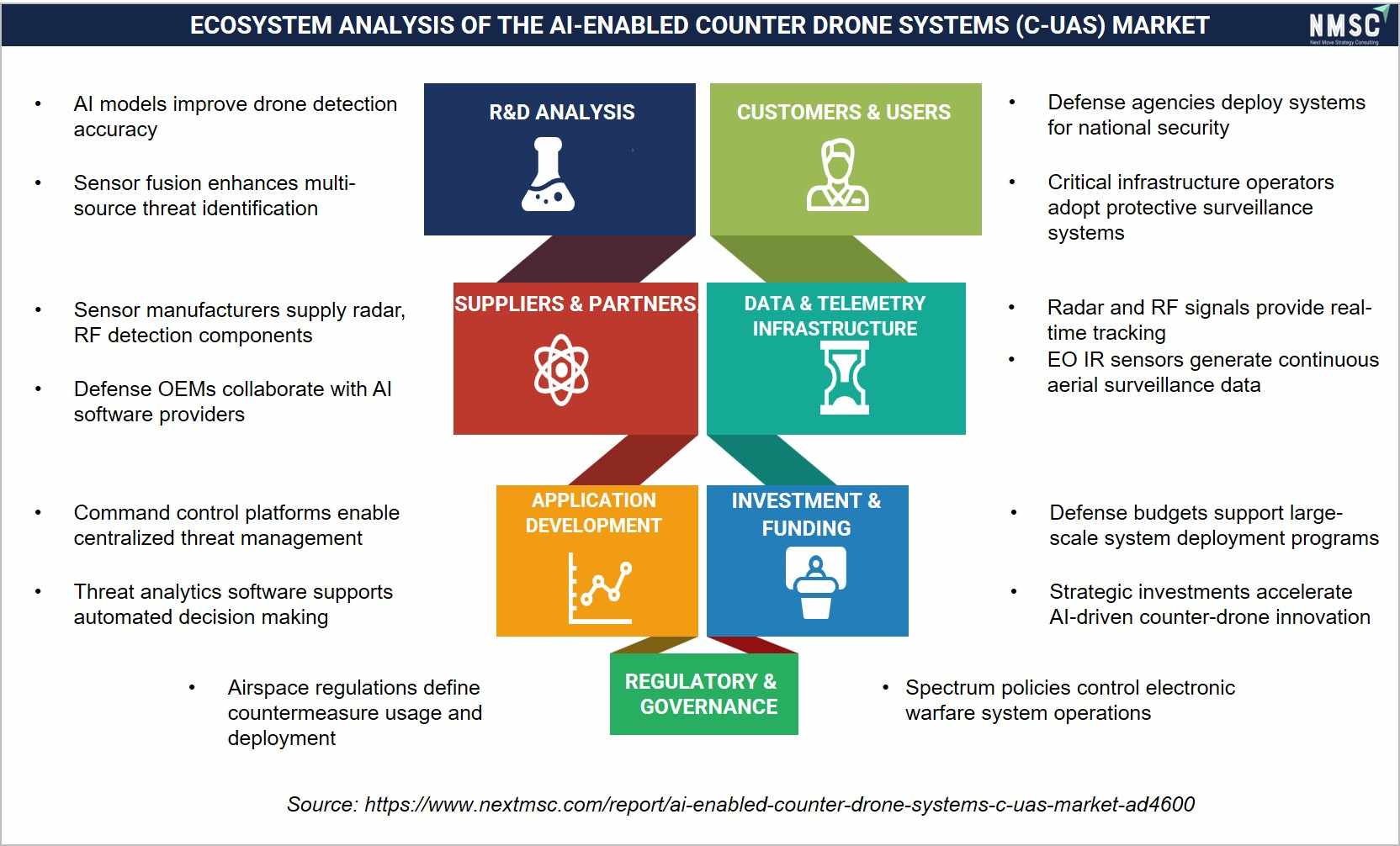
Our evaluation of the C-UAS ecosystem indicates that the counter-drone technology industry operates through tightly integrated layers of sensing, AI-driven analytics, and system deployment. In particular, collaboration between sensor manufacturers, defense OEMs, and software providers enables real-time threat detection and coordinated response. Furthermore, command-and-control platforms and telemetry infrastructure strengthen operational visibility. At the same time, sustained defense funding and regulatory oversight continue to shape system design, deployment models, and long-term scalability across both military and civilian security environments.
What Are the Key Market Drivers, Breakthroughs, and Investment Opportunities That Will Shape the AI-Enabled Counter-Drone Systems (C-UAS) Market in the Next Decade?
Growth Catalyst & Risk Assessment Matrix
|
DRIVERS / TRENDS / RESTRAINTS |
(+/–) % IMPACT ON CAGR FORECAST |
GEOGRAPHIC RELEVANCE |
IMPACT TIMELINE |
|
Proliferation of untraceable 3D-printed ghost drones and non-s tandard UAV platforms |
+1.5% |
North America, Europe, Asia-Pacific (China, India) |
Medium to long term (3–7 years) |
|
Increasing need for protection of critical civilian infrastructure including airports, power plants, and urban assets |
+1.4% |
North America, Europe, Middle East, Asia-Pacific |
Short to medium term (1–5 years) |
|
Adoption of C-UAS-as-a-Service (C-UaaS) for temporary and event-based deployments |
+1.1% |
North America, Europe, Asia-Pacific |
Short to medium term (1–4 years) |
|
Persistent accuracy limitations in differentiating drones from birds in complex environments |
–1.2% |
North America, Europe, Asia-Pacific |
Short to medium term (1–4 years) |
Based on our evaluation of global airspace security and defense modernization trends, we observed that the AI-enabled drone threat mitigation sector is experiencing strong growth, driven primarily by the rising proliferation of low-cost drones, increasing asymmetric threats, and rapid advancements in artificial intelligence, sensor fusion, and electronic warfare technologies. C-UAS solutions are increasingly adopted as a strategic investment to enhance situational awareness, strengthen threat response capabilities, and ensure protection of critical infrastructure and public environments.
Furthermore, advancements in AI-driven detection, real-time threat analytics, and multi-layered defense architectures are expanding system capabilities, enabling faster identification and neutralization of complex threats, including drone swarms. However, our assessment also indicates that high implementation costs and integration complexity continue to influence adoption, particularly across budget-constrained and civilian environments. At the same time, the emergence of software-defined platforms, managed services, and flexible deployment models is creating new growth opportunities by improving accessibility and enabling scalable, cost-efficient security solutions across diverse operational settings.
Growth Drivers:
How Does the Proliferation of Untraceable 3D-Printed Ghost Drones Drive AI-Enabled Counter Drone Systems (C-UAS) Market Demand?
Based on our analysis, we observed that the proliferation of untraceable 3D-printed ghost drones significantly drives demand for autonomous drone detection systems. As additive manufacturing and off-the-shelf components become more accessible, drones are increasingly produced without standardized identification or geofencing constraints. Therefore, such drones operate with greater anonymity and flexibility, which increases the frequency and unpredictability of aerial threats. In addition, rapid prototyping enables continuous design modifications, making detection more complex. As a result, security systems shift toward AI-driven, multi-sensor detection that relies on behavioral and physical signatures rather than signal intelligence. This shift accelerates the need for advanced, adaptive detection systems, thereby driving sustained market demand.
How Does the Need to Protect Critical Civilian Infrastructure Boost Market Demand?
NMSC's analysis indicates that the growing need to protect critical civilian infrastructure significantly boosts demand for AI-enabled counter drone systems (C-UAS) market. As airports, power plants, and urban assets face increasing exposure to unauthorized drone activity, even minor incursions disrupt operations and create safety risks. Therefore, infrastructure operators prioritize proactive detection and mitigation over reactive response. At the same time, high-density environments require continuous monitoring and rapid response capabilities. In addition, AI-enabled systems provide real-time tracking and automated alerts, which improve operational readiness and reduce response time.
On February 2026, the European Commission published a new Action Plan on Drone and Counter-Drone Security. This plan includes the establishment of a voluntary "EU Counter-Drone Deployment Initiative" for critical infrastructure, supported by funding from the European Defence Fund and the European Defence Industry Programme. As a result, adoption expands beyond defense into aviation, energy, and urban security applications. Overall, infrastructure protection emerges as a strong and consistent demand driver, supporting broader market expansion.
Growth Inhibitor:
How Do Accuracy Limitations in Differentiating Drones from Birds Restrain AI-Enabled Counter Drone Systems (C-UAS) Market Growth?
Based on our evaluation, we observed that persistent accuracy challenges in distinguishing drones from birds remain a key restraint in the AI-enabled counter drone systems (C-UAS) market. During our discussions with system operators and technology providers, stakeholders highlighted that false positives in complex environments reduce system reliability and operator confidence. In real-world deployments, environments with dense bird activity or visual clutter create classification challenges, particularly for radar and optical systems.
Additionally, The FAA forecasted that the commercial drone fleet would exceed 1 million units by the end of 2025, growing to 1.18 million by 2029. This massive increase in legitimate "non-bird" traffic creates a higher density of targets for detection systems to classify in real-time. This growing airspace complexity further amplifies the need for highly precise identification capabilities. Thus, improving classification accuracy through advanced training datasets and multi-sensor fusion is becoming a key focus area for vendors. However, deployment decisions remain cautious, particularly in sensitive civilian environments, as these limitations continue to affect system reliability and delay broader adoption, thereby constraining market growth.
Growth Opportunity:
How Is the Emergence of Counter-Drone Systems-as-a-Service (C-UaaS) Creating New Market Opportunities?
Based on our analysis, we identified that the adoption of C-UAS-as-a-Service (C-UaaS) creates new growth opportunities by introducing flexible and cost-efficient deployment models. As temporary and event-based environments require high-level security without permanent infrastructure, service-based offerings provide a practical alternative. Therefore, organizations access advanced detection and mitigation capabilities without significant upfront investment. This model supports rapid deployment across events, urban zones, and critical infrastructure sites.
In addition, bundled solutions combining hardware, AI software, and operational support improve ease of adoption. According to the U.S. Federal Emergency Management Agency (FEMA), USD 250 million in 2026 funding has been allocated under the Counter-UAS Grant Program to support temporary deployments for major national events, including large-scale public gatherings and international events. As a result, new customer segments, including private security and event operators, enter the market. Further, C-UaaS expands market accessibility and accelerates adoption across diverse use cases creating new opportunities for the market.
Pain Point Analysis Impacting the AI-Enabled Counter Drone Systems (C-UAS) Market:
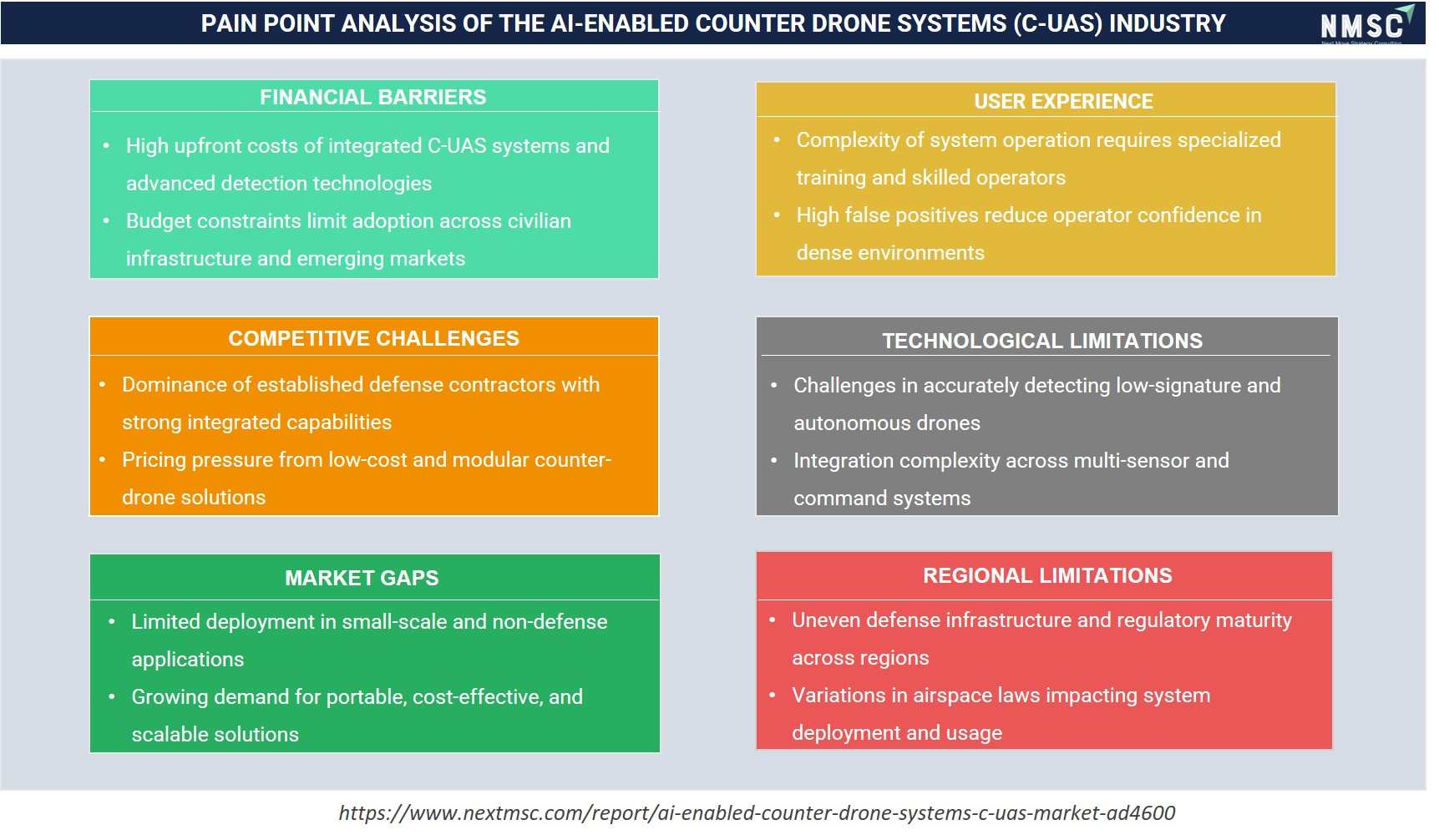
From our assessment of real-world deployments, we identified that the AI-enabled counter drone systems (C-UAS) market faces a combination of financial, operational, and technological challenges. High upfront investment and budget constraints continue to limit adoption beyond defense sectors. In addition, system complexity and false positives affect operator confidence in dynamic environments. Moreover, detection limitations for low-signature drones and integration challenges across multi-sensor systems persist. At the same time, regulatory variations and uneven infrastructure maturity across regions further influence deployment consistency and market expansion.
How Is the AI-Enabled Counter Drone Systems (C-UAS) Market Segmented in This Report, And What Are the Key Insights from the Segmentation Analysis?
Market Highlights & Strategic Insights – AI-Enabled Counter Drone Systems (C-UAS) Market:
|
Segments |
Key Takeaways |
|
Offering |
Systems dominate, led by fixed-site deployments across defense and critical infrastructure, while mobile and portable systems gain traction for flexible use. Software (C2, analytics, fusion) is becoming a key differentiator, and services are expanding with rising deployment complexity. |
|
Deployment Platform |
Fixed-site platforms lead due to permanent security needs, whereas mobile ground systems grow for tactical operations. Maritime and airborne platforms extend coverage, and platform-agnostic solutions improve interoperability. |
|
Mitigation Mode |
Electronic countermeasures lead, especially RF and GNSS jamming. Directed energy solutions are gaining momentum for precision, while kinetic methods remain relevant in high-risk scenarios. Non-effector approaches expand in regulated environments. |
|
End User Vertical |
Defense and military dominate, followed by government and public safety. Critical infrastructure adoption is rising, while commercial segments like stadiums and campuses are emerging as new demand areas. |
By Offering Insights
How Do Systems, Software, and Services Shape the AI-Enabled Counter Drone Systems (C-UAS) Market?
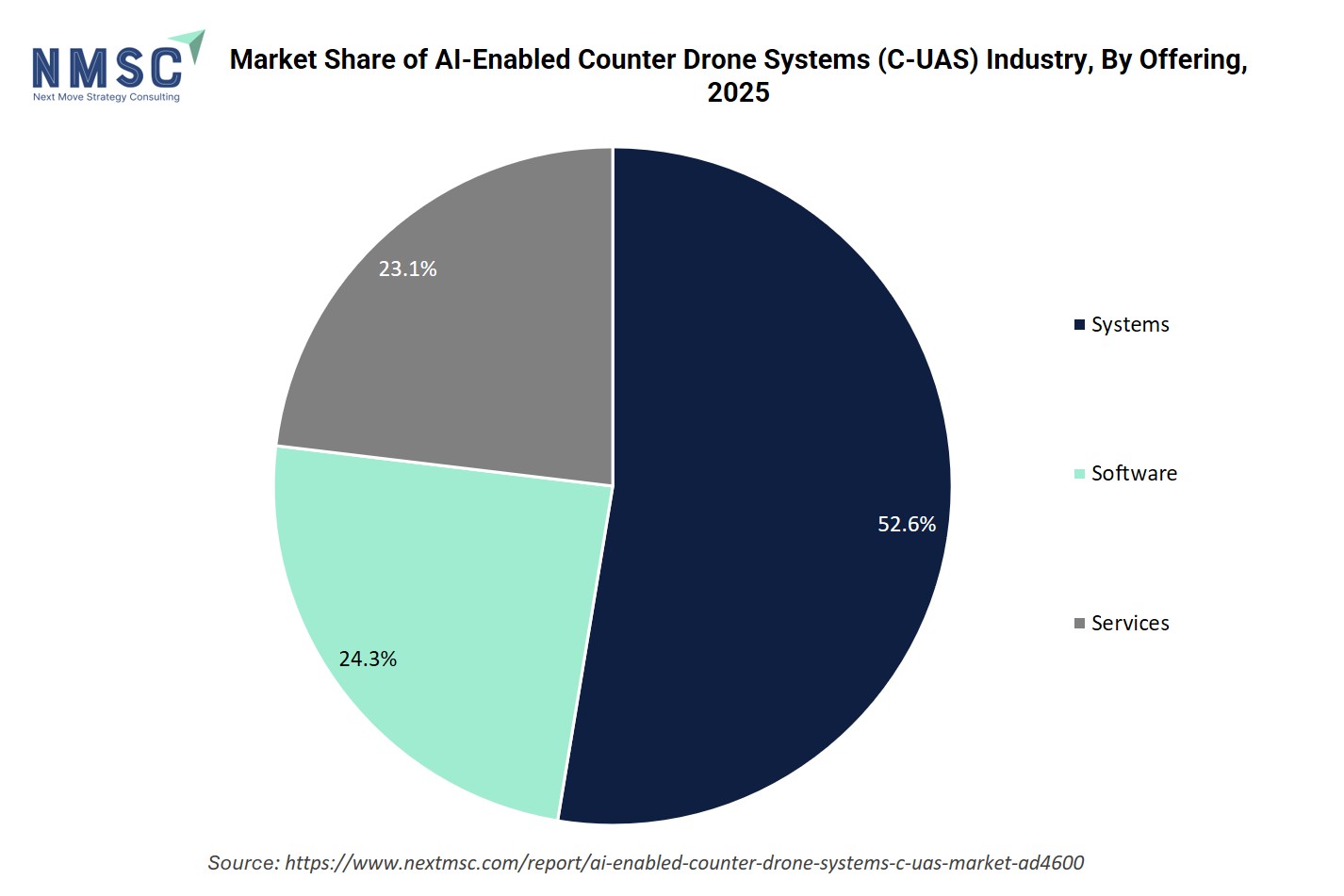
Based on our detailed assessment, we found that the AI-enabled counter drone systems (C-UAS) market is segmented into systems, software, and services. System offerings include fixed site, mobile ground, portable, maritime, and airborne solutions. Software includes command and control, detection and classification, sensor fusion, and threat analytics. Services cover integration and installation, maintenance and support, training, managed operations, and consulting.
From our evaluation of deployments, system solutions dominate adoption, particularly fixed site and mobile ground systems used across defense and critical infrastructure. At the same time, portable systems are gaining traction in tactical and event-based scenarios where rapid deployment is essential. Software is emerging as a critical layer, as command and control platforms, sensor fusion, and AI-driven analytics enable faster threat identification and coordinated response. In addition, services are becoming increasingly important as deployments scale, with operators prioritising integration, training, and lifecycle support to ensure consistent system performance and long-term operational readiness.
By Deployment Platform Insights
How Do Deployment Platforms Influence C-UAS System Adoption Across Environments?
Based on our analysis, we found that the AI-enabled counter drone systems (C-UAS) market share is segmented into fixed site, mobile ground, maritime, airborne, and platform-agnostic deployment platforms.
From our assessment of real-world use cases, fixed-site deployments account for a significant share due to their role in protecting permanent assets such as airports, military bases, and energy infrastructure. In contrast, mobile ground platforms are increasingly adopted in tactical operations and border security scenarios where flexibility and rapid repositioning are critical. Maritime and airborne platforms extend surveillance and response capabilities across complex terrains, including coastal zones and remote areas. Furthermore, platform-agnostic systems are gaining traction as they enable interoperability across multiple environments, allowing operators to deploy unified solutions across diverse operational settings with greater efficiency.
By Mitigation Mode Insights
How Do Different Mitigation Modes Shape Operational Effectiveness in the AI-Enabled Counter Drone Systems (C-UAS) Market?
Based on our evaluation, we found that the AI-enabled counter drone systems (C-UAS) market is segmented into electronic countermeasures, directed energy, kinetic intercept, and non-effector approaches. Electronic countermeasures include RF jamming, GNSS jamming, GNSS spoofing, and protocol manipulation. Directed energy includes high-power microwave and high-energy laser technologies. Kinetic intercept methods include projectile systems, interceptor drones, and net capture solutions.
From our operational analysis, we found that electronic countermeasures dominate adoption due to their ability to disable drones without causing physical damage, making them suitable for both military and civilian environments. At the same time, directed energy systems are gaining traction for their precision and effectiveness against complex and swarm-based threats. Kinetic methods remain relevant in high-risk scenarios requiring immediate physical neutralization. Meanwhile, non-effector approaches are increasingly preferred in regulated environments where controlled mitigation is essential, reflecting a broader industry shift toward layered and adaptable response strategies.
Regional Outlook:
Geographic Performance Snapshot:
|
Regions |
Key Takeaways |
|
North America |
North America represents a leading AI-enabled counter drone systems (C-UAS) market, supported by advanced defense infrastructure, early adoption of AI-driven surveillance technologies, and strong institutional readiness. High defense spending, presence of major technology providers, and widespread deployment across military bases, airports, and critical infrastructure continue to drive sustained market growth across the region. |
|
Europe |
Europe represents a well-established AI-enabled counter drone systems (C-UAS) market, driven by strong regulatory frameworks, increasing focus on airspace security, and strict data privacy requirements. Growth is supported by government-led security initiatives, coordinated airspace management, and rising adoption of compliant detection systems across airports and urban environments. |
|
Asia-Pacific |
Asia-Pacific represents the fastest-growing AI-enabled counter drone systems (C-UAS) market trends, supported by defense modernisation, expanding infrastructure, and rising drone activity across countries such as China, India, Japan, and South Korea. Government-backed security programs and increasing investment in AI-enabled surveillance technologies continue to accelerate adoption across both defense and civilian applications. |
|
Latin America |
Latin America represents a developing C-UAS market, supported by improving security infrastructure and increasing awareness of drone-related risks. Governments and infrastructure operators are gradually adopting detection and monitoring systems to enhance public safety and asset protection, contributing to steady market progression across the region. |
|
Middle East & Africa |
The Middle East & Africa represents an emerging AI-enabled counter drone systems (C-UAS) market, supported by rising investments in defense, critical infrastructure protection, and smart city initiatives. Gulf countries are actively adopting advanced counter-drone technologies, while parts of Africa are focusing on scalable monitoring solutions, driving gradual but consistent market development. |
The AI-enabled counter drone systems (C-UAS) market is geographically studied across North America, Europe, Asia Pacific, Latin America and Middle East & Africa and each region is further studied across countries.
AI-Enabled Counter Drone Systems (C-UAS) Market in North America
North America demonstrates a defense-centric and operationally mature AI-enabled counter drone systems (C-UAS) market, where early exposure to drone-related security risks and strong institutional readiness continue to support sustained adoption. From our regional assessment, we observed that the United States drives the majority of deployments, while Canada shows steady and application-focused growth across critical infrastructure environments. In particular, recurring drone incidents near military installations, airports, and public venues are reinforcing the need for AI-enabled detection and mitigation systems.
Our engagements with defense agencies and infrastructure operators indicate that layered architectures combining radar, RF sensing, and AI-based analytics are increasingly standardised across deployments. Furthermore, regulatory oversight around airspace control and electronic countermeasures continues to shape system configuration and usage. While defense applications remain dominant, selective adoption across aviation and energy infrastructure is expanding. Consequently, vendors prioritising system interoperability, real-time threat intelligence, and compliance alignment are reinforcing long-term contract visibility and deepening vendor integration within national security ecosystems.
AI-Enabled Counter Drone Systems (C-UAS) Market in the United States
Based on our direct engagements with defense agencies and security operators, we identifed that the United States represents the most operationally active C-UAS market globally. Adoption is primarily driven by persistent low-altitude drone threats, evolving battlefield requirements, and the need to secure high-value domestic assets. Defense and homeland security functions continue to prioritise AI-enabled systems capable of detecting, identifying, and mitigating drones in complex operational environments. Our analysis indicates that deployments increasingly emphasise integrated command-and-control platforms, multi-sensor fusion, and autonomous threat response capabilities. In addition, collaboration between established contractors such as Lockheed Martin supports continuous system advancement and deployment scalability. Furthermore, regulatory frameworks governing countermeasure usage continue to shape operational models and system configuration. As a result, the AI-enabled counter drone systems (C-UAS) market is steadily transitioning toward software-defined, interoperable systems that enhance mission flexibility and long-term operational readiness.
AI-Enabled Counter Drone Systems (C-UAS) Market in Canada
In Canada, a measured and infrastructure-focused adoption of C-UAS systems is supported by growing attention to airspace safety and the protection of critical assets. Our interactions with security stakeholders indicate that deployment is concentrated around airports, government facilities, and energy infrastructure, where drone intrusion risks are increasingly recognised. Compared to the United States, adoption remains more selective, with a stronger emphasis on monitoring and detection rather than active mitigation.
Our assessment shows that regulatory caution around electronic countermeasures and spectrum use continues to influence system selection and deployment scope. Consequently, AI-enabled detection platforms integrating radar and RF analysis are preferred for situational awareness and threat identification. Additionally, collaboration with local system integrators and compliance-driven procurement processes shapes vendor participation. Vendors that offer reliable detection accuracy, regulatory alignment, and long-term service support are better positioned to establish stable contracts and gradual market expansion.
AI-Enabled Counter Drone Systems (C-UAS) Market in Europe
The AI-enabled counter drone systems (C-UAS) market in Europe reflects a compliance-led and coordination-intensive landscape, where regulatory frameworks and controlled airspace management shape deployment pathways. From our regional analysis, we noticed that adoption is largely centred around airport security, defense installations, and high-visibility public environments.
Notably, recurring drone disruptions across major European airports have increased urgency around detection and early warning capabilities. Our interactions with aviation authorities and security agencies indicate that non-kinetic solutions, particularly AI-enabled RF detection and classification systems, are prioritised due to strict regulations on active countermeasures. At the same time, fragmented regulatory structures across countries create uneven adoption patterns. While Western Europe demonstrates stronger implementation maturity, other regions are progressing more selectively. This regulatory-first environment ultimately positions compliance-driven, detection-focused solutions at the core of Europe’s C-UAS evolution.
AI-Enabled Counter Drone Systems (C-UAS) Market in the United Kingdom
NMSC’s research indicates that the United Kingdom is transitioning toward a more security-focused C-UAS adoption model, supported by increasing attention to aviation safety and protection of dense urban environments. From our observations, we noticed that repeated drone-related incidents near airports have heightened institutional awareness and accelerated investment in detection infrastructure. Our engagements with security agencies and airport operators show that deployment strategies emphasise real-time monitoring, AI-based identification, and integration with existing surveillance networks. In addition, regulatory sensitivity around electronic countermeasures continues to shape system selection, favouring controlled and non-disruptive technologies. Rather than large-scale military-style deployments, the UK market is evolving through targeted, infrastructure-led implementations, reflecting a measured but steadily strengthening security posture.
AI-Enabled Counter Drone Systems (C-UAS) Market in Germany
Germany demonstrates a precision-oriented and standards-driven approach to C-UAS adoption, influenced by its strong engineering ecosystem and strict operational requirements. From our evaluation, we observed that deployment remains focused on safeguarding critical infrastructure, including industrial zones, airports, and government facilities. Our analysis indicates that buyers consistently prioritise certified systems, operational reliability, and seamless integration with existing security frameworks. Furthermore, data protection considerations and regulatory compliance play a central role in shaping deployment decisions. Unlike rapid adoption markets, Germany advances through carefully validated implementations, where performance assurance outweighs speed of deployment. Ultimately favouring high-certainty deployments where performance validation outweighs speed of rollout.
AI-Enabled Counter Drone Systems (C-UAS) Market in France
France shows a steadily strengthening C-UAS landscape, shaped by national security priorities and the need to secure high-profile public events and strategic assets. From our market interactions, we found increasing deployment across defense zones, urban centers, and large-scale gatherings where aerial threats require continuous monitoring. Our assessment indicates that integrated systems combining detection, identification, and controlled mitigation are gaining preference among security stakeholders. At the same time, centralized decision-making and strong institutional involvement support more coordinated deployment strategies compared to fragmented markets. Rather than purely reactive adoption, France is enabling coordinated, pre-emptive security frameworks rather than reactive response models.
AI-Enabled Counter Drone Systems (C-UAS) Market in Italy
The AI-enabled counter drone systems (C-UAS) market in Italy is progressing through a balanced mix of infrastructure protection needs and gradual security modernization efforts. Based on our analysis, we observed that adoption is primarily concentrated around airports, government sites, and event-based security deployments. Our engagements with public security stakeholders indicate that flexibility and ease of deployment are key considerations, particularly given the diversity of infrastructure environments. In addition, procurement decisions reflect a balance between capability and cost efficiency, shaping a preference for modular and scalable systems. Rather than uniform nationwide rollout, Italy’s market is expanding through targeted implementations, making deployment flexibility a decisive factor in vendor selection across diverse infrastructure settings.
AI-Enabled Counter Drone Systems (C-UAS) Market in Spain
Based on our assessment, we identified that Spain is gradually strengthening its C-UAS capabilities, supported by rising awareness of drone-related risks across public infrastructure and urban environments. In particular, increasing activity around airports and large gatherings is encouraging proactive monitoring investments. Our interactions with security operators indicate that affordability, rapid deployment, and system simplicity are critical decision factors. Moreover, adoption remains selective, with a stronger focus on detection and surveillance rather than active countermeasures. While the AI-enabled counter drone systems (C-UAS) market is still developing compared to Western European leaders, improving infrastructure readiness and growing operational awareness are steadily shaping adoption patterns, positioning Spain as a pragmatic and cost-conscious emerging market within the regional landscape.
AI-Enabled Counter Drone Systems (C-UAS) Market in the Nordics
The Nordic region, including Sweden, Norway, and Finland, represents a technologically advanced and quality-focused AI-enabled counter drone systems (C-UAS) market, where high digital maturity and strong institutional trust in automation support adoption. From our observations, we noticed that deployments are primarily aligned with critical infrastructure protection, border monitoring, and public safety applications. Our interactions with government authorities and infrastructure operators indicate that reliability, system transparency, and long-term operational performance are prioritised over rapid deployment. In addition, strict regulatory oversight and privacy considerations influence the preference for detection-first, non-intrusive solutions. Rather than scaling aggressively, the region advances through carefully validated implementations, where performance consistency and compliance remain central. Thus, reinforcing a deployment model centred on reliability, transparency, and long-term operational assurance.
AI-Enabled Counter Drone Systems (C-UAS) Market in Asia-Pacific
Based on our regional evaluation, we found that Asia-Pacific is emerging as a highly dynamic and rapidly evolving C-UAS market, driven by expanding defense budgets, increasing border security concerns, and rising drone activity across both civilian and military environments. In particular, large-scale infrastructure development and urban expansion are creating new demand for airspace monitoring and protection systems.
Our analysis indicates that adoption patterns vary significantly across countries, with some markets prioritising large-scale deployments while others focus on targeted security applications. Furthermore, government-led modernization programs and domestic technology development are accelerating system availability and deployment readiness. While cost sensitivity remains a factor in several markets, operational urgency and security requirements are increasingly shaping procurement decisions. As a result, the region is evolving as a high-growth environment where scale, adaptability, and localized strategies determine competitive success.
AI-Enabled Counter Drone Systems (C-UAS) Market in China
The AI-enabled counter drone systems (C-UAS) market in China reflects a scale-driven and state-supported adoption model, underpinned by strong domestic manufacturing capability and centralized security priorities. Based on our analysis, we noticed that deployment is extensive across public surveillance, urban security, and defense-related applications. Our assessment indicates that China emphasizes rapid deployment, cost efficiency, and integration with broader surveillance ecosystems. In addition, domestic technology ecosystems support end-to-end system development, enabling faster innovation cycles and widespread implementation. Unlike regulation-constrained markets, deployment is more centrally directed, allowing for quicker scaling across regions. This centralized and execution-focused approach positions China as a volume leader, where centralized execution and rapid scaling continue to accelerate nationwide deployment maturity.
AI-Enabled Counter Drone Systems (C-UAS) Market in Japan
Japan demonstrates a structured and reliability-driven AI-enabled counter drone systems (C-UAS) market, shaped by high safety standards, dense urban environments, and strong technological capability. From our evaluation, we found that adoption is primarily focused on protecting critical infrastructure, public events, and transportation hubs. Our interactions with security operators indicate that system precision, operational stability, and long-term service reliability are key purchasing criteria. Moreover, careful validation and controlled deployment approaches influence adoption timelines, favouring proven and highly reliable solutions over experimental systems. Rather than rapid expansion, Japan advances through incremental and quality-focused implementation, ensuring that system performance aligns with strict operational expectations. This approach continues to position the market as stable, high-trust, and technologically refined.
AI-Enabled Counter Drone Systems (C-UAS) Market in India
India represents a fast-emerging AI-enabled counter drone systems (C-UAS) market, where rising security concerns and expanding drone usage are driving early-stage but accelerating adoption. Based on our market interactions, we observed that deployment is increasingly prioritised across border security, defense operations, and high-profile public events. In particular, the need to monitor sensitive zones and manage unauthorized drone activity is strengthening demand for AI-enabled detection systems.
Our engagements with defense authorities and security operators indicate that initial adoption is centred around detection, tracking, and situational awareness, with gradual movement toward integrated mitigation capabilities. Furthermore, cost sensitivity and infrastructure diversity influence procurement decisions, encouraging modular and scalable system architectures. Rather than uniform deployment, the market is evolving through phased implementations, where cost-efficiency and phased deployment models continue to guide market expansion.
AI-Enabled Counter Drone Systems (C-UAS) Market in South Korea
South Korea demonstrates a highly responsive and technology-forward C-UAS market, supported by strong digital infrastructure and rapid adoption of advanced security systems. From our observations, we noticed that deployment is closely aligned with national security priorities and protection of dense urban and strategic environments. Our analysis indicates that buyers actively adopt AI-enabled systems with real-time analytics, automated threat detection, and integrated control platforms.
In addition, strong coordination between public authorities and technology providers accelerates deployment timelines and system upgrades. Unlike gradual adoption markets, South Korea shows a tendency toward early integration of advanced capabilities, reflecting high readiness for next-generation solutions. This proactive approach continues to position the country as a fast-moving and innovation-driven AI-enabled counter drone systems (C-UAS) market.
AI-Enabled Counter Drone Systems (C-UAS) Market in Taiwan
Taiwan reflects a strategically sensitive and technology-aligned C-UAS market, where security preparedness and infrastructure protection remain central to adoption. Based on our market assessment, we observed that deployment is concentrated around critical facilities, urban centers, and strategic installations requiring continuous monitoring. Our interactions with security stakeholders indicate that system interoperability, detection accuracy, and operational reliability are key selection criteria. Moreover, pilot deployments and controlled testing environments are commonly used to validate system performance before broader rollout. Rather than rapid scaling, the market progresses through calculated expansion, where validation and operational confidence take precedence. This cautious yet focused approach supports steady capability enhancement across Taiwan’s security ecosystem.
AI-Enabled Counter Drone Systems (C-UAS) Market in Indonesia
Indonesia represents an early-stage but progressively developing AI-enabled counter drone systems (C-UAS) market, shaped by growing urbanization, expanding infrastructure, and increasing awareness of aerial security risks. Our regional assessment indicates that adoption is primarily concentrated in major metropolitan areas and high-traffic infrastructure zones. Our analysis indicates that ease of deployment, cost efficiency, and operational simplicity are critical factors influencing purchasing decisions. In addition, infrastructure variability and resource constraints encourage preference for flexible and scalable systems. While adoption remains selective, improving logistics infrastructure and rising security awareness are gradually strengthening market traction. This evolving landscape positions Indonesia as a developing market where accessibility and practicality define long-term adoption potential.
AI-Enabled Counter Drone Systems (C-UAS) Market in Australia
Through our evaluation of national security deployments and infrastructure protection initiatives, we found that Australia maintains a stable and capability-focused AI-enabled counter drone systems (C-UAS) market, supported by high operational standards and geographically dispersed critical assets. In particular, the need to secure airports, defense facilities, and large public venues is reinforcing demand for reliable detection and monitoring systems. Our interactions with security operators indicate that system performance, ease of integration, and long-term service reliability are prioritised over rapid scaling. Furthermore, vast geographic coverage requirements encourage the use of flexible and remotely manageable solutions. While adoption is not volume-driven, investments are typically aligned with high-value, mission-critical applications. This results in a market where consistency, operational resilience, and lifecycle support define procurement and deployment strategies.
AI-Enabled Counter Drone Systems (C-UAS) Market in Latin America
Latin America presents a developing and unevenly distributed AI-enabled counter drone systems (C-UAS) market, where adoption patterns vary significantly across countries depending on security priorities and infrastructure maturity. Based on our regional analysis, we observed that demand is primarily concentrated in urban centers, critical infrastructure sites, and select government-led security programs. Our engagements with security authorities and infrastructure operators indicate that budget constraints and economic variability influence procurement strategies, favouring phased deployments and cost-effective solutions. In addition, awareness of drone-related risks is increasing, gradually strengthening the case for proactive monitoring systems. While large-scale adoption remains limited, targeted implementations are expanding steadily across key markets. This positions Latin America as a price-sensitive yet progressively evolving region, where phased investments and cost-aligned solutions continue to drive gradual market expansion.
AI-Enabled Counter Drone Systems (C-UAS) Market in the Middle East & Africa
From our assessment of regional security investments and infrastructure expansion, we identified that the Middle East & Africa AI-enabled counter drone systems (C-UAS) market presents a dual-structure landscape, combining high-value deployments in the Middle East with emerging adoption across parts of Africa. In particular, Gulf countries demonstrate strong demand driven by large-scale infrastructure, strategic asset protection, and advanced security requirements. Our analysis indicates that Middle Eastern markets prioritise integrated and high-performance systems, deployed as part of broader defense and smart city initiatives. In contrast, African markets remain at an earlier stage, where adoption is gradual and focused on essential monitoring capabilities. Furthermore, infrastructure limitations and budget considerations influence deployment scope across several regions. This contrast creates a dual-speed market where high-value deployments and gradual adoption evolve in parallel.
Strategic Framework Impacting the AI-Enabled Counter Drone Systems (C-UAS) Market
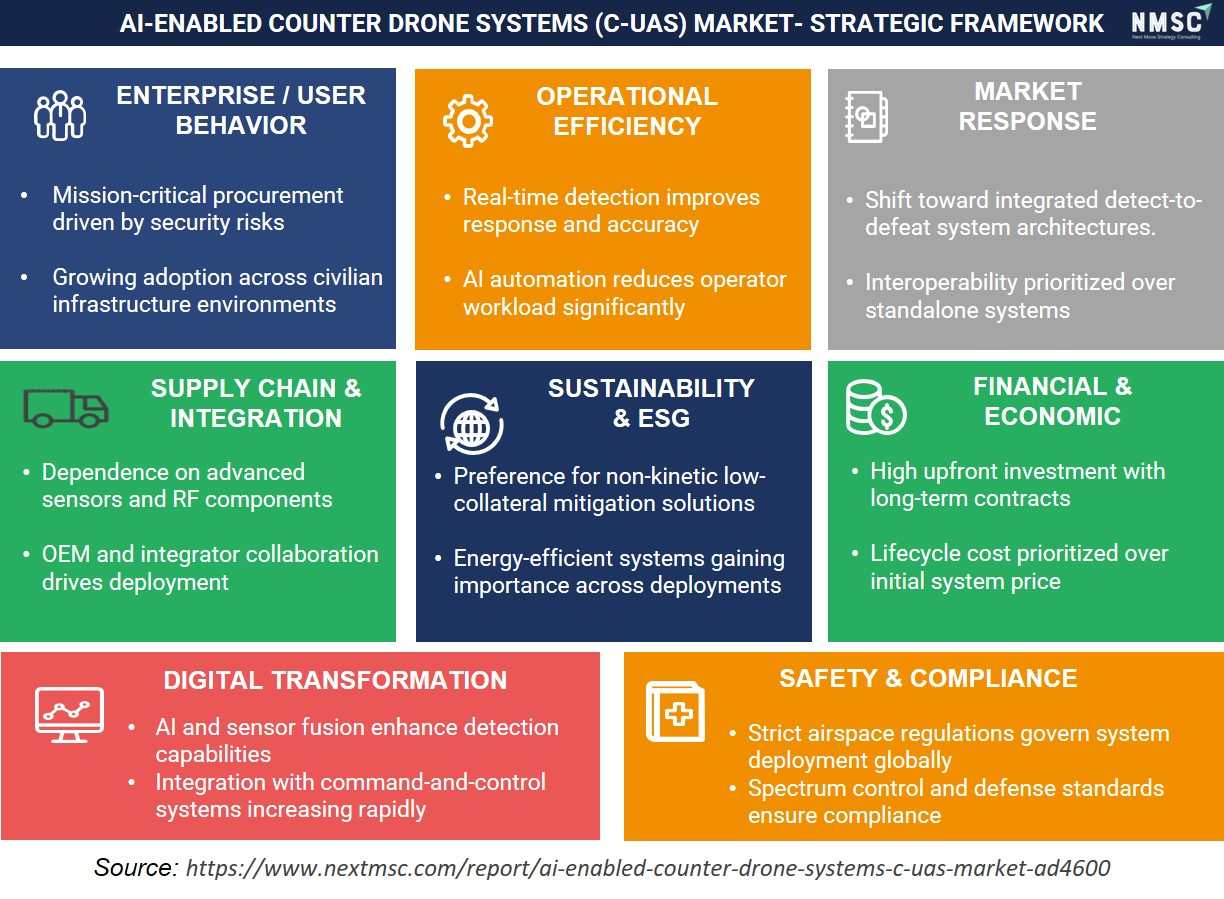
Our strategic analysis indicates that the AI-enabled counter drone systems (C-UAS) market is evolving through a balance of operational efficiency, regulatory alignment, and technological advancement. Mission-critical procurement and rising civilian adoption are shaping demand patterns. Meanwhile, AI-driven automation and sensor fusion are improving detection accuracy and response speed. In addition, interoperability and integrated system architectures are becoming key competitive differentiators. As deployment expands, lifecycle cost optimization, compliance requirements, and scalable solutions continue to define long-term growth and vendor positioning.
Competitive Landscape
Competitive Dynamics & M&A Landscape:
|
Key Takeaways |
|
The global AI-enabled counter drone systems (C-UAS) industry is led by major defense and aerospace providers such as RTX Corporation, Lockheed Martin, Northrop Grumman, Thales Group, Leonardo S.p.A., and L3Harris Technologies, which leverage integrated defense platforms, advanced sensor technologies, and global government contracts to maintain leadership. Meanwhile, specialised providers such as Dedrone, DroneShield, D-Fend Solutions, Sentrycs, and CerbAir compete through AI-driven detection, RF-based cyber takeover, and non-kinetic mitigation solutions. |
|
Companies increasingly focus on multi-layered architectures, AI-enabled threat classification, and interoperability to enhance detection accuracy and response effectiveness. In addition, technology-focused players such as Anduril Industries, Epirus, Fortem Technologies, and BlueHalo support innovation in autonomous systems, directed energy, and integrated command platforms, strengthening end-to-end operational capability. |
|
Recent developments highlight increasing system integration and capability consolidation, with companies including Israel Aerospace Industries, Rafael Advanced Defense Systems, Elbit Systems, Saab AB, and SRC Inc. enhancing layered defense solutions and expanding deployment across both military and critical infrastructure environments. |
Which Companies Dominate the AI-Enabled Counter Drone Systems (C-UAS) Industry and How Do They Compete?
Based on our analysis, we found that the AI-enabled counter drone systems (C-UAS) market is dominated by established defense contractors alongside fast-scaling counter-drone specialists. Companies such as RTX Corporation, Lockheed Martin, Northrop Grumman, Thales Group, and Leonardo S.p.A. consistently lead large-scale deployments where mission reliability, system integration, and long operational lifecycles are critical. From our implementation assessments, we found that these vendors are frequently selected for defense programs and national security projects requiring seamless integration with radar networks, command-and-control systems, and electronic warfare infrastructure. Competition at this level is primarily driven by system robustness, multi-domain capability, and proven field performance.
Market Dominated by AI-Enabled Counter Drone Systems (C-UAS) Giants and Specialists
From our observation, we found that the competitive landscape is further shaped by specialized providers such as Dedrone, DroneShield, D-Fend Solutions, Sentrycs, and CerbAir. Our interactions with security operators and pilot deployments show that these companies gain traction by offering AI-driven detection, RF-based cyber takeover, and non-kinetic mitigation solutions that are deployed rapidly with minimal infrastructure changes. In practice, defense majors define system scale and integration standards, while specialists accelerate adoption through flexible, software-centric, and cost-efficient solutions.
Innovation and Adaptability Drive Market Success
Innovation remains a core determinant of competitive positioning in the AI-enabled counter drone systems (C-UAS) market, as identified through our evaluation of live deployments across defense and critical infrastructure environments. Market participants such as Anduril Industries, Epirus, Fortem Technologies, and BlueHalo are advancing capabilities in AI-based threat detection, autonomous response systems, and directed energy technologies. From integrator feedback, we observed that vendors investing in multi-sensor fusion, real-time analytics, and modular system architectures are better positioned to address evolving threats such as drone swarms and low-altitude intrusions. These advancements reflect strong expertise in AI, electronic warfare, and integrated defense systems.
Market Players to Opt for Merger & Acquisition Strategies to Expand Their Presence
Based on our research, we observed that partnerships and capability integration are increasingly shaping the AI-enabled counter drone systems (C-UAS) market, as companies move toward unified detect-to-defeat solutions. In particular, this highlights a 2026 collaboration to develop a non-kinetic counter-UAS kill chain, combining AI-enabled sensing with high-power microwave capabilities. Furthermore, this integration enables a seamless workflow from detection to mitigation, improving response speed and operational precision. Rather than focusing solely on scale, vendors are prioritising interoperability, faster deployment, and system cohesion. As a result, such collaborations are strengthening end-to-end performance while redefining competitive positioning across the C-UAS landscape.
List of Key AI-Enabled Counter Drone Systems (C-UAS) Companies
-
RTX Corporation
-
Lockheed Martin Corporation
-
Northrop Grumman Corporation
-
Thales S.A.
-
Leonardo S.p.A.
-
Israel Aerospace Industries Ltd.
-
Rafael Advanced Defense Systems Ltd.
-
Elbit Systems Ltd.
-
Saab AB
-
Anduril Industries, Inc.
-
L3Harris Technologies, Inc.
-
BlueHalo, LLC
-
Epirus, Inc.
-
SRC, Inc.
-
Sentrycs Ltd.
-
Dedrone Holdings, Inc.
-
DroneShield Limited
-
Fortem Technologies, Inc.
-
D-Fend Solutions AD Ltd.
-
CerbAir SAS
What Are the Latest Key Industry Developments?
-
March 2026- Thales Group unveiled SkyDefender, an AI-enabled integrated air and missile defense architecture. Powered by the cortAIx AI accelerator, the system processes data from advanced sensors and supports multi-layer protection against evolving threats ranging from drones to hypersonic missiles.
-
January 2026-Epirus achieved a major breakthrough by demonstrating its Leonidas High-Power Microwave (HPM) system's ability to defeat fiber-optic guided drones. Since these drones don't use radio signals, traditional jammers fail; Epirus's AI-defined HPM induces a "full kill" on internal electronics instead.
-
January 2026- Lockheed Martin collaborated with Microsoft to integrate the Azure cloud digital backbone into its C-UAS systems. This allows for AI-driven model retraining via the cloud, enabling systems to update their "threat libraries" in real-time to recognize new drone models as soon as they appear on the battlefield.
Expert Insights

“Integrating Seraphim with Epirus’ Leonidas high-power microwave platform extends AI-enabled decision making through the defeat layer of the counter-UAS kill chain, delivering a turnkey detect-to-defeat capability. This partnership reflects a shared commitment to scalable, interoperable systems that give operators faster, more effective solutions to defeat evolving drone threats.”
— Justin MacLaurin, Digital Force Technologies CEO.
Statement made during the announcement of the integration of Seraphim AI with the Leonidas high-power microwave platform to deliver a unified non-kinetic counter-UAS solution.
Market Interpretation
The statement highlights the shift toward integrated, AI-driven detect-to-defeat systems in the AI-enabled counter drone systems (C-UAS) market. Based on our analysis, we observed that vendors are increasingly focusing on end-to-end, non-kinetic solutions that combine detection, decision-making, and mitigation within a unified platform. Additionally, the focus on scalability and interoperability reflects growing demand for fast, adaptable, and deployment-ready systems, reinforcing the market’s move toward cohesive and high-response counter-drone architectures.
What Are the Key Factors Influencing Investment Analysis & Opportunities in the Ai-Enabled Counter Drone Systems (C-Uas) Market?
Investment analysis in the AI-enabled counter drone systems (C-UAS) market is increasingly shaped by a shift toward integrated, platform-centric defense systems, rather than standalone detection or mitigation hardware. Based on our evaluation of funding activity, and capability expansion initiatives, we observed that investors favour vendors offering end-to-end “detect-to-defeat” architectures, combining sensing, AI-driven analytics, and non-kinetic response within unified platforms. Companies demonstrating scalable deployments, proprietary AI algorithms, and seamless integration with command-and-control (C2) systems consistently attract stronger strategic interest.
Moreover, investment concentration around multi-sensor fusion, autonomous threat classification, and directed energy technologies, particularly in solutions addressing complex threats such as drone swarms and low-altitude intrusions. Furthermore, strategic investments are increasingly led by defense agencies, sovereign funds, and technology partners seeking operational control and faster deployment capability. For investors, the most compelling opportunities lie in vendors combining technological depth, field-proven performance, and system interoperability, ensuring long-term relevance in an evolving threat environment.
Key Benefits for Stakeholders:
Next Move Strategy Consulting (NMSC) presents a comprehensive analysis of the AI-enabled counter drone systems (C-UAS) market trends, covering historical developments from 2020 to 2025 and providing forward-looking forecasts through 2035. Our study evaluates the market at global, regional, and country levels, delivering quantitative outlooks alongside qualitative insights into key growth drivers, adoption barriers, technology evolution, and investment trends across major C-UAS segments.
From our observation, we found the AI-enabled C-UAS industry delivers measurable value across a diverse stakeholder base. Investors benefit from long-term defense contracts, software-led platforms, and recurring revenue through system upgrades and lifecycle services. Defense agencies and security operators gain enhanced situational awareness, faster threat response, and improved protection of critical assets through AI-driven detection and mitigation systems.
Furthermore, system integrators, OEMs, and technology partners benefit from multi-layered deployments, integration services, and continuous capability upgrades as threat environments evolve. In addition, infrastructure operators including airports, energy facilities, and public venues achieve improved operational security and risk mitigation through scalable and compliant counter-drone solutions. By aligning AI innovation with real-world security requirements and system interoperability, the market continues to create sustained value while strengthening long-term defense and infrastructure resilience.
|
Parameters |
Details |
|
Customization Scope |
Free customization (equivalent to up to 80 analyst-working hours) after purchase. Addition or alteration to country, regional & segment scope. |
|
Pricing and Purchase Options |
Avail customized purchase options to meet your exact research needs. |
|
Approach |
In-depth primary and secondary research; proprietary databases; rigorous quality control and validation measures. |
|
Analytical Tools |
Porter's Five Forces, SWOT, value chain, and Harvey ball analysis to assess competitive intensity, stakeholder roles, and relative impact of key factors. |
AI-Enabled Counter Drone Systems Market Key Segments
By Offering
-
Systems
-
Fixed Site Systems
-
Mobile Ground Systems
-
Portable Systems
-
Maritime Systems
-
Airborne Systems
-
-
Software
-
Command and Control (C2)
-
Detection and Classification
-
Sensor Fusion
-
Threat Analytics
-
-
Services
-
Integration and Installation
-
Maintenance and Support
-
Training
-
Managed Operations
-
Consulting and Risk Assessment
-
By Deployment Platform
-
Fixed Site
-
Mobile Ground
-
Maritime
-
Airborne
-
Platform Agnostic
By Mitigation Mode
-
Electronic Countermeasure
-
RF Jamming
-
GNSS Jamming
-
GNSS Spoofing
-
Protocol Manipulation
-
-
Directed Energy
-
High Power Microwave
-
High Energy Laser
-
-
Kinetic Intercept
-
Projectile
-
Interceptor Drone
-
Net Capture
-
-
Non-Effector
By End User Vertical
-
Defense and Military
-
Government and Public Safety
-
Critical Infrastructure
-
Energy
-
Water and Utilities
-
Transportation
-
Industrial
-
-
Commercial
-
Stadiums and Events
-
Corporate Campuses
-
Logistics and Warehousing
-
Geographical Breakdown
-
North America: U.S., Canada, and Mexico.
-
Europe: UK, Germany, France, Italy, Spain, Sweden, Denmark, Finland, the Netherlands, and the Rest of Europe.
-
Asia Pacific: China, India, Japan, South Korea, Taiwan, Indonesia, Vietnam, Australia, Philippines, Malaysia and the rest of APAC.
-
Middle East & Africa (MEA): Saudi Arabia, UAE, Egypt, Israel, Turkey, Nigeria, South Africa, and the rest of MEA.
-
Latin America: Brazil, Argentina, Chile, Colombia, and the rest of LATAM.
Conclusion & Recommendations
This report provides stakeholders, service providers, investors, and consultants with actionable insights to capitalise on the structural transformation underway in the AI-enabled counter drone systems (C-UAS) market trends.
By combining rigorous data-driven analysis with proven strategic frameworks, NMSC’s AI-Enabled Counter Drone Systems (C-UAS) Market Report serves as a critical decision-support resource for navigating an increasingly complex airspace security landscape. The market is positioned for sustained expansion, supported by the rising proliferation of low-cost drones, evolving asymmetric threats, and growing need to secure critical infrastructure and public environments. Key strategic insights highlight the increasing importance of AI-driven detection, multi-sensor fusion, and integrated command-and-control platforms, as these capabilities enhance operational accuracy and real-time response effectiveness. Vendors that prioritise modular architectures, autonomous decision-making, and interoperable system design consistently strengthen deployment flexibility and long-term contract visibility.
For defense leaders and investors, capturing value requires focusing on high-priority applications such as border security, airport protection, and urban airspace monitoring, while continuing investments in AI innovation, directed energy systems, and system integration capabilities. Expanding presence in high-growth regions, particularly Asia-Pacific and the Middle East, unlocks new deployment opportunities driven by defense modernization and infrastructure expansion. As deployment scales, system reliability, rapid response capability, and measurable threat mitigation performance continue to enhance vendor credibility and accelerate adoption, creating durable value across the global AI-enabled counter drone systems (C-UAS) market ecosystem.


About the Author
 Saista Faiyaz
— Saista Faiyaz is Research Associate at Next Move Strategy Consulting, where she has covered consumer markets and healthcare technologies for 3 years. Her work includes primary interview review, secondary-source validation, market sizing, and structured analysis of company and industry data. She supports research by comparing evidence across sources, organizing findings into market narratives, and documenting assumptions used in analysis. Her scope includes cross-market benchmarking, and reports.
Saista Faiyaz
— Saista Faiyaz is Research Associate at Next Move Strategy Consulting, where she has covered consumer markets and healthcare technologies for 3 years. Her work includes primary interview review, secondary-source validation, market sizing, and structured analysis of company and industry data. She supports research by comparing evidence across sources, organizing findings into market narratives, and documenting assumptions used in analysis. Her scope includes cross-market benchmarking, and reports.
About the Reviewer
 Supradip Baul
— Supradip Baul is an accomplished business consultant and strategist with over a decade of rich experience in market intelligence, strategy, technology, and business transformation. His work has included rigorous qualitative and quantitative analysis across multiple industries, helping clients shape investment decisions and long-term roadmaps. Earlier in his career, he was associated with Gartner, where he contributed to industry-leading reports and market share analyses. He has worked with leading global companies and holds an MBA with a dual specialization in Marketing and Finance.
Supradip Baul
— Supradip Baul is an accomplished business consultant and strategist with over a decade of rich experience in market intelligence, strategy, technology, and business transformation. His work has included rigorous qualitative and quantitative analysis across multiple industries, helping clients shape investment decisions and long-term roadmaps. Earlier in his career, he was associated with Gartner, where he contributed to industry-leading reports and market share analyses. He has worked with leading global companies and holds an MBA with a dual specialization in Marketing and Finance.
At Next Move Strategy Consulting, we understand that insightful market research is the cornerstone of successful business decisions. That's why we employ a robust and multifaceted approach, combining various methodologies to deliver the most accurate and actionable data for our clients.

Research Landscape
We navigate the world of research with two primary approaches:
Qualitative Approach
Our qualitative research methodologies involve immersive techniques such as in-depth interviews, focus groups, and observational studies. By engaging directly with individuals and stakeholders, we uncover valuable insights that quantitative data alone may overlook.

Quantitative Research
In tandem with qualitative methodologies, NMSC leverages the power of Quantitative Research to provide a robust foundation of numerical insights. Through systematic data collection and analysis, we quantify patterns, preferences, and market trends, offering a comprehensive view of the business landscape.
Our quantitative research approach employs diverse tools, including surveys, experiments, and statistical modelling. These methodologies enable us to gather data from a large and representative sample, ensuring the statistical significance of our findings. By employing structured questionnaires and standardized data collection methods, we guarantee the reliability and validity of the information we present to our clients.
Quantitative research is particularly effective in measuring the prevalence of trends, assessing market size, and gauging the impact of various factors on consumer behavior. The numerical precision attained through this approach equips our clients with actionable insights, facilitating data-driven decision-making and strategy formulation.


Our Specialized Toolbox for Industry-Specific Market Research
We deploy a specialized arsenal of techniques tailored to meet your unique requirements. Here's a glimpse into our comprehensive toolbox:

Information Procurement
The stage entails acquiring market data or relevant information through various sources and methodologies.


Market Research Approach
We utilize both top-down and bottom-up approaches in market research analysis to achieve a comprehensive understanding of the market dynamics, leveraging the broad perspective of industry trends and macroeconomic factors alongside detailed insights from specific segments and individual companies.

Porters Five Forces Analysis
We conduct Porter's Five Forces analysis to evaluate the competitive landscape of an industry, providing us with insights into factors that affect profitability and strategic positioning.

SWOT Analysis

Forecasting
We utilize a forecasting model to predict future consumption by considering parameters like population, economics, regulations, market competition, drivers, constraints, technology, and pricing. We also employ statistical techniques such as multilinear regression, exponential smoothing, moving average, ARIMA, and Monte Carlo simulations for accurate predictions. In econometric forecasting, we analyzed short-term and long-term event impacts, attributing values based on regulatory frameworks, economic factors, and market events.





 Speak to Our Analyst