Israel Liquid Cooled EV Charging Cable Market, By Product Type (Integrated & Detachable Cable Assemblies), By Compatibility (Open Standard & OEM-Proprietary Locked), By Power Rating (400 to 599 A, 600 to 799 A, & ≥ 800 A), By Connector Standard (CCS1, CCS2, GB/T DC, CHAdeMO, & Others), By End Use (Public Charging, Commercial Fleet Charging, & Others), and By Buyer Type (Charging Network Operators, Charging Equipment OEMs, Automotive OEMs, & Others) - Analysis & Forecast, 2025–2035
Industry: Automotive & Transportation | Latest Edition: August 5, 2026 | No of Pages: 242 | No. of Tables: 122 | No. of Figures: 108 | Format: PDF | Report Code: AT5568
Israel Liquid Cooled EV Charging Cable Market Size & Forecast
|
Parameters |
Details |
|
Market Size in 2025 |
USD 1.1 million |
|
Market Size in 2026 |
USD 1.4 million |
|
Revenue Forecast in 2035 |
USD 2.6 million |
|
Growth Rate |
CAGR of 7.3% from 2026 to 2035 |
|
Market Volume in 2025 |
588 units |
|
Market Volume in 2026 |
787 units |
|
Volume Forecast in 2035 |
1,673 units |
|
Growth Rate |
CAGR of 8.8% from 2026 to 2035 |
|
Analysis Period |
2025–2035 |
|
Base Year Considered |
2025 |
|
Forecast Period |
2026–2035 |
|
Market Size Estimation |
Million (USD) |
|
Companies Profiled |
15 |
|
Market Share |
Available for 10 companies |
Industry Outlook
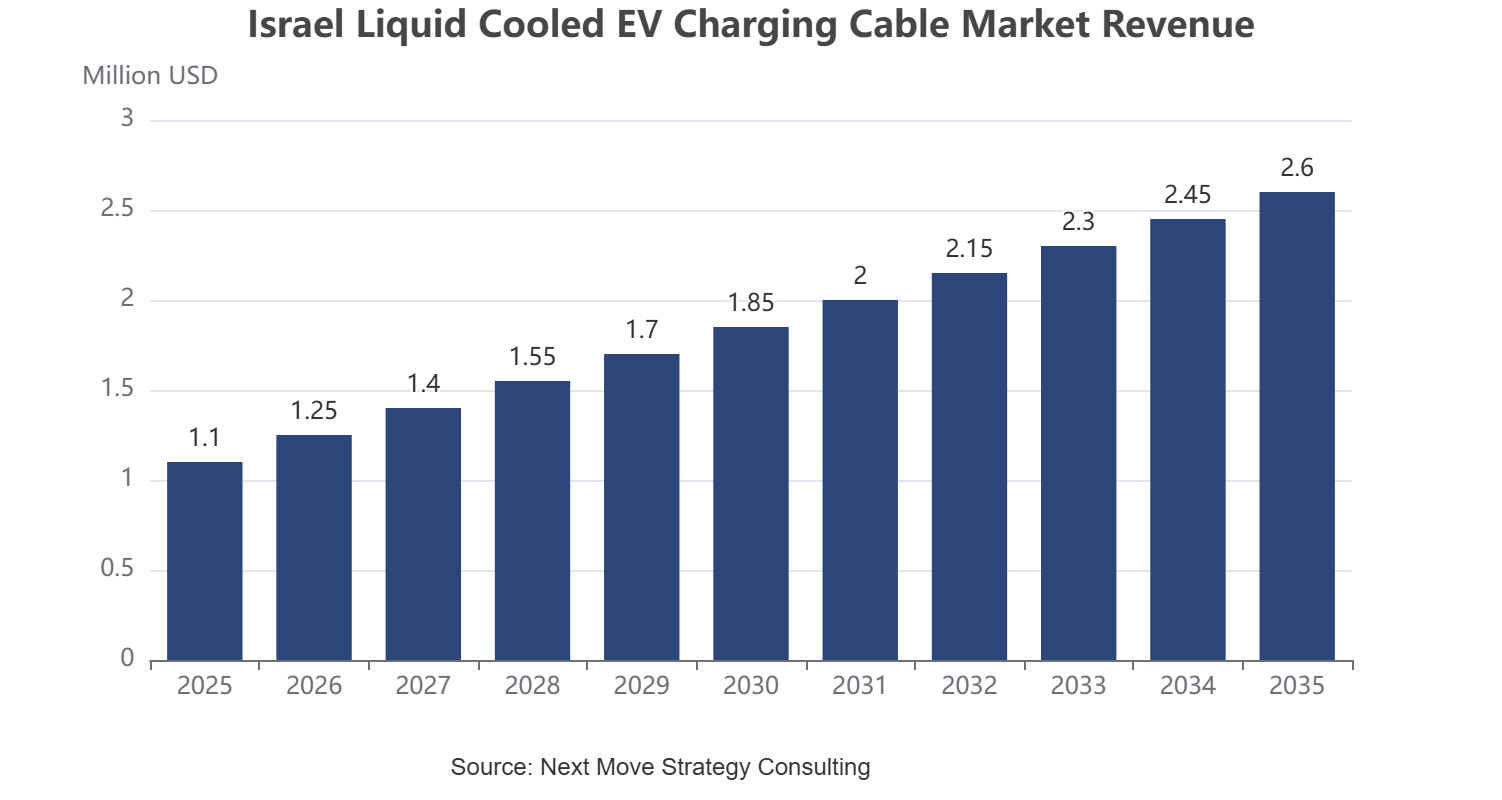
The Israel Liquid Cooled EV Charging Cable Market was valued at USD 1.1 million in 2025 and is estimated to reach USD 1.4 million by 2026. The market is projected to grow to USD 2.6 million by 2035, at a CAGR of 7.3% between 2026 and 2035. In terms of volume, the market recorded 588 units in 2025, with forecasts indicating growth to 787 units by 2026 and further to 1,673 units by 2035, reflecting a CAGR of 8.8% over the same forecast period.
Ecosystem Analysis of the Israel Liquid Cooled EV Charging Cable Market
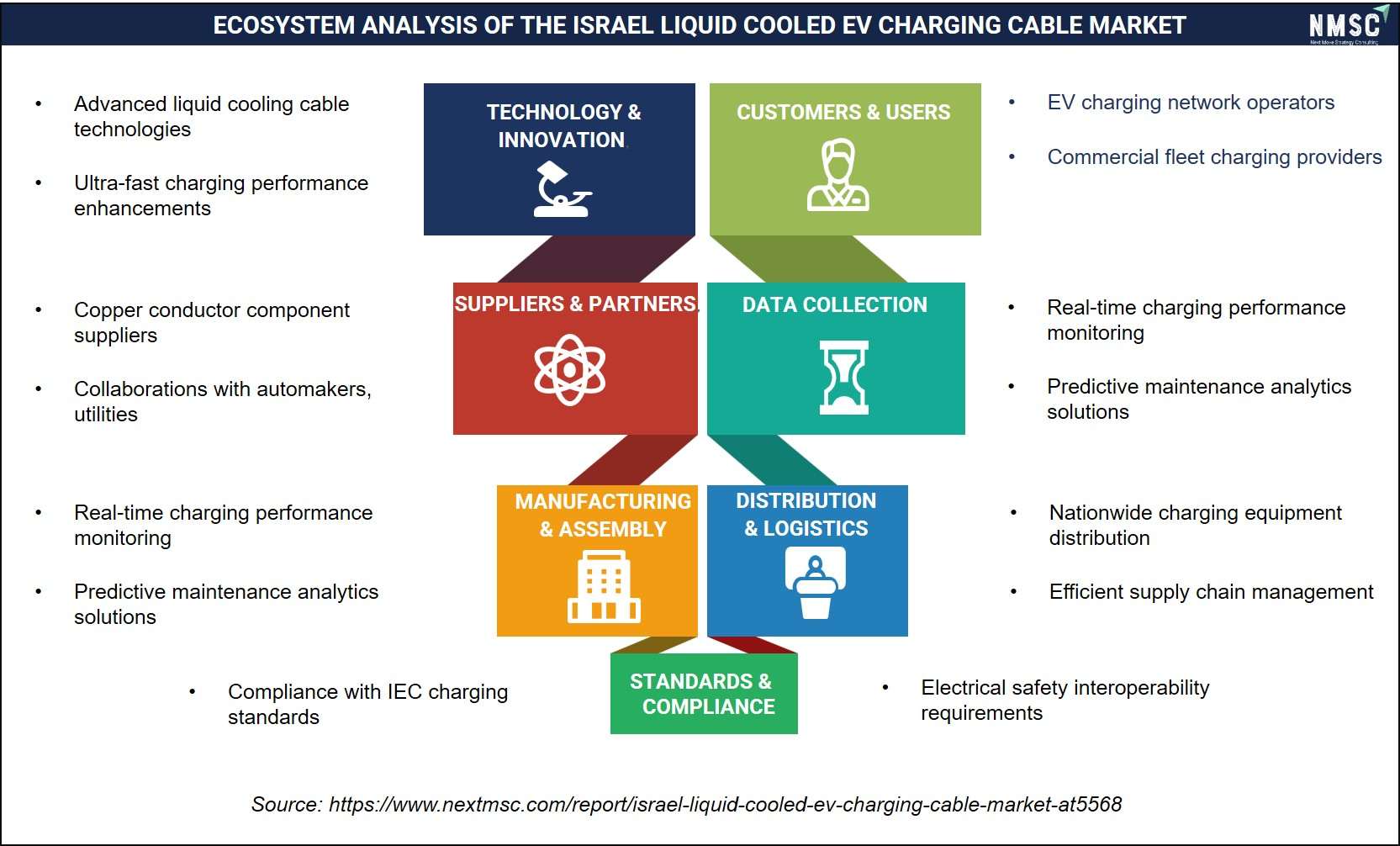
The above infographic infographic presents an ecosystem analysis of the Israel liquid-cooled EV charging cable market, highlighting the key stakeholders and interconnected activities that support industry growth. The framework illustrates the roles of technology and innovation, suppliers and partners, manufacturing and assembly, distribution and logistics, data collection, and standards compliance. It also emphasizes end users such as EV charging network operators and commercial fleet charging providers, demonstrating how collaboration across the value chain enables the expansion of Israel’s high-power EV charging infrastructure.
What are the Key Market Drivers, Breakthroughs, and Investment Opportunities that will Shape the Israel Liquid Cooled EV Charging Cable Industry in the Next Decade?
Growth Catalyst & Risk Assessment Matrix
|
Drivers / Trends / Restraints |
(+/-) % Impact on CAGR Forecast |
Geographic Relevance |
Impact Timeline |
|
Government National EV Adoption Plan and Zero-Emission Vehicle Targets Driving High-Power Charging Network Expansion |
+3.5% |
Tel Aviv, Jerusalem, Haifa urban corridors and national highway network |
Medium to Long term (2–5 years) |
|
High Per-Capita EV Penetration Rate and Tech-Forward Consumer Base Accelerating Premium Charging Infrastructure Demand |
+2.8% |
Greater Tel Aviv metropolitan area, Gush Dan region |
Medium term (2–4 years) |
|
Military, Defence, and Government Fleet Electrification Creating Specialized High-Power Cable Requirements |
+2.2% |
National (military bases, government infrastructure, border logistics) |
Long term (4–7 years) |
|
Smart Mobility Ecosystem and Startup Innovation Culture Accelerating EV Infrastructure Technology Adoption |
+1.9% |
Tel Aviv innovation district, national technology parks |
Medium term (2–5 years) |
|
Small Market Scale, High Import Dependency, and Geopolitical Supply Chain Vulnerabilities Limiting Growth Pace |
–3.1% |
National (import-reliant supply chain, limited local manufacturing) |
Short to Medium term (1–4 years) |
The Israel liquid cooled EV charging cable market is shaped by a distinctive combination of high EV adoption rates, progressive government policy, and a technology-forward consumer and enterprise base that together support steady demand growth. From NMSC’s analysis, government EV targets, premium consumer appetite for ultra-fast charging, and specialized defence fleet requirements are the primary demand catalysts. However, Israel’s small market scale and reliance on imported components temper the overall growth trajectory, resulting in a measured but consistent CAGR through the forecast period to 2035.
Growth Drivers:
How is Israel’s National EV Adoption Plan and Zero-Emission Vehicle Targets Driving Liquid Cooled Charging Infrastructure Investment?
Through our assessment, Israel’s national EV adoption plan, which targets significant electrification of the passenger and commercial vehicle fleet by 2030, is stimulating structured investment in high-power public charging infrastructure across the country. Government-mandated installation of fast-charging stations along major intercity highways and in urban centres is creating direct demand for liquid-cooled cable assemblies capable of sustained high-current performance. The Tel Aviv-Jerusalem and coastal highway corridors are priority deployment zones, driving concentrated infrastructure spending on advanced charging cable systems.
How is Israel’s High Per-Capita EV Penetration and Tech-Savvy Consumer Base Strengthening Demand for Premium Charging Solutions?
From NMSC’s analysis, Israel ranks among the highest globally in per-capita EV adoption, driven by a technology-forward consumer culture, strong household incomes in urban centres, and favourable tax incentives for electric vehicles. This premium consumer base generates consistent demand for high-speed, high-quality charging solutions, including ultra-fast public chargers equipped with liquid-cooled cable systems. The concentration of EV-dense households in the Gush Dan region and greater Tel Aviv metropolitan area reinforces demand for premium public and high-performance residential charging infrastructure deployments.
How is Military, Defence, and Government Fleet Electrification Creating Specialized Liquid Cooled Cable Demand in Israel?
Based on our industry assessment, Israel’s defence establishment and government fleet operators represent a structurally unique and strategically significant demand segment for high-power EV charging infrastructure. The progressive electrification of military support vehicles, government logistics fleets, and border patrol units requires depot charging solutions that prioritize rapid turnaround, operational reliability, and thermal resilience under extreme conditions. These requirements align precisely with the performance attributes of liquid-cooled charging cables, creating a specialized, high-value demand channel that is largely insulated from broader commercial market fluctuations.
Growth Inhibitor:
How do Small Market Scale, Import Dependency, and Geopolitical Supply Chain Risks Constrain Market Expansion in Israel?
In our assessment, Israel’s limited domestic market size and near-total dependence on imported liquid-cooled EV charging cable components represent structural constraints on market growth velocity. The absence of local cable manufacturing capability means that supply chain disruptions, logistics costs, and import lead times directly affect infrastructure deployment timelines. Additionally, geopolitical instability and regional security dynamics periodically disrupt import logistics and capital deployment decisions, introducing procurement uncertainty for charging infrastructure developers and limiting the pace of market expansion relative to comparable advanced economies of similar EV maturity.
Growth Opportunity:
How is Israel’s Smart Mobility Ecosystem and EV Technology Startup Culture Creating Long-Term Growth Opportunities for Liquid Cooled Cable Suppliers?
Israel’s globally recognized innovation ecosystem, encompassing over 6,000 active technology startups and a strong smart mobility sector, presents a distinctive long-term growth opportunity for liquid cooled EV charging cable suppliers. Israeli smart mobility ventures are developing next-generation charging management platforms, autonomous charging systems, and EV grid integration solutions that will require advanced cable technology as enabling hardware. Early supplier partnerships with Israeli technology companies offer access to proprietary pilot programs and potential co-development agreements that can generate both near-term revenue and long-term competitive differentiation in international markets.
Porter’s Five Forces Analysis of the Israel Liquid Cooled EV Charging Cable Market
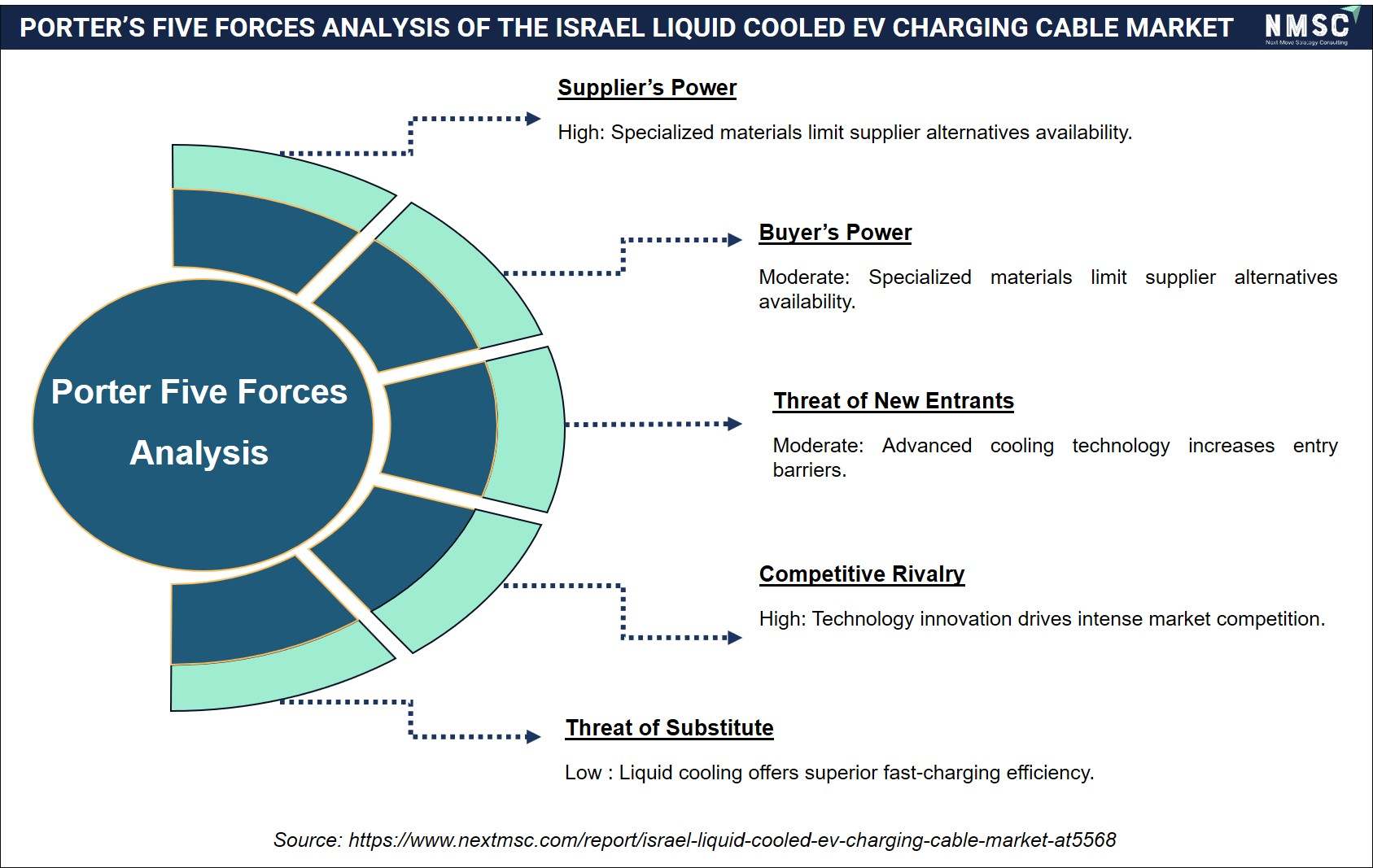
The above infographic presents a Porter’s Five Forces analysis of the Israel liquid-cooled EV charging cable market, highlighting the competitive factors that shape market attractiveness and growth prospects. The framework assesses the bargaining power of suppliers and buyers, the threat of new entrants and substitute technologies, and the intensity of competitive rivalry. Together, these forces provide insights into pricing dynamics, innovation trends, barriers to entry, and the strategic landscape influencing the development of Israel’s high-power EV charging ecosystem.
How is the Israel Liquid Cooled EV Charging Cable Market Segmented in This Report, and What Are the Key Insights from the Segmentation Analysis?
By End Use Insights
How does End Use Segmentation Reflect the Concentrated Yet Diverse Charging Demand Landscape in Israel?
Based on end use, the Israel Liquid Cooled EV Charging Cable Market is segmented into public charging, commercial fleet charging, heavy duty charging, and mobile charging.
From NMSC’s analysis, Israel’s compact geography concentrates end use demand across a well-defined set of urban and highway charging corridors. Public charging, particularly fast-charging hubs along intercity routes and in Tel Aviv and Jerusalem urban areas, represents the largest near-term demand channel. Commercial fleet and government vehicle charging is emerging as a stable secondary segment, while mobile and emergency backup charging holds strategic relevance given Israel’s defence readiness requirements and the need for resilient charging infrastructure across critical national facilities.
By Buyer Type Insights
How does Buyer Type Segmentation Capture the Distinct Procurement Dynamics Shaping Israel’s Liquid Cooled Charging Cable Market?
Based on buyer type, the Israel Liquid Cooled EV Charging Cable Market is segmented into charging network operators, charging equipment OEMs, automotive OEMs, fleet operators, infrastructure developers, and EPC companies.
Through our assessment, buyer type segmentation in Israel reveals a procurement landscape dominated by a small number of well-capitalized charging network operators and government-aligned infrastructure developers. Charging network operators driving national fast-charging rollout are the primary volume buyers, while automotive OEMs and fleet operators represent growing procurement channels as vehicle electrification accelerates. EPC companies supporting government and defence infrastructure projects represent a strategically important niche buyer segment unique to Israel’s market context, requiring specialized product certifications and supply chain security credentials.
Key Segments
By Product Type
-
Integrated Cable Assemblies
-
Fixed Length
-
Retractable
-
-
Detachable Cable Assemblies
By Compatibility
-
Open Standard
-
OEM-Proprietary Locked
By Power Rating
-
400 to 599 A
-
600 to 799 A
-
≥ 800 A
By Voltage Class
-
400V Systems
-
800V Systems
-
≥ 1,000V Systems
By Connector Standard
-
CCS1
-
CCS2
-
GB/T DC
-
CHAdeMO
-
NACS
-
MCS
-
ChaoJi
By End Use
-
Public Charging
-
Public Fast Charging Hubs
-
Retail and Destination Charging
-
Workplace Charging
-
High-Performance Residential Charging
-
-
Commercial Fleet Charging
-
Fleet Depots
-
Logistics and Last Mile Depots
-
Transit and Bus Depots
-
Ride Hailing and Taxi Depots
-
-
Heavy Duty Charging
-
Truck Corridor Charging
-
Mining and Off Highway Charging
-
Marine and Port Charging
-
Aviation and Ground Support Charging
-
-
Mobile Charging
-
Mobile Charging Units
-
Temporary Charging Sites
-
Emergency Backup Charging
-
By Buyer Type
-
Charging Network Operators
-
Charging Equipment OEMs
-
Automotive OEMs
-
Fleet Operators
-
Infrastructure Developers
-
EPC Companies
Competitive Landscape
The competitive landscape of the Israel liquid cooled EV charging cable market is characterized by a concentrated group of global connector and cable specialists operating through local subsidiaries, authorized distributors, and technology partnerships with Israeli infrastructure developers. Market positioning is driven by product certification to Israeli and European standards, supply chain reliability under constrained import conditions, and the ability to meet specialized requirements for defence and government procurement. Competition is largely import-based, with global players differentiated by technical depth, lead time performance, and established relationships with national charging network operators and EPC contractors.
Key Players of the Israel Liquid Cooled EV Charging Cable Market:
-
HUBER+SUHNER (Israel) Ltd.
-
Phoenix Contact (Israel) Ltd.
-
Amphenol Bar-Tec Ltd.
-
Chinaevse Israel
-
ITT Habonim Ltd.
-
Shanghai Mida EV Power (Israel)
-
Kempower Israel
-
TE Connectivity Israel Ltd.
-
Fujikura Israel
-
SINBON Electronics (Israel)
-
Aptiv Israel
-
Caledonian Cables (Israel) Ltd.
-
Company 13
-
Company 14
-
Company 15
Key players shaping Israel’s liquid cooled EV charging cable market, including HUBER+SUHNER (Israel), Phoenix Contact (Israel), Amphenol Bar-Tec, ITT Habonim, TE Connectivity Israel, Kempower Israel, Fujikura Israel, Aptiv Israel, SINBON Electronics (Israel), and Caledonian Cables (Israel), are competing through local distribution partnerships, product certification to Israeli standards, and supply chain reliability. From NMSC’s analysis, competitive differentiation in this market is increasingly anchored in responsiveness to defence and government procurement requirements alongside technical expertise in high-power CCS2 and emerging MCS-compatible cable system deployments.
Key Benefits for Stakeholders:
Next Move Strategy Consulting (NMSC) presents a comprehensive analysis of the Israel Liquid Cooled EV Charging Cable Market, covering historical trends from 2020 through 2025 and offering detailed forecasts through 2035. This study examines the market at the segment level, providing quantitative projections and strategic insights into key growth drivers, investment opportunities, and emerging trends across all major liquid-cooled EV charging cable categories, buyer types, and end use applications within Israel’s advanced and rapidly maturing EV charging infrastructure ecosystem.
Investors and stakeholders gain forward-looking demand intelligence grounded in Israel’s national EV policy framework, defence sector electrification trends, and smart mobility innovation dynamics. NMSC’s assessment provides cable manufacturers, charging equipment OEMs, and infrastructure developers with a structured understanding of Israel’s buyer archetypes, procurement channels, and connector standard preferences. Charging network operators, fleet managers, and EPC companies gain targeted insight to identify the most commercially viable product segments and strategic partnerships aligned with Israel’s evolving EV charging market through 2035.
|
Parameters |
Details |
|
Customization Scope |
Free customization (equivalent to up to 80 analyst-working hours) after purchase. |
|
Pricing and Purchase Options |
Avail customized purchase options to meet your exact research needs. |
|
Approach |
In-depth primary and secondary research; proprietary databases; rigorous quality control and validation measures. |
|
Analytical Tools |
Porter’s Five Forces, SWOT, value chain, and Harvey ball analysis to assess competitive intensity, stakeholder roles, and relative impact of key factors. |
Conclusion
The Israel Liquid Cooled EV Charging Cable Market is set for steady growth through 2035, supported by the country’s high EV penetration rate, government-driven charging infrastructure mandates, defence fleet electrification, and a world-leading smart mobility innovation ecosystem. With revenues projected to grow from USD 1.1 million in 2025 to USD 2.6 million by 2035 at a CAGR of 7.3%, Israel represents a compact but strategically important market for liquid cooled EV charging cable suppliers targeting high-value, premium-specification infrastructure deployments across the Eastern Mediterranean region.
About the Author
 Mayurima Roy
— Mayurima Roy is Research Analyst at Next Move Strategy Consulting, where she has spent 4 years working across the firm's full industry coverage rather than a single fixed vertical. Her work centers on structured research, ongoing trend tracking, competitive assessment, and insight-led content development, translating complex market data into clear, decision-ready narratives that support informed client decision-making across diverse global industries, market sectors, and world regions every day.
Mayurima Roy
— Mayurima Roy is Research Analyst at Next Move Strategy Consulting, where she has spent 4 years working across the firm's full industry coverage rather than a single fixed vertical. Her work centers on structured research, ongoing trend tracking, competitive assessment, and insight-led content development, translating complex market data into clear, decision-ready narratives that support informed client decision-making across diverse global industries, market sectors, and world regions every day.
About the Reviewer
 Supradip Baul
— Supradip Baul is an accomplished business consultant and strategist with over a decade of rich experience in market intelligence, strategy, technology, and business transformation. His work has included rigorous qualitative and quantitative analysis across multiple industries, helping clients shape investment decisions and long-term roadmaps. Earlier in his career, he was associated with Gartner, where he contributed to industry-leading reports and market share analyses. He has worked with leading global companies and holds an MBA with a dual specialization in Marketing and Finance.
Supradip Baul
— Supradip Baul is an accomplished business consultant and strategist with over a decade of rich experience in market intelligence, strategy, technology, and business transformation. His work has included rigorous qualitative and quantitative analysis across multiple industries, helping clients shape investment decisions and long-term roadmaps. Earlier in his career, he was associated with Gartner, where he contributed to industry-leading reports and market share analyses. He has worked with leading global companies and holds an MBA with a dual specialization in Marketing and Finance.
At Next Move Strategy Consulting, we understand that insightful market research is the cornerstone of successful business decisions. That's why we employ a robust and multifaceted approach, combining various methodologies to deliver the most accurate and actionable data for our clients.

Research Landscape
We navigate the world of research with two primary approaches:
Qualitative Approach
Our qualitative research methodologies involve immersive techniques such as in-depth interviews, focus groups, and observational studies. By engaging directly with individuals and stakeholders, we uncover valuable insights that quantitative data alone may overlook.

Quantitative Research
In tandem with qualitative methodologies, NMSC leverages the power of Quantitative Research to provide a robust foundation of numerical insights. Through systematic data collection and analysis, we quantify patterns, preferences, and market trends, offering a comprehensive view of the business landscape.
Our quantitative research approach employs diverse tools, including surveys, experiments, and statistical modelling. These methodologies enable us to gather data from a large and representative sample, ensuring the statistical significance of our findings. By employing structured questionnaires and standardized data collection methods, we guarantee the reliability and validity of the information we present to our clients.
Quantitative research is particularly effective in measuring the prevalence of trends, assessing market size, and gauging the impact of various factors on consumer behavior. The numerical precision attained through this approach equips our clients with actionable insights, facilitating data-driven decision-making and strategy formulation.


Our Specialized Toolbox for Industry-Specific Market Research
We deploy a specialized arsenal of techniques tailored to meet your unique requirements. Here's a glimpse into our comprehensive toolbox:

Information Procurement
The stage entails acquiring market data or relevant information through various sources and methodologies.


Market Research Approach
We utilize both top-down and bottom-up approaches in market research analysis to achieve a comprehensive understanding of the market dynamics, leveraging the broad perspective of industry trends and macroeconomic factors alongside detailed insights from specific segments and individual companies.

Porters Five Forces Analysis
We conduct Porter's Five Forces analysis to evaluate the competitive landscape of an industry, providing us with insights into factors that affect profitability and strategic positioning.

SWOT Analysis

Forecasting
We utilize a forecasting model to predict future consumption by considering parameters like population, economics, regulations, market competition, drivers, constraints, technology, and pricing. We also employ statistical techniques such as multilinear regression, exponential smoothing, moving average, ARIMA, and Monte Carlo simulations for accurate predictions. In econometric forecasting, we analyzed short-term and long-term event impacts, attributing values based on regulatory frameworks, economic factors, and market events.





 Speak to Our Analyst