Japan Liquid Cooled EV Charging Cable Market, By Product Type (Integrated & Detachable Cable Assemblies), By Compatibility (Open Standard & OEM-Proprietary Locked), By Power Rating (400 to 599 A, 600 to 799 A, & ≥ 800 A), By Connector Standard (CCS1, CCS2, GB/T DC, CHAdeMO, & Others), By End Use (Public Charging, Commercial Fleet Charging, & Others), and By Buyer Type (Charging Network Operators, Charging Equipment OEMs, Automotive OEMs, & Others) – Analysis & Forecast, 2025–2035
Industry: Automotive & Transportation | Latest Edition: September 3, 2026 | No of Pages: 242 | No. of Tables: 122 | No. of Figures: 108 | Format: PDF | Report Code : AT5469
Japan Liquid Cooled EV Charging Cable Market Size & Forecast
|
Parameters |
Details |
|
Market Size in 2025 |
USD 19.5 million |
|
Market Size in 2026 |
USD 27.6 million |
|
Revenue Forecast in 2035 |
USD 124.3 million |
|
Growth Rate |
CAGR of 18.2% from 2026 to 2035 |
|
Market Volume in 2025 |
15 thousand units |
|
Market Volume in 2026 |
22 thousand units |
|
Volume Forecast in 2035 |
122 thousand units |
|
Growth Rate |
CAGR of 21.3% from 2026 to 2035 |
|
Analysis Period |
2025–2035 |
|
Base Year Considered |
2025 |
|
Forecast Period |
2026–2035 |
|
Market Size Estimation |
Million (USD) |
|
Companies Profiled |
15 |
|
Market Share |
Available for 10 companies |
Industry Outlook
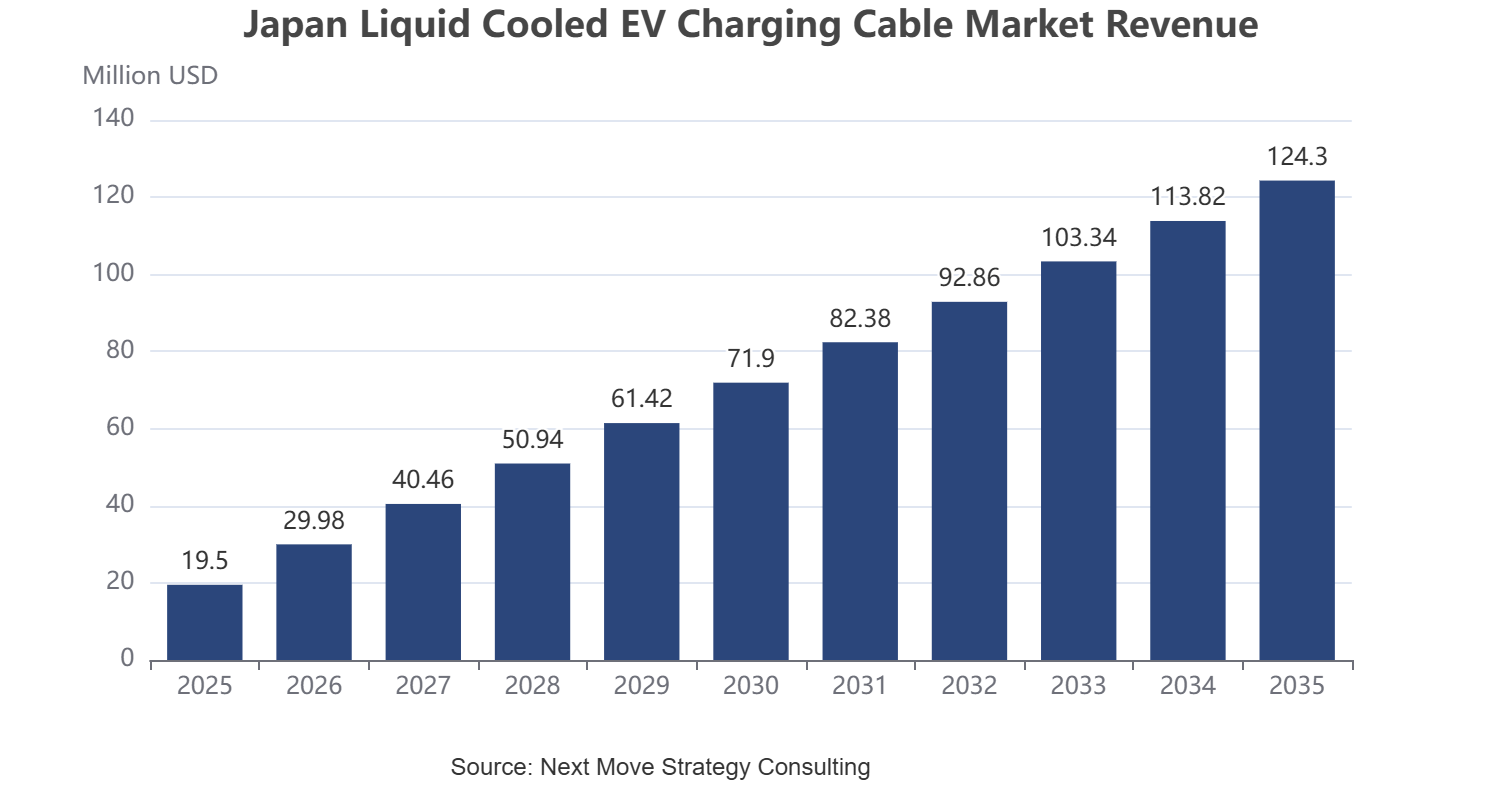
The Japan Liquid Cooled EV Charging Cable Market was valued at USD 19.5 million in 2025 and is expected to reach USD 27.6 million by the end of 2026. The market is projected to grow to USD 124.3 million by 2035, at a CAGR of 18.2% between 2026 and 2035. In terms of volume, the market recorded 15 thousand units in 2025, with forecasts indicating growth to 22 thousand units by 2026 and 122 thousand units by 2035, reflecting a volume CAGR of 21.3% over the same period.
Ecosystem Analysis of the Japan Liquid Cooled EV Charging Cable Market
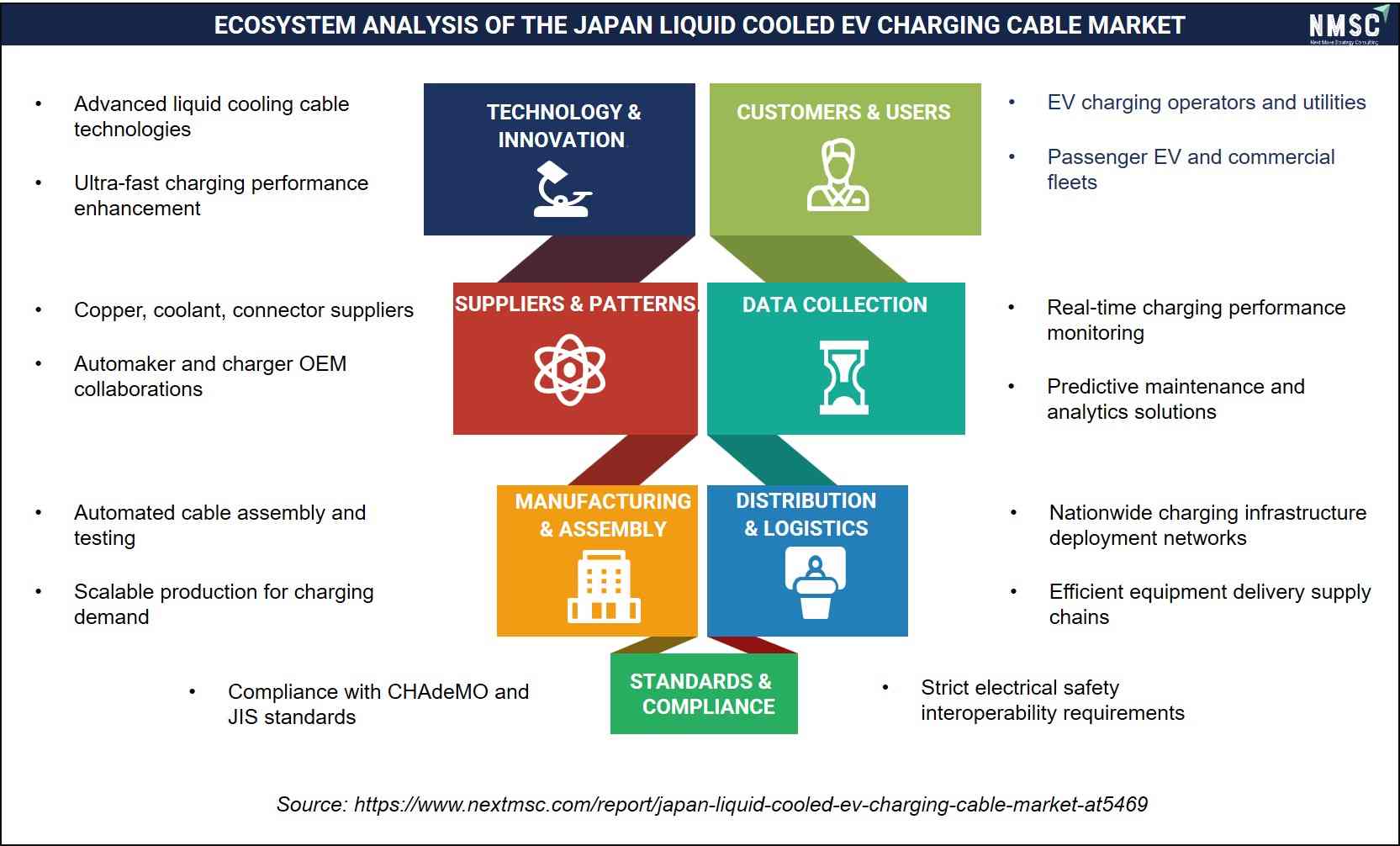
The above infographic presents an ecosystem analysis of the Japan liquid-cooled EV charging cable market, organized across seven pillars. Technology focuses on advanced cooling and ultra-fast charging, supported by suppliers and OEM collaborations. Automated assembly enables scalable production, while CHAdeMO and JIS compliance ensure safety. Data collection further enables real-time monitoring, and customers include charging operators, utilities, and commercial fleets. Looking ahead, we observed that nationwide deployment networks and efficient supply chains collectively shape the market’s evolution across Japan.
What are the Key Market Drivers, Breakthroughs, and Investment Opportunities that will Shape the Japan Liquid Cooled EV Charging Cable Industry in the Next Decade?
Growth Catalyst & Risk Assessment Matrix
|
Drivers / Trends / Restraints |
(+/-) % Impact on CAGR Forecast |
Geographic Relevance |
Impact Timeline |
|
Japan’s national EV adoption targets and government subsidies accelerating high-power charging infrastructure buildout across urban and intercity corridors |
+5.20% |
Japan (Tokyo, Osaka, Nagoya, and Tokaido Megalopolis corridors) |
Medium to Long term (2–5 years) |
|
Japanese OEM ultra-fast EV model launches requiring compatibility with high-power liquid-cooled charging infrastructure and 800V architecture |
+4.75% |
Japan (Toyota, Nissan, Honda, and Subaru OEM manufacturing hubs) |
Medium term (2–4 years) |
|
Japan’s high-density urban environment and smart city initiatives enabling compact high-power charging hub deployment with ergonomic cable management |
+4.10% |
Japan (metropolitan areas of Tokyo, Osaka, and Nagoya) |
Long term (4–7 years) |
|
Transit and commercial fleet electrification programs expanding demand for high-duty-cycle liquid-cooled cable systems in depot and logistics applications |
+3.85% |
Japan (major transit authorities and logistics operators nationwide) |
Medium to Long term (3–6 years) |
|
Connector standard fragmentation between CHAdeMO legacy infrastructure and emerging ChaoJi protocols creating procurement complexity and deployment delays |
–3.65% |
Japan (national charging infrastructure operators and equipment OEMs) |
Short to Medium term (1–4 years) |
The Japan Liquid Cooled EV Charging Cable Market operates within a uniquely structured automotive and energy ecosystem, shaped by government-backed EV adoption mandates, deep OEM innovation capacity, evolving connector standardization dynamics, and accelerating commercial fleet electrification programs. Japan’s decarbonization ambitions, anchored by its 2050 carbon neutrality commitment and 2035 new vehicle electrification targets, are generating sustained demand for high-performance, thermally efficient charging cable systems. This market’s growth trajectory reflects near-term infrastructure deployment urgency alongside long-term structural alignment with Japan’s comprehensive energy and transportation transition strategy.
Growth Drivers:
How is Japan’s Government Policy and EV Adoption Framework Driving Demand for Liquid Cooled EV Charging Cables?
Japan’s government has established firm EV adoption targets supported by purchase subsidies, infrastructure grants, and regulatory mandates aimed at accelerating the phase-out of internal combustion engine vehicles. These policy instruments are directly stimulating investment in high-power charging infrastructure across major urban corridors and national highway networks, where liquid-cooled cable systems are required to deliver ultra-fast charging performance with reliable thermal stability. National programs focused on charging infrastructure densification are prioritizing high-reliability hardware, creating a consistent procurement pipeline for certified liquid-cooled EV charging cable assemblies aligned with Japan’s evolving EV ecosystem.
How are Japanese OEM Ultra-Fast EV Model Launches Accelerating Liquid Cooled Charging Cable Adoption?
Japanese automotive OEMs are accelerating the launch of next-generation EV platforms supporting 800V architecture and multi-hundred-kilowat charging rates, necessitating compatibility with infrastructure equipped with liquid-cooled cable systems capable of managing elevated thermal loads. As these advanced platforms enter market deployment, demand for thermally efficient, high-current cable assemblies rises proportionally. OEM-driven demand forecasting is also encouraging domestic cable suppliers to invest in localized design, testing, and manufacturing partnerships, reinforcing Japan’s domestic supply chain resilience for liquid-cooled charging components across passenger and commercial vehicle segments.
How is Japan’s Urban Density and Smart City Development Accelerating Liquid Cooled Charging Hub Deployment?
Japan’s exceptionally dense urban environment and ongoing smart city initiatives are creating ideal conditions for rapid deployment of high-power charging hubs in compact, space-optimized configurations. Liquid-cooled cable systems, which enable thinner and more manageable cable designs despite high current capacity, are particularly suited to Japan’s urban infrastructure constraints, where space efficiency and aesthetic integration are operational priorities. Smart city programs are additionally embedding advanced charging infrastructure into integrated urban mobility frameworks, generating continuous demand for high-performance cable systems supporting dynamic, high-utilization public charging operations across metropolitan areas.
How is Japan’s Commercial Fleet Electrification Reinforcing Heavy-Duty Liquid Cooled Cable Demand?
Japan’s transit authorities and logistics sector are actively pursuing fleet electrification commitments tied to national decarbonization mandates, directly expanding demand for liquid-cooled charging cables suited to high-duty-cycle commercial applications. Bus depots, last-mile delivery facilities, and logistics distribution hubs require charging systems capable of delivering high power repeatedly and reliably, where thermal management is critical to operational longevity. These commercial fleet operators are standardizing on liquid-cooled cable solutions that support rapid turnaround charging cycles, reinforcing Japan’s efficiency-driven transport operations and contributing measurably to liquid-cooled cable market volume expansion.
Growth Inhibitor:
How is Japan’s Connector Standard Fragmentation Constraining Uniform Liquid Cooled Cable Market Development?
Japan’s charging infrastructure ecosystem is navigating a complex transition between legacy CHAdeMO protocols and emerging ChaoJi next-generation standards, creating procurement fragmentation and strategic uncertainty for infrastructure developers, cable manufacturers, and charging equipment OEMs. This dual-standard environment complicates product portfolio planning, delays large-scale infrastructure rollout decisions, and increases hardware qualification costs. Operators managing mixed connector environments face elevated maintenance complexity and interoperability challenges. While regulatory bodies are actively pursuing standardization alignment, this transitional period continues to constrain uniform liquid-cooled cable deployment and generates short-to-medium-term market development friction.
Growth Opportunity:
How is Japan’s Dual-Track Decarbonization Strategy Creating New Liquid Cooled Charging Infrastructure Opportunities?
Japan’s dual-track decarbonization strategy, balancing hydrogen fuel cell deployment and battery EV infrastructure expansion, is generating layered investment across multiple transportation segments including port operations, aviation ground support, and heavy logistics, all requiring high-current liquid-cooled charging solutions. As Japan positions its port cities and logistics corridors as model zones for integrated clean transport, demand for ultra-high-power liquid-cooled cable systems in non-automotive segments is expanding materially. This diversification beyond passenger vehicle charging is expected to create substantial incremental revenue opportunities for cable manufacturers addressing multi-segment thermal management performance requirements.
How is the Japan Liquid Cooled EV Charging Cable Market Segmented in this Report, and What are the Key Insights from the Segmentation Analysis?
By Connector Standard Insights
How do Connector Standard Segments Drive Technology Adoption Dynamics in the Japan Liquid Cooled EV Charging Cable Market?
Based on connector standard, the Japan Liquid Cooled EV Charging Cable Market is segmented into CCS1, CCS2, GB/T DC, CHAdeMO, NACS, MCS, and ChaoJi.
Japan’s connector standard segmentation reflects the country’s unique position as both a legacy CHAdeMO ecosystem and an early-adopter environment for next-generation ChaoJi technology, co-developed by Japanese and Chinese automotive stakeholders for ultra-high-power applications. Our analysis found that CHAdeMO-compatible liquid-cooled cables continue to serve existing infrastructure, while ChaoJi adoption is accelerating for new high-power installations. This transitional dynamic creates parallel demand across connector categories, with infrastructure developers maintaining dual compatibility portfolios to address both incumbent and emerging protocol requirements across Japan’s evolving high-performance charging network.
By End Use Insights
How do End Use Segments Shape Revenue and Volume Distribution in the Japan Liquid Cooled EV Charging Cable Market?
Based on end use, the Japan Liquid Cooled EV Charging Cable Market is segmented into Public Charging, Commercial Fleet Charging, Heavy Duty Charging, and Mobile Charging.
Japan’s end-use segmentation reveals a market increasingly diversified beyond traditional public fast-charging hubs toward fleet depots, logistics corridors, transit systems, and port-linked heavy-duty applications. Our assessment found that public fast charging hubs remain the primary volume driver, particularly along Japan’s densely connected intercity corridors and urban arterials. Simultaneously, commercial fleet charging within ride-hailing, logistics, and transit depot categories is expanding rapidly as Japan’s largest fleet operators implement structured electrification timelines, reinforcing sustained demand for high-durability liquid-cooled cable assemblies across increasingly diverse end-use environments.
Key Segments
By Product Type
-
Integrated Cable Assemblies
-
Fixed Length
-
Retractable
-
-
Detachable Cable Assemblies
By Compatibility
-
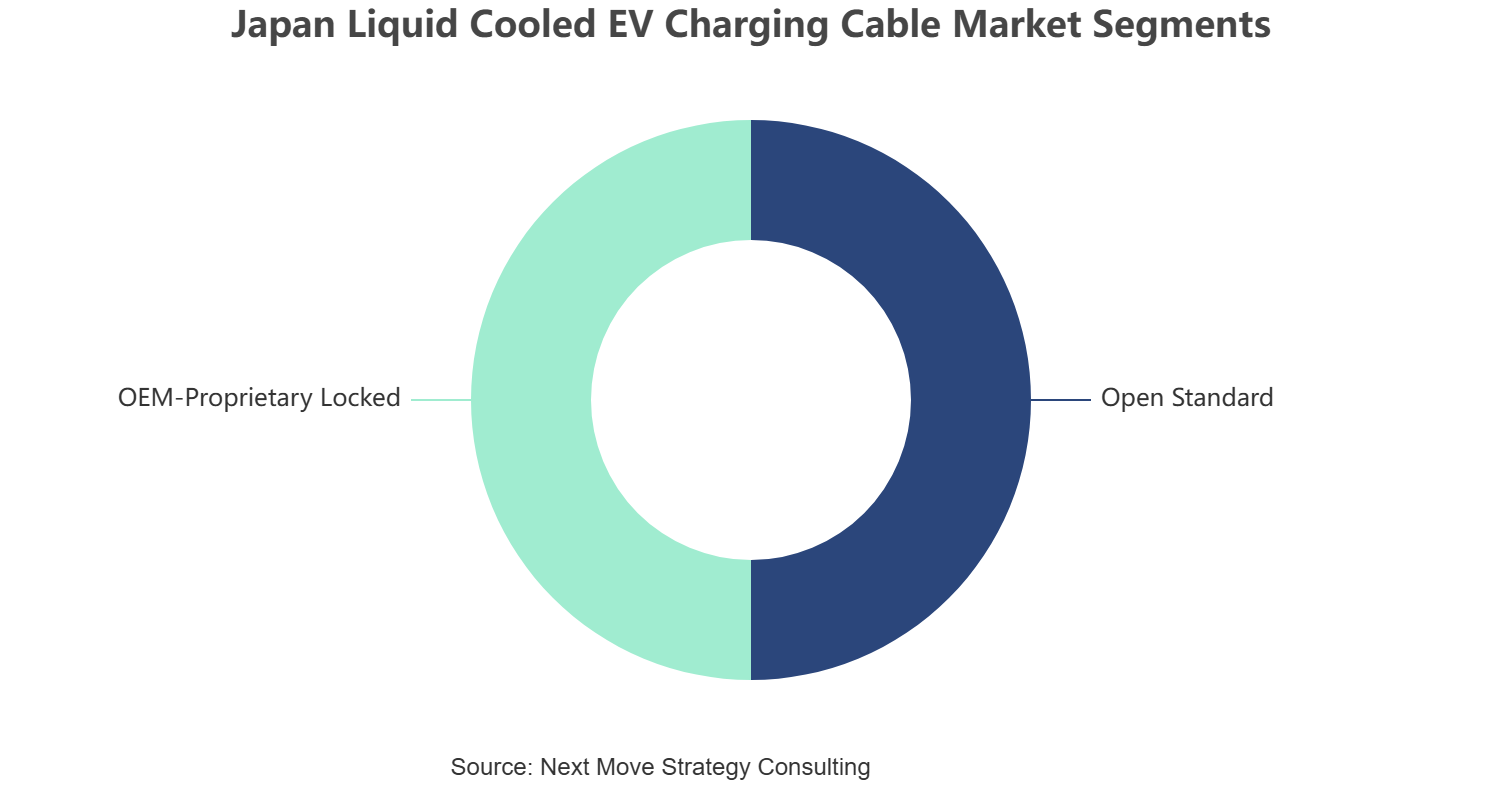
Open Standard
-
OEM-Proprietary Locked
By Power Rating
-
400 to 599 A
-
600 to 799 A
-
≥ 800 A
By Voltage Class
-
400V Systems
-
800V Systems
-
≥ 1,000V Systems
By Connector Standard
-
CCS1
-
CCS2
-
GB/T DC
-
CHAdeMO
-
NACS
-
MCS
-
ChaoJi
By End Use
-
Public Charging
-
Public Fast Charging Hubs
-
Retail and Destination Charging
-
Workplace Charging
-
High-Performance Residential Charging
-
-
Commercial Fleet Charging
-
Fleet Depots
-
Logistics and Last Mile Depots
-
Transit and Bus Depots
-
Ride Hailing and Taxi Depots
-
-
Heavy Duty Charging
-
Truck Corridor Charging
-
Mining and Off Highway Charging
-
Marine and Port Charging
-
Aviation and Ground Support Charging
-
-
Mobile Charging
-
Mobile Charging Units
-
Temporary Charging Sites
-
Emergency Backup Charging
-
By Buyer Type
-
Charging Network Operators
-
Charging Equipment OEMs
-
Automotive OEMs
-
Fleet Operators
-
Infrastructure Developers
-
EPC Companies
Competitive Landscape
The competitive landscape of the Japan Liquid Cooled EV Charging Cable Market is defined by a combination of global cable and connector specialists operating through Japan-incorporated subsidiaries, and internationally active manufacturers addressing domestic demand through export relationships and regional partnerships. Market competition is shaped by expertise in high-current thermal management engineering, connector interface compatibility with Japan-specific standards, and the ability to satisfy Japan’s rigorous quality and certification requirements. Competitive differentiation is increasingly anchored in liquid-cooled assembly innovation, connector versatility across the CHAdeMO-to-ChaoJi transition, and responsiveness to Japan’s evolving ultra-fast charging procurement landscape.
Key Players of the Japan Liquid Cooled EV Charging Cable Market:
-
Amphenol Japan K.K.
-
Aptiv Japan K.K.
-
Fujikura Ltd.
-
SINBON Japan Co., Ltd.
-
OMG EV Cable
-
ChiN/AEVSE
-
Shanghai Mida EV Power Co., Ltd
-
ITT Cannon Japan K.K.
-
LS Cable & System Japan Co., Ltd.
-
HUBER+SUHNER Japan Co., Ltd.
-
Shanghai Aein Wire & Cable Co., Ltd
-
Phoenix Contact K.K.
-
Tyco Electronics Japan G.K.
-
Caledonian Cables Limited
-
Leoni Wire Japan K.K.
Key players actively shaping this competitive ecosystem include Amphenol Japan K.K., Aptiv Japan K.K., Fujikura Ltd., SINBON Japan Co., Ltd., OMG EV Cable, ChiN/AEVSE, Shanghai Mida EV Power Co., Ltd, ITT Cannon Japan K.K., and others. These organizations compete through localized engineering capabilities, connector standard compliance, and strategic supply agreements with Japan’s leading charging network operators and EV OEMs, reinforcing deep market positioning across Japan’s expanding ultra-fast charging infrastructure landscape.
SWOT Analysis of the Japan Liquid Cooled EV Charging Cable Market
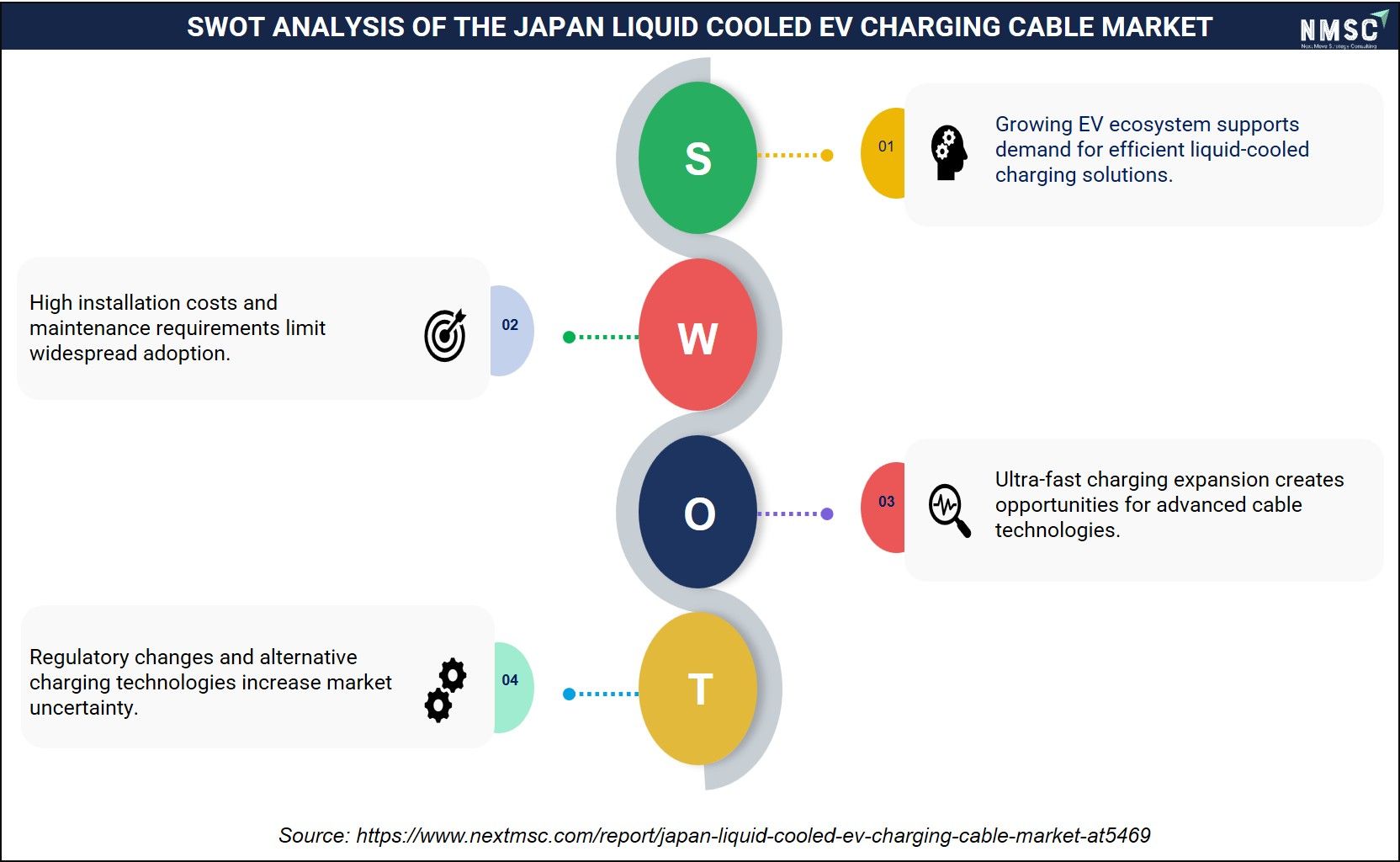
The above infographic presents a SWOT analysis of the Japan liquid-cooled EV charging cable market. Growing EV ecosystem supports demand for efficient liquid-cooled charging solutions as a key strength. However, high installation costs and maintenance requirements limit widespread adoption, posing notable weaknesses. Looking ahead, we observed that ultra-fast charging expansion creates opportunities for advanced cable technologies. That said, regulatory changes and alternative charging technologies continue to increase market uncertainty and long-term growth stability.
Key Benefits for Stakeholders
Next Move Strategy Consulting (NMSC) presents a comprehensive analysis of the Japan Liquid Cooled EV Charging Cable Market, covering historical trends from 2020 through 2025 and detailed forecasts through 2035. Our study examines the market across all key segments including product type, compatibility, power rating, voltage class, connector standard, end use, and buyer type, providing quantitative projections alongside insights into key growth drivers, challenges, and investment opportunities relevant to Japan’s rapidly evolving liquid-cooled EV charging cable ecosystem.
Our assessment indicates that investors, infrastructure developers, and charging equipment OEMs operating in Japan’s liquid-cooled EV charging cable market benefit from detailed demand visibility across connector standard transitions, end-use diversification trends, and policy-driven infrastructure expansion cycles. Fleet operators, public charging network operators, and automotive OEMs gain actionable value through segment-level forecasting enabling informed procurement and capital allocation decisions. Japan’s stringent quality and certification standards, combined with robust OEM collaboration frameworks, ensure high product assurance and long-term supply chain reliability across all key buyer categories.
|
Parameters |
Details |
|
Customization Scope |
Free customization (equivalent to up to 80 analyst-working hours) after purchase. |
|
Pricing and Purchase Options |
Avail customized purchase options to meet your exact research needs. |
|
Approach |
In-depth primary and secondary research; proprietary databases; rigorous quality control and validation measures. |
|
Analytical Tools |
Porter’s Five Forces, SWOT, value chain, and Harvey ball analysis to assess competitive intensity, stakeholder roles, and relative impact of key factors. |
Conclusion
The Japan Liquid Cooled EV Charging Cable Market presents a compelling growth trajectory anchored in strong government policy support, rapid OEM-driven infrastructure buildout, and an evolving connector standard landscape transitioning toward ultra-high-power ChaoJi compatibility. With a market projected to expand from USD 19.5 million in 2025 to USD 124.3 million by 2035 at a CAGR of 18.2%, Japan represents one of the most strategically significant and dynamically evolving regional markets for liquid-cooled charging cable systems within the broader Asia-Pacific EV infrastructure ecosystem.
About the Author
 Mayurima Roy is Research Analyst at Next Move Strategy Consulting, where she has spent 4 years working across the firm's full industry coverage rather than a single fixed vertical. Her work centers on structured research, ongoing trend tracking, competitive assessment, and insight-led content development, translating complex market data into clear, decision-ready narratives that support informed client decision-making across diverse global industries, market sectors, and world regions every day.
About the Reviewer
 Supradip Baul is an accomplished business consultant and strategist with over a decade of rich experience in market intelligence, strategy, technology, and business transformation. His work has included rigorous qualitative and quantitative analysis across multiple industries, helping clients shape investment decisions and long-term roadmaps. Earlier in his career, he was associated with Gartner, where he contributed to industry-leading reports and market share analyses. He has worked with leading global companies and holds an MBA with a dual specialization in Marketing and Finance.
At Next Move Strategy Consulting, we understand that insightful market research is the cornerstone of successful business decisions. That's why we employ a robust and multifaceted approach, combining various methodologies to deliver the most accurate and actionable data for our clients.

Research Landscape
We navigate the world of research with two primary approaches:
Qualitative Approach
Our qualitative research methodologies involve immersive techniques such as in-depth interviews, focus groups, and observational studies. By engaging directly with individuals and stakeholders, we uncover valuable insights that quantitative data alone may overlook.

Quantitative Research
In tandem with qualitative methodologies, NMSC leverages the power of Quantitative Research to provide a robust foundation of numerical insights. Through systematic data collection and analysis, we quantify patterns, preferences, and market trends, offering a comprehensive view of the business landscape.
Our quantitative research approach employs diverse tools, including surveys, experiments, and statistical modelling. These methodologies enable us to gather data from a large and representative sample, ensuring the statistical significance of our findings. By employing structured questionnaires and standardized data collection methods, we guarantee the reliability and validity of the information we present to our clients.
Quantitative research is particularly effective in measuring the prevalence of trends, assessing market size, and gauging the impact of various factors on consumer behavior. The numerical precision attained through this approach equips our clients with actionable insights, facilitating data-driven decision-making and strategy formulation.


Our Specialized Toolbox for Industry-Specific Market Research
We deploy a specialized arsenal of techniques tailored to meet your unique requirements. Here's a glimpse into our comprehensive toolbox:

Information Procurement
The stage entails acquiring market data or relevant information through various sources and methodologies.


Market Research Approach
We utilize both top-down and bottom-up approaches in market research analysis to achieve a comprehensive understanding of the market dynamics, leveraging the broad perspective of industry trends and macroeconomic factors alongside detailed insights from specific segments and individual companies.

Porters Five Forces Analysis
We conduct Porter's Five Forces analysis to evaluate the competitive landscape of an industry, providing us with insights into factors that affect profitability and strategic positioning.

SWOT Analysis

Forecasting
We utilize a forecasting model to predict future consumption by considering parameters like population, economics, regulations, market competition, drivers, constraints, technology, and pricing. We also employ statistical techniques such as multilinear regression, exponential smoothing, moving average, ARIMA, and Monte Carlo simulations for accurate predictions. In econometric forecasting, we analyzed short-term and long-term event impacts, attributing values based on regulatory frameworks, economic factors, and market events.





 Speak to Our Analyst