Latin America Drone Market By Component (Hardware, Software, and Services), By Platform Type (Multi-Rotor, Fixed-Wing, Hybrid VTOL, and Others), By Autonomy Level (Remotely Piloted, Assisted, Advanced, and Fully Autonomous), By Maximum Take-off Weight {Nano (<250 g), Micro (250 g–2 kg), Small (>2 kg–25 kg), and Others}, By End-User (Consumer Drone, Commercial & Industrial Drone, Government & Public Safety Drone, and Military Drone) – Analysis & Forecast, 2025–2035
Industry: Aerospace & Defense | Latest Edition: August 10, 2026 | No of Pages: 554 | No. of Tables: 264 | No. of Figures: 250 | Format: PDF | Report Code: AD4009
Latin America Drone Market Size & Forecast
|
Parameters |
Details |
|
Market Size in 2025 |
USD 3.30 billion |
|
Market Size in 2026 |
USD 3.83 billion |
|
Revenue Forecast in 2035 |
USD 7.76 billion |
|
Market Size Growth Rate |
CAGR of 8.17% from 2026 to 2035 |
|
Market Volume in 2025 |
149 thousand units |
|
Market Volume in 2026 |
181 thousand units |
|
Volume Forecast in 2035 |
494 thousand units |
|
Market Volume Growth Rate |
CAGR of 11.83% from 2026 to 2035 |
|
Analysis Period |
2025–2035 |
|
Base Year Considered |
2025 |
|
Forecast Period |
2026–2035 |
|
Market Size Estimation |
Billion (USD) |
|
Companies Profiled |
15 |
|
Market Share |
Available for 10 companies |
Industry Outlook
The Latin America Drone Market was valued at USD 3.30 billion in 2025 and is estimated to reach USD 3.83 billion in 2026, projected to expand to USD 7.76 billion by 2035 at a revenue CAGR of 8.17%. In volume terms, the market stood at 149 thousand units in 2025, estimated at 181 thousand units in 2026, and forecast to reach 494 thousand units by 2035 at a volume CAGR of 11.83%. This trajectory reflects accelerating agricultural drone adoption, expanding infrastructure inspection programs, and progressive regulatory frameworks across Brazil, Colombia, and Chile.
What Are the Key Growth Drivers, Restraints, and Opportunities Shaping the Latin America Drone Market Through 2035?
Growth Catalyst & Risk Assessment Matrix
|
Drivers / Trends / Restraints |
(+/–) % Impact on CAGR Forecast |
Geographic Relevance |
Impact Timeline |
|
Brazil’s position as the world’s largest agricultural exporter driving industrial-scale adoption of precision spraying, crop monitoring, and soil-mapping UAVs across soy, corn, and sugarcane belts |
+1.2% |
Brazil (Mato Grosso, Pará, São Paulo) |
Long term (4–7 years) |
|
Latin America’s energy, mining, and pipeline infrastructure creating large, recurring demand for drone-based inspection that reduces personnel hazard exposure and shortens inspection cycle times |
+1.0% |
Brazil, Colombia, Chile, Peru |
Medium to long term (3–6 years) |
|
ANAC RBAC-E94 in Brazil and U-Space frameworks in Colombia and Chile progressively enabling BVLOS commercial operations and unlocking scalable logistics, inspection, and monitoring revenue |
+0.8% |
Brazil, Colombia, Chile |
Medium term (2–5 years) |
|
High import tariffs on foreign-manufactured drones in Brazil, regional currency volatility, and fragmented certification infrastructure across smaller LATAM nations suppressing volume growth rate |
–0.9% |
Brazil (tariff impact), Argentina, smaller LATAM markets |
Short to medium term (1–4 years) |
|
Environmental monitoring across the Amazon Basin and public safety drone deployment in major Latin American cities creating new government- and grant-funded commercial opportunities |
+0.9% |
Amazon Basin, Brazil, Colombia, Peru, São Paulo, Bogotá, Lima, Santiago |
Long term (4–8 years) |
The Latin America Drone Market is shaped by the region’s exceptional agricultural scale, expansive infrastructure-intensive energy and mining sectors, and an urgent public safety imperative that collectively create differentiated demand patterns distinct from North American and European drone markets. Brazil anchors regional growth as the world’s largest exporter of soy, corn, and coffee, where precision agricultural UAVs are transitioning from pilot programs to industrial-scale deployment. Simultaneously, regulatory maturation across ANAC-governed Brazil, Colombia’s U-Space framework, and Chile’s DGAC guidelines is progressively enabling commercial BVLOS operations that unlock scalable revenue for logistics, inspection, and environmental monitoring verticals.
Growth Drivers:
How Is Brazil’s Agricultural Scale Creating the Region’s Largest Addressable Market for Precision Drone Adoption?
Brazil’s position as the world’s dominant agricultural exporter is creating the largest single addressable market for agricultural drone adoption in Latin America, with precision spraying, multispectral crop monitoring, and soil-mapping UAVs now scaling rapidly across soy, corn, sugarcane, and coffee growing belts in Mato Grosso, Pará, and São Paulo states. Chinese agricultural drone manufacturers have established regional distribution networks targeting Brazil’s 5.4 million farming establishments, while EMBRAPA-backed agronomic trials are generating drone-specific yield-impact data that is accelerating commercial farmer adoption beyond early-mover agribusiness operators, reinforcing Brazil as the regional volume leader for agricultural UAV procurement.
How Is Latin America’s Energy and Natural Resources Sector Driving Demand for Drone-Based Infrastructure Inspection?
Latin America’s energy and natural resources sector, encompassing Petrobras’ offshore and onshore oil infrastructure, Chile’s copper mining operations, Colombia’s pipeline networks, and Peru’s hydroelectric and transmission corridors, presents a structurally large and recurring demand base for drone-based infrastructure inspection that significantly reduces personnel exposure to hazardous environments while compressing inspection cycle times. Fixed-wing and hybrid VTOL drones equipped with thermal, LiDAR, and gas-detection payloads are being adopted at scale for pipeline leak detection, power line inspection, and tailings dam monitoring, replacing manned helicopter surveys and enabling higher-frequency inspection cadences that improve asset safety and regulatory compliance across the region.
How Is Regulatory Maturation in Brazil, Colombia, and Chile Unlocking Commercial BVLOS Drone Operations Across Latin America?
Brazil’s ANAC has progressively advanced its drone regulatory framework, with RBAC-E94 enabling beyond-visual-line-of-sight operations in approved corridors and the Drone Show platform facilitating operator registration, airspace authorization, and flight plan filing through a standardized digital system. Colombia’s U-Space framework and Chile’s DGAC remote pilot licensing requirements are creating comparable regulatory clarity that attracts enterprise drone operators and DaaS providers seeking consistent operating rules across the region’s largest economies. As regulatory certainty deepens, commercial drone service providers are investing in fleet scale-up, pilot certification programs, and payload specialization that collectively expand both revenue and volume for the Latin America market.
Growth Inhibitor:
What Import Duty, Currency, and Regulatory Fragmentation Factors Are Restraining Faster Drone Market Growth in Latin America?
Brazil’s import duty structure applies high tariff rates on foreign-manufactured drones, significantly raising acquisition costs in the consumer and prosumer segments relative to North American and Asian markets. Currency volatility across the region, with the Brazilian real, Argentine peso, and Colombian peso subject to recurring devaluation, makes USD-denominated drone procurement unpredictable for commercial operators budgeting in local currencies. Fragmented regulatory environments across smaller LATAM nations and limited pilot certification infrastructure further constrain the pace at which commercial drone operations can scale outside the region’s three largest drone markets.
Growth Opportunity:
What Environmental Monitoring and Public Safety Applications Represent the Strongest Emerging Opportunities in Latin America’s Drone Market?
Latin America’s Amazon basin, Pantanal wetlands, and Cerrado biome represent the world’s most data-scarce but ecologically critical monitoring environments, where drone-based environmental surveillance is gaining urgency from both national regulatory agencies and international conservation finance bodies seeking real-time deforestation, fire, and biodiversity tracking data. Government contracts for rainforest monitoring, carbon-credit verification, and illegal mining surveillance represent a structurally distinct, grant-funded revenue stream largely insulated from consumer purchasing-power constraints. Simultaneously, rapid urbanization across São Paulo, Bogotá, Lima, and Santiago is accelerating public safety drone procurement for law enforcement surveillance, crowd management, and traffic monitoring across Latin America’s megacities.
How Is the Latin America Drone Industry Segmented in This Report, and What Are the Key Insights from the Segmentation Analysis?
By Component Insights
How Do Component Segmentation Reflect Technology Value Distribution Across the Latin America Drone Market?
Based on component, the Latin America Drone Market is segmented into hardware, software, and services.
The market comprises an evolving ecosystem of hardware, software, and service solutions supporting drone adoption across commercial, government, and defense applications. According to our analysis, we found that hardware components provide the essential foundation for drone performance through advanced airframes, sensing technologies, and communication systems. Software platforms are enhancing operational intelligence through autonomous flight capabilities, data analytics, and fleet optimization, while service offerings enable flexible deployment, maintenance support, training, and scalable adoption models across diverse end-user segments.
By Price/Performance Grade Insights
How Does Price/Performance Grade Segmentation Reflect Adoption Patterns Across the Latin America Drone Market?
Based on price/performance grade, the Latin America Drone Market is segmented into consumer grade (<$1,000), prosumer grade ($1,000–$10,000), enterprise grade ($10,000–$100,000), and military grade (>$100,000) platforms.
The market encompasses a broad range of drone solutions designed to address different performance requirements, operational complexities, and investment capabilities across consumer, commercial, government, and defense applications. According to our analysis, we found that consumer and prosumer-grade platforms support recreational, imaging, and entry-level professional activities, while enterprise-grade systems are increasingly adopted for agriculture, surveying, mapping, and infrastructure inspection through advanced payload capabilities and improved reliability. Military-grade platforms serve specialized defense missions requiring enhanced endurance, autonomy, and mission-specific technologies, contributing significant value within high-performance drone applications.
Which Country is Dominating the Latin America Drone Market and Which is the Fastest Growing?
NMSC's assessment indicates that Brazil dominates the Latin America drone market while also emerging as the region’s fastest-growing market through 2035. Strong demand across agriculture, infrastructure, logistics, and public safety, coupled with extensive agricultural operations and increasing technology adoption, is driving UAV deployment. Furthermore, rising investments in autonomous systems, expanding commercial applications, and supportive regulatory developments are expected to sustain Brazil’s market leadership and accelerate future growth.
PESTEL Analysis of the Latin America Drone Market:
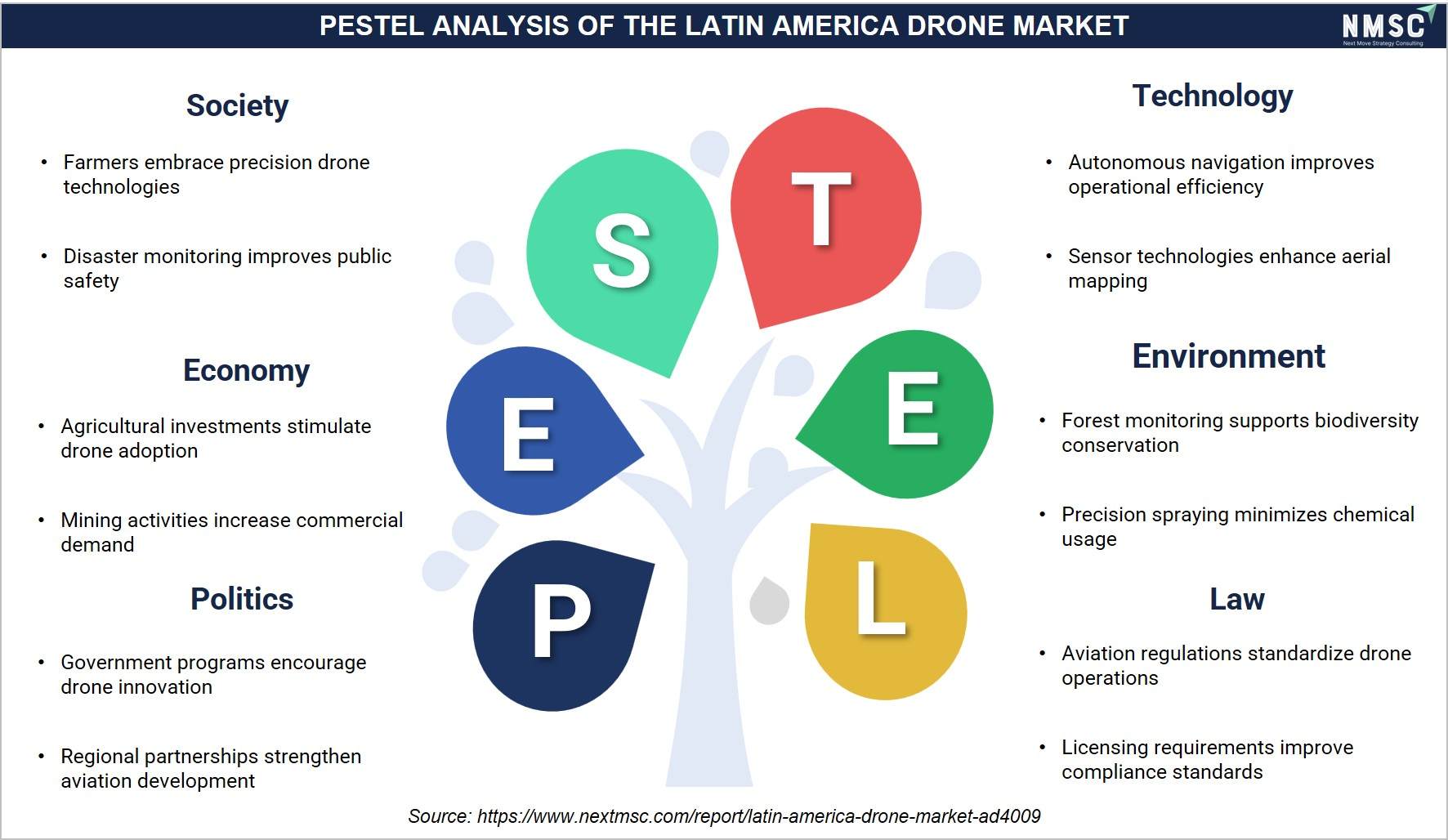
The above PESTEL analysis maps the key macro-environmental factors, such as political, economic, social, technological, environmental, and legal, shaping the Latin America drone market. From our analysis, we observed that political stability and government incentives support drone adoption across the region, while economic factors influence investment and operational costs. Social acceptance and technological advancements drive innovation, whereas environmental regulations promote sustainable operations. Legal frameworks, including aviation laws and data privacy standards, ensure compliance and safety, reflecting a comprehensive PESTEL landscape across the Latin America drone market.
Key Segments
By Component
-
Hardware
-
Airframe
-
Avionics & Core Systems
-
Payloads & Sensors (Cameras, LiDAR, Multispectral, etc.)
-
Communication Systems (C2 Links)
-
-
Software
-
Flight Control & Autonomy
-
Data Processing & Analytics
-
Fleet Management
-
-
Services
-
Drone-as-a-Service (DaaS)
-
Training & Certification
-
Maintenance, Repair & Overhaul (MRO)
-
Data Processing Services
-
By Platform Type
-
Multi-Rotor
-
Fixed-Wing
-
Hybrid VTOL (Vertical Take-Off and Landing)
-
Single-Rotor (Helicopter)
-
Tethered UAV
-
Loitering Munition
-
MALE/HALE/UCAV
By Autonomy Level
-
Remotely Piloted
-
Assisted Autonomy
-
Advanced Autonomy
-
Fully Autonomous
By Maximum Takeoff Weight (MTOW)
-
Nano: < 250 g
-
Micro: 250 g – 2 kg
-
Small: > 2 kg – 25 kg
-
Medium: > 25 kg – 150 kg
-
Large: > 150 kg – 600 kg
-
Very Large/Tactical: > 600 kg
By Price/Performance Grade
-
Consumer Grade (< $1,000)
-
Prosumer Grade ($1,000 – $10,000)
-
Enterprise Grade ($10,000 – $100,000)
-
Military Grade (> $100,000)
By End-User
-
Consumer Drone
-
Commercial & Industrial Drone
-
Aerial Imaging & Cinematography
-
Surveying & Mapping (Geomatics)
-
Agricultural Applications (spraying, crop monitoring)
-
Infrastructure Inspection (energy, utilities, transport)
-
Logistics & Delivery (package transport)
-
Environmental & Scientific Monitoring
-
-
Government & Public Safety Drone
-
Emergency Response & Disaster Management
-
Law Enforcement & Security
-
Firefighting & Public Safety
-
Smart City Management
-
-
Military Drone
-
Intelligence, Surveillance & Reconnaissance (ISR)
-
Combat Operations
-
Electronic Warfare (EW)
-
Target Acquisition & Designation
-
Logistics & Resupply
-
Decoy & Countermeasure Systems
-
By Region
-
Brazil
-
Argentina
-
Chile
-
Colombia
Competitive Landscape
The Latin America Drone Market is contested by a multi-tiered supplier landscape spanning Chinese volume-scale commercial manufacturers that dominate the consumer and prosumer segments through aggressive pricing and broad distribution networks, US-origin enterprise and defense drone specialists targeting commercial inspection and government end-users, and a small but growing roster of regional manufacturers and service integrators building Latin America-specific go-to-market capabilities. Competitive differentiation in the region’s largest commercial segment—precision agriculture—is driven primarily by agronomic efficacy data, local distributor relationships, and after-sales service density across Brazil’s geographically dispersed farming regions.
Strategic Developments:
July 15, 2025 – SZ DJI Technology Co. Ltd. launched the Agras T100, T70P, and T25P agricultural drones, with rollout beginning in Latin America. The new drones offer higher payload capacity, improved spraying efficiency, and advanced automation, strengthening DJI’s presence in the region’s growing agricultural drone market.
Key Players
-
SZ DJI Technology Co. Ltd.
-
Autel Robotics Co. Ltd.
-
EHang Holdings Limited
-
Skydio Inc.
-
Hydra Technologies de Mexico S.A. de C.V.
-
AgEagle Aerial Systems Inc.
-
Shenzhen Hubsan Technology Co. Ltd.
-
Quantum-Systems GmbH
-
Percepto Robotics Ltd
-
Yuneec International Co. Ltd.
-
Flyability SA
-
Guangzhou XAG Co. Ltd.
-
Delair SAS
-
Wingtra AG
-
Hydra Technologies
The competitive landscape is anchored by SZ DJI Technology Co. Ltd. and Autel Robotics Co. Ltd. in the consumer and commercial segments, with agricultural specialists Guangzhou XAG Co. Ltd. and AgEagle Aerial Systems Inc. targeting the precision agriculture vertical. Enterprise operators are served by Wingtra AG, Delair SAS, Quantum-Systems GmbH, and others address autonomous inspection use cases. Regional players Hydra Technologies de Mexico S.A. de C.V. and Hydra Technologies, alongside EHang Holdings Limited, and others collectively address consumer, defense, and specialized commercial applications.
Supply Chain Structure of the Latin America Drone Market:
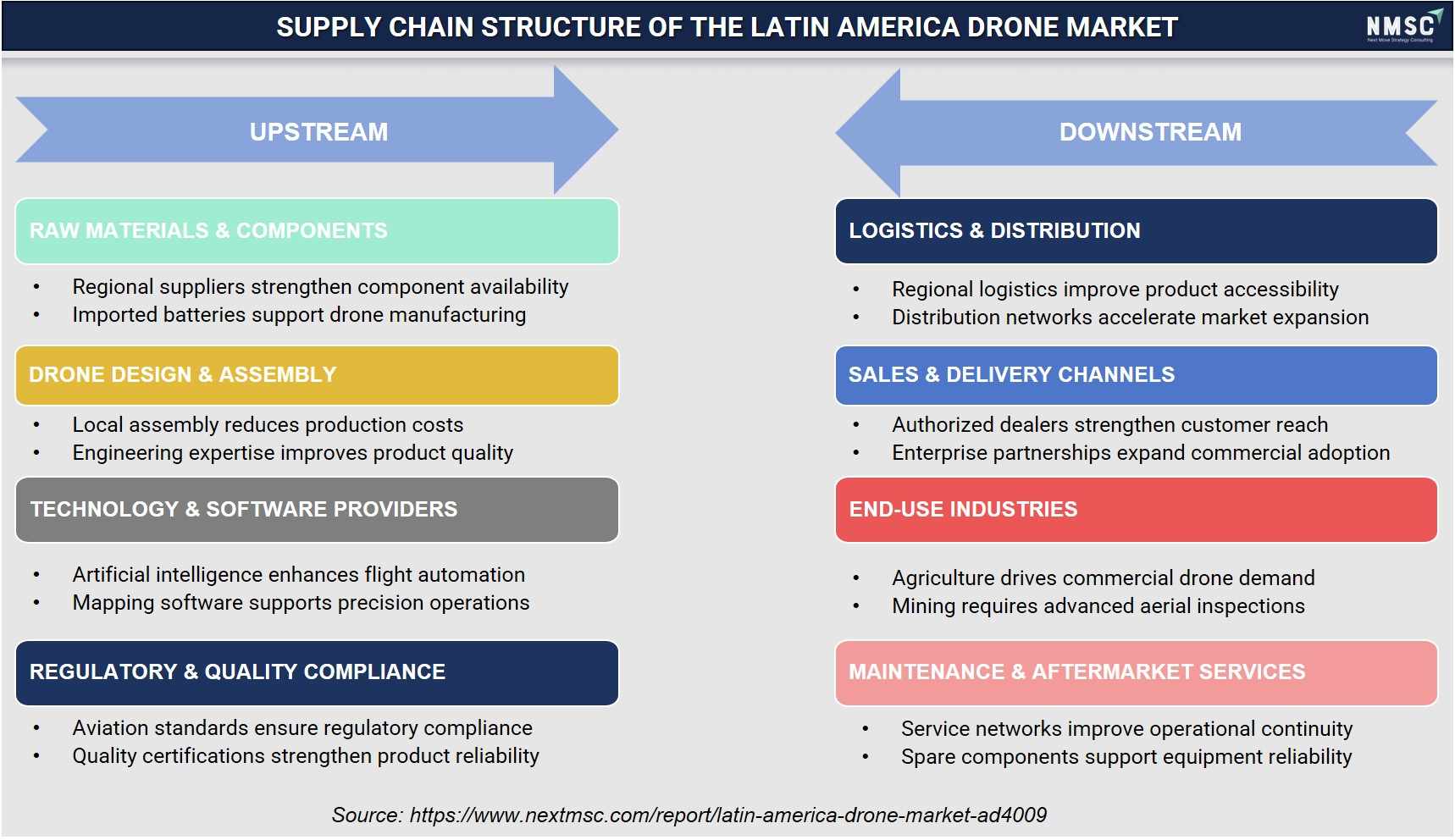
The above supply chain analysis maps the key operational stages, such as upstream and downstream, shaping the Latin America drone market. From our analysis, we observed that upstream activities include regional suppliers, imported batteries, local assembly, engineering expertise, artificial intelligence, mapping software, and aviation standards, while downstream activities encompass regional logistics, authorized dealers, enterprise partnerships, agriculture and mining end-users, and service networks, reflecting a well-integrated supply chain across the market.
Key Benefits for Stakeholders
NMSC’s Latin America Drone Market study delivers revenue and volume forecasts through 2035 across all component, platform, autonomy, MTOW, price-performance, and end-user segments. Stakeholders gain actionable intelligence on Brazil’s agricultural UAV adoption curve, regional regulatory development timelines, and competitive dynamics across Latin America’s fastest-scaling commercial drone verticals and public safety procurement programs.
Agricultural input companies, infrastructure operators, and logistics providers gain the end-user segment data needed to size commercial drone adoption in their specific verticals. Investors and market entrants benefit from country-level opportunity mapping across Brazil, Colombia, Chile, and emerging LATAM drone markets, supported by competitive profiling that identifies positioning gaps across consumer, enterprise, and government-facing drone segments.
|
Parameters |
Details |
|
Customization Scope |
Free customization (equivalent to up to 80 analyst-working hours) after purchase. |
|
Pricing and Purchase Options |
Avail customized purchase options to meet your exact research needs. |
|
Approach |
In-depth primary and secondary research; proprietary databases; rigorous quality control and validation measures. |
|
Analytical Tools |
Porter’s Five Forces, SWOT, value chain, and Harvey ball analysis to assess competitive intensity, stakeholder roles, and relative impact of key factors. |
Conclusion
The Latin America Drone Market is projected to grow from USD 3.83 billion in 2026 to USD 7.76 billion by 2035 at a revenue CAGR of 8.17%, with volume expanding from 181 to 494 thousand units at an 11.83% CAGR. Precision agriculture, infrastructure inspection, and progressive regulatory maturation in Brazil and Colombia are the primary growth catalysts, offset by import duty structures and currency volatility. Competitive intensity will intensify as Chinese commercial leaders, US enterprise specialists, and regional manufacturers contest Brazil’s dominant agricultural and inspection drone verticals and Latin America’s expanding public safety procurement pipeline.


About the Author
 Ridip Gogoi
— Ridip Gogoi is a Research Associate at Next Move Strategy Consulting, where he supports cross-vertical market research and analysis across multiple industry sectors, with four years of experience. His work includes market analysis, data validation, secondary research, and insight development, helping structure evidence into clear findings for business and strategy decisions. He contributes to research quality checks and reporting, with a focus on consistency, source review, and clarity accuracy.
Ridip Gogoi
— Ridip Gogoi is a Research Associate at Next Move Strategy Consulting, where he supports cross-vertical market research and analysis across multiple industry sectors, with four years of experience. His work includes market analysis, data validation, secondary research, and insight development, helping structure evidence into clear findings for business and strategy decisions. He contributes to research quality checks and reporting, with a focus on consistency, source review, and clarity accuracy.
About the Reviewer
 Supradip Baul
— Supradip Baul is an accomplished business consultant and strategist with over a decade of rich experience in market intelligence, strategy, technology, and business transformation. His work has included rigorous qualitative and quantitative analysis across multiple industries, helping clients shape investment decisions and long-term roadmaps. Earlier in his career, he was associated with Gartner, where he contributed to industry-leading reports and market share analyses. He has worked with leading global companies and holds an MBA with a dual specialization in Marketing and Finance.
Supradip Baul
— Supradip Baul is an accomplished business consultant and strategist with over a decade of rich experience in market intelligence, strategy, technology, and business transformation. His work has included rigorous qualitative and quantitative analysis across multiple industries, helping clients shape investment decisions and long-term roadmaps. Earlier in his career, he was associated with Gartner, where he contributed to industry-leading reports and market share analyses. He has worked with leading global companies and holds an MBA with a dual specialization in Marketing and Finance.
At Next Move Strategy Consulting, we understand that insightful market research is the cornerstone of successful business decisions. That's why we employ a robust and multifaceted approach, combining various methodologies to deliver the most accurate and actionable data for our clients.

Research Landscape
We navigate the world of research with two primary approaches:
Qualitative Approach
Our qualitative research methodologies involve immersive techniques such as in-depth interviews, focus groups, and observational studies. By engaging directly with individuals and stakeholders, we uncover valuable insights that quantitative data alone may overlook.

Quantitative Research
In tandem with qualitative methodologies, NMSC leverages the power of Quantitative Research to provide a robust foundation of numerical insights. Through systematic data collection and analysis, we quantify patterns, preferences, and market trends, offering a comprehensive view of the business landscape.
Our quantitative research approach employs diverse tools, including surveys, experiments, and statistical modelling. These methodologies enable us to gather data from a large and representative sample, ensuring the statistical significance of our findings. By employing structured questionnaires and standardized data collection methods, we guarantee the reliability and validity of the information we present to our clients.
Quantitative research is particularly effective in measuring the prevalence of trends, assessing market size, and gauging the impact of various factors on consumer behavior. The numerical precision attained through this approach equips our clients with actionable insights, facilitating data-driven decision-making and strategy formulation.


Our Specialized Toolbox for Industry-Specific Market Research
We deploy a specialized arsenal of techniques tailored to meet your unique requirements. Here's a glimpse into our comprehensive toolbox:

Information Procurement
The stage entails acquiring market data or relevant information through various sources and methodologies.


Market Research Approach
We utilize both top-down and bottom-up approaches in market research analysis to achieve a comprehensive understanding of the market dynamics, leveraging the broad perspective of industry trends and macroeconomic factors alongside detailed insights from specific segments and individual companies.

Porters Five Forces Analysis
We conduct Porter's Five Forces analysis to evaluate the competitive landscape of an industry, providing us with insights into factors that affect profitability and strategic positioning.

SWOT Analysis

Forecasting
We utilize a forecasting model to predict future consumption by considering parameters like population, economics, regulations, market competition, drivers, constraints, technology, and pricing. We also employ statistical techniques such as multilinear regression, exponential smoothing, moving average, ARIMA, and Monte Carlo simulations for accurate predictions. In econometric forecasting, we analyzed short-term and long-term event impacts, attributing values based on regulatory frameworks, economic factors, and market events.





 Speak to Our Analyst