Light-Emitting Diode (LED) Market Size, Share, Growth & Forecast by Type (Conventional LED, Mini LED, MicroLED, Flip Chip LED, AC LED, Other Technologies), Wavelength Range (Visible Spectrum, Ultraviolet A, Ultraviolet B, Ultraviolet C, Infrared Spectrum), Distribution Channel (Direct Sales, OEM, Online Retail), and End User Application (Automotive, Consumer Electronics, General Lighting, Display and Signage, Industrial, Infrastructure, Other Applications) — Global Analysis 2025–2035
Industry: Semiconductor & Electronics | Publishing Date: July 8, 2026 | Last Updated: September 30, 2026 | No of Pages: N/A | No. of Tables: N/A | No. of Figures: N/A | Format: PDF | Report Code: SE5020
What Is the Light-Emitting Diode (LED) Market Size?
The global Light-Emitting Diode (LED) Market was valued at USD 93.31 billion in 2025 and is expected to reach USD 102.37 billion in 2026. Continued adoption of energy-efficient lighting solutions, rapid advancement in display technologies, and growing integration of LED-based systems in automotive, healthcare, and horticulture applications are projected to propel the Light-Emitting Diode (LED) Market to USD 235.51 billion by 2035, advancing at a CAGR of 9.7% from 2026 to 2035. Key growth drivers include expanding MicroLED and Mini LED adoption, surging UV-C LED demand for sterilization, proliferation of smart lighting infrastructure, and rising deployment of LED-enabled agricultural lighting systems worldwide.
|
Parameters |
Details |
|
Market Size in 2025 |
USD 93.31 Billion |
|
Market Size in 2026 |
USD 102.37 Billion |
|
Revenue Forecast in 2035 |
USD 235.51 Billion |
|
Growth Rate |
CAGR of 9.7% from 2026 to 2035 |
|
Analysis Period |
2025–2035 |
|
Base Year Considered |
2025 |
|
Forecast Period |
2026–2035 |
|
Market Size Estimation |
USD Billion |
|
Companies Profiled |
20 |
|
Countries Covered |
33 |
|
Market Share |
Top 10 |
Light-Emitting Diode (LED) Market Overview
What Is the Light-Emitting Diode (LED) Market?
The Light-Emitting Diode (LED) Market encompasses the development, manufacturing, and commercialization of semiconductor-based light sources that convert electrical energy directly into photons across visible, ultraviolet, and infrared wavelengths. LEDs are deployed across a broad spectrum of applications, ranging from general illumination and display backlighting to automotive signal systems, medical phototherapy, agricultural grow-lighting, and UV-C disinfection. This market report covers all major product typologies, distribution channels, end-use verticals, and geographic markets within the global LED industry from 2025 through 2035.
How Has the Light-Emitting Diode (LED) Market Evolved?
The Light-Emitting Diode (LED) Market has evolved through three distinct technology phases. The first phase, spanning the 1990s through the mid-2000s, was defined by the commercialization of high-brightness blue LEDs and the subsequent development of white LEDs for general lighting applications. The second phase, from approximately 2008 to 2018, focused on mass adoption of LED-based luminaires that displaced fluorescent and incandescent technologies in residential, commercial, and industrial environments. NMSC's analysis indicates that the current phase is centered on advanced chiplet architectures, including MicroLED, Mini LED, and Flip Chip LED technologies, which are enabling unprecedented luminance density, color accuracy, and power efficiency across premium displays and next-generation lighting platforms.
How Do Regulations Influence the Light-Emitting Diode (LED) Market?
Regulatory developments are a critical structural driver shaping the Light-Emitting Diode (LED) Market globally. The U.S. Department of Energy's Solid-State Lighting program sets minimum efficacy standards under the Energy Policy Act, mandating progressive improvements in lumens-per-watt performance for commercial luminaires. The European Union's Ecodesign Regulation (EU) 2019/2020 progressively phased out halogen lamps and established minimum energy performance criteria that favor LED adoption across the bloc. From our research, we found that UV-C LED deployments in healthcare and water treatment are increasingly governed by IEC 62471 photobiological safety standards and WHO disinfection guidelines, creating a compliance framework that shapes product design and market access.
How Is Technology Adoption Expanding Across the Light-Emitting Diode (LED) Market?
Technology adoption across the Light-Emitting Diode (LED) Market is accelerating as semiconductor fabrication advances lower per-unit costs and improve device performance. Gallium nitride (GaN) on silicon substrate technology is reducing wafer costs for blue and white LEDs, enabling mass-market penetration in the general lighting segment. Based on NMSC's research, we found that MicroLED technology is progressing from early-stage commercial pilots to volume production for smartwatch displays and high-resolution AR/VR headsets, while Mini LED backlighting is becoming the premium standard in large-format televisions and professional monitors. Concurrently, UV-C LEDs based on aluminum gallium nitride (AlGaN) epitaxy are achieving efficacy breakthroughs that are making solid-state UV disinfection systems commercially viable across healthcare, food processing, and water purification markets.
|
Key Takeaways |
|
By type, Conventional LED held the largest share of the Light-Emitting Diode (LED) Market at USD 35.61 billion in 2025, anchored by its mature manufacturing ecosystem and dominant position in the general lighting and consumer electronics segments. The sub-segment benefits from established supply chains across China, Japan, and South Korea that sustain cost-competitive production volumes. |
|
MicroLED is the fastest-growing type sub-segment in the Light-Emitting Diode (LED) Market, projected to expand from USD 2.46 billion in 2025 to USD 28.55 billion by 2035 at a CAGR of 31.3%, driven by premium display adoption in smartwatches, AR/VR devices, and large-format direct-view video walls. |
|
By wavelength range, Visible Spectrum LEDs dominate the Light-Emitting Diode (LED) Market at USD 66.3 billion in 2025, underpinned by their broad deployment across general lighting, display backlighting, and automotive exterior lighting applications. |
|
Ultraviolet C (UV-C) LEDs represent the fastest-growing wavelength segment in the Light-Emitting Diode (LED) Market at a CAGR of 16.9% from 2026 to 2035, advancing from USD 6.14 billion in 2025 to USD 24.98 billion by 2035, propelled by post-pandemic institutionalization of UV disinfection in healthcare facilities, HVAC systems, and potable water treatment infrastructure. |
|
By distribution channel, Direct Sales led the Light-Emitting Diode (LED) Market at USD 38.06 billion in 2025, reflecting the prevalence of large-volume OEM procurement agreements between LED chipmakers and tier-one automotive, consumer electronics, and lighting fixture manufacturers. |
|
Online Retail is the fastest-growing distribution channel in the Light-Emitting Diode (LED) Market at a CAGR of 16.5% from 2026 to 2035, advancing from USD 8.59 billion in 2025 to USD 33.9 billion by 2035, driven by e-commerce expansion in emerging markets and the proliferation of direct-to-consumer smart lighting products. |
|
By end user application, General Lighting held the largest revenue share in the Light-Emitting Diode (LED) Market at USD 33.15 billion in 2025, reflecting the near-complete displacement of incandescent and fluorescent lighting technologies across residential, commercial, and municipal lighting segments. |
|
Horticulture is the fastest-growing end user application in the Light-Emitting Diode (LED) Market at a CAGR of 19.8% from 2026 to 2035, advancing from USD 2.46 billion in 2025 to USD 12.49 billion by 2035, driven by rapid expansion of indoor vertical farming and controlled-environment agriculture globally. |
|
Asia-Pacific dominated the Light-Emitting Diode (LED) Market at USD 39.29 billion in 2025 and is projected to reach USD 99.91 billion by 2035 at a CAGR of 10.9%, underpinned by the concentration of LED chipmakers in China, Taiwan, Japan, and South Korea, and by the region's rapidly expanding consumer electronics and infrastructure markets. |
|
Latin America is the fastest-growing region in the Light-Emitting Diode (LED) Market at a CAGR of 15.8% from 2026 to 2035, advancing from USD 8.59 billion in 2025 to USD 32.12 billion by 2035, driven by accelerating smart city investments and government-led LED streetlight replacement programs across Brazil, Mexico, and Colombia. |
|
China is the single largest country market in the Light-Emitting Diode (LED) Market, representing over 58% of Asia-Pacific revenue in 2025, anchored by the world's most extensive LED manufacturing base and robust domestic demand across construction, infrastructure, and consumer electronics sectors. |
|
India is the fastest-growing national market within Asia-Pacific in the Light-Emitting Diode (LED) Market, advancing at a CAGR exceeding 9.0% from 2026 to 2035, propelled by the government's UJALA scheme, Smart Cities Mission, and rapid expansion of domestic LED manufacturing capacity under the Production Linked Incentive program. |
Key Emerging Trends in the Light-Emitting Diode (LED) Market
How Is MicroLED Technology Reshaping the Premium Display Landscape Within the Light-Emitting Diode (LED) Market?
MicroLED technology is emerging as the defining display architecture for premium consumer electronics within the Light-Emitting Diode (LED) Market. Unlike conventional backlighting configurations, MicroLED arrays integrate millions of self-emissive LED chiplets at pitches below 50 micrometers, delivering infinite contrast ratios and peak luminance exceeding 10,000 nits without power efficiency penalties. Through our market assessment, we observed that Apple has integrated MicroLED technology into Apple Watch Ultra product lines, and Samsung's The Wall commercial display series has validated large-format direct-view MicroLED at scale, signalling accelerating adoption across both consumer and professional display segments through the forecast period.
How Is UV-C LED Technology Transforming Sterilisation and Disinfection Markets Within the Light-Emitting Diode (LED) Market?
UV-C LED technology is fundamentally transforming the disinfection segment of the Light-Emitting Diode (LED) Market by replacing mercury-vapor germicidal lamps with compact, mercury-free solid-state alternatives. AlGaN-based UV-C LEDs operating at wavelengths between 260 and 280 nanometers achieve germicidal efficacy against bacteria, viruses, and fungi without the hazardous material concerns associated with legacy mercury systems. Based on our analysis, we found that the U.S. Environmental Protection Agency's registration of UV-C LED-based disinfection systems has expanded their permissible use in food processing, healthcare, and public transit applications. Stakeholder impact is broad, affecting healthcare facility operators, water utility managers, and building HVAC system integrators seeking regulatory-compliant and maintenance-simplified disinfection solutions.
How Is Smart and Connected Lighting Driving New Value Propositions in the Light-Emitting Diode (LED) Market?
The integration of LED-based luminaires with IoT connectivity, sensor fusion, and network management platforms is creating a new category of intelligent lighting infrastructure within the Light-Emitting Diode (LED) Market. Smart LED systems enable occupancy-responsive dimming, daylight harvesting, and predictive maintenance capabilities that deliver energy savings beyond the inherent efficiency gains of LED substitution. Our findings suggest that the Zhaga Consortium's interoperability standards and the DALI Alliance's DALI-2 communication protocol are accelerating ecosystem-wide smart lighting adoption by reducing proprietary lock-in. Municipal governments deploying smart streetlight networks in cities such as Los Angeles, Amsterdam, and Singapore are generating measurable data on energy reductions exceeding 50% compared to legacy sodium vapor infrastructure.
How Is Mini LED Backlighting Becoming the New Premium Standard in the Display Segment of the Light-Emitting Diode (LED) Market?
Mini LED backlighting technology is rapidly establishing itself as the dominant premium display architecture for large-format televisions and professional monitors within the Light-Emitting Diode (LED) Market. By deploying thousands of smaller LED backlights operating in independently controlled local dimming zones, Mini LED panels achieve HDR performance approaching OLED displays at a significantly lower manufacturing cost. Through NMSC's assessment, we found that Samsung, LG Display, and BOE Technology have all scaled Mini LED production capacity, with Apple adopting Mini LED backlighting in its Pro Display XDR and iPad Pro product lines. This technology transition is reshaping LED chiplet demand structures and accelerating the shift toward high-value-added display-grade LED components.
What Are the Key Market Drivers, Breakthroughs, and Investment Opportunities that Will Shape the Light-Emitting Diode (LED) Market Industry in the Next Decade?
|
Drivers / Trends / Restraints |
(+/-) % Impact on CAGR Forecast |
Geographic Relevance |
Impact Timeline |
|
Energy Efficiency Policy Mandates |
+1.4% |
Global (led by EU, North America, APAC) |
2025–2030 |
|
MicroLED and Mini LED Display Adoption |
+1.2% |
North America, APAC, Europe |
2025–2035 |
|
UV-C LED Disinfection Demand |
+0.9% |
Global (all regions) |
2026–2035 |
|
Smart City and IoT Lighting Integration |
+0.8% |
APAC, Europe, North America |
2025–2032 |
|
Horticulture LED Adoption |
+0.7% |
North America, Europe, APAC |
2025–2035 |
|
Automotive LED Penetration (ADAS, ADB) |
+0.6% |
Europe, North America, APAC |
2025–2030 |
|
GaN-on-Si Cost Reduction Trajectory |
+0.5% |
Global |
2025–2032 |
|
Raw Material Price Volatility (Gallium) |
-0.5% |
Global |
Ongoing |
|
Intense Price Competition from China OEMs |
-0.6% |
Global (ex-China domestic) |
Ongoing |
|
Market Saturation in General Lighting |
-0.4% |
North America, Europe |
2025–2030 |
|
GenAI-Accelerated Display R&D Cycles |
+0.4% |
North America, APAC |
2026–2035 |
|
Infrared LED Growth in Biometric Sensing |
+0.5% |
Global |
2025–2032 |
What Are the Growth Drivers of the Light-Emitting Diode (LED) Market?
How Are Global Energy Efficiency Mandates Accelerating Adoption Across the Light-Emitting Diode (LED) Market?
Government-mandated energy efficiency standards represent one of the most powerful structural drivers of the Light-Emitting Diode (LED) Market globally. The U.S. Department of Energy's updated lamp standards, effective in 2023 under the Energy Policy and Conservation Act, effectively prohibit the sale of inefficient incandescent and halogen lamps in the United States, creating a regulatory requirement for LED substitution across hundreds of millions of installed luminaire sockets. The European Union's Ecodesign Regulation (EU) 2019/2020 has similarly eliminated fluorescent lamps from the European market from September 2023, directly expanding the addressable replacement opportunity for LED-based luminaires. Our analysis shows that these mandates are generating a structural and non-discretionary demand wave that underpins forecast growth across the general lighting segment through 2030.
How Is the Rapid Expansion of MicroLED and Mini LED Display Technologies Fueling Light-Emitting Diode (LED) Market Growth?
The commercial scaling of MicroLED and Mini LED architectures is creating a high-value demand category within the Light-Emitting Diode (LED) Market that commands substantially higher per-unit revenue compared to conventional lighting applications. Mini LED backlighting requires densities of 1,000 to 40,000 individual LED chiplets per display panel, dramatically increasing LED component volumes per end product. The U.S. International Trade Administration has identified advanced semiconductor display manufacturing as a strategic technology sector, with CHIPS and Science Act provisions supporting domestic MicroLED research and development investment. Based on our market evaluation, we noticed that the transition of television, laptop, and tablet manufacturers toward Mini LED and MicroLED configurations is reshaping the LED supply chain and creating durable volume growth for precision chiplet manufacturers.
How Is Growing Demand for UV-C LED Sterilization Systems Expanding the Light-Emitting Diode (LED) Market?
UV-C LED sterilization technology is transitioning from a post-pandemic specialty segment to a mainstream commercial category within the Light-Emitting Diode (LED) Market, driven by institutionalized biosafety protocols across healthcare, food processing, and public infrastructure sectors. The U.S. Centers for Disease Control and Prevention (CDC) and World Health Organization (WHO) both recognize UV-C radiation as an effective surface and air disinfection method, providing authoritative validation that accelerates procurement by hospitals, airport operators, and food manufacturers. Our assessment indicates that the elimination of hazardous mercury waste liabilities associated with legacy UV lamps is a compelling total-cost-of-ownership advantage for UV-C LED systems, particularly in jurisdictions governed by the Minamata Convention on Mercury, which 140 countries have ratified as of 2024.
What Are the Growth Inhibitors of the Light-Emitting Diode (LED) Market?
How Does Intense Price Competition from Chinese LED Manufacturers Constrain Profitability in the Light-Emitting Diode (LED) Market?
The concentration of LED chip manufacturing capacity in China, particularly in the Fujian and Jiangxi provinces, has generated sustained downward price pressure across standard LED categories within the Light-Emitting Diode (LED) Market. Chinese manufacturers, supported by provincial industrial subsidies documented in filings to the U.S. Department of Commerce, have achieved chip pricing levels that compress gross margins for international producers in the general lighting segment. The U.S. International Trade Commission has conducted multiple anti-dumping investigations into Chinese LED imports, underscoring the commercial severity of this pricing dynamic. This price erosion limits the revenue growth potential of commodity LED categories and compels non-Chinese manufacturers to migrate toward higher-margin specialty segments such as UV-C, MicroLED, and automotive-grade LEDs.
How Does the Market Saturation of General LED Lighting Limit Growth Potential in the Light-Emitting Diode (LED) Market?
The general lighting segment of the Light-Emitting Diode (LED) Market is approaching penetration saturation in developed economies, constraining aggregate market growth rates. The U.S. Department of Energy's Solid-State Lighting program reports that LED products accounted for over 47% of all U.S. lighting installations by 2022 and are projected to exceed 84% by 2035, indicating limited incremental unit volume growth from lamp replacement activity in North America and Europe. This structural saturation creates a headwind for revenue growth in the largest existing LED application segment and necessitates market participants to invest in higher-margin, lower-saturation application categories. Replacement cycles for LED luminaires, which carry rated lifespans of 25,000 to 50,000 hours, further reduce near-term replacement demand compared to the legacy incandescent era, moderating volume-driven revenue growth.
What Are the Growth Opportunities in the Light-Emitting Diode (LED) Market?
How Does the Global Expansion of Controlled-Environment Agriculture Create a Multi-Billion Dollar Opportunity in the Light-Emitting Diode (LED) Market?
Controlled-environment agriculture, encompassing vertical farms, greenhouse operations, and plant factories, represents one of the fastest-growing addressable markets for specialty LED-based horticultural lighting within the Light-Emitting Diode (LED) Market. Purpose-formulated LED grow-light spectra, optimized for photosynthetic efficiency across specific crop types, deliver yields 40% to 80% higher than conventional metal halide systems according to research published by the U.S. Department of Agriculture's Agricultural Research Service. The USDA's Specialty Crop Research Initiative has directed funding toward LED-integrated precision agriculture platforms. Through our market evaluation, we assessed that the global vertical farming market is attracting substantial private capital, creating durable downstream demand for high-efficacy full-spectrum and targeted-wavelength LED horticultural systems through the 2035 forecast horizon.
How Does the Electrification of Automotive Platforms Create Structural Demand Growth for the Light-Emitting Diode (LED) Market?
The accelerating transition to battery electric vehicles is creating a structurally favorable demand environment for high-performance automotive LED systems within the Light-Emitting Diode (LED) Market. Modern electric vehicles require sophisticated LED headlamp systems utilizing Adaptive Driving Beam technology, matrix-array high-beam configurations, and OLED tail lamp assemblies that carry substantially higher LED content per vehicle than internal combustion engine platforms. The U.S. National Highway Traffic Safety Administration's FMVSS No. 108 standard is evolving to accommodate ADB systems, and EU Regulation No. 48 mandates sophisticated headlamp technology across new type-approved vehicles. Our observation indicates that premium automakers including BMW, Mercedes-Benz, and Audi are integrating MicroLED-based matrix headlamp modules into production vehicles, creating a premium automotive LED sub-segment with strong growth momentum.
How Does Smart City Infrastructure Investment Generate Sustained Revenue Opportunity in the Light-Emitting Diode (LED) Market?
Smart city infrastructure programs represent a multi-decade, government-backed revenue opportunity for networked LED lighting systems within the Light-Emitting Diode (LED) Market. Municipal LED streetlight deployments that integrate occupancy sensing, dimming control, and IoT network connectivity deliver documented energy savings of 50% to 70% compared to legacy high-pressure sodium fixtures, as validated in evaluations published by the U.S. Department of Energy and the International Energy Agency. India's Smart Cities Mission, targeting 100 cities, and the European Commission's Smart Cities and Communities initiative are providing structured funding frameworks that accelerate LED procurement cycles. From our research, we found that networked smart streetlight systems generate recurring software and services revenue that extends the commercial value chain beyond hardware manufacturing.
Porter’s Five Forces Analysis of the Light-Emitting Diode (LED) Market
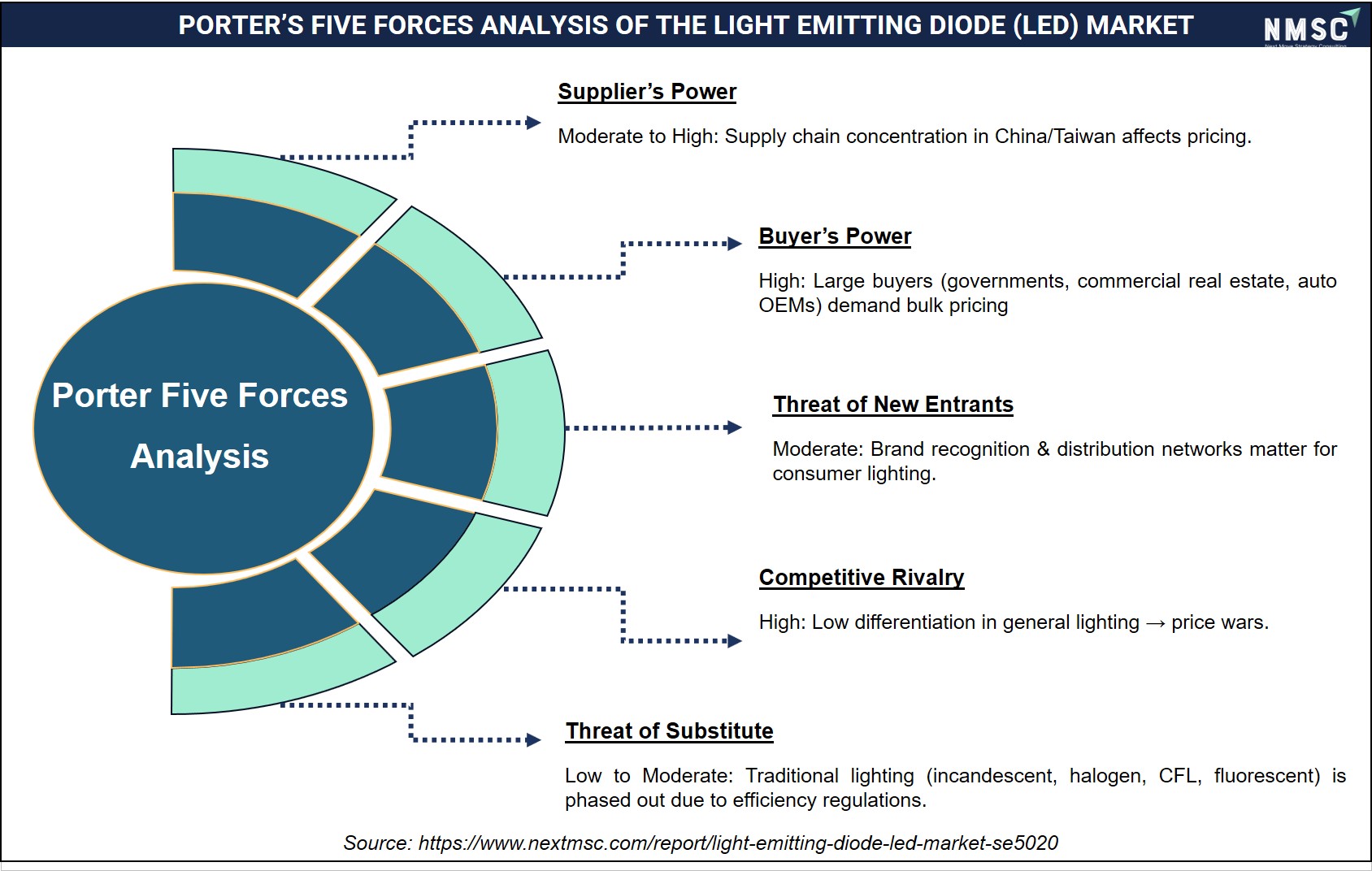
The infographic analyzes the Light Emitting Diode (LED) market by assessing high competitive rivalry among global players, driving intense price competition and rapid innovation. It highlights moderate threat of new entrants due to capital needs and patent barriers, moderate supplier power for raw materials like gallium, high buyer power from price-sensitive bulk purchasers, and moderate threat of substitutes from OLED and traditional lighting alternatives.
How Is the Light-Emitting Diode (LED) Market Segmented in This Report, and What Are the Key Insights from the Segmentation Analysis?
How Does LED Type Segmentation Reveal the Structural Composition and Innovation Trajectory of the Light-Emitting Diode (LED) Market?
|
LED Type Segment |
2025 (USD Bn) |
2035 (USD Bn) |
CAGR (%) |
|
Conventional LED |
35.61 |
67.8 |
7.4% |
|
High Power LED |
19.64 |
51.74 |
11.4% |
|
Mini LED |
9.82 |
48.17 |
19.3% |
|
MicroLED |
2.46 |
28.55 |
31.3% |
|
Flip Chip LED |
8.59 |
32.12 |
15.8% |
|
AC LED |
7.37 |
21.41 |
12.6% |
|
Other Technologies |
9.82 |
21.41 |
9.0% |
Based on our analysis of LED technology adoption trajectories and semiconductor device characterization data, we observed that the Light-Emitting Diode (LED) Market is segmented into Conventional LED, High Power LED, Mini LED, MicroLED, Flip Chip LED, AC LED, and Other Technologies. The Conventional LED segment continues to dominate due to its established manufacturing scale, cost-competitive positioning, and entrenched deployment across general lighting, consumer electronics backlighting, and display indicator applications. High Power LEDs are witnessing strong adoption in automotive headlamps, stadium lighting, and industrial applications that require high luminous flux from compact emitter form factors. Mini LED is emerging as the breakout growth category, transitioning from premium television backlighting into laptops, tablets, and professional monitors at accelerating volumes. MicroLED represents the fastest-growing segment within the Light-Emitting Diode (LED) Market, driven by smartwatch and AR/VR headset production ramp-ups at Samsung, Apple, and specialized display manufacturers.
How Does Wavelength Range Segmentation Illustrate the Expanding Application Diversity of the Light-Emitting Diode (LED) Market?
|
Wavelength Segment |
2025 (USD Bn) |
2035 (USD Bn) |
CAGR (%) |
|
Visible Spectrum |
66.3 |
146.3 |
9.2% |
|
Ultraviolet A |
8.59 |
24.98 |
12.6% |
|
Ultraviolet B |
4.91 |
16.06 |
14.1% |
|
Ultraviolet C |
6.14 |
24.98 |
16.9% |
|
Infrared Spectrum |
7.37 |
23.19 |
13.6% |
Through our market assessment, we observed that the Light-Emitting Diode (LED) Market is segmented by wavelength into Visible Spectrum, Ultraviolet A, Ultraviolet B, Ultraviolet C, and Infrared Spectrum categories. The Visible Spectrum segment dominates due to its foundational role in general lighting, display backlighting, architectural illumination, and automotive exterior systems. Ultraviolet A LEDs serve horticultural photomorphogenesis, counterfeit detection, and phototherapy applications, while UVB LEDs address phototherapy for dermatological conditions including psoriasis and vitamin D synthesis research. Ultraviolet C LEDs represent the fastest-growing wavelength segment within the Light-Emitting Diode (LED) Market, driven by post-pandemic institutionalisation of UV disinfection in healthcare, HVAC, and water treatment sectors. Infrared Spectrum LEDs are witnessing robust growth driven by biometric sensing, facial recognition modules, LiDAR proximity sensors, and medical monitoring applications embedded in consumer electronics and automotive platforms.
How Are Distribution Channel Dynamics Shaping Go-to-Market Strategies in the Light-Emitting Diode (LED) Market?
|
Distribution Channel |
2025 (USD Bn) |
2035 (USD Bn) |
CAGR (%) |
|
Direct Sales |
38.06 |
90.99 |
10.2% |
|
Distributor Network |
29.47 |
67.8 |
9.7% |
|
OEM |
17.19 |
42.82 |
10.7% |
|
Online Retail |
8.59 |
33.9 |
16.5% |
In our observation, the Light-Emitting Diode (LED) Market is segmented by distribution channel into Direct Sales, Distributor Network, OEM, and Online Retail. The Direct Sales segment continues to dominate, reflecting large-volume procurement agreements between LED chipmakers such as Nichia, ams OSRAM, and Seoul Semiconductor and tier-one customers in automotive, consumer electronics, and commercial lighting sectors. Distributor Networks remain integral for mid-tier and regional markets, providing logistical coverage, inventory buffer, and value-added technical support services. OEM channel activity is growing steadily as appliance manufacturers, medical device companies, and agricultural technology providers integrate LED assemblies into finished products. Online Retail is the fastest-growing distribution channel in the Light-Emitting Diode (LED) Market at a CAGR of 16.5%, driven by e-commerce adoption for DIY smart home lighting and the proliferation of aftermarket LED component sales to hobbyist and professional installer markets across Asia-Pacific and Latin America.
Which End User Applications Are Generating the Highest Value and Fastest Growth in the Light-Emitting Diode (LED) Market?
|
End User Application |
2025 (USD Bn) |
2035 (USD Bn) |
CAGR (%) |
|
General Lighting |
33.15 |
64.23 |
7.6% |
|
Consumer Electronics |
14.73 |
46.39 |
13.6% |
|
Automotive |
15.96 |
41.04 |
11.1% |
|
Display and Signage |
11.05 |
33.9 |
13.3% |
|
Industrial |
7.37 |
19.63 |
11.5% |
|
Healthcare and Sterilization |
3.68 |
16.06 |
17.8% |
|
Horticulture |
2.46 |
12.49 |
19.8% |
|
Infrastructure |
3.68 |
8.92 |
10.3% |
|
Other Applications |
1.23 |
3.57 |
12.6% |
Based on NMSC's research, we found that the Light-Emitting Diode (LED) Market is segmented by end user application into General Lighting, Consumer Electronics, Automotive, Display and Signage, Industrial, Healthcare and Sterilization, Horticulture, Infrastructure, and Other Applications. General Lighting is the largest application segment, representing USD 33.15 billion in 2025, anchored by entrenched adoption in residential, commercial, and municipal illumination contexts globally. Consumer Electronics is experiencing strong demand growth driven by Mini LED and MicroLED integration in smartphones, tablets, laptops, and televisions. Automotive continues to expand as ADB headlamps, ambient interior lighting, and high-density LED rear combination lights become standard across vehicle platforms. The Healthcare and Sterilization segment is advancing at a CAGR of 17.8%, while Horticulture LED represents the fastest-growing application at 19.8%, reflecting the emergence of indoor vertical farming and precision plant cultivation as major structural growth opportunities within the Light-Emitting Diode (LED) Market through 2035.
Regional Outlook
Geographic Performance Snapshot
|
Region |
2025 (USD Bn) |
2035 (USD Bn) |
CAGR (%) |
Key Driver |
|
North America |
23.33 |
51.74 |
9.3% |
Energy mandates, automotive & display demand |
|
Europe |
17.19 |
39.25 |
9.6% |
Ecodesign regulations, smart city programs |
|
Asia-Pacific |
39.29 |
99.91 |
10.9% |
Manufacturing base, electronics & infrastructure |
|
Middle East & Africa |
4.91 |
12.49 |
10.9% |
Smart city initiatives, Vision 2030 |
|
Latin America |
8.59 |
32.12 |
15.8% |
LED streetlight rollouts, smart urbanization |
North America Light-Emitting Diode (LED) Market
North America accounted for USD 23.33 billion in the Light-Emitting Diode (LED) Market in 2025 and is forecast to reach USD 51.74 billion by 2035 at a CAGR of 9.3%. The region benefits from robust regulatory mandates, including the DOE's phaseout of inefficient lamps, which sustain structural LED adoption across general lighting. Automotive LED integration, fueled by NHTSA-regulated ADB standards and EV platform growth, is a secondary demand driver. Investment in smart infrastructure and connected public lighting is further supporting premium LED system adoption across commercial and municipal procurement cycles.
U.S. Light-Emitting Diode (LED) Market
Based on our engagements with industry stakeholders and regulatory filings, the United States represents approximately 82% of North American Light-Emitting Diode (LED) Market revenue in 2025. The DOE Solid-State Lighting program's long-standing R&D investment has cultivated a strong domestic ecosystem of LED manufacturers, research institutions, and technology integrators. CHIPS and Science Act provisions support advanced semiconductor device research including MicroLED fabrication processes. Strong adoption of LED systems in commercial real estate, healthcare facilities, and federal buildings, mandated under executive orders on federal sustainability, sustains consistent volume demand. U.S. manufacturers such as Acuity Brands and Cree Lighting anchor the domestic luminaire segment.
Canada Light-Emitting Diode (LED) Market
Through our analysis, Canada demonstrates mature adoption of Light-Emitting Diode (LED) technology across commercial, industrial, and municipal markets. Natural Resources Canada's energy efficiency programs provide financial incentives for commercial LED retrofits in office buildings, retail environments, and industrial facilities. Provincial utility rebate programs in Ontario and British Columbia have historically supported LED adoption among mid-market commercial property owners. Automotive LED content in domestically assembled vehicles at Toyota, Honda, and GM Canada plants drives OEM procurement activity. Canada's progressive energy efficiency building codes are reinforcing structural demand for high-efficacy LED luminaires across new construction projects.
Mexico Light-Emitting Diode (LED) Market
From our assessment, Mexico is the fastest-growing Light-Emitting Diode (LED) Market within North America, advancing at a CAGR of approximately 8.2% from 2026 to 2035. Mexico's expanding manufacturing sector, which includes major automotive assembly plants for Ford, General Motors, and Volkswagen, generates OEM demand for automotive LED components. The Federal Electricity Commission's (CFE) public lighting modernization programs are accelerating LED streetlight deployments across major metropolitan areas. Rising e-commerce adoption is stimulating Online Retail channel growth for residential LED smart home systems. Government investment in industrial parks and nearshoring infrastructure is creating new commercial and industrial LED lighting demand at scale.
Europe Light-Emitting Diode (LED) Market
Europe accounted for USD 17.19 billion in the Light-Emitting Diode (LED) Market in 2025 and is projected to reach USD 39.25 billion by 2035 at a CAGR of 9.6%. The Ecodesign Regulation's elimination of fluorescent lamps from September 2023 represents a structural demand catalyst for LED replacement across approximately 6 billion installed fluorescent lamp sockets in the European market. Smart city programs under the European Commission's Horizon Europe framework and national urban development funds are accelerating the deployment of connected LED street lighting systems with integrated environmental sensing capabilities.
UK Light-Emitting Diode (LED) Market
Based on our engagements with European market participants, the United Kingdom represents a significant and mature segment of the European Light-Emitting Diode (LED) Market. The UK's Building Regulations Part L, setting minimum energy performance standards for commercial buildings, drives consistent demand for high-efficacy LED luminaires across construction and renovation projects. Post-Brexit, the UK maintains its own Energy-Related Products regulations, which align substantially with the EU Ecodesign framework. Smart motorway and public lighting LED deployment programs coordinated by Highways England and local councils are generating structured municipal procurement demand. The automotive supply chain serving Jaguar Land Rover and Nissan Sunderland creates domestic OEM LED component activity.
Germany Light-Emitting Diode (LED) Market
Through our analysis, Germany is Europe's largest individual country market within the Light-Emitting Diode (LED) Market, underpinned by its world-class automotive and industrial manufacturing sectors. Tier-one automotive LED suppliers including ams OSRAM, which is headquartered in Munich, and Tier-2 suppliers serving the Volkswagen Group, BMW, and Mercedes-Benz manufacturing ecosystem represent a major demand center. The Federal Environment Agency's (Umweltbundesamt) product energy labeling requirements enforce progressive LED efficiency standards across the German market. Industrial LED lighting adoption in Germany's extensive manufacturing and logistics facility base is a consistent volume driver, supported by energy cost incentives under the German Renewable Energy Act framework.
France Light-Emitting Diode (LED) Market
According to our evaluation, France represents a strategically important segment of the European Light-Emitting Diode (LED) Market. The French government's Plan de Rénovation Énergétique des Bâtiments allocates investment toward energy-efficient lighting upgrades in residential and public buildings, sustaining LED replacement demand. France's ambitious smart city agenda, advanced through initiatives under the Caisse des Dépôts infrastructure financing framework, is generating demand for connected LED street lighting systems in major urban centers including Paris, Lyon, and Marseille. The automotive supply chain supporting Stellantis and Renault manufacturing operations creates sustained OEM automotive LED procurement activity across the French light-emitting diode industry.
Italy Light-Emitting Diode (LED) Market
From our assessment, Italy demonstrates growing momentum in the Light-Emitting Diode (LED) Market, driven by energy efficiency incentives under the Superbonus and Ecobonus government programs that encourage LED lighting upgrades in residential and commercial buildings. Italy's manufacturing sector, particularly in furniture, fashion retail, and food production, is driving industrial and commercial LED adoption for precise illumination environments. The Italian government's Piano Nazionale di Ripresa e Resilienza (PNRR) allocates funding for smart city infrastructure, including connected LED public lighting, across major municipalities. The automotive sector served by Ferrari, Lamborghini, and Fiat Chrysler's supply chains generates premium automotive LED component demand.
Spain Light-Emitting Diode (LED) Market
Based on our market evaluation, Spain is demonstrating sustained growth in the Light-Emitting Diode (LED) Market, underpinned by the government's Agenda España Digital 2026 and national energy efficiency action plans. Spanish municipalities are among Europe's most active deployers of LED smart streetlight systems, with cities including Barcelona, Madrid, and Bilbao implementing large-scale connected lighting networks with occupancy sensing and remote management capabilities. Spain's tourism and hospitality sector generates commercial LED demand for architectural accent lighting and façade illumination in hotels and entertainment venues. The automotive LED component demand is supported by SEAT and Volkswagen Group Spain manufacturing operations in Martorell and Pamplona.
Sweden Light-Emitting Diode (LED) Market
Through our analysis, Sweden demonstrates advanced adoption of Light-Emitting Diode (LED) technology, consistent with the country's position as a global leader in energy efficiency and sustainable infrastructure. The Swedish Energy Agency's long-standing energy labeling program and stringent building energy performance requirements drive high-efficacy LED adoption across commercial and residential sectors. Swedish municipalities are fully committed to LED public lighting programs under national climate action targets. The horticulture LED segment is experiencing strong demand from Sweden's year-round greenhouse industry, which serves domestic fresh produce markets. Swedish industrial LED adoption in the mining and process industries is supported by Boliden and SSAB facility modernization programs.
Denmark Light-Emitting Diode (LED) Market
According to our evaluation, Denmark is a mature and innovation-oriented participant in the Light-Emitting Diode (LED) Market. Denmark's national energy efficiency programs, administered by the Danish Energy Agency, mandate LED-based solutions for publicly funded infrastructure projects. Copenhagen's commitment to becoming the world's first carbon-neutral capital by 2025 has accelerated smart LED streetlight deployment. Danish horticultural companies producing year-round crops in glasshouse environments are significant buyers of precision LED grow-lighting systems. Denmark's maritime sector, including vessel interior and navigation lighting for Maersk and the broader shipping industry, creates a specialized LED application market for marine-grade fixtures.
Finland Light-Emitting Diode (LED) Market
From our assessment, Finland represents a focused but technically sophisticated segment of the European Light-Emitting Diode (LED) Market. Finland's national energy strategy under the Ministry of Economic Affairs and Employment prioritizes building energy efficiency upgrades, sustaining commercial and residential LED replacement demand. The Finnish forestry and paper manufacturing industry drives significant industrial LED adoption for factory illumination in harsh operating environments. Finland's strong telecommunications and electronics manufacturing ecosystem generates demand for specialty LED components in consumer devices. Arctic climate conditions create demand for LED solutions specifically engineered for low-temperature operation in outdoor and infrastructure applications.
Netherlands Light-Emitting Diode (LED) Market
Based on our engagements with market participants across Benelux, the Netherlands stands as a leading adopter of advanced Light-Emitting Diode (LED) technology. The Dutch horticulture industry, which operates the world's most technically advanced greenhouse cluster in the Westland region, is a globally significant buyer of high-intensity horticultural LED grow-lighting systems. Amsterdam's smart city programs and the national government's LED public lighting mandates sustain municipal procurement demand. The Netherlands Authority for the Financial Markets and Netherlands Enterprise Agency (RVO) administer energy efficiency subsidy programs that accelerate commercial LED adoption. Dutch electronics manufacturing and precision instrument industries create demand for specialty LED components across industrial and medical applications.
Rest of Europe Light-Emitting Diode (LED) Market
Through our analysis, the Rest of Europe Light-Emitting Diode (LED) Market, encompassing Poland, Belgium, Switzerland, Austria, Portugal, the Czech Republic, and other regional economies, collectively represents a significant and growing revenue contributor. EU membership across most of these markets mandates compliance with Ecodesign Regulation lamp phase-out requirements, driving structured LED replacement demand. Poland's expanding automotive manufacturing base, hosting Stellantis and Toyota production facilities, drives OEM LED component procurement. Switzerland and Austria's premium construction sectors generate consistent commercial LED luminaire demand. Eastern European smart city investment programs funded through EU structural and cohesion funds are accelerating connected LED infrastructure deployments.
Asia-Pacific Light-Emitting Diode (LED) Market
Asia-Pacific is the largest region in the Light-Emitting Diode (LED) Market, accounting for USD 39.29 billion in 2025 and projected to reach USD 99.91 billion by 2035 at a CAGR of 10.9%. The region hosts the world's most extensive LED manufacturing base across China, Taiwan, Japan, and South Korea, and simultaneously represents the most dynamic demand environment through its rapidly expanding consumer electronics, automotive, and smart infrastructure markets. Government-led LED deployment programs, including India's UJALA scheme and China's Green Lighting project, are supplementing organic commercial demand with structured public procurement programs.
China Light-Emitting Diode (LED) Market
Based on our engagements with regional supply chain participants, China dominates the Asia-Pacific Light-Emitting Diode (LED) Market and is the single largest national market globally, representing over 58% of regional revenue in 2025. China's Ministry of Industry and Information Technology supports LED manufacturing through the Made in China 2025 strategic plan, investing in advanced semiconductor epitaxy, chiplet precision assembly, and smart lighting manufacturing capabilities. Domestic LED producers including San'an Optoelectronics, Ennostar, and Foshan NationStar operate at the world's largest production scales. China's massive construction, infrastructure, and consumer electronics industries sustain broad-based LED demand. The rapid adoption of Mini LED backlighting by domestic TV and panel manufacturers including BOE and HKC is a major technology adoption driver.
India Light-Emitting Diode (LED) Market
Through our analysis, India is the fastest-growing national Light-Emitting Diode (LED) Market within Asia-Pacific, advancing at a CAGR exceeding 9.0% from 2026 to 2035. The government's UJALA scheme has distributed over 367 million LED bulbs under the national LED rollout program, displacing an estimated 6,800 MW of peak electricity demand annually, according to Energy Efficiency Services Limited. The Smart Cities Mission targeting 100 urban centers is driving large-scale LED smart streetlight deployments. India's Production Linked Incentive scheme is stimulating domestic LED manufacturing investment, reducing import dependence. Rising consumer electronics penetration and expanding automotive production at Hyundai, Suzuki, and Tata Motors plants are generating incremental LED demand.
Japan Light-Emitting Diode (LED) Market
From our assessment, Japan represents a mature and technology-intensive segment of the Asia-Pacific Light-Emitting Diode (LED) Market. Japan's Agency for Natural Resources and Energy administers Top Runner energy efficiency standards that specify progressive LED performance requirements for commercial luminaires and consumer products. Japanese LED manufacturers including Nichia Corporation, Stanley Electric, Toyoda Gosei, and DOMINANT Opto hold globally recognized intellectual property portfolios in phosphor chemistry, epitaxial growth, and device packaging. The advanced automotive sector, serving Toyota, Honda, Subaru, and Denso, generates premium demand for Adaptive Driving Beam and matrix LED headlamp systems. Japan's sophisticated electronics and display industry sustains demand for specialty UV and infrared LED components.
South Korea Light-Emitting Diode (LED) Market
According to our evaluation, South Korea is a strategically important participant in the Light-Emitting Diode (LED) Market, both as a manufacturer and as an end-use demand center. Seoul Semiconductor is a globally leading LED component manufacturer headquartered in Korea, holding extensive patents in AC LED and SunLike spectrum technologies. Samsung and LG Electronics are driving domestic and global Mini LED and MicroLED display adoption through their flagship television and commercial display product lines. The Korean automotive sector, serving Hyundai-Kia, Genesis, and Kia EV platforms, sustains OEM demand for premium automotive LED headlamp modules. Korea's government-sponsored smart city testbeds in Songdo and Sejong City are generating structured demand for connected LED infrastructure.
Taiwan Light-Emitting Diode (LED) Market
Based on our market evaluation, Taiwan is a globally pivotal node within the Light-Emitting Diode (LED) Market supply chain. Taiwanese LED manufacturers, including Epistar, Everlight Electronics, and Harvatek Corporation, occupy critical positions in the global LED chiplet and component supply ecosystem. Taiwan's Ministry of Economic Affairs supports LED industry competitiveness through the Industrial Development Bureau's green technology investment programs. The island's advanced TSMC-centered semiconductor ecosystem is enabling MicroLED wafer process development at leading semiconductor fabs. Taiwan's electronics manufacturing sector, producing consumer devices for Apple, Dell, and HP, generates consistent demand for display-grade LED backlighting components across Mini LED and advanced edge-lit configurations.
Indonesia Light-Emitting Diode (LED) Market
Through our analysis, Indonesia is an emerging growth market within the Asia-Pacific Light-Emitting Diode (LED) Market, driven by rapid urbanization, infrastructure investment, and expanding consumer electronics penetration. The Indonesian government's National Medium-Term Development Plan includes electricity access expansion and energy efficiency programs that are accelerating LED adoption in residential and commercial sectors. ASEAN harmonized energy efficiency standards aligned with IEC protocols are encouraging LED product compliance across the archipelago. Indonesia's national streetlight modernization programs, implemented through the Ministry of Energy and Mineral Resources, are replacing sodium vapor fixtures with LED systems across major cities including Jakarta, Surabaya, and Bandung.
Vietnam Light-Emitting Diode (LED) Market
From our assessment, Vietnam demonstrates accelerating adoption of Light-Emitting Diode (LED) technology, supported by rapid economic growth, industrial expansion, and rising energy consumption. Vietnam's Ministry of Industry and Trade promotes LED adoption through energy efficiency labeling and financial incentive programs targeting commercial buildings and public infrastructure. Vietnam's rapidly expanding electronics manufacturing sector, which produces for Samsung, LG, Intel, and Foxconn, generates significant demand for industrial LED lighting in factory environments. The commercial construction boom in Hanoi and Ho Chi Minh City is sustaining LED luminaire demand in office, retail, and hospitality facilities. Vietnam's agricultural sector is beginning to explore LED horticultural systems for high-value crop production.
Australia Light-Emitting Diode (LED) Market
According to our evaluation, Australia represents a mature and high-value segment of the Asia-Pacific Light-Emitting Diode (LED) Market. The Australian Government's Equipment Energy Efficiency program mandates minimum energy performance standards for LED lamps and luminaires, aligning the market with global best-practice efficiency benchmarks. State government LED public lighting programs, including Transport for NSW's streetlight replacement initiative, are deploying smart LED systems with IoT management capabilities across major metropolitan areas. The agricultural sector in Queensland and South Australia is adopting LED grow-lighting in protected horticulture facilities. Australia's premium residential construction market sustains demand for architectural and decorative LED luminaire products.
Philippines Light-Emitting Diode (LED) Market
Based on our engagements, the Philippines Light-Emitting Diode (LED) Market is expanding rapidly in alignment with the country's urbanization trends and infrastructure development programs. The Department of Energy's energy efficiency programs and the Philippine Energy Efficiency Act promote LED adoption in commercial and government buildings. The government's Build, Build, Build infrastructure initiative has generated new commercial construction demand for LED lighting in roads, bridges, and public facilities. The Philippines' growing electronics assembly and business process outsourcing sectors sustain commercial facility LED demand. Rising consumer electronics adoption and smartphone penetration are creating downstream demand for display-grade LED components assembled at domestic electronics manufacturers.
Malaysia Light-Emitting Diode (LED) Market
Through our analysis, Malaysia represents a growing market within the Asia-Pacific Light-Emitting Diode (LED) Market, supported by its advanced electronics manufacturing ecosystem and government-led sustainability initiatives. Malaysia's Economic Transformation Program and the Green Technology Master Plan promote energy-efficient lighting adoption across commercial and public infrastructure. The country's semiconductor and electronics manufacturing sector, which serves as a regional hub for multinational corporations, generates consistent demand for industrial LED lighting and specialty LED components. Malaysia's Smart City initiatives in Kuala Lumpur, Iskandar, and Penang are driving connected LED streetlight deployments. The commercial construction and hospitality sectors are sustaining demand for architectural and decorative LED luminaires.
Thailand Light-Emitting Diode (LED) Market
From our assessment, Thailand demonstrates steady growth in the Light-Emitting Diode (LED) Market, underpinned by the government's Energy Efficiency Development Plan and expanding industrial base. Thailand's Board of Investment promotes LED manufacturing investment through tax incentive programs, attracting both domestic and international LED producers. The country's automotive manufacturing sector, serving Toyota, Honda, and Mitsubishi, generates OEM demand for automotive LED components. Thailand's vibrant tourism and hospitality industry drives commercial LED demand for hotel, resort, and entertainment venue lighting. Government streetlight modernization programs in Bangkok and provincial centers are accelerating LED adoption in public infrastructure.
Rest of Asia-Pacific Light-Emitting Diode (LED) Market
Based on our market evaluation, the Rest of Asia-Pacific Light-Emitting Diode (LED) Market, encompassing Singapore, Bangladesh, Pakistan, Sri Lanka, New Zealand, and other regional economies, collectively represents a growing revenue contributor. Singapore's advanced smart city infrastructure and Building and Construction Authority's Green Mark certification drive high-specification LED adoption in commercial buildings and public spaces. Bangladesh and Pakistan represent nascent but rapidly expanding markets driven by rural electrification programs and urbanization. New Zealand's commitment to carbon neutrality by 2050 is accelerating LED adoption across municipal and agricultural applications. Regional horticulture sectors in Southeast Asian nations are increasingly adopting LED grow-lighting for high-value crop production.
Middle East & Africa Light-Emitting Diode (LED) Market
Through our analysis, the Middle East & Africa Light-Emitting Diode (LED) Market accounted for USD 4.91 billion in 2025 and is projected to reach USD 12.49 billion by 2035 at a CAGR of 10.9%. Saudi Arabia's Vision 2030 and the UAE's Energy Strategy 2050 are driving large-scale LED streetlight and building lighting deployments as part of broader infrastructure modernization programs. The region's extreme climate conditions create favorable demand dynamics for LED systems due to their superior thermal performance and longevity compared to conventional lighting. Africa's expanding urbanization and electricity access programs, including Kenya's and South Africa's LED distribution initiatives, are creating emerging market demand across the continent.
Latin America Light-Emitting Diode (LED) Market
According to our evaluation, Latin America is the fastest-growing regional Light-Emitting Diode (LED) Market at a CAGR of 15.8% from 2026 to 2035, advancing from USD 8.59 billion in 2025 to USD 32.12 billion by 2035. Brazil's Minha Casa Minha Vida housing program and LED streetlight replacement initiatives across São Paulo, Rio de Janeiro, and Brasília are generating significant volume demand. Mexico's nearshoring-driven industrial expansion is creating new commercial and industrial LED lighting demand. Colombia's smart city programs in Bogotá and Medellín are deploying connected LED infrastructure. Chile's mining sector represents a specialized high-value application market for industrial-grade LED lighting systems designed for harsh operating environments.
Brazil Light-Emitting Diode (LED) Market
Based on our engagements, Brazil is the largest Light-Emitting Diode (LED) Market in Latin America, representing approximately 42% of regional revenue in 2025. PROCEL, Brazil's National Electricity Conservation Program administered by Eletrobras, provides energy efficiency incentives for commercial and residential LED adoption. Brazil's national public lighting modernization program, managed by the Ministry of Mines and Energy, has been deploying LED streetlights across major cities including São Paulo, Rio de Janeiro, and Brasília. The agricultural sector in Minas Gerais and São Paulo is beginning to adopt LED grow-lighting for high-value indoor cultivation. Brazil's automotive assembly plants operated by Volkswagen, Fiat, and Toyota generate OEM automotive LED demand.
Argentina Light-Emitting Diode (LED) Market
Through our analysis, Argentina demonstrates growing adoption of Light-Emitting Diode (LED) technology across commercial, industrial, and municipal sectors. Argentina's Secretariat of Energy administers energy efficiency programs that include LED adoption incentives for commercial buildings and public infrastructure. Buenos Aires City's LED public lighting program has deployed smart LED streetlights with remote monitoring capabilities across major arterial roads. Argentina's food processing and cold storage industry generates specialized demand for low-temperature LED luminaires in refrigerated warehouse and food plant environments. Consumer electronics retail expansion in Argentina's major cities is sustaining commercial and residential LED product adoption.
Chile Light-Emitting Diode (LED) Market
From our assessment, Chile represents a growing and technically advanced Light-Emitting Diode (LED) Market within Latin America. Chile's Ministry of Energy administers the Energy Efficiency Law of 2021, which mandates minimum energy performance standards for lighting products and public infrastructure. Santiago's metropolitan government has deployed connected LED streetlight networks with occupancy sensing across central business districts. Chile's mining industry, representing the world's largest copper production sector through Codelco and BHP Minera Escondida, creates substantial demand for high-intensity, industrial-grade LED luminaires for underground and open-pit mining operations. Chile's emerging vertical farming sector for blueberry and tomato production generates horticultural LED demand.
Colombia Light-Emitting Diode (LED) Market
According to our evaluation, Colombia is a high-growth participant in the Latin America Light-Emitting Diode (LED) Market. IPSE, Colombia's Institute for Planning and Promotion of Energy Solutions for Non-Connected Zones, deploys solar LED systems in rural communities outside the national electrical grid. The PROURE energy efficiency program provides incentives for commercial and public sector LED adoption. Bogotá and Medellín have implemented large-scale LED smart streetlight programs with centralized management platforms. Colombia's floriculture sector, a global leader in cut flower production, represents an early but growing adopter of LED supplemental greenhouse lighting. The rapid expansion of Colombia's retail and office construction market is sustaining commercial LED luminaire demand.
Rest of LATAM Light-Emitting Diode (LED) Market
Based on our market assessment, the Rest of Latin America Light-Emitting Diode (LED) Market, encompassing Peru, Ecuador, Venezuela, Uruguay, Paraguay, and Central American and Caribbean nations, collectively represents an early-stage but expanding growth opportunity. Peru's Ministry of Energy and Mines is implementing LED energy efficiency programs as part of national electrification and sustainability plans. Ecuador's commercial construction growth in Quito and Guayaquil is driving LED luminaire adoption in new office and retail developments. Costa Rica's ambitious sustainability commitments, targeting carbon neutrality, are accelerating commercial and public-sector LED adoption. Caribbean tourism infrastructure investments in hotels and resorts generate demand for premium LED architectural and decorative lighting solutions.
Competitive Landscape
Competitive Dynamics and M&A Landscape
|
Key Takeaways |
|
Market Structure – The Light-Emitting Diode (LED) Market features multi-tiered competition among Japanese phosphor chemistry and epitaxy pioneers (Nichia, Toyoda Gosei), Korean integrated LED manufacturers (Seoul Semiconductor, Samsung LED division), Taiwanese chipset and component specialists (Epistar, Everlight, Harvatek), and Chinese high-volume producers (San'an Optoelectronics, Foshan NationStar), each competing on distinct technical and commercial value propositions. |
|
Innovation Focus – Innovation across the Light-Emitting Diode (LED) Market is centered on MicroLED chiplet precision manufacturing and mass transfer processes, UV-C LED efficacy improvements for disinfection applications, GaN-on-Si substrate cost reduction, Flip Chip LED packaging advances, and AI-integrated smart lighting control platforms that extend the LED value chain beyond hardware into data and services. |
|
M&A Activity – ams OSRAM's ongoing portfolio rationalization following the 2021 Osram acquisition has reshaped the competitive map of the global LED industry. Seoul Semiconductor has strengthened its IP portfolio through strategic technology licensing agreements. Lumileds' separation from Philips consolidated a specialist automotive and industrial LED entity. Regional consolidation among Chinese LED manufacturers is ongoing, driven by government-supported industry rationalization programs in Fujian and Jiangxi provinces. |
How Do Companies Compete in the Light-Emitting Diode (LED) Market?
The Light-Emitting Diode (LED) Market is characterised by multi-tiered global competition defined by technology differentiation, patent portfolio strength, manufacturing scale, and vertical integration strategy. Japanese manufacturers, led by Nichia Corporation, compete through proprietary phosphor chemistry and epitaxial process leadership, commanding premium pricing in automotive and specialty LED categories. Korean manufacturers, including Seoul Semiconductor, differentiate through patented AC LED and sunlight-spectrum technologies. Taiwanese producers compete on breadth of product portfolio, customer service responsiveness, and cost-effective precision packaging. Chinese manufacturers leverage massive scale economies in conventional and high-power LED production. NMSC's analysis indicates that pricing strategies diverge significantly: premium Japanese and Korean producers maintain higher average selling prices through technology licensing, while Chinese volume producers compete aggressively on unit cost.
Which Kind of Companies Dominate the Light-Emitting Diode (LED) Market?
Three distinct categories of companies dominate the Light-Emitting Diode (LED) Market. The first category comprises vertically integrated global LED manufacturers with proprietary chip design, epitaxial growth, and packaging capabilities, including Nichia Corporation, ams OSRAM AG, Seoul Semiconductor, and Lumileds, who generate premium revenue through technology licensing and specialty LED products for automotive, medical, and display applications. The second category includes high-volume chipset and component manufacturers based in China and Taiwan, including San'an Optoelectronics, Foshan NationStar, Everlight Electronics, and Ennostar, who compete on cost efficiency and production scale for commodity LED categories. The third category encompasses application-specific LED solution providers serving horticulture, UV sterilization, and specialty industrial markets with differentiated product portfolios.
AI-Native Differentiation and Open Standards Drive Market Success in the Light-Emitting Diode (LED) Market
Innovation focus across the Light-Emitting Diode (LED) Market is concentrated in several strategic areas that are reshaping competitive positioning. Advanced MicroLED chiplet fabrication and precision mass transfer assembly are establishing new performance benchmarks for premium displays and wearable devices. UV-C LED efficacy improvements are driving mercury lamp displacement in disinfection applications. IoT-integrated smart lighting platforms enable LED manufacturers to extend their value propositions from pure hardware into managed services with recurring revenue characteristics. Our findings suggest that companies investing in GaN-on-Si substrate cost reduction and Flip Chip LED packaging technologies are achieving significant manufacturing efficiency gains. Patent portfolio strength in phosphor chemistry and epitaxial process design remains a critical competitive differentiator, particularly for premium automotive and medical-grade LED applications.
Market Players to Opt for Merger and Acquisition Strategies to Expand Their Presence in the Light-Emitting Diode (LED) Market
Mergers, acquisitions, and strategic partnerships are progressively reshaping the competitive landscape of the Light-Emitting Diode (LED) Market. ams OSRAM's consolidation of the Osram LED and photodetector portfolio created the most comprehensive optoelectronics company in Europe, establishing leadership across automotive, industrial, and consumer LED applications. Lumileds' carve-out from the Philips parent group enabled focused investment in high-power and automotive LED innovation. Our analysis indicates that ongoing consolidation among Taiwanese LED manufacturers under equity partnerships is creating more internationally competitive multi-product portfolios. Private equity interest in specialty LED sub-segments, particularly UV-C disinfection and horticultural LED, is expected to generate targeted acquisition activity through the 2025–2028 timeframe as market valuations in these fast-growing niches attract institutional capital.
Who Are the Key Market Players in the Light-Emitting Diode (LED) Market?
-
Nichia Corporation
-
ams OSRAM AG
-
Seoul Semiconductor Co., Ltd.
-
San'an Optoelectronics Co., Ltd.
-
Shenzhen Mulinsen Technology Co., Ltd.
-
Everlight Electronics Co., Ltd.
-
Lumileds Holding B.V.
-
Ennostar Inc.
-
Foshan NationStar Optoelectronics Co., Ltd.
-
Stanley Electric Co., Ltd.
-
Toyoda Gosei Co., Ltd.
-
Hongli Zhihui Group Co., Ltd.
-
Shenzhen Refond Optoelectronics Co., Ltd.
-
Shenzhen Jufei Optoelectronics Co., Ltd.
-
Harvatek Corporation
-
Kingbright Electronic Co., Ltd.
-
Edison Opto Corporation
-
DOMINANT Opto Technologies Sdn. Bhd.
-
Brightek Optoelectronic Co., Ltd.
-
Luckylight Electronics Co., Ltd.
What Are the Latest Developments in the Light-Emitting Diode (LED) Industry?
|
Date |
Event |
|
October 2025 |
Nichia Corporation announced successful development of a new UV-C LED light-source technology for large-scale mercury-free water sterilization systems |
|
May 2025 |
Seoul Semiconductor Co., Ltd. confirmed its participation at LightFair International 2025, showcasing proprietary LED technologies and emphasizing supply-chain resilience through its global manufacturing network |
|
January 2025 |
Nichia Corporation launched the NS2W806H-B2 white LED for LCD backlighting, integrating blue and green chips within a single package. The innovation enhances color reproduction and display performance while supporting demand for premium televisions, monitors, and next-generation display applications |
Expert Insights

“Light is essential for our society. With our leadership comes the responsibility for the way lighting impacts the environment around us.”
— Eric Rondolat, CEO of Signify
The statement was published in Signify’s 2024 Climate Transition Plan.
Market Interpretation
The quote highlights the growing role of sustainability as a core strategic driver in the LED market. As governments, businesses, and consumers increasingly prioritize energy efficiency and carbon reduction, LED technology is becoming a critical enabler of decarbonization efforts. The statement reflects a broader industry trend in which lighting manufacturers are positioning advanced LED solutions, connected lighting systems, and ultra-efficient technologies as key tools for achieving climate and energy-transition goals. Industry participants are also increasing investments in sustainable product design, circular economy initiatives, and low-carbon lighting infrastructure to align with evolving environmental regulations and corporate ESG commitments.
Supply Chain Analysis of the Light-Emitting Diode (LED) Market
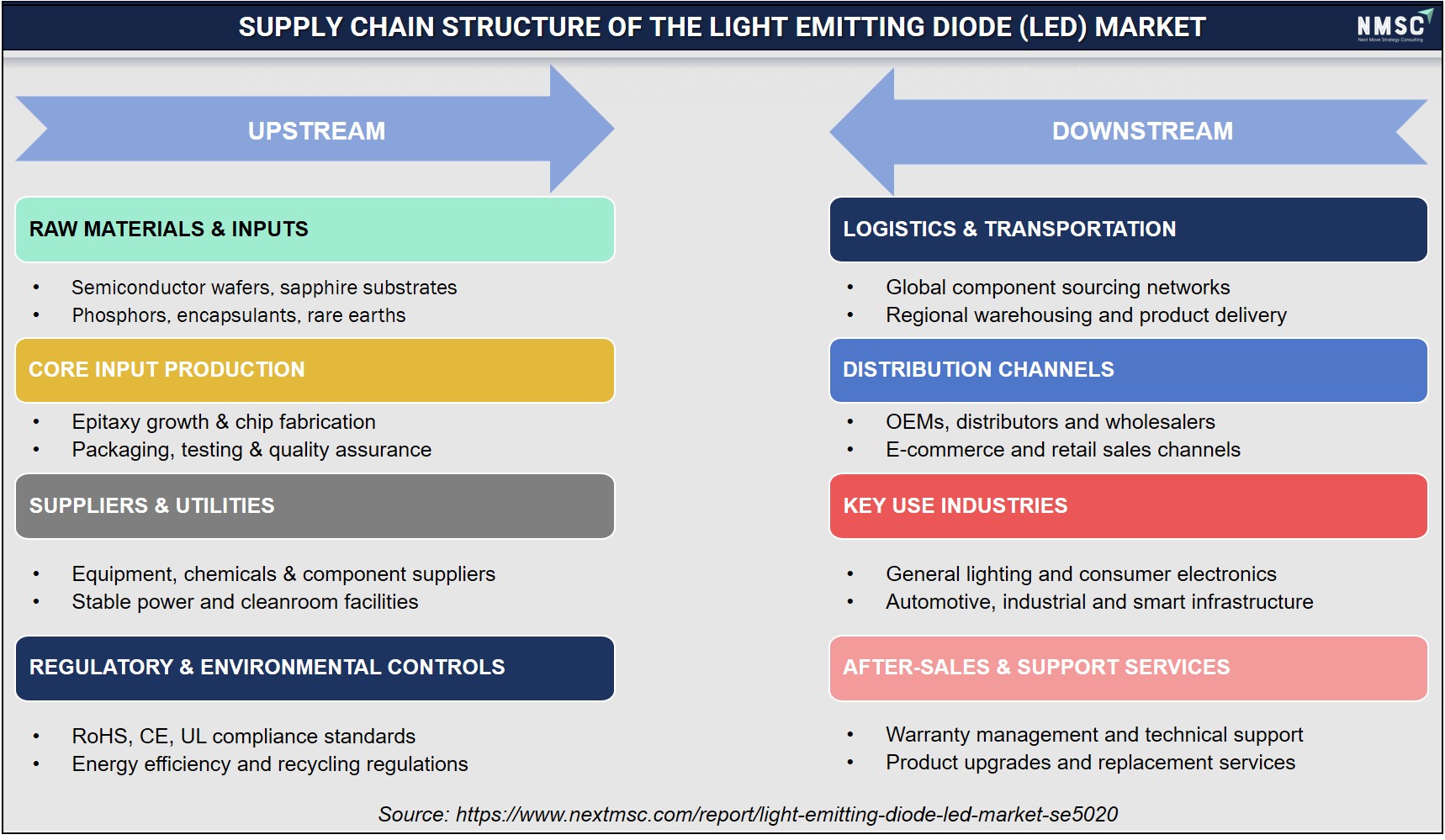
The infographic maps the LED market's supply chain, showing upstream components including semiconductor wafers, sapphire substrates, phosphors, epitaxy growth, chip fabrication, packaging, testing, and compliance with RoHS, CE, and UL standards. Downstream elements cover global logistics, OEM and e-commerce distribution channels, key use industries like automotive, general lighting, consumer electronics, and smart infrastructure, plus after-sales support including warranty management and replacement services.
What Are the Investment Opportunities in the Light-Emitting Diode (LED) Market?
Capital Inflows and Venture Activity
The Light-Emitting Diode (LED) Market is attracting increasing capital flows across both public and private investment channels, reflecting growing recognition of its multi-decade technology transformation potential. Venture capital activity is concentrated in MicroLED startup ventures pursuing novel mass transfer manufacturing processes, UV-C LED disinfection system companies developing mercury-free replacement products for institutional markets, and horticultural LED technology providers serving the expanding vertical farming sector. The National Venture Capital Association (NVCA) has reported growing investor interest in hardware-enabled deep technology companies, including optoelectronics, as AI and sustainability investment themes expand beyond software. Based on our market evaluation, government-backed investment in semiconductor optoelectronics R&D under the CHIPS Act and EU Chips Act is creating co-investment frameworks that attract private capital to advanced LED research programs.
Infrastructure Investment
Infrastructure investment linked to the Light-Emitting Diode (LED) Market spans multiple governmental and private capital formation channels. The U.S. Infrastructure Investment and Jobs Act allocates dedicated funding for energy-efficient public lighting and smart city infrastructure, creating structured procurement demand for advanced LED systems at the municipal and federal level. The European Commission's Clean Energy for EU Islands initiative and national infrastructure programs across Germany, France, and Italy are funding large-scale LED public infrastructure deployments. China's Ministry of Housing and Urban-Rural Development continues to invest in LED-integrated smart city infrastructure under the New Urbanization strategy. These multi-billion-dollar infrastructure programs create predictable, long-duration demand anchors for LED manufacturers and smart lighting system integrators across all major global markets.
ESG Considerations
Environmental, Social, and Governance considerations are increasingly integral to investment decisions affecting the Light-Emitting Diode (LED) Market. LED technology's fundamental energy efficiency advantage, delivering equivalent illumination at 75% to 90% lower energy consumption compared to incandescent alternatives, positions the sector as a direct enabler of Scope 2 greenhouse gas emission reductions for corporate real estate portfolios. The U.S. Executive Order 14057 on Catalyzing Clean Energy Industries mandates LED adoption across federal buildings, reflecting the technology's alignment with national sustainability commitments. UV-C LED technology's elimination of mercury waste associated with legacy germicidal lamps directly supports compliance with the Minamata Convention's environmental objectives, making it an investable ESG technology theme for institutional portfolios with materials safety and hazardous substance reduction mandates.
Digital Transformation Enablement
LED-based systems are becoming integral components of broader digital transformation programs in smart buildings, intelligent transportation, and precision agriculture. IoT-integrated LED luminaires serve as sensor platforms that collect occupancy, temperature, and air quality data in addition to providing illumination, extending the functional value proposition beyond pure lighting. The Zhaga Consortium's Book 18 standard for smart LED outdoor luminaire controls and the DALI Alliance's D4i standard for data-enabled indoor LED systems are creating interoperable digital ecosystems. Our analysis shows that enterprises and municipal governments undertaking digital infrastructure modernization are increasingly treating LED smart lighting systems as foundational network infrastructure investments, creating technology refresh cycles that are more frequent and value-enriched than simple lamp replacement activity historically associated with lighting markets.
Private Equity and Strategic M&A Activity
Private equity and strategic acquirers are actively pursuing investment opportunities within the Light-Emitting Diode (LED) Market, particularly in high-growth specialty segments. The separation of Lumileds from Philips and its subsequent private equity ownership under Apollo Global Management illustrates the standalone investment attractiveness of focused LED platform businesses. Strategic M&A activity among Taiwanese LED manufacturers, facilitated by government-supported industrial consolidation programs, is creating larger and more internationally competitive entities. Our assessment indicates that UV-C LED disinfection companies, horticultural LED system providers, and MicroLED technology startups represent the highest-conviction private equity target categories within the Light-Emitting Diode (LED) Market through the forecast period, given their above-average growth trajectories and structural technology differentiation barriers to entry.
Key Benefits for Stakeholders
For Enterprise Buyers
Enterprise buyers gain comprehensive, vendor-neutral intelligence on the Light-Emitting Diode (LED) Market, including quantitative sizing across all product types, wavelength ranges, distribution channels, and end user applications. This analysis supports lighting procurement strategy, LED technology roadmap planning, and vendor evaluation for large-scale commercial, industrial, and automotive applications. Our competitive landscape assessment enables procurement teams to benchmark supplier pricing strategies, evaluate LED chiplet vendor capabilities, and optimize LED-integrated product specifications with analytical rigor and market evidence.
For Investors and Financial Analysts
Investors and financial analysts access a structured assessment of the Light-Emitting Diode (LED) Market's growth trajectory, segment-level revenue forecasts through 2035, and competitive dynamics across global LED chipmaker, component, and system integrator categories. The CAGR analysis by type, wavelength, distribution channel, and application segment enables precise portfolio construction and valuation modeling. Detailed coverage of 20 key market players, combined with latest development tracking, provides an early-signal framework for identifying M&A targets, technology licensing opportunities, and at-risk incumbents within the global LED ecosystem.
For LED Manufacturers and Technology Providers
LED manufacturers and technology providers gain actionable intelligence on white-space opportunities, competitive positioning gaps, and the fastest-growing sub-segments within the Light-Emitting Diode (LED) Market. Segment analysis reveals high-growth areas including MicroLED, UV-C LED, and horticultural LED that command premium pricing and attract above-average capital investment. Our regional outlook sections identify geographic expansion priorities with regulatory context and market maturity assessment. The distribution channel and end-user application analysis enables vendors to refine go-to-market strategies, optimize channel mix, and align product roadmaps with the highest-conviction demand growth vectors across the 2025–2035 forecast horizon.
For Government and Regulatory Bodies
Government agencies and regulatory bodies gain structured analysis of how national energy efficiency mandates, product safety standards, and smart city programs are influencing the Light-Emitting Diode (LED) Market's structure and growth dynamics. Country-level insights provide policymakers with evidence-based perspectives on how regulatory design choices, such as fluorescent lamp phase-outs, minimum efficacy standards, and smart lighting procurement requirements, affect domestic industry competitiveness, energy consumption reduction, and technology adoption rates. The UV-C LED and horticulture segment analyses offer direct relevance to food safety, public health, and agricultural sustainability policy development.
Key Market Segments
By Type
-
Conventional LED
-
High Power LED
-
Mini LED
-
MicroLED
-
Flip Chip LED
-
AC LED
-
Other Technologies
By Wavelength Range
-
Visible Spectrum
-
Ultraviolet A
-
Ultraviolet B
-
Ultraviolet C
-
Infrared Spectrum
By Distribution Channel
-
Direct Sales
-
Distributor Network
-
OEM
-
Online Retail
By End User Application
-
Automotive
-
Consumer Electronics
-
General Lighting
-
Display and Signage
-
Industrial
-
Healthcare and Sterilization
-
Horticulture
-
Infrastructure
-
Other Applications
By Region
-
North America: U.S., Canada, and Mexico.
-
Europe: UK, Germany, France, Italy, Spain, Sweden, Denmark, Finland, the Netherlands, and the rest of Europe.
-
Asia Pacific: China, India, Japan, South Korea, Taiwan, Indonesia, Vietnam, Australia, Philippines, Malaysia and the rest of APAC.
-
Middle East & Africa (MEA): Saudi Arabia, UAE, Egypt, Israel, Turkey, Nigeria, South Africa, and the rest of MEA.
-
Latin America: Brazil, Argentina, Chile, Colombia, and the rest of LATAM.
Conclusion and Recommendations
Long-Term Outlook
The Light-Emitting Diode (LED) Market is entering a structurally significant decade of technology-driven diversification, extending well beyond its historical general lighting origins into high-value display, UV disinfection, automotive photonics, and precision agriculture applications. The market is forecast to grow from USD 102.37 billion in 2026 to USD 235.51 billion by 2035 at a CAGR of 9.7%. NMSC's analysis indicates that this trajectory reflects both the continued penetration of LED technology into addressable application segments that retain significant non-LED installed bases and the emergence of entirely new revenue categories driven by MicroLED, UV-C, and horticultural LED technologies that did not exist at commercial scale a decade ago.
Strategic Positioning Recommendations
LED manufacturers should prioritize technology differentiation in the MicroLED, UV-C, and Flip Chip LED categories that command premium pricing and face lower competition from Chinese volume producers. Companies investing in GaN-on-Si substrate cost reduction and advanced chiplet precision assembly processes will establish defensible manufacturing cost advantages. Sovereign supply chain positioning, particularly for gallium and phosphor materials, is increasingly strategic given geopolitical supply concentration risks. Vendors without credible smart lighting IoT integration capabilities will face structural disadvantage in municipal, commercial building, and automotive procurement processes that increasingly require intelligent, connected LED systems rather than standalone hardware.
Investment Attractiveness
The Light-Emitting Diode (LED) Market represents an attractive investment environment characterized by multiple secular growth drivers, structurally expanding application categories, and a technology transition cycle that continues to create new value-added revenue opportunities above commodity LED hardware pricing. Our assessment indicates that the highest-conviction investment themes within the Light-Emitting Diode (LED) Market include MicroLED display chiplet manufacturing (31.3% CAGR), UV-C LED disinfection systems (16.9% CAGR), horticultural LED grow-lighting (19.8% CAGR), and Online Retail distribution channel growth (16.5% CAGR). Latin America's 15.8% regional CAGR represents a compelling geographic growth investment thesis supported by government LED infrastructure mandates.
Market Shifts and Key Risks
The most significant market shift underway is the migration of LED value creation from general lighting commodity replacement toward specialized, high-margin applications in display, UV sterilization, automotive photonics, and controlled-environment agriculture. This shift benefits precision technology manufacturers at the expense of commodity LED chipmakers facing sustained margin compression. Key risks for the Light-Emitting Diode (LED) Market include gallium supply concentration in China creating input cost volatility, continued aggressive pricing from subsidized Chinese volume producers constraining gross margins in standard LED categories, technology obsolescence risk from OLED and quantum dot display technologies challenging LED backlit displays, and potential slowdowns in government infrastructure spending that could moderate smart city LED program procurement timelines.
Growth Pathways
Organizations seeking to maximize value from the Light-Emitting Diode (LED) Market should pursue a multi-horizon strategy. In the near term from 2025 to 2027, prioritize smart lighting IoT platform integration and UV-C LED product line development to capture post-pandemic institutionalized demand and comply with progressive energy efficiency mandates. In the mid-term from 2027 to 2031, invest in MicroLED volume manufacturing capability and horticultural LED system commercialization to capture the fastest-growing application revenue streams. In the long term from 2031 to 2035, position for premium automotive photonics integration including ADB matrix headlamps and in-cabin MicroLED display systems as the electrification of the global vehicle fleet creates a high-value, technically demanding LED application that commands premium pricing and long OEM supply relationships.
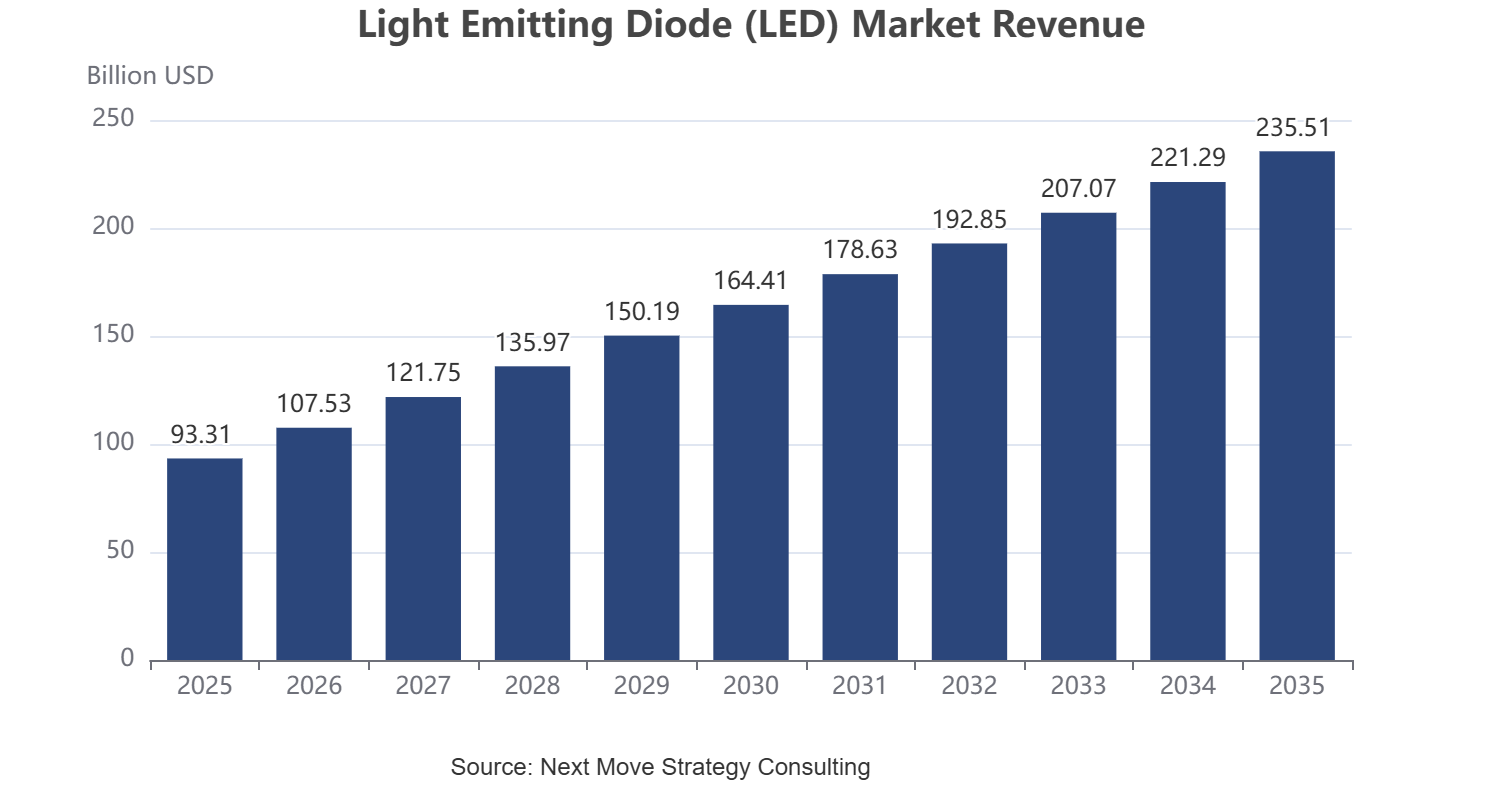
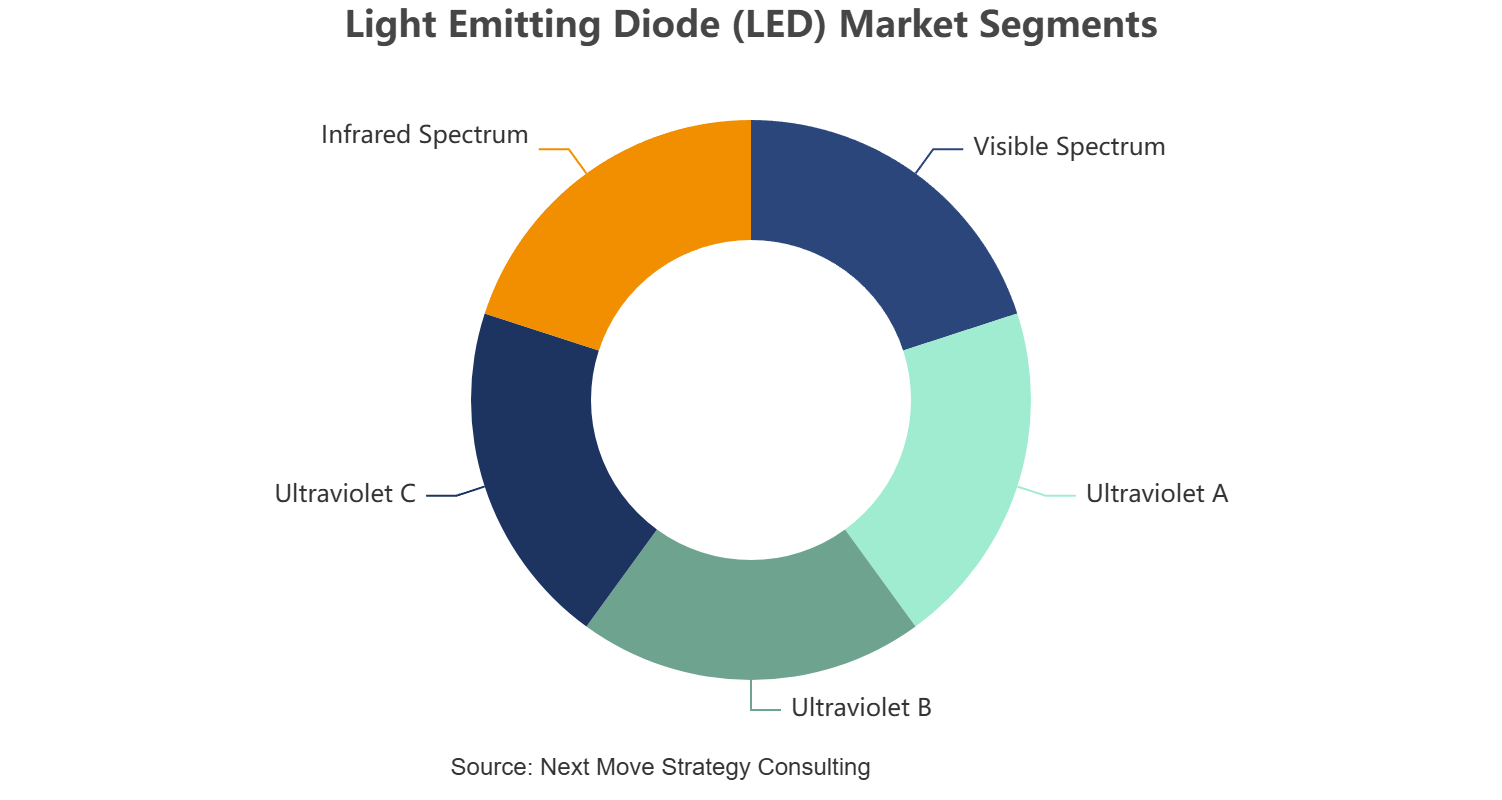
About the Author
 Mayurima Roy
— Mayurima Roy is Research Analyst at Next Move Strategy Consulting, where she has spent 4 years working across the firm's full industry coverage rather than a single fixed vertical. Her work centers on structured research, ongoing trend tracking, competitive assessment, and insight-led content development, translating complex market data into clear, decision-ready narratives that support informed client decision-making across diverse global industries, market sectors, and world regions every day.
Mayurima Roy
— Mayurima Roy is Research Analyst at Next Move Strategy Consulting, where she has spent 4 years working across the firm's full industry coverage rather than a single fixed vertical. Her work centers on structured research, ongoing trend tracking, competitive assessment, and insight-led content development, translating complex market data into clear, decision-ready narratives that support informed client decision-making across diverse global industries, market sectors, and world regions every day.
About the Reviewer
 Supradip Baul
— Supradip Baul is an accomplished business consultant and strategist with over a decade of rich experience in market intelligence, strategy, technology, and business transformation. His work has included rigorous qualitative and quantitative analysis across multiple industries, helping clients shape investment decisions and long-term roadmaps. Earlier in his career, he was associated with Gartner, where he contributed to industry-leading reports and market share analyses. He has worked with leading global companies and holds an MBA with a dual specialization in Marketing and Finance.
Supradip Baul
— Supradip Baul is an accomplished business consultant and strategist with over a decade of rich experience in market intelligence, strategy, technology, and business transformation. His work has included rigorous qualitative and quantitative analysis across multiple industries, helping clients shape investment decisions and long-term roadmaps. Earlier in his career, he was associated with Gartner, where he contributed to industry-leading reports and market share analyses. He has worked with leading global companies and holds an MBA with a dual specialization in Marketing and Finance.
At Next Move Strategy Consulting, we understand that insightful market research is the cornerstone of successful business decisions. That's why we employ a robust and multifaceted approach, combining various methodologies to deliver the most accurate and actionable data for our clients.

Research Landscape
We navigate the world of research with two primary approaches:
Qualitative Approach
Our qualitative research methodologies involve immersive techniques such as in-depth interviews, focus groups, and observational studies. By engaging directly with individuals and stakeholders, we uncover valuable insights that quantitative data alone may overlook.

Quantitative Research
In tandem with qualitative methodologies, NMSC leverages the power of Quantitative Research to provide a robust foundation of numerical insights. Through systematic data collection and analysis, we quantify patterns, preferences, and market trends, offering a comprehensive view of the business landscape.
Our quantitative research approach employs diverse tools, including surveys, experiments, and statistical modelling. These methodologies enable us to gather data from a large and representative sample, ensuring the statistical significance of our findings. By employing structured questionnaires and standardized data collection methods, we guarantee the reliability and validity of the information we present to our clients.
Quantitative research is particularly effective in measuring the prevalence of trends, assessing market size, and gauging the impact of various factors on consumer behavior. The numerical precision attained through this approach equips our clients with actionable insights, facilitating data-driven decision-making and strategy formulation.


Our Specialized Toolbox for Industry-Specific Market Research
We deploy a specialized arsenal of techniques tailored to meet your unique requirements. Here's a glimpse into our comprehensive toolbox:

Information Procurement
The stage entails acquiring market data or relevant information through various sources and methodologies.


Market Research Approach
We utilize both top-down and bottom-up approaches in market research analysis to achieve a comprehensive understanding of the market dynamics, leveraging the broad perspective of industry trends and macroeconomic factors alongside detailed insights from specific segments and individual companies.

Porters Five Forces Analysis
We conduct Porter's Five Forces analysis to evaluate the competitive landscape of an industry, providing us with insights into factors that affect profitability and strategic positioning.

SWOT Analysis

Forecasting
We utilize a forecasting model to predict future consumption by considering parameters like population, economics, regulations, market competition, drivers, constraints, technology, and pricing. We also employ statistical techniques such as multilinear regression, exponential smoothing, moving average, ARIMA, and Monte Carlo simulations for accurate predictions. In econometric forecasting, we analyzed short-term and long-term event impacts, attributing values based on regulatory frameworks, economic factors, and market events.





 Speak to Our Analyst