Medical Claims Processing Services Market Global Industry Analysis and Forecast (2026–2035)

Medical Claims Processing Services Market size was USD 13.36 Billion in 2025, projected to reach USD 34.96 Billion by 2035, growing at a CAGR of 9.44% from 2026 to 2035. Key drivers include rising healthcare claims volume, regulatory mandates for electronic prior authorization, and accelerating adoption of AI-assisted adjudication and cloud-based processing platforms, with North America leading the market.

Download Free Sample PDF
Base Year (2025)
$13.36 Billion
Forecast (2035)
$34.96 Billion
CAGR (2026-2035)
9.4%
Top Region
North America

What Is the Medical Claims Processing Services Market Size?

The global Medical Claims Processing Services Market size reached USD 13.36 Billion in 2025 and is estimated at USD 15.52 Billion in 2026, projected to reach USD 34.96 Billion by 2035 at a CAGR of 9.44% from 2026 to 2035. North America leads with approximately 48% revenue share, while Claims Submission and Clearinghouse Services dominates the service type segment at approximately 28% share in 2025. Third-party administrators handling health insurance claims form a critical sub-layer of this processing ecosystem, further expanding addressable market scope.

We observed that the market is transitioning rapidly from legacy batch-processing and paper-based workflows toward real-time, API-driven, AI-augmented platforms that process claims at higher velocity and lower per-unit cost, reshaping the competitive dynamics between clearinghouse operators, revenue cycle management specialists, and offshore-enabled coding and billing service providers.

Medical Claims Processing Services Market Global Industry Analysis and Forecast (2026–2035) Revenue Forecast

Values in USD Billion

2025 $13.36 Billion
2025
2026 $14.62 Billion
2026
2027 $16.00 Billion
2027
2028 $17.51 Billion
2028
2029 $19.17 Billion
2029
2030 $20.97 Billion
2030
2031 $22.95 Billion
2031
2032 $25.12 Billion
2032
2033 $27.49 Billion
2033
2034 $30.09 Billion
2034
2035 $34.96 Billion
2035

Key Takeaways

By Service Type: Claims Submission and Clearinghouse Services held the largest share, expanding from USD 3.68 Billion in 2025 to USD 9.44 Billion by 2035; Denial Management and Appeals Services is the fastest-growing sub-segment at 10.73% CAGR from 2026–2035.

By Delivery Mode: On-premise Delivery held the largest share in 2025 (USD 5.22 Billion); Cloud-based Delivery is the fastest-growing sub-segment at 13.41% CAGR from 2026–2035.

By End User: Hospitals and Health Systems held the largest share, expanding from USD 4.54 Billion in 2025 to USD 11.74 Billion by 2035; Ambulatory Surgical Centers are the fastest-growing sub-segment at 10.22% CAGR from 2026–2035.

Dominant Region: North America dominated with approximately 48% revenue share in 2025.

Fastest-Growing Region: Asia-Pacific is the fastest-growing region at 10.89% CAGR from 2026–2035.

Dominant Country: The United States led the global Medical Claims Processing Services Market with the highest absolute revenue in 2025.

Fastest-Growing Country: India is the fastest-growing country, driven by national digital health mission mandates and rapid private insurance sector expansion.

The Medical Claims Processing Services Market presents an absolute investment opportunity of USD 19.44 Billion between 2026 and 2035, representing a compelling case for capital deployment across cloud-based processing platforms, AI-driven adjudication engines, and emerging-market revenue cycle infrastructure.

According to NMSC analysis, the convergence of mandatory electronic prior authorization requirements, AI-assisted claim adjudication deployment at scale, and accelerating SaaS adoption is structurally repositioning the market from legacy batch-processing architectures toward real-time, interoperable claim transaction platforms that benefit cloud-focused vendors and predictive denial prevention specialists disproportionately.

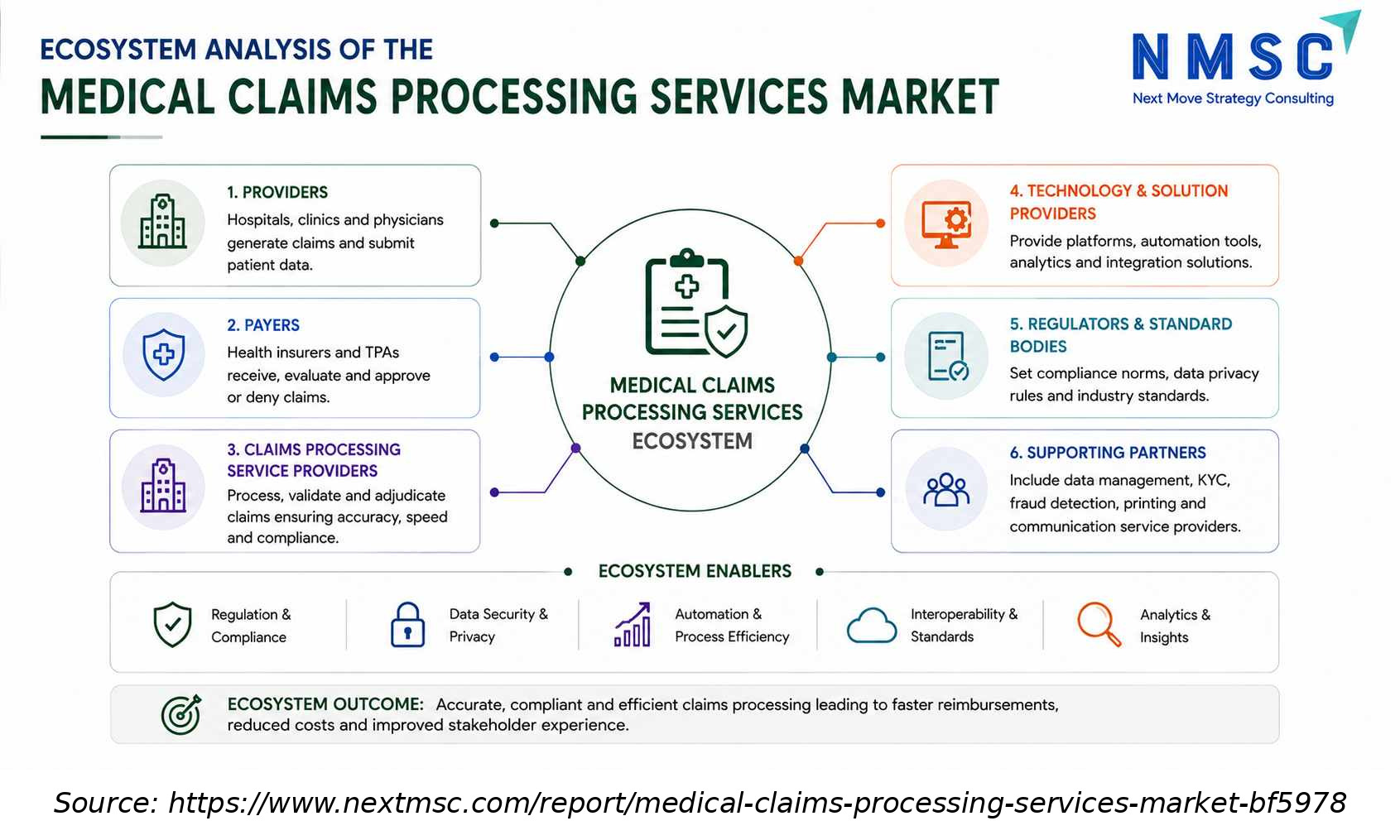
Ecosystem Analysis of the Medical Claims Processing Services Industry

The above infographic provides a detailed ecosystem analysis of the medical claims processing services market, mapping out six key segments from providers and payers to technology and support partners. It illustrates how these stakeholders interact within a connected network to process, validate, and adjudicate claims while ensuring regulatory compliance. The analysis further highlights crucial ecosystem enablers, such as data security, automation, and interoperability, that drive efficiency. Ultimately, it demonstrates how this interconnected chain leads to faster reimbursements, reduced costs, and an improved overall stakeholder experience.

What Does the Medical Claims Processing Services Market Encompass?

The Medical Claims Processing Services Market covers the full lifecycle of healthcare insurance claim management, encompassing submission, scrubbing, adjudication, medical coding, prior authorization, denial management, and payment remittance activities delivered by specialized vendors, clearinghouses, and revenue cycle management companies to hospitals, physician practices, insurance payers, ambulatory surgical centers, and third-party administrators. Market scope excludes adjacent pharmaceutical billing and supply-chain reimbursement activities, maintaining a clean boundary aligned with payer-to-provider claim transaction flows across commercial, government, and self-insured plan segments.

The market evolved from paper-intensive manual processing toward electronic data interchange (EDI)-based clearinghouse models in the 1990s, and has since advanced toward SaaS-delivered, AI-augmented platforms enabling real-time adjudication, predictive denial prevention, and automated prior authorization. Regulatory frameworks including HIPAA standard transaction code sets, the No Surprises Act, and CMS interoperability mandates are compelling providers and payers to upgrade processing infrastructure, while the shift toward value-based care is expanding the analytical complexity of claim validation and coding accuracy requirements across every market segment covered in this market report.

Market Drivers & Dynamics

Interactive Dataset
Rising healthcare claims volume from aging populations and expanding insurance enrollment driver +2.8% Global 2026–2035
Regulatory mandates for electronic prior authorization and HIPAA standard transaction formats driver +2.1% North America, Europe 2026–2032
Accelerating SaaS and AI platform adoption for real-time adjudication and medical coding driver +1.9% Global 2026–2033
Expansion of government-funded health insurance programs (Medicare, Medicaid, national schemes) driver +1.3% North America, Asia-Pacific 2026–2035
Digital health and telemedicine expansion generating new claim type complexity and volume driver +0.8% Global 2026–2030
Healthcare cybersecurity risks and HIPAA compliance cost escalating vendor operating overhead restraint −1.2% Global 2026–2035
High implementation cost and legacy system integration complexity for smaller providers restraint −0.9% MEA, Latin America 2026–2031
Payer reluctance to outsource adjudication of complex and high-cost specialty claims restraint −0.6% North America, Europe 2026–2030
Shortage of certified medical coders limiting coding services throughput capacity restraint −0.4% Global 2026–2028
Source: Next Move Strategy Consulting

Growth Drivers

What Is the Primary Growth Driver in the Market?

The primary driver is rising healthcare claims volume generated by aging populations and expanding insurance enrollment globally, creating demand for scalable, technology-enabled processing infrastructure. The U.S. Centers for Medicare and Medicaid Services projected that national health expenditure will reach USD 7.7 trillion by 2032, with physician and clinical services representing the fastest-growing spending category directly producing claims transactions. Government insurance program expansion, including Medicaid eligibility extensions under the Affordable Care Act, has materially increased claims pipeline volume entering automated and manual adjudication pathways across the industry.

How Is Digital Health Expansion Driving Medical Claims Processing Market Growth?

The expansion of telemedicine services and digital health delivery has structurally increased the complexity and volume of medical claims requiring specialized processing, as new current procedural terminology codes for telehealth encounters, remote patient monitoring, and digital therapeutics demand updated coding protocols and payer-specific adjudication rules. The U.S. Department of Health and Human Services confirmed sustained telehealth utilization post-COVID-19 public health emergency, embedding digital health claims as a durable growth vector for the Medical Claims Processing Services Market. Payers managing hybrid in-person and digital claim populations are accelerating procurement of AI-assisted coding platforms capable of handling expanded code sets.

Growth Inhibitors

What Is Restraining the Medical Claims Processing Services Market?

Healthcare cybersecurity risks represent the most consequential operational restraint, given that medical claims data contains protected health information (PHI) subject to HIPAA breach notification requirements, exposing processing vendors to significant regulatory and reputational liability. The U.S. Department of Health and Human Services Office for Civil Rights received reports of data breaches affecting over 133 million individuals in 2023 alone, and the February 2024 healthcare cybersecurity breach at Change Healthcare demonstrated the systemic fragility of claims processing infrastructure. Compliance investment required to maintain HIPAA, SOC 2, and HITRUST certification programs is materially increasing vendor operating costs, particularly for mid-market processors serving multi-payer environments.

Segmentation Analysis

2025 (USD Billion)
2035 (USD Billion)
Claims Submission and Clearinghouse Services 2025: $3.68 Billion | 2035: $9.44 Billion
Claims Submi
Claims Adjudication Services 2025: $3.36 Billion | 2035: $8.74 Billion
Claims Adjud
Medical Coding Services 2025: $2.47 Billion | 2035: $6.64 Billion
Medical Codi
Prior Authorization Services 2025: $1.60 Billion | 2035: $4.18 Billion
Prior Author
Denial Management and Appeals Services 2025: $1.20 Billion | 2035: $3.49 Billion
Denial Manag
Payment Processing and Remittance Services 2025: $1.05 Billion | 2035: $2.47 Billion
Payment Proc
Claims Submission and Clearinghouse Services $3.68 Billion $9.44 Billion 9.22%
Claims Adjudication Services $3.36 Billion $8.74 Billion 9.38%
Medical Coding Services $2.47 Billion $6.64 Billion 9.77%
Prior Authorization Services $1.60 Billion $4.18 Billion 9.43%
Denial Management and Appeals Services $1.20 Billion $3.49 Billion 10.73%
Payment Processing and Remittance Services $1.05 Billion $2.47 Billion 8.16%

Which Service Type Segment Dominates and Which Grows Fastest?

Claims Submission and Clearinghouse Services leads the Medical Claims Processing Services Market at USD 3.68 Billion in 2025, driven by the volume-intensive nature of electronic claim transmission, scrubbing, and payer routing that forms the foundational transaction layer of the entire claims value chain. Denial Management and Appeals Services is the fastest-growing segment at a 10.73% CAGR from 2026 to 2035, reflecting provider organizations' intensifying strategic focus on preventing revenue leakage through predictive analytics rather than reactive manual appeals, a shift that is generating sustained technology procurement investment across hospital and ambulatory care settings.

2025 (USD Billion)
2035 (USD Billion)
Cloud-based
On-premise D
Hybrid Deliv
Segment Item 2025 (USD Billion) 2035 (USD Billion) CAGR
Cloud-based (SaaS) Delivery $10.0 USD Billion $40.0 USD Billion 26.0%
On-premise Delivery $17.1 USD Billion $51.1 USD Billion 12.0%
Hybrid Delivery $24.2 USD Billion $62.2 USD Billion 14.0%

Segment-wise data is locked

Unlock complete segment-wise numbers for By Delivery Mode.

Unlock Full Data

Which Delivery Mode Leads and Which Grows Fastest?

On-premise Delivery held the largest share at USD 5.22 Billion in 2025, reflecting the prevalence of legacy payer and hospital enterprise systems requiring local data hosting due to historical data sovereignty preferences and security policy constraints. Cloud-based (SaaS) Delivery is the fastest-growing mode at a 13.41% CAGR from 2026 to 2035, driven by lower total cost of ownership, faster deployment cycles, and the ability to deliver real-time payer connectivity updates and AI model improvements without on-site infrastructure upgrades, increasingly winning new contracts over on-premises alternatives in both commercial and government plan processing segments.

2025 (USD Billion)
2035 (USD Billion)
Hospitals an
Insurance Pa
Physician Pr
Ambulatory S
Third-Party
Segment Item 2025 (USD Billion) 2035 (USD Billion) CAGR
Hospitals and Health Systems $10.0 USD Billion $40.0 USD Billion 26.0%
Insurance Payers and Health Plans $17.1 USD Billion $51.1 USD Billion 16.0%
Physician Practices and Clinics $24.2 USD Billion $62.2 USD Billion 18.0%
Ambulatory Surgical Centers $31.3 USD Billion $73.3 USD Billion 8.0%
Third-Party Administrators $38.4 USD Billion $84.4 USD Billion 23.0%

Segment-wise data is locked

Unlock complete segment-wise numbers for By End User.

Unlock Full Data

Which End User Segment Leads and Which Grows Fastest?

Hospitals and Health Systems dominate end-user demand at USD 4.54 Billion in 2025, reflecting the high claim volume, payer mix complexity, and regulatory compliance requirements that characterize inpatient and outpatient facility billing. Ambulatory Surgical Centers are the fastest-growing end user at a 10.22% CAGR from 2026 to 2035, as the structural shift of surgical procedures from inpatient hospital settings to outpatient ambulatory facilities generates rising claim volume with distinct coding and prior authorization needs. Expanding home healthcare services delivery is also contributing incremental claim complexity as remote care encounters enter standard billing workflows.

Growth Opportunities

Our analysis shows that three structurally significant whitespace opportunities exist for technology vendors, service providers, and investors positioning ahead of the Medical Claims Processing Services Market's 2035 forecast horizon.

Can AI-Driven Prior Authorization Platforms Unlock Significant Revenue for Technology Vendors?

Electronic prior authorization mandates from CMS and state-level payers are creating a structural procurement wave for AI-powered ePA platforms delivering real-time authorization decisions bidirectionally between providers and payers. Technology vendors offering ePA solutions integrated with EHR systems stand to capture significant revenue within the Prior Authorization Services segment, projected to expand from USD 1.60 Billion in 2025 to USD 4.18 Billion by 2035. Platforms enabling real-time payer-provider communication without manual intervention represent the clearest value proposition where administrative burden reduction is the primary procurement decision criterion.

Does Cloud-Based Claims Processing Adoption in Emerging Markets Create a Scalable White-Space Opportunity?

Healthcare insurance formalization across Asia-Pacific and the Middle East & Africa is generating rapid claims transaction volume growth that existing on-premise infrastructure cannot efficiently absorb, creating immediate demand for cloud-native processing platforms requiring minimal capital expenditure to deploy. Our assessment indicates that cloud-based (SaaS) Delivery is forecast to reach USD 18.32 Billion by 2035, with emerging market adoption contributing disproportionate growth versus mature North American deployment. Vendors adapting HIPAA-equivalent security controls to local regulatory frameworks in India, Saudi Arabia, and Brazil are best positioned to capture first-mover cloud adoption advantages in underserved claim processing markets.

How Can Predictive Denial Prevention Analytics Generate Sustainable Competitive Advantage?

The Denial Management and Appeals Services segment is the fastest-growing service type at a 10.73% CAGR from 2026 to 2035, driven by provider organizations shifting from reactive appeals management to proactive predictive denial prevention that reduces revenue leakage at the point of claim submission. Analytics platforms integrating payer-policy intelligence, clinical documentation completeness scoring, and eligibility verification into pre-submission workflows are demonstrating denial rate reductions of 20 to 35 percent in large U.S. health system implementations. Our findings suggest that vendors delivering quantifiable ROI through denial rate reduction are commanding premium pricing and securing multi-year contract renewals across hospital and ambulatory care end users.

Regional Outlook

2025 (USD Billion)
2035 (USD Billion)
North Americ
Europe
Asia-Pacific
Middle East
Latin Americ
Region 2025 (USD Billion) 2035 (USD Billion) CAGR (%)
North America $10.0 USD Billion $40.0 USD Billion 9.0%
Europe $17.1 USD Billion $51.1 USD Billion 27.0%
Asia-Pacific $24.2 USD Billion $62.2 USD Billion 25.0%
Middle East & Africa $31.3 USD Billion $73.3 USD Billion 23.0%
Latin America $38.4 USD Billion $84.4 USD Billion 12.0%

Regional data is locked

Unlock complete regional numbers for this market.

Unlock Full Data

Competitive Landscape

Our findings suggest that the Medical Claims Processing Services Market is shaped by a combination of large-scale clearinghouse technology platforms, vertically integrated revenue cycle management companies, offshore-enabled coding and billing service providers, and AI-native analytics specialists competing across distinct functional segments and end-user categories within the broader claims processing industry.

Dimension Description
Dimension Assessment
Market Structure Moderately concentrated at enterprise and large health system segments; highly competitive among mid-market SaaS platform vendors; U.S.-based clearinghouses handling over 90% of domestic electronic claims transactions through a limited number of dominant network hubs, with top-10 vendors accounting for a majority of total market revenue
Innovation Focus AI-assisted claim adjudication and auto-adjudication optimization, real-time electronic prior authorization, predictive denial prevention analytics, natural language processing for medical coding automation, interoperable API-based claim exchange, and cloud-native SaaS platform scalability
M&A Activity Private equity-backed roll-up consolidation of mid-market RCM service providers, AI and analytics capability tuck-in acquisitions, strategic partnerships between clearinghouses and EHR vendors embedding claims processing into clinical workflow platforms, and international expansion acquisitions targeting emerging market coding and billing BPO capacity

How Do Companies Compete in the Medical Claims Processing Services Industry?

Companies compete on claims processing accuracy rates, auto-adjudication ratios, HIPAA compliance certification levels, payer network connectivity breadth, and depth of EHR system integrations. We found that vendors maintaining verified real-time connectivity to the largest commercial and government payer networks command contract renewal advantages at incumbent clients, particularly when offering bundled eligibility verification, prior authorization, and adjudication capabilities that reduce the number of vendor relationships a provider organization must manage.

Which Competitive Archetypes Dominate the Medical Claims Processing Services Market?

Clearinghouse-anchored technology platforms, including those operated by UnitedHealth Group, Inc. through its Optum and Change Healthcare divisions, and Availity, LLC, dominate by network connectivity scale and payer relationship breadth. Specialized RCM platform companies including R1 RCM, Inc. and Waystar Health, Inc. differentiate through end-to-end revenue cycle management depth. Offshore-enabled BPO providers including GeBBS Healthcare Solutions, Inc. and Omega Healthcare Management Services Ltd. compete through cost-competitive staffed coding, denial management, and billing operations for mid-size providers seeking to outsource labor-intensive claim lifecycle functions.

What Innovation and Differentiation Strategies Are Companies Pursuing?

Leading vendors are deploying large-language models for clinical documentation analysis, training payer-policy AI models that predict coverage determination outcomes before claim submission, and embedding claims management natively into EHR clinical workflows. Healthcare identity and access management infrastructure is becoming a competitive differentiator for vendors managing multi-payer, multi-provider environments requiring secure, auditable claim data access controls and single-sign-on authentication at enterprise scale. Vendors that invest in interoperable FHIR API-based claim exchange are capturing disproportionate contract wins as CMS interoperability mandates take effect.

What M&A and Partnership Activity Is Shaping the Medical Claims Processing Services Market?

M&A activity is concentrated in private equity-backed consolidation of mid-market RCM service providers, technology capability acquisitions targeting AI coding and prior authorization automation, and strategic partnerships between clearinghouses and EHR vendors to embed claims processing directly into clinical workflow systems. Our analysis shows that Waystar Health, Inc.'s 2024 IPO and continued integration of legacy claims processing assets reflect the scale-driven platform consolidation replacing point-solution providers across the revenue cycle. International expansion acquisitions targeting offshore coding and billing capacity in India and the Philippines are an additional M&A vector among North American RCM platform companies.

Competitive Dynamics and M&A Landscape

Recent strategic moves, partnerships, and acquisitions shaping the Medical Claims Processing Services Market Global Industry Analysis and Forecast (2026–2035).

September 2026 Oracle Health Product Launch / AI Capability Oracle Health announced new AI capabilities across its revenue cycle management portfolio, designed to identify reimbursement risks earlier across scheduling, financial clearance, clinical documentation, charge capture, billing, and payment.
August 2026 Waystar Product Launch / Agentic Capabilities Waystar launched new AltitudeAI agentic capabilities that autonomously execute work across revenue-cycle workflows. The capabilities are built on Waystar's payment platform and payer connectivity and are designed to move revenue-cycle processes from AI-assisted insight toward automated execution.

Key Market Players

During our market evaluation, we noticed that the 20 companies listed below represent the validated set of leading providers across clearinghouse operations, RCM platform technology, medical coding services, prior authorization management, and denial analytics within the Medical Claims Processing Services Market Industry.

UnitedHealth Group, Inc. Cognizant Technology Solutions Corporation Oracle Corporation R1 RCM, Inc. Waystar Health, Inc. Claritev Corporation Cotiviti, Inc. Availity, LLC Experian plc Athenahealth, Inc. GeBBS Healthcare Solutions, Inc. Omega Healthcare Management Services Ltd. AGS Health, LLC Conifer Health Solutions, LLC Epic Systems Corporation Netsmart Technologies, Inc. SS&C Technologies Holdings, Inc. Veradigm Inc. Inovalon Holdings, Inc. eClinicalWorks LLC

Latest Developments

Our analysis shows that recent developments in the Medical Claims Processing Services Market underscore the sector's heightened focus on cybersecurity resilience, regulatory compliance technology, and platform consolidation following a period of significant market disruption and regulatory activity.

Date Event
September 2026 Oracle Health announced new AI capabilities across its revenue cycle management portfolio, designed to identify reimbursement risks earlier across scheduling, financial clearance, clinical documentation, charge capture, billing, and payment.

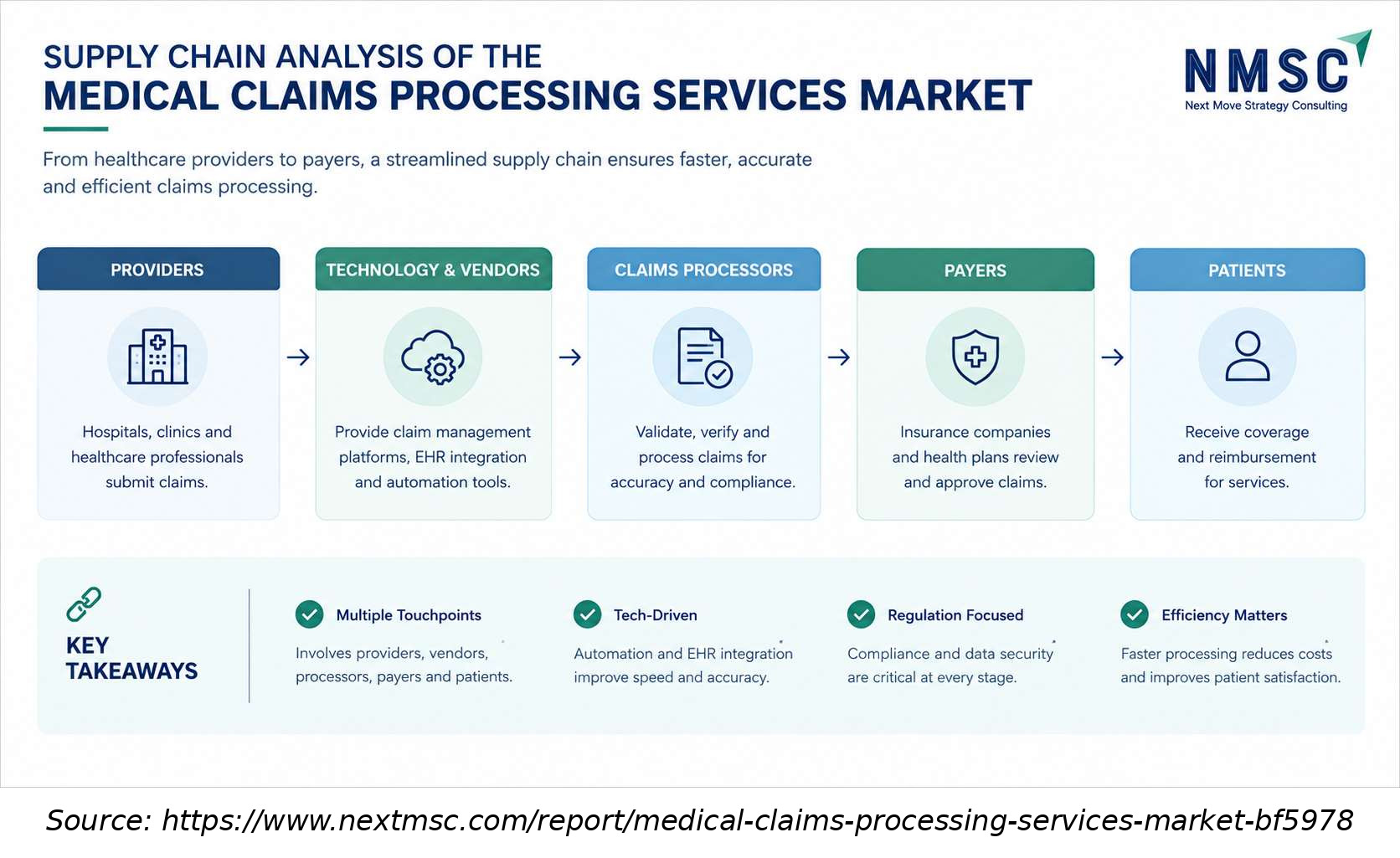
Supply Chain Analysis of the Medical Claims Processing Services Industry

Supply Chain Analysis of the Medical Claims Processing Services Industry
The above infographic provides a detailed supply chain analysis of the medical claims processing services market, outlining a five-step flow from healthcare providers to patients. It traces the process from initial claim submission through technology integration, processing, and payer approval to final reimbursement. The analysis highlights that this is a tech-driven and regulation-focused system where automation and EHR integration are critical for accuracy. Ultimately, it concludes that a streamlined supply chain is essential for reducing costs, ensuring compliance, and improving overall patient satisfaction.

Investment Opportunities

Where Are Capital Inflows Concentrating in the Medical Claims Processing Services Market?

Capital concentration is highest in AI-driven revenue cycle management platform companies, with private equity and growth equity investors executing roll-up strategies that aggregate mid-market coding, prior authorization, denial management, and clearinghouse service providers into unified, full-lifecycle claim management platforms. Waystar Health, Inc.'s 2024 IPO and R1 RCM, Inc.'s go-private transaction both reflect investor conviction in the scalable software economics of tech-enabled claims processing relative to labor-only service models. Early-stage venture capital is additionally flowing into standalone AI claim adjudication and ePA technology startups targeting the automation of the highest-friction nodes in the claim processing workflow.

How Is Infrastructure Investment Shaping Medical Claims Processing Capacity?

Infrastructure investment is concentrating on cloud-native clearinghouse platform modernization, FHIR API interoperability layer development, and enterprise-grade cybersecurity hardening following the systemic exposure demonstrated by the February 2024 clearinghouse disruption event. Our analysis shows that the U.S. Department of Health and Human Services has directed attention and informal guidance toward claims processing infrastructure redundancy, creating procurement conversations at large payer organizations about establishing multi-clearinghouse routing capability as an operational resilience standard. This investment cycle is accelerating the market's transition from monolithic on-premise processing to resilient, cloud-distributed claim transaction architecture.

What ESG Considerations Are Influencing Investment in the Medical Claims Processing Services Market?

Environmental, Social, and Governance considerations are shaping Medical Claims Processing Services Market investment through healthcare equity mandates that require processing platforms to support multilingual member communications, accessibility-compliant explanation of benefits delivery, and non-discriminatory prior authorization algorithm governance. We found that institutional investors applying ESG screens are assigning positive governance scores to processing vendors with transparent AI model auditing practices and bias detection protocols for adjudication and coding AI, reflecting growing payer and regulatory concern about algorithmic discrimination in coverage determination workflows. Data center energy efficiency is additionally entering ESG evaluation criteria for cloud-based processing infrastructure providers.
Key Benefits for Stakeholders

How Does This Report Benefit Industry Leaders?

Industry leaders gain service-type, delivery mode, and end-user segment revenue forecasts and CAGR benchmarks grounded in the consistent 2025–2035 figures used throughout this analysis, enabling precise capacity planning, technology investment prioritization, and go-to-market sequencing decisions. Regional growth differentials across 38 countries further inform geographic expansion, payer partnership origination, and regulatory engagement priorities for processing platform operators, BPO service providers, and clearinghouse network managers.

How Does This Report Benefit Investors and Financial Analysts?

Investors and financial analysts gain a reconciled market-sizing model, competitive-landscape assessment, and named-company positioning intelligence that supports due diligence for acquisition, growth equity, and public market investment decisions across the RCM platform, clearinghouse, medical coding BPO, and AI adjudication company universe. The Growth Catalyst & Risk Assessment Matrix quantifies driver and restraint impact on CAGR, directly supporting portfolio scenario analysis for the USD 19.44 Billion absolute market opportunity created between 2026 and 2035.

How Does This Report Benefit Technology Vendors and Product Teams?

Technology vendors and product teams gain visibility into which segments are growing fastest: Cloud-based Delivery at 13.41% CAGR, Denial Management and Appeals Services at 10.73% CAGR, and Ambulatory Surgical Centers end users at 10.22% CAGR, informing product roadmap prioritization and partnership strategy across EHR integration, AI adjudication, and electronic prior authorization capability investments. Competitive landscape intelligence on M&A activity and platform differentiation strategy provides directional signal for positioning cloud, AI, and interoperability offerings against the evolving procurement patterns of large health systems and commercial payers.

Key Market Segments Evaluated

By Service Type

  • Claims Submission and Clearinghouse Services 
    • Electronic Data Interchange (EDI) submission
    • Paper-to-digital claim conversion
    • Claim scrubbing and validation
    • Clearinghouse connectivity services
  • Claims Adjudication Services 
    • Automated claim adjudication
    • Manual review and adjudication
    • Real-time adjudication
  • Medical Coding Services 
    • Inpatient medical coding
    • Outpatient medical coding
    • Professional fee coding
    • Specialty coding
  • Prior Authorization Services 
    • Electronic prior authorization
    • Telephonic and manual prior authorization
    • Utilization review services
  • Denial Management and Appeals Services 
    • Denial prevention analytics
    • Claims resubmission services
    • Appeals management
  • Payment Processing and Remittance Services 
    • Electronic remittance advice (ERA) processing
    • Explanation of benefits (EOB) management
    • Payment posting and reconciliation

By Delivery Mode

  • Cloud-based (SaaS) Delivery
  • On-premise Delivery
  • Hybrid Delivery

By End User

  • Hospitals and Health Systems
  • Insurance Payers and Health Plans
  • Physician Practices and Clinics
  • Ambulatory Surgical Centers
  • Third-Party Administrators
  • Other End Users

By Region

  • North America 
    • U.S.
    • Canada
    • Mexico
  • Europe 
    • UK
    • Germany
    • France
    • Italy
    • Spain
    • Sweden
    • Denmark
    • Finland
    • Netherlands
    • Rest of Europe
  • Asia-Pacific 
    • China
    • India
    • Japan
    • South Korea
    • Taiwan
    • Indonesia
    • Vietnam
    • Australia
    • Philippines
    • Malaysia
    • Rest of APAC
  • Middle East & Africa 
    • Saudi Arabia
    • UAE
    • Egypt
    • Israel
    • Turkey
    • Nigeria
    • South Africa
    • Rest of MEA
  • Latin America 
    • Brazil
    • Argentina
    • Chile
    • Colombia
    • Rest of LATAM

Conclusion & Recommendations

The long-term outlook for the Medical Claims Processing Services Market is structurally positive, with the market expanding from USD 15.52 Billion in 2026 to USD 34.96 Billion by 2035 at a 9.44% CAGR, driven by rising claims volume, regulatory mandates for electronic processing, and AI-driven automation adoption. We observed that this growth trajectory is underpinned by durable demand-side fundamentals, aging populations, expanding insurance enrollment, and increasing healthcare utilization, that make the market's growth scenario resilient across varying macroeconomic conditions through the full 2035 forecast window.

What Strategic Positioning Do We Recommend?

Our assessment indicates that technology vendors and service providers should prioritize investments in electronic prior authorization integration, AI-assisted adjudication, and cloud-native SaaS delivery capabilities, which are the three fastest-growing value propositions in the market based on NMSC's segmentation analysis. Companies without established real-time payer network connectivity should pursue strategic clearinghouse partnerships rather than attempting to build proprietary networks, given the structural switching costs and regulatory compliance investment required to achieve competitive connectivity breadth in established markets.

How Attractive Is the Medical Claims Processing Services Market for Investment?

Investment attractiveness is highest in Asia-Pacific at 10.89% CAGR and MEA at 10.06% CAGR, where first-generation claims processing infrastructure deployment is creating greenfield platform adoption opportunities distinct from the replacement-cycle dynamics characterizing North America and Europe. Within service type segments, Denial Management and Appeals Services at 10.73% CAGR and Cloud-based Delivery at 13.41% CAGR offer the strongest near-term investment thesis, combining above-average growth with defensible software economics and multi-year contract structures that support durable enterprise valuations.

What Are the Key Market Shifts and Risks?

Key risks include concentration of clearinghouse operations among a small number of providers, as demonstrated by the systemic disruption of the February 2024 cyberattack event, alongside regulatory compliance cost escalation stemming from HIPAA, HITRUST, and state-level privacy law requirements. Our analysis shows that companies unable to achieve enterprise-grade cybersecurity posture risk exclusion from large payer and hospital procurement processes, while those over-dependent on labor-arbitrage offshore coding models face margin compression as AI-assisted coding automation displaces manual labor components of the medical coding services segment.

What Are the Primary Growth Pathways Through 2035?

Primary growth pathways include electronic prior authorization platform deployment ahead of CMS January 2027 mandate compliance deadlines, cloud-based SaaS claims processing expansion in Asia-Pacific and MEA where insurance formalization is driving first-time platform adoption, and predictive denial prevention analytics monetization at large health systems executing value-based care contracts. We observed that vendors combining real-time clearinghouse connectivity with AI-driven adjudication, denial prevention, and coding automation into unified platforms are best positioned to capture the USD 19.44 Billion absolute market opportunity created between 2026 and 2035.

FAQs

Expert Insights

Steve Johnson

Steve Johnson

Chief Financial Officer | Marpai

"Employers are looking for every opportunity to manage rising healthcare costs while continuing to provide strong benefits for their employees. Expanding our relationship with Claritev gives us access to a broader set of capabilities that can help improve claim payment accuracy, identify meaningful savings, and deliver greater value for our clients."

Analyst Interpretation

We observed that the growing focus on healthcare cost management is increasing demand for claims processing services that extend beyond basic claim submission and adjudication toward comprehensive payment accuracy and integrity. NMSC’s analysis indicates that pre- and post-payment validation, automated claim review, advanced analytics, and specialized clinical review are strengthening the value proposition of medical claims processing services by helping identify billing errors, inappropriate payments, and savings opportunities across the claims lifecycle. This shift is also encouraging payers, third-party administrators, and employer-sponsored health plans to adopt integrated claims management solutions that combine technology, analytics, and domain expertise to improve payment accuracy and streamline reimbursement processes.

About the Author

Mayurima Roy

Mayurima Roy

Mayurima Roy is Research Analyst at Next Move Strategy Consulting, where she has spent 4 years working across the firm's full industry coverage rather than a single fixed vertical. Her work centers on structured research, ongoing trend tracking, competitive assessment, and insight-led content development, translating complex market data into clear, decision-ready narratives that support informed client decision-making across diverse global industries, market sectors, and world regions every day.

About the Reviewer

Supradip Baul

Supradip Baul

Supradip Baul is an accomplished business consultant and strategist with over a decade of rich experience in market intelligence, strategy, technology, and business transformation. His work has included rigorous qualitative and quantitative analysis across multiple industries, helping clients shape investment decisions and long-term roadmaps. Earlier in his career, he was associated with Gartner, where he contributed to industry-leading reports and market share analyses. He has worked with leading global companies and holds an MBA with a dual specialization in Marketing and Finance.

Download Free Sample

Diana Trejo

DIANA TREJO

Assistant Manager

Sumitomo Corporation de Mexico, S.A. de C.V.

Recently, we purchased a report on the Mexico Data Center Market from Next Move Strategy Consulting. The service has been excellent, with support that is always timely and thoroughly professional. The information provided is interesting, highly useful, and delivered with clarity. I would highly recommend NextMSC for anyone seeking insightful and dependable analysis.

Nishant Awate

NISHANT AWATE

Business Development Global Sales

Zehnder Group Deutschland GmbH

Our experience working with Next Move Strategy Consulting was positive. The team was responsive, professional, and open to incorporating our specific requirements throughout the project. The India AHU market study was comprehensive and well structured, covering market value and volume forecasts, product and application segments, and key industry trends. The inclusion of both AHU and residential MVHR market insights made the study particularly relevant for our strategic market assessment. Overall, the report provides a solid foundation for evaluating market potential, identifying priority segments, and supporting business-development decisions in India.

Rishabh Jogani

RISHABH JOGANI

Strategy Analyst

Accenture Japan

We are incredibly impressed with the market report on the real estate market in India provided by Next Move Strategy Consulting. The report was thorough, insightful, and well-structured, offering deep analysis and actionable recommendations. It not only captured the current trends and dynamics but also provided a forward-looking perspective that has been invaluable for our strategic planning. Their team demonstrated exceptional professionalism, attention to detail, and a profound understanding of the industry. The data-driven insights and clarity of presentation exceeded our expectations, making complex market trends easy to understand. We highly recommend Next Move Strategy Consulting to anyone looking for reliable and comprehensive market research services. Their expertise has given us the confidence to navigate the complexities of the Indian real estate market with clarity and foresight.

Gaurav Jaiswal

GAURAV JAISWAL

Founder & CEO

Yano Charge Private Limited

The EV Charging market research report provided by the NextMSC was exceptionally detailed and insightful. It offered a comprehensive analysis that proved to be a game-changer for our strategic planning. Truly a testament to the NextMSC’s expertise and thoroughness in EV market landscape & analysis.

Gustaf Hummel Burstrom

GUSTAF HUMMEL BURSTROM

Founder

Revline Tools AB

Joseph and the team at Next Move Strategy Consulting have been excellent to work with, in supplying us with relevant market data and forecasts for our specific category. We had some special requirements and they were able to do a custom package to suit our needs. We would definitely recommend them to any other company needing market data and forecasts

Custom Market Research Services

We will customize the research for you if the listed report does not fully match your requirements.

Get 30% Free Customization

Select License

This website uses cookies to ensure you get the best experience on our website. Learn more

✖