Meeting Solutions Market Global Industry Analysis and Forecast (2026–2035)

Meeting Solutions Market size was USD 17.26 Billion in 2025, projected to reach USD 39.24 Billion by 2035, growing at a CAGR of 8.11% from 2026 to 2035. Key drivers include rising adoption of hybrid and remote work models across enterprise organizations, expanding AI-powered meeting intelligence capabilities embedded within leading cloud platforms, and growing enterprise demand for integrated room systems and cloud-based device management, with North America leading the market.

Download Free Sample PDF
Base Year (2025)
$17.26 Billion
Forecast (2035)
$39.24 Billion
CAGR (2026-2035)
8.1%
Top Region
North America

Market Size & Forecast

Meeting Solutions Market Global Industry Analysis and Forecast (2026–2035) Revenue Forecast

Values in USD Billion

2025 $17.26 Billion
2025
2026 $18.66 Billion
2026
2027 $20.17 Billion
2027
2028 $21.81 Billion
2028
2029 $23.58 Billion
2029
2030 $25.49 Billion
2030
2031 $27.56 Billion
2031
2032 $29.79 Billion
2032
2033 $32.21 Billion
2033
2034 $34.82 Billion
2034
2035 $39.24 Billion
2035

Key Takeaways

Dimension | Assessment

Market Structure | Moderately concentrated; top 10 companies hold the majority of market share, led by an integrated cloud platform leader alongside established hardware specialists and regional software providers

Innovation Focus | AI-powered meeting intelligence, integrated room ecosystem management, cloud-native device management, and hybrid work parity-of-experience hardware engineering

M&A Activity | Selective capability acquisitions and platform integration partnerships rather than large-scale consolidation; organic innovation investment remains the dominant competitive posture among established vendors

How Do Companies Compete in the Meeting Solutions Market Industry?

Companies compete primarily on platform integration breadth spanning hardware, software, and services, depth of AI capability embedded within meeting workflows, and strength of enterprise and multi-site account relationships. Our findings suggest that vendors with full-stack ecosystems spanning room hardware, cloud management software, and AI-assisted meeting intelligence hold a structural advantage over single-category competitors, as enterprise IT buyers evaluate meeting solutions on end-to-end workflow coverage rather than individual product performance metrics.

Which Competitive Archetypes Dominate the Meeting Solutions Market Industry?

Diversified cloud platform leaders such as Zoom, Cisco, and Microsoft dominate through integrated meeting, room management, and AI productivity ecosystems. Specialized hardware vendors including Logitech, HP, and Yealink differentiate through focused room system and audio engineering expertise. Niche software and interoperability providers such as Pexip and Barco compete on platform-agnostic compatibility and purpose-built visual collaboration capabilities. Vendors advancing [enterprise mobility](https: //www.nextmsc.com/report/enterprise-mobility-market) management integrations are gaining traction among organizations deploying meeting solutions across distributed workforces requiring unified device and endpoint management.

What Innovation and Differentiation Strategies Are Companies Pursuing?

We observed that leading companies are investing in [generative AI](https: //www.nextmsc.com/report/generative-ai-market) meeting assistants and automated transcription to convert meeting infrastructure into productivity software, increasing the defensibility of subscription revenue streams. Differentiation increasingly rests on integrated device ecosystem breadth, as enterprise buyers evaluate vendors on their ability to manage hardware, software, and user experience from a unified administrative console, reducing IT overhead while improving room availability and compliance metrics across large enterprise estates.

What M&A and Partnership Activity Is Shaping the Meeting Solutions Market?

Our assessment indicates that recent activity favors organic platform capability expansion over large-scale acquisitions, with vendors deepening integrations between room hardware, cloud management, and AI analytics layers. Strategic partnerships between hardware specialists such as Logitech and platform vendors including Microsoft and Google exemplify how the competitive landscape is consolidating around interoperability commitments rather than hardware exclusivity, reflecting enterprise buyers' preference for platform-certified hardware ecosystems that reduce deployment risk.

Key Market Players

Based on research conducted by NMSC, the following companies represent the validated set of leading participants across meeting hardware, software platforms, and professional and managed services within the Meeting Solutions Market.

[Zoom Communications, Inc.](https: //www.zoom.com/en/products/virtual-meetings/)

[Cisco Systems, Inc.](https: //www.cisco.com/site/us/en/products/collaboration/index.html)

Microsoft Corporation

Google LLC

Logitech International S.A.

HP Inc.

Huawei Technologies Co., Ltd.

GN Store Nord A/S

Lenovo Group Limited

Yealink Network Technology Corporation Limited

Barco NV

Crestron Electronics, Inc.

Shure Incorporated

Sennheiser electronic SE & Co. KG

QSC, LLC

Biamp Systems, LLC

Pexip AS

AVer Information Inc.

RingCentral, Inc.

8x8, Inc.

Latest Developments

We found that recent corporate activity reflects continued AI capability expansion and sustained digital platform investment across the Meeting Solutions Market, with leading vendors prioritizing intelligence layer development and interoperability certification.

Date | Event

September 2026 | Barco’s new ClickShare Hub Pro bundle combines Huddly’s AI camera and Shure’s MXA902 ceiling microphone/loudspeaker with Microsoft Teams certification. The solution targets medium-sized meeting rooms, adding intelligent participant framing and advanced audio

June 2026 | Biamp introduced Devio UCX, an Android-based unified communications compute platform with integrated professional DSP, alongside Microsoft Device Ecosystem Platform participation. The platform supports Microsoft Teams Rooms or Zoom Rooms and scales from huddle rooms to boardrooms, expanding standardized compute, device lifecycle management, and flexible peripheral deployment for enterprise meeting spaces.

June 2026 | QSC launched the Q-SYS RoomSuite Collaboration Bar and Q-SYS Scheduling Panel, while integrating Q-SYS with Microsoft Places as a data integration partner. The Windows-based collaboration bar supports Microsoft Teams Rooms

May 2026 | AVer announced a global collaboration with Lightware combining AVer’s AI-powered conferencing cameras with Lightware signal-management platforms.

February 2026 | Lenovo introduced new full-room meeting solutions integrating ThinkSmart Core Gen 2 and ThinkSmart Manager with Huddly intelligent audio-video devices. The bundles support Microsoft Teams Rooms and Zoom Rooms across room sizes, combining unified management with AI-enabled cameras and scalable deployment

Expert Insights

“With so many companies, including Microsoft, operating in a hybrid work world, now is the time to reimagine our meeting room experiences and make sure they are optimal and inclusive for all participants, whether they are in person or remote.”

— Nathalie D’Hers, Corporate Vice President, Microsoft Digital

Statement made in connection with Microsoft’s efforts to redesign meeting-room experiences for organizations operating in hybrid work environments and improve collaboration.

Market Interpretation

We observed that this perspective directly supports the continued expansion of hybrid meeting infrastructure as organizations adapt meeting spaces to distributed work models. NMSC’s analysis indicates that the shift toward inclusive hybrid collaboration is strengthening demand for integrated meeting-room cameras, microphones, displays, room-control systems, and collaboration platforms that deliver consistent experiences across physical and remote participants. This transition is also accelerating meeting-room modernization and technology upgrades as enterprises move beyond conventional conferencing setups toward standardized, connected, and hybrid-ready meeting environments.

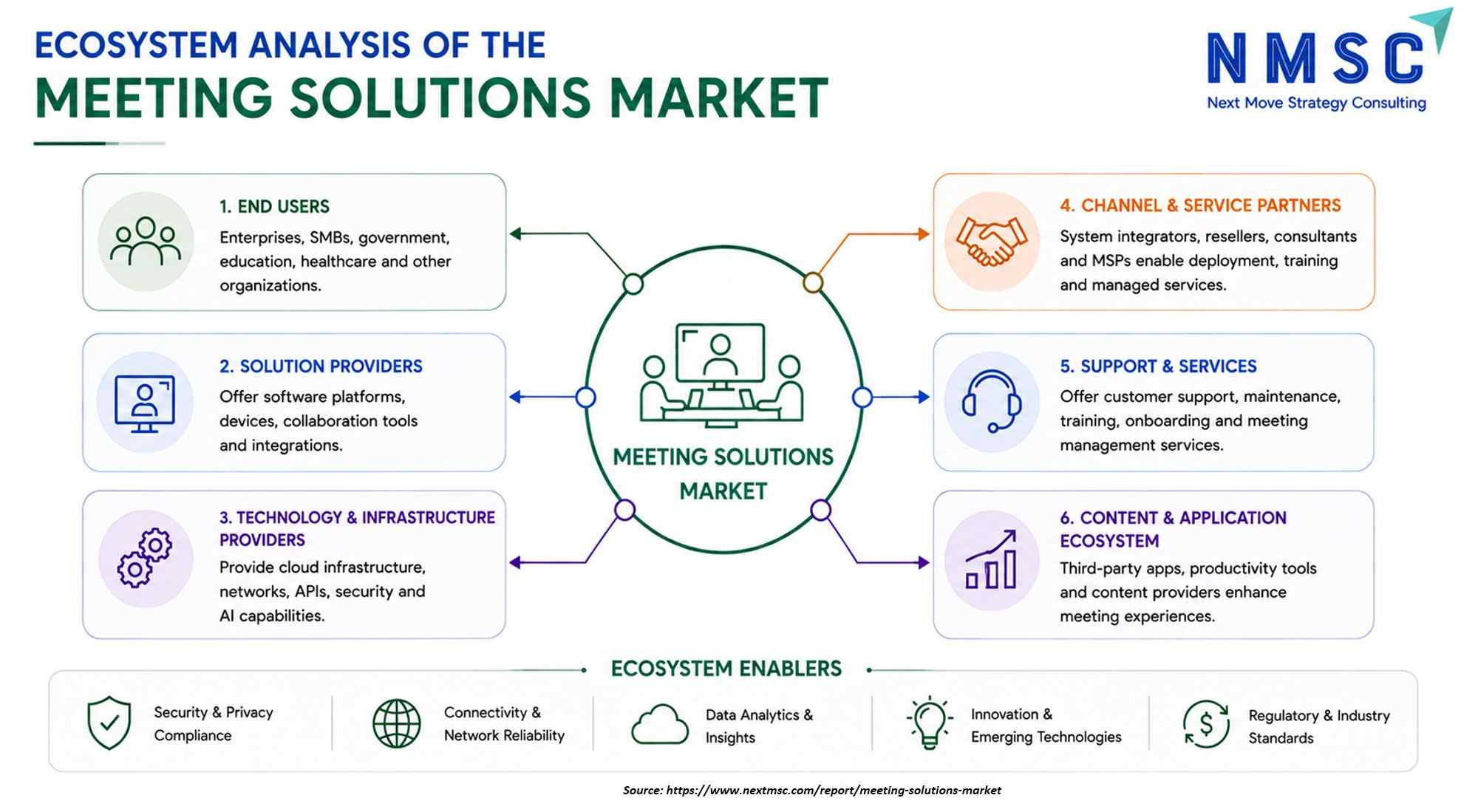
Ecosystem Analysis of the Meeting Solutions Industry

The above infographic provides a detailed ecosystem analysis of the meeting solutions market, mapping out six key segments from end users to the content and application ecosystem. It illustrates how solution providers, infrastructure suppliers, and channel partners interact within a connected network to deliver seamless collaboration tools and managed services. The analysis further highlights crucial ecosystem enablers, such as security compliance and network reliability, that support the industry. Ultimately, it demonstrates how this interconnected chain drives innovation and enhances meeting experiences for organizations across various sectors.

What does the Meeting Solutions Market Encompass?

The Meeting Solutions Market covers video and audio hardware, software platforms, and professional and managed services that enable in-person, remote, and hybrid meeting experiences across enterprise, educational, healthcare, and government environments. We found that the market has evolved from point-solution room systems into integrated ecosystems spanning room booking, device management, AI-assisted transcription, and remote monitoring. Demand for team collaboration software is pulling software-layer investment ahead of hardware refreshes in many enterprise procurement cycles.

Regulatory and enterprise policy frameworks governing data residency and privacy, including the European Union's General Data Protection Regulation, increasingly influence cloud computing platform procurement decisions within the market. Technology adoption trends toward generative AI and purpose-built device management software are raising baseline capability expectations across hardware and software categories alike, while IT procurement consolidation among large enterprises is pushing vendors to demonstrate end-to-end lifecycle management alongside traditional product and licensing revenue streams.

Key Emerging Trends

Based on research conducted by NMSC, we found that four structural trends are redefining how meeting hardware manufacturers, software platform providers, and managed services companies compete and expand their addressable enterprise population through 2035.

How Is AI-Powered Meeting Intelligence Reshaping the Value of Meeting Platforms?

We observed that AI integration across meeting platforms is fundamentally expanding the per-session value proposition from basic audio-visual transmission to comprehensive productivity output. Vendors including Zoom, Microsoft, and Cisco have embedded real-time transcription, automated meeting summaries, and AI-assisted action-item generation into their core platform offerings, converting passive recordings into searchable business artifacts. Capabilities grounded in natural language processing are now treated as standard expected features by enterprise buyers evaluating platform renewal rather than optional premium add-ons.

What Role Does Hybrid Work Normalization Play in Driving Room System Refresh Cycles?

Our analysis shows that the normalization of hybrid work arrangements is creating sustained hardware refresh demand across all room size categories. Organizations that deployed temporary remote work infrastructure between 2020 and 2022 are now replacing or upgrading purpose-built room systems for in-office spaces designed to equalize the meeting experience between in-room and remote participants. Logitech, HP, and Yealink have introduced camera-tracking and intelligent audio products specifically targeting this parity-of-experience requirement in huddle spaces and small meeting rooms.

How Are Stakeholders Responding to Platform Consolidation Pressure?

During our market evaluation, we noticed that large enterprise IT organizations are consolidating meeting platform, device management, and room scheduling into single-vendor or two-vendor ecosystems. Cisco's Webex Control Hub, Microsoft's Teams Rooms management suite, and Zoom's Rooms device management platform all reflect this consolidation pressure, as enterprise IT buyers favor administrative simplicity and integrated analytics over flexibility of multi-vendor deployments. This dynamic structurally advantages incumbents with full-stack capability over hardware-only or software-only specialists.

Why Are Space Utilization Analytics and Occupancy Sensing Gaining Adoption?

Our findings suggest that real-time occupancy sensing and space utilization analytics are becoming embedded requirements within enterprise meeting room deployments as organizations optimize real estate costs. Meeting displays paired with occupancy sensors and scheduling panels now feed space data into corporate real estate tools. This analytics layer is converting room hardware from a one-time capital expenditure into a recurring data service. Vendors such as Crestron and Barco are integrating video analytics capabilities into room management platforms to surface actionable utilization intelligence for facilities and IT teams.

Growth Drivers & Restraints

Our analysis shows that several structural drivers and measurable restraints are shaping the Meeting Solutions Market growth trajectory through 2035.

Growth Catalyst & Risk Assessment Matrix

What Is the Primary Growth Driver in the Meeting Solutions Market?

The primary growth driver is rising adoption of hybrid and remote work across enterprise and mid-market customer bases. Our analysis shows that continued deployment and modernization of hybrid meeting-room infrastructure are sustaining demand for room systems, cloud platform subscriptions, and managed services. Microsoft reported in 2025 that Teams Rooms were being upgraded at scale across smaller meeting spaces to support hybrid workplace requirements, reinforcing the continued demand for meeting-room technology.

How Is AI Platform Integration Driving Market Growth?

Our assessment indicates that AI-powered meeting intelligence features are directly driving platform average revenue per user upward across leading vendors. Zoom reported in its fiscal year 2025 results that AI Companion adoption metrics were a key retention driver across enterprise accounts, demonstrating how embedded AI capability is becoming the primary competitive differentiator for cloud meeting platform renewal decisions. This shift from hardware-dominated revenue to software and services is raising overall market margin profiles and accelerating recurring revenue growth above total volume growth.

What Is Restraining the Meeting Solutions Market?

We found that the primary restraint is high total cost of room system deployment, which limits adoption among price-sensitive small businesses and in emerging markets where enterprise IT budgets remain constrained. Full-featured meeting room configurations combining cameras, audio processors, displays, room compute, and scheduling panels can exceed USD 10,000 per room from leading vendors, creating a significant upfront capital barrier that cloud-only or bring-your-own-device approaches do not fully resolve for organizations requiring managed room-based meeting experiences.

Segmentation Analysis

Segment Sizing: By Offering

Which Offering Segment Dominates the Meeting Solutions Market?

Hardware leads with USD 8.98 Billion in 2025, reflecting the centrality of room systems, video devices, audio equipment, and interactive display products to overall meeting room deployment value. Services is the fastest-growing offering segment at an 11.62% CAGR, driven by growing enterprise demand for managed room operations, remote monitoring, and lifecycle management that reduce in-house IT overhead while maintaining room availability and regulatory compliance across large multi-site deployments.

Segment Sizing: By Room Size

Which Room Size Segment Dominates and Which Is Fastest-Growing?

Small Meeting Rooms and Non-Room-Based Meetings together represent the largest demand concentrations within the Meeting Solutions Market. Small Meeting Rooms at USD 4.14 Billion in 2025 reflect high physical room density across corporate campuses and distributed enterprise environments. Non-Room-Based Meetings at USD 4.15 Billion is also the fastest-growing segment at a 10.85% CAGR, as remote-participant-only and hybrid call formats increase total meeting volume without proportional growth in physical room utilization across permanently distributed workforces.

Segment Sizing: By Deployment Model

Which Deployment Model Leads and Which Grows Fastest in the Market?

Public Cloud leads deployment adoption at USD 6.21 Billion in 2025, reflecting the market shift from on-premises infrastructure to SaaS-based meeting platforms across enterprise and mid-market customers. Hybrid deployment is the fastest-growing model at a 14.29% CAGR, as organizations adopt phased transition strategies that maintain on-premises hardware estates while migrating meeting management, analytics, and AI workloads to cloud-based platforms, combining capital efficiency with data residency compliance flexibility.

Growth Opportunities

Our analysis shows that three whitespace opportunities stand out for manufacturers and service providers positioning ahead of 2035 demand in the Meeting Solutions Market.

Can SMB-Focused Cloud Meeting Bundles Capture Underpenetrated Small Business Demand?

Software vendors that bundle video meeting platforms with room scheduling, device management, and customer support tools into a single SMB-priced subscription can capture the large volume of small and medium businesses currently underserved by enterprise-grade hardware-plus-software room systems. Benefiting primarily the Software offering segment and the Small and Medium Businesses customer tier, this opportunity represents substantial addressable volume well beyond the enterprise accounts that dominate current platform revenue.

Does Healthcare and Education Vertical Expansion Create Incremental Platform Demand?

Organizations supplying HIPAA-compliant meeting platforms enabling telemedicine consultations and purpose-built collaboration tools for synchronous virtual classrooms can access structured budget pools distinct from general enterprise IT spending. This opportunity benefits the Healthcare and Life Sciences and Education end-user industry segments, as both verticals are accelerating digital infrastructure investment with dedicated regulatory and pedagogical requirements that generalist platforms are increasingly engineered to address.

Can Asia-Pacific Greenfield Deployment Unlock Disproportionate Growth for Platform Vendors?

Vendors entering India, Southeast Asia, and Tier 2 Chinese markets with cloud-first meeting platform offerings can access rapidly expanding knowledge-worker populations adopting meeting technology for the first time rather than replacing legacy systems. This opportunity primarily benefits the Public Cloud deployment model and the Asia-Pacific region, where rising enterprise formation rates and expanding broadband infrastructure are removing adoption barriers faster than in established markets, while lower average selling prices support higher volume growth per dollar of platform investment.

Regional Outlook

North America

North America holds the largest regional share of the Meeting Solutions Market at approximately 40% in 2025, driven by concentrated enterprise platform adoption and advanced deployment of AI-powered meeting technologies. Our assessment indicates that enterprise IT procurement consolidation and multi-site technology standardization are supporting recurring software and managed services revenue alongside continued room-system modernization. U.S. corporate real estate optimization trends are sustaining room-system refresh demand across the forecast period.

Asia-Pacific

Asia-Pacific is the fastest-growing region at a 9.73% CAGR through 2035, driven by rapid enterprise formation, expanding broadband infrastructure, and first-time adoption of cloud meeting platforms across China, India, and Southeast Asian markets. We observed that domestic vendors in China, including Huawei, compete aggressively with global platform leaders on price, accelerating total market volume even as average selling prices remain below North American and European levels, sustaining above-average unit growth alongside revenue expansion.

Europe

Europe's Meeting Solutions Market benefits from established enterprise IT organizations and strong regulatory frameworks that are accelerating investment in compliant cloud meeting platforms. Our findings suggest that GDPR compliance requirements are driving European enterprises toward private cloud and hybrid deployment models at above-average rates, supporting premium pricing for data-residency-compliant platforms from vendors operating certified European data centers and reinforcing enterprise software contract renewals ahead of the broader market growth rate.

Middle East & Africa

The Middle East & Africa region is expanding at a 9.28% CAGR, with Saudi Arabia and the UAE leading investment in enterprise collaboration infrastructure through Saudi Vision 2030, UAE digital-government initiatives, and broader digital-economy programs. Government and large-enterprise procurement in Gulf Cooperation Council states is supporting enterprise meeting-technology adoption, while Africa's growth remains more concentrated in cloud platform subscriptions than hardware-intensive deployments.

Latin America

Latin America is expanding at a 9.65% CAGR through 2035, led by Brazil's growing private sector digital transformation investment and rising enterprise demand for cloud-based meeting platforms. We observed that Argentina's constrained IT budget environment is limiting hardware adoption but supporting cloud-first platform uptake among cost-sensitive organizations prioritizing operational flexibility over capital expenditure on full room systems, making SaaS-based meeting solutions the primary growth engine in that market.

U.S.

Based on our estimates, the U.S. Meeting Solutions Market was valued at approximately USD 5.52 Billion in 2025 and is projected to reach USD 11.76 Billion by 2035 at a CAGR near 7.8%. The country's demand structure is anchored by high enterprise IT spending, concentrated adoption of Zoom, Microsoft Teams, and Cisco Webex, and advanced room system deployments across Fortune 500 corporate campuses. Centralized IT procurement and managed device operations are the primary competitive battlegrounds among platform vendors.
Canada
The market in Canada was estimated at approximately USD 1.03 Billion in 2025, forecast to reach USD 2.16 Billion by 2035 at roughly 7.7% CAGR. Canada's demand structure closely mirrors U.S. adoption patterns, with growing enterprise cloud migration and government public sector investment in secure meeting platforms supporting steady technology penetration and moderate competitive intensity between global platform leaders and regional system integrators.

UK

As per our estimate, the UK market stood near USD 0.97 Billion in 2025 and is expected to reach USD 2.14 Billion by 2035 at approximately 8.2% CAGR. Strong hybrid work adoption and established enterprise IT organizations support above-average spending on room systems and cloud meeting platforms, with regulatory influence centered on UK GDPR compliance requirements for cloud data handling and government security certification standards for public sector deployment.
Germany
According to our analysis, Germany's market was valued at about USD 0.86 Billion in 2025, projected to reach USD 1.96 Billion by 2035 at a CAGR near 8.6%. Germany's demand structure benefits from strong domestic manufacturing and financial services sectors with large conference facility investments, alongside a regulatory environment strongly favoring data-residency-compliant private cloud or hybrid meeting platform deployments over purely U.S.-hosted public cloud alternatives.
France
Based on our estimates, France's market reached approximately USD 0.69 Billion in 2025 and is forecast to grow to USD 1.57 Billion by 2035 at around 8.6% CAGR. Demand is supported by growing cloud platform adoption within large enterprises and the public sector, with France's digital sovereignty frameworks influencing procurement toward European-hosted meeting solutions and reinforcing demand for interoperability software bridging regulated and general-purpose platforms.
China
The market in China was valued at nearly USD 1.72 Billion in 2025 and is projected to reach USD 4.71 Billion by 2035 at approximately 10.6% CAGR. China's growth reflects its enormous enterprise user population and rapidly scaling domestic platform vendors alongside global entrants, with Huawei's meeting hardware and software ecosystem competing intensely with Zoom and Microsoft Teams in enterprise and government procurement, particularly in security-sensitive deployments requiring domestic data hosting.
India
As per our estimate, India's market was close to USD 0.52 Billion in 2025, expected to reach USD 1.96 Billion by 2035 at roughly 14.2% CAGR, the fastest among covered countries. Rising enterprise formation, expanding broadband infrastructure, and first-time cloud meeting platform adoption across IT services, banking, and healthcare sectors are driving demand. Technology penetration remains moderate but is accelerating rapidly as platform pricing reaches SMB-addressable levels and mobile-first cloud meeting adoption expands beyond metro markets.
Japan
According to our analysis, Japan's Meeting Solutions Market stood at about USD 0.69 Billion in 2025 and is forecast to reach USD 1.57 Billion by 2035 at approximately 8.6% CAGR. Japan's demand structure benefits from a strong corporate culture of meeting-intensive decision processes and high enterprise willingness to invest in premium room systems and AI-assisted meeting tools, with Yealink and global vendors competing alongside domestic hardware suppliers in enterprise and government segments.
South Korea
Based on our estimates, South Korea's market was valued near USD 0.35 Billion in 2025, projected to reach USD 0.94 Billion by 2035 at around 10.4% CAGR. Strong domestic technology adoption culture and high broadband penetration support rising cloud meeting platform usage across large conglomerates and mid-market enterprises, with domestic hardware vendors supplementing global platform offerings in a competitively intense urban market.
Australia
As per our estimate, Australia's market reached approximately USD 0.35 Billion in 2025 and is expected to grow to USD 0.78 Billion by 2035 at roughly 8.3% CAGR. Australia's demand structure benefits from strong enterprise IT adoption and a hybrid work transition well advanced relative to other Asia-Pacific markets, positioning the country as a consistent early adopter of cloud meeting platforms and integrated room management solutions.

UAE

Based on our estimates, the UAE Meeting Solutions Market was valued at about USD 0.35 Billion in 2025 and is forecast to reach USD 0.88 Billion by 2035 at approximately 9.7% CAGR. Growing digital economy investment and expanding multinational enterprise presence across Dubai and Abu Dhabi are driving room system and cloud platform demand, with government smart city initiatives supporting above-average technology adoption within public sector meeting environments.
Saudi Arabia
According to our analysis, Saudi Arabia's market stood near USD 0.41 Billion in 2025, projected to reach USD 1.00 Billion by 2035 at around 9.3% CAGR. Vision 2030 healthcare, education, and government digital transformation programs are generating structured procurement demand for enterprise meeting platforms and room systems, with data sovereignty requirements influencing platform selection toward vendors offering in-country or Gulf-region data hosting.
South Africa

The market in South Africa was estimated close to USD 0.21 Billion in 2025, expected to reach USD 0.49 Billion by 2035 at roughly 8.8% CAGR. A growing private sector and expanding enterprise technology adoption give South Africa the strongest meeting solutions penetration in sub-Saharan Africa, with cloud-first platform adoption driven by cost-efficiency requirements in an environment where full room system capital expenditure remains limited to larger corporate and government buyers.
Brazil
As per our estimate, Brazil's market reached approximately USD 0.52 Billion in 2025 and is projected to reach USD 1.33 Billion by 2035 at around 9.8% CAGR. Growing private sector cloud adoption and rising demand for enterprise video meeting platforms among financial services, retail, and technology companies are driving the market, with regional hardware distributors expanding portfolio coverage for mid-market buyers replacing legacy audioconferencing infrastructure.
Argentina
Based on our estimates, Argentina's market was valued at about USD 0.17 Billion in 2025, forecast to reach USD 0.43 Billion by 2035 at approximately 9.7% CAGR. Despite macroeconomic headwinds, demand for cloud-based meeting platforms is growing among multinational subsidiaries and export-oriented technology companies, with the relatively low cost of SaaS platform subscriptions supporting adoption in an environment where hardware capital expenditure budgets remain compressed relative to comparable LatAm markets.
Competitive Landscape
Our assessment indicates that the competitive landscape spans diversified cloud platform leaders, specialized hardware manufacturers, and regional software and services providers, each competing on AI capability depth, digital workflow integration breadth, and enterprise account relationship strength within the Meeting Solutions Market.
Key Takeaways
Dimension Assessment
Market Structure Moderately concentrated; top 10 companies hold the majority of market share, led by an integrated cloud platform leader alongside established hardware specialists and regional software providers
Innovation Focus AI-powered meeting intelligence, integrated room ecosystem management, cloud-native device management, and hybrid work parity-of-experience hardware engineering
M&A Activity Selective capability acquisitions and platform integration partnerships rather than large-scale consolidation; organic innovation investment remains the dominant competitive posture among established vendors
Source: www.nextmsc.com
How Do Companies Compete in the Meeting Solutions Market Industry?
Companies compete primarily on platform integration breadth spanning hardware, software, and services, depth of AI capability embedded within meeting workflows, and strength of enterprise and multi-site account relationships. Our findings suggest that vendors with full-stack ecosystems spanning room hardware, cloud management software, and AI-assisted meeting intelligence hold a structural advantage over single-category competitors, as enterprise IT buyers evaluate meeting solutions on end-to-end workflow coverage rather than individual product performance metrics.
Which Competitive Archetypes Dominate the Meeting Solutions Market Industry?
Diversified cloud platform leaders such as Zoom, Cisco, and Microsoft dominate through integrated meeting, room management, and AI productivity ecosystems. Specialized hardware vendors including Logitech, HP, and Yealink differentiate through focused room system and audio engineering expertise. Niche software and interoperability providers such as Pexip and Barco compete on platform-agnostic compatibility and purpose-built visual collaboration capabilities. Vendors advancing enterprise mobility management integrations are gaining traction among organizations deploying meeting solutions across distributed workforces requiring unified device and endpoint management.
What Innovation and Differentiation Strategies Are Companies Pursuing?
We observed that leading companies are investing in generative AI meeting assistants and automated transcription to convert meeting infrastructure into productivity software, increasing the defensibility of subscription revenue streams. Differentiation increasingly rests on integrated device ecosystem breadth, as enterprise buyers evaluate vendors on their ability to manage hardware, software, and user experience from a unified administrative console, reducing IT overhead while improving room availability and compliance metrics across large enterprise estates.
What M&A and Partnership Activity Is Shaping the Meeting Solutions Market?
Our assessment indicates that recent activity favors organic platform capability expansion over large-scale acquisitions, with vendors deepening integrations between room hardware, cloud management, and AI analytics layers. Strategic partnerships between hardware specialists such as Logitech and platform vendors including Microsoft and Google exemplify how the competitive landscape is consolidating around interoperability commitments rather than hardware exclusivity, reflecting enterprise buyers' preference for platform-certified hardware ecosystems that reduce deployment risk.
Key Market Players
Based on research conducted by NMSC, the following companies represent the validated set of leading participants across meeting hardware, software platforms, and professional and managed services within the Meeting Solutions Market.
Zoom Communications, Inc.
Cisco Systems, Inc.
Microsoft Corporation
Google LLC
Logitech International S.A.
HP Inc.
Huawei Technologies Co., Ltd.
GN Store Nord A/S
Lenovo Group Limited
Yealink Network Technology Corporation Limited
Barco NV
Crestron Electronics, Inc.
Shure Incorporated
Sennheiser electronic SE & Co. KG
QSC, LLC
Biamp Systems, LLC
Pexip AS
AVer Information Inc.
RingCentral, Inc.
8x8, Inc.
Latest Developments
We found that recent corporate activity reflects continued AI capability expansion and sustained digital platform investment across the Meeting Solutions Market, with leading vendors prioritizing intelligence layer development and interoperability certification.
Date Event
September 2026 Barco’s new ClickShare Hub Pro bundle combines Huddly’s AI camera and Shure’s MXA902 ceiling microphone/loudspeaker with Microsoft Teams certification. The solution targets medium-sized meeting rooms, adding intelligent participant framing and advanced audio
June 2026 Biamp introduced Devio UCX, an Android-based unified communications compute platform with integrated professional DSP, alongside Microsoft Device Ecosystem Platform participation. The platform supports Microsoft Teams Rooms or Zoom Rooms and scales from huddle rooms to boardrooms, expanding standardized compute, device lifecycle management, and flexible peripheral deployment for enterprise meeting spaces.
June 2026 QSC launched the Q-SYS RoomSuite Collaboration Bar and Q-SYS Scheduling Panel, while integrating Q-SYS with Microsoft Places as a data integration partner. The Windows-based collaboration bar supports Microsoft Teams Rooms
May 2026 AVer announced a global collaboration with Lightware combining AVer’s AI-powered conferencing cameras with Lightware signal-management platforms.
February 2026 Lenovo introduced new full-room meeting solutions integrating ThinkSmart Core Gen 2 and ThinkSmart Manager with Huddly intelligent audio-video devices. The bundles support Microsoft Teams Rooms and Zoom Rooms across room sizes, combining unified management with AI-enabled cameras and scalable deployment
Source: www.nextmsc.com
Expert Insights
“With so many companies, including Microsoft, operating in a hybrid work world, now is the time to reimagine our meeting room experiences and make sure they are optimal and inclusive for all participants, whether they are in person or remote.”
— Nathalie D’Hers, Corporate Vice President, Microsoft Digital
Statement made in connection with Microsoft’s efforts to redesign meeting-room experiences for organizations operating in hybrid work environments and improve collaboration.
Market Interpretation
We observed that this perspective directly supports the continued expansion of hybrid meeting infrastructure as organizations adapt meeting spaces to distributed work models. NMSC’s analysis indicates that the shift toward inclusive hybrid collaboration is strengthening demand for integrated meeting-room cameras, microphones, displays, room-control systems, and collaboration platforms that deliver consistent experiences across physical and remote participants. This transition is also accelerating meeting-room modernization and technology upgrades as enterprises move beyond conventional conferencing setups toward standardized, connected, and hybrid-ready meeting environments.

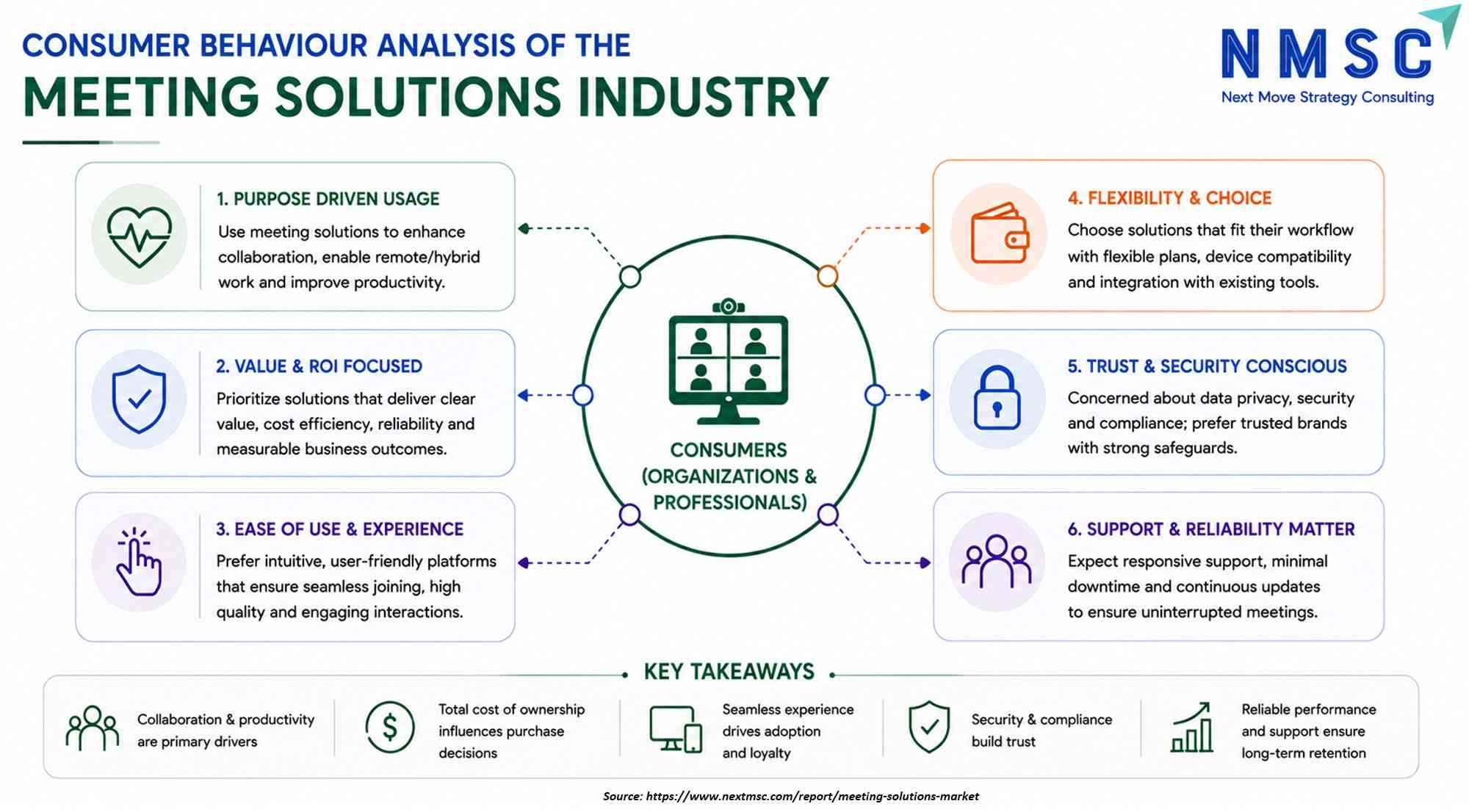
Consumer Behaviour Analysis of the Meeting Solutions Industry

The above infographic provides a detailed consumer behavior analysis of the meeting solutions industry, centering on the priorities of organizations and professionals. It highlights that consumers are driven by a need for enhanced collaboration, clear return on investment, and ease of use. Furthermore, the analysis emphasizes that buyers prioritize flexibility, strong security safeguards, and reliable support to ensure uninterrupted operations. Ultimately, the key takeaways conclude that a seamless user experience and robust security are critical for building trust and driving long-term customer retention.

What Is the Meeting Solutions Market Size?

We observed that enterprise demand is scaling across both hardware refresh cycles for in-office hybrid meeting spaces and cloud platform subscription growth driven by the normalization of distributed workforces, while enterprise IT procurement consolidation is increasing demand for integrated meeting platforms, room management software, and managed services alongside continued hardware investment.

What does the Meeting Solutions Market Encompass?

The Meeting Solutions Market covers video and audio hardware, software platforms, and professional and managed services that enable in-person, remote, and hybrid meeting experiences across enterprise, educational, healthcare, and government environments. We found that the market has evolved from point-solution room systems into integrated ecosystems spanning room booking, device management, AI-assisted transcription, and remote monitoring. Demand for team collaboration software is pulling software-layer investment ahead of hardware refreshes in many enterprise procurement cycles.

Regulatory and enterprise policy frameworks governing data residency and privacy, including the European Union's General Data Protection Regulation, increasingly influence cloud computing platform procurement decisions within the market. Technology adoption trends toward generative AI and purpose-built device management software are raising baseline capability expectations across hardware and software categories alike, while IT procurement consolidation among large enterprises is pushing vendors to demonstrate end-to-end lifecycle management alongside traditional product and licensing revenue streams.

Investment Opportunities

Where Are Capital Inflows Concentrating in the Meeting Solutions Market?

Capital is concentrating in AI meeting intelligence software development and cloud-native device management infrastructure, as evidenced by Zoom's continued AI Companion feature investment and Cisco's Webex AI product roadmap through 2025. This sustained platform investment signals durable capital allocation toward integrated digital workflow differentiation across the enterprise meeting solutions industry, with AI inference and transcription infrastructure receiving disproportionate attention relative to hardware-side capital deployment.

How Is Infrastructure Investment Shaping Long-Term Capacity in the Meeting Solutions Market?

Our findings suggest that infrastructure investment is shifting toward AI inference hardware and data center capacity required to support real-time transcription, meeting summaries, and intelligent audio-visual processing at enterprise scale. This shift favors vendors with existing cloud infrastructure relationships that can scale AI workload capacity alongside rising enterprise adoption without proportional cost increases per seat, improving long-term margin profiles for platform-first business models within the Meeting Solutions Market.

What ESG Considerations Are Influencing Meeting Solutions Market Investment Decisions?

Environmental, Social, and Governance considerations in the Meeting Solutions Market center on reducing enterprise carbon footprints by substituting physical travel with high-quality virtual collaboration infrastructure. We found that investors increasingly favor companies demonstrating quantifiable meeting-enabled travel reduction metrics alongside responsible AI practices, particularly around data privacy and consent protocols for AI-generated meeting transcripts. Improving customer experience management within meeting platforms also reflects social commitments to equitable collaboration access across geographies and organizational levels.

Key Benefits for Stakeholders

How Does This Report Benefit Industry Leaders?

Industry leaders gain segment-level revenue forecasts and CAGR benchmarks across offering, room size, deployment model, customer size, end-user industry, and sales channel axes, enabling product-roadmap decisions grounded in the same 2025–2035 figures used consistently throughout this analysis. Our findings on regional growth differentials further support market-entry and enterprise account strategy decisions for hardware manufacturers, software platform vendors, and managed services providers operating within the Meeting Solutions Market.

How Does This Report Benefit Investors and Financial Analysts?

Investors and financial analysts gain a reconciled market-sizing model, competitive landscape assessment, and named-company development tracking that supports valuation and capital-allocation decisions across the meeting solutions sector. The Growth Catalyst & Risk Assessment Matrix quantifies driver and restraint impact on CAGR, aiding scenario analysis and portfolio positioning across hardware, software, and services revenue streams within the Meeting Solutions Market.

How Does This Report Benefit Technology Vendors and Product Teams?

Technology vendors and product teams gain visibility into which offering and deployment model segments, such as Software and Hybrid, are growing fastest, informing engineering investment and go-to-market prioritization through 2035. The segmentation analysis across end-user industry axes supports vertical-specific decisions in healthcare, education, and government, where compliance requirements shape procurement. Adoption of e-learning software integration capabilities within education-focused meeting platforms represents a specific product differentiation opportunity identified within this report's segmentation analysis.

Key Market Segments Evaluated

Offering

  • Hardware
  • Software
  • Services

Room Size

  • Personal and Focus Spaces
  • Huddle Spaces
  • Small Meeting Rooms
  • Medium Meeting Rooms
  • Large Meeting Rooms
  • Extra-Large Meeting Rooms
  • Non-Room-Based Meetings

Deployment Model

  • Public Cloud
  • Private Cloud
  • On-Premises
  • Hybrid
  • Not Applicable

Customer Size

  • Small and Medium Businesses
  • Mid-Market Businesses
  • Large Enterprises

End-User Industry

  • IT and Telecommunications
  • Banking
  • Financial Services and Insurance
  • Healthcare and Life Sciences
  • Education
  • Government and Public Sector
  • Manufacturing
  • Retail and Wholesale
  • Media and Entertainment
  • Transportation and Logistics
  • Energy and Utilities
  • Other Industries

Sales Channel

  • Direct Sales
  • Indirect Sales
  • Distributor Sales
  • Reseller Sales
  • System Integrator Sales

Market Drivers & Dynamics

Interactive Dataset
Hybrid and remote work adoption driving demand for video meeting infrastructure driver +2.8% North America, Europe 2026–2035
AI-powered meeting intelligence and real-time transcription expanding platform value driver +1.9% North America, Asia-Pacific 2026–2032
Enterprise digital transformation accelerating hardware refresh and software upgrade cycles driver +1.5% Global 2026–2033
Growing adoption in healthcare and education verticals expanding the addressable user base driver +1.2% Asia-Pacific, North America 2026–2031
Cloud-native deployment reducing upfront capital expenditure barriers for SMBs driver +0.8% Global 2026–2030
High total cost of room system deployment limiting SMB and emerging-market adoption restraint −1.1% Global 2026–2035
Platform interoperability fragmentation increasing IT complexity and deployment friction restraint −0.7% Global 2026–2030
Network infrastructure gaps limiting video platform adoption in bandwidth-constrained regions restraint −0.5% Asia-Pacific, MEA, Latin America 2026–2031
Data privacy and regulatory compliance requirements slowing cloud platform deployment restraint −0.4% Europe, North America 2026–2033
Source: Next Move Strategy Consulting

Growth Drivers

What Is the Primary Growth Driver in the Meeting Solutions Market?

The primary growth driver is rising adoption of hybrid and remote work across enterprise and mid-market customer bases. Our analysis shows that continued deployment and modernization of hybrid meeting-room infrastructure are sustaining demand for room systems, cloud platform subscriptions, and managed services. Microsoft reported in 2025 that Teams Rooms were being upgraded at scale across smaller meeting spaces to support hybrid workplace requirements, reinforcing the continued demand for meeting-room technology.

How Is AI Platform Integration Driving Market Growth?

Our assessment indicates that AI-powered meeting intelligence features are directly driving platform average revenue per user upward across leading vendors. Zoom reported in its fiscal year 2025 results that AI Companion adoption metrics were a key retention driver across enterprise accounts, demonstrating how embedded AI capability is becoming the primary competitive differentiator for cloud meeting platform renewal decisions. This shift from hardware-dominated revenue to software and services is raising overall market margin profiles and accelerating recurring revenue growth above total volume growth.

Growth Inhibitors

What Is Restraining the Meeting Solutions Market?

We found that the primary restraint is high total cost of room system deployment, which limits adoption among price-sensitive small businesses and in emerging markets where enterprise IT budgets remain constrained. Full-featured meeting room configurations combining cameras, audio processors, displays, room compute, and scheduling panels can exceed USD 10,000 per room from leading vendors, creating a significant upfront capital barrier that cloud-only or bring-your-own-device approaches do not fully resolve for organizations requiring managed room-based meeting experiences.

What Are the Growth Opportunities?

Can SMB-Focused Cloud Meeting Bundles Capture Underpenetrated Small Business Demand?

Software vendors that bundle video meeting platforms with room scheduling, device management, and customer support tools into a single SMB-priced subscription can capture the large volume of small and medium businesses currently underserved by enterprise-grade hardware-plus-software room systems. Benefiting primarily the Software offering segment and the Small and Medium Businesses customer tier, this opportunity represents substantial addressable volume well beyond the enterprise accounts that dominate current platform revenue.

Does Healthcare and Education Vertical Expansion Create Incremental Platform Demand?

Organizations supplying HIPAA-compliant meeting platforms enabling telemedicine consultations and purpose-built collaboration tools for synchronous virtual classrooms can access structured budget pools distinct from general enterprise IT spending. This opportunity benefits the Healthcare and Life Sciences and Education end-user industry segments, as both verticals are accelerating digital infrastructure investment with dedicated regulatory and pedagogical requirements that generalist platforms are increasingly engineered to address.

Can Asia-Pacific Greenfield Deployment Unlock Disproportionate Growth for Platform Vendors?

Vendors entering India, Southeast Asia, and Tier 2 Chinese markets with cloud-first meeting platform offerings can access rapidly expanding knowledge-worker populations adopting meeting technology for the first time rather than replacing legacy systems. This opportunity primarily benefits the Public Cloud deployment model and the Asia-Pacific region, where rising enterprise formation rates and expanding broadband infrastructure are removing adoption barriers faster than in established markets, while lower average selling prices support higher volume growth per dollar of platform investment.

Segmentation Analysis

2025 (USD Billion)
2035 (USD Billion)
Hardware 2025: $8.98 Billion | 2035: $18.08 Billion
Hardware
Software 2025: $5.53 Billion | 2035: $13.73 Billion
Software
Services 2025: $2.75 Billion | 2035: $7.43 Billion
Services
Total 2025: $17.26 Billion | 2035: $39.24 Billion
Total
Hardware $8.98 Billion $18.08 Billion 7.66%
Software $5.53 Billion $13.73 Billion 10.50%
Services $2.75 Billion $7.43 Billion 11.62%
Total $17.26 Billion $39.24 Billion 8.11%

Which Offering Segment Dominates the Meeting Solutions Market?

2025 (USD Billion)
2035 (USD Billion)
Personal and
Huddle Space
Small Meetin
Medium Meeti
Large Meetin
Segment Item 2025 (USD Billion) 2035 (USD Billion) CAGR
Personal and Focus Spaces $10.0 USD Billion $40.0 USD Billion 25.0%
Huddle Spaces $17.1 USD Billion $51.1 USD Billion 11.0%
Small Meeting Rooms $24.2 USD Billion $62.2 USD Billion 25.0%
Medium Meeting Rooms $31.3 USD Billion $73.3 USD Billion 11.0%
Large Meeting Rooms $38.4 USD Billion $84.4 USD Billion 16.0%

Segment-wise data is locked

Unlock complete segment-wise numbers for Room Size.

Unlock Full Data

Which Room Size Segment Dominates and Which Is Fastest-Growing?

2025 (USD Billion)
2035 (USD Billion)
Public Cloud
Private Clou
On-Premises
Hybrid
Not Applicab
Segment Item 2025 (USD Billion) 2035 (USD Billion) CAGR
Public Cloud $10.0 USD Billion $40.0 USD Billion 27.0%
Private Cloud $17.1 USD Billion $51.1 USD Billion 9.0%
On-Premises $24.2 USD Billion $62.2 USD Billion 19.0%
Hybrid $31.3 USD Billion $73.3 USD Billion 17.0%
Not Applicable $38.4 USD Billion $84.4 USD Billion 18.0%

Segment-wise data is locked

Unlock complete segment-wise numbers for Deployment Model.

Unlock Full Data

Which Deployment Model Leads and Which Grows Fastest in the Market?

2025 (USD Billion)
2035 (USD Billion)
Small and Me
Mid-Market B
Large Enterp
Segment Item 2025 (USD Billion) 2035 (USD Billion) CAGR
Small and Medium Businesses $10.0 USD Billion $40.0 USD Billion 14.0%
Mid-Market Businesses $17.1 USD Billion $51.1 USD Billion 24.0%
Large Enterprises $24.2 USD Billion $62.2 USD Billion 22.0%

Segment-wise data is locked

Unlock complete segment-wise numbers for Customer Size.

Unlock Full Data
2025 (USD Billion)
2035 (USD Billion)
IT and Telec
Banking
Financial Se
Healthcare a
Education
Segment Item 2025 (USD Billion) 2035 (USD Billion) CAGR
IT and Telecommunications $10.0 USD Billion $40.0 USD Billion 24.0%
Banking $17.1 USD Billion $51.1 USD Billion 22.0%
Financial Services and Insurance $24.2 USD Billion $62.2 USD Billion 20.0%
Healthcare and Life Sciences $31.3 USD Billion $73.3 USD Billion 22.0%
Education $38.4 USD Billion $84.4 USD Billion 13.0%

Segment-wise data is locked

Unlock complete segment-wise numbers for End-User Industry.

Unlock Full Data
2025 (USD Billion)
2035 (USD Billion)
Direct Sales
Indirect Sal
Distributor
Reseller Sal
System Integ
Segment Item 2025 (USD Billion) 2035 (USD Billion) CAGR
Direct Sales $10.0 USD Billion $40.0 USD Billion 23.0%
Indirect Sales $17.1 USD Billion $51.1 USD Billion 9.0%
Distributor Sales $24.2 USD Billion $62.2 USD Billion 19.0%
Reseller Sales $31.3 USD Billion $73.3 USD Billion 13.0%
System Integrator Sales $38.4 USD Billion $84.4 USD Billion 10.0%

Segment-wise data is locked

Unlock complete segment-wise numbers for Sales Channel.

Unlock Full Data

Regional Outlook

2025 (USD Billion)
2035 (USD Billion)
North Americ
Asia-Pacific
Europe
Latin Americ
Middle East
Region 2025 (USD Billion) 2035 (USD Billion) CAGR (%)
North America $10.0 USD Billion $40.0 USD Billion 9.0%
Asia-Pacific $17.1 USD Billion $51.1 USD Billion 27.0%
Europe $24.2 USD Billion $62.2 USD Billion 25.0%
Latin America $31.3 USD Billion $73.3 USD Billion 23.0%
Middle East & Africa $38.4 USD Billion $84.4 USD Billion 12.0%

Regional data is locked

Unlock complete regional numbers for this market.

Unlock Full Data

Competitive Landscape

Dimension Description
Market Structure Moderately concentrated; top 10 companies hold the majority of market share, led by an integrated cloud platform leader alongside established hardware specialists and regional software providers
Innovation Focus AI-powered meeting intelligence, integrated room ecosystem management, cloud-native device management, and hybrid work parity-of-experience hardware engineering
M&A Activity Selective capability acquisitions and platform integration partnerships rather than large-scale consolidation; organic innovation investment remains the dominant competitive posture among established vendors

How Do Companies Compete in the Meeting Solutions Market Industry?

Companies compete primarily on platform integration breadth spanning hardware, software, and services, depth of AI capability embedded within meeting workflows, and strength of enterprise and multi-site account relationships. Our findings suggest that vendors with full-stack ecosystems spanning room hardware, cloud management software, and AI-assisted meeting intelligence hold a structural advantage over single-category competitors, as enterprise IT buyers evaluate meeting solutions on end-to-end workflow coverage rather than individual product performance metrics.

Which Competitive Archetypes Dominate the Meeting Solutions Market Industry?

Diversified cloud platform leaders such as Zoom, Cisco, and Microsoft dominate through integrated meeting, room management, and AI productivity ecosystems. Specialized hardware vendors including Logitech, HP, and Yealink differentiate through focused room system and audio engineering expertise. Niche software and interoperability providers such as Pexip and Barco compete on platform-agnostic compatibility and purpose-built visual collaboration capabilities. Vendors advancing enterprise mobility management integrations are gaining traction among organizations deploying meeting solutions across distributed workforces requiring unified device and endpoint management.

What Innovation and Differentiation Strategies Are Companies Pursuing?

We observed that leading companies are investing in generative AI meeting assistants and automated transcription to convert meeting infrastructure into productivity software, increasing the defensibility of subscription revenue streams. Differentiation increasingly rests on integrated device ecosystem breadth, as enterprise buyers evaluate vendors on their ability to manage hardware, software, and user experience from a unified administrative console, reducing IT overhead while improving room availability and compliance metrics across large enterprise estates.

What M&A and Partnership Activity Is Shaping the Meeting Solutions Market?

Our assessment indicates that recent activity favors organic platform capability expansion over large-scale acquisitions, with vendors deepening integrations between room hardware, cloud management, and AI analytics layers. Strategic partnerships between hardware specialists such as Logitech and platform vendors including Microsoft and Google exemplify how the competitive landscape is consolidating around interoperability commitments rather than hardware exclusivity, reflecting enterprise buyers' preference for platform-certified hardware ecosystems that reduce deployment risk.

Competitive Dynamics and M&A Landscape

Recent strategic moves, partnerships, and acquisitions shaping the Meeting Solutions Market Global Industry Analysis and Forecast (2026–2035).

September 2026 Barco Product Launch Barco’s new ClickShare Hub Pro bundle combines Huddly’s AI camera and Shure’s MXA902 ceiling microphone/loudspeaker with Microsoft Teams certification. The solution targets medium-sized meeting rooms, adding intelligent participant framing and advanced audio
June 2026 Biamp Product Launch Biamp introduced Devio UCX, an Android-based unified communications compute platform with integrated professional DSP, alongside Microsoft Device Ecosystem Platform participation. The platform supports Microsoft Teams Rooms or Zoom Rooms and scales from huddle rooms to boardrooms, expanding standardized compute, device lifecycle management, and flexible peripheral deployment for enterprise meeting spaces.
June 2026 QSC Product Launch QSC launched the Q-SYS RoomSuite Collaboration Bar and Q-SYS Scheduling Panel, while integrating Q-SYS with Microsoft Places as a data integration partner. The Windows-based collaboration bar supports Microsoft Teams Rooms
May 2026 AVer Partnership AVer announced a global collaboration with Lightware combining AVer’s AI-powered conferencing cameras with Lightware signal-management platforms.
February 2026 Lenovo Product Launch Lenovo introduced new full-room meeting solutions integrating ThinkSmart Core Gen 2 and ThinkSmart Manager with Huddly intelligent audio-video devices. The bundles support Microsoft Teams Rooms and Zoom Rooms across room sizes, combining unified management with AI-enabled cameras and scalable deployment

Key Market Players

Zoom Communications, Inc. Cisco Systems, Inc. Microsoft Corporation Google LLC Logitech International S.A. HP Inc. Huawei Technologies Co., Ltd. GN Store Nord A/S Lenovo Group Limited Yealink Network Technology Corporation Limited Barco NV Crestron Electronics, Inc. Shure Incorporated Sennheiser electronic SE & Co. KG QSC, LLC Biamp Systems, LLC Pexip AS AVer Information Inc. RingCentral, Inc. 8x8, Inc.

Expert Insights

Nathalie D’Hers

Nathalie D’Hers

Corporate Vice President | Microsoft Digital

"With so many companies, including Microsoft, operating in a hybrid work world, now is the time to reimagine our meeting room experiences and make sure they are optimal and inclusive for all participants, whether they are in person or remote."

Analyst Interpretation

We observed that this perspective directly supports the continued expansion of hybrid meeting infrastructure as organizations adapt meeting spaces to distributed work models. NMSC’s analysis indicates that the shift toward inclusive hybrid collaboration is strengthening demand for integrated meeting-room cameras, microphones, displays, room-control systems, and collaboration platforms that deliver consistent experiences across physical and remote participants. This transition is also accelerating meeting-room modernization and technology upgrades as enterprises move beyond conventional conferencing setups toward standardized, connected, and hybrid-ready meeting environments.

Delivered Customizations

We have successfully delivered the following deep-dive customizations:

Client Request Customization Delivered Value Adds
Historical Market Growth Analysis
  • Historical revenue analysis (2020–2025) across hardware, software and services offerings, with deployment model and customer size splits.
  • Shows how demand shifted from pandemic and hybrid-work peaks and which offerings are driving growth.
Company-Level Offering Share Analysis
  • Vendor revenue and share benchmarking across meeting hardware, software platforms and managed services, using disclosed financials and segment reporting.
  • Shows competitive position by offering and highlights share gaps and partnership or M&A targets.
Customer-Segment Opportunity Sizing (TAM / SAM / VAM)
  • Total, serviceable and value-addressable market sizing by customer size and end-user industry, with deployment model filters.
  • Ranks the most attractive customer and industry segments and supports go-to-market prioritization.
Room-Size Adoption and Upgrade Opportunity Assessment
  • Meeting-room penetration and upgrade potential across huddle, small, medium and large rooms by end-user industry, built from enterprise, office-stock and workplace-attendance statistics.
  • Shows which room formats and industries to target for product design and rollout.
Pricing and Licensing Benchmarking
  • Publicly listed hardware price points, room and user licence tiers and subscription models compared across offerings, deployment models and customer sizes.
  • Supports pricing strategy and bundling, and reveals cloud versus on-premises price gaps.
Channel and Partner Ecosystem Mapping
  • Mapping of direct sales, distributors, resellers, system integrators and online channels by customer size and offering, including major partner programs.
  • Identifies the right channel mix and partners for each customer size and region.

FAQs

About the Author

Mayurima Roy

Mayurima Roy

Mayurima Roy is Research Analyst at Next Move Strategy Consulting, where she has spent 4 years working across the firm's full industry coverage rather than a single fixed vertical. Her work centers on structured research, ongoing trend tracking, competitive assessment, and insight-led content development, translating complex market data into clear, decision-ready narratives that support informed client decision-making across diverse global industries, market sectors, and world regions every day.

About the Reviewer

Supradip Baul

Supradip Baul

Supradip Baul is an accomplished business consultant and strategist with over a decade of rich experience in market intelligence, strategy, technology, and business transformation. His work has included rigorous qualitative and quantitative analysis across multiple industries, helping clients shape investment decisions and long-term roadmaps. Earlier in his career, he was associated with Gartner, where he contributed to industry-leading reports and market share analyses. He has worked with leading global companies and holds an MBA with a dual specialization in Marketing and Finance.

Download Free Sample

Nishant Awate

NISHANT AWATE

Business Development Global Sales

Zehnder Group Deutschland GmbH

Our experience working with Next Move Strategy Consulting was positive. The team was responsive, professional, and open to incorporating our specific requirements throughout the project. The India AHU market study was comprehensive and well structured, covering market value and volume forecasts, product and application segments, and key industry trends. The inclusion of both AHU and residential MVHR market insights made the study particularly relevant for our strategic market assessment. Overall, the report provides a solid foundation for evaluating market potential, identifying priority segments, and supporting business-development decisions in India.

Mohit Agarwal

MOHIT AGARWAL

Chief Manager

DryChem India Pvt. Ltd.

Next Move Strategy Consulting is an amazing team of consultants. We required a market study report for our investors on top priority and the team went above and beyond our expectations to deliver the same with ample supporting data within a short time span enabling us to secure the investments and keep our project timeline maintained. Their professionalism, attention to detail, and timely delivery of actionable recommendations have left a lasting impression on our organization.

Kevin Coker

KEVIN COKER

Founder, CEO and Board Diector

Proxima Clinical Research

I have been using Next MSC reports for product positioning in a new geography for a long time. They have by far the best reports I have found and the price is reasonable too!

Amos Chang

AMOS CHANG

Strategy Consultant

Kardex Group

I have bought the intralogistics market reports from NMSC two times so far. Joseph and his team are always very helpful and flexible in responding to any customization requirements on the report. Their expertise in market reports really helps us steer the day-to-day business. I will definitely recommend and come back myself whenever there is a need.

Robert Sean Trevino

ROBERT SEAN TREVINO

Sr. Director, Head of Strategic Insights & Analytics

Foundation Medicine

I realized that it was a reliable source of information. These days, there are many people who are looking for authentic data, and this is one of the only sources that can offer them with what they need;

Custom Market Research Services

We will customize the research for you if the listed report does not fully match your requirements.

Get 30% Free Customization

Select License

This website uses cookies to ensure you get the best experience on our website. Learn more

✖