Campus Microgrid Market Size, Share, Trends and Growth Analysis, By Offering (Hardware and Equipment, Engineering and Integration, Managed Services, and Energy as a Service), By Campus Type (Higher Education, Healthcare, Government and Defense, Corporate, Industrial, Data Center, Municipal Community, Research Campus, and Others), By Operating Mode, By Primary Energy Source, By Ownership Model, By Sales Channel, and Region – Global Industry Report and Forecast, 2026–2035
Industry: Energy & Power | Publishing Date: July 16, 2026 | Last Updated: September 30, 2026 | No of Pages: N/A | No. of Tables: N/A | No. of Figures: N/A | Format: PDF | Report Code: EP5169
What Is the Campus Microgrid Market Size?
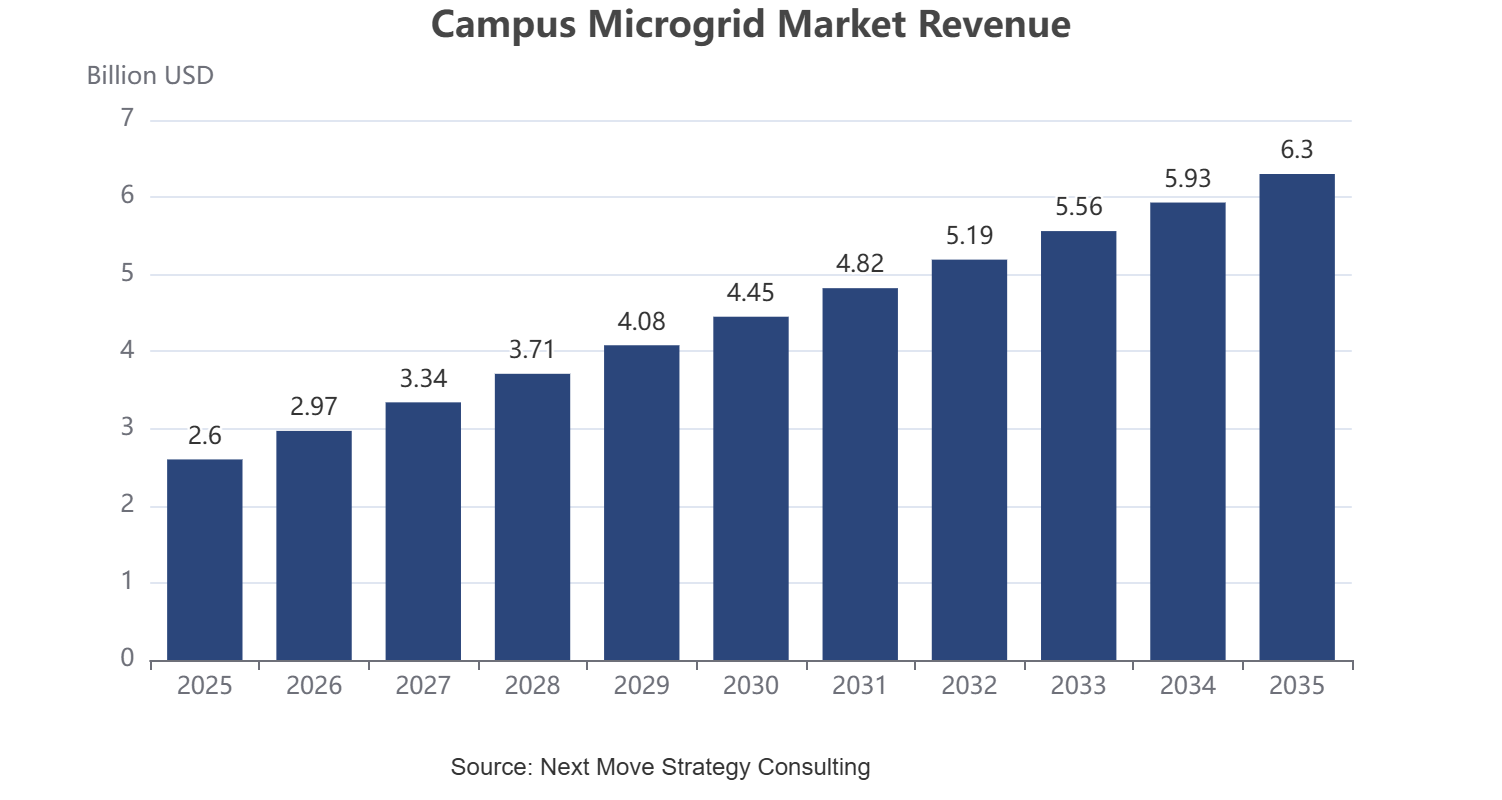
The global Campus Microgrid Market size was valued at USD 2.6 billion in 2025 and is estimated at USD 2.9 billion in 2026, forecast to reach USD 6.3 billion by 2035, expanding at a 9.2% CAGR between 2026 and 2035. North America leads with approximately 46% share, while hardware and equipment dominates all other offerings with approximately 52% share.
We observed that growth is broad-based across every segmentation axis, with data center resilience buildout and fuel cell-based generation adoption driving the dominant structural shifts through 2035.
|
Key Takeaways |
|
By Offering: Hardware and Equipment held the largest share of approximately 52% (USD 1.35 billion) in 2025; Energy as a Service is the fastest-growing sub-segment at 13.6% CAGR from 2026–2035. |
|
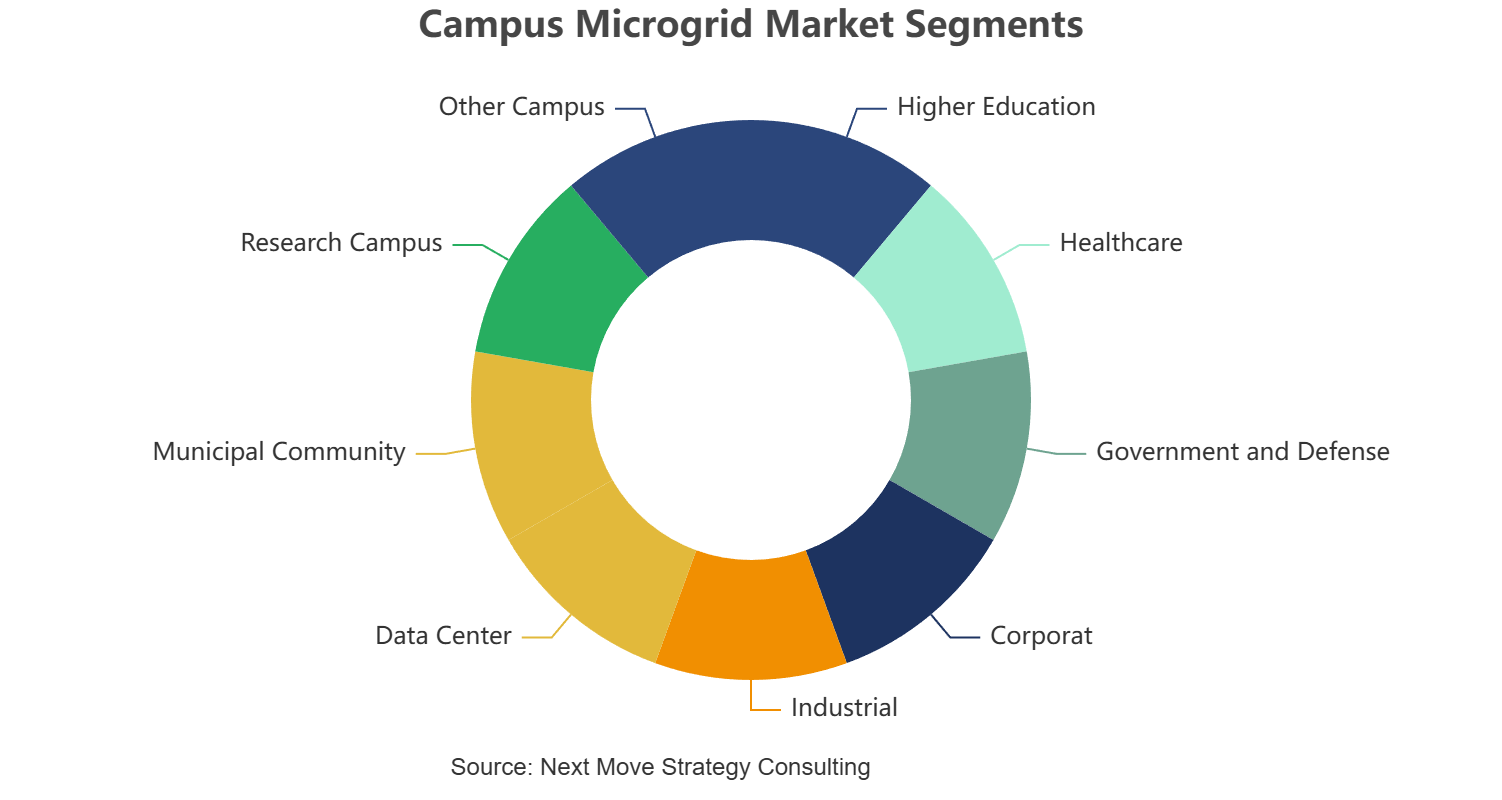
By Campus Type: Higher Education held the largest share of approximately 24% (USD 620 million) in 2025; Data Center is the fastest-growing sub-segment at 17.7% CAGR from 2026–2035. |
|
By Operating Mode: Grid Connected held the largest share of approximately 58% (USD 1.51 billion) in 2025; Islandable is the fastest-growing sub-segment at 10.3% CAGR from 2026–2035. |
|
By Primary Energy Source: Natural Gas Dominant held the largest share of approximately 34% (USD 880 million) in 2025; Fuel Cell Dominant is the fastest-growing sub-segment at 16.7% CAGR from 2026–2035. |
|
By Ownership Model: Customer Owned held the largest share of approximately 44% (USD 1.14 billion) in 2025; Energy as a Service is the fastest-growing sub-segment at 13.2% CAGR from 2026–2035. |
|
By Sales Channel: Direct Sales held the largest share of approximately 38% (USD 990 million) in 2025; Energy Service Company is the fastest-growing sub-segment at 12.1% CAGR from 2026–2035. |
|
Dominant Region: North America dominated with approximately 46% revenue share (USD 1.20 billion) in 2025. |
|
Fastest-Growing Region: Asia-Pacific is expected to register the highest CAGR of 11.6% during 2026–2035. |
|
Dominant Country: U.S. led with approximately USD 960 million in 2025. |
|
Fastest-Growing Country: China is the fastest-growing country at approximately 12.8% CAGR from 2026–2035. |
Market Opportunity: The campus microgrid market is expected to create an absolute dollar opportunity of USD 3.4 billion between 2026 and 2035, presenting significant investment potential across the distributed generation and campus resilience value chain.
According to Next Move Strategy Consulting analysis, campus operators are increasingly consolidating generation, storage, and controls procurement with fewer, full-service microgrid integrators to simplify multi-vendor commissioning, a shift that favors vendors with proven energy-as-a-service delivery models over single-component suppliers as data center and healthcare resilience demand intensifies through 2035.
What Does the Campus Microgrid Market Encompass?
The campus microgrid market encompasses hardware, engineering, managed services, and energy-as-a-service offerings that enable higher education, healthcare, government, corporate, and data center campuses to generate, store, and manage electricity independent of or in coordination with the utility grid. Our assessment indicates that the scope spans generation assets, energy storage, electrical infrastructure, and control and communication hardware, paired with consulting, engineering procurement and construction, operations and maintenance, and power purchase agreement structures deployed across grid-connected, islandable, and off-grid operating modes worldwide.
Regulatory frameworks and resilience programs, including U.S. Department of Energy grid resilience initiatives and state-level critical infrastructure mandates, shape campus microgrid adoption, while escalating extreme weather events and AI-driven data center power demand accelerate deployment timelines. We observed that technology adoption is shifting toward fuel cell and hybrid generation architectures that reduce dependence on diesel backup systems. Next Move Strategy Consulting's analysis indicates that this structural shift, combined with expanding energy-as-a-service financing models, is redefining procurement criteria across the campus microgrid market.
|
Parameter |
Details |
|
Market Size in 2025 |
USD 2.6 Billion |
|
Market Size in 2026 |
USD 2.9 Billion |
|
Revenue Forecast in 2035 |
USD 6.3 Billion |
|
Growth Rate |
CAGR of 9.2% from 2026 to 2035 |
|
Analysis Period |
2025–2035 |
|
Base Year Considered |
2025 |
|
Forecast Period |
2026–2035 |
|
Market Size Estimation |
Revenue (USD Billion) |
|
Companies Profiled |
20 |
|
Countries Covered |
33 |
|
Market Share |
Available for Top 10 Companies |
Key Emerging Trends
Based on research conducted by Next Move Strategy Consulting, we found that four structural trends are reshaping product development, campus deployment, and stakeholder engagement across the industry.
How Is Fuel Cell Generation Transforming Data Center Campus Power?
Solid oxide fuel cell generation is transforming how data center campuses secure primary power outside constrained utility interconnection queues. We observed that Bloom Energy Corporation closed approximately USD 7.65 billion in data center-related contracts within a roughly 90-day period in early 2026, reflecting rapid commercial acceptance of on-site fuel cell generation. Data center operators are adopting these architectures to bypass multi-year grid interconnection delays while securing dedicated, scalable baseload power for AI compute facilities.
Why Are Hospital Campuses Accelerating Microgrid Adoption?
Hospital campuses are accelerating microgrid adoption as extreme weather events increase the operational and financial cost of extended power outages. Our findings suggest that Baton Rouge General Medical Center activated two gas-fired microgrids across its Bluebonnet and Mid City campuses in November 2025, developed with Entergy Louisiana and Enchanted Rock LLC, to sustain full-facility power during hurricanes. Healthcare systems increasingly specify whole-facility microgrid coverage rather than partial critical-load backup generation.
How Is Energy as a Service Reshaping Campus Microgrid Procurement?
Energy-as-a-service financing structures are reshaping how campuses procure microgrid infrastructure without large upfront capital outlays. We observed that Ameresco, Inc. delivered a solar and battery storage microgrid for a Kaiser Permanente hospital campus in California in 2025 under a power purchase agreement structure. This trend is elevating demand for third-party ownership and shared savings contract models among healthcare and higher education campuses seeking resilience without balance-sheet capital investment.
What Role Does AI-Driven Power Demand Play in Microgrid Innovation?
AI-driven data center power demand is emerging as the dominant force reshaping campus microgrid technology roadmaps. Our analysis shows that Bloom Energy Corporation and Brookfield expanded their strategic AI infrastructure partnership from USD 5 billion to USD 25 billion in June 2026 to deploy fuel cell power at AI data center campuses. This direction is exemplified by developers designing power, infrastructure, and compute capacity in unison rather than sequentially provisioning generation after facility construction.
ECOSYSTEM ANALYSIS OF THE CAMPUS MICROGRID MARKET
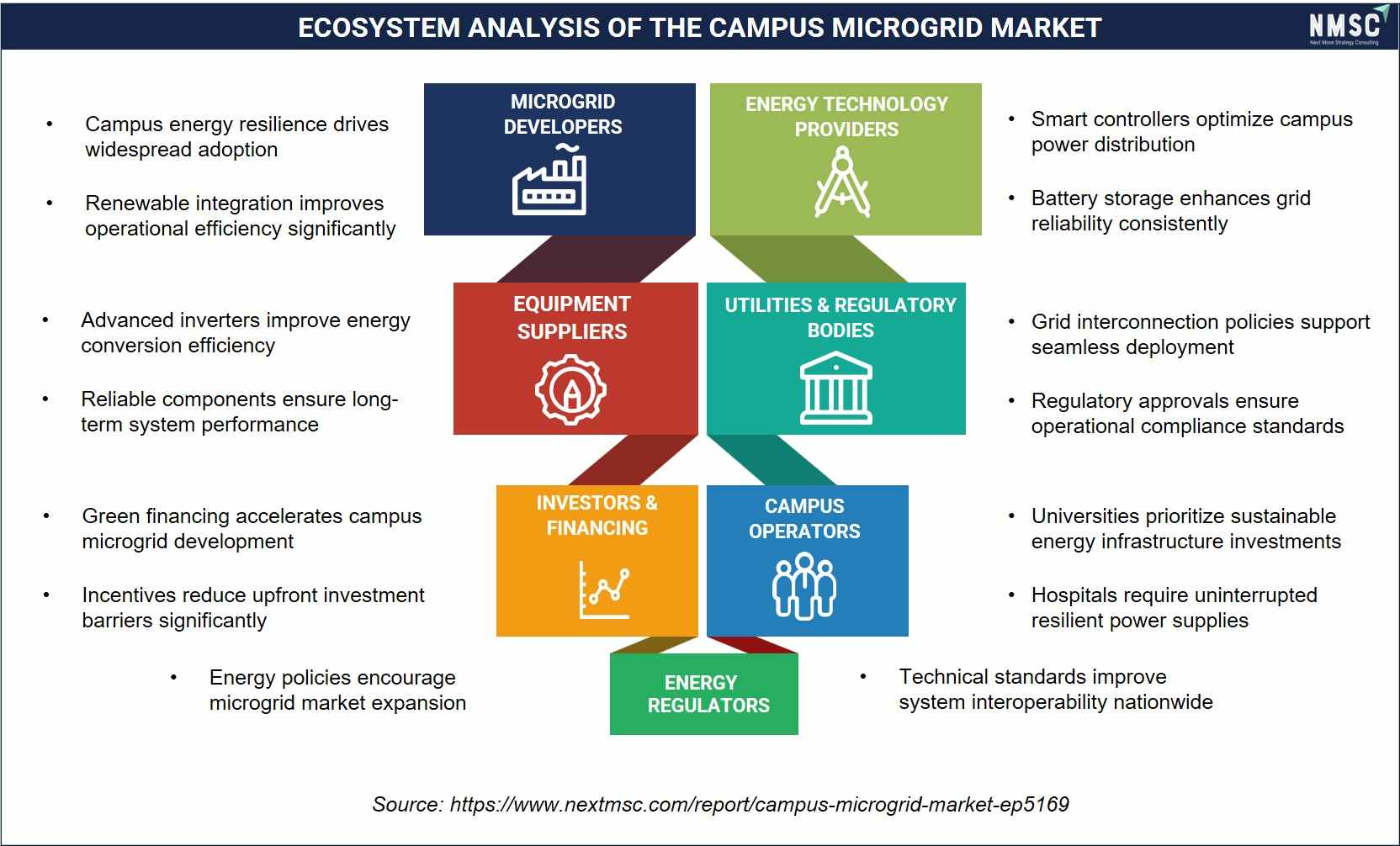
The Campus Microgrid Market is witnessing steady growth as educational institutions, healthcare campuses, government facilities, corporate parks, and industrial sites increasingly invest in resilient, sustainable, and cost-efficient energy systems. Rising adoption of distributed energy resources, battery storage, advanced energy management systems, and renewable power integration is driving market expansion. Growing emphasis on energy security, grid reliability, decarbonization, and intelligent campus infrastructure is expected to further accelerate demand throughout the forecast period.
Growth Drivers and Restraints
Growth Catalyst and Risk Assessment Matrix
|
Factors |
Type |
(+/−) % Impact on CAGR |
Geographic Relevance |
Impact Timeline |
|
AI-driven data center power demand outpacing grid interconnection capacity |
Driver |
+2.6% |
North America, Asia-Pacific |
2026-2035 |
|
Rising extreme weather-driven resilience investment in healthcare campuses |
Driver |
+2.2% |
North America |
2026-2035 |
|
Expanding fuel cell generation adoption for baseload campus power |
Driver |
+1.9% |
Global |
2026-2035 |
|
Growing energy-as-a-service financing lowering campus adoption barriers |
Driver |
+1.6% |
Global |
2026-2035 |
|
Government and defense installation resilience mandates |
Driver |
+1.3% |
North America, Europe |
2026-2035 |
|
Expanding university and government bioeconomy digital infrastructure investment |
Driver |
+1.0% |
Asia-Pacific |
2026-2032 |
|
High upfront capital costs for hardware-intensive microgrid deployments |
Restraint |
-1.4% |
Global |
2026-2035 |
|
Utility interconnection and regulatory approval delays |
Restraint |
-1.0% |
Global |
2026-2032 |
|
Grid interconnection queue congestion complicating grid-connected designs |
Restraint |
-0.7% |
North America |
2028-2035 |
What Is the Primary Growth Driver of the Campus Microgrid Market?
AI-driven data center power demand outpacing grid interconnection capacity is the primary driver of the market. The U.S. Department of Energy continues to document rising data center electricity consumption alongside multi-year utility interconnection queue backlogs across major grid regions. We observed that this capacity gap, reinforced by hyperscaler urgency to bring compute facilities online quickly, continues to anchor baseline consumption of on-site generation and fuel cell hardware across developed and emerging data center campus markets alike.
How Is Extreme Weather Resilience Driving Campus Microgrid Market Growth?
Rising extreme weather-driven resilience investment in healthcare campuses is accelerating hospital system investment in whole-facility microgrid coverage. Next Move Strategy Consulting's analysis indicates that this resilience pressure, combined with Baton Rouge General's November 2025 activation of dual campus microgrids following recurring hurricane exposure, is compressing adoption timelines for gas-fired and hybrid generation systems across North American and Gulf Coast healthcare campuses.
What Is Restraining Campus Microgrid Market Expansion?
High upfront capital costs for hardware-intensive microgrid deployments restrain adoption speed across the industry, particularly for smaller higher education and municipal community campuses with constrained capital budgets. We found that campuses without access to energy-as-a-service or third-party ownership financing face particular exposure, as limited balance-sheet capacity reduces their ability to fund generation, storage, and electrical infrastructure investments compared with larger, well-capitalized institutions.
Segmentation Analysis
Segment Sizing: By Offering
|
Segment |
2025 (USD) |
2035 (USD) |
CAGR% (2026–2035) |
|
Hardware and Equipment |
USD 1.35 Billion |
USD 2.98 Billion |
7.8% |
|
Engineering and Integration |
USD 0.52 Billion |
USD 1.18 Billion |
8.2% |
|
Managed Services |
USD 0.37 Billion |
USD 0.88 Billion |
8.9% |
|
Energy as a Service |
USD 0.36 Billion |
USD 1.26 Billion |
13.6% |
|
Total |
USD 2.6 Billion |
USD 6.3 Billion |
9.2% |
Which Offering Dominates the Campus Microgrid Market?
Hardware and Equipment led the market with USD 1.35 billion in 2025, supported by the capital-intensive nature of generation, storage, and electrical infrastructure required for every microgrid deployment. We observed that Energy as a Service is the fastest-growing offering, expanding at a 13.6% CAGR from 2026 to 2035, as campuses increasingly favor subscription and power purchase agreement structures over direct capital ownership of hardware assets.
Segment Sizing: By Campus Type
|
Segment |
2025 (USD) |
2035 (USD) |
CAGR% (2026–2035) |
|
Higher Education |
USD 0.62 Billion |
USD 1.24 Billion |
6.6% |
|
Healthcare |
USD 0.47 Billion |
USD 0.96 Billion |
7.0% |
|
Government and Defense |
USD 0.42 Billion |
USD 0.83 Billion |
6.8% |
|
Data Center |
USD 0.36 Billion |
USD 1.78 Billion |
17.7% |
|
Corporate |
USD 0.26 Billion |
USD 0.56 Billion |
7.6% |
|
Industrial |
USD 0.21 Billion |
USD 0.43 Billion |
7.2% |
|
Municipal Community |
USD 0.13 Billion |
USD 0.24 Billion |
6.2% |
|
Research Campus |
USD 0.08 Billion |
USD 0.16 Billion |
6.6% |
|
Other Campus |
USD 0.05 Billion |
USD 0.10 Billion |
5.8% |
|
Total |
USD 2.6 Billion |
USD 6.3 Billion |
9.2% |
Which Campus Type Leads Campus Microgrid Market Demand?
Higher Education remained the leading campus type within the market, valued at USD 620 million in 2025 on universities' long-standing role as early microgrid adopters with district energy infrastructure already in place. Our findings suggest that Data Center is the fastest-growing campus type, registering a 17.7% CAGR from 2026 to 2035, as AI compute facilities increasingly deploy on-site generation to secure power outside constrained utility interconnection queues.
Segment Sizing: By Primary Energy Source
|
Segment |
2025 (USD) |
2035 (USD) |
CAGR% (2026–2035) |
|
Natural Gas Dominant |
USD 0.88 Billion |
USD 1.92 Billion |
7.6% |
|
Renewable Dominant |
USD 0.73 Billion |
USD 1.67 Billion |
8.4% |
|
Hybrid |
USD 0.57 Billion |
USD 1.38 Billion |
8.9% |
|
Storage Dominant |
USD 0.26 Billion |
USD 0.65 Billion |
9.4% |
|
Fuel Cell Dominant |
USD 0.16 Billion |
USD 0.68 Billion |
16.7% |
|
Total |
USD 2.6 Billion |
USD 6.3 Billion |
9.2% |
Which Primary Energy Source Is Most Widely Adopted in Campus Microgrids?
Natural Gas Dominant systems remained the leading primary energy source, reaching USD 880 million in 2025 due to their reliable baseload output and established reciprocating engine and combined heat and power technology. Based on research conducted by Next Move Strategy Consulting, we found that Fuel Cell Dominant systems are the fastest-growing primary energy source at a 16.7% CAGR from 2026 to 2035, reflecting rapid data center campus adoption of solid oxide fuel cell generation.
Growth Opportunities
Our analysis shows that three forward-looking opportunities stand out for stakeholders positioning within the campus microgrid market over the 2026-2035 forecast period.
How Can Fuel Cell Generation Unlock Value for Data Center Campuses?
Fuel cell generation presents a whitespace opportunity for data center campuses seeking to bypass multi-year utility interconnection delays. Vendors that commercialize rapidly deployable, scalable fuel cell platforms stand to capture recurring service revenue as hyperscalers and colocation operators prioritize speed-to-power over traditional grid-connected development timelines.
Where Do Energy-as-a-Service Contracts Create New Demand?
Municipal community and smaller higher education campuses facing capital constraints represent an underpenetrated opportunity for energy-as-a-service and shared savings contract models. Vendors that develop accessible, low-upfront-cost financing structures can secure new contracts with budget-constrained institutions, benefiting from long-term recurring revenue as resilience needs outpace available capital budgets.
How Can Islandable Retrofit Services Benefit Government and Defense Campuses?
Government and defense installations seeking enhanced resilience create an opportunity for vendors offering islandable retrofit and expansion services for existing backup generation infrastructure. Early movers that validate rapid-deployment islanding upgrades can differentiate with defense and municipal campuses pursuing mission-critical resilience without full microgrid replacement projects.
SWOT ANALYSIS OF THE CAMPUS MICROGRID MARKET
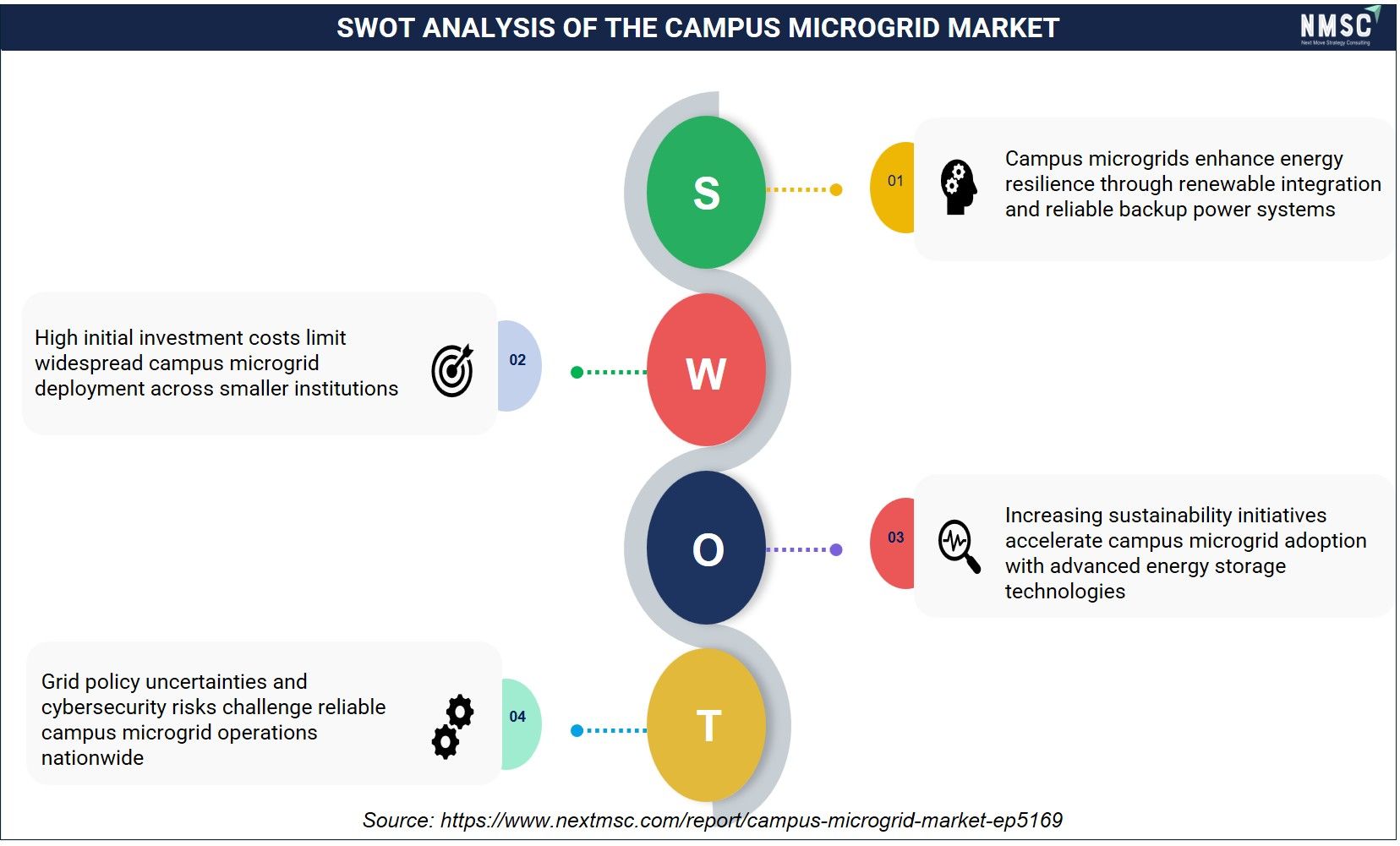
The SWOT analysis of the Campus Microgrid Market highlights strong growth potential driven by increasing demand for energy resilience, renewable energy integration, and advanced energy storage technologies. However, high upfront investment costs remain a barrier, particularly for smaller institutions. Expanding sustainability initiatives present significant opportunities, while evolving grid regulations and rising cybersecurity risks pose ongoing challenges to reliable and secure campus microgrid operations.
Regional Outlook
Geographic Performance Snapshot
|
Region |
2025 (USD) |
2035 (USD) |
CAGR% (2026–2035) |
Key Driver |
|
North America |
USD 1.20 Billion |
USD 2.64 Billion |
7.9% |
Data center resilience buildout and healthcare campus adoption |
|
Europe |
USD 0.62 Billion |
USD 1.42 Billion |
8.2% |
Energy security priorities and industrial campus electrification |
|
Asia-Pacific |
USD 0.52 Billion |
USD 1.56 Billion |
11.6% |
Expanding data center capacity and government digital infrastructure investment |
|
Middle East & Africa |
USD 0.16 Billion |
USD 0.41 Billion |
10.3% |
Gulf data center investment and grid resilience modernization |
|
Latin America |
USD 0.10 Billion |
USD 0.27 Billion |
9.4% |
Growing industrial campus investment and grid reliability concerns |
|
Total |
USD 2.6 Billion |
USD 6.3 Billion |
9.2% |
— |
North America Campus Microgrid Market Outlook
North America leads the campus microgrid market with a dense concentration of data center campuses and established healthcare and higher education microgrid adopters. We observed that Bloom Energy Corporation's expanding fuel cell contracts with data center operators sustain demand for on-site generation across the region. Technology adoption remains advanced, with energy-as-a-service financing driving demand across the region's capital-constrained municipal and educational institutions.
Europe Campus Microgrid Market Outlook
Europe's campus microgrid market reflects a maturing landscape shaped by energy security priorities following recent regional energy price volatility. Our findings suggest that campuses across Germany, France, and the UK are accelerating adoption of hybrid and renewable-dominant microgrid systems to reduce grid dependence. Technology adoption favors islandable configurations among the region's industrial and government campuses.
Asia-Pacific Campus Microgrid Market Outlook
Asia-Pacific is the fastest-growing campus microgrid market region, propelled by expanding data center capacity in China and rising government digital infrastructure investment. We found that regulatory frameworks remain less harmonized than in North America, giving vendors flexibility to scale hardware and engineering offerings rapidly. Technology adoption is accelerating as regional data center and industrial campus operators expand on-site generation pilots.
Middle East & Africa Campus Microgrid Market Outlook
The campus microgrid market in Middle East & Africa is expanding as Gulf Cooperation Council economies invest in data center capacity and grid resilience modernization programs. Our analysis shows that Saudi Arabia and the UAE are attracting microgrid investment linked to flagship digital infrastructure and government campus projects. Regulatory influence remains developing, while technology adoption is gradually shifting toward hybrid generation systems.
Latin America Campus Microgrid Market Outlook
Latin America's campus microgrid market is supported by growing industrial campus investment in Brazil and Argentina and persistent grid reliability concerns. We observed that regulatory frameworks are less stringent than in North America or Europe, though multinational operators are introducing microgrid systems locally. Technology adoption remains centered on natural gas and hybrid systems, with competitive intensity increasing as global vendors partner with regional distributors.
U.S. Campus Microgrid Market
Based on our estimates, the U.S. market was valued at approximately USD 960 million in 2025 and is projected to reach USD 2.04 billion by 2035, growing at a 7.5% CAGR. Demand is anchored by data center resilience buildout and a dense concentration of healthcare and higher education microgrid adopters. Technology penetration favors natural gas and fuel cell generation, and competitive intensity remains high among established vendors serving large institutional campuses.
Canada Campus Microgrid Market
The market in Canada reached roughly USD 168 million in 2025 and is forecast to hit USD 388 million by 2035 at an 8.5% CAGR. Demand structure mirrors U.S. resilience and sustainability adoption patterns, while federal clean energy guidance shapes generation technology expectations. Technology penetration is rising as national institutions request hybrid and renewable-dominant systems, with competitive intensity moderate given reliance on cross-border vendor partnerships.
UK Campus Microgrid Market
As per our estimate, the UK market stood at about USD 124 million in 2025, advancing toward USD 275 million by 2035 at a 7.8% CAGR. Demand is driven by higher education and healthcare campus resilience navigating national energy security priorities. Regulatory influence is significant, technology penetration favors hybrid systems, and competitive intensity remains steady among domestic and European vendors.
Germany Campus Microgrid Market
According to our analysis, Germany's market was valued near USD 161 million in 2025 and is set to reach USD 389 million by 2035, expanding at an 8.8% CAGR. Demand structure benefits from a strong domestic industrial and corporate campus base pursuing electrification. Germany's energy transition guidance drives regulatory influence, while technology penetration favors renewable-dominant systems among leading industrial operators.
France Campus Microgrid Market
Based on our estimates, France's market reached approximately USD 93 million in 2025, projected to climb to USD 213 million by 2035 at an 8.2% CAGR. Demand is supported by France's concentration of government and research campus infrastructure requiring resilience upgrades. Regulatory influence from French energy security legislation is notable, and competitive intensity remains high given the concentration of engineering vendors headquartered domestically.
China Campus Microgrid Market
The market in China stood at roughly USD 146 million in 2025 and is forecast to reach USD 479 million by 2035 at a 12.8% CAGR, the fastest among covered countries. Demand is fueled by rapidly expanding data center capacity and government-backed digital infrastructure programs. Regulatory influence is increasing gradually, technology penetration is accelerating through large operator pilots, and competitive intensity remains elevated among domestic and international vendors.
India Campus Microgrid Market
As per our estimate, India's market was valued at about USD 83 million in 2025, projected to reach USD 262 million by 2035 at a 12.2% CAGR. Demand structure reflects expanding data center and industrial campus investment alongside rising grid reliability concerns. Regulatory influence remains developing, while technology penetration is rising quickly as domestic and multinational vendors localize microgrid offerings.
Japan Campus Microgrid Market
According to our analysis, Japan's market reached close to USD 73 million in 2025 and is expected to hit USD 188 million by 2035, growing at a 9.8% CAGR. Demand is supported by Japan's established resilience culture following recurring natural disaster exposure. Regulatory influence is well established, technology penetration is advanced, and competitive intensity remains high among long-standing domestic vendors.
South Korea Campus Microgrid Market
Based on our estimates, South Korea's market stood at approximately USD 47 million in 2025, forecast to reach USD 131 million by 2035 at a 10.8% CAGR. Demand structure benefits from the country's advanced industrial base and expanding data center sector. Technology penetration is high, with domestic operators adopting fuel cell and hybrid systems, and competitive intensity remains pronounced amid rapid innovation cycles.
Australia Campus Microgrid Market
The campus microgrid market in Australia reached about USD 36 million in 2025 and is projected to reach USD 98 million by 2035, expanding at a 10.2% CAGR. Demand is supported by growing university and government campus resilience investment. Regulatory influence stems from national energy security strategy guidance, while technology penetration favors renewable-dominant systems amid moderate competitive intensity.
UAE Campus Microgrid Market
As per our estimate, the UAE market was valued near USD 38 million in 2025, projected to reach USD 98 million by 2035 at a 10.2% CAGR. Demand structure is shaped by the UAE's role as a regional data center and logistics hub. Regulatory influence remains moderate, technology penetration is improving through flagship digital infrastructure projects, and competitive intensity is rising as vendors expand Gulf portfolios.
Saudi Arabia Campus Microgrid Market
According to our analysis, Saudi Arabia's market reached roughly USD 45 million in 2025 and is expected to hit USD 121 million by 2035, growing at a 10.8% CAGR. Demand is driven by Vision 2030-linked digital infrastructure expansion and rising grid resilience investment. Regulatory influence is developing under national energy guidelines, and technology penetration is advancing as state-linked enterprises scale adoption.
South Africa Campus Microgrid Market
Based on our estimates, South Africa's market stood at about USD 19 million in 2025, forecast to reach USD 44 million by 2035 at a 9.2% CAGR. Demand structure reflects a developing institutional campus sector serving regional Southern African markets. Regulatory influence remains moderate, technology penetration is gradually improving, and competitive intensity is limited given reliance on imported microgrid components.
Brazil Campus Microgrid Market
The market in Brazil reached approximately USD 46 million in 2025 and is projected to reach USD 128 million by 2035, registering a 9.8% CAGR. Demand is underpinned by Brazil's expanding industrial and corporate campus base facing grid reliability challenges. Regulatory influence stems from national energy policy, technology penetration favors natural gas and hybrid systems, and competitive intensity remains moderate among regional distributors.
Argentina Campus Microgrid Market
As per our estimate, Argentina's market was valued near USD 15 million in 2025, projected to reach USD 38 million by 2035 at an 8.7% CAGR. Demand structure is supported by steady industrial campus investment despite macroeconomic volatility. Regulatory influence remains limited, technology penetration is modest, and competitive intensity is centered on a small number of regional distributors serving domestic institutions.
Competitive Landscape
We observed that the campus microgrid market features a moderately fragmented competitive landscape, with large industrial automation and power equipment incumbents competing alongside specialized energy-as-a-service developers on generation technology, financing flexibility, and campus-specific engineering expertise.
|
Key Takeaways |
|
Market Structure: Moderately fragmented; large power equipment and industrial automation vendors compete alongside specialized energy-as-a-service developers and generation technology innovators serving distinct campus types. |
|
Innovation Focus: Fuel cell generation for data centers, energy-as-a-service financing structures, and islandable retrofit engineering dominate current innovation pipelines across leading suppliers. |
|
M&A Activity: Active strategic investment exemplified by Bloom Energy Corporation's expanded USD 25 billion AI infrastructure partnership with Brookfield, reflecting large-scale capital commitments to campus-scale fuel cell generation. |
How Do Companies Compete in the Campus Microgrid Market?
Companies compete primarily on generation technology breadth, financing flexibility, and campus-specific engineering expertise across the industry. Large power equipment vendors such as Schneider Electric SE and Siemens AG leverage established electrical infrastructure relationships to embed microgrid controls natively, while specialized vendors such as Bloom Energy Corporation and Enchanted Rock LLC compete on generation technology innovation and energy-as-a-service delivery supplied directly to healthcare and data center campuses.
Which Competitive Archetypes Dominate the Campus Microgrid Market?
Two archetypes dominate the market: large power equipment and industrial automation vendors offering embedded microgrid controls across broader electrical infrastructure portfolios, and specialized generation and energy-as-a-service developers focused on campus-specific resilience solutions. Schneider Electric SE and Eaton Corporation plc exemplify the equipment-integrated archetype, while Bloom Energy Corporation and Enchanted Rock LLC exemplify the specialized archetype through dedicated generation and service delivery models.
How Are Companies Differentiating Through Innovation in Campus Microgrids?
Innovation and differentiation strategy increasingly center on fuel cell generation and rapid-deployment financing models. Bloom Energy's data center contract momentum and Ameresco's power purchase agreement-based hospital microgrids both apply differentiated technology and financing approaches to reduce campus adoption barriers. Our analysis shows that vendors unable to demonstrate credible energy-as-a-service delivery risk exclusion from campus request-for-proposal shortlists as capital-constrained institutions prioritize financing flexibility.
What M&A and Expansion Activity Is Shaping the Campus Microgrid Market?
Strategic investment and partnership expansion continue to shape competitive dynamics within the industry. Bloom Energy Corporation's June 2026 expansion of its AI infrastructure partnership with Brookfield from USD 5 billion to USD 25 billion illustrates large-scale capital commitment to campus-scale fuel cell generation, while Ameresco's and Enchanted Rock's healthcare campus projects demonstrate parallel expansion into energy-as-a-service delivery models across institutional end markets.
Key Market Players
Our assessment indicates that the following 20 companies are actively shaping generation technology innovation, financing model development, and campus deployment strategy within the global campus microgrid market.
-
Schneider Electric SE
-
Siemens AG
-
Eaton Corporation plc
-
GE Vernova Inc.
-
Hitachi Energy Ltd.
-
Ameresco, Inc.
-
PowerSecure, Inc.
-
Cummins Inc.
-
Bloom Energy Corporation
-
Caterpillar Inc.
-
Wärtsilä Oyj Abp
-
Rolls-Royce Power Systems AG
-
S&C Electric Company
-
Johnson Controls International plc
-
ENGIE SA
-
Enel SpA
-
Tesla, Inc.
-
Enchanted Rock LLC
Latest Developments
We found that recent project activations and strategic partnerships within the campus microgrid market are concentrated on data center fuel cell generation and healthcare campus resilience deployments.
|
Date |
Event |
|
November 2025 |
Baton Rouge General Medical Center activated two gas-fired microgrids across its Bluebonnet and Mid City campuses, developed with Entergy Louisiana and Enchanted Rock LLC, providing 3.6 MW and 5.8 MW of full-facility backup capacity. |
Expert Insights
 "The technology we need to further the energy transition is already available, but the pace of the transition must accelerate. We need to rapidly scale the deployment of solar technology, EV charging infrastructure, microgrids, and the electrification of homes, buildings, and transport."
— Nadège Petit, Chief Innovation Officer, Schneider Electric
Statement made during: Schneider Electric's RE+ 2024 announcement, where the company discussed accelerating the global energy transition through wider deployment of distributed energy technologies, including microgrids, renewable energy, EV charging infrastructure, and building electrification.
Market Interpretation:
This statement highlights the increasing importance of microgrids as a critical component of modern energy infrastructure, supporting the transition toward decentralized, resilient, and low-carbon power systems. In the Campus Microgrid Market, universities, healthcare campuses, research institutions, and corporate campuses are increasingly deploying microgrids integrated with solar PV, battery energy storage, EV charging infrastructure, and intelligent energy management systems. Growing electrification of buildings, rising electricity demand, and institutional sustainability commitments are expected to accelerate investments in campus microgrids to enhance energy resilience, optimize operational efficiency, and support net-zero objectives.
Investment Opportunities
What Capital Inflows Are Targeting the Campus Microgrid Market?
Capital inflows into the campus microgrid market are increasingly directed toward fuel cell generation capacity and data center-focused financing structures. Strategic investors continue to fund large-scale generation partnerships, as seen in Bloom Energy Corporation's expanded USD 25 billion AI infrastructure commitment with Brookfield. We observed that investors favor companies demonstrating rapid deployment capability, viewing speed-to-power as a proxy for long-term data center campus contract retention.
How Is Infrastructure Investment Supporting Campus Microgrid Deployment?
Infrastructure investment is expanding generation manufacturing capacity and engineering resources across vendors to support accelerating campus microgrid demand. Our findings suggest that vendors are investing in modular, rapidly deployable generation and storage systems to improve installation speed, supporting the urgency demanded by data center campuses seeking to bypass multi-year utility interconnection timelines.
What ESG Considerations Are Shaping Campus Microgrid Investment Decisions?
Environmental, social, and governance considerations are increasingly relevant to investment decisions across the industry, with emissions performance and community resilience as key criteria. Government resilience and clean energy programs continue to inform institutional procurement standards for campus generation technology. We found that investors increasingly favor vendors offering lower-emission natural gas, fuel cell, and renewable-dominant systems, treating emissions performance as a governance indicator alongside reliability compliance.
Key Benefits for Stakeholders
How Does This Report Benefit Enterprise and Industry Leaders?
Enterprise and industry leaders gain access to validated segmentation, competitive benchmarking, and regional demand forecasts that support procurement and product-portfolio decisions across the campus microgrid industry. Our analysis shows that detailed campus type, primary energy source, and ownership model breakdowns help facilities and sustainability teams align vendor specifications with resilience and financing requirements while identifying underserved campus segments for portfolio expansion.
How Does This Report Benefit Investors and Financial Analysts?
Investors and financial analysts benefit from consistent, single-point market size and CAGR estimates that support valuation and capital-allocation decisions across the campus microgrid market supply chain. We observed that the report's regional and segment-level growth differentials help identify which vendors and technology categories are best positioned to capture above-market growth in Data Center and Fuel Cell Dominant categories through 2035.
How Does This Report Benefit Technology Vendors and Product Teams?
Technology vendors and product teams gain insight into emerging design requirements, including fuel cell generation, energy-as-a-service financing structures, and islandable retrofit engineering, that are reshaping the industry. Our findings suggest that this analysis helps research and development teams prioritize roadmaps around rapid deployment capability and financing flexibility increasingly required by campus request-for-proposal processes.
Key Market Segments
By Offering
-
Hardware and Equipment
-
Generation Assets
-
Solar PV
-
Wind Turbines
-
Combined Heat and Power
-
Reciprocating Engines
-
Fuel Cells
-
Other Generation Assets
-
-
Energy Storage
-
Lithium-Ion Battery Systems
-
Flow Battery Systems
-
Thermal Energy Storage
-
Other Energy Storage
-
-
Electrical Infrastructure
-
Switchgear
-
Transformers
-
Inverters and Converters
-
Protection Systems
-
Metering and Sensors
-
Power Distribution Equipment
-
-
Control and Communication
-
Microgrid Controllers
-
Energy Management Systems
-
Distributed Energy Resource Management Systems
-
SCADA
-
Communication Hardware
-
-
-
Engineering and Integration
-
Consulting and Feasibility
-
System Design
-
Engineering Procurement and Construction
-
Commissioning
-
Retrofit and Expansion
-
-
Managed Services
-
Operations and Maintenance
-
Remote Monitoring
-
Performance Optimization
-
Asset Management
-
-
Energy as a Service
-
Power Purchase Agreement
-
Energy Service Agreement
-
Subscription Service
-
Shared Savings Contract
-
Other Service Contracts
-
By Campus Type
-
Higher Education
-
Healthcare
-
Government and Defense
-
Corporate
-
Industrial
-
Data Center
-
Municipal Community
-
Research Campus
-
Other Campus
By Operating Mode
-
Grid Connected
-
Islandable
-
Off Grid
By Primary Energy Source
-
Renewable Dominant
-
Natural Gas Dominant
-
Fuel Cell Dominant
-
Storage Dominant
-
Hybrid
By Ownership Model
-
Customer Owned
-
Utility Owned
-
Third Party Owned
-
Energy as a Service
By Sales Channel
-
Direct Sales
-
EPC Contractor
-
Energy Service Company
-
Utility Partnership
By Region
-
North America: U.S., Canada, Mexico
-
Europe: UK, Germany, France, Italy, Spain, Sweden, Denmark, Finland, Netherlands, Rest of Europe
-
Asia-Pacific: China, India, Japan, South Korea, Taiwan, Indonesia, Vietnam, Australia, Philippines, Malaysia, Rest of APAC
-
Middle East & Africa: Saudi Arabia, UAE, Egypt, Israel, Turkey, Nigeria, South Africa, Rest of MEA
-
Latin America: Brazil, Argentina, Chile, Colombia, Rest of LATAM
Conclusion and Recommendations
What Is the Long-Term Outlook for the Campus Microgrid Market?
The long-term outlook for the market remains positive, with global revenue projected to more than double from USD 2.6 billion in 2025 to USD 6.3 billion by 2035 at a 9.2% CAGR. We observed that sustained data center power demand, extreme weather-driven healthcare resilience investment, and expanding fuel cell adoption will continue underpinning demand across higher education, healthcare, and data center campuses through the forecast period.
What Strategic Positioning Should Campus Microgrid Vendors Pursue?
Vendors should prioritize fuel cell and hybrid generation capability while pursuing energy-as-a-service financing structures to secure long-term campus contracts. Next Move Strategy Consulting's assessment indicates that companies investing early in rapid-deployment engineering and islandable retrofit capability will be best positioned to capture premium positioning within the campus microgrid market.
How Attractive Is the Campus Microgrid Market for New Investment?
The campus microgrid industry presents an attractive investment case, supported by a USD 3.4 billion absolute dollar opportunity between 2026 and 2035 and above-average growth in Asia-Pacific and Data Center categories. We found that investment attractiveness is highest for vendors combining fast-deployment generation technology with flexible financing, positioning them to serve both large data center and capital-constrained institutional campus segments simultaneously.
What Market Shifts and Key Risks Should Stakeholders Monitor?
Stakeholders should monitor high upfront capital costs, utility interconnection and regulatory approval delays, and grid interconnection queue congestion as key risks to the campus microgrid market. Our analysis shows that vendors unable to offer flexible financing risk losing procurement consideration to competitors with proven energy-as-a-service delivery, particularly as capital-constrained institutions weigh resilience needs against budget limitations.
What Are the Key Growth Pathways for the Campus Microgrid Market?
Key growth pathways include expanding fuel cell generation for data center campuses, scaling energy-as-a-service financing models, and deepening penetration into government and defense installation resilience programs. Next Move Strategy Consulting's analysis indicates that vendors pursuing these pathways while maintaining rapid deployment discipline will be best positioned to capture the campus microgrid market's projected growth through 2035.
About the Author
 Liza Phukan
— Liza Phukan is Research Associate at Next Move Strategy Consulting, where she has covered emerging industries and market research across sectors for 3.5 years. Her work includes analyzing industry developments, validating market data, and developing structured business content from research findings. She uses secondary research and data-validation practices to turn complex market information into clear decision-useful market analysis for business audiences and support report development and B2B.
Liza Phukan
— Liza Phukan is Research Associate at Next Move Strategy Consulting, where she has covered emerging industries and market research across sectors for 3.5 years. Her work includes analyzing industry developments, validating market data, and developing structured business content from research findings. She uses secondary research and data-validation practices to turn complex market information into clear decision-useful market analysis for business audiences and support report development and B2B.
About the Reviewer
 Supradip Baul
— Supradip Baul is an accomplished business consultant and strategist with over a decade of rich experience in market intelligence, strategy, technology, and business transformation. His work has included rigorous qualitative and quantitative analysis across multiple industries, helping clients shape investment decisions and long-term roadmaps. Earlier in his career, he was associated with Gartner, where he contributed to industry-leading reports and market share analyses. He has worked with leading global companies and holds an MBA with a dual specialization in Marketing and Finance.
Supradip Baul
— Supradip Baul is an accomplished business consultant and strategist with over a decade of rich experience in market intelligence, strategy, technology, and business transformation. His work has included rigorous qualitative and quantitative analysis across multiple industries, helping clients shape investment decisions and long-term roadmaps. Earlier in his career, he was associated with Gartner, where he contributed to industry-leading reports and market share analyses. He has worked with leading global companies and holds an MBA with a dual specialization in Marketing and Finance.
At Next Move Strategy Consulting, we understand that insightful market research is the cornerstone of successful business decisions. That's why we employ a robust and multifaceted approach, combining various methodologies to deliver the most accurate and actionable data for our clients.

Research Landscape
We navigate the world of research with two primary approaches:
Qualitative Approach
Our qualitative research methodologies involve immersive techniques such as in-depth interviews, focus groups, and observational studies. By engaging directly with individuals and stakeholders, we uncover valuable insights that quantitative data alone may overlook.

Quantitative Research
In tandem with qualitative methodologies, NMSC leverages the power of Quantitative Research to provide a robust foundation of numerical insights. Through systematic data collection and analysis, we quantify patterns, preferences, and market trends, offering a comprehensive view of the business landscape.
Our quantitative research approach employs diverse tools, including surveys, experiments, and statistical modelling. These methodologies enable us to gather data from a large and representative sample, ensuring the statistical significance of our findings. By employing structured questionnaires and standardized data collection methods, we guarantee the reliability and validity of the information we present to our clients.
Quantitative research is particularly effective in measuring the prevalence of trends, assessing market size, and gauging the impact of various factors on consumer behavior. The numerical precision attained through this approach equips our clients with actionable insights, facilitating data-driven decision-making and strategy formulation.


Our Specialized Toolbox for Industry-Specific Market Research
We deploy a specialized arsenal of techniques tailored to meet your unique requirements. Here's a glimpse into our comprehensive toolbox:

Information Procurement
The stage entails acquiring market data or relevant information through various sources and methodologies.


Market Research Approach
We utilize both top-down and bottom-up approaches in market research analysis to achieve a comprehensive understanding of the market dynamics, leveraging the broad perspective of industry trends and macroeconomic factors alongside detailed insights from specific segments and individual companies.

Porters Five Forces Analysis
We conduct Porter's Five Forces analysis to evaluate the competitive landscape of an industry, providing us with insights into factors that affect profitability and strategic positioning.

SWOT Analysis

Forecasting
We utilize a forecasting model to predict future consumption by considering parameters like population, economics, regulations, market competition, drivers, constraints, technology, and pricing. We also employ statistical techniques such as multilinear regression, exponential smoothing, moving average, ARIMA, and Monte Carlo simulations for accurate predictions. In econometric forecasting, we analyzed short-term and long-term event impacts, attributing values based on regulatory frameworks, economic factors, and market events.





 Speak to Our Analyst