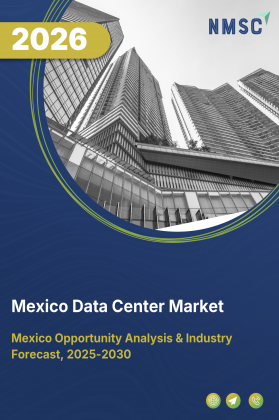
Mexico Data Center Market By Infrastructure (Hardware, Software, Services), By Type (Enterprise, Colocation, Cloud, Hyperscale, & others), By Data Center Rating (Tier I–IV), By Size (Small, Mid, Large), By Power Capacity (<0.01 GW–>0.5 GW), By Rack Density (<10kW–>50kW), by Redundancy (N–3N/2N+2), By PUE (<1.2–>2.0), by Design (Traditional, Containerized, Modular), and By End User (Cloud, Technology, Telecom, Healthcare, & Others) – Global Opportunity Analysis and Industry Forecast, 2025–2030
Industry: ICT & Media | Latest Edition: June 19, 2026 | No of Pages: 247 | No. of Tables: 115 | No. of Figures: 105 | Format: PDF | Report Code: IC2423
Industry Outlook
The Mexico Data Center Market size was valued at USD 5.02 billion in 2024, and is expected to be valued at USD 5.77 billion by the end of 2025. The industry is projected to grow, hitting USD 8.76 billion by 2030, with a CAGR of 8.71% between 2025 and 2030.
Mexico is an emerging data centre hub, driven by the expansion of hyperscaler clouds, the nearshoring of enterprise IT, and fast-growing domestic demand for AI, streaming, and e-commerce workloads. Major cloud providers, Google Cloud, Microsoft Azure, and Amazon Web Services, announced or opened local regions in 2024–2025; hyperscaler presence is catalyzing campus-scale builds and third-party operator activity.
Government and grid operators are concurrently planning transmission and capacity upgrades to accommodate rising electrical loads tied to data center projects. The market’s principal use-cases today are public cloud and enterprise cloud migration, colocation for multinational supply-chain partners, disaster recovery, and emerging on-shore AI/ML compute.
Near-term risk centers on local power and water availability in hot-growth hubs (notably Querétaro), but policy responses and planned transmission investments aim to reduce bottlenecks. Buyers value local data-residency, low latency to US markets, and sustainable power commitments; sellers compete on interconnection density, power efficiency and scalable campus footprints.

The chart shows the steady increase in Mexico’s fixed-broadband subscriptions from 17.80 units per 100 people in 2020 to 21.70 units per 100 people by 2024, indicating consistent annual growth in broadband penetration. This rising trend suggests a broader and more reliable digital infrastructure, which is critical for supporting the operational demands and expansion of data storage solutions across the country. Higher fixed-broadband adoption enhances connectivity and increases demand from businesses and consumers for cloud computing and digital services, thus driving sustained Mexico data center market growth.
What Are the Key Trends in Mexico Data Center Market?
How is Hyperscaler On-Shoring Reshaping the Mexico Data Center Market?
The rollout of local regions by hyperscalers, such as Google Cloud’s deployment in Querétaro in December 2024, Microsoft’s cloud investments and local data center developments in Mexico, and AWS’s announced Mexico Region slated for early 2025, has transformed Mexico from a latency-sensitive market into one equipped with onshore capacity for cloud-native workloads.
This shift has produced a dual impact: direct campus investments by cloud providers and a secondary wave of colocation and carrier-neutral facilities designed to capture enterprise and telecom traffic requiring hybrid connectivity with hyperscaler environments.
This trend is driving higher demand for MW-scale high-density power, cross-connects, and local interconnection fabrics, while simultaneously accelerating the need for skilled professionals in networking, facilities operations, and cloud engineering. For data center operators, the strategic takeaway is to integrate interconnection and managed services, combining connectivity with cloud migration, and to pre-design capacity for AI-ready racks with higher densities to attract workloads migrating from the United States.
Will Energy and Water Constraints Determine which Metros Scale Fastest?
The Mexico data center market expansion is increasingly constrained by local energy and water limitations. While utilities and grid planners, including CENACE and CFE, are updating transmission plans to support clusters such as Querétaro, capacity expansion and generation buildout remain time-intensive, resulting in geographic sorting: metros with robust transmission, available land, and cooperative permitting attract campus investments, whereas water-stressed regions face scrutiny and community resistance.
In response, operators are adopting low-water or waterless cooling designs and securing long-term power purchase agreements (PPAs) to ensure sustainable supply. Companies are advised to prioritize early energy agreements and community engagement, as air-cooled or closed-loop systems help reduce regulatory and social risks while accelerating commercial ramp-up timelines.
How will AI/ML Demand and Nearshoring Affect Capacity and Pricing?
The rapid adoption of generative AI and nearshoring of compute results in higher rack densities and longer-term capacity commitments. Mexico’s proximity to the US and improving local cloud regions reduce latency for AI inference and training workloads, raising the premium for low-latency, high-throughput colocation.
Pricing will bifurcate: commodity colocation (lower density) competes on price per kW, while premium campuses with direct interconnect and containment for GPU clusters command higher ARPU. Strategic insight: operators should create GPU-optimized pods, sell managed GPU tenancy and launch fixed multi-year capacity blocks for cloud customers to capture the higher lifetime value of AI workloads.
What are the Key Market Drivers, Breakthroughs, and Investment Opportunities that will Shape the Mexico Data Center Market in the Next Decade?
The Mexico data center market trends is witnessing robust growth, driven primarily by hyperscaler on-shoring, nearshoring of US-based IT and industrial workloads, and an expanding domestic demand for digital services, cloud computing, and AI-driven applications. These factors are attracting significant capital investment into colocation, interconnection, and managed services.
However, growth is constrained by energy and water limitations, permitting complexity, and community acceptance, which collectively pose execution challenges. Understanding these dynamics is critical for investors and operators seeking sustainable returns and market positioning.
Growth Drivers:
Which Investments are Accelerating the Data Center Capacity Expansion in Mexico?
The Mexico data center market demand is experiencing significant momentum, fuelled by the accelerated digitalization of businesses and government services. Major investments are driving this expansion. In September 2024, Microsoft committed USD 1.3 billion over three years to develop cloud and AI infrastructure, enhance digital skills, and increase connectivity, particularly for small and medium-sized enterprises and underserved regions.
Likewise, in February 2024, AWS pledged over USD 5 billion to establish a cluster of data center monitoring systems in Mexico, supporting growing enterprise cloud adoption. These initiatives underscore Mexico’s strategic push to expand data center capacity and support emerging technologies.
How are Data Sovereignty and Regulatory Compliance Driving Mexico’s Data Center Demand?
The growing focus on data sovereignty and regulatory compliance is prompting businesses to rely more on domestic data infrastructure. Under Mexico’s fintech law, financial institutions must store certain transaction and accounting records within national borders when using cloud services, while the Federal Law for Protection of Personal Data (LFPDPPP) enforces stringent privacy protections.
Additionally, the government’s National Digital Strategy promotes domestic infrastructure to enhance security, reduce latency, and improve service delivery. Collectively, these regulations are boosting demand for local data centers and encouraging global cloud providers to establish compliant regional facilities.
Growth Inhibitors:
What Challenges are Impacting the Mexico Data Center Market?
Despite robust growth, the data center market in Mexico faces notable infrastructure and sustainability challenges. Periodic electricity shortages and grid stress, highlighted by record national power demand during the 2024 heatwaves, pose risks to continuous operations.
Additionally, water scarcity in regions like Querétaro, a hub for hyperscale developments, creates further constraints. These environmental and resource limitations increase both capital and operational expenditures, as operators must invest in closed-loop water cooling systems, renewable energy procurement, and backup generation, while also managing community opposition and regulatory delays.
How is Edge Computing Shaping Opportunities in Mexico Data Center Market?
Edge computing is creating new growth opportunities for Mexico Data Center market by reducing latency and enabling real-time processing. Modernization efforts in the electricity sector, supported by government and private initiatives through 2025, are expanding renewable generation and enhancing grid resilience, paving the way for greener data center operations.
Simultaneously, edge deployments are enabling decentralized, low-latency infrastructure that complements hyperscale regions, allowing providers to deliver tailored solutions for fintech, e-commerce, and industrial IoT. Together, these trends help mitigate sustainability challenges while positioning Mexico as a strategic digital hub for North America’s nearshoring and AI-driven economy.
How Mexico Data Center Market is Segmented in this Report, and What are the Key Insights from the Segmentation Analysis?
By Infrastructure Insights
Which Infrastructure Segment is Shaping the Mexico Data Center Industry in 2025?
Based on component, the market is segmented into Hardware, Software, and Services.
Services dominate the Mexico data center industry, accounting for the largest share. The strong presence of colocation and cloud hosting services is reshaping how enterprises approach IT infrastructure. Rather than investing heavily in on-premises systems, businesses are relying on managed service providers to deliver scalability, flexibility, and cost-efficiency. Operation & support services play a key role by ensuring uptime and smooth day-to-day operations, while hosting and managed services help enterprises adapt to hybrid and multi-cloud strategies. The growing digital economy, combined with rising demand from BFSI, retail, and IT industries, further strengthens this segment’s leadership.
Software represents the smallest but fastest-growing segment in the Mexico data center market. As data centers become more complex, operators are adopting advanced tools for monitoring, orchestration, and automation. Security software leads the category, driven by the increasing risk of cyber threats and regulatory compliance requirements. Backup and disaster recovery software is also gaining traction as enterprises focus on business continuity. DCIM platforms further enhance efficiency by offering real-time insights into power, cooling, and asset utilization. While its market share is currently limited, the software segment is poised for robust growth as Mexico embraces Industry 4.0 and hybrid cloud adoption.

The chart illustrates the breakdown of the Mexico data center market by infrastructure segment for 2024, showing that services constitute the largest share at 53.6%, followed by hardware at 34.3%, and software at 12.2%. This highlights a market dominated by service-based offerings such as maintenance, support, and managed operations, with hardware, comprising physical equipment and components, representing a significant but smaller portion, and software solutions accounting for the least share among the three segments.
By Type Insights
Which Type of Data Center Is Leading Mexico’s Market Growth in 2025?
Based on by type, the market is segmented into enterprise data centers, colocation data centers, cloud data centers, hyperscale data centers, edge data centers, micro data centers, and others.
Colocation data centers dominate the market and provide shared space, power, cooling, and network infrastructure for multiple clients in Mexico. Organisations house their servers and IT equipment without investing in building their own facilities. These centers offer scalability, reliability, and connectivity while reducing capital expenditure. Managed services such as monitoring, maintenance, and security are included, allowing enterprises to focus on core business operations. The growing demand for cloud adoption, hybrid IT strategies, and digital services has positioned colocation centers as a key growth segment, providing flexible, cost-effective, and resilient infrastructure solutions for Mexican enterprises.
By Data Center Rating Insights
Which Data Center Rating are Driving the Mexico Data Center Market in 2025?
On the basis of data center rating, the market is segmented into Tier I, Tier II, Tier III, and Tier IV.
Tier III data centers dominate the market due to their concurrently maintainable infrastructure, providing redundancy in both power and cooling systems. They support enterprise, hyperscale, and colocation operations requiring high availability and reliability. These facilities are designed for 24/7 operations, with minimal downtime during maintenance, making them ideal for critical business applications and cloud services. Tier III centers incorporate advanced monitoring, management, and disaster recovery planning. Their scalable architecture allows operators to expand capacity without interrupting existing workloads, making them a preferred choice for enterprises and service providers aiming for high-performance, secure, and resilient IT infrastructure in Mexico’s evolving data center ecosystem.
By Size Insights
Which Data Center Sizes are Most Prominent in Mexico in 2025?
Based on size, the market is segmented into Small Data Centers, Mid-Sized Data centers, and Large Data centers.
Large data centers dominate the market, offering high-density computing, advanced cooling, and robust power systems. They support hyperscale, colocation, and cloud service providers, enabling the deployment of enterprise-grade IT workloads, big data analytics, and AI operations. These centers are designed for maximum efficiency, scalability, and redundancy, incorporating Tier III or IV infrastructure standards. With modular construction, energy-efficient systems, and advanced monitoring, large facilities ensure continuous uptime and operational resilience. They are central to Mexico’s expanding digital economy, supporting high-performance workloads for enterprises, cloud providers, and hyperscale operators while meeting growing demands for secure, scalable, and sustainable IT infrastructure.

The chart illustrates the Mexico data center market by power capacity for 2024, with hyperscale data centers (0.1–0.5 GW) making up the largest share at 40.0%. This is followed by large data centers (0.05–0.1 GW) at 26.4%, medium facilities (0.01–0.05 GW) at 23.8%, and small data centers (<0.01 GW) at 9.9%.
By Power Capacity Insights
Which Power Capacity Segments are Driving Mexico’s Data Center Expansion in 2025?
Based on Power Capacity, the market is segmented into <0.01 Gw (Small), 0.01-0.05 Gw (Medium), 0.05-0.1 Gw (Large), and 0.1-0.5 Gw (Hyperscale).
Hyperscale data centers provide massive computing power, supporting cloud providers, AI workloads, big data processing, and global enterprise operations. In Mexico, these centers are built with modular, fully redundant, and energy-efficient designs, integrating advanced cooling, power distribution, and monitoring systems. Hyperscale facilities enable rapid deployment of services and support extremely high-density racks. They are critical for enterprises and cloud providers requiring maximum scalability, fault tolerance, and uptime. These centers drive Mexico’s IT infrastructure growth, enabling digital transformation, supporting regional cloud expansion, and providing the backbone for data-intensive operations and next-generation technologies.
By Server Rack Density Insight
Which Server Rack Densities are Influencing Mexico Data Center Market in 2025?
On the basis of Server Rack Density, the market is segmented into <10kw, 10-19kw, 20-29kw, 30-39kw, 40-49kw, and >50kw.
Medium-high density racks support large-scale computing and enterprise operations in Mexico. They provide higher power delivery, enhanced cooling capacity, and space efficiency, making them suitable for virtualization, mid-tier cloud services, and analytics workloads. These racks allow operators to consolidate multiple servers into smaller footprints, reducing real estate costs while maximizing compute performance. They are frequently deployed in colocation and enterprise facilities where moderate-to-high density workloads are processed. With increasing adoption of hybrid IT and cloud strategies, medium-high density racks are critical for ensuring operational efficiency, energy optimization, and reliable performance across Mexico’s growing digital infrastructure
By Data Center Redundancy Insights
Which Redundancy Levels are Ensuring Mexico’s Data Center Reliability in 2025?
Based on redundancy, the market is segmented into N, N+1, N+2, 2N, 2N+1, and 3N/2N+2. N+1 and N+2 are widely adopted.
2N redundancy involves complete duplication of all critical infrastructure, providing fully fault-tolerant operations. In Mexico, 2N data centers cater to hyperscale operators, cloud providers, and large enterprises running mission-critical workloads. These facilities feature duplicate power lines, cooling systems, and network paths to ensure uninterrupted operations. While costly to build and operate, 2N redundancy guarantees high availability and reliability, integrated with advanced monitoring, predictive maintenance, and disaster recovery strategies. Such data centers are essential for applications requiring continuous uptime, including banking, telecommunications, and large-scale digital services, making 2N a premium standard in Mexico’s market.
By PUE Outlook Insights
Which PUE Levels are Driving Energy Efficiency in Mexico’s Data Centers in 2025?
Based on Power Usage Effectiveness (PUE), the market is segmented into <1.2, 1.2–1.5, 1.5–2.0, and >2.0.
A PUE of 1.2–1.5 indicates good energy efficiency and is common among modern mid-tier data centers in Mexico. These facilities integrate optimized cooling systems, advanced power distribution, and monitoring tools to balance operational costs with performance. They are suitable for enterprise, colocation, and regional cloud operations that require reliable infrastructure without incurring the high capital costs of ultra-efficient hyperscale facilities. This range reflects the adoption of modern technologies, gradual modernization of legacy systems, and growing awareness of sustainability and operational efficiency in Mexico’s expanding data center market.
By Design Outlook Insights
Which Data Center Designs are Reshaping Mexico’s Market in 2025?
On the basis of design, the market is segmented into Traditional, Containerized, and Modular.
Modular data centers combine the flexibility of containerized designs with the robustness of traditional facilities. In Mexico, they are increasingly adopted for scalable enterprise, colocation, and hyperscale workloads. Modular centers allow incremental capacity expansion, energy-efficient operations, and faster deployment compared to traditional builds. They integrate standardized power, cooling, and monitoring systems, enabling operators to optimize space, cost, and operational efficiency. This approach supports urban and regional IT hubs, providing the ability to scale as demand grows. Modular designs play a pivotal role in Mexico’s evolving data center landscape, bridging the gap between small-scale flexibility and large-scale reliability for growing digital workloads.

The chart represents the Mexico data center market distribution by end user for 2024, showing that cloud service providers make up the largest segment at 31.2%, followed by telecom companies at 15.2%, technology providers at 13.6%, and BFSI (banking, financial services, and insurance) at 9.9%. Other notable segments include retail & e-commerce (7.3%), entertainment & media (6.5%), healthcare (5.9%), government (4.5%), and a smaller share for remaining categories such as education (3.4%) and energy (2.7%).
By End-User Insights
Which End Users are Driving Mexico’s Data Center Demand in 2025?
Based on end user, the market is segmented into Cloud Service Providers, Technology Providers, Telecom, Healthcare, BFSI, Retail & E-Commerce, Entertainment & Media, Government, Energy, and Others.
Cloud service providers are the largest end-user segment in Mexico, driving demand for hyperscale and high-performance data centers. They utilize facilities for public, private, and hybrid cloud services, SaaS deployments, and scalable IT infrastructure. CSPs prioritize redundancy, energy efficiency, and high-density server racks to deliver uninterrupted services to enterprises and consumers. Their growth fuels the expansion of Mexico’s modern data center market, influencing infrastructure standards, operational practices, and energy optimization strategies. With increasing cloud adoption, CSPs play a key role in shaping the country’s digital transformation and supporting data-intensive applications, including AI, analytics, and content delivery networks.
Competitive Landscape
Which Companies Dominate the Mexico Data Center Industry and How do they Compete?
Competition in the Mexico data center sector is shaped among hyperscalers, including Google Cloud, Microsoft, and AWS; and strong regional specialists like KIO. Hyperscalers capture demand through owned regions, establishing anchor workloads and long-term visibility. Global operators compete primarily on interconnection density, carrier neutrality, and scale, while regional players leverage local relationships, permitting efficiency, and deep market knowledge to secure projects and tenants. This dynamic creates a multi-layered competitive landscape, where strategy, connectivity, and local expertise determine market positioning.

The chart displays the market share distribution of companies in the Mexico data center market for 2024, with Amazon Web Services (AWS) holding a significant share of 29.3%, followed by Microsoft Corporation at 17.3%, Google Cloud at 12.0%, and KIO at 6.3%. The remainder of the market, labeled as "Others," constitutes the largest portion at 35.1%, indicating a diverse competitive landscape beyond the top players.
Market Dominated by “Tech Giants and Specialists”
Competition in the market is shaped among hyperscalers, including Google Cloud, Microsoft, and AWS; global REITs and operators such as Equinix, Digital Realty, and Ascenty; and strong regional specialists like KIO and Aligned Data Centers. Hyperscalers anchor demand by developing owned regions, establishing core workloads, and creating predictable long-term traffic. Regional and specialist operators, including KIO, capture enterprise and telecom colocation requirements, leveraging local relationships, permitting expertise, and market knowledge. Global operators differentiate through interconnection density, carrier neutrality, and scale. This dual structure has fostered a layered ecosystem in which hyperscalers and neutral colocation providers co-exist, collaborating on connectivity, hybrid-cloud integration, and managed services, creating opportunities for strategic partnerships that enhance operational efficiency and tenant value.
Innovation and Adaptability Drive Market Success
Successful players in the market prioritize sustainability through long-term power purchase agreements (PPAs) and renewable energy offsets, while designing facilities for higher rack densities and specialized workloads. They increasingly offer managed GPU and AI-capable solutions to meet the growing demand for compute-intensive applications.
Illustrative examples include hyperscalers committing to locally built, energy-efficient data centers, and operators launching GPU-ready modules and power-dense designs that support AI, machine learning, and high-performance computing workloads, positioning themselves to capture next-generation enterprise and cloud demand.
Market Players to Opt for M&A Strategies to Expand their Presence
Mergers and acquisitions continue to serve as a rapid strategy for expanding connectivity and data center footprint in Mexico. Global players acquire local operators to accelerate market entry and gain immediate operational scale, while domestic champions frequently partner with financial institutions and utility providers to secure reliable energy supply and funding.
Recent activity across Latin America suggests ongoing consolidation, with both international and regional players using strategic M&A as a key growth lever to strengthen market position, enhance service offerings, and capture demand from hyperscalers, enterprises, and telecom clients.
Key Players
-
Amazon Web Services Mexico, S. de R.L. de C.V.
-
Microsoft México, S. de R.L. de C.V.
-
Google Cloud Mexico, S. de R.L. de C.V.
-
Equinix Mexico Holdings, S. de R.L. de C.V.
-
Ascenty Mexico, S. de R.L. de C.V.
-
Sixsigma Networks Mexico, S.A. de C.V.
-
Odata Colocation Mexico, S.A. de C.V.
-
Scala Data Centers S.A.
-
CloudHQ, LLC
-
Edgeuno Mexico, S.A. de C.V.
-
EdgeConneX Inc.
-
HostDime.com.mx, S.A. de C.V.
-
Layer 9 Data Centers Holdco LLC
-
Mexico Tower Partners, S.A.P.I. de C.V.
-
Cirion Technologies Mexico, S. de R.L.
What are the Latest Key Industry Developments?
-
December 2024 - Google Cloud has officially launched its Querétaro cloud region in Mexico, representing the company’s 41st global region and significantly boosting the country’s onshore cloud capacity for regional workloads.
-
January 2025 - AWS launched its Mexico Region, introducing local availability zones and enhancing cloud performance by reducing latency for customers across the country.
-
May 2024 - Microsoft announced the launch of its first data center region in Mexico, Mexico Central, making scalable, highly available, and resilient cloud services locally accessible to organizations worldwide.
-
April 2025 - In April 2025, Arelion and Gold Data entered a strategic partnership to build underground dark fiber connections between KIO Networks’ MEX-5 (Tultitlán) and QRO1 (Querétaro) data centers. This strengthens connectivity, resilience, and low-latency options for enterprise and cloud / ICT customers.
-
June 2025 - Equinix announced plans to launch a new USD 79 million data center in Monterrey in Q3 2025. Additionally, the company committed to contributing USD 200 million to Mexico's economy between 2024 and 2026, highlighting its ongoing investment in the region's digital infrastructure.
What are the Key Factors Influencing Investment Analysis & Opportunities in the Mexico Data Center Market?
Investment decisions hinge on secured long-term power (PPAs and transmission interconnections), interconnection penetration (direct cloud on-ramps), and the availability of talent and permitting speed in target metros. Valuation drivers include contracted MW under management, ARPU per kW (higher for GPU and premium interconnect), and length of anchor tenant commitments.
Hotspots include Querétaro (cluster effect), Mexico City metropolitan ring (connectivity), and industrial corridors near Monterrey. Institutional investors should evaluate sponsors’ ability to secure grid capacity and community acceptance; hedge strategies include staged capacity delivery, energy-backed financing, and revenue diversification via managed services and interconnection.
Key Benefits for Stakeholders:
Next Move Strategy Consulting (NMSC) presents a comprehensive analysis of the Mexico Data Center Market, covering historical trends from 2020 through 2024 and offering detailed forecasts through 2030. Our study examines the market at global, regional, and country levels, providing quantitative projections and insights into key growth drivers, challenges, and investment opportunities across all major Data Center segments.
Investors gain longer-duration revenue streams and higher ARPU from AI/nearshoring demand; policymakers receive FDI, skilled jobs and digital infrastructure that support GDP growth; customers benefit from lower latency, improved data residency, and scalable AI infrastructure. To balance growth and local welfare, stakeholders must coordinate on energy plans, vocational training and transparent resource-use agreements to sustain both community needs and commercial expansion.
Report Scope:
|
Parameters |
Details |
|
Market Size in 2025 |
USD 5.77 billion |
|
Revenue Forecast in 2030 |
USD 8.76 billion |
|
Growth Rate |
CAGR of 8.71% from 2025 to 2030 |
|
Analysis Period |
2024–2030 |
|
Base Year Considered |
2024 |
|
Forecast Period |
2025–2030 |
|
Market Size Estimation |
billion (USD) |
|
Growth Factors |
|
|
Companies Profiled |
15 |
|
Market Share |
Available for 10 companies |
|
Customization Scope |
Free customization (equivalent to up to 80 analyst-working hours) after purchase. Addition or alteration to country, regional & segment scope. |
|
Pricing and Purchase Options |
Avail customized purchase options to meet your exact research needs. |
|
Approach |
In-depth primary and secondary research; proprietary databases; rigorous quality control and validation measures. |
|
Analytical Tools |
Porter's Five Forces, SWOT, value chain, and Harvey ball analysis to assess competitive intensity, stakeholder roles, and relative impact of key factors. |
Mexico Data Center Market Key Segments
By Infrastructure
-
Hardware
-
IT Hardware
-
Servers
-
Storage Systems
-
Networking Equipment
-
-
Power Infrastructure Hardware
-
Uninterruptible Power Supplies (UPS)
-
Generators
-
Automatic Transfer Switches
-
Power Distribution Units (PDUs)
-
-
Mechanical Infrastructure Hardware
-
Computer-Room Air Conditioners (CRAC/CRA Units)
-
Chillers
-
Racks
-
Cable Management Systems
-
-
Safety & Security Hardware
-
Fire Suppression Systems
-
Physical Security Systems (CCTV, Access Controls)
-
-
-
Software
-
DCIM & Monitoring
-
Automation & Orchestration
-
Backup & Disaster Recovery
-
Security Software
-
Virtualization Software
-
Analytics & Reporting Software
-
Other Software
-
-
Services
-
Planning & Professional Services
-
Site & Building Design
-
System/Infrastructure Engineering
-
Professional Advisory (Compliance, Energy Audits)
-
-
Integration & Deployment Services
-
Electrical & Mechanical Installation
-
Commissioning & Acceptance Testing
-
-
Operation & Support Services
-
Preventive & Corrective Maintenance
-
Facilities Management / Remote Monitoring
-
Support Services (Helpdesk, Onsite SLA Support)
-
-
Hosting & Managed Services
-
Colocation & Cloud Hosting Services
-
Virtual/Private Hosting Platforms
-
-
By Type
-
Enterprise Data Centers
-
Colocation Data Centers
-
Cloud Data Centers
-
Hyperscale Data Centers
-
Edge Data Centers
-
Micro Data Centers
-
Others
By Data Center Rating
-
Tier I
-
Tier II
-
Tier III
-
Tier IV
By Size
-
Small Data Centers
-
Mid-Sized Data Centers
-
Large Data Centers
By Power Capacity
-
<0.01 GW (Small)
-
0.01–0.05 GW (Medium)
-
0.05–0.1 GW (Large)
-
0.1–0.5 GW (Hyperscale)
By Server Rack Density
-
<10 kW
-
10–19 kW
-
20–29 kW
-
30–39 kW
-
40–49 kW
-
>50 kW
By Data Center Redundancy
-
N (No Redundancy)
-
N+1 (Single-Fault Tolerant)
-
N+2 (Dual-Fault Tolerant)
-
2N (Full Duplication)
-
2N+1 (Concurrently Maintainable + Extra Spare)
-
3N / 2N+2 (Multi-Backup Fault Tolerant)
By PUE Outlook
-
Less Than 1.2
-
1.2–1.5
-
1.5–2.0
-
Greater Than 2.0
By Design Outlook
-
Traditional
-
Containerized
-
Modular
By End User
-
Cloud Service Provider
-
Technology Provider
-
Telecom
-
Healthcare
-
BFSI
-
Retail & E-Commerce
-
Entertainment & Media
-
Government
-
Energy
-
Others
Conclusion & Recommendations
Our report equips stakeholders, industry participants, investors, policy-makers, and consultants with actionable intelligence to capitalize on the transformative Mexico data center market potential.
By combining robust data-driven analysis with strategic frameworks, NMSC’s Mexico Data Center Market Report serves as an indispensable resource for navigating the evolving landscape. The industry is steadily evolving toward a more cloud-driven, connected, and resilient digital infrastructure model. Strategic priorities emphasize the expansion of hyperscale and edge deployments, integration of renewable energy and advanced cooling technologies to enhance sustainability, and partnerships with global cloud and telecom providers to extend regional capacity.
The outlook points to sustained growth as nearshoring, AI adoption, and digital transformation accelerate across industries. Operators that invest in energy efficiency, automation, and scalable modular designs will be best positioned to capture market share and establish leadership in Mexico’s rapidly expanding digital ecosystem.


About the Author
 Sikha Haritwal
— Sikha Haritwal is an assistant manager with strong expertise in market research, data analysis, and cross-functional coordination. She plays a key role in leading complex research initiatives, strengthening analytical rigor, and enabling data-driven decision-making across teams. Known for her leadership mindset and structured problem-solving approach, she supports process improvement, enhances operational efficiency, and contributes to building scalable frameworks that drive long-term strategic outcomes and organizational effectiveness.
Sikha Haritwal
— Sikha Haritwal is an assistant manager with strong expertise in market research, data analysis, and cross-functional coordination. She plays a key role in leading complex research initiatives, strengthening analytical rigor, and enabling data-driven decision-making across teams. Known for her leadership mindset and structured problem-solving approach, she supports process improvement, enhances operational efficiency, and contributes to building scalable frameworks that drive long-term strategic outcomes and organizational effectiveness.
About the Reviewer
 Supradip Baul
— Supradip Baul is an accomplished business consultant and strategist with over a decade of rich experience in market intelligence, strategy, technology, and business transformation. His work has included rigorous qualitative and quantitative analysis across multiple industries, helping clients shape investment decisions and long-term roadmaps. Earlier in his career, he was associated with Gartner, where he contributed to industry-leading reports and market share analyses. He has worked with leading global companies and holds an MBA with a dual specialization in Marketing and Finance.
Supradip Baul
— Supradip Baul is an accomplished business consultant and strategist with over a decade of rich experience in market intelligence, strategy, technology, and business transformation. His work has included rigorous qualitative and quantitative analysis across multiple industries, helping clients shape investment decisions and long-term roadmaps. Earlier in his career, he was associated with Gartner, where he contributed to industry-leading reports and market share analyses. He has worked with leading global companies and holds an MBA with a dual specialization in Marketing and Finance.
At Next Move Strategy Consulting, we understand that insightful market research is the cornerstone of successful business decisions. That's why we employ a robust and multifaceted approach, combining various methodologies to deliver the most accurate and actionable data for our clients.

Research Landscape
We navigate the world of research with two primary approaches:
Qualitative Approach
Our qualitative research methodologies involve immersive techniques such as in-depth interviews, focus groups, and observational studies. By engaging directly with individuals and stakeholders, we uncover valuable insights that quantitative data alone may overlook.

Quantitative Research
In tandem with qualitative methodologies, NMSC leverages the power of Quantitative Research to provide a robust foundation of numerical insights. Through systematic data collection and analysis, we quantify patterns, preferences, and market trends, offering a comprehensive view of the business landscape.
Our quantitative research approach employs diverse tools, including surveys, experiments, and statistical modelling. These methodologies enable us to gather data from a large and representative sample, ensuring the statistical significance of our findings. By employing structured questionnaires and standardized data collection methods, we guarantee the reliability and validity of the information we present to our clients.
Quantitative research is particularly effective in measuring the prevalence of trends, assessing market size, and gauging the impact of various factors on consumer behavior. The numerical precision attained through this approach equips our clients with actionable insights, facilitating data-driven decision-making and strategy formulation.


Our Specialized Toolbox for Industry-Specific Market Research
We deploy a specialized arsenal of techniques tailored to meet your unique requirements. Here's a glimpse into our comprehensive toolbox:

Information Procurement
The stage entails acquiring market data or relevant information through various sources and methodologies.


Market Research Approach
We utilize both top-down and bottom-up approaches in market research analysis to achieve a comprehensive understanding of the market dynamics, leveraging the broad perspective of industry trends and macroeconomic factors alongside detailed insights from specific segments and individual companies.

Porters Five Forces Analysis
We conduct Porter's Five Forces analysis to evaluate the competitive landscape of an industry, providing us with insights into factors that affect profitability and strategic positioning.

SWOT Analysis

Forecasting
We utilize a forecasting model to predict future consumption by considering parameters like population, economics, regulations, market competition, drivers, constraints, technology, and pricing. We also employ statistical techniques such as multilinear regression, exponential smoothing, moving average, ARIMA, and Monte Carlo simulations for accurate predictions. In econometric forecasting, we analyzed short-term and long-term event impacts, attributing values based on regulatory frameworks, economic factors, and market events.





 Speak to Our Analyst