Middle East & Africa Construction Market By Project Type (New Construction, Renovation & Retrofit, and Maintenance & Repair), By Sector (Buildings, Industrial & Process, and Civil & Infrastructure Construction), By Construction Method (On-site, Off-site Prefabricated, and Others), By Contractor Role (General, EPC, Specialty Trade Contractors, & Others), By Customer Type (Government & Public Authorities, Private Real Estate Developers, & Others) – Opportunity Analysis & Forecast, 2025-2035
Industry: Construction & Manufacturing | Latest Edition: September 7, 2026 | No of Pages: 426 | No. of Tables: 181 | No. of Figures: 175 | Format: PDF | Report Code: CM4880
Middle East & Africa Construction Market Size & Forecast
|
Parameters |
Details |
|
Market Size in 2026 |
USD 554.78 Billion |
|
Revenue Forecast in 2035 |
USD 822.16 Billion |
|
Growth Rate |
CAGR of 4.47% from 2026 to 2035 |
|
Analysis Period |
2025–2035 |
|
Base Year Considered |
2025 |
|
Forecast Period |
2026–2035 |
|
Market Size Estimation |
Billion (USD) |
|
Countries Covered |
7 |
|
Companies Profiled |
15 |
|
Market Share |
Available for 10 companies |
Industry Outlook
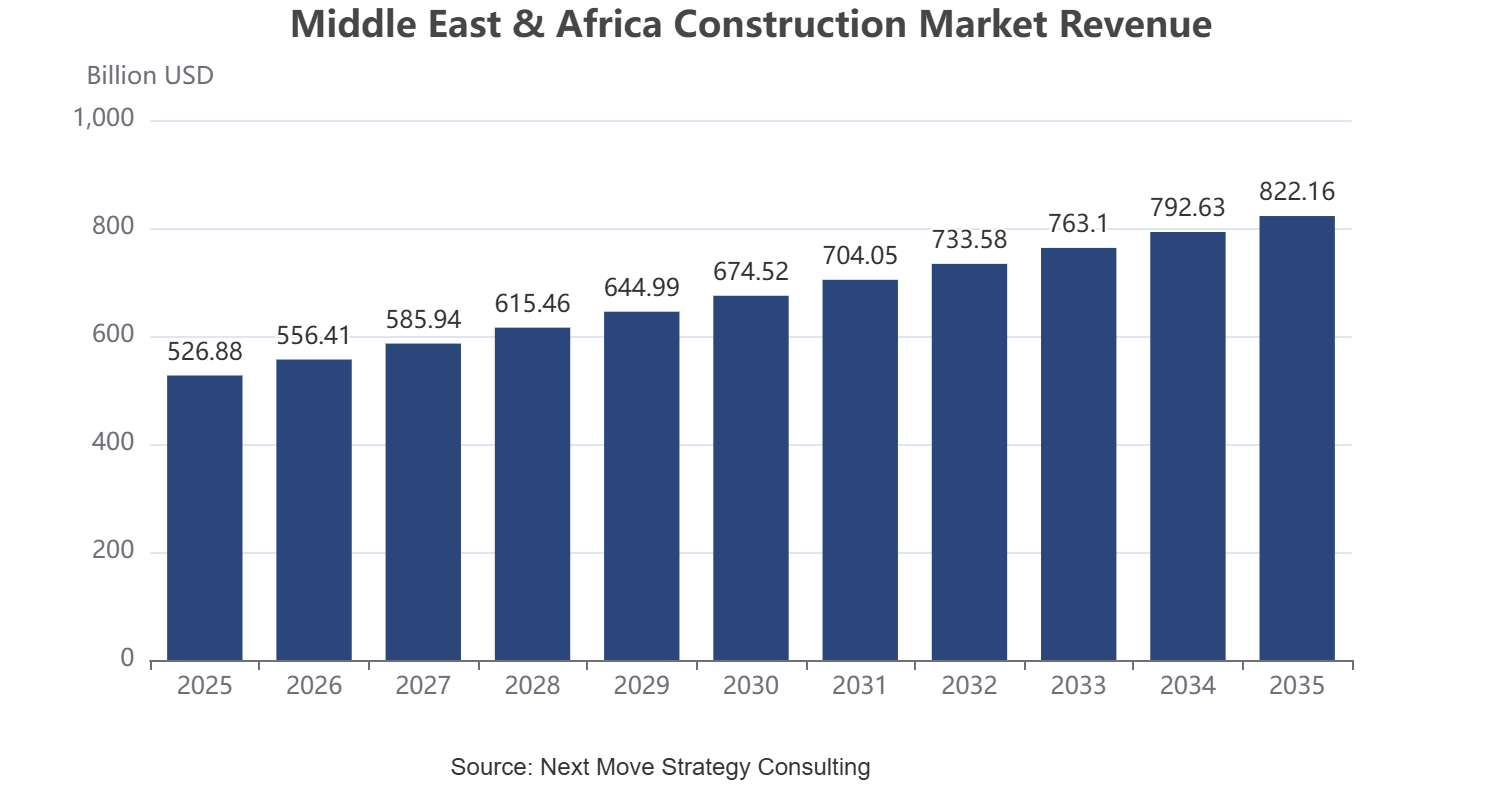
The Middle East & Africa Construction Market size was valued at USD 526.88 billion in 2025 and is expected to reach USD 554.78 billion by 2026. Looking ahead, the industry is projected to expand significantly, reaching USD 822.16 billion by 2035, registering a CAGR of 4.47% from 2026 to 2035.
What are the Key Market Drivers, Breakthroughs, and Investment Opportunities that will Shape the Middle East & Africa Construction Market in the Next Decade?
Growth Catalyst & Risk Assessment Matrix
|
DRIVERS / TRENDS / RESTRAINTS |
(+/-) % IMPACT ON CAGR FORECAST |
GEOGRAPHIC RELEVANCE |
IMPACT TIMELINE |
|
Government investments in mega infrastructure and tourism projects, including smart cities, airports, and luxury developments |
+3.92% |
UAE, Saudi Arabia, Qatar, Egypt |
Medium to Long term (3–6 years) |
|
Expansion of energy and transportation infrastructure improving connectivity and industrial development |
+3.18% |
Saudi Arabia, UAE, South Africa, Egypt, Nigeria |
Medium term (2–5 years) |
|
Development of affordable housing projects driven by urbanization and housing demand |
+2.74% |
South Africa, Nigeria, Egypt, Kenya, Saudi Arabia |
Medium to Long term (3–6 years) |
|
Political instability and financing challenges limiting investment confidence and project execution continuity |
-3.56% |
Middle East & Africa (Nigeria, South Africa, parts of Sub-Saharan Africa) |
Short to Medium term (1–4 years) |
|
Renewable energy infrastructure investment, including solar, wind, and green hydrogen projects |
+2.83% |
Saudi Arabia, UAE, Morocco, Egypt, South Africa |
Medium to Long term (3–6 years) |
Government-led investments in mega infrastructure and tourism projects are significantly driving growth across the Middle East & Africa construction market by expanding high-value project pipelines and attracting global capital. Our analysis indicates that large-scale developments such as smart cities, luxury tourism destinations, airports, and integrated urban complexes are creating sustained demand for construction services while accelerating the adoption of advanced building techniques. We observed that long-term national development strategies and international partnerships are ensuring continuous capital inflow and execution efficiency. In addition, the expansion of energy and transportation infrastructure is strengthening regional connectivity and supporting industrial development through investments in power systems, logistics corridors, and transport networks. At the same time, rising focus on affordable housing projects is further boosting demand by addressing urban population growth and housing shortages. However, political instability and financing challenges continue to limit execution continuity. Despite this, increasing renewable energy investments are unlocking new opportunities and reinforcing long-term market growth.
Growth Drivers:
How are Government Investments in Mega Infrastructure and Tourism Projects Driving Market Growth?
NMSC analysis confirms that large-scale government investments in mega infrastructure and tourism projects are driving market growth across the Middle East & Africa construction market by significantly expanding high-value project pipelines. Countries across the region are prioritizing developments such as smart cities, luxury tourism destinations, airports, and large urban complexes to diversify economic activity and attract global investment. Based on our interactions with infrastructure agencies and contractors, we observed that these projects create sustained demand for construction services while accelerating adoption of advanced building techniques. Moreover, long-term national development strategies are ensuring continuous capital allocation toward flagship projects. At the same time, international partnerships and foreign investments are strengthening execution capabilities. As a result, mega project development continues to act as a key driver, reinforcing large-scale construction growth across the region.
How is the Development of Affordable Housing Projects Boosting the Middle East & Africa Construction Market Demand?
From our evaluation of regional construction trends, we identified that the increasing focus on affordable housing development is boosting market demand across the Middle East & Africa construction market. Rapid population growth, urban migration, and rising housing shortages are compelling governments to prioritize large-scale residential construction programs. Based on our interactions with developers and housing authorities, we observed that public housing initiatives and subsidized residential projects are expanding construction activity, particularly in emerging urban centers. Moreover, supportive policies and financing schemes are encouraging private sector participation in affordable housing segments. At the same time, standardized construction methods are improving cost efficiency and project scalability. As these initiatives continue to expand, affordable housing development emerges as a strong demand-side driver supporting sustained market growth.
How is the Expansion of Energy and Transportation Infrastructure Driving the Middle East & Africa Construction Market Growth?
Our assessment indicates that the expansion of energy and transportation infrastructure is driving market growth in the Middle East & Africa construction market by improving regional connectivity and supporting industrial development. Investments in power generation, transmission networks, highways, rail systems, and ports are creating consistent construction demand across both urban and remote regions. Based on our interactions with contractors and infrastructure planners, we observed that governments are prioritizing integrated infrastructure frameworks to enhance trade efficiency and economic resilience. Furthermore, cross-border connectivity projects and logistics corridor developments are strengthening regional integration. In addition, increasing energy demand is accelerating investments in both conventional and renewable power infrastructure. Consequently, the continuous expansion of transport and energy systems is sustaining construction activity and supporting long-term market growth.
Growth Inhibitor:
How are Political Instability and Financing Challenges Restraining the Middle East & Africa Construction Market Expansion?
Political instability and financing challenges are restraining market expansion in the Middle East & Africa construction market by increasing investment risks and limiting project execution continuity. Uncertain political environments in certain regions disrupt project planning, delay approvals, and affect investor confidence. Based on our interactions with developers and financial institutions, we identified that funding constraints and limited access to long-term capital restrict the ability to initiate and complete large-scale projects. Furthermore, fluctuations in economic conditions and currency instability increase financial risk for both domestic and international stakeholders. At the same time, reliance on government funding in some markets exposes projects to budgetary constraints. As these challenges persist, they continue to slow construction activity and act as a significant constraint on overall market growth.
Growth Opportunity:
How is Renewable Energy Infrastructure Investment Creating New Opportunities for the Market?
Renewable energy infrastructure investment is creating new opportunities for the Middle East & Africa construction market as countries accelerate the transition toward sustainable energy systems. Governments across the region are investing in solar, wind, and green hydrogen projects to diversify energy sources and reduce dependence on fossil fuels. Based on our interactions with contractors and energy developers, we found that large-scale renewable projects are generating demand for specialized construction capabilities, including grid integration and energy storage infrastructure. Moreover, international funding and partnerships are supporting project financing and technology transfer. In addition, policy incentives and long-term sustainability targets are encouraging broader adoption of clean energy infrastructure. As investment momentum continues, renewable energy development unlocks new growth avenues and strengthens long-term market expansion.
Strategic Framework of the Middle East & Africa Construction Industry
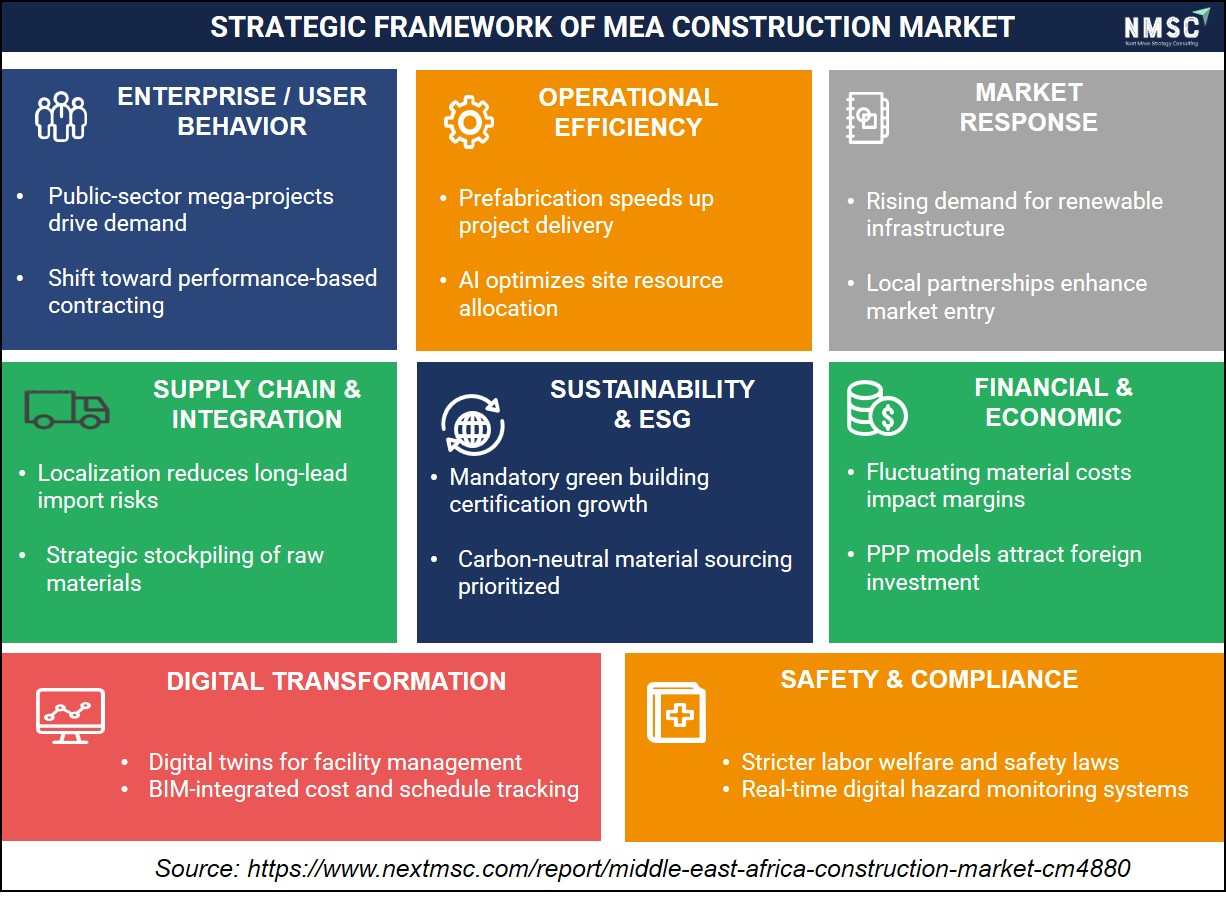
Based on our strategic assessment of the MEA construction market, we identified that public-sector investments and mega-projects are driving demand, while a shift toward performance-based contracting is improving execution accountability. Moreover, operational efficiency is advancing through prefabrication and AI-enabled resource optimization. Supply chain localization and strategic stockpiling are reducing dependency risks, although cost volatility remains a concern. At the same time, sustainability and ESG priorities, supported by green certifications, are gaining traction. Financial inflows through PPP models, along with digital transformation and stricter safety compliance, are collectively shaping long-term market competitiveness.
Which Country Is Dominating the Middle East & Africa Construction Market?
Turkey holds the dominant position in the Middle East & Africa construction market, supported by its strong construction industry base, strategic geographic location, and extensive experience in large-scale infrastructure and real estate development. The country benefits from diversified construction activities across residential, commercial, transportation, and energy sectors, enabling consistent project pipelines and regional influence. In addition, Turkish contractors have a strong presence in international markets, enhancing execution capabilities and competitiveness. Our analysis indicates that Turkey’s leadership is reinforced by well-established engineering expertise, cost-efficient construction practices, and a robust network of contractors and suppliers.
Furthermore, increasing adoption of modern construction technologies and project management tools improves efficiency, scalability, and timely project delivery. In addition, government support for infrastructure development and urban transformation projects creates a favorable environment for sustained growth. Consequently, rising demand for housing, transportation networks, and industrial infrastructure drives market expansion, while continuous advancements in construction practices further strengthen Turkey’s leadership. Therefore, Turkey remains the primary hub for construction activity, expertise, and project execution across the Middle East & Africa region.
Which Country Is Set to Witness the Fastest Growth?
The United Arab Emirates (UAE) is demonstrating substantial growth in the Middle East & Africa construction market, supported by increasing investments in infrastructure development, real estate expansion, and tourism-driven projects. Large-scale developments, including commercial complexes, residential communities, and hospitality projects, are driving strong construction demand across key cities. Accelerated development of smart city initiatives, transportation networks, and sustainable infrastructure is further boosting demand for advanced construction solutions and innovative building practices.
In addition, growing adoption of green building standards, digital construction tools, and prefabrication techniques is improving efficiency, quality, and environmental performance. Our assessment suggests that supportive government initiatives, diversified economic strategies, and increasing foreign investments are strengthening construction pipelines and market opportunities. Furthermore, the expansion of mega projects and international events continues to enhance the country’s construction outlook. Therefore, as investment inflows and development activities continue to rise, the UAE is poised to play an increasingly important role in driving regional construction market growth in the Middle East & Africa.
How is the Middle East & Africa Construction Market segmented in this report, and what are the key insights from the segmentation analysis?
By Contractor Role Insights
Is Contractor Role Segmentation Supporting Project Execution in the Middle East & Africa Construction Market?
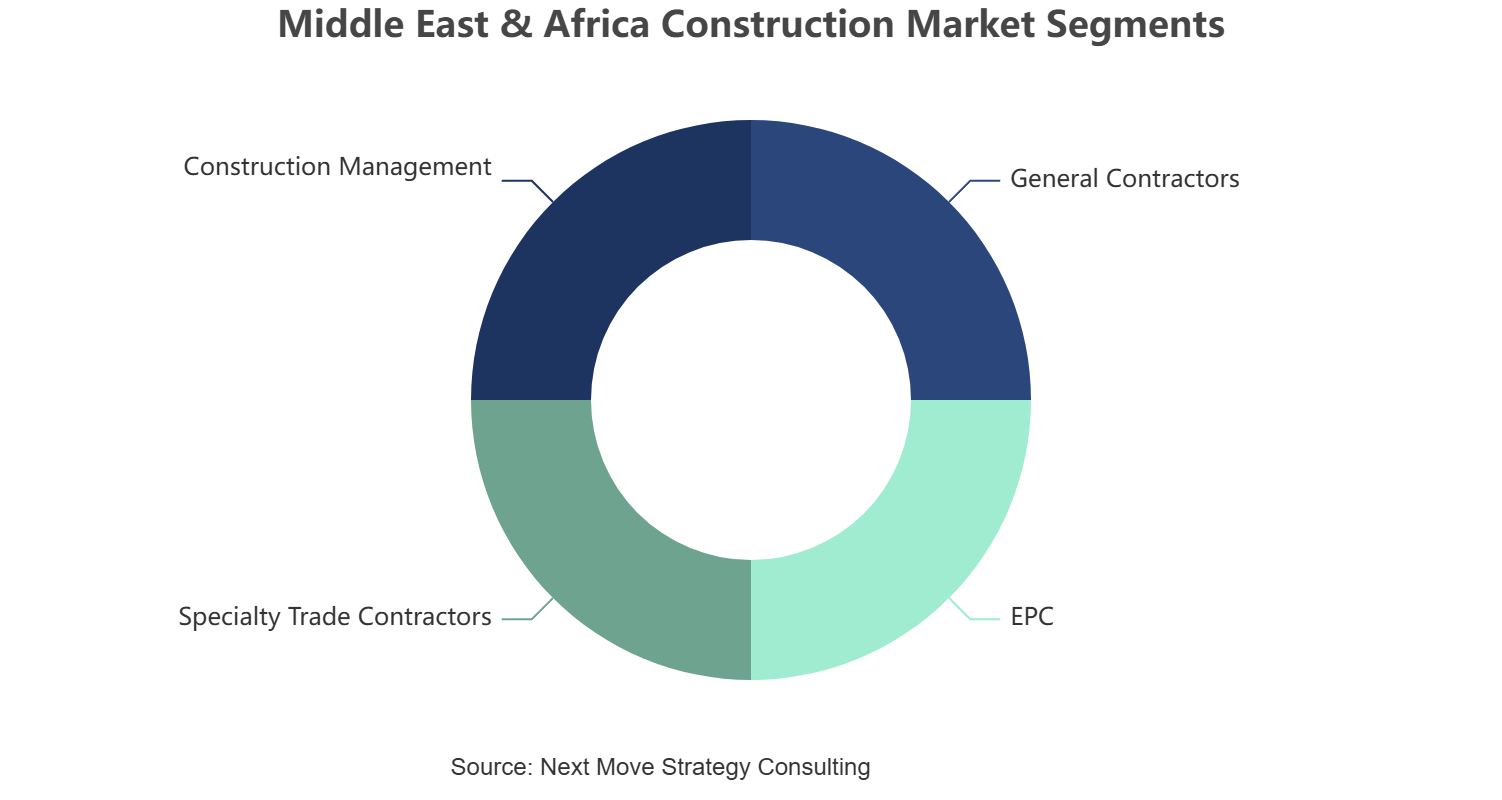
Based on contractor role, the Market is segmented into general contractors, EPC, specialty trade contractors, and construction management.
Based on our assessment, we observed that EPC contractors are supporting large-scale industrial, transportation, and energy infrastructure developments across the Middle East & Africa due to integrated engineering and execution capabilities. General contractors continue contributing across residential, commercial, and mixed-use developments, while specialty trade contractors provide technical expertise in electrical, structural, mechanical, and finishing works. Construction management services are also gaining importance for project coordination, procurement planning, regulatory compliance, and resource allocation. Furthermore, rising infrastructure investments and complex project requirements are strengthening the involvement of multiple contractor categories across regional construction activities.
By Project Type Insights
Is Project Type Segmentation Influencing Construction Activities in the Middle East & Africa Construction Market?
Based on project type, the market is segmented into new construction, renovation & retrofit, and maintenance & repair.
New construction projects continue to contribute significantly to construction activity across the Middle East & Africa due to infrastructure expansion, urban development, industrial investments, and tourism-related projects. Based on our evaluation, we identified that renovation & retrofit activities are increasing across commercial buildings, hospitality infrastructure, healthcare facilities, and public assets requiring modernisation and energy-efficiency upgrades. Maintenance & repair services also support operational continuity across transportation systems, utilities, industrial facilities, and residential developments. In addition, governments and private sector participants are increasing investments in long-term infrastructure preservation and asset lifecycle management across several regional economies.
Competitive Landscape
The Middle East & Africa construction industry is characterised by a competitive and moderately fragmented structure, supported by the presence of regional infrastructure developers, multinational engineering firms, and specialised construction contractors. The market growth is being driven by rising investments in mega infrastructure projects, smart city developments, transportation networks, energy infrastructure expansion, and large-scale residential and commercial construction activities across the Gulf countries, Africa, and other emerging economies. In addition, the increasing adoption of advanced construction technologies, sustainable building practices, and integrated project delivery models is strengthening operational efficiency and supporting broader market expansion.
Strategic Developments:
-
April 2026 – Hassan Allam Holding and Al Bawani Co. secured a contract valued at approximately USD 490 million for the development of the Saudi Arabia Museum of Contemporary Art (SAMoCA), strengthening cultural and mixed-use infrastructure construction activities in Saudi Arabia.
-
March 2026 – Orascom Construction PLC, together with ENGIE and Aeolus Energy, signed a power purchase agreement for the development of a 900 MW wind farm near Ras Shokeir in Egypt, supporting regional renewable infrastructure expansion.
Key Players of the Middle East & Africa Construction Market
-
Saudi Binladin Group
-
Nesma & Partners Contracting Co.
-
Al Bawani Co.
-
Trojan Construction Group LLC
-
ALEC Engineering & Contracting LLC
-
Arabian Construction Company LLC
-
Hassan Allam Holding
-
Rönesans İnşaat
-
ENKA İnşaat ve Sanayi A.Ş.
-
Limak İnşaat Sanayi ve Ticaret A.Ş.
-
Julius Berger Nigeria Plc
-
Wilson Bayly Holmes-Ovcon (WBHO)
-
Raubex Group Limited
NMSC evaluation indicates that the competitive dynamics are increasingly shaped by large-scale project execution capabilities, engineering expertise, financial strength, and the ability to deliver complex infrastructure developments across diverse end-use sectors. Key players such as Saudi Binladin Group, Nesma & Partners Contracting Co., Trojan Construction Group LLC, ALEC Engineering & Contracting LLC, Orascom Construction PLC, Hassan Allam Holding, Rönesans İnşaat, Julius Berger Nigeria Plc, and Wilson Bayly Holmes-Ovcon (WBHO) are strengthening their presence through strategic infrastructure contracts, expansion of sustainable construction capabilities, advanced project management integration, and diversified regional project portfolios. In addition, companies with strong regional execution networks, integrated engineering capabilities, and diversified infrastructure exposure are better positioned to address evolving construction requirements across transportation, energy, industrial, residential, and commercial sectors. Consequently, the competitive landscape is advancing toward a more technology-driven, sustainability-focused, and integrated structure in the Middle East & Africa construction market.
Porter’s Five Forces Analysis of the Middle East & Africa Construction Industry
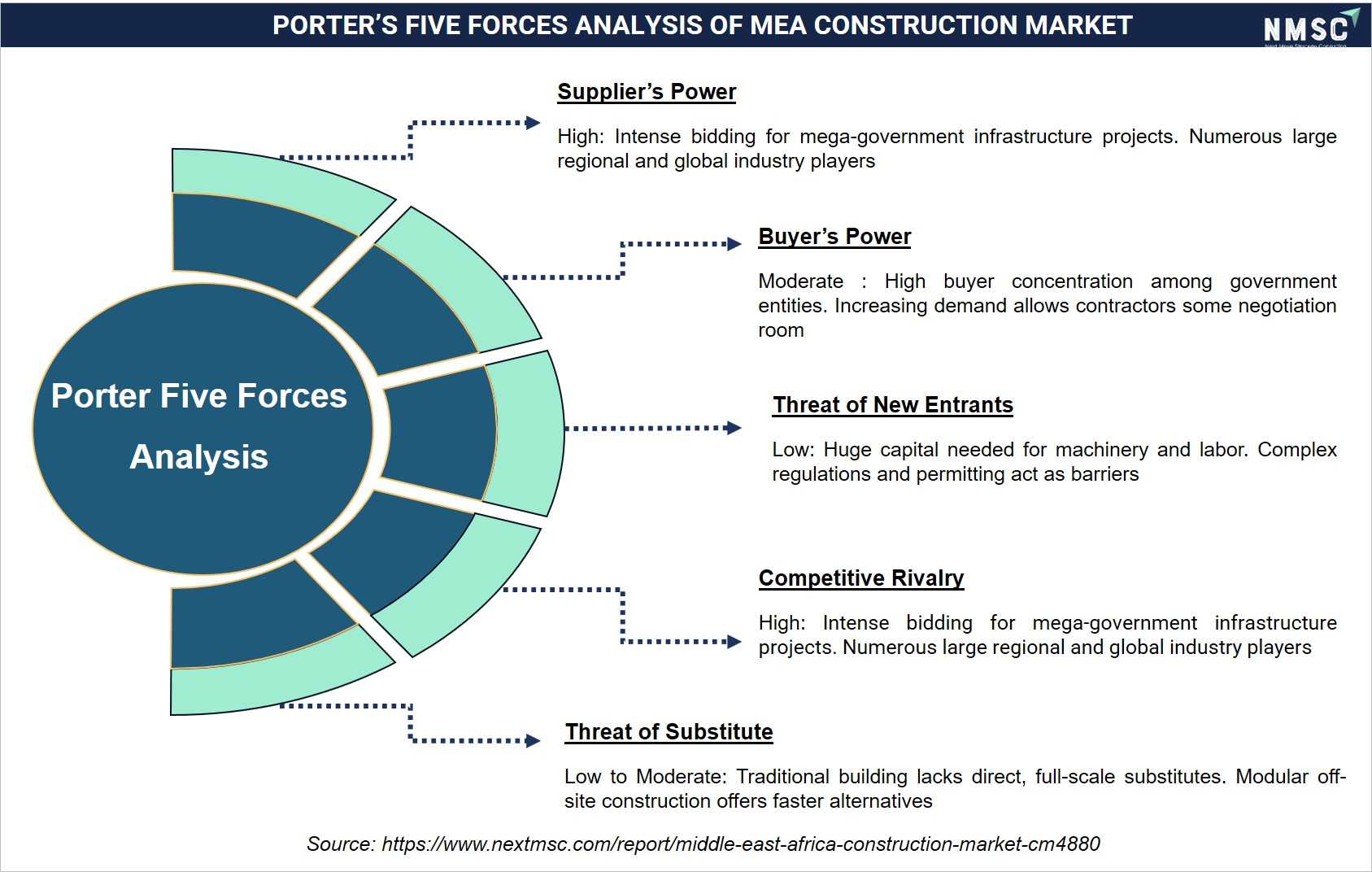
Based on our evaluation of competitive dynamics, we observed that supplier power is moderate to high due to reliance on imported materials and fluctuating costs, while buyer power remains moderate as governments dominate large-scale project demand. The threat of new entrants is relatively low, given capital intensity and regulatory barriers. However, competitive rivalry is increasing with the entry of international contractors and regional players. Additionally, substitutes such as modular construction methods present a moderate threat, gradually enhancing efficiency and influencing traditional construction practices across the MEA region.
Middle East & Africa Construction Market Key Segments
By Project Type
-
New Construction
-
Renovation & Retrofit
-
Maintenance & Repair
By Sector
-
Buildings Construction
-
Residential Buildings
-
Affordable Housing
-
Luxury Housing
-
-
Commercial Buildings
-
Office Buildings
-
Retail Buildings
-
Hospitality
-
Educational Buildings
-
Healthcare Buildings
-
Government & Public Buildings
-
Entertainment & Sports Venues
-
-
Industrial & Warehouse Buildings
-
Manufacturing Buildings
-
Warehouses & Logistics Centers
-
-
-
Industrial & Process Construction
-
Power Generation Facilities
-
Oil & Gas Facilities
-
Chemical & Petrochemical Plants
-
Other Process & Heavy Manufacturing Plants
-
-
Civil & Infrastructure Construction
-
Transportation Infrastructure
-
Roads & Highways
-
Bridges
-
Tunnels
-
Railways & Metros
-
Airports
-
Ports & Terminals
-
-
Environmental & Utility Infrastructure
-
Water Supply & Treatment Systems
-
Wastewater & Sewerage Systems
-
Solid Waste Management Systems
-
Dams, Levees & Flood Control
-
-
Telecommunication
-
By Construction Method
-
On-site Construction
-
Off-site Prefabricated
-
Hybrid Construction
-
3D Construction
By Contractor Role
-
General Contractors
-
EPC
-
Specialty Trade Contractors
-
Construction Management
By Customer Type
-
Government & Public Authorities
-
Private Real Estate Developers
-
Industrial & Energy Corporations
-
Healthcare Institutions
-
Educational Institutions
-
Individual Households
Key Benefits for Stakeholders:
Next Move Strategy Consulting (NMSC) presents a comprehensive analysis of the Middle East & Africa construction market trends, covering historical developments from 2020 to 2025 and providing forward-looking forecasts through 2035.
Our study evaluates the Middle East & Africa construction market at regional and country levels, delivering quantitative outlooks alongside qualitative insights into key growth drivers, infrastructure investments, regulatory developments, urbanization trends, and technology adoption across major construction segments.
From our observation, we found the Middle East & Africa construction market delivers measurable value to a diverse stakeholder ecosystem. Investors benefit from high-value project opportunities supported by government-led infrastructure programs, economic diversification initiatives, and large-scale urban developments in countries such as Saudi Arabia and United Arab Emirates. Contractors and developers gain from expanding project pipelines across residential, commercial, energy, and transport sectors driven by population growth and tourism development. Material suppliers and equipment providers benefit from rising demand for construction inputs, advanced machinery, and sustainable building solutions. By aligning infrastructure expansion with economic diversification strategies and smart city initiatives, the market supports long-term growth, operational efficiency, and resilient urban transformation across the region.
|
Parameters |
Details |
|
Customization Scope |
Free customization (equivalent to up to 80 analyst-working hours) after purchase. |
|
Pricing and Purchase Options |
Avail customized purchase options to meet your exact research needs. |
|
Approach |
In-depth primary and secondary research; proprietary databases; rigorous quality control and validation measures. |
|
Analytical Tools |
Porter's Five Forces, SWOT, value chain, and Harvey ball analysis to assess competitive intensity, stakeholder roles, and relative impact of key factors. |
About the Author
 Saista Faiyaz
— Saista Faiyaz is Research Associate at Next Move Strategy Consulting, where she has covered consumer markets and healthcare technologies for 3 years. Her work includes primary interview review, secondary-source validation, market sizing, and structured analysis of company and industry data. She supports research by comparing evidence across sources, organizing findings into market narratives, and documenting assumptions used in analysis. Her scope includes cross-market benchmarking, and reports.
Saista Faiyaz
— Saista Faiyaz is Research Associate at Next Move Strategy Consulting, where she has covered consumer markets and healthcare technologies for 3 years. Her work includes primary interview review, secondary-source validation, market sizing, and structured analysis of company and industry data. She supports research by comparing evidence across sources, organizing findings into market narratives, and documenting assumptions used in analysis. Her scope includes cross-market benchmarking, and reports.
About the Reviewer
 Supradip Baul
— Supradip Baul is an accomplished business consultant and strategist with over a decade of rich experience in market intelligence, strategy, technology, and business transformation. His work has included rigorous qualitative and quantitative analysis across multiple industries, helping clients shape investment decisions and long-term roadmaps. Earlier in his career, he was associated with Gartner, where he contributed to industry-leading reports and market share analyses. He has worked with leading global companies and holds an MBA with a dual specialization in Marketing and Finance.
Supradip Baul
— Supradip Baul is an accomplished business consultant and strategist with over a decade of rich experience in market intelligence, strategy, technology, and business transformation. His work has included rigorous qualitative and quantitative analysis across multiple industries, helping clients shape investment decisions and long-term roadmaps. Earlier in his career, he was associated with Gartner, where he contributed to industry-leading reports and market share analyses. He has worked with leading global companies and holds an MBA with a dual specialization in Marketing and Finance.
At Next Move Strategy Consulting, we understand that insightful market research is the cornerstone of successful business decisions. That's why we employ a robust and multifaceted approach, combining various methodologies to deliver the most accurate and actionable data for our clients.

Research Landscape
We navigate the world of research with two primary approaches:
Qualitative Approach
Our qualitative research methodologies involve immersive techniques such as in-depth interviews, focus groups, and observational studies. By engaging directly with individuals and stakeholders, we uncover valuable insights that quantitative data alone may overlook.

Quantitative Research
In tandem with qualitative methodologies, NMSC leverages the power of Quantitative Research to provide a robust foundation of numerical insights. Through systematic data collection and analysis, we quantify patterns, preferences, and market trends, offering a comprehensive view of the business landscape.
Our quantitative research approach employs diverse tools, including surveys, experiments, and statistical modelling. These methodologies enable us to gather data from a large and representative sample, ensuring the statistical significance of our findings. By employing structured questionnaires and standardized data collection methods, we guarantee the reliability and validity of the information we present to our clients.
Quantitative research is particularly effective in measuring the prevalence of trends, assessing market size, and gauging the impact of various factors on consumer behavior. The numerical precision attained through this approach equips our clients with actionable insights, facilitating data-driven decision-making and strategy formulation.


Our Specialized Toolbox for Industry-Specific Market Research
We deploy a specialized arsenal of techniques tailored to meet your unique requirements. Here's a glimpse into our comprehensive toolbox:

Information Procurement
The stage entails acquiring market data or relevant information through various sources and methodologies.


Market Research Approach
We utilize both top-down and bottom-up approaches in market research analysis to achieve a comprehensive understanding of the market dynamics, leveraging the broad perspective of industry trends and macroeconomic factors alongside detailed insights from specific segments and individual companies.

Porters Five Forces Analysis
We conduct Porter's Five Forces analysis to evaluate the competitive landscape of an industry, providing us with insights into factors that affect profitability and strategic positioning.

SWOT Analysis

Forecasting
We utilize a forecasting model to predict future consumption by considering parameters like population, economics, regulations, market competition, drivers, constraints, technology, and pricing. We also employ statistical techniques such as multilinear regression, exponential smoothing, moving average, ARIMA, and Monte Carlo simulations for accurate predictions. In econometric forecasting, we analyzed short-term and long-term event impacts, attributing values based on regulatory frameworks, economic factors, and market events.





 Speak to Our Analyst