Strain Gauge Market Size, Share, Growth & Forecast by Offering (Bare Strain Gauges: Foil, Semiconductor, Wire, Optical, Vibrating Wire; Accessories & Consumables; Services), By Technology (Electrical Resistance, Semiconductor Piezoresistive, and Others), By Application (Experimental Stress Analysis, Transducer Manufacturing), By Customer Type (OEMs, Test Laboratories, and others), and By End Use (Aerospace & Defense, Automotive & Mobility, and others) — Global Analysis 2025–2035
Industry: Semiconductor & Electronics | Publishing Date: July 7, 2026 | Last Updated: September 30, 2026 | No of Pages: N/A | No. of Tables: N/A | No. of Figures: N/A | Format: PDF | Report Code: SE5005
What Is the Strain Gauge Market Size?
The global Strain Gauge Market was valued at USD 824.6 million in 2025 and is expected to reach USD 861.4 million in 2026. Sustained demand from aerospace and defense testing, automotive development programs, structural health monitoring, and industrial automation is projected to propel the market to USD 1,250 million by 2035, advancing at a CAGR of 4.2% from 2026 to 2035. Key growth drivers include expanding transducer manufacturing requirements, the integration of optical fiber strain gauges in civil infrastructure monitoring, rising adoption of semiconductor piezoresistive sensors in electric vehicle battery testing, and growing investments in smart manufacturing across Asia Pacific.
|
Parameters |
Details |
|
Market Size in 2025 |
USD 824.6 Million |
|
Market Size in 2026 |
USD 861.4 Million |
|
Revenue Forecast in 2035 |
USD 1253.8 Million |
|
Growth Rate |
CAGR of 4.2% from 2026 to 2035 |
|
Analysis Period |
2025–2035 |
|
Base Year Considered |
2025 |
|
Forecast Period |
2026–2035 |
|
Market Size Estimation |
Million USD |
|
Companies Profiled |
20 |
|
Countries Covered |
33 |
|
Market Share |
Top 10 |
Strain Gauge Market Overview
What Is the Strain Gauge Market?
A strain gauge is a precision electromechanical sensing device that measures deformation, load, stress, torque, or pressure by detecting changes in electrical resistance, optical wavelength, or resonant frequency when a substrate undergoes mechanical strain. The Strain Gauge Market encompasses bare gauges, installation accessories, calibration services, and embedded transducer products used across aerospace, automotive, civil engineering, industrial machinery, energy, medical, and research end-use sectors globally.
How Has the Strain Gauge Market Evolved?
The Strain Gauge Market has evolved across several distinct technology generations. The first phase centered on wire strain gauges developed in the 1930s for experimental stress analysis. The second phase introduced bonded metallic foil gauges that became the dominant form factor for laboratory and industrial applications. The current phase is defined by high-precision optical fiber sensing, distributed fiber Bragg grating systems, and semiconductor piezoresistive gauges capable of nanoscale measurement resolution for advanced electronics manufacturing and structural health monitoring applications.
How Do Regulations Influence the Strain Gauge Market?
Regulatory frameworks directly influence procurement and quality standards in the Strain Gauge Market. The U.S. Federal Aviation Administration mandates calibrated, traceable strain measurement instrumentation for structural flight test certification programs. The European Union's EN 1337 and ISO 6507 standards govern mechanical testing instrumentation. The American Society for Testing and Materials (ASTM) E1237 standard establishes installation and calibration protocols for bonded resistance strain gauges, creating compliance-driven procurement patterns across aerospace OEMs, bridge inspection authorities, and industrial quality assurance laboratories worldwide.
How Is Technology Adoption Expanding Across the Strain Gauge Market?
Technology adoption within the Strain Gauge Market is accelerating as end users require higher measurement accuracy, environmental durability, and wireless data acquisition capability. Optical fiber strain gauges are gaining adoption in civil infrastructure and offshore energy applications due to their immunity to electromagnetic interference and ability to operate in corrosive or submerged environments. Simultaneously, MEMS-based piezoresistive strain gauges are enabling miniaturized transducer designs for medical devices and aerospace avionics. Industry 4.0 integration is further driving demand for strain gauges with embedded digital outputs compatible with industrial IoT platforms.
|
Key Takeaways |
|
By offering, Bare Strain Gauges held the largest share at USD 496.2 million in 2025, driven by the high volume consumption of foil strain gauges across transducer manufacturing and experimental stress analysis programs. Foil strain gauges, particularly linear and rosette types, dominate due to their precision, availability in a wide range of resistance values, and compatibility with standard adhesive bonding and signal conditioning techniques. |
|
Optical Strain Gauges are the fastest-growing sub-segment under Bare Strain Gauges at a CAGR of 7.3% from 2026 to 2035, as fiber Bragg grating technology achieves broader adoption in civil infrastructure monitoring, offshore oil and gas pipeline inspection, and wind turbine blade health monitoring programs requiring long-term, multiplexed sensing capability. |
|
By technology, Electrical Resistance strain gauges generated USD 466.2 million in 2025, maintaining the largest segment share. Foil variants within this category dominate due to their low cost, high accuracy, wide temperature range, and multi-decade track record across load cell, pressure transducer, and experimental mechanics applications globally. |
|
Optical Fiber technology is the fastest-growing technology segment at a CAGR of 7.3% from 2026 to 2035, with Fiber Bragg Grating sensing driving adoption in structural health monitoring and distributed sensing enabling real-time pipeline and civil infrastructure condition assessment. |
|
By application, Transducer Manufacturing accounted for the largest share at USD 508.2 million in 2025, underpinned by the high-volume deployment of foil strain gauges in load cells, pressure transducers, and force and torque sensors used across industrial weighing, process control, and automotive testing industries. |
|
Experimental Stress Analysis is advancing at a CAGR of 4.0% from 2026 to 2035, with fatigue testing and structural test sub-segments gaining momentum as aerospace OEMs and civil engineering contractors increase structural validation investment ahead of next-generation aircraft and infrastructure programs. |
|
By customer type, Original Equipment Manufacturers (OEMs) held the dominant share at USD 312.4 million in 2025, as transducer and instrument manufacturers consume strain gauges in high volume for production-scale sensor integration across load cells, medical devices, and industrial instrumentation platforms. |
|
System Integrators are the fastest-growing customer type at a CAGR of 6.4% from 2026 to 2035, reflecting the growing integration of multi-sensor structural monitoring systems in smart bridges, intelligent buildings, and industrial automation deployments that require custom strain measurement network design and installation services. |
|
By end use, Industrial Machinery and Automation led at USD 196.4 million in 2025, supported by high adoption in machine tool calibration, robotic force feedback systems, and factory automation quality control applications requiring reliable, accurate strain measurement across diverse production environments. |
|
Automotive and Mobility is the fastest-growing end-use segment at a CAGR of 5.8% from 2026 to 2035, with EV and Battery sub-segments representing the highest growth area as automotive OEMs and battery manufacturers deploy strain gauges for structural validation, thermal management testing, and battery pack integrity assessment. |
|
Asia Pacific is the largest regional market at USD 298.6 million in 2025 and is projected to reach USD 474.8 million by 2035 at a CAGR of 4.8%, supported by large-scale manufacturing investment in China and Japan, expanding automotive and electronics production in South Korea and Taiwan, and infrastructure buildout across Southeast Asia. |
|
Middle East and Africa is the fastest-growing region at a CAGR of 5.7% from 2026 to 2035, driven by major civil infrastructure projects under Saudi Vision 2030, UAE smart city programs, and growing energy sector investment requiring structural health monitoring across pipelines, dams, and offshore platforms. |
|
Saudi Arabia is the fastest-growing country market within the Middle East & Africa Strain Gauge Market, driven by expanding infrastructure monitoring projects, industrial diversification initiatives, energy-sector investments, and increasing deployment of advanced sensing technologies across construction and industrial applications. |
|
China is the fastest-growing major country market in the Strain Gauge Market, propelled by rapid expansion of domestic transducer and load cell manufacturing, government-backed infrastructure investment requiring structural monitoring, and growing aerospace and EV manufacturing sectors demanding high-precision strain measurement solutions at competitive price points. |
Key Emerging Trends in the Strain Gauge Market
How Is Distributed Optical Fiber Sensing Transforming the Strain Gauge Market?
Distributed optical fiber sensing is fundamentally reshaping the Strain Gauge Market by enabling continuous, real-time strain monitoring across entire structures rather than point-by-point measurement. Fiber Bragg grating arrays and distributed Rayleigh backscattering systems now allow bridge inspection authorities and pipeline operators to simultaneously monitor thousands of sensing points on a single fiber. Luna Innovations' ODiSI-B distributed sensing platform, for example, delivers millimeter-resolution strain mapping across several meters of fiber, enabling detection of micro-cracks in composite aerospace structures before they become critical fatigue failures.
How Is the EV Battery Testing Wave Driving New Strain Gauge Applications?
The rapid global scale-up of electric vehicle battery manufacturing is creating a significant new demand wave for precision strain gauges within the Strain Gauge Market. Battery cell swelling, pack structural integrity under thermal cycling, and crash load distribution in EV chassis all require high-resolution strain measurement during development and production validation. Through our market assessment, we observed that semiconductor piezoresistive strain gauges are gaining traction in EV battery testing due to their superior frequency response and compact footprint compatible with miniaturized test fixtures on cylindrical, pouch, and prismatic battery cell formats.
How Is Industry 4.0 Integration Reshaping Strain Gauge Deployment in Industrial Automation?
Industry 4.0 adoption is reshaping how strain gauges are deployed in industrial machinery and automation applications within the Strain Gauge Market. Traditional gauges requiring analog signal conditioning and manual data acquisition are being replaced by digitally interfaced, IoT-enabled sensing nodes that stream strain data directly to cloud-based monitoring platforms. Manufacturers such as Hottinger Brüel and Kjær and Vishay Precision Group have introduced wireless strain gauge bridges and digital strain amplifiers compatible with standard industrial Ethernet protocols, enabling real-time condition monitoring of presses, robotic joints, and CNC machine spindles in smart factory environments.
How Are Structural Health Monitoring Programs Expanding Strain Gauge Adoption in Civil Engineering?
Government-mandated structural health monitoring programs for aging bridges, dams, and transportation infrastructure are creating durable long-term demand within the Strain Gauge Market. Based on NMSC's research, we found that vibrating wire strain gauges and embedded fiber Bragg grating sensors are the preferred technologies for long-term civil infrastructure monitoring due to their stability over decades-long deployment periods, corrosion resistance, and low susceptibility to temperature drift. Notable deployments include instrumented concrete bridges in North America and Europe where strain sensing networks alert maintenance teams to structural anomalies months before they become visible to inspection crews.
Ecosystem Analysis of the Strain Gauge Market
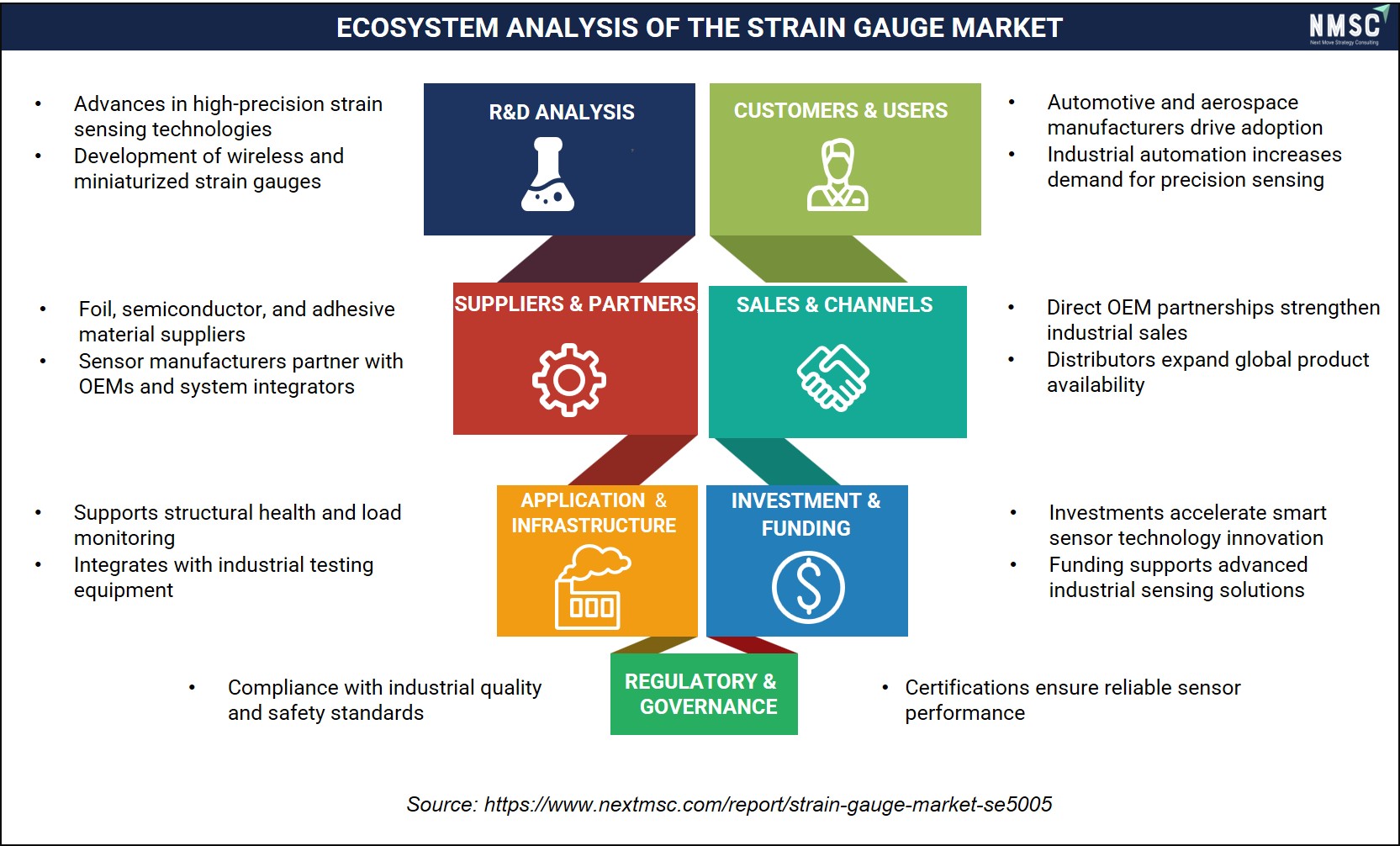
Based on our comprehensive assessment, we found that the strain gauge market ecosystem consists of raw material suppliers, sensor manufacturers, calibration service providers, research institutions, industrial integrators, and end users across automotive, aerospace, healthcare, and manufacturing sectors. Collaboration among technology developers, distributors, testing laboratories, and regulatory bodies supports product innovation, measurement accuracy, quality assurance, and wider adoption of precision sensing solutions.
What Are the Key Market Drivers, Breakthroughs, and Investment Opportunities that will Shape the Strain Gauge Market in the Next Decade?
|
Drivers / Trends / Restraints |
(+/-) % Impact on CAGR Forecast |
Geographic Relevance |
Impact Timeline |
|
Expanding Transducer Manufacturing Base |
+0.8% |
Global (led by Asia Pacific, North America) |
2025–2030 |
|
Structural Health Monitoring Infrastructure Mandates |
+0.6% |
North America, Europe, Asia Pacific |
2025–2035 |
|
EV and Battery Testing Demand Growth |
+0.5% |
North America, Europe, China, South Korea |
2025–2032 |
|
Optical Fiber Strain Gauge Technology Adoption |
+0.4% |
Europe, North America, Asia Pacific |
2026–2035 |
|
Industry 4.0 and IoT Integration in Manufacturing |
+0.3% |
North America, Europe, Japan, China |
2025–2030 |
|
Civil Infrastructure Renewal Programs |
+0.4% |
North America, Europe, Middle East |
2026–2035 |
|
High Gauge Installation Complexity |
-0.4% |
Emerging markets globally |
Ongoing |
|
Substitution by Alternative Sensing Modalities |
-0.3% |
All regions |
2026–2035 |
|
Miniaturization Demand in Medical and Aerospace |
+0.3% |
North America, Europe |
2025–2030 |
|
Offshore Energy Structural Monitoring Growth |
+0.2% |
Europe (North Sea), Middle East |
2026–2035 |
What Are the Growth Drivers of the Strain Gauge Market?
How Is Expanding Global Transducer Manufacturing Driving Strain Gauge Market Growth?
Transducer manufacturing represents the single largest demand driver for the Strain Gauge Market, with load cells, pressure transducers, and force and torque sensors consuming high volumes of precision foil and semiconductor strain gauges across global production facilities. The U.S. National Institute of Standards and Technology (NIST) has documented growing demand for traceable force measurement standards, reflecting the expanding base of industrial weighing and process control instruments. NMSC's analysis indicates that load cell manufacturers in China, Germany, and the United States collectively deploy hundreds of millions of strain gauges annually in high-volume sensor production operations.
How Are Government Infrastructure Investment Programs Creating Sustained Demand for Strain Gauges?
Government-funded infrastructure renewal and structural health monitoring mandates are creating a sustained, long-cycle demand stream within the Strain Gauge Market. The U.S. Infrastructure Investment and Jobs Act (IIJA), signed in 2021, allocated USD 1.2 trillion in infrastructure spending, a significant portion directed toward bridge rehabilitation and structural assessment programs that require embedded or surface-mounted strain sensing networks. Similarly, the European Union's Cohesion Fund and national infrastructure programs across Germany, France, and Italy are directing investment toward monitoring solutions for aging road and rail bridge stock, directly expanding the addressable market for vibrating wire and optical fiber strain gauges.
How Is Aerospace and Defense Testing Investment Supporting Strain Gauge Market Expansion?
Aerospace and defense structural testing programs represent a technically demanding and high-value demand segment within the Strain Gauge Market. The U.S. Department of Defense and NASA mandate calibrated, traceable strain measurement in all structural flight test and fatigue certification programs, sustaining demand for high-temperature, high-cycle specialty foil strain gauges and multi-axis rosette configurations. Our findings suggest that next-generation aircraft programs, including advanced air mobility vehicles, commercial hypersonic platforms, and satellite launch structures, require specialized strain gauges capable of operating across extreme temperature ranges from cryogenic propellant systems to aerodynamic heating environments exceeding 1,000°C.
What Are the Growth Inhibitors of the Strain Gauge Market?
How Does Gauge Installation Complexity Constrain Strain Gauge Market Penetration?
Strain gauge installation requires trained technicians skilled in surface preparation, adhesive selection, soldering, and protective coating application, creating a skilled labor constraint that limits market penetration in cost-sensitive industrial and construction applications. The demanding installation process, standardized under ASTM E1237 and HBM application notes, results in significant labor costs relative to the per-unit gauge price, creating a total-cost-of-measurement barrier. Our assessment indicates that this constraint particularly affects adoption in civil infrastructure monitoring in emerging markets where measurement technician training programs and certified installation contractors are scarce relative to the scale of infrastructure investment.
How Does Competition from Alternative Sensing Technologies Restrain Strain Gauge Market Growth?
The Strain Gauge Market faces competitive pressure from alternative measurement modalities that can fulfill some structural monitoring applications without the installation challenges associated with bonded gauges. Non-contact measurement techniques including digital image correlation (DIC) and laser extensometry systems are increasingly used in laboratory structural testing as complements or substitutes to bonded strain gauges. In long-span civil infrastructure applications, accelerometer networks and GNSS displacement monitoring systems offer installation simplicity advantages. Our analysis shows that these substitutes currently address a minority of use cases, but their improving cost-performance profiles could increasingly constrain strain gauge growth in specific laboratory and infrastructure monitoring segments through 2035.
What Are the Growth Opportunities in the Strain Gauge Market?
How Does the Structural Health Monitoring Market Create Multi-Dimensional Opportunity for Strain Gauge Suppliers?
Structural health monitoring represents the most strategically significant long-term growth opportunity in the Strain Gauge Market, combining elements of civil engineering, energy, aerospace, and industrial machinery demand into a unified, government-supported growth vector. The U.S. Federal Highway Administration's (FHWA) Long-Term Bridge Performance (LTBP) program has deployed instrumented bridge monitoring sites across multiple U.S. states, establishing a precedent for permanent, multi-sensor strain measurement networks. Our assessment indicates that the global installed base of permanently monitored structures will expand significantly through 2035, as national bridge safety mandates following high-profile structural failures create regulatory pull for embedded vibrating wire and fiber optic strain sensor deployments.
How Does the Growth of Offshore Renewable Energy Create New Strain Gauge Opportunities?
The global expansion of offshore wind energy infrastructure is creating a new and rapidly growing demand vertical within the Strain Gauge Market. Offshore wind turbine foundations, tower structures, and rotor blades require continuous strain monitoring to optimize maintenance schedules, detect fatigue damage accumulation, and validate structural performance models against actual environmental loading. The U.S. Bureau of Safety and Environmental Enforcement (BSEE) and European offshore safety regulators require structural integrity monitoring for offshore energy platforms. NMSC's analysis indicates that fiber optic strain gauges are the preferred technology for offshore wind monitoring due to their immunity to marine corrosion, lightning immunity, and ability to operate in hazardous zone environments without intrinsically safe power requirements.
How Does Semiconductor Fabrication and Advanced Electronics Manufacturing Drive Strain Gauge Opportunity?
Advanced semiconductor fabrication and electronics packaging processes create precision strain measurement requirements that are driving adoption of high-resolution piezoresistive and optical strain gauges in a non-traditional but rapidly growing application segment. Die attach stress monitoring, printed circuit board warpage characterization, and wafer-level package strain analysis require strain gauges or embedded sensing elements capable of measuring micro-strain levels at elevated temperatures. Our findings suggest that the U.S. CHIPS and Science Act, which allocated over USD 52 billion for domestic semiconductor manufacturing, is catalyzing investment in advanced fabrication facilities that will require specialized strain measurement instrumentation for process qualification and quality control purposes.
How Is the Strain Gauge Market Segmented in This Report, and What Are the Key Insights from the Segmentation Analysis?
How Does the Offering Structure Define Revenue Distribution Across the Strain Gauge Market?
|
Offering Segment |
2025 (USD Mn) |
2035 (USD Mn) |
CAGR (%) |
|
Bare Strain Gauges |
496.2 |
756.8 |
4.3% |
|
Accessories and Consumables |
166.4 |
254.6 |
4.3% |
|
Services |
162.0 |
242.4 |
4.1% |
|
Total |
824.6 |
1,253.8 |
4.2% |
Based on NMSC's research, we found that the Strain Gauge Market is segmented into Bare Strain Gauges, Accessories and Consumables, and Services. The Bare Strain Gauges segment dominates at USD 496.2 million in 2025, led by foil strain gauges which account for the majority of bare gauge revenue due to their widespread adoption in transducer manufacturing and experimental stress analysis. Within foil gauges, linear and rosette configurations are the highest-volume subtypes, while specialty gauges serve niche aerospace and high-temperature applications. Semiconductor, wire, optical, and vibrating wire gauges each serve specific performance requirements, with optical fiber strain gauges achieving the fastest growth trajectory driven by structural health monitoring demand. Accessories and Consumables, including adhesives, coatings, leadwires, and installation supplies, follow gauge adoption patterns. Services, encompassing custom design, calibration, and repair and requalification programs, are growing steadily as quality and traceability requirements in transducer manufacturing and aerospace testing programs intensify.
Which Technology Segments Are Driving Innovation and Growth in the Strain Gauge Market?
|
Technology Segment |
2025 (USD Mn) |
2035 (USD Mn) |
CAGR (%) |
|
Electrical Resistance |
466.2 |
678.4 |
3.8% |
|
Semiconductor Piezoresistive |
168.6 |
264.6 |
4.6% |
|
Optical Fiber |
88.4 |
178.6 |
7.3% |
|
Vibrating Wire |
74.8 |
98.4 |
2.8% |
|
Other Sensing Principles |
26.6 |
33.8 |
2.4% |
Through our market assessment, we observed that the Strain Gauge Market is segmented by technology into Electrical Resistance, Semiconductor Piezoresistive, Optical Fiber, Vibrating Wire, and Other Sensing Principles. Electrical Resistance gauges, encompassing foil and wire subtypes, command the dominant share at USD 466.2 million in 2025, benefiting from established supply chains, broad application compatibility, and widespread availability of matched signal conditioning instrumentation. Silicon and germanium piezoresistive variants within the Semiconductor segment are gaining share in high-sensitivity applications including medical devices and avionics pressure transducers. Optical Fiber technology, spanning Fiber Bragg Grating and Distributed Sensing approaches, is the fastest-growing technology at a CAGR of 7.3%, driven by civil infrastructure monitoring and offshore energy structural assessment deployments. Vibrating Wire technology maintains stable demand in long-term geotechnical and civil engineering monitoring due to its exceptional long-term stability and compatibility with remote, battery-powered data acquisition systems.
How Does Application Segmentation Reveal the Core Commercial Drivers of the Strain Gauge Market?
|
Application Segment |
2025 (USD Mn) |
2035 (USD Mn) |
CAGR (%) |
|
Experimental Stress Analysis |
316.4 |
468.6 |
4.0% |
|
Transducer Manufacturing |
508.2 |
785.2 |
4.4% |
NMSC's analysis indicates that the Strain Gauge Market is segmented by application into Experimental Stress Analysis and Transducer Manufacturing. Transducer Manufacturing is the dominant application at USD 508.2 million in 2025, reflecting the high-volume consumption of precision foil strain gauges in the production of load cells, pressure transducers, and force and torque sensors used across industrial weighing, process control, and automotive testing markets. Within Transducer Manufacturing, load cells represent the single highest-volume sub-application. Experimental Stress Analysis encompasses material testing, structural testing, fatigue testing, and other analytical programs, and is supported by growth in aerospace certification programs, civil engineering structural assessment, and advanced manufacturing process development. Fatigue testing is the most technically demanding sub-application, requiring high-cycle specialty gauges and sophisticated data acquisition systems.
How Do Customer Types Shape Procurement and Demand Patterns in the Strain Gauge Market?
|
Customer Type |
2025 (USD Mn) |
2035 (USD Mn) |
CAGR (%) |
|
Original Equipment Manufacturers |
312.4 |
494.8 |
4.7% |
|
Test Laboratories |
168.6 |
248.4 |
3.9% |
|
Industrial End Users |
196.4 |
286.2 |
3.8% |
|
Contractors and Installers |
78.4 |
118.6 |
4.2% |
|
System Integrators |
42.2 |
78.4 |
6.4% |
|
Other Customer Categories |
26.6 |
27.4 |
0.3% |
Our analysis shows that the Strain Gauge Market is segmented by customer type into Original Equipment Manufacturers, Test Laboratories, Industrial End Users, Contractors and Installers, System Integrators, and Other Customer Categories. OEMs dominate at USD 312.4 million in 2025, as transducer and measurement instrument manufacturers consume strain gauges in regular high-volume production cycles with stringent calibration and traceability requirements. Industrial End Users represent the second-largest customer segment, encompassing process industry operators, machine builders, and automotive assembly facilities that purchase gauges for in-house stress analysis and process monitoring. Test Laboratories, including university research facilities and independent testing organizations, maintain stable demand for diverse gauge types across fatigue, structural, and materials characterization programs. System Integrators are the fastest-growing customer type, reflecting the growing market for turnkey structural health monitoring system delivery, particularly in civil engineering and energy infrastructure sectors.
How Are Distribution Channels Evolving to Serve Diverse Buyers Across the Strain Gauge Market?
|
Distribution Channel |
2025 (USD Mn) |
2035 (USD Mn) |
CAGR (%) |
|
Direct Sales |
412.2 |
626.4 |
4.3% |
|
Distributor Networks |
314.6 |
468.4 |
4.1% |
|
Online Sales |
97.8 |
159.0 |
5.0% |
Based on our market evaluation, we noticed that the Strain Gauge Market is segmented by distribution channel into Direct Sales, Distributor Networks, and Online Sales. Direct Sales dominates at USD 412.2 million in 2025, reflecting the preference of high-volume OEM customers and aerospace procurement programs for direct relationships with manufacturers to ensure supply chain traceability, product customization, and technical support. Distributor Networks serve the fragmented base of industrial end users, test laboratories, and contractors by stocking diverse gauge catalogs and providing regional application support. Online Sales, while the smallest channel at USD 97.8 million in 2025, is the fastest-growing at a CAGR of 5.0%, as e-commerce procurement platforms and manufacturer webstores expand accessible strain gauge assortments to smaller laboratories, educational institutions, and industrial maintenance buyers.
Which End-Use Sectors Are Creating the Highest Demand and Growth in the Strain Gauge Market?
|
End-Use Segment |
2025 (USD Mn) |
2035 (USD Mn) |
CAGR (%) |
|
Aerospace and Defense |
128.4 |
196.2 |
4.3% |
|
Automotive and Mobility |
118.8 |
208.4 |
5.8% |
|
Industrial Machinery and Automation |
196.4 |
285.2 |
3.8% |
|
Civil Engineering and Infrastructure |
148.6 |
224.8 |
4.2% |
|
Energy and Utilities |
88.4 |
148.6 |
5.3% |
|
Medical and Life Sciences |
68.6 |
98.4 |
3.7% |
|
Research and Education |
48.2 |
62.4 |
2.6% |
|
Other End Uses |
27.2 |
29.8 |
0.9% |
From our research, we found that the Strain Gauge Market is segmented by end use into Aerospace and Defense, Automotive and Mobility, Industrial Machinery and Automation, Civil Engineering and Infrastructure, Energy and Utilities, Medical and Life Sciences, Research and Education, and Other End Uses. Industrial Machinery and Automation leads at USD 196.4 million in 2025, supported by the broad adoption of strain gauges in machine tool force monitoring, robot joint torque sensing, and press force verification applications. Automotive and Mobility is the fastest-growing segment at a CAGR of 5.8%, propelled by rising EV structural testing, battery cell swelling measurement, and advanced driver assistance system chassis load monitoring programs at automotive OEMs globally. Aerospace and Defense maintains strong demand through ongoing flight test certification, structural fatigue assessment, and space launch vehicle structural qualification programs. Civil Engineering and Infrastructure is growing steadily driven by bridge health monitoring mandates and smart infrastructure investment programs across North America, Europe, and Asia Pacific.
Regional Outlook
Geographic Performance Snapshot
|
Region |
2025 (USD Mn) |
2035 (USD Mn) |
CAGR (%) |
Key Driver |
|
North America |
238.6 |
352.4 |
4.0% |
Aerospace testing, automotive OEM, SHM mandates |
|
Europe |
196.4 |
288.6 |
3.9% |
Infrastructure renewal, wind energy, precision manufacturing |
|
Asia Pacific |
298.6 |
474.8 |
4.8% |
Transducer manufacturing, EV growth, civil infrastructure |
|
Middle East and Africa |
48.4 |
84.6 |
5.7% |
Vision 2030 infrastructure, energy sector SHM |
|
Latin America |
42.6 |
53.4 |
2.3% |
Industrial growth, mining, oil and gas |
North America Strain Gauge Market
North America is the second-largest regional market for strain gauges, accounting for USD 238.6 million in 2025 and forecast to reach USD 352.4 million by 2035 at a CAGR of 4.0%. The region benefits from the presence of leading strain gauge manufacturers, the world's most extensive aerospace and defense structural testing programs, and a mature automotive development sector. Structural health monitoring mandates from the Federal Highway Administration for bridge inspection create steady infrastructure demand. Regulatory frameworks including FAA structural testing requirements and NIST calibration traceability standards reinforce high-quality gauge procurement practices across the region.
U.S. Strain Gauge Market
Based on our engagements with industry stakeholders, the United States represents the dominant country market for strain gauges in North America, driven by extensive federal aerospace and defense structural testing budgets, a large automotive OEM development base in Michigan, and significant university and national laboratory research programs. The NASA Structural Test Program and U.S. Air Force aircraft certification processes create sustained demand for specialty foil strain gauges. The Federal Highway Administration's (FHWA) bridge inspection and monitoring requirements support vibrating wire and optical fiber gauge adoption. Major gauge manufacturers including Vishay Precision Group maintain U.S. production facilities serving aerospace, transducer, and industrial end markets.
Canada Strain Gauge Market
Through our analysis, Canada represents a mid-sized strain gauge market with demand concentrated in the aerospace manufacturing sector centered in Quebec and Ontario, the energy industry in Alberta, and mining operations in British Columbia. Bombardier's commercial aircraft programs and Pratt and Whitney Canada's jet engine testing programs drive demand for precision foil and high-temperature specialty strain gauges. Canada's extensive civil infrastructure stock, including the TransCanada Pipeline network and bridge infrastructure managed under the National Infrastructure Assessment, supports vibrating wire and fiber optic gauge adoption for long-term structural monitoring applications across the country.
Mexico Strain Gauge Market
From our assessment, Mexico is the fastest-growing strain gauge market within North America, driven by the nearshoring of automotive manufacturing operations from Asia and the United States, expanding aerospace component manufacturing in Queretaro and Chihuahua, and growing industrial machinery adoption across the Bajio region. Major automotive OEMs including General Motors, BMW, and Volkswagen have expanded Mexico manufacturing operations, creating demand for quality control strain measurement instrumentation. The Mexican government's National Infrastructure Program supports civil infrastructure monitoring requirements. Industrial distributor networks serve the fragmented base of small and medium manufacturing enterprises acquiring strain gauges for production quality assurance purposes.
Europe Strain Gauge Market
Europe is the third-largest regional market in the Strain Gauge Market, accounting for USD 196.4 million in 2025 and forecast to reach USD 288.6 million by 2035 at a CAGR of 3.9%. The region benefits from a strong precision manufacturing culture, world-class aerospace and automotive testing infrastructure, and expanding offshore wind energy structural monitoring programs in the North Sea. European regulatory standards under EN ISO and DIN frameworks maintain high instrumentation quality requirements. Germany and the United Kingdom represent the largest national markets, supported by strong automotive testing, precision engineering, and civil infrastructure monitoring industries.
U.K. Strain Gauge Market
Based on our engagements, the United Kingdom represents Europe's largest or second-largest strain gauge market, driven by BAE Systems' aerospace programs, Rolls-Royce jet engine structural testing, Formula One motorsport applications, and a well-developed civil infrastructure monitoring industry. National Highways and Network Rail requirements for bridge and rail infrastructure structural assessment support vibrating wire and fiber optic gauge deployment. The UK's National Physical Laboratory (NPL) provides traceable calibration standards for force and strain measurement, underpinning quality requirements across UK gauge users in aerospace, automotive, and industrial sectors throughout the forecast period.
Germany Strain Gauge Market
Through our analysis, Germany is a leading European strain gauge market, supported by the world's most advanced automotive testing ecosystem centered on BMW, Mercedes-Benz, Volkswagen, and Audi structural development programs. German precision engineering culture, manifested through Physikalisch-Technische Bundesanstalt (PTB) calibration standards, creates consistently high measurement quality requirements that drive adoption of premium foil and semiconductor strain gauges. Hottinger Brüel and Kjær GmbH, headquartered in Darmstadt, enjoys a significant home market advantage. German aerospace programs including Airbus Hamburg and MTU Aero Engines Munich sustain demand for high-temperature specialty gauge types in engine component and structural assembly testing.
France Strain Gauge Market
According to our evaluation, France is a significant European strain gauge market, anchored by Airbus's Toulouse headquarters, Safran's aerospace engine and equipment programs, and an extensive nuclear energy infrastructure requiring structural monitoring. The French civil engineering sector, overseen by the Ministere de la Transition ecologique, maintains active bridge and tunnel monitoring programs that create demand for vibrating wire and optical fiber strain gauges. France's CEA (Alternative Energies and Atomic Energy Commission) conducts advanced structural materials testing requiring precision strain measurement instrumentation. French manufacturing distributor networks serve a diverse base of industrial and construction sector customers across the country.
Italy Strain Gauge Market
From our assessment, Italy is a mid-tier European strain gauge market with demand concentrated in precision manufacturing, motorsport engineering, and civil infrastructure. Italian automotive OEMs including Ferrari, Lamborghini, and their supplier networks require precision strain measurement for chassis and powertrain development. Italy's extensive aging infrastructure stock, including bridges and tunnels under the Ministry of Infrastructure and Transport oversight, is driving investment in structural health monitoring solutions. Celmi S.r.l., an Italian strain gauge manufacturer, serves domestic industrial and transducer customers. The Italian industrial machinery sector, concentrated in the Milan-Turin corridor, maintains active demand for force and torque measurement in production applications.
Spain Strain Gauge Market
Based on our market evaluation, Spain demonstrates growing momentum in the Strain Gauge Market, supported by CASA Airbus facilities in Seville, an expanding wind energy sector requiring turbine structural monitoring, and civil infrastructure investment through the MITMA (Ministry of Transport, Mobility and Urban Agenda). Spanish industrial manufacturers in the Basque Country and Catalonia regions drive demand for force and torque strain gauge transducers in machine tool applications. Infrastructure assessment programs for Spain's extensive motorway and railway network under ADIF (Administrator of Railway Infrastructures) provide structural monitoring demand for vibrating wire and optical fiber strain gauge systems throughout the forecast period.
Sweden Strain Gauge Market
According to our evaluation, Sweden is a technically advanced strain gauge market supported by Volvo Cars, Scania, and SAAB aerospace structural testing programs, Ericsson electronic manufacturing processes, and LKAB's iron ore mining operations requiring structural monitoring. The Swedish Transport Administration (Trafikverket) maintains active bridge and infrastructure monitoring requirements. Sweden's manufacturing sector, characterized by high automation and precision engineering standards, supports demand for embedded strain gauge force sensing in robotic assembly systems. Sweden's offshore and onshore wind energy expansion under national renewable energy programs creates growing demand for turbine structural monitoring sensor systems.
Denmark Strain Gauge Market
Through our analysis, Denmark is a specialized strain gauge market significantly influenced by the global wind energy sector, given Vestas Wind Systems' headquarters and extensive global rotor blade and nacelle structural testing programs in the country. Denmark Technical University (DTU) maintains leading wind turbine structural research programs requiring precision strain gauge instrumentation. Danish maritime and offshore industry structural monitoring programs support vibrating wire and optical fiber gauge demand. Denmark's Bridge Management System under the Danish Road Directorate provides civil infrastructure monitoring demand. The country's high per-capita technology adoption ensures quality instrumentation remains standard across Danish industrial and research procurement programs.
Finland Strain Gauge Market
From our assessment, Finland is a technically capable strain gauge market with demand driven by paper and pulp machinery manufacturers including Valmet, Nokia's electronics manufacturing quality control programs, and Finland's extensive bridge and rail infrastructure management programs under the Finnish Transport Infrastructure Agency (FTIA). Finnish shipbuilding and icebreaker construction programs require structural strain measurement during vessel testing and commissioning. Finland's wood processing machinery sector uses strain gauge force sensing for cutting force optimization and process control. Finnish research institutions including VTT Technical Research Centre maintain active structural materials testing programs requiring diverse strain gauge types.
Netherlands Strain Gauge Market
Based on our engagements, the Netherlands is a significant strain gauge market anchored by Royal Dutch Shell and SBM Offshore oil and gas structural monitoring programs, Fokker Aerostructures aerospace composite testing, and ASML semiconductor equipment precision manufacturing requiring extremely accurate force and torque measurement. The Netherlands' extensive water management infrastructure, including dikes and water barriers managed by Rijkswaterstaat, requires long-term structural health monitoring using embedded vibrating wire and optical strain gauges. The Port of Rotterdam, Europe's largest port, drives demand for structural monitoring of crane systems, quay walls, and marine infrastructure across the country.
Rest of Europe Strain Gauge Market
According to our evaluation, the Rest of Europe, encompassing Poland, Belgium, Switzerland, Austria, Portugal, Czech Republic, Norway, and other nations, collectively represents a growing and commercially significant portion of the European Strain Gauge Market. Switzerland hosts major precision measurement and test equipment companies and pharmaceutical manufacturing instrumentation programs requiring high-accuracy force sensing. Norway's offshore oil and gas sector on the North Sea continental shelf creates structural monitoring demand for subsea pipeline and platform applications. Poland and Czech Republic are growing markets driven by expanding automotive component manufacturing for German OEMs and growing industrial machinery adoption in modernizing manufacturing facilities.
Asia Pacific Strain Gauge Market
Asia Pacific is the largest regional market in the Strain Gauge Market, generating USD 298.6 million in 2025 and projected to reach USD 474.8 million by 2035 at a CAGR of 4.8%. The region's leadership reflects the concentration of global transducer and load cell manufacturing in China and Japan, expanding automotive testing programs across South Korea and Japan, large-scale civil infrastructure development across Southeast Asia, and the rapid emergence of EV manufacturing and battery testing programs across the region. China alone accounts for approximately 45% of regional strain gauge demand, driven by domestic transducer manufacturing exports and infrastructure investment.
China Strain Gauge Market
Based on our engagements, China is the largest national strain gauge market in Asia Pacific and one of the largest globally, driven by massive transducer and load cell manufacturing output, large-scale infrastructure construction requiring civil structural monitoring, and rapidly expanding EV and aerospace manufacturing programs. China's Ministry of Industry and Information Technology (MIIT) standards for industrial measurement instrumentation drive quality requirements. Domestic manufacturers including Zhonghang Electronic Measuring Instruments, Top Sensor Technology, and Hanzhong Quanyuan Electronic serve both domestic OEM customers and international distribution networks. Government infrastructure programs under the 14th Five-Year Plan invest significantly in smart infrastructure monitoring capabilities.
India Strain Gauge Market
Through our analysis, India is a fast-growing strain gauge market driven by expanding automotive manufacturing, government infrastructure investment under the PM GatiShakti National Master Plan, and growing aerospace and defense programs under DRDO and HAL. The Bureau of Indian Standards (BIS) mandates calibration traceability for industrial measurement instruments. Indian transducer manufacturers and OEMs are increasingly adopting precision strain gauges for load cell and pressure sensor production. IPA Private Limited, an Indian strain gauge manufacturer, serves domestic industrial and research customers. India's expanding metro rail networks and expressway programs create structural monitoring demand for bridge and tunnel instrumentation throughout the forecast period.
Japan Strain Gauge Market
From our assessment, Japan is the second-largest Asia Pacific strain gauge market, supported by world-class automotive testing programs at Toyota, Honda, Nissan, and Mazda, precision manufacturing at robotics companies including FANUC and Yaskawa, and advanced civil infrastructure monitoring by national and prefectural transport authorities. Kyowa Electronic Instruments, Tokyo Measuring Instruments Laboratory, and Showa Measuring Instruments are leading Japanese strain gauge manufacturers serving both domestic and international markets. Japan's National Institute of Advanced Industrial Science and Technology (AIST) provides force and strain calibration traceability. Japan's seismic monitoring infrastructure investment also creates sustained demand for long-term structural vibration and strain measurement systems.
South Korea Strain Gauge Market
According to our evaluation, South Korea demonstrates high strain gauge market maturity, supported by Hyundai and Kia automotive structural development programs, Samsung Electronics precision manufacturing quality control requirements, and Korea Aerospace Research Institute (KARI) aerospace structural testing programs. Korea's shipbuilding industry, led by Hyundai Heavy Industries and Samsung Heavy Industries, requires structural strain monitoring during vessel construction and commissioning. South Korea's expansive bridge and expressway network managed by Korea Expressway Corporation (KEC) supports civil infrastructure monitoring demand. The growing domestic EV sector and battery manufacturing expansion at LG Energy Solution and SK Innovation create new strain gauge demand for structural and thermal characterization applications.
Taiwan Strain Gauge Market
Based on our engagements, Taiwan's Strain Gauge Market is centered on semiconductor and electronics manufacturing quality control, precision machine tool force monitoring, and aerospace component manufacturing structural testing. TSMC's and other foundries' advanced packaging processes require precision strain measurement for substrate warpage and die-attach stress characterization. Taiwan's precision machinery industry, concentrated in Taichung, uses strain gauge force sensing in CNC machine tool monitoring. Taiwan's Civil Aeronautics Administration and aerospace OEM supply chain programs create demand for specialty foil and high-temperature strain gauges in aircraft structural component testing throughout the forecast period.
Indonesia Strain Gauge Market
Through our analysis, Indonesia is a growing strain gauge market driven by expanding manufacturing investment, large-scale infrastructure development under the National Development Planning Agency (Bappenas) programs, and mining industry structural monitoring requirements. PT Jasa Marga's toll road network and Indonesia's bridge infrastructure managed by the Ministry of Public Works require structural health monitoring capabilities. The oil and gas sector, centered on Pertamina operations, drives pipeline and offshore platform structural monitoring demand. Indonesia's growing automotive assembly sector creates demand for production quality control strain measurement instrumentation as Japanese and Korean automotive OEMs expand local manufacturing operations to serve ASEAN markets.
Vietnam Strain Gauge Market
According to our evaluation, Vietnam is an emerging strain gauge market experiencing accelerating growth driven by rapidly expanding electronics and semiconductor manufacturing investment from Samsung, Intel, and LG. Vietnam's manufacturing sector expansion requires precision process monitoring instrumentation. Major infrastructure projects including expressways, urban metro systems, and bridges under the Ministry of Transport create structural monitoring demand. Vietnam's oil and gas sector, operated through PetroVietnam, drives offshore platform structural monitoring requirements. The growing automotive assembly sector, including Toyota Vietnam and Ford Vietnam operations, creates incremental demand for automotive development and quality control strain measurement instrumentation.
Australia Strain Gauge Market
From our assessment, Australia is the most mature strain gauge market in Southeast Asia and Oceania, with demand concentrated in mining and resources, civil infrastructure, and aerospace sectors. BHP, Rio Tinto, and Fortescue's iron ore and copper mining operations require structural monitoring of processing equipment, conveyors, and ground support systems. Transport for NSW, VicRoads, and Main Roads Western Australia manage extensive bridge and tunnel infrastructure requiring long-term structural health monitoring. Australian aerospace programs managed by DSTG and BAE Systems Australia sustain demand for military aircraft structural testing gauge requirements. Australian mining equipment manufacturers integrate strain gauges in mine vehicle structural monitoring systems.
Philippines Strain Gauge Market
Based on our engagements, the Philippines is a developing strain gauge market with demand concentrated in infrastructure development, electronics manufacturing, and process industries. The Department of Public Works and Highways (DPWH) manages ongoing infrastructure programs including bridge construction and expressway development that require structural monitoring. Philippine electronics manufacturing zones house facilities serving global electronics OEMs, creating demand for process quality control instrumentation. The Philippine mining sector requires structural monitoring for tunneling and ground support applications. The Build Build Build infrastructure program has significantly increased civil engineering activity, creating growing demand for structural monitoring instrumentation
Malaysia Strain Gauge Market
Through our analysis, Malaysia is a mid-tier and growing strain gauge market driven by electronics and semiconductor manufacturing expansion in Penang, civil infrastructure investment under the 12th Malaysia Plan, and oil and gas structural monitoring in the offshore production sector. Petronas's offshore platform management and pipeline network monitoring create sustained demand for fiber optic and vibrating wire structural monitoring sensors. Malaysian construction of the Klang Valley MRT system and Pan Borneo Highway network incorporates structural health monitoring instrumentation. Malaysia's growing aerospace manufacturing sector, anchored by Airbus helicopter assembly in Subang, creates demand for precision strain measurement in structural assembly qualification programs.
Rest of APAC Strain Gauge Market
According to our evaluation, the Rest of Asia Pacific, comprising Thailand, Singapore, Bangladesh, Sri Lanka, Pakistan, New Zealand, and smaller regional economies, collectively represents a developing segment of the Strain Gauge Market. Singapore, as a major hub for precision engineering, biomedical device manufacturing, and petrochemical production on Jurong Island, drives premium instrumentation demand. Thailand's automotive manufacturing sector, anchored by Toyota, Honda, and Isuzu production facilities, creates strain gauge demand for quality control and structural testing applications. New Zealand's civil infrastructure and seismic monitoring programs create demand for vibrating wire and optical fiber structural monitoring sensors across the country.
Middle East and Africa Strain Gauge Market
The Middle East and Africa is the fastest-growing region in the Strain Gauge Market, advancing from USD 48.4 million in 2025 to USD 84.6 million by 2035 at a CAGR of 5.7%. Vision-driven national transformation programs across the Gulf Cooperation Council are generating major civil and industrial infrastructure investments that require structural health monitoring. Saudi Arabia and the UAE collectively represent approximately 60% of regional strain gauge demand, driven by construction of mega-projects including NEOM and cultural infrastructure, offshore energy platform monitoring, and desalination facility structural assessment programs throughout the forecast period.
Saudi Arabia Strain Gauge Market
Based on our engagements, Saudi Arabia is the largest strain gauge market in the MEA region, driven by ARAMCO's extensive onshore and offshore oil and gas infrastructure requiring structural health monitoring, NEOM smart city construction programs, and the Saudi Vision 2030 infrastructure investment mandate. Saudi Standards, Metrology and Quality Organization (SASO) calibration requirements drive adoption of traceable measurement instrumentation. The Saudi Electricity Company's power generation infrastructure and desalination plant structural monitoring programs add demand. Major infrastructure contractor programs managed by the Ministry of Municipal, Rural Affairs and Housing create requirements for vibrating wire and optical fiber structural monitoring instrumentation across kingdom-wide construction projects.
UAE Strain Gauge Market
Through our analysis, UAE is the second-largest MEA strain gauge market, anchored by Abu Dhabi National Energy Company (TAQA) oil and gas infrastructure monitoring, Expo 2020 legacy infrastructure monitoring programs, and Al Maktoum International Airport and Dubai Metro structural assessment requirements. Abu Dhabi's nuclear power program at Barakah creates instrumentation demand for structural monitoring of nuclear facility components. UAE's advanced construction sector, including the Burj Khalifa and Dubai Frame iconic structures, maintains ongoing structural health monitoring programs. The Abu Dhabi Department of Energy's offshore platform management creates demand for offshore-rated vibrating wire and fiber optic strain monitoring sensor systems.
Egypt Strain Gauge Market
From our assessment, Egypt is an emerging strain gauge market with growing demand driven by the New Administrative Capital construction program, Suez Canal Zone industrial development, and Egypt's oil and gas production sector managed by Egyptian General Petroleum Corporation (EGPC). Major bridge construction projects over the Nile and road infrastructure under the Egyptian Road Development Authority create structural monitoring requirements. Egypt's cement and construction materials manufacturing sector uses force measurement instrumentation in production quality control. Egyptian universities and research institutions maintain strain measurement capability for structural engineering research programs aligned with national infrastructure development priorities across the country.
Israel Strain Gauge Market
According to our evaluation, Israel occupies a distinct position in the MEA Strain Gauge Market as a high-technology defense and aerospace economy with precision measurement requirements that significantly exceed its geographic size. Israel Aerospace Industries and Elbit Systems aerospace and defense programs drive demand for high-performance specialty foil and semiconductor strain gauges in structural flight test and weapons system qualification programs. Israel's advanced medical device manufacturing sector creates demand for miniaturized piezoresistive strain gauges. Israeli university research programs, particularly at Technion and Tel Aviv University, maintain active structural materials testing programs requiring diverse strain gauge configurations.
Turkey Strain Gauge Market
Based on our engagements, Turkey is a significant and growing MEA strain gauge market, driven by an expanding automotive manufacturing sector with Renault, Fiat, and Ford production facilities, major civil infrastructure investment including Istanbul's Third Bosphorus Bridge monitoring, and Turkish Aerospace Industries (TAI) aircraft structural testing programs. Turkey's bridge infrastructure managed by General Directorate of Highways requires ongoing structural health monitoring. Turkish construction conglomerates involved in infrastructure projects across the Middle East and Africa create additional demand for structural monitoring instrumentation. Turkey's defense industry modernization program under the Presidency of Defense Industries drives demand for aerospace-grade strain measurement capability.
Nigeria Strain Gauge Market
Through our analysis, Nigeria is Sub-Saharan Africa's most significant strain gauge market, with demand concentrated in the oil and gas sector managed by Nigerian National Petroleum Corporation (NNPC), increasingly active civil infrastructure construction, and growing manufacturing. Offshore pipeline structural monitoring for Shell, Total, and ExxonMobil Nigerian operations requires vibrating wire and optical fiber sensing systems. Nigeria's ongoing road and bridge infrastructure development under the Federal Roads Maintenance Agency creates structural monitoring requirements. The expansion of Nigerian cement manufacturing capacity by Dangote Cement and other producers creates demand for process weighing and conveyor structural monitoring instrumentation across production facilities.
South Africa Strain Gauge Market
According to our evaluation, South Africa is the most industrially advanced strain gauge market in Sub-Saharan Africa, supported by an established mining industry requiring structural monitoring of mine shafts, surface equipment, and ground support systems. Anglo American, Gold Fields, and Sibanye Stillwater's underground operations require geotechnical vibrating wire strain gauges for ongoing ground deformation monitoring. South Africa's heavy engineering sector, including rail freight operator Transnet's locomotive and rail infrastructure maintenance programs, creates demand for force measurement instrumentation. The South African National Roads Agency (SANRAL) manages bridge structural monitoring programs across the national highway network, driving vibrating wire and optical fiber gauge demand.
Rest of MEA Strain Gauge Market
Based on our engagements, the Rest of the Middle East and Africa, encompassing Kuwait, Qatar, Bahrain, Oman, Jordan, Morocco, Kenya, Ghana, Ethiopia, and other nations, collectively represents a developing segment of the Strain Gauge Market. GCC countries outside Saudi Arabia and UAE are investing in major infrastructure as part of national diversification strategies, including Qatar's post-World Cup infrastructure legacy programs and Kuwait's national development plan infrastructure projects. Morocco is developing as a manufacturing hub for the automotive sector with Renault and PSA group factories requiring production quality measurement. Kenya and Ethiopia are growing markets driven by infrastructure development programs supported by international development financing institutions.
Latin America Strain Gauge Market
Latin America is the smallest regional market in the Strain Gauge Market at USD 42.6 million in 2025, forecast to reach USD 53.4 million by 2035 at a CAGR of 2.3%. Brazil and Mexico collectively account for approximately 70% of regional revenue. Demand is driven by Brazil's oil and gas offshore platform monitoring, Mexico's expanding automotive manufacturing sector, and civil infrastructure investment across major economies. Mining operations in Chile and Peru create additional structural monitoring demand. Regional growth is moderated by economic volatility and currency headwinds that constrain capital instrumentation investment in some national markets throughout the forecast period.
Brazil Strain Gauge Market
Based on our engagements, Brazil is the largest strain gauge market in Latin America, with demand concentrated in Petrobras's offshore oil and gas platform structural monitoring, Brazil's automotive sector centered on Sao Paulo state manufacturing facilities, and civil infrastructure programs managed by the Ministry of Infrastructure. Pre-salt deepwater platform structures require robust structural health monitoring including fiber optic strain sensing systems capable of long-term subsea operation. Brazil's aerospace sector, anchored by Embraer's commercial and defense aircraft structural testing programs in Sao Jose dos Campos, creates sustained demand for aerospace-grade foil and specialty strain gauges throughout the forecast period.
Argentina Strain Gauge Market
Through our analysis, Argentina is the second-largest Latin America strain gauge market, with demand driven by oil and gas exploration in the Vaca Muerta shale formation, industrial machinery manufacturing in Buenos Aires and Cordoba, and civil infrastructure assessment programs. YPF's oil and gas production infrastructure requires structural integrity monitoring. Argentina's aerospace and defense manufacturing programs, including FMA military aircraft maintenance, create demand for specialty strain gauge measurement capability. Argentine universities and CONICET research institutions maintain active structural engineering research programs. Economic conditions and currency volatility create periodic procurement constraints that affect the pace of instrumentation investment cycles in the market.
Chile Strain Gauge Market
From our assessment, Chile is a stable strain gauge market with demand concentrated in mining operations monitoring at BHP Escondida, Codelco, and Anglo-American copper and lithium mining facilities, civil infrastructure assessment programs under the Ministry of Public Works, and increasingly the lithium battery manufacturing supply chain. Chile's seismically active geography creates structural monitoring requirements for critical infrastructure including dams, bridges, and high-rise buildings in Santiago and major cities. Chile's growing renewable energy sector, including the Atacama solar power installations, creates emerging demand for structural monitoring instrumentation in large-scale renewable energy facility infrastructure.
Colombia Strain Gauge Market
According to our evaluation, Colombia is a developing strain gauge market with demand driven by the oil and gas sector managed by Ecopetrol, civil infrastructure investment under the 4G and 5G highway concession programs, and expanding manufacturing in Bogota, Medellin, and Cali. Colombia's Andes Mountain highway and tunnel network creates structural monitoring requirements for geotechnically challenging civil engineering projects. Ecopetrol's pipeline network monitoring programs drive demand for vibrating wire and fiber optic structural sensing systems. Colombian manufacturing expansion and growing automotive assembly operations create incremental demand for production quality control strain measurement instrumentation throughout the forecast period.
Rest of LATAM Strain Gauge Market
Based on our engagements, the Rest of Latin America, including Peru, Ecuador, Uruguay, Paraguay, Bolivia, Costa Rica, Panama, and Caribbean nations, collectively represents a smaller but developing component of the Strain Gauge Market. Peru's mining sector, hosting major copper production at Las Bambas and Cerro Verde, drives demand for structural monitoring of mining equipment and ground support systems. Ecuador's oil production infrastructure managed by Petroecuador requires pipeline structural monitoring. Panama's Canal Authority maintains structural monitoring programs for canal infrastructure. Uruguay and Costa Rica are developing markets with nascent demand for civil infrastructure and manufacturing quality control strain measurement instrumentation.
Supply Chain Structure of the Strain Gauge Market
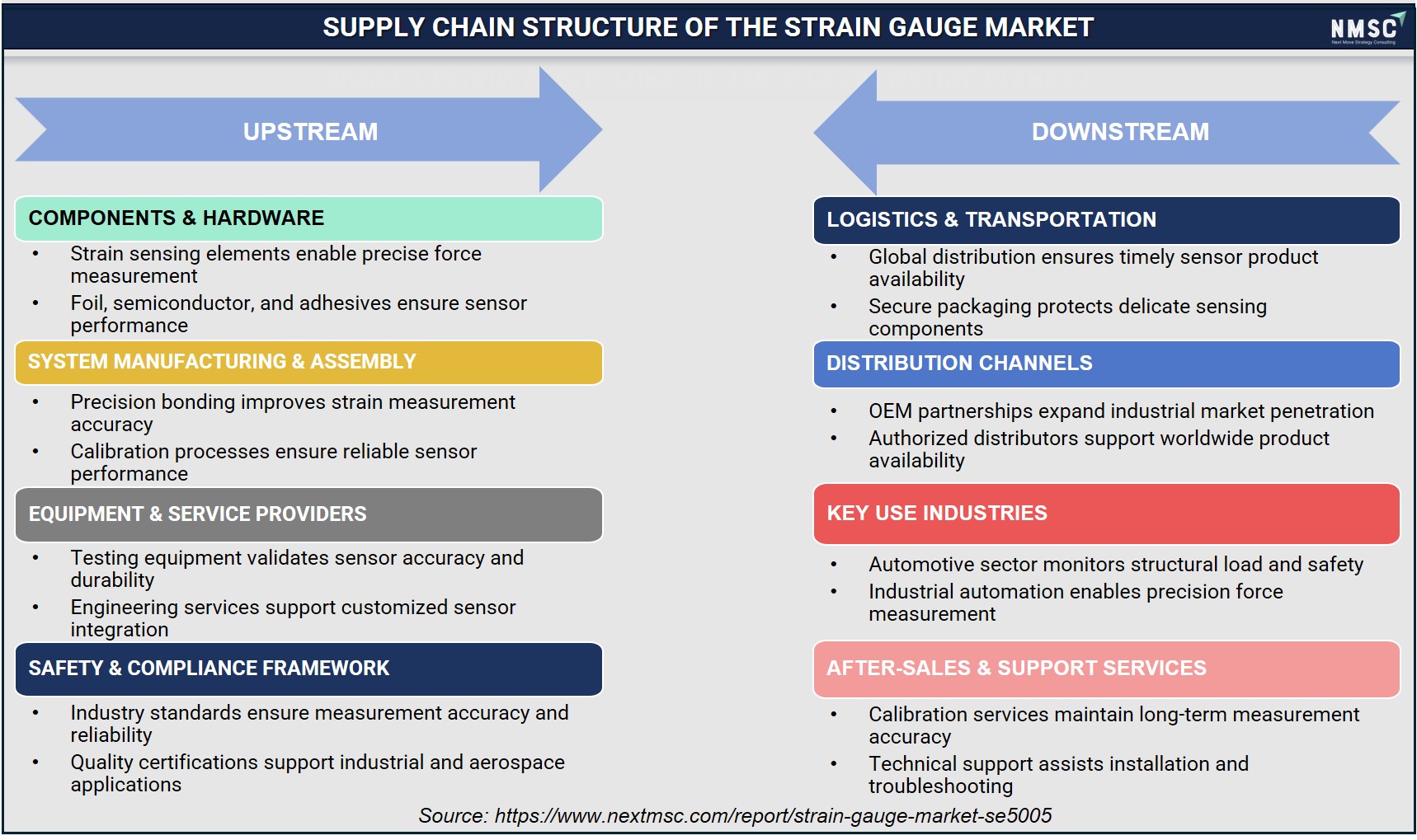
Based on our comprehensive assessment, we found that the strain gauge supply chain begins with suppliers of sensing foils, semiconductor materials, adhesives, and electronic components. Manufacturers conduct bonding, calibration, and testing processes to ensure measurement accuracy and reliability. Distribution networks and OEM partnerships facilitate global market access, while calibration services and technical support maintain performance. Industry standards and certifications ensure compliance across critical applications.
Competitive Landscape
Competitive Dynamics and M&A Landscape
|
Key Takeaways |
Details |
|
Market Structure |
The Strain Gauge Market features tiered competition among established precision measurement incumbents including Vishay Precision Group and Hottinger Brüel and Kjær GmbH, mid-tier specialists including Kyowa Electronic Instruments and Tokyo Measuring Instruments Laboratory, and emerging Chinese manufacturers including Zhonghang Electronic Measuring Instruments and Top Sensor Technology competing on price and volume in transducer manufacturing segments. |
|
Innovation Focus |
Innovation across the Strain Gauge Market centers on optical fiber and fiber Bragg grating sensing for structural health monitoring, MEMS-based miniaturized piezoresistive gauges for medical and avionics applications, wireless data acquisition integration, and specialty high-temperature gauges for aerospace and energy applications requiring measurement capability in extreme thermal environments exceeding 400°C. |
|
M&A Activity |
MinebeaMitsumi Inc. has expanded its precision sensing portfolio through strategic acquisitions in the force measurement space. Hottinger Brüel and Kjær's merger combining HBM and Brüel and Kjær created a comprehensive measurement ecosystem. Private equity interest in precision sensing instrumentation companies is growing, with consolidation expected among mid-tier manufacturers serving industrial and civil infrastructure markets. |
How Do Companies Compete in the Strain Gauge Market?
The Strain Gauge Market is characterized by multi-tiered competition among global precision measurement incumbents, specialized technology-focused manufacturers, and cost-competitive Asian suppliers. Premium market leaders including Vishay Precision Group and Hottinger Brüel and Kjær compete on measurement performance, product breadth, application engineering support, and NIST/PTB traceable calibration capabilities. Mid-tier specialists including Kyowa Electronic Instruments and Tokyo Measuring Instruments Laboratory differentiate on specialized product lines for specific applications including aerospace and high-temperature measurement. Cost-competitive Chinese manufacturers are increasingly capturing transducer manufacturing volume segments through competitive pricing and domestically integrated supply chains serving the load cell and weighing instrument industry. Geographic expansion, particularly into Southeast Asian and Middle Eastern infrastructure markets, is a key strategic priority for leading Western manufacturers.
Which Kind of Companies Dominate the Strain Gauge Market?
Three categories of companies dominate the Strain Gauge Market. First, full-portfolio measurement incumbents including Vishay Precision Group and Hottinger Brüel and Kjær GmbH offer comprehensive strain gauge product lines spanning foil, semiconductor, optical, and vibrating wire technologies alongside complete signal conditioning and data acquisition ecosystems. Second, specialized regional manufacturers including Kyowa Electronic Instruments, Tokyo Measuring Instruments Laboratory, and Showa Measuring Instruments serve technically demanding Japanese and international markets with premium foil gauges for aerospace and automotive applications. Third, Chinese volume manufacturers including Zhonghang Electronic Measuring Instruments, Top Sensor Technology, HT Sensor Technology, and Hanzhong Quanyuan Electronic have achieved significant market share in transducer manufacturing segments through competitive pricing and rapid product catalog expansion.
AI-Native Differentiation and Open Standards Drive Market Success in the Strain Gauge Market
Innovation in the Strain Gauge Market is focused on optical fiber sensing integration, wireless data acquisition compatibility, miniaturization for MEMS and medical applications, and high-temperature specialty gauge development. Luna Innovations has differentiated its fiber optic sensing platform through high spatial resolution distributed measurement capability. Kulite Semiconductor Products has sustained leadership in high-pressure, high-temperature piezoresistive transducer sensing elements for aerospace and turbomachinery applications. GEOKON and Geosense have built strong positions in the civil infrastructure vibrating wire sensing market through decades of field-proven product reliability. Manufacturers that invest in digital output gauge interfaces compatible with Industry 4.0 data acquisition standards are gaining competitive advantage in industrial automation and smart manufacturing customer segments.
Market Players to Opt for Merger and Acquisition Strategies to Expand Their Presence in the Strain Gauge Market
Consolidation activity in the Strain Gauge Market is driven by opportunities to expand geographic coverage, broaden product portfolios across gauge technologies, and capture synergies between sensing hardware and signal conditioning software ecosystems. MinebeaMitsumi Inc. has demonstrated an acquisition-driven growth strategy in precision sensing, leveraging its miniature bearing and precision components manufacturing heritage to expand into force and strain sensing. The convergence of structural health monitoring system providers with fiber optic strain gauge manufacturers is expected to generate M&A activity through 2028. Private equity firms with portfolios in precision measurement instrumentation are actively evaluating acquisition targets in the optical fiber strain sensing and civil infrastructure monitoring sensor segments.
Who Are the Key Market Players in the Strain Gauge Market?
-
Vishay Precision Group, Inc.
-
Zhonghang Electronic Measuring Instruments Co., Ltd.
-
Hottinger Brüel and Kjær GmbH
-
Kyowa Electronic Instruments Co., Ltd.
-
Tokyo Measuring Instruments Laboratory Co., Ltd.
-
MinebeaMitsumi Inc.
-
Showa Measuring Instruments Co., Ltd.
-
BCM Sensor Technologies BV
-
Hitec Products, Inc.
-
Kulite Semiconductor Products, Inc.
-
Luna Innovations Incorporated
-
GEOKON, Incorporated
-
Geosense Ltd.
-
RST Instruments Ltd.
-
Top Sensor Technology Co., Ltd.
-
HT Sensor Technology CO., LTD.
-
Hanzhong Quanyuan Electronic Co., Ltd.
-
IPA Private Limited
-
ME-Messsysteme GmbH
-
Celmi S.r.l.
What Are the Latest Developments in the Strain Gauge Industry?
|
Date |
Event |
|
April 2026 |
MinebeaMitsumi's semiconductor business unit launched the MMS651 Series of digital air velocity sensors. While focusing on airflow, this launch highlights their broader MEMS (Micro-Electro-Mechanical Systems) expertise, the same technology underpinning the industry's push toward miniaturized, ultra-precise force and strain sensing for compact industrial equipment |
|
February 2026 |
Kyowa Electronic Instruments continued to push the "digitization" of its sensing portfolio with the launch of the WDS-500C Sensor Checker on February 5, 2026. This product exemplifies the market-wide trend of replacing traditional analog tools with smart digital modules that simplify integration into modern IoT and factory automation systems. |
What Are the Investment Opportunities in the Strain Gauge Market?
Capital Inflows and Venture Activity
The Strain Gauge Market continues to attract targeted investment from strategic investors, industrial technology companies, and private equity firms seeking exposure to precision sensing, industrial automation, and structural health monitoring technologies. Investment activity is increasingly focused on advanced sensing platforms incorporating optical fiber technology, semiconductor-based strain measurement, wireless monitoring capabilities, and integrated analytics solutions. We noticed that growing demand for predictive maintenance, infrastructure monitoring, and smart industrial systems is strengthening investor confidence in companies capable of delivering differentiated sensing technologies and high-value monitoring applications across multiple end-use industries.
Infrastructure Investment
Global infrastructure modernization programs are creating substantial investment opportunities across the Strain Gauge Market. Governments and infrastructure operators are increasing spending on transportation networks, bridges, tunnels, dams, energy infrastructure, and smart city projects that require continuous structural monitoring and asset performance assessment. Moreover, we found that initiatives such as the U.S. Infrastructure Investment and Jobs Act, European infrastructure modernization programs, and large-scale development projects across Asia-Pacific and the Middle East are generating long-term demand for strain gauge technologies and structural health monitoring solutions. These investments support recurring instrumentation deployment, monitoring system upgrades, and long-duration maintenance contracts.
ESG and Sustainable Infrastructure Management
Environmental, Social, and Governance (ESG) priorities are increasingly influencing investment decisions within the Strain Gauge Market. Structural health monitoring technologies support sustainability objectives by extending asset lifecycles, reducing material waste, improving infrastructure resilience, and minimizing the environmental impact associated with premature asset replacement. Based on our assessment, organizations investing in smart infrastructure and lifecycle management programs are increasingly adopting strain gauge-based monitoring systems to improve operational efficiency and optimize maintenance planning. These capabilities align closely with sustainability initiatives focused on resource efficiency, infrastructure longevity, and responsible asset management.
Digital Transformation Enablement
Digital transformation initiatives are creating significant opportunities at the intersection of strain gauge hardware, industrial IoT, cloud computing, and advanced analytics. Organizations are increasingly deploying connected sensing systems capable of generating real-time performance data that supports predictive maintenance, condition monitoring, and operational optimization programs. We further analysed that companies offering integrated monitoring platforms combining sensing technologies with data analytics, cloud-based dashboards, and automated reporting capabilities are positioned to capture higher-value opportunities than standalone hardware suppliers. The continued adoption of Industry 4.0, smart infrastructure, and digital engineering frameworks is expected to support durable demand for intelligent sensing solutions.
Private Equity and Strategic M&A Activity
Private equity firms and strategic acquirers are actively evaluating opportunities within the Strain Gauge Market as demand for precision sensing and monitoring technologies expands across industrial, infrastructure, automotive, and energy sectors. Investment activity is increasingly focused on optical sensing technologies, wireless monitoring platforms, structural health monitoring system providers, and industrial instrumentation manufacturers. Strategic acquisitions are accelerating as sensing companies seek to expand technology portfolios, strengthen software capabilities, and increase exposure to higher-growth monitoring applications. We assessed that investors should closely monitor consolidation opportunities among optical fiber sensing providers, industrial IoT monitoring companies, calibration technology specialists, and structural health monitoring platform vendors as attractive acquisition targets throughout the 2025–2028 period within the Strain Gauge Market.
Key Benefits for Stakeholders
For Market Participants
Market participants gain comprehensive visibility into the Strain Gauge Market through detailed segmentation across offering, technology, application, customer type, distribution channel, and end-use industry categories. The report supports strategic planning, competitive benchmarking, and product portfolio optimization by identifying high-growth segments, evolving customer requirements, and emerging market opportunities. Detailed regional and country-level analysis further enables organizations to align investment decisions with changing demand patterns and competitive dynamics.
For Investors
Investors, private equity firms, venture capital organizations, and financial institutions gain access to a structured assessment of the Strain Gauge Market's growth outlook, competitive landscape, and long-term revenue opportunities through 2035. Market sizing, CAGR forecasts, segment-level analysis, and regional performance assessments support investment screening, valuation modeling, and portfolio benchmarking activities. Competitive intelligence and industry trend analysis provide visibility into emerging technology leaders, acquisition opportunities, and attractive investment themes across precision sensing and structural health monitoring markets.
For Manufacturers
Manufacturers benefit from detailed insights into technology adoption trends, customer demand evolution, and growth opportunities across the Strain Gauge Market. The report highlights emerging opportunities in optical fiber strain gauges, semiconductor strain gauges, wireless sensing solutions, and structural monitoring applications, supporting research and development prioritization as well as capital allocation decisions. These insights help manufacturers optimize product development strategies, strengthen market positioning, and target the most attractive end-use sectors.
For Distributors
Distributors and channel partners gain valuable intelligence regarding regional demand patterns, customer purchasing behavior, and growth opportunities across major geographic markets. Country-level analysis enables distributors to identify underserved markets, optimize inventory planning, and strengthen channel development initiatives. The report also supports strategic expansion decisions by highlighting the fastest-growing customer segments and application areas within the Strain Gauge Market.
For System Integrators
System integrators gain actionable insights into competitive dynamics, technology trends, and implementation opportunities across structural health monitoring, industrial automation, energy infrastructure, and transportation applications. The report provides visibility into evolving customer requirements and market developments, supporting service portfolio expansion and strategic positioning initiatives. Detailed analysis of monitoring system adoption trends further enables integrators to identify high-value opportunities across infrastructure and industrial digitalization projects.
For Policy Makers
Government agencies, standards organizations, and regulatory authorities gain a structured understanding of how strain gauge technologies support infrastructure safety, asset reliability, and engineering performance monitoring initiatives. The report provides an evidence base for procurement planning, infrastructure monitoring program development, and metrology standards advancement. These insights support informed policy development and long-term infrastructure management strategies.
For Research Institutions
Research organizations, universities, and technical laboratories benefit from comprehensive insights into technology innovation trends, application developments, and market evolution within the Strain Gauge Market. The report supports research prioritization, grant development activities, and laboratory investment planning by identifying emerging sensing technologies, evolving application requirements, and future growth opportunities across industrial and infrastructure monitoring environments.
Key Market Segments
By Offering
-
Bare Strain Gauges
-
Foil Strain Gauges
-
Linear
-
Rosette
-
Specialty
-
-
Semiconductor Strain Gauges
-
Wire Strain Gauges
-
Optical Strain Gauges
-
Vibrating Wire Strain Gauges
-
Other Bare Strain Gauges
-
-
Accessories and Consumables
-
Adhesives and Coatings
-
Leadwires and Termination Kits
-
Installation Tools and Supplies
-
Other Accessories
-
-
Services
-
Custom Design
-
Calibration
-
Repair and Requalification
-
Other Services
-
By Technology
-
Electrical Resistance
-
Foil
-
Wire
-
-
Semiconductor Piezoresistive
-
Silicon
-
Germanium
-
Other
-
-
Optical Fiber
-
Fiber Bragg Grating
-
Distributed Sensing
-
-
Vibrating Wire
-
Other Sensing Principles
By Application
-
Experimental Stress Analysis
-
Material Test
-
Structural Test
-
Fatigue Test
-
Other
-
-
Transducer Manufacturing
-
Load Cells
-
Pressure Transducers
-
Force and Torque Sensors
-
Other
-
By Customer Type
-
Original Equipment Manufacturers
-
Test Laboratories
-
Industrial End Users
-
Contractors and Installers
-
System Integrators
-
Other Customer Categories
By Distribution Channel
-
Direct Sales
-
Distributor Networks
-
Online Sales
By End Use
-
Aerospace and Defense
-
Flight Test
-
Space
-
Other
-
-
Automotive and Mobility
-
Passenger Vehicles
-
Commercial Vehicles
-
EV and Battery
-
Other
-
-
Industrial Machinery and Automation
-
Machine Tools
-
Robotics
-
Factory Automation
-
Other
-
-
Civil Engineering and Infrastructure
-
Structural Health Monitoring
-
Tunnels and Bridges
-
Dams and Foundations
-
Other
-
-
Energy and Utilities
-
Oil and Gas
-
Power
-
Wind and Renewables
-
Other
-
-
Medical and Life Sciences
-
Medical Devices
-
Lab Instruments
-
Other
-
-
Research and Education
-
Universities
-
Labs
-
Other
-
-
Other End Uses
By Region
-
North America: U.S., Canada, and Mexico
-
Europe: UK, Germany, France, Italy, Spain, Sweden, Denmark, Finland, the Netherlands, and the rest of Europe
-
Asia Pacific: China, India, Japan, South Korea, Taiwan, Indonesia, Vietnam, Australia, Philippines, Malaysia and the rest of APAC
-
Middle East and Africa: Saudi Arabia, UAE, Egypt, Israel, Turkey, Nigeria, South Africa, and the rest of MEA
-
Latin America: Brazil, Argentina, Chile, Colombia, and the rest of LATAM
Conclusion and Recommendations
Long-Term Outlook
The Strain Gauge Market is entering a sustained growth decade underpinned by converging structural drivers including aging infrastructure monitoring mandates, EV structural testing scale-up, industrial automation adoption, and offshore renewable energy expansion. The market is forecast to advance from USD 861.4 million in 2026 to USD 1,250 million by 2035 at a CAGR of 4.2%. Our analysis further indicates that this growth reflects both the resilience of established demand streams in transducer manufacturing and experimental stress analysis, and the emergence of structurally new demand categories including fiber optic distributed sensing for civil infrastructure and semiconductor gauge adoption in advanced automotive and medical device applications throughout the forecast period.
Strategic Positioning Recommendations
Strain gauge manufacturers should prioritize investment in optical fiber strain gauge product development and civil infrastructure monitoring application engineering, as this segment offers the highest CAGR at 7.3% and is supported by durable government infrastructure spending commitments. Manufacturers targeting the Automotive and Mobility segment, growing at 5.8% CAGR, should develop application packages specifically addressing EV battery structural testing, battery cell swelling measurement, and EV chassis structural load distribution analysis. Geographic expansion into Middle East and Africa markets, growing at a CAGR of 5.7%, offers significant first-mover advantage for manufacturers willing to invest in regional application engineering and distribution channel development aligned with Vision 2030 infrastructure programs.
Investment Attractiveness
The Strain Gauge Market offers moderate but highly resilient investment attractiveness characterized by long equipment replacement cycles, mission-critical applications that maintain demand during economic contractions, and expanding addressable market boundaries from new application segments including EV testing and structural health monitoring. The highest-conviction investment themes are optical fiber strain gauge manufacturers serving civil infrastructure monitoring, companies integrating wireless data acquisition with traditional bonded gauge products for Industry 4.0 applications, and system integrators building recurring monitoring-as-a-service revenue streams on structural health monitoring contracts. Investors should monitor the pace of government infrastructure monitoring mandate development as the primary regulatory catalyst for addressable market expansion.
Market Shifts and Key Risks
The most significant market shift underway is the transition from point-measurement foil gauge installations toward spatially distributed optical fiber sensing networks for civil and energy infrastructure monitoring applications. This shift benefits fiber optic strain gauge technology suppliers and system integrators while potentially constraining volume growth for traditional vibrating wire and foil gauge suppliers in long-term infrastructure monitoring segments. Key risks include competition from alternative non-contact measurement technologies including digital image correlation and laser extensometry, macroeconomic slowdowns reducing capital instrumentation spending in manufacturing end markets, and accelerating Chinese domestic manufacturing competitiveness placing pricing pressure on Western manufacturers in standard transducer-grade foil gauge product categories.
Growth Pathways
Organizations seeking to maximize value from the Strain Gauge Market should pursue a three-horizon strategy. In the near term (2025–2027), manufacturers should invest in digital output gauge interface development compatible with Industry 4.0 data acquisition standards and expand product portfolios to include application-specific gauge kits for EV battery testing. In the mid-term (2027–2031), suppliers should prioritize geographic expansion into Middle East and Asia Pacific structural health monitoring markets with localized application engineering support. In the long term (2031–2035), investment in next-generation MEMS-integrated and self-powering strain gauge systems compatible with autonomous structural monitoring networks will be essential to maintain competitive relevance as civil infrastructure monitoring becomes increasingly automated and remotely managed.
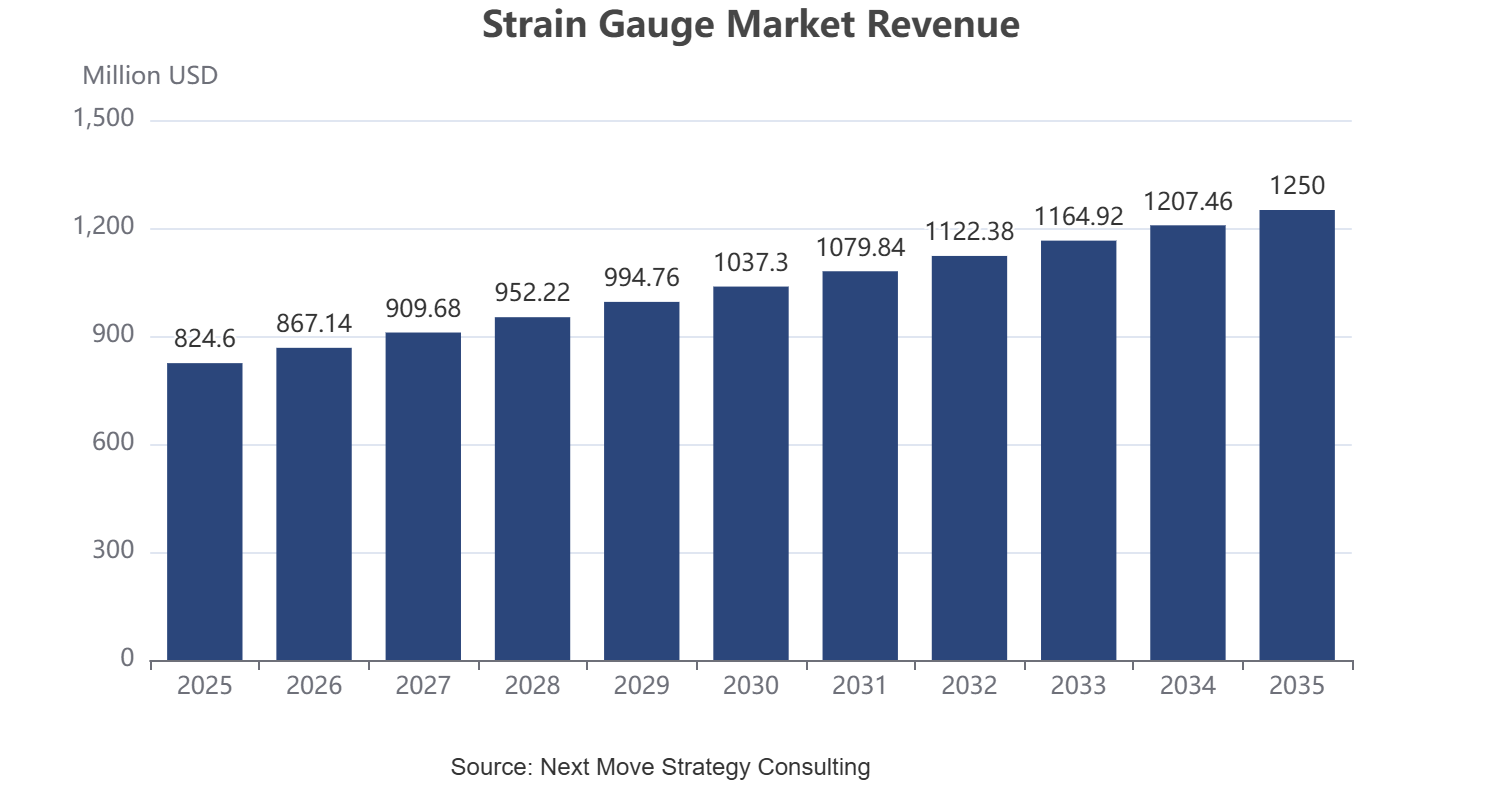
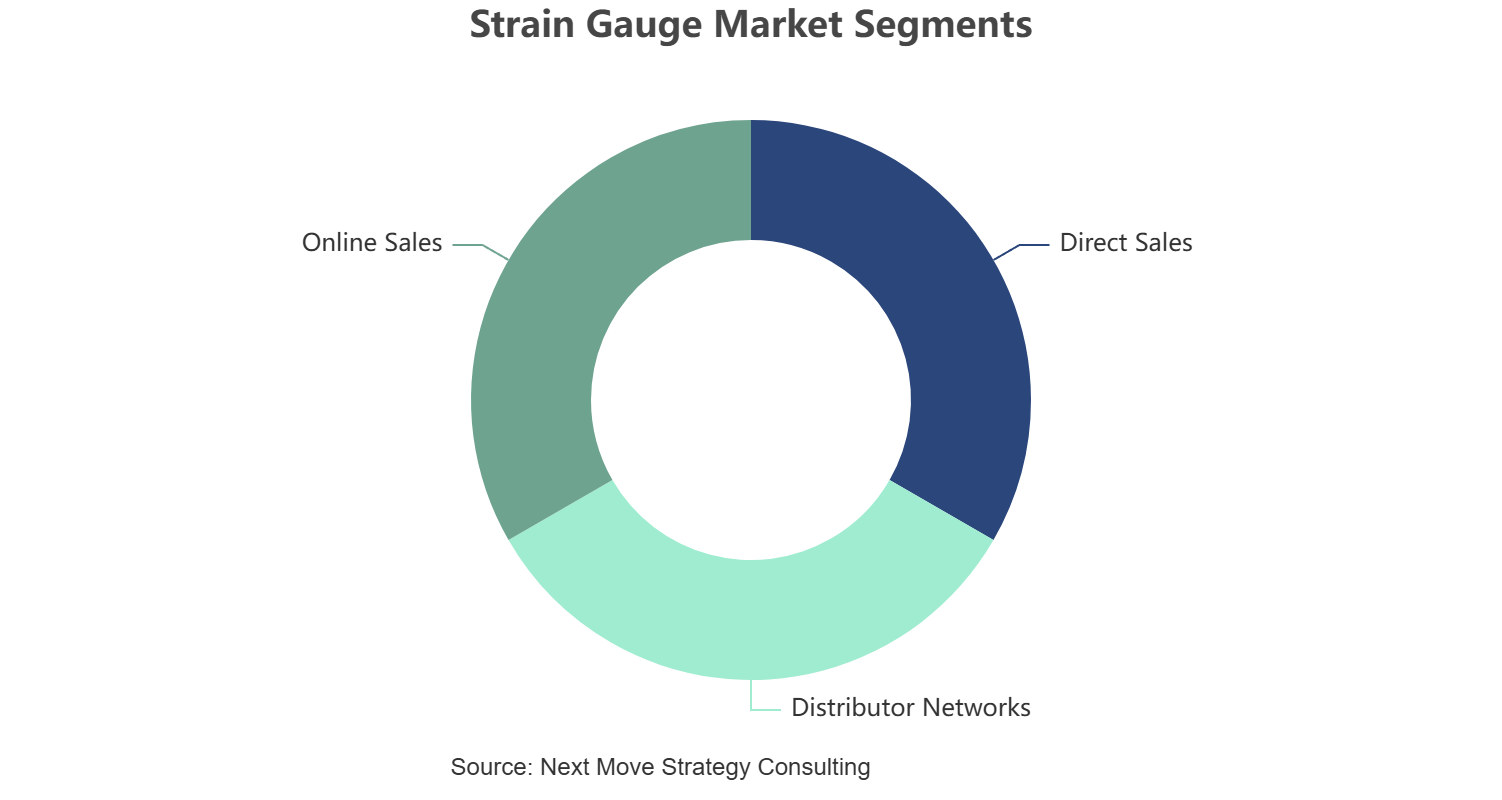
About the Author
 Saista Faiyaz
— Saista Faiyaz is Research Associate at Next Move Strategy Consulting, where she has covered consumer markets and healthcare technologies for 3 years. Her work includes primary interview review, secondary-source validation, market sizing, and structured analysis of company and industry data. She supports research by comparing evidence across sources, organizing findings into market narratives, and documenting assumptions used in analysis. Her scope includes cross-market benchmarking, and reports.
Saista Faiyaz
— Saista Faiyaz is Research Associate at Next Move Strategy Consulting, where she has covered consumer markets and healthcare technologies for 3 years. Her work includes primary interview review, secondary-source validation, market sizing, and structured analysis of company and industry data. She supports research by comparing evidence across sources, organizing findings into market narratives, and documenting assumptions used in analysis. Her scope includes cross-market benchmarking, and reports.
About the Reviewer
 Supradip Baul
— Supradip Baul is an accomplished business consultant and strategist with over a decade of rich experience in market intelligence, strategy, technology, and business transformation. His work has included rigorous qualitative and quantitative analysis across multiple industries, helping clients shape investment decisions and long-term roadmaps. Earlier in his career, he was associated with Gartner, where he contributed to industry-leading reports and market share analyses. He has worked with leading global companies and holds an MBA with a dual specialization in Marketing and Finance.
Supradip Baul
— Supradip Baul is an accomplished business consultant and strategist with over a decade of rich experience in market intelligence, strategy, technology, and business transformation. His work has included rigorous qualitative and quantitative analysis across multiple industries, helping clients shape investment decisions and long-term roadmaps. Earlier in his career, he was associated with Gartner, where he contributed to industry-leading reports and market share analyses. He has worked with leading global companies and holds an MBA with a dual specialization in Marketing and Finance.
At Next Move Strategy Consulting, we understand that insightful market research is the cornerstone of successful business decisions. That's why we employ a robust and multifaceted approach, combining various methodologies to deliver the most accurate and actionable data for our clients.

Research Landscape
We navigate the world of research with two primary approaches:
Qualitative Approach
Our qualitative research methodologies involve immersive techniques such as in-depth interviews, focus groups, and observational studies. By engaging directly with individuals and stakeholders, we uncover valuable insights that quantitative data alone may overlook.

Quantitative Research
In tandem with qualitative methodologies, NMSC leverages the power of Quantitative Research to provide a robust foundation of numerical insights. Through systematic data collection and analysis, we quantify patterns, preferences, and market trends, offering a comprehensive view of the business landscape.
Our quantitative research approach employs diverse tools, including surveys, experiments, and statistical modelling. These methodologies enable us to gather data from a large and representative sample, ensuring the statistical significance of our findings. By employing structured questionnaires and standardized data collection methods, we guarantee the reliability and validity of the information we present to our clients.
Quantitative research is particularly effective in measuring the prevalence of trends, assessing market size, and gauging the impact of various factors on consumer behavior. The numerical precision attained through this approach equips our clients with actionable insights, facilitating data-driven decision-making and strategy formulation.


Our Specialized Toolbox for Industry-Specific Market Research
We deploy a specialized arsenal of techniques tailored to meet your unique requirements. Here's a glimpse into our comprehensive toolbox:

Information Procurement
The stage entails acquiring market data or relevant information through various sources and methodologies.


Market Research Approach
We utilize both top-down and bottom-up approaches in market research analysis to achieve a comprehensive understanding of the market dynamics, leveraging the broad perspective of industry trends and macroeconomic factors alongside detailed insights from specific segments and individual companies.

Porters Five Forces Analysis
We conduct Porter's Five Forces analysis to evaluate the competitive landscape of an industry, providing us with insights into factors that affect profitability and strategic positioning.

SWOT Analysis

Forecasting
We utilize a forecasting model to predict future consumption by considering parameters like population, economics, regulations, market competition, drivers, constraints, technology, and pricing. We also employ statistical techniques such as multilinear regression, exponential smoothing, moving average, ARIMA, and Monte Carlo simulations for accurate predictions. In econometric forecasting, we analyzed short-term and long-term event impacts, attributing values based on regulatory frameworks, economic factors, and market events.





 Speak to Our Analyst