Nanosensors and Nanoelectronics Market Size, Share, Trends and Growth Analysis, By Offering (Nanosensors, Nanoelectromechanical Systems, Nanophotonics Components, and Nano-Enabled Electronic Components), By Component Architecture, By End Use Industry, By Buyer Type (OEM, Research Institution, Government, Healthcare Provider, and Other Buyer Types), By Distribution Channel (Direct Sales, Distributor, and Other Distribution Channels), and Region — Global Industry Report and Forecast, 2026–2035
Industry: Semiconductor & Electronics | Publishing Date: August 11, 2026 | Last Updated: August 11, 2026 | No of Pages: N/A | No. of Tables: N/A | No. of Figures: N/A | Format: PDF | Report Code: SE5668
What Is the Nanosensors and Nanoelectronics Market Size?
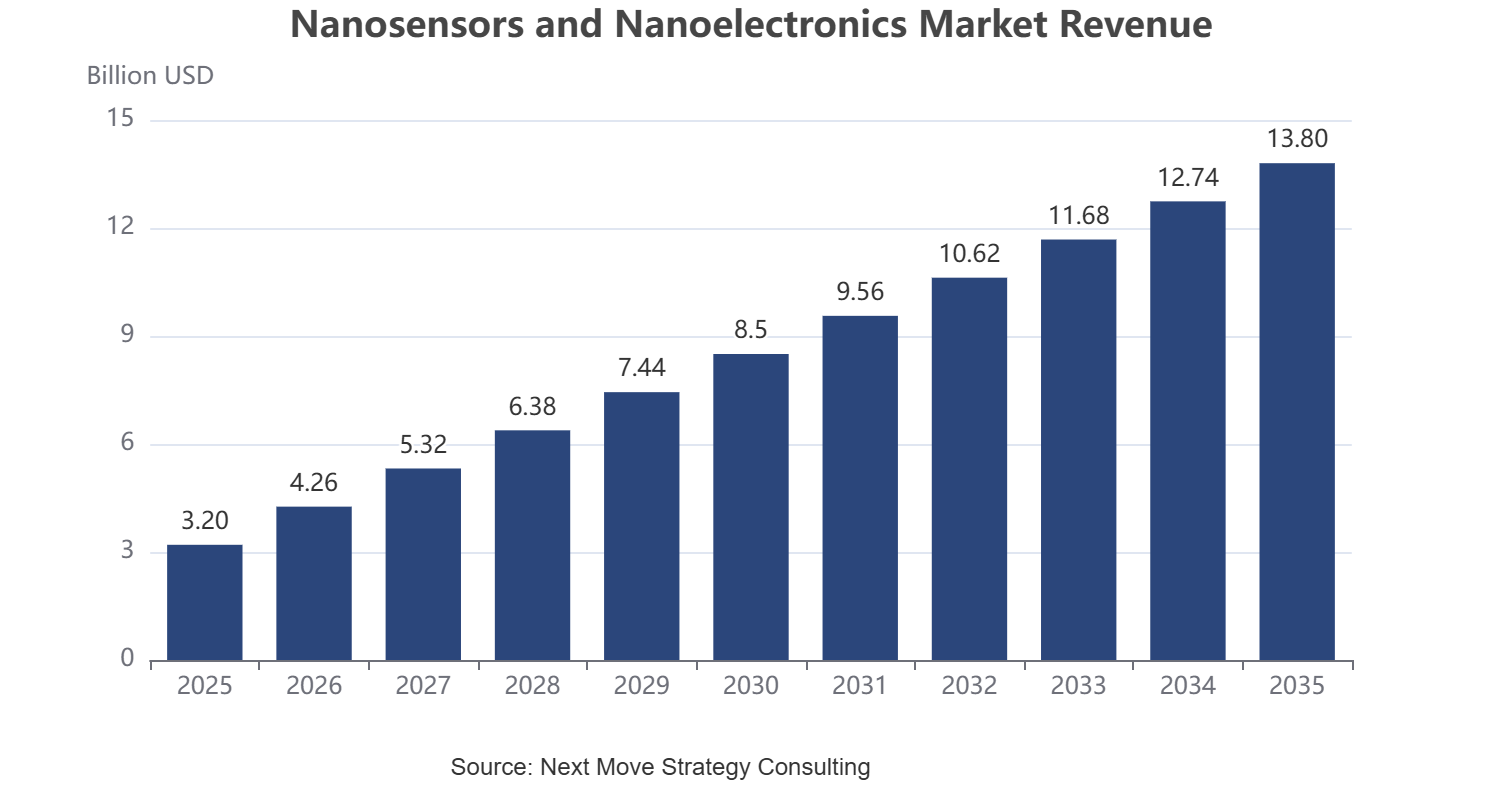
The global nanosensors and nanoelectronics market size was valued at USD 3.20 billion in 2025 and is estimated at USD 3.65 billion in 2026, forecast to reach USD 13.80 billion by 2035, expanding at a 15.92% CAGR between 2026 and 2035. North America leads with approximately 38% share, while nanosensors dominate all offerings with approximately 38% share.
We observed that growth is broad-based across every segmentation axis, with nanophotonics component adoption and telecommunications infrastructure expansion driving the dominant structural shifts in the nanosensors and nanoelectronics market through 2035.
|
Key Takeaways |
|
By Offering: Nanosensors held the largest share of approximately 38% (USD 1.22 Billion) in 2025; Nanophotonics Components is the fastest-growing sub-segment at 21.67% CAGR from 2026–2035. |
|
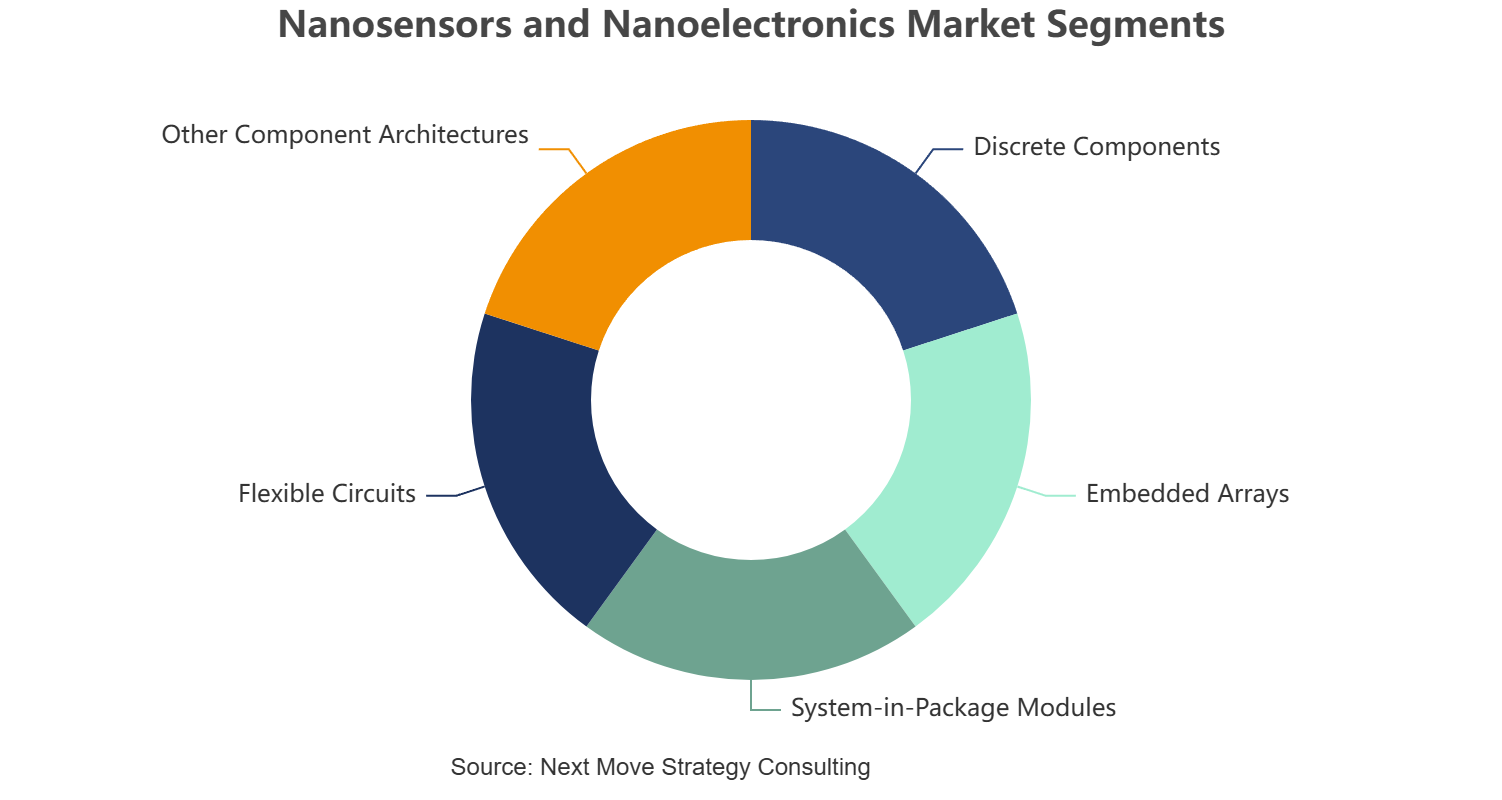
By Component Architecture: Discrete Components held the largest share of approximately 28% (USD 0.90 Billion) in 2025; System-in-Package Modules is the fastest-growing sub-segment at 20.16% CAGR from 2026–2035. |
|
By End Use Industry: Consumer Electronics held the largest share of approximately 30% (USD 0.96 Billion) in 2025; Telecommunications is the fastest-growing sub-segment at 22.92% CAGR from 2026–2035. |
|
By Buyer Type: OEM represent the core procurement base, while research institutions, government agencies, and healthcare providers support specialized adoption. |
|
By Distribution Channel: Direct sales remain the leading route, with distributors and project-based sales broadening market reach. |
|
Dominant Region: North America dominated with approximately 38% revenue share (USD 1.22 Billion) in 2025. |
|
Fastest-Growing Region: Asia-Pacific is expected to register the highest CAGR of 20.22% during 2026–2035. |
|
Dominant Country: U.S. led with approximately USD 0.98 billion in 2025. |
|
Fastest-Growing Country: India is the fastest-growing country at approximately 23.25% CAGR from 2026–2035. |
Market Opportunity: The nanosensors and nanoelectronics market is expected to create an absolute dollar opportunity of USD 10.15 billion between 2026 and 2035, presenting significant investment potential across the photonics, sensing, and nano-enabled electronics value chain.
According to Next Move Strategy Consulting analysis, nanoelectronics vendors are increasingly co-developing integrated photonic circuits alongside conventional nanosensor portfolios to serve data center optical interconnect demand, a shift that favors diversified nanotechnology suppliers over single-category sensor specialists as telecommunications infrastructure investment accelerates through 2035.
What Does the Nanosensors and Nanoelectronics Market Encompass?
The nanosensors and nanoelectronics market encompasses chemical, biological, physical, and optical nanosensors, nanoelectromechanical systems, nanophotonics components, and nano-enabled electronic components supplied to OEM, research institutions, government agencies, and healthcare providers across consumer electronics, healthcare, automotive, aerospace, and telecommunications applications. Our assessment indicates that the market has evolved from laboratory-scale nanofabrication research into commercially scaled component supply, supported by semiconductor foundry capacity expansion and rising integration of nanoscale sensing into mainstream electronic devices.
Regulatory frameworks such as national nanotechnology research initiatives and semiconductor export control policies shape technology transfer and commercialization pathways, while workplace nanomaterial safety standards increasingly influence manufacturing protocols. We found that technology adoption is shifting toward system-in-package integration that combines sensing, processing, and photonic functionality within single modules. Next Move Strategy Consulting's analysis indicates that this structural shift, combined with expanding data center optical interconnect demand, is redefining sourcing criteria across the nanosensors and nanoelectronics market landscape.
|
Parameters |
Details |
|
Market Size in 2025 |
USD 3.20 Billion |
|
Market Size in 2026 |
USD 3.65 Billion |
|
Revenue Forecast in 2035 |
USD 13.80 Billion |
|
Growth Rate |
CAGR of 15.92% from 2026 to 2035 |
|
Analysis Period |
2025–2035 |
|
Base Year Considered |
2025 |
|
Forecast Period |
2026–2035 |
|
Market Size Estimation |
Revenue (USD Billion) |
|
Companies Profiled |
20 |
|
Countries Covered |
33 |
|
Market Share |
Available for Top 10 Companies |
Key Emerging Trends
We found that four structural trends are reshaping product development and integration strategy across the nanosensors and nanoelectronics market heading into 2035.
How Are Integrated Photonic Circuits Reshaping Data Center Interconnects?
Integrated photonic circuits are enabling data centers to move optical signal processing onto compact nanoscale chips, replacing bulkier discrete optical components in high-bandwidth interconnect applications. Our analysis shows that this shift is accelerating nanophotonics adoption across hyperscale computing infrastructure. Coherent Corp. has publicly disclosed continued investment in its photonic integrated circuit manufacturing capacity, illustrating how established optics vendors are integrating nanoscale photonics into commercial data center supply chains.
How Is System-in-Package Integration Transforming Component Design?
System-in-package modules are enabling manufacturers to combine sensing, signal processing, and connectivity functions within a single compact package rather than assembling discrete components on a circuit board. We observed that Silex Microsystems AB has expanded its MEMS and nanoscale foundry services supporting system-in-package integration for OEM customers. This convergence of sensing and processing is becoming a key differentiator among vendors competing for space-constrained device designs.
How Is Biological Nanosensor Adoption Reshaping Diagnostics?
Biological nanosensors are enabling point-of-care diagnostic devices to detect disease biomarkers at concentrations below the threshold of conventional laboratory assays. Based on research conducted by Next Move Strategy Consulting, we found that diagnostic device portfolios are being restructured around nanoscale biosensing rather than traditional immunoassay methods alone. Nanomix Inc. has disclosed continued development of its point-of-care nanosensor diagnostic platform, reflecting accelerated commercialization of biological nanosensing technology.
How Is Flexible Nano-Circuit Technology Reshaping Wearable Electronics?
Flexible nano-circuits are enabling wearable and conformable electronic devices that maintain functionality under bending and stretching conditions unsuitable for rigid circuit boards. Our findings suggest that flexible circuit adoption is becoming standard practice for next-generation wearable health monitoring devices rather than a niche application, reshaping how consumer electronics and healthcare device manufacturers approach form factor design through 2035.
Ecosystem Analysis of the Nanosensors and Nanoelectronics Market
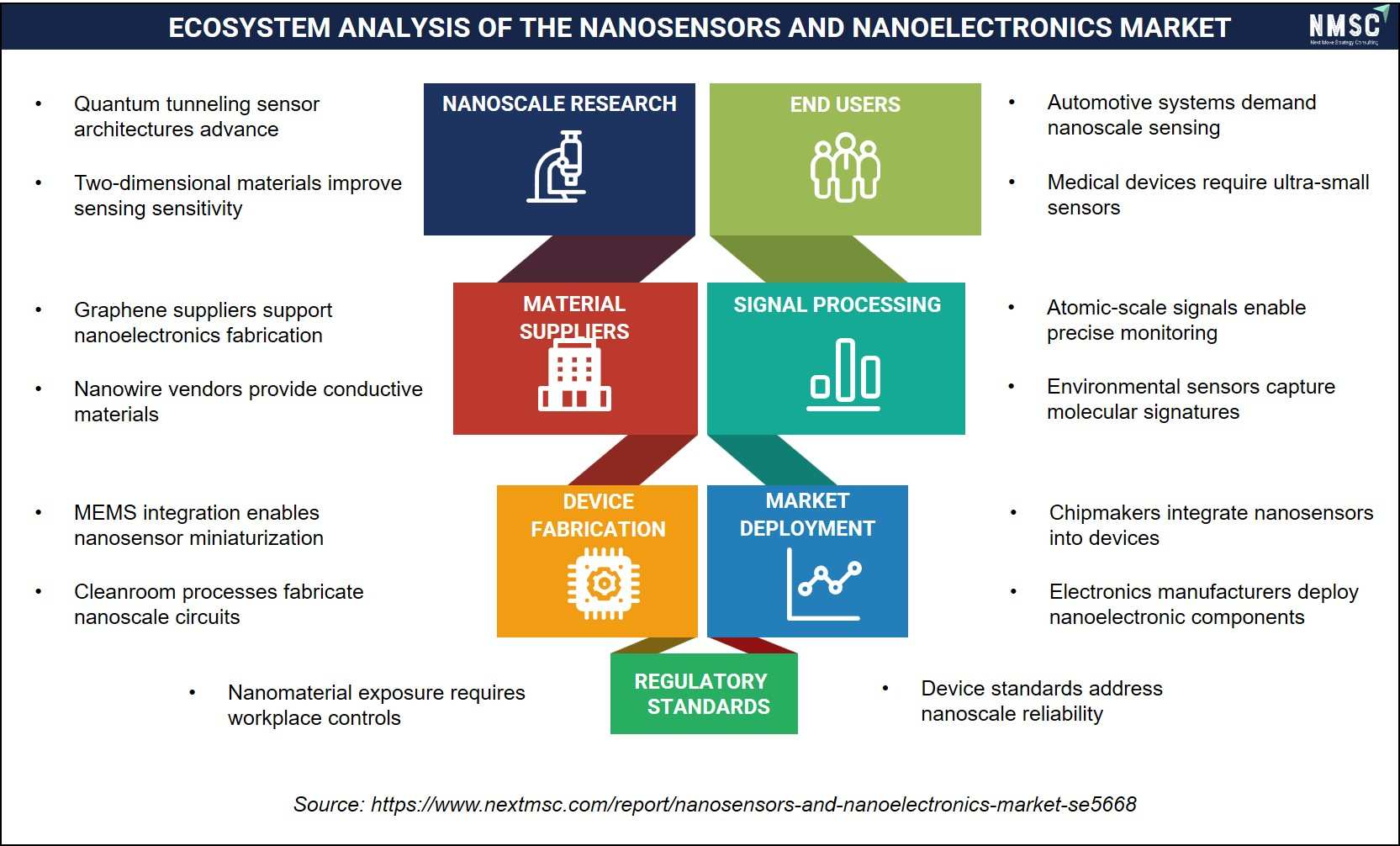
Our analysis indicates that the Nanosensors and Nanoelectronics Market is supported by a collaborative ecosystem involving nanoscale research institutions, advanced material suppliers, device manufacturers, signal processing technology providers, regulatory authorities, and end users. Research drives innovation in nanomaterials and sensing technologies, while fabrication and signal processing enable high-performance devices. Regulatory compliance ensures product reliability and safety, and market deployment across healthcare, electronics, automotive, and industrial sectors accelerates commercialization and long-term industry growth.
Growth Drivers and Restraints
|
Factors |
Type |
(+/-) % Impact on CAGR |
Geographic Relevance |
Impact Timeline |
|
Rising data center optical interconnect infrastructure investment |
Driver |
+3.1% |
North America, Asia-Pacific |
2026–2035 |
|
Expanding point-of-care diagnostic device adoption |
Driver |
+2.4% |
Global |
2026–2035 |
|
Growing government nanotechnology research funding |
Driver |
+1.8% |
North America, Europe, Asia-Pacific |
2026–2032 |
|
Increasing consumer electronics miniaturization demand |
Driver |
+1.3% |
Asia-Pacific, North America |
2026–2035 |
|
Rising automotive sensor integration for autonomous systems |
Driver |
+0.9% |
North America, Europe |
2027–2035 |
|
High nanofabrication capital equipment costs |
Restraint |
-1.5% |
Global |
2026–2031 |
|
Semiconductor export control and technology transfer restrictions |
Restraint |
-1.1% |
Asia-Pacific, North America |
2026–2032 |
|
Limited standardization across nanomaterial characterization methods |
Restraint |
-0.7% |
Global |
2026–2030 |
|
Workplace nanomaterial safety compliance costs |
Restraint |
-0.5% |
Europe, North America |
2026–2031 |
What Is the Primary Growth Driver?
Rising data center optical interconnect infrastructure investment is the primary growth driver, with the U.S. Department of Energy reporting sustained growth in data center capacity requiring higher-bandwidth optical connectivity. We observed that this infrastructure buildout, combined with rising artificial intelligence workload processing demand, is pushing hyperscale operators toward nanophotonics-based interconnect solutions, directly supporting the 15.92% CAGR projected for 2026–2035.
How Is Government Research Funding Driving Market Growth?
Government nanotechnology research funding is expanding foundational research that translates into commercial nanosensor and nanoelectronics applications. Regulatory guidance from the U.S. National Nanotechnology Initiative on research priority areas is supporting continued public investment in nanoscale sensing and photonics research. Our assessment indicates that this funding-driven innovation is replicating across European and Asia-Pacific research programs as governments prioritize semiconductor and nanotechnology self-sufficiency, reinforcing nanophotonics components as the fastest-growing offering segment through 2035.
What Is Restraining Nanosensors and Nanoelectronics Market Growth?
High nanofabrication capital equipment costs remain the primary restraint, as advanced lithography and deposition equipment required for nanoscale component manufacturing require substantial upfront capital investment. We found that semiconductor export control and technology transfer restrictions further complicate cross-border supply chain coordination for advanced nanoelectronics components, an industry-derived estimate given the absence of a single publicly verifiable global export control cost dataset for this category.
Segmentation Analysis
Segment Sizing: By Offering
|
Segment |
2025 (USD Billion) |
2035 (USD Billion) |
CAGR% (2026–2035) |
|
Nanosensors |
1.22 |
4.60 |
15.89% |
|
Nanoelectromechanical Systems (NEMS) |
0.77 |
2.95 |
16.10% |
|
Nanophotonics Components |
0.83 |
4.85 |
21.67% |
|
Nano-Enabled Electronic Components |
0.38 |
1.40 |
15.59% |
|
Total |
3.20 |
13.80 |
15.92% |
Which Offering Segment Dominates the Nanosensors and Nanoelectronics Market?
Nanosensors, spanning chemical, biological, physical, and optical detection technologies, held the leading position in 2025 with approximately 38% share given the breadth of established commercial applications across healthcare, environmental monitoring, and industrial sensing. Nanophotonics components are the fastest-growing sub-segment at 21.67% CAGR, driven by rising integrated photonic circuit adoption in data center optical interconnect and telecommunications infrastructure.
Segment Sizing: By Component Architecture
|
Segment |
2025 (USD Billion) |
2035 (USD Billion) |
CAGR% (2026–2035) |
|
Discrete Components |
0.90 |
3.20 |
15.14% |
|
Embedded Arrays |
0.75 |
3.35 |
18.09% |
|
System-in-Package Modules |
0.68 |
3.55 |
20.16% |
|
Flexible Circuits |
0.55 |
2.85 |
20.06% |
|
Other Component Architectures |
0.32 |
0.85 |
11.47% |
|
Total |
3.20 |
13.80 |
15.92% |
Which Component Architecture Is Fastest-Growing in the Nanosensors and Nanoelectronics Market?
Discrete components dominate the component architecture axis with approximately 28% share in 2025, reflecting established manufacturing infrastructure for standalone nanoscale devices. Our analysis shows that system-in-package modules are the fastest-growing sub-segment at 20.16% CAGR as manufacturers increasingly combine sensing, processing, and connectivity functions within compact integrated packages, narrowing the gap with discrete components through 2035.
Segment Sizing: By End Use Industry
|
Segment |
2025 (USD Billion) |
2035 (USD Billion) |
CAGR% (2026–2035) |
|
Consumer Electronics |
0.96 |
3.80 |
16.52% |
|
Healthcare and Life Sciences |
0.64 |
2.65 |
17.10% |
|
Automotive and Mobility |
0.51 |
2.30 |
18.22% |
|
Industrial Automation |
0.38 |
1.65 |
17.72% |
|
Telecommunications |
0.32 |
2.05 |
22.92% |
|
Energy and Storage |
0.19 |
0.85 |
18.11% |
|
Aerospace and Defense |
0.13 |
0.35 |
11.63% |
|
Other End Use Industries |
0.07 |
0.15 |
8.84% |
|
Total |
3.20 |
13.80 |
15.92% |
Which End Use Industry Leads Nanosensors and Nanoelectronics Market Demand?
Consumer electronics dominates the end use industry axis with approximately 30% share in 2025, reflecting sustained device miniaturization demand across smartphones, wearables, and smart home products. Our analysis shows that telecommunications are the fastest-growing sub-segment at 22.92% CAGR as data center and network infrastructure operators expand nanophotonics-based optical interconnect deployment, reflecting the sector's strategic position in global connectivity infrastructure buildout.
Growth Opportunities
How Can Foundry Partnership Models Expand OEM Access?
Offering shared nanofabrication foundry capacity to smaller OEM customers creates an access mechanism for companies lacking capital to build proprietary nanofabrication facilities, benefiting the discrete components and embedded arrays segments as demand diversifies beyond large-scale manufacturers.
How Can Point-of-Care Diagnostic Licensing Expand Healthcare Reach?
Licensing biological nanosensor diagnostic platforms to regional healthcare device manufacturers creates a mechanism for established developers to monetize proprietary sensing technology without direct market entry costs, benefiting the healthcare and life sciences end use segment.
How Can Photonic-Electronic Co-Packaging Expand Data Center Value?
Developing co-packaged optics that integrate nanophotonics components directly with processing electronics creates a bandwidth density mechanism, benefiting the nanophotonics components segment as data center operators seek higher-performance optical interconnect solutions.
Regional Outlook
|
Region |
2025 (USD Billion) |
2035 (USD Billion) |
CAGR% (2026–2035) |
Key Driver |
|
North America |
1.22 |
4.60 |
15.89% |
Data center infrastructure investment and semiconductor R&D leadership |
|
Asia-Pacific |
1.02 |
5.35 |
20.22% |
Expanding semiconductor manufacturing and government nanotechnology funding |
|
Europe |
0.64 |
2.85 |
18.05% |
Strong nanotechnology research infrastructure and photonics innovation |
|
Latin America |
0.16 |
0.60 |
15.82% |
Growing electronics manufacturing and research investment |
|
Middle East and Africa |
0.16 |
0.40 |
10.72% |
Emerging technology diversification investment |
|
Total |
3.20 |
13.80 |
15.92% |
|
North America Nanosensors and Nanoelectronics Market Outlook
North America dominates the nanosensors and nanoelectronics market with approximately 38% share in 2025, supported by concentrated data center infrastructure investment and semiconductor research leadership across the U.S. and Canada. We observed rapid technology adoption in integrated photonic circuits, while regulatory clarity from national nanotechnology initiatives is easing research commercialization pathways. Our assessment indicates that continued hyperscale computing investment will sustain the region's leadership through 2035.
Asia-Pacific Nanosensors and Nanoelectronics Market Outlook
Asia-Pacific is the fastest-growing region at 20.22% CAGR, driven by expanding semiconductor manufacturing capacity and government nanotechnology funding across China, India, Japan, and South Korea. Our analysis shows that growing consumer electronics production is accelerating nanosensor and nanoelectronics component demand, while technology penetration in system-in-package integration continues to rise. Strategic outlook favors continued expansion in regional semiconductor foundry capacity.
Europe Nanosensors and Nanoelectronics Market Outlook
Europe's nanosensors and nanoelectronics market reflects strong research infrastructure supported by established photonics and nanotechnology innovation centers. We found that biological and chemical nanosensor adoption is well established, with national research funding frameworks providing predictable innovation pathways. Strategic outlook favors continued growth in photonics-focused research commercialization and healthcare diagnostic applications.
Latin America Nanosensors and Nanoelectronics Market Outlook
Latin America is emerging as a growing market for electronics manufacturing and nanotechnology research investment, supported by expanding industrial automation adoption across Brazil and Argentina. We observed that regulatory support for technology investment has supported gradual market development, while technology penetration in discrete nanosensor components continues to expand. Strategic outlook favors continued growth in regional electronics assembly partnerships.
Middle East and Africa Nanosensors and Nanoelectronics Market Outlook
Middle East and Africa growth is supported by emerging technology diversification investment across Gulf states and South Africa as governments pursue economic diversification beyond traditional resource sectors. Our findings suggest that regulatory environments are gradually expanding technology import and research collaboration pathways, though limited domestic nanofabrication capacity continues to moderate regional self-sufficiency. Strategic outlook favors continued public research investment partnerships.
U.S. Nanosensors and Nanoelectronics Market
Based on our estimates, demand for nanosensors and nanoelectronics in the U.S. stood at approximately USD 0.98 billion in 2025, projected to approach USD 3.65 billion by 2035 at a 15.73% CAGR. Demand is anchored in concentrated data center infrastructure investment and semiconductor research leadership. Regulatory oversight through the National Nanotechnology Initiative supports predictable research commercialization. Technology penetration in integrated photonic circuits is advanced, and competitive intensity among top-tier suppliers is high.
Canada Nanosensors and Nanoelectronics Market
The market in Canada for nanosensors and nanoelectronics stood at approximately USD 0.24 billion in 2025, projected to reach USD 0.95 billion by 2035 at a 16.52% CAGR. Demand is shaped by growing electronics manufacturing and research investment supported by federal innovation programs. Regulatory influence from national research funding agencies shapes technology commercialization. Technology penetration in nanosensor adoption is rising, and strategic outlook favors continued research partnership expansion.
UK Nanosensors and Nanoelectronics Market
As per our estimate, demand for nanosensors and nanoelectronics in UK stood at approximately USD 0.16 billion in 2025, projected to reach USD 0.68 billion by 2035 at a 17.44% CAGR. Demand centers on photonics and nanotechnology research commercialization under established national innovation frameworks. Regulatory influence from national research councils shapes funding priorities. Technology penetration favors biological and chemical nanosensors, and strategic outlook favors continued healthcare diagnostic innovation.
Germany Nanosensors and Nanoelectronics Market
According to our analysis, demand for nanosensors and nanoelectronics in Germany stood at approximately USD 0.26 billion in 2025, projected to reach USD 1.15 billion by 2035 at a 17.96% CAGR. Demand is driven by strong nanotechnology research infrastructure and automotive sensor integration investment. Regulatory oversight aligns with European Union research and innovation frameworks. Technology adoption in nanoelectromechanical systems is advanced, and competitive intensity among domestic developers remains high.
France Nanosensors and Nanoelectronics Market
Based on our estimates, demand for nanosensors and nanoelectronics in France stood at approximately USD 0.14 billion in 2025, projected to reach USD 0.62 billion by 2035 at a 17.98% CAGR. Demand reflects strong photonics research commercialization supported by established innovation cluster infrastructure. Regulatory influence follows European Union research funding frameworks. Technology penetration in nanophotonics components is expanding, and strategic outlook favors continued research-to-market translation.
China Nanosensors and Nanoelectronics Market
The market in China for nanosensors and nanoelectronics stood at approximately USD 0.42 billion in 2025, projected to reach USD 2.55 billion by 2035 at a 22.19% CAGR. Demand is driven by expanding semiconductor manufacturing capacity and government nanotechnology funding supporting domestic production. Regulatory influence from national technology authorities shapes manufacturing standards, while technology penetration in system-in-package integration is rising. Competitive intensity is high among domestic and multinational suppliers.
India Nanosensors and Nanoelectronics Market
As per our estimate, demand for nanosensors and nanoelectronics in India stood at approximately USD 0.16 billion in 2025, projected to reach USD 1.05 billion by 2035 at a 23.25% CAGR. Demand reflects rapidly expanding government nanotechnology research funding supported by growing electronics manufacturing investment. Regulatory influence from national research bodies shapes funding priorities, while technology penetration in nanosensor commercialization continues to accelerate. Strategic outlook favors continued high-growth research-driven expansion.
Japan Nanosensors and Nanoelectronics Market
According to our analysis, demand for nanosensors and nanoelectronics in Japan stood at approximately USD 0.22 billion in 2025, projected to reach USD 0.85 billion by 2035 at a 16.20% CAGR. Demand centers on premium consumer electronics and precision sensing applications supported by advanced manufacturing infrastructure. Regulatory oversight through national technology authorities ensures strict quality standards. Technology penetration in nanophotonics is mature, and competitive intensity favors domestic specialty developers.
South Korea Nanosensors and Nanoelectronics Market
Based on our estimates, demand for nanosensors and nanoelectronics in South Korea stood at approximately USD 0.12 billion in 2025, projected to reach USD 0.62 billion by 2035 at a 20.02% CAGR. Demand is supported by semiconductor and consumer electronics manufacturing with government-backed nanotechnology research programs. Regulatory influence from national technology authorities shapes manufacturing standards. Technology penetration in nanoelectronics is rising, and strategic outlook favors continued public research investment.
Australia Nanosensors and Nanoelectronics Market
The market in Australia for nanosensors and nanoelectronics stood at approximately USD 0.08 billion in 2025, projected to reach USD 0.35 billion by 2035 at a 17.82% CAGR. Demand reflects growing research and defense-linked nanosensor consumption across urban technology centers. Regulatory oversight through national research funding frameworks shapes technology development. Technology penetration in physical nanosensors is advanced, and competitive intensity remains moderate among established suppliers.
UAE Nanosensors and Nanoelectronics Market
As per our estimate, demand for nanosensors and nanoelectronics in the UAE stood at approximately USD 0.045 billion in 2025, projected to reach USD 0.13 billion by 2035 at a 12.51% CAGR. Demand is emerging around technology diversification investment supporting research infrastructure development. Regulatory influence from national technology authorities is expanding research collaboration pathways. Technology penetration remains early-stage, and strategic outlook favors continued public research investment partnerships.
Saudi Arabia Nanosensors and Nanoelectronics Market
According to our analysis, demand for nanosensors and nanoelectronics in Saudi Arabia stood at approximately USD 0.05 billion in 2025, projected to reach USD 0.15 billion by 2035 at a 12.98% CAGR. Demand is driven by government technology diversification programs supporting research infrastructure investment. Regulatory influence from national technology authorities shapes research collaboration standards. Technology penetration in nanosensor adoption is rising, and competitive intensity is moderate.
South Africa Nanosensors and Nanoelectronics Market
Based on our estimates, demand for nanosensors and nanoelectronics in South Africa stood at approximately USD 0.03 billion in 2025, projected to reach USD 0.08 billion by 2035 at an 11.51% CAGR. Demand reflects gradually expanding research and technology investment supported by domestic innovation programs. Regulatory influence from national research authorities shapes funding registration. Technology penetration in nanosensor adoption is expanding, and strategic outlook favors continued awareness-building programs.
Brazil Nanosensors and Nanoelectronics Market
The market in Brazil for nanosensors and nanoelectronics stood at approximately USD 0.10 billion in 2025, projected to reach USD 0.40 billion by 2035 at a 16.65% CAGR. Demand is anchored in expanding electronics manufacturing and growing research investment across urban industrial centers. Regulatory influence from national technology authorities has supported research infrastructure investment. Technology penetration in discrete nanosensor components is advanced, and competitive intensity among multinational suppliers is high.
Argentina Nanosensors and Nanoelectronics Market
As per our estimate, demand for nanosensors and nanoelectronics in Argentina stood at approximately USD 0.035 billion in 2025, projected to reach USD 0.13 billion by 2035 at a 15.70% CAGR. Demand reflects expanding research and technology investment supported by favorable innovation policy. Regulatory influence from national research authorities shapes funding standards. Technology penetration is rising, and strategic outlook favors continued regional research partnership expansion.
Supply Chain Structure of the Nanosensors and Nanoelectronics Market
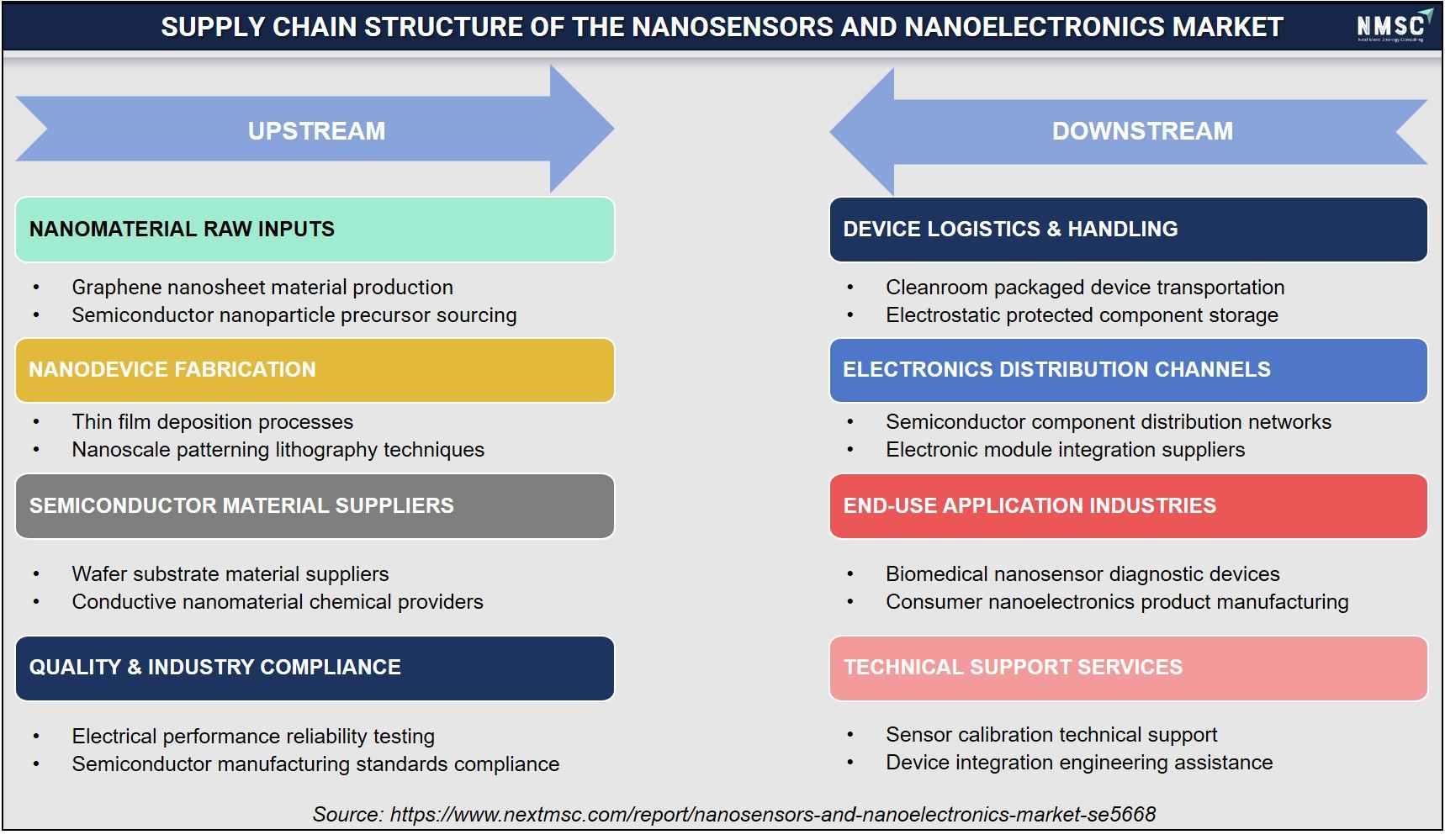
Our analysis indicates that the Nanosensors and Nanoelectronics Market relies on a highly specialized supply chain beginning with nanomaterial production, semiconductor precursors, and conductive material suppliers. Manufacturing includes nanodevice fabrication, precision lithography, and rigorous quality testing to ensure device reliability and compliance with semiconductor standards. Downstream operations encompass protected logistics, electronics distribution, end-use integration, and technical support. Strong coordination across suppliers, manufacturers, distributors, and technology integrators enables efficient commercialization and widespread adoption across multiple industries.
Competitive Landscape
|
Dimension |
Details |
|
Market Structure |
Moderately fragmented with specialized nanotechnology developers alongside diversified sensor and photonics manufacturers |
|
Innovation Focus |
Integrated photonic circuits, system-in-package integration, and biological nanosensor commercialization |
|
M&A Activity |
Selective acquisitions to expand photonics and nanofabrication foundry capacity |
How Do Companies Compete in the Nanosensors and Nanoelectronics Market?
Leading companies compete on nanofabrication process depth, foundry capacity scale, and application-specific design engineering across sensing, photonics, and electromechanical categories. Our analysis shows that pricing strategies vary by offering type, with integrated photonic circuits commanding premium pricing over discrete sensor components. Geographic expansion is pursued through foundry partnerships and research collaboration agreements in markets with growing semiconductor manufacturing investment.
Which Competitive Archetypes Dominate the Nanosensors and Nanoelectronics Industry?
Diversified sensor manufacturers such as Sensirion AG and Bosch Sensortec GmbH compete on broad application coverage and manufacturing scale, while photonics specialists such as Coherent Corp. and Hamamatsu Photonics K.K. compete on optical component performance depth. Nanofabrication foundries such as Silex Microsystems AB and X-FAB Silicon Foundries SE differentiate through shared manufacturing capacity access. This archetype segmentation explains sustained competitive diversity across the category.
What Is the Innovation and Differentiation Strategy Across the Industry?
Industry leaders differentiate through integrated photonic circuit research, system-in-package integration capability, and biological nanosensor commercialization that connects component performance to measurable application outcomes. We observed that foundry partnership models are becoming a standard differentiator, allowing smaller OEM customers to accessadvanced nanofabrication capacity without proprietary facility investment.
How Active Is M&A in the Nanosensors and Nanoelectronics Industry?
M&A activity remains selective, concentrated on expanding photonics and nanofabrication foundry capacity rather than large-scale consolidation. Recent acquisitions integrating specialty sensor developers with foundry manufacturing capability illustrate how established companies are reinforcing existing product portfolios rather than expanding into unrelated categories.
Key Market Players
Our assessment indicates that the following companies represent the validated set of leading global nanosensors and nanoelectronics providers active as of 2026, ranked by verifiable market-specific scale of operations.
-
Sensirion AG
-
Coherent Corp.
-
Silex Microsystems AB
-
SiTime Corporation
-
ams-OSRAM AG
-
Knowles Corporation
-
Melexis NV
-
OmniVision Technologies, Inc.
-
Nanomix Inc.
-
Owlstone Inc.
-
Applied Nanotools Inc.
-
Brewer Science, Inc.
-
Aryballe Technologies SAS
-
X-FAB Silicon Foundries SE
-
Teledyne DALSA Inc.
-
Tronics Microsystems SA
-
MEMSCAP S.A.
-
Atomica Corp.
Latest Developments
We found that recent corporate activity reflects continued photonics and nanofabrication capacity investment among leading nanosensors and nanoelectronics providers heading into 2026.
|
Date |
Event |
|
March 2026 |
ams OSRAM AG unveiled its optical force sensing technology at Light + Building 2026, enabling contactless, high-precision user interfaces for compact electronic devices through advanced photonics-based sensing. |
|
January 2026 |
Bosch Sensortec GmbH introduced the BMI5 inertial sensor family at CES 2026, featuring AI-enabled MEMS sensors designed for XR, wearable, and next-generation nanoelectronics applications requiring high-precision motion sensing. |
Expert Insights
 “Next-generation AI systems are becoming increasingly complex. To meet their demanding memory, power, thermal, and reliability requirements, chips are evolving into heterogeneous assemblies of multiple technologies that continuously interact with – and influence – one another.”
— Patrick Vandenameele, Executive Vice President and CEO-elect, imec
Statement made in an interview with imec discussing the increasing complexity of AI systems and the need for advanced chip integration technologies to address memory, power, thermal, and reliability requirements.
Market Interpretation
The statement highlights the growing complexity of semiconductor architectures as AI workloads place greater demands on memory bandwidth, power efficiency, thermal management, and reliability. The shift toward heterogeneous chip assemblies is accelerating the adoption of advanced packaging, chiplet architectures, and the integration of multiple semiconductor technologies within a single system. This evolution is creating opportunities for advanced semiconductor integration and packaging technologies as chip manufacturers seek scalable solutions capable of supporting increasingly demanding AI applications.
Investment Opportunities
What Capital Inflows Are Shaping the Nanosensors and Nanoelectronics Market?
Capital inflows are concentrated in photonic integrated circuit manufacturing capacity and nanofabrication foundry expansion, with leading companies reinvesting in advanced lithography and deposition equipment to meet growing data center and consumer electronics demand. We observed that Coherent Corp. has disclosed continued investment in photonic manufacturing capacity, an industry-derived benchmark for capital intensity across top-tier nanoelectronics providers.
How Is Infrastructure Investment Evolving Across the Industry?
Infrastructure investment is expanding in regional nanofabrication foundry capacity designed to serve growing global demand for nanosensors and nanoelectronics components. Our analysis shows that similar capacity investments are likely across Asia-Pacific and European markets through 2035 as multinational manufacturers diversify their geographic production footprint.
What ESG Considerations Are Relevant to Nanosensors and Nanoelectronics Market Investment?
Environmental, social, and governance considerations increasingly center on nanomaterial workplace safety, energy-efficient nanofabrication processes, and equitable access to advanced diagnostic technology through affordable biological nanosensor platforms. We found that these considerations are becoming embedded in institutional investment screening criteria applied to nanotechnology component manufacturers.
Key Benefits for Stakeholders
How Does This Report Benefit Nanotechnology Industry Leaders?
Industry leaders gain a validated view of segment-level growth rates, competitive archetypes, and regional demand drivers that inform manufacturing investment prioritization and go-to-market sequencing across offering categories through 2035.
How Does This Report Benefit Investors and Financial Analysts?
Investors and financial analysts gain access to consistent market sizing, CAGR benchmarks, and competitive landscape analysis that support capital allocation decisions across sensing, photonics, and nanoelectromechanical systems manufacturers.
How Does This Report Benefit Technology Vendors and Product Teams?
Technology vendors and product teams gain visibility into integrated photonic circuit, system-in-package integration, and biological nanosensor trends that inform partnership and product development strategies aligned with leading manufacturers' innovation roadmaps.
Key Market Segments
By Offering
-
Nanosensors
-
Chemical Nanosensors
-
Biological Nanosensors
-
Physical Nanosensors
-
Optical Nanosensors
-
Other Nanosensor
-
-
Nanoelectromechanical Systems (NEMS)
-
NEMS Resonators
-
NEMS Actuators
-
NEMS Switches
-
Other Nanoelectromechanical Systems
-
-
Nanophotonics Components
-
Optoelectronic Components
-
Optical Metasurfaces
-
Integrated Photonic Circuits
-
Other Nanophotonics Components
-
-
Nano-Enabled Electronic Components
-
Flexible Nano-Circuits
-
Nano-Capacitors
-
Other Nano-Enabled Electronic Components
-
By Component Architecture
-
Discrete Components
-
Embedded Arrays
-
System-in-Package Modules
-
Flexible Circuits
-
Other Component Architectures
By End Use Industry
-
Consumer Electronics
-
Healthcare and Life Sciences
-
Energy and Storage
-
Automotive and Mobility
-
Aerospace and Defense
-
Industrial Automation
-
Telecommunications
-
Other End Use Industries
By Buyer Type
-
OEM
-
Research Institution
-
Government
-
Healthcare Provider
-
Other Buyer Types
By Distribution Channel
-
Direct Sales
-
Distributor
-
E-Commerce
-
Project-Based Sales
-
Other Distribution Channels
By Region
-
North America: U.S., Canada, Mexico
-
Europe: UK, Germany, France, Italy, Spain, Sweden, Denmark, Finland, Netherlands, Rest of Europe
-
Asia-Pacific: China, India, Japan, South Korea, Taiwan, Indonesia, Vietnam, Australia,Philippines, Malaysia, Rest of APAC
-
Middle East and Africa: Saudi Arabia, UAE, Egypt, Israel, Turkey, Nigeria, South Africa, Rest of MEA
-
Latin America: Brazil, Argentina, Chile, Colombia, Rest of LATAM
Conclusion and Recommendations
What Is the Long-Term Outlook for the Nanosensors and Nanoelectronics Market?
The nanosensors and nanoelectronics market is projected to expand from USD 3.65 billion in 2026 to USD 13.80 billion by 2035 at a 15.92% CAGR, supported by sustained data center infrastructure investment and expanding consumer electronics miniaturization demand. We found that this trajectory reflects durable structural demand rather than a cyclical upswing, positioning the industry for continued long-term expansion.
What Are the Strategic Positioning Recommendations?
Producers should prioritize nanophotonics and system-in-package portfolio expansion in North America and Asia-Pacific while building research collaboration partnerships in Europe to serve growing photonics innovation demand. Our assessment indicates that companies balancing both strategies will capture the broadest share of the projected USD 10.15 billion incremental opportunity through 2035.
How Attractive Is the Nanosensors and Nanoelectronics Market for Investment?
The market's 15.92% CAGR, combined with a moderately fragmented competitive structure among twenty validated global providers, signals an attractive investment profile for capital targeting AI infrastructure-linked photonics and sensing demand rather than saturated legacy electronics categories.
What Market Shifts and Key Risks Should Stakeholders Monitor?
Stakeholders should monitor semiconductor export control policy shifts, nanofabrication capital equipment cost trends, and nanomaterial characterization standardization gaps that could moderate deployment pace across the forecast period.
What Are the Primary Growth Pathways Through 2035?
Primary growth pathways include expanding integrated photonic circuit adoption, scaling system-in-package integration capability, and growing biological nanosensor commercialization in point-of-care diagnostics, each reinforcing the nanosensors and nanoelectronics market's projected expansion to USD 13.80 billion by 2035.
About the Author
 Saista Faiyaz
— Saista Faiyaz is Research Associate at Next Move Strategy Consulting, where she has covered consumer markets and healthcare technologies for 3 years. Her work includes primary interview review, secondary-source validation, market sizing, and structured analysis of company and industry data. She supports research by comparing evidence across sources, organizing findings into market narratives, and documenting assumptions used in analysis. Her scope includes cross-market benchmarking, and reports.
Saista Faiyaz
— Saista Faiyaz is Research Associate at Next Move Strategy Consulting, where she has covered consumer markets and healthcare technologies for 3 years. Her work includes primary interview review, secondary-source validation, market sizing, and structured analysis of company and industry data. She supports research by comparing evidence across sources, organizing findings into market narratives, and documenting assumptions used in analysis. Her scope includes cross-market benchmarking, and reports.
About the Reviewer
 Supradip Baul
— Supradip Baul is an accomplished business consultant and strategist with over a decade of rich experience in market intelligence, strategy, technology, and business transformation. His work has included rigorous qualitative and quantitative analysis across multiple industries, helping clients shape investment decisions and long-term roadmaps. Earlier in his career, he was associated with Gartner, where he contributed to industry-leading reports and market share analyses. He has worked with leading global companies and holds an MBA with a dual specialization in Marketing and Finance.
Supradip Baul
— Supradip Baul is an accomplished business consultant and strategist with over a decade of rich experience in market intelligence, strategy, technology, and business transformation. His work has included rigorous qualitative and quantitative analysis across multiple industries, helping clients shape investment decisions and long-term roadmaps. Earlier in his career, he was associated with Gartner, where he contributed to industry-leading reports and market share analyses. He has worked with leading global companies and holds an MBA with a dual specialization in Marketing and Finance.
At Next Move Strategy Consulting, we understand that insightful market research is the cornerstone of successful business decisions. That's why we employ a robust and multifaceted approach, combining various methodologies to deliver the most accurate and actionable data for our clients.

Research Landscape
We navigate the world of research with two primary approaches:
Qualitative Approach
Our qualitative research methodologies involve immersive techniques such as in-depth interviews, focus groups, and observational studies. By engaging directly with individuals and stakeholders, we uncover valuable insights that quantitative data alone may overlook.

Quantitative Research
In tandem with qualitative methodologies, NMSC leverages the power of Quantitative Research to provide a robust foundation of numerical insights. Through systematic data collection and analysis, we quantify patterns, preferences, and market trends, offering a comprehensive view of the business landscape.
Our quantitative research approach employs diverse tools, including surveys, experiments, and statistical modelling. These methodologies enable us to gather data from a large and representative sample, ensuring the statistical significance of our findings. By employing structured questionnaires and standardized data collection methods, we guarantee the reliability and validity of the information we present to our clients.
Quantitative research is particularly effective in measuring the prevalence of trends, assessing market size, and gauging the impact of various factors on consumer behavior. The numerical precision attained through this approach equips our clients with actionable insights, facilitating data-driven decision-making and strategy formulation.


Our Specialized Toolbox for Industry-Specific Market Research
We deploy a specialized arsenal of techniques tailored to meet your unique requirements. Here's a glimpse into our comprehensive toolbox:

Information Procurement
The stage entails acquiring market data or relevant information through various sources and methodologies.


Market Research Approach
We utilize both top-down and bottom-up approaches in market research analysis to achieve a comprehensive understanding of the market dynamics, leveraging the broad perspective of industry trends and macroeconomic factors alongside detailed insights from specific segments and individual companies.

Porters Five Forces Analysis
We conduct Porter's Five Forces analysis to evaluate the competitive landscape of an industry, providing us with insights into factors that affect profitability and strategic positioning.

SWOT Analysis

Forecasting
We utilize a forecasting model to predict future consumption by considering parameters like population, economics, regulations, market competition, drivers, constraints, technology, and pricing. We also employ statistical techniques such as multilinear regression, exponential smoothing, moving average, ARIMA, and Monte Carlo simulations for accurate predictions. In econometric forecasting, we analyzed short-term and long-term event impacts, attributing values based on regulatory frameworks, economic factors, and market events.





 Speak to Our Analyst