Next-Generation Biomanufacturing Market

Next-generation biomanufacturing market size was USD 24.63 Bn in 2025, projected to reach USD 60.04 Bn by 2035 at a 9.32% CAGR from 2026 to 2035 worldwide.

Download Free Sample PDF
Base Year (2025)
$24.63 Billion
Forecast (2035)
$60.04 Billion
CAGR (2026-2035)
9.3%
Top Region
North America

What Is the Next-Generation Biomanufacturing Market Size?

The global next-generation biomanufacturing market size was valued at USD 24.63 Billion in 2025 and is estimated at USD 26.93 Billion in 2026, forecast to reach USD 60.04 Billion by 2035, expanding at a 9.32% CAGR between 2026 and 2035. North America leads with approximately a 42% share, while Upstream systems dominate all other equipment categories with approximately a 34% share.

We observed that growth is broadest in automation, cell and gene therapy, and CDMO-oriented categories, with continuous bioprocessing architectures and Asia-Pacific capacity expansion recording the strongest structural gains through 2035.

Next-Generation Biomanufacturing Market Revenue Forecast

Values in USD Billion

2025 $24.63 Billion
2025
2026 $26.93 Billion
2026
2027 $29.43 Billion
2027
2028 $32.18 Billion
2028
2029 $35.18 Billion
2029
2030 $38.46 Billion
2030
2031 $42.04 Billion
2031
2032 $45.96 Billion
2032
2033 $50.24 Billion
2033
2034 $54.92 Billion
2034
2035 $60.04 Billion
2035

Key Takeaways

By Equipment: Upstream systems held the largest share of approximately 34% (USD 8.37 billion) in 2025; Automation and robotics is the fastest-growing sub-segment at 12.7% CAGR from 2026-2035.

By Consumables and raw materials: Single-use assemblies held the largest share of approximately 32% (USD 7.88 billion) in 2025; Sensors and probes is the fastest-growing sub-segment at 13.1% CAGR from 2026-2035.

By Software and Digital Platforms: Automation software held the largest share of approximately 38% (USD 9.36 billion) in 2025; Analytics and modelling is the fastest-growing sub-segment at 13.3% CAGR from 2026-2035.

By Technical services: CDMO and contract manufacturing held the largest share of approximately 30% (USD 7.39 billion) in 2025; Engineering and integration is the fastest-growing sub-segment at 12.4% CAGR from 2026-2035.

By Workflow step: Upstream held the largest share of approximately 34% (USD 8.37 billion) in 2025; Analytics and control is the fastest-growing sub-segment at 13.0% CAGR from 2026 to 2035.

By Technology architecture: Single-use held the largest share of approximately 42% (USD 10.35 billion) in 2025; Continuous is the fastest-growing sub-segment at 14.4% CAGR from 2026-2035.

By Modality: Monoclonal antibodies held the largest share of approximately 32% (USD 7.88 billion) in 2025; Cell therapy is the fastest-growing sub-segment at 14.4% CAGR from 2026-2035.

By End Users: Biopharma Companies held the largest share of approximately 54% (USD 13.30 billion) in 2025; CDMOs and CMOs is the fastest-growing sub-segment at 12.0% CAGR from 2026-2035.

By Sales channel: Direct key accounts held the largest share of approximately 48% (USD 11.82 billion) in 2025; Contract service is the fastest-growing sub-segment at 12.5% CAGR from 2026-2035.

Dominant Region: North America dominated with approximately 42% revenue share (USD 10.35 billion) in 2025.

Fastest-Growing Region: Asia-Pacific is expected to register the highest CAGR of 12.6% during 2026-2035.

Dominant Country: The U.S. led with approximately USD 8.07 billion in 2025.

Fastest-Growing Country: India is the fastest-growing country at approximately 14.8% CAGR from 2026-2035.

Market Opportunity: The next-generation biomanufacturing market is expected to create an absolute dollar opportunity of USD 33.11 billion between 2026 and 2035, presenting significant investment potential across automation, continuous bioprocessing, and cell and gene therapy manufacturing platforms.

According to NMSC analysis, equipment vendors are increasingly bundling hardware with digital analytics and automation software into unified platforms, a shift that favors suppliers capable of delivering integrated upstream-to-downstream solutions over component-only vendors as biopharma and CDMO customers consolidate procurement relationships through 2035.

Ecosystem Analysis of the Next-Generation Biomanufacturing Industry

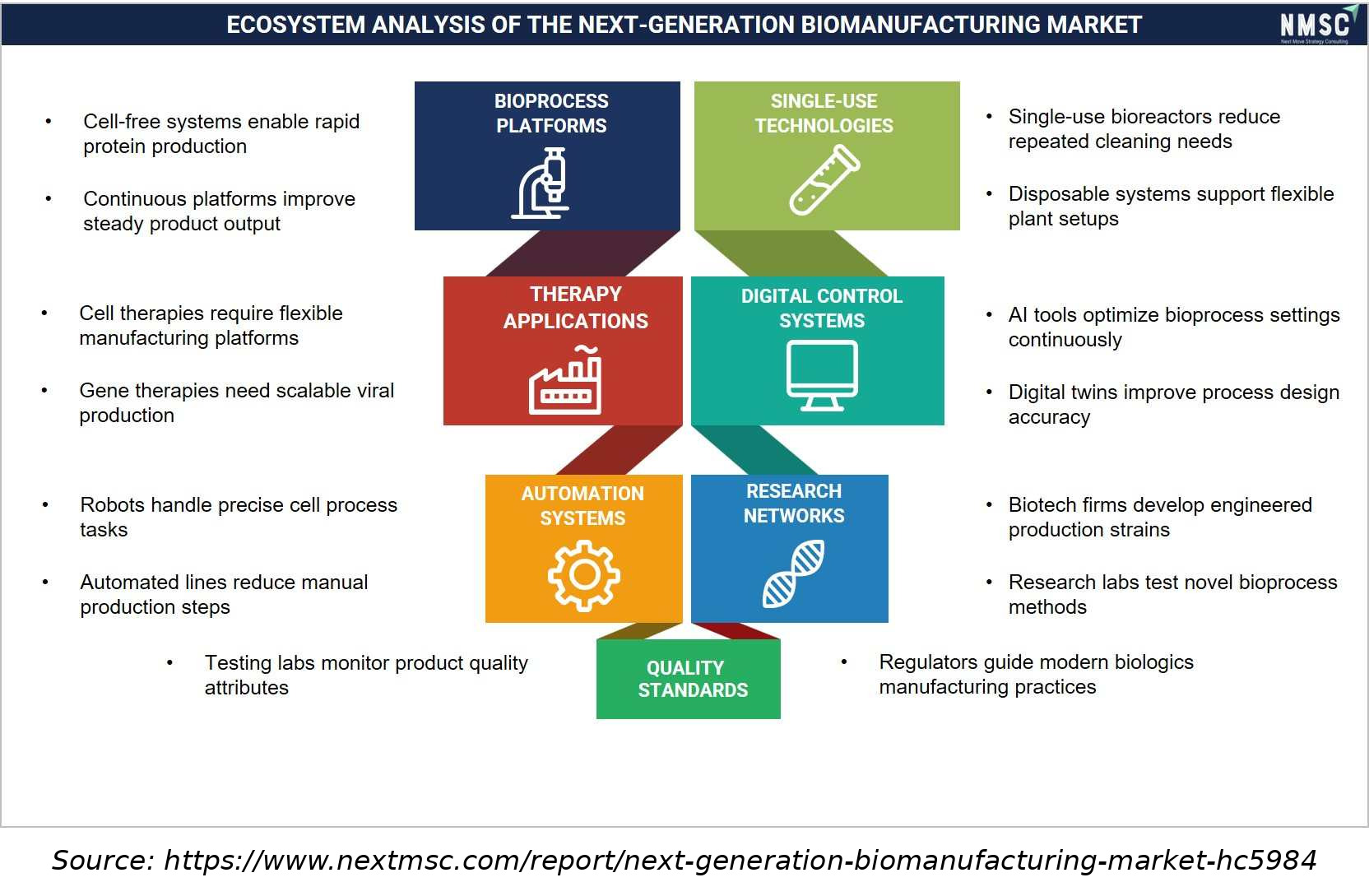
The above infographic presents an ecosystem analysis of the next-generation biomanufacturing market, covering bioprocess platforms, single-use technologies, therapy applications, automation systems, research networks, digital controls, and quality oversight. Cell-free systems and continuous platforms are accelerating protein production, while single-use bioreactors reduce cleaning requirements and enhance operational flexibility. AI and digital twins are optimizing bioprocess settings and design accuracy, while robotic automation minimizes manual intervention. Cell and gene therapies are driving demand for flexible manufacturing platforms, supported by regulatory guidance and quality standards. Looking ahead, we observed that integration of advanced automation and digital tools will remain central to improving efficiency and scalability across the biopharmaceutical sector.

What Does the Next-Generation Biomanufacturing Market Encompass?

The next-generation biomanufacturing market encompasses the equipment, consumables, software, and technical services used to produce biologics through single-use, continuous, and digitally enabled manufacturing architectures. Our assessment indicates that the scope spans upstream and downstream processing systems, fill-finish equipment, automation and robotics, single-use consumables, and analytics platforms, supplied to biopharma companies, CDMOs, and research institutions across monoclonal antibody, cell therapy, gene therapy, and mRNA production workflows.
Regulatory frameworks, including the U.S. FDA's guidance on advanced manufacturing technologies and process analytical technology, continue to shape adoption timelines for continuous and digitally monitored production systems. We observed that technology adoption is shifting toward integrated automation and analytics platforms, as CDMOs pursuing single-use bioprocessing capacity expansion increasingly specify digitally connected equipment across the next-generation biomanufacturing market.

Market Drivers & Dynamics

Interactive Dataset
Expanding CDMO single-use capacity investment driver +2.4% North America, Asia-Pacific 2026-2035
Rising cell and gene therapy manufacturing demand driver +2.1% Global 2026-2035
Growing adoption of automation and robotics in bioprocessing driver +1.7% North America, Europe 2026-2035
Increasing integration of at-line and real-time analytics driver +1.3% Global 2026-2035
Expanding biomanufacturing capacity investment in Asia-Pacific driver +1.1% Asia-Pacific 2026-2035
Growing outsourcing of biologics manufacturing to CDMOs driver +0.9% Global 2026-2032
High capital cost of continuous and automated manufacturing conversion restraint -1.2% Global 2026-2035
Regulatory validation burden for novel manufacturing technologies restraint -0.8% North America, Europe 2026-2035
Shortage of skilled bioprocess engineering talent restraint -0.6% Global 2026-2032
Source: Next Move Strategy Consulting

Growth Drivers

What Is the Primary Growth Driver of the Next-Generation Biomanufacturing Market?

Expanding CDMO single-use capacity investment is the primary driver of the market. The National Institute for Innovation in Manufacturing Biopharmaceuticals continues to fund technology and workforce development projects supporting advanced biomanufacturing capacity. We observed that this capacity investment, reinforced by Samsung Biologics' 2025 facility expansion, sustains baseline demand for upstream and downstream single-use systems across CDMO and biopharma company end users.

How Is Cell and Gene Therapy Demand Driving Market Growth?

Rising cell and gene therapy manufacturing demand is accelerating market growth as these modalities require specialized, smaller-batch production equipment distinct from traditional monoclonal antibody manufacturing. The National Institute of Standards and Technology continues to document growing federal investment in biomanufacturing process control data infrastructure. Our assessment indicates that this demand growth is accelerating adoption timelines for specialized cell and gene therapy manufacturing equipment and media across North American and European advanced therapy production facilities.

Growth Inhibitors

What Is Restraining Next-Generation Biomanufacturing Market Expansion?

The high capital cost of continuous and automated manufacturing conversion restrains adoption among smaller biopharma companies with constrained capital budgets. The U.S. Securities and Exchange Commission's public filings from major equipment suppliers continue to document the capital-intensive nature of advanced bioprocessing technology investment. We found that smaller biopharma companies face particular exposure, as limited capital availability constrains their ability to adopt continuous and automated manufacturing platforms relative to larger, well-capitalized CDMOs and biopharma companies.

Segmentation Analysis

2025 (USD Billion)
2035 (USD Billion)
Upstream systems 2025: $8.37 Billion | 2035: $19.76 Billion
Upstream sys
Downstream systems 2025: $6.40 Billion | 2035: $15.62 Billion
Downstream s
Fill finish systems 2025: $3.94 Billion | 2035: $9.07 Billion
Fill finish
Automation and robotics 2025: $3.45 Billion | 2035: $10.15 Billion
Automation a
Other equipment 2025: $2.46 Billion | 2035: $5.44 Billion
Other equipm
Upstream systems $8.37 Billion $19.76 Billion 10.0%
Downstream systems $6.40 Billion $15.62 Billion 10.4%
Fill finish systems $3.94 Billion $9.07 Billion 9.7%
Automation and robotics $3.45 Billion $10.15 Billion 12.7%
Other equipment $2.46 Billion $5.44 Billion 9.2%

Which Equipment Segment Dominates the Next-Generation Biomanufacturing Market?

Upstream systems led the market with USD 8.37 billion in 2025, supported by sustained demand for bioreactor and fermenter capacity across biologics production. We observed that Automation and robotics is the fastest-growing equipment category, expanding at a 12.7% CAGR from 2026 to 2035, as manufacturers increasingly specify liquid handling robots and process control hardware to reduce manual intervention and improve production consistency.

2025 (USD Billion)
2035 (USD Billion)
Single-use a
Bags and con
Tubing and m
Connectors a
Other single
Segment Item 2025 (USD Billion) 2035 (USD Billion) CAGR
Single-use assemblies $10.0 USD Billion $40.0 USD Billion 25.0%
Bags and containers $17.1 USD Billion $51.1 USD Billion 11.0%
Tubing and manifolds $24.2 USD Billion $62.2 USD Billion 25.0%
Connectors and disconnectors $31.3 USD Billion $73.3 USD Billion 11.0%
Other single-use assemblies $38.4 USD Billion $84.4 USD Billion 16.0%

Segment-wise data is locked

Unlock complete segment-wise numbers for By Consumables and raw materials.

Unlock Full Data
2025 (USD Billion)
2035 (USD Billion)
Data managem
Historian
Batch record
LIMS
Analytics an
Segment Item 2025 (USD Billion) 2035 (USD Billion) CAGR
Data management $10.0 USD Billion $40.0 USD Billion 27.0%
Historian $17.1 USD Billion $51.1 USD Billion 9.0%
Batch records $24.2 USD Billion $62.2 USD Billion 19.0%
LIMS $31.3 USD Billion $73.3 USD Billion 17.0%
Analytics and modelling $38.4 USD Billion $84.4 USD Billion 18.0%

Segment-wise data is locked

Unlock complete segment-wise numbers for By Software and Digital Platforms.

Unlock Full Data
2025 (USD Billion)
2035 (USD Billion)
Process deve
Tech transfe
CDMO and con
Engineering
Quality cont
Segment Item 2025 (USD Billion) 2035 (USD Billion) CAGR
Process development $10.0 USD Billion $40.0 USD Billion 14.0%
Tech transfer and validation $17.1 USD Billion $51.1 USD Billion 24.0%
CDMO and contract manufacturing $24.2 USD Billion $62.2 USD Billion 22.0%
Engineering and integration $31.3 USD Billion $73.3 USD Billion 12.0%
Quality control and testing $38.4 USD Billion $84.4 USD Billion 27.0%

Segment-wise data is locked

Unlock complete segment-wise numbers for By Technical services.

Unlock Full Data
2025 (USD Billion)
2035 (USD Billion)
Upstream
Downstream
Fill-finish
Analytics an
Cross-functi
Segment Item 2025 (USD Billion) 2035 (USD Billion) CAGR
Upstream $10.0 USD Billion $40.0 USD Billion 24.0%
Downstream $17.1 USD Billion $51.1 USD Billion 22.0%
Fill-finish $24.2 USD Billion $62.2 USD Billion 20.0%
Analytics and control $31.3 USD Billion $73.3 USD Billion 22.0%
Cross-functional $38.4 USD Billion $84.4 USD Billion 13.0%

Segment-wise data is locked

Unlock complete segment-wise numbers for By Workflow step.

Unlock Full Data
2025 (USD Billion)
2035 (USD Billion)
Single-use
Stainless st
Continuous
Modular
Hybrid
Segment Item 2025 (USD Billion) 2035 (USD Billion) CAGR
Single-use $10.0 USD Billion $40.0 USD Billion 23.0%
Stainless steel $17.1 USD Billion $51.1 USD Billion 9.0%
Continuous $24.2 USD Billion $62.2 USD Billion 19.0%
Modular $31.3 USD Billion $73.3 USD Billion 13.0%
Hybrid $38.4 USD Billion $84.4 USD Billion 10.0%

Segment-wise data is locked

Unlock complete segment-wise numbers for By Technology architecture.

Unlock Full Data
2025 (USD Billion)
2035 (USD Billion)
Monoclonal a
Vaccines
Cell therapy
Gene therapy
Recombinant
Segment Item 2025 (USD Billion) 2035 (USD Billion) CAGR
Monoclonal antibodies $10.0 USD Billion $40.0 USD Billion 21.0%
Vaccines $17.1 USD Billion $51.1 USD Billion 23.0%
Cell therapy $24.2 USD Billion $62.2 USD Billion 25.0%
Gene therapy $31.3 USD Billion $73.3 USD Billion 15.0%
Recombinant proteins $38.4 USD Billion $84.4 USD Billion 16.0%

Segment-wise data is locked

Unlock complete segment-wise numbers for By Modality.

Unlock Full Data

Which Modality Segment Leads Next-Generation Biomanufacturing Market Demand?

Monoclonal antibodies remained the dominant modality, valued at USD 7.88 billion in 2025, due to their established role as the largest and most mature category of manufactured biologics. Our findings suggest that Cell therapy is the fastest-growing modality, registering a 14.4% CAGR from 2026 to 2035, as expanding clinical approvals and manufacturing scale-up drive demand for specialized, smaller-batch production equipment and consumables.

2025 (USD Billion)
2035 (USD Billion)
Biopharma Co
CDMOs and CM
Academic and
Government a
Segment Item 2025 (USD Billion) 2035 (USD Billion) CAGR
Biopharma Companies $10.0 USD Billion $40.0 USD Billion 9.0%
CDMOs and CMOs $17.1 USD Billion $51.1 USD Billion 23.0%
Academic and Research Institutions $24.2 USD Billion $62.2 USD Billion 9.0%
Government and Public labs $31.3 USD Billion $73.3 USD Billion 23.0%

Segment-wise data is locked

Unlock complete segment-wise numbers for By End Users.

Unlock Full Data

Which End User Segment Is Most Widely Served in the Market?

Biopharma Companies remained the dominant end user, reaching USD 13.30 billion in 2025 due to concentrated in-house manufacturing investment across large pharmaceutical and biotechnology organizations. Based on research conducted by NMSC, we found that CDMOs and CMOs is the fastest-growing end user at a 12.0% CAGR from 2026 to 2035, reflecting rising outsourcing of biologics manufacturing to contract organizations with specialized advanced therapy production capacity.

2025 (USD Billion)
2035 (USD Billion)
Direct key a
Distributor
System integ
E-commerce a
Contract ser
Segment Item 2025 (USD Billion) 2035 (USD Billion) CAGR
Direct key accounts $10.0 USD Billion $40.0 USD Billion 23.0%
Distributor $17.1 USD Billion $51.1 USD Billion 21.0%
System integrator $24.2 USD Billion $62.2 USD Billion 15.0%
E-commerce and catalogue $31.3 USD Billion $73.3 USD Billion 9.0%
Contract service $38.4 USD Billion $84.4 USD Billion 10.0%

Segment-wise data is locked

Unlock complete segment-wise numbers for By Sales channel.

Unlock Full Data

Growth Opportunities

Our analysis shows that three forward-looking opportunities stand out for stakeholders positioning within the next-generation biomanufacturing market over the 2026-2035 forecast period.

How Can Integrated Automation Platforms Unlock Value for CDMOs?

Integrated automation and analytics platforms present a whitespace opportunity for vendors serving CDMOs pursuing simplified, digitally connected manufacturing operations. Suppliers that commercialize bundled hardware-software offerings stand to capture recurring software and service revenue as CDMOs standardize digital infrastructure across expanding single-use production capacity.

Where Does Specialized Cell and Gene Therapy Media Create New Demand?

Advanced therapy manufacturers represent an underpenetrated opportunity for specialized, GMP-compliant media and reagents tailored to specific cell and gene therapy modalities. Providers that develop application-specific inputs supporting cell and gene therapy manufacturing can secure long-term supply contracts with biopharma companies and CDMOs scaling advanced therapy production.

How Can Real-Time Analytics Benefit Continuous Manufacturing Adopters?

Manufacturers transitioning toward continuous bioprocessing create an opportunity for vendors offering real-time, at-line analytics that support connected, regulated production campaigns. Early movers that streamline rapid measurement technology integration can differentiate with biopharma companies and CDMOs pursuing standardized, data-driven continuous manufacturing infrastructure.

Regional Outlook

2025 (USD Billion)
2035 (USD Billion)
North Americ
Europe
Asia-Pacific
Middle East
Latin Americ
Region 2025 (USD Billion) 2035 (USD Billion) CAGR (%)
North America $10.0 USD Billion $40.0 USD Billion 9.0%
Europe $17.1 USD Billion $51.1 USD Billion 27.0%
Asia-Pacific $24.2 USD Billion $62.2 USD Billion 25.0%
Middle East & Africa $31.3 USD Billion $73.3 USD Billion 23.0%
Latin America $38.4 USD Billion $84.4 USD Billion 12.0%

Regional data is locked

Unlock complete regional numbers for this market.

Unlock Full Data

Supply Chain Analysis of the Next-Generation Biomanufacturing Industry

Supply Chain Analysis of the Next-Generation Biomanufacturing Industry
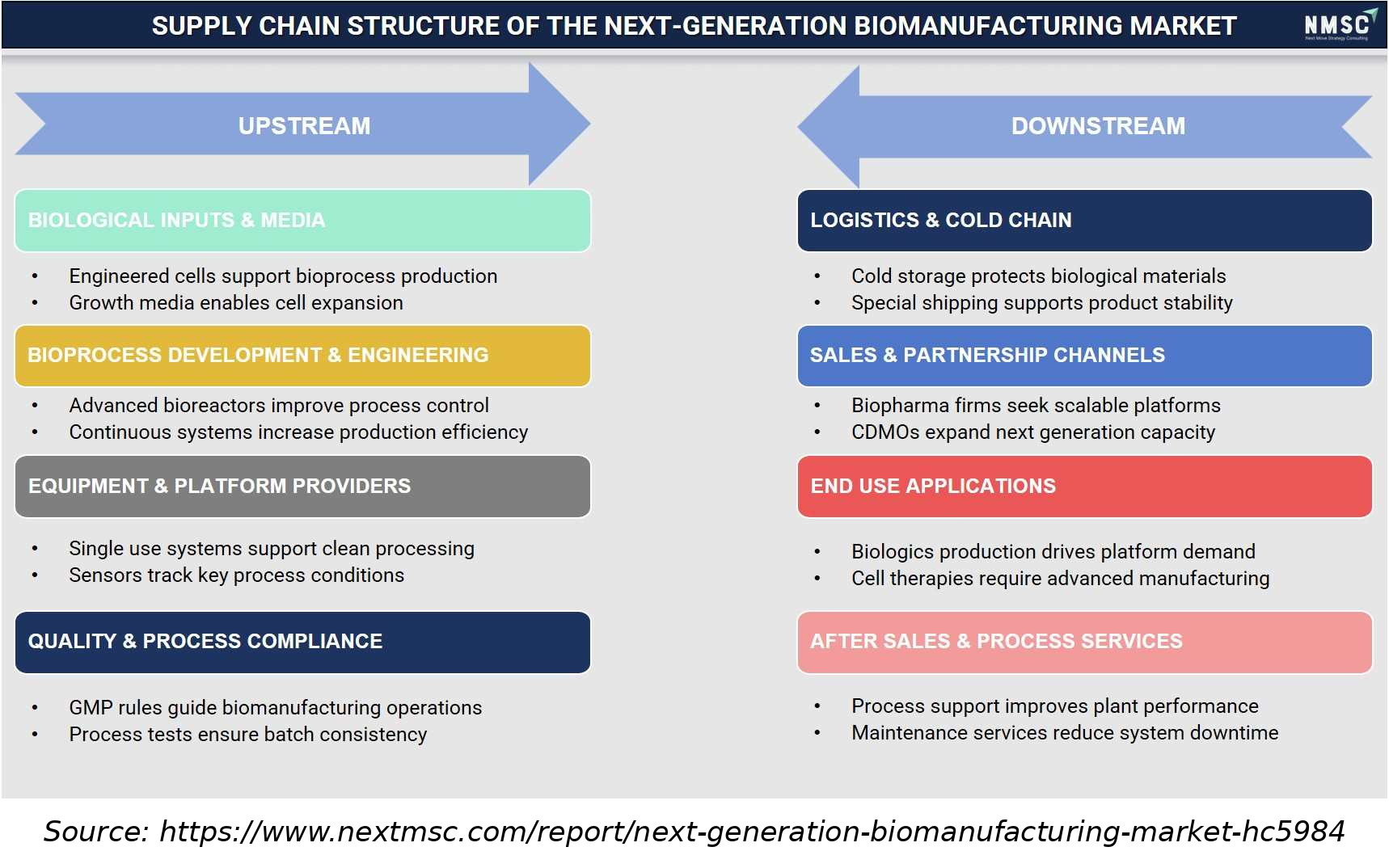
The above infographic presents the supply chain structure of the next-generation biomanufacturing market, segmented into upstream and downstream activities. Engineered cells and growth media support bioprocess development, with advanced bioreactors and continuous systems improving control and efficiency. Single-use platforms and sensors enable clean processing, while GMP compliance and batch testing ensure quality. Downstream, cold chain logistics protect biological materials for delivery to biopharma firms and CDMOs. End-use applications include biologics and cell therapies. Looking ahead, we observed that process support and maintenance services remain essential for optimizing performance and reducing downtime across the biomanufacturing industry.

Competitive Landscape

We observed that the next-generation biomanufacturing market features a moderately consolidated competitive landscape, with diversified life sciences majors competing alongside specialized bioprocessing vendors on equipment breadth, digital integration depth, and global manufacturing footprint. Key Takeaways

Dimension Description
Market Structure Moderately consolidated; the top companies profiled in this report collectively account for a majority of global next-generation biomanufacturing revenue, while numerous specialized analytics and consumables vendors serve niche process categories.
Innovation Focus Intensified downstream processing, at-line real-time analytics, and specialized cell and gene therapy media dominate current innovation pipelines across leading vendors.
M&A Activity Selective capacity and capability expansion, exemplified by Samsung Biologics' Plant 5 commissioning and continued single-use bioreactor platform scale-up across major equipment suppliers.

How Do Companies Compete in the Next-Generation Biomanufacturing Market?

Companies compete primarily on equipment breadth, digital integration depth, and global manufacturing footprint across the industry. Diversified life sciences majors such as Thermo Fisher Scientific Inc. and Danaher Corporation leverage broad upstream-to-downstream portfolios to serve multinational biopharma customers, while specialized vendors such as Repligen Corporation and Sartorius AG compete on process-specific analytics and purification innovation for demanding continuous manufacturing applications.

Which Competitive Archetypes Dominate the Next-Generation Biomanufacturing Market?

Two archetypes dominate the market: diversified life sciences equipment majors offering integrated upstream, downstream, and digital platform portfolios, and specialized process technology vendors focused on analytics, purification, or media innovation. Thermo Fisher Scientific Inc. and Sartorius AG exemplify the diversified archetype through combined hardware and software offerings, while Repligen Corporation and Eppendorf SE exemplify the specialist archetype serving analytics and laboratory-adjacent bioprocessing niches.

How Are Companies Differentiating Through Innovation in the Market?

Innovation and differentiation strategy increasingly center on intensified, connected processing modules and real-time analytics integration. Sartorius's Pionic Quad and Cross downstream modules and Repligen's CTech SoloVPE PLUS at-line analytics both illustrate how vendors are compressing manufacturing footprint and decision cycles simultaneously. Our analysis shows that vendors unable to demonstrate connected, data-driven platform capabilities risk exclusion from CDMO and biopharma procurement, where digital integration increasingly shapes vendor selection.

What M&A and Expansion Activity Is Shaping the Next-Generation Biomanufacturing Market?

Capacity expansion and product line extension continue to shape competitive positioning within the industry more than large-scale acquisitions at this stage of market maturity. Samsung Biologics' Plant 5 commissioning and Lonza's TheraPEAK portfolio expansion illustrate how both CDMOs and equipment suppliers pursue capability growth through organic investment. These moves illustrate how diversified groups pursue geographic expansion and manufacturing scale across biopharma, CDMO, and research institution customer segments.

Key Market Players

Our assessment indicates that the following companies are actively shaping equipment innovation, digital platform integration, and go-to-market strategy within the global next-generation biomanufacturing market.

ThermoFisher Scientific Inc. Danaher Corporation Merck KGaA, Darmstadt, Germany Sartorius AG Lonza Group AG Samsung Biologics Co., Ltd. WuXi Biologics (Cayman) Inc. FUJIFILM Biotechnologies Avantor, Inc. Corning Incorporated Solventum Corporation Repligen Corporation Bio-Rad Laboratories, Inc. Waters Corporation Agilent Technologies, Inc. Eppendorf SE Emerson Electric Co. Bruker Corporation Shimadzu Corporation Asahi Kasei Life Science Corp

Latest Developments

We found that recent product and capacity announcements within the next-generation biomanufacturing market are concentrated on intensified downstream processing and single-use capacity expansion, reflecting the industry's broader shift toward connected, scalable production architectures.

Date Event
July 2026 Sartorius reported that multiple Pionic modules operated together as one coordinated downstream process for 72 hours in May 2026.
February 2026 FUJIFILM Biotechnologies opened its expanded Teesside, UK site following approximately USD 540 million of investment. The facility adds 2,000-L and 5,000-L single-use bioreactors, with a total capacity of up to 19,000 liters, for small- and mid-scale antibody manufacturing.
August 2025 WuXi Biologics announced that its WuXiU intensified perfusion platform achieved fully automated continuous drug-substance production at pilot scale.

Expert Insights

Justin Byers

Justin Byers

Founder and CEO | Axio BioPharma

"“AI in biomanufacturing has to be grounded in the realities of how biologics are actually developed, transferred, manufactured, and regulated.”"

Analyst Interpretation

The statement highlights the growing shift toward AI-enabled, data-driven, and digitally integrated biomanufacturing systems. NMSC's analysis indicates that next-generation biomanufacturing is increasingly incorporating artificial intelligence, digital twins, and connected manufacturing data to improve process development, technology transfer, production efficiency, and regulatory readiness. The integration of these capabilities is expected to strengthen manufacturing scalability, process predictability, and operational flexibility across biologics production.

What Capital Inflows Are Targeting the Next-Generation Biomanufacturing Market?

What Capital Inflows Are Targeting the Next-Generation Biomanufacturing Market?

Capital inflows into the next-generation biomanufacturing market are increasingly directed toward CDMO capacity expansion and connected digital platform development. We observed that investors favor companies demonstrating integrated equipment-software offerings and expanding CDMO capacity, viewing platform breadth as a proxy for long-term customer retention.

How Is Infrastructure Investment Supporting Next-Generation Biomanufacturing Market Delivery?

Infrastructure investment is expanding manufacturing capacity across Asia-Pacific, particularly in China and South Korea, to serve rising global biologics demand. Our findings suggest that suppliers are investing in continuous bioprocessing equipment manufacturing capacity to improve supply consistency across upstream and downstream product lines supporting growing biopharma and CDMO customer volumes.

What ESG Considerations Are Shaping Next-Generation Biomanufacturing Investment Decisions?

Environmental, social, and governance considerations increasingly factor into investment decisions, with single-use plastic waste reduction and energy efficiency of continuous manufacturing systems as key criteria. We found that investors increasingly favor companies with documented sustainable manufacturing roadmaps, treating single-use consumables recyclability as a governance indicator alongside energy consumption disclosure for large-scale biomanufacturing facilities.

How Does This Report Benefit Enterprise and Industry Leaders?

How Does This Report Benefit Enterprise and Industry Leaders?

Enterprise and industry leaders gain access to validated segmentation, competitive benchmarking, and regional demand forecasts that support sourcing and technology-investment decisions across the next-generation biomanufacturing industry. Our analysis shows that detailed equipment, modality, and end-user breakdowns help procurement and manufacturing engineering teams align vendor selection with performance and integration requirements.

How Does This Report Benefit Investors and Financial Analysts?

Investors and financial analysts benefit from consistent, single-point market size and CAGR estimates that support valuation and capital-allocation decisions across the next-generation biomanufacturing supply chain. We observed that the report's regional and segment-level growth differentials help identify which equipment and services vendors are best positioned to capture above-market growth in automation and Asia-Pacific categories through 2035.

How Does This Report Benefit Technology Vendors and Product Teams?

Technology vendors and product teams gain insight into emerging requirements, including intensified downstream processing, real-time analytics, and specialized cell and gene therapy media, that are reshaping the industry. Our findings suggest that this analysis helps R&D teams prioritize development roadmaps around connected platform integration and modality-specific consumables increasingly required in CDMO and biopharma company procurement.

Key Market Segments Evaluated

By Equipment

  • Upstream systems 
    • Bioreactors and fermenters
    • Perfusion and cell retention
    • Media and buffer prep
    • Other upstream equipment
  • Downstream systems 
    • Chromatography systems
    • Filtration and TFF systems
    • Clarification systems
    • Other downstream equipment
  • Fill finish systems 
    • Aseptic filling
    • Lyophilization
    • Sterile transfer
    • Other fill finish equipment
  • Automation and robotics 
    • Liquid handling robots
    • Sampling and monitoring hardware
    • Process control hardware
    • Other automation hardware
  • Other equipment

By Consumables and raw materials

  • Single-use assemblies 
    • Bags and containers
    • Tubing and manifolds
    • Connectors and disconnectors
    • Other single-use assemblies
  • Filtration and purification consumables 
    • Depth filters and capsules
    • Membrane filters
    • Prepacked columns and resins
    • Other filtration consumables
  • Cell culture inputs 
    • Media
    • Supplements and feeds
    • Serum-free inputs
    • Other cell culture inputs
  • Buffers and reagents
  • Sensors and probes
  • Other consumables

By Software and Digital Platforms

  • Data management 
    • Historian
    • Batch records
    • LIMS
  • Analytics and modelling 
    • PAT analytics
    • Process simulation
    • Digital twins
    • Other analytics
  • Automation software 
    • SCADA
    • DCS
    • MES
    • Other control software
  • Other software

By Technical services

  • Process development
  • Tech transfer and validation
  • CDMO and contract manufacturing
  • Engineering and integration
  • Quality control and testing
  • Training and support
  • Other services

By Workflow step

  • Upstream
  • Downstream
  • Fill-finish
  • Analytics and control
  • Cross-functional

By Technology architecture

  • Single-use
  • Stainless steel
  • Continuous
  • Modular
  • Hybrid

By Modality

  • Monoclonal antibodies
  • Vaccines
  • Cell therapy
  • Gene therapy
  • Recombinant proteins
  • MRNA
  • Plasmid DNA
  • Other biologics

By End Users

  • Biopharma Companies
  • CDMOs and CMOs
  • Academic and Research Institutions
  • Government and Public labs

By Sales channel

  • Direct key accounts
  • Distributor
  • System integrator
  • E-commerce and catalogue
  • Contract service

By Region

  • North America 
    • U.S.
    • Canada
    • Mexico
  • Europe 
    • UK
    • Germany
    • France
    • Italy
    • Spain
    • Sweden
    • Denmark
    • Finland
    • Netherlands
    • Rest of Europe
  • Asia-Pacific 
    • China
    • India
    • Japan
    • South Korea
    • Taiwan
    • Indonesia
    • Vietnam
    • Australia
    • Philippines
    • Malaysia
    • Rest of APAC
  • Middle East & Africa 
    • Saudi Arabia
    • UAE
    • Egypt
    • Israel
    • Turkey
    • Nigeria
    • South Africa
    • Rest of MEA
  • Latin America 
    • Brazil
    • Argentina
    • Chile
    • Colombia
    • Rest of LATAM

Conclusion & Recommendations

The long-term outlook for the market remains highly positive, with global revenue projected to grow from USD 24.63 Billion in 2025 to USD 60.04 Billion by 2035 at a 9.32% CAGR. We observed that expanding CDMO capacity investment, rising cell and gene therapy manufacturing demand, and growing automation adoption will continue underpinning growth across biopharma, CDMO, and research institution customer segments through the forecast period.

What Strategic Positioning Should Next-Generation Biomanufacturing Vendors Pursue?

Vendors should prioritize connected, platform-level integration across equipment, software, and analytics while pursuing modality-specific consumables development to secure long-term customer contracts. Our assessment indicates that vendors investing early in real-time analytics and specialized cell and gene therapy inputs will be best positioned to capture premium pricing within the next-generation biomanufacturing market.

How Attractive Is the Next-Generation Biomanufacturing Market for New Investment?

The next-generation biomanufacturing industry presents a highly attractive investment case, supported by a USD 33.11 billion absolute dollar opportunity between 2026 and 2035 and above-average growth in Asia-Pacific and cell therapy categories. We found that investment attractiveness is highest for companies combining integrated equipment portfolios with digital platform capabilities, positioning them to serve both established biopharma and expanding CDMO customer segments simultaneously.

What Market Shifts and Key Risks Should Stakeholders Monitor?

Stakeholders should monitor the high capital cost of continuous manufacturing conversion, regulatory validation burden for novel technologies, and shortage of skilled bioprocess engineering talent as key risks to the next-generation biomanufacturing market. Our analysis shows that vendors unable to demonstrate validated, connected platform capabilities risk losing accounts to competitors with proven digital integration, particularly as CDMOs increasingly standardize procurement around platform-level vendor relationships.

What Are the Key Growth Pathways for the Next-Generation Biomanufacturing Market?

Key growth pathways include expanding integrated automation and analytics platforms, scaling specialized cell and gene therapy consumables, and deepening penetration into Asia-Pacific CDMO capacity expansion. NMSC's analysis indicates that vendors pursuing these pathways while maintaining interoperability across upstream and downstream equipment categories will be best positioned to capture the market's projected growth through 2035.

FAQs

About the Author

Mayurima Roy

Mayurima Roy

Mayurima Roy is Research Analyst at Next Move Strategy Consulting, where she has spent 4 years working across the firm's full industry coverage rather than a single fixed vertical. Her work centers on structured research, ongoing trend tracking, competitive assessment, and insight-led content development, translating complex market data into clear, decision-ready narratives that support informed client decision-making across diverse global industries, market sectors, and world regions every day.

About the Reviewer

Supradip Baul

Supradip Baul

Supradip Baul is an accomplished business consultant and strategist with over a decade of rich experience in market intelligence, strategy, technology, and business transformation. His work has included rigorous qualitative and quantitative analysis across multiple industries, helping clients shape investment decisions and long-term roadmaps. Earlier in his career, he was associated with Gartner, where he contributed to industry-leading reports and market share analyses. He has worked with leading global companies and holds an MBA with a dual specialization in Marketing and Finance.

Download Free Sample

Mohit Agarwal

MOHIT AGARWAL

Chief Manager

DryChem India Pvt. Ltd.

Next Move Strategy Consulting is an amazing team of consultants. We required a market study report for our investors on top priority and the team went above and beyond our expectations to deliver the same with ample supporting data within a short time span enabling us to secure the investments and keep our project timeline maintained. Their professionalism, attention to detail, and timely delivery of actionable recommendations have left a lasting impression on our organization.

Kishu Kanda

KISHU KANDA

Strategy Analyst

Accenture

We purchased the AI Consumer Market Report from this company. Not only did they customize the report to meet our specific requirements, but they also showed great flexibility in accommodating our budget. The report we received fully met our expectations. Additionally, they provided prompt and thorough responses to both our pre-purchase and follow-up questions. We look forward to working with this company again in the future.

Ross J Mckenzie

ROSS J MCKENZIE

Business Insight Manager

Staysure Group

“Next MSC have been incredibly helpful in providing detailed & robust information on our market, alongside quantifying growth by different segments. The process to procure was simple and easy, with sample reports and regular contact to ensure we had what we needed. Succinct detail on their sources & methodologies is also greatly received, allowing transparency in this respect helps build trust in the detail you pay for. Joseph in particular was fantastic, and helped ensure efficient provision of the insight pack – thank you NMSC!”.

Semih Kavaklioglu

SEMIH KAVAKLIOGLU

Co-Founder & Sales Manager

Decortie

I work a lot in the marketing industry and I know that research is an essential part of any campaign. I have used Market research reports for my own products and I found them to be very informative and well-researched. The team here produces insightful reports for a good price

Robert Sean Trevino

ROBERT SEAN TREVINO

Sr. Director, Head of Strategic Insights & Analytics

Foundation Medicine

I realized that it was a reliable source of information. These days, there are many people who are looking for authentic data, and this is one of the only sources that can offer them with what they need;

Custom Market Research Services

We will customize the research for you if the listed report does not fully match your requirements.

Get 30% Free Customization

Select License

This website uses cookies to ensure you get the best experience on our website. Learn more

✖