AI Subtitle Generation Market Size, Share, Trends and Growth Analysis, By Speech To Text Infrastructure (Cloud Speech API Systems, and Embedded Speech Systems), By Subtitle Application Software, By Enterprise Speech Intelligence, By Managed Caption Service, By Output Type, By Processing Mode, By Deployment Mode, By Revenue Model, By End User (Individual Content Creators, SMB Marketing Teams, Enterprise Communication Teams, and Others) — Global Industry Report and Forecast, 2026–2035
Industry: ICT & Media | Publishing Date: July 22, 2026 | Last Updated: September 30, 2026 | No of Pages: N/A | No. of Tables: N/A | No. of Figures: N/A | Format: PDF | Report Code: IC5302
What Is the AI Subtitle Generation Market Size?
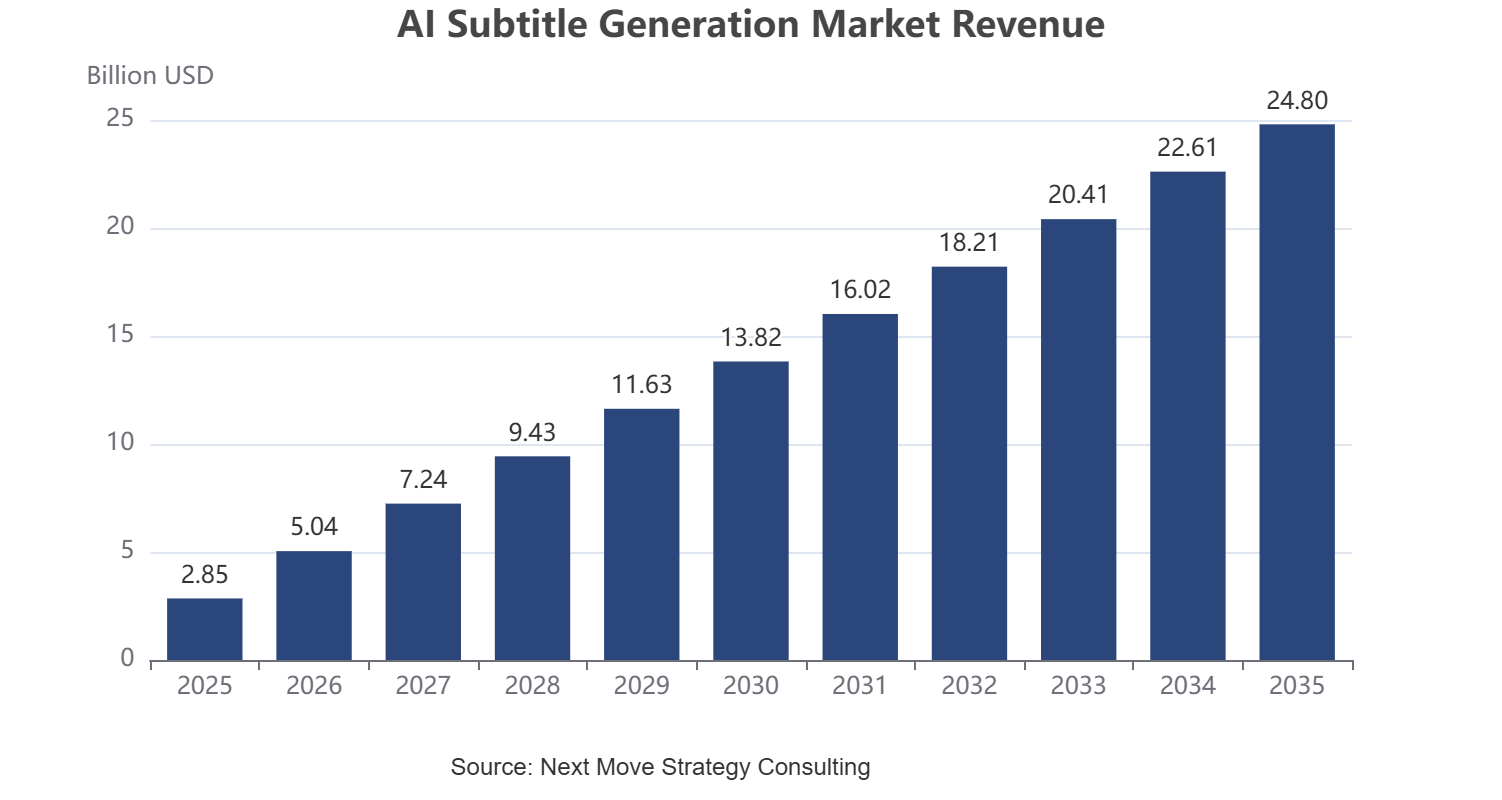
The global AI Subtitle Generation Market size was valued at USD 2.85 Billion in 2025 and is estimated at USD 3.62 Billion in 2026, forecast to reach USD 24.80 Billion by 2035, expanding at a 23.8% CAGR between 2026 and 2035. North America leads with approximately 38% share, while Cloud Speech API Systems dominate all other speech-to-text infrastructure types with approximately 58% share.
We observed that the growth is broad-based across every segmentation axis, with real-time streaming processing and translated subtitle output driving the dominant structural shifts through 2035.
|
Key Takeaways |
|
By Speech To Text Infrastructure: Cloud Speech API Systems held the largest share of approximately 58% (USD 1.65 Billion) in 2025; Embedded Speech Systems is the fastest-growing sub-segment at 24.8% CAGR from 2026–2035. |
|
By Subtitle Application Software: Creator SaaS Platforms held the largest share of approximately 44% (USD 1.25 Billion) in 2025; Creator SaaS Platforms is the fastest-growing sub-segment at 25.1% CAGR from 2026–2035. |
|
By Enterprise Speech Intelligence: Meeting Intelligence Systems held the largest share of approximately 40% (USD 1.14 Billion) in 2025; Knowledge Intelligence Systems is the fastest-growing sub-segment at 25.7% CAGR from 2026–2035. |
|
By Managed Caption Service: Automated Caption Services held the largest share of approximately 52% (USD 1.48 Billion) in 2025; Automated Caption Services is the fastest-growing sub-segment at 24.9% CAGR from 2026–2035. |
|
By Output Type: Timestamped Subtitle Output held the largest share of approximately 28% (USD 0.80 Billion) in 2025; Translated Subtitle Output is the fastest-growing sub-segment at 26.6% CAGR from 2026–2035. |
|
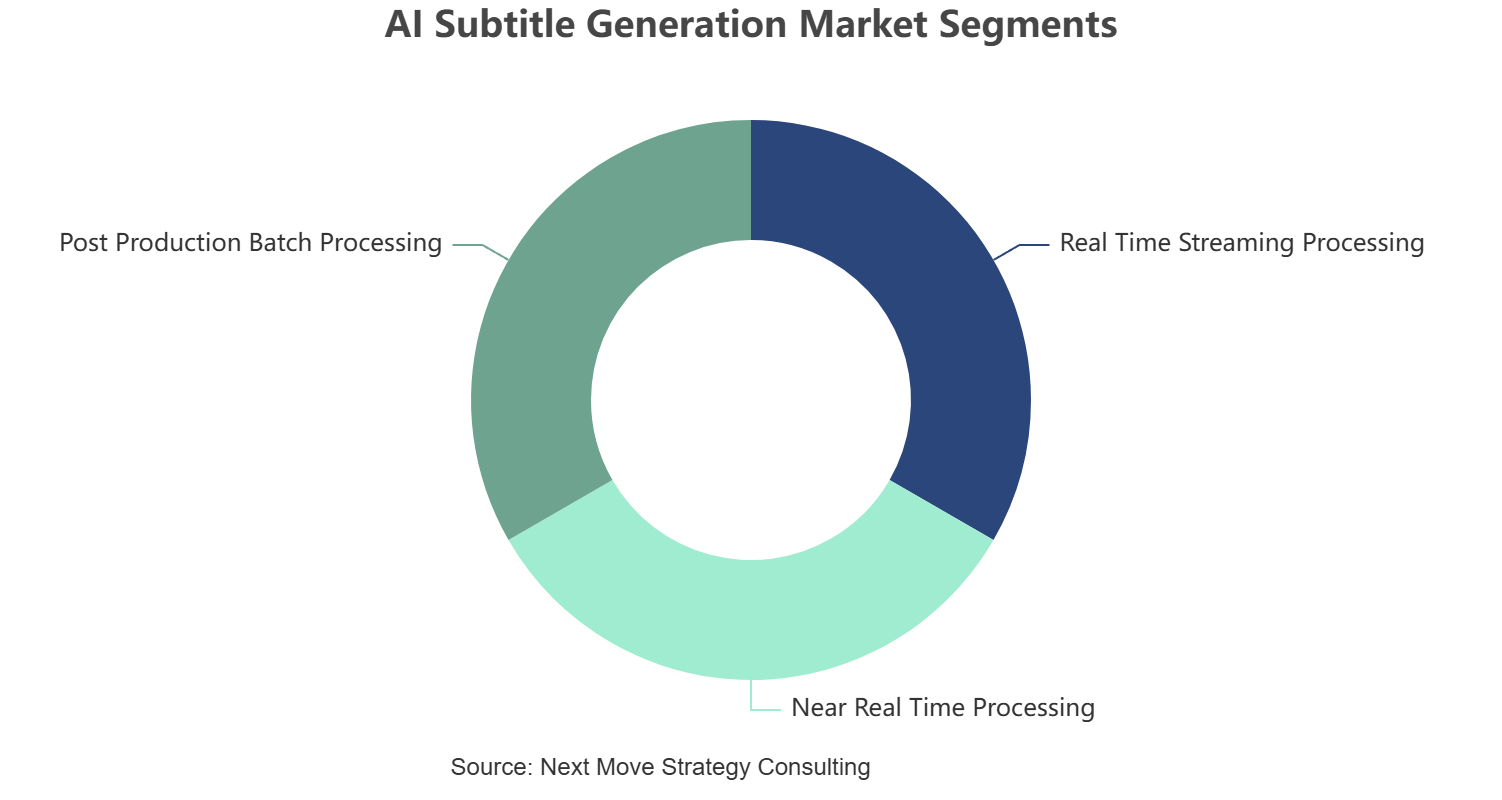
By Processing Mode: Real Time Streaming Processing held the largest share of approximately 39% (USD 1.11 Billion) in 2025; Real Time Streaming Processing is the fastest-growing sub-segment at 26.2% CAGR from 2026–2035. |
|
By Deployment Mode: Public Cloud API held the largest share of approximately 36% (USD 1.03 Billion) in 2025; On Device Embedded System is the fastest-growing sub-segment at 27.5% CAGR from 2026–2035. |
|
By Revenue Model: Subscription Based SaaS Licensing held the largest share of approximately 41% (USD 1.17 Billion) in 2025; Usage Based API Pricing is the fastest-growing sub-segment at 26.2% CAGR from 2026–2035. |
|
By End User: Individual Content Creators held the largest share of approximately 24% (USD 0.68 Billion) in 2025; Developers and Platform Builders is the fastest-growing sub-segment at 27.6% CAGR from 2026–2035. |
|
Dominant Region: North America dominated with approximately 38% revenue share (USD 1.09 Billion) in 2025. |
|
Fastest-Growing Region: Asia-Pacific is expected to register the highest CAGR of 27.0% during 2026–2035. |
|
Dominant Country: U.S. led with approximately USD 0.85 Billion in 2025. |
|
Fastest-Growing Country: India is the fastest-growing country at approximately 27.0% CAGR from 2026–2035. |
Market Opportunity: The AI subtitle generation market is expected to create an absolute dollar opportunity of USD 21.18 billion between 2026 and 2035, presenting significant investment potential across the enterprise communication, media localization, and creator-economy captioning value chain.
According to Next Move Strategy Consulting analysis, enterprise buyers are increasingly consolidating speech-to-text vendor relationships around unified cloud computing infrastructure to simplify multilingual compliance, a shift that favors diversified platform vendors over single-language specialists as accessibility regulation intensifies through 2035.
AI Subtitle Generation Market Overview
What Does the AI Subtitle Generation Market Encompass?
The AI subtitle generation market encompasses software and cloud infrastructure that automatically convert spoken audio into timestamped, styled, and translated on-screen text using automatic speech recognition and natural language models. Our assessment indicates that the scope spans cloud speech API systems, embedded on-device engines, creator SaaS caption editors, enterprise meeting intelligence platforms, and managed human-verified compliance services supplied to content creators, marketing teams, enterprise communication functions, and broadcast organizations across consumer, enterprise, and public-sector end markets.
The category has evolved from a niche broadcast accessibility tool into a mainstream content production layer, driven by short-video creator growth, remote-meeting adoption, and multilingual streaming demand worldwide. Regulatory frameworks such as the U.S. Federal Communications Commission's closed captioning rules and the European Union's Web Accessibility Directive shape compliance-grade caption formatting requirements, while national broadcast authorities increasingly influence localization standards. We observed that technology adoption is shifting toward real-time streaming transcription that replaces manual subtitling workflows to improve turnaround speed and multilingual reach.
|
Parameters |
Details |
|
Market Size in 2025 |
USD 2.85 Billion |
|
Market Size in 2026 |
USD 3.62 Billion |
|
Revenue Forecast in 2035 |
USD 24.80 Billion |
|
Growth Rate |
CAGR of 23.8% from 2026 to 2035 |
|
Analysis Period |
2025–2035 |
|
Base Year Considered |
2025 |
|
Forecast Period |
2026–2035 |
|
Market Size Estimation |
USD Billion |
|
Companies Profiled |
20 |
|
Countries Covered |
33 |
|
Market Share |
Available for Top 10 Companies |
Key Emerging Trends in the AI Subtitle Generation Market
Based on research conducted by Next Move Strategy Consulting, we found that four structural trends are reshaping product development, workflow integration, and stakeholder engagement across the industry.
How Is Real-Time Streaming Transcription Transforming Live Content Captioning?
Real-time streaming speech recognition is replacing delayed post-production subtitling for live broadcasts, webinars, and social livestreams. We observed that Microsoft Corporation's Azure AI Speech real-time transcription service expanded language coverage through 2025, enabling sub-second captioning latency for enterprise meeting platforms. Broadcasters and event platforms are adopting these architectures to satisfy live-accessibility mandates, while creator platforms retool ingestion pipelines to accommodate continuous, low-latency caption streams across livestream and video-conferencing applications.
Why Are Multilingual Localization Workflows Gaining Enterprise Adoption?
Multilingual subtitle translation is gaining share as global streaming platforms and enterprise communication teams respond to expanding international audiences. Our findings suggest that media localization teams increasingly specify automated first-pass translation paired with human quality review to reduce turnaround time. Companies such as Rev.com and Verbit are expanding localization service portfolios, positioning translated subtitle output as a premium, higher-margin category within the broader market segmentation structure.
How Is Short-Form Video Reshaping Caption Styling Requirements?
Social video platforms are pushing subtitle tools toward styled, animated, brand-consistent caption rendering rather than plain timestamped text. We observed that creator SaaS platforms increasingly bundle template-driven caption styling with automated speech recognition to serve individual content creators and SMB marketing teams. This trend is elevating demand for design-integrated caption tools among short-video and social commerce applications, while platform vendors redesign editors to minimize manual styling effort during rapid content turnaround cycles.
What Role Does On-Device Processing Play in Subtitle Generation Innovation?
On-device embedded speech recognition is emerging as a privacy-preserving response to cloud-latency and data-residency concerns. Our analysis shows that Apple Inc. and Alphabet Inc. are embedding on-device transcription engines within consumer operating systems to enable offline captioning without cloud dependency. This direction exemplifies growing demand for embedded SDK licensing among device manufacturers and privacy-sensitive enterprise communication teams seeking compliance-grade, locally processed transcript output.
Consumer Behavior Analysis of the AI Subtitle Generation Market
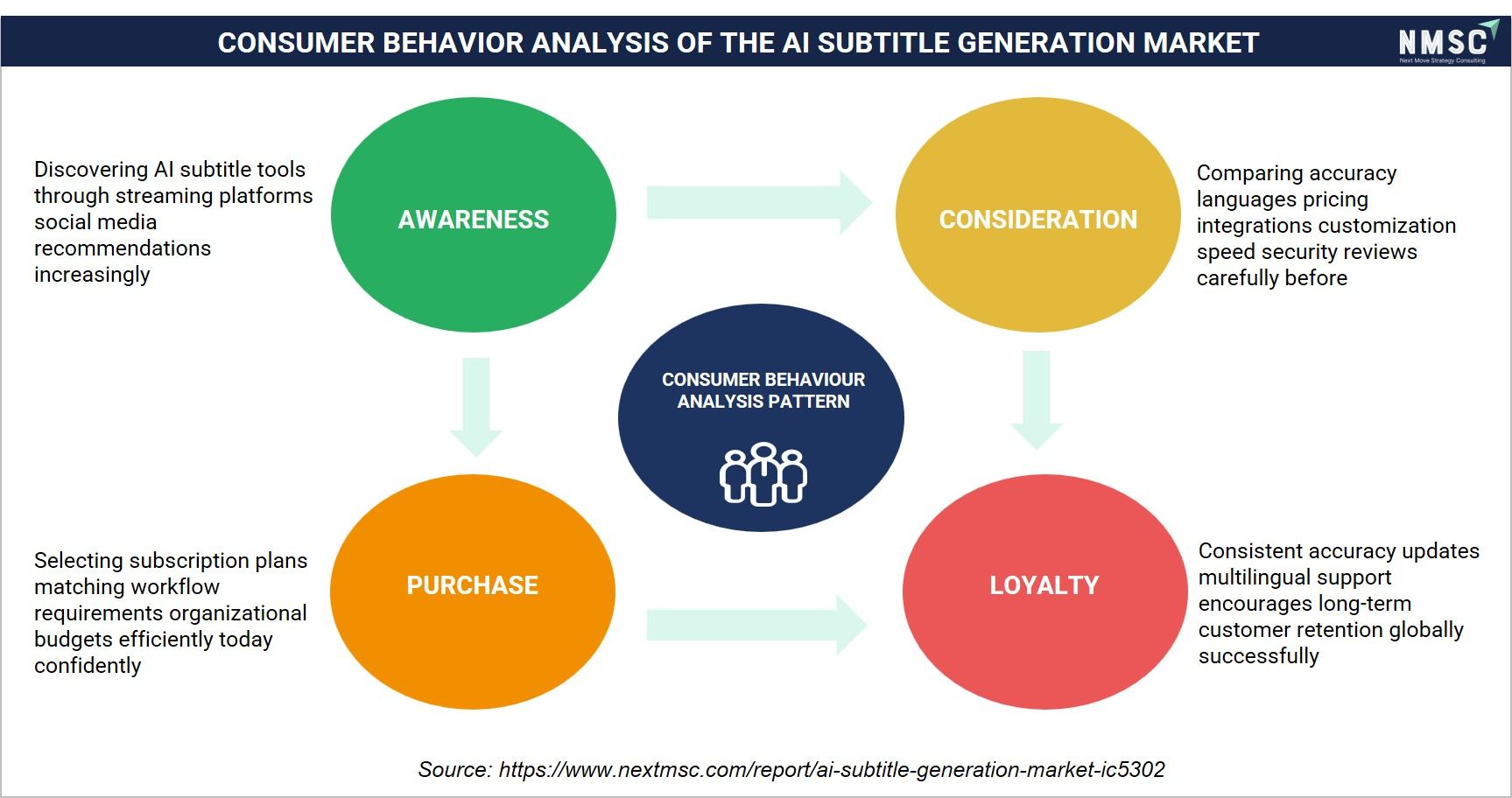
Our analysis indicates that buyers typically progress from awareness through digital content platforms and online recommendations to evaluating subtitle accuracy, multilingual capabilities, pricing, integration, security, and workflow compatibility before purchase. Long-term customer retention depends on consistent transcription quality, continuous AI model improvements, multilingual expansion, responsive support, and seamless platform integration that enhances user experience and operational efficiency.
Growth Drivers and Restraints
Growth Catalyst and Risk Assessment Matrix
|
Factors |
Type |
(+/−) % Impact on CAGR |
Geographic Relevance |
Impact Timeline |
|
Rising short-video creator economy adoption |
Driver |
+3.4% |
Global |
2026–2035 |
|
Enterprise remote-meeting and collaboration growth |
Driver |
+2.9% |
North America, Europe |
2026–2035 |
|
Accessibility and closed-captioning regulation |
Driver |
+2.2% |
North America, Europe |
2026–2035 |
|
Streaming platform multilingual localization demand |
Driver |
+3.1% |
Asia-Pacific, Latin America |
2026–2035 |
|
Advances in automatic speech recognition accuracy |
Driver |
+2.6% |
Global |
2026–2035 |
|
Expansion of API-based developer integration |
Driver |
+2.0% |
Global |
2026–2032 |
|
Data privacy and transcript-security concerns |
Restraint |
-1.5% |
North America, Europe |
2026–2035 |
|
Accuracy limitations for low-resource languages |
Restraint |
-1.1% |
Asia-Pacific, MEA |
2026–2032 |
|
Pricing pressure from bundled platform features |
Restraint |
-0.9% |
Global |
2028–2035 |
What Is the Primary Growth Driver of the AI Subtitle Generation Market?
Rising short-video creator economy activity following expanding social platform usage is the primary driver of the market. The U.S. Federal Communications Commission continues to enforce closed-captioning obligations for covered video programming, sustaining baseline institutional demand for compliant caption generation. We observed that this creator-driven behavioral shift, reinforced by platform monetization incentives, continues to anchor consumption of creator SaaS and design-integrated caption tools across developed and emerging economies alike.
How Is Enterprise Communication Growth Driving AI Subtitle Generation Market Growth?
Enterprise adoption of remote and hybrid meeting platforms is accelerating market growth toward meeting intelligence and transcript summarization systems. Microsoft Corporation's Teams and Alphabet Inc.'s Google Meet have expanded native live-captioning capabilities, pushing enterprise communication teams to specify integrated transcription. Our assessment indicates that this workplace-driven demand, combined with compliance logging requirements in regulated industries, is compressing adoption timelines for enterprise speech intelligence platforms across North America and Europe.
What Is Restraining AI Subtitle Generation Market Expansion?
Data privacy and transcript-security concerns tied to sensitive meeting and call content restrain enterprise adoption velocity across regulated sectors. The European Commission's data protection framework imposes strict processing conditions on voice-derived personal data, requiring vendors to demonstrate compliant handling. We found that smaller regional vendors face particular exposure, as limited compliance infrastructure reduces their ability to compete for large enterprise contracts compared with larger, platform-integrated technology providers.
Segmentation Analysis
Segment Sizing: By Speech To Text Infrastructure
|
Segment |
2025 (USD) |
2035 (USD) |
CAGR% (2026–2035) |
|
Cloud Speech API Systems |
USD 1.65 Billion |
USD 13.64 Billion |
23.1% |
|
Embedded Speech Systems |
USD 1.20 Billion |
USD 11.16 Billion |
24.8% |
|
Total |
USD 2.85 Billion |
USD 24.80 Billion |
23.8% |
Which Speech To Text Infrastructure Segment Dominates the AI Subtitle Generation Market?
Cloud Speech API Systems, encompassing real-time, batch, and multilingual recognition APIs, led the market with USD 1.65 billion in 2025, supported by elastic scalability and continuous model updates offered by hyperscale providers. We observed that Embedded Speech Systems are the fastest-growing infrastructure category, expanding at a 24.8% CAGR from 2026 to 2035, as on-device recognition engines gain traction across privacy-sensitive consumer and enterprise applications requiring offline processing capability.
Segment Sizing: By Subtitle Application Software
|
Segment |
2025 (USD) |
2035 (USD) |
CAGR% (2026–2035) |
|
Video Editing Software |
USD 0.97 Billion |
USD 7.44 Billion |
22.1% |
|
Creator SaaS Platforms |
USD 1.25 Billion |
USD 11.90 Billion |
25.1% |
|
Design Integrated Caption Tools |
USD 0.63 Billion |
USD 5.46 Billion |
23.8% |
|
Total |
USD 2.85 Billion |
USD 24.80 Billion |
23.8% |
Which Subtitle Application Software Segment Leads Market Demand?
Creator SaaS Platforms remained the leading application software category, valued at USD 1.25 billion in 2025 on sustained web-based caption editor adoption among independent creators and marketing teams. Our findings suggest that Creator SaaS Platforms also register the fastest growth among application software categories, expanding at a 25.1% CAGR from 2026 to 2035, as social video caption tools increasingly bundle automated styling with multilingual translation to serve expanding creator-economy workflows.
Segment Sizing: By End User
|
Segment |
2025 (USD) |
2035 (USD) |
CAGR% (2026–2035) |
|
Individual Content Creators |
USD 0.68 Billion |
USD 4.96 Billion |
21.5% |
|
SMB Marketing Teams |
USD 0.54 Billion |
USD 4.46 Billion |
23.0% |
|
Enterprise Communication Teams |
USD 0.60 Billion |
USD 5.70 Billion |
25.1% |
|
Media and Broadcast Organizations |
USD 0.48 Billion |
USD 3.97 Billion |
23.1% |
|
Developers and Platform Builders |
USD 0.37 Billion |
USD 4.22 Billion |
27.6% |
|
Public Sector Compliance Entities |
USD 0.18 Billion |
USD 1.49 Billion |
23.1% |
|
Total |
USD 2.85 Billion |
USD 24.80 Billion |
23.8% |
Which End User Segment Is Most Significant in the AI Subtitle Generation Market?
Individual Content Creators remained the largest end-user category, reaching USD 0.68 billion in 2025 due to widespread adoption of automated captioning across independent social video production. Based on research conducted by Next Move Strategy Consulting, we found that Developers and Platform Builders represent the fastest-growing end-user category at a 27.6% CAGR from 2026 to 2035, reflecting rising API-based integration of speech-to-text capability into third-party applications.
Growth Opportunities
Our analysis shows that three forward-looking opportunities stand out for stakeholders positioning within the AI subtitle generation market over the 2026–2035 forecast period.
How Can Real-Time Multilingual Captioning Unlock Value for Enterprise Communication Teams?
Real-time multilingual captioning presents a whitespace opportunity for enterprise communication teams seeking to support globally distributed workforces. Vendors that commercialize low-latency, multi-language live transcription stand to capture recurring seat-based licensing revenue as enterprises expand cross-border collaboration, particularly among knowledge-intensive organizations requiring searchable transcript repositories alongside live captioning capability.
Where Do Broadcast-Grade Compliance Services Create New Demand?
Broadcast and legal-record captioning represent an underpenetrated opportunity for human-verified compliance service providers engineered to regulatory formatting standards. Providers that develop validated, high-accuracy workflows for broadcast and legal-record use cases can secure long-term contracts with media and public-sector compliance entities, benefiting from recurring project-based revenue tied to accessibility and record-keeping mandates.
How Can Embedded SDK Licensing Benefit Device and Platform Builders?
Device manufacturers and platform builders seeking offline captioning capability create an opportunity for embedded speech recognition vendors offering licensable, on-device SDKs. Early movers that secure efficient, low-power recognition models can differentiate with consumer electronics and automotive platform builders pursuing privacy-preserving, connectivity-independent captioning features across their product portfolios.
Regional Outlook
Geographic Performance Snapshot
|
Region |
2025 (USD) |
2035 (USD) |
CAGR% (2026–2035) |
Key Driver |
|
North America |
USD 1.09 Billion |
USD 7.94 Billion |
21.5% |
Enterprise SaaS adoption and FCC/ADA-driven accessibility captioning mandates |
|
Europe |
USD 0.68 Billion |
USD 4.96 Billion |
21.5% |
EU Web Accessibility Directive and multilingual broadcast compliance requirements |
|
Asia-Pacific |
USD 0.77 Billion |
USD 8.43 Billion |
27.0% |
Expanding short-video creator economy and rising cloud speech API adoption |
|
Middle East & Africa |
USD 0.17 Billion |
USD 1.98 Billion |
27.7% |
Government digital media localization programs and media diversification initiatives |
|
Latin America |
USD 0.14 Billion |
USD 1.49 Billion |
26.5% |
Growing streaming platform penetration and creator-economy content localization demand |
|
Total |
USD 2.85 Billion |
USD 24.80 Billion |
23.8% |
— |
North America AI Subtitle Generation Market Outlook
North America leads the AI subtitle generation market with an established enterprise SaaS ecosystem and mature accessibility compliance infrastructure. We observed that Federal Communications Commission closed-captioning requirements sustain demand for compliance-grade caption tools, while enterprise communication teams increasingly specify integrated meeting-intelligence platforms. Technology adoption remains advanced, with cloud speech API consumption driving demand for scalable, multilingual transcription across the region's remote-work-heavy corporate sector.
Europe AI Subtitle Generation Market Outlook
Europe's AI subtitle generation market reflects a mature but regulation-intensive landscape shaped by the European Union's Web Accessibility Directive and data protection framework. Our findings suggest that organizations across Germany, France, and the UK are accelerating adoption of privacy-compliant, on-premises-capable transcription systems to satisfy stringent data-residency expectations, while broadcasters expand multilingual subtitle translation to serve the region's linguistically diverse audience base.
Asia-Pacific AI Subtitle Generation Market Outlook
Asia-Pacific is registering the fastest regional growth in the AI subtitle generation market, propelled by an expanding short-video creator economy and rising cloud infrastructure investment. We observed that ByteDance Ltd.'s platforms continue to embed automated captioning natively within short-video creation tools, accelerating consumer-side adoption. Regional technology adoption is advancing quickly, with creator SaaS platforms and embedded speech systems both gaining share across the region's mobile-first content ecosystem.
Middle East & Africa AI Subtitle Generation Market Outlook
The Middle East & Africa AI subtitle generation market is emerging, supported by government-led media localization programs and expanding digital broadcast infrastructure. Our assessment indicates that national broadcasters are adopting automated multilingual subtitle translation to serve linguistically diverse populations, while public-sector compliance entities gradually formalize captioning standards. Strategic outlook favors vendors offering Arabic and regional-language model accuracy alongside standard English-language recognition capability.
Latin America AI Subtitle Generation Market Outlook
Latin America's AI subtitle generation market is expanding on growing streaming platform penetration and creator-economy content localization demand. We found that regional media organizations increasingly specify Spanish and Portuguese multilingual translation to serve cross-border audiences within the streaming value chain. Technology adoption remains concentrated in creator SaaS platforms and managed localization services, with strategic outlook favoring vendors combining regional language accuracy with competitive subscription pricing.
U.S. AI Subtitle Generation Market Outlook
Based on our estimates, the U.S. reflects the region's most mature enterprise SaaS adoption, with meeting-intelligence and compliance captioning demand anchoring baseline consumption. Regulatory influence from FCC accessibility rules remains significant, while technology penetration is high across enterprise communication teams. Competitive intensity is elevated given concentrated hyperscale vendor presence, and strategic outlook favors providers embedding transcription within broader productivity suites. The country was valued at approximately USD 0.85 Billion in 2025 and is projected to reach USD 6.19 Billion by 2035, expanding at a 21.5% CAGR from 2026 to 2035.
Canada AI Subtitle Generation Market Outlook
The market in Canada shows steady enterprise and broadcast-driven demand structure, with bilingual English-French captioning requirements shaping localization workflows. Regulatory influence from national broadcast accessibility standards supports institutional adoption, while technology penetration continues to rise among SMB marketing teams. Competitive intensity remains moderate, and strategic outlook favors vendors offering strong bilingual translation accuracy. The country was valued at approximately USD 0.15 Billion in 2025 and is projected to reach USD 1.11 Billion by 2035, expanding at a 21.5% CAGR from 2026 to 2035.
UK AI Subtitle Generation Market Outlook
As per our estimate, the UK demonstrates a demand structure centered on broadcast compliance and enterprise communication adoption, reinforced by Ofcom accessibility expectations. Regulatory influence remains substantial, while technology penetration is advancing quickly among creator SaaS platform users. Competitive intensity is high given dense vendor presence, and strategic outlook favors providers with broadcast-grade human verification capability. The country was valued at approximately USD 0.16 Billion in 2025 and is projected to reach USD 1.19 Billion by 2035, expanding at a 21.5% CAGR from 2026 to 2035.
Germany AI Subtitle Generation Market Outlook
According to our analysis, Germany exhibits a demand structure shaped by stringent data protection expectations and strong enterprise manufacturing-sector communication needs. Regulatory influence from the European data protection framework is pronounced, while technology penetration continues to expand among enterprise speech intelligence adopters. Competitive intensity is moderate to high, and strategic outlook favors vendors demonstrating verifiable on-premises processing options. The country was valued at approximately USD 0.14 Billion in 2025 and is projected to reach USD 1.04 Billion by 2035, expanding at a 21.5% CAGR from 2026 to 2035.
France AI Subtitle Generation Market Outlook
Based on our estimates, France shows demand concentrated in media localization and public broadcast captioning, supported by national language-preservation policy. Regulatory influence from EU accessibility rules remains significant, while technology penetration is rising among enterprise and creator segments alike. Competitive intensity is moderate, and strategic outlook favors providers with strong French-language model accuracy. The country was valued at approximately USD 0.11 Billion in 2025 and is projected to reach USD 0.79 Billion by 2035, expanding at a 21.5% CAGR from 2026 to 2035.
China AI Subtitle Generation Market Outlook
The market in China leads Asia-Pacific with a demand structure dominated by short-video creator platforms and domestic cloud infrastructure. Regulatory influence from data-localization requirements shapes vendor deployment choices, while technology penetration is among the highest globally given mobile-first content consumption. Competitive intensity is intense given strong domestic platform presence, and strategic outlook favors vendors with compliant in-country cloud hosting. The country was valued at approximately USD 0.26 Billion in 2025 and is projected to reach USD 2.87 Billion by 2035, expanding at a 27.0% CAGR from 2026 to 2035.
India AI Subtitle Generation Market Outlook
As per our estimate, India is the fastest-growing country market, with demand structure driven by expanding creator-economy platforms and enterprise outsourcing communication needs. Regulatory influence remains developing, while technology penetration is accelerating rapidly among SMB marketing teams. Competitive intensity is rising as global vendors expand local-language model support, and strategic outlook favors providers with strong multilingual Indian-language accuracy. The country was valued at approximately USD 0.15 Billion in 2025 and is projected to reach USD 1.60 Billion by 2035, expanding at a 27.0% CAGR from 2026 to 2035.
Japan AI Subtitle Generation Market Outlook
According to our analysis, Japan shows a demand structure anchored in broadcast compliance and enterprise meeting-intelligence adoption. Regulatory influence from national broadcast standards remains moderate, while technology penetration is advancing steadily among enterprise communication teams. Competitive intensity is moderate given strong domestic technology vendor presence, and strategic outlook favors providers with precise Japanese-language recognition accuracy. The country was valued at approximately USD 0.12 Billion in 2025 and is projected to reach USD 1.35 Billion by 2035, expanding at a 27.0% CAGR from 2026 to 2035.
South Korea AI Subtitle Generation Market Outlook
Based on our estimates, South Korea demonstrates a demand structure shaped by strong streaming platform and creator-economy adoption. Regulatory influence remains limited, while technology penetration is high given advanced digital infrastructure. Competitive intensity is elevated given dense domestic technology competition, and strategic outlook favors vendors integrating tightly with regional streaming and social platforms. The country was valued at approximately USD 0.09 Billion in 2025 and is projected to reach USD 0.93 Billion by 2035, expanding at a 27.0% CAGR from 2026 to 2035.
Australia AI Subtitle Generation Market Outlook
The market in Australia shows a demand structure combining broadcast accessibility compliance with growing enterprise SaaS adoption. Regulatory influence from national accessibility standards remains steady, while technology penetration continues to expand among creator and enterprise segments. Competitive intensity is moderate, and strategic outlook favors providers offering strong English-language accuracy with regional support infrastructure. The country was valued at approximately USD 0.05 Billion in 2025 and is projected to reach USD 0.59 Billion by 2035, expanding at a 27.0% CAGR from 2026 to 2035.
UAE AI Subtitle Generation Market Outlook
As per our estimate, the UAE reflects a demand structure driven by government digital media initiatives and expanding enterprise communication adoption. Regulatory influence from national media diversification programs is increasingly significant, while technology penetration is rising quickly among public and private sector organizations. Competitive intensity remains moderate, and strategic outlook favors vendors offering strong Arabic-language recognition capability. The country was valued at approximately USD 0.04 Billion in 2025 and is projected to reach USD 0.44 Billion by 2035, expanding at a 27.7% CAGR from 2026 to 2035.
Saudi Arabia AI Subtitle Generation Market Outlook
According to our analysis, Saudi Arabia shows demand structure shaped by Vision 2030-linked digital media expansion and government localization initiatives. Regulatory influence from national broadcast authorities is growing, while technology penetration is accelerating among public-sector compliance entities. Competitive intensity remains moderate, and strategic outlook favors providers with validated Arabic-language transcription accuracy. The country was valued at approximately USD 0.03 Billion in 2025 and is projected to reach USD 0.40 Billion by 2035, expanding at a 27.7% CAGR from 2026 to 2035.
South Africa AI Subtitle Generation Market Outlook
Based on our estimates, South Africa demonstrates an emerging demand structure centered on broadcast and enterprise communication adoption. Regulatory influence from national broadcasting standards remains developing, while technology penetration is gradually rising among enterprise communication teams. Competitive intensity is limited given fewer regional specialist vendors, and strategic outlook favors providers offering multilingual African-language support. The country was valued at approximately USD 0.02 Billion in 2025 and is projected to reach USD 0.24 Billion by 2035, expanding at a 27.7% CAGR from 2026 to 2035.
Brazil AI Subtitle Generation Market Outlook
The market in Brazil leads Latin America with a demand structure driven by streaming platform expansion and creator-economy content localization. Regulatory influence remains developing, while technology penetration is rising steadily among SMB marketing teams and media organizations. Competitive intensity is moderate, and strategic outlook favors vendors with strong Portuguese-language model accuracy. The country was valued at approximately USD 0.06 Billion in 2025 and is projected to reach USD 0.69 Billion by 2035, expanding at a 26.5% CAGR from 2026 to 2035.
Argentina AI Subtitle Generation Market Outlook
As per our estimate, Argentina shows a demand structure shaped by growing creator-economy and enterprise communication adoption. Regulatory influence remains limited, while technology penetration continues to expand among independent content creators. Competitive intensity is moderate, and strategic outlook favors providers offering competitively priced Spanish-language subscription plans. The country was valued at approximately USD 0.03 Billion in 2025 and is projected to reach USD 0.28 Billion by 2035, expanding at a 26.5% CAGR from 2026 to 2035.
SWOT Analysis of the AI Subtitle Generation Market
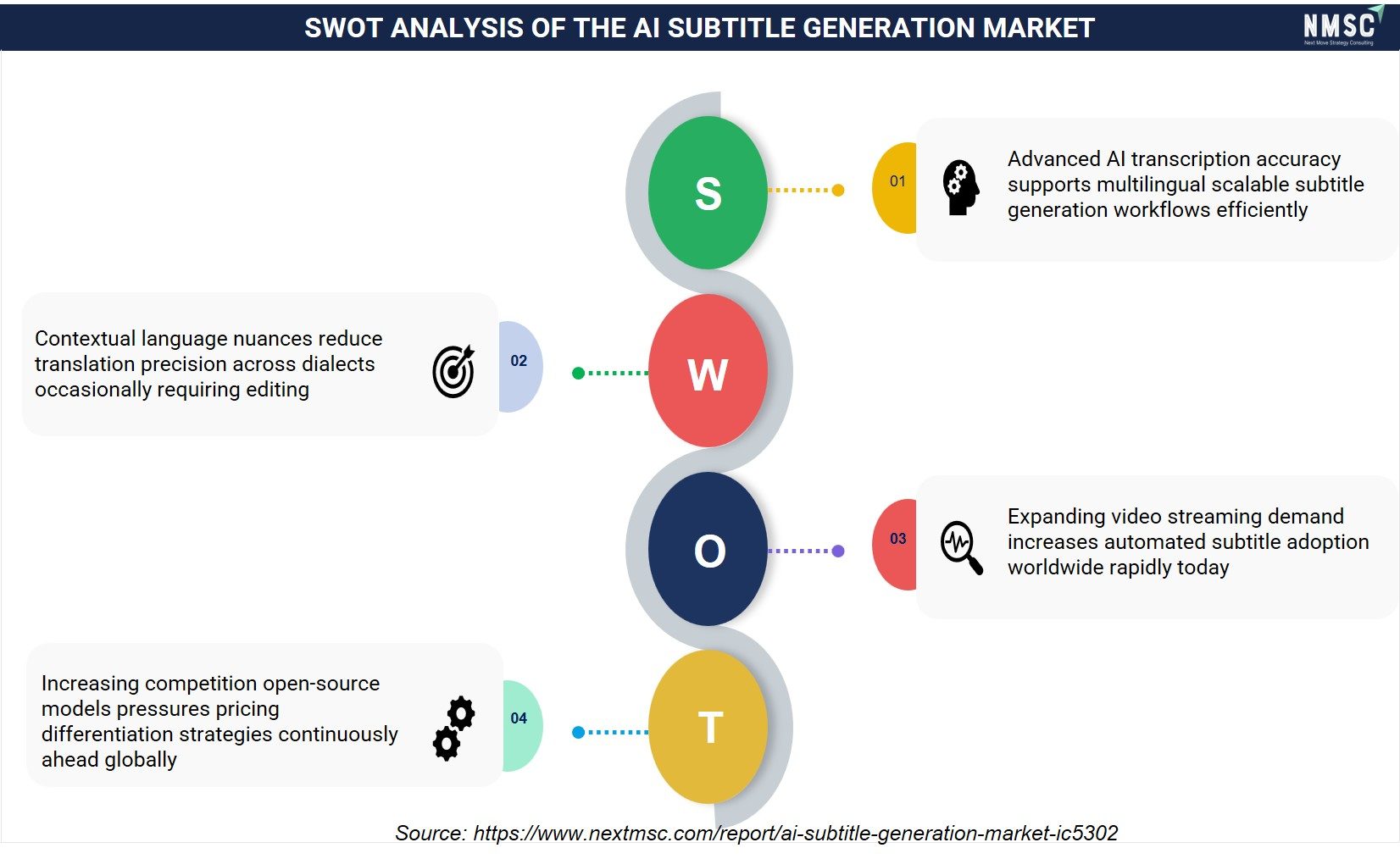
Our findings suggest that advanced AI transcription accuracy and scalable multilingual subtitle generation strengthen market growth and enterprise adoption. However, contextual language nuances and regional dialects continue to affect translation precision, increasing post-editing requirements. Expanding global video streaming, digital media production, and multilingual content distribution create substantial growth opportunities, while rising competition from open-source AI models intensifies pricing pressure and product differentiation challenges.
Competitive Landscape
Our analysis shows that the AI subtitle generation market features a mix of hyperscale technology platforms and specialized captioning software vendors competing across accuracy, integration depth, and language coverage.
|
Category |
Details |
|
Market Structure |
Moderately fragmented, combining hyperscale cloud speech providers with specialized creator-focused and enterprise-focused captioning software vendors |
|
Innovation Focus |
Real-time multilingual accuracy, on-device recognition efficiency, and styled caption automation for social video formats |
|
M&A Activity |
Selective acquisitions of language-model and localization specialists by larger platform vendors to expand language coverage |
How Do Companies Compete Within the AI Subtitle Generation Industry?
Companies compete primarily on transcription accuracy, language coverage, and integration depth with existing content production and communication workflows. Our assessment indicates that hyperscale providers such as Microsoft Corporation and Alphabet Inc. leverage broad cloud ecosystem integration, while specialized vendors like AssemblyAI and Deepgram compete on developer-friendly API accuracy and pricing flexibility within the enterprise speech intelligence segment of the industry.
Which Competitive Archetypes Dominate the AI Subtitle Generation Market?
Two competitive archetypes dominate the market: platform-embedded hyperscale providers offering bundled captioning within broader productivity suites, and standalone specialist vendors such as Descript and VEED differentiating through creator-focused editing experience. We observed that this bifurcation reflects distinct customer priorities, with enterprises favoring integrated bundling and independent creators favoring dedicated, feature-rich editing platforms.
What Innovation and Differentiation Strategies Define Market Leaders?
Market leaders differentiate through proprietary language model accuracy, low-latency real-time processing, and styled caption template libraries tailored to social video formats. Our findings suggest that companies including Otter.ai and Sonix are investing in searchable transcript repository features to extend their value proposition beyond basic captioning into broader knowledge intelligence and enterprise search use cases.
What M&A Activity Is Shaping the AI Subtitle Generation Industry?
Mergers and acquisitions within the industry have concentrated on language-model and localization capability, as larger platform vendors seek to expand multilingual coverage without building models internally. We found that this consolidation trend favors specialized localization service providers such as Happy Scribe and Trint, which possess verified multilingual accuracy assets attractive to acquirers seeking rapid language-portfolio expansion.
Key Market Players
Based on research conducted by Next Move Strategy Consulting, the following companies represent the validated set of key players actively shaping the AI subtitle generation market.
-
Alphabet Inc.
-
Microsoft Corporation
-
Amazon Web Services, Inc.
-
Adobe Inc.
-
Apple Inc.
-
Meta Platforms, Inc.
-
ByteDance Ltd.
-
Rev.com, Inc.
-
Verbit Inc.
-
Deepgram, Inc.
-
Cantab Research Limited (trading as Speechmatics)
-
Otter.ai, Inc.
-
Descript, Inc.
-
VEED Limited
-
Kapwing, Inc.
-
Sonix, Inc.
-
Happy Scribe S.L.
Latest Developments
We observed several notable developments across the industry during 2025 and 2026 that reflect the market's rapid product and partnership evolution.
|
Date |
Event |
|
April 2026 |
Deepgram announced the general availability of Flux Multilingual, the first real-time conversational speech recognition model supporting 10 languages. The model enables dynamic, mid-conversation language switching with sub-400 millisecond response times and monolingual-grade accuracy for voice agents |
|
January 2026 |
Speechmatics reported a 4x year-over-year surge in real-time streaming usage, driven by voice agents and broadcasting. The company expanded its on-device deployment capabilities to run locally on low-to-mid specification laptops while achieving accuracy within 10% of server-grade models, alongside supporting real-time streaming architectures across 55+ languages with latencies under 250ms. |
|
April 2025 |
AssemblyAI introduced Slam-1, its prompt-based Speech Language Model designed to combine large language model reasoning with audio processing. The model allows developers to optimize transcription accuracy for industry-specific terminology through text prompts without requiring custom model development. |
Expert Insights
 "At the same time we have automatic translation working to translate the subtitles to your own language. What's important is that this is running on your machine locally, offline, without any cloud services. It runs directly inside the executable."
— Jean-Baptiste Kempf, President, VideoLAN
Statement made during CES 2025, where VideoLAN showcased VLC Media Player's AI-powered automatic subtitle generation and real-time translation running entirely on-device without cloud services.
Market Interpretation
Jean-Baptiste Kempf's statement highlights a significant technological advancement in the AI Subtitle Generation Market, where subtitle creation and multilingual translation are increasingly performed in real time using on-device AI rather than cloud-based processing. Local execution improves privacy, reduces latency, eliminates internet dependency, and lowers operational costs, making AI subtitle generation more suitable for enterprise media workflows, education, broadcasting, and content localization. As demand for multilingual video content continues to expand, offline AI subtitle generation is expected to become an important differentiator for media software providers.
Investment Opportunities
What Capital Inflows Are Shaping the AI Subtitle Generation Market?
Venture and strategic capital continue flowing toward specialized speech-to-text vendors such as AssemblyAI and Deepgram, reflecting investor confidence in developer-focused API monetization models. We observed that funding activity concentrates on companies demonstrating differentiated accuracy benchmarks and expanding enterprise contract pipelines, positioning well-capitalized specialists to compete against hyperscale bundled offerings over the 2026–2035 forecast period.
How Significant Is Infrastructure Investment in This Market?
Cloud infrastructure investment underpins scalable real-time transcription delivery, with hyperscale providers continuing to expand global data center capacity supporting speech-processing workloads. Our assessment indicates that infrastructure investment increasingly prioritizes edge-computing capability to support on-device embedded systems, reducing latency and supporting privacy-sensitive deployment models favored by enterprise and public-sector compliance entities.
What ESG Considerations Are Relevant to This Market?
Environmental, social, and governance considerations within the market center on accessibility inclusion and energy-efficient model design. We found that captioning technology directly advances social accessibility goals by improving content access for deaf and hard-of-hearing audiences, while vendors face growing governance expectations around transparent data handling of voice-derived personal information under frameworks such as the European Union's data protection regulation.
Key Benefits for Stakeholders
How Does This Report Benefit Enterprise and Industry Leaders?
Enterprise and industry leaders gain access to validated segmentation, competitive benchmarking, and regional demand analysis that support vendor selection and internal build-versus-buy technology decisions. Next Move Strategy Consulting's analysis indicates that this report's forecasts and structural insights help communication and IT leaders prioritize investment across meeting intelligence, compliance captioning, and knowledge-management use cases through 2035.
How Does This Report Benefit Investors and Financial Analysts?
Investors and financial analysts benefit from consolidated market-sizing data, growth-driver quantification, and competitive-landscape mapping that inform capital-allocation decisions across the speech-to-text and captioning technology value chain. Our analysis shows that the report's regional and segment-level CAGR breakdowns support comparative evaluation of specialist vendors against diversified hyperscale platform competitors.
How Does This Report Benefit Technology Vendors and Product Teams?
Technology vendors and product teams gain a structured view of segmentation, emerging trends, and whitespace growth opportunities that inform roadmap prioritization across real-time processing, multilingual translation, and embedded deployment capability. We observed that the report's competitive archetype analysis helps product teams position differentiated offerings against both hyperscale and specialist competitors within the AI subtitle generation market.
Key Market Segments
By Speech To Text Infrastructure
-
Cloud Speech API Systems
-
Real-Time Speech Recognition APIs
-
Batch Speech Recognition APIs
-
Multilingual Speech Models
-
-
Embedded Speech Systems
-
On Device Speech Recognition Engines
-
Embedded SDK Licensing Systems
-
By Subtitle Application Software
-
Video Editing Software
-
Timeline-Based Subtitle Generation
-
Automated Caption Rendering Tools
-
-
Creator SaaS Platforms
-
Web-Based Subtitle Editors
-
Social Video Caption Tools
-
-
Design Integrated Caption Tools
-
Template-Driven Subtitle Systems
-
Brand Style Caption Export Tools
-
By Enterprise Speech Intelligence
-
Meeting Intelligence Systems
-
Live Meeting Captioning
-
Transcript Summarization Outputs
-
-
Contact Center Speech Systems
-
Call Transcription Outputs
-
Compliance Logging Captions
-
-
Knowledge Intelligence Systems
-
Searchable Transcript Repositories
-
Internal Communication Captioning
-
By Managed Caption Service
-
Automated Caption Services
-
AI First Pass Transcription
-
Machine-Assisted Editing Workflows
-
-
Human Verified Compliance Services
-
Broadcast Standard Formatting
-
Legal Record Captioning Workflows
-
-
Localization Services
-
Multilingual Subtitle Translation
-
Regional Adaptation Workflows
-
By Output Type
-
Raw Speech Transcript Output
-
Timestamped Subtitle Output
-
Translated Subtitle Output
-
Styled Visual Caption Output
-
Compliance Certified Caption Output
By Processing Mode
-
Real Time Streaming Processing
-
Near Real Time Processing
-
Post Production Batch Processing
By Deployment Mode
-
Public Cloud API
-
SaaS Application
-
Desktop Application
-
On Device Embedded System
-
Private Enterprise Deployment
By Revenue Model
-
Subscription Based SaaS Licensing
-
Usage Based API Pricing
-
Seat Based Enterprise Licensing
-
Bundled Platform Feature Allocation
-
Managed Service Contracts
By End User
-
Individual Content Creators
-
SMB Marketing Teams
-
Enterprise Communication Teams
-
Media and Broadcast Organizations
-
Developers and Platform Builders
-
Public Sector Compliance Entities
By Region
-
North America: U.S., Canada, Mexico.
-
Europe: UK, Germany, France, Italy, Spain, Sweden, Denmark, Finland, Netherlands, Rest of Europe.
-
Asia-Pacific: China, India, Japan, South Korea, Taiwan, Indonesia, Vietnam,Australia, Philippines, Malaysia, Rest of APAC.
-
Middle East & Africa: Saudi Arabia, UAE, Egypt, Israel, Turkey, Nigeria, South Africa, Rest of MEA.
-
Latin America: Brazil, Argentina, Chile, Colombia, Rest of LATAM.
Conclusion and Recommendations
What Is the Long-Term Outlook for the AI Subtitle Generation Market?
The long-term outlook for the AI subtitle generation market remains strongly positive, supported by a projected expansion from USD 3.62 Billion in 2026 to USD 24.80 Billion by 2035 at a 23.8% CAGR. Next Move Strategy Consulting's analysis indicates that sustained creator-economy growth, enterprise communication digitization, and multilingual streaming demand will continue anchoring long-term revenue expansion across both consumer and enterprise segments through the forecast period.
What Strategic Positioning Should Stakeholders Pursue?
Vendors should prioritize real-time multilingual processing capability while pursuing deep integration with existing content-production and communication ecosystems to secure long-term customer relationships. Our assessment indicates that companies investing early in embedded on-device recognition and enterprise compliance-grade formatting will be best positioned to capture premium pricing within the AI subtitle generation market.
How Attractive Is the AI Subtitle Generation Market for New Investment?
The AI subtitle generation industry presents an attractive investment case, supported by a USD 21.18 billion absolute dollar opportunity between 2026 and 2035 and above-average growth in Asia-Pacific and on-device embedded categories. We found that investment attractiveness is highest for vendors combining proprietary accuracy advantages with scaled cloud infrastructure, positioning them to serve both cost-sensitive creator and premium enterprise segments simultaneously.
What Market Shifts and Key Risks Should Stakeholders Monitor?
Stakeholders should monitor data-privacy regulatory tightening, accuracy limitations for low-resource languages, and competitive pricing pressure from bundled platform features as key risks to the AI subtitle generation market. Our analysis shows that vendors unable to demonstrate compliant data handling risk losing enterprise contracts to competitors with certified privacy-preserving processing architectures, particularly within Europe's increasingly regulated data environment.
What Are the Key Growth Pathways for the AI Subtitle Generation Market?
Key growth pathways include expanding real-time multilingual processing portfolios, scaling embedded on-device recognition capability, and deepening penetration into enterprise knowledge-intelligence and compliance use cases. Next Move Strategy Consulting's analysis indicates that vendors pursuing these pathways while maintaining pricing competitiveness in creator SaaS categories will be best positioned to capture the AI subtitle generation market's projected growth through 2035.
About the Author
 Saista Faiyaz
— Saista Faiyaz is Research Associate at Next Move Strategy Consulting, where she has covered consumer markets and healthcare technologies for 3 years. Her work includes primary interview review, secondary-source validation, market sizing, and structured analysis of company and industry data. She supports research by comparing evidence across sources, organizing findings into market narratives, and documenting assumptions used in analysis. Her scope includes cross-market benchmarking, and reports.
Saista Faiyaz
— Saista Faiyaz is Research Associate at Next Move Strategy Consulting, where she has covered consumer markets and healthcare technologies for 3 years. Her work includes primary interview review, secondary-source validation, market sizing, and structured analysis of company and industry data. She supports research by comparing evidence across sources, organizing findings into market narratives, and documenting assumptions used in analysis. Her scope includes cross-market benchmarking, and reports.
About the Reviewer
 Supradip Baul
— Supradip Baul is an accomplished business consultant and strategist with over a decade of rich experience in market intelligence, strategy, technology, and business transformation. His work has included rigorous qualitative and quantitative analysis across multiple industries, helping clients shape investment decisions and long-term roadmaps. Earlier in his career, he was associated with Gartner, where he contributed to industry-leading reports and market share analyses. He has worked with leading global companies and holds an MBA with a dual specialization in Marketing and Finance.
Supradip Baul
— Supradip Baul is an accomplished business consultant and strategist with over a decade of rich experience in market intelligence, strategy, technology, and business transformation. His work has included rigorous qualitative and quantitative analysis across multiple industries, helping clients shape investment decisions and long-term roadmaps. Earlier in his career, he was associated with Gartner, where he contributed to industry-leading reports and market share analyses. He has worked with leading global companies and holds an MBA with a dual specialization in Marketing and Finance.
At Next Move Strategy Consulting, we understand that insightful market research is the cornerstone of successful business decisions. That's why we employ a robust and multifaceted approach, combining various methodologies to deliver the most accurate and actionable data for our clients.

Research Landscape
We navigate the world of research with two primary approaches:
Qualitative Approach
Our qualitative research methodologies involve immersive techniques such as in-depth interviews, focus groups, and observational studies. By engaging directly with individuals and stakeholders, we uncover valuable insights that quantitative data alone may overlook.

Quantitative Research
In tandem with qualitative methodologies, NMSC leverages the power of Quantitative Research to provide a robust foundation of numerical insights. Through systematic data collection and analysis, we quantify patterns, preferences, and market trends, offering a comprehensive view of the business landscape.
Our quantitative research approach employs diverse tools, including surveys, experiments, and statistical modelling. These methodologies enable us to gather data from a large and representative sample, ensuring the statistical significance of our findings. By employing structured questionnaires and standardized data collection methods, we guarantee the reliability and validity of the information we present to our clients.
Quantitative research is particularly effective in measuring the prevalence of trends, assessing market size, and gauging the impact of various factors on consumer behavior. The numerical precision attained through this approach equips our clients with actionable insights, facilitating data-driven decision-making and strategy formulation.


Our Specialized Toolbox for Industry-Specific Market Research
We deploy a specialized arsenal of techniques tailored to meet your unique requirements. Here's a glimpse into our comprehensive toolbox:

Information Procurement
The stage entails acquiring market data or relevant information through various sources and methodologies.


Market Research Approach
We utilize both top-down and bottom-up approaches in market research analysis to achieve a comprehensive understanding of the market dynamics, leveraging the broad perspective of industry trends and macroeconomic factors alongside detailed insights from specific segments and individual companies.

Porters Five Forces Analysis
We conduct Porter's Five Forces analysis to evaluate the competitive landscape of an industry, providing us with insights into factors that affect profitability and strategic positioning.

SWOT Analysis

Forecasting
We utilize a forecasting model to predict future consumption by considering parameters like population, economics, regulations, market competition, drivers, constraints, technology, and pricing. We also employ statistical techniques such as multilinear regression, exponential smoothing, moving average, ARIMA, and Monte Carlo simulations for accurate predictions. In econometric forecasting, we analyzed short-term and long-term event impacts, attributing values based on regulatory frameworks, economic factors, and market events.





 Speak to Our Analyst