Nigeria Aluminum Market By Type (Primary, Secondary, Scrap), By Product Type (Flat-Rolled, Casting, Extrusions, Forgings, Powder & Paste, Billets, Wire Rods, Foundry Alloys, Aluminum Silicon Alloy, Others), By Alloy Series (1xxx–7xxx), By Distribution Channel (OEM Direct, Distributors, Aftermarket, E-commerce, Scrap Traders), By End User (Transportation, Consumer Goods, Machinery & Equipment, Construction, Packaging, Electrical Engineering, Others) – Analysis & Forecast, 2025–2035
Industry: Materials and Chemical | Latest Edition: September 30, 2026 | No of Pages: 245 | No. of Tables: 122 | No. of Figures: 112 | Format: PDF | Report Code: MC4651
Nigeria Aluminum Market Size & Forecast
|
Parameters |
Details |
|
Market Size in 2026 |
USD 797.40 Million |
|
Revenue Forecast in 2035 |
USD 1161.49 Million |
|
Growth Rate |
CAGR of 4.27% from 2026 to 2035 |
|
Market Volume in 2026 |
356.86 Kilotons |
|
Volume Forecast in 2035 |
473.11 Kilotons |
|
Growth Rate |
CAGR of 3.18% from 2026 to 2035 |
|
Analysis Period |
2025–2035 |
|
Base Year Considered |
2025 |
|
Forecast Period |
2026–2035 |
|
Market Size Estimation |
Million |
|
Companies Profiled |
15 |
|
Market Share |
Available for 10 companies |
Industry Outlook
The Nigeria Aluminum Market size was valued at USD 711.02 million in 2025 and is expected to reach USD 797.40 million by 2026. Looking ahead, the industry is projected to expand significantly, reaching USD 1161.49 million by 2035, registering a CAGR of 4.27% from 2026 to 2035. In terms of volume, the market recorded 320 Kilotons in 2025, with forecasts indicating growth to 356.86 Kilotons by 2026 and further to 473.11 Kilotons by 2035, reflecting a CAGR of 3.18% over the same period.
What Are the Key Market Drivers, Breakthroughs, and Investment Opportunities That Will Shape the Aluminum Industry in the Next Decade?
Growth Catalyst & Risk Assessment Matrix
|
DRIVERS / TRENDS / RESTRAINTS |
(+/–) % IMPACT ON CAGR FORECAST |
GEOGRAPHIC RELEVANCE |
IMPACT TIMELINE |
|
Urbanization and infrastructure expansion driving construction-grade aluminium demand |
+1.9% |
Lagos, Abuja, Port Harcourt, Kano, nationwide urban corridors |
Short to medium term (1–3 years) |
|
Packaging and consumer goods growth increasing demand for cans, foils, and containers |
+1.6% |
Lagos, Ibadan, Abuja, Onitsha, nationwide FMCG hubs |
Short to medium term (1–4 years) |
|
Industrial diversification expanding aluminium use across automotive, electrical, and machinery sectors |
+1.5% |
Lagos industrial zones, Ogun, Kano, Port Harcourt clusters |
Medium term (2–5 years) |
|
Logistics inefficiencies and policy uncertainty constraining supply chain efficiency and investment |
-1.9% |
Nationwide ports, inland logistics corridors, industrial hubs |
Short to medium term (1–3 years) |
|
Recycling and remelting capacity expansion improving domestic supply and reducing import dependence |
+1.8% |
Lagos, Ogun industrial zones, nationwide scrap collection networks |
Medium to long term (2–6 years) |
Our analysis indicates that the Nigeria aluminum market is being supported by accelerating urbanisation, infrastructure expansion, and rising consumer demand for packaged goods, which together are increasing the offtake for profiles, roofing systems, cans, closures, foils, and fabricated products. Industrial diversification into machinery, electrical equipment, automotive components, furniture, and renewable energy frames is also widening the application scope. Additionally, evolving supply chains linked to construction and manufacturing are encouraging stronger downstream processing activity and broader domestic consumption patterns.
Structural challenges, including weak logistics networks, power instability, import dependence, and policy uncertainty, continue to affect operating efficiency, investment planning, and margin stability across producers and fabricators. However, our assessment confirms that recycling systems, remelt capacity, alumina refining initiatives, and modernisation of ageing assets offer a pathway toward stronger local feedstock availability and reduced external exposure. Furthermore, deeper value-chain integration can improve supply resilience, strengthen competitiveness, and support long-term industrial expansion in the market.
Growth Drivers:
How Are Urbanization and Large Infrastructure Projects Driving Raw Material Demand in the Aluminum Market?
Our analysis indicates that accelerated urban migration is expanding demand for residential towers, transport terminals, warehouses, and utility networks that increasingly specify lightweight, corrosion-resistant materials. Aluminum profiles, roofing sheets, window systems, and structural components benefit as developers seek faster installation and lower lifecycle maintenance. Moreover, public investments in roads, bridges, rail links, and power assets deepen procurement pipelines for fabricators and converters. This dynamic continues to strengthen the Nigerian aluminum market through broad-based construction pull.
How Are Growing Packaging and Consumer Goods Sectors Driving Increase Aluminum Demand Use Across Nigeria?
Our review of the data suggests that rising consumption of beverages, personal care items, processed foods, and household products is supporting stronger offtake for cans, closures, foils, and containers. Manufacturers value aluminium for barrier protection, shelf appeal, recyclability, and compatibility with automated filling lines. In addition, brand owners increasingly prioritize durable packaging formats that preserve product quality across long distribution routes. These commercial shifts are reinforcing the Nigeria aluminum market across packaging conversion and downstream manufacturing channels.
How Is Industrial Diversification Supporting Broader Aluminum Applications Across Sectors?
Nigeria’s expanding industrial base is widening aluminium demand beyond construction and packaging into automotive components, electrical systems, machinery housings, furniture, and renewable energy frames. Producers favor aluminium where weight reduction, conductivity, and fabrication flexibility improve operating efficiency and product performance. Furthermore, our observation highlights that import substitution policies encourage local assembly activities that consume semi-finished metal inputs. As manufacturing capabilities mature, the market gains support from more diversified end-use demand streams.
Growth Inhibitor:
How Do Logistics Inefficiencies and Policy Uncertainty Constrain Industry Expansion in the Aluminum Market?
Our assessment confirms that inconsistent transport networks, port congestion, and inland delivery bottlenecks can elevate lead times and working capital requirements for manufacturers handling imported billets, coils, and machinery. Power reliability challenges also raise dependence on self-generation, increasing conversion costs and pressuring margins for extrusion, rolling, and fabrication operators. Consequently, these structural inefficiencies reduce plant utilization flexibility and slow investment decisions, creating friction across the Nigerian aluminum market supply chain.
Based on our assessment, we found that policy unpredictability around tariffs, foreign exchange access, and industrial incentives can further complicate long-horizon capital planning. Investors typically require clarity on input sourcing rules, repatriation conditions, and taxation frameworks before committing to capacity additions or technology upgrades. Therefore, when such visibility is limited, modernization cycles may be delayed, and regional competitiveness can weaken over time. This uncertainty continues to challenge the market through cautious capital allocation behavior.
Growth Opportunity:
How Can Investment in Recycling and Remelting Capacity Strengthen Future Domestic Aluminum Supply?
Expanding collection systems, scrap segregation, and remelt capacity could materially improve local feedstock availability for foundries, casters, and extrusion plants. Secondary aluminium production often reduces exposure to imported raw materials while supporting shorter replenishment cycles for domestic buyers. Meanwhile, our evaluation shows that manufacturers can benefit from lower logistics complexity and greater input responsiveness during demand swings. This pathway offers scalable upside for the market through stronger circular supply integration.
Our findings reveal that coordinated investment in recycling parks, industrial scrap recovery, and quality certification standards can attract downstream processors seeking dependable metal inputs. Partnerships between municipalities, packaging companies, and converters may improve collection economics while formalizing fragmented scrap channels. Ultimately, higher secondary metal usage can enhance resilience, employment creation, and cost competitiveness for local manufacturers. Such developments position the market for more self-sustaining industrial expansion.
SWOT Analysis of the Nigeria Aluminum Market
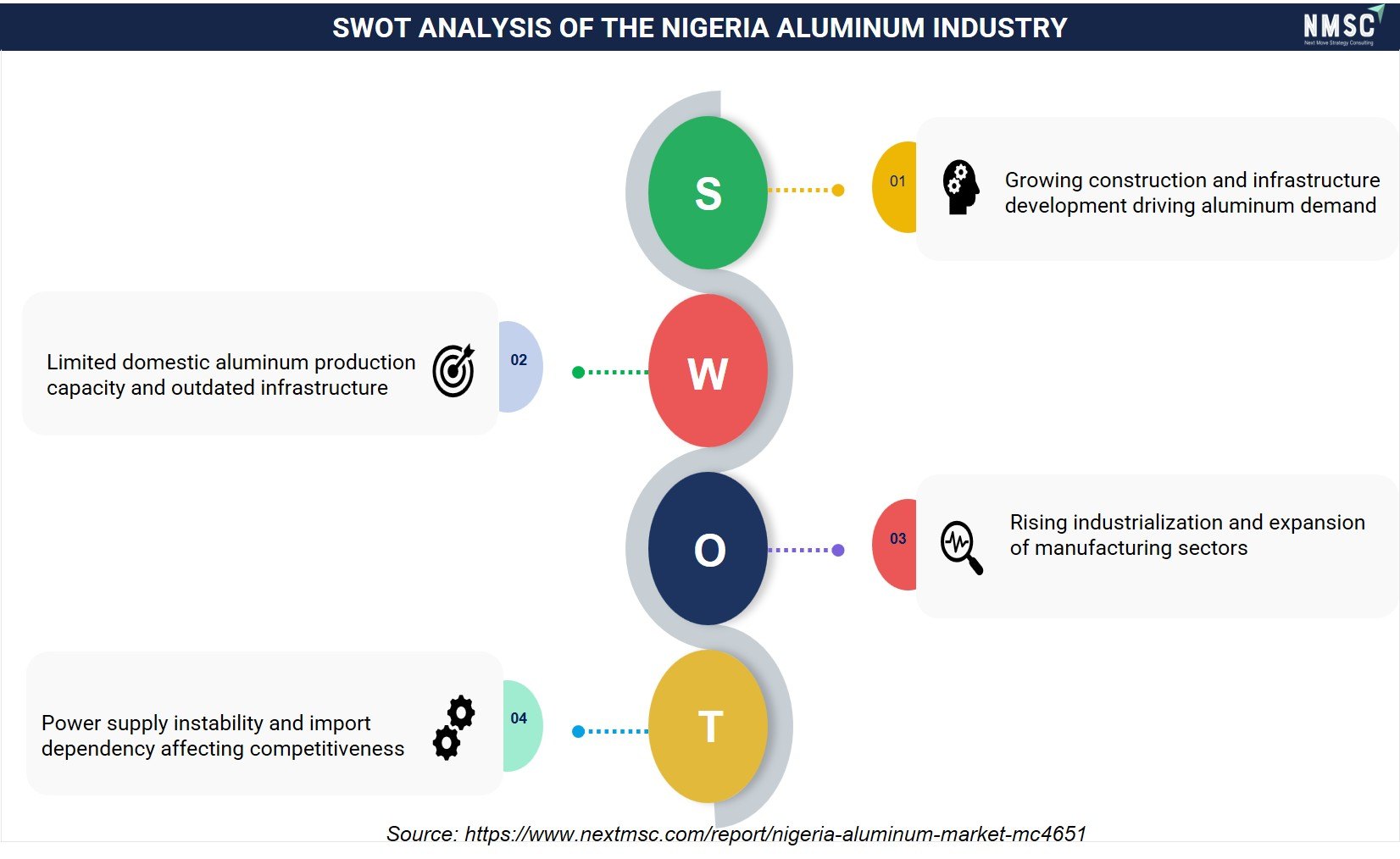
Our analysis indicates that the Nigeria aluminum industry is supported by rising construction activity, urban expansion, and infrastructure development that sustain demand for profiles, roofing, and fabricated products. However, limited domestic production capacity, aging industrial assets, and operating inefficiencies continue to restrict supply responsiveness. Furthermore, industrialization across automotive, packaging, and consumer goods segments is creating new downstream avenues for processors and fabricators. Power instability, import dependence, currency volatility, and global price exposure remain persistent commercial risks, while modernization and recycling investment can improve long-term competitiveness.
How Is the Nigeria Aluminum Market Segmented in This Report, and What Are the Key Insights From the Segmentation Analysis?
By Type
How Does the Aluminum Type Segment Influence Supply Stability in the Nigeria Aluminum Market?
The Nigeria aluminum market by type includes Primary Aluminum and Secondary (Recycled) Aluminum, with Secondary Aluminum further segmented into Industrial Scrap, Post-Consumer Scrap, and Remelted Secondary Production, reflecting both virgin supply inputs and recycling-based material flows.
Primary Aluminum is typically associated with consistency in chemical composition and suitability for high-specification applications in construction, packaging, and engineering components. Secondary Aluminum plays a significant role in cost-sensitive and sustainability-oriented procurement, particularly through Industrial Scrap derived from manufacturing waste, Post-Consumer Scrap collected from end-use recovery channels, and Remelted Secondary Production used for reprocessing into semi-finished forms. Moreover, our assessment shows that procurement patterns increasingly reflect pricing volatility management, recycling efficiency, and supply continuity considerations, therefore shaping the balance between primary imports and domestic secondary recovery within the market.
By Product Form
How Do Product Form Segments Determine Industrial Usage Patterns in the Nigeria Aluminum Market?
The Nigeria aluminum market by product form includes Flat-Rolled, Casting, Extrusions, Forgings, Powder & Paste, Billets, Wire Rods, Foundry Alloys, Aluminium Silicon (AlSi) Alloy, and Other Products, representing a wide range of semi-finished and engineered aluminum outputs used across multiple industries. Flat-Rolled products further include Sheet, Coil, Plate, Foil, and Can-Stock, while Extrusions include Profiles and Tubes & Pipes designed for structural and fabrication applications.
Our market analysis suggests that Flat-Rolled products are commonly used in packaging, roofing, cladding, and general fabrication activities where formability and surface finish are key selection parameters. Additionally, Extrusions are frequently applied in construction frameworks, transport structures, and industrial assemblies requiring dimensional precision. Casting products support machinery parts, automotive components, and engineering applications, whereas Billets serve as upstream feedstock for extrusion and rolling operations. Similarly, Wire Rods are associated with electrical and conductive applications, while Foundry Alloys and AlSi materials support specialized casting requirements. Overall, procurement behavior increasingly reflects fabrication capability, lead-time reliability, alloy consistency, and downstream conversion efficiency, thus influencing product form selection across the market.
Competitive Landscape
Based on NMSC’s assessment of the Nigerian aluminium market, the competitive structure is shaped by a developing mix of extrusion manufacturers, packaging producers, and downstream fabrication companies aligned with rising urbanization and industrial expansion. Companies such as Nigerian Aluminium Extrusions Limited and Tower Aluminium Group Plc play a central role in domestic extrusion output and construction material supply, while established participants like Aluminium Extrusion Industries Plc and GZ Industries Limited contribute to profile manufacturing and beverage can production capabilities. From an industry intelligence perspective, Abumet Nigeria Limited, Reinnova Green Holdings Limited, Avon Crowncaps & Containers Nigeria Limited, and System Metal Industries Limited strengthen domestic fabrication, closures, and packaging-linked aluminium demand. Regional participants including Alo Aluminium Company Limited, Tonimas Nigeria Limited, and Jumac-J Aluminium Ventures Limited further support downstream diversification and project-based supply networks. Overall, the Nigerian aluminium sector reflects a gradually expanding market structure supported by construction growth, consumer packaging demand, and increasing local processing activity.
Supply Chain Structure Of The Nigeria Aluminum Market
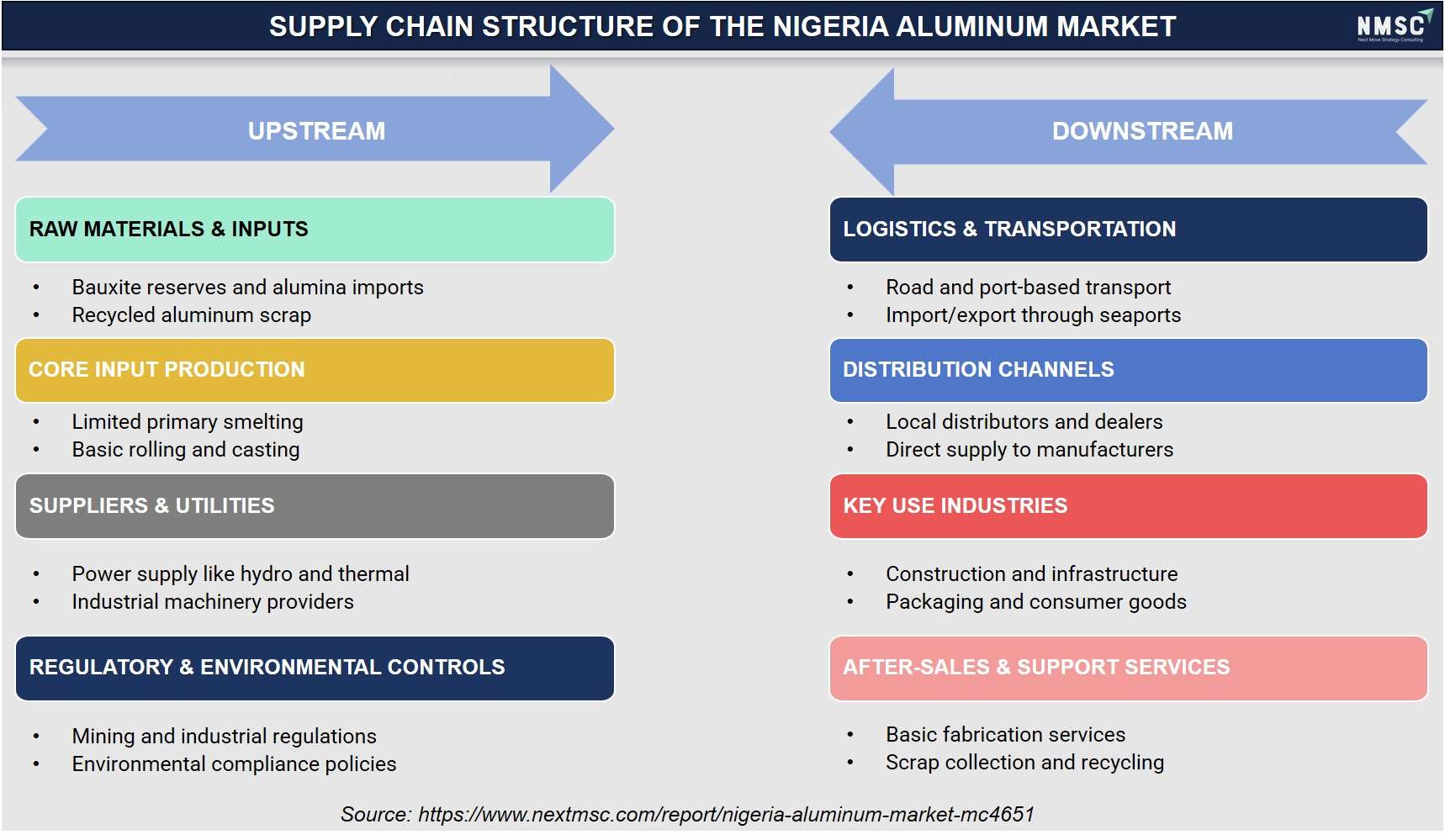
The Nigeria aluminum market supply chain combines upstream dependence on bauxite resources, imported alumina, recycled scrap, limited smelting, rolling, and casting capacity, with downstream reliance on ports, road transport, distributors, and direct industrial buyers. Construction, infrastructure, beverage cans, and household packaging remain major consumption channels. Additionally, our review of the data suggests that policy focus on value addition and domestic alumina refining is expected to reduce import reliance, strengthen raw material security, and improve integration across fabrication, installation, and recycling networks.
Key Players
-
Nigerian Aluminium Extrusions Limited
-
Tower Aluminium Group Plc
-
Aluminium Extrusion Industries Plc
-
GZ Industries Limited
-
Abumet Nigeria Limited
-
Reinnova Green Holdings Limited
-
Avon Crowncaps & Containers Nigeria Limited
-
System Metal Industries Limited
-
Alo Aluminium Company Limited
-
Tonimas Nigeria Limited
-
Jumac-J Aluminium Ventures Limited
-
Company 12
-
Company 13
-
Company 14
-
Company 15
Our analysis indicates that competitive dynamics in the Nigeria aluminum market are increasingly shaped by production efficiency, low-carbon manufacturing capabilities, and value-added downstream product innovation rather than primary metal capacity alone. We observe that leading suppliers are actively investing in recycling infrastructure, advanced rolling and extrusion technologies, and energy-efficient smelting processes to address rising demand for sustainable and lightweight materials across transportation, construction, packaging, and aerospace applications. The growing preference for recycled and secondary aluminum, in our view, reflects end-user focus on cost optimization, emission reduction, and circular supply chain strategies.
We also identified that market leaders are strengthening their positions through domestic capacity expansions, localized supply chains, and long-term contracts with automotive, beverage packaging, and industrial customers. These strategies enable stronger market penetration while reducing exposure to import volatility, logistics disruptions, and trade policy uncertainty. Overall, we expect sustained investment in recycling capacity, fabrication technologies, and customer-specific alloy development to remain the key determinant of competitive positioning in the Nigeria Aluminum Market.
Nigeria Aluminum Market Key Segments
By Type
-
Primary Aluminum
-
Secondary (Recycled) Aluminum
-
Industrial Scrap
-
Post-Consumer Scrap
-
Remelted Secondary Production
-
By Product Type
-
Flat-Rolled
-
Sheet
-
Coil
-
Plate
-
Foil
-
Can-Stock
-
-
Casting
-
Extrusions
-
Profiles
-
Tubes & Pipes
-
-
Forgings
-
Powder & Paste
-
Billets
-
Wire Rods
-
Foundry Alloys
-
Aluminium Silicon (AlSi) Alloy
-
Other Products
By Alloy Series
-
1xxx Series
-
2xxx Series
-
3xxx Series
-
4xxx Series
-
5xxx Series
-
6xxx Series
-
7xxx Series
By Distribution Channel
-
OEM Direct
-
Distributors
-
Aftermarket
-
E-commerce
-
Scrap Traders
By End User
-
Transportation
-
Aerospace
-
Automotive
-
Marine
-
Rail
-
-
Consumer Goods
-
Machinery & Equipment
-
Construction
-
Packaging
-
Food & Beverage
-
Cosmetics
-
Others
-
-
Electrical Engineering
-
Other End Users
Key Benefits for Stakeholders:
Next Move Strategy Consulting (NMSC) presents a comprehensive analysis of the Nigeria aluminum market trends, covering historical developments from 2020 to 2025 and providing forward-looking forecasts through 2035. The study assesses the market at regional levels, combining quantitative market sizing with qualitative insights into key growth drivers, supply-demand dynamics, pricing trends, sustainability transitions, technology evolution, and investment activity across major aluminum product categories and end-use industries.
From our analysis, the Nigeria aluminum market delivers strong value across the industrial ecosystem. Manufacturers benefit from lightweight, durable, and recyclable materials that improve product performance and production efficiency. Investors gain exposure to long-term growth supported by infrastructure development, electric vehicle expansion, packaging demand, and rising adoption of recycled aluminum. Fabricators, processors, and technology providers benefit from recurring opportunities through value-added product development, recycling capacity expansion, and long-term supply agreements. Overall, the market supports industrial competitiveness, supply chain resilience, and Nigeria’s broader manufacturing transformation, reinforcing its strategic importance in the country’s industrial landscape.
|
Parameters |
Details |
|
Customization Scope |
Free customization (equivalent to up to 80 analyst-working hours) after purchase. |
|
Pricing and Purchase Options |
Avail customized purchase options to meet your exact research needs. |
|
Approach |
In-depth primary and secondary research; proprietary databases; rigorous quality control and validation measures. |
|
Analytical Tools |
Porter's Five Forces, SWOT, value chain, and Harvey ball analysis to assess competitive intensity, stakeholder roles, and relative impact of key factors. |


About the Author
 Tushmi Dutta
— Tushmi Dutta is a focused researcher specializing in detailed analysis and insight-driven research across diverse business landscapes. She supports strategic initiatives through structured data interpretation, thorough validation, and clear communication of findings that aid informed decision-making. With a strong interest in writing, she enjoys presenting research insights in an engaging and accessible manner. Beyond work, she enjoys traveling, reading, painting, and continuously learning new skills that contribute to her creative and professional growth.
Tushmi Dutta
— Tushmi Dutta is a focused researcher specializing in detailed analysis and insight-driven research across diverse business landscapes. She supports strategic initiatives through structured data interpretation, thorough validation, and clear communication of findings that aid informed decision-making. With a strong interest in writing, she enjoys presenting research insights in an engaging and accessible manner. Beyond work, she enjoys traveling, reading, painting, and continuously learning new skills that contribute to her creative and professional growth.
About the Reviewer
 Supradip Baul
— Supradip Baul is an accomplished business consultant and strategist with over a decade of rich experience in market intelligence, strategy, technology, and business transformation. His work has included rigorous qualitative and quantitative analysis across multiple industries, helping clients shape investment decisions and long-term roadmaps. Earlier in his career, he was associated with Gartner, where he contributed to industry-leading reports and market share analyses. He has worked with leading global companies and holds an MBA with a dual specialization in Marketing and Finance.
Supradip Baul
— Supradip Baul is an accomplished business consultant and strategist with over a decade of rich experience in market intelligence, strategy, technology, and business transformation. His work has included rigorous qualitative and quantitative analysis across multiple industries, helping clients shape investment decisions and long-term roadmaps. Earlier in his career, he was associated with Gartner, where he contributed to industry-leading reports and market share analyses. He has worked with leading global companies and holds an MBA with a dual specialization in Marketing and Finance.
At Next Move Strategy Consulting, we understand that insightful market research is the cornerstone of successful business decisions. That's why we employ a robust and multifaceted approach, combining various methodologies to deliver the most accurate and actionable data for our clients.

Research Landscape
We navigate the world of research with two primary approaches:
Qualitative Approach
Our qualitative research methodologies involve immersive techniques such as in-depth interviews, focus groups, and observational studies. By engaging directly with individuals and stakeholders, we uncover valuable insights that quantitative data alone may overlook.

Quantitative Research
In tandem with qualitative methodologies, NMSC leverages the power of Quantitative Research to provide a robust foundation of numerical insights. Through systematic data collection and analysis, we quantify patterns, preferences, and market trends, offering a comprehensive view of the business landscape.
Our quantitative research approach employs diverse tools, including surveys, experiments, and statistical modelling. These methodologies enable us to gather data from a large and representative sample, ensuring the statistical significance of our findings. By employing structured questionnaires and standardized data collection methods, we guarantee the reliability and validity of the information we present to our clients.
Quantitative research is particularly effective in measuring the prevalence of trends, assessing market size, and gauging the impact of various factors on consumer behavior. The numerical precision attained through this approach equips our clients with actionable insights, facilitating data-driven decision-making and strategy formulation.


Our Specialized Toolbox for Industry-Specific Market Research
We deploy a specialized arsenal of techniques tailored to meet your unique requirements. Here's a glimpse into our comprehensive toolbox:

Information Procurement
The stage entails acquiring market data or relevant information through various sources and methodologies.


Market Research Approach
We utilize both top-down and bottom-up approaches in market research analysis to achieve a comprehensive understanding of the market dynamics, leveraging the broad perspective of industry trends and macroeconomic factors alongside detailed insights from specific segments and individual companies.

Porters Five Forces Analysis
We conduct Porter's Five Forces analysis to evaluate the competitive landscape of an industry, providing us with insights into factors that affect profitability and strategic positioning.

SWOT Analysis

Forecasting
We utilize a forecasting model to predict future consumption by considering parameters like population, economics, regulations, market competition, drivers, constraints, technology, and pricing. We also employ statistical techniques such as multilinear regression, exponential smoothing, moving average, ARIMA, and Monte Carlo simulations for accurate predictions. In econometric forecasting, we analyzed short-term and long-term event impacts, attributing values based on regulatory frameworks, economic factors, and market events.





 Speak to Our Analyst