Refillable Packaging Market Size, Share, Growth & Forecast By Product Family (Refillable Primary Packs: Bottles, Jars, Tubes, Compacts; Refill Packs: Inserts, Pods, Sachets; Packaging Components: Pumps, Closures, Applicators), By Material (Glass, Plastic, Metal, Paperboard, Hybrid), By Buyer Type, By Revenue Stream, By Sales Channel, and By End Use Industry (Beauty & Personal Care, Home Care, Food & Beverage, Pharma, Other Consumer Goods) — Global Analysis 2025–2035
Industry: Materials and Chemical | Publishing Date: July 7, 2026 | Last Updated: September 30, 2026 | No of Pages: N/A | No. of Tables: N/A | No. of Figures: N/A | Format: PDF | Report Code: MC5013
What Is the Refillable Packaging Market Size?
The global Refillable Packaging Market was valued at USD 47.8 billion in 2025 and is expected to reach USD 51.2 billion in 2026. Driven by accelerating sustainability legislation, expanding brand-owner circular economy commitments, and growing consumer preference for eco-friendly packaging solutions, the market is projected to reach USD 99.6 billion by 2035, advancing at a CAGR of 7.7% from 2026 to 2035. Key growth drivers include the European Union's Single-Use Plastics Directive (SUPD), rising demand for refillable beauty and personal care packaging, growing home care refill programs at retail, and the premiumization of refillable glass and metal packaging across fragrance and spirits categories.
|
Parameters |
Details |
|
Market Size in 2025 |
USD 47.8 Billion |
|
Market Size in 2026 |
USD 51.2 Billion |
|
Revenue Forecast in 2035 |
USD 99.6 Billion |
|
Growth Rate |
CAGR of 7.7% from 2026 to 2035 |
|
Analysis Period |
2025–2035 |
|
Base Year Considered |
2025 |
|
Forecast Period |
2026–2035 |
|
Market Size Estimation |
Billion USD |
|
Companies Profiled |
20 |
|
Countries Covered |
33 |
|
Market Share |
Top 10 |
Refillable Packaging Market Overview
What Is the Refillable Packaging Market?
Refillable packaging refers to any primary pack, refill insert, or packaging component that is intentionally designed for multiple use cycles, enabling consumers or retailers to replenish the product content without discarding the outer container. The refillable packaging market encompasses refillable primary packs including bottles, jars, tubes, compacts, and cases; refill packs such as inserts, pods, pouches, sachets, and refill bags; and supporting packaging components including pumps, dispensers, closures, caps, and applicators. The market serves end users across beauty and personal care, home care, food and beverage, pharmaceutical, and other consumer goods industries globally.
How Has the Refillable Packaging Market Evolved?
The refillable packaging market has transitioned through three distinct evolution phases. The first phase, predominantly spanning the 1980s and 1990s, centered on glass bottle refills in beverages and limited cosmetics. The second phase, from the 2000s through 2015, introduced structured refill-at-home programs led by premium fragrance houses and selective home care brands. NMSC's analysis indicates that the current phase, beginning approximately 2018 and accelerating through 2025, is characterized by system-wide adoption across beauty, personal care, and home care, supported by retailer refill infrastructure, e-commerce refill subscription models, and regulatory mandates compelling packaging circularity at scale.
How Do Regulations Influence the Refillable Packaging Market?
Regulatory developments have become a primary structural driver shaping the refillable packaging market. The European Commission's Single-Use Plastics Directive (SUPD), enacted in 2021, prohibits certain single-use plastic products and mandates reusability requirements across packaging categories. The proposed EU Packaging and Packaging Waste Regulation (PPWR) introduces mandatory reusable packaging targets across member states by 2030. In the United States, the Environmental Protection Agency's (EPA) Sustainable Materials Management (SMM) program and California's extended producer responsibility (EPR) legislation are compelling brand owners to invest in refillable packaging architectures. These regulatory pressures are directly driving capital allocation toward refillable packaging R&D and commercialization.
How Is Technology Adoption Expanding Across the Refillable Packaging Market?
Technology adoption in the refillable packaging market is accelerating across materials science, smart dosing, and digital tracking. Advanced lightweight glass formulations, bio-based and recycled plastic resins, and durable aluminium and stainless-steel systems are expanding the range of viable refillable materials. Airless pump technology, precision dosing dispensers, and tamper-evident closure innovations are improving the consumer experience of refillable systems. Through our market assessment, we observed that digital traceability tools including QR codes and NFC-enabled refillable packs are enabling brands to track refill cycles, authenticate refills, and engage consumers across refill journeys, further driving adoption across premium brand segments.
|
Key Takeaways |
|
By product family, Refillable Primary Packs dominated the market with USD 22.4 billion in 2025, driven by entrenched demand for refillable glass and plastic bottles across fragrance, spirits, and personal care categories. |
|
Packaging Components is the fastest-growing product family segment at a CAGR of 9.0% from 2026 to 2035, driven by surging demand for refillable pump dispensers, airless systems, and precision applicators across beauty and pharmaceutical end uses. |
|
By material, Plastic remained the largest material segment at USD 18.6 billion in 2025, underpinned by PET and HDPE refillable bottle adoption across home care and personal care categories globally. |
|
Hybrid materials represent the fastest-growing material category at a CAGR of 13.8% from 2026 to 2035, as brand owners adopt composite refillable structures combining recycled plastic, paperboard, and bio-based components to achieve circular economy targets. |
|
By buyer type, Brand Owners accounted for the largest buyer segment at USD 28.4 billion in 2025, as major consumer goods multinationals drive the majority of refillable packaging design, investment, and procurement decisions globally. |
|
Retailers are the fastest-growing buyer type at a CAGR of 12.6% from 2026 to 2035, as large-format retailers and specialty beauty chains invest in in-store refill station infrastructure and retail refill program expansion. |
|
By revenue stream, New Refillable Packaging Sales constituted the largest revenue stream at USD 22.4 billion in 2025, representing initial system adoption investments by brand owners and contract manufacturers. |
|
Refurbishment and Refill Services is the fastest-growing revenue stream at a CAGR of 12.3% from 2026 to 2035, reflecting the growing commercial value of take-back, cleaning, and reconditioned refillable packaging programs. |
|
By sales channel, Direct Sales represented the largest channel at USD 18.6 billion in 2025, with direct procurement relationships between brand owners and packaging suppliers remaining the dominant commercial model. |
|
E-commerce Sales is the fastest-growing channel at a CAGR of 11.6% from 2026 to 2035, as direct-to-consumer refill subscription programs and online refill kit sales gain scale across beauty, home care, and nutraceutical categories. |
|
By end use industry, Beauty and Personal Care dominated with USD 16.8 billion in 2025, reflecting the sector's leadership in refillable primary pack adoption across skincare, fragrance, makeup, and haircare categories. |
|
Pharma and Healthcare is the fastest-growing end use industry at a CAGR of 10.5% from 2026 to 2035, driven by demand for refillable pharmaceutical dispensers, nutraceutical refill packs, and OTC refillable packaging formats. |
|
Europe held the largest regional share in the Refillable Packaging Market at USD 14.8 billion in 2025, projected to reach USD 31.9 billion by 2035 at a CAGR of 8.0%, supported by stringent circular economy regulations, strong consumer sustainability awareness, and widespread adoption of refillable packaging systems across personal care, household, and food applications. |
|
Middle East & Africa is the fastest-growing region in the Refillable Packaging Market at a CAGR of 10.8% from 2026 to 2035, driven by increasing sustainability initiatives, growing investments in modern retail infrastructure, rising environmental awareness, and expanding adoption of reusable packaging solutions across consumer goods sectors. |
|
Germany is the largest country market in the Refillable Packaging Market, supported by advanced recycling infrastructure, strong regulatory support for circular packaging systems, and widespread adoption of refillable formats across beauty, personal care, and household product categories. |
|
Saudi Arabia is the fastest-growing country market within the Middle East & Africa Refillable Packaging Market, driven by sustainability-focused economic diversification initiatives, expanding retail modernization programs, increasing consumer demand for environmentally responsible packaging solutions, and growing investments in circular economy infrastructure. |
Key Emerging Trends in the Refillable Packaging Market
How Is the Premiumization of Refillable Packaging Reshaping the Beauty and Fragrance Industry?
From our research, we found that premiumization is the dominant commercial trend reshaping the refillable packaging market across beauty and fragrance. Luxury houses including Dior, Chanel, and Guerlain have institutionalized refillable fragrance flacons, with consumers actively paying premium prices for refillable bottle programs. Verescence and Gerresheimer have responded by engineering high-clarity, heavy-gauge refillable glass flacons specifically designed for multi-cycle use without visual degradation. This trend is accelerating the migration from disposable secondary pack models to refillable primary pack systems across prestige tiers, driving significant incremental revenue for specialized glass and premium metal packaging manufacturers.
How Are Retailer Refill Station Programs Transforming the Sales Channel for Refillable Packaging?
Our assessment indicates that retailer-anchored refill station programs are becoming a structurally important sales channel for the refillable packaging market. Retailers including dm, Rossmann, and REWE in Europe have deployed in-store refill stations across cleaning, laundry, and personal care categories, enabling consumers to refill existing containers at reduced cost and with measurably lower plastic consumption. Based on our market evaluation, we noticed that this trend is compelling packaging manufacturers to develop standardized refillable container formats compatible with multiple retail refill infrastructure systems, creating new B2B2C commercial relationships between packaging suppliers, brand owners, and retailers.
How Is the Refill-at-Home Model Driving Innovation in Concentrated Refill Pack Formats?
The refill-at-home model, which enables consumers to purchase concentrated refill packs or pouches and dilute them into a permanent primary container, is one of the most commercially significant format innovations in the refillable packaging market. Through NMSC's assessment, we found that brands including Bower Collective, Splosh, and major FMCG companies have launched concentrated home care refill sachets and pods that reduce water content, transportation weight, and packaging material by up to 75% versus conventional formats. This model is expanding rapidly through e-commerce subscriptions and represents the primary growth driver for the sachets and refill bags sub-segment within refill packs.
How Is Material Innovation in Hybrid and Paperboard Refillable Structures Opening New Market Opportunities?
NMSC's analysis indicates that hybrid and paperboard refillable packaging structures represent one of the most dynamic innovation frontiers in the market. Brands including Dove, Gillette, and sustainable beauty startups have launched refillable solid shampoo bars and compressed format personal care products in paperboard refillable outer cases, significantly reducing plastic content. Hybrid structures combining paperboard exteriors with lightweight plastic or aluminium interior chambers are gaining commercial traction in skincare, fragrance, and home care, offering refillability alongside enhanced shelf presence. Our findings suggest that this segment will outperform all other material categories through 2035 at a CAGR of 13.8%.
Consumer Behavior Analysis of the Refillable Packaging Market
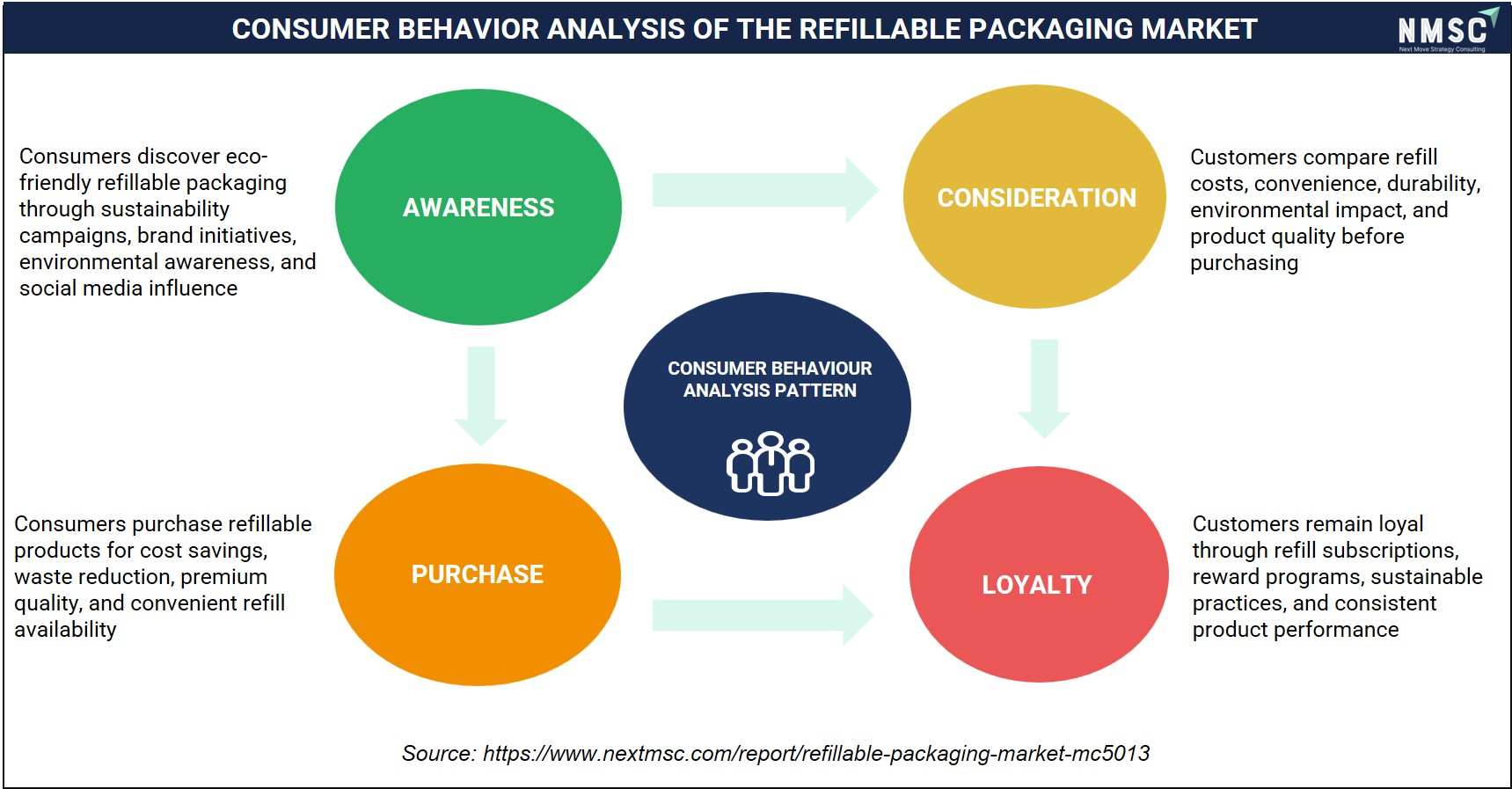
Based on our comprehensive assessment, we found that consumer adoption of refillable packaging follows a journey driven by sustainability awareness, cost considerations, and convenience preferences. Customers evaluate refill solutions based on durability, environmental impact, and product quality before purchasing. Our analysis indicates that loyalty is strengthened through refill subscriptions, reward programs, and consistent product performance, supporting long-term engagement and repeat purchases.
What Are the Key Market Drivers, Breakthroughs, and Investment Opportunities that Will Shape the Refillable Packaging Industry in the Next Decade?
|
Drivers / Trends / Restraints |
(+/-) % Impact on CAGR Forecast |
Geographic Relevance |
Impact Timeline |
|
Surge in Sustainability Regulations Globally |
+1.4% |
Europe, North America, APAC |
2025–2030 |
|
Growing Consumer Preference for Eco-Friendly Packaging |
+1.2% |
Global (all regions) |
2025–2035 |
|
Brand Owner ESG Commitments and Circular Economy Goals |
+1.1% |
North America, Europe |
2025–2032 |
|
Rise of Refill-at-Home and E-commerce Refill Models |
+0.9% |
Europe, North America |
2026–2035 |
|
Expansion of Retail Refill Stations and Programs |
+0.8% |
Europe, APAC |
2025–2030 |
|
EU SUPD and Single-Use Plastics Directive |
+0.7% |
Europe, MEA |
2025–2030 |
|
High Initial Capital Cost of Refillable Systems |
-1.0% |
SMB, Emerging Markets |
Ongoing |
|
Consumer Behavioral Inertia Toward Disposables |
-0.7% |
MEA, Latin America |
Ongoing |
|
Logistical Complexity in Reverse Logistics and Refill Supply Chains |
-0.6% |
All regions |
2025–2030 |
|
Innovation in Sustainable Material Science (Hybrid & Paperboard) |
+0.9% |
Global |
2026–2035 |
|
Luxury Refillable Packaging Premium Pricing Opportunity |
+0.6% |
Europe, North America, APAC |
2026–2035 |
What Are the Drivers of the Refillable Packaging Market Growth?
How Are Escalating Sustainability Regulations Driving Refillable Packaging Market Adoption?
Regulatory mandates represent the single most powerful structural driver of the refillable packaging market. The EU's Single-Use Plastics Directive (SUPD) has restricted or prohibited a range of single-use plastic packaging items across member states, compelling brand owners to pivot toward reusable and refillable formats. The proposed EU Packaging and Packaging Waste Regulation (PPWR), currently advancing through the European legislative process, introduces mandatory reuse targets that would require a specified percentage of packaging placed on the EU market to be available in reusable formats by 2030 and 2040. The U.S. EPA's Sustainable Materials Management program explicitly promotes reusable packaging as a priority circular economy intervention, creating government-backed demand for refillable packaging solutions across North American consumer markets.
How Are Brand Owner ESG Commitments Creating Sustained Demand for Refillable Packaging?
Corporate ESG commitments from major multinational consumer goods companies are creating long-cycle, strategic demand for refillable packaging investment. Unilever's commitment under its Unilever Compass to halve its use of virgin plastic and triple its use of refillable packaging by 2025 represents a USD billion-scale procurement signal for refillable packaging suppliers globally. Procter and Gamble, Henkel, and L'Oreal have made comparable public commitments to increase refillable packaging across their brand portfolios. Based on NMSC's research, we found that these corporate sustainability pledges are translating directly into multi-year refillable packaging supply agreements, R&D co-investment with packaging manufacturers, and accelerated consumer education programs supporting refill behavior adoption.
How Is the Accelerating Growth of E-commerce Refill Subscriptions Expanding the Refillable Packaging Market?
The rapid growth of e-commerce as a direct-to-consumer channel for refill products is materially expanding the addressable market for refillable packaging. Subscription-based refill models, in which consumers receive concentrated refill pods, pouches, or cartridges on a recurring basis for use in a permanent primary pack, are reducing consumer friction associated with refillable packaging adoption. Our analysis shows that the direct-to-consumer refill subscription market spans personal care, home care, nutraceuticals, and food and beverage categories, with growing participation from major FMCG brands and digital-native sustainable brands. This channel expansion is driving demand for lightweight, postal-compatible refill pack formats and elevated unboxing-ready refill packaging designs.
What Are the Growth Inhibitors of the Refillable Packaging Market?
How Does the High Initial Capital Cost of Refillable Packaging Systems Constrain Market Expansion?
The high initial capital investment required to design, validate, and commercialize refillable packaging systems is a significant constraint on market penetration, particularly among small and medium-sized brands. Unlike conventional packaging procurement, refillable systems require investment in reverse logistics infrastructure, cleaning and refurbishment protocols, consumer education programs, and specialized filling equipment compatible with refill formats. The U.S. EPA has documented in its Sustainable Materials Management program guidance that circular packaging models require higher upfront investment compared to linear packaging models, creating adoption barriers for brands without dedicated sustainability capital budgets. These cost factors extend payback periods and slow market penetration among smaller brand operators.
How Does Consumer Behavioral Inertia Toward Disposable Packaging Limit Refillable Packaging Market Growth?
Consumer behavioral inertia toward familiar single-use and disposable packaging formats represents a persistent demand-side constraint for the refillable packaging market. Despite growing environmental awareness, a significant proportion of consumers across emerging markets and among price-sensitive demographic segments continue to prioritize purchase convenience, hygiene perceptions, and lower unit prices associated with conventional disposable packaging. The United Nations Environment Programme (UNEP) has noted in its Single-Use Plastics Roadmap for Sustainability that behavior change toward reusable systems requires sustained investment in consumer education, accessible refill infrastructure, and price parity with disposable alternatives. Overcoming this inertia requires coordinated action from retailers, brands, and governments, slowing the pace of market adoption.
What Are the Growth Opportunities in the Refillable Packaging Market?
How Does the Expansion of Luxury Refillable Packaging Across Fragrance and Color Cosmetics Represent a High-Margin Growth Opportunity?
The luxury personal care and fragrance segment represents a structurally attractive high-margin growth opportunity within the refillable packaging market. Premium consumers in Europe, North America, and Asia-Pacific are demonstrating a demonstrably higher willingness to pay for refillable luxury packaging systems, with refillable fragrance flacons commanding price premiums of 20% to 40% over conventional formats in some brand architectures. Our assessment indicates that the intersection of prestige consumer values, brand differentiation imperatives, and environmental credentials is uniquely favorable for refillable packaging adoption across luxury beauty, creating a durable revenue opportunity for specialized glass, metal, and premium applicator packaging manufacturers through 2035.
How Does the Growing Pharmaceutical and Nutraceutical Sector Create a Structural Opportunity for Refillable Packaging?
The pharmaceutical and nutraceutical sectors represent an underexploited but structurally significant growth opportunity for refillable packaging manufacturers. The U.S. FDA's guidance on reusable containers and the European Medicines Agency's (EMA) guidance on pharmaceutical packaging both provide regulatory pathways for validated refillable primary packaging in specific OTC, nutraceutical, and prescription categories. Refillable glass vials, refillable dispensing systems for topical preparations, and refillable capsule containers for nutraceuticals are gaining regulatory acceptance and commercial traction. From our assessment, we observed that pharmaceutical brands pursuing sustainability commitments are increasingly evaluating refillable packaging solutions as a credible pathway to reducing packaging waste across their product portfolios.
How Does the Rise of Emerging Market Retail Refill Infrastructure Create a Long-Term Growth Pathway for the Refillable Packaging Market?
Emerging markets in Asia-Pacific, Latin America, and the Middle East and Africa represent a long-term structural growth opportunity for refillable packaging as retail infrastructure investment accelerates. In markets including Indonesia, Brazil, and South Africa, sachets and small-format single-use packaging have historically dominated due to affordability constraints, but rising incomes, expanding formal retail channels, and growing environmental policy pressure are creating conditions for refillable packaging adoption. UNEP's plastics roadmap explicitly identifies sachet replacement through reusable and refillable formats as a priority intervention for developing economies. Retail refill station infrastructure, supported by local government programs and multinational FMCG commitments, is expanding the commercial viability of refillable packaging across these high-growth markets.
How Is the Refillable Packaging Market Segmented in This Report, and What Are the Key Insights from the Segmentation Analysis?
How Do Different Product Family Segments Define the Core Architecture of the Refillable Packaging Market?
|
Product Family Segment |
2025 (USD Bn) |
2035 (USD Bn) |
CAGR (%) |
|
Refillable Primary Packs |
22.4 |
43.2 |
7.6% |
|
– Bottles |
8.2 |
15.4 |
7.2% |
|
– Jars |
5.6 |
10.8 |
7.5% |
|
– Tubes |
4.2 |
8.6 |
8.3% |
|
– Compacts and Cases |
2.8 |
5.9 |
8.6% |
|
– Other Primary Packs |
1.6 |
2.5 |
5.1% |
|
Refill Packs |
14.6 |
30.8 |
8.6% |
|
– Inserts and Cartridges |
4.2 |
8.9 |
8.7% |
|
– Pods and Pouches |
3.8 |
8.6 |
9.5% |
|
– Sachets and Refill Bags |
4.6 |
9.8 |
8.6% |
|
– Other Refills |
2.0 |
3.5 |
6.3% |
|
Packaging Components |
10.8 |
25.6 |
9.0% |
|
– Pumps and Dispensers |
4.2 |
9.8 |
9.9% |
|
– Closures and Caps |
3.6 |
8.2 |
9.6% |
|
– Applicators |
2.0 |
5.4 |
11.7% |
|
– Other Components |
1.0 |
2.2 |
9.1% |
Based on our analysis of global refillable packaging procurement trends, we observed that the market is structured into three primary product families: Refillable Primary Packs, Refill Packs, and Packaging Components. Refillable Primary Packs dominate the market at USD 22.4 billion in 2025, led by refillable bottles and jars across personal care and fragrance. Within Refill Packs, Sachets and Refill Bags hold the largest share driven by concentrated home care adoption, while Pods and Pouches emerge as the fastest-growing sub-segment at a CAGR of 9.5%. Packaging Components represent the fastest-growing primary segment overall, with Applicators achieving the highest individual sub-segment CAGR of 11.7%, reflecting growing demand for precision dosing and refillable cosmetic applicator systems.
Which Material Segments Are Driving Innovation and Revenue Growth in the Refillable Packaging Market?
|
Material Segment |
2025 (USD Bn) |
2035 (USD Bn) |
CAGR (%) |
|
Glass |
12.4 |
21.6 |
6.4% |
|
Plastic |
18.6 |
34.2 |
7.0% |
|
– PET |
7.2 |
13.8 |
7.5% |
|
– HDPE |
5.6 |
10.4 |
7.1% |
|
– PP |
3.8 |
6.8 |
6.7% |
|
– Other Plastic |
2.0 |
3.2 |
5.3% |
|
Metal |
8.4 |
17.8 |
8.7% |
|
– Aluminium |
6.2 |
13.4 |
8.9% |
|
– Stainless Steel |
2.2 |
4.4 |
8.0% |
|
Paperboard |
4.2 |
12.6 |
13.1% |
|
Hybrid |
4.2 |
13.4 |
13.8% |
Through our market assessment, we evaluated that the refillable packaging market spans five primary material categories: Glass, Plastic, Metal, Paperboard, and Hybrid. Plastic dominates at USD 18.6 billion in 2025 due to widespread adoption of refillable PET and HDPE bottle formats across home care and personal care. Glass maintains a significant position at USD 12.4 billion, anchored by the premium fragrance and spirits segments. Metal, led by Aluminium, is growing strongly at 8.7% CAGR as brands adopt durable and recyclable refillable aluminium formats for deodorant, personal care, and food and beverage categories. Hybrid and Paperboard represent the two fastest-growing material segments at CAGRs of 13.8% and 13.1% respectively, reflecting the market's pivot toward innovative, low-carbon refillable material architectures.
How Do Different Buyer Types Shape Procurement Dynamics and Commercial Models in the Refillable Packaging Market?
|
Buyer Type Segment |
2025 (USD Bn) |
2035 (USD Bn) |
CAGR (%) |
|
Brand Owner |
28.4 |
56.2 |
7.9% |
|
Private Label |
8.6 |
16.8 |
7.8% |
|
Contract Manufacturer |
6.2 |
13.2 |
8.8% |
|
Retailer |
4.6 |
13.4 |
12.6% |
Our findings suggest that Brand Owners constitute the largest buyer segment at USD 28.4 billion in 2025, as global FMCG, beauty, and home care brand owners drive the majority of refillable packaging investment through corporate sustainability mandates and new product development programs. Private Label buyers represent a stable second segment at USD 8.6 billion, led by European grocery and drug chains developing own-brand refillable product lines. Contract Manufacturers are growing at 8.8% CAGR as co-manufacturing networks expand refillable filling capabilities. Retailers are the fastest-growing buyer type at 12.6% CAGR, propelled by the rapid scaling of in-store refill station programs across Europe and Asia-Pacific.
How Do Different Revenue Streams Reveal the Commercial Evolution of the Refillable Packaging Industry?
|
Revenue Stream Segment |
2025 (USD Bn) |
2035 (USD Bn) |
CAGR (%) |
|
New Refillable Packaging Sales |
22.4 |
42.8 |
7.4% |
|
Refill Pack Sales |
14.8 |
32.6 |
9.2% |
|
Packaging Component Sales |
7.2 |
14.6 |
8.2% |
|
Refurbishment and Refill Services |
3.4 |
9.6 |
12.3% |
Based on NMSC's research, we found that the refillable packaging market generates revenue across four primary streams. New Refillable Packaging Sales constitutes the largest stream at USD 22.4 billion in 2025, representing initial system adoption. Refill Pack Sales is the second-largest and fastest-growing recurring revenue stream at a CAGR of 9.2%, as established refillable pack user bases generate repeat purchase revenue. Packaging Component Sales reflects ongoing replacement and aftermarket demand for pumps, closures, and applicators. Refurbishment and Refill Services represents the highest-growth revenue stream at 12.3% CAGR, reflecting the commercialization of take-back, cleaning, and reconditioning services as brand owners formalize reverse logistics programs.
How Are Sales Channels Reshaping Go-to-Market Strategies in the Refillable Packaging Market?
|
Sales Channel Segment |
2025 (USD Bn) |
2035 (USD Bn) |
CAGR (%) |
|
Direct Sales |
18.6 |
34.2 |
7.0% |
|
Distributor Sales |
12.8 |
23.6 |
7.0% |
|
E-commerce Sales |
8.4 |
22.4 |
11.6% |
|
Retail Refill Programs |
8.0 |
19.4 |
10.3% |
Our analysis shows that Direct Sales remains the dominant channel at USD 18.6 billion in 2025, reflecting the continued importance of direct procurement relationships between major brand owners and packaging suppliers for high-volume, customized refillable packaging systems. Distributor Sales represents an approximately equal channel at USD 12.8 billion, serving mid-tier and regional brand owners. E-commerce Sales is the fastest-growing channel at 11.6% CAGR, driven by direct-to-consumer refill subscription programs and online refill kit sales. Retail Refill Programs are growing strongly at 10.3% CAGR as grocery, drug, and specialty beauty retailers establish in-store refill infrastructure and formalize structured refill programs with brand partners.
Which End Use Industries Are Generating the Most Value and Growth Momentum in the Refillable Packaging Market?
|
End Use Industry Segment |
2025 (USD Bn) |
2035 (USD Bn) |
CAGR (%) |
|
Beauty and Personal Care |
16.8 |
34.4 |
8.3% |
|
– Skincare |
5.6 |
12.2 |
9.1% |
|
– Makeup |
3.2 |
7.2 |
9.4% |
|
– Fragrance |
2.8 |
5.4 |
7.6% |
|
– Haircare |
2.6 |
5.2 |
8.0% |
|
– Oral Care |
1.2 |
2.4 |
8.0% |
|
– Bath and Body |
1.4 |
2.0 |
4.0% |
|
Home Care |
12.4 |
25.6 |
8.4% |
|
– Laundry Care |
5.2 |
10.8 |
8.5% |
|
– Surface Cleaners |
4.2 |
8.8 |
8.6% |
|
– Dishwashing |
3.0 |
6.0 |
8.0% |
|
Food and Beverage |
10.6 |
19.8 |
7.2% |
|
– Alcoholic Beverages |
4.8 |
8.6 |
6.7% |
|
– Non-Alcoholic Beverages |
3.8 |
7.2 |
7.4% |
|
– Packaged Food |
2.0 |
4.0 |
8.0% |
|
Pharma and Healthcare |
5.4 |
13.2 |
10.5% |
|
– Prescription |
2.2 |
5.2 |
10.0% |
|
– OTC |
1.8 |
4.4 |
10.4% |
|
– Nutraceuticals |
1.4 |
3.6 |
11.1% |
|
Other Consumer Goods |
2.6 |
6.6 |
10.9% |
Based on our market evaluation, we noticed that Beauty and Personal Care dominates the refillable packaging market at USD 16.8 billion in 2025, with Makeup and Skincare sub-segments recording the highest growth rates within the category at CAGRs of 9.4% and 9.1% respectively. Home Care is the second-largest industry segment at USD 12.4 billion, driven by expanding laundry and surface cleaner refill programs. Food and Beverage contributes USD 10.6 billion, anchored by the well-established refillable glass bottle model in spirits and craft beverages. Pharma and Healthcare is the fastest-growing end use industry at a CAGR of 10.5%, with nutraceuticals representing the highest-growth sub-segment at 11.1% as supplement brands pivot to refillable dispensing systems.
Regional Outlook
Geographic Performance Snapshot
|
Region |
2025 (USD Bn) |
2035 (USD Bn) |
CAGR (%) |
Key Driver |
|
North America |
12.4 |
24.8 |
8.0% |
Sustainability regulations, brand-owner ESG commitments |
|
Europe |
14.8 |
29.6 |
8.0% |
EU SUPD, refill retail programs, luxury packaging demand |
|
Asia-Pacific |
13.6 |
29.8 |
9.1% |
Rising beauty demand, urbanization, circular economy policy |
|
Middle East & Africa |
3.4 |
8.6 |
10.8% |
Vision 2030 sustainability, growing personal care market |
|
Latin America |
3.6 |
6.8 |
7.4% |
Home care refill adoption, growing middle class demand |
North America Refillable Packaging Market
North America is a leading region in the global refillable packaging market, contributing USD 12.4 billion in 2025 and forecast to reach USD 24.8 billion by 2035 at a CAGR of 8.0%. The region benefits from strong brand owner ESG commitments, growing consumer awareness of sustainable packaging, and an expanding e-commerce refill subscription economy. Regulatory developments including state-level extended producer responsibility (EPR) legislation in California, New York, and Colorado are compelling brand owners to design for reusability. The presence of major multinational consumer goods companies and a well-developed retail infrastructure further positions North America as a critical market for refillable packaging growth through the forecast period.
U.S. Refillable Packaging Market
Based on our engagements with packaging industry stakeholders, the U.S. constitutes the majority of North American refillable packaging revenue. The U.S. refillable packaging market is driven by beauty and personal care sector investment, growing home care refill subscription adoption, and sustainability mandates from major CPG companies. The EPA's Sustainable Materials Management program and California's Extended Producer Responsibility legislation are compelling brand owners to increase refillable packaging penetration. E-commerce platforms including Grove Collaborative, Package Free Shop, and Amazon's Climate Pledge Friendly program are accelerating consumer access to refill products and driving demand for postal-compatible refill pack formats.
Canada Refillable Packaging Market
Through our analysis, Canada represents approximately 10% of North American refillable packaging revenue, with growing traction in beauty, personal care, and home care categories. Canada's federal single-use plastics regulations under the Canadian Environmental Protection Act (CEPA), which prohibited certain single-use plastic items beginning in 2022, are compelling brand owners and retailers to expand refillable alternatives. Specialty retailers including Bulk Barn operate established in-store refill programs for food and home care products. The Canadian retail sector's strong sustainability positioning and high consumer environmental awareness create a favorable commercial environment for refillable packaging adoption.
Mexico Refillable Packaging Market
From our assessment, Mexico is the fastest-growing market in North America for refillable packaging, supported by a large consumer goods market, rapidly expanding organized retail, and growing environmental awareness among urban middle-class consumers. Mexican regulations including the General Law for Climate Change and state-level plastic regulations in Mexico City and other jurisdictions are driving initial brand owner adoption of sustainable and refillable packaging formats. Home care refill sachets and concentrated refill formats have demonstrated strong early commercial traction in the Mexican market, particularly across laundry care and surface cleaner categories where sachets have historically dominated.
Europe Refillable Packaging Market
Europe is the largest regional market for refillable packaging, accounting for USD 14.8 billion in 2025 and projected to reach USD 29.6 billion by 2035 at a CAGR of 8.0%. Europe's leadership is underpinned by the most comprehensive regulatory framework for packaging reuse globally, including the EU Single-Use Plastics Directive, the EU Packaging and Packaging Waste Regulation, and national plastic reduction programs across member states. Consumer adoption of refillable packaging is highest in Northern and Western Europe, supported by retail refill infrastructure, sustainable brand positioning, and high consumer willingness to pay for environmentally responsible packaging solutions across beauty, personal care, and home care categories.
UK Refillable Packaging Market
Based on our engagements, the UK is among Europe's most advanced markets for refillable packaging adoption. The UK's Plastic Packaging Tax, introduced in April 2022, imposes a charge on plastic packaging with less than 30% recycled content, creating a financial incentive for brands to adopt refillable and reusable packaging systems. Retailers including Boots, Waitrose (Unpacked initiative), and The Body Shop have operationalized in-store refill programs at scale. The UK government's Resources and Waste Strategy explicitly promotes reuse and refillable packaging as priority interventions, creating a supportive regulatory environment for continued market expansion through the forecast period.
Germany Refillable Packaging Market
According to our evaluation, Germany is the largest individual country market for refillable packaging in Europe, with an estimated market size of USD 3.2 billion in 2025. Germany's Pfand (deposit-return) system for beverage containers represents one of the world's most established large-scale refillable packaging systems, achieving exceptional return rates for glass and PET bottles. The German Packaging Act (Verpackungsgesetz) and extended producer responsibility framework further incentivize refillable and reusable packaging adoption. Major German retailers including dm and Rossmann operate extensive in-store refill stations across personal care and home care categories, making Germany a global reference market for refillable packaging commercialization.
France Refillable Packaging Market
Through our analysis, France is a key European market for refillable packaging, driven by the French Anti-Waste Law for a Circular Economy (Loi AGEC), which mandates specific reuse targets for retail packaging and requires major retailers to offer refillable options by 2030. The French luxury cosmetics and fragrance industry, home to LVMH, L'Oreal, and Kering brands, is actively adopting premium refillable primary pack systems. ADEME, the French Environment and Energy Management Agency, actively promotes refillable packaging innovation through public grants and circular economy programs, creating a supportive ecosystem for market growth across French consumer goods sectors.
Italy Refillable Packaging Market
From our assessment, Italy represents a growing European market for refillable packaging, with adoption concentrated in the premium cosmetics, fragrance, and food and beverage sectors. Italy's cosmetics manufacturing cluster in Lombardy houses several leading packaging suppliers including Lumson and Bormioli Luigi with active refillable product portfolios. Italian regulatory alignment with EU packaging directives is compelling brand owners to introduce refillable format options across product lines. Consumer awareness of sustainability in urban centers including Milan and Rome is driving demand for refillable packaging in premium and prestige personal care and fragrance categories.
Spain Refillable Packaging Market
Based on our market evaluation, Spain demonstrates steady commercial momentum for refillable packaging, supported by growing consumer sustainability awareness, EU regulatory alignment, and retail sector investment in refill infrastructure. The Spanish Law on Waste and Contaminated Soil, enacted in 2022, transposes the EU SUPD into national law and introduces reuse objectives for packaging. Spanish retailers and personal care brands are expanding refillable format offerings across skincare, haircare, and home care categories. Spain's sizable FMCG market and growing e-commerce adoption are creating favorable conditions for refillable packaging penetration through the forecast period.
Sweden Refillable Packaging Market
Through our analysis, Sweden is among Europe's most sustainability-oriented markets for refillable packaging, supported by a highly engaged consumer base, strong national environmental policy, and a well-developed deposit-return system (Pantystem) for beverage containers. Swedish consumer brands including Swedish Match and Oriflame have adopted refillable primary packaging systems across their product portfolios. Sweden's national chemicals and waste legislation (Avfallsförordning) aligns with EU frameworks, creating a comprehensive regulatory platform for refillable packaging adoption. The Swedish retail sector's strong sustainability positioning makes it a favorable commercial environment for innovative refillable packaging formats.
Denmark Refillable Packaging Market
From our assessment, Denmark maintains a highly mature refillable packaging market, anchored by Dansk Retursystem, one of Europe's highest-performing deposit-return systems for beverage containers. Denmark's National Circular Economy Strategy and the Danish Environmental Protection Act provide a strong regulatory foundation for refillable packaging expansion beyond beverages into personal care and home care categories. Danish consumers demonstrate among the highest environmental awareness and refill adoption rates in Europe, creating favorable market conditions for premium refillable packaging formats in cosmetics, personal care, and specialty food and beverage applications.
Finland Refillable Packaging Market
Based on our engagements, Finland is an advanced market for refillable packaging with particularly strong adoption in beverage and personal care categories. Finland's PALPA deposit-return system achieves over 90% return rates for bottles and cans, reflecting deep consumer behavioral adoption of refillable and returnable packaging norms. Finnish retailers and brands are actively expanding refillable packaging programs beyond beverages into cosmetics, cleaning products, and nutraceuticals. Finland's national circular economy roadmap explicitly prioritizes refillable packaging as a key intervention for plastic waste reduction, ensuring continued regulatory support for market expansion.
Netherlands Refillable Packaging Market
Through our analysis, the Netherlands is a strategically important European market for refillable packaging, combining strong consumer sustainability values with a well-developed retail infrastructure for refill programs. The Dutch Deposit Return System (statiegeld) for PET bottles and cans provides a proven behavioral model for refillable packaging. The Netherlands Environmental Assessment Agency (PBL) and the Dutch Circular Economy Plan (Nederland Circulair in 2050) are driving policy-level support for refillable packaging across all consumer goods categories. Dutch retailers and personal care brands are actively investing in refill station infrastructure and sustainable refillable product lines.
Rest of Europe Refillable Packaging Market
Based on our market evaluation, the Rest of Europe, comprising Poland, Belgium, Switzerland, Austria, Portugal, Norway, and other European nations, collectively represents a growing segment of the European refillable packaging market. Belgium, home to major FMCG companies including Beiersdorf operations and retail chains Delhaize, is expanding refillable packaging programs across personal care and home care. Switzerland's strong consumer sustainability orientation and premium retail environment support high-value refillable packaging adoption. Poland and other Central and Eastern European markets are at earlier adoption stages but are rapidly advancing under EU regulatory alignment requirements.
Asia-Pacific Refillable Packaging Market
Asia-Pacific is the fastest-growing major region in the refillable packaging market, advancing from USD 13.6 billion in 2025 to USD 29.8 billion by 2035 at a CAGR of 9.1%. The region's growth is driven by rapid urbanization, rising disposable incomes, escalating beauty and personal care consumption, and increasingly stringent plastic reduction policies across major economies. China's ban on specific single-use plastics and India's phase-out of certain single-use plastic items are compelling brand owners and retailers to accelerate refillable packaging adoption. The K-beauty and J-beauty premium refillable skincare market in South Korea and Japan represents a high-value commercial opportunity for specialized packaging manufacturers.
China Refillable Packaging Market
Based on our engagements, China is the largest individual country market for refillable packaging in Asia-Pacific. China's Action Plan for Plastic Pollution Control, issued by the National Development and Reform Commission (NDRC) and the Ministry of Ecology and Environment (MEE), mandates progressive restrictions on single-use plastics, compelling brand owners to explore refillable packaging formats. The premium beauty market in China, dominated by domestic and international luxury brands, is a significant driver of refillable glass and metal packaging adoption. E-commerce platforms including Tmall and JD.com are facilitating digital refill subscription growth, creating demand for compact and postal-compatible refill pack formats across beauty and personal care categories.
India Refillable Packaging Market
Through our analysis, India represents a high-growth emerging market for refillable packaging, supported by government-mandated phase-outs of single-use plastics under the Environment (Protection) Act and the Plastic Waste Management Rules. The Bureau of Indian Standards (BIS) is developing standards for reusable and refillable packaging formats to support the regulatory transition. The Indian home care and personal care markets are expanding rapidly with refill sachets and pouches representing an established consumer behavior, creating a strong foundation for transitioning toward more structured refillable primary pack and refill pack systems as retail infrastructure matures.
Japan Refillable Packaging Market
From our assessment, Japan maintains one of the world's most advanced refillable packaging markets, with a deeply embedded consumer culture of refillable packaging adoption across personal care, home care, and food categories. Japanese consumers have long demonstrated high brand loyalty to refillable shampoo, conditioner, and cleaning product formats, with leading brands including Kao, Lion, and Unicharm operating extensive refillable primary pack and refill pouch programs. Japan's Container and Packaging Recycling Law and the Act on Promotion of Resource Circulation for Plastics reinforce policy-level support for refillable packaging adoption, ensuring sustained commercial momentum through the forecast period.
South Korea Refillable Packaging Market
Based on our engagements, South Korea is a highly sophisticated market for refillable packaging, with strong adoption in premium beauty, personal care, and home care categories. The Korean beauty (K-beauty) industry's global influence has amplified refillable skincare packaging adoption, with brands including Innisfree, AmorePacific, and LG Household and Health Care operating commercial refillable product lines. South Korea's Act on Promotion of Saving and Recycling of Resources mandates extended producer responsibility for packaging, supporting investment in refillable systems. The Korean Ministry of Environment's green packaging guidelines further reinforce policy support for refillable packaging market expansion.
Taiwan Refillable Packaging Market
Through our analysis, Taiwan demonstrates growing commercial traction for refillable packaging across personal care and home care categories. Taiwan's Resource Recycling Act and regulations under the Environmental Protection Administration (EPA) impose packaging waste reduction responsibilities on brand owners, incentivizing investment in refillable and reusable packaging formats. Taiwanese consumers in urban centers demonstrate increasing environmental awareness, supporting adoption of premium refillable personal care and home care products. The presence of global FMCG brand operations in Taiwan and a well-developed retail sector create favorable commercial conditions for refillable packaging expansion.
Indonesia Refillable Packaging Market
From our assessment, Indonesia represents one of the most significant emerging market opportunities for refillable packaging in Asia-Pacific. The Indonesian government's National Plastic Waste Reduction Roadmap targets a 70% reduction in marine plastic waste by 2025, compelling brand owners and retailers to invest in refillable and reusable packaging alternatives to sachets and single-use plastics. Leading consumer goods companies including Unilever Indonesia have piloted sachet replacement programs using refillable dispensing systems. The large consumer goods market, rapidly expanding organized retail, and growing environmental awareness among urban Indonesian consumers create long-term structural demand for refillable packaging solutions.
Vietnam Refillable Packaging Market
Based on our engagements, Vietnam is an emerging and high-growth market for refillable packaging, driven by government commitments to plastic reduction under the National Plastic Action Partnership and environmental obligations under the revised Law on Environmental Protection 2020. Vietnam's Extended Producer Responsibility (EPR) framework, effective 2024, imposes recycling and reuse obligations on brand owners and packaging manufacturers operating in the Vietnamese market. The rapid growth of Vietnam's beauty, personal care, and home care sectors, combined with government-backed sustainability programs, creates growing commercial demand for structured refillable packaging formats.
Australia Refillable Packaging Market
Through our analysis, Australia maintains a maturing refillable packaging market, supported by the Australian Packaging Covenant Organisation (APCO) and the National Packaging Targets which set goals for 100% of packaging to be recyclable, reusable, or compostable by 2025. Australian retailers including Woolworths and Coles have piloted refill station programs for personal care and home care categories. The National Waste Policy and Product Stewardship programs are compelling brand owners to invest in refillable packaging design. Consumer awareness of sustainability is high across Australian urban markets, supporting premium refillable personal care and home care product adoption.
Philippines Refillable Packaging Market
From our assessment, the Philippines represents a developing but strategically important market for refillable packaging in Southeast Asia. The Philippine Extended Producer Responsibility (EPR) Act of 2022, requiring brand owners, importers, and manufacturers to establish EPR programs for plastic packaging, is compelling initial investment in refillable packaging as a compliance mechanism. The Philippines' large consumer goods market, historically dominated by sachets, is transitioning toward concentrated refill and refillable format alternatives as organized retail expands. Government-led programs and consumer awareness campaigns are supporting early behavioral adoption of refillable packaging across urban Filipino markets.
Malaysia Refillable Packaging Market
Based on our engagements, Malaysia is a growing market for refillable packaging supported by the National Solid Waste Management Policy and a government commitment to reducing single-use plastics under the Roadmap Towards Zero Single Use Plastics 2018–2030. The Malaysian retail sector, including major pharmacy chains and specialty beauty retailers, is expanding refillable product offerings. Malaysia's growing middle class and rising beauty consumption provide a favorable demand environment for premium refillable personal care packaging. The presence of international FMCG brand operations and a developing consumer sustainability awareness base support gradual market expansion through the forecast period.
Rest of Asia-Pacific Refillable Packaging Market
Through our analysis, the Rest of Asia-Pacific, comprising Thailand, Singapore, New Zealand, Bangladesh, Sri Lanka, and Pacific island nations, collectively represents an important and growing segment of regional refillable packaging demand. Singapore's Zero Waste Masterplan and the Resource Sustainability Act are driving corporate and consumer adoption of sustainable packaging alternatives including refillable formats. Thailand's growing beauty and personal care market, combined with government-led plastic reduction initiatives, is creating early-stage demand for refillable packaging. New Zealand's strong sustainability culture and waste reduction policies support premium refillable packaging adoption across personal care and home care categories.
Middle East and Africa Refillable Packaging Market
The Middle East and Africa is the fastest-growing region in the refillable packaging market, advancing from USD 3.4 billion in 2025 to USD 8.6 billion by 2035 at a CAGR of 10.8%. Vision-driven national transformation programs in Saudi Arabia and the UAE, rapid growth in personal care consumption across Africa, and emerging sustainability regulatory frameworks are the primary growth engines. The region's developing organized retail infrastructure and growing urbanization are creating new commercial channels for refillable packaging adoption across beauty, home care, and food and beverage categories. International brand owners are increasingly including MEA in their refillable packaging rollout plans as the regional market matures.
Saudi Arabia Refillable Packaging Market
Based on our engagements, Saudi Arabia is the largest refillable packaging market in the Middle East and Africa region, driven by Vision 2030's sustainability objectives and the National Environment Strategy managed by the National Center for Environmental Compliance (NCEC). The Saudi Standards, Metrology and Quality Organization (SASO) is developing packaging sustainability standards aligned with international frameworks. The rapid growth of the Saudi premium beauty and personal care market, including expanding luxury fragrance consumption, is driving demand for high-quality refillable glass and metal primary packs. International consumer goods companies including Unilever, Procter and Gamble, and L'Oreal are increasing refillable packaging SKU availability across Saudi retail channels.
UAE Refillable Packaging Market
Through our analysis, the UAE represents a premium and growing market for refillable packaging, anchored by high per-capita consumer goods expenditure, a sophisticated retail environment, and strong government sustainability commitments. The UAE's National Program for Advanced Packaging and the UAE Strategy for Green Development 2030 are creating policy-level demand for sustainable and refillable packaging formats. Dubai's retail sector, including luxury beauty and department store channels, is adopting refillable fragrance and skincare packaging programs from international luxury brands. The UAE's role as a regional trade hub further amplifies its commercial importance for refillable packaging market participants seeking MEA expansion.
Egypt Refillable Packaging Market
From our assessment, Egypt is an emerging market for refillable packaging in North Africa, supported by a large consumer goods market and government commitments to plastic waste reduction under the Egypt Vision 2030 and the National Action Plan for Plastic Pollution. Egypt's Ministry of Environment has implemented regulations targeting single-use plastics, providing initial policy incentives for refillable packaging alternatives. Home care refill sachets and concentrated formats have commercial precedent in the Egyptian market, creating a behavioral foundation for transitioning to structured refillable systems as retail infrastructure develops and consumer awareness increases.
Israel Refillable Packaging Market
Based on our engagements, Israel demonstrates a developed sustainability culture and growing refillable packaging adoption across personal care and home care categories. The Israeli Ministry of Environmental Protection has enacted the Law for Reduction of Usage of Plastic Bags and regulation of plastic beverage bottles, creating regulatory momentum for refillable packaging formats. Israeli consumer goods brands and international brand owners operating in Israel are increasingly offering refillable packaging options across premium personal care product lines. The Israeli retail environment, characterized by high consumer environmental awareness, provides a commercially favorable context for refillable packaging market growth.
Turkey Refillable Packaging Market
Through our analysis, Turkey is a growing market for refillable packaging in the MEA region, supported by a large and expanding consumer goods industry, EU candidacy-aligned regulatory development, and growing sustainability awareness among Turkish urban consumers. Turkey's regulation on limiting the use of plastic bags and alignment with EU packaging directives are creating regulatory pressure for sustainable packaging adoption. The Turkish personal care and home care sectors, both manufacturing hubs and substantial consumer markets, represent key channels for refillable packaging growth. International and domestic brand owners are beginning to introduce refillable product formats across key Turkish retail channels.
Nigeria Refillable Packaging Market
From our assessment, Nigeria is an emerging market for refillable packaging in Sub-Saharan Africa, characterized by a large consumer base, rapid urbanization, and growing organized retail expansion. Nigeria's National Environmental Standards and Regulations Enforcement Agency (NESREA) has implemented regulations targeting plastic pollution. The predominance of sachet-based packaging in low-income consumer segments creates both a challenge and a long-term opportunity for structured refillable packaging adoption as formal retail channels expand. International FMCG companies operating in Nigeria are beginning to introduce concentrated refill formats and refillable dispensing systems as part of broader Africa sustainability commitments.
South Africa Refillable Packaging Market
Based on our engagements, South Africa is the most advanced refillable packaging market in Sub-Saharan Africa, supported by a well-developed retail sector, established producer responsibility organizations including PETCO and the Packaging SA EPR framework, and a growing consumer sustainability movement. South Africa's National Pricing Strategy for Waste Management and EPR regulations under the Waste Management Act compel brand owners to invest in packaging reuse and recyclability. Major South African retailers including Pick n Pay, Woolworths SA, and Checkers have implemented packaging sustainability commitments that include refillable format adoption across personal care and home care product categories.
Rest of MEA Refillable Packaging Market
Through our analysis, the Rest of MEA, comprising Kuwait, Qatar, Bahrain, Oman, Morocco, Kenya, Ethiopia, and other nations, collectively represents an early-stage but commercially meaningful segment of MEA refillable packaging demand. GCC nations including Kuwait, Qatar, and Bahrain are aligning with UAE and Saudi sustainability frameworks, creating regulatory momentum for refillable packaging adoption. Morocco's National Waste Management Program and Kenya's stringent plastic bag ban, described as one of the world's toughest, demonstrate the policy commitment across the broader African continent that will gradually create commercial demand for refillable packaging systems as consumer markets develop.
Latin America Refillable Packaging Market
Latin America is a developing but commercially significant region in the refillable packaging market, contributing USD 3.6 billion in 2025 and projected to grow to USD 6.8 billion by 2035 at a CAGR of 7.4%. The region's growth is driven by a large and growing consumer goods market, expanding organized retail infrastructure, rising environmental awareness among urban middle-class consumers, and progressive national plastic reduction legislation. Brazil's National Solid Waste Policy (PNRS) and Argentina's Extended Producer Responsibility framework are creating regulatory incentives for refillable packaging adoption. The home care refill sachet and concentrated format models have strong commercial precedent across Latin American markets.
Brazil Refillable Packaging Market
Based on our engagements, Brazil is the largest refillable packaging market in Latin America, supported by a USD 200 billion consumer goods industry and one of the world's largest organized retail sectors. Brazil's National Solid Waste Policy (PNRS), Law 12.305/2010, mandates shared responsibility for the lifecycle of packaging and establishes a legal framework for reverse logistics and reuse programs. Major FMCG brands including Unilever Brazil, Procter and Gamble Brazil, and Natura have implemented or piloted refillable packaging programs. The growing Brazilian middle class and expanding sustainability retail programs at chains including Carrefour Brazil and Grupo Pao de Acucar support incremental refillable packaging market penetration.
Argentina Refillable Packaging Market
Through our analysis, Argentina is the second-largest refillable packaging market in Latin America, with commercial traction primarily in home care and personal care categories. Argentina's National Law on Minimum Standards for Integral Management of Industrial and Service Activity Waste and provincial-level packaging regulations are creating progressive compliance incentives for refillable format adoption. Economic conditions in Argentina, including currency constraints, have historically created consumer demand for concentrated and refill-format products as cost-reduction strategies, inadvertently creating a behavioral base for structured refillable packaging transitions as retail infrastructure develops.
Chile Refillable Packaging Market
From our assessment, Chile is a relatively advanced Latin American market for sustainable and refillable packaging, supported by progressive environmental legislation including the Framework Law on Waste Management, Extended Producer Responsibility and Promotion of Recycling (Law 20.920). Chile's EPR program imposes mandatory collection and recycling targets on packaging producers, creating financial incentives for refillable packaging adoption. Chilean retailers and personal care brands are among the most sustainability-advanced in Latin America, with growing refillable product offerings across premium beauty and home care channels supporting market expansion.
Colombia Refillable Packaging Market
Based on our engagements, Colombia represents a growing market for refillable packaging, driven by the Colombian National Policy for the Comprehensive Management of Plastic Materials and government commitments to reduce single-use plastics under the National Action Plan for Plastic Pollution. Colombian major cities including Bogota and Medellin have implemented single-use plastic restrictions, creating urban market demand for refillable alternatives. International FMCG companies and domestic Colombian brands are introducing refillable home care and personal care formats, with concentrated liquid detergent refill sachets and hand soap refill pouches gaining initial commercial traction.
Rest of Latin America Refillable Packaging Market
Through our analysis, the Rest of Latin America, comprising Peru, Ecuador, Uruguay, Paraguay, Bolivia, and Central American nations, collectively represents an early-stage but growing segment of the Latin American refillable packaging market. Peru's Framework Law on Plastic Waste Management and Ecuador's regulation banning single-use plastic bags and certain packaging items are creating initial regulatory foundations for refillable packaging adoption. Uruguay's commitment to sustainable packaging under its national circular economy policy positions it as a potential early adopter of structured refillable packaging programs within the region. Market growth across these economies will be gradual but structurally supported by expanding organized retail and rising sustainability policy commitment.
Strategic Framework of the Refillable Packaging Market
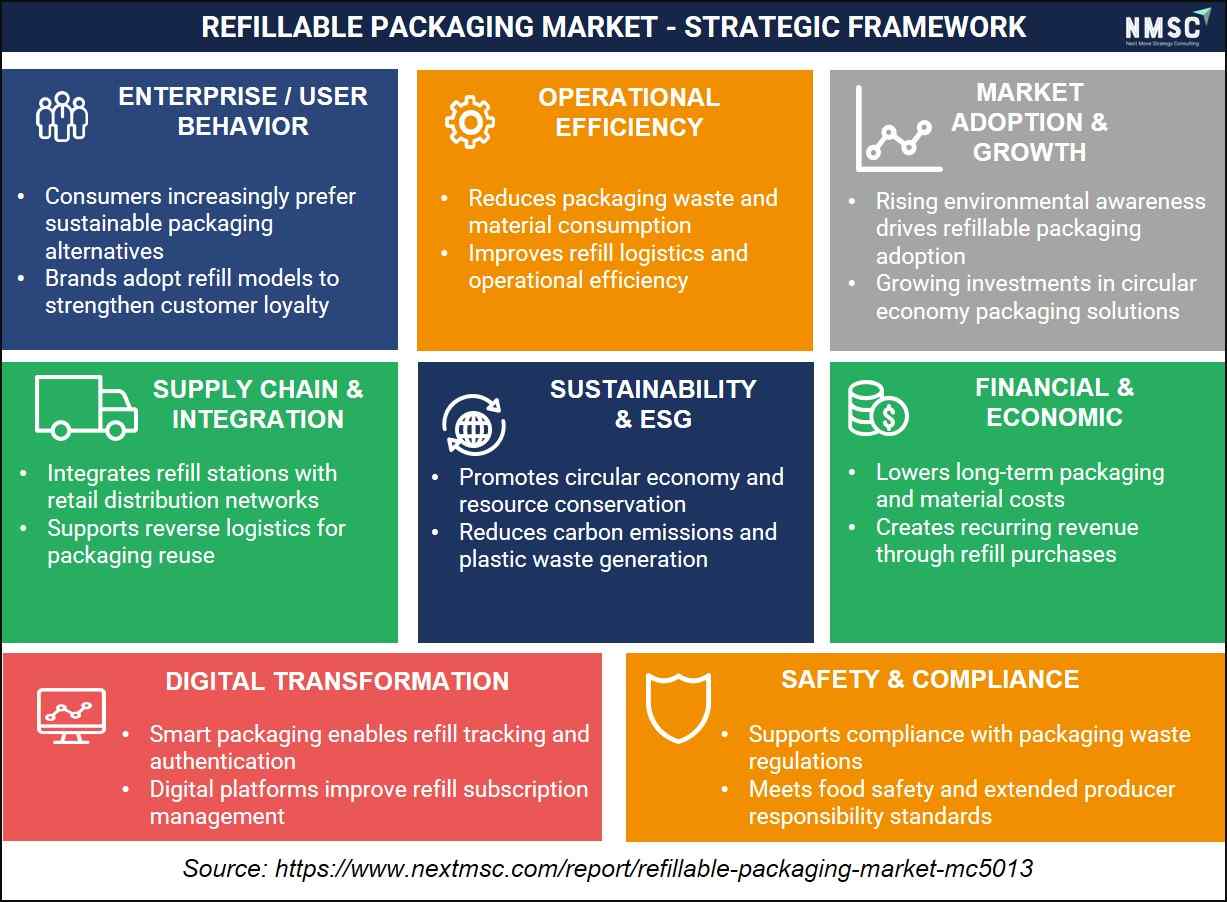
Based on our comprehensive assessment, we found that the Refillable Packaging Market is expanding due to rising environmental awareness, circular economy initiatives, and increasing consumer preference for sustainable products. Refill systems improve operational efficiency by reducing packaging waste and material consumption. Our analysis indicates that digital tracking technologies, reverse logistics integration, regulatory compliance, and recurring refill purchases are strengthening market growth and profitability.
Competitive Landscape
Competitive Dynamics and M&A Landscape
|
Key Takeaways |
Details |
|
Market Structure |
The global refillable packaging industry is moderately fragmented, with a mix of large multinational packaging conglomerates and specialized niche players. The top ten companies collectively account for approximately 38% of total market revenue, indicating significant competitive space for mid-tier and regional participants. |
|
Innovation Focus |
Leading players are investing heavily in refill ecosystem design, smart dosing technologies, airless pump systems, and lightweight glass alternatives. Material innovation in hybrid and paperboard refillable packaging structures is also an active R&D area, particularly among beauty and personal care packaging specialists. |
|
M&A Activity |
M&A activity in the refillable packaging sector has been primarily focused on expanding refill system capabilities, acquiring sustainable material innovators, and securing vertical integration across the packaging value chain. Strategic alliances between brand owners and packaging suppliers are increasingly formalizing refill ecosystem partnerships. |
How Do Companies Compete in the Refillable Packaging Market?
Competition in the refillable packaging market is structured around differentiated product innovation, material science investment, geographic manufacturing footprint, and refill ecosystem partnership capabilities. Leading companies including Amcor, Silgan Holdings, and AptarGroup compete through breadth of product portfolio, manufacturing scale, and established relationships with major multinational brand owners. Specialist players including Verescence, HEINZ-GLAS, and Lumson differentiate through premium glass manufacturing capabilities and expertise in luxury beauty refillable primary pack design. Pricing strategies across the market range from value-engineered plastic refillable solutions targeting mass market applications to ultra-premium glass and metal systems targeting prestige beauty and spirits brands.
Which Kind of Companies Dominate the Refillable Packaging Market?
The refillable packaging market is dominated by two primary categories of participants. The first category comprises global packaging conglomerates including Amcor, Ardagh Group, Silgan Holdings, and ALPLA, which serve a broad spectrum of end use industries with diverse material and format capabilities. The second category comprises specialized luxury and beauty packaging manufacturers including Verescence, HEINZ-GLAS, Lumson, Toly, and Texen, which focus specifically on high-value refillable primary packs and precision packaging components for prestige beauty, fragrance, and personal care brands. Strategic differentiation increasingly centers on sustainable material credentials, circular design capability, and ability to deliver validated multi-cycle refillable packaging systems at commercial scale.
Market Players to Opt for Merger and Acquisition Strategies to Expand Their Presence in the Refillable Packaging Market
M&A activity in the refillable packaging market is being driven by the strategic imperative to acquire sustainable material science capabilities, expand refill system engineering expertise, and secure vertical integration across the packaging value chain. Larger packaging conglomerates are targeting acquisitions of specialized refillable system innovators, sustainable material specialists, and luxury packaging manufacturers to accelerate their positioning in the premium refillable packaging segment. Strategic alliances between packaging suppliers and brand owners are also proliferating, with co-investment in refill infrastructure, collaborative design programs, and joint commercialization of refillable packaging platforms replacing purely transactional supply relationships.
Who Are the Key Market Players in the Refillable Packaging Market?
-
Amcor plc
-
Silgan Holdings Inc.
-
AptarGroup, Inc.
-
Glass, Inc.
-
Verallia SA
-
Ardagh Group S.A.
-
ALPLA Werke Alwin Lehner GmbH & Co KG
-
Gerresheimer AG
-
Albea S.A.
-
Quadpack Industries, S.A.
-
HCP Packaging USA, Inc.
-
Verescence France SAS
-
HEINZ-GLAS GmbH & Co. KGaA
-
Bormioli Luigi S.p.A.
-
Texen SAS
-
Lumson S.p.A.
-
Guala Closures S.p.A.
-
SCHOTT AG
-
Toly Products Limited
-
GEKA GmbH
What Are the Latest Developments in the Refillable Packaging Industry?
|
Date |
Event |
|
April 2026 |
Verallia SA launched its "Balance" range under the Selective Line brand. This premium glass packaging range applies advanced eco-design principles to significantly reduce carbon footprints, addressing the rising demand from spirits and food brands for sophisticated, lightweight glass that remains compatible with traditional industrial reuse and refill cycles. |
|
January 2026 |
Amcor plc partnered with a consortium of global brands (including L'Oréal, P&G, and Unilever) to launch a city-scale reusable packaging initiative in Ottawa, Canada. Scheduled for Q3 2026, this project tests shared infrastructure for collection, professional washing, and reverse logistics, creating a scalable "reuse blueprint" for retail environments. |
Expert Insights
 "Consumers do not wake up wanting a packaging system; they want a product they love, at a price that makes sense, in a format that is easy to use."
— Sian Sutherland, Co-Founder, A Plastic Planet
Statement made while discussing the factors influencing consumer adoption of refillable packaging solutions and the importance of convenience, affordability, and user experience in driving refill system acceptance.
Market Interpretation
The comment highlights a critical factor shaping the Refillable Packaging Market: consumer adoption depends not only on sustainability benefits but also on convenience, affordability, and product experience. As brands increasingly introduce refillable packaging formats to reduce packaging waste and support circular economy objectives, successful market expansion requires refill systems that seamlessly integrate into consumers' purchasing habits. Companies are therefore investing in user-friendly refill designs, retail refill infrastructure, lightweight refill packs, and cost-effective packaging solutions to encourage repeat usage. The growing emphasis on balancing sustainability with consumer convenience is expected to accelerate innovation and support broader adoption of refillable packaging across personal care, household, food, and beverage applications.
What Are the Investment Opportunities in the Refillable Packaging Market?
Capital Inflows and Infrastructure Investment
The refillable packaging market is attracting increasing capital inflows across manufacturing capacity expansion, refill infrastructure deployment, and sustainable material science R&D. European packaging manufacturers are benefiting from EU Green Deal funding mechanisms and national circular economy investment programs that provide grants and subsidized financing for refillable packaging capacity investment. Our assessment indicates that glass packaging manufacturers including Verallia and Ardagh Group are executing capital expenditure programs specifically targeting increased refillable glass production capacity in response to confirmed brand owner demand signals. Refill station infrastructure companies are attracting venture capital and private equity investment as the retail refill program market scales across Europe and Asia-Pacific.
ESG Investment Alignment and Sustainability Finance
The refillable packaging market is increasingly aligned with global ESG investment mandates, making it an attractive target for sustainability-focused institutional capital. Refillable packaging manufacturers with demonstrated circularity credentials are accessing favorable green bond and sustainability-linked loan financing terms from European and North American financial institutions. The EU Taxonomy for Sustainable Activities explicitly supports investment in circular packaging systems including reusable and refillable packaging as qualifying green economic activities. NMSC's analysis indicates that packaging companies with strong refillable product portfolios are achieving higher ESG ratings from major rating agencies, enabling lower-cost access to sustainability-linked financing instruments and attracting ESG-mandated institutional equity investors.
Private Equity and Venture Capital Activity
Private equity and venture capital investment in the refillable packaging market is concentrated in three primary areas: innovative refillable packaging system designers, concentrated refill product brands, and refill logistics and reverse logistics technology platforms. Venture-backed startups including Loop Industries, Splosh, and Bower Collective have demonstrated the commercial viability of D2C refill subscription models, attracting follow-on growth capital. Private equity firms are targeting bolt-on acquisitions of specialty refillable packaging manufacturers within the portfolios of larger packaging conglomerates, seeking to create focused sustainable packaging platforms with premium market positioning and strong recurring revenue from refill system replenishment contracts.
Digital Transformation Opportunities in Refillable Packaging
Digital technology investment is creating new commercial opportunities within the refillable packaging market through traceability, consumer engagement, and operational optimization applications. NFC-enabled and QR-coded refillable primary packs enable brand owners to authenticate refills, track refill cycles, collect consumer behavior data, and deliver personalized loyalty rewards through digital consumer touchpoints embedded within refillable packaging systems. Our findings suggest that digital refillable packaging platforms that integrate authentication, subscription management, and consumer engagement capabilities represent a high-growth investment theme within the broader market, with meaningful revenue model diversification potential for packaging manufacturers beyond traditional substrate supply.
Key Benefits for Stakeholders
For Brand Owners and Consumer Goods Companies
Brand owners and consumer goods companies gain access to a comprehensive commercial and regulatory intelligence framework for refillable packaging investment decision-making through this report. The segmentation analysis identifies which product family, material, and end use industry segments offer the highest growth rates and revenue potential, enabling strategic portfolio prioritization. Regional and country-level insights provide the regulatory environment context necessary to sequence refillable packaging rollouts across geographic markets efficiently. Competitive landscape analysis reveals where peer brands are investing and how packaging supplier partnerships are being structured, supporting negotiation strategy and supplier selection for refillable packaging programs.
For Packaging Manufacturers and Material Suppliers
Packaging manufacturers and material suppliers gain actionable intelligence on the fastest-growing material segments, end use applications, and buyer type channels within the refillable packaging market. The material segmentation reveals that Hybrid and Paperboard represent the highest-growth material categories at CAGRs of 13.8% and 13.1% respectively, providing strategic direction for R&D investment prioritization. Regional analysis identifies geographic markets where refillable packaging demand is accelerating most rapidly, informing manufacturing footprint expansion and market entry strategy. Competitive landscape and M&A analysis enables manufacturers to identify consolidation opportunities and capability gaps to address through organic investment or strategic acquisition.
For Investors and Financial Analysts
Investors and financial analysts access a structured, data-rich assessment of the refillable packaging market's growth trajectory, segment-level revenue forecasts, competitive dynamics, and M&A landscape through 2035. CAGR analysis by segment, material, buyer type, and region enables precise portfolio construction and valuation modeling for refillable packaging market participants. The investment opportunities section identifies the highest-conviction investment themes including Hybrid materials, Pharma and Healthcare end use adoption, E-commerce refill channel growth, and MEA regional expansion. Detailed company coverage of all 20 profiled packaging manufacturers provides an analytical foundation for screening acquisition targets, emerging leaders, and competitive risk assessment.
For Government and Regulatory Bodies
Government agencies and regulatory bodies gain a structured market analysis of how national and regional packaging reuse regulations are influencing commercial investment in the refillable packaging market. Country-level insights provide policymakers with evidence-based perspectives on how regulatory design choices, including deposit-return systems, EPR frameworks, and mandatory reuse targets, translate into measurable market outcomes. The regional analysis and growth driver narrative provides a comparative benchmarking tool for assessing the effectiveness of national refillable packaging policy interventions against international equivalents, supporting regulatory design and policy evaluation for plastic reduction and circular economy programs.
Refillable Packaging Market Key Segments
By Product Family
-
Refillable Primary Packs
-
Bottles
-
Jars
-
Tubes
-
Compacts and Cases
-
Other Primary Packs
-
-
Refill Packs
-
Inserts and Cartridges
-
Pods and Pouches
-
Sachets and Refill Bags
-
Other Refills
-
-
Packaging Components
-
Pumps and Dispensers
-
Closures and Caps
-
Applicators
-
Other Components
-
By Material
-
Glass
-
Plastic
-
PET
-
HDPE
-
PP
-
Other Plastic
-
-
Metal
-
Aluminium
-
Stainless Steel
-
-
Paperboard
-
Hybrid
By Buyer Type
-
Brand Owner
-
Private Label
-
Contract Manufacturer
-
Retailer
By Revenue Stream
-
New Refillable Packaging Sales
-
Refill Pack Sales
-
Packaging Component Sales
-
Refurbishment and Refill Services
By Sales Channel
-
Direct Sales
-
Distributor Sales
-
E-commerce Sales
-
Retail Refill Programs
By End Use Industry
-
Beauty and Personal Care
-
Skincare
-
Makeup
-
Fragrance
-
Haircare
-
Oral Care
-
Bath and Body
-
-
Home Care
-
Laundry Care
-
Surface Cleaners
-
Dishwashing
-
-
Food and Beverage
-
Alcoholic Beverages
-
Non-Alcoholic Beverages
-
Packaged Food
-
-
Pharma and Healthcare
-
Prescription
-
OTC
-
Nutraceuticals
-
-
Other Consumer Goods
By Region
-
North America: U.S., Canada, and Mexico.
-
Europe: UK, Germany, France, Italy, Spain, Sweden, Denmark, Finland, the Netherlands, and the rest of Europe.
-
Asia Pacific: China, India, Japan, South Korea, Taiwan, Indonesia , Vietnam, Australia, Philippines, Malaysia and the rest of APAC.
-
Middle East and Africa (MEA): Saudi Arabia, UAE, Egypt, Israel, Turkey, Nigeria, South Africa, and the rest of MEA.
-
Latin America: Brazil, Argentina, Chile, Colombia, and the rest of LATAM.
Conclusion and Recommendations
Long-Term Outlook
The refillable packaging market is entering a decade of structurally accelerating growth, advancing from USD 51.2 billion in 2026 to USD 99.6 billion by 2035 at a CAGR of 7.7%. This expansion reflects a fundamental shift in packaging industry economics, driven by tightening regulatory mandates for packaging reuse, escalating corporate ESG commitments from multinational brand owners, and rapidly maturing consumer behavioral adoption of refillable and refill-at-home purchasing models. NMSC's analysis indicates that by 2030, refillable packaging will represent a mandatory compliance reality rather than an optional sustainability initiative for brands operating in the EU, UK, and increasingly across major Asia-Pacific and Latin American markets.
Strategic Positioning Recommendations
Packaging manufacturers should prioritize refillable system engineering capabilities over conventional packaging capacity expansion in their capex planning through 2030. Investment in multi-material refillable packaging design, sustainable substrate innovation in Hybrid and Paperboard formats, and refill ecosystem partnership development will be the primary sources of competitive differentiation. Brand owners should embed refillable packaging KPIs into product development stage gates and establish multi-year refillable packaging supply partnerships with tier-one packaging manufacturers to secure capacity and co-investment in custom refillable system development. Retailers should accelerate in-store refill station deployment across beauty and home care as a commercial differentiator and consumer loyalty driver.
Investment Attractiveness
The refillable packaging market represents an attractive investment environment given durable regulatory tailwinds, growing brand owner capital commitments, and structural consumer behavioral shifts favoring sustainable packaging formats. The highest-conviction investment themes across the forecast period include Hybrid and Paperboard material innovation (CAGRs of 13.8% and 13.1% respectively), Refurbishment and Refill Services (12.3% CAGR), E-commerce Sales channel growth (11.6% CAGR), and MEA regional expansion (10.8% CAGR). Investors should monitor luxury packaging specialists including Verescence, Lumson, and Toly for consolidation activity, and track the scaling trajectories of D2C refill subscription brands as potential platform investment opportunities within the broader ecosystem.
Market Shifts and Key Risks
The most significant market shift underway is the migration from isolated refillable SKU pilots by brand owners toward system-wide refillable packaging architectures embedded in product line strategy, corporate ESG reporting, and supply chain operations. This shift fundamentally changes the commercial relationship between brand owners and packaging manufacturers from transactional to strategic partnership. Key risks for the refillable packaging market include consumer behavioral adoption rates falling below regulatory requirement assumptions, particularly in MEA and Latin America; logistical complexity and reverse logistics costs exceeding brand owner investment thresholds; and competitive pressure from advanced mono-material recyclable packaging alternatives that may partially substitute for refillable formats in certain end use applications.
Growth Pathways
Organizations seeking to maximize value from the refillable packaging market should pursue a three-horizon strategy. In the near term (2025 to 2027), prioritize refillable packaging system design and regulatory compliance preparation for EU PPWR reuse targets, and establish refill infrastructure pilot programs in key European and Asia-Pacific markets. In the mid-term (2027 to 2031), invest in Hybrid and Paperboard material refillable innovations, scale E-commerce refill subscription programs, and expand retail refill station partnerships with major retail chains across North America and APAC. In the long term (2031 to 2035), leverage established refillable packaging ecosystems to pursue market expansion across MEA and Latin America as regulatory frameworks mature and consumer adoption accelerates across these high-growth regions.
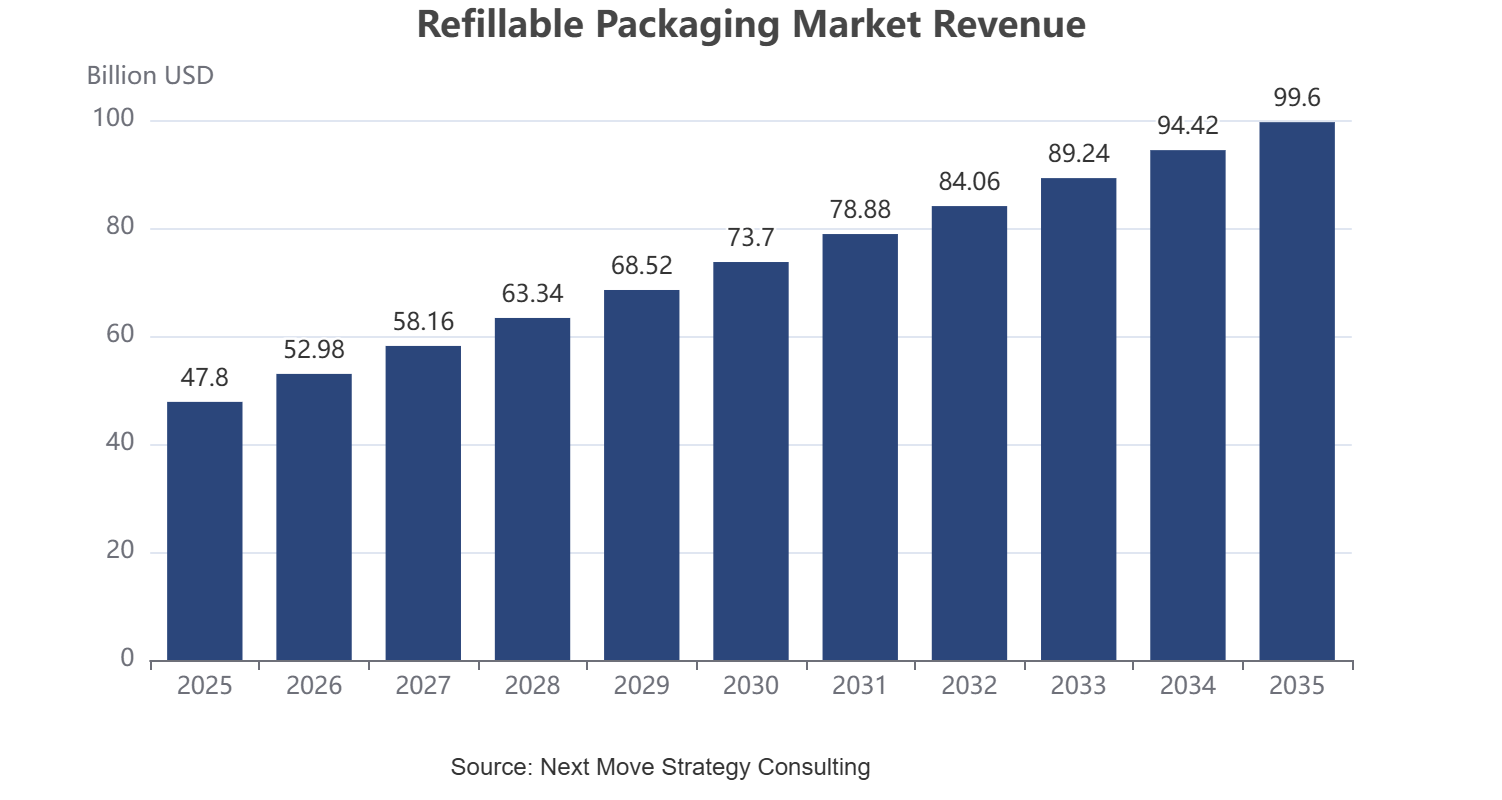
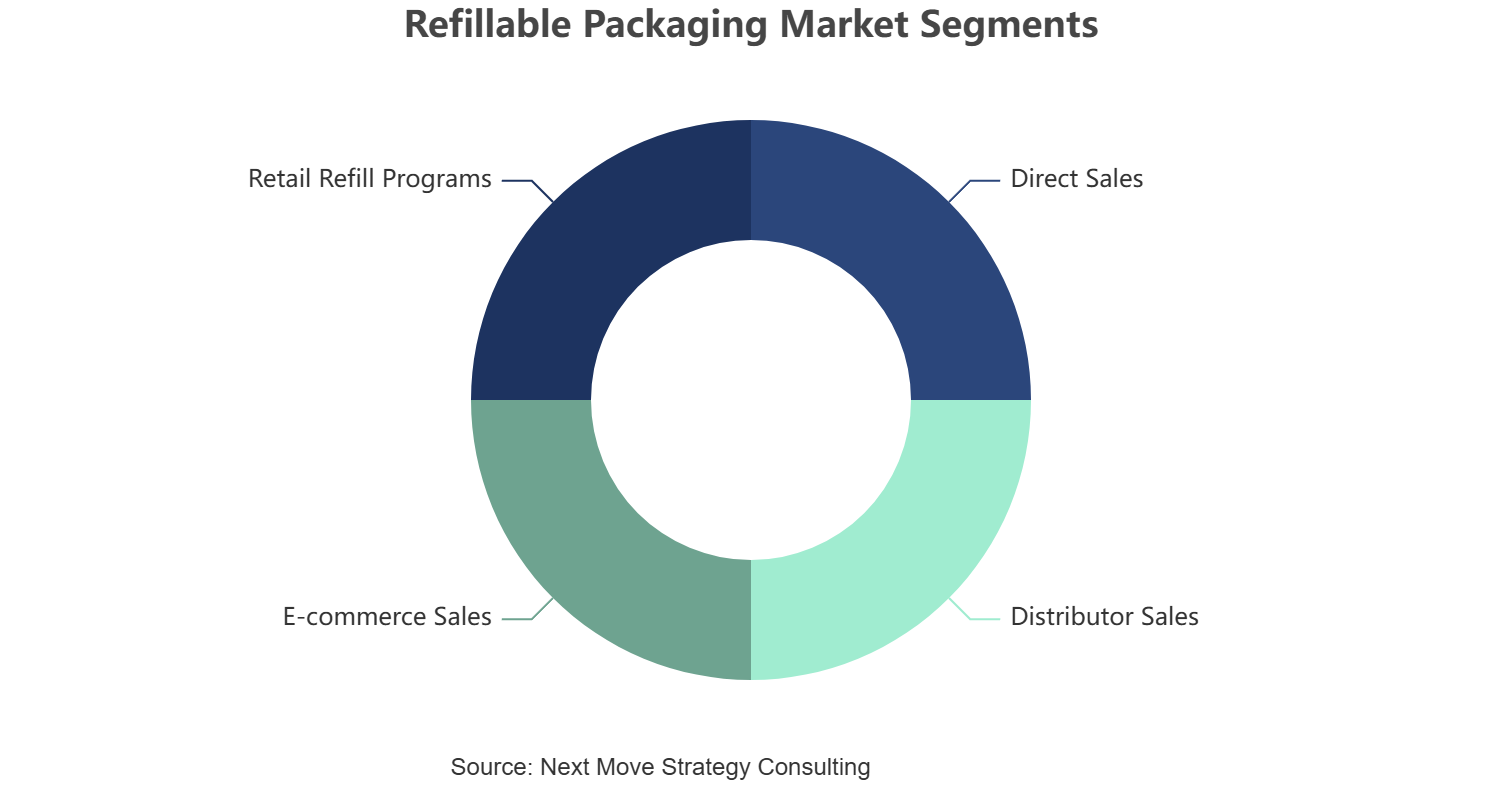
About the Author
 Saista Faiyaz
— Saista Faiyaz is Research Associate at Next Move Strategy Consulting, where she has covered consumer markets and healthcare technologies for 3 years. Her work includes primary interview review, secondary-source validation, market sizing, and structured analysis of company and industry data. She supports research by comparing evidence across sources, organizing findings into market narratives, and documenting assumptions used in analysis. Her scope includes cross-market benchmarking, and reports.
Saista Faiyaz
— Saista Faiyaz is Research Associate at Next Move Strategy Consulting, where she has covered consumer markets and healthcare technologies for 3 years. Her work includes primary interview review, secondary-source validation, market sizing, and structured analysis of company and industry data. She supports research by comparing evidence across sources, organizing findings into market narratives, and documenting assumptions used in analysis. Her scope includes cross-market benchmarking, and reports.
About the Reviewer
 Supradip Baul
— Supradip Baul is an accomplished business consultant and strategist with over a decade of rich experience in market intelligence, strategy, technology, and business transformation. His work has included rigorous qualitative and quantitative analysis across multiple industries, helping clients shape investment decisions and long-term roadmaps. Earlier in his career, he was associated with Gartner, where he contributed to industry-leading reports and market share analyses. He has worked with leading global companies and holds an MBA with a dual specialization in Marketing and Finance.
Supradip Baul
— Supradip Baul is an accomplished business consultant and strategist with over a decade of rich experience in market intelligence, strategy, technology, and business transformation. His work has included rigorous qualitative and quantitative analysis across multiple industries, helping clients shape investment decisions and long-term roadmaps. Earlier in his career, he was associated with Gartner, where he contributed to industry-leading reports and market share analyses. He has worked with leading global companies and holds an MBA with a dual specialization in Marketing and Finance.
At Next Move Strategy Consulting, we understand that insightful market research is the cornerstone of successful business decisions. That's why we employ a robust and multifaceted approach, combining various methodologies to deliver the most accurate and actionable data for our clients.

Research Landscape
We navigate the world of research with two primary approaches:
Qualitative Approach
Our qualitative research methodologies involve immersive techniques such as in-depth interviews, focus groups, and observational studies. By engaging directly with individuals and stakeholders, we uncover valuable insights that quantitative data alone may overlook.

Quantitative Research
In tandem with qualitative methodologies, NMSC leverages the power of Quantitative Research to provide a robust foundation of numerical insights. Through systematic data collection and analysis, we quantify patterns, preferences, and market trends, offering a comprehensive view of the business landscape.
Our quantitative research approach employs diverse tools, including surveys, experiments, and statistical modelling. These methodologies enable us to gather data from a large and representative sample, ensuring the statistical significance of our findings. By employing structured questionnaires and standardized data collection methods, we guarantee the reliability and validity of the information we present to our clients.
Quantitative research is particularly effective in measuring the prevalence of trends, assessing market size, and gauging the impact of various factors on consumer behavior. The numerical precision attained through this approach equips our clients with actionable insights, facilitating data-driven decision-making and strategy formulation.


Our Specialized Toolbox for Industry-Specific Market Research
We deploy a specialized arsenal of techniques tailored to meet your unique requirements. Here's a glimpse into our comprehensive toolbox:

Information Procurement
The stage entails acquiring market data or relevant information through various sources and methodologies.


Market Research Approach
We utilize both top-down and bottom-up approaches in market research analysis to achieve a comprehensive understanding of the market dynamics, leveraging the broad perspective of industry trends and macroeconomic factors alongside detailed insights from specific segments and individual companies.

Porters Five Forces Analysis
We conduct Porter's Five Forces analysis to evaluate the competitive landscape of an industry, providing us with insights into factors that affect profitability and strategic positioning.

SWOT Analysis

Forecasting
We utilize a forecasting model to predict future consumption by considering parameters like population, economics, regulations, market competition, drivers, constraints, technology, and pricing. We also employ statistical techniques such as multilinear regression, exponential smoothing, moving average, ARIMA, and Monte Carlo simulations for accurate predictions. In econometric forecasting, we analyzed short-term and long-term event impacts, attributing values based on regulatory frameworks, economic factors, and market events.





 Speak to Our Analyst