Sustainable Packaging Market Size, Share, Trends and Growth Analysis, By Packaging (Fibre & Paper, Plastic, Metal, Glass, and Hybrid & Other Packaging), By Circularity Claim (Recyclable, Recycled Content, Reusable, Compostable, and Bio-based), By Pack Layer, By Buyer Type, By Sales Channel, By End Use (Food, Beverage, Foodservice, Personal Care & Home Care, Healthcare, Industrial & Chemical, E-commerce and Others), and Region – Global Industry Report and Forecast, 2026–2035.
What Is the Sustainable Packaging Market Size?
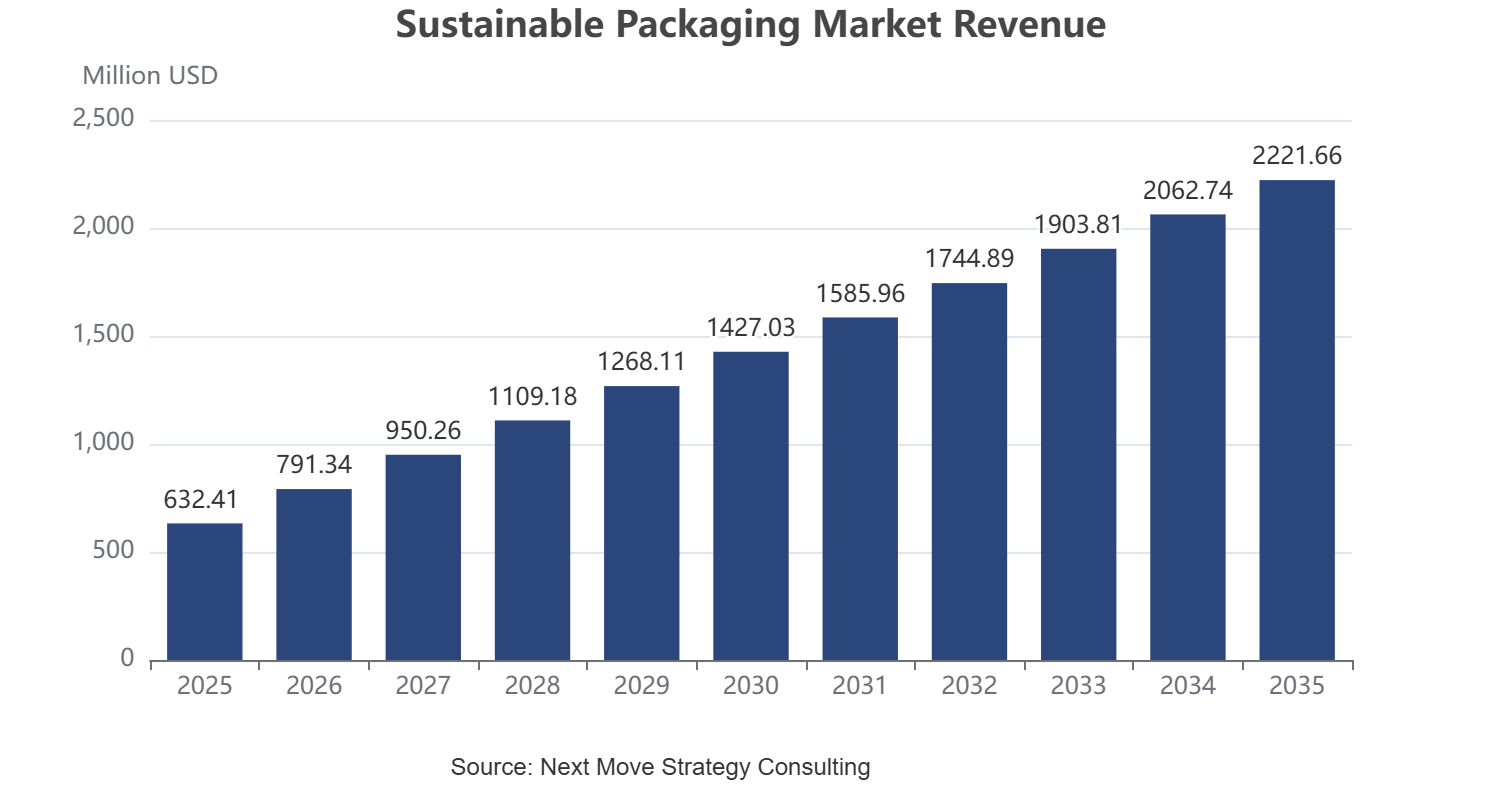
The global sustainable packaging market size was valued at USD 632.41 million in 2025 and is estimated at USD 717.08 million in 2026, forecast to reach USD 2,221.66 million by 2035, expanding at a 13.39% CAGR between 2026 and 2035. Asia-Pacific leads with approximately 33% share, while Fibre and Paper Packaging dominates all other packaging formats with approximately 48% share.
We observed that growth is broad-based across every segmentation axis, with hybrid formats and e-commerce-driven demand driving the most pronounced structural shifts through 2035.
|
Key Takeaways |
|
By Packaging: Fibre and Paper Packaging held the largest share of approximately 48% (USD 303.56 million) in 2025; Hybrid and Other Packaging is the fastest-growing sub-segment at 25.5% CAGR from 2026–2035. |
|
By Circularity Claim: Recyclable held the largest share of approximately 46% (USD 290.91 million) in 2025; Compostable is the fastest-growing sub-segment at 16.4% CAGR from 2026–2035. |
|
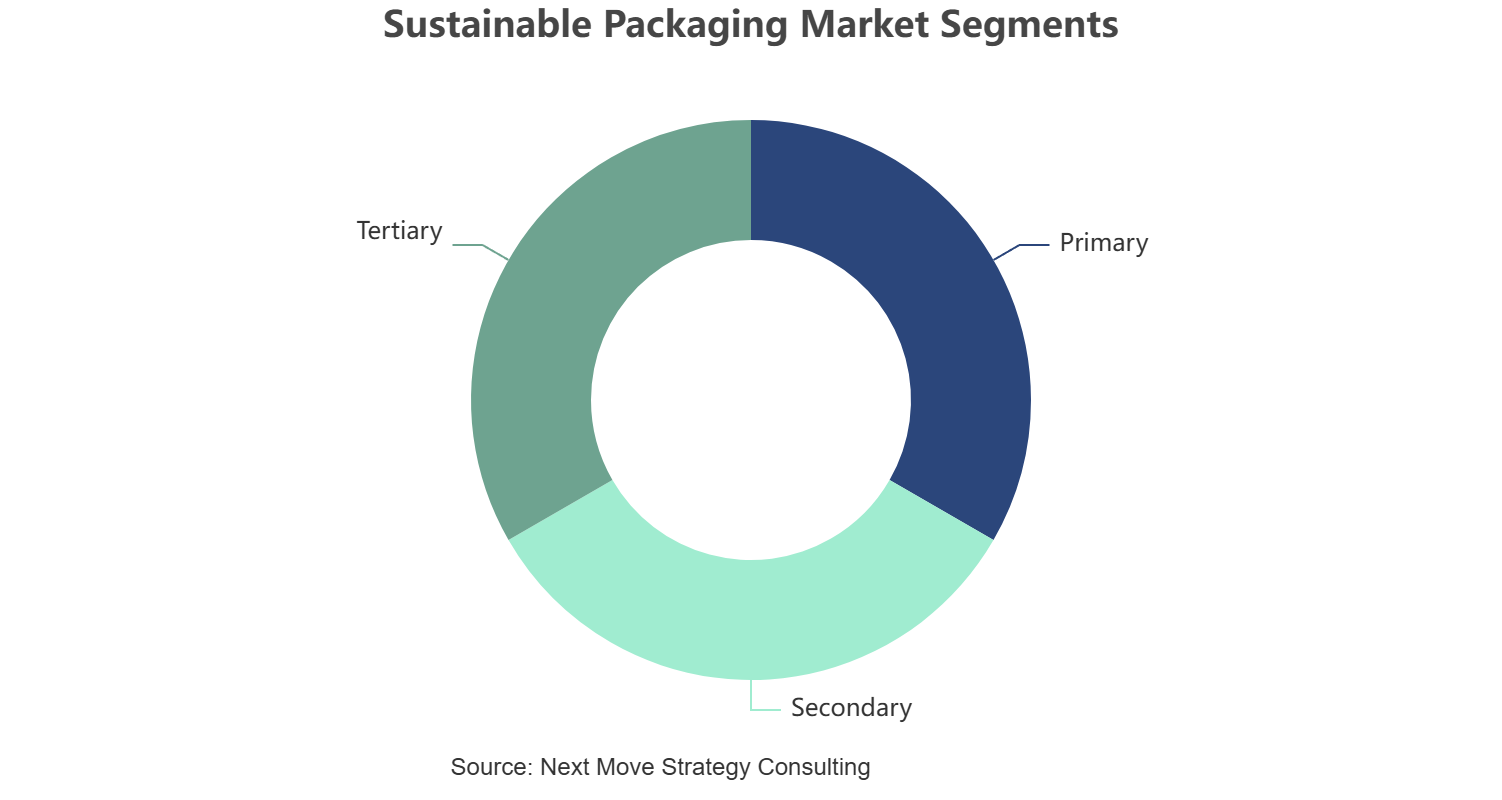
By Pack Layer: Primary held the largest share of approximately 62% (USD 392.09 million) in 2025; Tertiary is the fastest-growing sub-segment at 18.1% CAGR from 2026–2035. |
|
By Buyer Type: Brand Owner held the largest share of approximately 42% (USD 265.62 million) in 2025; Logistics Operator is the fastest-growing sub-segment at 19.5% CAGR from 2026–2035. |
|
By Sales Channel: Direct held the largest share of approximately 44% (USD 278.26 million) in 2025; E-commerce is the fastest-growing sub-segment at 19.7% CAGR from 2026–2035. |
|
By End Use: Food held the largest share of approximately 34% (USD 215.04 million) in 2025; E-commerce and Retail is the fastest-growing sub-segment at 21.5% CAGR from 2026–2035. |
|
Dominant Region: Asia-Pacific dominated with approximately 33% revenue share (USD 208.70 million) in 2025. |
|
Fastest-Growing Region: Asia-Pacific is also expected to register the highest regional CAGR of 14.7% during 2026–2035. |
|
Dominant Country: The U.S. led with approximately USD 155.57 million in 2025. |
|
Fastest-Growing Country: India is the fastest-growing country at approximately 18.0% CAGR from 2026–2035. |
Market Opportunity: The sustainable packaging market is expected to create an absolute dollar opportunity of USD 1,504.58 million between 2026 and 2035, presenting significant investment potential across recycled-content fibre packaging, compostable formats, and e-commerce-optimized pack layers.
According to Next Move Strategy Consulting analysis, large-scale packaging mergers completed in 2025 are consolidating recycled-content fibre capacity faster than regulatory compliance deadlines require, positioning early-mover consolidators to capture disproportionate share of EU Packaging and Packaging Waste Regulation-driven demand through 2035.
What Does the Sustainable Packaging Market Encompass?
The sustainable packaging market encompasses fibre and paper, plastic, metal, glass, and hybrid packaging formats designed for recyclability, recycled content, reusability, compostability, or bio-based composition across primary, secondary, and tertiary pack layers. We observed that the scope spans brand owners, retailers, foodservice operators, industrial manufacturers, logistics operators, and public sector buyers sourcing through direct, distributor, converter, e-commerce, and contract packager channels for food, beverage, foodservice, personal care, healthcare, and e-commerce and retail end uses. The category has evolved from a compliance-driven cost center into a brand differentiation and supply chain resilience priority as large-scale packaging consolidation accelerates.
Regulatory frameworks such as the European Union's Packaging and Packaging Waste Regulation (EU) 2025/40 shape recyclability, recycled content, and reuse requirements across the industry. Our assessment indicates that technology adoption is shifting toward mono-material recyclable structures and verified recycled-content fibre sourcing following major sector consolidation. Next Move Strategy Consulting's analysis indicates that this structural shift, combined with large-scale packaging company mergers, is redefining procurement criteria across the sustainable packaging market.
|
Parameter |
Details |
|
Market Size in 2025 |
USD 632.41 Million |
|
Market Size in 2026 |
USD 717.08 Million |
|
Revenue Forecast in 2035 |
USD 2,221.66 Million |
|
Growth Rate |
CAGR of 13.39% from 2026 to 2035 |
|
Analysis Period |
2025–2035 |
|
Base Year Considered |
2025 |
|
Forecast Period |
2026–2035 |
|
Market Size Estimation |
USD Million |
|
Companies Profiled |
20 |
|
Countries Covered |
33 |
|
Market Share |
Available for Top 10 Companies |
Key Emerging Trends
Based on research conducted by Next Move Strategy Consulting, we found that four structural trends are reshaping product design, corporate consolidation, and stakeholder engagement across the industry.
How Is Large-Scale Packaging Consolidation Reshaping Fibre Capacity?
Large-scale packaging consolidation is reshaping fibre-based sustainable packaging capacity as major producers merge to expand recycled-content manufacturing scale. We observed that International Paper completed its acquisition of DS Smith on January 31, 2025, creating a combined company deriving approximately 90% of revenue from sustainable fibre-based packaging. This consolidation, following Smurfit Kappa's earlier combination with WestRock, is concentrating recycled-content fibre capacity among fewer, larger integrated producers.
Why Is Mono-Material Design Gaining Adoption Across Plastic Formats?
Mono-material design is gaining adoption as brand owners simplify plastic packaging structures to improve recyclability. Our findings suggest that Amcor's completed combination with Berry Global, finalized April 30, 2025, is accelerating the development of recyclable and lightweight flexible packaging formats across personal care and household applications. This convergence of material science capabilities is positioning combined entities to scale mono-material solutions faster than standalone competitors.
How Is the EU Packaging and Packaging Waste Regulation Driving Design Changes?
The European Union's Packaging and Packaging Waste Regulation is driving design changes across all packaging formats sold in the bloc. We observed that the regulation entered into force on February 11, 2025, and applies generally from August 12, 2026, establishing recyclability, recycled content, and reuse requirements across the packaging lifecycle. Manufacturers are increasingly redesigning primary and secondary pack layers to meet design-for-recycling criteria ahead of phased compliance deadlines extending to 2030 and beyond.
What Role Does E-Commerce Growth Play in Tertiary Packaging Innovation?
E-commerce growth is driving innovation in tertiary and secondary packaging designed to reduce void fill and improve parcel-level recyclability. Based on research conducted by Next Move Strategy Consulting, we found that logistics operators and online retailers are increasingly specifying right-sized, curbside-recyclable corrugated formats to reduce shipping costs and packaging waste simultaneously. This shift is elevating demand for fibre-based tertiary packaging over traditional plastic void-fill materials.
Strategic Framework Of The Sustainable Packaging Market
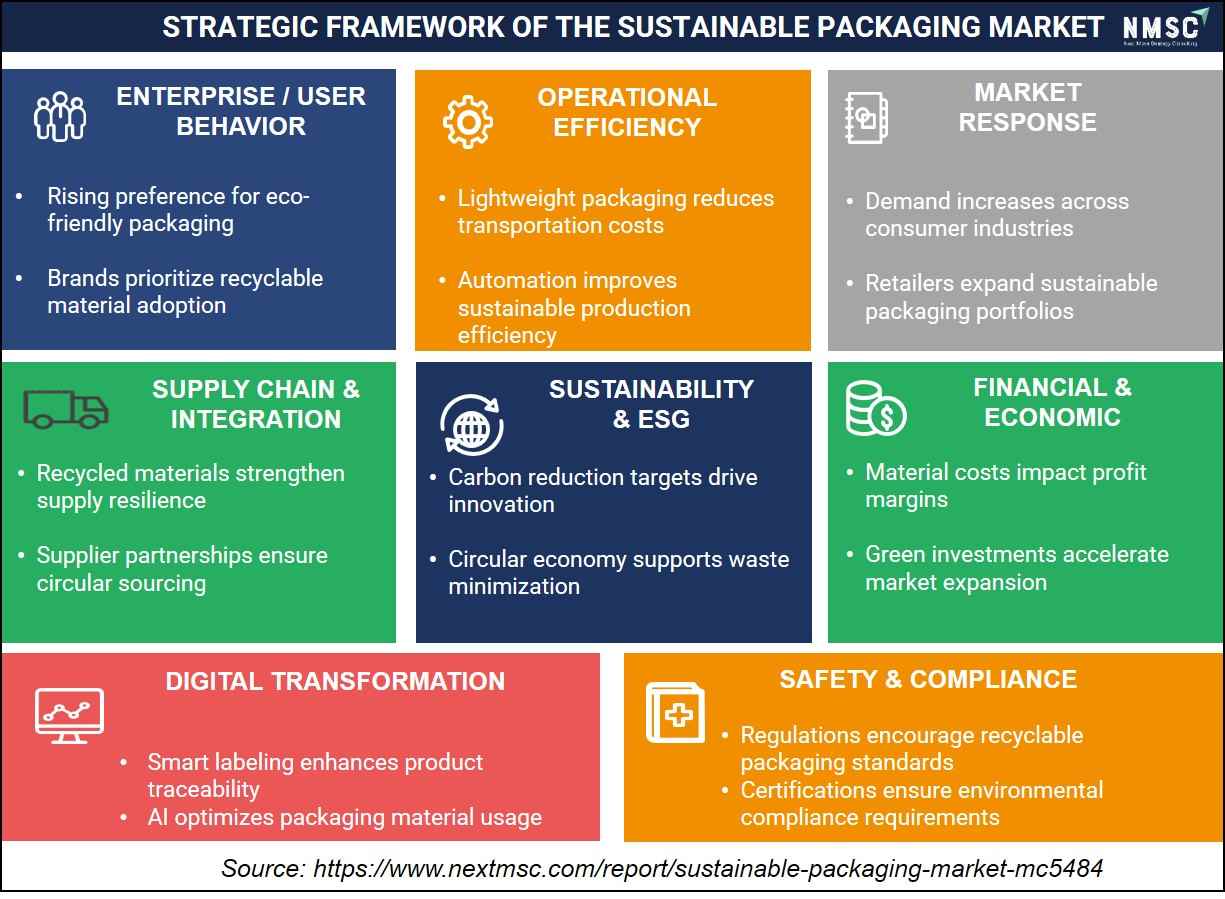
The strategic framework of the sustainable packaging market illustrates the major factors driving industry growth. Rising consumer demand for eco-friendly packaging, recyclable materials, and lightweight designs improves operational efficiency and market adoption. Strong supply chain partnerships, circular economy initiatives, and ESG commitments support sustainability goals. Digital technologies such as AI and smart labeling enhance traceability and resource optimization, while regulatory compliance and green investments accelerate innovation, competitiveness, and long-term market expansion.
Growth Drivers and Restraints
Growth Catalyst and Risk Assessment Matrix
|
Factors |
Type |
(+/−) % Impact on CAGR |
Geographic Relevance |
Impact Timeline |
|
Brand owner commitments to recyclable and recycled-content packaging |
Driver |
+3.8% |
Global |
2026–2035 |
|
EU Packaging and Packaging Waste Regulation compliance requirements |
Driver |
+2.9% |
Europe |
2026–2032 |
|
Large-scale packaging company consolidation expanding recycled fibre capacity |
Driver |
+2.2% |
North America, Europe |
2026–2030 |
|
E-commerce growth driving right-sized, recyclable parcel packaging demand |
Driver |
+2.0% |
Global |
2026–2035 |
|
Asia-Pacific manufacturing and consumption base expansion |
Driver |
+1.9% |
Asia-Pacific |
2026–2035 |
|
Retailer and foodservice compostable packaging adoption |
Driver |
+1.1% |
Global |
2026–2032 |
|
Higher input costs for recycled and bio-based materials versus virgin plastic |
Restraint |
−1.4% |
Global |
2026–2030 |
|
Inconsistent recycling infrastructure across regions |
Restraint |
−1.0% |
Global |
2026–2032 |
|
Integration risk following large-scale packaging mergers |
Restraint |
−0.6% |
North America, Europe |
2026–2028 |
What Is the Primary Growth Driver of the Sustainable Packaging Market?
Brand owner commitments to recyclable and recycled-content packaging remain the primary driver of the market. The European Union's Packaging and Packaging Waste Regulation (EU) 2025/40 establishes binding recyclability and recycled content requirements across all packaging placed on the EU market. We observed that this regulatory pressure, combined with brand owner sustainability commitments, is sustaining sequential investment among leading fibre and plastic packaging producers.
How Is Packaging Industry Consolidation Driving Market Growth?
Large-scale packaging industry consolidation is driving growth by concentrating capital and recycled-content manufacturing capability behind fewer, larger producers. International Paper's completed acquisition of DS Smith created a company deriving approximately 90% of revenue from sustainable fibre-based packaging, according to the company's official announcement. Our assessment indicates that this consolidation, alongside Amcor's combination with Berry Global, is accelerating scale-driven innovation in recyclable and lightweight packaging formats through 2035.
What Is Restraining Sustainable Packaging Market Expansion?
Higher input costs for recycled and bio-based materials relative to virgin plastic restrain broader market expansion. Industry-derived estimates indicate that recycled-content fibre and bioplastic feedstock remain more expensive than conventional virgin materials in most regions, extending payback periods for brand owners transitioning packaging portfolios. We found that inconsistent recycling infrastructure across emerging markets further compounds this restraint, limiting the practical recyclability of packaging formats designed to EU specification.
Segmentation Analysis
Segment Sizing: By Packaging
|
Segment |
2025 (USD) |
2035 (USD) |
CAGR% (2026–2035) |
|
Fibre and Paper Packaging |
USD 303.56 Million |
USD 999.75 Million |
12.7% |
|
Plastic Packaging |
USD 189.72 Million |
USD 599.85 Million |
12.2% |
|
Metal Packaging |
USD 75.89 Million |
USD 266.6 Million |
13.4% |
|
Glass Packaging |
USD 37.94 Million |
USD 111.08 Million |
11.3% |
|
Hybrid and Other Packaging |
USD 25.3 Million |
USD 244.38 Million |
25.5% |
|
Total |
USD 632.41 Million |
USD 2221.66 Million |
13.39% |
Which Packaging Segment Dominates the Sustainable Packaging Market?
Fibre and Paper Packaging led the market with USD 303.56 million in 2025, supported by its established recyclability profile and the scale advantages created by recent industry consolidation. We observed that Hybrid and Other Packaging is the fastest-growing segment, expanding at a 25.5% CAGR from 2026 to 2035, as fibre-plastic hybrid structures and novel bio-composites gain adoption among brand owners seeking barrier performance alongside improved recyclability credentials.
Segment Sizing: By Circularity Claim
|
Segment |
2025 (USD) |
2035 (USD) |
CAGR% (2026–2035) |
|
Recyclable |
USD 290.91 Million |
USD 888.65 Million |
11.8% |
|
Recycled Content |
USD 164.43 Million |
USD 599.85 Million
|
13.8% |
|
Reusable |
USD 75.89 Million |
USD 288.82 Million |
14.3% |
|
Compostable |
USD 63.24 Million |
USD 288.82 Million |
16.4% |
|
Bio-based |
USD 37.94 Million |
USD 155.52 Million |
15.2% |
|
Total |
USD 632.41 Million |
USD 2221.66 Million |
13.39% |
Which Circularity Claim Segment Leads Market Demand?
Recyclable remained the leading circularity claim, valued at USD 290.91 million in 2025, reflecting its broad applicability across fibre, plastic, and metal formats. Our findings suggest that Compostable is the fastest-growing circularity claim, registering a 16.4% CAGR from 2026 to 2035, as foodservice operators and personal care brands increasingly specify compostable formats for single-use applications where mechanical recycling infrastructure remains limited.
Segment Sizing: By End Use
|
Segment |
2025 (USD) |
2035 (USD) |
CAGR% (2026–2035) |
|
Food |
USD 215.04 Million |
USD 666.49 Million |
12.0% |
|
Beverage |
USD 126.48 Million |
USD 399.9 Million |
12.2% |
|
Foodservice |
USD 75.89 Million |
USD 244.38 Million |
12.4% |
|
Personal Care and Home Care |
USD 63.24 Million |
USD 199.95 Million |
12.2% |
|
Healthcare |
USD 50.59 Million |
USD 199.95 Million |
14.7% |
|
Industrial and Chemical |
USD 37.94 Million |
USD 133.3 Million |
13.4% |
|
E-commerce and Retail |
USD 37.94 Million |
USD 266.6 Million |
21.5% |
|
Agriculture |
USD 18.97 Million |
USD 88.87 Million |
16.7% |
|
Other |
USD 6.32 Million |
USD 22.22 Million |
13.4% |
|
Total |
USD 632.41 Million |
USD 2221.66 Million |
13.39% |
Which End Use Segment Dominates the Sustainable Packaging Market?
Food remained the leading end use, reaching USD 215.04 million in 2025, as food brand owners face the most extensive regulatory and consumer pressure to adopt sustainable formats. Based on research conducted by Next Move Strategy Consulting, we found that E-commerce and Retail is the fastest-growing end use, expanding at a 21.5% CAGR from 2026 to 2035, as online retailers scale right-sized, curbside-recyclable parcel packaging to reduce both shipping costs and packaging waste.
Growth Opportunities
Our analysis shows that three forward-looking opportunities stand out for stakeholders positioning within the sustainable packaging market over the 2026–2035 forecast period.
How Can Recycled-Content Fibre Capacity Unlock Value for Consolidated Producers?
Recycled-content fibre capacity presents a significant opportunity for producers that have consolidated scale through recent mergers. Companies that integrate acquired fibre assets into unified recycled-content supply chains stand to capture long-term contracts with brand owners seeking verified, high-recycled-content corrugated and folding carton packaging ahead of EU Packaging and Packaging Waste Regulation compliance deadlines.
Where Does Compostable Foodservice Packaging Create New Demand?
Compostable foodservice packaging represents an underpenetrated opportunity as foodservice operators seek single-use format alternatives where mechanical recycling remains impractical. Suppliers that scale certified compostable fibre and bioplastic foodservice packaging can capture recurring contracts with quick-service restaurants and institutional foodservice operators transitioning away from conventional plastic formats.
How Can Right-Sized E-Commerce Packaging Benefit Logistics Operators?
Right-sized, curbside-recyclable e-commerce packaging creates an opportunity for suppliers serving logistics operators and online retailers seeking to reduce void fill and shipping costs simultaneously. Providers that offer automated pack-sizing solutions paired with fibre-based, recyclable tertiary packaging can capture growing contract volume as e-commerce order volumes continue to scale globally.
Supply Chain Structure Of The Sustainable Packaging Market
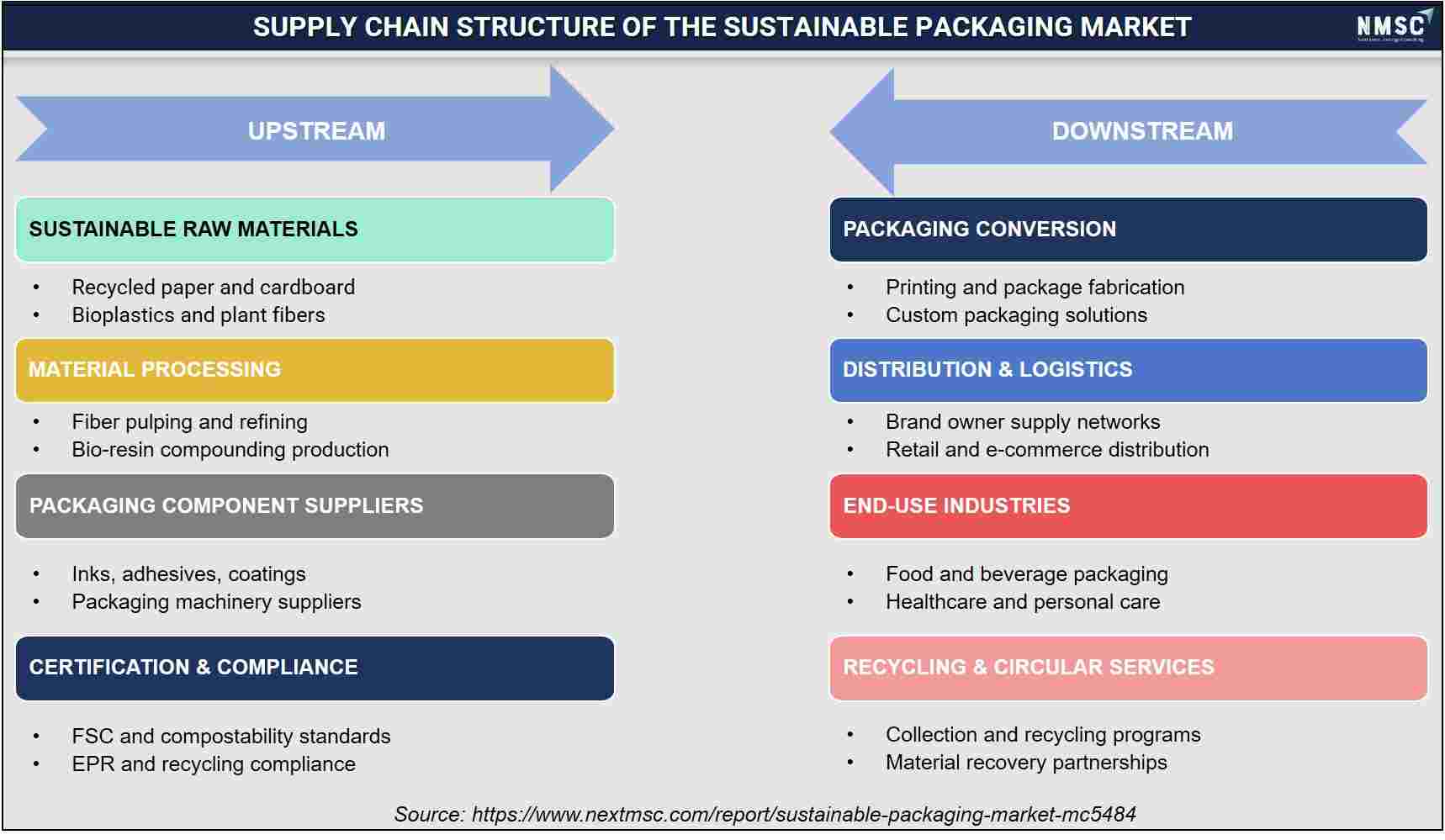
The supply chain structure of the sustainable packaging market begins with upstream activities, including sourcing recycled paper, bioplastics, and plant-based fibers, followed by material processing, component supply, and compliance with sustainability standards. Downstream operations involve packaging conversion, distribution, and delivery to end-use industries such as food, beverages, healthcare, and personal care. The cycle is completed through recycling and circular economy services, ensuring material recovery, waste reduction, and sustainable resource utilization.
Regional Outlook
Geographic Performance Snapshot
|
Region |
2025 (USD) |
2035 (USD) |
CAGR% (2026–2035) |
Key Driver |
|
North America |
USD 189.72 Million |
USD 599.85 Million |
12.2% |
Large-scale fibre packaging consolidation and brand owner sustainability commitments |
|
Europe |
USD 170.75 Million |
USD 533.2 Million |
12.1% |
EU Packaging and Packaging Waste Regulation compliance requirements |
|
Asia-Pacific |
USD 208.7 Million |
USD 822.01 Million |
14.7% |
Expanding manufacturing base and rising e-commerce packaging demand |
|
Middle East & Africa |
USD 31.62 Million |
USD 133.3 Million |
15.5% |
Growing retail modernization and national sustainability initiatives |
|
Latin America |
USD 31.62 Million |
USD 133.3 Million |
15.5% |
Expanding food and beverage packaging demand and retail sector growth |
|
Total |
USD 632.41 Million |
USD 2221.66 Million |
13.39% |
— |
North America Sustainable Packaging Market Outlook
North America's sustainable packaging market reflects a landscape reshaped by International Paper's completed acquisition of DS Smith, which created a company deriving approximately 90% of revenue from sustainable fibre-based packaging. We observed that brand owner sustainability commitments continue to drive demand for recyclable and recycled-content formats across food, beverage, and e-commerce applications. Technology adoption favors mono-material recyclable structures, and strategic outlook remains positive through 2035.
Europe Sustainable Packaging Market Outlook
Europe's market reflects a regulation-intensive landscape shaped by the European Union's Packaging and Packaging Waste Regulation (EU) 2025/40. Our findings suggest that recyclability and recycled content requirements, applying generally from August 2026, are accelerating demand for verified circular packaging among brand owners in Germany, France, and the UK. Technology adoption favors design-for-recycling formats, and competitive intensity remains high among established European and global producers.
Asia-Pacific Sustainable Packaging Market Outlook
Asia-Pacific is the dominant and fastest-growing region in the sustainable packaging market, anchored by expanding manufacturing capacity and rapidly scaling e-commerce demand across China, Japan, and South Korea. We found that regional brand owners and retailers are increasingly specifying recyclable and recycled-content formats to align with export market requirements. Regulatory frameworks remain less harmonized than in Europe, and technology adoption is accelerating across fibre-based and compostable packaging formats.
Middle East & Africa Sustainable Packaging Market Outlook
The Middle East & Africa market is expanding as retail modernization and national sustainability initiatives drive demand for recyclable and recycled-content packaging. Our analysis shows that Saudi Arabia and the UAE are attracting growing brand owner investment in sustainable packaging formats tied to broader economic diversification programs. Regulatory frameworks remain developing, and technology adoption is gradually shifting toward internationally recognized circularity standards.
Latin America Sustainable Packaging Market Outlook
Latin America's market is supported by expanding food and beverage packaging demand and growing retail sector modernization in Brazil and Argentina. We observed that regulatory frameworks remain less harmonized than in North America or Europe, though extended producer responsibility initiatives are gaining traction regionally. Technology adoption remains centered on established recyclable fibre and plastic formats, with competitive intensity increasing as global producers expand regional distribution partnerships.
U.S. Sustainable Packaging Market
Based on our estimates, the U.S. market was valued at approximately USD 155.57 million in 2025 and is projected to reach USD 467.88 million by 2035, growing at an 11.6% CAGR. Demand is anchored by International Paper's completed acquisition of DS Smith and continued brand owner sustainability commitments. Technology penetration favors recyclable fibre and mono-material plastic formats, and competitive intensity is high among International Paper, Ball Corporation, Graphic Packaging, Sonoco Products, and Dart Container serving national brand owner and retailer customers.
Canada Sustainable Packaging Market
The market in Canada reached roughly USD 22.77 million in 2025 and is forecast to hit USD 83.98 million by 2035 at a 13.9% CAGR. Demand structure mirrors U.S. brand owner and retailer sustainability commitments, supported by national extended producer responsibility programs. Technology penetration is rising as Cascades and other regional fibre producers expand recycled-content capacity, with competitive intensity moderate given reliance on cross-border supply from U.S.-based producers.
UK Sustainable Packaging Market
As per our estimate, the UK market stood at about USD 40.98 million in 2025, advancing toward USD 122.64 million by 2035 at an 11.6% CAGR. Demand is driven by DS Smith's legacy UK manufacturing base, now integrated within International Paper, and continued retailer packaging reduction commitments. Regulatory influence remains significant under UK extended producer responsibility rules, technology penetration favors recyclable fibre formats, and competitive intensity remains steady among domestic and international producers.
Germany Sustainable Packaging Market
According to our analysis, Germany's market was valued near USD 51.23 million in 2025 and is set to reach USD 154.63 million by 2035, expanding at an 11.7% CAGR. Demand structure benefits from Germany's mature packaging recycling infrastructure and strong domestic fibre packaging base. Germany's implementation of the EU Packaging and Packaging Waste Regulation drives regulatory influence, while technology penetration favors verified recycled-content and design-for-recycling formats.
France Sustainable Packaging Market
Based on our estimates, France's market reached approximately USD 30.73 million in 2025, projected to climb to USD 90.64 million by 2035 at an 11.4% CAGR. Demand is supported by national extended producer responsibility programs and growing retailer sustainability commitments. Regulatory influence from EU Packaging and Packaging Waste Regulation compliance is notable, and competitive intensity remains moderate given the concentration of European fibre and plastic packaging producers.
China Sustainable Packaging Market
The market in China stood at roughly USD 79.31 million in 2025 and is forecast to reach USD 271.26 million by 2035, registering a 13.1% CAGR. Demand is fueled by the country's expansive manufacturing and export packaging base and rapidly scaling e-commerce sector. Regulatory influence is increasing gradually under domestic circular economy policy, technology penetration is advancing across recyclable fibre and plastic formats, and competitive intensity remains high among domestic and international producers.
India Sustainable Packaging Market
As per our estimate, India's market was valued at about USD 37.57 million in 2025, projected to reach USD 197.28 million by 2035 at an 18.0% CAGR, the fastest among all covered countries. Demand structure reflects rapidly expanding e-commerce and food and beverage packaging consumption. Regulatory influence remains developing under national plastic waste management rules, while technology penetration is rising quickly as international producers expand local recyclable and compostable packaging capacity.
Japan Sustainable Packaging Market
According to our analysis, Japan's market reached close to USD 33.39 million in 2025 and is expected to hit USD 115.08 million by 2035, growing at a 13.2% CAGR. Demand is supported by Japan's established container and packaging recycling law framework and strong domestic fibre packaging base. Regulatory influence is well established, technology penetration is advanced across recyclable and mono-material formats, and competitive intensity remains high among established domestic and international producers.
South Korea Sustainable Packaging Market
Based on our estimates, South Korea's market stood at approximately USD 25.04 million in 2025, forecast to reach USD 90.42 million by 2035 at a 13.7% CAGR. Demand structure benefits from the country's extended producer responsibility system and expanding e-commerce packaging consumption. Technology penetration is rising as brand owners adopt recyclable and recycled-content formats, and competitive intensity remains moderate amid growing international producer presence.
Australia Sustainable Packaging Market
The market in Australia reached about USD 16.70 million in 2025 and is projected to reach USD 57.54 million by 2035, expanding at a 13.2% CAGR. Demand is supported by the national packaging covenant and growing retailer sustainability commitments. Regulatory influence stems from national packaging targets for recyclability and recycled content, while technology penetration favors imported recyclable fibre and plastic formats amid moderate competitive intensity.
UAE Sustainable Packaging Market
As per our estimate, the UAE market was valued near USD 10.12 million in 2025, projected to reach USD 39.99 million by 2035 at a 14.7% CAGR. Demand structure is shaped by the UAE's role as a regional retail and food and beverage distribution hub. Regulatory influence remains moderate, technology penetration is improving through imported recyclable packaging formats, and competitive intensity is rising as international producers expand regional distribution partnerships.
Saudi Arabia Sustainable Packaging Market
According to our analysis, Saudi Arabia's market reached roughly USD 11.38 million in 2025 and is expected to hit USD 49.32 million by 2035, growing at a 15.8% CAGR, the fastest in the Middle East & Africa region. Demand is driven by retail modernization and national sustainability initiatives tied to economic diversification goals. Regulatory influence is developing under national environmental authority guidelines, and technology penetration is advancing as international producers scale regional operations.
South Africa Sustainable Packaging Market
Based on our estimates, South Africa's market stood at about USD 5.06 million in 2025, forecast to reach USD 20.00 million by 2035 at a 14.7% CAGR. Demand structure reflects a developing packaging recycling base addressing rising retail and food and beverage consumption. Regulatory influence remains moderate, technology penetration is gradually improving, and competitive intensity is limited given reliance on international producers routing supply through regional distributors.
Brazil Sustainable Packaging Market
The market in Brazil reached approximately USD 17.39 million in 2025 and is projected to reach USD 69.32 million by 2035, registering a 14.8% CAGR. Demand is underpinned by Brazil's expanding food and beverage packaging consumption and growing retail sector modernization, supported by Klabin's domestic fibre packaging base. Regulatory influence stems from national extended producer responsibility rules, technology penetration favors established recyclable fibre formats, and competitive intensity remains moderate among regional distributors.
Argentina Sustainable Packaging Market
As per our estimate, Argentina's market was valued near USD 6.32 million in 2025, projected to reach USD 27.99 million by 2035 at a 16.0% CAGR. Demand structure is supported by steady food and beverage packaging investment despite macroeconomic volatility. Regulatory influence remains limited, technology penetration is modest, and competitive intensity is centered on a small number of regional distributors partnering with global packaging producers.
Competitive Landscape
We observed that the competitive landscape has consolidated rapidly, with a wave of large-scale mergers concentrating fibre and plastic packaging capacity among fewer, larger integrated producers.
|
Category |
Assessment |
|
Market Structure |
Increasingly consolidated; large-scale mergers including Smurfit Westrock, International Paper-DS Smith, and Amcor-Berry Global have concentrated capacity among fewer integrated producers |
|
Innovation Focus |
Mono-material recyclable structures, verified recycled-content fibre sourcing, compostable foodservice formats, and right-sized e-commerce packaging |
|
M&A Activity |
Sustained large-scale consolidation, including International Paper's completed acquisition of DS Smith and Amcor's completed combination with Berry Global, both finalized in 2025 |
How Do Companies Compete in the Sustainable Packaging Market?
Companies compete primarily on recycled-content verification, material science breadth, and the ability to serve multinational brand owners across multiple packaging formats. We found that scale advantages created by recent mega-mergers increasingly anchor competitive positioning, as combined entities negotiate better fibre and resin procurement terms. Pricing strategies remain closely tied to virgin material cost differentials, pushing producers toward vertical integration into recycled feedstock to protect margin stability.
Which Competitive Archetypes Dominate the Sustainable Packaging Market?
Two archetypes dominate the sustainable packaging market: large, recently consolidated fibre and plastic packaging conglomerates that compete on integrated scale and material science breadth, and specialized regional producers that compete on niche circularity claims and local market relationships. Our analysis shows that differentiation increasingly centers on verified recycled-content sourcing and design-for-recycling capability, positioning consolidated producers to capture greater wallet share as brand owners consolidate supplier relationships.
How Are Companies Differentiating Through Innovation?
Leading producers are differentiating through mono-material recyclable structures, compostable foodservice formats, and verified recycled-content fibre and plastic sourcing. During our market evaluation, we noticed that several producers are simultaneously integrating recently acquired assets and expanding recycled-content capacity, positioning themselves as full-service partners across multiple packaging formats rather than single-material specialists.
What M&A and Geographic Expansion Activity Is Reshaping the Market?
Geographic expansion and merger integration are reshaping competitive positioning across North America and Europe. We observed that International Paper's January 2025 completion of its DS Smith acquisition and Amcor's April 2025 completion of its Berry Global combination both created companies with expanded transatlantic manufacturing footprints, following Smurfit Kappa's earlier combination with WestRock to form Smurfit Westrock, illustrating a sustained wave of scale-driven consolidation across the sector.
Key Market Players
Our assessment indicates that the following companies represent the leading producers shaping competitive dynamics across the sustainable packaging market.
-
Smurfit Westrock
-
International Paper
-
Ball Corporation
-
Tetra Pak
-
Stora Enso
-
Graphic Packaging Holding Company
-
Mondi
-
Oji Holdings Corporation
-
Sonoco Products Company
-
Nippon Paper Industries Co., Ltd.
-
Huhtamäki Oyj
-
Sealed Air Corporation
-
UPM-Kymmene Corporation
-
Cascades Inc.
-
Ardagh Metal Packaging S.A.
-
Novolex Holdings, LLC
-
Klabin S.A.
-
Dart Container Corporation
Latest Developments
We found that recent mergers, regulatory milestones, and sustainability disclosures underscore the pace of change across the sustainable packaging supply chain.
|
Date |
Event |
|
November 2024 |
Amcor announced a definitive agreement to combine with Berry Global in an all-stock transaction. The merger will create a global leader in consumer and healthcare packaging, strengthening Amcor's sustainable packaging portfolio through enhanced innovation, broader product offerings, and increased scale. |
Expert Insights
 "The global packaging sector is evolving rapidly, with sustainability taking center stage. We continue to increase investments in sustainable and circular packaging solutions that help customers achieve their sustainability targets."
— Per Öhagen, President & CEO, Nefab Group
Statement made in: Nefab Sustainability Report 2024 – CEO Statement (Published in 2025).
Market Interpretation
This statement highlights one of the strongest long-term trends in sustainable packaging: investment in circular packaging systems and reusable transport packaging. As manufacturers seek to reduce carbon emissions and comply with regulations such as the EU Packaging and Packaging Waste Regulation (PPWR), demand for reusable and recyclable industrial packaging solutions is expected to grow significantly across logistics, electronics, and automotive industries.
Investment Opportunities
Where Are Capital Inflows Concentrated in the Sustainable Packaging Market?
Capital inflows are concentrated in large-scale fibre and plastic packaging consolidation. We observed that International Paper's USD 9.9 billion acquisition of DS Smith and Amcor's all-stock combination with Berry Global, both completed in 2025, represent the largest capital commitments in the sector's recent history. This pattern reflects sustained investor confidence in scale-driven sustainable packaging capability.
How Is Infrastructure Investment Expanding Recycled-Content Capacity?
Infrastructure investment is expanding recycled-content capacity as consolidated producers integrate acquired manufacturing assets. We found that International Paper's combination with DS Smith is expected to deliver at least USD 514 million in synergies, while Amcor's combination with Berry Global targets USD 650 million in identified synergies through fiscal 2028. This pattern reflects continued investment in integrating and scaling recycled-content production across combined manufacturing networks.
What ESG Considerations Are Shaping Sustainable Packaging Investment?
Environmental, social, and governance considerations are central to investment decisions as the European Union's Packaging and Packaging Waste Regulation mandates recyclability and recycled content disclosure. Our findings suggest that Berry Global's pre-merger 2024 Sustainability Report, which highlighted an MSCI rating upgrade to AA, signals growing investor emphasis on verified circular economy performance, favoring producers with documented sustainability credentials over less transparent competitors.
Key Benefits for Stakeholders
How Does This Report Benefit Enterprise and Industry Leaders?
Enterprise and industry leaders gain a structured view of segment-level demand across packaging format, circularity claim, pack layer, buyer type, sales channel, and end use, supported by Next Move Strategy Consulting's forecasts through 2035. Our analysis shows that this data enables capacity planning decisions, helping producers prioritize investment in the fastest-growing segments, including hybrid formats and compostable packaging.
How Does This Report Benefit Investors and Financial Analysts?
Investors and financial analysts benefit from validated market sizing, regional growth differentials, and competitive landscape analysis that inform capital allocation decisions. We found that the report's country-level revenue breakdowns and CAGR projections support comparative evaluation of expansion opportunities across North America, Europe, Asia-Pacific, the Middle East & Africa, and Latin America, strengthening due diligence on packaging-related investment targets.
How Does This Report Benefit Technology Vendors and Product Teams?
Technology vendors and product teams gain insight into emerging trends, including mono-material recyclable design, compostable foodservice formats, and right-sized e-commerce packaging. Our assessment indicates that this analysis helps product teams prioritize research and development roadmaps toward the formats and circularity claims showing the strongest forecast growth, improving alignment between innovation investment and evolving brand owner specifications.
Key Market Segments
By Packaging
-
Fibre and Paper Packaging
-
Corrugated Packaging
-
Folding Cartons
-
Moulded Fibre Packaging
-
Paper Bags and Sacks
-
Flexible Paper Packaging
-
Paper Tubes and Drums
-
-
Plastic Packaging
-
Rigid Plastic Packaging
-
Flexible Plastic Packaging
-
Foamed Plastic Packaging
-
Compostable Bioplastic Packaging
-
-
Metal Packaging
-
Aluminum Packaging
-
Steel Packaging
-
Metal Closures and Ends
-
Foil Packaging
-
-
Glass Packaging
-
Returnable Glass
-
One Way Glass
-
-
Hybrid and Other Packaging
-
Fibre Plastic Hybrid
-
Multilayer Recyclable
-
Novel Bio Composites
-
Other Residual Formats
-
By Circularity Claim
-
Recyclable
-
Recycled Content
-
Reusable
-
Compostable
-
Bio-based
Pack Layer
-
Primary
-
Secondary
-
Tertiary
By Buyer Type
-
Brand Owner
-
Retailer
-
Foodservice Operator
-
Industrial Manufacturer
-
Logistics Operator
-
Public Sector
By Sales Channel
-
Direct
-
Distributor
-
Converter
-
E-commerce
-
Contract Packager
By End Use
-
Food
-
Beverage
-
Foodservice
-
Personal Care and Home Care
-
Healthcare
-
Industrial and Chemical
-
E-commerce and Retail
-
Agriculture
-
Other
By Region
-
North America: U.S., Canada, Mexico
-
Europe: UK, Germany, France, Italy, Spain, Sweden, Denmark, Finland, Netherlands, Rest of Europe
-
Asia-Pacific: China, India, Japan, South Korea, Taiwan, Indonesia, Vietnam, Australia, Philippines, Malaysia, Rest of APAC
-
Middle East & Africa: Saudi Arabia, UAE, Egypt, Israel, Turkey, Nigeria, South Africa, Rest of MEA
-
Latin America: Brazil, Argentina, Chile, Colombia, Rest of LATAM
Conclusion and Recommendations
What Is the Long-Term Outlook for the Sustainable Packaging Market?
The long-term outlook remains strongly positive, with the market projected to expand from USD 717.08 million in 2026 to USD 2,221.66 million by 2035 at a 13.39% CAGR. Our assessment indicates that this growth will be increasingly concentrated among consolidated fibre and plastic packaging producers as recycled-content capacity scales to meet both regulatory and brand owner sustainability commitments through 2035.
What Strategic Positioning Should Producers Pursue?
Producers should pursue integrated positioning that combines fibre and plastic material science capability following recent large-scale mergers. We found that companies completing successful integration of acquired recycled-content capacity, following the models set by International Paper's DS Smith acquisition and Amcor's Berry Global combination, are best positioned to secure long-term brand owner contracts through 2035.
How Attractive Is the Market for New Investment?
The market presents high investment attractiveness given its 13.39% forecast CAGR and the scale of recent capital commitments across the sector. Our findings suggest that investors focusing on recycled-content fibre capacity, compostable foodservice formats, and mono-material recyclable plastics stand to benefit from above-market growth relative to the broader sustainable packaging category.
What Are the Key Market Shifts and Risks?
Key shifts include accelerating industry consolidation and rising demand for verified recycled-content and compostable formats. We observed that principal risks include higher input costs for recycled and bio-based materials relative to virgin plastic, inconsistent recycling infrastructure across regions, and integration risk following large-scale mergers, all of which could slow the pace of the industry's consolidation-driven growth if unresolved.
What Are the Primary Growth Pathways Through 2035?
Primary growth pathways include scaling recycled-content fibre capacity, expanding compostable foodservice packaging, and deepening right-sized e-commerce packaging adoption. Based on research conducted by Next Move Strategy Consulting, we found that producers combining these three pathways with successful post-merger integration are best positioned to capture the USD 1,504.58 million absolute dollar opportunity created between 2026 and 2035.
About the Author
 Liza Phukan is Research Associate at Next Move Strategy Consulting, where she has covered emerging industries and market research across sectors for 3.5 years. Her work includes analyzing industry developments, validating market data, and developing structured business content from research findings. She uses secondary research and data-validation practices to turn complex market information into clear decision-useful market analysis for business audiences and support report development and B2B.
About the Reviewer
 Supradip Baul is an accomplished business consultant and strategist with over a decade of rich experience in market intelligence, strategy, technology, and business transformation. His work has included rigorous qualitative and quantitative analysis across multiple industries, helping clients shape investment decisions and long-term roadmaps. Earlier in his career, he was associated with Gartner, where he contributed to industry-leading reports and market share analyses. He has worked with leading global companies and holds an MBA with a dual specialization in Marketing and Finance.
At Next Move Strategy Consulting, we understand that insightful market research is the cornerstone of successful business decisions. That's why we employ a robust and multifaceted approach, combining various methodologies to deliver the most accurate and actionable data for our clients.

Research Landscape
We navigate the world of research with two primary approaches:
Qualitative Approach
Our qualitative research methodologies involve immersive techniques such as in-depth interviews, focus groups, and observational studies. By engaging directly with individuals and stakeholders, we uncover valuable insights that quantitative data alone may overlook.

Quantitative Research
In tandem with qualitative methodologies, NMSC leverages the power of Quantitative Research to provide a robust foundation of numerical insights. Through systematic data collection and analysis, we quantify patterns, preferences, and market trends, offering a comprehensive view of the business landscape.
Our quantitative research approach employs diverse tools, including surveys, experiments, and statistical modelling. These methodologies enable us to gather data from a large and representative sample, ensuring the statistical significance of our findings. By employing structured questionnaires and standardized data collection methods, we guarantee the reliability and validity of the information we present to our clients.
Quantitative research is particularly effective in measuring the prevalence of trends, assessing market size, and gauging the impact of various factors on consumer behavior. The numerical precision attained through this approach equips our clients with actionable insights, facilitating data-driven decision-making and strategy formulation.


Our Specialized Toolbox for Industry-Specific Market Research
We deploy a specialized arsenal of techniques tailored to meet your unique requirements. Here's a glimpse into our comprehensive toolbox:

Information Procurement
The stage entails acquiring market data or relevant information through various sources and methodologies.


Market Research Approach
We utilize both top-down and bottom-up approaches in market research analysis to achieve a comprehensive understanding of the market dynamics, leveraging the broad perspective of industry trends and macroeconomic factors alongside detailed insights from specific segments and individual companies.

Porters Five Forces Analysis
We conduct Porter's Five Forces analysis to evaluate the competitive landscape of an industry, providing us with insights into factors that affect profitability and strategic positioning.

SWOT Analysis

Forecasting
We utilize a forecasting model to predict future consumption by considering parameters like population, economics, regulations, market competition, drivers, constraints, technology, and pricing. We also employ statistical techniques such as multilinear regression, exponential smoothing, moving average, ARIMA, and Monte Carlo simulations for accurate predictions. In econometric forecasting, we analyzed short-term and long-term event impacts, attributing values based on regulatory frameworks, economic factors, and market events.





 Speak to Our Analyst