Authentication Packaging Market Size, Share, Growth & Forecast by Product Type (Authentication Labels: Pressure Sensitive, Shrink Sleeve, In Mold, Wet Glue, RFID Embedded, NFC Embedded, Serialized & Others), By Digital Authentication Systems, By Authentication Materials and Enablers, By Authentication Services and Integration, By Security Authentication Mechanism, By Packaging Substrate, By Revenue Model, By Distribution Channel, and By End Use Industry — Global Analysis 2025–2035
Industry: Materials and Chemical | Publishing Date: July 6, 2026 | Last Updated: September 30, 2026 | No of Pages: N/A | No. of Tables: N/A | No. of Figures: N/A | Format: PDF | Report Code: MC4974
What Is the Authentication Packaging Market Size?
The global Authentication Packaging Market was valued at USD 4.8 billion in 2025 and is projected to reach USD 5.3 billion in 2026. Driven by escalating counterfeiting threats across pharmaceuticals, luxury goods, and food and beverage sectors, sustained regulatory mandates for serialization, and rapid integration of digital technologies such as RFID, NFC, and blockchain-enabled track-and-trace systems, the market is forecast to reach USD 12.6 billion by 2035, advancing at a CAGR of 10.1% from 2026 to 2035. Key growth catalysts include expanding government serialization mandates, rising consumer demand for product authenticity, accelerating adoption of cloud-based authentication platforms, and the proliferation of smart packaging solutions across global supply chains.
|
Parameters |
Details |
|
Market Size in 2025 |
USD 4.8 Billion |
|
Market Size in 2026 |
USD 5.3 Billion |
|
Revenue Forecast in 2035 |
USD 12.6 Billion |
|
Growth Rate |
CAGR of 10.1% from 2026 to 2035 |
|
Analysis Period |
2025–2035 |
|
Base Year Considered |
2025 |
|
Forecast Period |
2026–2035 |
|
Market Size Estimation |
Billion USD |
|
Companies Profiled |
20 |
|
Countries Covered |
33 |
|
Market Share |
Top 10 |
Authentication Packaging Market Overview
What Is the Authentication Packaging Market?
Authentication Packaging refers to the integrated suite of physical, digital, and forensic solutions applied to packaging systems to verify product genuineness, deter counterfeiting, ensure supply chain integrity, and support regulatory compliance. NMSC's analysis indicates that the market encompasses overt features such as holograms and color-shifting inks, covert elements including molecular taggants and invisible watermarks, and digital systems such as serialized QR codes, RFID tags, NFC-enabled closures, and cloud-based verification platforms deployed across end-to-end supply chain networks.
How Has the Authentication Packaging Market Evolved?
The Authentication Packaging Market has progressed through three distinct phases of structural transformation. The initial phase centered on physical security features such as tamper-evident seals and pressure-sensitive authentication labels. The second phase integrated optical technologies including holographic films, security inks, and void seals across pharmaceutical and luxury goods supply chains. Based on NMSC's research, we found that the current phase is characterized by convergence of digital serialization, cloud-based track-and-trace infrastructure, and IoT-enabled smart packaging, enabling real-time authentication verification across complex global distribution ecosystems.
How Do Regulations Influence the Authentication Packaging Market?
Regulatory frameworks have emerged as a primary structural driver shaping the Authentication Packaging Market. The U.S. Drug Supply Chain Security Act (DSCSA), implemented by the U.S. Food and Drug Administration (FDA), mandates unit-level serialization across pharmaceutical supply chains. The European Union's Falsified Medicines Directive (FMD) requires unique identifiers and tamper-evident features on medicinal product packaging. From our research, we found that the World Health Organization (WHO) IMPACT initiative and national anti-counterfeiting frameworks in India, China, and Brazil are further reinforcing demand for compliant authentication packaging solutions across multiple verticals.
How Is Technology Adoption Expanding Across the Authentication Packaging Market?
Technology adoption across the Authentication Packaging Market is accelerating as brand owners, regulators, and logistics operators invest in integrated authentication ecosystems. RFID and NFC-enabled packaging are gaining traction in luxury goods and pharmaceuticals for real-time product verification. Through NMSC's assessment, we found that cloud-based serialization platforms and mobile verification applications are expanding authentication accessibility to channel partners and consumers. Holographic films, security inks, and molecular taggants continue to play a foundational role in multi-layered authentication strategies, particularly in segments where forensic verification is required.
|
Key Takeaways |
|
By product type, Authentication Labels held the largest share in the Authentication Packaging Market at USD 1.9 billion in 2025, driven by widespread adoption of pressure-sensitive and RFID-embedded labels across pharmaceutical and food and beverage packaging applications. |
|
Authentication Closures and Caps represent the fastest-growing product type in the Authentication Packaging Market at a CAGR of 10.8% from 2026 to 2035, as NFC-enabled and RFID-enabled closures gain traction in premium spirits, luxury goods, and pharmaceutical packaging. |
|
By digital authentication systems, Serialization and Unique Code Generation held the dominant share at USD 1.2 billion in 2025, underpinned by mandatory pharmaceutical serialization regulations including the U.S. DSCSA and EU FMD frameworks. |
|
Cloud-Based Authentication Platforms are the fastest-growing digital authentication system at a CAGR of 12.0% from 2026 to 2035, driven by demand for real-time verification, scalable SaaS infrastructure, and integrated track-and-trace capabilities. |
|
By authentication materials and enablers, Holographic Films and Foils commanded the largest share at USD 1.2 billion in 2025, supported by their broad application across pharmaceuticals, luxury goods, government documents, and FMCG products. |
|
Taggants and Molecular Markers represent the fastest-growing materials segment at a CAGR of 13.7% from 2026 to 2035, reflecting increasing adoption in forensic authentication applications where covert, undetectable verification is required. |
|
By security authentication mechanism, Digital Authentication is the fastest-growing segment at a CAGR of 11.3% from 2026 to 2035, driven by the integration of serialized QR codes, NFC, and RFID technologies into mainstream packaging lines. |
|
By end use industry, Pharmaceuticals dominated the Authentication Packaging Market at USD 1.4 billion in 2025, supported by stringent global serialization mandates and high cost of patient safety risks from counterfeit medicines. |
|
Beauty and Personal Care is among the fastest-growing end use industries at a CAGR of 10.8% from 2026 to 2035, driven by rising premium brand protection needs and expanding regulatory oversight of cosmetic product authentication. |
|
By revenue model, Software Subscription and Licensing is the fastest-growing revenue stream at a CAGR of 13.3% from 2026 to 2035, as brand owners transition to SaaS-based serialization and authentication platforms. |
|
North America held the largest regional share in the Authentication Packaging Market at USD 1.6 billion in 2025, supported by the DSCSA-mandated pharmaceutical serialization rollout and high brand owner investment in anti-counterfeiting solutions. |
|
Middle East & Africa is the fastest-growing region in the Authentication Packaging Market at a CAGR of 12.8% from 2026 to 2035, driven by increasing pharmaceutical production, stronger anti-counterfeiting regulations, rising demand for product traceability, and expanding adoption of secure packaging technologies |
|
The United States is the largest individual country market in the Authentication Packaging Market, accounting for approximately 22% of global revenue in 2025, underpinned by the DSCSA mandate and the presence of leading authentication solution providers. |
|
Saudi Arabia is the fastest-growing country market within the Middle East & Africa Authentication Packaging Market, driven by expanding pharmaceutical manufacturing, increasing regulatory focus on product authentication, growing investments in smart packaging technologies, and rising adoption of serialization and traceability solutions. |
Key Emerging Trends in the Authentication Packaging Market
How Is the Integration of NFC and RFID Technologies Redefining Authentication Packaging Solutions?
Near-field communication (NFC) and radio-frequency identification (RFID) technologies are fundamentally transforming the Authentication Packaging Market by enabling real-time, contactless product verification at the consumer, retail, and distribution levels. Our analysis shows that leading brand owners in pharmaceuticals and luxury goods are embedding NFC chips directly into closures and labels, enabling consumers to authenticate products via smartphones. Companies such as Avery Dennison and Schreiner Group have launched dedicated NFC-enabled authentication label programs, while pharmaceutical firms are integrating RFID into unit-dose packaging to support DSCSA-compliant track-and-trace operations.
How Are Cloud-Based Serialization Platforms Reshaping the Authentication Packaging Ecosystem?
Cloud-based serialization and authentication platforms are becoming the central infrastructure layer of the Authentication Packaging Market, enabling brand owners, contract manufacturers, and logistics providers to manage product identity across global supply chains. Through our market assessment, we observed that platforms such as Antares Vision's Intelligent Information Solutions and INEXTO's serialization infrastructure allow real-time verification, aggregation, and exception management across distributed packaging lines. The shift to software-as-a-service (SaaS) models is lowering deployment barriers for mid-market pharmaceutical and FMCG manufacturers while enabling seamless integration with enterprise resource planning (ERP) and warehouse management systems.
How Are Molecular Taggants and Forensic Authentication Technologies Gaining Strategic Importance?
Molecular taggants and forensic authentication technologies are emerging as a high-growth frontier within the Authentication Packaging Market, particularly for brand owners requiring covert verification that is invisible to counterfeiters. Our assessment indicates that companies such as Applied DNA Sciences deploy SigNature DNA-based molecular markers embedded in security inks and substrates to create unforgeable product identifiers. AlpVision's Cryptoglyph technology embeds invisible digital watermarks in packaging artwork, enabling field authentication without altering the visual design. These forensic-grade technologies are gaining traction in pharmaceuticals, government-issued documents, and high-value luxury goods where overt features alone are insufficient.
How Is the Convergence of Blockchain and Digital Authentication Driving Next-Generation Packaging Integrity?
The convergence of blockchain technology with digital authentication systems is creating a new tier of supply chain transparency within the Authentication Packaging Market. Based on NMSC's research, we found that distributed ledger frameworks allow immutable recording of serialized product events from manufacturing through distribution to the consumer, eliminating data tampering risk. Major pharmaceutical distributors and FMCG brand owners are piloting blockchain-linked serialization systems to comply with global track-and-trace mandates while simultaneously building consumer-accessible product provenance portals. This convergence positions authentication packaging as a strategic data asset rather than a cost center.
Ecosystem Analysis of the Authentication Packaging Market
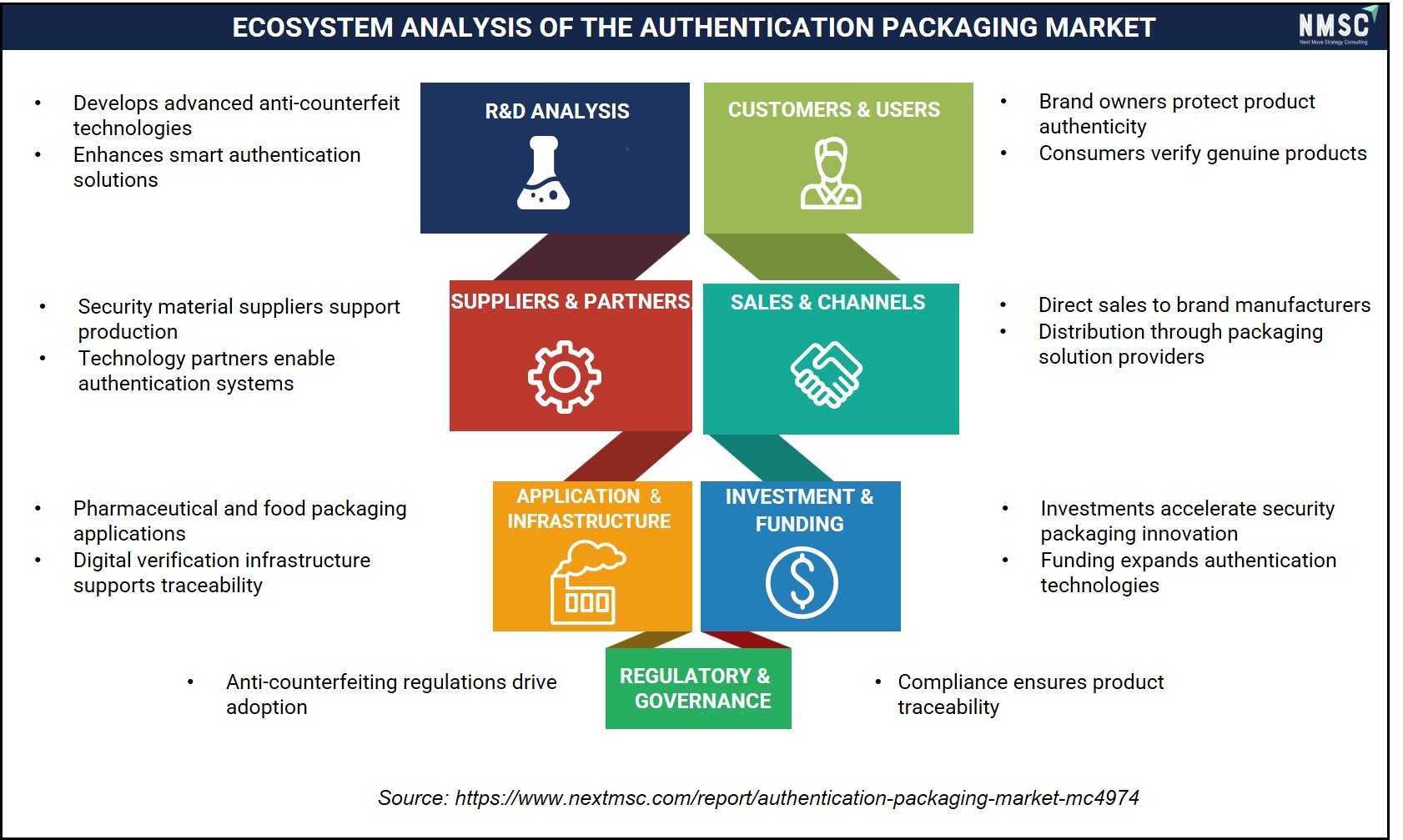
Based on our comprehensive assessment, we found that the authentication packaging ecosystem comprises technology developers, packaging manufacturers, material suppliers, serialization providers, and brand owners. Advanced authentication solutions including QR codes, RFID tags, holograms, and blockchain platforms enhance product verification and traceability. Regulatory agencies, distribution partners, and end-use industries support adoption, while continuous innovation strengthens anti-counterfeiting capabilities across global supply chains.
What Are the Key Market Drivers, Breakthroughs, and Investment Opportunities that Will Shape the Authentication Packaging Market in the Next Decade?
|
Drivers / Trends / Restraints |
(+/-) % Impact on CAGR Forecast |
Geographic Relevance |
Impact Timeline |
|
DSCSA and FMD Pharmaceutical Serialization Mandates |
+1.8% |
North America, Europe |
2025–2030 |
|
Rising Global Counterfeiting Incidence |
+1.5% |
Global (all regions) |
2025–2035 |
|
NFC and RFID Smart Packaging Integration |
+1.4% |
North America, Europe, APAC |
2025–2032 |
|
Cloud-Based Serialization Platform Adoption |
+1.2% |
Global |
2026–2035 |
|
Blockchain-Linked Track and Trace Systems |
+0.9% |
North America, Europe |
2026–2035 |
|
High Implementation Cost for SMEs |
-1.0% |
LATAM, MEA, South and Southeast Asia |
Ongoing |
|
Lack of Standardized Global Authentication Protocols |
-0.8% |
All regions |
Ongoing |
|
Molecular Taggants and Forensic Authentication Expansion |
+1.1% |
Global (led by Pharma and Luxury) |
2026–2035 |
|
E-Commerce Anti-Counterfeiting Investment |
+0.8% |
APAC, North America, Europe |
2025–2030 |
|
Sustainability-Driven Material Innovation |
+0.6% |
Europe, North America |
2026–2035 |
What Are the Drivers of the Authentication Packaging Market Growth?
How Are Pharmaceutical Serialization Mandates Accelerating Demand for Authentication Packaging?
Pharmaceutical serialization mandates represent the single most influential regulatory growth driver for the Authentication Packaging Market. The U.S. FDA's Drug Supply Chain Security Act (DSCSA) established a phased interoperable electronic track-and-trace system requiring unit-level serialization across the entire pharmaceutical supply chain, with enhanced requirements effective from November 2023. The European Union Falsified Medicines Directive (FMD) similarly mandates unique identifiers and tamper-evident features for prescription medicines across EU member states. Based on our engagements with pharmaceutical packaging stakeholders, these mandates have driven substantial capital deployment into serialization implementation services, compliance validation platforms, and packaging line integration solutions globally.
How Is the Escalation of Global Counterfeiting Threats Driving Adoption of Authentication Packaging?
The sustained escalation of counterfeiting and illicit trade is a foundational demand driver for the Authentication Packaging Market across multiple industries. The World Customs Organization (WCO) and the International Criminal Police Organization (INTERPOL) have consistently highlighted pharmaceutical and consumer goods counterfeiting as priority enforcement challenges with severe public health and economic consequences. Through our analysis, we found that counterfeit pharmaceutical trade poses direct patient safety risks, compelling governments and brand owners across Asia Pacific, Latin America, and Africa to invest in multi-layer authentication packaging systems. The Organisation for Economic Co-operation and Development (OECD) has documented that trade in counterfeit and pirated goods represents a significant share of global trade, reinforcing sustained investment in authentication infrastructure.
How Is the Proliferation of E-Commerce Channels Creating New Authentication Packaging Demand?
The rapid expansion of global e-commerce is creating structural new demand for authentication packaging, as online distribution channels significantly increase the risk of counterfeit product infiltration into consumer supply chains. Our findings suggest that brand owners across luxury goods, pharmaceuticals, and electronics are investing in consumer-accessible digital authentication features, including serialized QR codes, NFC tags, and mobile verification applications, to extend product authentication capabilities directly to end consumers. The World Trade Organization (WTO) and national customs authorities have flagged cross-border e-commerce as a key counterfeiting vector, compelling regulatory frameworks that incentivize brand owners to implement unit-level authentication across digital commerce channels.
What Are the Growth Inhibitors of the Authentication Packaging Market?
How Does the High Implementation Cost of Authentication Systems Constrain Market Penetration Among Small and Medium Enterprises?
The capital intensity of implementing comprehensive authentication packaging systems represents a significant structural barrier for small and medium-sized manufacturers. Packaging line integration of RFID readers, serialization printers, vision inspection systems, and cloud-based verification platforms requires substantial upfront investment in hardware, software, and compliance validation services. Our assessment indicates that smaller pharmaceutical and FMCG producers in emerging markets often lack the financial capacity to implement full-scale serialization infrastructure, creating compliance gaps. The U.S. Small Business Administration (SBA) has noted that regulatory compliance costs disproportionately burden smaller manufacturers, reflecting a systemic challenge that limits the speed of global authentication packaging adoption.
How Does the Absence of Harmonized Global Authentication Standards Limit the Scalability of Authentication Packaging Solutions?
The fragmentation of authentication packaging standards across jurisdictions presents a material challenge for multinational brand owners and technology providers operating across multiple regulatory regimes. While the U.S. DSCSA and EU FMD have established regional frameworks, there is no single globally harmonized authentication standard encompassing labeling, serialization formats, and verification protocols. Through our market assessment, we observed that the International Organization for Standardization (ISO) and GS1 organization are advancing standardization efforts, but adoption remains uneven across regions. This fragmentation compels brand owners to maintain multiple authentication packaging configurations, increasing operational complexity and total cost of compliance.
What Are the Growth Opportunities in the Authentication Packaging Market?
How Does the Expansion of Anti-Counterfeiting Regulations in Emerging Markets Create Structural Opportunities for Authentication Packaging Providers?
Emerging market governments across Asia, Latin America, Africa, and the Middle East are progressively strengthening anti-counterfeiting legislative frameworks, creating substantial new addressable market opportunities for authentication packaging solution providers. India's Drugs and Cosmetics Act amendments and the Central Drugs Standard Control Organisation (CDSCO) serialization guidelines for export-oriented pharmaceuticals are expanding demand for authentication labeling and digital verification platforms. According to evaluation of government policy trajectories, Brazil's ANVISA regulatory framework and China's National Medical Products Administration (NMPA) traceability requirements are similarly generating mandatory investment in pharmaceutical authentication packaging infrastructure across their respective manufacturing sectors.
How Is the Integration of Sustainable Materials Creating Innovation Opportunities Within the Authentication Packaging Market?
The convergence of sustainability imperatives and authentication packaging innovation is creating a structurally significant product development opportunity. Through our analysis, we found that brand owners and packaging converters are increasingly seeking authentication solutions compatible with recycled substrates, bio-based films, and water-based security inks to meet extended producer responsibility requirements and circular economy mandates. The European Commission's Packaging and Packaging Waste Regulation (PPWR) establishes mandatory recyclability requirements that are compelling authentication packaging developers to redesign holographic films, security adhesives, and composite substrates for recyclability. This intersection of authentication functionality and environmental compliance is driving R&D investment among leading security printing and materials companies.
How Does the Growth of Connected Packaging and the Internet of Things Present a Transformational Opportunity for the Authentication Packaging Market?
The convergence of authentication packaging with the broader Internet of Things (IoT) ecosystem is creating a transformational growth opportunity for smart, connected authentication solutions. Our analysis shows that NFC-enabled packaging is evolving beyond authentication into a consumer engagement layer, enabling brand owners to deliver personalized content, loyalty rewards, and product provenance information through authenticated product interactions. The GS1 Digital Link standard is enabling a single QR code to serve as a serialized identifier across regulatory compliance, supply chain visibility, consumer engagement, and product authentication use cases simultaneously. This multi-functionality is accelerating NFC and QR adoption across premium consumer goods and pharmaceutical packaging segments globally.
How Is the Authentication Packaging Market Segmented in This Report, and What Are the Key Insights from the Segmentation Analysis?
How Does Product Type Segmentation Reveal the Structural Composition of the Authentication Packaging Market?
|
Product Type Segment |
2025 (USD Bn) |
2035 (USD Bn) |
CAGR (%) |
|
Authentication Labels |
1.90 |
4.80 |
9.7% |
|
Authentication Tags |
0.80 |
2.20 |
10.6% |
|
Authentication Seals |
1.10 |
2.80 |
9.8% |
|
Authentication Closures & Caps |
1.00 |
2.80 |
10.8% |
Based on NMSC's research, we found that the Authentication Packaging Market by product type encompasses Authentication Labels, Authentication Tags, Authentication Seals, and Authentication Closures and Caps. Authentication Labels represent the dominant product segment, driven by the extensive deployment of pressure-sensitive labels, RFID-embedded labels, and serialized labels across pharmaceutical blister packs, food and beverage cartons, and luxury goods packaging. Authentication Closures & Caps are the fastest-growing product category, advancing at a CAGR of 10.8% from 2026 to 2035, driven by growing demand for tamper-evident packaging and enhanced product security across pharmaceutical, food, and consumer goods industries.
How Are Digital Authentication Systems Transforming Verification Capabilities in the Authentication Packaging Market?
|
Digital Authentication System |
2025 (USD Bn) |
2035 (USD Bn) |
CAGR (%) |
|
Serialization and Unique Code Generation |
1.20 |
3.10 |
9.9% |
|
Cloud-Based Authentication Platforms |
0.90 |
2.80 |
12.0% |
|
Mobile Verification Applications |
0.70 |
2.00 |
11.0% |
|
Track and Trace Systems |
1.00 |
2.50 |
9.6% |
|
Monitoring and Alert Systems |
0.60 |
1.50 |
9.6% |
|
Other Digital Systems |
0.40 |
0.70 |
5.8% |
From our market assessment, we observed that the Authentication Packaging Market is structured across Serialization and Unique Code Generation, Cloud-Based Authentication Platforms, Mobile Verification Applications, Track and Trace Systems, Monitoring and Alert Systems, and Other Digital Systems. Serialization and Unique Code Generation remains the dominant segment, reflecting mandatory pharmaceutical regulatory requirements under DSCSA and FMD that necessitate unit-level unique identifier generation across global supply chains. Cloud-Based Authentication Platforms are the fastest-growing segment as brand owners adopt SaaS-based serialization infrastructure for scalability, real-time visibility, and regulatory reporting. Mobile Verification Applications are gaining significant traction among brand owners seeking to extend authentication capabilities directly to distribution partners and consumers.
Which Authentication Materials Are Driving Innovation and Growth in the Authentication Packaging Market?
|
Materials and Enablers Segment |
2025 (USD Bn) |
2035 (USD Bn) |
CAGR (%) |
|
Security Inks and Coatings |
0.90 |
2.10 |
8.9% |
|
Holographic Films and Foils |
1.20 |
3.00 |
9.6% |
|
Security Papers and Substrates |
0.80 |
1.80 |
8.4% |
|
Taggants and Molecular Markers |
0.50 |
1.80 |
13.7% |
|
Tamper Evident Adhesives |
0.90 |
2.20 |
9.3% |
|
Other Security Materials |
0.50 |
1.70 |
13.0% |
Our analysis shows that the Authentication Packaging Market by materials encompasses Security Inks and Coatings, Holographic Films and Foils, Security Papers and Substrates, Taggants and Molecular Markers, Tamper Evident Adhesives, and Other Security Materials. Holographic Films and Foils dominate the segment due to their proven effectiveness as an overt anti-counterfeiting measure across pharmaceuticals, consumer goods, and government documents. Taggants and Molecular Markers represent the fastest-growing materials segment, driven by increasing brand owner preference for forensic-grade covert authentication that cannot be reproduced without proprietary manufacturing knowledge. Security Inks and Coatings continue to see strong demand as an integrated substrate-level security layer in combination with other overt and covert features.
How Are Authentication Services Creating Value Across the Authentication Packaging Supply Chain?
|
Services and Integration Segment |
2025 (USD Bn) |
2035 (USD Bn) |
CAGR (%) |
|
Serialization Implementation Services |
1.10 |
2.70 |
9.4% |
|
Packaging Line Integration Services |
1.00 |
2.60 |
10.0% |
|
Compliance and Validation Services |
0.80 |
2.20 |
10.6% |
|
Managed Authentication Services |
1.10 |
3.20 |
11.3% |
|
Maintenance and Support Services |
0.50 |
1.20 |
9.1% |
|
Other Professional Services |
0.30 |
0.70 |
8.9% |
NMSC's analysis indicates that authentication services encompass Serialization Implementation Services, Packaging Line Integration Services, Compliance and Validation Services, Managed Authentication Services, Maintenance and Support Services, and Other Professional Services. Serialization Implementation Services remain the largest segment, supported by the ongoing pharmaceutical serialization mandate rollout across North America, Europe, and emerging markets. Managed Authentication Services are the fastest-growing segment as brand owners transition from project-based implementation to ongoing managed service models that provide continuous compliance monitoring, system updates, and verification analytics. Packaging Line Integration Services are experiencing strong demand as pharmaceutical and FMCG manufacturers retrofit existing production lines with serialization printers, vision systems, and AI data management infrastructure.
How Do Different Security Authentication Mechanisms Serve Complementary Roles in the Authentication Packaging Market?
|
Authentication Mechanism |
2025 (USD Bn) |
2035 (USD Bn) |
CAGR (%) |
|
Overt Authentication |
1.50 |
3.50 |
8.9% |
|
Covert Authentication |
1.20 |
3.20 |
10.3% |
|
Forensic Authentication |
0.60 |
1.50 |
9.6% |
|
Digital Authentication |
1.50 |
4.40 |
11.3% |
Through our market assessment, we observed that the Authentication Packaging Market by security mechanism is structured around Overt Authentication, Covert Authentication, Forensic Authentication, and Digital Authentication. Overt Authentication and Digital Authentication jointly hold the largest market shares, reflecting brand owner preference for multi-layered strategies that combine consumer-visible features with digitally verifiable serialized identifiers. Digital Authentication is the fastest-growing mechanism segment, driven by the integration of NFC, RFID, and serialized QR codes into packaging lines serving pharmaceutical, food and beverage, and luxury goods brand owners globally. Covert Authentication is gaining importance as counterfeiters become increasingly sophisticated at replicating overt security features.
How Does Packaging Substrate Choice Influence Authentication Feature Design and Performance?
|
Packaging Substrate |
2025 (USD Bn) |
2035 (USD Bn) |
CAGR (%) |
|
Paper |
0.60 |
1.30 |
8.0% |
|
Paperboard |
0.50 |
1.10 |
8.2% |
|
Film |
0.80 |
2.10 |
10.1% |
|
Foil |
0.70 |
1.70 |
9.3% |
|
Plastic |
0.90 |
2.30 |
9.8% |
|
Metal |
0.40 |
1.00 |
9.6% |
|
Glass |
0.30 |
0.80 |
10.3% |
|
Composite |
0.40 |
1.40 |
13.3% |
|
Not Applicable |
0.20 |
0.90 |
16.2% |
Based on our evaluation, the Authentication Packaging Market by substrate includes Paper, Paperboard, Film, Foil, Plastic, Metal, Glass, Composite, and Not Applicable categories. Plastic substrates dominate due to their prevalence across pharmaceutical blister packaging, FMCG containers, and consumer electronics packaging, all of which require integrated authentication features. Not Applicable is the fastest-growing segment at a CAGR of 16.2%. Among applicable packaging substrates, Composite Packaging is the fastest-growing category at a CAGR of 13.3%. Film substrates are experiencing strong demand growth driven by flexible packaging applications in food and beverage and pharmaceutical sectors requiring integrated holographic and security printing elements.
How Are Evolving Revenue Models Reshaping the Commercial Structure of the Authentication Packaging Market?
|
Revenue Model |
2025 (USD Bn) |
2035 (USD Bn) |
CAGR (%) |
|
Product Sales |
2.10 |
4.80 |
8.6% |
|
Software Subscription and Licensing |
1.00 |
3.50 |
13.3% |
|
Professional Services |
1.00 |
2.70 |
10.4% |
|
Maintenance and Support |
0.70 |
1.60 |
8.6% |
From our analysis, we found that the Authentication Packaging Market by revenue model encompasses Product Sales, Software Subscription and Licensing, Professional Services, and Maintenance and Support. Product Sales remains the largest revenue stream due to the material-intensive nature of physical authentication features including labels, seals, holographic films, and RFID tags. Software Subscription and Licensing is the fastest-growing revenue model at a CAGR of 13.3%, driven by the transition of brand owners to cloud-based serialization platforms and SaaS authentication management systems. Professional Services revenues are expanding steadily as pharmaceutical and FMCG manufacturers require expert support for serialization implementation, packaging line integration, and regulatory compliance validation.
How Do Distribution Channel Strategies Determine Competitive Positioning in the Authentication Packaging Market?
|
Distribution Channel |
2025 (USD Bn) |
2035 (USD Bn) |
CAGR (%) |
|
Direct to Brand Owners |
1.60 |
4.00 |
9.6% |
|
Packaging Converters |
1.20 |
3.10 |
9.9% |
|
Distributors |
0.80 |
1.90 |
9.0% |
|
System Integrators |
0.50 |
1.50 |
11.6% |
|
OEM and Equipment Partners |
0.40 |
1.20 |
11.6% |
|
Direct Software Sales |
0.30 |
0.90 |
11.6% |
Our assessment indicates that the Authentication Packaging Market is served through Direct to Brand Owners, Packaging Converters, Distributors, System Integrators, OEM and Equipment Partners, and Direct Software Sales channels. Direct to Brand Owners remains the dominant channel as pharmaceutical and luxury goods companies prefer to manage authentication vendor relationships directly to ensure compliance alignment and brand protection strategy integration. System Integrators, OEM and Equipment Partners, and Direct Software Sales are the fastest-growing channels, reflecting the increasing integration of authentication capabilities into broader packaging line automation and enterprise software ecosystems.
Which End Use Industries Are Generating the Highest Demand for Authentication Packaging Solutions?
|
End Use Industry |
2025 (USD Bn) |
2035 (USD Bn) |
CAGR (%) |
|
Pharmaceuticals |
1.40 |
3.80 |
10.4% |
|
Food and Beverage |
1.10 |
2.90 |
10.2% |
|
Beauty and Personal Care |
0.50 |
1.40 |
10.8% |
|
Luxury Goods |
0.50 |
1.30 |
10.0% |
|
Apparel and Footwear |
0.30 |
0.80 |
10.3% |
|
Electronics |
0.30 |
0.80 |
10.3% |
|
Automotive |
0.20 |
0.50 |
9.6% |
|
Industrial Goods |
0.20 |
0.40 |
7.2% |
|
Government and Excise |
0.20 |
0.50 |
9.6% |
|
Other Consumer Goods |
0.10 |
0.20 |
7.2% |
NMSC's analysis indicates that the Authentication Packaging Market serves Pharmaceuticals, Food and Beverage, Beauty and Personal Care, Luxury Goods, Apparel and Footwear, Electronics, Automotive, Industrial Goods, Government and Excise, and Other Consumer Goods end use industries. Pharmaceuticals is the dominant end use industry, driven by mandatory serialization regulations, high patient safety stakes, and extensive investment in packaging line integration and compliance validation services. Food and Beverage is the second-largest sector as food safety regulators across North America, Europe, and Asia Pacific strengthen product traceability requirements. Beauty and Personal Care is the fastest-growing end use industry, driven by premium brand protection needs, expanding counterfeit detection requirements, and consumer demand for product authenticity verification.
Regional Outlook
Geographic Performance Snapshot
|
Region |
2025 (USD Bn) |
2035 (USD Bn) |
CAGR (%) |
Key Driver |
|
North America |
1.60 |
3.90 |
9.3% |
DSCSA mandate, pharmaceutical brand protection |
|
Europe |
1.40 |
3.50 |
9.6% |
FMD compliance, luxury goods authentication |
|
Asia Pacific |
1.20 |
3.40 |
11.0% |
Pharmaceutical manufacturing, e-commerce growth |
|
Middle East & Africa |
0.30 |
1.00 |
12.8% |
National anti-counterfeiting frameworks |
|
Latin America |
0.30 |
0.80 |
10.3% |
ANVISA mandates, pharmaceutical exports |
Source: www.nextmsc.com
North America Authentication Packaging Market
North America Authentication Packaging Market accounts for USD 1.6 billion in 2025 and is forecast to reach USD 3.9 billion by 2035 at a CAGR of 9.3%. The region is structurally led by the U.S. DSCSA pharmaceutical serialization mandate, high brand owner investment in anti-counterfeiting infrastructure, and the presence of leading authentication technology vendors. Regulatory maturity under FDA, Health Canada, and COFEPRIS frameworks, combined with strong demand from pharmaceutical, food and beverage, and luxury goods sectors, underpins sustained market leadership.
U.S. Authentication Packaging Market
Based on our engagements with the North American pharmaceutical and consumer goods packaging ecosystem, the United States represents approximately 68% of North American Authentication Packaging Market revenue in 2025. The U.S. DSCSA mandate requires pharmaceutical manufacturers, wholesalers, and dispensers to implement electronic, interoperable track-and-trace systems at the unit level, driving continuous investment in authentication labels, serialization platforms, and compliance services. Strong adoption of NFC-enabled packaging and mobile verification applications across luxury goods and premium food and beverage brands further supports the robust market outlook.
Canada Authentication Packaging Market
Through our analysis, Canada Authentication Packaging Market demonstrates steady growth driven by Health Canada's pharmaceutical labeling regulations and the adoption of GS1 Canada standards for supply chain serialization. Canadian pharmaceutical manufacturers are progressively aligning with DSCSA requirements for cross-border product distribution into the U.S. market. The food and beverage and cannabis packaging sectors are also emerging as adoption growth areas, with regulatory frameworks under the Cannabis Act requiring product authentication and tamper-evidence features across retail packaging.
Mexico Authentication Packaging Market
From our assessment, Mexico Authentication Packaging Market is advancing at an estimated CAGR of 11.0% from 2026 to 2035, representing the fastest growth within North America. COFEPRIS regulations governing pharmaceutical product traceability and labeling standards are driving adoption of serialization and authentication packaging solutions among domestic and export-oriented manufacturers. The expanding medical device manufacturing sector and growth of premium consumer goods brands are also creating new demand for multi-layered authentication packaging across Mexican production facilities.
Europe Authentication Packaging Market
Europe Authentication Packaging Market accounted for USD 1.4 billion in 2025 and is projected to reach USD 3.5 billion by 2035 at a CAGR of 9.6%. The European Union's Falsified Medicines Directive (FMD) has been a decisive structural driver, mandating serialization and tamper-evidence features across prescription pharmaceutical packaging since 2019. The European luxury goods industry further reinforces demand for premium authentication solutions including holographic films, NFC-enabled closures, and covert security inks across fashion, spirits, and cosmetics packaging.
UK Authentication Packaging Market
Based on our engagements, the UK Authentication Packaging Market retains EU-equivalent pharmaceutical serialization requirements post-Brexit through the Medicines and Healthcare Products Regulatory Agency (MHRA) framework, maintaining robust investment in authentication packaging infrastructure. The UK luxury goods sector, including premium spirits, fashion accessories, and cosmetics, is a significant driver of holographic, NFC, and multi-layered authentication packaging demand. London's role as a major hub for brand owner headquarters further concentrates authentication packaging procurement decisions within the UK market.
Germany Authentication Packaging Market
Through our analysis, Germany Authentication Packaging Market is among Europe's largest, supported by the country's position as the EU's leading pharmaceutical manufacturing hub and the headquarters of major packaging companies including LEONHARD KURZ and Schreiner Group. FMD compliance investment remains significant across German pharmaceutical production facilities. The German engineering and automotive industries also create niche demand for component-level authentication labeling and RFID-based parts tracking systems integrated into supply chain authentication frameworks.
France Authentication Packaging Market
From our assessment, France Authentication Packaging Market is driven by the country's globally prominent luxury goods sector, encompassing fashion, cosmetics, fine wines, and spirits. Leading French luxury conglomerates have been at the forefront of implementing multi-layered authentication packaging strategies combining holographic labels, NFC-enabled packaging, and brand-specific covert security features. The French National Agency for the Safety of Medicines (ANSM) enforces FMD compliance across the pharmaceutical sector, maintaining consistent serialization-related investment.
Italy Authentication Packaging Market
According to evaluation of Italy's packaging sector, the country's Authentication Packaging Market is shaped by a combination of pharmaceutical compliance requirements and strong demand from the food and beverage, wine, and luxury fashion industries. The Istituto Superiore di Sanità enforces stringent pharmaceutical labeling and serialization standards aligned with FMD requirements. Italian wine producers are increasingly adopting authentication labels, NFC-enabled capsules, and digital provenance verification systems to combat counterfeiting and support premium brand positioning.
Spain Authentication Packaging Market
Based on our engagements, Spain Authentication Packaging Market demonstrates steady growth underpinned by pharmaceutical FMD compliance, food authentication requirements for premium olive oil, wine, and ibérico products, and an expanding cosmetics packaging sector. The Spanish Agency of Medicines and Medical Devices (AEMPS) oversees pharmaceutical serialization compliance, while the food industry increasingly adopts geographic indication authentication features to protect Protected Designation of Origin (PDO) products against counterfeiting.
Sweden Authentication Packaging Market
Through our analysis, Sweden Authentication Packaging Market benefits from a highly developed pharmaceutical sector and a progressive regulatory environment that has supported early FMD implementation. Swedish pharmaceutical manufacturers were among the first in Europe to complete full EMVS (European Medicines Verification System) integration. The country's strong sustainability orientation is also driving innovation in eco-compatible authentication materials, particularly bio-based security inks and recyclable holographic substrates.
Denmark Authentication Packaging Market
From our assessment, Denmark Authentication Packaging Market is characterized by strong pharmaceutical compliance activity aligned with FMD requirements and a growing food and beverage sector that is increasingly adopting product authentication features. Danish pharmaceutical manufacturers maintain high levels of investment in serialization and authentication packaging infrastructure. The Danish food industry's emphasis on premium quality and geographic origin authentication is creating additional demand for digital verification and traceability solutions.
Finland Authentication Packaging Market
According to evaluation, Finland Authentication Packaging Market demonstrates consistent demand from the pharmaceutical sector under FMD compliance requirements and from the food and beverage industry focused on product authenticity and supply chain transparency. Finnish pharmaceutical distributors and wholesalers have been early adopters of EMVS-compatible serialization infrastructure. The country's advanced digital infrastructure and high technology adoption rates support the integration of cloud-based authentication platforms across packaging supply chains.
Netherlands Authentication Packaging Market
Based on our engagements, the Netherlands Authentication Packaging Market occupies a strategically significant position as a major European pharmaceutical logistics and distribution hub. The Netherlands' Rotterdam port and its role as a European pharmaceutical distribution center generate substantial demand for authentication labeling, RFID tracking, and anti-counterfeiting packaging in pharmaceutical cold chain operations. Dutch food and beverage exporters also invest in authentication solutions to support product provenance verification across European retail channels.
Asia Pacific Authentication Packaging Market
Asia Pacific Authentication Packaging Market accounted for USD 1.2 billion in 2025 and is forecast to reach USD 3.4 billion by 2035 at a CAGR of 11.0%, representing the fastest-growing region globally. China, India, Japan, and South Korea collectively drive the majority of regional demand, supported by expanding pharmaceutical manufacturing, rising e-commerce penetration, and increasingly stringent national anti-counterfeiting regulations. The region's growth is further supported by government-led serialization mandates, rapid adoption of mobile verification applications, and expanding consumer demand for product authenticity assurance.
China Authentication Packaging Market
Based on our engagements, China Authentication Packaging Market is shaped by the National Medical Products Administration (NMPA) requirements for pharmaceutical traceability and electronic supervision codes across the domestic supply chain. China is simultaneously one of the world's largest pharmaceutical manufacturers and one of the most significant sources of counterfeit goods, creating a dual compliance and brand protection demand dynamic. Domestic authentication technology providers and international companies are competing to supply serialization infrastructure, security labels, and track-and-trace platforms to Chinese pharmaceutical and consumer goods manufacturers.
India Authentication Packaging Market
Through our analysis, India Authentication Packaging Market is among the fastest-growing in Asia Pacific, driven by the CDSCO's serialization requirements for pharmaceutical exports and expanding domestic anti-counterfeiting enforcement. India's large generic pharmaceutical manufacturing sector represents a significant addressable market for authentication labels, serialization platforms, and compliance services. The government's e-pharmacovigilance initiatives and the India Pharmacopoeia Commission's track-and-trace guidelines are progressively elevating authentication packaging investment across Indian pharmaceutical production facilities.
Japan Authentication Packaging Market
From our assessment, Japan Authentication Packaging Market is characterized by high market maturity, stringent pharmaceutical regulations under the Pharmaceuticals and Medical Devices Agency (PMDA), and advanced adoption of holographic and security printing technologies. Japanese brand owners across cosmetics, food, and consumer electronics are early adopters of multi-layer authentication packaging strategies. The country's strong industrial heritage in precision printing and specialty chemicals underpins a competitive domestic authentication materials industry serving both domestic and export markets.
South Korea Authentication Packaging Market
According to evaluation, South Korea Authentication Packaging Market demonstrates strong growth driven by the Ministry of Food and Drug Safety (MFDS) pharmaceutical serialization requirements and the country's globally prominent cosmetics and electronics industries. South Korean cosmetics brands, including major K-beauty conglomerates, are significant adopters of anti-counterfeiting packaging solutions including holographic foils, NFC-enabled packaging, and serialized QR codes to protect premium brand positioning in export markets.
Taiwan Authentication Packaging Market
Based on our engagements, Taiwan Authentication Packaging Market is driven by the country's significant pharmaceutical manufacturing sector and its role as a major electronics component producer requiring component-level authentication. The Taiwan Food and Drug Administration (TFDA) serialization requirements for pharmaceutical products are expanding authentication packaging demand. Taiwan's electronics manufacturing sector also generates niche demand for RFID and barcode-based authentication solutions for component tracking and anti-counterfeiting across global supply chains.
Indonesia Authentication Packaging Market
Through our analysis, Indonesia Authentication Packaging Market is an emerging high-growth market within Southeast Asia, driven by the National Agency of Drug and Food Control (BPOM) pharmaceutical labeling requirements and expanding middle-class demand for authenticated consumer products. The country's rapidly growing e-commerce sector and rising pharmaceutical manufacturing investment are creating new demand for authentication labels, serialization services, and mobile verification applications tailored to Indonesian market conditions and regulatory frameworks.
Vietnam Authentication Packaging Market
From our assessment, Vietnam Authentication Packaging Market is experiencing accelerating growth driven by the Drug Administration of Vietnam (DAV) pharmaceutical product labeling requirements and expanding manufacturing investment. Vietnam's growing role as a manufacturing hub for consumer electronics, apparel, and food processing is creating demand for authentication packaging solutions that support brand protection and export compliance. Government-led anti-counterfeiting enforcement initiatives are progressively elevating awareness and adoption of authentication packaging across domestic distribution channels.
Australia Authentication Packaging Market
According to evaluation, Australia Authentication Packaging Market demonstrates steady growth supported by the Therapeutic Goods Administration (TGA) pharmaceutical serialization requirements and strong adoption of food authentication standards aligned with Food Standards Australia New Zealand (FSANZ) guidelines. Australia's premium food and wine export sector is an active adopter of digital provenance and authentication packaging, with geographic indication verification becoming a key marketing and brand protection tool for export-oriented producers in competitive international markets.
Philippines Authentication Packaging Market
Based on our engagements, the Philippines Authentication Packaging Market is expanding in line with the Food and Drug Administration (FDA) of the Philippines' pharmaceutical labeling modernization and growing consumer awareness of product counterfeiting. The country's significant pharmaceutical distribution sector and rapidly growing FMCG market are driving adoption of authentication labels and anti-tamper packaging solutions. International brand owners exporting to the Philippines are progressively implementing market-specific authentication features aligned with local regulatory expectations.
Malaysia Authentication Packaging Market
Through our analysis, Malaysia Authentication Packaging Market is supported by the National Pharmaceutical Regulatory Agency (NPRA) pharmaceutical serialization and labeling requirements and the country's role as a regional pharmaceutical manufacturing center. Malaysia's electronics and food manufacturing sectors also generate demand for authentication packaging solutions. The government's Industry4WRD initiative, which promotes industrial digitalization, is creating a favorable policy environment for adoption of smart and digital authentication packaging technologies.
Middle East & Africa Authentication Packaging Market
Middle East and Africa Authentication Packaging Market accounted for USD 0.3 billion in 2025 and is projected to reach USD 1.0 billion by 2035, representing the highest regional CAGR at 12.8%. Government-led anti-counterfeiting and pharmaceutical serialization initiatives across Gulf Cooperation Council (GCC) member states, South Africa, and Nigeria are accelerating adoption. The region's growing pharmaceutical import activity, expanding e-commerce markets, and Vision 2030-aligned investment programs in Saudi Arabia and the UAE are structurally supporting market development.
Saudi Arabia Authentication Packaging Market
Based on our engagements, Saudi Arabia Authentication Packaging Market is driven by the Saudi Food and Drug Authority (SFDA) pharmaceutical serialization requirements, which mandate unique identifiers on pharmaceutical packaging distributed within the Kingdom. Saudi Arabia's Vision 2030 industrial diversification program is also attracting pharmaceutical manufacturing investment, creating direct demand for authentication packaging infrastructure. The country's large retail sector and high consumer awareness of product counterfeiting across luxury and consumer goods categories further support authentication packaging adoption.
UAE Authentication Packaging Market
Through our analysis, UAE Authentication Packaging Market benefits from the Dubai and Abu Dhabi role as major regional pharmaceutical distribution hubs and the country's stringent pharmaceutical and food safety regulatory frameworks. The UAE Ministry of Health and Prevention requires authentication features on pharmaceutical products. The UAE's position as a luxury goods and premium consumer products market drives adoption of high-end authentication packaging including holographic films, NFC-enabled packaging, and branded security features protecting premium brand integrity.
Egypt Authentication Packaging Market
From our assessment, Egypt Authentication Packaging Market is emerging as a growth market within North Africa and MEA, driven by the Egyptian Drug Authority (EDA) pharmaceutical labeling and traceability requirements and a large domestic pharmaceutical manufacturing industry. Egypt's government has been investing in pharmaceutical sector modernization and anti-counterfeiting enforcement, creating progressive demand for authentication labels, serialization services, and digital verification platforms tailored to local production and distribution infrastructure.
Israel Authentication Packaging Market
According to evaluation, Israel Authentication Packaging Market reflects the country's advanced pharmaceutical and medical device manufacturing sector and strong adoption of international regulatory standards including EMA and FDA guidelines. Israeli pharmaceutical exporters invest significantly in authentication packaging to meet the requirements of their primary export markets in Europe and North America. The country's strong cybersecurity and digital technology sector is also influencing adoption of advanced digital authentication solutions, including blockchain-linked serialization and cloud-based verification platforms.
Turkey Authentication Packaging Market
Based on our engagements, Turkey Authentication Packaging Market demonstrates consistent growth driven by the Turkish Medicines and Medical Devices Agency (TITCK) ITS (Drug Tracking System) pharmaceutical serialization program, which mandates electronic traceability for pharmaceutical products. Turkey's pharmaceutical manufacturing sector is a significant domestic driver of authentication packaging adoption. The country's cosmetics and food manufacturing industries are also progressive adopters of anti-counterfeiting packaging features, supported by growing regulatory enforcement and export compliance requirements.
Nigeria Authentication Packaging Market
Through our analysis, Nigeria Authentication Packaging Market is an emerging opportunity driven by the National Agency for Food and Drug Administration and Control (NAFDAC) pharmaceutical authentication requirements and the country's status as a primary target for counterfeit medicine distribution in West Africa. NAFDAC has implemented e-authentication systems and mobile phone-based verification programs for pharmaceutical products. Rising awareness of counterfeit goods risks and expanding pharmaceutical manufacturing investment are progressively driving adoption of authentication packaging solutions across Nigerian supply chains.
South Africa Authentication Packaging Market
From our assessment, South Africa Authentication Packaging Market is shaped by South African Health Products Regulatory Authority (SAHPRA) pharmaceutical labeling and authentication requirements and the country's role as the largest pharmaceutical market in sub-Saharan Africa. South Africa's consumer goods sector is experiencing increasing adoption of anti-counterfeiting packaging driven by brand owner investment in product protection and consumer trust building. The country's advanced retail infrastructure and growing e-commerce market are also creating new channels for consumer-accessible product authentication.
Latin America Authentication Packaging Market
Latin America Authentication Packaging Market accounted for USD 0.3 billion in 2025 and is projected to reach USD 0.8 billion by 2035 at a CAGR of 10.3%. Brazil's ANVISA pharmaceutical traceability regulations and Argentina's pharmaceutical authentication requirements are the primary regulatory drivers. The region's growing pharmaceutical export activity, expanding e-commerce market, and rising consumer awareness of product counterfeiting are collectively supporting authentication packaging demand growth across the major national markets.
Brazil Authentication Packaging Market
Based on our engagements, Brazil Authentication Packaging Market is the largest in Latin America, driven by the Brazilian Health Regulatory Agency (ANVISA) mandatory pharmaceutical traceability system (SNCM), which requires electronic serialization and reporting for pharmaceutical products. Brazil's large domestic pharmaceutical manufacturing sector and significant generic medicine industry generate sustained demand for authentication labeling, serialization implementation services, and compliance platforms. The country's food and beverage sector is also an active adopter of authentication packaging aligned with Brazil's food safety regulatory framework.
Argentina Authentication Packaging Market
Through our analysis, Argentina Authentication Packaging Market demonstrates emerging growth driven by the National Administration of Drugs, Food and Medical Technology (ANMAT) pharmaceutical authentication and serialization requirements. Argentina's pharmaceutical industry is a significant domestic driver of authentication packaging adoption, with manufacturers investing in compliance infrastructure aligned with Mercosur regional and global export standards. Growing awareness of counterfeit product risks in consumer goods categories is also creating incremental demand for authentication packaging solutions.
Chile Authentication Packaging Market
From our assessment, Chile Authentication Packaging Market is supported by the Institute of Public Health (ISP) pharmaceutical product control requirements and the country's export-oriented food and wine industry. Chilean wine producers are progressive adopters of digital authentication and provenance verification features on export-oriented packaging. The pharmaceutical sector's alignment with international serialization standards for export compliance is also driving authentication packaging adoption, particularly among manufacturers targeting North American and European regulatory requirements.
Colombia Authentication Packaging Market
According to evaluation, Colombia Authentication Packaging Market is expanding driven by the National Institute for the Surveillance of Food and Medicine (INVIMA) pharmaceutical authentication requirements and a growing consumer goods market with rising counterfeiting concerns. Colombia's government has been strengthening intellectual property enforcement frameworks, creating a supportive environment for brand owner investment in authentication packaging. The country's cosmetics and food manufacturing sectors are emerging adopters of anti-counterfeiting packaging solutions aligned with regional and international brand protection standards.
Strategic Framework of the Authentication Packaging Market
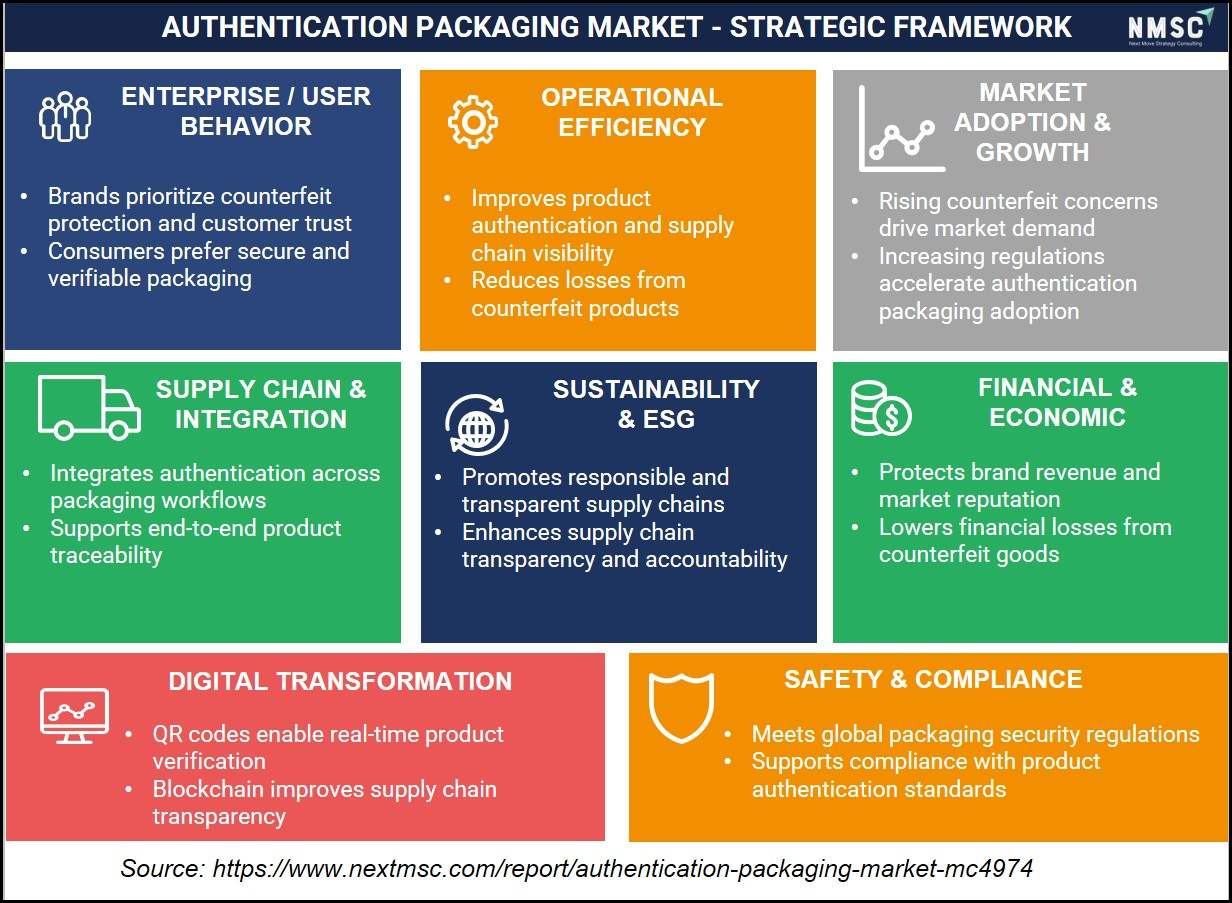
Based on our comprehensive assessment, we found that authentication packaging strengthens product security, supply chain visibility, and consumer trust. Rising counterfeit concerns and stricter regulatory requirements accelerate market adoption. Organizations integrate authentication technologies across packaging operations to improve traceability and brand protection. Digital transformation initiatives support real-time verification, while sustainability objectives and compliance requirements enhance long-term market value and operational efficiency.
Competitive Landscape
Competitive Dynamics and M&A Landscape
|
Key Takeaways |
Details |
|
Market Structure |
The Authentication Packaging industry is moderately consolidated, with leading multinational companies such as CCL Industries, Avery Dennison, Crane NXT, TOPPAN Holdings, and SICPA holding significant global market shares. The market also features a competitive tier of specialized players including INEXTO, AlpVision, Securikett, and Applied DNA Sciences focusing on niche forensic and digital authentication technologies. |
|
Innovation Focus |
Innovation is concentrated in NFC and RFID-enabled authentication packaging, cloud-based serialization platforms, molecular tagging technologies, and integration of blockchain-linked track-and-trace systems. Companies are investing in consumer-accessible mobile verification applications and sustainable authentication material development aligned with circular economy packaging mandates. |
|
M&A Activity |
M&A activity in the Authentication Packaging Market has focused on acquiring digital serialization software capabilities, expanding geographic footprint in high-growth pharmaceutical markets, and integrating forensic authentication technology portfolios. Technology consolidation and vertical integration across authentication materials, digital systems, and managed services represent key strategic themes in the competitive landscape. |
How Do Companies Compete in the Authentication Packaging Market?
The Authentication Packaging Market exhibits moderate-to-high competitive intensity, with competition driven by technological differentiation, regulatory expertise, geographic reach, and integrated solution capability. Leading companies compete on the breadth of their multi-layered authentication portfolios combining physical security features with digital verification systems. NMSC's analysis indicates that companies offering end-to-end managed authentication services, including serialization implementation, line integration, compliance validation, and ongoing platform support, are achieving stronger customer retention and higher revenue per engagement than point-solution providers.
Which Kind of Companies Dominate the Authentication Packaging Market?
The Authentication Packaging Market is dominated by diversified multinational packaging and security printing companies with established brand protection portfolios, global manufacturing capabilities, and deep regulatory expertise. CCL Industries, Avery Dennison, and TOPPAN Holdings leverage their extensive label and security printing infrastructure to serve pharmaceutical and FMCG brand owners globally. Crane NXT and SICPA maintain leadership in forensic and covert authentication technologies serving government, currency, and excise markets. Our analysis shows that pharmaceutical serialization specialists including INEXTO, Antares Vision, and SATO Holdings are establishing strong mid-market positions by offering focused track-and-trace platform expertise.
AI-Native Differentiation and Open Standards Drive Market Success in the Authentication Packaging Market
Through our market assessment, we observed that leading companies are integrating artificial intelligence and machine learning capabilities into their authentication platforms to automate exception detection, predict counterfeiting risk patterns, and optimize verification workflows. Adoption of open serialization standards including GS1 Digital Link and EPCIS (Electronic Product Code Information Services) is enabling interoperability across multi-vendor supply chain ecosystems, providing a competitive advantage to companies that architect open, standards-compliant authentication infrastructure. AI-enabled vision systems on packaging lines are also improving serialization accuracy and inspection speeds, reducing compliance risk for pharmaceutical manufacturers.
Market Players to Opt for Merger and Acquisition Strategies to Expand Their Presence in the Authentication Packaging Market
Based on NMSC's research, we found that M&A activity in the Authentication Packaging Market is accelerating as established packaging and security printing companies seek to acquire digital authentication software capabilities, expand geographic coverage in Asia Pacific and Latin America, and integrate forensic authentication technologies into their product portfolios. Strategic acquisitions of serialization platform providers and cloud-based verification software companies are enabling traditional physical authentication solution providers to offer comprehensive managed service offerings, repositioning themselves as integrated authentication ecosystem partners for pharmaceutical and FMCG brand owners.
Who Are the Key Market Players in the Authentication Packaging Market?
-
CCL Industries Inc.
-
Avery Dennison Corporation
-
TOPPAN Holdings Inc.
-
Crane NXT, Co.
-
SICPA SA
-
3M Company
-
Amcor plc
-
Zebra Technologies Corporation
-
LEONHARD KURZ Stiftung & Co. KG
-
Fedrigoni S.p.A.
-
UFlex Limited
-
SATO Holdings Corporation
-
Schreiner Group GmbH & Co. KG
-
SML Group Limited
-
Authentix, Inc.
-
INEXTO SA
-
Securikett Ulrich & Horn GmbH
-
AlpVision SA
-
Applied DNA Sciences, Inc.
-
Antares Vision S.p.A.
What Are the Latest Developments in the Authentication Packaging Market?
|
Date |
Event |
|
Aril 2026 |
Crane NXT, Co. completed its acquisition of Antares Vision S.p.A., a leading provider of detection, inspection, and traceability solutions. Antares Vision has been delisted from the Euronext Milan stock exchange and is now a wholly-owned subsidiary within Crane NXT’s new "Detection & Traceability Technologies" segment. This move positions Crane NXT to dominate the ~USD 3 billion life sciences and food & beverage authentication sectors. |
|
March 2026 |
CCL Industries announced plans to acquire Sleever International, a global leader in shrink sleeve labels and decorative technology, for approximately USD151 million. This acquisition, expected to close mid-2026, adds 11 manufacturing facilities to CCL’s portfolio and is part of a broader strategy to strengthen their global footprint in secure labeling and packaging |
|
March 2026 |
Avery Dennison launched its AD IdentiFresh RFID inlay series, specifically engineered for high-moisture environments like meat and deli cases. This breakthrough addresses long-standing challenges in retail authentication, helping suppliers and retailers reduce food waste and manage inventory with greater accuracy, which remains a key focus as the global economic cost of food waste is projected to reach USD 540 billion by the end of 2026. |
|
January 2026 |
OPPAN Digital (a subsidiary of TOPPAN Holdings) has upgraded its Edge Safe secure elements and Secure Activate Service to support Post-Quantum Cryptography (PQC). This allows IoT devices and authenticated packaging to remain secure against the future threat of quantum computing by utilizing NIST-approved algorithms like ML-DSA and ML-KEM. |
Expert Insights

“It is crucial to ensure that the products are genuine and have not been tampered with, counterfeited, or diverted. Our many label types and brand protection tools help achieve just that – from plastics with exceptional barrier properties, multi-faceted lamination possibilities, RFID inlays, braille and other embossing capabilities.”
— Alan Barretto, Managing Director, Nilpeter India
Statement made while discussing authentication and brand protection solutions designed to combat counterfeiting, product diversion, and tampering through advanced labeling and security technologies.
Market Interpretation
The comment highlights the growing importance of authentication packaging solutions in ensuring product integrity and supply chain security. As counterfeit products and unauthorized product diversion continue to challenge manufacturers across industries, companies are increasingly adopting advanced authentication technologies such as RFID-enabled labels, security laminates, tamper-evident features, and specialized embossing techniques. These solutions help improve traceability, strengthen brand protection, and enhance consumer confidence by enabling reliable product verification. The increasing focus on anti-counterfeiting measures, regulatory compliance, and supply chain transparency is expected to accelerate demand for authentication packaging solutions across pharmaceuticals, food and beverages, cosmetics, consumer goods, and industrial sectors.
What Are the Investment Opportunities in the Authentication Packaging Market?
Capital Inflows and Venture Activity
The Authentication Packaging Market continues to attract increasing investment from private equity firms, venture capital investors, and strategic corporate stakeholders as brand protection and anti-counterfeiting initiatives become critical priorities across pharmaceutical, food and beverage, luxury goods, and consumer product industries. Digital authentication technology providers, serialization software developers, and track-and-trace platform vendors are securing significant investment to expand product capabilities and global market reach. We noticed that investor interest is particularly concentrated in cloud-based authentication platforms, mobile verification technologies, and integrated brand protection ecosystems that generate recurring subscription revenues while addressing growing regulatory compliance requirements.
Infrastructure Investment
Pharmaceutical manufacturing expansion, advanced packaging modernization, and supply chain digitalization programs are creating substantial infrastructure investment opportunities across the Authentication Packaging Market. Governments and private-sector organizations worldwide are investing in manufacturing facilities, serialization infrastructure, and product traceability systems to strengthen supply chain security and combat counterfeit products. Moreover, we found that new pharmaceutical production facilities, medical device manufacturing plants, and high-value consumer goods packaging operations are increasingly integrating authentication technologies during facility design and modernization phases. These investments create long-term demand for serialization systems, tamper-evident packaging solutions, and digital verification platforms.
ESG and Sustainable Authentication Solutions
Environmental, Social, and Governance (ESG) considerations are emerging as an important investment driver within the Authentication Packaging Market. Packaging manufacturers and authentication technology providers are investing in sustainable security materials, recyclable authentication labels, environmentally friendly security inks, and circular economy-compatible packaging solutions. Based on our assessment, increasing regulatory emphasis on packaging sustainability is encouraging the development of authentication technologies that simultaneously support product security and environmental objectives. Vendors capable of delivering both high-performance anti-counterfeiting protection and sustainable packaging compliance are expected to benefit from growing customer and investor preference for environmentally responsible solutions.
Digital Transformation Enablement
The digitalization of product authentication is fundamentally transforming the Authentication Packaging Market by creating recurring revenue opportunities through cloud-based platforms, software subscriptions, and managed authentication services. Organizations are increasingly adopting digital verification systems, mobile authentication applications, blockchain-enabled traceability solutions, and cloud-based serialization platforms to improve supply chain visibility and consumer engagement. We further analysed that the transition from physical-only security features toward integrated digital authentication ecosystems is creating durable long-term demand for software-driven authentication services, making digital transformation a foundational growth driver for the market.
Private Equity and Strategic M&A Activity
Private equity firms and strategic acquirers are actively pursuing opportunities within the Authentication Packaging Market as demand for product security, traceability, and regulatory compliance solutions continues to expand globally. Investment activity is increasingly focused on serialization software providers, digital authentication platforms, security printing specialists, and track-and-trace technology companies. Strategic acquisitions are accelerating as packaging companies, software vendors, and supply chain technology providers seek to strengthen authentication capabilities through inorganic growth. We assessed that investors should closely monitor consolidation opportunities among digital authentication software providers, security label manufacturers, serialization platform developers, and anti-counterfeiting technology specialists as attractive acquisition targets throughout the 2025–2028 period within the Authentication Packaging Market.
Key Benefits for Stakeholders
For Pharmaceutical Manufacturers
Pharmaceutical manufacturers gain comprehensive insights into regulatory compliance requirements, serialization technology adoption trends, and authentication packaging implementation strategies across global markets. The report supports informed decision-making regarding DSCSA, FMD, and other track-and-trace compliance initiatives while providing visibility into technology investments that strengthen product security and supply chain integrity. Detailed market analysis further enables manufacturers to evaluate authentication solutions, optimize packaging investments, and enhance counterfeit prevention capabilities.
For Brand Owners and Marketing Teams
Brand owners and marketing organizations gain valuable intelligence regarding market growth trends, consumer authentication behavior, and evolving brand protection technologies within the Authentication Packaging Market trends. The report provides detailed analysis of authentication adoption across luxury goods, food and beverage, consumer products, and pharmaceutical sectors, supporting strategic investment decisions aimed at protecting brand reputation, strengthening consumer trust, and improving product traceability across global distribution networks.
For Authentication Technology Providers
Authentication technology providers benefit from detailed visibility into market size, competitive positioning, customer adoption patterns, and emerging growth opportunities across the Authentication Packaging Market. Segmentation analysis highlights the fastest-growing technology categories, end-user industries, and regional demand trends, enabling vendors to optimize product development strategies, prioritize investments, and strengthen competitive differentiation within the rapidly evolving brand protection ecosystem.
For Investors and Private Equity Firms
Investors, venture capital firms, and private equity sponsors gain access to a structured assessment of the Authentication Packaging Market’s growth trajectory, competitive landscape, and long-term revenue opportunities through 2035. Detailed market sizing, CAGR forecasts, segment-level analysis, and investment opportunity assessments support valuation modeling, portfolio development, and acquisition screening activities. Company benchmarking and strategic development analysis provide visibility into emerging market leaders and attractive technology segments across authentication software, managed services, and security materials.
For Packaging Converters and Printers
Packaging converters and printing companies gain actionable insights into authentication packaging demand trends, technology adoption patterns, and customer requirements across multiple end-use industries. The report supports capability development planning, equipment investment decisions, and portfolio diversification strategies by identifying high-growth authentication technologies and emerging market opportunities. Regional analysis further assists packaging providers in aligning expansion initiatives with evolving customer demand and regulatory requirements.
For Regulatory Authorities and Governments
Government agencies, customs authorities, healthcare regulators, and policy organizations gain a structured understanding of authentication technology adoption, anti-counterfeiting initiatives, and supply chain security trends shaping the Authentication Packaging Market. The report provides insights into regulatory best practices, technology deployment patterns, and market development dynamics that support evidence-based policy formulation, enforcement strategies, and national anti-counterfeiting programs.
For Logistics and Supply Chain Operators
Logistics providers, distributors, and supply chain operators benefit from detailed analysis of track-and-trace technologies, serialization adoption trends, and authentication system integration requirements. The report provides visibility into regional implementation patterns, technology maturity levels, and supplier capabilities, enabling organizations to strengthen supply chain transparency, improve product verification processes, and support secure product movement across increasingly complex global distribution networks.
Authentication Packaging Market Key Segments
By Product Type
-
Authentication Labels
-
Pressure Sensitive Labels
-
Shrink Sleeve Labels
-
In Mold Labels
-
Wet Glue Labels
-
RFID Embedded Labels
-
NFC Embedded Labels
-
Serialized Labels
-
Other Authentication Labels
-
-
Authentication Tags
-
RFID
-
NFC
-
Security Hang Tags
-
Other Tags
-
-
Authentication Seals
-
Tamper Evident Seals
-
Security Adhesive Tapes
-
Void Seals
-
Barrier Seals
-
Other Security Seals
-
-
Authentication Closures & Caps
-
Tamper Evident Caps
-
NFC Enabled Closures
-
RFID Enabled Closures
-
Shrink Bands
-
Liner Seals
-
Other Security Closures
-
By Digital Authentication Systems
-
Serialization and Unique Code Generation
-
Cloud Based Authentication Platforms
-
Mobile Verification Applications
-
Track and Trace Systems
-
Monitoring and Alert Systems
-
Other Digital Systems
By Authentication Materials and Enablers
-
Security Inks and Coatings
-
Holographic Films and Foils
-
Security Papers and Substrates
-
Taggants and Molecular Markers
-
Tamper Evident Adhesives
-
Other Security Materials
By Authentication Services and Integration
-
Serialization Implementation Services
-
Packaging Line Integration Services
-
Compliance and Validation Services
-
Managed Authentication Services
-
Maintenance and Support Services
-
Other Professional Services
By Security Authentication Mechanism
-
Overt Authentication
-
Covert Authentication
-
Forensic Authentication
-
Digital Authentication
By Packaging Substrate
-
Paper
-
Paperboard
-
Film
-
Foil
-
Plastic
-
Metal
-
Glass
-
Composite
-
Not Applicable
By Revenue Model
-
Product Sales
-
Software Subscription and Licensing
-
Professional Services
-
Maintenance and Support
By Distribution Channel
-
Direct to Brand Owners
-
Packaging Converters
-
Distributors
-
System Integrators
-
OEM and Equipment Partners
-
Direct Software Sales
By End Use Industry
-
Pharmaceuticals
-
Food and Beverage
-
Beauty and Personal Care
-
Luxury Goods
-
Apparel and Footwear
-
Electronics
-
Automotive
-
Industrial Goods
-
Government and Excise
-
Other Consumer Goods
By Region
-
North America: U.S., Canada, and Mexico.
-
Europe: UK, Germany, France, Italy, Spain, Sweden, Denmark, Finland, the Netherlands, and the rest of Europe.
-
Asia Pacific: China, India, Japan, South Korea, Taiwan, Indonesia, Vietnam, Australia, Philippines, Malaysia and the rest of APAC.
-
Middle East & Africa (MEA): Saudi Arabia, UAE, Egypt, Israel, Turkey, Nigeria, South Africa, and the rest of MEA.
-
Latin America: Brazil, Argentina, Chile, Colombia, and the rest of LATAM
Conclusion and Recommendations
Long-Term Outlook
The Authentication Packaging Market is entering a period of sustained long-term expansion driven by strengthening anti-counterfeiting regulations, increasing supply chain transparency requirements, and growing adoption of digital product authentication technologies across pharmaceutical, food and beverage, luxury goods, and consumer product industries. The market's long-term growth trajectory is supported by the convergence of physical security features with cloud-based verification platforms, mobile authentication applications, and track-and-trace ecosystems. We further analysed that the transition from standalone security labels and tamper-evident solutions toward integrated digital-physical authentication platforms will remain the defining structural trend shaping market development through 2035.
Strategic Positioning Recommendations
Authentication packaging solution providers should prioritize investments in digital authentication technologies, including NFC-enabled packaging, RFID-based traceability systems, cloud-based serialization platforms, and connected packaging ecosystems. Organizations that successfully combine physical security capabilities with digital verification infrastructure will strengthen their competitive positioning and create higher-value recurring revenue opportunities. Vendors should also invest in sustainable authentication materials, advanced serialization capabilities, and regulatory compliance expertise to address evolving customer requirements. Expanding pharmaceutical industry partnerships and strengthening capabilities related to DSCSA, FMD, and emerging global track-and-trace regulations will remain critical for long-term market leadership.
Investment Attractiveness
The Authentication Packaging Market represents an attractive investment environment supported by regulatory-driven demand, recurring software revenues, and increasing brand protection spending across multiple industries. We assessed that the highest-conviction investment opportunities include digital authentication software platforms, managed authentication services, cloud-based serialization solutions, connected packaging technologies, and advanced track-and-trace ecosystems. Long-term contracts with pharmaceutical manufacturers, luxury brands, and consumer goods companies provide stable revenue visibility, while expanding adoption of digital verification technologies creates significant opportunities for scalable growth and value creation.
Market Shifts and Key Risks
The most significant market shift underway is the migration from traditional physical authentication solutions toward integrated authentication ecosystems that combine security features, serialization, consumer engagement, and supply chain visibility within unified platforms. This transformation increasingly favors vendors capable of delivering end-to-end authentication solutions rather than standalone security products. Key risks for the Authentication Packaging Market include fragmented global regulatory requirements, high implementation and integration costs for smaller organizations, evolving counterfeit techniques that continuously challenge security effectiveness, and potential commoditization of conventional authentication technologies. Market participants should closely monitor regulatory developments, digital authentication adoption rates, and emerging security technologies as leading indicators of future competitive positioning.
Growth Pathways
Organizations seeking to maximize value within the Authentication Packaging Market should pursue a phased innovation and expansion strategy. In the near term (2025–2027), focus on serialization adoption, regulatory compliance readiness, and deployment of digital verification capabilities. In the mid-term (2027–2031), expand investments in connected packaging ecosystems, cloud-based authentication platforms, and AI-enabled authentication analytics to improve supply chain visibility and consumer engagement. In the long term (2031–2035), prioritize advanced molecular authentication technologies, intelligent track-and-trace networks, and sustainable authentication materials aligned with circular economy objectives. Asia Pacific and the Middle East and Africa represent the strongest geographic growth pathways as anti-counterfeiting regulations mature, pharmaceutical manufacturing capacity expands, and brand protection investments accelerate across emerging economies.
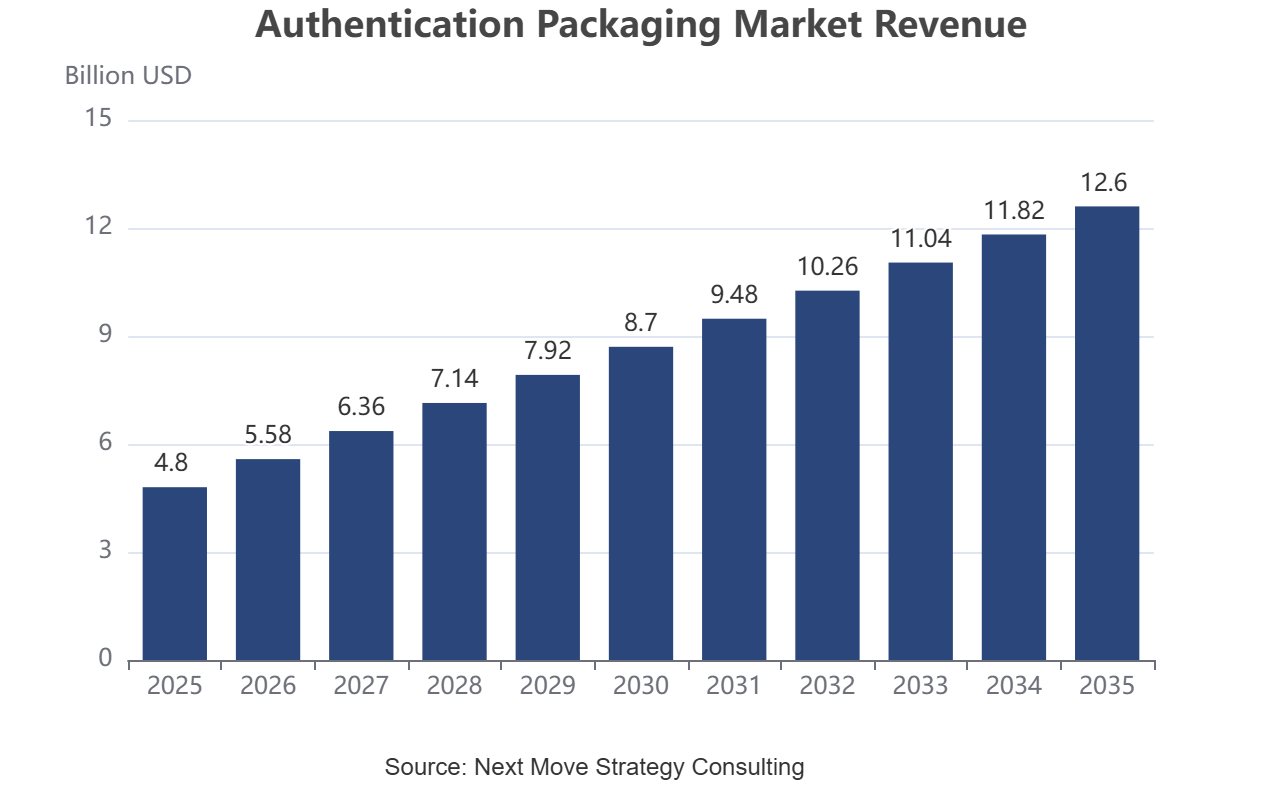
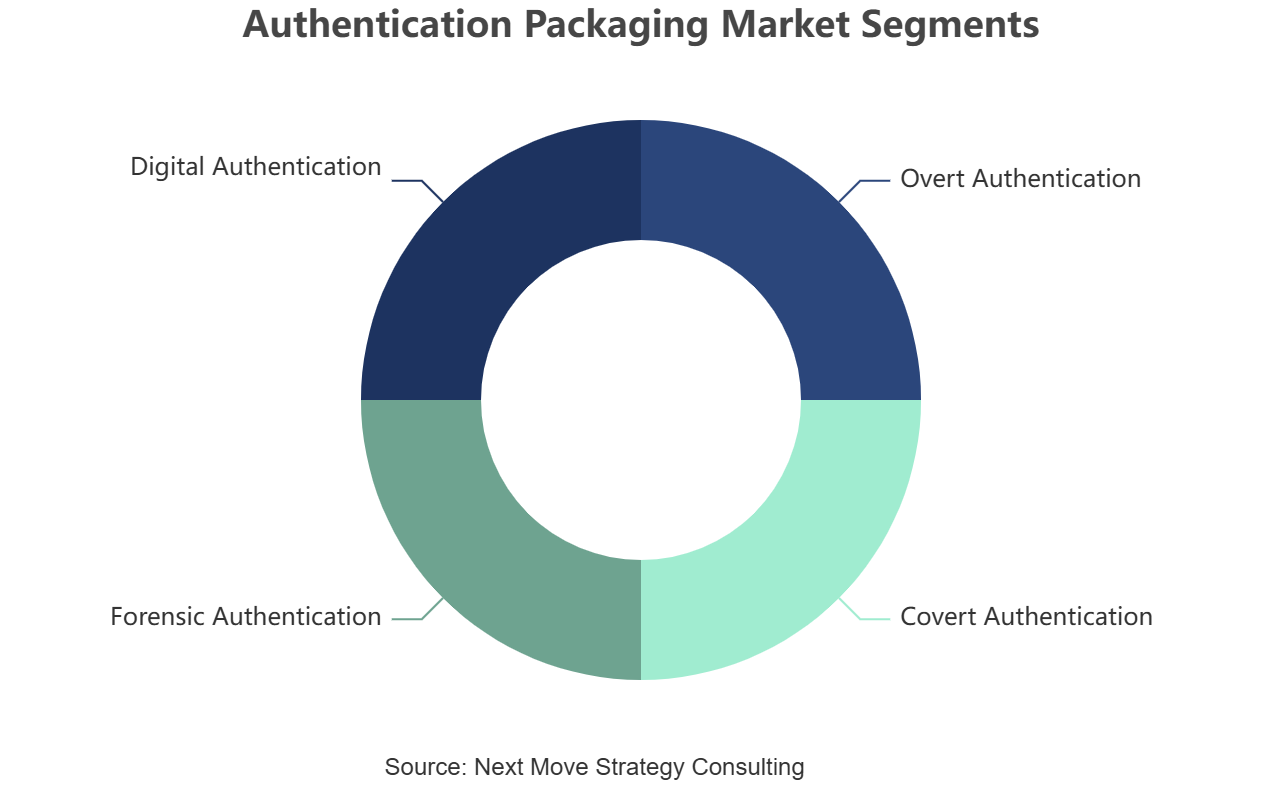
About the Author
 Saista Faiyaz
— Saista Faiyaz is Research Associate at Next Move Strategy Consulting, where she has covered consumer markets and healthcare technologies for 3 years. Her work includes primary interview review, secondary-source validation, market sizing, and structured analysis of company and industry data. She supports research by comparing evidence across sources, organizing findings into market narratives, and documenting assumptions used in analysis. Her scope includes cross-market benchmarking, and reports.
Saista Faiyaz
— Saista Faiyaz is Research Associate at Next Move Strategy Consulting, where she has covered consumer markets and healthcare technologies for 3 years. Her work includes primary interview review, secondary-source validation, market sizing, and structured analysis of company and industry data. She supports research by comparing evidence across sources, organizing findings into market narratives, and documenting assumptions used in analysis. Her scope includes cross-market benchmarking, and reports.
About the Reviewer
 Supradip Baul
— Supradip Baul is an accomplished business consultant and strategist with over a decade of rich experience in market intelligence, strategy, technology, and business transformation. His work has included rigorous qualitative and quantitative analysis across multiple industries, helping clients shape investment decisions and long-term roadmaps. Earlier in his career, he was associated with Gartner, where he contributed to industry-leading reports and market share analyses. He has worked with leading global companies and holds an MBA with a dual specialization in Marketing and Finance.
Supradip Baul
— Supradip Baul is an accomplished business consultant and strategist with over a decade of rich experience in market intelligence, strategy, technology, and business transformation. His work has included rigorous qualitative and quantitative analysis across multiple industries, helping clients shape investment decisions and long-term roadmaps. Earlier in his career, he was associated with Gartner, where he contributed to industry-leading reports and market share analyses. He has worked with leading global companies and holds an MBA with a dual specialization in Marketing and Finance.
At Next Move Strategy Consulting, we understand that insightful market research is the cornerstone of successful business decisions. That's why we employ a robust and multifaceted approach, combining various methodologies to deliver the most accurate and actionable data for our clients.

Research Landscape
We navigate the world of research with two primary approaches:
Qualitative Approach
Our qualitative research methodologies involve immersive techniques such as in-depth interviews, focus groups, and observational studies. By engaging directly with individuals and stakeholders, we uncover valuable insights that quantitative data alone may overlook.

Quantitative Research
In tandem with qualitative methodologies, NMSC leverages the power of Quantitative Research to provide a robust foundation of numerical insights. Through systematic data collection and analysis, we quantify patterns, preferences, and market trends, offering a comprehensive view of the business landscape.
Our quantitative research approach employs diverse tools, including surveys, experiments, and statistical modelling. These methodologies enable us to gather data from a large and representative sample, ensuring the statistical significance of our findings. By employing structured questionnaires and standardized data collection methods, we guarantee the reliability and validity of the information we present to our clients.
Quantitative research is particularly effective in measuring the prevalence of trends, assessing market size, and gauging the impact of various factors on consumer behavior. The numerical precision attained through this approach equips our clients with actionable insights, facilitating data-driven decision-making and strategy formulation.


Our Specialized Toolbox for Industry-Specific Market Research
We deploy a specialized arsenal of techniques tailored to meet your unique requirements. Here's a glimpse into our comprehensive toolbox:

Information Procurement
The stage entails acquiring market data or relevant information through various sources and methodologies.


Market Research Approach
We utilize both top-down and bottom-up approaches in market research analysis to achieve a comprehensive understanding of the market dynamics, leveraging the broad perspective of industry trends and macroeconomic factors alongside detailed insights from specific segments and individual companies.

Porters Five Forces Analysis
We conduct Porter's Five Forces analysis to evaluate the competitive landscape of an industry, providing us with insights into factors that affect profitability and strategic positioning.

SWOT Analysis

Forecasting
We utilize a forecasting model to predict future consumption by considering parameters like population, economics, regulations, market competition, drivers, constraints, technology, and pricing. We also employ statistical techniques such as multilinear regression, exponential smoothing, moving average, ARIMA, and Monte Carlo simulations for accurate predictions. In econometric forecasting, we analyzed short-term and long-term event impacts, attributing values based on regulatory frameworks, economic factors, and market events.





 Speak to Our Analyst