Personalized Skincare Market Global Industry Analysis and Forecast (2026–2035)

The global Personalized Skincare Market size was valued at USD 28.50 billion in 2025 and is estimated at USD 31.54 billion in 2026, forecast to reach USD 78.53 billion by 2035, expanding at a 10.7% CAGR between 2026 and 2035. North America leads with approximately 38% share, while Facial Care dominates all other product categories with approximately 68% share.

Download Free Sample PDF
Base Year (2025)
$28.50 Billion
Forecast (2035)
$78.53 Billion
CAGR (2026-2035)
10.7%
Top Region
North America

What Is the Personalized Skincare Market Size?

The global personalized skincare industry size was valued at USD 28.50 billion in 2025 and is estimated at USD 31.54 billion in 2026, forecast to reach USD 78.53 billion by 2035, expanding at a 10.7% CAGR between 2026 and 2035. North America leads with approximately 38% share, while Facial Care accounted for the largest product share, at approximately 68%.

We observed that growth is distributed across the major product, technology, formulation, consumer, channel, and regional segments, with AI image analysis and online distribution channels driving key structural shifts expected through 2035.

Personalized Skincare Market Global Industry Analysis and Forecast (2026–2035) Revenue Forecast

Values in USD Billion

2025 $28.50 Billion
2025
2026 $31.55 Billion
2026
2027 $34.93 Billion
2027
2028 $38.66 Billion
2028
2029 $42.80 Billion
2029
2030 $47.38 Billion
2030
2031 $52.45 Billion
2031
2032 $58.06 Billion
2032
2033 $64.27 Billion
2033
2034 $71.15 Billion
2034
2035 $78.53 Billion
2035

Key Takeaways

By Product: Facial Care held the largest share of approximately 68% (USD 19.38 billion) in 2025; Other Skincare is the fastest-growing sub-segment at 14.3% CAGR from 2026–2035.

By Personalization Technology: Questionnaire held the largest share of approximately 34% (USD 9.69 billion) in 2025; Microbiome Analysis is the fastest-growing sub-segment at 27.2% CAGR from 2026–2035.

By Formulation: Semi-Custom Formulation held the largest share in 2025; Adaptive Formulation is the fastest-growing sub-segment from 2026–2035.

By Skin Type: Combination held the largest share in 2025; Sensitive is the fastest-growing sub-segment from 2026–2035.

By Skin Concern: Aging held the largest share in 2025; Hyperpigmentation is the fastest-growing sub-segment from 2026–2035.

By Distribution Channel: Online held the largest share of approximately 58% (USD 16.53 billion) in 2025; Online is also the fastest-growing channel at 12.3% CAGR from 2026–2035.

By Price Tier: Premium held the largest share in 2025; Mass is the fastest-growing sub-segment from 2026–2035.

By End User: Women held the largest share in 2025; Men is the fastest-growing sub-segment from 2026–2035.

Dominant Region: North America dominated with approximately 38% revenue share (USD 10.83 billion) in 2025.

Fastest-Growing Region: Asia-Pacific is expected to register the highest CAGR of 13.8% during 2026–2035.

Dominant Country: U.S. led with approximately USD 8.88 billion in 2025.

Fastest-Growing Country: India is the fastest-growing country at approximately 15.6% CAGR from 2026–2035.

Market Opportunity: The personalized skincare market is expected to create an absolute revenue opportunity of USD 46.99 billion between 2026 and 2035, presenting significant investment potential across AI image analysis platforms and adaptive formulation manufacturing infrastructure.

According to NMSC analysis, some beauty conglomerates have pursued acquisitions or partnerships with direct-to-consumer personalization specialists to build AI diagnostic and custom-formulation capability, an approach that may favor diversified companies combining dermatological credibility with scaled manufacturing over standalone digital-native brands as competitive intensity increases through 2035.

What Does the Personalized Skincare Market Encompass?
The personalized skincare market encompasses facial, body, and other skincare products formulated or recommended based on individual skin type, concern, and lifestyle data gathered through questionnaires, AI image analysis, dermatologist assessment, or genetic and microbiome testing. The scope includes genetic-data-enabled and microbiome-informed product recommendations rather than standalone genetic-testing or laboratory-diagnostics revenue, and treats wearable diagnostic hardware as an enabling technology rather than an in-scope product category. Dermatology clinics and medical spas are treated as distribution and service channels for personalized skincare rather than a separate dermatology services market, and personalized prescription skincare is included within scope. Our assessment indicates that the scope spans custom, semi-custom, and adaptive formulations distributed through online and offline channels across mass, premium, and luxury price tiers. The category has evolved from generic questionnaire-based recommendations into a data-rich, technology-driven discipline, driven by AI diagnostic accuracy, teledermatology adoption, and rising consumer demand for tailored regimens.
Cosmetic ingredient safety regulation governs skincare formulations broadly, while separate medical device regulatory frameworks apply only to diagnostic technologies in certain jurisdictions. Requirements depend on the specific product claims, intended use, formulation, and jurisdiction involved, and shape product development and market entry accordingly. We observed that technology adoption is shifting from static questionnaires toward AI-powered image analysis and wearable sensor platforms capable of continuous skin monitoring. NMSC's analysis indicates that this structural shift, combined with expanding retail distribution for personalized brands, is redefining product development priorities across the personalized skincare market.

Market Drivers & Dynamics

Interactive Dataset
Rising consumer demand for AI-driven skin diagnostics driver High Global 2026–2035
Expanding retail distribution for direct-to-consumer brands driver Moderate-High North America, Global 2026–2032
Growing adoption of genetic and microbiome-based testing driver High North America, Europe 2026–2035
Rising e-commerce and mobile application-based personalization driver Moderate Asia-Pacific, Global 2026–2035
Expanding men's grooming and inclusive personalization offerings driver Moderate Global 2026–2032
Rising consumer awareness of dermatological skin conditions driver Moderate Global 2026–2035
High cost of custom formulation limiting mass adoption restraint Moderate-High Latin America, MEA 2026–2032
Data privacy concerns over biometric and genetic skin data restraint Moderate Europe, North America 2028–2035
Fragmented regulatory classification of skin diagnostic devices restraint Low-Moderate Global 2026–2030
Source: Next Move Strategy Consulting

Growth Drivers

What Is the Primary Growth Driver of the Personalized Skincare Market?

Rising consumer demand for AI-driven skin diagnostics is the primary driver of the market. Amorepacific Corporation was named a CES 2026 Innovation Award Honoree for Skinsight, an electronic skin platform co-developed with MIT researchers that tracks skin-aging factors in real time via an ultra-thin sensor patch, reflecting sustained brand investment in AI-powered personalized beauty technology. We observed that this behavioral shift, reinforced by expanding smartphone camera capability, continues to anchor baseline consumption of AI image analysis and diagnostic tools across developed and emerging markets alike.

How Is Retail Expansion Driving Personalized Skincare Market Growth?
Expanding retail distribution for direct-to-consumer personalization brands is accelerating market growth toward broader consumer accessibility. Curology LLC's confirmed retail presence at major mass-market chains extends personalized prescription skincare beyond subscription-only distribution. Our assessment indicates that this expansion, combined with rising retail sales growth reported by direct-to-consumer brands, is compressing adoption timelines for personalized products across mass retail channels in North America.

Growth Inhibitors

What Is Restraining Personalized Skincare Market Expansion?
High cost of custom formulation restrains broader mass-market adoption of fully personalized skincare regimens. Where diagnostic tools make medical claims, the U.S. Food and Drug Administration may classify them as regulated medical devices, a classification that can increase compliance costs for the specific market entrants offering those diagnostic technologies. We found that smaller direct-to-consumer brands face particular exposure, as limited manufacturing scale constrains their ability to reduce per-unit custom formulation costs relative to larger diversified beauty conglomerates.

Segmentation Analysis

2025 (USD Billion)
2035 (USD Billion)
Facial Care 2025: $19.38 Billion | 2035: $47.90 Billion
Facial Care
Body Care 2025: $6.84 Billion | 2035: $21.99 Billion
Body Care
Other Skincare 2025: $2.28 Billion | 2035: $8.64 Billion
Other Skinca
Facial Care $19.38 Billion $47.90 Billion 9.5%
Body Care $6.84 Billion $21.99 Billion 12.4%
Other Skincare $2.28 Billion $8.64 Billion 14.3%

Which Product Segment Dominates the Personalized Skincare Market?

Facial Care led the market with USD 19.38 billion in 2025, supported by strong consumer demand for personalized cleansers, serums, and sun care products tailored to individual skin needs. We observed that Other Skincare is the fastest-growing product category, expanding at a 14.3% CAGR from 2026 to 2035, as brands extend personalization technology into neck, hand, and foot care applications previously underserved by customized formulations.

2025 (USD Billion)
2035 (USD Billion)
AI Image Ana
Questionnair
Dermatologis
DNA Analysis
Microbiome A
Segment Item 2025 (USD Billion) 2035 (USD Billion) CAGR
AI Image Analysis $10.0 USD Billion $40.0 USD Billion 16.0%
Questionnaire $17.1 USD Billion $51.1 USD Billion 22.0%
Dermatologist Assessment $24.2 USD Billion $62.2 USD Billion 16.0%
DNA Analysis $31.3 USD Billion $73.3 USD Billion 22.0%
Microbiome Analysis $38.4 USD Billion $84.4 USD Billion 13.0%

Segment-wise data is locked

Unlock complete segment-wise numbers for By Personalization Technology.

Unlock Full Data

Which Personalization Technology Leads Market Adoption?

Questionnaire-based personalization remained the leading technology, valued at USD 9.69 billion in 2025, on the strength of its low cost and broad accessibility across mass-market brands. Based on research conducted by NMSC, we found that Microbiome Analysis is the fastest-growing personalization technology at a 27.2% CAGR from 2026 to 2035, closely followed by genetic testing-based DNA Analysis, as premium brands scale scientifically substantiated diagnostic capability.

2025 (USD Billion)
2035 (USD Billion)
Custom Formu
Semi-Custom
Adaptive For
Segment Item 2025 (USD Billion) 2035 (USD Billion) CAGR
Custom Formulation $10.0 USD Billion $40.0 USD Billion 17.0%
Semi-Custom Formulation $17.1 USD Billion $51.1 USD Billion 11.0%
Adaptive Formulation $24.2 USD Billion $62.2 USD Billion 25.0%

Segment-wise data is locked

Unlock complete segment-wise numbers for By Formulation.

Unlock Full Data
2025 (USD Billion)
2035 (USD Billion)
Normal
Dry
Oily
Combination
Sensitive
Segment Item 2025 (USD Billion) 2035 (USD Billion) CAGR
Normal $10.0 USD Billion $40.0 USD Billion 25.0%
Dry $17.1 USD Billion $51.1 USD Billion 15.0%
Oily $24.2 USD Billion $62.2 USD Billion 17.0%
Combination $31.3 USD Billion $73.3 USD Billion 23.0%
Sensitive $38.4 USD Billion $84.4 USD Billion 16.0%

Segment-wise data is locked

Unlock complete segment-wise numbers for By Skin Type.

Unlock Full Data
2025 (USD Billion)
2035 (USD Billion)
Acne
Aging
Hyperpigment
Dryness
Sensitive Sk
Segment Item 2025 (USD Billion) 2035 (USD Billion) CAGR
Acne $10.0 USD Billion $40.0 USD Billion 21.0%
Aging $17.1 USD Billion $51.1 USD Billion 15.0%
Hyperpigmentation $24.2 USD Billion $62.2 USD Billion 9.0%
Dryness $31.3 USD Billion $73.3 USD Billion 15.0%
Sensitive Skin $38.4 USD Billion $84.4 USD Billion 24.0%

Segment-wise data is locked

Unlock complete segment-wise numbers for By Skin Concern.

Unlock Full Data
2025 (USD Billion)
2035 (USD Billion)
Online
Brand Websit
E-Commerce M
Mobile Appli
Offline
Segment Item 2025 (USD Billion) 2035 (USD Billion) CAGR
Online $10.0 USD Billion $40.0 USD Billion 25.0%
Brand Website $17.1 USD Billion $51.1 USD Billion 19.0%
E-Commerce Marketplace $24.2 USD Billion $62.2 USD Billion 25.0%
Mobile Application $31.3 USD Billion $73.3 USD Billion 19.0%
Offline $38.4 USD Billion $84.4 USD Billion 20.0%

Segment-wise data is locked

Unlock complete segment-wise numbers for By Distribution Channel.

Unlock Full Data

Which Distribution Channel Leads Personalized Skincare Market Reach?
Online distribution remained the leading channel, valued at USD 16.53 billion in 2025, on the strength of brand websites and mobile applications that collect diagnostic data directly from consumers. Our findings suggest that Online is also the fastest-growing distribution channel, registering a 12.3% CAGR from 2026 to 2035, as e-commerce marketplaces expand personalized skincare storefronts and subscription-based replenishment models.

2025 (USD Billion)
2035 (USD Billion)
Mass
Premium
Luxury
Segment Item 2025 (USD Billion) 2035 (USD Billion) CAGR
Mass $10.0 USD Billion $40.0 USD Billion 26.0%
Premium $17.1 USD Billion $51.1 USD Billion 24.0%
Luxury $24.2 USD Billion $62.2 USD Billion 14.0%

Segment-wise data is locked

Unlock complete segment-wise numbers for By Price Tier.

Unlock Full Data
2025 (USD Billion)
2035 (USD Billion)
Women
Men
Unisex
Segment Item 2025 (USD Billion) 2035 (USD Billion) CAGR
Women $10.0 USD Billion $40.0 USD Billion 26.0%
Men $17.1 USD Billion $51.1 USD Billion 16.0%
Unisex $24.2 USD Billion $62.2 USD Billion 18.0%

Segment-wise data is locked

Unlock complete segment-wise numbers for By End User.

Unlock Full Data

Consumer Behavior and Adoption Trends in Personalized Skincare

Consumer Behavior and Adoption Trends in Personalized Skincare

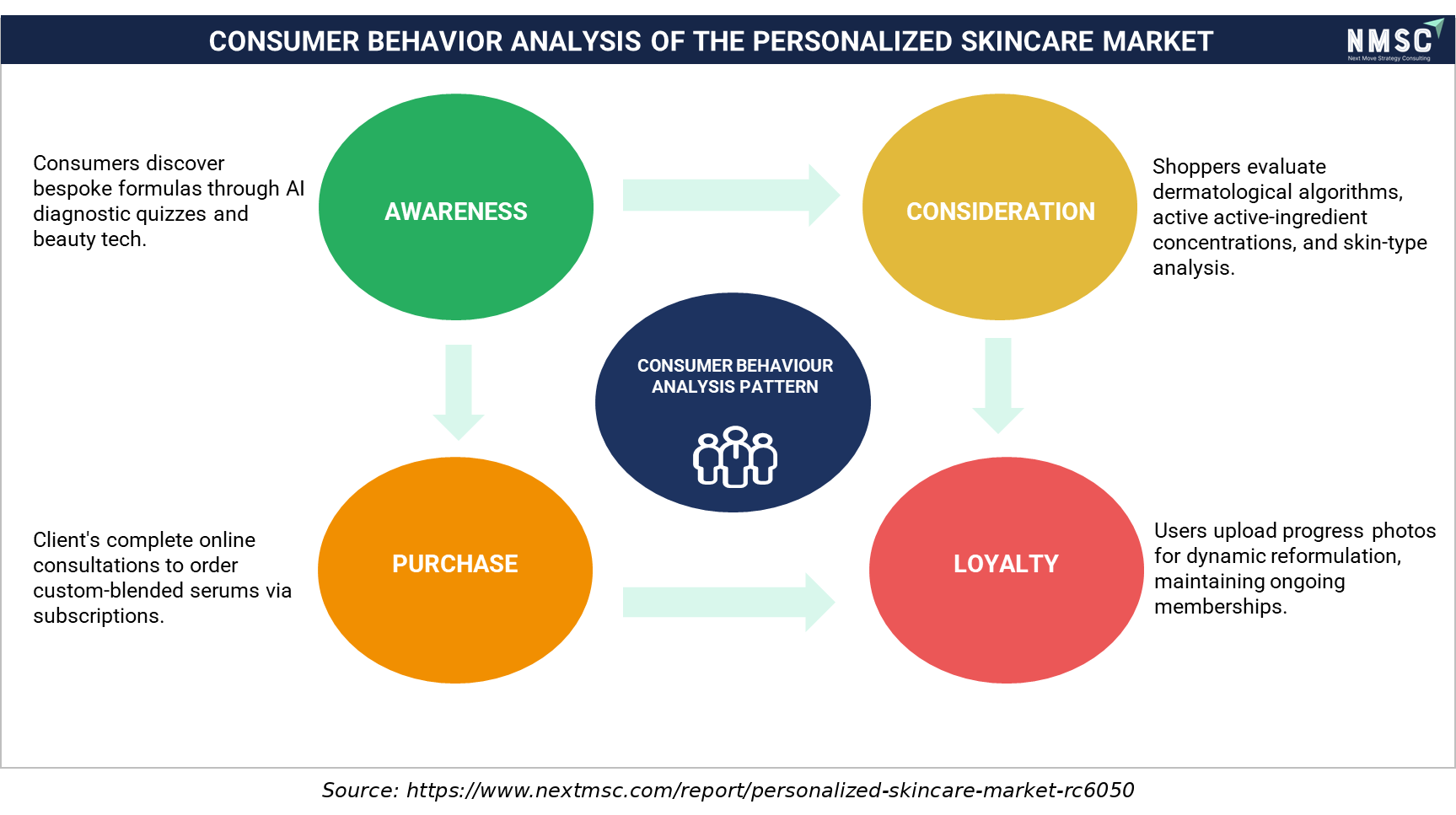
Consumer behavior in personalized skincare is increasingly influenced by digital diagnostics, skin-type analysis, ingredient transparency, and individualized formulation; this section presents a qualitative analysis rather than a survey-based empirical finding. Consumers often explore AI-enabled consultations before evaluating product suitability and active ingredients. Personalized recommendations, progress tracking, subscription models, and formulation adjustments can strengthen engagement, encourage repeat purchases, and support longer-term customer relationships.

Growth Opportunities

Our analysis shows that three forward-looking opportunities stand out for stakeholders positioning within the personalized skincare market over the 2026–2035 forecast period.

How Can Wearable Skin Sensors Unlock Continuous Personalization Revenue?

Wearable skin sensor platforms present a whitespace opportunity for brands seeking to move beyond one-time diagnostics toward continuous, subscription-based personalization. Vendors that commercialize consumer-grade wearable sensors stand to capture recurring revenue as premium and luxury tier consumers seek ongoing skin monitoring, particularly among aging and hyperpigmentation skin concern segments.

Where Does Men's Grooming Personalization Create Market Whitespace?

Men's personalized skincare represents an underpenetrated opportunity as grooming brands expand tailored formulations beyond women-focused product lines. Vendors that develop AI-driven diagnostic tools specifically calibrated for men's skin concerns can secure long-term customer relationships, benefiting from rising acceptance of personalized grooming routines among male consumers globally.

How Can Dermatology Clinic Partnerships Unlock Premium Distribution?

Dermatology clinics and medical spas seeking differentiated patient offerings create an opportunity for personalized skincare brands offering clinically validated formulations, including professional acne medication-adjacent regimens. Early movers that secure clinic-based distribution partnerships can differentiate with premium and luxury tier consumers pursuing physician-backed personalization for acne, aging, and sensitive skin concerns.

Regional Outlook

2025 (USD Billion)
2035 (USD Billion)
North Americ
Asia-Pacific
Europe
Latin Americ
Middle East
Region 2025 (USD Billion) 2035 (USD Billion) CAGR (%)
North America $10.0 USD Billion $40.0 USD Billion 9.0%
Asia-Pacific $17.1 USD Billion $51.1 USD Billion 27.0%
Europe $24.2 USD Billion $62.2 USD Billion 25.0%
Latin America $31.3 USD Billion $73.3 USD Billion 23.0%
Middle East & Africa $38.4 USD Billion $84.4 USD Billion 12.0%

Regional data is locked

Unlock complete regional numbers for this market.

Unlock Full Data

Ecosystem Analysis of the Personalized Skincare Market

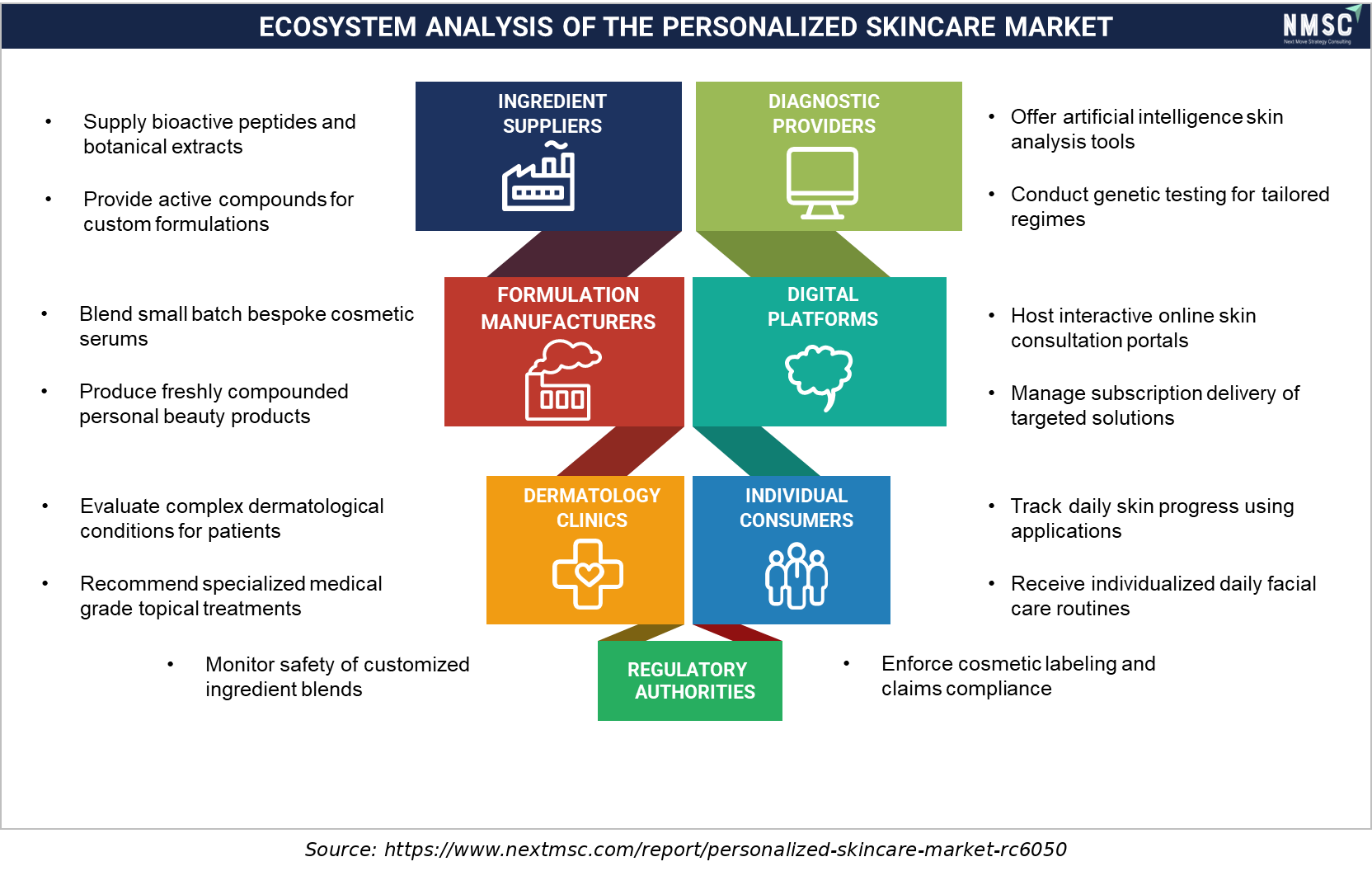
The personalized skincare ecosystem connects ingredient suppliers, diagnostic technology providers, formulation manufacturers, digital platforms, dermatology clinics, consumers, and regulatory authorities. Value typically flows from diagnostic-data providers, such as AI image analysis and microbiome testing vendors, to formulation manufacturers that translate diagnostic outputs into customized products, which personalized brands then deliver through direct-to-consumer, retail, and dermatology or medical-spa channels. Coordination bottlenecks most often arise at the data-to-formulation handoff, where diagnostic accuracy and manufacturing lead times must align to support timely, tailored product delivery and regulatory compliance.

Competitive Landscape

We observed that the personalized skincare market includes global beauty conglomerates competing alongside specialized direct-to-consumer personalization brands on diagnostic accuracy, formulation flexibility, and distribution reach across the broader cosmetics industry.

Dimension Description
Market Structure The market includes global beauty conglomerates and specialized personalization brands; the top companies profiled in this report are among the most visible participants in global personalized skincare revenue, while a growing set of direct-to-consumer specialists serve technology-forward, subscription-based demand.
Innovation Focus AI image analysis, wearable skin sensors, and genetic and microbiome-based diagnostics dominate current innovation pipelines across leading companies.
Strategic Partnerships and Expansion Activity Selective retail partnership expansion, exemplified by Curology LLC's confirmed retail partnership extending personalized prescription skincare into mass retail distribution.

How Do Companies Compete in the Personalized Skincare Market?

Companies compete primarily on diagnostic accuracy, formulation flexibility, and brand trust across the industry. Global conglomerates such as L'Oréal S.A. and The Estée Lauder Companies Inc. leverage extensive research and development infrastructure to serve premium and luxury tier consumers, while direct-to-consumer specialists such as Curology LLC and Function of Beauty LLC compete on subscription convenience and rapid formulation customization for mass and premium segments.

Which Competitive Archetypes Dominate the Personalized Skincare Market?

Two archetypes dominate the market: diversified global beauty conglomerates offering personalization within broader premium product portfolios, and specialized direct-to-consumer brands built exclusively around personalization technology. Amorepacific Corporation and Shiseido Company, Limited exemplify the diversified archetype through proprietary AI diagnostic platforms, while Atolla, Inc. and PROVEN Skincare, Inc. exemplify the specialized archetype serving algorithm-driven, subscription-based custom formulation demand.

How Are Companies Differentiating Through Innovation in Personalized Skincare?

Innovation and differentiation strategy increasingly center on wearable sensors and AI-powered diagnostic platforms. Amorepacific Corporation's Skinsight electronic skin platform and AI-powered skin analysis technology integrated with Samsung Electronics both extend automated diagnostics into continuous, high-accuracy personalization. Our analysis shows that brands unable to demonstrate credible proprietary diagnostic technology may face reduced access to premium retail and dermatology clinic partnerships.

What Strategic Partnerships and Expansion Activity Is Shaping the Personalized Skincare Market?

Retail partnership expansion and technology collaboration continue to reshape capability within the industry. Curology LLC's confirmed retail partnership broadened access to personalized prescription skincare beyond digital-only distribution, while Amorepacific Corporation's continued collaboration with MIT researchers and Samsung Electronics illustrates cross-industry technology partnerships accelerating diagnostic innovation across the personalized skincare market.

Key Market Players

Our assessment indicates that the following 16 companies are actively shaping product innovation, diagnostic technology, and distribution expansion within the global personalized skincare market.

L'Oréal S.A. The Estée Lauder Companies Inc. Shiseido Company, Limited Beiersdorf AG Amorepacific Corporation Kao Corporation LG Household & Health Care Ltd. Natura &Co Holding S.A. Clarins SAS Kosé Corporation POLA ORBIS Holdings Inc. Curology LLC Function of Beauty LLC Dermatica Limited PROVEN Skincare, Inc. Atolla, Inc.

Latest Developments

We found that recent developments within the personalized skincare market are concentrated on wearable diagnostic technology, retail expansion, and AI-powered consultation tools, reflecting the industry's accelerating technology-first transition.

Date Event
June 2026 Amorepacific and Samsung Electronics showcased AI Beauty Screen, a smart mirror that analyzes wrinkles, pigmentation, pores, redness, and skin tone and recommends products and beauty devices based on individual skin conditions and personal color, at VivaTech 2026 in France.
March 2026 L'Oréal launched a Lancôme pilot program utilizing Cell BioPrint technology to provide proteomics-based personalized skin analysis and product recommendations in select retail locations.
Nov 2025 Amorepacific's Skinsight™ electronic-skin platform, co-developed with MIT, uses a wearable sensor and AI application to monitor individual skin-aging factors and generate personalized skincare recommendations based on real-time skin and lifestyle data.
Jan 2025 L'Oréal unveiled Cell BioPrint at CES 2025, a portable skin-analysis device using protein biomarkers and proteomics to assess biological skin age, identify potential skin concerns, and provide personalized skincare insights. The technology was developed through an exclusive partnership with NanoEnTek.

Expert Insights

Alice Chang

Alice Chang

Founder & CEO | Perfect Corp.

"AI Skin technology holds massive potential in the dermatology and medical spa industries as it can greatly enhance personalization while educating consumers about their skin."

Analyst Interpretation

The insight highlights the growing role of artificial intelligence in enabling personalized skincare experiences. AI-powered skin analysis can identify individual skin conditions and concerns, helping consumers and professionals make more targeted skincare and treatment decisions. The expansion of such technologies into dermatology and medical-spa channels is also broadening the addressable market for personalized skincare solutions, while increasing consumer awareness and demand for individualized recommendations.

Investment Opportunities

What Capital Inflows Are Targeting the Personalized Skincare Market?

Capital inflows into the personalized skincare market are increasingly directed toward AI diagnostic technology and direct-to-consumer brands with proprietary formulation platforms. Amorepacific Corporation's Skinsight electronic-skin platform, co-developed with MIT researchers and recognized as a CES 2026 Innovation Award Honoree, reflects sustained commercial investment behind AI-driven personalized beauty technology. We observed that investors favor companies demonstrating credible proprietary diagnostic technology and expanding retail distribution.

How Is Infrastructure Investment Supporting Personalized Skincare Delivery?

Infrastructure investment is expanding manufacturing flexibility and diagnostic data processing capacity to support personalized skincare delivery at scale. Our findings suggest that brands with confirmed mass-retail distribution, such as Curology LLC, are investing in retail-ready packaging and logistics infrastructure to support broader retail accessibility. Brands are prioritizing small-batch manufacturing and diagnostic application infrastructure as the binding constraint on personalization scale.

What ESG Considerations Are Shaping Personalized Skincare Investment Decisions?

Environmental, social, and governance considerations are central to investment decisions across the industry, with organic personal care ingredients sourcing and data privacy as key criteria. Beiersdorf AG and L'Oréal S.A. continue to publish sustainability disclosures covering ingredient sourcing and packaging circularity. We found that investors increasingly scrutinize companies' biometric and genetic data handling practices as governance indicators alongside formulation transparency.

Key Benefits for Stakeholders

How Does This Report Benefit Enterprise and Industry Leaders?

Enterprise and industry leaders gain access to validated segmentation, competitive benchmarking, and regional demand forecasts that support product design and distribution sourcing decisions across the personalized skincare industry. Our analysis shows that detailed product, personalization technology, and price tier breakdowns help brand teams align formulation strategy with regulatory and consumer trust requirements while identifying underserved categories for portfolio expansion.

How Does This Report Benefit Investors and Financial Analysts?

Investors and financial analysts benefit from consistent, single-point market size and CAGR estimates that support valuation and capital-allocation decisions across the personalized skincare market supply chain. We observed that the report's regional and segment-level growth differentials help identify which companies are best positioned to capture above-market growth in AI image analysis and microbiome-based categories through 2035.

How Does This Report Benefit Technology Vendors and Product Teams?

Technology vendors and product teams gain insight into emerging design requirements, including wearable diagnostic sensors, genetic and microbiome testing integration, and adaptive formulation manufacturing, that are reshaping the industry. Our findings suggest that this analysis helps research and development teams prioritize roadmaps around diagnostic accuracy and data privacy increasingly required by beauty conglomerate and retail partner procurement processes.

Key Market Segments Evaluated

By Product

  • Facial Care
  • Body Care
  • Other Skincare

By Personalization Technology

  • Questionnaire
  • AI Image Analysis
  • Dermatologist Assessment
  • In-Store Skin Analysis
  • DNA Analysis
  • Microbiome Analysis

By Formulation

  • Custom Formulation
  • Semi-Custom Formulation
  • Adaptive Formulation

By Skin Type

  • Normal
  • Dry
  • Oily
  • Combination
  • Sensitive

By Skin Concern

  • Acne
  • Aging
  • Hyperpigmentation
  • Dryness
  • Sensitive Skin
  • Redness
  • Oil Control
  • Pore Care
  • Other Skin Concerns

By Distribution Channel

  • Online
  • Offline

By Price Tier

  • Mass
  • Premium
  • Luxury

By End User

  • Women
  • Men
  • Unisex

Conclusion & Recommendations

The long-term outlook for the personalized skincare market remains robust, supported by expanding AI diagnostic accuracy, rising retail accessibility, and growing consumer demand for tailored regimens. NMSC's analysis indicates that the market's expansion from USD 28.50 billion in 2025 to USD 78.53 billion by 2035 is consistent with sustained multi-year growth across the underlying product, technology, and distribution segments, positioning the industry for sustained double-digit expansion through the forecast period.

What Strategic Positioning Should Companies Pursue?

Companies should prioritize proprietary AI diagnostic technology and expanding retail partnerships to differentiate from undifferentiated questionnaire-based competitors. Our assessment indicates that companies combining dermatological credibility with scaled manufacturing and wearable diagnostic capability are likely to be better positioned to capture premium and luxury tier contracts within the personalized skincare market's technology-forward segments.

How Attractive Is the Personalized Skincare Market for New Investment?
The personalized skincare industry presents an attractive investment case, supported by a USD 46.99 billion absolute revenue opportunity between 2026 and 2035 and above-average growth in Asia-Pacific and microbiome-based categories. We found that investment attractiveness is highest for companies combining proprietary diagnostic technology with scaled retail distribution, positioning them to serve both mass and premium consumer segments simultaneously.

What Market Shifts and Key Risks Should Stakeholders Monitor?

Stakeholders should monitor high custom formulation costs, data privacy concerns over biometric and genetic data, and fragmented device regulation as key risks to the personalized skincare market. Our analysis shows that companies unable to scale manufacturing efficiency risk losing mass-market consumers to competitors with lower per-unit personalization costs, particularly as retail expansion accelerates.

What Are the Key Growth Pathways for the Personalized Skincare Market?

Key growth pathways include expanding wearable diagnostic sensor adoption, scaling retail distribution for direct-to-consumer brands, and deepening penetration into men's grooming and microbiome-based personalization categories. NMSC's analysis indicates that companies pursuing these pathways while maintaining formulation cost discipline are likely to be better positioned to capture the personalized skincare market's projected growth through 2035.

FAQs

About the Author

Mihul Sharma

Mihul Sharma

Mihul Sharma is Research Associate at Next Move Strategy Consulting, where he has covered technology, industrial, and healthcare markets for 3 years. His work applies structured business research, market analysis, and secondary-source review to assess market trends, competitive developments, and growth opportunities. He supports report development by fully synthesizing industry data, company information, and market signals into concise findings for strategy and investment-focused research teams.

About the Reviewer

Supradip Baul

Supradip Baul

Supradip Baul is an accomplished business consultant and strategist with over a decade of rich experience in market intelligence, strategy, technology, and business transformation. His work has included rigorous qualitative and quantitative analysis across multiple industries, helping clients shape investment decisions and long-term roadmaps. Earlier in his career, he was associated with Gartner, where he contributed to industry-leading reports and market share analyses. He has worked with leading global companies and holds an MBA with a dual specialization in Marketing and Finance.

Download Free Sample

Kevin Coker

KEVIN COKER

Founder, CEO and Board Diector

Proxima Clinical Research

I have been using Next MSC reports for product positioning in a new geography for a long time. They have by far the best reports I have found and the price is reasonable too!

Semih Kavaklioglu

SEMIH KAVAKLIOGLU

Co-Founder & Sales Manager

Decortie

I work a lot in the marketing industry and I know that research is an essential part of any campaign. I have used Market research reports for my own products and I found them to be very informative and well-researched. The team here produces insightful reports for a good price

Rishabh Jogani

RISHABH JOGANI

Strategy Analyst

Accenture Japan

We are incredibly impressed with the market report on the real estate market in India provided by Next Move Strategy Consulting. The report was thorough, insightful, and well-structured, offering deep analysis and actionable recommendations. It not only captured the current trends and dynamics but also provided a forward-looking perspective that has been invaluable for our strategic planning. Their team demonstrated exceptional professionalism, attention to detail, and a profound understanding of the industry. The data-driven insights and clarity of presentation exceeded our expectations, making complex market trends easy to understand. We highly recommend Next Move Strategy Consulting to anyone looking for reliable and comprehensive market research services. Their expertise has given us the confidence to navigate the complexities of the Indian real estate market with clarity and foresight.

Amos Chang

AMOS CHANG

Strategy Consultant

Kardex Group

I have bought the intralogistics market reports from NMSC two times so far. Joseph and his team are always very helpful and flexible in responding to any customization requirements on the report. Their expertise in market reports really helps us steer the day-to-day business. I will definitely recommend and come back myself whenever there is a need.

Nishant Awate

NISHANT AWATE

Business Development Global Sales

Zehnder Group Deutschland GmbH

Our experience working with Next Move Strategy Consulting was positive. The team was responsive, professional, and open to incorporating our specific requirements throughout the project. The India AHU market study was comprehensive and well structured, covering market value and volume forecasts, product and application segments, and key industry trends. The inclusion of both AHU and residential MVHR market insights made the study particularly relevant for our strategic market assessment. Overall, the report provides a solid foundation for evaluating market potential, identifying priority segments, and supporting business-development decisions in India.

Custom Market Research Services

We will customize the research for you if the listed report does not fully match your requirements.

Get 30% Free Customization

Select License

This website uses cookies to ensure you get the best experience on our website. Learn more

✖