Power Distribution Unit (PDU) Market Global Industry Analysis and Forecast (2026–2035)

Power Distribution Unit (PDU) Market size was USD 5.08 Billion in 2025, projected to reach USD 17.56 Billion by 2035, growing at a CAGR of 12.01% from 2026 to 2035. Key drivers include rapid data center expansion propelled by AI and cloud computing workload growth, growing edge computing infrastructure deployments requiring distributed power management, and accelerating 5G network buildouts and industrial IoT adoption, with North America leading the market.

Download Free Sample PDF
Base Year (2025)
$5.08 Billion
Forecast (2035)
$17.56 Billion
CAGR (2026-2035)
12.0%
Top Region
North America

What Is the Power Distribution Unit (PDU) Market Size?

The global Power Distribution Unit (PDU) Market size reached USD 5.08 Billion in 2025 and is estimated at USD 6.33 Billion in 2026, forecast to reach USD 17.56 Billion by 2035 at a CAGR of 12.01% between 2026 and 2035. North America leads with an approximate 35% share, while Basic PDU dominates the type segment at approximately 28% share in 2025.

We observed that accelerating demand from AI-accelerated hyperscale data center construction and rapidly expanding edge computing deployments is structurally reshaping purchasing patterns across both hyperscale and enterprise power distribution procurement, elevating intelligent and switched PDU variants ahead of the broader market.

Power Distribution Unit (PDU) Market Global Industry Analysis and Forecast (2026–2035) Revenue Forecast

Values in USD Billion

2025 $5.08 Billion
2025
2026 $6.33 Billion
2026
2027 $7.09 Billion
2027
2028 $7.94 Billion
2028
2029 $8.90 Billion
2029
2030 $9.96 Billion
2030
2031 $11.16 Billion
2031
2032 $12.50 Billion
2032
2033 $14.00 Billion
2033
2034 $15.68 Billion
2034
2035 $17.56 Billion
2035

Key Takeaways

By Type: Basic PDU held the largest share, expanding from USD 1.42 Billion in 2025 to USD 3.58 Billion by 2035; Intelligent PDU is the fastest-growing sub-segment at a 16.91% CAGR from 2026–2035.

By Phase: Three Phase PDU held the largest share, expanding from USD 2.64 Billion in 2025 to USD 10.46 Billion by 2035; Three Phase is also the faster-growing phase at a 13.71% CAGR from 2026–2035.

By End User: Data Center held the largest share, expanding from USD 2.34 Billion in 2025 to USD 8.32 Billion by 2035; Healthcare is the fastest-growing end-user segment at a 13.55% CAGR from 2026–2035.

Dominant Region: North America dominated with approximately 35% revenue share in 2025.

Fastest-Growing Region: Asia-Pacific is expected to register the highest CAGR of 14.18% during 2026–2035.

Dominant Country: The U.S. led the market, anchored by concentrated hyperscale data center density and high intelligent PDU adoption.

Fastest-Growing Country: India is the fastest-growing country, supported by rapid digital infrastructure investment and expanding data center capacity.

The Power Distribution Unit (PDU) Market presents an absolute investment opportunity of approximately USD 11.23 Billion between 2026 and 2035, calculated as the difference between the 2035 forecast of USD 17.56 Billion and the 2026 base of USD 6.33 Billion, positioning intelligent PDU platforms and edge power distribution infrastructure as high-conviction categories for data center equipment investors and power management solution vendors.

According to NMSC analysis, the segment’s momentum stems from the convergence of AI-driven hyperscale infrastructure buildouts with digital remote management capabilities that enable real-time circuit-level monitoring and outlet-level switching, expanding total addressable spend per installation well beyond the pricing norms of conventional passive power distribution hardware.

What Does the Power Distribution Unit (PDU) Market Encompass?

The Power Distribution Unit (PDU) Market covers rack-mount and floor-mount hardware units that receive alternating-current power from a utility feed or uninterruptible power supply and distribute it to servers, networking equipment, and storage devices through a structured set of protected outlets. Serving datacenterinfrastructure operators, telecommunications providers, industrial automation facilities, banking and financial services organizations, healthcare networks, and government installations, the market encompasses six principal product types: basic passive PDUs, input-level and outlet-level metered PDUs, SNMP-capable monitored PDUs, outlet-switched PDUs with remote reboot capability, full-featured intelligent PDUs with embedded processors and DCIM connectivity, and dual-feed automatic transfer switch PDUs that maintain power continuity on primary-feed failures.

The market has evolved from commodity power strips without metering capability into a differentiated technology segment where intelligent PDUs embed dedicated processors, network interface cards, and sub-ampere outlet current sensors capable of streaming real-time consumption data to data center infrastructure management systems and building management platforms. Regulatory influence centers on IEC 60884-1 plug and socket-outlet safety standards, ASHRAE thermal envelope guidelines for maximum allowable rack inlet temperatures, and the European Union’s Energy Efficiency Directive requirements for IT equipment load measurement, which together are structurally upgrading the product mix toward higher-value monitored, switched, and intelligent variants. Technology adoption trends favor open-API architectures that allow PDU telemetry to integrate with third-party power management system platforms and cloud-based analytics environments, reducing vendor lock-in while enabling predictive circuit protection and capacity planning at the rack level.

Market Drivers & Dynamics

Interactive Dataset
Hyperscale data center expansion driven by AI and cloud workload demand driver +3.2% North America, Asia-Pacific 2026–2035
Edge computing infrastructure proliferation and 5G network densification driver +2.4% Global 2026–2033
Industrial IoT adoption and manufacturing automation investment driver +1.8% Asia-Pacific, Europe 2026–2035
Regulatory mandates for granular power monitoring and PUE reporting driver +1.5% Europe, North America 2026–2032
Rising replacement cycle for legacy basic PDU installed bases driver +1.2% North America, Europe 2026–2030
High upfront capital cost of intelligent PDU technology vs. basic alternatives restraint −1.4% Asia-Pacific, Latin America 2026–2032
Electronic component supply chain disruptions affecting production lead times restraint −0.8% Global 2026–2029
Cybersecurity vulnerabilities in networked intelligent PDU deployments restraint −0.6% North America, Europe 2026–2030
Low prioritization of PDU upgrades in legacy industrial and government installations restraint −0.4% Middle East & Africa, Latin America 2026–2031
Source: Next Move Strategy Consulting

Growth Drivers

What Is the Primary Growth Driver in the Power Distribution Unit (PDU) Market?

The primary growth driver is hyperscale data center expansion propelled by artificial intelligence workload growth, cloud computing service provider infrastructure investment, and enterprise colocation demand. The U.S. Department of Energy’s data center energy usage research estimates that data centers consumed approximately 4.4% of total U.S. electricity in recent years, with AI-specific workloads accelerating power consumption growth at a rate roughly three times faster than overall data center demand, directly stimulating procurement of high-density intelligent and switched PDU variants to manage elevated per-rack circuit loads that basic metered units are not designed to support.

How Is Edge Computing Infrastructure Driving Power Distribution Unit (PDU) Market Growth?

Edge computing infrastructure proliferation is driving a parallel PDU deployment wave distinct from traditional centralized data center buildouts. Our findings suggest that telecommunications operators, content delivery networks, and enterprise edge deployments collectively represent the second-largest growth driver for PDU demand, particularly for compact, ruggedized basic and metered PDU formats that meet the space and thermal constraints of distributed edge enclosures. This segment generates recurring procurement volume as edge node count scales alongside ongoing 5G network densification programs across Asia-Pacific, North America, and Europe during the 2026–2035 forecast period.

Growth Inhibitors

What Is Restraining the Power Distribution Unit (PDU) Market?

We found that the primary restraint is the higher upfront capital cost of intelligent PDU technology relative to legacy basic PDU installations, which creates adoption friction among small and medium-sized enterprise buyers and cost-sensitive operators in emerging markets. Industry-derived estimates suggest that the average unit selling price for a 24-outlet intelligent PDU with DCIM integration capability exceeds that of a comparable basic PDU by a factor of four to six, limiting upgrade cycles in budget-constrained environments despite the measurable operational cost savings that per-outlet monitoring and remote switching capabilities deliver over multi-year deployment periods.

Segmentation Analysis

2025 (USD Billion)
2035 (USD Billion)
Basic PDU 2025: $1.42 Billion | 2035: $3.58 Billion
Basic PDU
Metered PDU 2025: $1.02 Billion | 2035: $3.42 Billion
Metered PDU
Monitored PDU 2025: $0.91 Billion | 2035: $3.18 Billion
Monitored PD
Switched PDU 2025: $0.81 Billion | 2035: $3.02 Billion
Switched PDU
Intelligent PDU 2025: $0.66 Billion | 2035: $3.36 Billion
Intelligent
ATS PDU 2025: $0.26 Billion | 2035: $1.00 Billion
ATS PDU
Basic PDU $1.42 Billion $3.58 Billion 8.16%
Metered PDU $1.02 Billion $3.42 Billion 11.64%
Monitored PDU $0.91 Billion $3.18 Billion 12.14%
Switched PDU $0.81 Billion $3.02 Billion 12.95%
Intelligent PDU $0.66 Billion $3.36 Billion 16.91%
ATS PDU $0.26 Billion $1.00 Billion 13.34%

Which Type Segment Dominates the Power Distribution Unit (PDU) Market?

Basic PDU leads with USD 1.42 Billion in 2025, expanding to USD 3.58 Billion by 2035, reflecting the continued volume significance of low-cost passive power distribution for commodity server rack installations where monitoring and switching capabilities are not operationally required. Intelligent PDU is the fastest-growing type segment at a 16.91% CAGR, as enterprises upgrading legacy basic PDU installations toward per-outlet monitoring and remote switching capabilities consistently prioritize intelligent variants for new datacentercooling and power infrastructure deployments, driven by AI density requirements and DCIM integration mandates that basic and metered alternatives cannot satisfy.

2025 (USD Billion)
2035 (USD Billion)
Single Phase
Three Phase
Three Phase
Three Phase
Segment Item 2025 (USD Billion) 2035 (USD Billion) CAGR
Single Phase $10.0 USD Billion $40.0 USD Billion 25.0%
Three Phase $17.1 USD Billion $51.1 USD Billion 11.0%
Three Phase Delta $24.2 USD Billion $62.2 USD Billion 25.0%
Three Phase Wye $31.3 USD Billion $73.3 USD Billion 11.0%

Segment-wise data is locked

Unlock complete segment-wise numbers for By Phase.

Unlock Full Data

Which Phase Segment Leads and Which Grows Fastest?

Three-phase PDUs hold USD 2.64 Billion in 2025, expanding to USD 10.46 Billion by 2035, reflecting the predominance of three-phase power distribution in hyperscale and enterprise data centers where higher power loads require balanced three-phase delivery to minimize neutral conductor current and ensure circuit reliability. Three-phase is also the faster-growing phase at a 13.71% CAGR, driven by the surge in high-density AI server rack deployments that mandate three-phase input to support per-rack power loads exceeding 30 kW that single-phase distribution infrastructure cannot safely deliver at standard conductor ratings.

2025 (USD Billion)
2035 (USD Billion)
Data Center
Hyperscale D
Enterprise D
Colocation D
Telecom
Segment Item 2025 (USD Billion) 2035 (USD Billion) CAGR
Data Center $10.0 USD Billion $40.0 USD Billion 27.0%
Hyperscale Data Center $17.1 USD Billion $51.1 USD Billion 9.0%
Enterprise Data Center $24.2 USD Billion $62.2 USD Billion 19.0%
Colocation Data Center $31.3 USD Billion $73.3 USD Billion 17.0%
Telecom $38.4 USD Billion $84.4 USD Billion 18.0%

Segment-wise data is locked

Unlock complete segment-wise numbers for By End User.

Unlock Full Data

Which End-User Segment Dominates and Which Is Fastest-Growing in the Power Distribution Unit (PDU) Market?

Data Center customers dominate at USD 2.34 Billion in 2025, reflecting the concentration of power distribution infrastructure investment within hyperscale, enterprise, and colocation data center environments where rack density, uptime requirements, and energy efficiency mandates create disproportionate PDU procurement volumes relative to other vertical markets. Healthcare is the fastest-growing end-user segment at a 13.55% CAGR, as hospital data centers, telehealth infrastructure, and medical device manufacturing environments expand their IT footprints while requiring uninterruptible power distribution with integrated surge protection and outlet-level monitoring for regulatory compliance with health IT infrastructure standards and FDA cybersecurity guidance for networked medical devices.

Supply Chain Analysis of the Power Distribution Unit (PDU) Market

Supply Chain Analysis of the Power Distribution Unit (PDU) Market

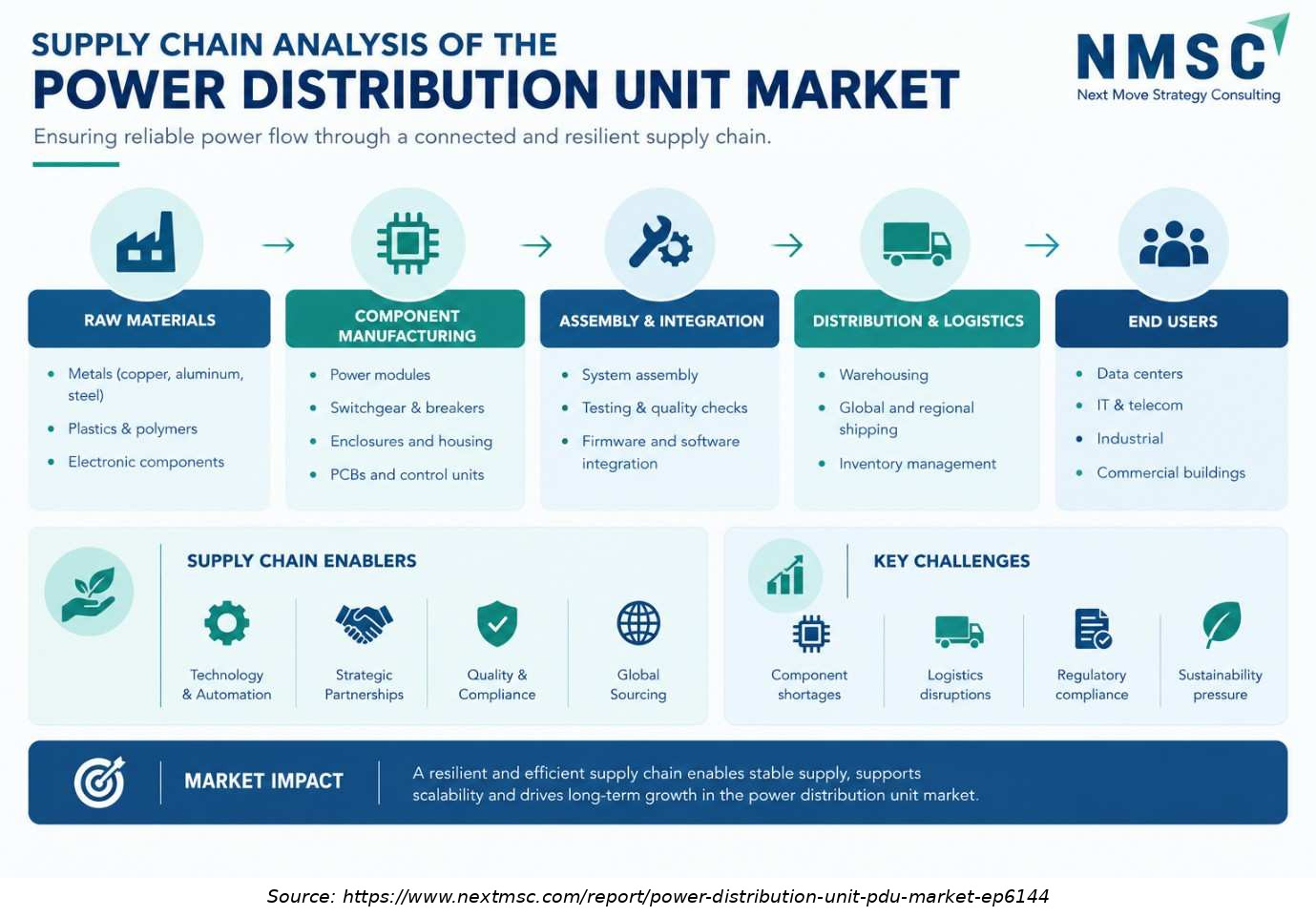
The above infographic provides a detailed supply chain analysis of the Power Distribution Unit (PDU) market, outlining a five-step flow from raw materials to end users. It traces the process from sourcing metals and electronic components through manufacturing, assembly, and distribution to final deployment in data centers and industrial buildings. The analysis highlights crucial supply chain enablers like technology and strategic partnerships, while also addressing key challenges such as component shortages and regulatory compliance. Ultimately, it concludes that a resilient and efficient supply chain is essential for ensuring stable supply and driving long-term market growth.

Growth Opportunities

Our analysis shows that three whitespace opportunities stand out for PDU manufacturers and software integrators positioning ahead of 2035 demand.

Can High-Density AI Server Rack Configurations Unlock a New Tier of Intelligent PDU Demand?

Server rack deployments dedicated to AI training and inference workloads are driving per-rack power requirements toward 50–100 kW configurations that conventional PDU product lines were not designed to support. Manufacturers that develop three-phase intelligent PDUs rated for continuous loads exceeding 60A per phase with per-outlet current sensing at sub-ampere resolution can capture procurement volumes from hyperscale datacenter operators rewriting PDU specifications for next-generation AI compute rows. This opportunity benefits the Intelligent PDU type segment and the Data Center end-user segment as AI infrastructure investment cycles accelerate through 2035.

Does Edge Computing Infrastructure Expansion Create Underserved PDU Market Segments?

Distributed edge computing deployments across telecom cell sites, retail edge nodes, and industrial IoT infrastructure are generating demand for compact, ruggedized PDU formats with IP-rated enclosures, extended temperature operating ranges, and cellular-connected remote management that the data center-centric PDU product landscape has not historically addressed at scale. Vendors that develop purpose-built edge PDU product lines can capture this structurally distinct demand, benefiting the Basic PDU and Monitored PDU type segments and the Telecom end-user segment as 5G network densification drives new non-data-center PDU deployment volumes across Asia-Pacific, Latin America, and Middle East & Africa markets.

Can Sustainability Mandates Drive Metered PDU Replacement Cycles in Emerging Markets?

Government-led data center efficiency programs and ESG-driven corporate sustainability reporting requirements are accelerating metered PDU adoption in markets where basic passive PDU installations remain the norm, most notably in Asia-Pacific manufacturing and BFSI data centers where outlet-level consumption data is increasingly required for regulatory filings and carbon accounting. Companies that position metered and monitored PDU migration programs as compliance enablers rather than hardware upgrades can unlock structured replacement cycle demand in otherwise price-sensitive markets, benefiting the Metered PDU and Monitored PDU type segments and the BFSI and Industrial end-user segments as ESG reporting obligations expand.

Regional Outlook

2025 (USD Billion)
2035 (USD Billion)
North Americ
Asia-Pacific
Europe
Latin Americ
Middle East
Region 2025 (USD Billion) 2035 (USD Billion) CAGR (%)
North America $10.0 USD Billion $40.0 USD Billion 9.0%
Asia-Pacific $17.1 USD Billion $51.1 USD Billion 27.0%
Europe $24.2 USD Billion $62.2 USD Billion 25.0%
Latin America $31.3 USD Billion $73.3 USD Billion 23.0%
Middle East & Africa $38.4 USD Billion $84.4 USD Billion 12.0%

Regional data is locked

Unlock complete regional numbers for this market.

Unlock Full Data

Competitive Landscape

Our assessment indicates that the Power Distribution Unit (PDU) Market competitive landscape spans integrated power management platform leaders, specialized data center PDU manufacturers, and diversified industrial power equipment groups, each competing on product breadth, intelligent monitoring capability, and data center ecosystem integration depth. Key Takeaways

Dimension Description
Dimension Assessment
Market Structure Moderately consolidated; top 10 companies hold the majority of market share, led by integrated power management platform leaders alongside specialized data center PDU manufacturers and diversified industrial power equipment groups.
Innovation Focus High-density three-phase intelligent PDU development for AI compute racks, DCIM-integrated remote outlet management platforms, solid-state circuit breaker integration, and edge-ruggedized compact PDU formats.
M&A Activity Selective capability acquisitions targeting intelligent PDU software platforms and DCIM integration technology rather than large-scale manufacturing consolidation, reflecting the software differentiation requirements of intelligent PDU leadership.

How Do Companies Compete in the Power Distribution Unit (PDU) Market?

Companies compete primarily on intelligent monitoring depth, DCIM platform integration breadth, three-phase product density capability, and strength of hyperscale data center account relationships. Our findings suggest that vendors with integrated hardware and software PDU ecosystems that natively connect to major DCIM platforms hold a structural competitive advantage over single-product competitors, as data center operators increasingly favor consolidated vendor relationships that reduce integration complexity and provide unified real-time power visibility across mixed PDU product generations.

Which Competitive Archetypes Dominate the Power Distribution Unit (PDU) Market?

Diversified power management platform leaders such as Schneider Electric and Eaton Corporation dominate through integrated PDU, UPS, and DCIM software ecosystems spanning multiple product categories and data center tiers, while specialized data center PDU manufacturers including Vertiv Holdings and Legrand differentiate through dedicated intelligent PDU engineering expertise and purpose-built software integration capabilities. Industrial power equipment groups such as ABB and Siemens compete on combined protection, distribution, and automation capability that extends across both data center and industrial edge deployment environments.

What Innovation and Differentiation Strategies Are Companies Pursuing?

We observed that leading companies are investing in solid-state circuit breaker integration, AI-assisted load prediction algorithms, and high-density three-phase outlet configurations to capture AI compute rack procurement volumes that conventional PDU product lines cannot technically address. Differentiation increasingly rests on software-defined PDU architectures that allow per-outlet configuration changes through firmware updates without physical hardware replacement, enabling a recurring software subscription revenue model alongside one-time hardware procurement that diversifies manufacturer revenue streams beyond traditional one-time hardware transactions.

What M&A and Partnership Activity Is Shaping the Power Distribution Unit (PDU) Market?

Recent activity favors capability acquisitions and platform integration over large-scale manufacturing consolidation, reflecting the software and DCIM integration investment required to differentiate intelligent PDU products in an increasingly specification-driven hyperscale procurement environment. NMSC’s analysis indicates that established manufacturers are prioritizing internal engineering investment in high-density product development alongside selective acquisitions of intelligent PDU software and analytics platforms, rather than horizontal manufacturing M&A that would not directly address the software differentiation gap driving intelligent PDU growth relative to basic and metered alternatives.

Competitive Dynamics and M&A Landscape

Recent strategic moves, partnerships, and acquisitions shaping the Power Distribution Unit (PDU) Market Global Industry Analysis and Forecast (2026–2035).

July 2026 Panduit Product Launch Panduit announced the ES2P Power Distribution Unit, a managed rack PDU for data centers, edge deployments, enterprise environments, and technology-refresh projects.
July 2026 Vertiv Product Firmware Update Vertiv released firmware version 7.2.1 for PowerIT Upgradeable rack PDUs and rack transfer switches. The update adds multi-feed support, zero-touch provisioning, enhanced authentication and configuration logging, expanded API and Redfish support for multi-feed data, and reliability improvements.

Key Market Players

Based on research conducted by NMSC, the following companies represent the validated set of leading participants across PDU products, intelligent monitoring platforms, and power distribution services.

Schneider Electric SE Eaton Corporation plc Vertiv Holdings Co. Legrand SA ABB Ltd. Siemens AG Delta Electronics, Inc. Panduit Corp. Hewlett Packard Enterprise Company Belden Inc. nVent Electric plc Leviton Manufacturing Co. CyberPower Systems, Inc. Austin Hughes Group Rittal GmbH & Co. KG Minuteman International, Inc. Elcom Technologies, Inc. Bachmann electronic GmbH Powertek Europe Ltd. Black Box Corporation

Strategic Analysis of the Power Distribution Unit (PDU) Market

Strategic Analysis of the Power Distribution Unit (PDU) Market

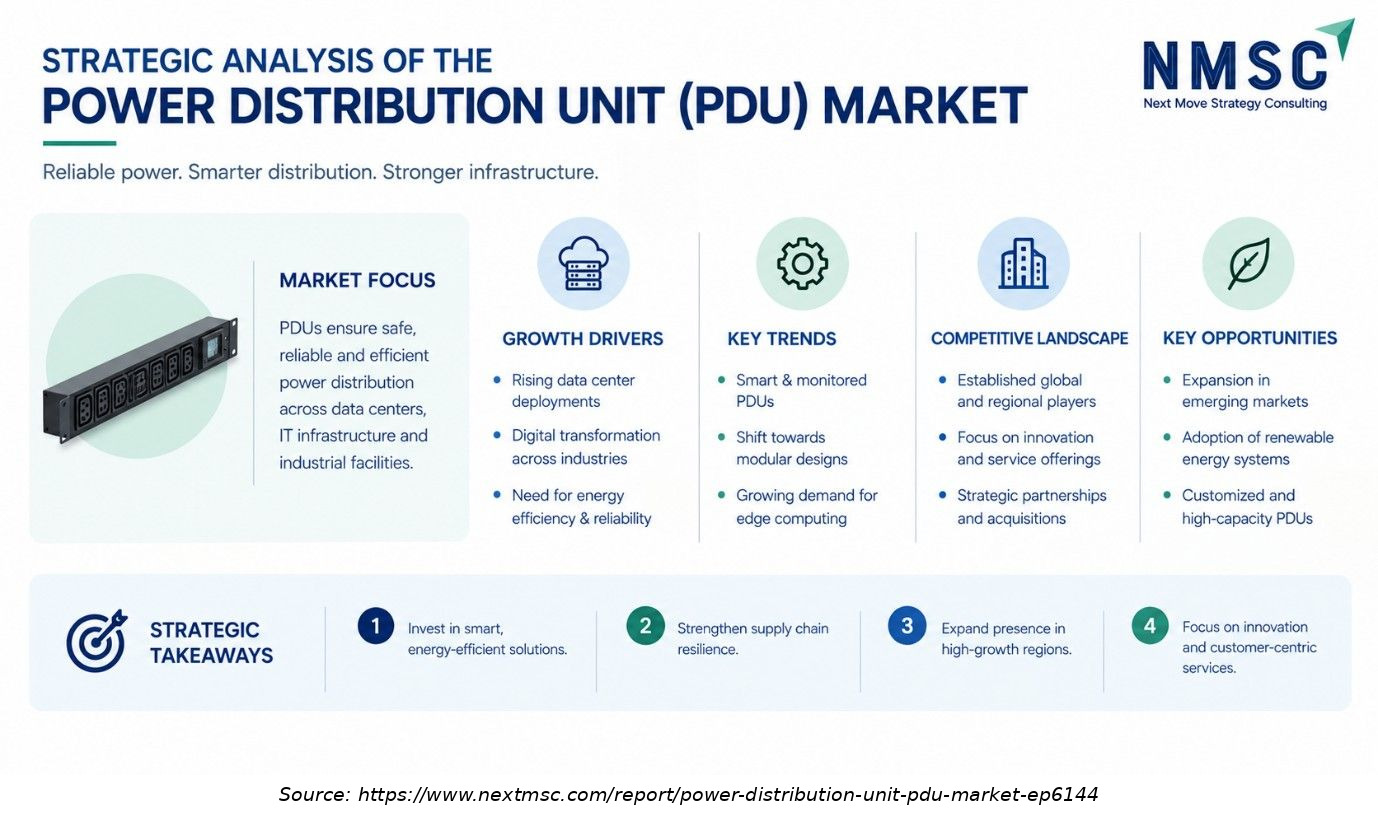
The above infographic provides a strategic analysis of the Power Distribution Unit (PDU) market, highlighting its focus on ensuring reliable power across data centers and IT infrastructure. It identifies key growth drivers such as digital transformation and rising data center deployments, alongside trends like smart, modular designs. The analysis further outlines the competitive landscape and key opportunities in emerging markets and renewable energy integration. Ultimately, the strategic takeaways emphasize investing in energy-efficient solutions, strengthening supply chain resilience, and focusing on innovation to drive future growth.

Latest Developments

We found that recent corporate activity across the Power Distribution Unit (PDU) Market reflects continued intelligent PDU platform investment and sustained product development focused on high-density AI rack environments and DCIM integration capability.

Date Event
July 2026 Panduit announced the ES2P Power Distribution Unit, a managed rack PDU for data centers, edge deployments, enterprise environments, and technology-refresh projects.
July 2026 Vertiv released firmware version 7.2.1 for PowerIT Upgradeable rack PDUs and rack transfer switches. The update adds multi-feed support, zero-touch provisioning, enhanced authentication and configuration logging, expanded API and Redfish support for multi-feed data, and reliability improvements.

Expert Insights

Ramesh Menon

Ramesh Menon

Vice President, IT Systems Business | Vertiv

"The Vertiv PowerIT rack PDU not only addresses the need for reliable high-density power but also provides the flexibility and scalability to support evolving infrastructure requirements and future-friendly data center growth."

Analyst Interpretation

We observed that rising rack power densities across AI, HPC, and data-intensive computing environments are increasing requirements for high-capacity and scalable power distribution systems. NMSC’s analysis indicates that PDU demand is shifting toward solutions capable of supporting higher electrical loads while maintaining load balancing, operational reliability, and flexible configuration. This evolution is strengthening demand for high-density rack PDUs across hyperscale data centers, colocation facilities, enterprise data centers, and other infrastructure environments undergoing rapid capacity expansion.

Investment Opportunities

Where Are Capital Inflows Concentrating in the Power Distribution Unit (PDU) Market?

Recent Vertiv disclosures indicate continued investment in data-center power and digital infrastructure capacity, with Vertiv reporting a combined order backlog of approximately USD 15.0 billion at December 31, 2025. The backlog covers a broad critical-infrastructure portfolio and should not be interpreted as PDU-only revenue. It nevertheless provides company-level evidence of strong demand for data-center infrastructure capacity rather than a standalone measure of PDU market inflows.

How Is Infrastructure Investment Shaping Long-Term PDU Market Capacity?

Our findings suggest that infrastructure investment is shifting toward modular, scalable PDU architectures that allow per-outlet configuration changes through firmware updates without physical hardware replacement, reducing total cost of ownership for data center operators managing evolving rack density configurations over multi-year facility lifespans. This shift favors manufacturers with software-defined PDU platforms that can expand monitoring and switching capability through software licensing alongside rising AI server rack turnover rates, enabling a recurring revenue model that diversifies returns beyond one-time hardware procurement cycles across both hyperscale and enterprise deployment channels.

What ESG Considerations Are Influencing Investment Decisions in the Power Distribution Unit (PDU) Market?

Environmental, Social, and Governance considerations center on reducing data center Scope 2 emissions by enabling granular power measurement at the outlet level, which is a prerequisite for the asset-level emissions accounting required under the EU Corporate Sustainability Reporting Directive and voluntary frameworks including the Science Based Targets initiative for information and communication technology organizations. We found that investors increasingly favor PDU vendors demonstrating measurable integration into DCIM platforms used for ESG reporting, linking intelligent PDU adoption to sustainability commitments, while the broader smart grid infrastructure investment wave is creating parallel demand for advanced power metering at the rack level as utilities and corporate sustainability officers seek more granular facility-level energy consumption visibility.

Key Benefits for Stakeholders

How Does This Report Benefit Industry Leaders?

Industry leaders gain segment-level revenue forecasts and CAGR benchmarks across type, phase, and end-user axes, enabling product-roadmap decisions grounded in the same 2025–2035 market size figures used consistently throughout this analysis. Our findings on regional growth differentials, competitive archetype analysis, and intelligent PDU adoption drivers further support product prioritization decisions and strategic go-to-market positioning for data center, telecom, and industrial end markets across the 38 countries covered.

How Does This Report Benefit Investors and Financial Analysts?

Investors and financial analysts gain a reconciled market-sizing model, validated Top 20 company set, and named-company development tracking that supports valuation and capital-allocation decisions across the PDU market and adjacent power infrastructure segments. The Growth Catalyst & Risk Assessment Matrix quantifies driver and restraint impact on CAGR, enabling scenario analysis for portfolio positioning in data center infrastructure hardware, critical power equipment, and intelligent monitoring software investment theses.

How Does This Report Benefit Technology Vendors and Product Teams?

Technology vendors and product teams gain visibility into which type and end-user segments, such as Intelligent PDU and Healthcare, are growing fastest within the overall Power Distribution Unit (PDU) Market, informing where to prioritize engineering investment and go-to-market focus through 2035. The market report’s competitive landscape assessment and M&A activity analysis additionally support partnership and acquisition target identification for vendors seeking to expand their DCIM integration capability or high-density product portfolios ahead of the AI-driven replacement cycle.

Key Market Segments Evaluated

By Type

  • Basic PDU 
    • Non-Surge-Protected Basic PDU
    • Surge-Protected Basic PDU
  • Metered PDU 
    • Input-Level Metered PDU
    • Outlet-Level Metered PDU
  • Monitored PDU 
    • SNMP-Enabled Monitored PDU
    • Non-SNMP Monitored PDU
  • Switched PDU 
    • Outlet-Switched PDU
    • Branch-Circuit-Switched PDU
  • Intelligent PDU 
    • Rack-Level Intelligent PDU
    • Floor PDU
  • ATS PDU 
    • Single-Input ATS PDU
    • Dual-Input ATS PDU

By Phase

  • Single Phase
  • Three Phase 
    • Three Phase Delta
    • Three Phase Wye

By End User

  • Data Center 
    • Hyperscale Data Center
    • Enterprise Data Center
    • Colocation Data Center
  • Telecom 
    • Wireless Infrastructure
    • Wireline Infrastructure
  • Industrial 
    • Manufacturing and Process Automation
    • Critical Infrastructure
  • BFSI
  • Healthcare 
    • Hospital Data Center
    • Telehealth Infrastructure
  • Government and Defense

By Region

  • North America 
    • U.S.
    • Canada
    • Mexico
  • Europe 
    • UK
    • Germany
    • France
    • Italy
    • Spain
    • Sweden
    • Denmark
    • Finland
    • Netherlands
    • Rest of Europe
  • Asia-Pacific 
    • China
    • India
    • Japan
    • South Korea
    • Taiwan
    • Indonesia
    • Vietnam
    • Australia
    • Philippines
    • Malaysia
    • Rest of APAC
  • Middle East & Africa 
    • Saudi Arabia
    • UAE
    • Egypt
    • Israel
    • Turkey
    • Nigeria
    • South Africa
    • Rest of MEA
  • Latin America 
    • Brazil
    • Argentina
    • Chile
    • Colombia
    • Rest of LATAM

Conclusion & Recommendations

The long-term outlook remains structurally positive, with the Power Distribution Unit (PDU) Market expanding from USD 6.33 Billion in 2026 to USD 17.56 Billion by 2035 at a 12.01% CAGR, driven by data center expansion accelerated by AI workload growth, edge computing infrastructure proliferation, and rising regulatory demand for outlet-level power monitoring. We observed that this growth trajectory is underpinned by durable structural catalysts, hyperscale data center construction cycles, 5G-driven edge deployment, and ESG-linked efficiency mandates, rather than cyclical demand, supporting sustained manufacturer investment in intelligent PDU platforms throughout the forecast period.

What Strategic Positioning Do We Recommend?

Our assessment indicates that manufacturers should prioritize high-density three-phase intelligent PDU development and DCIM software integration to capture the fastest-growing Intelligent PDU and Data Center segments that will collectively generate the majority of market value growth through 2035. Companies without established DCIM ecosystem integration should pursue platform partnerships or targeted software acquisitions rather than standalone hardware strategies, given the market’s accelerating shift toward software-defined power management that enables dynamic reconfiguration without physical hardware replacement and creates recurring revenue alongside one-time hardware transactions.

How Attractive Is the Power Distribution Unit (PDU) Market for Investment?

Investment attractiveness is high in Asia-Pacific and Latin America given superior CAGR profiles of 14.18% and 13.12%, respectively, while North America offers the largest absolute revenue base with strong hyperscale-driven recurring procurement demand tied to AI infrastructure replacement cycles. We found that Intelligent PDU and Three Phase product revenue streams offer substantially stronger margin and growth profiles than Basic PDU alternatives that face increasing commoditization pressure from lower-cost manufacturers, making the intelligent and three-phase segments the primary value capture targets for investors across the 2026–2035 period.

What Are the Key Market Shifts and Risks in the Power Distribution Unit (PDU) Market?

Key risks include the potential for hyperscale operators to develop proprietary busway-based power distribution architectures that reduce rack-level PDU procurement volumes in high-density AI campuses, and the exposure of networked intelligent PDUs to cybersecurity vulnerabilities as power infrastructure becomes increasingly connected to enterprise networks and cloud-based management systems. Our analysis shows that manufacturers unable to demonstrate robust cybersecurity certifications, including NIST SP 800-82 alignment for industrial control systems, risk disqualification from government and regulated-industry data center procurement processes as security requirements tighten across North America and Europe.

What Are the Primary Growth Pathways Through 2035?

Primary growth pathways include expanding three-phase intelligent PDU product lines for AI compute rack environments, developing purpose-built edge PDU variants for telecom and industrial deployments that address physical and connectivity constraints absent from data center-centric product lines, and integrating PDU hardware with DCIM software platforms to capture recurring subscription revenue alongside hardware procurement cycles. We observed that companies combining all three pathways are best positioned to capture disproportionate share of the USD 11.23 Billion absolute opportunity created between 2026 and 2035.

FAQs

About the Author

Mayurima Roy

Mayurima Roy

Mayurima Roy is Research Analyst at Next Move Strategy Consulting, where she has spent 4 years working across the firm's full industry coverage rather than a single fixed vertical. Her work centers on structured research, ongoing trend tracking, competitive assessment, and insight-led content development, translating complex market data into clear, decision-ready narratives that support informed client decision-making across diverse global industries, market sectors, and world regions every day.

About the Reviewer

Supradip Baul

Supradip Baul

Supradip Baul is an accomplished business consultant and strategist with over a decade of rich experience in market intelligence, strategy, technology, and business transformation. His work has included rigorous qualitative and quantitative analysis across multiple industries, helping clients shape investment decisions and long-term roadmaps. Earlier in his career, he was associated with Gartner, where he contributed to industry-leading reports and market share analyses. He has worked with leading global companies and holds an MBA with a dual specialization in Marketing and Finance.

Download Free Sample

Semih Kavaklioglu

SEMIH KAVAKLIOGLU

Co-Founder & Sales Manager

Decortie

I work a lot in the marketing industry and I know that research is an essential part of any campaign. I have used Market research reports for my own products and I found them to be very informative and well-researched. The team here produces insightful reports for a good price

Amos Chang

AMOS CHANG

Strategy Consultant

Kardex Group

I have bought the intralogistics market reports from NMSC two times so far. Joseph and his team are always very helpful and flexible in responding to any customization requirements on the report. Their expertise in market reports really helps us steer the day-to-day business. I will definitely recommend and come back myself whenever there is a need.

Kishu Kanda

KISHU KANDA

Strategy Analyst

Accenture

We purchased the AI Consumer Market Report from this company. Not only did they customize the report to meet our specific requirements, but they also showed great flexibility in accommodating our budget. The report we received fully met our expectations. Additionally, they provided prompt and thorough responses to both our pre-purchase and follow-up questions. We look forward to working with this company again in the future.

Gustaf Hummel Burstrom

GUSTAF HUMMEL BURSTROM

Founder

Revline Tools AB

Joseph and the team at Next Move Strategy Consulting have been excellent to work with, in supplying us with relevant market data and forecasts for our specific category. We had some special requirements and they were able to do a custom package to suit our needs. We would definitely recommend them to any other company needing market data and forecasts

Nishant Awate

NISHANT AWATE

Business Development Global Sales

Zehnder Group Deutschland GmbH

Our experience working with Next Move Strategy Consulting was positive. The team was responsive, professional, and open to incorporating our specific requirements throughout the project. The India AHU market study was comprehensive and well structured, covering market value and volume forecasts, product and application segments, and key industry trends. The inclusion of both AHU and residential MVHR market insights made the study particularly relevant for our strategic market assessment. Overall, the report provides a solid foundation for evaluating market potential, identifying priority segments, and supporting business-development decisions in India.

Custom Market Research Services

We will customize the research for you if the listed report does not fully match your requirements.

Get 30% Free Customization

Select License

This website uses cookies to ensure you get the best experience on our website. Learn more

✖