Processing and Discovery Market Global Industry Analysis and Forecast (2026–2035)

Processing and Discovery Market size was USD 33.70 billion in 2026, projected to reach USD 50.97 billion by 2035, growing at a CAGR of 4.70% from 2026 to 2035. Key drivers include expanding extended producer responsibility regulation, rising material recovery facility modernization, and growing AI-enabled sorting adoption, with North America leading the market.

Download Free Sample PDF
Base Year (2025)
$31.20 Billion
Forecast (2035)
$50.97 Billion
CAGR (2026-2035)
4.7%
Top Region
North America

What Is the Processing and Discovery Market Size?

The global processing and discovery market size was valued at USD 31.2 Billion in 2025 and is estimated to grow from USD 33.70 Billion in 2026 to USD 50.97 Billion by 2035, expanding at a CAGR of 4.70% between 2026 and 2035. North America led the processing and discovery market with an approximate 32% revenue share in 2026, while Sorting and Separation Equipment remained the dominant equipment-type segment with an approximate 20% share of 2026 revenue.

We observed that the processing and discovery market's momentum is best captured through a concise set of indicators before deeper analysis follows.

Processing and Discovery Market Global Industry Analysis and Forecast (2026–2035) Revenue Forecast

Values in USD Billion

2025 $31.20 Billion
2025
2026 $33.70 Billion
2026
2027 $35.28 Billion
2027
2028 $36.94 Billion
2028
2029 $38.68 Billion
2029
2030 $40.50 Billion
2030
2031 $42.40 Billion
2031
2032 $44.39 Billion
2032
2033 $46.48 Billion
2033
2034 $48.66 Billion
2034
2035 $50.97 Billion
2035

Key Takeaways

By Equipment Type: Sorting and Separation Equipment held the largest share of approximately USD 6.24 Billion in 2025; Single-Material Recycling Systems is the fastest-growing equipment type at 8.84% CAGR from 2026–2035.

Dominant Region: North America dominated with approximately USD 9.98 Billion in 2025 and is projected to reach USD 14.27 Billion by 2035.

Fastest-Growing Region: Asia-Pacific is the fastest-growing region at 7.19% CAGR from 2026–2035.

Dominant Country: U.S. led as the largest single national contributor within North America.

Fastest-Growing Country: China is the fastest-growing country, with its CAGR outpacing the regional Asia-Pacific average.

Market Opportunity: The processing and discovery market is projected to generate an incremental revenue opportunity of approximately USD 17.27 Billion between 2026 and 2035, reflecting the absolute dollar gap between the 2035 forecast and the 2026 base value a signal of sustained capital investment in integrated, multi-material recovery infrastructure.

According to NMSC analysis, single-material recycling systems serving plastics, batteries, and e-waste streams are scaling faster than traditional mixed-stream material recovery facility equipment, a dynamic tied to extended producer responsibility regulation that is not fully captured in aggregate equipment-type revenue figures.

What does the Processing and Discovery Market Encompass?

The processing and discovery market encompasses stand-alone equipment and integrated processing systems used to sort, size-reduce, convey, compact, wash, and reprocess recyclable and waste material streams across material recovery facilities, single-material recycling plants, and specialized recovery facilities. Our assessment indicates that the market's scope spans optical sorters, shredders, balers, washing systems, and fully integrated material recovery systems, distinct from broader waste management equipment categories that include collection and transport assets outside the processing and sorting stage.
Structurally, the market has evolved from stand-alone, single-function equipment toward fully integrated processing systems combining sorting, size reduction, and material reprocessing within a single engineered plant. We found that regulatory environments administered by environmental and waste authorities continue to expand extended producer responsibility mandates shaping equipment investment timing, while technology adoption trends in AI-enabled optical sorting and robotic sorting are reshaping how facility operators balance throughput capacity against material purity requirements.

Ecosystem Analysis of the Processing Discovery Market

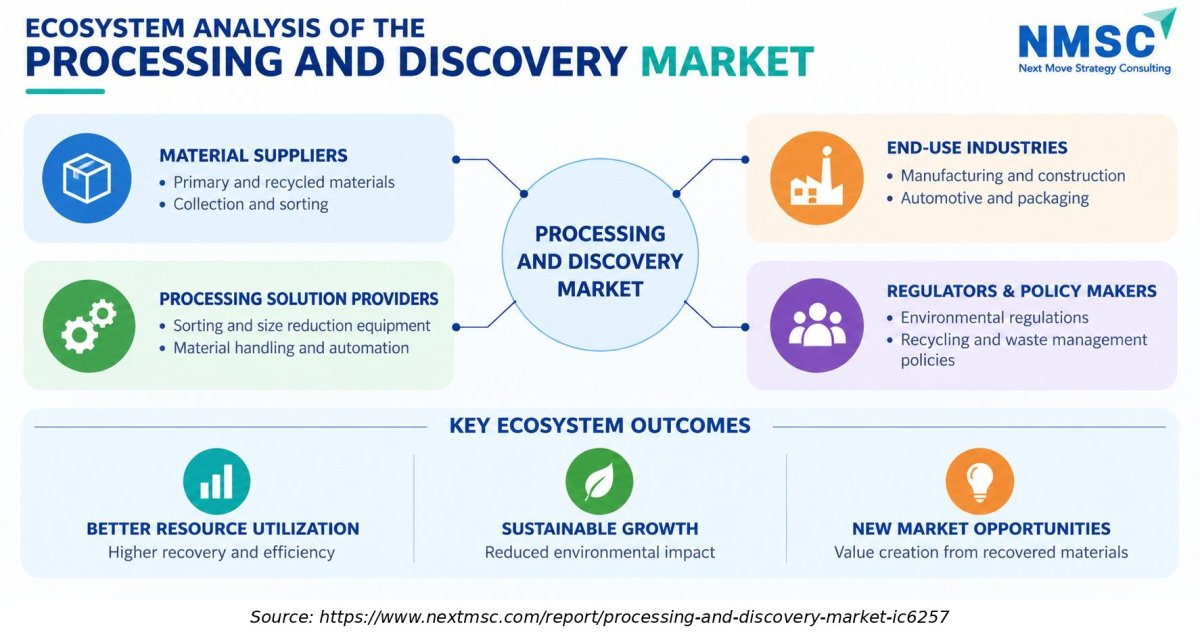
The infographic illustrates the interconnected ecosystem of the Processing and Discovery Market, highlighting material suppliers, processing solution providers, end-use industries, and regulators. It shows how these stakeholders contribute to material sourcing, processing efficiency, industrial applications, and regulatory compliance. The ecosystem ultimately supports better resource utilization, sustainable growth, and new market opportunities through improved processing capabilities and value creation from recovered materials.

Market Drivers & Dynamics

Interactive Dataset
Expanding extended producer responsibility regulation globally driver +1.6% Europe, North America, Asia-Pacific 2026–2035
Rising material recovery facility modernization and capacity expansion driver +1.1% North America, Europe 2026–2033
Growing AI-enabled optical and robotic sorting adoption driver +0.8% North America, Europe, Asia-Pacific 2027–2035
Expanding single-material recycling capacity for batteries and e-waste driver +0.6% Global 2026–2033
High upfront capital cost for integrated processing system deployment restraint −0.6% Asia-Pacific, Latin America, MEA 2026–2032
Volatile recovered material commodity pricing affecting facility economics restraint −0.4% Global 2026–2030
Persistent facility labor shortages constraining manual sorting throughput restraint −0.3% North America, Europe 2026–2030
Source: Next Move Strategy Consulting

Growth Drivers

What Is the Primary Growth Driver for the Processing and Discovery Market?

Expanding extended producer responsibility regulation globally is the primary growth driver, as regulatory mandates requiring higher recycling rates push facility operators toward equipment upgrades and capacity expansion. The U.S. Environmental Protection Agency continues to report national recycling rate data that informs state-level extended producer responsibility policy development, underscoring the regulatory momentum driving sustained equipment investment across covered material categories.

How Is AI-Enabled Sorting Driving the Market Growth?

AI-enabled optical and robotic sorting technology is driving growth by improving material purity and throughput relative to manual and legacy near-infrared sorting alone. Company analysis indicates that equipment providers with established AI-enabled sorting capability are capturing incremental facility modernization spend from operators seeking to meet tightening downstream material purity specifications. Based on research conducted by NMSC, we found that this shift is most pronounced across North American and European material recovery facilities.

Growth Inhibitors

What Is Restraining the Processing and Discovery Market?

High upfront capital cost for integrated processing system deployment is restraining adoption among smaller facility operators, as fully engineered plants require substantial capital commitment relative to incremental stand-alone equipment purchases. We observed that this restraint is most pronounced across emerging-market facility operators lacking access to long-term project financing, slowing integrated system adoption even where regulatory and material-volume fundamentals support investment.

What Are the Growth Opportunities?

Can AI Retrofit Packages Unlock Legacy Facility Modernization Demand?

AI-enabled optical sorting retrofit packages designed for installation within existing facility footprints can unlock modernization demand among operators unable to justify full facility rebuilds. This mechanism primarily benefits equipment providers with modular retrofit engineering capability serving material recovery facility operators seeking incremental purity improvements.

Will Dedicated Battery Recycling Lines Expand Specialized Equipment Demand?

Dedicated battery recycling processing lines addressing rising end-of-life lithium-ion battery volumes offer equipment providers a mechanism to expand beyond traditional municipal solid waste-oriented product lines. Providers with established battery recycling processing technology are best positioned to capture this expanding specialized-stream opportunity.

Can Modular Plant Financing Models Expand Emerging-Market Facility Investment?

Modular, financeable integrated processing system packages tailored to emerging-market capital constraints can expand facility investment beyond markets currently limited by high upfront capital requirements. Plant builders and system integrators with established modular financing partnerships are best positioned to capture this emerging-market opportunity as regulatory recycling mandates expand globally.

Segmentation Analysis

2025 (USD Billion)
2035 (USD Billion)
Sorting and Separation Equipment 2025: $6.24 Billion | 2035: $10.70 Billion
Sorting and
Size Reduction Equipment 2025: $4.99 Billion | 2035: $7.14 Billion
Size Reducti
Feeding and Conveying Equipment 2025: $3.12 Billion | 2035: $4.08 Billion
Feeding and
Compaction and Densification Equipment 2025: $2.50 Billion | 2035: $3.06 Billion
Compaction a
Washing and Cleaning Equipment 2025: $2.81 Billion | 2035: $4.08 Billion
Washing and
Material Reprocessing Equipment 2025: $2.18 Billion | 2035: $3.06 Billion
Material Rep
Material Recovery Systems 2025: $4.37 Billion | 2035: $8.16 Billion
Material Rec
Construction and Demolition Systems 2025: $1.56 Billion | 2035: $3.06 Billion
Construction
Single-Material Recycling Systems 2025: $2.18 Billion | 2035: $5.10 Billion
Single-Mater
Organics and Fuel Recovery Systems 2025: $0.94 Billion | 2035: $2.04 Billion
Organics and
Specialised Recovery Systems 2025: $0.31 Billion | 2035: $0.51 Billion
Specialised
Sorting and Separation Equipment $6.24 Billion $10.70 Billion 5.28%
Size Reduction Equipment $4.99 Billion $7.14 Billion 3.17%
Feeding and Conveying Equipment $3.12 Billion $4.08 Billion 2.15%
Compaction and Densification Equipment $2.50 Billion $3.06 Billion 1.40%
Washing and Cleaning Equipment $2.81 Billion $4.08 Billion 3.38%
Material Reprocessing Equipment $2.18 Billion $3.06 Billion 2.95%
Material Recovery Systems $4.37 Billion $8.16 Billion 6.26%
Construction and Demolition Systems $1.56 Billion $3.06 Billion 6.85%
Single-Material Recycling Systems $2.18 Billion $5.10 Billion 8.84%
Organics and Fuel Recovery Systems $0.94 Billion $2.04 Billion 8.08%
Specialised Recovery Systems $0.31 Billion $0.51 Billion 4.66%

Which Equipment Type Dominates the Processing and Discovery Market?

Sorting and Separation Equipment dominates equipment-type segmentation with an estimated USD 6.57 Billion in 2026, rising to USD 10.70 Billion by 2035, reflecting its foundational role at the start of nearly every processing line regardless of downstream material stream. Single-Material Recycling Systems are the fastest-growing category at a 8.84% CAGR, reflecting rising dedicated capacity investment in battery, e-waste, and textile recycling streams covered by expanding extended producer responsibility mandates.

Growth Opportunities

Beyond current demand drivers, three whitespace opportunities stand out as forward-looking mechanisms for revenue expansion through 2035.

Can AI Retrofit Packages Unlock Legacy Facility Modernization Demand?

AI-enabled optical sorting retrofit packages designed for installation within existing facility footprints can unlock modernization demand among operators unable to justify full facility rebuilds. This mechanism primarily benefits equipment providers with modular retrofit engineering capability serving material recovery facility operators seeking incremental purity improvements.

Will Dedicated Battery Recycling Lines Expand Specialized Equipment Demand?

Dedicated battery recycling processing lines addressing rising end-of-life lithium-ion battery volumes offer equipment providers a mechanism to expand beyond traditional municipal solid waste-oriented product lines. Providers with established battery recycling processing technology are best positioned to capture this expanding specialized-stream opportunity.

Can Modular Plant Financing Models Expand Emerging-Market Facility Investment?

Modular, financeable integrated processing system packages tailored to emerging-market capital constraints can expand facility investment beyond markets currently limited by high upfront capital requirements. Plant builders and system integrators with established modular financing partnerships are best positioned to capture this emerging-market opportunity as regulatory recycling mandates expand globally.

Regulatory Framework of the Processing and Discovery Market

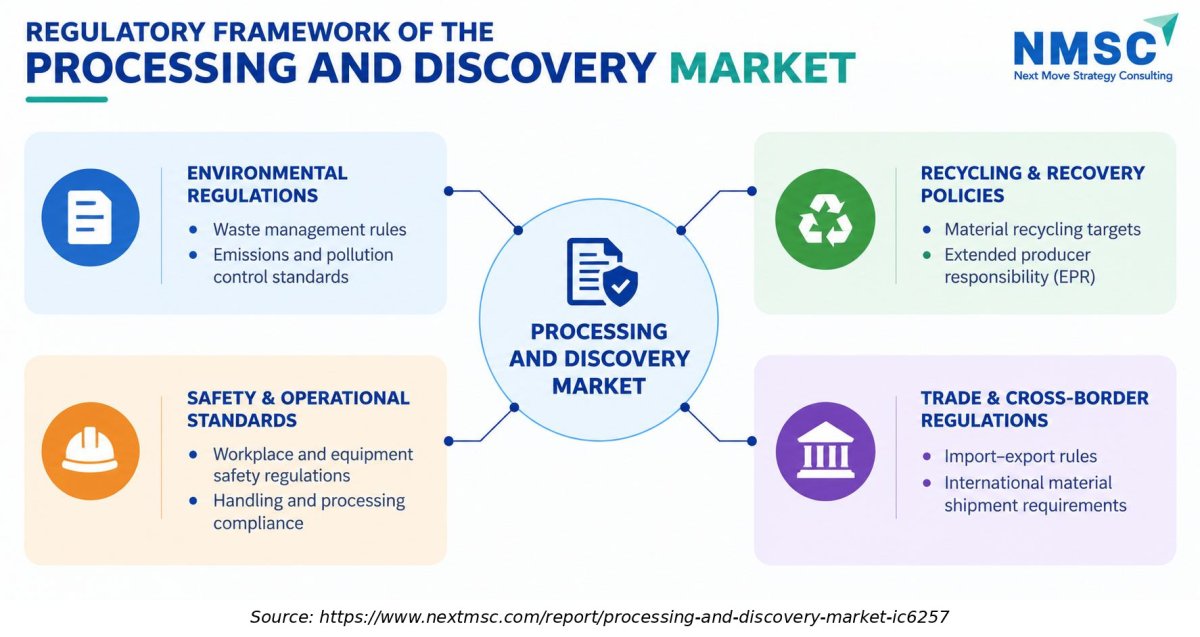
The infographic presents the key regulatory areas shaping the Processing and Discovery Market, including environmental regulations, recycling and recovery policies, safety and operational standards, and trade and cross-border requirements. It highlights how waste management, recycling targets, workplace safety, processing compliance, and international material movement influence market operations and support responsible, compliant, and sustainable industry development.

Regional Outlook

2025 (USD Billion)
2035 (USD Billion)
North Americ
Europe
Asia-Pacific
Middle East
Latin Americ
Region 2025 (USD Billion) 2035 (USD Billion) CAGR (%)
North America $10.0 USD Billion $40.0 USD Billion 9.0%
Europe $17.1 USD Billion $51.1 USD Billion 27.0%
Asia-Pacific $24.2 USD Billion $62.2 USD Billion 25.0%
Middle East & Africa $31.3 USD Billion $73.3 USD Billion 23.0%
Latin America $38.4 USD Billion $84.4 USD Billion 12.0%

Regional data is locked

Unlock complete regional numbers for this market.

Unlock Full Data

Competitive Landscape

Our findings suggest that the competitive landscape spans diversified industrial equipment manufacturers and specialized recycling technology providers, each pursuing distinct differentiation strategies.

Dimension Description
Dimension Assessment
Market Structure Moderately consolidated; diversified industrial equipment manufacturers hold significant integrated system share while specialized providers compete on specific equipment category depth
Innovation Focus AI-enabled optical sorting, robotic picking, modular integrated plant design
M&A Activity Selective; diversified manufacturers acquire specialized sorting and single-material recycling technology developers to expand system breadth

How Do Companies Compete in the Processing and Discovery Market Industry?
Companies compete primarily on sorting accuracy, system integration breadth, and depth of relationships with material recovery facility and specialized recycling plant operators. Our analysis shows that providers combining advanced sorting technology with full integrated system engineering capability sustain larger facility contract wins than single-equipment-category specialists competing on narrow product lines alone.

Which Competitive Archetypes Dominate the Processing and Discovery Market Industry?
Two archetypes dominate: diversified industrial equipment manufacturers offering full integrated processing system capability, and specialized equipment providers focused on specific categories such as optical sorting or shredding. We observed that the differentiation between these archetypes is narrowing as specialized providers expand into adjacent equipment categories to offer broader system packages.

What Innovation and Differentiation Strategies Are Companies Pursuing?

Company analysis indicates that leading firms are differentiating through AI-enabled optical sorting accuracy, robotic picking integration, and modular plant design reducing commissioning timelines. Investment in single-material recycling system engineering continues, alongside expanded service and retrofit offerings targeting facility operators seeking incremental modernization without full plant replacement.

How Active Is M&A in the Processing and Discovery Industry?

M&A activity remains selective as diversified manufacturers acquire specialized sorting and single-material recycling technology developers to expand integrated system breadth. Based on research conducted by NMSC, we found that acquisition interest is concentrated on AI-enabled sorting and battery recycling technology developers, reflecting strategic pivots toward the fastest-growing equipment categories.

Key Market Players

Our assessment indicates that the following companies represent the validated set of key players shaping competitive dynamics across sorting, size reduction, and integrated processing system categories within the processing and discovery market.

TOMRA Systems ASA EREMA Engineering Recycling Maschinen und Anlagen Ges.m.b.H. Metso Corporation ANDRITZ AG Vecoplan AG BHS-Sonthofen GmbH Lindner Recyclingtech GmbH Doppstadt Umwelttechnik GmbH Komptech GmbH SSI Shredding Systems, Inc. UNTHA shredding technology GmbH STADLER Anlagenbau GmbH Bollegraaf Recycling Solutions B.V. CP Group Bulk Handling Systems Machinex Technologies Inc. STEINERT GmbH Sesotec GmbH Pellenc ST Shred-Tech Corporation

Latest Developments

We observed that recent developments across the industry reflect continued investment in AI-enabled sorting and integrated processing system capability.

Date Event
September 2026 Levitated Metals invested in TOMRA’s AUTOSORT PULSE and X-TRACT technologies to upgrade Zorba into alloy-specific recycled aluminum products. The deployment supports higher-value recovery of 5052 and 6063 alloys and shows how advanced elemental analysis and sensor sorting are enabling more precise processing of complex non-ferrous recycling streams.
Aug 2026 STEINERT expanded its Mexican presence by opening a new subsidiary to provide direct support for recycling and raw-material customers. The move strengthens local service capabilities for sorting and separation technologies and supports market penetration across Mexico’s recycling, metals-processing, and mining industries.
Jun 2026 Vecoplan and Meinhardt Holzwerk completed a redesigned recovered-wood shredding line using VRZ 2500 and VEZ 3200 shredders. The upgraded plant cuts energy consumption by about half while improving material quality and reducing fines, highlighting demand for efficient, high-throughput shredding systems in recovered-wood recycling applications.

Investment Opportunities

Where Is Capital Flowing Within the Processing and Discovery Market?

Capital inflows are concentrated in AI-enabled sorting technology development and integrated processing system manufacturing capacity expansion among diversified equipment providers. We found that strategic capital is also flowing into single-material recycling system developers serving battery and e-waste streams, signaling growing institutional interest in regulation-linked specialized processing categories.

How Significant Is Infrastructure Investment in This Market?

Infrastructure investment is substantial, with equipment providers expanding manufacturing capacity and engineering capability to meet rising integrated system demand across Asia-Pacific and Middle East & Africa. Our assessment indicates that continued investment in modular plant engineering is becoming a prerequisite for competing in fast-growing emerging-market facility construction programs.

What ESG Considerations Are Relevant to This Market?

ESG considerations center on energy efficiency of processing equipment, water use reduction in washing and cleaning systems, and the broader circular-economy value proposition that higher-purity sorting enables for downstream material markets. We observed that equipment providers increasingly disclose energy and water efficiency performance metrics in response to facility operator sustainability reporting requirements.

Key Benefits for Stakeholders

How Does This Report Benefit Industry Leaders?

Industry and enterprise leaders gain a structured view of equipment-type and regional revenue distribution, supporting prioritization decisions across product development and manufacturing capacity planning. Our analysis shows that this structured segmentation clarifies where competitive intensity is rising fastest ahead of resource-allocation decisions.

How Does This Report Benefit Investors and Financial Analysts?

Investors and financial analysts gain reconciled market-size, CAGR, and regional-growth data supporting valuation and portfolio-allocation decisions. Company analysis indicates that segment-level growth differentials, particularly around single-material recycling systems, are material inputs for evaluating equipment provider growth durability.

How Does This Report Benefit Technology Vendors and Product Teams?

Technology vendors and product teams gain visibility into equipment-type trends shaping AI sorting and integrated system engineering priorities. We found that this analysis supports prioritization of engineering investment toward the fastest-growing equipment categories identified across the forecast period.

Key Market Segments Evaluated

By Processing and Recovery Equipment

  • Stand-alone equipment 
    • Sorting and separation equipment
      • Optical sorters
      • Magnetic separators
      • Eddy current separators
      • Air separators
      • Density separators
      • Ballistic separators
      • Screening equipment
      • Robotic sorters
      • Metal detection equipment
      • Other sorting and separation equipment
    • Size reduction equipment
      • Shredders
      • Granulators
      • Crushers
      • Mills and pulverisers
      • Grinders
      • Chippers
      • Shears
      • Other size reduction equipment
    • Feeding and conveying equipment
      • Feeders
      • Hoppers
      • Belt conveyors
      • Chain conveyors
      • Screw conveyors
      • Metering systems
      • Bag openers
      • Bale breakers
      • Other feeding and conveying equipment
    • Compaction and densification equipment
      • Balers
      • Compactors
      • Can densifiers
      • Briquetters
      • Other compaction and densification equipment
    • Washing and cleaning equipment
      • Pre-wash systems
      • Hot wash systems
      • Cold wash systems
      • Friction washers
      • Float-sink systems
      • Dry cleaning systems
      • Dryers
      • Other washing and cleaning equipment
    • Material reprocessing equipment
      • Extruders
      • Melt filtration systems
      • Devolatilization systems
      • Pelletizers
      • Other material reprocessing equipment
  • Integrated processing systems 
    • Material recovery systems
      • Single-stream MRF systems
      • Dual-stream MRF systems
      • Mixed-waste MRF systems
      • Commercial recycling systems
      • Industrial recycling systems
    • Construction and demolition systems
      • C&D sorting systems
      • C&D processing plants
    • Single-material recycling systems
      • Plastic recycling systems
      • Paper recycling systems
      • Metal recycling systems
      • Glass recycling systems
      • Cable recycling systems
      • E-waste recycling systems
      • Battery recycling systems
      • Tire recycling systems
      • Textile recycling systems
    • Organics and fuel recovery systems
      • Organics processing systems
      • Refuse-derived fuel systems
      • Solid recovered fuel systems
      • Biomass processing systems
    • Specialised recovery systems
      • Incinerator bottom ash systems
      • Automotive residue processing systems
      • Gypsum recycling systems
      • Other specialised recovery systems

By Material Processed

  • Paper and cardboard 
    • OCC
    • Mixed paper
    • Office paper
    • Cartons
  • Plastics 
    • PET
    • HDPE
    • PP
    • PVC
    • LDPE and film
    • Mixed plastics
  • Metals 
    • Ferrous metals
    • Aluminum
    • Copper
    • Mixed non-ferrous metals
  • Glass
  • E-waste and electrical equipment
  • Batteries
  • Construction and demolition waste
  • Municipal solid waste
  • Commercial and industrial waste
  • Wood waste
  • Organic waste
  • Tires and rubber
  • Textiles
  • Incinerator bottom ash and slag
  • Multi-material feedstock
  • Other defined material streams

By End-User Facility

  • Material recovery facilities 
    • Single-stream MRFs
    • Dual-stream MRFs
    • Mixed-waste MRFs
  • Commercial recycling facilities
  • Industrial recycling facilities
  • Plastic recycling plants
  • Paper recycling plants
  • Metal recycling plants
  • Glass recycling plants
  • E-waste recycling plants
  • Battery recycling plants
  • Construction and demolition recycling plants
  • Tire recycling plants
  • Textile recycling plants
  • Organics processing facilities
  • Fuel recovery facilities
  • Specialised recovery facilities

By Buyer Type

  • Municipal and public-sector buyers
  • Waste management companies
  • Recycling operators
  • Scrap processors
  • Industrial manufacturers
  • Specialised recycling companies
  • Plant builders and system integrators
  • Commercial waste generators
  • Other institutional buyers

By Revenue Stream

  • New equipment and system sales
  • Upgrade and retrofit sales

By Sales Channel

  • Direct sales
  • Distributor sales
  • Agent sales
  • System integrator sales
  • OEM partner sales

By Region

  • North America 
    • U.S.
    • Canada
    • Mexico.
  • Europe 
    • UK
    • Germany
    • France
    • Italy
    • Spain
    • Sweden
    • Denmark
    • Finland
    • Netherlands
    • Rest of Europe.
  • Asia-Pacific 
    • China
    • India
    • Japan
    • South Korea
    • Taiwan
    • Indonesia
    • Vietnam
    • Australia
    • Philippines
    • Malaysia
    • Rest of APAC.
  • Middle East & Africa 
    • Saudi Arabia
    • UAE
    • Egypt
    • Israel
    • Turkey
    • Nigeria
    • South Africa
    • Rest of MEA.
  • Latin America 
    • Brazil
    • Argentina
    • Chile
    • Colombia
    • Rest of LATAM.

Conclusion & Recommendations

The long-term outlook remains steadily expansionary, with revenue projected to grow from USD 33.70 Billion in 2026 to USD 50.97 Billion by 2035 at a 4.70% CAGR. Our analysis shows that this trajectory is underpinned by structural regulatory demand rather than cyclical commodity price movements alone.

What Strategic Positioning Should Companies Pursue?

Companies should prioritize AI-enabled sorting capability and integrated system engineering over single-equipment-category specialization alone. We found that providers combining advanced sorting technology with full plant integration capability sustain more resilient facility contract wins than competitors reliant on individual equipment sales.

How Attractive Is the Market for Investment?

Investment attractiveness is moderate to high given double-digit growth in Asia-Pacific and single-material recycling categories alongside a large, stable base of mature-market facility modernization demand. Our assessment indicates that capital allocators should weight exposure toward providers with proven AI-enabled sorting and integrated system capability over legacy stand-alone equipment-only competitors.

What Market Shifts and Key Risks Should Stakeholders Monitor?

Key risks include high upfront capital costs for integrated system deployment, volatile recovered material commodity pricing, and persistent facility labor shortages. We observed that capital cost barriers pose the most immediate risk to adoption timelines across emerging-market facility operators lacking established project financing access.

What Are the Primary Growth Pathways Through 2035?

Primary growth pathways include AI retrofit packages for legacy facility modernization, dedicated battery recycling lines, and modular plant financing models for emerging-market investment. Our findings suggest that companies combining all three pathways will outpace single-lever competitors through the forecast period.

FAQs

Sources & References

1.

U.S. Environmental Protection Agency — National Recycling Strategy

www.epa.gov
2.

TOMRA Systems ASA — Investor Relations

www.tomra.com/en/investors
3.

Metso Corporation — Investor Relations

www.metso.com/investors/
4.

ANDRITZ AG — Investor Relations

www.andritz.com/investor-en
5.

Bollegraaf Recycling Solutions B.V. — Corporate Website

www.bollegraaf.com
6.

EREMA Engineering Recycling Maschinen und Anlagen Ges.m.b.H. — Corporate Website

www.erema.com
7.

STADLER Anlagenbau GmbH — Corporate Website

w-stadler.de
8.

Bulk Handling Systems — Corporate Website

www.bulkhandlingsystems.com

About the Author

Liza Phukan

Liza Phukan

Liza Phukan is Research Associate at Next Move Strategy Consulting, where she has covered emerging industries and market research across sectors for 3.5 years. Her work includes analyzing industry developments, validating market data, and developing structured business content from research findings. She uses secondary research and data-validation practices to turn complex market information into clear decision-useful market analysis for business audiences and support report development and B2B.

About the Reviewer

Supradip Baul

Supradip Baul

Supradip Baul is an accomplished business consultant and strategist with over a decade of rich experience in market intelligence, strategy, technology, and business transformation. His work has included rigorous qualitative and quantitative analysis across multiple industries, helping clients shape investment decisions and long-term roadmaps. Earlier in his career, he was associated with Gartner, where he contributed to industry-leading reports and market share analyses. He has worked with leading global companies and holds an MBA with a dual specialization in Marketing and Finance.

Download Free Sample

Gustaf Hummel Burstrom

GUSTAF HUMMEL BURSTROM

Founder

Revline Tools AB

Joseph and the team at Next Move Strategy Consulting have been excellent to work with, in supplying us with relevant market data and forecasts for our specific category. We had some special requirements and they were able to do a custom package to suit our needs. We would definitely recommend them to any other company needing market data and forecasts

Pratyush Kumar Das

PRATYUSH KUMAR DAS

Assistant Manager

Polycab India Limited

We would like to express our appreciation for the data and insights provided by nextmsc. We are very pleased with the quality and depth of the information, which has proven to be highly valuable and beneficial for our business decision-making.

Gaurav Jaiswal

GAURAV JAISWAL

Founder & CEO

Yano Charge Private Limited

The EV Charging market research report provided by the NextMSC was exceptionally detailed and insightful. It offered a comprehensive analysis that proved to be a game-changer for our strategic planning. Truly a testament to the NextMSC’s expertise and thoroughness in EV market landscape & analysis.

Amos Chang

AMOS CHANG

Strategy Consultant

Kardex Group

I have bought the intralogistics market reports from NMSC two times so far. Joseph and his team are always very helpful and flexible in responding to any customization requirements on the report. Their expertise in market reports really helps us steer the day-to-day business. I will definitely recommend and come back myself whenever there is a need.

Robert Sean Trevino

ROBERT SEAN TREVINO

Sr. Director, Head of Strategic Insights & Analytics

Foundation Medicine

I realized that it was a reliable source of information. These days, there are many people who are looking for authentic data, and this is one of the only sources that can offer them with what they need;

Custom Market Research Services

We will customize the research for you if the listed report does not fully match your requirements.

Get 30% Free Customization

Select License

This website uses cookies to ensure you get the best experience on our website. Learn more

✖