Public Safety Drone Market Global Industry Analysis and Forecast (2026–2035)

The Public Safety Drone Market is estimated at USD 1.42 Billion in 2025, rising to USD 11.65 Billion by 2035 at a 23.4% CAGR from 2026 to 2035, led by North America and driven by autonomous Drone as First Responder adoption, streamlined BVLOS regulations, rising border security investments, and real-time crime center integration.

Download Free Sample PDF
Base Year (2025)
$1.42 Billion
Forecast (2035)
$11.65 Billion
CAGR (2026-2035)
23.4%
Top Region
North America

What Is the Public Safety Drone Market Size?

The global public safety drone market size was valued at USD 1.42 billion in 2025 and is estimated at USD 1.75 billion in 2026, forecast to reach USD 11.65 billion by 2035, expanding at a 23.4% CAGR between 2026 and 2035. North America leads with approximately 46% share, while law enforcement and police operations dominate all other applications with approximately 42% share.

We observed that growth is broad-based across every segmentation axis, with the Software component and the Traffic Management and Accident Investigation application expanding at 27.5% and 29.1% CAGR, respectively, the fastest rates among their segments through the forecast window.

Public Safety Drone Market Global Industry Analysis and Forecast (2026–2035) Revenue Forecast
Values in USD Billion

2025 $1.42 Billion
2025
2026 $1.75 Billion
2026
2027 $2.16 Billion
2027
2028 $2.66 Billion
2028
2029 $3.29 Billion
2029
2030 $4.06 Billion
2030
2031 $5.01 Billion
2031
2032 $6.18 Billion
2032
2033 $7.63 Billion
2033
2034 $9.41 Billion
2034
2035 $11.65 Billion
2035

Key Takeaways

By Application: Law Enforcement and Police Operations held the largest share of approximately 42% (USD 0.60 billion) in 2025; Traffic Management and Accident Investigation is the fastest-growing sub-segment at 29.1% CAGR from 2026–2035.

By Component: Hardware held the largest share of approximately 48% (USD 0.68 billion) in 2025; Software is the fastest-growing sub-segment at 27.5% CAGR from 2026–2035.

By Drone Type: Multi-Rotor Drones held the largest share of approximately 68% (USD 0.97 billion) in 2025; Hybrid VTOL Drones is the fastest-growing sub-segment at 27.0% CAGR from 2026–2035.

By Payload Type: Thermal and Infrared Cameras held the largest share of approximately 39% (USD 0.55 billion) in 2025; Sensor Payloads for Chemical and Radiation Detection is the fastest-growing sub-segment at 27.0% CAGR from 2026–2035.

By End User: Police Departments held the largest share of approximately 44% (USD 0.62 billion) in 2025; Border Patrol and Customs Agencies is the fastest-growing sub-segment at 25.9% CAGR from 2026–2035.

By Operation Mode: Remotely Piloted held the largest share of approximately 46% (USD 0.65 billion) in 2025; Fully Autonomous is the fastest-growing sub-segment at 31.0% CAGR from 2026–2035.

Dominant Region: North America dominated with approximately 46% revenue share (USD 0.65 billion) in 2025.

Fastest-Growing Region: Asia-Pacific is expected to register the highest CAGR of 27.0% during 2026–2035.

Dominant Country: U.S. led with approximately USD 0.55 billion in 2025.

Fastest-Growing Country: India is the fastest-growing country at approximately 30.5% CAGR from 2026–2035.

Market Opportunity: The public safety drone market is expected to create an absolute dollar opportunity of USD 9.90 billion between 2026 and 2035, presenting significant investment potential across the Drone as First Responder and border security surveillance value chain.

According to NMSC analysis, police departments and fire agencies are increasingly consolidating drone procurement into multi-year bundled contracts that combine hardware, fleet software, and real-time crime center integration, a shift that favors diversified public safety technology platforms over single-hardware drone manufacturers as autonomous DFR programs are increasingly adopted across metropolitan public safety agencies through 2035.

What Does the Public Safety Drone Market Encompass?
The public safety drone market encompasses hardware, software, and service offerings built around unmanned aerial vehicle platforms deployed by police departments, fire and rescue agencies, emergency medical services, and border patrol and customs agencies. Our assessment indicates that the scope spans fixed-wing, multi-rotor, and hybrid VTOL airframes paired with thermal imaging, video analytics, and fleet management software supplied for law enforcement, firefighting, search and rescue, border surveillance, disaster response, and traffic accident investigation missions. The category has evolved from manually piloted tactical surveillance into an autonomous, Drone as First Responder discipline as agencies pursue faster incident response and reduced officer risk exposure.
Regulatory frameworks shaping procurement eligibility and operating altitude for public safety fleets include the Federal Aviation Administration's Part 107 Public Safety Organization Shielded Operations Waiver, introduced in November 2024, and the separate Part 91 public aircraft operations pathway established under Section 927 of the 2024 FAA Reauthorization Act. American Security Drone Act provisions separately restrict certain federal agencies and federal-grant-funded programs from procuring drones from covered foreign manufacturers; these domestic-sourcing restrictions apply to specific federal and grant-funded purchases rather than to public safety drone procurement broadly. We observed that technology adoption is shifting toward autonomous, beyond visual line of sight missions that dispatch drones directly from 911 call data without an onsite pilot. NMSC's analysis indicates that this structural shift, combined with growing real-time crime center integration, is redefining procurement criteria across the public safety drone market.

Market Drivers & Dynamics

Interactive Dataset
Expanded FAA Part 107 and Part 91 waiver pathways enabling BVLOS DFR operations driver High North America 2026–2035
Rising demand for autonomous first-responder situational awareness driver High Global 2026–2035
Expanding border security and surveillance investment driver Moderate North America, MEA 2026–2035
Growing real-time crime center integration and evidence management driver Moderate Global 2026–2033
Falling cost of thermal imaging and autonomous flight technology driver Moderate Global 2026–2032
Federal grant funding supporting domestic public safety drone procurement driver Low North America 2026–2030
Public privacy and civil liberties concerns over aerial surveillance restraint Moderate North America, Europe 2026–2035
Airspace integration and BVLOS certification complexity restraint Moderate Global 2026–2032
Domestic manufacturing requirements restricting foreign hardware procurement restraint Low North America 2026–2030
Source: Next Move Strategy Consulting

Growth Drivers

What Is the Primary Growth Driver of the Public Safety Drone Market?

Expanded FAA Part 107 and Part 91 waiver pathways enabling beyond visual line of sight operations are the primary driver of the market. The FAA's Public Safety Organization Shielded Operations Waiver, introduced under Part 107 in November 2024, and its Reauthorization Act-based Part 91 Certificate of Waiver or Authorization pathway have both broadened the operational envelope available to qualifying agencies. This regulatory expansion, reinforced by rising demand for autonomous first-responder situational awareness, continues to anchor baseline demand for drone hardware and fleet software across developed public safety markets.

How Is Drone as First Responder Adoption Driving Public Safety Drone Market Growth?
Drone as First Responder adoption is accelerating as agencies report operational benefits from autonomous aerial dispatch during active incidents. Platform providers have disclosed program-level data describing drones frequently arriving on scene ahead of ground patrol units and assisting in resolving select calls without a physical response, though comprehensive independent national statistics remain limited. This operational evidence, combined with growing real-time crime center integration, is compressing adoption timelines for autonomous fleets across North America and Europe.

Growth Inhibitors

What Is Restraining Public Safety Drone Market Expansion?
Public privacy and civil liberties concerns over persistent aerial surveillance restrain adoption among agencies facing community and legislative scrutiny. Advocacy organizations continue to document policy gaps around drone footage retention, audit trails, and use limitations at the state and municipal level. We found that agencies without clear community-facing use policies face particular reputational exposure, as public pushback can delay or reverse DFR program launches despite strong operational justification.

What Are the Growth Opportunities?

How Can Real-Time Crime Center Software Integration Unlock New Revenue?

Real-time crime center software integration presents a whitespace opportunity for platform vendors serving multi-agency public safety networks. Suppliers connecting drone video feeds with existing evidence management and dispatch systems are positioned to build recurring subscription revenue beyond one-time hardware sales.

Where Do Indoor Tactical Drones Create Recurring Hardware Revenue?

Indoor tactical drones represent an underpenetrated opportunity for hardware manufacturers serving SWAT and specialized tactical units. Vendors that expand indoor-rated, collision-tolerant airframes can secure long-term equipment contracts with police departments seeking safer building-search alternatives to manual entry during high-risk incidents.

How Can Domestic Manufacturing Certification Expand Federal Grant Eligibility?

Domestic manufacturing certification creates an opportunity for hardware suppliers seeking eligibility for federal public safety grant funding. Early movers that achieve National Defense Authorization Act and American Security Drone Act compliance can differentiate with agencies prioritizing grant-eligible procurement over lower-cost foreign-manufactured alternatives.

Segmentation Analysis

2025 (USD Billion)
2035 (USD Billion)
Law Enforcement and Police Operations 2025: $0.60 Billion | 2035: $4.99 Billion
Law Enforcem
Firefighting and Fire Rescue 2025: $0.26 Billion | 2035: $1.78 Billion
Firefighting
Search and Rescue Operations 2025: $0.20 Billion | 2035: $1.24 Billion
Search and R
Border Security and Surveillance 2025: $0.18 Billion | 2035: $1.76 Billion
Border Secur
Disaster Response and Emergency Management 2025: $0.12 Billion | 2035: $1.11 Billion
Disaster Res
Traffic Management and Accident Investigation 2025: $0.06 Billion | 2035: $0.77 Billion
Traffic Mana
Law Enforcement and Police Operations $0.60 Billion $4.99 Billion 23.6%
Firefighting and Fire Rescue $0.26 Billion $1.78 Billion 21.2%
Search and Rescue Operations $0.20 Billion $1.24 Billion 20.0%
Border Security and Surveillance $0.18 Billion $1.76 Billion 25.6%
Disaster Response and Emergency Management $0.12 Billion $1.11 Billion 24.9%
Traffic Management and Accident Investigation $0.06 Billion $0.77 Billion 29.1%

Which Application Dominates the Public Safety Drone Market?

Law Enforcement and Police Operations led the market with USD 0.60 billion in 2025, supported by rapid Drone as First Responder program adoption enabled by streamlined BVLOS waiver approvals. We observed that Traffic Management and Accident Investigation is the fastest-growing application, expanding at a 29.1% CAGR from 2026 to 2035, as police departments increasingly deploy drones for rapid crash scene documentation and traffic incident clearance.

2025 (USD Billion)
2035 (USD Billion)
Hardware
Airframe
Propulsion S
Battery and
Camera and S
Segment Item 2025 (USD Billion) 2035 (USD Billion) CAGR
Hardware $10.0 USD Billion $40.0 USD Billion 27.0%
Airframe $17.1 USD Billion $51.1 USD Billion 17.0%
Propulsion System $24.2 USD Billion $62.2 USD Billion 15.0%
Battery and Power System $31.3 USD Billion $73.3 USD Billion 17.0%
Camera and Sensors $38.4 USD Billion $84.4 USD Billion 26.0%

Segment-wise data is locked

Unlock complete segment-wise numbers for By Component.

Unlock Full Data

Which Component Segment Leads Public Safety Drone Market Demand?
Hardware remained the leading component within the market, valued at USD 0.68 billion in 2025 on the strength of airframe, thermal camera, and infrared detector sensor demand across every deployed fleet. Our findings suggest that Software is the fastest-growing component, registering a 27.5% CAGR from 2026 to 2035, as fleet management, video analytics, and real-time crime center integration platforms increasingly capture recurring subscription revenue from police departments.

2025 (USD Billion)
2035 (USD Billion)
Fixed-Wing D
Multi-Rotor
Hybrid VTOL
Segment Item 2025 (USD Billion) 2035 (USD Billion) CAGR
Fixed-Wing Drones $10.0 USD Billion $40.0 USD Billion 12.0%
Multi-Rotor Drones $17.1 USD Billion $51.1 USD Billion 10.0%
Hybrid VTOL Drones $24.2 USD Billion $62.2 USD Billion 20.0%

Segment-wise data is locked

Unlock complete segment-wise numbers for By Drone Type.

Unlock Full Data
2025 (USD Billion)
2035 (USD Billion)
Thermal and
Optical and
Communicatio
Sensor Paylo
Segment Item 2025 (USD Billion) 2035 (USD Billion) CAGR
Thermal and Infrared Cameras $10.0 USD Billion $40.0 USD Billion 25.0%
Optical and Zoom Cameras $17.1 USD Billion $51.1 USD Billion 27.0%
Communication Relay Payloads $24.2 USD Billion $62.2 USD Billion 13.0%
Sensor Payloads for Chemical and Radiation Detection $31.3 USD Billion $73.3 USD Billion 15.0%

Segment-wise data is locked

Unlock complete segment-wise numbers for By Payload Type.

Unlock Full Data
2025 (USD Billion)
2035 (USD Billion)
Police Depar
Fire and Res
Emergency Me
Border Patro
Disaster Man
Segment Item 2025 (USD Billion) 2035 (USD Billion) CAGR
Police Departments $10.0 USD Billion $40.0 USD Billion 25.0%
Fire and Rescue Departments $17.1 USD Billion $51.1 USD Billion 23.0%
Emergency Medical Services $24.2 USD Billion $62.2 USD Billion 9.0%
Border Patrol and Customs Agencies $31.3 USD Billion $73.3 USD Billion 23.0%
Disaster Management Agencies $38.4 USD Billion $84.4 USD Billion 24.0%

Segment-wise data is locked

Unlock complete segment-wise numbers for By End User.

Unlock Full Data

Which End User Leads Public Safety Drone Market Demand?
Police Departments remained the leading end user, valued at USD 0.62 billion in 2025, reflecting law enforcement's early and sustained investment in Drone as First Responder programs. Our analysis shows that Border Patrol and Customs Agencies is the fastest-growing end user, registering a 25.9% CAGR from 2026 to 2035, as national governments expand autonomous aerial surveillance along international borders and points of entry.

2025 (USD Billion)
2035 (USD Billion)
Remotely Pil
Semi-Autonom
Fully Autono
Segment Item 2025 (USD Billion) 2035 (USD Billion) CAGR
Remotely Piloted $10.0 USD Billion $40.0 USD Billion 20.0%
Semi-Autonomous $17.1 USD Billion $51.1 USD Billion 22.0%
Fully Autonomous $24.2 USD Billion $62.2 USD Billion 8.0%

Segment-wise data is locked

Unlock complete segment-wise numbers for By Operation Mode.

Unlock Full Data

Growth Opportunities

Our analysis shows that three forward-looking opportunities stand out for stakeholders positioning within the public safety drone market over the 2026–2035 forecast period.

How Can Real-Time Crime Center Software Integration Unlock New Revenue?

Real-time crime center software integration presents a whitespace opportunity for platform vendors serving multi-agency public safety networks. Suppliers connecting drone video feeds with existing evidence management and dispatch systems are positioned to build recurring subscription revenue beyond one-time hardware sales.

Where Do Indoor Tactical Drones Create Recurring Hardware Revenue?

Indoor tactical drones represent an underpenetrated opportunity for hardware manufacturers serving SWAT and specialized tactical units. Vendors that expand indoor-rated, collision-tolerant airframes can secure long-term equipment contracts with police departments seeking safer building-search alternatives to manual entry during high-risk incidents.

How Can Domestic Manufacturing Certification Expand Federal Grant Eligibility?

Domestic manufacturing certification creates an opportunity for hardware suppliers seeking eligibility for federal public safety grant funding. Early movers that achieve National Defense Authorization Act and American Security Drone Act compliance can differentiate with agencies prioritizing grant-eligible procurement over lower-cost foreign-manufactured alternatives.

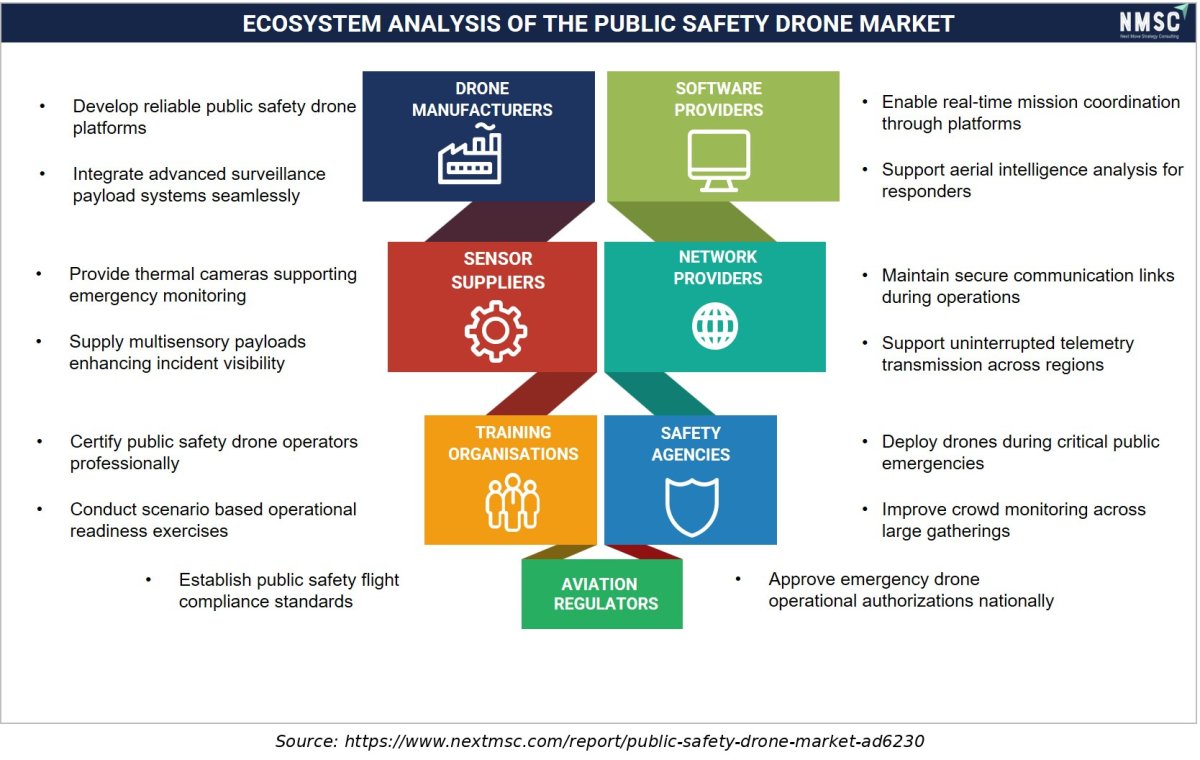
Ecosystem Analysis of the Public Safety Drone Market

The public safety drone market operates through a connected ecosystem comprising drone manufacturers, sensor and software providers, network operators, training organizations, safety agencies, and aviation regulators. Collaboration among these stakeholders enables reliable drone deployment, secure data exchange, regulatory compliance, and mission readiness, supporting efficient emergency response, disaster management, law enforcement, and critical infrastructure monitoring.

Regional Outlook

2025 (USD Billion)
2035 (USD Billion)
North Americ
Asia-Pacific
Europe
Middle East
Latin Americ
Region 2025 (USD Billion) 2035 (USD Billion) CAGR (%)
North America $10.0 USD Billion $40.0 USD Billion 9.0%
Asia-Pacific $17.1 USD Billion $51.1 USD Billion 27.0%
Europe $24.2 USD Billion $62.2 USD Billion 25.0%
Middle East & Africa $31.3 USD Billion $73.3 USD Billion 23.0%
Latin America $38.4 USD Billion $84.4 USD Billion 12.0%

Regional data is locked

Unlock complete regional numbers for this market.

Unlock Full Data

Competitive Landscape

We observed that the public safety drone market features a moderately fragmented competitive landscape, with global autonomous DFR platform providers competing alongside specialized hardware manufacturers on regulatory approval scale and evidence-system integration.

Dimension Description
Market Structure Moderately fragmented; a handful of established public safety drone providers profiled in this report compete for large police and fire department contracts, while numerous regional and specialized tactical hardware providers serve localized demand.
Innovation Focus Autonomous DFR flight software, real-time crime center integration, and indoor tactical robotics dominate current innovation pipelines across leading providers.
M&A Activity Selective capital raises and partnerships, exemplified by BRINC Drones, Inc.'s USD 125 million funding round led by Motorola Solutions to expand domestic manufacturing capacity.

How Do Companies Compete in the Public Safety Drone Market?

Companies compete primarily on regulatory approval scale, evidence-system integration, and breadth of law enforcement partnerships across the industry. Larger platform providers pursue real-time crime center integration to serve multinational police departments, while regional and specialized providers compete on cost efficiency and rapid deployment for localized tactical surveillance supplied to smaller agencies.

Which Competitive Archetypes Dominate the Public Safety Drone Market?

Two prominent competitive archetypes characterize the market: evidence-platform-integrated autonomous DFR providers offering end-to-end public safety software ecosystems, and specialized hardware manufacturers focused on airframes, thermal payloads, or indoor tactical robotics. Axon Enterprise, Inc. and Skydio, Inc. exemplify the evidence-platform-integrated archetype through their joint DFR offering, while BRINC Drones, Inc. and Teledyne Technologies Incorporated exemplify the specialized hardware archetype serving niche tactical and thermal imaging demand.

How Are Companies Differentiating Through Innovation in Public Safety Drone Operations?

Innovation and differentiation strategy increasingly center on autonomous flight software and evidence-system interoperability. Axon Enterprise, Inc.'s Fusus and Dedrone airspace awareness technology, paired with Skydio, Inc.'s autonomous flight platform, aim to reduce the operator-to-drone ratio required for scaled fleet operations. Providers unable to demonstrate credible BVLOS operating scale may face increased competitive pressure in large police department vendor evaluations.

What M&A and Expansion Activity Is Shaping the Public Safety Drone Market?

Capital raises, strategic partnerships, and domestic manufacturing expansion continue to consolidate capabilities within the industry. BRINC Drones, Inc.'s reported USD 125 million funding round supported a threefold manufacturing facility expansion, while Skydio, Inc.'s announced USD 3.5 billion U.S. production investment illustrates how leading providers are pursuing rapid domestic capacity scale-up to meet surging DFR demand.

Key Market Players

Our assessment indicates that the following 20 companies are actively shaping fleet expansion, regulatory strategy, and autonomous flight capability development within the global public safety drone market.

Axon Enterprise, Inc. Skydio, Inc. BRINC Drones, Inc. Flock Safety, Inc. SZ DJI Technology Co., Ltd. Teledyne Technologies Incorporated Parrot SA AeroVironment, Inc. Anduril Industries, Inc. Percepto Ltd. Easy Aerial, Inc. Skyfront Corporation Red Cat Holdings, Inc. Vantage Robotics Freefly Systems LLC DraganflyInc. Impossible Aerospace, Inc. Insitu, Inc. Airobotics Ltd. Autel Robotics Co., Ltd.

Latest Developments

We found that recent regulatory milestones and funding announcements within the public safety drone market are concentrated on DFR program scale-up and domestic manufacturing expansion, reflecting the industry's broader shift toward mainstream deployment.

Date Event
May 2026 Axon partnered with Echodyne to integrate advanced radar capabilities into public safety drone operations, improving Drone as First Responder (DFR), homeland security, and law enforcement airspace awareness.
Apr 2026 Skydio announced plans to invest USD 3.5 billion over five years to expand U.S. manufacturing capacity, an investment commitment rather than realized expenditure, to meet growing demand from public safety, emergency response, and government agencies.
Mar 2026 BRINC launched Guardian, its next-generation Drone as First Responder platform featuring autonomous docking, satellite connectivity, and emergency payload delivery for police and fire agencies.
Oct 2025 Flock Safety introduced Alpha, an NDAA-compliant Drone as First Responder platform designed specifically for police and emergency response agencies.

Expert Insights

Rick Smith

Rick Smith

Founder & CEO | Axon

"Drones are the future of public safety. If we can provide first responders more time, more information and, effectively, more resources, we can drastically improve the way they protect our communities."

Analyst Interpretation

This statement reflects a 2024 industry perspective voiced at the time Axon and Skydio announced their integrated DFR partnership, and it highlighted the increasing role drones were expected to play as a core technology for modern public safety operations rather than merely supplemental surveillance tools. By emphasizing enhanced situational awareness, faster response times, and improved resource allocation for first responders, the statement anticipated the growing adoption of autonomous drone systems by law enforcement, fire departments, and emergency medical services that has continued since. It also foreshadowed the market trend toward integrated drone ecosystems that combine AI-enabled flight, real-time data sharing, and public safety software platforms, which has continued to shape investment and deployment across emergency response agencies.

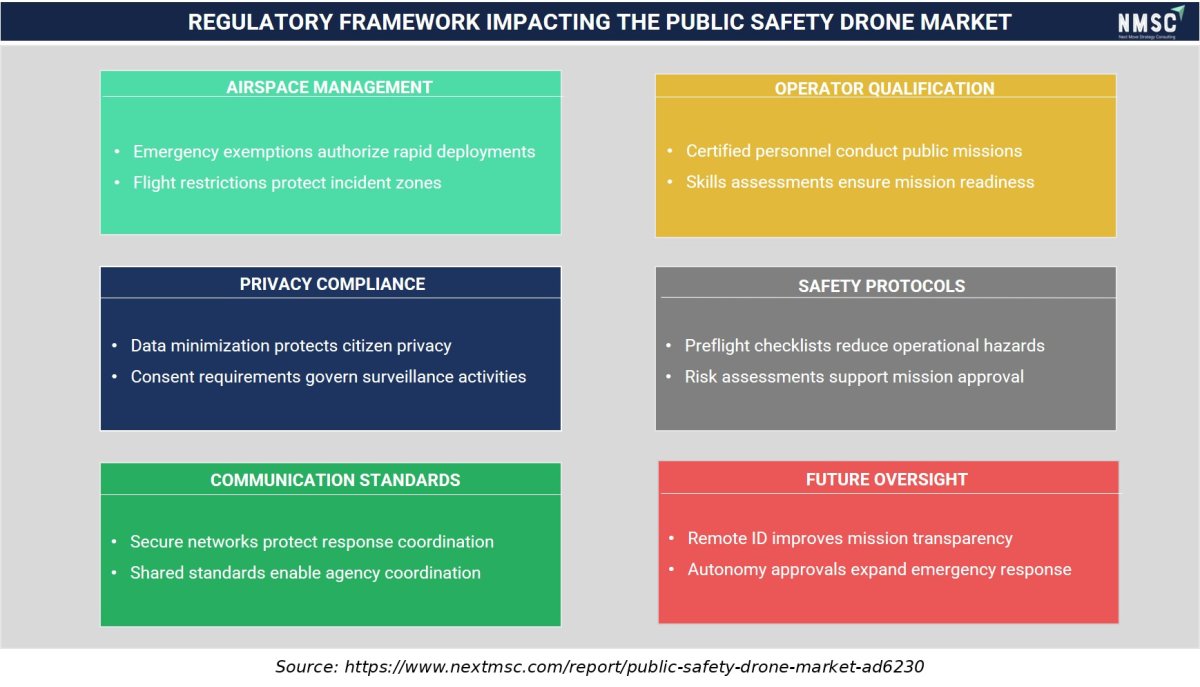
Regulatory Framework Impacting the Public Safety Drone Market

The regulatory framework for public safety drones in the United States centers on the Federal Aviation Administration's Part 107 small unmanned aircraft rule and its Part 91 public aircraft operations pathway. Qualifying agencies may pursue the Part 107 Public Safety Organization Shielded Operations Waiver for beyond visual line of sight flights within one statute mile of the remote pilot in command, or a Part 91 Certificate of Waiver or Authorization established under Section 927 of the 2024 FAA Reauthorization Act for broader public aircraft operations. Remote ID compliance, requiring most drones to broadcast identification and location data, applies across both pathways. Internationally, the European Union Aviation Safety Agency's U-space framework and national civil aviation authorities govern comparable BVLOS and airspace integration requirements shaping public safety drone deployment outside the United States.

Investment Opportunities

What Capital Inflows Are Targeting the Public Safety Drone Market?

Capital inflows into the public safety drone market are increasingly directed toward domestic manufacturing capacity and autonomous flight software development. Venture and strategic investors continue to fund scale-up, as seen in BRINC Drones, Inc.'s reported USD 125 million funding round led by Motorola Solutions. Investors appear to favor providers demonstrating validated DFR operating scale, viewing regulatory approval history and domestic manufacturing compliance as a potential competitive advantage.

How Is Infrastructure Investment Supporting Public Safety Drone Deployment?

Infrastructure investment is expanding drone docking stations and launch infrastructure to serve rising DFR call volumes across major U.S. metros. Our findings suggest that providers are investing in dedicated rooftop and station-based launch infrastructure at police and fire facilities to reduce response time, supporting the throughput required for citywide autonomous drone networks.

What ESG Considerations Are Shaping Public Safety Drone Investment Decisions?

Environmental, social, and governance considerations are central to investment decisions across the industry, with officer safety and community privacy as key criteria. Civil liberties organizations continue to document policy gaps around drone footage retention and use limitations at the municipal level. We found that investors increasingly favor providers that support transparent use-policy frameworks, treating community trust as a governance and reputational risk indicator.

Key Benefits for Stakeholders

How Does This Report Benefit Enterprise and Industry Leaders?

Enterprise and industry leaders gain access to validated segmentation, competitive benchmarking, and regional demand forecasts that support sourcing and technology-partnership decisions across the public safety drone industry. Our analysis shows that detailed application, component, and end user breakdowns help procurement teams align specifications with regulatory and operational requirements while identifying underserved application segments for program expansion.

How Does This Report Benefit Investors and Financial Analysts?

Investors and financial analysts benefit from consistent, single-point market size and CAGR estimates that support valuation and capital-allocation decisions across the public safety drone market supply chain. We observed that the report's regional and segment-level growth differentials help identify which hardware, software, and service providers are best positioned to capture above-market growth through 2035.

How Does This Report Benefit Technology Vendors and Product Teams?

Technology vendors and product teams gain insight into emerging design requirements, including BVLOS-compliant detect-and-avoid systems and evidence-platform interoperability, that are reshaping the industry. Our findings suggest that this analysis helps R&D teams prioritize development roadmaps around autonomous navigation and domestic manufacturing compliance increasingly required by police and fire department procurement processes.

Key Market Segments Evaluated

By Application

  • Law Enforcement and Police Operations
  • Firefighting and Fire Rescue
  • Search and Rescue Operations
  • Border Security and Surveillance
  • Disaster Response and Emergency Management
  • Traffic Management and Accident Investigation

By Component

  • Hardware 
    • Airframe
    • Propulsion System
    • Battery and Power System
    • Camera and Sensors
    • Communication Systems
  • Software 
    • Flight Management Software
    • Video Analytics Software
    • Mapping and Geospatial Software
    • Fleet Management Software
  • Services 
    • Training and Certification Services
    • Maintenance and Repair Services
    • Data Analytics Services

By Drone Type

  • Fixed-Wing Drones
  • Multi-Rotor Drones
  • Hybrid VTOL Drones

By Payload Type

  • Thermal and Infrared Cameras
  • Optical and Zoom Cameras
  • Communication Relay Payloads
  • Sensor Payloads for Chemical and Radiation Detection

By End User

  • Police Departments
  • Fire and Rescue Departments
  • Emergency Medical Services
  • Border Patrol and Customs Agencies
  • Disaster Management Agencies

By Operation Mode

  • Remotely Piloted
  • Semi-Autonomous
  • Fully Autonomous

By Region

  • North America 
    • U.S.
    • Canada
    • Mexico
  • Europe 
    • UK
    • Germany
    • France
    • Italy
    • Spain
    • Sweden
    • Denmark
    • Finland
    • Netherlands
    • Rest of Europe
  • Asia-Pacific 
    • China
    • India
    • Japan
    • South Korea
    • Taiwan
    • Indonesia
    • Vietnam
    • Australia
    • Philippines
    • Malaysia
    • Rest of APAC
  • Middle East & Africa 
    • Saudi Arabia
    • UAE
    • Egypt
    • Israel
    • Turkey
    • Nigeria
    • South Africa
    • Rest of MEA
  • Latin America 
    • Brazil
    • Argentina
    • Chile
    • Colombia
    • Rest of LATAM

Conclusion & Recommendations

The long-term outlook for the market remains highly positive, with global revenue projected to expand more than eightfold from USD 1.42 billion in 2025 to USD 11.65 billion by 2035 at a 23.4% CAGR. Expanded FAA waiver pathways, growing border security investment, and accelerating autonomous DFR adoption will continue underpinning demand across hardware, software, and services applications through the forecast period.

What Strategic Positioning Should Public Safety Drone Suppliers Pursue?

Suppliers should prioritize integrated hardware-to-software platforms while pursuing domestic manufacturing certification to secure long-term police and fire department contracts. Our assessment indicates that providers investing early in autonomous flight software and real-time crime center interoperability will be best positioned to capture premium pricing within the public safety drone market.

How Attractive Is the Public Safety Drone Market for New Investment?

The public safety drone industry presents an attractive investment case, supported by a USD 9.90 billion absolute dollar opportunity between 2026 and 2035 and above-average growth in Asia-Pacific and software categories. We found that investment attractiveness is highest for providers combining regulatory approval scale with evidence-platform integration, positioning them to serve both cost-sensitive tactical and premium DFR program segments simultaneously.

What Market Shifts and Key Risks Should Stakeholders Monitor?

Stakeholders should monitor public privacy concerns, airspace integration complexity, and domestic manufacturing procurement restrictions as key risks to the public safety drone market. Our analysis shows that providers unable to demonstrate validated BVLOS operating scale and transparent use policies risk losing procurement shortlists to competitors with larger proprietary regulatory track records, particularly within North America's increasingly certification-driven public safety environment.

What Are the Key Growth Pathways for the Public Safety Drone Market?

Key growth pathways include expanding BVLOS-certified fleet capacity, scaling autonomous fleet management subscription revenue, and deepening penetration into border security and disaster management channels. NMSC's analysis indicates that suppliers pursuing these pathways while meeting domestic sourcing requirements will be best positioned to capture the public safety drone market's projected growth through 2035.

FAQs

About the Author

Mihul Sharma

Mihul Sharma

Mihul Sharma is Research Associate at Next Move Strategy Consulting, where he has covered technology, industrial, and healthcare markets for 3 years. His work applies structured business research, market analysis, and secondary-source review to assess market trends, competitive developments, and growth opportunities. He supports report development by fully synthesizing industry data, company information, and market signals into concise findings for strategy and investment-focused research teams.

About the Reviewer

Supradip Baul

Supradip Baul

Supradip Baul is an accomplished business consultant and strategist with over a decade of rich experience in market intelligence, strategy, technology, and business transformation. His work has included rigorous qualitative and quantitative analysis across multiple industries, helping clients shape investment decisions and long-term roadmaps. Earlier in his career, he was associated with Gartner, where he contributed to industry-leading reports and market share analyses. He has worked with leading global companies and holds an MBA with a dual specialization in Marketing and Finance.

Download Free Sample

Gaurav Jaiswal

GAURAV JAISWAL

Founder & CEO

Yano Charge Private Limited

The EV Charging market research report provided by the NextMSC was exceptionally detailed and insightful. It offered a comprehensive analysis that proved to be a game-changer for our strategic planning. Truly a testament to the NextMSC’s expertise and thoroughness in EV market landscape & analysis.

Diana Trejo

DIANA TREJO

Assistant Manager

Sumitomo Corporation de Mexico, S.A. de C.V.

Recently, we purchased a report on the Mexico Data Center Market from Next Move Strategy Consulting. The service has been excellent, with support that is always timely and thoroughly professional. The information provided is interesting, highly useful, and delivered with clarity. I would highly recommend NextMSC for anyone seeking insightful and dependable analysis.

Gustaf Hummel Burstrom

GUSTAF HUMMEL BURSTROM

Founder

Revline Tools AB

Joseph and the team at Next Move Strategy Consulting have been excellent to work with, in supplying us with relevant market data and forecasts for our specific category. We had some special requirements and they were able to do a custom package to suit our needs. We would definitely recommend them to any other company needing market data and forecasts

Nishant Awate

NISHANT AWATE

Business Development Global Sales

Zehnder Group Deutschland GmbH

Our experience working with Next Move Strategy Consulting was positive. The team was responsive, professional, and open to incorporating our specific requirements throughout the project. The India AHU market study was comprehensive and well structured, covering market value and volume forecasts, product and application segments, and key industry trends. The inclusion of both AHU and residential MVHR market insights made the study particularly relevant for our strategic market assessment. Overall, the report provides a solid foundation for evaluating market potential, identifying priority segments, and supporting business-development decisions in India.

Semih Kavaklioglu

SEMIH KAVAKLIOGLU

Co-Founder & Sales Manager

Decortie

I work a lot in the marketing industry and I know that research is an essential part of any campaign. I have used Market research reports for my own products and I found them to be very informative and well-researched. The team here produces insightful reports for a good price

Custom Market Research Services

We will customize the research for you if the listed report does not fully match your requirements.

Get 30% Free Customization

Select License

This website uses cookies to ensure you get the best experience on our website. Learn more

✖