Firefighting Drone Market Size, Share, Trends and Growth Analysis, By Drone Type (Multi-Rotor Drones, Fixed-Wing Drones, Hybrid VTOL Drones, Single-Rotor Helicopter Drones, and Swarm and Multi-Drone Systems), By Application (Fire Detection and Aerial Surveillance, Fire Suppression and Retardant Delivery, and Others), By Payload Capacity, By End User, By Operation Mode, and Region — Global Industry Report and Forecast, 2026–2035
Industry: Aerospace & Defense | Publishing Date: August 1, 2026 | Last Updated: August 1, 2026 | No of Pages: N/A | No. of Tables: N/A | No. of Figures: N/A | Format: PDF | Report Code: AD5518
What Is the Firefighting Drone Market Size?
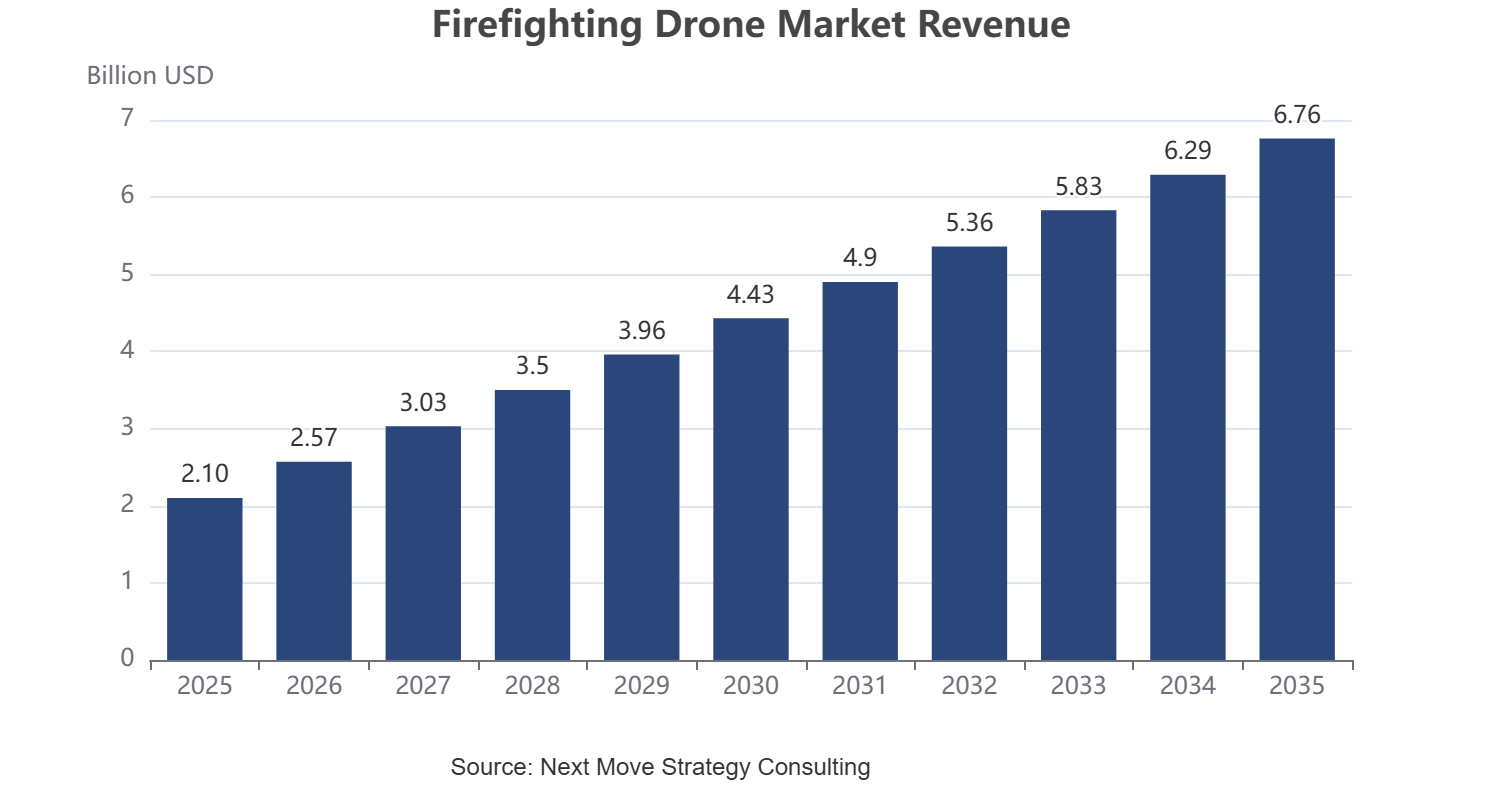
The global firefighting drone sector's size was valued at USD 2.10 billion in 2025 and is estimated at USD 2.36 billion in 2026, forecast to reach USD 6.76 billion by 2035, expanding at a 12.4% CAGR between 2026 and 2035. North America leads with approximately 36% share, while multi-rotor drones dominate all other drone types with approximately 44% share.
We observed that growth is broad-based across every segmentation axis, with autonomous swarm coordination and heavy-lift suppression payloads driving the dominant structural shifts through 2035.
|
Key Takeaways |
|
By Drone Type: Multi-Rotor Drones held the largest share of approximately 44% (USD 0.92 billion) in 2025; Swarm and Multi-Drone Systems is the fastest-growing sub-segment at 20.5% CAGR from 2026–2035. |
|
By Application: Fire Detection and Aerial Surveillance held the largest share of approximately 39% (USD 0.82 billion) in 2025; Fire Suppression and Retardant Delivery is the fastest-growing sub-segment at 16.5% CAGR from 2026–2035. |
|
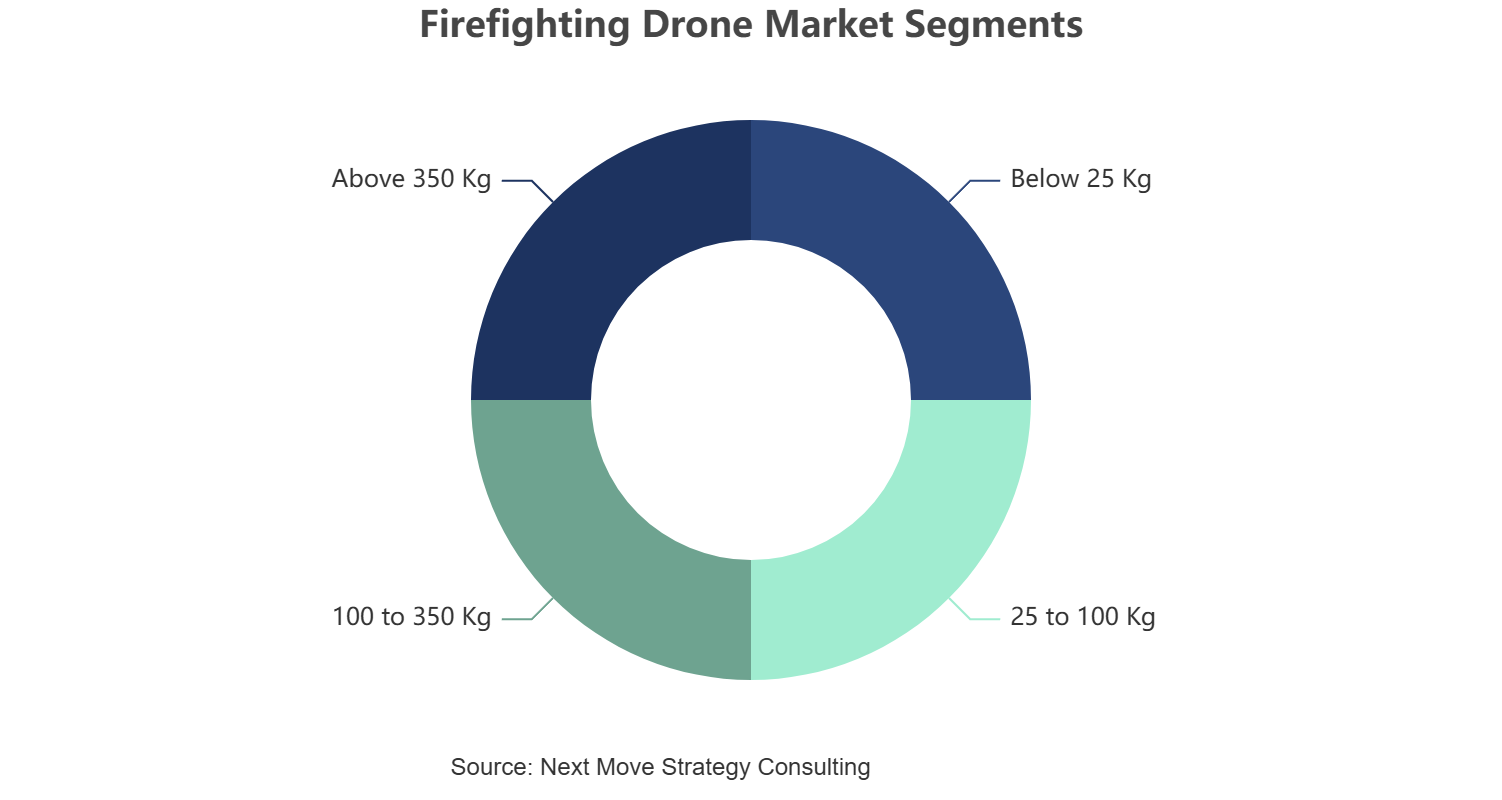
By Payload Capacity: Below 25 Kg held the largest share of approximately 41% (USD 0.86 billion) in 2025; Above 350 Kg is the fastest-growing sub-segment at 17.6% CAGR from 2026–2035. |
|
By End User: Fire Departments and Municipal Agencies held the largest share of approximately 34% (USD 0.71 billion) in 2025; Forestry and Wildland Fire Management Agencies is the fastest-growing sub-segment at 16.1% CAGR from 2026–2035. |
|
By Operation Mode: Visual Line of Sight (VLOS) held the largest share of approximately 58% (USD 1.22 billion) in 2025; Beyond Visual Line of Sight (BVLOS) is the fastest-growing sub-segment at 16.7% CAGR from 2026–2035. |
|
Dominant Region: North America dominated with approximately 36% revenue share (USD 0.76 billion) in 2025. |
|
Fastest-Growing Region: Asia-Pacific is expected to register the highest CAGR of 16.3% during 2026–2035. |
|
Dominant Country: U.S. led with approximately USD 620 million in 2025. |
|
Fastest-Growing Country: India is the fastest-growing country at approximately 18.7% CAGR from 2026–2035. |
Market Opportunity: The firefighting drone market is expected to create an absolute dollar opportunity of USD 4.40 billion between 2026 and 2035, presenting significant investment potential across the wildland fire management and public-safety UAS value chain.
According to Next Move Strategy Consulting analysis, wildland fire agencies are increasingly consolidating procurement around fewer, BVLOS-certified suppliers capable of integrating detection, suppression, and swarm-coordination software into a single platform, a shift that favors diversified UAS manufacturers over single-purpose airframe builders as airspace-integration requirements tighten through 2035.
What Does the Firefighting Drone Market Encompass?
The firefighting drone industry encompasses unmanned aerial systems engineered for fire detection, aerial surveillance, and active suppression, spanning multi-rotor, fixed-wing, hybrid VTOL, and single-rotor helicopter airframes equipped with thermal imaging, retardant, foam, or water-drop payloads. Our assessment indicates that the scope covers platforms supplied to fire departments, forestry agencies, industrial facilities, airports, and defense organizations across wildland, structural, and industrial fire scenarios. The category has evolved from reconnaissance-only quadcopters into mission-critical suppression systems as wildfire frequency and severity have escalated worldwide.
Regulatory frameworks such as the U.S. Federal Aviation Administration's proposed Part 108 beyond visual line of sight rule and the European Union Aviation Safety Agency's U-space integration rules shape airspace-access requirements for firefighting UAS, while national wildland fire agencies increasingly define procurement standards for detection and suppression payloads. We observed that technology adoption is shifting toward autonomous swarm coordination and heavy-lift suppression platforms capable of direct-attack missions. Next Move Strategy Consulting's analysis indicates that this structural shift, combined with tightening BVLOS certification pathways, is redefining sourcing criteria across the firefighting drone market.
|
Parameter |
Details |
|
Market Size in 2025 |
USD 2.10 Billion |
|
Market Size in 2026 |
USD 2.36 Billion |
|
Revenue Forecast in 2035 |
USD 6.76 Billion |
|
Growth Rate |
CAGR of 12.4% from 2026 to 2035 |
|
Analysis Period |
2025–2035 |
|
Base Year Considered |
2025 |
|
Forecast Period |
2026–2035 |
|
Market Size Estimation |
Revenue (USD Billion) |
|
Companies Profiled |
20 |
|
Countries Covered |
33 |
|
Market Share |
Available for Top 10 Companies |
Key Emerging Trends
Based on research conducted by Next Move Strategy Consulting, we found that four structural trends are reshaping product development, deployment models, and stakeholder engagement across the industry.
How Is Autonomous Swarm Technology Transforming Wildfire Suppression?
Autonomous multi-drone swarm systems are replacing single-aircraft reconnaissance missions to enable continuous water and retardant relay operations. We observed that FireSwarm Solutions' Fire Wasp heavy-lift platform, developed with Tsunami Tsolutions and carrying a 350 kg payload, entered certification testing in 2025 for daisy-chained water pickup and drop missions. Wildland fire agencies are piloting swarm coordination to sustain perimeter containment during the overnight hours when manned aircraft are typically grounded.
Why Are Heavy-Lift Suppression Drones Gaining Adoption Among Fire Agencies?
Heavy-lift drones capable of carrying class A foam, water, or retardant loads are gaining share as agencies seek faster initial-attack response than ground crews can achieve in difficult terrain. Our findings suggest that startups including Seneca and Windracers are targeting sub-ten-minute response windows from detection to suppression. Windracers' 30-foot wingspan platform, selected for the XPRIZE Wildfire competition, was field-tested by a UK fire department, reinforcing agency interest in rapid-response airframes.
How Is BVLOS Regulation Reshaping Firefighting Drone Deployment?
Beyond visual line of sight regulatory reform is a defining trend, as agencies require multi-mile detection and suppression range beyond a pilot's direct sightline. We observed that the Federal Aviation Administration published its Part 108 Notice of Proposed Rulemaking on August 7, 2025, proposing a standardized framework for aircraft up to 1,320 pounds. Manufacturers are redesigning detect-and-avoid systems and remote identification features to align with this anticipated certification pathway.
What Role Does AI-Powered Detection Play in Firefighting Drone Innovation?
AI-enabled thermal detection is emerging as a core differentiator, allowing drones to identify ignition points before they escalate into large-scale wildfires. Our analysis shows that Sikorsky and Rain jointly demonstrated autonomous wildfire suppression techniques during a Southern California event in May 2025, pairing helicopter-scale autonomy software with drone-based aerial detection. Manufacturers are integrating machine-learning hotspot recognition to reduce false-positive dispatches and improve first-attack accuracy.
Growth Drivers and Restraints
Growth Catalyst and Risk Assessment Matrix
|
Factors |
Type |
(+/−) % Impact on CAGR |
Geographic Relevance |
Impact Timeline |
|
Rising global wildfire frequency and severity |
Driver |
+2.4% |
Global |
2026-2035 |
|
FAA Part 108 BVLOS rulemaking enabling scaled operations |
Driver |
+1.9% |
North America |
2026-2035 |
|
Expansion of heavy-lift and swarm suppression technology |
Driver |
+1.6% |
Global |
2026-2033 |
|
Rising defense and homeland security UAS procurement |
Driver |
+1.3% |
North America, Europe, Asia-Pacific |
2026-2035 |
|
Government wildland fire management budget expansion |
Driver |
+1.1% |
Global |
2026-2035 |
|
Growing utility and insurance sector early-detection adoption |
Driver |
+0.8% |
North America, Europe |
2026-2032 |
|
Airspace integration and detect-and-avoid restrictions |
Restraint |
-1.0% |
Global |
2026-2035 |
|
High upfront cost of heavy-lift suppression platforms |
Restraint |
-0.7% |
Global |
2026-2035 |
|
Limited endurance and payload of battery-electric platforms |
Restraint |
-0.5% |
Global |
2026-2032 |
What Is the Primary Growth Driver of the Firefighting Drone Market?
Rising wildfire frequency and severity is the primary driver of the market. The U.S. National Interagency Fire Center's incident statistics show annual wildfire acreage burned exceeding the ten-year national average in multiple recent seasons across the western United States. We observed that this escalation, reinforced by prolonged drought conditions tracked by federal land-management agencies, continues to anchor baseline procurement of detection and suppression drones across developed and emerging wildfire-prone economies alike.
How Is BVLOS Regulation Driving Firefighting Drone Market Growth?
Beyond visual line of sight rulemaking is accelerating market growth by expanding the operational range available to detection and suppression missions. The Federal Aviation Administration's Part 108 proposal, published August 7, 2025, would replace individual waiver approvals with a standardized framework covering aircraft up to 1,320 pounds. Our assessment indicates that this regulatory shift, combined with parallel European Union Aviation Safety Agency U-space integration efforts, is compressing certification timelines for long-range suppression platforms across North America and Europe.
What Is Restraining Firefighting Drone Market Expansion?
Airspace integration risk restrains market expansion, since active wildfires typically operate under temporary flight restrictions that ground both manned aircraft and unauthorized civilian drones simultaneously. The Federal Aviation Administration and U.S. Forest Service jointly maintain public-safety guidance warning that unauthorized drone incursions can suspend aerial firefighting operations entirely. We found that this collision-risk sensitivity slows procurement approval cycles for new suppression platforms, particularly among agencies coordinating mixed manned-unmanned airspace during active incidents.
Segmentation Analysis
Segment Sizing: By Drone Type
|
Segment |
2025 (USD) |
2035 (USD) |
CAGR% (2026–2035) |
|
Multi-Rotor Drones |
USD 0.92 Billion |
USD 2.60 Billion |
12.2% |
|
Fixed-Wing Drones |
USD 0.50 Billion |
USD 1.46 Billion |
12.6% |
|
Hybrid VTOL Drones |
USD 0.34 Billion |
USD 1.40 Billion |
17.0% |
|
Single-Rotor Helicopter Drones |
USD 0.23 Billion |
USD 0.71 Billion |
13.3% |
|
Swarm and Multi-Drone Systems |
USD 0.11 Billion |
USD 0.59 Billion |
20.5% |
|
Total |
USD 2.10 Billion |
USD 6.76 Billion |
12.4% |
Which Drone Type Segment Dominates the Firefighting Drone Market?
Multi-Rotor Drones led the market with USD 0.92 billion in 2025, supported by their vertical takeoff flexibility and near-universal compatibility with thermal-imaging and small suppression payloads across structural and initial-attack missions. We observed that Swarm and Multi-Drone Systems are the fastest-growing drone type, expanding at a 20.5% CAGR from 2026 to 2035, as coordinated multi-aircraft relay missions gain traction among wildland agencies seeking continuous suppression coverage.
Segment Sizing: By Application
|
Segment |
2025 (USD) |
2035 (USD) |
CAGR% (2026–2035) |
|
Fire Detection and Aerial Surveillance |
USD 0.82 Billion |
USD 2.31 Billion |
12.2% |
|
Fire Suppression and Retardant Delivery |
USD 0.57 Billion |
USD 2.25 Billion |
16.5% |
|
Post-Fire Damage Assessment and Mapping |
USD 0.32 Billion |
USD 0.93 Billion |
12.6% |
|
Search and Rescue Support |
USD 0.25 Billion |
USD 0.77 Billion |
13.3% |
|
Communication Relay and Command Support |
USD 0.14 Billion |
USD 0.50 Billion |
15.2% |
|
Total |
USD 2.10 Billion |
USD 6.76 Billion |
12.4% |
Which Application Segment Leads Firefighting Drone Market Demand?
Fire Detection and Aerial Surveillance remained the leading application, valued at USD 0.82 billion in 2025 on sustained thermal-imaging reconnaissance demand across wildland and structural incidents. Our findings suggest that Fire Suppression and Retardant Delivery is the fastest-growing application, registering a 16.5% CAGR from 2026 to 2035, as heavy-lift and swarm platforms increasingly perform direct-attack missions once reserved exclusively for manned aerial firefighting assets.
Segment Sizing: By End User
|
Segment |
2025 (USD) |
2035 (USD) |
CAGR% (2026–2035) |
|
Fire Departments and Municipal Agencies |
USD 0.71 Billion |
USD 2.10 Billion |
12.8% |
|
Forestry and Wildland Fire Management Agencies |
USD 0.61 Billion |
USD 2.33 Billion |
16.1% |
|
Industrial and Energy Facilities |
USD 0.34 Billion |
USD 1.05 Billion |
13.3% |
|
Airports and Aviation Authorities |
USD 0.19 Billion |
USD 0.54 Billion |
12.3% |
|
Defense and Homeland Security Agencies |
USD 0.17 Billion |
USD 0.54 Billion |
13.7% |
|
Other End Users |
USD 0.08 Billion |
USD 0.20 Billion |
10.7% |
|
Total |
USD 2.10 Billion |
USD 6.76 Billion |
12.4% |
Which End User Segment Leads the Firefighting Drone Market?
Fire Departments and Municipal Agencies remained the largest end user, valued at USD 0.71 billion in 2025, reflecting broad-based procurement of detection and small-payload suppression drones across metropolitan and regional fire services. Based on research conducted by Next Move Strategy Consulting, we found that Forestry and Wildland Fire Management Agencies is the fastest-growing end user, expanding at a 16.1% CAGR from 2026 to 2035, driven by heavy-lift retardant platform adoption across national wildland fire programs.
Growth Opportunities
Our analysis shows that three forward-looking opportunities stand out for stakeholders positioning within the firefighting drone sector over the 2026-2035 forecast period.
How Can Heavy-Lift Retardant Drones Unlock Direct-Attack Capability for Wildland Agencies?
Heavy-lift retardant drones present a whitespace opportunity for wildland fire agencies seeking initial-attack capability in terrain inaccessible to ground crews and manned aircraft. Suppliers that certify above-350-kg suppression platforms stand to capture recurring government procurement contracts as forestry and wildland fire management agencies expand direct-attack drone fleets alongside traditional aerial tankers.
Where Does Autonomous Swarm Coordination Create New Demand for Industrial Operators?
Utility and energy infrastructure operators represent an underpenetrated opportunity for autonomous swarm-coordinated detection drones deployed along transmission corridors and industrial facilities. Manufacturers that develop always-on, self-relaying detection swarms can secure long-term monitoring contracts with industrial and energy facility end users, benefiting from recurring subscription-based revenue tied to wildfire-liability risk reduction programs.
How Can BVLOS-Certified Platforms Benefit Fire Departments Pursuing 24/7 Aerial Coverage?
Fire departments pursuing continuous aerial coverage create an opportunity for manufacturers offering beyond visual line of sight certified platforms compliant with the FAA's forthcoming Part 108 framework. Early movers that secure certification can differentiate with municipal fire departments seeking round-the-clock detection and rapid-suppression capability across their jurisdictions, benefiting from first-mover procurement advantages.
Regulatory Framework Impacting the Firefighting Drone Market
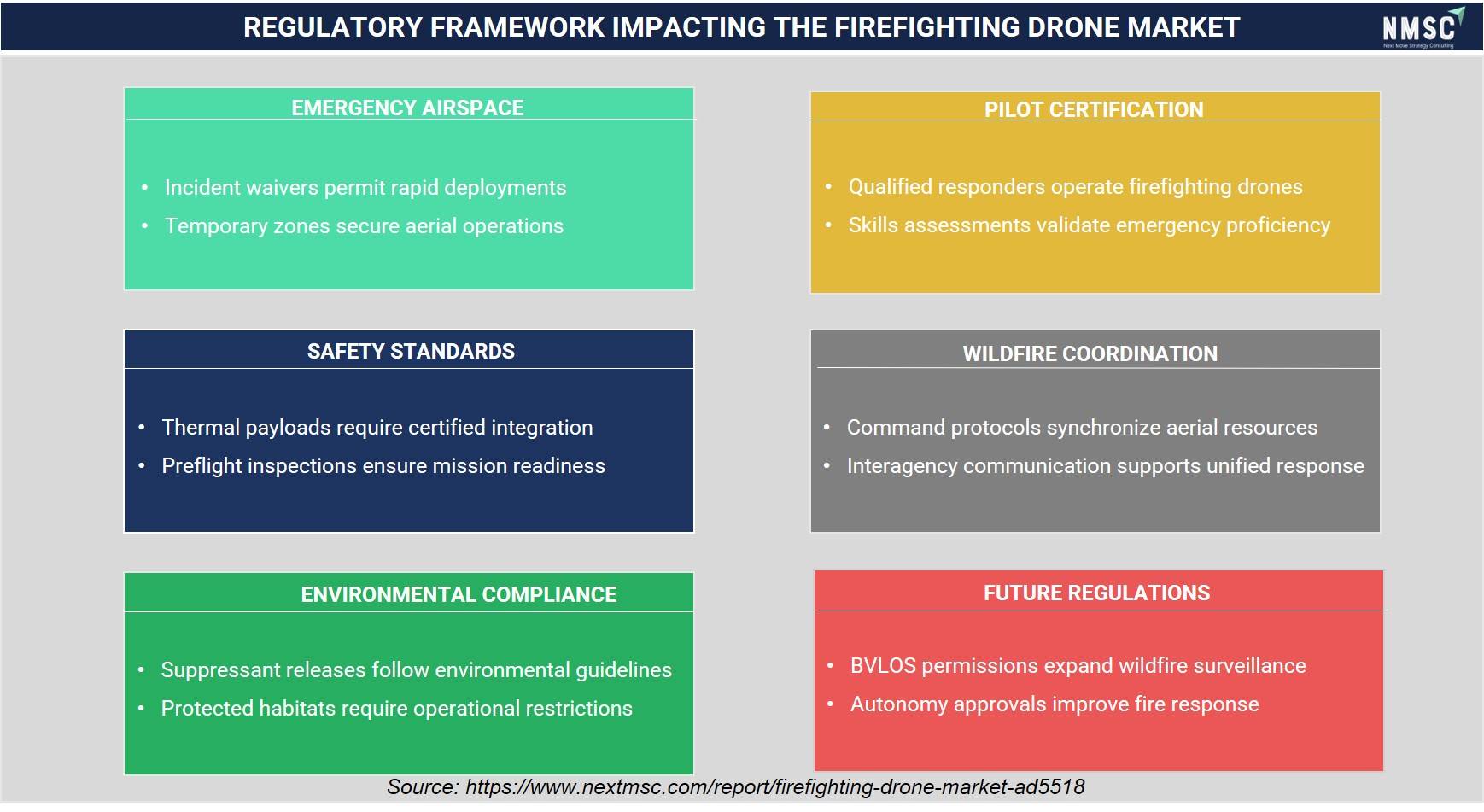
The regulatory framework for the firefighting drone sector defines the operational, safety, and certification requirements for emergency aerial missions. Regulations governing airspace access, pilot qualifications, equipment standards, environmental compliance, and interagency coordination support safe deployments, while evolving policies for autonomous operations and BVLOS flights are expected to strengthen future firefighting capabilities.
Regional Outlook
Geographic Performance Snapshot
|
Region |
2025 (USD) |
2035 (USD) |
CAGR% (2026–2035) |
Key Driver |
|
North America |
USD 0.76 Billion |
USD 2.15 Billion |
12.2% |
Mature wildland fire agencies and FAA Part 108 BVLOS rulemaking |
|
Europe |
USD 0.48 Billion |
USD 1.42 Billion |
12.8% |
EU civil protection coordination and Mediterranean wildfire escalation |
|
Asia-Pacific |
USD 0.55 Billion |
USD 2.14 Billion |
16.3% |
Expanding domestic drone manufacturing and rising forest-fire incidence |
|
Middle East & Africa |
USD 0.19 Billion |
USD 0.63 Billion |
14.2% |
Rising disaster-response infrastructure investment across GCC states |
|
Latin America |
USD 0.12 Billion |
USD 0.42 Billion |
14.9% |
Growing Amazon and Cerrado wildfire response programs |
|
Total |
USD 2.10 Billion |
USD 6.76 Billion |
12.4% |
– |
North America Firefighting Drone Market Outlook
North America leads the firefighting drone market with an established wildland fire management infrastructure and the world's most active drone-regulatory reform agenda. We observed that the Federal Aviation Administration's Part 108 proposal sustains investor and procurement interest in BVLOS-capable suppression platforms, while agencies increasingly specify heavy-lift drones to supplement aerial tanker fleets. Technology adoption remains advanced, with defense-adjacent manufacturers driving demand for autonomous swarm coordination across the region's wildfire-prone western states.
Europe Firefighting Drone Market Outlook
Europe's firefighting drone market reflects a coordination-intensive landscape shaped by the European Union's civil protection mechanism and the European Union Aviation Safety Agency's evolving U-space integration rules. Our findings suggest that Mediterranean member states are accelerating procurement of detection and suppression drones to address lengthening wildfire seasons. Technology adoption favors fixed-wing and hybrid VTOL platforms, supported by cross-border civil protection asset-sharing programs coordinated at the European Commission level.
Asia-Pacific Firefighting Drone Market Outlook
Asia-Pacific is the fastest-growing firefighting drone market region, propelled by an expanding domestic drone manufacturing base in China and rising forest-fire incidence across Southeast Asia and Australia. We found that regulatory frameworks remain less harmonized than in North America or Europe, giving regional manufacturers flexibility to scale multi-rotor production rapidly. Technology adoption is accelerating as China-based suppliers expand export capacity to serve global wildland and industrial fire-response programs.
Middle East & Africa Firefighting Drone Market Outlook
The firefighting drone market in Middle East & Africa is expanding as Gulf Cooperation Council economies invest in disaster-response infrastructure and industrial-facility fire protection. Our analysis shows that Saudi Arabia and the UAE are attracting UAS investment tied to national resilience programs. Regulatory influence remains moderate, while technology adoption is gradually shifting toward imported detection and suppression platforms as regional agencies align with international civil-aviation safety expectations.
Latin America Firefighting Drone Market Outlook
Latin America's firefighting drone market is supported by expanding Amazon and Cerrado wildfire response programs in Brazil and growing civil-defense modernization in Argentina. We observed that regulatory frameworks are less stringent than in North America or Europe, though national environmental agencies operating locally are introducing dedicated wildfire-monitoring drone fleets. Technology adoption remains centered on fixed-wing detection platforms, with competitive intensity increasing as regional distributors partner with global UAS integrators.
U.S. Firefighting Drone Market
the U.S. market was valued at approximately USD 620 million in 2025 and is projected to reach USD 1.71 billion by 2035, growing at a 11.9% CAGR. Demand is anchored by mature wildland fire agency procurement, high defense-sector UAS investment, and the Federal Aviation Administration's advancing Part 108 BVLOS framework. Technology penetration favors heavy-lift and swarm platforms, and competitive intensity remains high among established manufacturers serving federal and state wildfire programs.
Canada Firefighting Drone Market
The market in Canada reached roughly USD 90 million in 2025 and is forecast to hit USD 280 million by 2035 at a 13.4% CAGR. Demand structure mirrors U.S. wildland fire management patterns, while Transport Canada's UAS regulations shape BVLOS operational approvals. Technology penetration is rising as provincial wildfire services request drone-swarm relay capability, with competitive intensity moderate given reliance on cross-border supply from established North American manufacturers.
UK Firefighting Drone Market
As per our estimate, the UK market stood at about USD 90 million in 2025, advancing toward USD 250 million by 2035 at a 12.0% CAGR. Demand is driven by fire and rescue services piloting rapid-response suppression drones following successful 2025 field trials. Regulatory influence is significant under UK Civil Aviation Authority oversight, technology penetration favors fixed-wing detection platforms, and competitive intensity remains steady among domestic and European manufacturers.
Germany Firefighting Drone Market
According to our analysis, Germany's market was valued near USD 80 million in 2025 and is set to reach USD 230 million by 2035, expanding at a 12.5% CAGR. Demand structure benefits from a strong domestic industrial and forestry base requiring fire-monitoring UAS. Germany's participation in EU civil protection coordination drives regulatory influence, while technology penetration favors hybrid VTOL platforms among leading regional integrators.
France Firefighting Drone Market
Based on our estimates, France's market reached approximately USD 60 million in 2025, projected to climb to USD 180 million by 2035 at a 13.0% CAGR. Demand is supported by France's Mediterranean wildfire exposure, which shapes suppression and detection drone adoption. Regulatory influence from national civil-aviation and civil-protection authorities is notable, and competitive intensity remains high given the concentration of European UAS integrators headquartered domestically.
China Firefighting Drone Market
The market in China stood at roughly USD 210 million in 2025 and is forecast to reach USD 800 million by 2035, registering a 16.0% CAGR. Demand is fueled by an expanding domestic drone manufacturing base and a dense concentration of regional UAS suppliers. Regulatory influence is increasing gradually, technology penetration is accelerating through export-oriented production upgrades, and competitive intensity remains elevated among numerous China-based manufacturers.
India Firefighting Drone Market
As per our estimate, India's market was valued at about USD 90 million in 2025, projected to reach USD 420 million by 2035 at a 18.7% CAGR, the fastest among covered countries. Demand structure reflects rising forest-fire incidence and expanding state disaster-response drone procurement. Regulatory influence remains developing, while technology penetration is rising quickly as domestic manufacturers localize firefighting drone production to serve India's expanding wildland and industrial fire-response base.
Japan Firefighting Drone Market
According to our analysis, Japan's market reached close to USD 70 million in 2025 and is expected to hit USD 220 million by 2035, growing at a 13.6% CAGR. Demand is supported by Japan's dense urban fire-risk profile and precision-engineered UAS manufacturing heritage. Regulatory influence is well established under Japan Civil Aviation Bureau oversight, technology penetration is advanced, and competitive intensity remains high among long-standing domestic manufacturers.
South Korea Firefighting Drone Market
Based on our estimates, South Korea's market stood at approximately USD 40 million in 2025, forecast to reach USD 140 million by 2035 at a 14.9% CAGR. Demand structure benefits from the country's advanced domestic UAS manufacturing base and government-backed disaster-response modernization programs. Technology penetration is high, with domestic integrators supplying detection-focused platforms, and competitive intensity remains pronounced amid rapid product innovation cycles.
Australia Firefighting Drone Market
The firefighting drone market in Australia reached about USD 40 million in 2025 and is projected to reach USD 140 million by 2035, expanding at a 14.9% CAGR. Demand is supported by a well-established bushfire-response sector and growing agency preference for aerial detection technology. Regulatory influence stems from the Civil Aviation Safety Authority's UAS operating rules, while technology penetration favors imported fixed-wing detection systems amid moderate competitive intensity.
UAE Firefighting Drone Market
As per our estimate, the UAE market was valued near USD 40 million in 2025, projected to reach USD 140 million by 2035 at a 14.9% CAGR. Demand structure is shaped by the UAE's role as a regional disaster-response and civil-defense technology hub. Regulatory influence remains moderate, technology penetration is improving through imported detection platforms, and competitive intensity is rising as distributors expand product portfolios to serve Gulf markets.
Saudi Arabia Firefighting Drone Market
According to our analysis, Saudi Arabia's market reached roughly USD 50 million in 2025 and is expected to hit USD 190 million by 2035, growing at a 16.0% CAGR. Demand is driven by Vision 2030-linked disaster-response infrastructure investment and rising industrial-facility fire-protection spending. Regulatory influence is developing under General Authority of Civil Aviation guidelines, and technology penetration is advancing as domestic integrators scale procurement.
South Africa Firefighting Drone Market
Based on our estimates, South Africa's market stood at about USD 20 million in 2025, forecast to reach USD 60 million by 2035 at a 13.0% CAGR. Demand structure reflects a developing wildland fire management base serving regional Southern African agencies. Regulatory influence remains moderate, technology penetration is gradually improving, and competitive intensity is limited given reliance on imported detection drones from Europe and Asia.
Brazil Firefighting Drone Market
The market in Brazil reached approximately USD 50 million in 2025 and is projected to reach USD 170 million by 2035, registering a 14.6% CAGR. Demand is underpinned by expanding Amazon and Cerrado wildfire-monitoring programs coordinated by national environmental agencies. Regulatory influence stems from Brazil's National Civil Aviation Agency, technology penetration favors fixed-wing detection drones, and competitive intensity remains moderate among regional integrators.
Argentina Firefighting Drone Market
As per our estimate, Argentina's market was valued near USD 20 million in 2025, projected to reach USD 70 million by 2035 at a 14.9% CAGR. Demand structure is supported by steady civil-defense modernization despite macroeconomic volatility. Regulatory influence remains limited, technology penetration is modest, and competitive intensity is centered on a small number of regional distributors serving domestic wildland-fire agencies.
Ecosystem Analysis of the Firefighting Drone Market
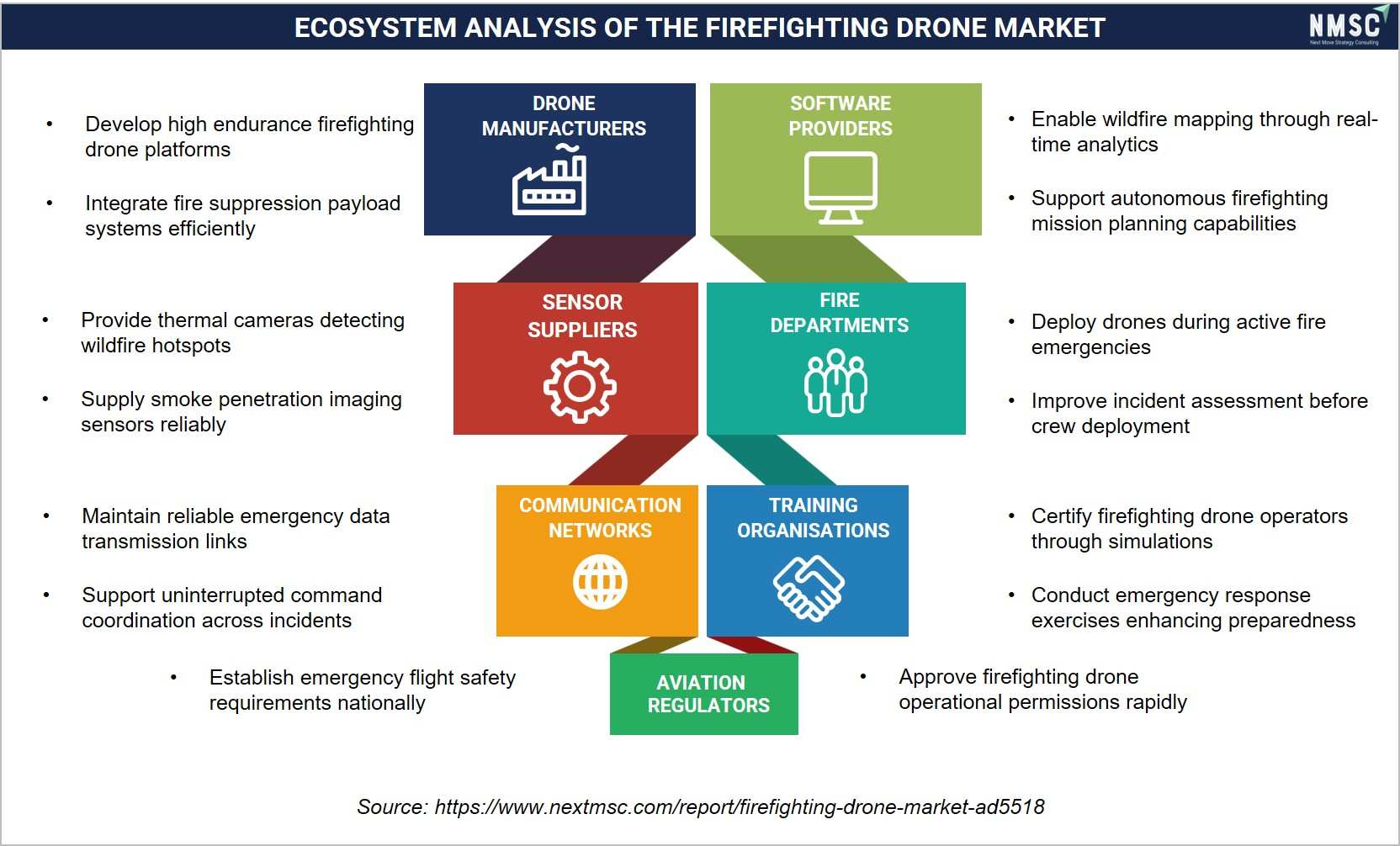
The firefighting drone market ecosystem brings together drone manufacturers, sensor suppliers, software providers, communication network operators, training organizations, fire departments, and aviation regulators. Collaboration among these stakeholders enables advanced aerial surveillance, secure communications, mission planning, regulatory compliance, and emergency response coordination, supporting the effective adoption of drone-based firefighting solutions.
Competitive Landscape
We observed that the firefighting drone market features a moderately fragmented competitive landscape, with diversified aerospace and defense manufacturers competing alongside specialized wildfire-native startups on innovation, certification speed, and payload capability.
|
Dimension |
Description |
|
Market Structure |
Moderately fragmented; a small group of diversified UAS and defense manufacturers compete alongside numerous wildfire-native startups pursuing certification and pilot agreements with government agencies. |
|
Innovation Focus |
Heavy-lift suppression payloads, autonomous swarm coordination, AI-powered thermal detection, and BVLOS certification pathways dominate current innovation pipelines across leading suppliers. |
|
M&A Activity |
Selective consolidation through platform acquisitions, exemplified by Robinson Helicopter Company's integration of Ascent AeroSystems to broaden heavy-lift UAS capabilities across public-safety and firefighting applications. |
How Do Companies Compete in the Firefighting Drone Market?
Companies compete primarily on certification speed, payload capability, and integration with agency dispatch systems across the industry. Global players such as DJI and Lockheed Martin leverage broad platform portfolios to serve government and defense customers, while specialized startups including Draganfly and FireSwarm Solutions compete on rapid pilot-program deployment and wildfire-specific suppression payload development for wildland and municipal fire agencies.
Which Competitive Archetypes Dominate the Firefighting Drone Market?
Two archetypes dominate the market: diversified aerospace and defense manufacturers offering full-service platform and regulatory support, and specialized wildfire-native startups focused on rapid-response suppression innovation. Lockheed Martin and Elbit Systems exemplify the diversified archetype through integrated sensor-to-airframe manufacturing, while Draganfly and Seneca exemplify the specialized archetype through mission-specific suppression payload development for wildland fire agencies.
What Innovation and Differentiation Strategies Define Leading Players?
Leading players differentiate through heavy-lift payload engineering, autonomous swarm software, and BVLOS certification readiness. Manufacturers such as Windracers and FireSwarm Solutions are pursuing rapid-response airframe designs, while diversified players including AeroVironment and Teledyne FLIR integrate thermal-imaging sensor suites to strengthen detection accuracy, positioning both archetypes to capture premium government procurement contracts as certification pathways mature.
What M&A Activity Is Shaping the Firefighting Drone Market?
M&A activity remains selective, centered on platform and capability acquisitions rather than broad consolidation. Robinson Helicopter Company's acquisition of Ascent AeroSystems expanded its heavy-lift UAS portfolio into public-safety and wildfire-response applications. We found that similar targeted acquisitions are likely as diversified aerospace manufacturers seek to acquire certification expertise and wildfire-specific payload technology from smaller specialized developers.
Key Market Players
We observed that the firefighting drone market's competitive set spans diversified aerospace and defense manufacturers, established commercial UAS producers, and specialized wildfire-native developers, with the following companies representing the validated leaders profiled in this report.
-
SZ DJI Technology Co., Ltd.
-
Lockheed Martin Corporation
-
AeroVironment, Inc.
-
Elbit Systems Ltd.
-
EHang Holdings Limited
-
Parrot SA
-
Yuneec International Co., Ltd.
-
Volatus Aerospace Corp.
-
Chengdu JOUAV Automation Tech Co., Ltd.
-
Windracers Limited
-
Ascent AeroSystems, LLC
-
Aerones SIA
-
FireSwarm Solutions Inc.
-
Teledyne FLIR LLC
-
L3Harris Technologies, Inc.
-
Skydio, Inc.
-
Autel Robotics Co., Ltd.
-
Insitu, Inc.
-
Percepto Ltd.
Latest Developments
We observed that recent developments across the industry center on regulatory milestones, platform certification, and government contract awards through 2025 and 2026.
|
Date |
Event |
|
Jun 2026 |
FireSwarm Solutions and Kongsberg Geospatial signed a Memorandum of Understanding to jointly develop and commercialize an integrated wildfire response platform combining FireSwarm's autonomous suppression drone swarms with IRIS Terminal for wildfire command, logistics, and emergency response. |
|
Feb 2025 |
Parrot introduced ANAFI USA for Firefighters, specifically designed for fire departments with thermal imaging, 32× zoom, and public safety capabilities for wildfire and structural fire operations. |
Investment Opportunities
How Are Capital Inflows Shaping the Firefighting Drone Market?
Venture and strategic capital inflows are accelerating as wildfire-native startups pursue certification milestones. We observed that companies including FireSwarm Solutions and Seneca have attracted growing strategic partner interest tied to heavy-lift and swarm-suppression development, reflecting investor confidence in the sector's transition from pilot programs to recurring government procurement revenue.
Where Is Infrastructure Investment Concentrated Within the Market?
Infrastructure investment is concentrated in ground-control networks, drone-in-a-box detection stations, and BVLOS-compliant airspace-management systems. Our assessment indicates that fire agencies and utility operators are jointly funding always-on detection infrastructure, particularly across wildfire-prone transmission corridors, to reduce response latency ahead of anticipated FAA Part 108 implementation.
What ESG Considerations Influence Firefighting Drone Investment?
Environmental and social governance considerations favor firefighting drones as a firefighter-safety and ecosystem-protection technology, reducing human exposure to hazardous wildland conditions. We found that government disaster-resilience funding increasingly prioritizes autonomous detection and suppression procurement as a documented risk-reduction investment, strengthening the sector's alignment with public-sector ESG-linked infrastructure spending programs.
Key Benefits for Stakeholders
How Does This Report Benefit Fire Agency and Public-Safety Leaders?
Fire agency and public-safety leaders gain access to validated market sizing, segmentation, and regional benchmarks that support procurement planning and budget justification. Our analysis shows that the report's payload-capacity and end-user breakdowns help agencies compare platform investment priorities against peer jurisdictions pursuing similar detection and suppression capability expansion.
How Does This Report Benefit Investors and Financial Analysts?
Investors and financial analysts benefit from independently derived revenue forecasts, competitive landscape analysis, and identification of the fastest-growing segments through 2035. We observed that the report's company profiles and M&A context support diligence on strategic positioning across diversified manufacturers and specialized wildfire-native developers.
How Does This Report Benefit Technology Vendors and Product Teams?
Technology vendors and product teams gain a structured view of segmentation priorities, regulatory milestones, and regional demand drivers to inform product roadmaps. Based on research conducted by Next Move Strategy Consulting, we found that the report's trend and opportunity analysis helps product teams prioritize BVLOS certification and swarm-coordination features aligned with agency procurement timelines.
Key Market Segments
By Drone Type
-
Multi-Rotor Drones
-
Fixed-Wing Drones
-
Hybrid VTOL Drones
-
Single-Rotor Helicopter Drones
-
Swarm and Multi-Drone Systems
By Application
-
Fire Detection and Aerial Surveillance
-
Fire Suppression and Retardant Delivery
-
Post-Fire Damage Assessment and Mapping
-
Search and Rescue Support
-
Communication Relay and Command Support
By Payload Capacity
-
Below 25 Kg
-
25 to 100 Kg
-
100 to 350 Kg
-
Above 350 Kg
By End User
-
Fire Departments and Municipal Agencies
-
Forestry and Wildland Fire Management Agencies
-
Industrial and Energy Facilities
-
Airports and Aviation Authorities
-
Defense and Homeland Security Agencies
-
Other End Users
By Operation Mode
-
Visual Line of Sight (VLOS)
-
Beyond Visual Line of Sight (BVLOS)
By Region
-
North America: U.S., Canada, Mexico.
-
Europe: UK, Germany, France, Italy, Spain, Sweden, Denmark, Finland, Netherlands, Rest of Europe.
-
Asia-Pacific: China, India, Japan, South Korea, Taiwan, Indonesia, Vietnam,Australia, Philippines, Malaysia, Rest of APAC.
-
Middle East & Africa: Saudi Arabia, UAE, Egypt, Israel, Turkey, Nigeria, South Africa, Rest of MEA.
-
Latin America: Brazil, Argentina, Chile, Colombia, Rest of LATAM.
Conclusion and Recommendations
What Is the Long-Term Outlook for the Firefighting Drone Market?
The long-term outlook for the market remains strongly positive, with global revenue projected to more than triple from USD 2.10 billion in 2025 to USD 6.76 billion by 2035 at a 12.4% CAGR. We observed that escalating wildfire frequency, maturing BVLOS regulation, and autonomous swarm expansion will continue underpinning demand across fire department, forestry, and industrial applications through the forecast period.
What Strategic Positioning Should Firefighting Drone Suppliers Pursue?
Suppliers should prioritize heavy-lift and swarm-coordination product platforms while pursuing early BVLOS certification under the anticipated FAA Part 108 framework to secure long-term agency contracts. Our assessment indicates that manufacturers investing early in autonomous detection-to-suppression integration will be best positioned to capture premium government pricing within the firefighting drone market.
How Attractive Is the Firefighting Drone Market for New Investment?
The firefighting drone industry presents an attractive investment case, supported by a USD 4.40 billion absolute dollar opportunity between 2026 and 2035 and above-average growth in Asia-Pacific and swarm-system categories. We found that investment attractiveness is highest for manufacturers combining certification readiness with scaled heavy-lift manufacturing capacity.
What Market Shifts and Key Risks Should Stakeholders Monitor?
Stakeholders should monitor airspace-integration restrictions, high heavy-lift platform costs, and battery-endurance limitations as key risks to the firefighting drone market. Our analysis shows that suppliers unable to secure BVLOS certification risk losing procurement share to competitors with validated detect-and-avoid systems, particularly as agencies coordinate increasingly complex mixed manned-unmanned airspace.
What Are the Key Growth Pathways for the Firefighting Drone Market?
Key growth pathways include expanding heavy-lift retardant portfolios, scaling autonomous swarm-coordination software, and deepening penetration into industrial and utility-sector monitoring channels. Next Move Strategy Consulting's analysis indicates that suppliers pursuing these pathways while maintaining certification discipline will be best positioned to capture the firefighting drone market's projected growth through 2035.
About the Author
 Mihul Sharma
— Mihul Sharma is Research Associate at Next Move Strategy Consulting, where he has covered technology, industrial, and healthcare markets for 3 years. His work applies structured business research, market analysis, and secondary-source review to assess market trends, competitive developments, and growth opportunities. He supports report development by fully synthesizing industry data, company information, and market signals into concise findings for strategy and investment-focused research teams.
Mihul Sharma
— Mihul Sharma is Research Associate at Next Move Strategy Consulting, where he has covered technology, industrial, and healthcare markets for 3 years. His work applies structured business research, market analysis, and secondary-source review to assess market trends, competitive developments, and growth opportunities. He supports report development by fully synthesizing industry data, company information, and market signals into concise findings for strategy and investment-focused research teams.
About the Reviewer
 Supradip Baul
— Supradip Baul is an accomplished business consultant and strategist with over a decade of rich experience in market intelligence, strategy, technology, and business transformation. His work has included rigorous qualitative and quantitative analysis across multiple industries, helping clients shape investment decisions and long-term roadmaps. Earlier in his career, he was associated with Gartner, where he contributed to industry-leading reports and market share analyses. He has worked with leading global companies and holds an MBA with a dual specialization in Marketing and Finance.
Supradip Baul
— Supradip Baul is an accomplished business consultant and strategist with over a decade of rich experience in market intelligence, strategy, technology, and business transformation. His work has included rigorous qualitative and quantitative analysis across multiple industries, helping clients shape investment decisions and long-term roadmaps. Earlier in his career, he was associated with Gartner, where he contributed to industry-leading reports and market share analyses. He has worked with leading global companies and holds an MBA with a dual specialization in Marketing and Finance.
At Next Move Strategy Consulting, we understand that insightful market research is the cornerstone of successful business decisions. That's why we employ a robust and multifaceted approach, combining various methodologies to deliver the most accurate and actionable data for our clients.

Research Landscape
We navigate the world of research with two primary approaches:
Qualitative Approach
Our qualitative research methodologies involve immersive techniques such as in-depth interviews, focus groups, and observational studies. By engaging directly with individuals and stakeholders, we uncover valuable insights that quantitative data alone may overlook.

Quantitative Research
In tandem with qualitative methodologies, NMSC leverages the power of Quantitative Research to provide a robust foundation of numerical insights. Through systematic data collection and analysis, we quantify patterns, preferences, and market trends, offering a comprehensive view of the business landscape.
Our quantitative research approach employs diverse tools, including surveys, experiments, and statistical modelling. These methodologies enable us to gather data from a large and representative sample, ensuring the statistical significance of our findings. By employing structured questionnaires and standardized data collection methods, we guarantee the reliability and validity of the information we present to our clients.
Quantitative research is particularly effective in measuring the prevalence of trends, assessing market size, and gauging the impact of various factors on consumer behavior. The numerical precision attained through this approach equips our clients with actionable insights, facilitating data-driven decision-making and strategy formulation.


Our Specialized Toolbox for Industry-Specific Market Research
We deploy a specialized arsenal of techniques tailored to meet your unique requirements. Here's a glimpse into our comprehensive toolbox:

Information Procurement
The stage entails acquiring market data or relevant information through various sources and methodologies.


Market Research Approach
We utilize both top-down and bottom-up approaches in market research analysis to achieve a comprehensive understanding of the market dynamics, leveraging the broad perspective of industry trends and macroeconomic factors alongside detailed insights from specific segments and individual companies.

Porters Five Forces Analysis
We conduct Porter's Five Forces analysis to evaluate the competitive landscape of an industry, providing us with insights into factors that affect profitability and strategic positioning.

SWOT Analysis

Forecasting
We utilize a forecasting model to predict future consumption by considering parameters like population, economics, regulations, market competition, drivers, constraints, technology, and pricing. We also employ statistical techniques such as multilinear regression, exponential smoothing, moving average, ARIMA, and Monte Carlo simulations for accurate predictions. In econometric forecasting, we analyzed short-term and long-term event impacts, attributing values based on regulatory frameworks, economic factors, and market events.





 Speak to Our Analyst