Quantum Sensor Market Size, Share, Trends and Growth Analysis, By Product Type (Atomic Clocks, Magnetic Sensors, Gravimeters and Gradiometers, Gyroscopes, Imaging and Photon Detectors, and Other Quantum Sensors), By Technology Platform (Atomic Systems, Solid-State Defects, Superconducting Circuits, and Photonic Platforms), By End-User Industry Vertical, and Region – Global Industry Report and Forecast, 2026–2035
Industry: Semiconductor & Electronics | Publishing Date: July 28, 2026 | Last Updated: September 30, 2026 | No of Pages: N/A | No. of Tables: N/A | No. of Figures: N/A | Format: PDF | Report Code: SE3032
What Is the Quantum Sensor Market Size?
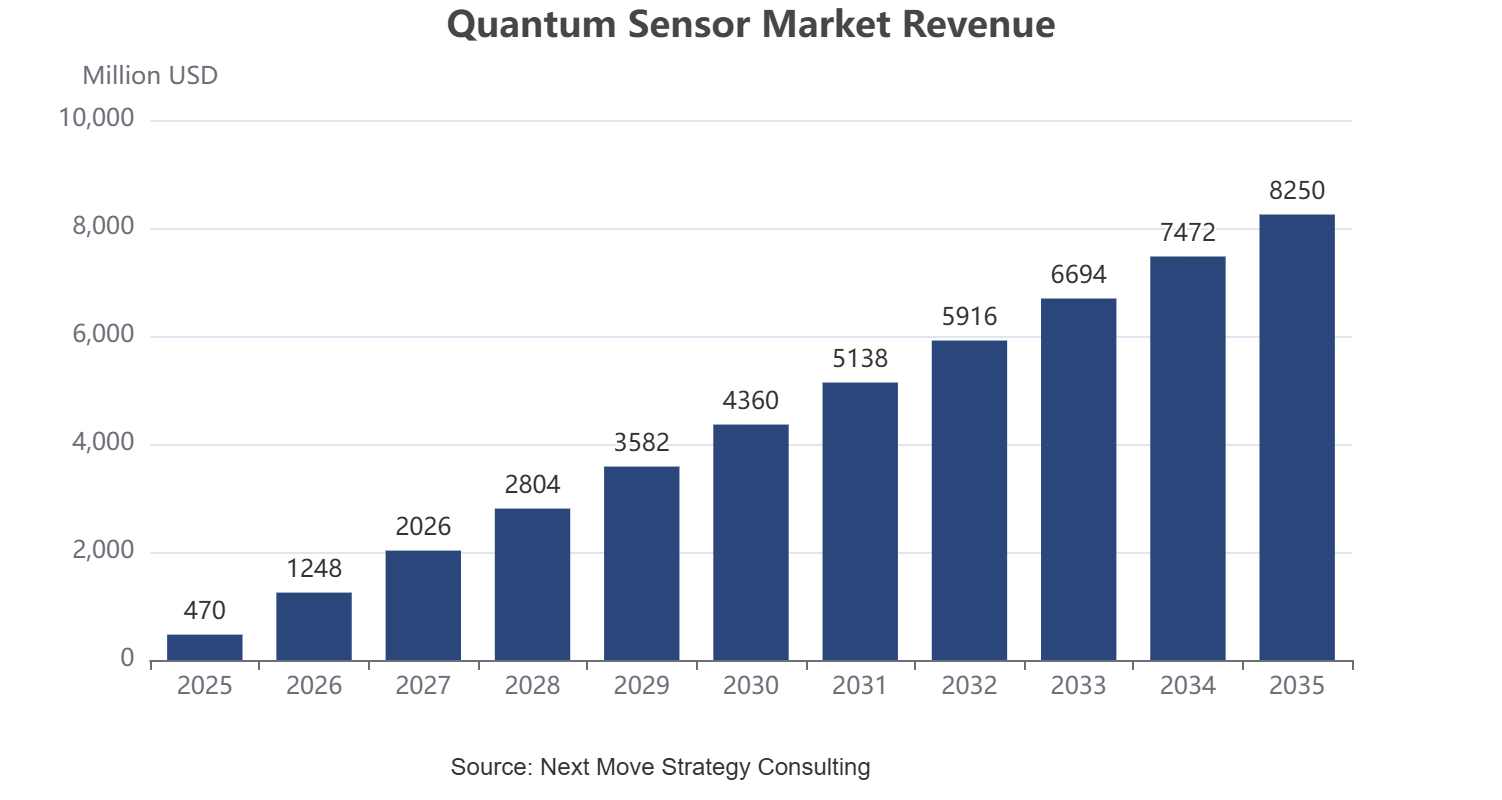
The global Quantum Sensor Market size was valued at USD 470 million in 2025 and is estimated at USD 620 million in 2026, forecast to reach USD 8.25 billion by 2035, at a 33.3% CAGR from 2026 to 2035. North America leads with approximately 42% share, while atomic clocks dominate all other product types with approximately 28% share.
We observed that growth is accelerating fastest in photonic and telecommunications-linked applications, reflecting the market's transition from defense-funded research programs toward broader commercial deployment through 2035.
|
Key Takeaways |
|
By Product Type: Atomic Clocks held the largest share of approximately 28% (USD 131.6 Million) in 2025; Imaging and Photon Detectors is the fastest-growing sub-segment at 39.5% CAGR from 2026–2035. |
|
By Technology Platform: Atomic Systems held the largest share of approximately 40% (USD 188.0 Million) in 2025; Photonic Platforms is the fastest-growing sub-segment at 37.3% CAGR from 2026–2035. |
|
By End-User Industry Vertical: Aerospace and Defense held the largest share of approximately 34% (USD 159.8 Million) in 2025; Telecommunications and IT is the fastest-growing sub-segment at 39.5% CAGR from 2026–2035. |
|
Dominant Region: North America dominated with approximately 42% revenue share (USD 197.4 Million) in 2025. |
|
Fastest-Growing Region: Asia-Pacific is expected to register the highest CAGR of 39.0% during 2026–2035. |
|
Dominant Country: U.S. led with approximately USD 154.0 Million in 2025. |
|
Fastest-Growing Country: India is the fastest-growing country at approximately 48.4% CAGR from 2026–2035. |
Market Opportunity: The quantum sensor market is expected to create an absolute dollar opportunity of USD 7.63 billion between 2026 and 2035, presenting significant investment potential across defense, navigation, and telecommunications-linked quantum sensing applications.
According to Next Move Strategy Consulting analysis, government-backed quantum initiatives are increasingly transitioning from laboratory-scale demonstrations to fielded systems, a shift that favors vertically integrated manufacturers capable of delivering ruggedized, deployment-ready quantum sensors over pure research-stage suppliers as procurement programs mature through 2035.
What Does the Quantum Sensor Market Encompass?
The quantum sensor market encompasses devices that exploit quantum mechanical phenomena, including superposition, entanglement, and spin-state sensitivity, to measure time, magnetic fields, gravity, rotation, and single photons with precision unattainable by classical sensors. Our assessment indicates that the scope spans atomic clocks, magnetometers, gravimeters, gyroscopes, and photon detectors supplied to aerospace and defense agencies, research institutions, and increasingly commercial telecommunications and healthcare operators. The category has evolved from laboratory-bound atomic physics demonstrations into ruggedized, field-deployable instruments driven by national quantum strategies and defense modernization programs.
Regulatory and funding frameworks such as the U.S. Department of Commerce's CHIPS Research and Development Office and national quantum initiatives across Europe and Asia-Pacific shape investment in quantum sensing and adjacent quantum hardware development. We observed that technology adoption is shifting toward neutral-atom and solid-state defect platforms offering improved manufacturability. Next Move Strategy Consulting's analysis indicates that this structural shift, combined with growing defense and space-agency procurement, is redefining sourcing criteria across the quantum sensor market.
|
Field |
Details |
|
Market Size in 2025 |
USD 470 Million |
|
Market Size in 2026 |
USD 620 Million |
|
Revenue Forecast in 2035 |
USD 8250 Million |
|
Growth Rate |
CAGR of 33.3% from 2026 to 2035 |
|
Analysis Period |
2025–2035 |
|
Base Year Considered |
2025 |
|
Forecast Period |
2026–2035 |
|
Market Size Estimation |
USD Million |
|
Companies Profiled |
15 |
|
Countries Covered |
33 |
|
Market Share |
Available for Top 10 Companies |
Key Emerging Trends
We found that four structural trends are reshaping product development, funding, and stakeholder engagement across the quantum sensor industry.
How Is Quantum Sensing Transitioning from Research to Deployed Systems?
Quantum sensor developers are transitioning from laboratory demonstrations to fielded, contract-backed systems for government and commercial customers. We observed that Infleqtion secured more than USD 20 million in contracted funding for NASA's Quantum Gravity Gradiometer Pathfinder mission, announced in February 2026, to fly the first quantum gravity sensor to measure Earth's gravitational field from orbit. This shift is elevating demand for ruggedized, space- and field-qualified quantum instruments among government and commercial customers.
Why Is Quantum Timing Gaining Traction in Defense and Telecommunications?
Quantum-enabled precision timing is gaining traction as defense and telecommunications operators seek resilient alternatives to GPS-dependent timing. Our findings suggest that Infleqtion launched its first quantum-enabled precision timing solution with Safran Electronics & Defense in April 2026, integrating its Tiqker optical atomic clock with Safran's White Rabbit and SecureSync systems. This trend is elevating demand for atomic clock technology among defense, telecommunications, and critical infrastructure customers seeking resilient navigation and timing.
How Is Capital Market Access Accelerating Quantum Sensor Commercialization?
Public capital market access is accelerating commercialization timelines across the quantum sensing industry. We observed that Infleqtion completed its listing via merger with Churchill Capital Corp X in February 2026, raising more than USD 550 million to fund manufacturing and shipping rather than additional research. This trend is reshaping competitive dynamics as publicly funded manufacturers scale production capacity ahead of research-stage competitors.
How Is Government Funding Elevating Photonic and Solid-State Sensor Development?
Government funding programs are elevating development of photonic and solid-state defect quantum sensors used in single-photon detection and quantum networking applications. Suppliers of superconducting nanowire single-photon detectors and diamond nitrogen-vacancy sensors are benefiting from national quantum initiatives funding component-level research alongside broader quantum computing infrastructure. This trend is reshaping procurement criteria toward vendors demonstrating manufacturable, scalable photonic sensor platforms.
Ecosystem Analysis of the Quantum Sensor Market
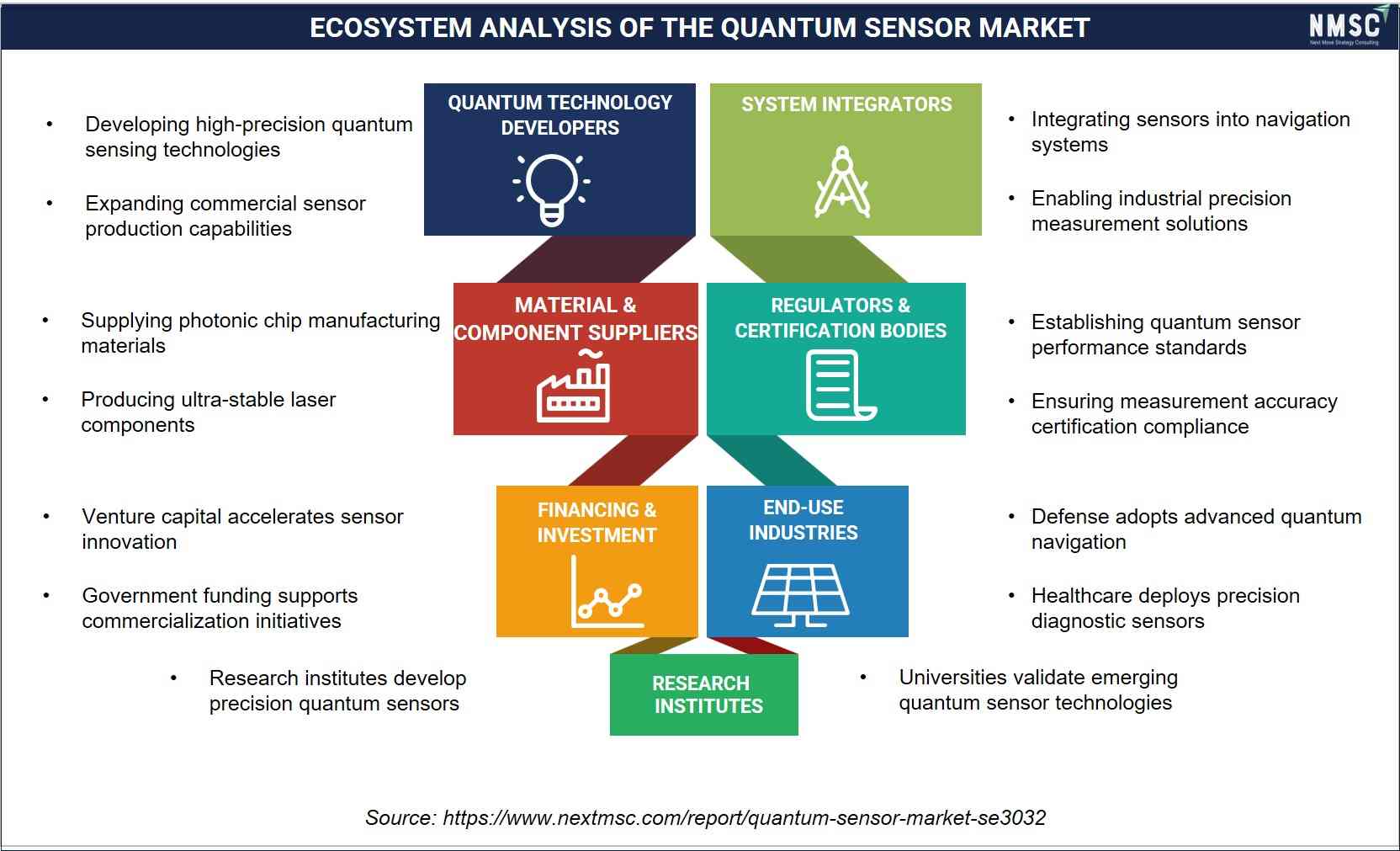
The quantum sensor market ecosystem is built on collaboration among technology developers, material and component suppliers, system integrators, regulators, investors, research institutes, and end-use industries. Research organizations drive innovation, while funding accelerates commercialization and large-scale deployment. Component suppliers and integrators enable high-performance sensing solutions that meet industry standards. Growing adoption across aerospace, defence, healthcare, automotive, energy, telecommunications, and industrial manufacturing continues to strengthen the market and support technological advancements.
Growth Drivers and Restraints
Growth Catalyst and Risk Assessment Matrix
|
Factors |
Type |
(+/-) % Impact on CAGR |
Geographic Relevance |
Impact Timeline |
|
Government defense and space agency procurement programs |
Driver |
+6.5% |
North America, Europe |
2026–2035 |
|
National quantum technology strategies and funding initiatives |
Driver |
+5.8% |
Global |
2026–2035 |
|
GPS-denied navigation and resilient timing demand |
Driver |
+4.2% |
North America, Asia-Pacific |
2026–2035 |
|
Public capital market access for quantum manufacturers |
Driver |
+3.0% |
North America |
2026–2030 |
|
Quantum networking and telecommunications infrastructure investment |
Driver |
+3.5% |
Global |
2026–2035 |
|
Oil, gas, and mineral exploration gravimetry adoption |
Driver |
+2.1% |
North America, Middle East & Africa |
2026–2032 |
|
Component manufacturability and yield constraints |
Restraint |
-2.8% |
Global |
2026–2032 |
|
High unit cost relative to classical sensor alternatives |
Restraint |
-1.9% |
Global |
2026–2033 |
What Is the Primary Growth Driver of the Quantum Sensor Market?
Government defense and space agency procurement programs are the primary driver of the market. We observed that Infleqtion signed a Letter of Intent with the U.S. Department of Commerce's CHIPS Research and Development Office in May 2026 for up to USD 100 million in proposed funding to accelerate domestic quantum technology development. This funding momentum continues to anchor baseline procurement of atomic clock and inertial sensing systems across defense and national security programs.
How Is National Quantum Strategy Funding Driving Market Growth?
National quantum technology strategies are accelerating market growth as governments fund both research and manufacturing scale-up. Our assessment indicates that Infleqtion's Department of Energy ARPA-E awards, totaling more than USD 10 million across its ENCODE and QC3 programs through March 2026, illustrate how public funding is directly supporting quantum sensing and quantum-enhanced computing development. This funding pattern is compressing commercialization timelines for atomic and solid-state sensor platforms.
What Is Restraining Quantum Sensor Market Expansion?
Component manufacturability constraints and yield challenges restrain the pace of quantum sensor commercialization across the industry, particularly for superconducting nanowire and diamond nitrogen-vacancy center devices requiring cryogenic or highly controlled fabrication environments. High unit costs relative to classical inertial and timing sensors further limit adoption outside defense and scientific applications. We found that smaller specialized manufacturers face particular exposure to these constraints, as limited production scale reduces their ability to reduce per-unit costs compared with larger, well-capitalized competitors.
Segmentation Analysis
Segment Sizing: By Product Type
|
Segment |
2025 (USD) |
2035 (USD) |
CAGR% (2026–2035) |
|
Atomic Clocks |
USD 131.6 Million |
USD 1650.0 Million |
28.4% |
|
Magnetic Sensors (Magnetometers) |
USD 103.4 Million |
USD 1980.0 Million |
34.6% |
|
Gravimeters and Gradiometers |
USD 56.4 Million |
USD 825.0 Million |
30.6% |
|
Gyroscopes |
USD 65.8 Million |
USD 1072.5 Million |
32.2% |
|
Imaging and Photon Detectors |
USD 75.2 Million |
USD 1980.0 Million |
39.5% |
|
Other Quantum Sensors |
USD 37.6 Million |
USD 742.5 Million |
35.1% |
|
Total |
USD 470.0 Million |
USD 8250.0 Million |
33.3% |
Which Product Type Dominates the Quantum Sensor Market?
Atomic Clocks led the market with USD 131.6 million in 2025, supported by established defense and telecommunications timing applications and relatively mature manufacturing processes. We observed that Imaging and Photon Detectors is the fastest-growing product type, expanding at a 39.5% CAGR from 2026 to 2035, as quantum networking and single-photon detection demand accelerates alongside broader quantum computing and communications infrastructure investment.
Segment Sizing: By Technology Platform
|
Segment |
2025 (USD) |
2035 (USD) |
CAGR% (2026–2035) |
|
Atomic Systems |
USD 188.0 Million |
USD 2640.0 Million |
30.1% |
|
Solid-State Defects |
USD 103.4 Million |
USD 2145.0 Million |
35.8% |
|
Superconducting Circuits |
USD 84.6 Million |
USD 1320.0 Million |
31.6% |
|
Photonic Platforms |
USD 94.0 Million |
USD 2145.0 Million |
37.3% |
|
USD 470.0 Million |
USD 8250.0 Million |
33.3% |
Which Technology Platform Leads Quantum Sensor Development?
Atomic Systems led the market, valued at USD 188.0 million in 2025, reflecting the maturity of neutral-atom and laser-cooled atomic sensing techniques underpinning clocks and magnetometers. Our findings suggest that Photonic Platforms is the fastest-growing technology platform, registering a 37.3% CAGR from 2026 to 2035, as single-photon detector demand scales alongside quantum networking, secure communications, and quantum computing interconnect applications.
Segment Sizing: By End-User Industry Vertical
|
Segment |
2025 (USD) |
2035 (USD) |
CAGR% (2026–2035) |
|
Aerospace and Defense |
USD 159.8 Million |
USD 2310.0 Million |
30.5% |
|
Healthcare and Life Sciences |
USD 65.8 Million |
USD 1320.0 Million |
35.3% |
|
Oil, Gas, and Mineral Exploration |
USD 56.4 Million |
USD 742.5 Million |
29.1% |
|
Automotive and Transportation |
USD 37.6 Million |
USD 907.5 Million |
38.1% |
|
Telecommunications and IT |
USD 47.0 Million |
USD 1237.5 Million |
39.5% |
|
Scientific Research and Academia |
USD 75.2 Million |
USD 990.0 Million |
29.1% |
|
Agriculture and Environmental Monitoring |
USD 28.2 Million |
USD 742.5 Million |
39.5% |
|
Total |
USD 470.0 Million |
USD 8250.0 Million |
33.3% |
Which End-User Vertical Leads Quantum Sensor Demand?
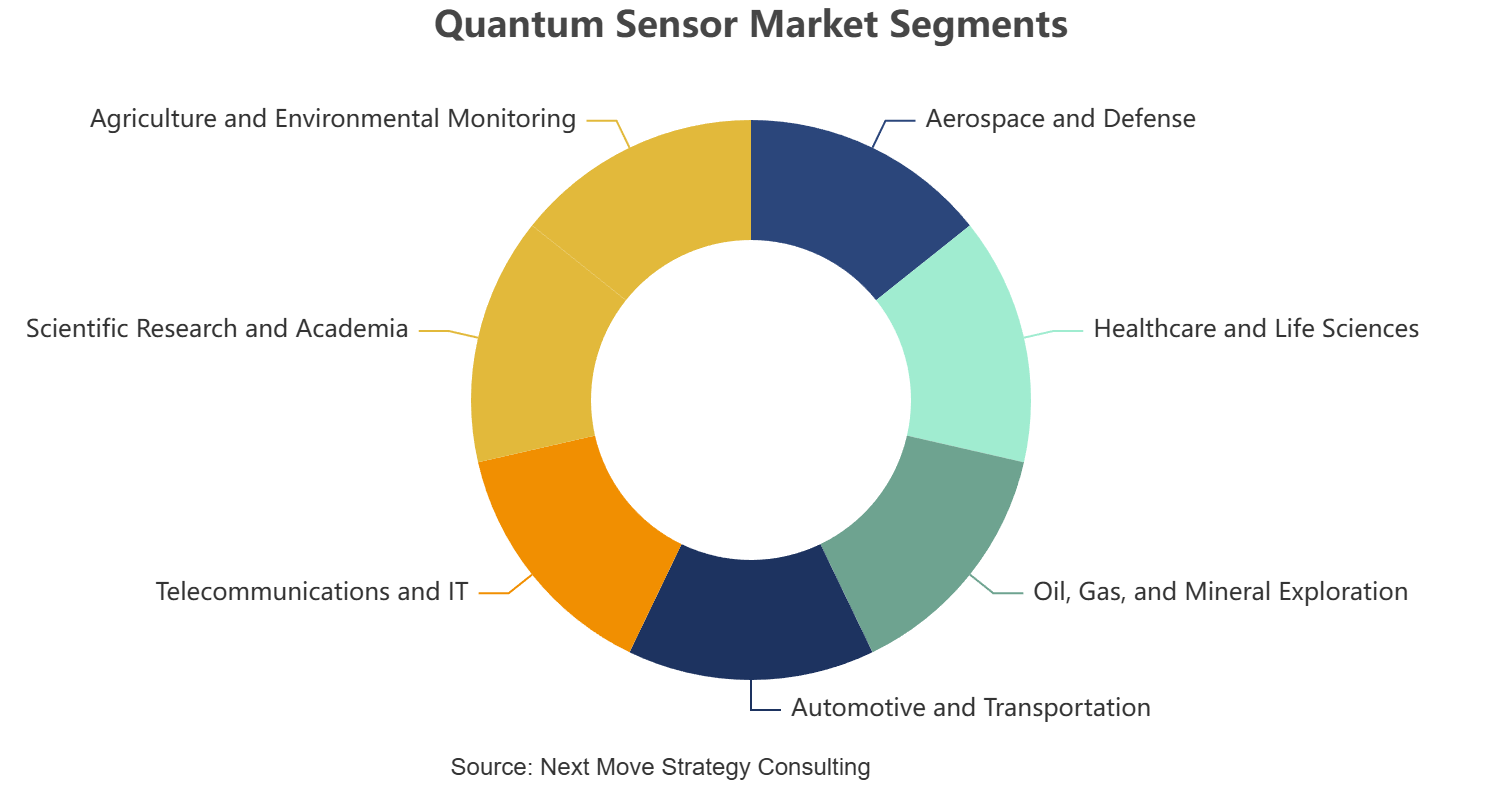
Aerospace and Defense remained the leading end-user vertical, valued at USD 159.8 million in 2025 on sustained government procurement of navigation, timing, and gravimetric sensing systems. Our analysis shows that Telecommunications and IT is among the fastest-growing verticals, registering a 39.5% CAGR from 2026 to 2035, as network operators adopt quantum-enabled timing and single-photon detection to support secure communications and resilient synchronization infrastructure.
Growth Opportunities
Our analysis shows that three forward-looking opportunities stand out for stakeholders positioning within the quantum sensor market over the 2026–2035 forecast period.
How Can GPS-Denied Navigation Unlock Value for Quantum Inertial Sensor Makers?
GPS-denied navigation presents a whitespace opportunity for manufacturers offering quantum gyroscopes and cold-atom inertial sensors resistant to jamming and spoofing. Suppliers that commercialize ruggedized, deployment-ready inertial systems stand to capture recurring defense and commercial aviation contracts as operators seek resilient alternatives to satellite-dependent navigation.
Where Does Space-Based Quantum Sensing Create New Demand?
Space-based quantum gravimetry and magnetometry represent an underpenetrated opportunity for manufacturers engineering radiation-tolerant, low-power quantum sensors. Suppliers that secure qualified-vendor status with national space agencies can access long-term, mission-scale contracts, benefiting from recurring engineering and integration revenue tied to Earth observation and planetary science programs.
How Can Quantum Timing Benefit Telecommunications Network Operators?
Quantum-enabled precision timing systems create an opportunity for suppliers serving telecommunications operators seeking resilient network synchronization independent of GPS. Early movers that validate optical atomic clock integration with existing network timing protocols can differentiate with operators pursuing infrastructure resilience, capturing recurring revenue tied to the segment's above-market growth through 2035.
Porter's Five Forces Analysis of the Quantum Sensor Market
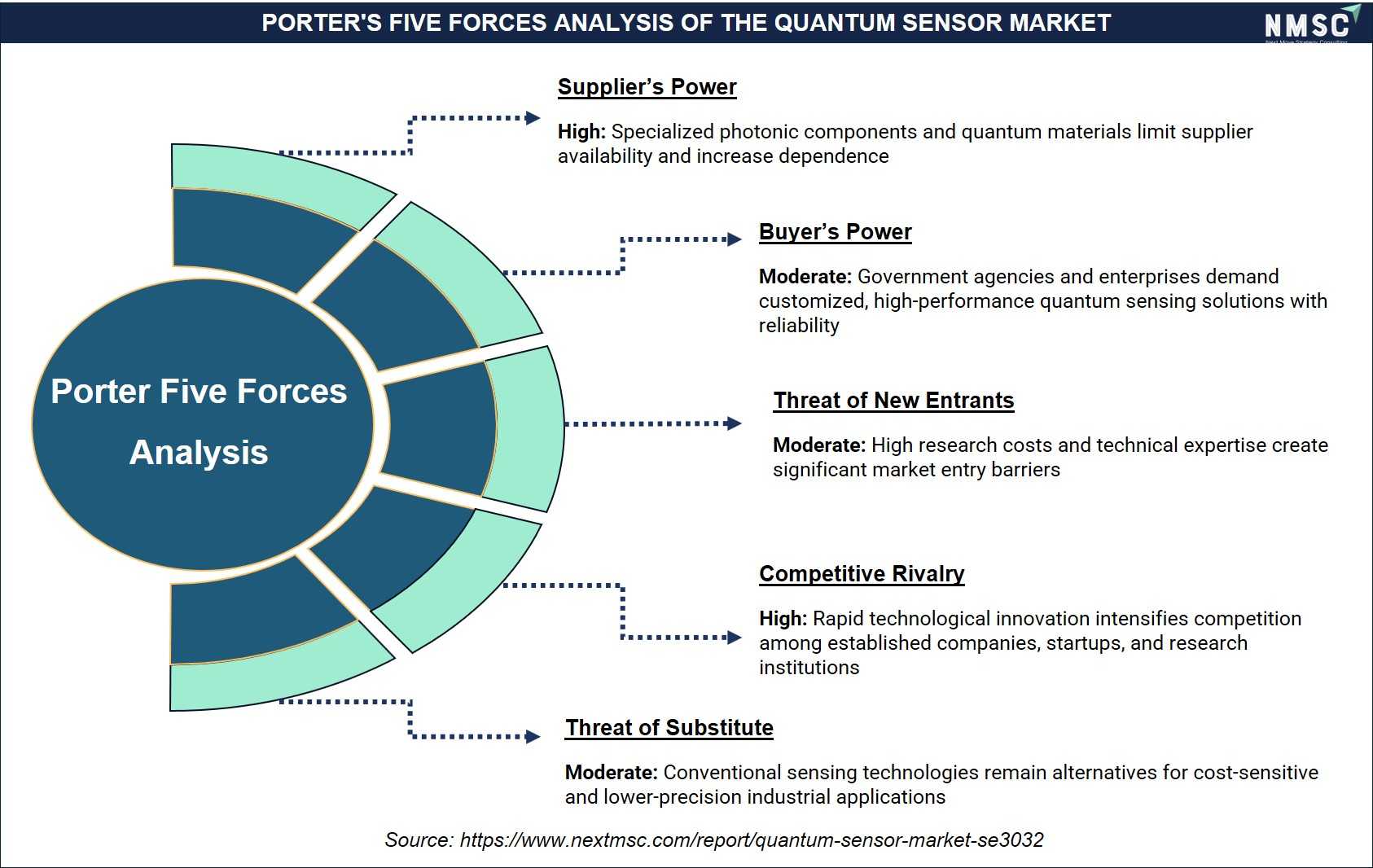
Porter's Five Forces analysis indicates that the quantum sensor market has moderate competitive rivalry driven by technological innovation and strategic collaborations. Supplier bargaining power is moderate to high due to specialized quantum components and materials, while buyer bargaining power remains moderate because of limited commercial alternatives. The threat of new entrants is moderate owing to high R&D costs and technical expertise requirements, whereas the threat of substitutes is low to moderate, as quantum sensors offer superior precision over conventional sensing technologies in critical applications.
Regional Outlook
Geographic Performance Snapshot
|
Region |
2025 (USD) |
2035 (USD) |
CAGR% (2026–2035) |
Key Driver |
|
North America |
USD 197.4 Million |
USD 2887.5 Million |
30.6% |
Defense procurement and NASA-backed space sensing missions |
|
Europe |
USD 131.6 Million |
USD 1980.0 Million |
31.1% |
National quantum flagship programs and defense modernization |
|
Asia-Pacific |
USD 103.4 Million |
USD 2640.0 Million |
39.0% |
Rapid national quantum investment and electronics manufacturing scale-up |
|
Middle East & Africa |
USD 18.8 Million |
USD 412.5 Million |
36.7% |
Vision-linked technology diversification and exploration gravimetry demand |
|
Latin America |
USD 18.8 Million |
USD 330.0 Million |
33.3% |
Growing scientific research investment and resource exploration activity |
|
Total |
USD 470.0 Million |
USD 8250.0 Million |
33.3% |
-- |
North America Quantum Sensor Market Outlook
North America leads the market, anchored by sustained defense procurement and NASA-backed space sensing missions. We observed that the U.S. Department of Commerce's CHIPS Research and Development Office continues to fund domestic quantum manufacturers, sustaining demand for atomic clock and inertial sensing systems. Technology adoption remains advanced, with government agencies increasingly specifying deployment-ready quantum instruments to manage GPS-denied navigation and precision timing requirements across the region.
Europe Quantum Sensor Market Outlook
Europe's market reflects a research-intensive landscape shaped by national quantum flagship programs and defense modernization initiatives across member states. Our findings suggest that utilities and defense agencies across Germany, France, and the UK are accelerating adoption of quantum magnetometers and gravimeters for exploration and infrastructure monitoring. Technology adoption favors solid-state defect and photonic platforms, supported by regional research institutions investing in component-level manufacturing capability.
Asia-Pacific Quantum Sensor Market Outlook
Asia-Pacific is the fastest-growing market region, propelled by large-scale national quantum investment programs and expanding electronics manufacturing capacity. We found that regulatory frameworks remain less harmonized than in North America or Europe, giving regional manufacturers flexibility to scale photonic sensor production rapidly. Technology adoption is accelerating as regional research institutions expand quantum sensing capability, while equipment vendors localize production to serve fast-growing domestic demand.
Middle East & Africa Quantum Sensor Market Outlook
The market in Middle East & Africa is expanding as Gulf Cooperation Council economies invest in technology diversification and oil, gas, and mineral exploration gravimetry. Our analysis shows that Saudi Arabia and the UAE are attracting quantum research investment linked to national diversification visions. Regulatory influence remains moderate, while technology adoption is gradually shifting toward imported atomic clock and gravimeter systems as regional institutions build quantum research capability.
Latin America Quantum Sensor Market Outlook
Latin America's market is supported by growing scientific research investment in Brazil and expanding resource exploration activity across the region. We observed that regulatory frameworks are less stringent than in North America or Europe, though research institutions are introducing quantum magnetometry for mineral exploration applications. Technology adoption remains centered on imported atomic clock and magnetometer systems, with competitive intensity increasing as regional distributors partner with global quantum sensor manufacturers.
U.S. Quantum Sensor Market
Based on our estimates, the U.S. market was valued at approximately USD 154.0 million in 2025 and is projected to reach USD 2194.5 million by 2035, growing at a 30.3% CAGR. Demand is anchored by NASA space sensing missions, Department of Commerce quantum manufacturing funding, and defense navigation programs. Technology penetration favors neutral-atom and optical clock platforms, and competitive intensity remains high among established vendors serving federal procurement channels.
Canada Quantum Sensor Market
The market in Canada reached roughly USD 27.6 million in 2025 and is forecast to hit USD 404.2 million by 2035 at a 30.6% CAGR. Demand structure reflects strong domestic quantum research institutions and growing defense modernization investment. Technology penetration is rising as research institutions specify solid-state defect sensors for scientific applications, with competitive intensity moderate given reliance on cross-border supply from U.S.-based vendors.
UK Quantum Sensor Market
As per our estimate, the UK market stood at about USD 26.3 million in 2025, advancing toward USD 356.4 million by 2035 at a 29.5% CAGR. Demand is driven by the UK's National Quantum Computing Centre and defense navigation modernization programs. Regulatory influence is significant under national quantum mission targets, technology penetration favors neutral-atom systems, and competitive intensity remains steady among domestic and European vendors.
Germany Quantum Sensor Market
According to our analysis, Germany's market was valued near USD 31.6 million in 2025 and is set to reach USD 435.6 million by 2035, expanding at a 29.8% CAGR. Demand structure benefits from a strong domestic industrial and automotive base requiring precision quantum magnetometers and gravimeters. Germany's national quantum technology strategy drives regulatory influence, while technology penetration favors solid-state defect sensors among leading research-linked manufacturers.
France Quantum Sensor Market
Based on our estimates, France's market reached approximately USD 18.4 million in 2025, projected to climb to USD 277.2 million by 2035 at a 31.1% CAGR. Demand is supported by France's defense-linked quantum research programs and photonic sensor manufacturing base. Regulatory influence from national quantum initiative funding is notable, and competitive intensity remains high given the concentration of specialized quantum photonics manufacturers headquartered domestically.
China Quantum Sensor Market
The market in China stood at roughly USD 37.2 million in 2025 and is forecast to reach USD 1003.2 million by 2035, registering a 39.8% CAGR. Demand is fueled by the world's largest national quantum technology investment program and expanding domestic electronics manufacturing capacity. Regulatory influence is increasing gradually alongside state-directed technology priorities, technology penetration is accelerating through domestic vendor capacity upgrades, and competitive intensity remains elevated among numerous China-based manufacturers.
India Quantum Sensor Market
As per our estimate, India's market was valued at about USD 10.3 million in 2025, projected to reach USD 475.2 million by 2035 at a 48.4% CAGR, the fastest among all covered countries. Demand structure reflects India's National Quantum Mission and expanding defense and telecommunications research investment. Regulatory influence remains developing, while technology penetration is rising quickly as international vendors localize platforms to serve India's growing research base.
Japan Quantum Sensor Market
According to our analysis, Japan's market reached close to USD 16.5 million in 2025 and is expected to hit USD 316.8 million by 2035, growing at a 34.6% CAGR. Demand is supported by Japan's precision electronics manufacturing heritage and defense modernization priorities. Regulatory influence is well established, technology penetration is advanced, and competitive intensity remains high among long-standing domestic instrumentation manufacturers.
South Korea Quantum Sensor Market
Based on our estimates, South Korea's market stood at approximately USD 13.4 million in 2025, forecast to reach USD 316.8 million by 2035 at a 37.8% CAGR. Demand structure benefits from the country's national quantum technology roadmap and advanced semiconductor manufacturing base. Technology penetration is high, with domestic vendors supplying photonic sensor components, and competitive intensity remains pronounced amid rapid research commercialization cycles.
Australia Quantum Sensor Market
The market in Australia reached about USD 7.2 million in 2025 and is projected to reach USD 158.4 million by 2035, expanding at a 36.6% CAGR. Demand is supported by strong domestic quantum research institutions and mineral exploration gravimetry applications. Regulatory influence stems from national quantum strategy funding, while technology penetration favors gravimeter and magnetometer systems amid moderate competitive intensity.
UAE Quantum Sensor Market
As per our estimate, the UAE market was valued near USD 4.1 million in 2025, projected to reach USD 115.5 million by 2035 at a 40.4% CAGR. Demand structure is shaped by the UAE's technology diversification initiatives and growing research institution investment. Regulatory influence remains moderate, technology penetration is improving through imported quantum sensing platforms, and competitive intensity is rising as distributors expand portfolios to serve Gulf research markets.
Saudi Arabia Quantum Sensor Market
According to our analysis, Saudi Arabia's market reached roughly USD 4.9 million in 2025 and is expected to hit USD 107.2 million by 2035, growing at a 36.7% CAGR. Demand is driven by Vision 2030-linked research investment and oil and gas exploration gravimetry applications. Regulatory influence is developing under national research funding frameworks, and technology penetration is advancing as domestic institutions scale quantum research capability.
South Africa Quantum Sensor Market
Based on our estimates, South Africa's market stood at about USD 2.3 million in 2025, forecast to reach USD 41.2 million by 2035 at a 33.9% CAGR. Demand structure reflects developing scientific research investment and mineral exploration applications across the region. Regulatory influence remains moderate, technology penetration is gradually improving, and competitive intensity is limited given reliance on imported quantum sensing technology from Europe and North America.
Brazil Quantum Sensor Market
The market in Brazil reached approximately USD 9.0 million in 2025 and is projected to reach USD 151.8 million by 2035, registering a 32.7% CAGR. Demand is underpinned by Brazil's expanding scientific research base and mineral and offshore exploration gravimetry applications. Regulatory influence stems from national research funding agency priorities, technology penetration favors gravimeter systems, and competitive intensity remains moderate among regional distributors.
Argentina Quantum Sensor Market
As per our estimate, Argentina's market was valued near USD 3.0 million in 2025, projected to reach USD 52.8 million by 2035 at a 33.3% CAGR. Demand structure is supported by steady scientific research activity despite macroeconomic volatility. Regulatory influence remains limited, technology penetration is modest, and competitive intensity is centered on a small number of regional distributors serving domestic research institutions.
Competitive Landscape
We observed that the quantum sensor market features a fragmented, innovation-driven competitive landscape, with diversified industrial technology groups competing alongside specialized quantum startups on component performance, manufacturability, and government relationships.
|
Key Takeaways |
Details |
|
Market Structure |
Fragmented; the leading companies profiled in this report include both diversified industrial groups and specialized quantum startups, with no single vendor commanding dominant share across all product categories. |
|
Innovation Focus |
Deployment-ready atomic clocks, single-photon detector manufacturability, and space- and field-qualified quantum sensing platforms dominate current innovation pipelines across leading suppliers. |
|
M&A Activity |
Selective consolidation and capital raises, exemplified by Infleqtion's public listing via merger with Churchill Capital Corp X in February 2026, raising more than USD 550 million for manufacturing scale-up. |
How Do Companies Compete in the Quantum Sensor Market?
Companies compete primarily on measurement precision, ruggedization for field deployment, and manufacturing scalability across the industry. Diversified players such as Honeywell International Inc. and Robert Bosch GmbH leverage broad industrial manufacturing capability to serve defense and automotive customers, while specialized quantum startups compete on component-level performance and rapid iteration for research institutions and early commercial adopters seeking cutting-edge sensitivity.
Which Competitive Archetypes Dominate the Quantum Sensor Market?
Two archetypes dominate the market: diversified industrial technology groups offering integrated sensing hardware backed by established manufacturing and government relationships, and specialized quantum startups focused on specific sensor modalities. Infleqtion Inc. and Honeywell International Inc. exemplify the diversified archetype through broad quantum computing and sensing portfolios, while Single Quantum B.V. and Qnami AG exemplify the specialized archetype, concentrating on single-photon detection and diamond-based magnetometry respectively.
How Are Companies Differentiating Through Innovation in Quantum Sensing?
Innovation and differentiation strategy increasingly center on transitioning laboratory-grade sensitivity into manufacturable, deployment-ready products. Infleqtion's April 2026 launch of its Tiqker optical atomic clock integrated with Safran's timing systems illustrates how suppliers are engineering commercial-grade reliability into fundamentally quantum instruments. Our analysis shows that suppliers unable to demonstrate credible manufacturability and field reliability risk exclusion from defense and space agency procurement shortlists.
What M&A and Investment Activity Is Shaping the Quantum Sensor Market?
Mergers, public listings, and government-backed investment continue to reshape capability within the industry. Infleqtion's February 2026 public listing via merger with Churchill Capital Corp X, raising more than USD 550 million, illustrates how capital markets are increasingly funding quantum sensor manufacturing scale-up, while the company's May 2026 Letter of Intent with the U.S. Department of Commerce for up to USD 100 million reflects growing government co-investment in domestic quantum manufacturing capacity.
Key Market Players
Our assessment indicates that the following 15 companies are actively shaping product innovation, funding activity, and geographic expansion within the global quantum sensor market.
-
Infleqtion Inc. (formerly ColdQuanta)
-
Exail (includes iXblue / Muquans product family)
-
AOSense Inc.
-
M Squared Lasers Ltd. (M²)
-
Nomad Atomics Pty Ltd
-
Single Quantum B.V.
-
Photon Spot Inc.
-
Munich Quantum Instruments GmbH (MQI)
-
Pixel Photonics GmbH
-
Quantum Opus LLC
-
Qnami AG
-
Quantum Diamond Technologies Inc. (QDTI)
-
Robert Bosch GmbH (Bosch Quantum Sensing)
Latest Developments
We found that recent developments within the quantum sensor market are concentrated on the transition from research-stage demonstrations to funded, deployment-ready systems, reflecting the industry's broader commercialization momentum.
|
Date |
Event |
|
May, 2026 |
Infleqtion launched Quantum Spectrum, an atom-based RF sensing platform for defense and critical infrastructure, creating a new category of quantum sensing architecture backed by U.S., U.K., and Australian defense programs. |
|
April 2025 |
Bosch and Element Six formed the joint venture “Bosch Quantum Sensing” to accelerate the commercialization of diamond-based quantum sensors. The partnership combines Bosch's sensor expertise with Element Six's synthetic diamond technology for applications in healthcare, navigation, mobility, and natural resource exploration. Bosch expects the addressable market for medical and mobility applications to reach the mid-single-digit billions of euros annually by the mid-2030s. |
Expert Insights
 “Quantum sensors are reaching maturity levels that will allow us to run pilots in a wide range of environments and for a wide range of applications.”
— Mathieu Munsch, CEO, Qnami
This statement was featured in McKinsey & Company's 2024 report, Quantum Sensing's Untapped Potential: Insights for Leaders, discussing the commercialization of quantum sensing technologies and their transition from research to real-world industrial deployment.
Market Interpretation
The statement underscores the growing maturity of quantum sensing technologies as they progress from laboratory demonstrations to pilot-scale commercial implementations. Increasing technological readiness is enabling validation across industries including healthcare, semiconductor manufacturing, aerospace, navigation, and advanced scientific instrumentation. As successful pilot projects demonstrate measurable performance advantages over conventional sensing technologies, organizations are expected to accelerate commercial adoption and investment, supporting long-term growth of the global quantum sensor market.
Investment Opportunities
What Capital Inflows Are Targeting the Quantum Sensor Market?
Capital inflows into the market are increasingly directed toward manufacturers demonstrating a credible path from research to deployment. We observed that Infleqtion's public listing in February 2026 raised more than USD 550 million specifically earmarked for manufacturing and shipping rather than additional research. Investors favor vendors with validated government contracts as a proxy for long-term revenue visibility and manufacturing scale-up potential.
How Is Infrastructure Investment Supporting Quantum Sensor Manufacturing?
Infrastructure investment is expanding component-level manufacturing capacity to serve rising defense, space agency, and telecommunications demand. Our findings suggest that Infleqtion's Letter of Intent with the U.S. Department of Commerce for up to USD 100 million supports the precision manufacturing required for neutral-atom quantum systems, reflecting broader government co-investment in domestic quantum sensor production capacity.
What ESG Considerations Are Shaping Quantum Sensor Investment Decisions?
Environmental, social, and governance considerations are increasingly relevant to investment decisions across the industry, particularly regarding energy-efficient cryogenic and photonic manufacturing processes. National funding agencies continue to inform research disclosures tied to publicly funded quantum programs. We found that investors increasingly favor manufacturers with transparent government contract disclosures, treating them as governance indicators alongside export control and dual-use technology compliance.
Key Benefits for Stakeholders
How Does This Report Benefit Enterprise and Industry Leaders?
Enterprise and industry leaders gain access to validated segmentation, competitive benchmarking, and regional demand forecasts that support sourcing and product-portfolio decisions across the quantum sensor industry. Our analysis shows that detailed product type, technology platform, and end-user breakdowns help procurement teams align specifications with defense and research funding requirements while identifying underserved verticals for portfolio expansion.
How Does This Report Benefit Investors and Financial Analysts?
Investors and financial analysts benefit from consistent, single-point market size and CAGR estimates that support valuation and capital-allocation decisions across the quantum sensor supply chain. We observed that the report's regional and segment-level growth differentials help identify which manufacturers are best positioned to capture above-market growth in photonic platforms and telecommunications-linked applications through 2035.
How Does This Report Benefit Technology Vendors and Product Teams?
Technology vendors and product teams gain insight into emerging design requirements, including field ruggedization, manufacturability, and government qualification standards, that are reshaping the industry. Our findings suggest that this analysis helps R&D teams prioritize development roadmaps around deployment-ready architecture and funding pathways increasingly required by defense and space agency procurement processes.
Key Market Segments
By Product Type
-
Atomic Clocks
-
Magnetic Sensors (Magnetometers)
-
SQUID-based
-
Optically Pumped Magnetometers (OPM)
-
Nitrogen-Vacancy (NV) Center Magnetometers
-
-
Gravimeters and Gradiometers
-
Gyroscopes
-
Imaging and Photon Detectors
-
Single-Photon Avalanche Diodes (SPAD)
-
Superconducting Nanowire Single-Photon Detectors (SNSPD)
-
-
Other Quantum Sensors
By Technology Platform
-
Atomic Systems
-
Solid-State Defects
-
Superconducting Circuits
-
Photonic Platforms
By End-User Industry Vertical
-
Aerospace and Defense
-
Healthcare and Life Sciences
-
Oil, Gas, and Mineral Exploration
-
Automotive and Transportation
-
Telecommunications and IT
-
Scientific Research and Academia
-
Agriculture and Environmental Monitoring
By Region
-
North America: U.S., Canada, Mexico
-
Europe: UK, Germany, France, Italy, Spain, Sweden, Denmark, Finland, Netherlands, Rest of Europe
-
Asia-Pacific: China, India, Japan, South Korea, Taiwan, Indonesia, Vietnam,
-
Middle East & Africa: Saudi Arabia, UAE, Egypt, Israel, Turkey, Nigeria, South Africa, Rest of MEA
-
Latin America: Brazil, Argentina, Chile, Colombia, Rest of LATAM
Conclusion and Recommendations
What Is the Long-Term Outlook for the Quantum Sensor Market?
The long-term outlook for the market remains exceptionally strong, with global revenue projected to expand from USD 470 million in 2025 to USD 8.25 billion by 2035 at a 33.3% CAGR. We observed that sustained government procurement, national quantum strategy funding, and the transition from research demonstrations to deployed systems will continue underpinning demand across defense, telecommunications, and scientific research applications through the forecast period.
What Strategic Positioning Should Quantum Sensor Suppliers Pursue?
Suppliers should prioritize deployment-ready, ruggedized product platforms while pursuing government funding partnerships to secure long-term contracts. Our assessment indicates that manufacturers investing early in manufacturable photonic and solid-state defect sensor capability, alongside proven field reliability, will be best positioned to capture premium pricing within the quantum sensor market.
How Attractive Is the Quantum Sensor Market for New Investment?
The quantum sensor industry presents an exceptionally attractive investment case, supported by a USD 7.63 billion absolute dollar opportunity between 2026 and 2035 and above-average growth in Asia-Pacific and telecommunications-linked applications. We found that investment attractiveness is highest for manufacturers combining validated government contracts with public capital market access, positioning them to scale manufacturing ahead of research-stage competitors.
What Market Shifts and Key Risks Should Stakeholders Monitor?
Stakeholders should monitor component manufacturability constraints, high unit costs, and dependency on government funding cycles as key risks to the quantum sensor market. Our analysis shows that suppliers unable to demonstrate credible manufacturability and field reliability risk losing shortlist status to competitors with proven deployment track records, particularly as defense and space agency procurement programs mature.
What Are the Key Growth Pathways for the Quantum Sensor Market?
Key growth pathways include expanding photonic and telecommunications-linked sensor portfolios, scaling manufacturable atomic and solid-state defect platforms, and deepening penetration into commercial healthcare and automotive verticals. Next Move Strategy Consulting's analysis indicates that suppliers pursuing these pathways while maintaining defense-grade reliability will be best positioned to capture the quantum sensor market's projected growth through 2035.
About the Author
 Liza Phukan
— Liza Phukan is Research Associate at Next Move Strategy Consulting, where she has covered emerging industries and market research across sectors for 3.5 years. Her work includes analyzing industry developments, validating market data, and developing structured business content from research findings. She uses secondary research and data-validation practices to turn complex market information into clear decision-useful market analysis for business audiences and support report development and B2B.
Liza Phukan
— Liza Phukan is Research Associate at Next Move Strategy Consulting, where she has covered emerging industries and market research across sectors for 3.5 years. Her work includes analyzing industry developments, validating market data, and developing structured business content from research findings. She uses secondary research and data-validation practices to turn complex market information into clear decision-useful market analysis for business audiences and support report development and B2B.
About the Reviewer
 Supradip Baul
— Supradip Baul is an accomplished business consultant and strategist with over a decade of rich experience in market intelligence, strategy, technology, and business transformation. His work has included rigorous qualitative and quantitative analysis across multiple industries, helping clients shape investment decisions and long-term roadmaps. Earlier in his career, he was associated with Gartner, where he contributed to industry-leading reports and market share analyses. He has worked with leading global companies and holds an MBA with a dual specialization in Marketing and Finance.
Supradip Baul
— Supradip Baul is an accomplished business consultant and strategist with over a decade of rich experience in market intelligence, strategy, technology, and business transformation. His work has included rigorous qualitative and quantitative analysis across multiple industries, helping clients shape investment decisions and long-term roadmaps. Earlier in his career, he was associated with Gartner, where he contributed to industry-leading reports and market share analyses. He has worked with leading global companies and holds an MBA with a dual specialization in Marketing and Finance.
At Next Move Strategy Consulting, we understand that insightful market research is the cornerstone of successful business decisions. That's why we employ a robust and multifaceted approach, combining various methodologies to deliver the most accurate and actionable data for our clients.

Research Landscape
We navigate the world of research with two primary approaches:
Qualitative Approach
Our qualitative research methodologies involve immersive techniques such as in-depth interviews, focus groups, and observational studies. By engaging directly with individuals and stakeholders, we uncover valuable insights that quantitative data alone may overlook.

Quantitative Research
In tandem with qualitative methodologies, NMSC leverages the power of Quantitative Research to provide a robust foundation of numerical insights. Through systematic data collection and analysis, we quantify patterns, preferences, and market trends, offering a comprehensive view of the business landscape.
Our quantitative research approach employs diverse tools, including surveys, experiments, and statistical modelling. These methodologies enable us to gather data from a large and representative sample, ensuring the statistical significance of our findings. By employing structured questionnaires and standardized data collection methods, we guarantee the reliability and validity of the information we present to our clients.
Quantitative research is particularly effective in measuring the prevalence of trends, assessing market size, and gauging the impact of various factors on consumer behavior. The numerical precision attained through this approach equips our clients with actionable insights, facilitating data-driven decision-making and strategy formulation.


Our Specialized Toolbox for Industry-Specific Market Research
We deploy a specialized arsenal of techniques tailored to meet your unique requirements. Here's a glimpse into our comprehensive toolbox:

Information Procurement
The stage entails acquiring market data or relevant information through various sources and methodologies.


Market Research Approach
We utilize both top-down and bottom-up approaches in market research analysis to achieve a comprehensive understanding of the market dynamics, leveraging the broad perspective of industry trends and macroeconomic factors alongside detailed insights from specific segments and individual companies.

Porters Five Forces Analysis
We conduct Porter's Five Forces analysis to evaluate the competitive landscape of an industry, providing us with insights into factors that affect profitability and strategic positioning.

SWOT Analysis

Forecasting
We utilize a forecasting model to predict future consumption by considering parameters like population, economics, regulations, market competition, drivers, constraints, technology, and pricing. We also employ statistical techniques such as multilinear regression, exponential smoothing, moving average, ARIMA, and Monte Carlo simulations for accurate predictions. In econometric forecasting, we analyzed short-term and long-term event impacts, attributing values based on regulatory frameworks, economic factors, and market events.





 Speak to Our Analyst