Remote Patient Monitoring Market Global Industry Analysis and Forecast (2026-2035)

Remote Patient Monitoring Market size was USD 81.07 Billion in 2025, projected to reach USD 451.93 Billion by 2035, growing at a CAGR of 16.1% from 2026 to 2035. Key drivers include rising prevalence of chronic diseases, expanding reimbursement policies for RPM services, and the integration of AI-driven analytics and connected wearable platforms into clinical workflows, with North America leading the market.

Download Free Sample PDF
Base Year (2025)
$81.07 Billion
Forecast (2035)
$451.93 Billion
CAGR (2026-2035)
16.1%
Top Region
North America

What Is the Remote Patient Monitoring Market Size?

The global Remote Patient Monitoring Market size reached USD 81.07 Billion in 2025 and is estimated at USD 118.16 Billion in 2026, forecast to reach USD 451.93 Billion by 2035 at a CAGR of 16.1% between 2026 and 2035. North America leads with approximately a 35% share, while RPM Devices dominate the offering segment at approximately a 55% share in 2025.

We observed that chronic disease burden continues to scale demand across all offering and application segments, reinforcing the structural growth case as RPM platforms transition from supplementary monitoring tools to core components of integrated digital care pathways.

Remote Patient Monitoring Market Global Industry Analysis and Forecast (2026-2035) Revenue Forecast

Values in USD Billion

2025 $81.07 Billion
2025
2026 $118.16 Billion
2026
2027 $137.18 Billion
2027
2028 $159.27 Billion
2028
2029 $184.91 Billion
2029
2030 $214.68 Billion
2030
2031 $249.25 Billion
2031
2032 $289.38 Billion
2032
2033 $335.97 Billion
2033
2034 $390.06 Billion
2034
2035 $451.93 Billion
2035

Key Takeaways

By Offering: RPM Devices held the largest share, expanding from USD 44.59 billion in 2025 to USD 217.33 billion by 2035; RPM Software and Platforms is the fastest-growing sub-segment at 19.8% CAGR from 2026–2035.

By End User: Hospitals and Health Systems held the largest share, expanding from USD 36.48 billion in 2025 to USD 185.29 billion by 2035; Home Care Settings is the fastest-growing sub-segment at 17.8% CAGR from 2026–2035.

By Application: Cardiovascular Disease Management held the largest share, expanding from USD 24.32 billion in 2025 to USD 130.06 billion by 2035; Cancer Management is the fastest-growing sub-segment at 20.4% CAGR from 2026–2035.

Dominant Region: North America dominated with approximately 35% revenue share in 2025.

Fastest-Growing Region: Latin America is expected to register the highest CAGR of 19.3% during 2026–2035.

Dominant Country: The U.S. led the market, anchored by concentrated RPM adoption and high technology penetration.

Fastest-Growing Country: India is the fastest-growing country, supported by rising smartphone penetration and expanding telehealth infrastructure.

The market presents an absolute investment opportunity of approximately USD 333.77 Billion between 2026 and 2035, calculated as the difference between the 2035 forecast of USD 451.93 Billion and the 2026 base of USD 118.16 Billion, positioning RPM software platforms and connected wearable devices as a high-conviction category for digital health investors and healthcare system infrastructure funds.

According to NMSC analysis, the segment's growth momentum stems from the convergence of rising chronic disease burden with AI-enabled remote diagnostic capabilities that extend clinical monitoring beyond hospital settings into home and ambulatory care environments, expanding total addressable spend per patient well beyond traditional in-facility monitoring costs.

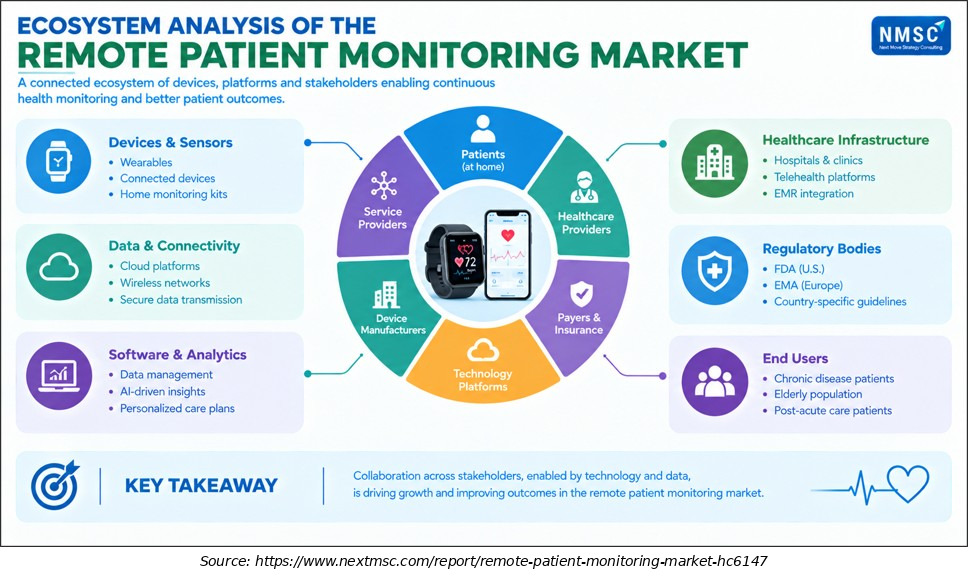
Ecosystem Analysis of the Remote Patient Monitoring Industry

The above infographic provides a detailed ecosystem analysis of the remote patient monitoring market, mapping out the interconnected network of devices, platforms, and stakeholders enabling continuous healthcare. It illustrates how wearable sensors, data connectivity, and software analytics interact with healthcare providers, payers, and regulatory bodies to support patients at home. The analysis further highlights the critical role of technology platforms and AI-driven insights in delivering personalized care. Ultimately, it concludes that collaboration across these stakeholders, driven by data and technology, is essential for improving patient outcomes and fueling market growth.

What Does the Remote Patient Monitoring Market Encompass?

The Remote Patient Monitoring Market covers connected monitoring devices, digital platforms, and managed clinical services that enable healthcare providers to collect, transmit, and analyze patient health data from outside traditional clinical settings. Covered modalities include cardiac monitoring devices, continuous glucose systems, blood pressure monitors, pulse oximeters, respiratory monitors, multiparameter wearable sensors, and weight tracking devices, alongside AI-assisted treatment planning software, patient engagement platforms, and remote alert management services. We observed that the market has evolved from a discrete telemetry niche into a digitally integrated continuum of care, where continuous data capture, AI-assisted triage, and remote clinical workflows determine patient outcomes across hospitals, ambulatory centers, and home care environments.

The regulatory environment is shaped by medical device clearance standards under the U.S. Food and Drug Administration, the EU Medical Device Regulation, and equivalent national authorities, alongside evolving Centers for Medicare and Medicaid Services billing guidance for RPM services that has expanded reimbursable care management codes since 2019. Technology adoption trends favor direct integration of RPM platforms with electronic health record systems, enabling automated alert workflows and reducing manual data reconciliation. Our findings suggest that hospital group purchasing consolidation is accelerating platform-level competitive differentiation, as health systems increasingly favor integrated RPM vendors over single-device suppliers.

Market Drivers & Dynamics

Interactive Dataset
Rising prevalence of chronic diseases driver +3.8% Global 2026–2035
Growth in reimbursement for RPM services driver +2.7% North America, Europe 2026–2033
Aging population driving home care demand driver +2.1% North America, Europe, Asia-Pacific 2026–2035
Integration of AI and predictive analytics driver +1.8% North America, Asia-Pacific 2026–2031
Expansion of 5G connectivity driver +1.4% Asia-Pacific, North America 2026–2032
Data privacy and cybersecurity concerns restraint −1.6% Global 2026–2035
High device cost and limited insurance coverage restraint −1.2% Asia-Pacific, MEA, Latin America 2026–2035
Technology literacy gaps among elderly patients restraint −0.8% Global 2026–2030
Regulatory complexity and device approval timelines restraint −0.6% Global 2026–2032
Source: Next Move Strategy Consulting

Growth Drivers

What Is the Primary Growth Driver in the Remote Patient Monitoring Market?

The primary growth driver is the rising global prevalence of chronic diseases, which compels healthcare systems to extend clinical monitoring beyond episodic facility encounters. The Centers for Disease Control and Prevention estimates that approximately 60% of U.S. adults live with at least one chronic disease, driving sustained institutional demand for continuous remote monitoring infrastructure across cardiovascular, metabolic, and respiratory disease management categories. Integrated RPM programs incorporating implantable cardiac monitors and continuous biometric wearables reduce preventable hospital readmissions by enabling early clinical intervention, generating measurable cost savings that support both provider adoption and payer reimbursement expansion.

How Is Expanding Reimbursement for RPM Services Driving the Remote Patient Monitoring Market Growth?

Reimbursement expansion is directly accelerating the monetization of RPM investments across health systems, converting previously non-billable monitoring activity into recognized care management revenue. The Centers for Medicare and Medicaid Services has progressively expanded billing codes for remote physiologic monitoring since 2019, adding covered services for device setup, patient education, and monthly clinical time thresholds that incentivize provider participation. Our analysis shows that payer coverage expansion in Europe and Asia-Pacific markets is following the U.S. model with a regulatory lag of two to four years, positioning reimbursement as a sustained structural driver through 2035 rather than a one-time adoption catalyst.

Growth Inhibitors

What Is Restraining the Remote Patient Monitoring Market?

We found that the primary restraint is data privacy and cybersecurity risk, which creates institutional hesitancy around deploying connected monitoring infrastructure at scale. RPM systems aggregate sensitive biometric data across cloud platforms and third-party communication networks, creating attack surfaces governed by the Health Insurance Portability and Accountability Act in the U.S. and the General Data Protection Regulation in Europe. Healthcare cybersecurity incidents involving patient data breaches have escalated since 2020, creating reputational and regulatory exposure that slows procurement cycles and increases vendor due diligence requirements. Additionally, high out-of-pocket device costs continue to limit adoption in emerging markets where implantable defibrillators and advanced cardiac monitoring devices remain inaccessible to price-sensitive patient cohorts without payer coverage.

Segmentation Analysis

2025 (USD Billion)
2035 (USD Billion)
RPM Devices 2025: $44.59 Billion | 2035: $217.33 Billion
RPM Devices
RPM Software and Platforms 2025: $19.46 Billion | 2035: $143.75 Billion
RPM Software
RPM Services 2025: $17.02 Billion | 2035: $90.85 Billion
RPM Services
RPM Devices $44.59 Billion $217.33 Billion 14.4%
RPM Software and Platforms $19.46 Billion $143.75 Billion 19.8%
RPM Services $17.02 Billion $90.85 Billion 15.5%

Which Offering Segment Dominates the Remote Patient Monitoring Market?

RPM Devices lead with USD 44.59 Billion in 2025, expanding to USD 217.33 Billion by 2035, reflecting the centrality of cardiac monitoring devices, continuous glucose systems, and ECG monitoring instruments to overall case value and clinician workflow. RPM Software and Platforms is the fastest-growing offering at 19.8% CAGR, as AI-assisted analytics, patient engagement applications, and EHR integration middleware increasingly become standard components of RPM programs rather than optional supplements. Our findings suggest that integrated software ecosystems generate higher switching costs than standalone devices, driving platform-centric competitive strategies across leading manufacturers through the 2035 forecast period.

2025 (USD Billion)
2035 (USD Billion)
Hospitals an
Academic Med
Community Ho
Integrated H
Home Care Se
Segment Item 2025 (USD Billion) 2035 (USD Billion) CAGR
Hospitals and Health Systems $10.0 USD Billion $40.0 USD Billion 26.0%
Academic Medical Centers $17.1 USD Billion $51.1 USD Billion 16.0%
Community Hospitals $24.2 USD Billion $62.2 USD Billion 18.0%
Integrated Health Networks $31.3 USD Billion $73.3 USD Billion 8.0%
Home Care Settings $38.4 USD Billion $84.4 USD Billion 23.0%

Segment-wise data is locked

Unlock complete segment-wise numbers for By End User.

Unlock Full Data

Which Customer Type Leads and Which Grows Fastest in the Remote Patient Monitoring Market?

Hospitals and Health Systems dominate at USD 36.48 Billion in 2025, reflecting their role as primary decision-makers for complex, multi-condition patient monitoring at scale. Home Care Settings represents the fastest-growing end-user segment at 17.8% CAGR, driven by hospital-at-home program expansion, aging population preference for in-home care, and improving patient digital literacy supporting self-managed monitoring. During our market evaluation, we noticed that hospital group purchasing organization consolidation is reshaping procurement dynamics within the hospital segment, while direct-to-patient platform models simultaneously expand the addressable population in the Home Care Settings segment through consumer-grade monitoring applications.

2025 (USD Billion)
2035 (USD Billion)
Cardiovascul
Arrhythmia M
Heart Failur
Hypertension
Other Cardio
Segment Item 2025 (USD Billion) 2035 (USD Billion) CAGR
Cardiovascular Disease Management $10.0 USD Billion $40.0 USD Billion 18.0%
Arrhythmia Management $17.1 USD Billion $51.1 USD Billion 16.0%
Heart Failure Management $24.2 USD Billion $62.2 USD Billion 22.0%
Hypertension Management $31.3 USD Billion $73.3 USD Billion 12.0%
Other Cardiovascular Applications $38.4 USD Billion $84.4 USD Billion 19.0%

Segment-wise data is locked

Unlock complete segment-wise numbers for By Application.

Unlock Full Data

Which Application Segment Dominates and Which Is Fastest-Growing?

Cardiovascular Disease Management leads application demand at USD 24.32 Billion in 2025, growing to USD 130.06 Billion by 2035, reflecting the established clinical evidence base for RPM in cardiac arrhythmia, heart failure, and hypertension management programs. Cancer Management is the fastest-growing application at 20.4% CAGR, as oncology programs increasingly adopt RPM to monitor chemotherapy side effects and detect early deterioration between treatment cycles. Our assessment indicates that expanding clinical evidence for RPM in oncology, alongside reimbursement code extensions into cancer care management, is widening the addressable population available to RPM device manufacturers, and growing use of neuromodulation and neurological monitoring is simultaneously elevating Neurological Disorders Management as the second-fastest-growing application sub-segment at 17.1% CAGR.

2025 (USD Billion)
2035 (USD Billion)
North Americ
Canada
Mexico
Europe: UK
Germany
Segment Item 2025 (USD Billion) 2035 (USD Billion) CAGR
North America: U.S. $10.0 USD Billion $40.0 USD Billion 26.0%
Canada $17.1 USD Billion $51.1 USD Billion 16.0%
Mexico $24.2 USD Billion $62.2 USD Billion 22.0%
Europe: UK $31.3 USD Billion $73.3 USD Billion 12.0%
Germany $38.4 USD Billion $84.4 USD Billion 27.0%

Segment-wise data is locked

Unlock complete segment-wise numbers for By Region.

Unlock Full Data

Growth Opportunities

Our analysis shows that three structural whitespace opportunities stand out for device manufacturers, platform providers, and service organizations positioning ahead of 2035 demand across the Remote Patient Monitoring Market.

Can AI-Enhanced Predictive RPM Platforms Capture Early Intervention Value at Scale?

Manufacturers embedding machine learning algorithms and clinical decision support modules directly into RPM platform architectures can capture growing provider demand for predictive, rather than reactive, patient monitoring capabilities. Predictive RPM platforms generating risk-stratification scores from continuous biometric streams expand total revenue per patient case beyond passive monitoring contracts, benefiting the RPM Software and Platforms segment. Monitoring of cancer andtumorprofiling applications alongside traditional chronic disease management is further widening the addressable clinical use case for AI-enhanced RPM analytics platforms through 2035.

Does Expanded Hospital-at-Home Reimbursement Create a Scalable Institutional Adoption Pathway?

Healthcare organizations operating under Centers for Medicare and Medicaid Services hospital-at-home authorization require integrated multi-parameter monitoring infrastructure that generates both clinical alerts and regulatory-compliant care documentation simultaneously. Vendors bundling monitoring devices with alert management software and clinical data management services capture this dual requirement, benefiting RPM Devices and RPM Services segments while reinforcing the value of integrated commercial models over component-only supplier relationships within the rapidly growing Home Care Settings end-user segment.

Can Mobile-First RPM Solutions Address Chronic Disease Burden in High-Growth Emerging Markets?

Companies deploying mobile-first, low-infrastructure RPM solutions optimized for smartphone connectivity can capture rising chronic disease monitoring demand in Asia-Pacific and Latin American markets where broadband penetration is growing faster than traditional clinical infrastructure investment. Cellular-enabled RPM devices and app-based patient engagement platforms lower deployment costs relative to legacy monitoring systems, benefiting the RPM Software and Platforms offering segment. Expanded monitoring of patients managing renal conditions requiring dialysis and metabolic conditions in emerging markets represents a high-growth addressable population that mobile-first RPM models can serve cost-effectively through 2035.

Regional Outlook

2025 (USD Billion)
2035 (USD Billion)
North Americ
Asia-Pacific
Europe
Latin Americ
Middle East
Region 2025 (USD Billion) 2035 (USD Billion) CAGR (%)
North America $10.0 USD Billion $40.0 USD Billion 9.0%
Asia-Pacific $17.1 USD Billion $51.1 USD Billion 27.0%
Europe $24.2 USD Billion $62.2 USD Billion 25.0%
Latin America $31.3 USD Billion $73.3 USD Billion 23.0%
Middle East & Africa $38.4 USD Billion $84.4 USD Billion 12.0%

Regional data is locked

Unlock complete regional numbers for this market.

Unlock Full Data

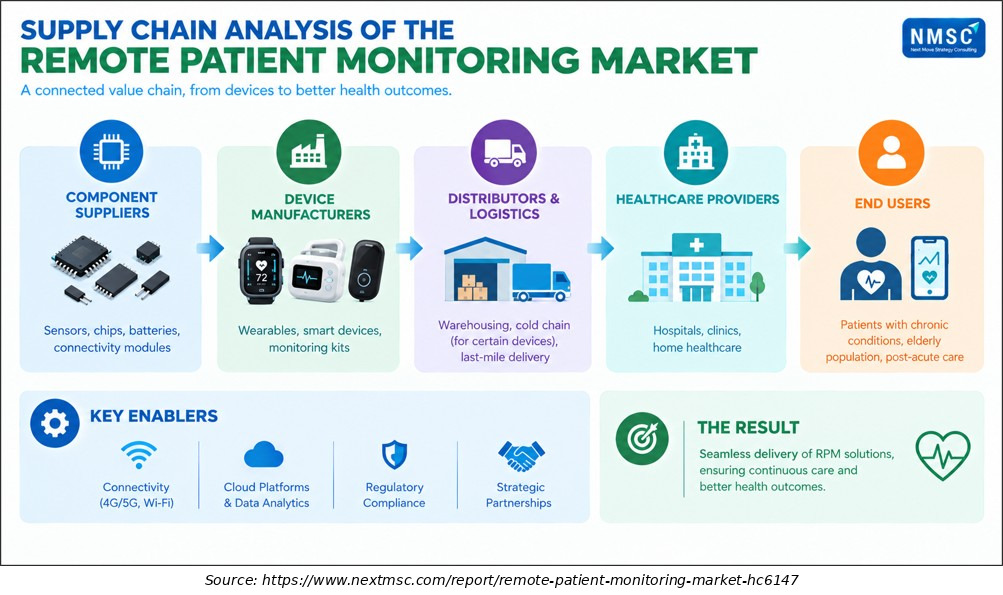
Supply Chain Analysis of the Remote Patient Monitoring Industry

Supply Chain Analysis of the Remote Patient Monitoring Industry
The above infographic provides a detailed supply chain analysis of the remote patient monitoring market, outlining a five-step flow from component suppliers to end users. It traces the process from sourcing sensors and chips through device manufacturing and logistics to final deployment by healthcare providers for patients with chronic conditions. The analysis further highlights key enablers, such as connectivity, cloud platforms, and regulatory compliance, that support the ecosystem. Ultimately, it concludes that this connected value chain ensures the seamless delivery of monitoring solutions, leading to continuous care and better health outcomes.

Competitive Landscape

Our assessment indicates that the competitive landscape spans diversified digital RPM platform leaders, specialized device manufacturers, and managed monitoring service providers, each competing on clinical indication breadth, digital platform integration depth, and hospital system account relationships. Key Takeaways

Dimension Description
Dimension Assessment
Market Structure Moderately consolidated; top 10 companies command significant share, led by integrated digital platform leaders alongside specialized cardiac monitoring and CGM device manufacturers
Innovation Focus AI-assisted predictive analytics, expanded CGM clinical indications, hospital-at-home platform integration, 5G-enabled real-time monitoring, and EHR interoperability
M&A Activity Strategic investments targeting AI analytics capability and home monitoring platform scale, alongside organic clinical indication expansion and direct-to-consumer channel development

How Do Companies Compete in the Remote Patient Monitoring Market?

Companies compete primarily on depth of platform integration across device, software, and service layers; breadth of clinical indication coverage across cardiac, metabolic, and respiratory disease categories; and strength of hospital system and health network account relationships. Our findings suggest that vendors with integrated hardware-software ecosystems hold a structural competitive advantage over single-product manufacturers, as health systems evaluate RPM vendors on end-to-end workflow capability and regulatory compliance infrastructure rather than individual device performance specifications alone.

Which Competitive Archetypes Dominate the Remote Patient Monitoring Market?

Diversified digital platform leaders such as Koninklijke Philips N.V. and GE HealthCare Technologies Inc. dominate through integrated monitoring device and software ecosystems spanning multiple clinical indications, while specialized device manufacturers including Dexcom, Inc. and iRhythm Technologies, Inc. differentiate through focused clinical evidence and regulatory clearance leadership in CGM and cardiac patch monitoring respectively. Managed monitoring service providers compete on clinical alert management infrastructure and care coordination capabilities that health systems without internal monitoring operations find difficult to replicate organically at scale.

What Innovation and Differentiation Strategies Are Companies Pursuing in the Remote Patient Monitoring Market?

Leading companies are investing in AI-assisted predictive analytics modules and expanded clinical indication development to capture patient populations beyond traditional chronic disease categories. Differentiation increasingly centers on integrated platform breadth, as health systems evaluate RPM vendors on the ability to serve multiple disease categories from a single data infrastructure. We observed that companies without established digital analytics capabilities are pursuing AI platform partnerships or acquisitions to close competitive gaps before hospital procurement consolidation further entrenches incumbent vendor relationships. The use of video analytics for contactless vital sign monitoring is also emerging as a differentiation axis for platform vendors targeting hospital-at-home programs that require continuous visual and biometric monitoring in parallel.

What M&A and Partnership Activity Is Shaping the Remote Patient Monitoring Market?

During our market evaluation, we noticed that recent M&A activity reflects strategic acquisition of AI analytics capabilities and home monitoring platform infrastructure rather than large-scale horizontal consolidation among device manufacturers. Teladoc Health's acquisition of Livongo established the model for platform-driven RPM scale, while subsequent partnerships between device manufacturers and analytics software providers have continued reshaping the competitive landscape. Our analysis shows that established manufacturers are prioritizing clinical indication expansion and digital platform enhancement over transformative M&&A, reflecting the clinical validation intensity required for new RPM device clearances under existing regulatory frameworks.

Key Market Players

NMSC's analysis identifies the following 20 companies as the leading Remote Patient Monitoring Market producers, platform providers, and service developers, ranked by market-specific revenue, production capacity, or scale of confirmed operations across the 38 covered geographies as of 2026.

Koninklijke Philips N.V. GE HealthCare Technologies Inc. Medtronic plc Abbott Laboratories Dexcom, Inc. iRhythm Technologies, Inc. Masimo Corporation ResMed Inc. Boston Scientific Corporation Insulet Corporation Nihon Kohden Corporation Honeywell International Inc. Apple Inc. Alphabet Inc. Samsung Electronics Co., Ltd. Garmin Ltd. Omron Healthcare Co., Ltd. Nonin Medical, Inc. Teladoc Health, Inc. Biofourmis, Inc.

Latest Developments

We found that recent product launches, regulatory clearances, and policy developments confirm accelerating investment and innovation intensity across the Remote Patient Monitoring Market, with particularly high activity in CGM, cardiac monitoring, and connected care platform categories during 2024–2025.

Date Event
August 2026 Philips expanded its open patient-monitoring ecosystem through collaborations with Blue Spark Technologies, Caretaker Medical, Cuviva, LifeSignals, Respiree, and smartQare.
August 2026 iRhythm agreed to acquire VitalConnect for approximately USD 287.5 million, expanding its cardiac-monitoring platform across ambulatory, inpatient, and hospital-to-home settings.
December 2025 OMRON Healthcare expanded its global ECG strategy through additional investment in Tricog Health and integration of its ECG-enabled blood-pressure monitors with Tricog's platform.

Expert Insights

Oren Nissim

Oren Nissim

CEO and Co-Founder | Brook Health

"In 2026, RPM is poised for its next major transformation: moving beyond data capture to create living, connected care experiences."

Analyst Interpretation

The statement identifies a major structural trend within the RPM market: the movement from monitoring as a standalone data-collection function toward integrated continuous care delivery. The incorporation of AI, automated follow-ups, adaptive monitoring, and clinical workflows is expanding the functional scope of RPM platforms. This supports broader adoption across chronic disease management and home-based care while increasing demand for scalable and patient-centric monitoring solutions.

Investment Opportunities

Where Are Capital Inflows Concentrating in the Remote Patient Monitoring Market?

Capital is concentrating in AI analytics platforms and predictive monitoring software infrastructure, reflected in sustained venture investment in AI-driven RPM startups and platform acquisitions by established device manufacturers seeking to expand recurring software revenue. Companies embedding machine learning algorithms and clinical decision support modules directly into RPM platforms generate higher average revenue per patient than device-only manufacturers, attracting capital allocation toward integrated software platform models. Industry-derived estimates suggest that software-as-a-service RPM revenue streams are attracting premium valuation multiples relative to hardware businesses, driving increased capital allocation toward platform-centric business models across both public and private market participants.

How Is Infrastructure Investment Shaping Long-Term Capacity in the Remote Patient Monitoring Market?

Our findings suggest that infrastructure investment is shifting toward 5G-optimized RPM sensor manufacturing and cloud health data management systems that support high-frequency biometric data ingestion at population scale. Healthcare information technology investment in interoperability standards, including HL7 FHIR implementation across major EHR platforms, is establishing the data exchange infrastructure required for scalable RPM integration with clinical care workflows. This shift favors manufacturers with existing digital platform infrastructure that can scale alongside rising remote monitoring program enrollment while maintaining data latency and security compliance standards required under U.S. and European regulatory frameworks.

What ESG Considerations Are Influencing Investment Decisions in the Remote Patient Monitoring Market?

Environmental, Social, and Governance considerations center on expanding equitable access to RPM services across underserved populations, including rural communities with limited specialist access and lower-income patient cohorts historically excluded from advanced monitoring by cost and literacy barriers. Companies demonstrating transparent clinical safety protocols for at-home RPM programs, particularly in direct-to-consumer CGM and cardiac monitoring categories under expanding FDA OTC clearance pathways, are increasingly favored by institutional investors evaluating governance standards. We found that investors are also tracking energy consumption and device recyclability commitments across RPM hardware manufacturers as ESG integration criteria within digital health sector portfolios.

Key Benefits for Stakeholders

How Does This Report Benefit Industry Leaders?

Industry leaders gain segment-level revenue forecasts and CAGR benchmarks across offering, end-user, and application axes, enabling product roadmap decisions grounded in the same 2025–2035 figures applied consistently throughout this analysis. NMSC's analysis indicates that regional growth differential data and competitive landscape assessments further support market entry timing, product portfolio prioritization, and hospital group partnership strategy decisions across North America, Asia-Pacific, and emerging market geographies where growth rates and adoption maturity differ significantly.

How Does This Report Benefit Investors and Financial Analysts?

Investors and financial analysts gain a reconciled market sizing model, segment-level CAGR benchmarks, and named-company development tracking that support valuation and capital allocation decisions across publicly traded and private RPM companies. The report's Growth Catalyst and Risk Assessment Matrix quantifies driver and restraint impact on CAGR, enabling scenario analysis for portfolio positioning across high-growth segments including RPM Software and Platforms at 19.8% CAGR and the Home Care Settings end-user segment at 17.8% CAGR through 2035.

How Does This Report Benefit Technology Vendors and Product Teams?

Technology vendors and product teams gain visibility into which offerings and end-user segments, particularly RPM Software and Platforms and Home Care Settings, are growing fastest through 2035, informing engineering investment prioritization and go-to-market channel strategy. Our assessment indicates that competitive archetype analysis and M&A activity tracking provide actionable intelligence for build-versus-buy decisions around AI analytics capability, EHR integration middleware, and clinical alert management service infrastructure across the forecast period.

Key Market Segments Evaluated

By Offering

  • RPM Devices 
    • Cardiac Monitoring Devices
      • Wearable ECG Monitors
      • Implantable Cardiac Monitors
      • Event Monitors
      • Other Cardiac Monitoring Devices
    • Blood Glucose Monitors
      • Continuous Glucose Monitors
      • Flash Glucose Monitors
    • Pulse Oximeters
      • Wearable Pulse Oximeters
      • Fingertip Pulse Oximeters
    • Blood Pressure Monitors
      • Wrist Blood Pressure Monitors
      • Upper Arm Blood Pressure Monitors
    • Respiratory Monitors
      • Spirometers
      • Capnographs
      • Other Respiratory Monitoring Devices
    • Weight Scales and Body Composition Monitors
    • Multi-parameter Monitors
    • Other RPM Devices
  • RPM Software and Platforms 
    • Data Collection and Integration Software
    • Clinical Decision Support Software
    • Remote Patient Engagement Platforms
    • AI-based Analytics Software
    • EHR Integration Software
    • Other RPM Software
  • RPM Services 
    • Remote Monitoring and Telehealth Services
    • Data Management Services
    • Clinical Alert Management Services
    • Training and Education Services
    • Support and Maintenance Services
    • Other RPM Services

By End User

  • Hospitals and Health Systems 
    • Academic Medical Centers
    • Community Hospitals
    • Integrated Health Networks
  • Home Care Settings 
    • Home Health Agencies
    • Patient Self-monitoring Programs
    • Ambulatory Care Centers
    • Specialty Clinics
    • Cardiology Clinics
    • Endocrinology Clinics
    • Pulmonology Clinics
    • Oncology Clinics
    • Other Specialty Clinics
  • Others 
    • Long-term Care Facilities
    • Rehabilitation Centers

By Application

  • Cardiovascular Disease Management 
    • Arrhythmia Management
    • Heart Failure Management
    • Hypertension Management
    • Other Cardiovascular Applications
  • Diabetes Management 
    • Type 1 Diabetes
    • Type 2 Diabetes
  • Respiratory Disease Management 
    • COPD Management
    • Asthma Management
    • Sleep Apnea Management
  • Neurological Disorders Management 
    • Epilepsy Monitoring
    • Parkinson's Disease Monitoring
    • Other Neurological Applications
  • Cancer Management 
    • Oncology Patient Monitoring
    • Chemotherapy Side Effect Monitoring
  • Other Applications 
    • Obesity Management
    • Renal Disease Monitoring
    • Post-surgical Monitoring

By Region

  • North America 
    • U.S.
    • Canada
    • Mexico
  • Europe 
    • UK
    • Germany
    • France
    • Italy
    • Spain
    • Sweden
    • Denmark
    • Finland
    • Netherlands
    • Rest of Europe
  • Asia-Pacific 
    • China
    • India
    • Japan
    • South Korea
    • Taiwan
    • Indonesia
    • Vietnam
    • Australia
    • Philippines
    • Malaysia
    • Rest of APAC
  • Middle East & Africa 
    • Saudi Arabia
    • UAE
    • Egypt
    • Israel
    • Turkey
    • Nigeria
    • South Africa
    • Rest of MEA
  • Latin America 
    • Brazil
    • Argentina
    • Chile
    • Colombia
    • Rest of LATAM

Conclusion & Recommendations

The long-term outlook remains structurally positive, with the market expanding from USD 118.16 Billion in 2026 to USD 451.93 Billion by 2035 at a CAGR of 16.1%, driven by rising chronic disease prevalence and digital platform integration across care settings. We observed that this growth trajectory is underpinned by durable demographic and reimbursement tailwinds rather than speculative demand, supporting sustained manufacturer investment in device and software innovation. The shift toward home-based and ambulatory care settings will increasingly shift total addressable market toward the RPM Software and Platforms and Services segments through the forecast window.

What Strategic Positioning Recommendations Apply to the Remote Patient Monitoring Market?

Our assessment indicates that manufacturers should prioritize AI-enabled predictive analytics integration and hospital-at-home platform bundling to capture the fastest-growing RPM Software and Platforms and Home Care Settings segments. Companies without established digital analytics ecosystems should pursue platform partnerships rather than hardware-only commercial strategies, given the market's demonstrated shift toward integrated workflow solutions that generate higher switching costs and recurring software revenue per patient case. Regional expansion into Asia-Pacific and Latin America should prioritize mobile-first deployment models that align with connectivity infrastructure realities in high-growth emerging markets.

How Attractive Is the Remote Patient Monitoring Market for Investment?
Investment attractiveness is high in Asia-Pacific and Latin America given superior CAGR profiles of 18.1% and 19.3%, respectively, while North America offers the largest absolute revenue base with strong institutional RPM program adoption and established reimbursement infrastructure. Our findings suggest that RPM Software and Platforms and managed RPM service revenue streams offer stronger growth and margin profiles than mature physical device segments in established markets, favoring platform-centric investment positioning over hardware-only exposure for investors deploying across the 2026–2035 window.

What Are the Key Market Shifts and Risks in the Remote Patient Monitoring Market?

Key risks include data privacy and cybersecurity regulatory escalation constraining cloud-based RPM platform deployment, direct-to-consumer monitoring safety concerns drawing FDA and EMA scrutiny, and reimbursement policy reversal in markets where coverage expansion remains provisional rather than legislatively mandated. Our analysis shows that companies unable to demonstrate robust HIPAA- and GDPR-compliant data security architectures risk facing tightening oversight that could slow direct consumer channel growth, particularly in cardiac and glucose monitoring categories where OTC clearance expansion is most active and patient self-management adoption is highest.

What Are the Primary Growth Pathways Through 2035 in the Remote Patient Monitoring Market?

Primary growth pathways include expanded clinical indication development for continuous monitoring beyond traditional cardiac and diabetes categories into oncology and neurological disease management, deeper hospital-at-home digital platform bundling that converts monitoring infrastructure into billable care management services, and mobile-first direct-to-consumer models serving chronic disease populations in emerging markets with limited clinical infrastructure. We observed that companies combining all three pathways are best positioned to capture a disproportionate share of the USD 333.77 Billion absolute revenue opportunity between 2026 and 2035.

FAQs

About the Author

Mayurima Roy

Mayurima Roy

Mayurima Roy is Research Analyst at Next Move Strategy Consulting, where she has spent 4 years working across the firm's full industry coverage rather than a single fixed vertical. Her work centers on structured research, ongoing trend tracking, competitive assessment, and insight-led content development, translating complex market data into clear, decision-ready narratives that support informed client decision-making across diverse global industries, market sectors, and world regions every day.

About the Reviewer

Supradip Baul

Supradip Baul

Supradip Baul is an accomplished business consultant and strategist with over a decade of rich experience in market intelligence, strategy, technology, and business transformation. His work has included rigorous qualitative and quantitative analysis across multiple industries, helping clients shape investment decisions and long-term roadmaps. Earlier in his career, he was associated with Gartner, where he contributed to industry-leading reports and market share analyses. He has worked with leading global companies and holds an MBA with a dual specialization in Marketing and Finance.

Download Free Sample

Pratyush Kumar Das

PRATYUSH KUMAR DAS

Assistant Manager

Polycab India Limited

We would like to express our appreciation for the data and insights provided by nextmsc. We are very pleased with the quality and depth of the information, which has proven to be highly valuable and beneficial for our business decision-making.

Nishant Awate

NISHANT AWATE

Business Development Global Sales

Zehnder Group Deutschland GmbH

Our experience working with Next Move Strategy Consulting was positive. The team was responsive, professional, and open to incorporating our specific requirements throughout the project. The India AHU market study was comprehensive and well structured, covering market value and volume forecasts, product and application segments, and key industry trends. The inclusion of both AHU and residential MVHR market insights made the study particularly relevant for our strategic market assessment. Overall, the report provides a solid foundation for evaluating market potential, identifying priority segments, and supporting business-development decisions in India.

Diana Trejo

DIANA TREJO

Assistant Manager

Sumitomo Corporation de Mexico, S.A. de C.V.

Recently, we purchased a report on the Mexico Data Center Market from Next Move Strategy Consulting. The service has been excellent, with support that is always timely and thoroughly professional. The information provided is interesting, highly useful, and delivered with clarity. I would highly recommend NextMSC for anyone seeking insightful and dependable analysis.

Gaurav Jaiswal

GAURAV JAISWAL

Founder & CEO

Yano Charge Private Limited

The EV Charging market research report provided by the NextMSC was exceptionally detailed and insightful. It offered a comprehensive analysis that proved to be a game-changer for our strategic planning. Truly a testament to the NextMSC’s expertise and thoroughness in EV market landscape & analysis.

Henri Knyphausen

HENRI KNYPHAUSEN

Partner at Singulier [Ex-BCG]

Singulier

I recently engaged NEXTMSC.com for a commercial due diligence project within the intralogistics sector, and I am pleased to provide a reference based on my experience. In utilizing NEXTMSC.com's services, I found their report to offer valuable insights into market dynamics and key industry players. The initial report provided a solid foundation for our analysis. However, as we were investigating a smaller target in the market, and I had specific customization requests requiring additional research. These requests included detailed information on product portfolios of various players and sub-market sizes, both inclusive and exclusive of certain product categories. NEXTMSC.com demonstrated commendable responsiveness and agility in accommodating these customization requests. Within a timeframe of 1-2 weeks, they delivered a revised report that met our specific needs. Furthermore, they were receptive to my follow-up inquiries, ensuring clarity and understanding of the data provided. The final deliverable significantly contributed to our due diligence efforts. One of NEXTMSC.com's notable strengths lies in their qualitative research capabilities. However, for future engagements, I would recommend the inclusion of a quantified market model in Excel format. Such a model would offer the ability to conduct in-depth analyses and explore various market segments, including country-specific data and subcomponent breakdowns. Based on my positive experience, I would not hesitate to work with NEXTMSC.com again. Their responsiveness, willingness to accommodate customization requests, and commitment to delivering actionable insights make them a reliable partner for commercial research projects.

Custom Market Research Services

We will customize the research for you if the listed report does not fully match your requirements.

Get 30% Free Customization

Select License

This website uses cookies to ensure you get the best experience on our website. Learn more

✖