AI-Powered Continuous Health Monitoring Market Global Industry Analysis and Forecast (2026-2035)

AI-Powered Continuous Health Monitoring Market size was USD 22.8 billion in 2026, projected to reach USD 136.51 billion by 2035, growing at a CAGR of 22.0% from 2026 to 2035. Key drivers include rising chronic disease prevalence, expanding FDA clearances for cuffless blood pressure monitoring, and growing wearable data integration into clinical workflows, with North America leading the market.

Download Free Sample PDF
Base Year (2025)
$18.50 Billion
Forecast (2035)
$136.51 Billion
CAGR (2026-2035)
22.0%
Top Region
North America

What Is the AI-Powered Continuous Health Monitoring Market Size?

The global AI-powered continuous health monitoring market size was valued at USD 18.5 billion in 2025 and is estimated at USD 22.8 billion in 2026, forecast to reach USD 136.51 billion by 2035, expanding at a 22.0% CAGR between 2026 and 2035. North America leads with approximately 42% share, while Smartwatch and Wristband devices dominate all other device types with approximately 38% share.

We observed that growth is broad-based across every segmentation axis, with cuffless blood pressure sensing and remote patient monitoring adoption driving the dominant structural shifts through 2035.

AI-Powered Continuous Health Monitoring Market Global Industry Analysis and Forecast (2026-2035) Revenue Forecast

Values in USD Billion

2025 $18.50 Billion
2025
2026 $22.80 Billion
2026
2027 $27.82 Billion
2027
2028 $33.94 Billion
2028
2029 $41.40 Billion
2029
2030 $50.51 Billion
2030
2031 $61.62 Billion
2031
2032 $75.18 Billion
2032
2033 $91.72 Billion
2033
2034 $111.90 Billion
2034
2035 $136.51 Billion
2035

Key Takeaways

By Device Type: Smartwatch and Wristband held the largest share of approximately 38% (USD 7.03 billion) in 2025; Cuffless Blood Pressure Device is the fastest-growing device type at 30.5% CAGR from 2026–2035.

By Monitoring Parameter: Multi-Parameter Monitoring held the largest share of approximately 27% (USD 5.00 billion) in 2025; Blood Pressure Monitoring is the fastest-growing parameter at 26.9% CAGR from 2026–2035.

By End User: Consumer and Wellness held the largest share of approximately 48% (USD 8.88 billion) in 2025; Remote Patient Monitoring is the fastest-growing end user at 25.1% CAGR from 2026–2035.

Dominant Region: North America dominated with approximately 42% revenue share (USD 7.77 billion) in 2025.

Fastest-Growing Region: Asia-Pacific is expected to register the highest CAGR of 24.8% during 2026–2035.

Dominant Country: U.S. led with approximately USD 6.60 billion in 2025.

Fastest-Growing Country: India is the fastest-growing country at approximately 29.8% CAGR from 2026–2035.

Market Opportunity: The AI-powered continuous health monitoring market is expected to create an absolute dollar opportunity of USD 113.71 billion between 2026 and 2035, presenting significant investment potential across the cuffless blood pressure sensing and remote patient monitoring value chain.

According to NMSC analysis, device makers are increasingly embedding cloud-based AI interpretation layers on top of existing sensor hardware rather than developing new sensing modalities, a shift that favors vendors with large existing installed bases and clinical partnership networks over new entrants as regulatory clearance pathways for AI-derived health insights mature through 2035.

What Does the AI-Powered Continuous Health Monitoring Market Encompass?

The AI-powered continuous health monitoring market encompasses wearable and connected devices that use artificial intelligence to continuously track physiological parameters such as heart rate, glucose, blood pressure, respiration, and sleep, then interpret that data into actionable health insights. Our assessment indicates that the scope spans consumer smartwatches, smart rings, chest patches, continuous glucose monitors, and cuffless blood pressure devices, supplied to consumer wellness users, hospitals, and remote patient monitoring programs across cardiac, metabolic, and respiratory applications.
Regulatory frameworks such as the U.S. Food and Drug Administration's 510(k) clearance pathway and its evolving guidance on cuffless blood pressure and AI-enabled wellness features shape product classification and marketing claims. We observed that technology adoption is shifting from single-parameter tracking toward digital healthcare platforms that integrate wearable data directly into electronic health records for clinician review. NMSC's analysis indicates that this clinical integration trend, combined with expanding cuffless blood pressure clearances, is redefining vendor selection criteria across the AI-powered continuous health monitoring market.

Market Drivers & Dynamics

Interactive Dataset
Rising chronic disease prevalence driving demand for continuous metabolic and cardiac monitoring driver +3.8% Global 2026–2035
Expanding FDA clearances for cuffless blood pressure and AI-enabled wellness features driver +3.1% North America, Asia-Pacific 2026–2035
Growing integration of wearable data into electronic health records and clinical workflows driver +2.4% North America, Europe 2026–2032
Rising consumer adoption of smart rings and multi-parameter wearables driver +2.0% Global 2026–2035
Expanding generative AI integration for personalized health coaching and insights driver +1.6% Global 2027–2035
Growing remote patient monitoring reimbursement support in developed healthcare systems driver +1.3% North America, Europe 2026–2035
Rising cross-device data partnerships expanding interoperable monitoring ecosystems driver +0.9% Global 2026–2033
Regulatory uncertainty around AI-derived health claims and wellness device classification restraint −2.2% North America, Europe 2026–2030
Data privacy and security concerns regarding continuous physiological data collection restraint −1.4% Global 2026–2032
Accuracy limitations of optical and cuffless sensing compared with clinical-grade equipment restraint −1.0% Global 2026–2030
Source: Next Move Strategy Consulting

Growth Drivers

What Is the Primary Growth Driver of the AI-Powered Continuous Health Monitoring Market?

Rising chronic disease prevalence is the primary driver of the market. Dexcom, Inc. reported 2024 revenue of USD 4.032 billion, an 11% increase over 2023, reflecting sustained demand for continuous glucose monitoring among people managing diabetes and broader metabolic health concerns. We observed that this chronic disease burden, reinforced by growing consumer interest in preventive health tracking, continues to anchor baseline demand for continuous monitoring devices across cardiac, metabolic, and respiratory applications.

How Is FDA Clearance Activity Driving Market Growth?

Expanding FDA clearance activity for cuffless and AI-enabled blood pressure monitoring devices is accelerating market growth by legitimizing new sensing categories. Aktiia SA's Hilo cuffless blood pressure band received FDA 510(k) clearance in July 2025, while Sibel Health, Inc.'s ANNE Maternal platform received clearance in 2026, both expanding regulatory-recognized use cases beyond traditional cuffed and tethered monitoring. Our assessment indicates that this clearance momentum is compressing commercialization timelines for emerging device categories across North America and Asia-Pacific.

Growth Inhibitors

What Is Restraining AI-Powered Continuous Health Monitoring Market Expansion?

Regulatory uncertainty around AI-derived health claims restrains broader market expansion. The FDA's evolving guidance distinguishing wellness-focused features from clinical diagnostic claims creates classification ambiguity for manufacturers developing blood pressure, heart rate, and glucose-adjacent AI features. We found that smaller device makers face particular exposure, as limited regulatory affairs resources slow their ability to navigate clearance pathways compared with large, well-resourced medical device and consumer electronics manufacturers.

Segmentation Analysis

2025 (USD Billion)
2035 (USD Billion)
Smartwatch and Wristband 2025: $7.03 Billion | 2035: $45.05 Billion
Smartwatch a
Continuous Glucose Monitor 2025: $4.44 Billion | 2035: $32.76 Billion
Continuous G
Smart Ring 2025: $2.04 Billion | 2035: $19.11 Billion
Smart Ring
Chest Patch and Strap 2025: $1.85 Billion | 2035: $12.29 Billion
Chest Patch
Cuffless Blood Pressure Device 2025: $1.11 Billion | 2035: $15.02 Billion
Cuffless Blo
Smart Clothing and Textile 2025: $0.93 Billion | 2035: $6.83 Billion
Smart Clothi
Other Form Factors 2025: $1.11 Billion | 2035: $5.46 Billion
Other Form F
Smartwatch and Wristband $7.03 Billion $45.05 Billion 20.1%
Continuous Glucose Monitor $4.44 Billion $32.76 Billion 22.0%
Smart Ring $2.04 Billion $19.11 Billion 25.3%
Chest Patch and Strap $1.85 Billion $12.29 Billion 20.6%
Cuffless Blood Pressure Device $1.11 Billion $15.02 Billion 30.5%
Smart Clothing and Textile $0.93 Billion $6.83 Billion 22.0%
Other Form Factors $1.11 Billion $5.46 Billion 16.6%

Which Device Type Dominates the AI-Powered Continuous Health Monitoring Market?

Smartwatch and Wristband devices led the market with USD 7.03 billion in 2025, supported by broad consumer adoption and expanding multi-parameter sensor integration from major technology brands. We observed that Cuffless Blood Pressure Device is the fastest-growing device type, expanding at a 30.5% CAGR from 2026 to 2035, as recent FDA clearances and clinical guideline integrations accelerate commercial availability of previously experimental blood pressure sensing technology.

2025 (USD Billion)
2035 (USD Billion)
Cardiac Moni
Glucose Moni
Blood Pressu
Respiratory
Sleep Monito
Segment Item 2025 (USD Billion) 2035 (USD Billion) CAGR
Cardiac Monitoring (Heart Rate and ECG) $10.0 USD Billion $40.0 USD Billion 25.0%
Glucose Monitoring $17.1 USD Billion $51.1 USD Billion 11.0%
Blood Pressure Monitoring $24.2 USD Billion $62.2 USD Billion 25.0%
Respiratory Monitoring $31.3 USD Billion $73.3 USD Billion 11.0%
Sleep Monitoring $38.4 USD Billion $84.4 USD Billion 16.0%

Segment-wise data is locked

Unlock complete segment-wise numbers for By Monitoring Parameter.

Unlock Full Data

Which Monitoring Parameter Leads AI-Powered Continuous Health Monitoring Market Demand?

Multi-Parameter Monitoring remained the dominant parameter category, reaching USD 5.00 billion in 2025 as devices increasingly combine cardiac, continuous glucose monitoring and sleep sensing within a single platform. Our findings suggest that Blood Pressure Monitoring is the fastest-growing parameter, registering a 26.9% CAGR from 2026 to 2035, as cuffless sensing technology matures from experimental wellness features toward clinically recognized continuous blood pressure tracking.

2025 (USD Billion)
2035 (USD Billion)
Consumer and
Hospital and
Remote Patie
Sports and P
Segment Item 2025 (USD Billion) 2035 (USD Billion) CAGR
Consumer and Wellness $10.0 USD Billion $40.0 USD Billion 27.0%
Hospital and Clinical $17.1 USD Billion $51.1 USD Billion 9.0%
Remote Patient Monitoring $24.2 USD Billion $62.2 USD Billion 19.0%
Sports and Performance $31.3 USD Billion $73.3 USD Billion 17.0%

Segment-wise data is locked

Unlock complete segment-wise numbers for By End User.

Unlock Full Data

Which End User Leads AI-Powered Continuous Health Monitoring Market Adoption?

Consumer and Wellness remained the leading end user, valued at USD 8.88 billion in 2025 on sustained mainstream adoption of smartwatches, smart rings, and consumer continuous glucose monitors. We found that Remote Patient Monitoring is the fastest-growing end user, registering a 25.1% CAGR from 2026 to 2035, as healthcare systems expand reimbursement support for continuous monitoring programs that reduce hospital readmissions and enable earlier clinical intervention.

2025 (USD Billion)
2035 (USD Billion)
Direct to Co
Retail and E
Hospital and
Distributor
Segment Item 2025 (USD Billion) 2035 (USD Billion) CAGR
Direct to Consumer $10.0 USD Billion $40.0 USD Billion 14.0%
Retail and E-commerce $17.1 USD Billion $51.1 USD Billion 24.0%
Hospital and Clinic Procurement $24.2 USD Billion $62.2 USD Billion 22.0%
Distributor and Partner Channel $31.3 USD Billion $73.3 USD Billion 12.0%

Segment-wise data is locked

Unlock complete segment-wise numbers for By Distribution Channel.

Unlock Full Data

Consumer Behavior Analysis of the AI-Powered Continuous Health Monitoring Market

Consumer Behavior Analysis of the AI-Powered Continuous Health Monitoring Market

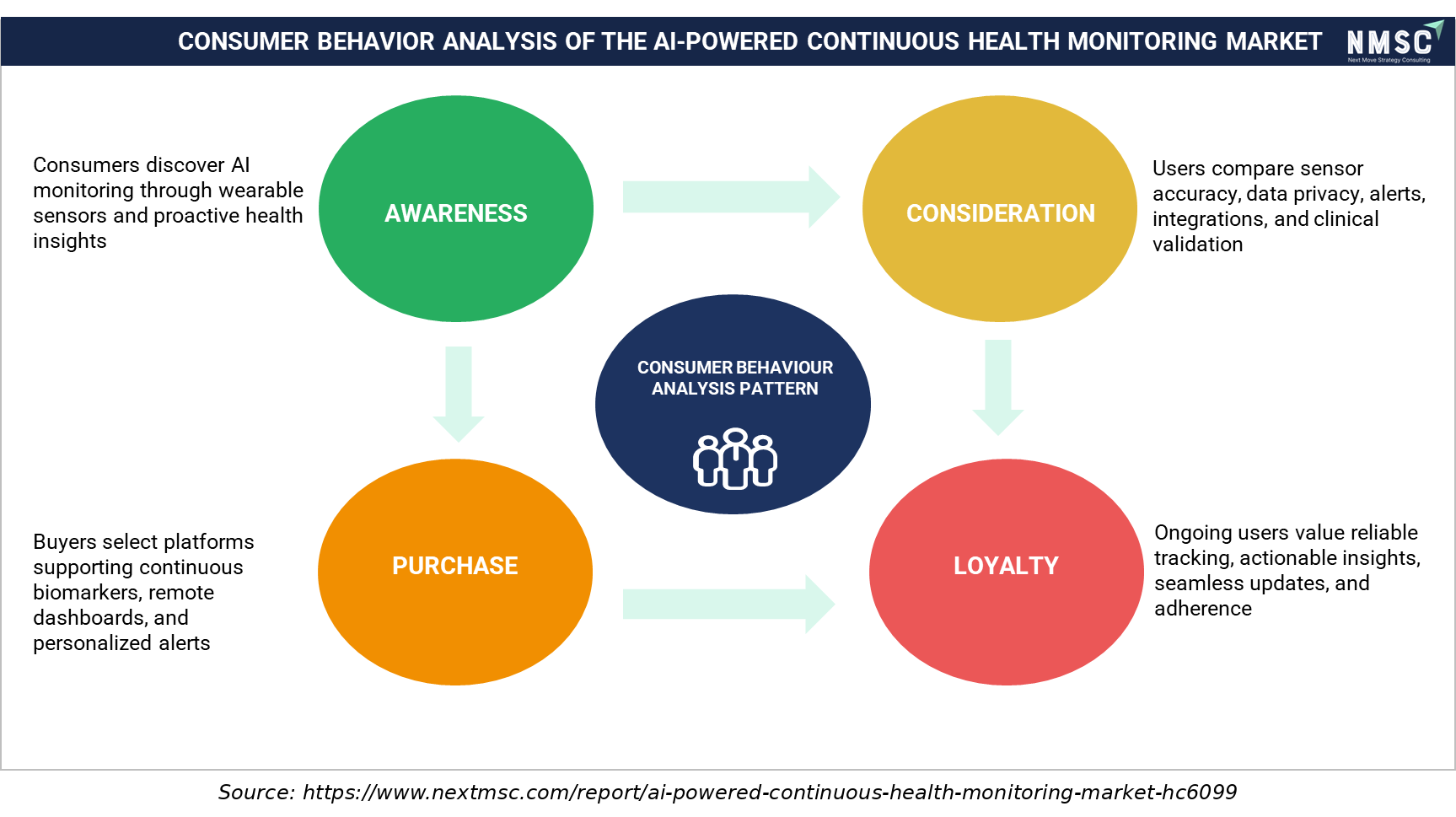
Consumer adoption of AI-powered continuous health monitoring solutions typically progresses from awareness to long-term loyalty. Users evaluate sensor accuracy, data privacy, clinical validation, actionable alerts, and integration capabilities before selecting a platform. Reliable monitoring, personalized insights, and seamless user experiences can strengthen engagement, encourage continued use, and support long-term adherence to digital health solutions.

Growth Opportunities

Our analysis shows that three forward-looking opportunities stand out for stakeholders positioning within the AI-powered continuous health monitoring market over the 2026-2035 forecast period.

How Can Clinical EHR Integration Unlock Value for Wearable Manufacturers?

Deeper integration with electronic health record systems presents a whitespace opportunity for wearable manufacturers seeking clinical-grade positioning. Vendors that build validated data pipelines connecting consumer wearable AI platforms directly into clinician workflows stand to capture recurring subscription revenue as health systems increasingly accept wearable data as supplementary clinical information.

Where Does Cuffless Blood Pressure Technology Create New Demand?

Cuffless blood pressure monitoring represents an underpenetrated opportunity as hypertension management shifts from periodic clinic readings toward continuous home tracking. Vendors that achieve broader regulatory clearance and clinical guideline recognition can capture demand from patients managing masked and white-coat hypertension currently underserved by traditional cuff-based devices.

How Can Chest Patch Platforms Expand Access to Home Cardiac Monitoring?

Chest connected wearable patches create an opportunity for manufacturers to extend clinical-grade cardiac and respiratory monitoring into home settings for patients discharged from hospital care. Early movers that combine patch-based sensing with connected care platforms can differentiate against smartwatch-only competitors serving primarily wellness use cases.

Regional Outlook

2025 (USD Billion)
2035 (USD Billion)
North Americ
Europe
Asia-Pacific
Middle East
Latin Americ
Region 2025 (USD Billion) 2035 (USD Billion) CAGR (%)
North America $10.0 USD Billion $40.0 USD Billion 9.0%
Europe $17.1 USD Billion $51.1 USD Billion 27.0%
Asia-Pacific $24.2 USD Billion $62.2 USD Billion 25.0%
Middle East & Africa $31.3 USD Billion $73.3 USD Billion 23.0%
Latin America $38.4 USD Billion $84.4 USD Billion 12.0%

Regional data is locked

Unlock complete regional numbers for this market.

Unlock Full Data

Competitive Landscape

We observed that the AI-powered continuous health monitoring market features a moderately fragmented competitive landscape, with diversified consumer technology majors competing alongside specialized medical device and digital health companies on sensor accuracy, AI interpretation quality, and regulatory clearance depth.

Dimension Description
Market Structure Moderately fragmented; diversified consumer electronics majors hold significant installed base and brand recognition, while specialized medical device and digital health companies compete on clinical-grade accuracy and regulatory clearance depth.
Innovation Focus Generative AI health interpretation, cuffless blood pressure sensing, and cross-device data interoperability dominate current innovation pipelines across leading companies.
M&A Activity Strategic investment and partnership activity, exemplified by Dexcom, Inc.'s USD 75 million investment in and data partnership with Oura Health Oy.

How Do Companies Compete in the AI-Powered Continuous Health Monitoring Market?

Companies compete primarily on sensor accuracy, AI interpretation quality, and regulatory clearance depth across the industry. Diversified consumer technology majors such as Apple Inc. and Samsung Electronics Co., Ltd. leverage large installed bases and integrated ecosystems to serve mainstream consumers, while specialized companies such as Dexcom, Inc. and Masimo Corporation compete on clinical-grade sensing accuracy and deep regulatory clearance portfolios for both consumer and hospital use cases.

Which Competitive Archetypes Dominate the AI-Powered Continuous Health Monitoring Market?

Two archetypes dominate the market: diversified consumer technology majors offering broad wellness ecosystems, and specialized medical device and digital health companies offering clinical-grade accuracy and regulatory depth. Apple Inc. and Samsung Electronics Co., Ltd. exemplify the diversified archetype through integrated smartwatch platforms, while Dexcom, Inc. and iRhythm Technologies, Inc. exemplify the specialized archetype through deep clinical validation and FDA clearance portfolios.

How Are Companies Differentiating Through Innovation in AI-Powered Continuous Health Monitoring?

Innovation and differentiation strategy increasingly center on generative AI interpretation and cross-device interoperability. Dexcom, Inc.'s generative AI-powered Smart Food Logging feature and its data partnership with Oura Health Oy both illustrate how companies are extending value beyond raw sensor data into personalized, interpretable insights. Our analysis shows that companies unable to demonstrate credible AI interpretation and regulatory clearance risk losing consumer trust and clinical adoption to more established competitors.

What M&A and Partnership Activity Is Shaping the AI-Powered Continuous Health Monitoring Market?

Strategic investment and partnership activity continue to consolidate capabilities within the industry. Dexcom, Inc.'s USD 75 million investment in Oura Health Oy, alongside its Stelo integration with the Oura Ring, illustrates how companies are partnering across device categories to expand data interoperability. Diversified technology majors including Apple Inc. and Samsung Electronics Co., Ltd. continue to deepen health monitoring capability through internal platform investment rather than acquisition.

Key Market Players

Our assessment indicates that the following 20 companies are actively shaping product innovation, capacity expansion, and go-to-market strategy within the global AI-powered continuous health monitoring market.

Apple Inc. Samsung Electronics Co., Ltd. Garmin Ltd. Whoop, Inc. Oura Health Oy Fitbit LLC Dexcom, Inc. Abbott Laboratories Masimo Corporation iRhythm Technologies, Inc. Biofourmis, Inc. Eko Health, Inc. Withings SA Aktiia SA Sibel Health, Inc. Sky Labs Co., Ltd. Carré Technologies Inc. Respiree Pte Ltd Current Health Ltd. VitalConnect, Inc.

Regulatory Framework Impacting the AI-Powered Continuous Health Monitoring Market

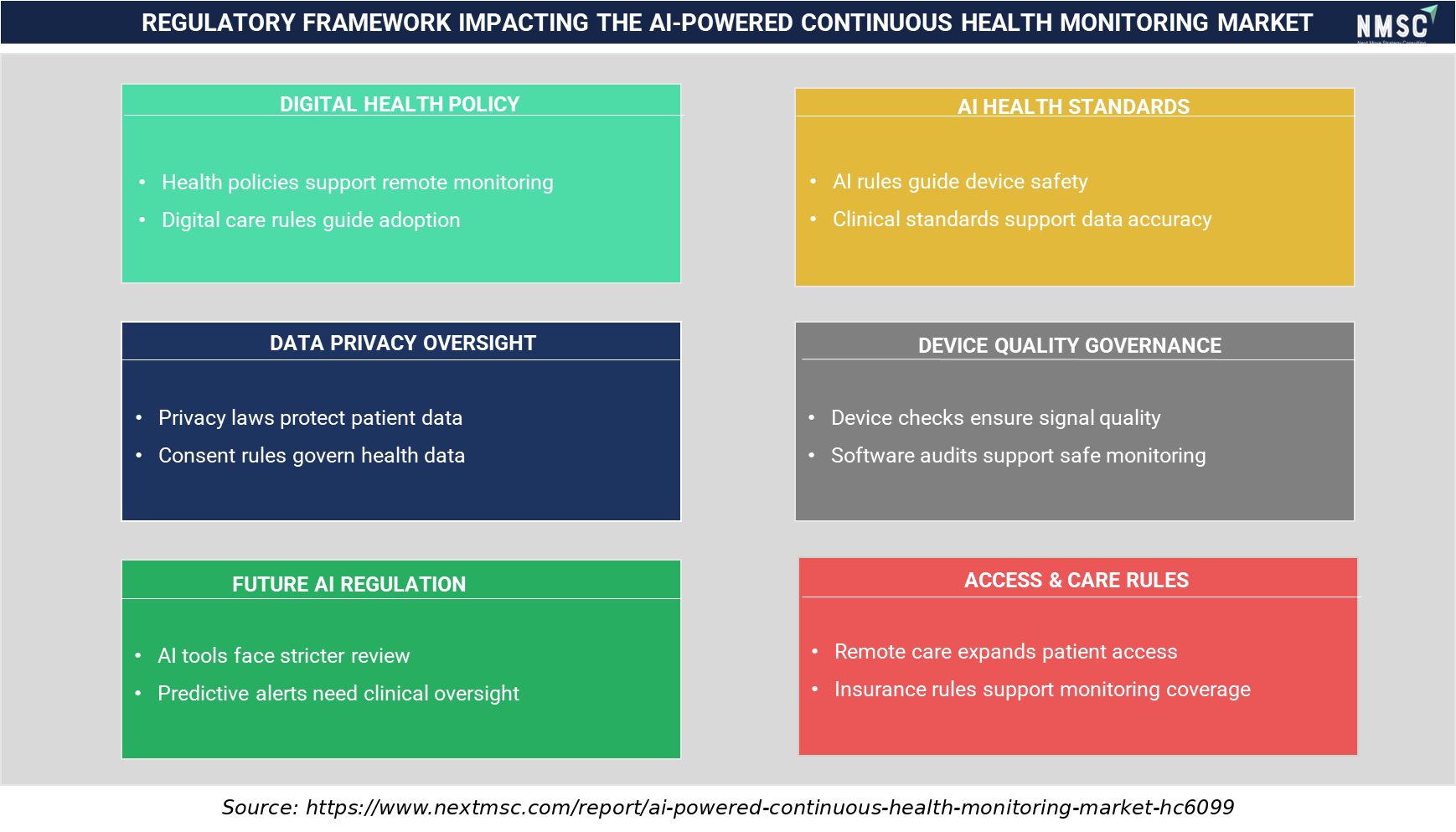
Regulatory frameworks play a critical role in shaping the development and adoption of AI-powered continuous health monitoring solutions. Digital health policies, AI safety standards, data privacy requirements, device quality controls, and clinical oversight influence market access and product design. As AI-enabled monitoring advances, providers must demonstrate accuracy, security, reliability, and responsible governance.

Latest Developments

We found that recent product launches, regulatory clearances, and partnership activity within the AI-powered continuous health monitoring market are concentrated on cuffless sensing and cross-device data interoperability, reflecting the industry's rapid capitalization cycle.

Date Event
July 2026 Samsung unveiled Galaxy Watch9 and Galaxy Watch Ultra2 with continuous health monitoring across sleep, cardiovascular health, exercise and recovery. The devices use AI-driven interpretation of biometrics, including heart rate, HRV, respiratory rate, temperature and blood oxygen, to provide personalized health guidance.
May 28, 2026 Oura launched Health Radar alongside Oura Ring 5, creating a proactive monitoring layer that continuously scans cardiovascular and respiratory signals. The feature adds Blood Pressure Signals and Nighttime Breathing trends, while combining longitudinal biometrics with AI-enabled interpretation to surface changes that may warrant attention.

Expert Insights

Dr. Kyu Rhee

President and CEO | National Association of Community Health Centers (NACHC)

"Continuous health monitoring of physical activity, sleep, nutrition and stress should become new, additional vital signs for users and health professionals. Combining this essential health data with clinical data powered by AI insights has the potential to transform the health system by improving health outcomes, reducing healthcare costs, and empowering patients, their caregivers and healthcare teams."

Analyst Interpretation

The statement captures a significant shift in the AI-Powered Continuous Health Monitoring Market from intermittent clinical measurements toward continuous, multimodal health-data collection. As wearable and connected sensors generate longitudinal information on physiological and behavioral signals, AI can combine these data streams with clinical records to identify patterns and support earlier interventions. This is expanding the market from standalone wearable tracking toward integrated platforms linking sensors, AI analytics, healthcare providers, and patients.

Investment Opportunities

What Capital Inflows Are Targeting the AI-Powered Continuous Health Monitoring Market?

Capital inflows into the AI-powered continuous health monitoring market are increasingly directed toward cross-device data partnerships and cuffless sensing technology development. Dexcom, Inc.'s USD 75 million investment in Oura Health Oy illustrates growing strategic investment in interoperable monitoring ecosystems. We observed that investors favor companies demonstrating credible regulatory clearance pathways, viewing FDA clearance milestones as a proxy for long-term commercial viability and clinical adoption potential.

How Is Infrastructure Investment Supporting AI-Powered Continuous Health Monitoring Deployment?

Infrastructure investment is expanding cloud-based AI processing and electronic health record integration capacity to support continuous monitoring data at scale. Our findings suggest that companies including Dexcom, Inc. and Biofourmis, Inc. are investing in generative AI and clinical data pipeline infrastructure to support both consumer wellness applications and remote patient monitoring programs requiring clinician-facing dashboards.

What ESG Considerations Are Shaping AI-Powered Continuous Health Monitoring Investment Decisions?

Environmental, social, and governance considerations are increasingly relevant to investment decisions, with health equity and data privacy governance as key criteria. Companies' data protection and algorithmic transparency practices continue to inform enterprise ESG assessments across the digital health supply chain. We found that investors increasingly favor companies with transparent AI validation methodologies, treating clinical evidence generation as a governance indicator alongside growth metrics.

Key Benefits for Stakeholders

How Does This Report Benefit Enterprise and Industry Leaders?

Enterprise and industry leaders gain access to validated segmentation, competitive benchmarking, and regional demand forecasts that support product-positioning and go-to-market decisions across the AI-powered continuous health monitoring industry. Our analysis shows that detailed device type, monitoring parameter, and end-user breakdowns help product teams align development roadmaps with regulatory and consumer transparency expectations while identifying underserved segments for expansion.

How Does This Report Benefit Investors and Financial Analysts?

Investors and financial analysts benefit from consistent, single-point market size and CAGR estimates that support valuation and capital-allocation decisions across the AI-powered continuous health monitoring supply chain. We observed that the report's regional and segment-level growth differentials help identify which companies are best positioned to capture above-market growth in Asia-Pacific and cuffless blood pressure device categories through 2035.

How Does This Report Benefit Technology Vendors and Product Teams?

Technology vendors and product teams gain insight into emerging design requirements, including generative AI interpretation, cuffless sensing, and cross-device interoperability, that are reshaping the industry. Our findings suggest that this analysis helps R&D teams prioritize development roadmaps around clinical-grade validation increasingly required by regulators and health systems evaluating remote patient monitoring platforms.

Key Market Segments Evaluated

By Device Type

  • Smartwatch and Wristband
  • Continuous Glucose Monitor
  • Smart Ring
  • Chest Patch and Strap
  • Cuffless Blood Pressure Device
  • Smart Clothing and Textile
  • Other Form Factors

By Monitoring Parameter

  • Multi-Parameter Monitoring
  • Glucose Monitoring
  • Cardiac Monitoring (Heart Rate and ECG)
  • Sleep Monitoring
  • Blood Pressure Monitoring
  • Respiratory Monitoring
  • Activity and Recovery Monitoring

By End User

  • Consumer and Wellness
  • Hospital and Clinical
  • Remote Patient Monitoring
  • Sports and Performance

By Distribution Channel

  • Direct to Consumer
  • Retail and E-commerce
  • Hospital and Clinic Procurement
  • Distributor and Partner Channel

Conclusion & Recommendations

The long-term outlook for the market remains strongly positive, with global revenue projected to expand more than sevenfold from USD 18.5 billion in 2025 to USD 136.51 billion by 2035 at a 22.0% CAGR. We observed that sustained chronic disease prevalence, expanding FDA clearance activity, and growing generative AI integration will continue underpinning demand across consumer wellness, hospital, and remote patient monitoring applications through the forecast period.

What Strategic Positioning Should AI-Powered Continuous Health Monitoring Vendors Pursue?

Vendors should prioritize cross-device data interoperability while pursuing deep regulatory clearance portfolios to secure long-term consumer trust and clinical adoption. Our assessment indicates that vendors investing early in generative AI interpretation capability and cuffless sensing technology will be best positioned to capture premium pricing within the AI-powered continuous health monitoring market.

How Attractive Is the AI-Powered Continuous Health Monitoring Market for New Investment?

The AI-powered continuous health monitoring industry presents a highly attractive investment case, supported by a USD 113.71 billion absolute dollar opportunity between 2026 and 2035 and above-average growth in Asia-Pacific and cuffless blood pressure device categories. We found that investment attractiveness is highest for companies combining proven clinical validation with scalable consumer distribution, positioning them to serve both wellness-focused and clinically regulated market segments simultaneously.

What Market Shifts and Key Risks Should Stakeholders Monitor?

Stakeholders should monitor regulatory classification uncertainty, data privacy concerns, and sensing accuracy limitations as key risks to the AI-powered continuous health monitoring market. Our analysis shows that companies unable to demonstrate credible clinical validation and transparent data governance risk losing consumer trust and regulatory standing to competitors with more established evidence generation practices, particularly as scrutiny of AI-derived health claims increases.

What Are the Key Growth Pathways for the AI-Powered Continuous Health Monitoring Market?

Key growth pathways include expanding generative AI interpretation capability, scaling cuffless blood pressure sensing toward broader clinical recognition, and deepening penetration into remote patient monitoring and clinical care channels. NMSC's analysis indicates that vendors pursuing these pathways while maintaining strong regulatory and data interoperability practices will be best positioned to capture the AI-powered continuous health monitoring market's projected growth through 2035.

FAQs

About the Author

Mihul Sharma

Mihul Sharma

Mihul Sharma is Research Associate at Next Move Strategy Consulting, where he has covered technology, industrial, and healthcare markets for 3 years. His work applies structured business research, market analysis, and secondary-source review to assess market trends, competitive developments, and growth opportunities. He supports report development by fully synthesizing industry data, company information, and market signals into concise findings for strategy and investment-focused research teams.

About the Reviewer

Supradip Baul

Supradip Baul

Supradip Baul is an accomplished business consultant and strategist with over a decade of rich experience in market intelligence, strategy, technology, and business transformation. His work has included rigorous qualitative and quantitative analysis across multiple industries, helping clients shape investment decisions and long-term roadmaps. Earlier in his career, he was associated with Gartner, where he contributed to industry-leading reports and market share analyses. He has worked with leading global companies and holds an MBA with a dual specialization in Marketing and Finance.

Download Free Sample

Melanie Samko

MELANIE SAMKO

Director of Marketing

TOSOH BIOSCIENCE, INC.

The information provided by NMSC is incredibly valuable, thank you so much for such a excellent work. I really appreciate it. I will make sure to reference all of it, in my summary document.

Ross J Mckenzie

ROSS J MCKENZIE

Business Insight Manager

Staysure Group

“Next MSC have been incredibly helpful in providing detailed & robust information on our market, alongside quantifying growth by different segments. The process to procure was simple and easy, with sample reports and regular contact to ensure we had what we needed. Succinct detail on their sources & methodologies is also greatly received, allowing transparency in this respect helps build trust in the detail you pay for. Joseph in particular was fantastic, and helped ensure efficient provision of the insight pack – thank you NMSC!”.

Rishabh Jogani

RISHABH JOGANI

Strategy Analyst

Accenture Japan

We are incredibly impressed with the market report on the real estate market in India provided by Next Move Strategy Consulting. The report was thorough, insightful, and well-structured, offering deep analysis and actionable recommendations. It not only captured the current trends and dynamics but also provided a forward-looking perspective that has been invaluable for our strategic planning. Their team demonstrated exceptional professionalism, attention to detail, and a profound understanding of the industry. The data-driven insights and clarity of presentation exceeded our expectations, making complex market trends easy to understand. We highly recommend Next Move Strategy Consulting to anyone looking for reliable and comprehensive market research services. Their expertise has given us the confidence to navigate the complexities of the Indian real estate market with clarity and foresight.

Nishant Awate

NISHANT AWATE

Business Development Global Sales

Zehnder Group Deutschland GmbH

Our experience working with Next Move Strategy Consulting was positive. The team was responsive, professional, and open to incorporating our specific requirements throughout the project. The India AHU market study was comprehensive and well structured, covering market value and volume forecasts, product and application segments, and key industry trends. The inclusion of both AHU and residential MVHR market insights made the study particularly relevant for our strategic market assessment. Overall, the report provides a solid foundation for evaluating market potential, identifying priority segments, and supporting business-development decisions in India.

Mohit Agarwal

MOHIT AGARWAL

Chief Manager

DryChem India Pvt. Ltd.

Next Move Strategy Consulting is an amazing team of consultants. We required a market study report for our investors on top priority and the team went above and beyond our expectations to deliver the same with ample supporting data within a short time span enabling us to secure the investments and keep our project timeline maintained. Their professionalism, attention to detail, and timely delivery of actionable recommendations have left a lasting impression on our organization.

Custom Market Research Services

We will customize the research for you if the listed report does not fully match your requirements.

Get 30% Free Customization

Select License

This website uses cookies to ensure you get the best experience on our website. Learn more

✖