Soil Amendments Market Global Industry Analysis and Forecast (2026–2035)

The global Soil Amendments Market size was valued at USD 5.95 billion in 2025 and is estimated at USD 6.32 billion in 2026, forecast to reach USD 10.95 billion by 2035, expanding at a 6.30% CAGR from 2026 to 2035. Key drivers include rising soil-degradation concerns and regenerative farming adoption, and government soil-health and carbon-sequestration programs, with Asia-Pacific leading the global market.

Download Free Sample PDF
Base Year (2025)
$5.95 Billion
Forecast (2035)
$10.95 Billion
CAGR (2026-2035)
6.3%
Top Region
Asia-Pacific

What Is the Soil Amendments Market Size?

The global soil amendments market size was valued at USD 5.95 Billion in 2025 and is estimated at USD 6.32 Billion in 2026, forecast to reach USD 10.95 Billion by 2035, expanding at a 6.30% CAGR between 2026 and 2035. Asia-Pacific leads with approximately a 32% share, while organic amendments dominate all other product types with approximately a 58% share.

We observed that growth is concentrated in liquid formulations and online distribution, with organic amendments continuing to anchor overall demand across major grain and horticulture producing regions through 2035.

Soil Amendments Market Global Industry Analysis and Forecast (2026–2035) Revenue Forecast

Values in USD Billion

2025 $5.95 Billion
2025
2026 $6.32 Billion
2026
2027 $6.72 Billion
2027
2028 $7.15 Billion
2028
2029 $7.60 Billion
2029
2030 $8.08 Billion
2030
2031 $8.58 Billion
2031
2032 $9.13 Billion
2032
2033 $9.70 Billion
2033
2034 $10.31 Billion
2034
2035 $10.95 Billion
2035

Key Takeaways

By Type: Organic Amendments held the largest share of approximately 58% (USD 3.45 Billion) in 2025; Organic Amendments is also the fastest-growing sub-segment at 7.09% CAGR from 2026–2035.

By Form: Dry held the largest share of approximately 64% (USD 3.81 Billion) in 2025; Liquid is the fastest-growing sub-segment at 8.14% CAGR from 2026–2035.

By Application: Agricultural held the largest share of approximately 76% (USD 4.52 Billion) in 2025; Non-Agricultural is the fastest-growing sub-segment at 7.71% CAGR from 2026–2035.

By Crop Type: Grains and Cereals held the largest share of approximately 36% (USD 2.14 Billion) in 2025; Fruits and Vegetables is the fastest-growing sub-segment at 7.53% CAGR from 2026–2035.

By Distribution Channel: Distributors and Retailers held the largest share of approximately 52% (USD 3.09 Billion) in 2025; Online is the fastest-growing sub-segment at 11.78% CAGR from 2026–2035.

Dominant Region: Asia-Pacific dominated with approximately 32% revenue share (USD 1.90 Billion) in 2025.

Fastest-Growing Region: Asia-Pacific is also expected to register the highest CAGR of 8.02% during 2026–2035.

Dominant Country: U.S. led with approximately USD 1.43 Billion in 2025.

Fastest-Growing Country: India is the fastest-growing country at approximately 9.87% CAGR from 2026–2035.

Market Opportunity: The soil amendments market is expected to create an absolute dollar opportunity of USD 4.63 Billion between 2026 and 2035, presenting significant investment potential across the organic-fiber, biological, and precision soil-health value chain.

According to Next Move Strategy Consulting analysis, manufacturers are increasingly consolidating biochar, gypsum, and biological amendment portfolios under single distribution platforms to simplify regional regulatory compliance, a shift that favors diversified suppliers over single-product specialists as soil-health mandates expand through 2035.

Soil Amendments Market Overview

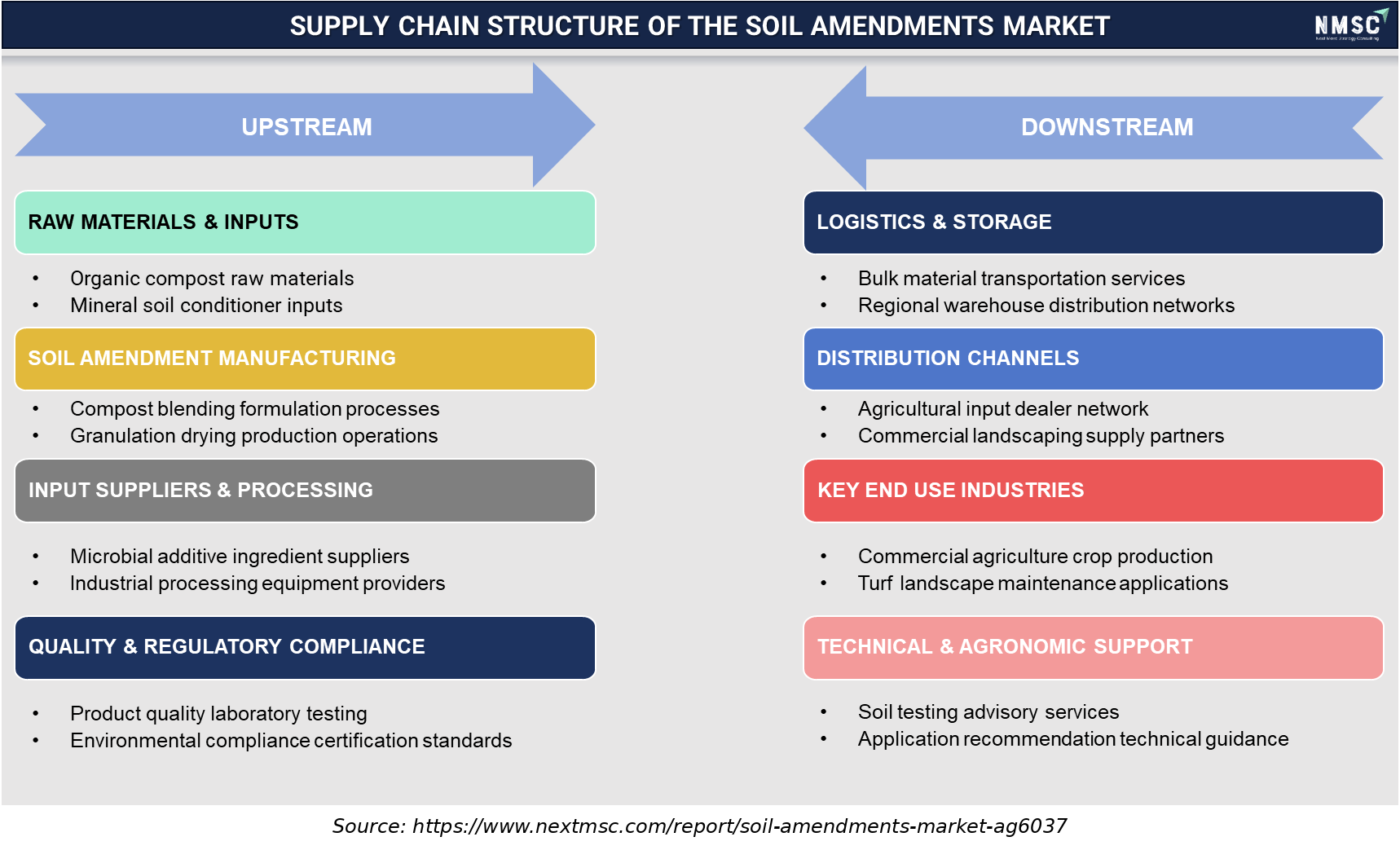
The soil amendments market encompasses organic materials such as compost, manure, and biochar, alongside inorganic inputs such as gypsum, lime, and sulfur, applied to improve soil structure, fertility, and water retention. Our assessment indicates that the scope spans agricultural and non-agricultural applications, including turf and ornamental use, distributed through retailers, direct sales, and increasingly online retail channels. The category has evolved from a general crop-input category into a distinct soil-health-focused market report segment, driven by rising soil-degradation concerns, regenerative farming adoption, and government soil-conservation programs worldwide.
Regulatory frameworks such as the U.S. Department of Agriculture's soil health initiatives and the European Union's Farm to Fork strategy shape organic-input certification and nutrient-runoff standards, while national biochar subsidy programs increasingly influence adoption decisions. We observed that technology adoption is shifting toward liquid and biological formulations that improve nutrient-use efficiency. Next Move Strategy Consulting's analysis indicates that this structural shift, combined with precision-agriculture adoption, is redefining sourcing criteria across the market.

Market Drivers & Dynamics

Interactive Dataset
Rising soil-degradation concerns and regenerative farming adoption driver +1.6% Global 2026-2035
Government soil-health and biochar subsidy programs driver +1.3% Europe, Asia-Pacific 2026-2035
Expansion of biological and microbiome-based amendment technology driver +1.1% Global 2026-2035
Growth of precision agriculture and fertigation adoption driver +0.9% North America, Europe 2026-2032
Rising demand for high-value fruit and vegetable production driver +1.0% Asia-Pacific, Latin America 2026-2035
Expansion of organized agricultural retail in Asia-Pacific driver +1.2% Asia-Pacific 2026-2035
Price sensitivity among smallholder farmers versus conventional inputs restraint -0.9% Asia-Pacific, Africa 2026-2035
Variable and inconsistent product-quality standards across regions restraint -0.7% Global 2026-2032
Logistics and storage costs for bulk organic amendments restraint -0.6% Global 2026-2035
Source: Next Move Strategy Consulting

Growth Drivers

What Is the Primary Growth Driver of the Soil Amendments Market?

Rising soil-degradation concerns and regenerative farming adoption are the primary driver of the market. The U.S. Department of Agriculture continues to publish soil health data through its Natural Resources Conservation Service that informs grower adoption of amendment products. We observed that this agronomic shift, reinforced by nutrient-replenishment needs following high-yield harvests, continues to anchor baseline demand for organic and inorganic amendments across developed and emerging economies alike.

How Is Government Soil-Health Policy Driving Market Growth?

Government soil-health and carbon-sequestration programs are accelerating market growth toward biochar and organic amendment adoption. National pyrolysis and biochar subsidy programs are pushing growers toward certified, carbon-rich soil inputs. Our assessment indicates that this policy support, combined with expanding regenerative-agriculture certification schemes, is compressing adoption timelines for biological and organic amendment technology across multiple regions.

Growth Inhibitors

What Is Restraining Soil Amendments Market Expansion?

Price sensitivity among smallholder farmers relative to conventional fertilizer alternatives restrains margin stability and adoption pace across the supply chain. The U.S. Environmental Protection Agency's guidance on nutrient management continues to shape how manufacturers substantiate soil-health product claims, adding compliance overhead. We found that smaller regional producers face particular exposure, as limited scale reduces their ability to absorb quality-certification costs compared with larger, vertically integrated crop-input companies.

What Are the Growth Opportunities?

How Can Biochar Platforms Unlock Value for Row-Crop Producers?

Biochar production platforms present a whitespace opportunity for suppliers seeking to serve carbon-sequestration-focused row-crop producers. Companies that commercialize scalable pyrolysis capacity stand to capture recurring supply contracts as growers pursue soil-carbon credit programs, particularly among grains and cereals producers seeking measurable regenerative-agriculture outcomes.

Where Do Microbiome-Based Biologicals Create New Demand?

Specialty and fruit and vegetable growers represent an underpenetrated opportunity for microbiome-based biological amendment adoption. Companies that develop validated, crop-specific biological formulations can secure long-term procurement relationships with high-value horticulture operators, benefiting from premium-pricing tiers tied to yield-improvement outcomes.

How Can Digital Distribution Platforms Benefit Specialty Amendment Suppliers?

Specialty amendment suppliers seeking direct grower access create an opportunity in expanding online and precision-agriculture-linked distribution platforms. Early movers that integrate digital ordering with agronomic advisory services can differentiate with distributors and cooperatives pursuing data-driven soil-health recommendations for their grower networks.

Segmentation Analysis

2025 (USD Billion)
2035 (USD Billion)
Organic Amendments 2025: $3.45 Billion | 2035: $6.79 Billion
Organic Amen
Inorganic Amendments 2025: $2.50 Billion | 2035: $4.16 Billion
Inorganic Am
Organic Amendments $3.45 Billion $6.79 Billion 7.09%
Inorganic Amendments $2.50 Billion $4.16 Billion 5.12%

Which Type Segment Dominates the Soil Amendments Market?

Organic Amendments led the market with USD 3.45 Billion in 2025, supported by broad compost, manure, and biochar adoption across row-crop and horticulture applications. We observed that Organic Amendments is also the fastest-growing type segment, expanding at a 7.09% CAGR from 2026 to 2035, as regenerative-agriculture certification and carbon-sequestration incentives accelerate adoption relative to conventional inorganic inputs such as gypsum and lime.

2025 (USD Billion)
2035 (USD Billion)
Dry
Liquid
Segment Item 2025 (USD Billion) 2035 (USD Billion) CAGR
Dry $10.0 USD Billion $40.0 USD Billion 17.0%
Liquid $17.1 USD Billion $51.1 USD Billion 11.0%

Segment-wise data is locked

Unlock complete segment-wise numbers for By Form.

Unlock Full Data
2025 (USD Billion)
2035 (USD Billion)
Agricultural
Non-Agricult
Segment Item 2025 (USD Billion) 2035 (USD Billion) CAGR
Agricultural $10.0 USD Billion $40.0 USD Billion 18.0%
Non-Agricultural $17.1 USD Billion $51.1 USD Billion 16.0%

Segment-wise data is locked

Unlock complete segment-wise numbers for By Application.

Unlock Full Data

Which Application Leads Soil Amendments Market Demand?

Agricultural applications remained the leading application segment within the market, valued at USD 4.52 Billion in 2025 on sustained demand for soil-fertility inputs across row crops. Our findings suggest that Non-Agricultural applications, including turf and ornamental use, is the fastest-growing category, registering a 7.71% CAGR from 2026 to 2035, as commercial landscaping and sports-turf operators increasingly adopt soil-conditioning products.

2025 (USD Billion)
2035 (USD Billion)
Grains and C
Oilseeds and
Fruits and V
Other Crops
Segment Item 2025 (USD Billion) 2035 (USD Billion) CAGR
Grains and Cereals $10.0 USD Billion $40.0 USD Billion 27.0%
Oilseeds and Pulses $17.1 USD Billion $51.1 USD Billion 17.0%
Fruits and Vegetables $24.2 USD Billion $62.2 USD Billion 27.0%
Other Crops $31.3 USD Billion $73.3 USD Billion 9.0%

Segment-wise data is locked

Unlock complete segment-wise numbers for By Crop Type.

Unlock Full Data
2025 (USD Billion)
2035 (USD Billion)
Distributors
Direct Sales
Online
Segment Item 2025 (USD Billion) 2035 (USD Billion) CAGR
Distributors and Retailers $10.0 USD Billion $40.0 USD Billion 25.0%
Direct Sales $17.1 USD Billion $51.1 USD Billion 19.0%
Online $24.2 USD Billion $62.2 USD Billion 25.0%

Segment-wise data is locked

Unlock complete segment-wise numbers for By Distribution Channel.

Unlock Full Data

Which Distribution Channel Is Most Widely Used in Soil Amendments?

Distributors and Retailers remained the dominant distribution channel across the market, reaching USD 3.09 Billion in 2025 due to established agricultural cooperative and dealer networks. Based on research conducted by Next Move Strategy Consulting, we found that Online is the fastest-growing channel at a 11.78% CAGR from 2026 to 2035, reflecting growers' increasing use of digital procurement platforms for specialty and biological amendment products.

Growth Opportunities

Our analysis shows that three forward-looking opportunities stand out for stakeholders positioning within the soil amendments market over the 2026-2035 forecast period.

How Can Biochar Platforms Unlock Value for Row-Crop Producers?

Biochar production platforms present a whitespace opportunity for suppliers seeking to serve carbon-sequestration-focused row-crop producers. Companies that commercialize scalable pyrolysis capacity stand to capture recurring supply contracts as growers pursue soil-carbon credit programs, particularly among grains and cereals producers seeking measurable regenerative-agriculture outcomes.

Where Do Microbiome-Based Biologicals Create New Demand?

Specialty and fruit and vegetable growers represent an underpenetrated opportunity for microbiome-based biological amendment adoption. Companies that develop validated, crop-specific biological formulations can secure long-term procurement relationships with high-value horticulture operators, benefiting from premium-pricing tiers tied to yield-improvement outcomes.

How Can Digital Distribution Platforms Benefit Specialty Amendment Suppliers?

Specialty amendment suppliers seeking direct grower access create an opportunity in expanding online and precision-agriculture-linked distribution platforms. Early movers that integrate digital ordering with agronomic advisory services can differentiate with distributors and cooperatives pursuing data-driven soil-health recommendations for their grower networks.

Regional Outlook

2025 (USD Billion)
2035 (USD Billion)
North Americ
Europe
Asia-Pacific
Middle East
Latin Americ
Region 2025 (USD Billion) 2035 (USD Billion) CAGR (%)
North America $10.0 USD Billion $40.0 USD Billion 9.0%
Europe $17.1 USD Billion $51.1 USD Billion 27.0%
Asia-Pacific $24.2 USD Billion $62.2 USD Billion 25.0%
Middle East & Africa $31.3 USD Billion $73.3 USD Billion 23.0%
Latin America $38.4 USD Billion $84.4 USD Billion 12.0%

Regional data is locked

Unlock complete regional numbers for this market.

Unlock Full Data

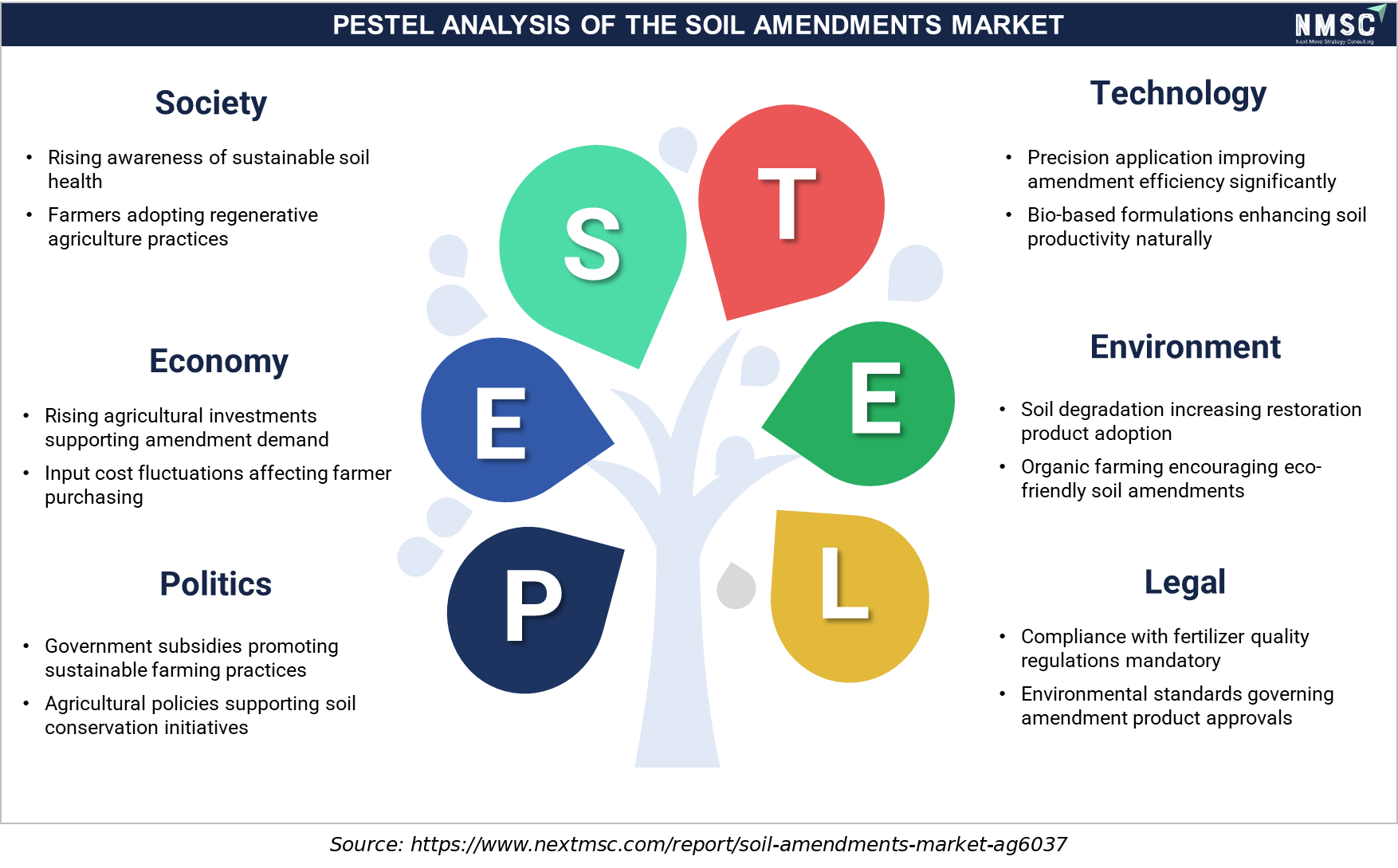
PESTEL Analysis of the Soil Amendments Industry

PESTEL Analysis of the Soil Amendments Industry
Based on our PESTEL assessment, we identified that the soil amendments industry is influenced by government agricultural policies, rising investments in sustainable farming, increasing awareness of soil health, advancements in biological and precision agriculture technologies, environmental emphasis on soil conservation and carbon sequestration, and evolving regulations governing product quality and environmental safety. Furthermore, our analysis indicates that these political, economic, social, technological, environmental, and legal factors collectively shape market growth, product innovation, regulatory compliance, and the adoption of sustainable soil management practices.

Competitive Landscape

We observed that the soil amendments market features a moderately consolidated competitive landscape, with diversified global crop-input groups competing alongside specialized biological and mineral-amendment producers on formulation innovation and distribution reach.

Dimension Description
Market Structure Moderately consolidated; diversified crop-input groups profiled in this report account for a significant share of global revenue, while specialty biochar and biological producers serve differentiated soil-health demand.
Innovation Focus Biochar production technology, microbiome-based biologicals, and liquid formulation innovation dominate current pipelines across leading manufacturers.
M&A Activity Selective portfolio expansion, exemplified by ICL Group Ltd.'s acquisition of Lavie Bio to strengthen its microbiome-based agricultural solutions capability.

How Do Companies Compete in the Soil Amendments Market?

Companies compete primarily on formulation efficacy, distribution reach, and agronomic advisory support across the industry. Diversified global groups such as Nutrien Ltd. and Yara International ASA leverage scale and integrated cooperative networks to serve mainstream row-crop demand, while specialized producers such as Haifa Group and Novonesis A/S compete on formulation innovation aimed at high-value horticulture and biological-input segments.

Which Competitive Archetypes Dominate the Soil Amendments Market?

Two archetypes dominate the market: diversified crop-input groups offering integrated fertility and amendment portfolios across broad geographies, and specialized biological or mineral-amendment producers focused on single-category products. The Mosaic Company and Compass Minerals International, Inc. exemplify the diversified and mineral-focused archetype, while Novonesis A/S exemplifies the specialized archetype centered on biological soil technology.

How Are Companies Differentiating Through Innovation in Soil Amendments?

Innovation and differentiation strategy increasingly center on biochar production scale-up and biological formulation validation. ICL Group Ltd. and Novonesis A/S both continue to expand biological and carbon-based soil input research to secure verifiable soil-health credentials. Our analysis shows that manufacturers unable to demonstrate credible agronomic performance data risk exclusion from large cooperative and distributor procurement programs in North America and Europe.

What M&A and Expansion Activity Is Shaping the Soil Amendments Market?

Strategic acquisitions and geographic expansion continue to shape formulation capabilities within the industry. ICL Group Ltd.'s acquisition of Lavie Bio broadened its microbiome-based agricultural solutions portfolio, while Nutrien Ltd. and BASF SE continue to expand crop-input distribution capacity across their multi-region networks, illustrating how diversified groups pursue geographic expansion and portfolio consolidation across organic and inorganic amendment categories.

Key Market Players

Our assessment indicates that the following 20 companies are actively shaping product innovation, distribution expansion, and soil-health strategy within the global soil amendments market.

Nutrien Ltd. The Mosaic Company Yara International ASA ICL Group Ltd. BASF SE UPL Limited Corteva, Inc. Bayer AG OCP Group Compass Minerals International, Inc. Koch Ag & Energy Solutions, LLC EuroChem Group AG PhosAgro PJSC Sociedad Química y Minera de Chile S.A. Haifa Group Coromandel International Limited Tata Chemicals Limited Novonesis A/S Sinochem Group Co., Ltd. Deepak Fertilisers and Petrochemicals Corporation Limited

Latest Developments

We found that recent developments within the soil amendments market are concentrated on biochar technology and biological-input acquisitions, reflecting the industry's broader soil-health transition.

Date Event
June 2026 Yara International ASA updated its long-term capital allocation strategy, increasing investment in mature, high-return U.S. ammonia projects while continuing global expansion of low-carbon fertilizer solutions and sustainable crop nutrition portfolios.
April 2026 Nutrien Ltd. partnered with BASF to combine Nutrien's agronomic expertise with BASF's xarvio FIELD MANAGER and xarvio BIOENERGY digital farming platforms, enabling growers to optimize yields, measure carbon intensity, and participate in emerging low-carbon biofuel markets.
March 2025 The Mosaic Company relaunched its philanthropic arm as The Mosaic Company Foundation for Sustainable Food Systems, strengthening initiatives in the United States, India, and Brazil to advance 4R Nutrient Stewardship, improve soil health, and enhance smallholder agricultural productivity.

Investment Opportunities

What Capital Inflows Are Targeting the Soil Amendments Market?

Capital inflows into the market are increasingly directed toward biochar production capacity and biological-input technology. Strategic acquirers, including established crop-input manufacturers, continue to fund biological-solutions companies, as seen in ICL Group Ltd.'s acquisition of Lavie Bio. We observed that investors favor companies demonstrating validated agronomic performance data, viewing efficacy evidence as a proxy for long-term distributor contract retention.

How Is Infrastructure Investment Supporting Soil Amendment Manufacturing?

Infrastructure investment is expanding pyrolysis and biochar processing capacity across North America, Europe, and Asia-Pacific to serve rising demand for carbon-focused amendments. Our findings suggest that regional manufacturers are investing in liquid-formulation production lines to improve nutrient-delivery precision, supporting adoption among fertigation and precision-agriculture-oriented growers.

What ESG Considerations Are Shaping Soil Amendments Investment Decisions?

Environmental, social, and governance considerations are central to investment decisions across the industry, with carbon-sequestration potential and soil-biodiversity outcomes as key criteria. The U.S. Department of Agriculture's Natural Resources Conservation Service continues to inform manufacturer soil-health disclosures. We found that investors increasingly favor companies with validated carbon-impact data, treating it as a governance indicator alongside product-safety compliance.

Key Benefits for Stakeholders

How Does This Report Benefit Enterprise and Industry Leaders?

Enterprise and industry leaders gain access to validated segmentation, competitive benchmarking, and regional demand forecasts that support product-portfolio and distribution decisions across the soil amendments industry. Our analysis shows that detailed type, application, and crop-type breakdowns help procurement and R&D teams align formulation priorities with regional agronomic and regulatory requirements while identifying underserved segments for portfolio expansion.

How Does This Report Benefit Investors and Financial Analysts?

Investors and financial analysts benefit from consistent, single-point market size and CAGR estimates that support valuation and capital-allocation decisions across the market's supply chain. We observed that the report's regional and segment-level growth differentials help identify which manufacturers and biological-input suppliers are best positioned to capture above-market growth in Asia-Pacific and liquid-formulation categories through 2035.

How Does This Report Benefit Technology Vendors and Product Teams?

Technology vendors and product teams gain insight into emerging formulation requirements, including biochar production scale-up and biological-input validation, that are reshaping the industry. Our findings suggest that this analysis helps R&D teams prioritize development roadmaps around carbon-focused and microbiome-based formulations increasingly required by grower and distributor sourcing criteria.

Key Market Segments Evaluated

By Type

  • Organic Amendments
  • Inorganic Amendments

By Form

  • Dry
  • Liquid

By Application

  • Agricultural
  • Non-Agricultural

By Crop Type

  • Grains and Cereals
  • Oilseeds and Pulses
  • Fruits and Vegetables
  • Other Crops

By Distribution Channel

  • Distributors and Retailers
  • Direct Sales
  • Online

Conclusion & Recommendations

The long-term outlook for the market remains positive, with global revenue projected to grow from USD 5.95 Billion in 2025 to USD 10.95 Billion by 2035 at a 6.30% CAGR. We observed that sustained soil-health investment, government carbon-sequestration policy, and biological-input adoption will continue underpinning growth across agricultural and non-agricultural applications through the forecast period.

What Strategic Positioning Should Soil Amendments Companies Pursue?

Companies should prioritize biochar production scale-up and biological-input validation while pursuing distributor and cooperative partnerships to secure long-term grower trust. Our assessment indicates that manufacturers investing early in liquid-formulation technology and agronomic advisory capability will be best positioned to capture premium pricing within the soil amendments market.

How Attractive Is the Soil Amendments Market for New Investment?

The soil amendments industry presents an attractive investment case, supported by a USD 4.63 Billion absolute dollar opportunity between 2026 and 2035 and above-average growth in Asia-Pacific and liquid-formulation categories. We found that investment attractiveness is highest for companies combining validated agronomic performance data with scaled distribution capacity, positioning them to serve both row-crop and specialty-crop grower segments simultaneously.

What Market Shifts and Key Risks Should Stakeholders Monitor?

Stakeholders should monitor price sensitivity among smallholder farmers, inconsistent regional quality standards, and rising logistics costs as key risks to the market. Our analysis shows that manufacturers unable to substantiate soil-health performance claims risk losing distributor shelf space to competitors with verified, certified product lines, particularly within Europe's increasingly regulated agricultural-input environment.

What Are the Key Growth Pathways for the Soil Amendments Market?

Key growth pathways include expanding biochar production capacity, scaling microbiome-based biological partnerships, and deepening penetration into online distribution and Asia-Pacific markets. Next Move Strategy Consulting's analysis indicates that companies pursuing these pathways while maintaining cost competitiveness will be best positioned to capture the market's projected growth through 2035.

FAQs

About the Author

Saista Faiyaz

Saista Faiyaz

Saista Faiyaz is Research Associate at Next Move Strategy Consulting, where she has covered consumer markets and healthcare technologies for 3 years. Her work includes primary interview review, secondary-source validation, market sizing, and structured analysis of company and industry data. She supports research by comparing evidence across sources, organizing findings into market narratives, and documenting assumptions used in analysis. Her scope includes cross-market benchmarking, and reports.

About the Reviewer

Supradip Baul

Supradip Baul

Supradip Baul is an accomplished business consultant and strategist with over a decade of rich experience in market intelligence, strategy, technology, and business transformation. His work has included rigorous qualitative and quantitative analysis across multiple industries, helping clients shape investment decisions and long-term roadmaps. Earlier in his career, he was associated with Gartner, where he contributed to industry-leading reports and market share analyses. He has worked with leading global companies and holds an MBA with a dual specialization in Marketing and Finance.

Download Free Sample

Kishu Kanda

KISHU KANDA

Strategy Analyst

Accenture

We purchased the AI Consumer Market Report from this company. Not only did they customize the report to meet our specific requirements, but they also showed great flexibility in accommodating our budget. The report we received fully met our expectations. Additionally, they provided prompt and thorough responses to both our pre-purchase and follow-up questions. We look forward to working with this company again in the future.

Kevin Coker

KEVIN COKER

Founder, CEO and Board Diector

Proxima Clinical Research

I have been using Next MSC reports for product positioning in a new geography for a long time. They have by far the best reports I have found and the price is reasonable too!

Gustaf Hummel Burstrom

GUSTAF HUMMEL BURSTROM

Founder

Revline Tools AB

Joseph and the team at Next Move Strategy Consulting have been excellent to work with, in supplying us with relevant market data and forecasts for our specific category. We had some special requirements and they were able to do a custom package to suit our needs. We would definitely recommend them to any other company needing market data and forecasts

Nishant Awate

NISHANT AWATE

Business Development Global Sales

Zehnder Group Deutschland GmbH

Our experience working with Next Move Strategy Consulting was positive. The team was responsive, professional, and open to incorporating our specific requirements throughout the project. The India AHU market study was comprehensive and well structured, covering market value and volume forecasts, product and application segments, and key industry trends. The inclusion of both AHU and residential MVHR market insights made the study particularly relevant for our strategic market assessment. Overall, the report provides a solid foundation for evaluating market potential, identifying priority segments, and supporting business-development decisions in India.

Gaurav Jaiswal

GAURAV JAISWAL

Founder & CEO

Yano Charge Private Limited

The EV Charging market research report provided by the NextMSC was exceptionally detailed and insightful. It offered a comprehensive analysis that proved to be a game-changer for our strategic planning. Truly a testament to the NextMSC’s expertise and thoroughness in EV market landscape & analysis.

Custom Market Research Services

We will customize the research for you if the listed report does not fully match your requirements.

Get 30% Free Customization

Select License

This website uses cookies to ensure you get the best experience on our website. Learn more

✖