Garden Soil Market

Garden soil market size was USD 4.83 billion in 2025, projected to reach USD 10.76 billion by 2035 at an 8.3% CAGR from 2026 to 2035, per this market report.

Download Free Sample PDF
Base Year (2025)
$4.83 Billion
Forecast (2035)
$10.76 Billion
CAGR (2026-2035)
8.3%
Top Region
North America

What Is the Garden Soil Market Size?

The global garden soil market size was valued at USD 4.83 billion in 2025 and is estimated at USD 5.25 billion in 2026, forecast to reach USD 10.76 billion by 2035, expanding at an 8.3% CAGR between 2026 and 2035. North America leads with approximately 38% share, while Potting Soil dominates all other product types with approximately 34% share.

We observed that the growth is broad-based across every segmentation axis, with raised bed gardening adoption and e-commerce distribution driving the dominant structural shifts through 2035.

Garden Soil Market Revenue Forecast

Values in USD Billion

2025 $4.83 Billion
2025
2026 $5.23 Billion
2026
2027 $5.67 Billion
2027
2028 $6.14 Billion
2028
2029 $6.64 Billion
2029
2030 $7.20 Billion
2030
2031 $7.79 Billion
2031
2032 $8.44 Billion
2032
2033 $9.14 Billion
2033
2034 $9.90 Billion
2034
2035 $10.76 Billion
2035

Key Takeaways

By Product Type: Potting Soil held the largest share of approximately 34% (USD 1.64 billion) in 2025; Raised Bed Soil is the fastest-growing sub-segment at 14.3% CAGR from 2026-2035.

By Distribution Channel: Home Improvement and Garden Centers held the largest share of approximately 42% (USD 2.03 billion) in 2025; Online/E-commerce is the fastest-growing sub-segment at 15.2% CAGR from 2026-2035.

By End User: Residential Home Gardening held the largest share of approximately 56% (USD 2.71 billion) in 2025; Professional Growers and Greenhouses is the fastest-growing sub-segment at 10.7% CAGR from 2026-2035.

Dominant Region: North America dominated with approximately 38% revenue share (USD 1.84 billion) in 2025.

Fastest-Growing Region: Asia-Pacific is expected to register the highest CAGR of 11.2% during 2026-2035.

Dominant Country: U.S. led with approximately USD 1.51 billion in 2025.

Fastest-Growing Country: India is the fastest-growing country at approximately 17.0% CAGR from 2026-2035.

Market Opportunity: The garden soil market is expected to create an absolute dollar opportunity of USD 5.51 billion between 2026 and 2035, presenting significant investment potential across the raised bed gardening and organic soil amendment value chain.

According to Next Move Strategy Consulting analysis, manufacturers are increasingly launching peat-free and coco coir-based formulations to address tightening peat extraction regulations in Europe, a shift that favors suppliers with diversified raw-material sourcing over peat-dependent producers as retailers expand sustainability-labeled product shelving through 2035.

What Does the Garden Soil Market Encompass?

The market encompasses bagged and bulk soil products formulated for residential and commercial planting, including potting soil, topsoil, garden soil blends, raised bed soil, lawn and turf soil, and compost-based amendments. Our assessment indicates that the scope spans organic and conventional formulations distributed through home improvement retailers, mass retail, e-commerce, and specialty nurseries to residential gardeners, commercial landscapers, and professional growers. The category has evolved from generic bagged topsoil into differentiated, plant-specific formulations, closely intersecting with the broader lawn and garden consumables products ecosystem worldwide.
Regulatory frameworks and national policy measures aimed at reducing peat use, together with organic certification standards, influence formulation and sourcing decisions across the market, while urban gardening incentive programs increasingly influence consumer demand. We observed that technology adoption is shifting toward peat-free, coco coir, and compost-based formulations that reduce environmental impact while maintaining plant performance. Next Move Strategy Consulting's analysis indicates that this structural shift, combined with rising raised bed and container gardening adoption, is redefining sourcing criteria across the garden soil market.

CONSUMER BEHAVIOR ANALYSIS OF THE GARDEN SOIL MARKET

CONSUMER BEHAVIOR ANALYSIS OF THE GARDEN SOIL MARKET

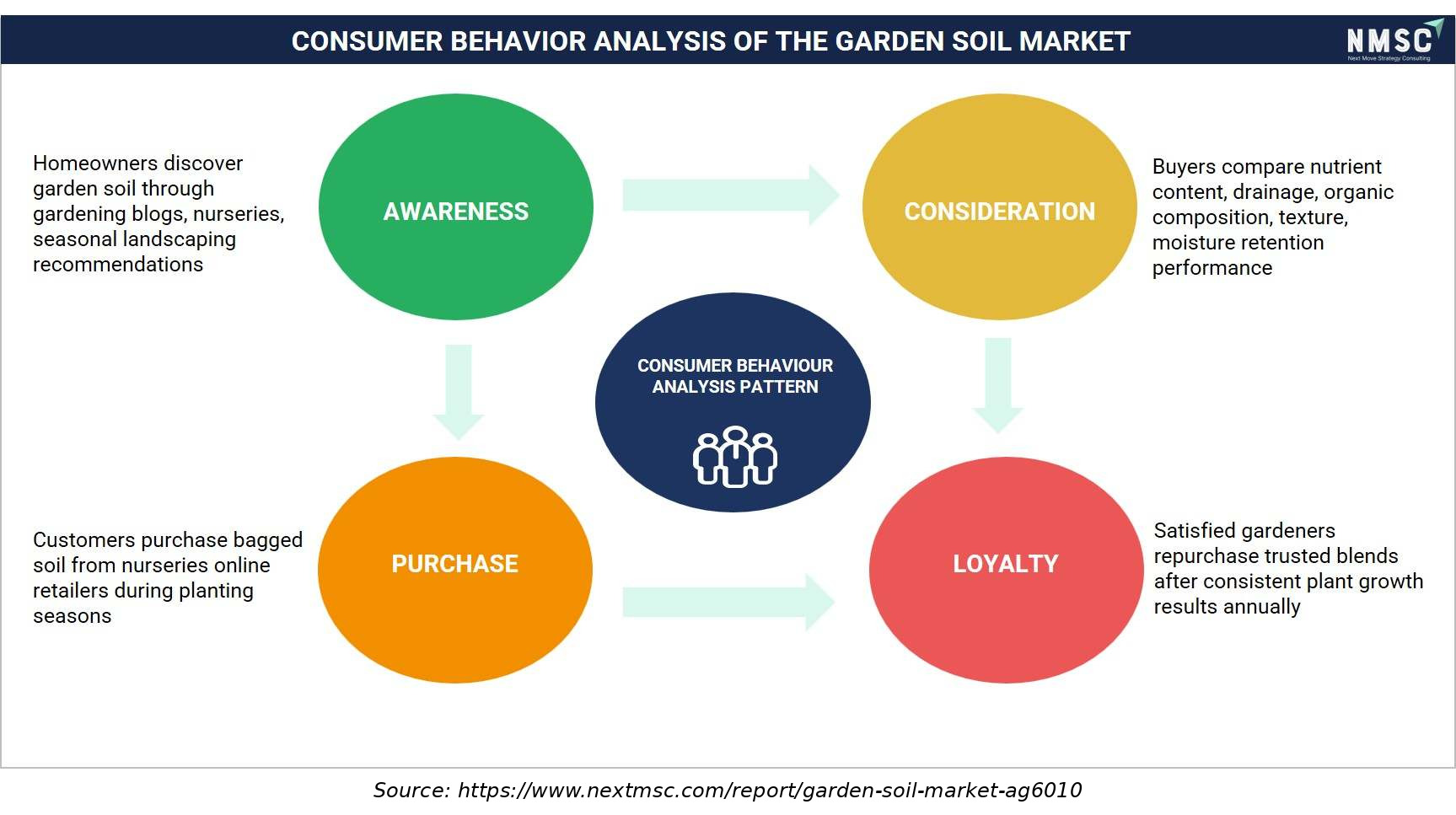
The image illustrates the consumer behavior journey in the market, highlighting four key stages: awareness, consideration, purchase, and loyalty. Consumers typically discover garden soil through gardening blogs, nurseries, and landscaping recommendations before evaluating product attributes such as nutrient content, drainage, texture, and moisture retention. Purchases are commonly made through nurseries or online retailers, while consistent product performance and healthy plant growth encourage repeat purchases, fostering long-term customer loyalty and brand preference.

Market Drivers & Dynamics

Interactive Dataset
Sustained home and urban gardening participation growth driver +2.2% North America, Europe 2026-2035
Rising raised bed and container gardening adoption driver +1.8% North America, Europe 2026-2035
Expanding commercial landscaping investment driver +1.4% Global 2026-2035
E-commerce distribution channel expansion driver +1.1% Global 2026-2032
Growing organic and edible gardening participation driver +0.9% North America, Europe 2026-2035
Peat extraction restrictions raising input costs restraint -1.0% Europe 2026-2032
High freight costs for bulky bagged soil products restraint -0.8% Global 2026-2032
Seasonal demand concentration limiting year-round revenue stability restraint -0.6% North America, Europe 2026-2035
Source: Next Move Strategy Consulting

Growth Drivers

What Is the Primary Growth Driver of the Garden Soil Market?

Sustained home and urban gardening participation growth is the primary driver of the market. The U.S. Department of Agriculture continues to report expanding participation in home food gardening and community garden programs nationwide. We observed that this participation growth, reinforced by rising raised bed and container gardening adoption, continues to anchor baseline consumption of potting soil and garden soil blends across developed and emerging economies alike.

How Is Raised Bed Gardening Adoption Driving Market Growth?

Rising raised bed and container gardening adoption is accelerating market growth toward specialized, higher-margin soil formulations. USDA urban agriculture programs support community gardens and other urban growing initiatives, indirectly supporting demand for soil and growing-media products used in these applications. Our assessment indicates that this program support, combined with rising suburban home gardening participation, is compressing adoption timelines for premium raised bed soil formulations among residential and community garden buyers.

Growth Inhibitors

What Is Restraining Garden Soil Market Expansion?

Peat extraction restrictions raise input costs across the garden soil supply chain in key European markets. Policy measures and industry commitments to reduce peat use are increasing pressure on manufacturers to diversify growing-media inputs and expand alternative formulations, which compresses manufacturers' access to traditional growing media inputs. We found that smaller regional producers face particular exposure, as limited scale reduces their ability to invest in alternative peat-free input sourcing compared with larger, diversified manufacturers with established coco coir supply chains.

What Are the Growth Opportunities?

How Can Peat-Free Formulations Unlock Value for Manufacturers?

Peat-free and coco coir-based formulations present a whitespace opportunity for manufacturers seeking to differentiate in sustainability-conscious European and North American markets. Suppliers that commercialize validated, performance-equivalent peat-free blends stand to capture recurring retail shelf space as regulatory pressure and consumer sustainability preference continue to compress conventional peat-based product demand.

Where Does Subscription-Based Replenishment Create New Demand?

Subscription-based replenishment models represent an underpenetrated opportunity for e-commerce-focused garden soil brands seeking recurring revenue. Providers that develop validated seasonal replenishment subscriptions can secure long-term consumer relationships, benefiting from predictable recurring revenue tied to expanding raised bed and container gardening adoption among suburban households.

How Can Professional Grower-Specific Blends Benefit Greenhouse Operators?

Professional growers and greenhouse operators seeking crop-specific formulations create an opportunity for manufacturers offering customized, high-performance soil blends. Early movers that secure direct supply relationships with commercial nurseries can differentiate with professional buyers pursuing consistent, batch-tested growing media for high-value crop production.

Segmentation Analysis

2025 (USD Billion)
2035 (USD Billion)
Potting Soil 2025: $1.64 Billion | 2035: $3.44 Billion
Potting Soil
Topsoil 2025: $1.06 Billion | 2035: $1.94 Billion
Topsoil
Garden Soil Blends 2025: $0.87 Billion | 2035: $2.15 Billion
Garden Soil
Raised Bed Soil 2025: $0.39 Billion | 2035: $1.40 Billion
Raised Bed S
Lawn and Turf Soil 2025: $0.58 Billion | 2035: $1.08 Billion
Lawn and Tur
Compost and Soil Amendments 2025: $0.29 Billion | 2035: $0.75 Billion
Compost and
Potting Soil $1.64 Billion $3.44 Billion 7.6%
Topsoil $1.06 Billion $1.94 Billion 5.9%
Garden Soil Blends $0.87 Billion $2.15 Billion 9.6%
Raised Bed Soil $0.39 Billion $1.40 Billion 14.3%
Lawn and Turf Soil $0.58 Billion $1.08 Billion 6.1%
Compost and Soil Amendments $0.29 Billion $0.75 Billion 10.2%

Which Product Type Segment Dominates the Garden Soil Market?

Potting Soil led the market with USD 1.64 billion in 2025, supported by near-universal use across container and indoor plant applications. We observed that Raised Bed Soil is the fastest-growing product type, expanding at a 14.3% CAGR from 2026 to 2035, as suburban and community gardeners increasingly adopt raised bed systems requiring specialized drainage-optimized formulations.

2025 (USD Billion)
2035 (USD Billion)
Home Improve
Mass Retail
Online/E-com
Nurseries an
Segment Item 2025 (USD Billion) 2035 (USD Billion) CAGR
Home Improvement and Garden Centers $10.0 USD Billion $40.0 USD Billion 25.0%
Mass Retail and Supermarkets $17.1 USD Billion $51.1 USD Billion 19.0%
Online/E-commerce $24.2 USD Billion $62.2 USD Billion 25.0%
Nurseries and Specialty Stores $31.3 USD Billion $73.3 USD Billion 19.0%

Segment-wise data is locked

Unlock complete segment-wise numbers for By Distribution Channel.

Unlock Full Data

Which Distribution Channel Leads Garden Soil Sales?

Home Improvement and Garden Centers remained the leading distribution channel, valued at USD 2.03 billion in 2025 on sustained consumer preference for in-person product selection and immediate pickup. Based on research conducted by Next Move Strategy Consulting, we found that Online/E-commerce is the fastest-growing channel at a 15.2% CAGR from 2026 to 2035, reflecting expanding lawn care services and direct-to-consumer subscription delivery adoption among time-constrained suburban gardeners.

2025 (USD Billion)
2035 (USD Billion)
Residential
Commercial L
Professional
Government a
Segment Item 2025 (USD Billion) 2035 (USD Billion) CAGR
Residential Home Gardening $10.0 USD Billion $40.0 USD Billion 26.0%
Commercial Landscaping $17.1 USD Billion $51.1 USD Billion 16.0%
Professional Growers and Greenhouses $24.2 USD Billion $62.2 USD Billion 18.0%
Government and Municipal $31.3 USD Billion $73.3 USD Billion 8.0%

Segment-wise data is locked

Unlock complete segment-wise numbers for By End User.

Unlock Full Data

Which End User Segment Leads Garden Soil Adoption?

Residential Home Gardening remained the leading end user segment, valued at USD 2.71 billion in 2025 on sustained suburban and urban household gardening participation. Our findings suggest that Professional Growers and Greenhouses is the fastest-growing segment, registering a 10.7% CAGR from 2026 to 2035, as commercial nurseries and greenhouse operators scale specialized soil procurement for high-value crop production.

Growth Opportunities

Our analysis shows that three forward-looking opportunities stand out for stakeholders positioning within the market over the 2026-2035 forecast period.

How Can Peat-Free Formulations Unlock Value for Manufacturers?

Peat-free and coco coir-based formulations present a whitespace opportunity for manufacturers seeking to differentiate in sustainability-conscious European and North American markets. Suppliers that commercialize validated, performance-equivalent peat-free blends stand to capture recurring retail shelf space as regulatory pressure and consumer sustainability preference continue to compress conventional peat-based product demand.

Where Does Subscription-Based Replenishment Create New Demand?

Subscription-based replenishment models represent an underpenetrated opportunity for e-commerce-focused garden soil brands seeking recurring revenue. Providers that develop validated seasonal replenishment subscriptions can secure long-term consumer relationships, benefiting from predictable recurring revenue tied to expanding raised bed and container gardening adoption among suburban households.

How Can Professional Grower-Specific Blends Benefit Greenhouse Operators?

Professional growers and greenhouse operators seeking crop-specific formulations create an opportunity for manufacturers offering customized, high-performance soil blends. Early movers that secure direct supply relationships with commercial nurseries can differentiate with professional buyers pursuing consistent, batch-tested growing media for high-value crop production.

PRICE POINT ANALYSIS OF THE GARDEN SOIL MARKET

PRICE POINT ANALYSIS OF THE GARDEN SOIL MARKET
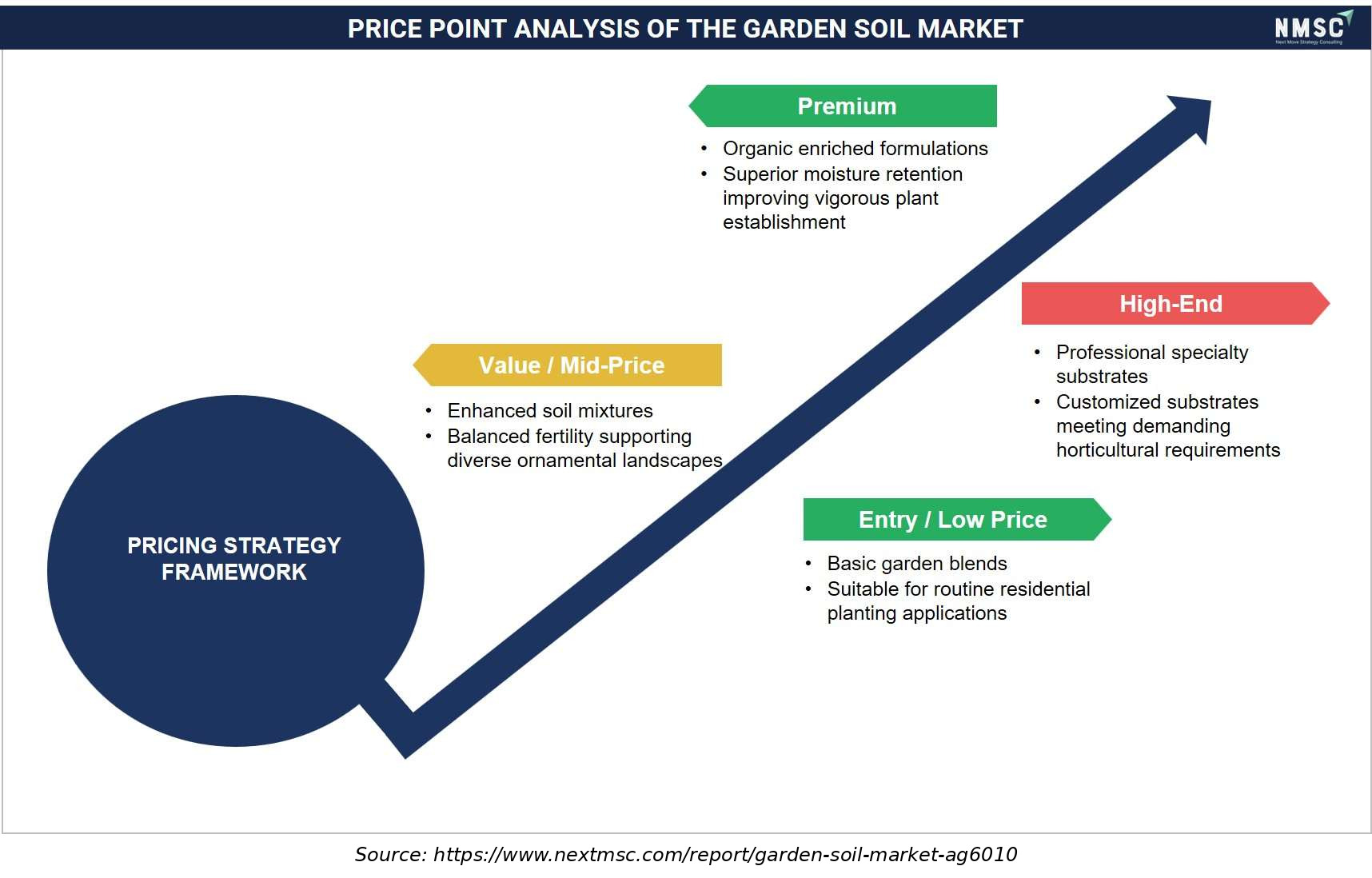
The image presents a price point analysis of the market, categorizing products into entry/low-price, value/mid-price, premium, and high-end segments. Pricing varies based on factors such as soil composition, organic certifications, nutrient enrichment, moisture retention, packaging size, and brand reputation. While entry-level products target budget-conscious gardeners, premium and high-end offerings emphasize superior performance, sustainability, and specialized formulations for professional growers and gardening enthusiasts.

Ecosystem Analysis

End Users

  • Residential Home Gardening
  • Commercial Landscaping
  • Professional Growers and Greenhouses
  • Government and Municipal

Regional Outlook

2025 (USD Billion)
2035 (USD Billion)
North Americ
Europe
Asia-Pacific
Middle East
Latin Americ
Region 2025 (USD Billion) 2035 (USD Billion) CAGR (%)
North America $10.0 USD Billion $40.0 USD Billion 9.0%
Europe $17.1 USD Billion $51.1 USD Billion 27.0%
Asia-Pacific $24.2 USD Billion $62.2 USD Billion 25.0%
Middle East & Africa $31.3 USD Billion $73.3 USD Billion 23.0%
Latin America $38.4 USD Billion $84.4 USD Billion 12.0%

Regional data is locked

Unlock complete regional numbers for this market.

Unlock Full Data

Competitive Landscape

We observed that the market remains moderately fragmented, with large national brands, regional specialty producers, and organic-focused manufacturers competing across overlapping segments of the value chain.

Dimension Description
Market Structure Moderately fragmented among top 10 national brands, with a long tail of regional and specialty organic producers
Innovation Focus Peat-free formulation, raised bed-specific blends, and organic certification
M&A Activity Acquisition of regional peat and compost producers to secure raw-material supply

How Do Companies Compete in the Garden Soil Market?

Companies compete primarily on brand recognition, retail shelf placement, and formulation differentiation within the market. We observed that vertically integrated producers combining raw-material sourcing with branded finished products can offer more competitive retail pricing than smaller regional blenders. Organic certification and peat-free labeling increasingly differentiate proposals in retail procurement, alongside consistent supply reliability for buyers seeking uninterrupted seasonal shelf stocking.

Which Competitive Archetypes Dominate the Garden Soil Industry?

Two archetypes dominate the garden soil industry: large national consumer brands with broad retail distribution, and specialized organic or regional producers concentrated in premium or sustainability-focused positioning. We found that the first group competes primarily on shelf presence and price, while the second differentiates through certified organic and peat-free formulations that command premium pricing, securing recurring purchases from sustainability-conscious gardeners willing to pay more for verified environmental credentials.

What Innovation and Differentiation Strategies Define Market Leaders?

Market leaders differentiate through peat-free formulation, raised bed-specific blends, and expanding direct-to-consumer lawn care products distribution. Our analysis shows that companies investing in coco coir and compost-based input sourcing are positioning to capture premium sustainability-focused retail accounts, while subscription-based e-commerce delivery increasingly forms a core part of competitive strategy across direct-to-consumer brands.

How Active Is M&A in the Garden Soil Market?

M&A activity remains moderate as manufacturers pursue acquisitions of regional peat and compost producers to secure diversified raw-material supply. We found that leading brands continue to acquire smaller specialty organic producers to expand premium product portfolios, while regional producers pursue distribution partnerships to enter new e-commerce and mass retail channels across Asia-Pacific and Latin America.

Key Market Players

We observed that the following companies represent the leading participants shaping the competitive structure of the garden soil market.

The Scotts Miracle-Gro Company Sun Gro Horticulture Canada Ltd. FoxFarm Soil & Fertilizer Company Espoma Company Kellogg Garden Products, Inc. Premier Tech Ltd. Jiffy Products International BV Klasmann-Deilmann GmbH COMPO GmbH ASB Greenworld Sdn. Bhd. Michigan Peat Company Lambert Peat Moss Inc. Rexius Forest By-Products, Inc. Gardener's Supply Company Berger Peat Moss Ltd. Profile Products LLC Proven Winners LLC Denali Water Solutions LLC Vermont Compost Company Coast of Maine Organic Products, Inc.

Latest Developments

Our assessment indicates that recent corporate activity reflects continued product innovation and distribution expansion across the market.

Date Event
July 2025 Premier Tech announced a strategic transaction to integrate Van der Knaap Group, a Dutch leader in growing media, organic fertilizers and rooting solutions, into its Growers and Consumers Group. The transaction strengthens Premier Tech's horticultural portfolio, particularly its coco substrate and coconut-fibre-based products, while expanding its global production footprint and market presence
October 2024 Denali launched ReCirculate™ Compost and Potting Soil, manufactured from recycled grocery food waste and announced nationwide retail availability beginning in 2025. The launch supports the growing demand for sustainable and circular-economy garden soil products.

Expert Insights

Peter Burks

Peter Burks

Chief Executive | Garden Centre Association (GCA)

"Garden centres are on the frontline of the transition to peat-free gardening. Staff are regularly asked for advice by customers who want to make the switch but aren't always sure where to start."

Analyst Interpretation

The statement highlights the accelerating shift toward sustainable garden soil products as consumers increasingly adopt peat-free gardening practices. Rising environmental awareness and government-backed sustainability initiatives are encouraging gardeners to choose eco-friendly soil formulations made from renewable materials such as compost, wood fibre, bark, and coconut coir. Consequently, manufacturers are expanding peat-free product portfolios, while garden centres play an increasingly important role in educating consumers and driving adoption. This trend is expected to stimulate innovation, strengthen premium product demand, and support long-term growth in the global market.

Investment Opportunities

Where Are Capital Inflows Concentrated in the Garden Soil Market?

Capital inflows are concentrated in peat-free input sourcing and raised bed-specific product line expansion. We observed that manufacturers and strategic investors are increasingly funding coco coir and compost processing capacity to reduce reliance on restricted peat sources, reflecting growing investor confidence in sustainably sourced garden soil as a durable, regulation-resilient product category.

How Significant Is Infrastructure Investment in Garden Soil Manufacturing?

Infrastructure investment in compost processing and bagging capacity is accelerating as manufacturers respond to rising e-commerce order volumes. Our findings suggest that European garden soil manufacturers are investing in regional distribution centers to reduce shipping costs for bulky soil products, supporting faster fulfilment for growing online order volumes.

What ESG Considerations Shape Garden Soil Investment?

Environmental, social, and governance considerations increasingly shape investment decisions, with investors favoring manufacturers that demonstrate verified sustainable sourcing of peat alternatives. We observed that compost and organic waste diversion partnerships are drawing heightened investor attention as a lever for reducing the environmental footprint of garden soil production, reflecting growing attention to circular sourcing across the horticultural products value chain.

Key Benefits for Stakeholders

How Does This Report Benefit Manufacturer and Industry Leaders?

Manufacturer and industry leaders gain access to segment-level revenue forecasts and product-type adoption trends that inform portfolio planning. Our analysis shows that the report's regional breakdowns support market-entry and capacity-expansion decisions, helping stakeholders align investment with the fastest-growing product types and distribution channels through 2035.

How Does This Report Benefit Investors and Financial Analysts?

Investors and financial analysts benefit from consolidated market-sizing data, competitive-landscape mapping, and CAGR-level growth drivers that support valuation and due-diligence work. We found that the report's country-level forecasts help identify markets with the strongest risk-adjusted return profiles, particularly across the fastest-growing Asia-Pacific and Latin America regions.

How Does This Report Benefit Retailers and Distribution Partners?

Retailers and distribution partners gain segmentation-level insight into distribution channel, end user, and product type preferences that inform shelf allocation and merchandising strategy. Our assessment indicates that the report's trend analysis highlights e-commerce and subscription-based replenishment as a high-growth adjacency, helping distribution partners align channel investment with the fastest-growing sub-segments identified in this market report.

Key Market Segments Evaluated

By Product Type

  • Potting Soil
  • Topsoil
  • Garden Soil Blends
  • Raised Bed Soil
  • Lawn and Turf Soil
  • Compost and Soil Amendments

By Distribution Channel

  • Home Improvement and Garden Centers
  • Mass Retail and Supermarkets
  • Online/E-commerce
  • Nurseries and Specialty Stores

By End User

  • Residential Home Gardening
  • Commercial Landscaping
  • Professional Growers and Greenhouses
  • Government and Municipal

By Region

  • North America 
    • U.S.
    • Canada
    • Mexico
  • Europe 
    • UK
    • Germany
    • France
    • Italy
    • Spain
    • Sweden
    • Denmark
    • Finland
    • Netherlands
    • Rest of Europe
  • Asia-Pacific 
    • China
    • India
    • Japan
    • South Korea
    • Taiwan
    • Indonesia
    • Vietnam
    • Australia
    • Philippines
    • Malaysia
    • Rest of APAC
  • Middle East & Africa 
    • Saudi Arabia
    • UAE
    • Egypt
    • Israel
    • Turkey
    • Nigeria
    • South Africa
    • Rest of MEA
  • Latin America 
    • Brazil
    • Argentina
    • Chile
    • Colombia
    • Rest of LATAM

Conclusion & Recommendations

The long-term outlook remains positive, with the market projected to grow from USD 5.25 billion in 2026 to USD 10.76 billion by 2035. We observed that this trajectory is underpinned by structural home gardening participation and raised bed adoption rather than short-term seasonal spending alone, positioning garden soil as durable consumer horticulture infrastructure through 2035 and beyond.

What Strategic Positioning Should Stakeholders Pursue?

Stakeholders should pursue differentiated positioning that combines peat-free formulation, raised bed-specific product lines, and expanding e-commerce fulfillment capability. Our analysis shows that manufacturers investing early in organic certification and diversified raw-material sourcing, spanning potting soil, raised bed, and compost categories, will be best positioned to capture premium retail and direct-to-consumer contract awards within the market.

How Attractive Is the Garden Soil Market for New Investment?

The garden soil industry presents an attractive investment case, supported by a USD 5.51 billion absolute dollar opportunity between 2026 and 2035 and above-average growth in Asia-Pacific and Latin America. We found that investment attractiveness is highest for manufacturers combining brand recognition with sustainability differentiation, positioning them to serve both cost-sensitive mass retail buyers and premium organic-focused segments simultaneously.

What Market Shifts and Key Risks Should Stakeholders Monitor?

Stakeholders should monitor peat extraction restrictions, high freight costs for bulky products, and seasonal demand concentration as key risks to the market. Our analysis shows that manufacturers unable to secure diversified peat-free input supply risk losing shelf space to competitors with established alternative sourcing, particularly as regulatory pressure accelerates across European markets through 2035.

What Are the Key Growth Pathways for the Garden Soil Market?

Key growth pathways include expanding peat-free and organic-certified product portfolios, scaling e-commerce fulfillment capability, and deepening penetration into professional grower and greenhouse buyer segments. Next Move Strategy Consulting's analysis indicates that manufacturers pursuing these pathways while maintaining cost competitiveness in core potting soil categories will be best positioned to capture the market's projected growth through 2035.

FAQs

About the Author

Mayurima Roy

Mayurima Roy

Mayurima Roy is Research Analyst at Next Move Strategy Consulting, where she has spent 4 years working across the firm's full industry coverage rather than a single fixed vertical. Her work centers on structured research, ongoing trend tracking, competitive assessment, and insight-led content development, translating complex market data into clear, decision-ready narratives that support informed client decision-making across diverse global industries, market sectors, and world regions every day.

About the Reviewer

Supradip Baul

Supradip Baul

Supradip Baul is an accomplished business consultant and strategist with over a decade of rich experience in market intelligence, strategy, technology, and business transformation. His work has included rigorous qualitative and quantitative analysis across multiple industries, helping clients shape investment decisions and long-term roadmaps. Earlier in his career, he was associated with Gartner, where he contributed to industry-leading reports and market share analyses. He has worked with leading global companies and holds an MBA with a dual specialization in Marketing and Finance.

Download Free Sample

Gaurav Jaiswal

GAURAV JAISWAL

Founder & CEO

Yano Charge Private Limited

The EV Charging market research report provided by the NextMSC was exceptionally detailed and insightful. It offered a comprehensive analysis that proved to be a game-changer for our strategic planning. Truly a testament to the NextMSC’s expertise and thoroughness in EV market landscape & analysis.

Robert Sean Trevino

ROBERT SEAN TREVINO

Sr. Director, Head of Strategic Insights & Analytics

Foundation Medicine

I realized that it was a reliable source of information. These days, there are many people who are looking for authentic data, and this is one of the only sources that can offer them with what they need;

Nishant Awate

NISHANT AWATE

Business Development Global Sales

Zehnder Group Deutschland GmbH

Our experience working with Next Move Strategy Consulting was positive. The team was responsive, professional, and open to incorporating our specific requirements throughout the project. The India AHU market study was comprehensive and well structured, covering market value and volume forecasts, product and application segments, and key industry trends. The inclusion of both AHU and residential MVHR market insights made the study particularly relevant for our strategic market assessment. Overall, the report provides a solid foundation for evaluating market potential, identifying priority segments, and supporting business-development decisions in India.

Melanie Samko

MELANIE SAMKO

Director of Marketing

TOSOH BIOSCIENCE, INC.

The information provided by NMSC is incredibly valuable, thank you so much for such a excellent work. I really appreciate it. I will make sure to reference all of it, in my summary document.

Mohit Agarwal

MOHIT AGARWAL

Chief Manager

DryChem India Pvt. Ltd.

Next Move Strategy Consulting is an amazing team of consultants. We required a market study report for our investors on top priority and the team went above and beyond our expectations to deliver the same with ample supporting data within a short time span enabling us to secure the investments and keep our project timeline maintained. Their professionalism, attention to detail, and timely delivery of actionable recommendations have left a lasting impression on our organization.

Custom Market Research Services

We will customize the research for you if the listed report does not fully match your requirements.

Get 30% Free Customization

Select License

This website uses cookies to ensure you get the best experience on our website. Learn more

✖