South Africa Aluminum Market By Type (Primary, Secondary, Scrap), By Product Type (Flat-Rolled, Casting, Extrusions, Forgings, Powder & Paste, Billets, Wire Rods, Foundry Alloys, Aluminum Silicon Alloy, Others), By Alloy Series (1xxx–7xxx), By Distribution Channel (OEM Direct, Distributors, Aftermarket, E-commerce, Scrap Traders), By End User (Transportation, Consumer Goods, Machinery & Equipment, Construction, Packaging, Electrical Engineering, Others) – Analysis & Forecast, 2025–2035
Industry: Materials and Chemical | Latest Edition: September 30, 2026 | No of Pages: 244 | No. of Tables: 122 | No. of Figures: 112 | Format: PDF | Report Code: MC4652
South Africa Aluminum Market Size & Forecast
|
Parameters |
Details |
|
Market Size in 2026 |
USD 3.28 Billion |
|
Revenue Forecast in 2035 |
USD 5.07 Billion |
|
Growth Rate |
CAGR of 4.94% from 2026 to 2035 |
|
Market Volume in 2026 |
1.39 Million Tons |
|
Volume Forecast in 2035 |
1.96 Million Tons |
|
Growth Rate |
CAGR of 3.85% from 2026 to 2035 |
|
Analysis Period |
2025–2035 |
|
Base Year Considered |
2025 |
|
Forecast Period |
2026–2035 |
|
Market Size Estimation |
Billion |
|
Companies Profiled |
15 |
|
Market Share |
Available for 10 companies |
Industry Outlook
The South Africa Aluminum Market size was valued at USD 2.91 billion in 2025 and is expected to reach USD 3.28 billion by 2026. Looking ahead, the industry is projected to expand significantly, reaching USD 5.07 billion by 2035, registering a CAGR of 4.94% from 2026 to 2035. In terms of volume, the market recorded 1.24 Million Tons in 2025, with forecasts indicating growth to 1.39 Million Tons by 2026 and further to 1.96 Million Tons by 2035, reflecting a CAGR of 3.85% over the same period.
What Are the Key Market Drivers, Breakthroughs, and Investment Opportunities That Will Shape the Aluminum Industry in the Next Decade?
Growth Catalyst & Risk Assessment Matrix
|
DRIVERS / TRENDS / RESTRAINTS |
(+/–) % IMPACT ON CAGR FORECAST |
GEOGRAPHIC RELEVANCE |
IMPACT TIMELINE |
|
Mining expansion strengthening upstream aluminium feedstock availability and refining integration |
+1.8% |
Gauteng, Limpopo, Northern Cape, industrial mining corridors |
Medium term (2–5 years) |
|
Construction and packaging demand driving aluminium use in structural and consumer applications |
+1.7% |
Johannesburg, Cape Town, Durban, Pretoria, nationwide urban centers |
Short to medium term (1–4 years) |
|
Industrial manufacturing and automotive demand increasing aluminium adoption in engineered and lightweight components |
+1.6% |
Gauteng industrial belt, Eastern Cape automotive clusters, KwaZulu-Natal hubs |
Medium term (2–5 years) |
|
Political and economic uncertainty affecting investment stability and capacity expansion |
-1.9% |
Nationwide industrial and mining regions |
Short to medium term (1–3 years) |
|
Energy reliability improvements and industrial integration supporting long-term aluminium production growth |
+1.5% |
National grid zones, Gauteng, Northern Cape energy-linked regions |
Medium to long term (3–7 years) |
The South Africa aluminum market is shaped by a complex balance of strong demand drivers and persistent structural constraints across the value chain. Mining-linked upstream activity supports raw material availability, while construction, packaging, and industrial manufacturing continue to reinforce steady aluminum consumption. However, competitive intensity remains high due to global import pressure and strong bargaining power from key end-use sectors. Additionally, our analysis indicates that energy dependency and policy uncertainty create cost volatility and investment hesitation, which together limit smooth capacity expansion and operational stability across the industry landscape.
Furthermore, our evaluation shows that the market is gradually transitioning toward a more technology-driven and sustainability-focused structure, supported by automation, energy-efficient processing, and stricter environmental regulations. While electricity constraints and economic uncertainty continue to challenge production efficiency, long-term potential is being shaped by reforms in energy systems and improved alignment with resource availability. Consequently, downstream fabrication and value-added manufacturing are expected to gain greater importance, strengthening industrial integration and resilience across the market.
Growth Drivers:
How Are Growing Mining Activities Driving Raw Aluminum Production in the Market?
Expanding mining-linked upstream activities are strengthening the availability of raw aluminum inputs, particularly as extraction ecosystems become more closely integrated with processing requirements. Our analysis indicates that the South Africa aluminum market benefits from improved alignment between mineral sourcing and early-stage refinement, which enhances feedstock stability for downstream conversion. Additionally, resource-driven industrial clustering supports smoother material flow across production stages, reducing dependency gaps and improving operational continuity within primary aluminum-related activities.
How Is Demand Construction and Packaging Sectors Driving Aluminum Market Expanding?
Our evaluation shows that rising construction activity and increasing packaging requirements are significantly reinforcing aluminum consumption across structural and consumer-oriented applications. The market is experiencing stronger uptake in building systems, architectural applications, and flexible packaging formats due to aluminum’s lightweight and protective characteristics. Furthermore, growing urbanization and evolving consumption patterns are encouraging wider adoption of recyclable and durable material solutions across commercial and residential developments.
How Is Industrial Manufacturing and Automotive Demand Strengthening the Market?
Industrial manufacturing and transport-oriented sectors are accelerating the use of aluminum in engineered components, structural assemblies, and lightweight applications. The South Africa aluminum market is increasingly influenced by efficiency-focused design shifts where durability and weight reduction remain central priorities. Moreover, our observation highlights that broader industrial modernization trends are encouraging substitution toward advanced aluminum applications across mechanical systems, supporting improved performance and operational efficiency.
Growth Inhibitor:
How Are Political and Economic Uncertainties Affecting Development in the Market?
Our assessment confirms that ongoing political and economic fluctuations are creating uneven conditions for investment planning and long-term capacity expansion across the value chain. Within the South African aluminum market, uncertainty in policy direction and macroeconomic stability affects capital deployment decisions, particularly in energy-intensive production environments. Consequently, this results in cautious expansion behavior and delayed modernisation efforts across both upstream and downstream segments.
Furthermore, our scrutiny reveals that exchange rate volatility and regulatory unpredictability further complicate operational consistency, affecting procurement planning and cost structures across the ecosystem. The market consequently experiences pressure on margins and reduced long-term visibility for industrial stakeholders, limiting the pace of technological advancement and integrated capacity development across production networks.
Growth Opportunity:
How Will Energy Reforms and Value-Added Manufacturing Shape the Future of the South Africa Aluminum Market?
Improving alignment between resource availability and energy system reforms will play a central role in strengthening primary aluminum production capabilities. Our research indicates that the South Africa aluminum market is positioned to benefit from enhanced energy reliability and efficiency-driven reforms that support more stable and cost-effective production environments. In addition, greater integration of upstream material access with industrial processing systems is expected to improve supply continuity and operational resilience.
Moreover, our strategic review shows that downstream industrial expansion, supported by energy improvements and localized processing development, will shape the next phase of structural growth. The market is gradually evolving toward more value-added fabrication and component manufacturing, where improved infrastructure and industrial coordination enhance productivity. Consequently, this shift supports diversification across construction, transport, and packaging applications, thereby strengthening long-term industrial adaptability.
Porter’s Five Forces Analysis of the South Africa Aluminum Market
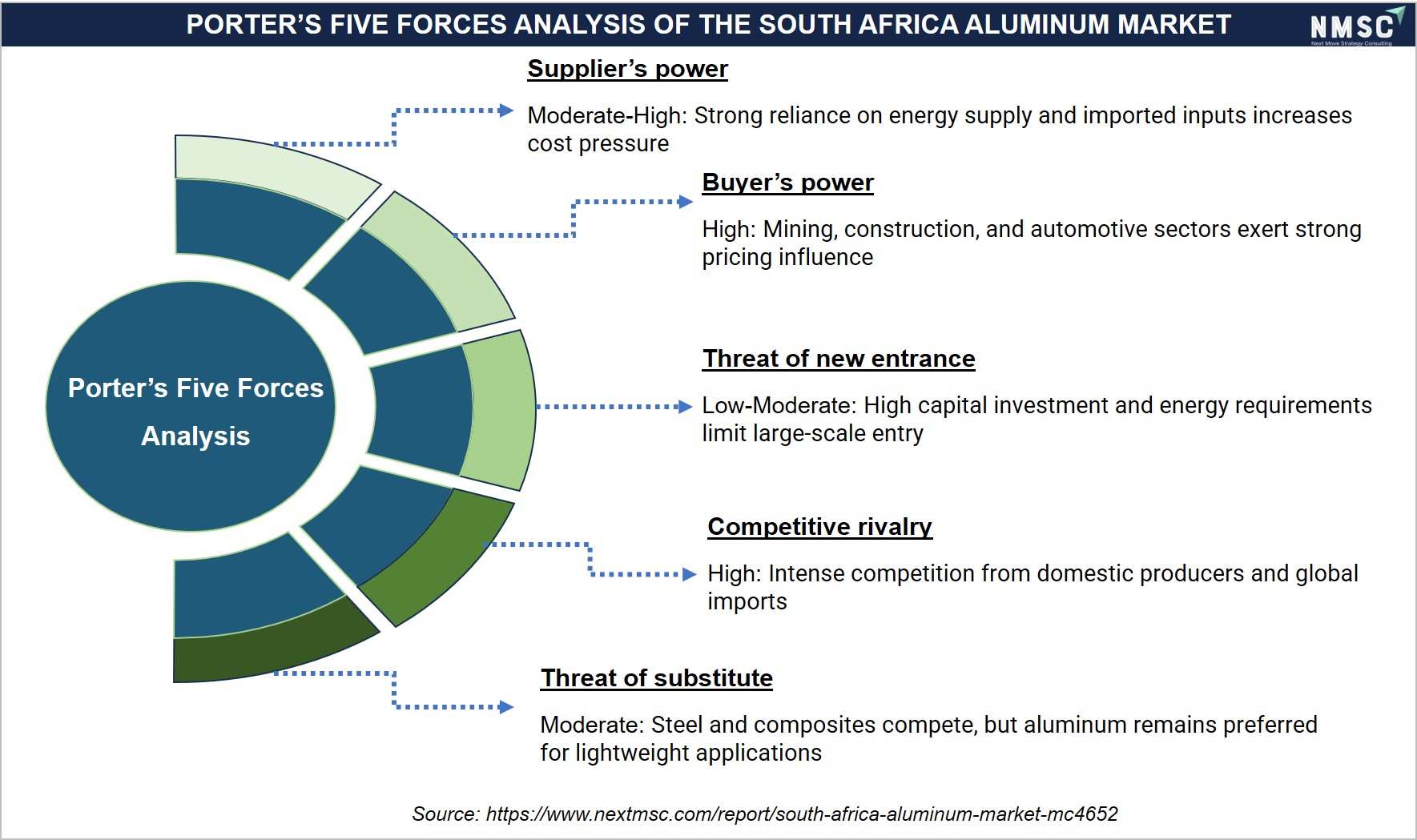
Our analysis indicates that the South Africa aluminum market operates in a highly competitive environment where profitability is shaped by strong external pressures from both suppliers and buyers. Energy dependence and imported inputs increase supplier influence, while major demand sectors such as mining, construction, and automotive reinforce buyer dominance. Additionally, intense rivalry between domestic producers and global imports sustains pricing pressure, although moderate substitution threats and high entry barriers provide partial stability. Consequently, our evaluation shows that the market remains structurally constrained, yet resilient due to aluminum’s industrial advantages.
How Is the South Africa Aluminum Market Segmented in This Report, and What Are the Key Insights from the Segmentation Analysis?
By Alloy Series
How Do Alloy Classifications Shape Application Efficiency in The South Africa Aluminum Market?
The aluminum market by alloy series includes 1xxx Series, 2xxx Series, 3xxx Series, 4xxx Series, 5xxx Series, 6xxx Series, and 7xxx Series, representing a structured classification of aluminum based on purity levels, mechanical strength, corrosion resistance, and fabrication suitability across industrial applications.
1xxx Series is associated with high-purity aluminum grades, while 6xxx Series is widely used for structural and extruded applications in engineering and construction sectors. 3xxx Series is commonly linked with forming-oriented applications such as sheets, panels, and general-purpose fabrication where moderate strength is required. Additionally, 5xxx Series is selected for marine and corrosion-exposed environments due to its resistance properties, whereas 2xxx Series and 7xxx Series are aligned with high-strength aerospace and engineering applications. Moreover, 4xxx Series serves niche applications such as welding fillers and thermal-related uses. Our expert analysis indicates that procurement trends increasingly reflect requirements for alloy certification, temper consistency, and fabrication compatibility, therefore influencing how processors, OEMs, and industrial buyers select alloy grades across the market.
By Distribution Channel
How Do Distribution Channels Influence Procurement Dynamics in the South Africa Aluminum Market?
The aluminum market by distribution channel includes OEM Direct, Distributors, Aftermarket, E-commerce, and Scrap Traders, reflecting multiple procurement pathways that connect producers, processors, service providers, and recycling networks across the value chain.
OEM Direct channels typically support large-volume, specification-driven contracts, while Distributors provide diversified inventory access and flexible order fulfillment for varied industrial users. Distributors are widely used by buyers seeking shorter lead times, multi-product availability, and reduced dependency on direct mill sourcing. Aftermarket channels support replacement demand in automotive, machinery, and construction-related installations where continuity of operations influences purchasing timing. Furthermore, our research suggests that e-commerce platforms are gradually supporting standardized transactions, repeat ordering, and price transparency for smaller procurement cycles. Scrap Traders play a critical role in supplying recyclable aluminum feedstock to secondary processors and remelting units. Procurement behavior increasingly depends on pricing stability, logistics efficiency, credit terms, and supply assurance, thus shaping how each distribution channel is utilized across the market.
Competitive Landscape
Based on NMSC’s assessment of the South African aluminium industry, the competitive structure is defined by a blend of upstream mining interests, primary aluminium production, extrusion specialists, die-casting firms, and global façade system providers aligned with diversified industrial demand. Companies such as South32 Limited and Hulamin Limited form the backbone of upstream and semi-finished aluminium production, supporting downstream supply for packaging, automotive, and construction applications. Extrusion and fabrication capacity is strengthened by Wispeco (Pty) Ltd, Zimalco (Pty) Ltd, and Wahl Industries (Pty) Ltd, while die-casting and precision engineering segments are supported by AG Die Casting (Pty) Ltd, Pressure Die Castings (Pty) Ltd, Imritec (Pty) Ltd, Copalcor (Pty) Ltd, and KPL Die Casting (Pty) Ltd. Additionally, packaging and flexible materials players such as Nampak Limited and Constantia Flexibles Group GmbH expand aluminium usage across consumer goods, while international system providers like Schüco International KG and Reynaers Aluminium NV enhance façade and architectural solution integration. Overall, the South African aluminium sector reflects a moderately integrated industrial ecosystem supported by mining strength, diversified downstream manufacturing, and growing alignment with construction, packaging, and engineering demand.
Strategic Developments:
-
October 2025 – South32 reported that its Hillside Aluminium smelter in Richards Bay maintained steady production of about 181,000 tonnes while continuing to operate near its maximum technical capacity. The update highlights ongoing operational stability despite energy constraints, with full-year guidance unchanged at 720,000 tonnes. This reflects sustained resilience in South Africa’s primary aluminium supply chain.
Pestel Analysis of The South Africa Aluminum Market:
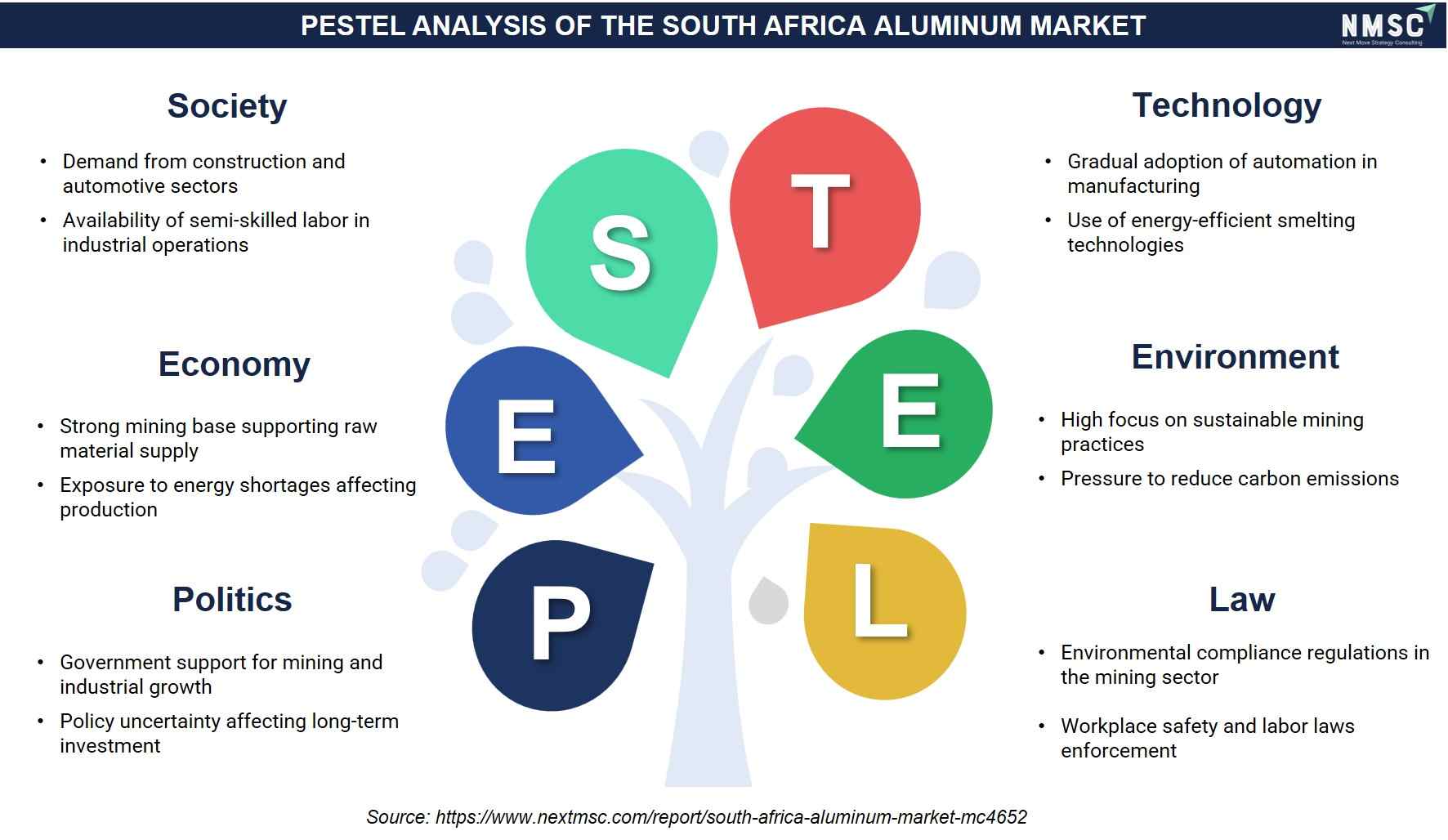
The South Africa aluminum market is shaped by a mixed macro-environment where strong mining fundamentals and industrial demand coexist with structural constraints. Political support for mining and industrial growth is evident, however policy uncertainty continues to affect long-term investment confidence. Moreover, our research demonstrates that economic pressures such as energy shortages limit production efficiency, while technological shifts toward automation and energy-efficient smelting are improving competitiveness. Environmental compliance and strict legal frameworks are also intensifying sustainability expectations. Consequently, the market is steadily transitioning toward a more efficient, regulated, and low-carbon industrial structure.
Key Players
-
South32 Limited
-
Schüco International KG
-
Reynaers Aluminium NV
-
Hulamin Limited
-
Wispeco (Pty) Ltd
-
Nampak Limited
-
Constantia Flexibles Group GmbH
-
Zimalco (Pty) Ltd
-
Wahl Industries (Pty) Ltd
-
Imritec (Pty) Ltd
-
AG Die Casting (Pty) Ltd
-
Pressure Die Castings (Pty) Ltd
-
Copalcor (Pty) Ltd
-
KPL Die Casting (Pty) Ltd
-
Company 15
Our analysis indicates that competitive dynamics in the South Africa aluminum market are increasingly shaped by production efficiency, low-carbon manufacturing capabilities, and value-added downstream product innovation rather than primary metal capacity alone. We observe that leading suppliers are actively investing in recycling infrastructure, advanced rolling and extrusion technologies, and energy-efficient smelting processes to address rising demand for sustainable and lightweight materials across transportation, construction, packaging, and aerospace applications. The growing preference for recycled and secondary aluminum, in our view, reflects end-user focus on cost optimization, emission reduction, and circular supply chain strategies.
We also identified that market leaders are strengthening their positions through domestic capacity expansions, localized supply chains, and long-term contracts with automotive, beverage packaging, and industrial customers. These strategies enable stronger market penetration while reducing exposure to import volatility, logistics disruptions, and trade policy uncertainty. Overall, we expect sustained investment in recycling capacity, fabrication technologies, and customer-specific alloy development to remain the key determinant of competitive positioning in the South Africa aluminum market.
South Africa Aluminum Market Key Segments
By Type
-
Primary Aluminum
-
Secondary (Recycled) Aluminum
-
Industrial Scrap
-
Post-Consumer Scrap
-
Remelted Secondary Production
-
By Product Form
-
Flat-Rolled
-
Sheet
-
Coil
-
Plate
-
Foil
-
Can-Stock
-
-
Casting
-
Extrusions
-
Profiles
-
Tubes & Pipes
-
-
Forgings
-
Powder & Paste
-
Billets
-
Wire Rods
-
Foundry Alloys
-
Aluminium Silicon (AlSi) Alloy
-
Other Products
By Alloy Series
-
1xxx Series
-
2xxx Series
-
3xxx Series
-
4xxx Series
-
5xxx Series
-
6xxx Series
-
7xxx Series
By Distribution Channel
-
OEM Direct
-
Distributors
-
Aftermarket
-
E-commerce
-
Scrap Traders
By End User
-
Transportation
-
Aerospace
-
Automotive
-
Marine
-
Rail
-
-
Consumer Goods
-
Machinery & Equipment
-
Construction
-
Packaging
-
Food & Beverage
-
Cosmetics
-
Others
-
-
Electrical Engineering
-
Other End Users
Key Benefits for Stakeholders:
Next Move Strategy Consulting (NMSC) presents a comprehensive analysis of the South Africa aluminum market, covering historical developments from 2020 to 2025 and providing forward-looking forecasts through 2035. The study assesses the market at regional levels, combining quantitative market sizing with qualitative insights into key growth drivers, supply-demand dynamics, pricing trends, sustainability transitions, technology evolution, and investment activity across major aluminum product categories and end-use industries.
From our analysis, the South Africa aluminum market delivers strong value across the industrial ecosystem. Manufacturers benefit from lightweight, durable, and recyclable materials that improve product performance and production efficiency. Investors gain exposure to long-term growth supported by infrastructure development, electric vehicle expansion, packaging demand, and rising adoption of recycled aluminum. Fabricators, processors, and technology providers benefit from recurring opportunities through value-added product development, recycling capacity expansion, and long-term supply agreements. Overall, the market supports industrial competitiveness, supply chain resilience, and South Africa’s broader manufacturing transformation, reinforcing its strategic importance in the country’s industrial landscape.
|
Parameters |
Details |
|
Customization Scope |
Free customization (equivalent to up to 80 analyst-working hours) after purchase. |
|
Pricing and Purchase Options |
Avail customized purchase options to meet your exact research needs. |
|
Approach |
In-depth primary and secondary research; proprietary databases; rigorous quality control and validation measures. |
|
Analytical Tools |
Porter's Five Forces, SWOT, value chain, and Harvey ball analysis to assess competitive intensity, stakeholder roles, and relative impact of key factors. |
About the Author
 Tushmi Dutta
— Tushmi Dutta is a focused researcher specializing in detailed analysis and insight-driven research across diverse business landscapes. She supports strategic initiatives through structured data interpretation, thorough validation, and clear communication of findings that aid informed decision-making. With a strong interest in writing, she enjoys presenting research insights in an engaging and accessible manner. Beyond work, she enjoys traveling, reading, painting, and continuously learning new skills that contribute to her creative and professional growth.
Tushmi Dutta
— Tushmi Dutta is a focused researcher specializing in detailed analysis and insight-driven research across diverse business landscapes. She supports strategic initiatives through structured data interpretation, thorough validation, and clear communication of findings that aid informed decision-making. With a strong interest in writing, she enjoys presenting research insights in an engaging and accessible manner. Beyond work, she enjoys traveling, reading, painting, and continuously learning new skills that contribute to her creative and professional growth.
About the Reviewer
 Supradip Baul
— Supradip Baul is an accomplished business consultant and strategist with over a decade of rich experience in market intelligence, strategy, technology, and business transformation. His work has included rigorous qualitative and quantitative analysis across multiple industries, helping clients shape investment decisions and long-term roadmaps. Earlier in his career, he was associated with Gartner, where he contributed to industry-leading reports and market share analyses. He has worked with leading global companies and holds an MBA with a dual specialization in Marketing and Finance.
Supradip Baul
— Supradip Baul is an accomplished business consultant and strategist with over a decade of rich experience in market intelligence, strategy, technology, and business transformation. His work has included rigorous qualitative and quantitative analysis across multiple industries, helping clients shape investment decisions and long-term roadmaps. Earlier in his career, he was associated with Gartner, where he contributed to industry-leading reports and market share analyses. He has worked with leading global companies and holds an MBA with a dual specialization in Marketing and Finance.
At Next Move Strategy Consulting, we understand that insightful market research is the cornerstone of successful business decisions. That's why we employ a robust and multifaceted approach, combining various methodologies to deliver the most accurate and actionable data for our clients.

Research Landscape
We navigate the world of research with two primary approaches:
Qualitative Approach
Our qualitative research methodologies involve immersive techniques such as in-depth interviews, focus groups, and observational studies. By engaging directly with individuals and stakeholders, we uncover valuable insights that quantitative data alone may overlook.

Quantitative Research
In tandem with qualitative methodologies, NMSC leverages the power of Quantitative Research to provide a robust foundation of numerical insights. Through systematic data collection and analysis, we quantify patterns, preferences, and market trends, offering a comprehensive view of the business landscape.
Our quantitative research approach employs diverse tools, including surveys, experiments, and statistical modelling. These methodologies enable us to gather data from a large and representative sample, ensuring the statistical significance of our findings. By employing structured questionnaires and standardized data collection methods, we guarantee the reliability and validity of the information we present to our clients.
Quantitative research is particularly effective in measuring the prevalence of trends, assessing market size, and gauging the impact of various factors on consumer behavior. The numerical precision attained through this approach equips our clients with actionable insights, facilitating data-driven decision-making and strategy formulation.


Our Specialized Toolbox for Industry-Specific Market Research
We deploy a specialized arsenal of techniques tailored to meet your unique requirements. Here's a glimpse into our comprehensive toolbox:

Information Procurement
The stage entails acquiring market data or relevant information through various sources and methodologies.


Market Research Approach
We utilize both top-down and bottom-up approaches in market research analysis to achieve a comprehensive understanding of the market dynamics, leveraging the broad perspective of industry trends and macroeconomic factors alongside detailed insights from specific segments and individual companies.

Porters Five Forces Analysis
We conduct Porter's Five Forces analysis to evaluate the competitive landscape of an industry, providing us with insights into factors that affect profitability and strategic positioning.

SWOT Analysis

Forecasting
We utilize a forecasting model to predict future consumption by considering parameters like population, economics, regulations, market competition, drivers, constraints, technology, and pricing. We also employ statistical techniques such as multilinear regression, exponential smoothing, moving average, ARIMA, and Monte Carlo simulations for accurate predictions. In econometric forecasting, we analyzed short-term and long-term event impacts, attributing values based on regulatory frameworks, economic factors, and market events.





 Speak to Our Analyst