South Korea GaN Charger Market By Power Output (Up to 30W, 31W to 65W, 66W to 100W, and Above 100W), By Product Type (Wall Chargers, Desktop Chargers, Power Banks, and Car Chargers), By Device Compatibility (Smartphones, Tablets, Laptops, Multi-device, and Other Electronics), By Number of Ports (Single Port, Dual Port, and More than 2 Ports), By Sales Channel (Online and Offline), By End User (Consumer, Commercial, and Industrial) – Opportunity Analysis and Industry Forecast, 2025–2035
Industry: Semiconductor & Electronics | Latest Edition: September 30, 2026 | No of Pages: 175 | No. of Tables: 72 | No. of Figures: 60 | Format: PDF | Report Code: SE1398
South Korea GaN Charger Market Size & Forecast 2025–2035
|
Parameters |
Details |
|
Market Size in 2025 |
USD 45.0 Million |
|
Market Size in 2026 |
USD 62.4 Million |
|
Revenue Forecast in 2035 |
USD 435.5 Million |
|
Growth Rate |
CAGR of 24.09% from 2026 to 2035 |
|
Market Volume in 2025 |
1 Million Units |
|
Market Volume in 2026 |
2 Million Units |
|
Volume Forecast in 2035 |
12 Million Units |
|
Growth Rate |
CAGR of 26.12% from 2026 to 2035 |
|
Analysis Period |
2025–2035 |
|
Base Year Considered |
2025 |
|
Forecast Period |
2026–2035 |
|
Market Size Estimation |
Million (USD) |
|
Companies Profiled |
13 |
|
Market Share |
Available for 10 Companies |
Industry Outlook
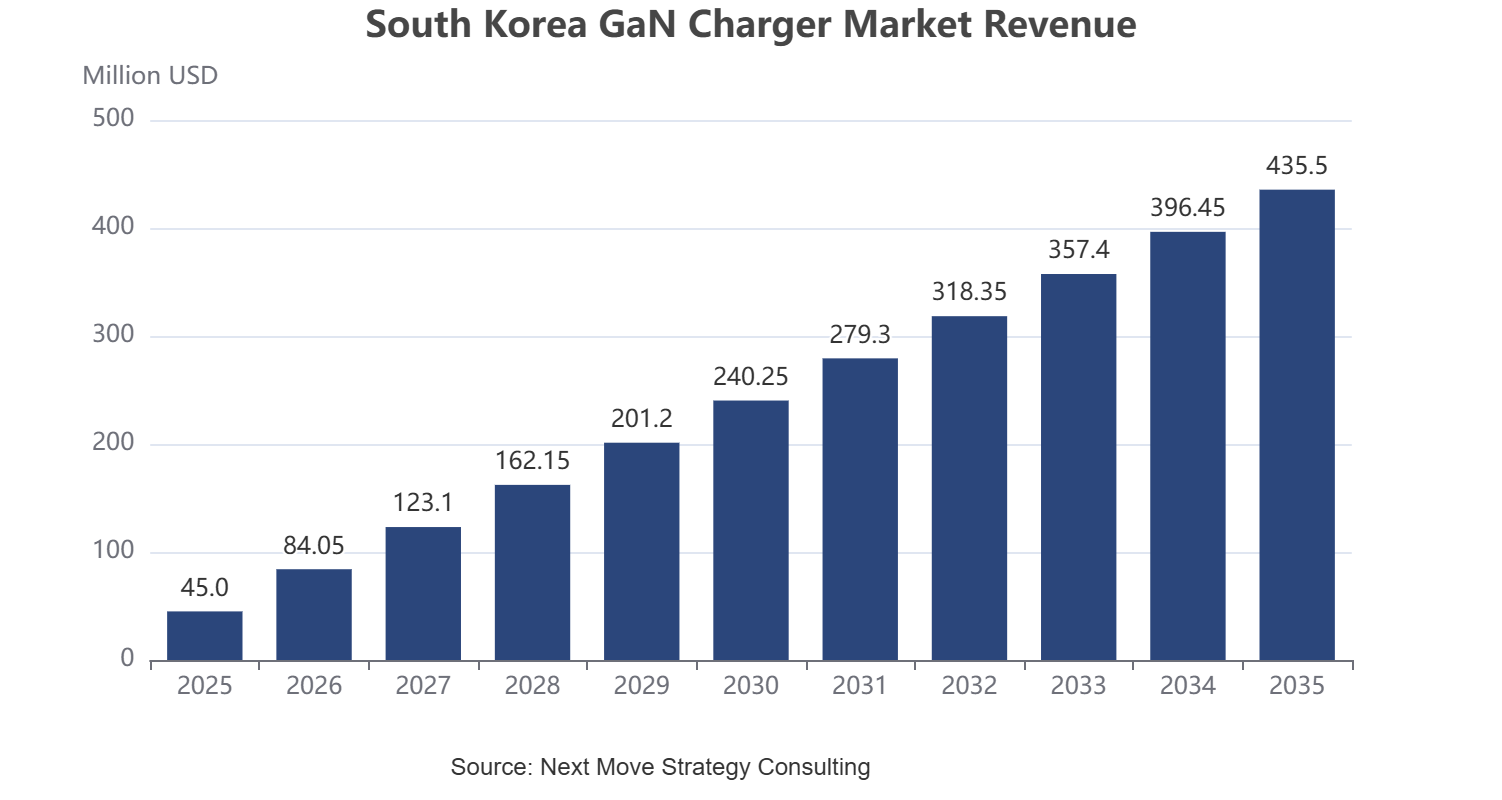
The South Korea GaN Charger Market was valued at USD 45.0 million in 2025 and reached USD 62.4 million in 2026. Looking ahead, the market is projected to experience strong growth, reaching USD 435.5 million by 2035, registering a CAGR of 24.09% from 2026 to 2035. In terms of volume, the market recorded 1 million units in 2025, with forecasts indicating growth to 2 million units by 2026 and further to 12 million units by 2035, reflecting a CAGR of 26.12% over the same period.
What Are the Key Market Drivers, Emerging Trends, and Investment Opportunities That Will Shape the South Korea GaN Charger Market in the Next Decade?
Growth Catalyst & Risk Assessment Matrix
|
Drivers / Trends / Restraints |
(+/-) % Impact on CAGR Forecast |
Geographic Relevance |
Impact Timeline |
|
Exceptionally high smartphone and laptop penetration combined with strong consumer purchasing power is accelerating demand for premium GaN chargers |
+2.4% |
Seoul, Busan, Incheon, Nationwide |
Short to medium term (1-5 years) |
|
Advanced domestic semiconductor manufacturing ecosystem is strengthening local GaN component supply chains and accelerating product innovation |
+2.0% |
Gyeonggi-do, Seoul, Nationwide |
Medium term (2-7 years) |
|
Rising ownership of multiple connected devices among consumers is fueling demand for multi-port GaN chargers across South Korea |
+1.7% |
Nationwide, Urban Centers |
Medium to long term (3-8 years) |
|
Market saturation and intense price competition among established electronics brands are compressing margins and limiting differentiation |
-1.6% |
Nationwide |
Short to medium term (1-5 years) |
|
Rising demand for multi-device charging and strong export potential leveraging semiconductor expertise are creating new growth opportunities |
+1.8% |
Nationwide, Global Export Markets |
Long term (4-10 years) |
Through our market assessment, we observed that the South Korea GaN Charger Market is experiencing significant growth, driven by high smartphone and laptop penetration, strong domestic semiconductor manufacturing capabilities, and rising consumer preference for compact, fast-charging accessories. However, market saturation and intense price competition among established electronics brands continue to restrain broader differentiation opportunities. At the same time, growing demand for multi-device charging solutions and expanding export opportunities are expected to create substantial long-term growth prospects for GaN charger manufacturers across South Korea.
Growth Drivers
How Is High Smartphone and Laptop Penetration Driving the South Korea GaN Charger Market?
Our market assessment indicates that South Korea's exceptionally high smartphone and laptop penetration, combined with strong consumer purchasing power, is a major factor driving demand for GaN chargers. Tech-savvy South Korean consumers increasingly prefer compact, high-wattage chargers capable of powering multiple premium devices simultaneously. GaN technology enables faster charging speeds, reduced heat generation, and superior power efficiency, positioning it as a preferred alternative to conventional silicon-based chargers across the country's highly digitalized consumer electronics market.
How Is South Korea's Domestic Semiconductor Manufacturing Base Fueling Market Growth?
Based on our market evaluation, South Korea's advanced domestic semiconductor manufacturing ecosystem, anchored by leading global chipmakers, is strengthening local GaN component supply chains and accelerating product innovation. This robust manufacturing base enables faster commercialization of next-generation GaN charging technologies and supports close collaboration between semiconductor producers and consumer electronics brands. The resulting innovation pipeline is helping domestic and international charger manufacturers introduce higher-performance products more rapidly across the South Korean market.
How Is Rising Multi-Device Ownership Supporting Market Development Across South Korea?
According to NMSC research, rising ownership of multiple connected devices, including smartphones, tablets, laptops, and wearables, among South Korean consumers is fueling demand for multi-port GaN chargers capable of charging several devices simultaneously. This trend is particularly strong among younger, urban consumers who prioritize convenience and desk or travel space efficiency. Growing adoption of remote work and hybrid lifestyles is further reinforcing demand for versatile, high-wattage charging accessories across South Korea.
Growth Inhibitor:
How Does Market Saturation and Price Competition Restrain Market Growth?
Despite strong growth prospects, the market continues to face challenges related to market saturation and intense price competition among a large number of established domestic and international electronics brands. Through our market analysis, we observed that this competitive intensity is compressing profit margins and making product differentiation increasingly difficult for manufacturers. Additionally, the market's maturity means volume growth is comparatively more moderate than in emerging Asian economies with lower existing GaN charger penetration.
Growth Opportunity:
How Are Multi-Device Demand and Export Potential Creating New Growth Opportunities?
Through NMSC's assessment, we found that rising consumer demand for multi-device charging solutions, coupled with South Korea's strong position as a technology export hub, is creating significant opportunities for GaN charger manufacturers. Growing adoption of premium, high-wattage chargers among gamers, content creators, and remote professionals is expanding the addressable market. Furthermore, South Korean manufacturers are well positioned to leverage domestic semiconductor expertise to expand GaN charger exports across global markets, generating long-term opportunities.
SWOT ANALYSIS OF THE SOUTH KOREA GAN CHARGER MARKET
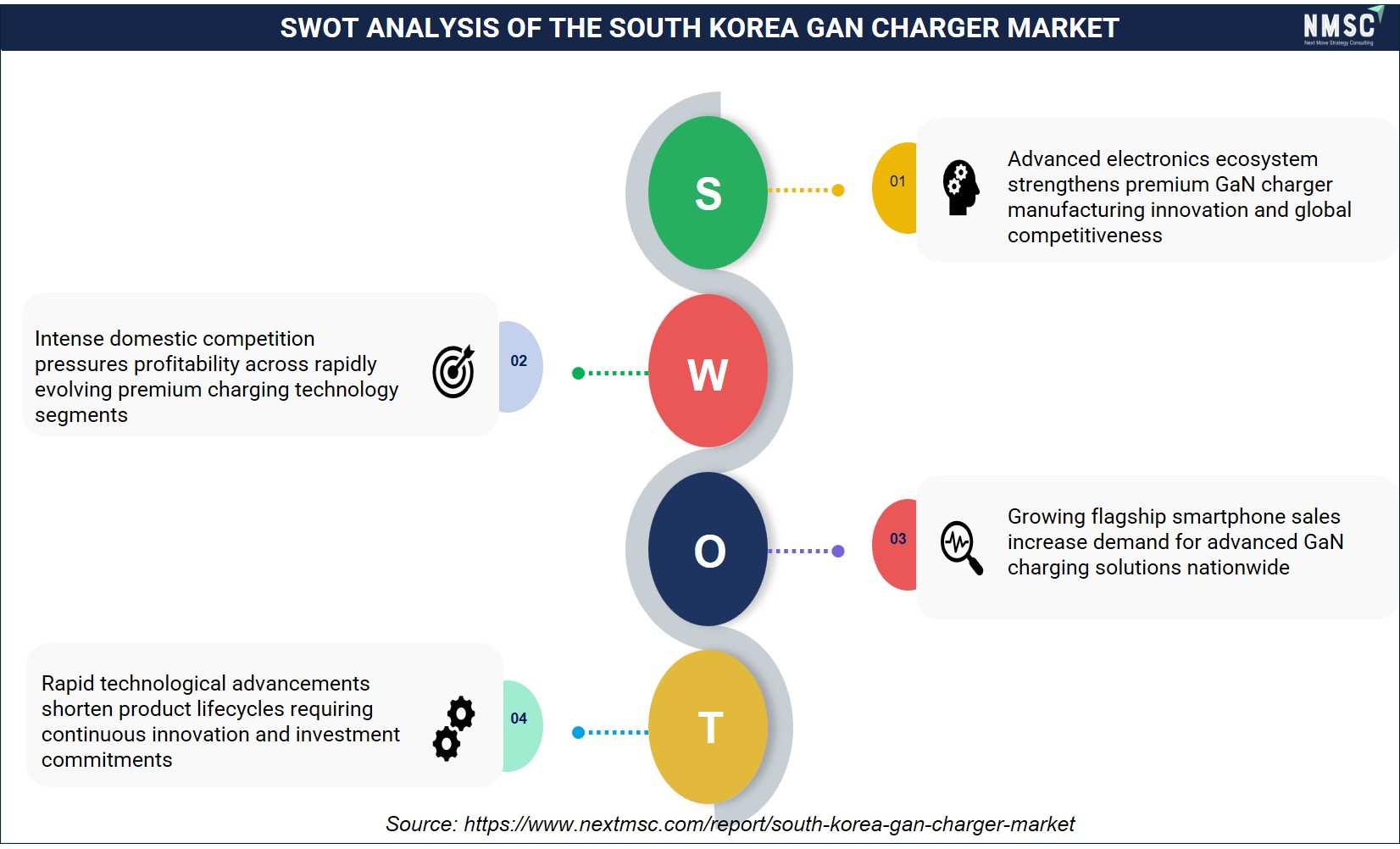
The SWOT analysis highlights the major factors shaping the market. The market benefits from a strong electronics manufacturing ecosystem that supports innovation and global competitiveness in premium GaN chargers. Rising flagship smartphone adoption creates new growth opportunities for advanced fast-charging solutions. However, intense domestic competition pressures profit margins, while rapid technological advancements require manufacturers to invest continuously in research, product development, and innovation to remain competitive.
How Is the South Korea GaN Charger Market Segmented in This Report, and What Are the Key Insights from the Segmentation Analysis?
By Power Output Insights
How Is Power Output Influencing Demand Across the South Korea GaN Charger Market?
Based on power output, the market is segmented into Up to 30W, 31W to 65W, 66W to 100W, and Above 100W.
Based on our analysis, we observed that power output remains a key factor influencing purchasing decisions in the market. Chargers offering up to 30W remain popular for smartphones, while the 31W to 65W segment is witnessing strong demand due to its suitability for fast-charging smartphones and lightweight laptops favored by South Korean consumers. Meanwhile, 66W to 100W and above 100W chargers are gaining traction among gamers and professionals requiring simultaneous multi-device charging capability.
By Product Type Insights
How Is Product Type Shaping Growth in the South Korea GaN Charger Market?
Based on product type, the market is segmented into Wall Chargers, Desktop Chargers, Power Banks, and Car Chargers.
Based on our evaluation, we identified that product innovation and premium design preferences are shaping the market. Wall chargers continue to dominate given their widespread everyday use, while desktop chargers are gaining popularity among professionals working from home or hybrid offices. Power banks equipped with GaN technology are witnessing rising demand among commuters and travelers seeking compact, high-capacity charging solutions. Car chargers are also seeing steady adoption alongside rising connected vehicle ownership across South Korea.
Competitive Landscape Overview
The arket is characterized by a mature and highly competitive landscape, supported by the presence of global consumer electronics brands, domestic semiconductor manufacturers, and specialized charging accessory companies. Market growth is driven by strong consumer demand for premium, high-performance charging solutions, continuous advancements in GaN semiconductor technology, and rising preference for compact, multi-device charging accessories. Intense competition is encouraging rapid product innovation, aggressive pricing strategies, and differentiated design approaches among market participants across South Korea.
Strategic Development
-
January 2025 - Belkin unveiled its CES 2025 lineup, introducing new 70W and 100W USB-C GaN Wall Chargers manufactured with up to 90% post-consumer recycled materials. The new GaN chargers deliver high-power fast charging in a compact design for smartphones, tablets, and laptops.
Key Players
-
Belkin Korea Co. Ltd.
-
Targus Korea Co. Ltd.
-
Nomad Goods Inc.
-
Razer Korea Co. Ltd.
-
Xiaomi Korea Co. Ltd.
-
Momax Technology Hong Kong Limited
-
Alogic Corporation Pty Ltd
-
Buffalo Korea Co. Ltd.
-
Minix Technology Limited
-
Nothing Technology Limited
-
Philips Korea Ltd.
-
ZTE Corporation Korea
NMSC's analysis indicates that competitive dynamics in the market are shaped by advancements in gallium nitride semiconductor technology, premium product design, and multi-device charging capability. Key companies such as Belkin Korea, Dell International, Targus Korea, Nomad Goods, Razer Korea, Xiaomi Korea, Momax Technology, Alogic Corporation, Buffalo Korea, Minix Technology, Nothing Technology, Philips Korea, and ZTE Corporation Korea are strengthening market positions through product innovation, premium design, and expansion of energy-efficient GaN charging portfolios across South Korea.
Key Segments
By Power Output
-
Up to 30W
-
31W to 65W
-
66W to 100W
-
Above 100W
By Product Type
-
Wall Chargers
-
Desktop Chargers
-
Power Banks
-
Car Chargers
By Device Compatibility
-
Smartphones
-
Tablets
-
Laptops
-
Multi-device
-
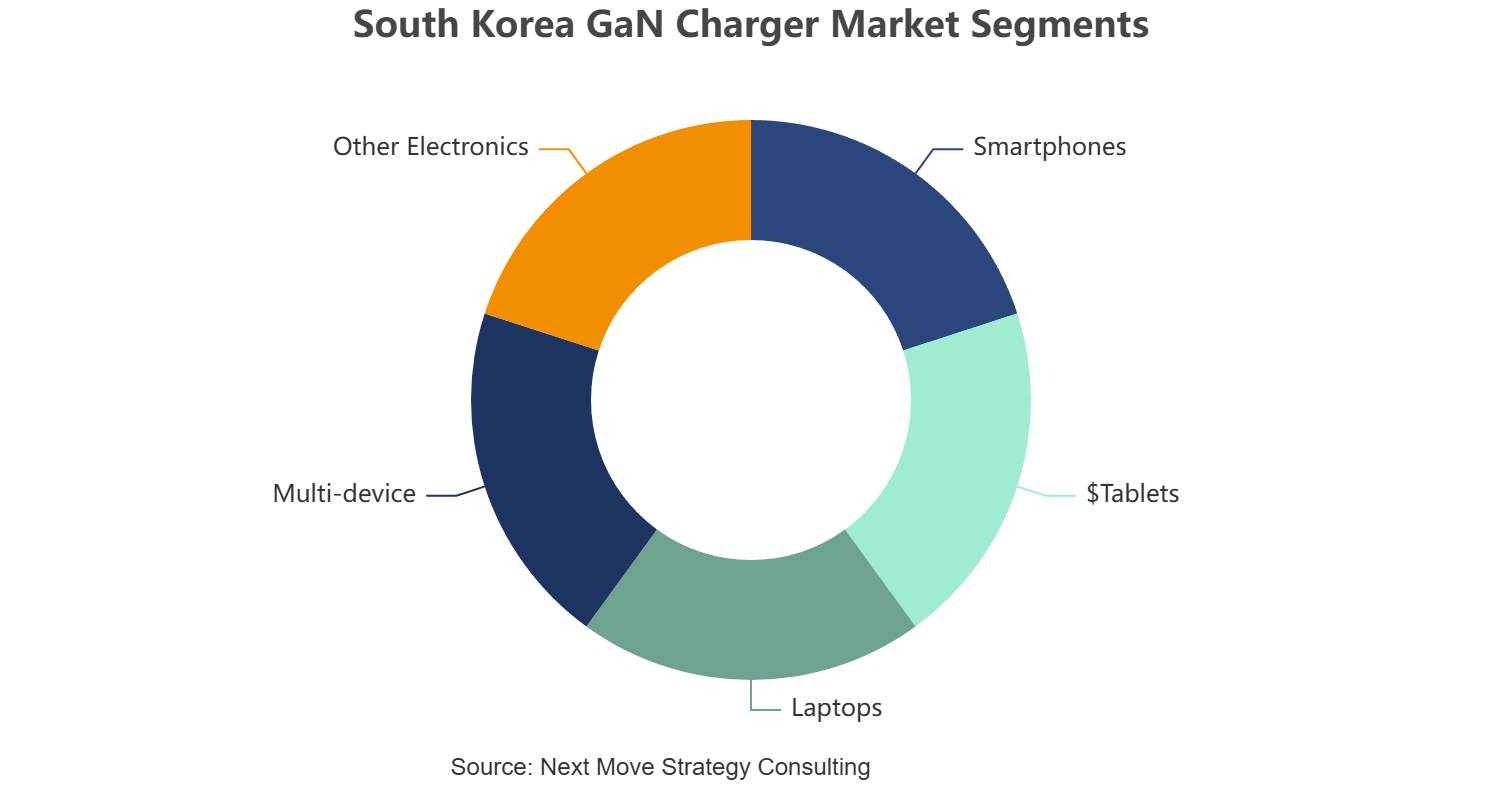
Other Electronics
By Number of Ports
-
Single Port
-
Dual Port
-
More than 2 Ports
By Sales Channel
-
Online
-
Offline
By End User
-
Consumer
-
Commercial
-
Industrial
PRICE POINT ANALYSIS OF THE SOUTH KOREA GAN CHARGER MARKET
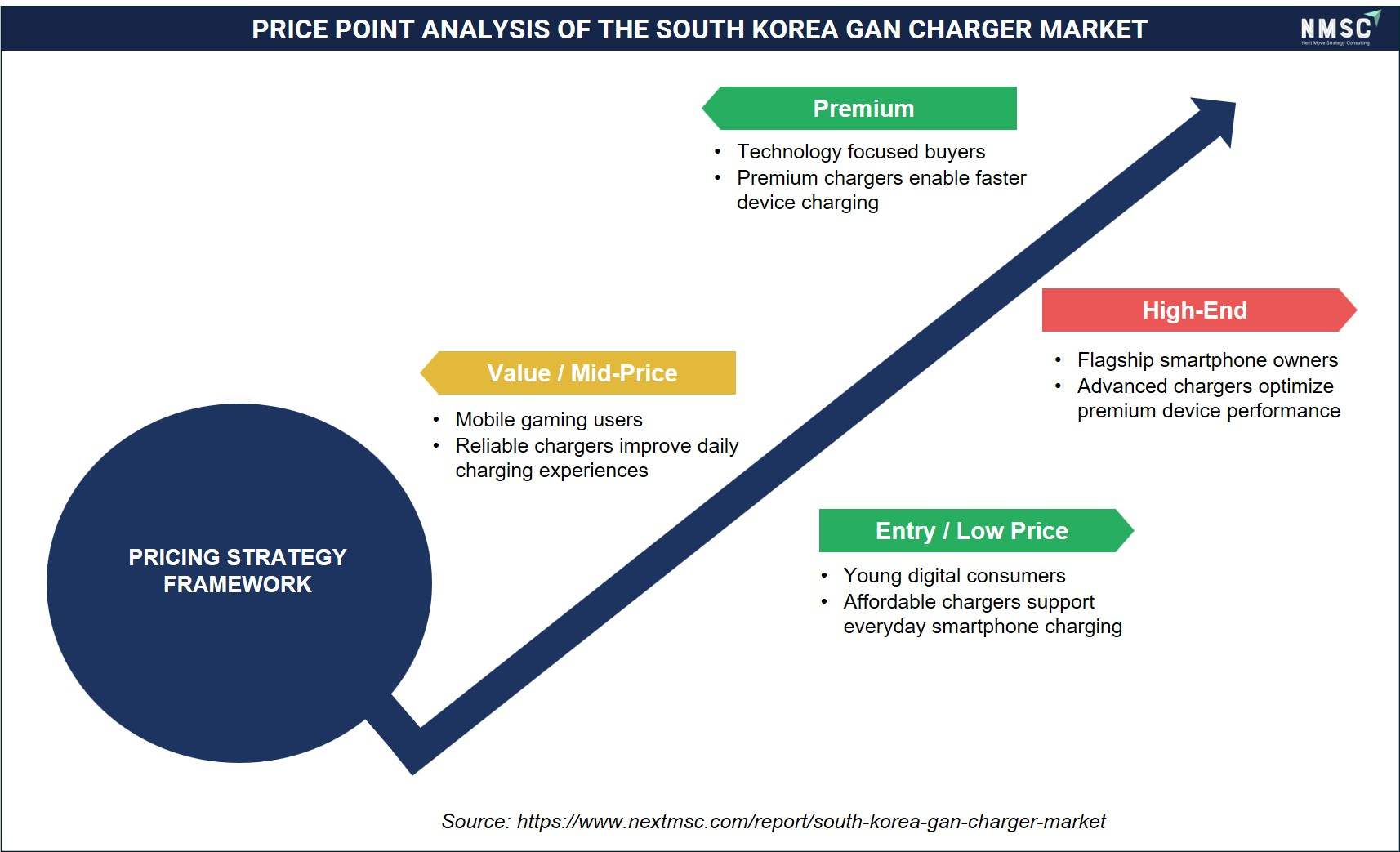
The price point analysis of the market highlights a diverse pricing strategy catering to different consumer segments. Entry-level chargers target budget-conscious users seeking reliable everyday charging, while mid-price models appeal to mobile gamers and regular users looking for enhanced performance. Premium and high-end GaN chargers focus on technology enthusiasts and flagship smartphone owners, offering faster charging speeds, advanced features, and superior device compatibility, thereby driving value across multiple price categories.
Key Benefits for Stakeholders
Next Move Strategy Consulting (NMSC) presents a comprehensive analysis of the market, covering historical developments from 2020 to 2025 and providing forecasts through 2035. Our study evaluates the market across key South Korean regions, delivering quantitative market outlooks alongside qualitative insights into GaN charger adoption, fast-charging technology trends, power output innovations, and advancements in gallium nitride semiconductor technology relevant to domestic manufacturers, distributors, and retailers.
Investors benefit from expanding opportunities in premium, high-performance charging solutions and export-oriented semiconductor manufacturing, while GaN semiconductor manufacturers, charger manufacturers, consumer electronics brands, component suppliers, distributors, and retailers benefit from rising demand for compact, high-speed, and energy-efficient charging solutions across South Korea. Policymakers and industry associations also gain insights into regulatory trends, manufacturing capabilities, and competitive dynamics shaping the South Korea GaN charger ecosystem going forward.
|
Parameters |
Details |
|
Customization Scope |
Free customization (equivalent to up to 80 analyst-working hours) after purchase. |
|
Pricing and Purchase Options |
Avail customized purchase options to meet your exact research needs. |
|
Approach |
In-depth primary and secondary research; proprietary databases; rigorous quality control and validation measures. |
|
Analytical Tools |
Porter's Five Forces, SWOT, value chain, and Harvey ball analysis to assess competitive intensity, stakeholder roles, and relative impact of key factors. |
Conclusion
The South Korea GaN Charger Market is positioned for robust growth through 2035, expanding from USD 45.0 million in 2025 to a projected USD 435.5 million, registering a CAGR of 24.09% during the forecast period. This growth is driven by high smartphone and laptop penetration, strong domestic semiconductor manufacturing capabilities, and rising demand for multi-device charging solutions. Although market saturation and intense price competition may temper growth, expanding export opportunities and continuous product innovation are expected to create long-term opportunities and strengthen competitive dynamics across South Korea.
About the Author
 Liza Phukan
— Liza Phukan is Research Associate at Next Move Strategy Consulting, where she has covered emerging industries and market research across sectors for 3.5 years. Her work includes analyzing industry developments, validating market data, and developing structured business content from research findings. She uses secondary research and data-validation practices to turn complex market information into clear decision-useful market analysis for business audiences and support report development and B2B.
Liza Phukan
— Liza Phukan is Research Associate at Next Move Strategy Consulting, where she has covered emerging industries and market research across sectors for 3.5 years. Her work includes analyzing industry developments, validating market data, and developing structured business content from research findings. She uses secondary research and data-validation practices to turn complex market information into clear decision-useful market analysis for business audiences and support report development and B2B.
About the Reviewer
 Supradip Baul
— Supradip Baul is an accomplished business consultant and strategist with over a decade of rich experience in market intelligence, strategy, technology, and business transformation. His work has included rigorous qualitative and quantitative analysis across multiple industries, helping clients shape investment decisions and long-term roadmaps. Earlier in his career, he was associated with Gartner, where he contributed to industry-leading reports and market share analyses. He has worked with leading global companies and holds an MBA with a dual specialization in Marketing and Finance.
Supradip Baul
— Supradip Baul is an accomplished business consultant and strategist with over a decade of rich experience in market intelligence, strategy, technology, and business transformation. His work has included rigorous qualitative and quantitative analysis across multiple industries, helping clients shape investment decisions and long-term roadmaps. Earlier in his career, he was associated with Gartner, where he contributed to industry-leading reports and market share analyses. He has worked with leading global companies and holds an MBA with a dual specialization in Marketing and Finance.
At Next Move Strategy Consulting, we understand that insightful market research is the cornerstone of successful business decisions. That's why we employ a robust and multifaceted approach, combining various methodologies to deliver the most accurate and actionable data for our clients.

Research Landscape
We navigate the world of research with two primary approaches:
Qualitative Approach
Our qualitative research methodologies involve immersive techniques such as in-depth interviews, focus groups, and observational studies. By engaging directly with individuals and stakeholders, we uncover valuable insights that quantitative data alone may overlook.

Quantitative Research
In tandem with qualitative methodologies, NMSC leverages the power of Quantitative Research to provide a robust foundation of numerical insights. Through systematic data collection and analysis, we quantify patterns, preferences, and market trends, offering a comprehensive view of the business landscape.
Our quantitative research approach employs diverse tools, including surveys, experiments, and statistical modelling. These methodologies enable us to gather data from a large and representative sample, ensuring the statistical significance of our findings. By employing structured questionnaires and standardized data collection methods, we guarantee the reliability and validity of the information we present to our clients.
Quantitative research is particularly effective in measuring the prevalence of trends, assessing market size, and gauging the impact of various factors on consumer behavior. The numerical precision attained through this approach equips our clients with actionable insights, facilitating data-driven decision-making and strategy formulation.


Our Specialized Toolbox for Industry-Specific Market Research
We deploy a specialized arsenal of techniques tailored to meet your unique requirements. Here's a glimpse into our comprehensive toolbox:

Information Procurement
The stage entails acquiring market data or relevant information through various sources and methodologies.


Market Research Approach
We utilize both top-down and bottom-up approaches in market research analysis to achieve a comprehensive understanding of the market dynamics, leveraging the broad perspective of industry trends and macroeconomic factors alongside detailed insights from specific segments and individual companies.

Porters Five Forces Analysis
We conduct Porter's Five Forces analysis to evaluate the competitive landscape of an industry, providing us with insights into factors that affect profitability and strategic positioning.

SWOT Analysis

Forecasting
We utilize a forecasting model to predict future consumption by considering parameters like population, economics, regulations, market competition, drivers, constraints, technology, and pricing. We also employ statistical techniques such as multilinear regression, exponential smoothing, moving average, ARIMA, and Monte Carlo simulations for accurate predictions. In econometric forecasting, we analyzed short-term and long-term event impacts, attributing values based on regulatory frameworks, economic factors, and market events.





 Speak to Our Analyst