
Subscription Billing Management Market Size, Share, Trends and Growth Analysis, By Platform Type (Standalone Subscription, Enterprise Suite Billing Module, Commerce Billing Platform, and Payments Native Billing Platform), By Organization Size, By Deployment Model, By Monetization Model, By Billing Frequency, By Business Function, By Revenue Stream, By Sales Channel, By Industry Vertical, and Region — Global Industry Report and Forecast, 2026–2035
Industry: ICT & Media | Publishing Date: July 24, 2026 | Last Updated: September 30, 2026 | No of Pages: N/A | No. of Tables: N/A | No. of Figures: N/A | Format: PDF | Report Code: IC5375
What Is the Subscription Billing Management Market Size?
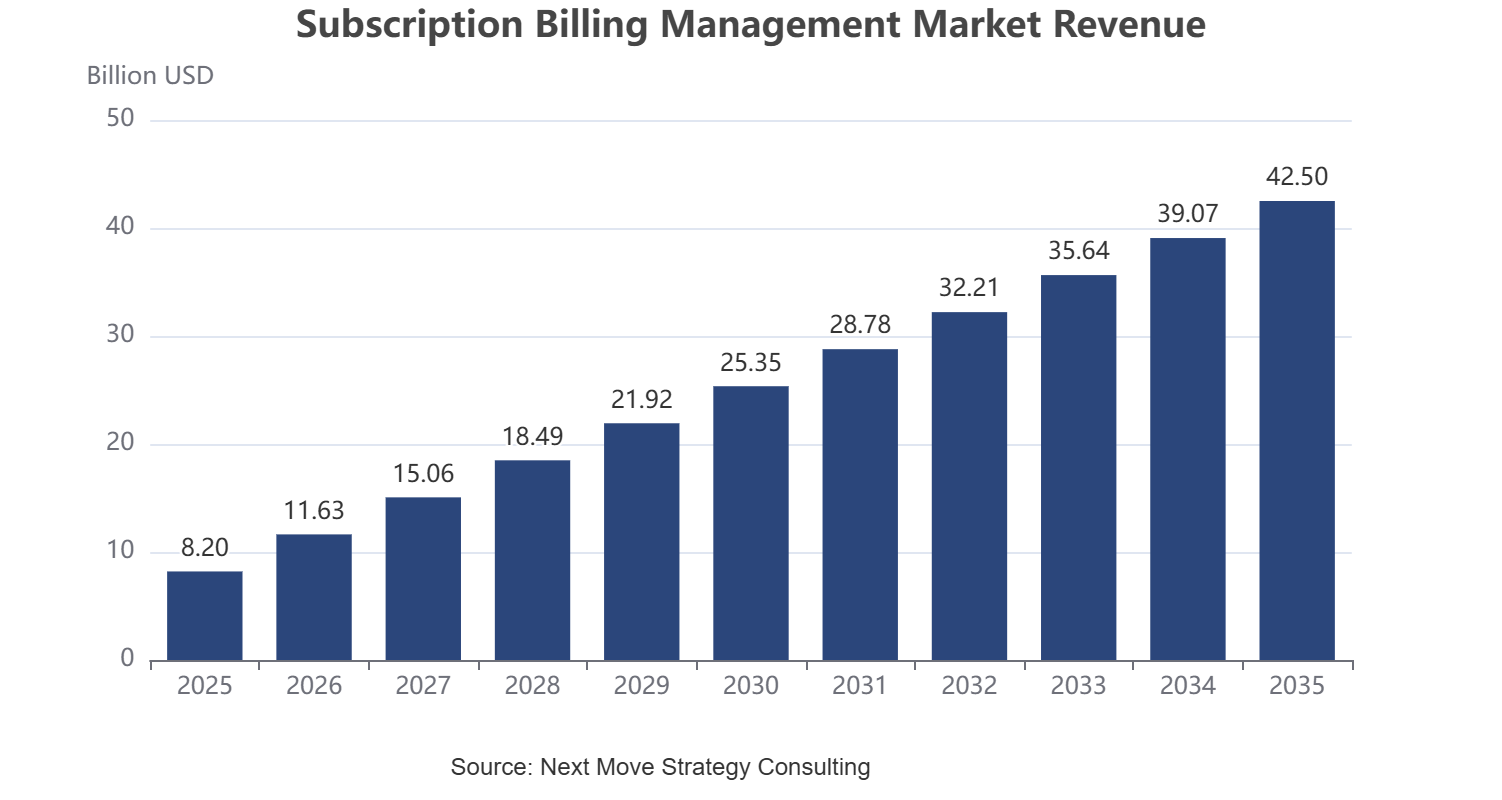
The global subscription billing management market size was valued at USD 8.20 billion in 2025 and is estimated at USD 9.85 billion in 2026, forecast to reach USD 42.50 billion by 2035, expanding at a 17.6% CAGR between 2026 and 2035. North America leads with approximately 36% share, while standalone subscription platforms dominate all other platform types with approximately 38% share.
We observed that growth is broad-based across every segmentation axis, with payments native billing platforms and public cloud deployment driving the most pronounced structural shifts in the subscription billing management market through 2035.
|
Key Takeaways |
|
By Platform Type: Standalone Subscription held the largest share of approximately 38% (USD 3.12 Billion) in 2025; Payments Native Billing Platform is the fastest-growing sub-segment at 21.5% CAGR from 2026–2035. |
|
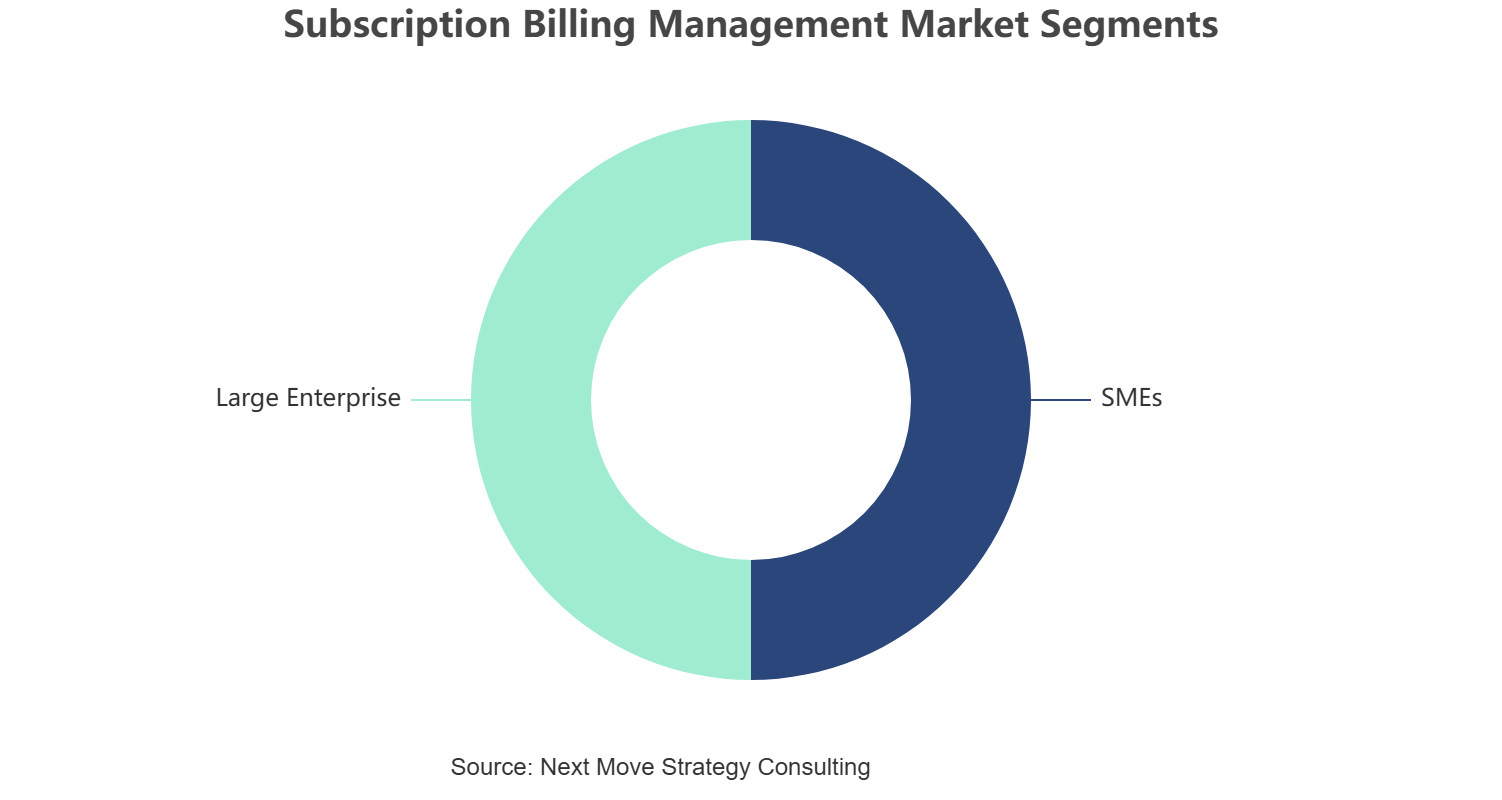
By Organization Size: Large Enterprise held the larger share in 2025, while SMEs is the fastest-growing sub-segment as modular billing platforms lower adoption barriers from 2026–2035. |
|
By Deployment Model: Public Cloud held the largest share of approximately 50% (USD 4.10 Billion) in 2025; Public Cloud is also the fastest-growing sub-segment at 19.1% CAGR from 2026–2035. |
|
By Monetization Model: Tiered Subscription held the largest share in 2025, while Usage Based and Outcome-Based models are the fastest-growing categories from 2026–2035. |
|
By Billing Frequency: Monthly held the largest share in 2025, while Multi-Year billing is the fastest-growing frequency from 2026–2035. |
|
By Industry Vertical: Software held the largest share of approximately 22% (USD 1.80 Billion) in 2025; Public Sector is the fastest-growing sub-segment at 21.3% CAGR from 2026–2035. |
|
Dominant Region: North America dominated with approximately 36% revenue share (USD 2.95 Billion) in 2025. |
|
Fastest-Growing Region: Middle East & Africa is expected to register the highest CAGR of 21.5% during 2026–2035. |
|
Dominant Country: U.S. led with approximately USD 2.30 Billion in 2025. |
|
Fastest-Growing Country: India is the fastest-growing country at approximately 24.0% CAGR from 2026–2035. |
Market Opportunity: The subscription billing management market is expected to create an absolute dollar opportunity of USD 32.65 billion between 2026 and 2035, presenting significant investment potential across the standalone subscription, enterprise suite, commerce billing, and payments native platform value chain.
According to Next Move Strategy Consulting analysis, enterprises are increasingly consolidating disparate invoicing, revenue recognition, and dunning tools into unified billing platforms to reduce revenue leakage, a shift that favors vendors offering integrated usage rating and tax management capabilities over point solutions as monetization models diversify through 2035.
What Does the Subscription Billing Management Market Encompass?
The subscription billing management market encompasses software platforms and modules that automate subscription lifecycle management, usage rating, invoicing, tax calculation, payment collection, dunning, and revenue recognition for enterprises monetizing recurring and usage-based offerings. Our assessment indicates that the scope spans standalone subscription platforms, enterprise suite billing modules embedded within ERP and CRM systems, commerce billing platforms, and payments native billing platforms supplied across software, telecommunications, financial services, retail, media, and manufacturing end markets. The category has evolved from simple recurring invoicing into comprehensive revenue operations infrastructure supporting hybrid and outcome-based pricing.
Regulatory frameworks such as the Financial Accounting Standards Board's ASC 606 revenue recognition standard and the International Accounting Standards Board's IFRS 15 shape mandatory revenue reporting requirements, while regional value-added tax and sales tax regimes increasingly inform automated tax management module design. We observed that technology adoption is shifting toward AI-assisted usage rating and predictive dunning that reduce involuntary churn. Next Move Strategy Consulting's analysis indicates that this structural shift, combined with rising adoption of consumption-based pricing, is redefining vendor selection criteria across the subscription billing management market.
|
Parameter |
Details |
|
Market Size in 2025 |
USD 8.20 Billion |
|
Market Size in 2026 |
USD 9.85 Billion |
|
Revenue Forecast in 2035 |
USD 42.50 Billion |
|
Growth Rate |
CAGR of 17.6% from 2026 to 2035 |
|
Analysis Period |
2025–2035 |
|
Base Year Considered |
2025 |
|
Forecast Period |
2026–2035 |
|
Market Size Estimation |
Revenue (USD Billion) |
|
Companies Profiled |
20 |
|
Countries Covered |
33 |
|
Market Share |
Available for Top 10 Companies |
Key Emerging Trends
Based on research conducted by Next Move Strategy Consulting, we found that four structural trends are reshaping product development, pricing architecture, and stakeholder engagement across the subscription billing management market.
How Is Usage-Based Pricing Transforming Billing Platform Architecture?
Vendors are re-architecting rating engines to support granular, real-time usage metering alongside traditional fixed subscription tiers. We observed that Stripe, Inc. expanded its usage-based billing capabilities in 2025 to support metered consumption pricing for AI and infrastructure customers. Enterprises adopting hybrid pricing are demanding sub-second rating accuracy, pushing platform vendors to invest heavily in mediation and event-processing infrastructure.
Why Is AI-Assisted Dunning Management Becoming a Core Retention Lever?
Predictive dunning management is shifting from static retry logic to machine learning models that optimize payment recovery timing and channel selection. Our findings suggest that Recurly, Inc. and similar platforms increasingly embed AI-driven card update and retry sequencing directly into checkout and renewal workflows. Subscription businesses are prioritizing involuntary churn reduction, positioning intelligent dunning as a differentiated capability within the broader billing platform category.
How Is Embedded Finance Reshaping Commerce Billing Platforms?
Embedded payment and merchant-of-record capabilities are increasingly bundled directly into billing platforms to simplify global tax compliance and settlement for digital sellers, often integrating a native payment gateway layer alongside invoicing. We observed that Paddle.com Market Ltd. expanded its merchant of record offering in 2025 to cover additional international tax jurisdictions. This trend is elevating demand for commerce billing platforms among cross-border software and digital media sellers seeking simplified compliance.
What Role Does Quote to Cash Convergence Play in Enterprise Suite Innovation?
Enterprise suite vendors are converging configure-price-quote, billing, and revenue recognition into unified quote to cash workflows to eliminate handoff friction between sales and finance teams. Our analysis shows that Salesforce, Inc. expanded quote to cash integration across its revenue cloud offering in 2025. Vendors are packaging billing alongside CRM and ERP modules, exemplifying a direction toward consolidated, single-platform revenue operations for enterprise buyers.
Strategic Framework of the Subscription Billing Management Market
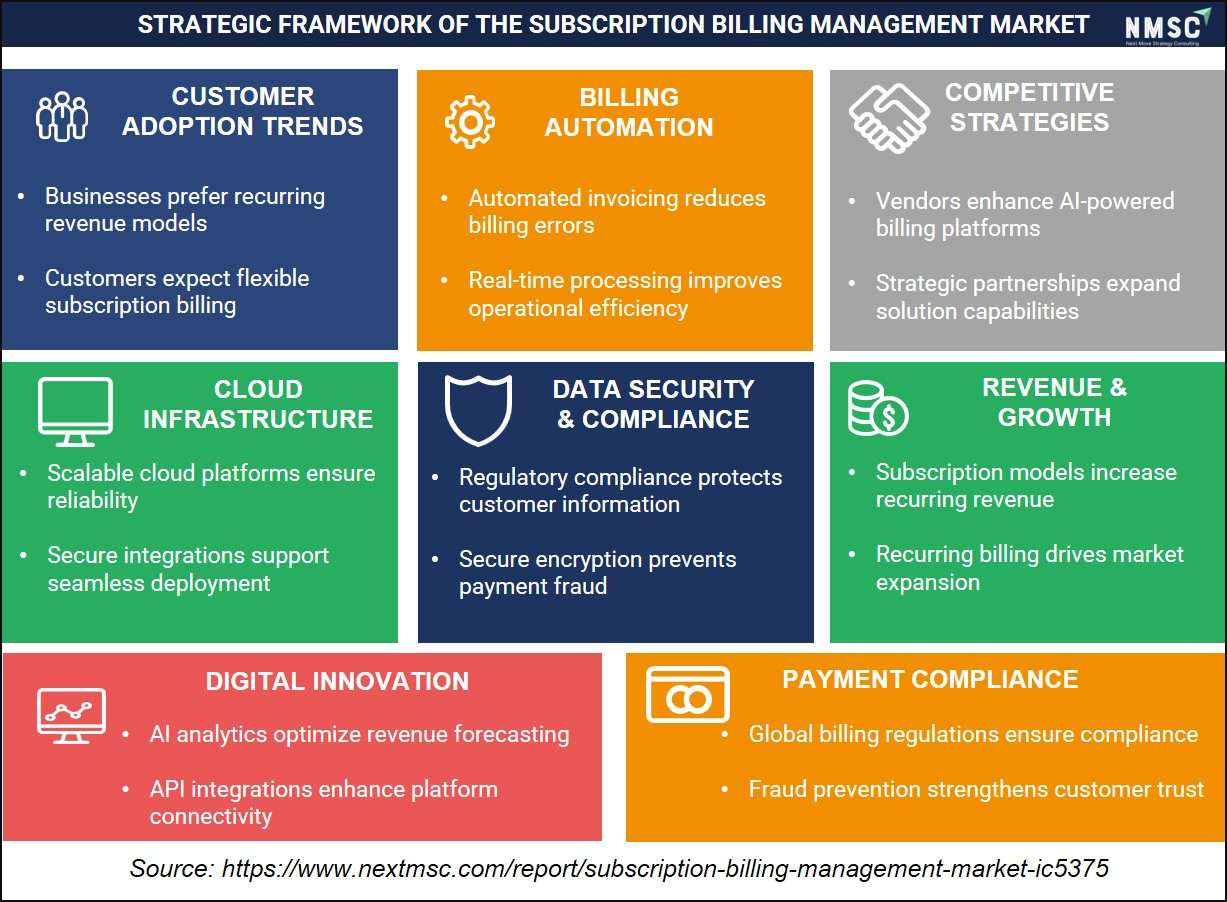
Our analysis shows that the Subscription Billing Management Market is evolving through automated billing, AI-powered innovation, and secure cloud infrastructure that enhance operational efficiency. Moreover, businesses increasingly adopt flexible recurring revenue models, while real-time invoicing, API integrations, and compliance-driven payment security strengthen customer trust. Consequently, strategic partnerships, advanced analytics, and scalable subscription platforms enable sustainable revenue growth and long-term competitive advantage across digital businesses.
Growth Drivers and Restraints
Growth Catalyst and Risk Assessment Matrix
|
Factors |
Type |
(+/-) % Impact on CAGR |
Geographic Relevance |
Impact Timeline |
|
Rising adoption of subscription and usage-based business models |
Driver |
+3.5% |
Global |
2026–2035 |
|
Mandatory revenue recognition compliance (ASC 606, IFRS 15) |
Driver |
+2.6% |
North America, Europe |
2026–2035 |
|
Proliferation of embedded finance and merchant of record models |
Driver |
+2.2% |
Global |
2026–2035 |
|
Growth of AI-assisted dunning and churn reduction tools |
Driver |
+1.8% |
North America, Europe, Asia-Pacific |
2026–2035 |
|
Expansion of cloud marketplace and channel-led distribution |
Driver |
+1.4% |
Global |
2026–2032 |
|
Rapid SaaS and digital commerce growth in Asia-Pacific |
Driver |
+1.3% |
Asia-Pacific |
2026–2035 |
|
Complexity of multi-jurisdictional tax and VAT compliance |
Restraint |
-1.2% |
Europe, Asia-Pacific |
2026–2035 |
|
High migration cost from legacy billing systems |
Restraint |
-0.9% |
Global |
2026–2032 |
|
Data integration fragmentation across legacy ERP and CRM systems |
Restraint |
-0.7% |
Global |
2026–2035 |
What Is the Primary Growth Driver of the Subscription Billing Management Market?
Rising adoption of subscription and usage-based business models is the primary driver of the subscription billing management market. The U.S. Securities and Exchange Commission continues to observe growing recurring revenue disclosure among public software companies, reflecting sustained enterprise migration toward subscription monetization over one-time licensing. We observed that this structural shift, reinforced by investor preference for predictable revenue, continues to anchor baseline consumption of billing platforms across developed and emerging economies alike.
How Is Regulation Driving Subscription Billing Management Market Growth?
Mandatory revenue recognition compliance is accelerating subscription billing management market growth toward automated billing platforms. The Financial Accounting Standards Board's ASC 606 standard and the International Accounting Standards Board's IFRS 15 require auditable, standardized revenue recognition for multi-element subscription contracts. Our assessment indicates that this regulatory pressure, combined with growing finance team scrutiny of manual spreadsheet-based recognition, is compressing adoption timelines for automated billing and revenue recognition modules across North America and Europe.
What Is Restraining Subscription Billing Management Market Expansion?
Complexity of multi-jurisdictional tax and VAT compliance restrains the pace of platform deployment for cross-border sellers. Regulatory bodies including the European Commission's Directorate-General for Taxation and Customs Union enforce varying VAT thresholds and digital services tax rules across member states, complicating global rollouts. We found that mid-market enterprises face particular exposure, as limited tax operations resources reduce their ability to navigate multi-jurisdictional compliance compared with larger, vertically integrated billing organizations.
Segmentation Analysis
Segment Sizing: By Platform Type
|
Segment |
2025 (USD) |
2035 (USD) |
CAGR% (2026–2035) |
|
Standalone Subscription |
USD 3.12 Billion |
USD 13.60 Billion |
15.4% |
|
Enterprise Suite Billing Module |
USD 2.46 Billion |
USD 12.75 Billion |
17.6% |
|
Commerce Billing Platform |
USD 1.64 Billion |
USD 9.35 Billion |
18.9% |
|
Payments Native Billing Platform |
USD 0.98 Billion |
USD 6.80 Billion |
21.5% |
|
Total |
USD 8.20 Billion |
USD 42.50 Billion |
17.6% |
Which Platform Type Dominates the Subscription Billing Management Market?
Standalone Subscription platforms lead the subscription billing management platform type segmentation with approximately 38% share in 2025, reflecting enterprise preference for purpose-built billing systems over broader suite modules during initial adoption. We observed that Payments Native Billing Platform is the fastest-growing platform type at 21.5% CAGR through 2035, driven by demand for embedded payment collection and settlement as digital sellers seek unified checkout and billing experiences.
Segment Sizing: By Deployment Model
|
Segment |
2025 (USD) |
2035 (USD) |
CAGR% (2026–2035) |
|
Public Cloud |
USD 4.10 Billion |
USD 23.80 Billion |
19.1% |
|
Private Cloud |
USD 1.48 Billion |
USD 5.53 Billion |
13.4% |
|
Hybrid Cloud |
USD 1.80 Billion |
USD 9.78 Billion |
18.3% |
|
On Premises |
USD 0.82 Billion |
USD 3.39 Billion |
14.7% |
|
Total |
USD 8.20 Billion |
USD 42.50 Billion |
17.6% |
Which Deployment Model Is Growing Fastest in the Subscription Billing Management Market?
Public Cloud deployment remains dominant with the subscription billing management market approximately 50% share in 2025, anchored in enterprise preference for vendor-managed cloud computing infrastructure that scales with transaction volume. Our findings suggest that Public Cloud is also the fastest-growing deployment model at 19.1% CAGR through 2035, evidenced by accelerating migration away from on premises billing systems among mid-market and large enterprise buyers alike.
Segment Sizing: By Industry Vertical
|
Segment |
2025 (USD) |
2035 (USD) |
CAGR% (2026–2035) |
|
Software |
USD 1.80 Billion |
USD 8.50 Billion |
16.4% |
|
Telecommunications |
USD 1.15 Billion |
USD 5.53 Billion |
16.7% |
|
Financial Services |
USD 1.07 Billion |
USD 5.53 Billion |
16.7% |
|
Retail and E-commerce |
USD 0.98 Billion |
USD 5.53 Billion |
18.8% |
|
Media and Entertainment |
USD 0.66 Billion |
USD 3.40 Billion |
17.6% |
|
Manufacturing |
USD 0.57 Billion |
USD 2.98 Billion |
17.7% |
|
Healthcare |
USD 0.57 Billion |
USD 3.40 Billion |
19.5% |
|
Energy and Utilities |
USD 0.41 Billion |
USD 2.13 Billion |
17.7% |
|
Professional Services |
USD 0.41 Billion |
USD 2.13 Billion |
17.7% |
|
Public Sector |
USD 0.25 Billion |
USD 1.70 Billion |
21.3% |
|
Transportation and Logistics |
USD 0.21 Billion |
USD 1.06 Billion |
17.3% |
|
Others |
USD 0.12 Billion |
USD 0.61 Billion |
17.4% |
|
Total |
USD 8.20 Billion |
USD 42.50 Billion |
17.6% |
Which Industry Vertical Leads Subscription Billing Management Adoption?
Software leads industry vertical adoption with the subscription billing management market approximately 22% share in 2025, reflecting the sector's origin as the earliest and deepest adopter of recurring revenue models. We observed that Public Sector is the fastest-growing vertical at 21.3% CAGR, as government agencies modernize licensing and permit-fee collection systems onto automated, auditable billing infrastructure aligned with public financial accountability requirements.
Growth Opportunities
Next Move Strategy Consulting identifies three forward-looking whitespace opportunities across the subscription billing management market that extend beyond current adoption patterns.
How Can Outcome-Based Monetization Support Unlock New Revenue?
Purpose-built support for outcome-based and value-metric pricing creates a mechanism for platform vendors to capture premium licensing from enterprises shifting away from flat subscription fees. Software and industrial IoT vendors adopting performance-linked contracts stand to benefit from billing platforms capable of tracking and invoicing against negotiated outcome metrics.
What Opportunity Does Embedded Tax Automation Present?
Deepening native integration with real-time global tax calculation addresses a persistent compliance burden for cross-border digital sellers. Retail and e-commerce vendors expanding into new international markets represent the primary beneficiary segment for billing platforms that can operationalize automated VAT and sales tax determination at checkout.
How Does Channel Partner Enablement Expand the Addressable Market?
Purpose-built billing modules distributed through cloud marketplaces and system integrator channels open a currently underpenetrated buyer segment lacking direct sales relationships with billing vendors. Small and medium enterprises across telecommunications and professional services verticals benefit from marketplace-native billing tools, expanding the addressable base beyond direct-sales-led incumbents.
Regional Outlook
Geographic Performance Snapshot
|
Region |
2025 (USD) |
2035 (USD) |
CAGR% (2026–2035) |
Key Driver |
|
North America |
USD 2.95 Billion |
USD 12.75 Billion |
15.3% |
Revenue recognition compliance |
|
Europe |
USD 2.05 Billion |
USD 9.78 Billion |
16.6% |
VAT and tax digitization |
|
Asia-Pacific |
USD 2.30 Billion |
USD 14.03 Billion |
19.8% |
SaaS and digital commerce growth |
|
Middle East & Africa |
USD 0.49 Billion |
USD 3.40 Billion |
21.5% |
Digital economy diversification |
|
Latin America |
USD 0.41 Billion |
USD 2.54 Billion |
20.0% |
Fintech and e-commerce expansion |
|
Total |
USD 8.20 Billion |
USD 42.50 Billion |
17.6% |
|
North America Subscription Billing Management Market
North America dominates the subscription billing management market with approximately 36% share in 2025, supported by mature revenue recognition regulation and deep enterprise SaaS penetration. We observed that the region's regulatory environment, anchored by the Financial Accounting Standards Board's ASC 606 standard, sustains strong demand for automated billing and revenue recognition platforms. Technology adoption remains advanced, with strategic outlook favoring continued platform consolidation among large enterprise buyers through 2035.
Europe Subscription Billing Management Market
Europe's subscription billing management market is shaped decisively by evolving VAT digitization mandates and cross-border digital services tax requirements across member states. Our assessment indicates that demand maturity is high in software and financial services, with regulatory influence driving tax management and compliance module adoption. Technology penetration is accelerating as enterprises replace manual invoicing with automated, auditable billing platforms ahead of tightening e-invoicing mandates.
Asia-Pacific Subscription Billing Management Market
Asia-Pacific is a fast-growing subscription billing management region at 19.8% CAGR, propelled by rapid SaaS adoption and expanding digital commerce across China, India, and Southeast Asia. We found that regulatory influence is less mature than in Europe, but technology adoption is accelerating quickly among large enterprises and digital-native sellers seeking cloud-delivered, usage-based billing infrastructure. Competitive intensity is rising as global vendors expand regional data center presence to serve local compliance needs.
Middle East & Africa Subscription Billing Management Market
The Middle East & Africa subscription billing management region is the fastest-growing at 21.5% CAGR, driven by sovereign digital economy diversification strategies and expanding telecommunications and fintech sectors. Our analysis shows that regulatory influence remains developing, with technology adoption concentrated among large telecommunications operators and government-linked enterprises. Strategic outlook favors continued expansion as regional vendors partner with global billing platform providers to serve localized compliance needs.
Latin America Subscription Billing Management Market
Latin America's subscription billing management market reflects strong demand structure anchored in fintech expansion and rising e-commerce adoption across the region. We observed that regulatory influence is increasing gradually as regional governments modernize electronic invoicing mandates. Technology penetration remains concentrated among large enterprises, with strategic outlook favoring gradual expansion into mid-market retail and software buyers through the forecast period.
U.S. Subscription Billing Management Market
Based on our estimates, the U.S. subscription billing management market was valued at approximately USD 2300 million in 2025 and is projected to reach approximately USD 9950 million by 2035, expanding at a 15.3% CAGR between 2026 and 2035. We observed strong demand structure driven by software and financial services sector adoption, with high technology penetration and elevated competitive intensity among global platform vendors. Regulatory influence from ASC 606 revenue recognition requirements continues to anchor strategic outlook toward automated, auditable billing infrastructure.
Canada Subscription Billing Management Market
The market in the Canada subscription billing management market was valued at approximately USD 560 million in 2025 and is projected to reach approximately USD 2420 million by 2035, expanding at a 15.4% CAGR between 2026 and 2035. demand is shaped by telecommunications and professional services buyers responding to recurring revenue reporting requirements. Regulatory influence remains moderate relative to the U.S., while technology adoption is accelerating among mid-market enterprises seeking integrated billing and revenue recognition visibility.
UK Subscription Billing Management Market
As per our estimate, the UK subscription billing management market was valued at approximately USD 574 million in 2025 and is projected to reach approximately USD 2738 million by 2035, expanding at a 16.4% CAGR between 2026 and 2035. the market benefits from mature financial services regulation and early alignment with digital VAT reporting standards. Technology penetration is high among large enterprises, with strategic outlook favoring continued adoption of tax management and revenue recognition modules through the forecast period.
Germany Subscription Billing Management Market
According to our analysis, the Germany subscription billing management market was valued at approximately USD 615 million in 2025 and is projected to reach approximately USD 2934 million by 2035, expanding at a 16.8% CAGR between 2026 and 2035. demand is anchored in manufacturing and software sectors adapting to national e-invoicing mandates. Regulatory influence from EU VAT digitization rules is elevated, driving strong adoption of tax and compliance-focused billing modules among large exporters.
France Subscription Billing Management Market
Based on our estimates, the France subscription billing management market was valued at approximately USD 369 million in 2025 and is projected to reach approximately USD 1760 million by 2035, expanding at a 16.5% CAGR between 2026 and 2035. the market reflects steady demand from retail and media sectors aligning with national digital tax law requirements. Technology adoption is moderate to high, with regulatory influence and competitive intensity increasing as domestic enterprises adopt automated billing platforms.
China Subscription Billing Management Market
The market in the China subscription billing management market was valued at approximately USD 805 million in 2025 and is projected to reach approximately USD 4911 million by 2035, expanding at a 19.5% CAGR between 2026 and 2035. China is driven by large-scale SaaS and digital commerce growth exposed to rapid consumer subscription adoption. Regulatory influence remains developing relative to Western markets, while technology adoption is accelerating rapidly among large enterprises building usage-based billing infrastructure into digital platforms.
India Subscription Billing Management Market
As per our estimate, the India subscription billing management market was valued at approximately USD 414 million in 2025 and is projected to reach approximately USD 2525 million by 2035, expanding at a 24.0% CAGR between 2026 and 2035. India is the fastest-growing country market, propelled by expanding IT services and SaaS export growth. Regulatory influence is emerging, while technology penetration is rising quickly among large enterprises and mid-market SaaS vendors seeking cost-efficient, cloud-delivered billing platforms.
Japan Subscription Billing Management Market
According to our analysis, the Japan subscription billing management market was valued at approximately USD 368 million in 2025 and is projected to reach approximately USD 2245 million by 2035, expanding at a 18.8% CAGR between 2026 and 2035. Japan's market is shaped by mature telecommunications and manufacturing sectors prioritizing subscription and usage-based monetization. Technology adoption is high among large enterprises, with regulatory influence gradually strengthening alongside national digital invoicing legislation.
South Korea Subscription Billing Management Market
Based on our estimates, the South Korea subscription billing management market was valued at approximately USD 276 million in 2025 and is projected to reach approximately USD 1684 million by 2035, expanding at a 19.9% CAGR between 2026 and 2035. South Korea shows strong demand from telecommunications and technology manufacturers exposed to expanding digital subscription services. Technology penetration is elevated, and competitive intensity is rising as domestic conglomerates adopt integrated billing and revenue recognition platforms to support export-critical software offerings.
Australia Subscription Billing Management Market
The market in the Australia subscription billing management market was valued at approximately USD 207 million in 2025 and is projected to reach approximately USD 1263 million by 2035, expanding at a 19.6% CAGR between 2026 and 2035. Australia reflects moderate demand from software and retail sectors responding to subscription economy growth. Regulatory influence is increasing under national digital tax reporting requirements, with technology adoption concentrated among large enterprises and growing steadily among mid-market buyers.
UAE Subscription Billing Management Market
As per our estimate, the UAE subscription billing management market was valued at approximately USD 108 million in 2025 and is projected to reach approximately USD 748 million by 2035, expanding at a 21.3% CAGR between 2026 and 2035. the UAE market benefits from its role as a regional digital commerce and fintech hub requiring robust billing infrastructure. Technology adoption is relatively high among large enterprises, with strategic outlook favoring continued platform investment tied to national digital economy diversification programs.
Saudi Arabia Subscription Billing Management Market
According to our analysis, the Saudi Arabia subscription billing management market was valued at approximately USD 118 million in 2025 and is projected to reach approximately USD 816 million by 2035, expanding at a 21.6% CAGR between 2026 and 2035. Saudi Arabia's market is anchored in telecommunications and government-linked enterprise billing modernization tied to national economic diversification strategy. Regulatory influence is developing, while technology penetration is rising among large enterprises adopting automated, cloud-based billing platforms.
South Africa Subscription Billing Management Market
Based on our estimates, the South Africa subscription billing management market was valued at approximately USD 69 million in 2025 and is projected to reach approximately USD 476 million by 2035, expanding at a 21.0% CAGR between 2026 and 2035. South Africa shows emerging demand from telecommunications and financial services sectors managing recurring revenue billing complexity. Technology adoption remains concentrated among large enterprises, with regulatory influence gradually increasing alongside broader African digital taxation initiatives.
Brazil Subscription Billing Management Market
The market in the Brazil subscription billing management market was valued at approximately USD 189 million in 2025 and is projected to reach approximately USD 1168 million by 2035, expanding at a 20.1% CAGR between 2026 and 2035. Brazil is driven by fintech and e-commerce sectors exposed to expanding digital subscription adoption. Regulatory influence is increasing under national electronic invoicing frameworks, with technology adoption concentrated among large enterprises and expanding gradually into the mid-market.
Argentina Subscription Billing Management Market
As per our estimate, the Argentina subscription billing management market was valued at approximately USD 66 million in 2025 and is projected to reach approximately USD 406 million by 2035, expanding at a 19.8% CAGR between 2026 and 2035. Argentina's market reflects early-stage demand from software and retail buyers responding to growing digital subscription adoption. Technology penetration remains moderate, with strategic outlook favoring gradual platform adoption as enterprises prioritize revenue recognition and tax compliance coverage.
SWOT Analysis of the Subscription Billing Management Market
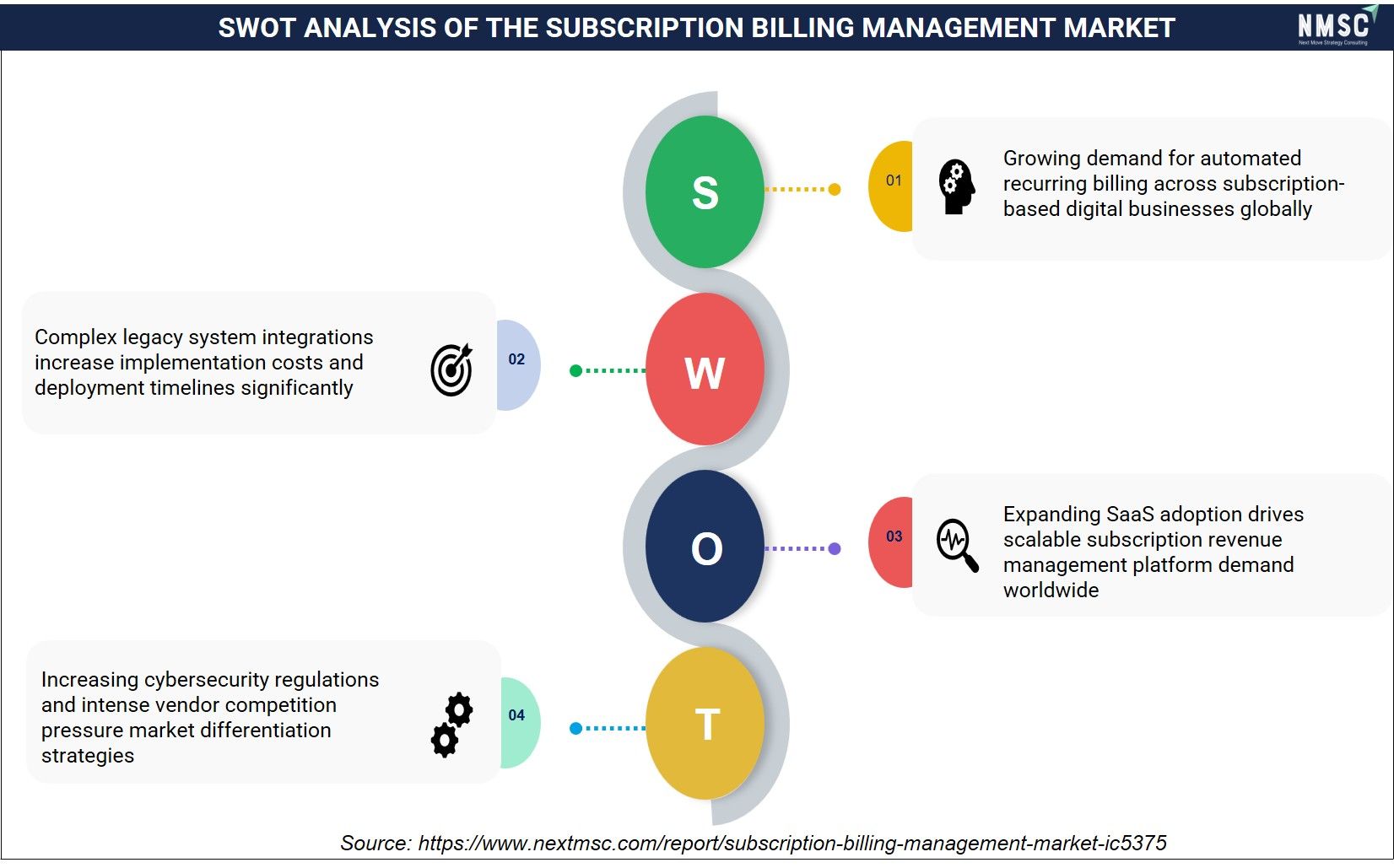
Based on our market evaluation, we noticed that the Subscription Billing Management Market benefits from rising demand for automated recurring billing and expanding SaaS adoption, creating strong growth opportunities. However, legacy system integration challenges and increasing implementation complexity may slow deployment. Additionally, evolving cybersecurity regulations and intense vendor competition require continuous innovation. Therefore, organizations prioritizing scalable, secure, and intelligent billing platforms are better positioned to strengthen market differentiation and long-term business performance.
Competitive Landscape
We observed that the subscription billing management market remains moderately fragmented, with established enterprise software vendors, payments-native specialists, and dedicated billing platform providers competing across overlapping platform type categories.
|
Dimension |
Description |
|
Market Structure |
Moderately fragmented, with large enterprise software vendors and specialized billing platform providers competing across standalone, enterprise suite, commerce, and payments native categories. |
|
Innovation Focus |
AI-assisted usage rating, predictive dunning management, and embedded tax automation capabilities dominate current innovation pipelines across leading vendors. |
|
M&A Activity |
Enterprise software vendors acquiring standalone billing specialists to broaden quote to cash and revenue operations coverage across the competitive landscape. |
How Do Companies Compete in the Subscription Billing Management Market?
Companies compete primarily on breadth of monetization model support, rating accuracy, and depth of native tax and revenue recognition automation. Our analysis shows that vendors bundling usage rating, dunning, and compliance modules into unified platforms command stronger enterprise retention than single-function specialists. Pricing strategies increasingly favor consumption-based models tied to billed transaction volume rather than flat platform licensing.
Which Competitive Archetypes Dominate the Subscription Billing Management Industry?
Two archetypes dominate the subscription billing management market: diversified enterprise software vendors extending ERP and CRM suites into billing modules, and specialized billing platform providers built natively around subscription and usage monetization. We found that the former differentiates on workflow integration depth, while the latter differentiates on rating flexibility and speed of new monetization model support.
What Innovation and Differentiation Strategies Define Market Leaders?
Market leaders differentiate through proprietary rating engines, AI-assisted dunning tooling, and expanding embedded payments and tax coverage. Our findings suggest that vendors investing in real-time, sub-second usage rating gain preference among infrastructure and AI buyers requiring granular consumption billing, positioning rating performance as an emerging competitive differentiator alongside monetization model breadth.
How Active Is M&A in the Subscription Billing Management Market?
M&A activity remains active as diversified enterprise software vendors acquire standalone billing specialists to close quote to cash coverage gaps. We observed that this consolidation trend, combined with geographic expansion into Asia-Pacific and Middle East markets, is reshaping competitive positioning as vendors race to offer single-platform, globally comprehensive billing infrastructure.
Key Market Players
Our assessment indicates that the following companies represent the leading validated participants shaping competitive dynamics across the subscription billing management market.
-
Salesforce, Inc.
-
Zuora, Inc.
-
CSG Systems International, Inc.
-
Chargebee, Inc.
-
BillingPlatform Corporation
-
Recurly, Inc.
-
Paddle.com Market Ltd.
-
Aria Systems, Inc.
-
Maxio LLC
-
Conga, Inc.
-
Cerillion plc
-
Gotransverse, LLC
-
Cleverbridge AG
-
Bright Market, LLC (FastSpring)
-
OneBill Software, Inc.
-
LogiSense Corporation
-
m3ter Ltd.
Latest Developments
We found that recent developments across leading subscription billing management market vendors reflect accelerating investment in usage-based rating capabilities and expanded embedded finance coverage.
|
Date |
Event |
|
July 2025 |
Stripe launched new products specifically for businesses in Germany, introducing capabilities that help companies expand internationally, improve payment acceptance, and support AI-driven commerce. The country-focused product rollout strengthens Stripe Billing and subscription management capabilities for German enterprises operating recurring revenue models. |
|
April 2025 |
Stripe introduced new features for businesses in Japan, including PayPay integration and additional localized payment capabilities. The country-specific product launch enables Japanese subscription businesses to simplify recurring payments, improve customer checkout experiences, and strengthen digital commerce through locally preferred payment methods. |
|
February 2025 |
Zuora completed its acquisition by Silver Lake in partnership with GIC Pte. Ltd. for USD 10.00 per share in cash, resulting in the company's common stock ceasing to trade and its delisting from the New York Stock Exchange. |
Investment Opportunities
Where Are Capital Inflows Concentrated in the Subscription Billing Management Market?
Capital inflows are concentrated in usage-based rating engines and embedded payments vendors, reflecting investor conviction in consumption pricing demand durability. We observed that private equity and strategic acquirers continue to fund payments native billing specialists capable of expanding proprietary settlement coverage, positioning these segments as the most active area of investment activity through 2035.
How Is Infrastructure Investment Shaping Market Capacity?
Vendors are investing in regional cloud infrastructure to meet data residency requirements across Europe and Asia-Pacific, supporting public cloud deployment growth. Our assessment indicates that this infrastructure expansion, disclosed in company annual reports, underpins the subscription billing management market ability to serve multinational enterprises requiring jurisdiction-specific data processing for billing workloads.
What ESG Considerations Influence Investment in the Subscription Billing Management Market?
Transparent, auditable billing and revenue recognition practices are attracting elevated investor interest as governance expectations expand globally. We found that vendors demonstrating strong data security and financial reporting integrity are favored by institutional investors screening for governance readiness, reinforcing capital allocation toward compliance-focused billing platforms.
Key Benefits for Stakeholders
How Does This Report Benefit Enterprise and Industry Leaders?
Enterprise and industry leaders gain access to validated segmentation, competitive benchmarking, and regional adoption data that inform billing platform selection and budget planning. Our analysis, forecasts, and strategic insights support finance and product leaders in prioritizing investment across platform type, deployment model, and monetization model segments aligned with organizational pricing strategy.
How Does This Report Benefit Investors and Financial Analysts?
Investors and financial analysts benefit from consolidated subscription billing management market sizing, growth driver analysis, and company-level competitive positioning that support valuation and due diligence work. The report's regional and segment-level forecasts provide a structured basis for assessing capital allocation opportunities across the subscription billing management value chain through 2035.
How Does This Report Benefit Technology Vendors and Product Teams?
Technology vendors and product teams gain insight into emerging trends, competitive archetypes, and underserved segments such as outcome-based monetization and channel partner enablement. These strategic insights support product roadmap prioritization and go-to-market positioning against both diversified software vendors and specialized billing platform competitors.
Key Market Segments
By Platform Type
-
Standalone Subscription
-
Subscription First
-
Usage-Based
-
Hybrid Subscription
-
Revenue Operations
-
-
Enterprise Suite Billing Module
-
ERP Integrated
-
CRM Integrated
-
Financial Management
-
Quote to Cash
-
-
Commerce Billing Platform
-
Merchant of Record Billing Platform
-
Digital Commerce Billing Platform
-
Marketplace Billing Platform
-
-
Payments Native Billing Platform
-
Payment Gateway Billing
-
Embedded Engine
-
By Organization Size
-
SMEs
-
Large Enterprise
By Deployment Model
-
Public Cloud
-
Private Cloud
-
Hybrid Cloud
-
On Premises
By Monetization Model
-
Fixed Subscription
-
Tiered Subscription
-
Usage Based
-
Hybrid
-
Outcome-Based
By Billing Frequency
-
Monthly
-
Quarterly
-
Annual
-
Multi-Year
By Business Function
-
Subscription Lifecycle Management
-
Product Catalog Management
-
Pricing Management
-
Usage Rating
-
Mediation
-
Billing and Invoicing
-
Tax Management
-
Payment Collection
-
Dunning Management
-
Revenue Recognition
-
Financial Reporting
-
Analytics
By Revenue Stream
-
Software Subscription
-
Usage Fees
-
Transaction Fees
-
Professional Services
-
Support and Maintenance
-
Managed Services
By Sales Channel
-
Direct Sales
-
Channel Partners
-
Cloud Marketplace
-
OEM
-
System Integrators
By Industry Vertical
-
Software
-
Telecommunications
-
Financial Services
-
Retail and E-commerce
-
Media and Entertainment
-
Manufacturing
-
Healthcare
-
Energy and Utilities
-
Professional Services
-
Public Sector
-
Transportation and Logistics
-
Others
By Region
-
North America: U.S., Canada, Mexico.
-
Europe: UK, Germany, France, Italy, Spain, Sweden, Denmark, Finland, Netherlands, Rest of Europe.
-
Asia-Pacific: China, India, Japan, South Korea, Taiwan, Indonesia, Vietnam,Australia, Philippines, Malaysia, Rest of APAC.
-
Middle East & Africa: Saudi Arabia, UAE, Egypt, Israel, Turkey, Nigeria, South Africa, Rest of MEA.
-
Latin America: Brazil, Argentina, Chile, Colombia, Rest of LATAM.
Conclusion and Recommendations
What Is the Long-Term Outlook for the Subscription Billing Management Market?
The long-term outlook remains strongly positive, with the subscription billing management market projected to expand from USD 9.85 billion in 2026 to USD 42.50 billion by 2035 at a 17.6% CAGR. We observed that sustained regulatory pressure and rising subscription and usage-based business model adoption underpin durable demand across every platform type and industry vertical through the forecast period.
What Strategic Positioning Should Vendors Pursue?
Vendors should prioritize integrated monetization model support spanning fixed, tiered, usage-based, and outcome-based pricing over single-model specialization. Our assessment indicates that platform consolidation favors providers capable of embedding tax automation and revenue recognition directly within billing workflows, positioning integration depth as the primary differentiator against narrower point-solution competitors.
How Attractive Is the Market for New Investment?
Investment attractiveness remains high given the market's projected 17.6% CAGR and regulatory-driven demand durability. We found that usage-based rating and embedded payments segments offer the strongest near-term return profile, supported by accelerating enterprise budget allocation toward consumption pricing infrastructure.
What Market Shifts and Key Risks Should Stakeholders Monitor?
Stakeholders should monitor tax regulation tightening, which could restrain cross-border deployment, alongside consolidation risk as larger vendors acquire specialized billing providers. Our analysis shows that pricing pressure from bundled enterprise suite offerings represents an additional risk to standalone billing vendors over the forecast period.
What Are the Key Growth Pathways Through 2035?
Key growth pathways include outcome-based monetization support, embedded tax automation expansion, and deeper channel partner enablement ahead of tightening digital tax regulation. Next Move Strategy Consulting's analysis indicates that vendors executing across these pathways are best positioned to capture the USD 32.65 billion absolute dollar opportunity available between 2026 and 2035.
About the Author
 Saista Faiyaz
— Saista Faiyaz is Research Associate at Next Move Strategy Consulting, where she has covered consumer markets and healthcare technologies for 3 years. Her work includes primary interview review, secondary-source validation, market sizing, and structured analysis of company and industry data. She supports research by comparing evidence across sources, organizing findings into market narratives, and documenting assumptions used in analysis. Her scope includes cross-market benchmarking, and reports.
Saista Faiyaz
— Saista Faiyaz is Research Associate at Next Move Strategy Consulting, where she has covered consumer markets and healthcare technologies for 3 years. Her work includes primary interview review, secondary-source validation, market sizing, and structured analysis of company and industry data. She supports research by comparing evidence across sources, organizing findings into market narratives, and documenting assumptions used in analysis. Her scope includes cross-market benchmarking, and reports.
About the Reviewer
 Supradip Baul
— Supradip Baul is an accomplished business consultant and strategist with over a decade of rich experience in market intelligence, strategy, technology, and business transformation. His work has included rigorous qualitative and quantitative analysis across multiple industries, helping clients shape investment decisions and long-term roadmaps. Earlier in his career, he was associated with Gartner, where he contributed to industry-leading reports and market share analyses. He has worked with leading global companies and holds an MBA with a dual specialization in Marketing and Finance.
Supradip Baul
— Supradip Baul is an accomplished business consultant and strategist with over a decade of rich experience in market intelligence, strategy, technology, and business transformation. His work has included rigorous qualitative and quantitative analysis across multiple industries, helping clients shape investment decisions and long-term roadmaps. Earlier in his career, he was associated with Gartner, where he contributed to industry-leading reports and market share analyses. He has worked with leading global companies and holds an MBA with a dual specialization in Marketing and Finance.
At Next Move Strategy Consulting, we understand that insightful market research is the cornerstone of successful business decisions. That's why we employ a robust and multifaceted approach, combining various methodologies to deliver the most accurate and actionable data for our clients.

Research Landscape
We navigate the world of research with two primary approaches:
Qualitative Approach
Our qualitative research methodologies involve immersive techniques such as in-depth interviews, focus groups, and observational studies. By engaging directly with individuals and stakeholders, we uncover valuable insights that quantitative data alone may overlook.

Quantitative Research
In tandem with qualitative methodologies, NMSC leverages the power of Quantitative Research to provide a robust foundation of numerical insights. Through systematic data collection and analysis, we quantify patterns, preferences, and market trends, offering a comprehensive view of the business landscape.
Our quantitative research approach employs diverse tools, including surveys, experiments, and statistical modelling. These methodologies enable us to gather data from a large and representative sample, ensuring the statistical significance of our findings. By employing structured questionnaires and standardized data collection methods, we guarantee the reliability and validity of the information we present to our clients.
Quantitative research is particularly effective in measuring the prevalence of trends, assessing market size, and gauging the impact of various factors on consumer behavior. The numerical precision attained through this approach equips our clients with actionable insights, facilitating data-driven decision-making and strategy formulation.


Our Specialized Toolbox for Industry-Specific Market Research
We deploy a specialized arsenal of techniques tailored to meet your unique requirements. Here's a glimpse into our comprehensive toolbox:

Information Procurement
The stage entails acquiring market data or relevant information through various sources and methodologies.


Market Research Approach
We utilize both top-down and bottom-up approaches in market research analysis to achieve a comprehensive understanding of the market dynamics, leveraging the broad perspective of industry trends and macroeconomic factors alongside detailed insights from specific segments and individual companies.

Porters Five Forces Analysis
We conduct Porter's Five Forces analysis to evaluate the competitive landscape of an industry, providing us with insights into factors that affect profitability and strategic positioning.

SWOT Analysis

Forecasting
We utilize a forecasting model to predict future consumption by considering parameters like population, economics, regulations, market competition, drivers, constraints, technology, and pricing. We also employ statistical techniques such as multilinear regression, exponential smoothing, moving average, ARIMA, and Monte Carlo simulations for accurate predictions. In econometric forecasting, we analyzed short-term and long-term event impacts, attributing values based on regulatory frameworks, economic factors, and market events.





 Speak to Our Analyst