Sustainable Packaging in Cosmetics Market Global Industry Analysis and Forecast (2026–2035)

The global Sustainable Packaging in Cosmetics Market size was valued at USD 13.20 billion in 2025 and is estimated at USD 14.35 billion in 2026, forecast to reach USD 29.80 billion by 2035, expanding at an 8.46% CAGR from 2026 to 2035. Key drivers include tightening extended producer responsibility regulations and growing cosmetics brand sustainability commitments, with Europe leading the global market.

Download Free Sample PDF
Base Year (2025)
$13.20 Billion
Forecast (2035)
$29.80 Billion
CAGR (2026-2035)
8.5%
Top Region
Europe

What Is the Sustainable Packaging in Cosmetics Market Size?

The global sustainable packaging in cosmetics market size was valued at USD 13.20 billion in 2025 and is estimated at USD 14.35 billion in 2026, forecast to reach USD 29.80 billion by 2035, expanding at an 8.46% CAGR between 2026 and 2035. Europe leads with approximately 34% share, while primary packaging dominates all packaging layers with approximately 68% share.

We observed that growth is broad-based across every segmentation axis, with recyclable and bio-based material adoption and regulatory-driven redesign driving the dominant structural shifts in the sustainable packaging in cosmetics market through 2035.

Sustainable Packaging in Cosmetics Market Global Industry Analysis and Forecast (2026–2035) Revenue Forecast

Values in USD Billion

2025 $13.20 Billion
2025
2026 $14.32 Billion
2026
2027 $15.53 Billion
2027
2028 $16.84 Billion
2028
2029 $18.27 Billion
2029
2030 $19.81 Billion
2030
2031 $21.49 Billion
2031
2032 $23.31 Billion
2032
2033 $25.28 Billion
2033
2034 $27.42 Billion
2034
2035 $29.80 Billion
2035

Key Takeaways

By Packaging Layer: Primary Packaging held the largest share of approximately 68% (USD 8.98 Billion) in 2025; Tertiary Packaging is the fastest-growing sub-segment at 11.18% CAGR from 2026–2035.

By Material Type: Plastic held the largest share of approximately 40% (USD 5.28 Billion) in 2025; Renewable Materials is the fastest-growing sub-segment at 13.32% CAGR from 2026–2035.

By Sustainability Mechanism: Recyclable Packaging held the largest share of approximately 35% (USD 4.62 Billion) in 2025; Bio-based Packaging is the fastest-growing sub-segment at 11.21% CAGR from 2026–2035.

Dominant Region: Europe dominated with approximately 34% revenue share (USD 4.49 Billion) in 2025.

Fastest-Growing Region: Latin America is expected to register the highest CAGR of 13.39% during 2026–2035.

Dominant Country: U.S. led with approximately USD 2.35 billion in 2025.

Fastest-Growing Country: UAE is the fastest-growing country at approximately 13.99% CAGR from 2026–2035.

What Does the Sustainable Packaging in Cosmetics Market Encompass?

The sustainable packaging in cosmetics market encompasses recyclable, refillable, reusable, bio-based, compostable, and lightweight primary, secondary, and tertiary packaging supplied to global, regional, and indie beauty brands across skin care, color cosmetics, hair care, fragrance, and personal care categories. Our assessment indicates that the category has evolved from single-use plastic containers into a materials-diversified segment incorporating PCR plastics, glass, aluminum, and molded fiber, driven by brand sustainability commitments and tightening packaging waste regulation across major cosmetics-consuming markets.
Regulatory frameworks such as the European Union's Circular Economy Action Plan and extended producer responsibility statutes shape packaging material selection, while eco-design labeling requirements increasingly influence brand procurement standards. We found that technology adoption is shifting toward airless dispensing systems and mono-material rigid containers that simplify recycling stream sorting. Next Move Strategy Consulting's analysis indicates that this structural shift, combined with rising indie beauty brand adoption of refill formats, is redefining sourcing criteria across the sustainable packaging in cosmetics market report landscape.

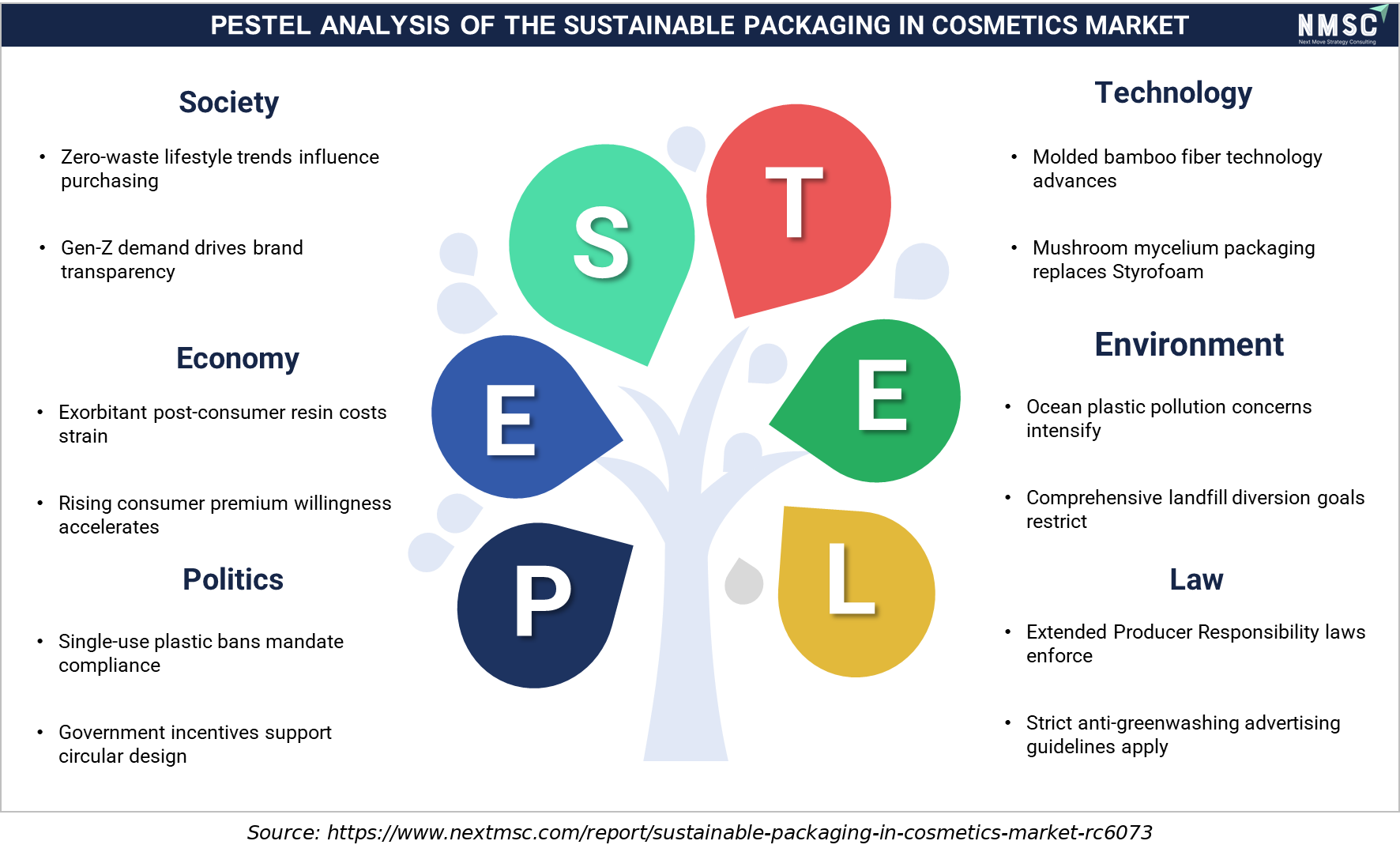
PESTEL Analysis of the Sustainable Packaging in Cosmetics Market

PESTEL Analysis of the Sustainable Packaging in Cosmetics Market
NMSC's analysis indicates that zero-waste lifestyle trends and Gen-Z demands for brand transparency drive the Sustainable Packaging in Cosmetics Market. Furthermore, advancements like molded bamboo and mushroom mycelium help mitigate high post-consumer resin costs. Concurrently, single-use plastic bans, ocean plastic concerns, and Extended Producer Responsibility laws enforce compliance, while strict anti-greenwashing advertising guidelines promote genuine circular design and landfill diversion goals.

Market Drivers & Dynamics

Interactive Dataset
Tightening extended producer responsibility regulation driver +1.6% Europe, North America 2026–2035
Rising brand commitments to recycled and renewable content driver +1.3% Global 2026–2035
Growing indie beauty brand adoption of refillable formats driver +1.0% North America, Europe 2026–2032
Expansion of e-commerce-compliant sustainable packaging design driver +0.8% Asia-Pacific, North America 2026–2035
Increasing consumer willingness to pay for eco-friendly packaging driver +0.6% Global 2027–2035
Higher input costs for certified recycled and bio-based materials restraint -0.9% Global 2026–2032
Limited recycling infrastructure for mixed-material packaging restraint -0.7% Asia-Pacific, Latin America 2026–2033
Technical performance limitations of compostable materials in humid conditions restraint -0.5% Global 2026–2030
Slower packaging redesign cycles among mass-market brands restraint -0.4% Middle East and Africa, Latin America 2026–2031
Source: Next Move Strategy Consulting

Growth Drivers

What Is the Primary Growth Driver?

Tightening extended producer responsibility regulation is the primary growth driver, with the European Commission's Circular Economy Action Plan setting binding recycled-content and recyclability targets that directly affect cosmetics packaging design. We observed that this regulatory pressure, combined with expanding national packaging waste levies, is pushing cosmetics brands toward recyclable and mono-material packaging formats, directly supporting the 8.46% CAGR projected for 2026–2035.

How Is Brand Sustainability Commitment Driving Market Growth?

Cosmetics brand sustainability commitments are expanding recycled and renewable content adoption as companies publish measurable packaging targets tied to corporate responsibility reporting. Regulatory guidance from the U.S. Federal Trade Commission's Green Guides on environmental marketing claims is supporting more standardized sustainability labeling. Our assessment indicates that this commitment-driven adoption is replicating across Asia-Pacific and Latin American markets as multinational beauty brands extend packaging standards globally, reinforcing renewable materials as the fastest-growing material type segment through 2035.

Growth Inhibitors

What Is Restraining Sustainable Packaging in Cosmetics Market Growth?

Higher input costs for certified recycled and bio-based materials remain the primary restraint, as PCR plastic and renewable material feedstock frequently command premium pricing over virgin plastic inputs. We found that limited recycling infrastructure for mixed-material packaging further complicates end-of-life recovery in several Asia-Pacific and Latin American markets, an industry-derived estimate given the absence of a single publicly verifiable global recycling infrastructure cost dataset for this category.

What Are the Growth Opportunities?

How Can Refill Station Partnerships Expand Retail Reach?

Partnering with specialty retailers to install in-store refill stations creates a recurring point-of-sale mechanism, benefiting refillable packaging suppliers as beauty retailers seek differentiated sustainability experiences for in-person shoppers.

How Can Certified PCR Supply Chain Integration Expand Material Reliability?

Building direct-sourcing relationships with certified PCR plastic reclaimers creates a supply security mechanism, benefiting the plastic material type segment as brands seek to reduce exposure to recycled feedstock price volatility.

How Can Molded Fiber Innovation Expand Secondary Packaging Adoption?

Developing molded fiber alternatives to plastic trays and inserts creates a plastic-reduction mechanism, benefiting the secondary packaging segment as brands seek compostable presentation packaging for gift sets and premium product bundles.

Segmentation Analysis

2025 (USD Billion)
2035 (USD Billion)
Primary Packaging 2025: $8.98 Billion | 2035: $19.20 Billion
Primary Pack
Secondary Packaging 2025: $2.64 Billion | 2035: $6.50 Billion
Secondary Pa
Tertiary Packaging 2025: $1.58 Billion | 2035: $4.10 Billion
Tertiary Pac
Primary Packaging $8.98 Billion $19.20 Billion 8.81%
Secondary Packaging $2.64 Billion $6.50 Billion 10.53%
Tertiary Packaging $1.58 Billion $4.10 Billion 11.18%

Which Packaging Layer Segment Dominates the Sustainable Packaging in Cosmetics Market?

Primary packaging, covering rigid containers, flexible containers, dispensing systems, closures, and applicators that directly contact the cosmetic product, defines the leading packaging layer. We found that this segment held approximately 68% share in 2025 given its role as the highest-value, most visible packaging tier across skin care and color cosmetics categories. Tertiary packaging is the fastest-growing sub-segment at 11.18% CAGR, driven by rising e-commerce shipment volumes requiring sustainable corrugated cases and protective wraps.

2025 (USD Billion)
2035 (USD Billion)
Plastic
PET
HDPE
PP
PE
Segment Item 2025 (USD Billion) 2035 (USD Billion) CAGR
Plastic $10.0 USD Billion $40.0 USD Billion 25.0%
PET $17.1 USD Billion $51.1 USD Billion 11.0%
HDPE $24.2 USD Billion $62.2 USD Billion 25.0%
PP $31.3 USD Billion $73.3 USD Billion 11.0%
PE $38.4 USD Billion $84.4 USD Billion 16.0%

Segment-wise data is locked

Unlock complete segment-wise numbers for By Material Type.

Unlock Full Data

Which Material Type Is Fastest-Growing in the Sustainable Packaging in Cosmetics Market?

Plastic, primarily PCR and bio-based grades, dominates the material type axis with approximately 40% share in 2025, reflecting established injection molding and tube extrusion infrastructure across the packaging supply chain. Our analysis shows that renewable materials, including bamboo, wood, and cork, is the fastest-growing sub-segment at 13.32% CAGR as premium and indie beauty brands adopt natural material accents to differentiate on shelf and reduce plastic dependency.

2025 (USD Billion)
2035 (USD Billion)
Recyclable P
Refillable P
Reusable Pac
Bio-based Pa
Compostable
Segment Item 2025 (USD Billion) 2035 (USD Billion) CAGR
Recyclable Packaging $10.0 USD Billion $40.0 USD Billion 27.0%
Refillable Packaging $17.1 USD Billion $51.1 USD Billion 9.0%
Reusable Packaging $24.2 USD Billion $62.2 USD Billion 19.0%
Bio-based Packaging $31.3 USD Billion $73.3 USD Billion 17.0%
Compostable Packaging $38.4 USD Billion $84.4 USD Billion 18.0%

Segment-wise data is locked

Unlock complete segment-wise numbers for By Sustainability Mechanism.

Unlock Full Data

Which Sustainability Mechanism Leads Market Demand?

Recyclable packaging dominates the sustainability mechanism axis with approximately 35% share in 2025, reflecting broad brand and regulatory alignment around established recycling stream compatibility. Our analysis shows that bio-based packaging is the fastest-growing sub-segment at 11.21% CAGR as brands seek renewable feedstock alternatives to conventional petroleum-based plastics, narrowing the gap with recyclable packaging as the leading sustainability mechanism through 2035.

2025 (USD Billion)
2035 (USD Billion)
Injection Mo
Blow Molding
Tube Extrusi
Thermoformin
Compression
Segment Item 2025 (USD Billion) 2035 (USD Billion) CAGR
Injection Molding $10.0 USD Billion $40.0 USD Billion 14.0%
Blow Molding $17.1 USD Billion $51.1 USD Billion 24.0%
Tube Extrusion $24.2 USD Billion $62.2 USD Billion 22.0%
Thermoforming $31.3 USD Billion $73.3 USD Billion 12.0%
Compression Molding $38.4 USD Billion $84.4 USD Billion 27.0%

Segment-wise data is locked

Unlock complete segment-wise numbers for By Manufacturing Process.

Unlock Full Data
2025 (USD Billion)
2035 (USD Billion)
Direct Print
Screen Print
Digital Prin
Flexographic
Labeling
Segment Item 2025 (USD Billion) 2035 (USD Billion) CAGR
Direct Printing $10.0 USD Billion $40.0 USD Billion 24.0%
Screen Printing $17.1 USD Billion $51.1 USD Billion 22.0%
Digital Printing $24.2 USD Billion $62.2 USD Billion 20.0%
Flexographic Printing $31.3 USD Billion $73.3 USD Billion 22.0%
Labeling $38.4 USD Billion $84.4 USD Billion 13.0%

Segment-wise data is locked

Unlock complete segment-wise numbers for By Decoration Technology.

Unlock Full Data
2025 (USD Billion)
2035 (USD Billion)
Skin Care
Facial Care
Body Care
Sun Care
Color Cosmet
Segment Item 2025 (USD Billion) 2035 (USD Billion) CAGR
Skin Care $10.0 USD Billion $40.0 USD Billion 23.0%
Facial Care $17.1 USD Billion $51.1 USD Billion 9.0%
Body Care $24.2 USD Billion $62.2 USD Billion 19.0%
Sun Care $31.3 USD Billion $73.3 USD Billion 13.0%
Color Cosmetics $38.4 USD Billion $84.4 USD Billion 10.0%

Segment-wise data is locked

Unlock complete segment-wise numbers for By Cosmetic Application.

Unlock Full Data
2025 (USD Billion)
2035 (USD Billion)
Direct Sales
Packaging Di
Contract Pac
Direct B2B E
Segment Item 2025 (USD Billion) 2035 (USD Billion) CAGR
Direct Sales $10.0 USD Billion $40.0 USD Billion 21.0%
Packaging Distributors $17.1 USD Billion $51.1 USD Billion 23.0%
Contract Packaging Partners $24.2 USD Billion $62.2 USD Billion 25.0%
Direct B2B E-commerce $31.3 USD Billion $73.3 USD Billion 15.0%

Segment-wise data is locked

Unlock complete segment-wise numbers for By Sales Channel.

Unlock Full Data
2025 (USD Billion)
2035 (USD Billion)
Global Beaut
Regional Bea
Indie Beauty
Contract Man
Private Labe
Segment Item 2025 (USD Billion) 2035 (USD Billion) CAGR
Global Beauty Brands $10.0 USD Billion $40.0 USD Billion 9.0%
Regional Beauty Brands $17.1 USD Billion $51.1 USD Billion 23.0%
Indie Beauty Brands $24.2 USD Billion $62.2 USD Billion 9.0%
Contract Manufacturers $31.3 USD Billion $73.3 USD Billion 23.0%
Private Label Brands $38.4 USD Billion $84.4 USD Billion 8.0%

Segment-wise data is locked

Unlock complete segment-wise numbers for By End User.

Unlock Full Data

Growth Opportunities

We identified three forward-looking whitespace opportunities within the sustainable packaging in cosmetics market that are distinct from the primary investment thesis outlined above.

How Can Refill Station Partnerships Expand Retail Reach?

Partnering with specialty retailers to install in-store refill stations creates a recurring point-of-sale mechanism, benefiting refillable packaging suppliers as beauty retailers seek differentiated sustainability experiences for in-person shoppers.

How Can Certified PCR Supply Chain Integration Expand Material Reliability?

Building direct-sourcing relationships with certified PCR plastic reclaimers creates a supply security mechanism, benefiting the plastic material type segment as brands seek to reduce exposure to recycled feedstock price volatility.

How Can Molded Fiber Innovation Expand Secondary Packaging Adoption?

Developing molded fiber alternatives to plastic trays and inserts creates a plastic-reduction mechanism, benefiting the secondary packaging segment as brands seek compostable presentation packaging for gift sets and premium product bundles.

Regional Outlook

2025 (USD Billion)
2035 (USD Billion)
Europe
Asia-Pacific
North Americ
Latin Americ
Middle East
Region 2025 (USD Billion) 2035 (USD Billion) CAGR (%)
Europe $10.0 USD Billion $40.0 USD Billion 9.0%
Asia-Pacific $17.1 USD Billion $51.1 USD Billion 27.0%
North America $24.2 USD Billion $62.2 USD Billion 25.0%
Latin America $31.3 USD Billion $73.3 USD Billion 23.0%
Middle East and Africa $38.4 USD Billion $84.4 USD Billion 12.0%

Regional data is locked

Unlock complete regional numbers for this market.

Unlock Full Data

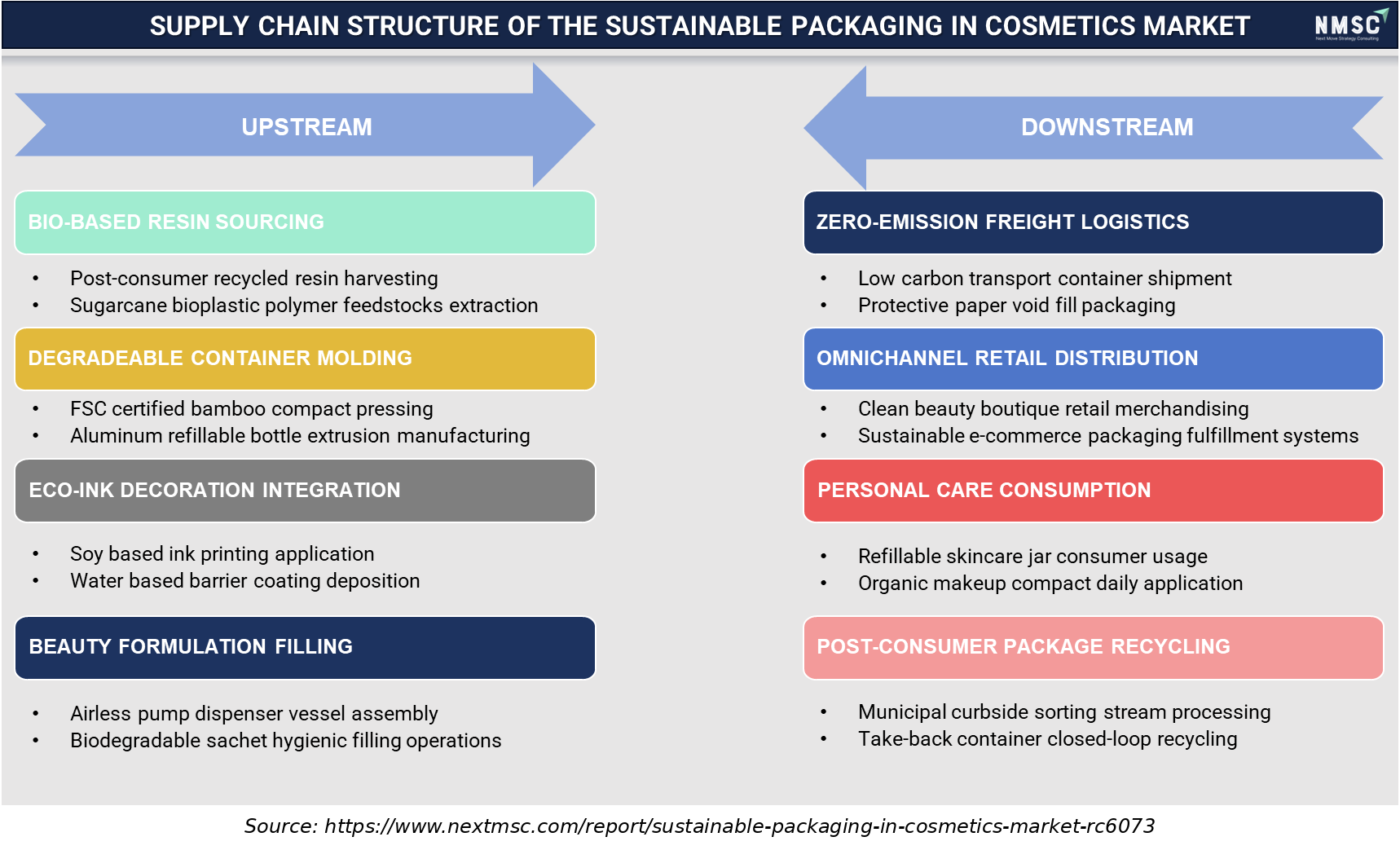
Supply Chain Structure of the Sustainable Packaging in Cosmetics Market

Supply Chain Structure of the Sustainable Packaging in Cosmetics Market
Based on research conducted by NMSC, we found that the supply chain structure of the Sustainable Packaging in Cosmetics Market integrates sugarcane bioplastics, FSC-certified bamboo pressing, and soy-ink printing with zero-emission freight logistics. Downstream, omnichannel networks supply clean beauty boutiques and e-commerce platforms. Ultimately, consumer usage of refillable skincare jars and organic makeup compacts is completed by municipal curbside sorting and take-back closed-loop recycling systems.

Competitive Landscape

We found that the sustainable packaging in cosmetics industry is moderately consolidated, with a mix of diversified global packaging manufacturers and specialized regional converters competing across material and format categories.

Dimension Description
Market Structure Moderately consolidated with diversified global packaging manufacturers alongside specialized regional converters
Innovation Focus Mono-material design, PCR plastic integration, and refillable system engineering
M and A Activity Selective acquisitions to expand material science capability and regional manufacturing footprint

How Do Companies Compete in the Sustainable Packaging in Cosmetics Market?

Leading companies compete on material science depth, manufacturing scale, and design engineering capability across rigid and flexible packaging formats. Our analysis shows that pricing strategies vary by material type, with certified PCR and bio-based packaging commanding premium pricing over conventional virgin plastic formats. Geographic expansion is pursued through regional manufacturing partnerships in markets with growing beauty brand manufacturing investment.

Which Competitive Archetypes Dominate the Sustainable Packaging in Cosmetics Industry?

Diversified global packaging manufacturers such as Amcor plc and AptarGroup, Inc. compete on manufacturing scale and material science breadth, while specialized premium converters such as Axilone Group and Baralan International S.p.A. compete on design engineering for luxury beauty brands. Regional contract packagers such as HCP Packaging (Shanghai) Co., Ltd. differentiate through Asia-Pacific manufacturing proximity. This archetype segmentation explains sustained competitive diversity across the category.

What Is the Innovation and Differentiation Strategy Across the Industry?

Industry leaders differentiate through mono-material design research, PCR plastic supply chain integration, and refillable system engineering that connects packaging performance to measurable sustainability outcomes. We observed that certified recycled-content sourcing is becoming a standard differentiator, allowing manufacturers to meet brand sustainability commitments beyond conventional packaging specifications.

How Active Is M&A in the Sustainable Packaging in Cosmetics Industry?

M&A activity remains selective, concentrated on combining material science capability with regional manufacturing footprint rather than large-scale consolidation. Recent acquisitions integrating specialty packaging converters with sustainable material suppliers illustrate how established manufacturers are reinforcing existing product portfolios rather than expanding into unrelated categories.

Key Market Players

Our assessment indicates that the following companies represent the validated set of leading global sustainable packaging in cosmetics providers active as of 2026, ranked by verifiable market-specific scale of operations.

Amcor plc AptarGroup, Inc. Silgan Holdings Inc. Gerresheimer AG Albéa Group Mondi plc TriMas Corporation CCL Industries Inc. Sonoco Products Company Huhtamäki Oyj Quadpack Industries, S.A. HCP Packaging (Shanghai) Co., Ltd. Lumson S.p.A. Hoffmann Neopac AG Axilone Group Baralan International S.p.A. Yonwoo Co., Ltd. Virospack, S.L. EPL Limited Libo Cosmetics Co., Ltd.

Latest Developments

We found that recent corporate activity reflects continued material innovation and manufacturing capacity investment among leading sustainable packaging in cosmetics providers heading into 2026.

Date Event
January 2026 Aptar Beauty launched NeoDropper Autoload, a next-generation auto-loading dropper packaging solution for prestige and dermocosmetic skincare products. Featuring a twist-and-push automatic dispensing mechanism with a short applicator, it provides controlled dosing, hygienic application, and enhanced protection against formula contamination.
January 2026 Quadpack launched Linea PP Panstick, a recyclable and refillable packaging solution designed for makeup applications including foundations, blushes, and highlighters. Constructed from mono-material polypropylene with post-consumer recycled options, it features a practical snap-on refill system and a POM-free smooth dispensing mechanism.
September 2025 Hoffmann Neopac unveiled PaperX FiberTop, a paper-based tube packaging solution featuring a fiber body, shoulder, and closure designed for full recyclability in paper waste streams. Developed alongside AISA and Blue Ocean Closures, it reduces plastic content by up to 87% for sustainable cosmetics.

Expert Insights

Laney Crowell

Laney Crowell

Founder & CEO | Saie

"My hope is that this unprecedented commitment inspires the beauty industry to clean up the 120 billion pieces of plastic we produce annually, and ultimately find a solution to our plastic addiction. While daunting, I know this is just the beginning and I couldn't be more excited to start this journey."

Analyst Interpretation

The statement underscores the increasing urgency for the cosmetics industry to reduce its reliance on conventional plastic packaging and accelerate the adoption of sustainable alternatives. As environmental concerns, regulatory pressures, and consumer demand for eco-conscious products continue to grow, cosmetic brands are investing in recyclable, refillable, and lower-impact packaging solutions. This industry-wide shift is fostering innovation in sustainable materials and circular packaging systems, supporting the long-term growth of the sustainable packaging in cosmetics market.

Investment Opportunities

What Capital Inflows Are Shaping the Sustainable Packaging in Cosmetics Market?

Capital inflows are concentrated in PCR plastic processing capacity and mono-material tube manufacturing expansion, with leading companies reinvesting in certified recycled-content supply chains to meet brand sustainability commitments. We observed that Amcor plc has disclosed continued investment in recycled-content packaging platforms, an industry-derived benchmark for capital intensity across top-tier manufacturers.

How Is Infrastructure Investment Evolving Across the Industry?

Infrastructure investment is expanding in regional manufacturing capacity and recycling feedstock processing designed to serve growing global demand for certified sustainable packaging materials. Our analysis shows that similar capacity investments are likely across Asia-Pacific and Latin American markets through 2035 as multinational packaging manufacturers diversify their geographic production footprint.

What ESG Considerations Are Relevant to Sustainable Packaging in Cosmetics Market Investment?

Environmental, social, and governance considerations increasingly center on verified recycled-content sourcing, reduced virgin plastic dependency, and packaging end-of-life recovery infrastructure investment. We found that these considerations are becoming embedded in institutional investment screening criteria applied to packaging manufacturers and cosmetics brand customers.

Key Benefits for Stakeholders

How Does This Report Benefit Packaging Industry Leaders?

Industry leaders gain a validated view of segment-level growth rates, competitive archetypes, and regional demand drivers that inform manufacturing investment prioritization and go-to-market sequencing across material categories through 2035.

How Does This Report Benefit Investors and Financial Analysts?

Investors and financial analysts gain access to consistent market sizing, CAGR benchmarks, and competitive landscape analysis that support capital allocation decisions across packaging material and format manufacturers.

How Does This Report Benefit Technology Vendors and Product Teams?

Technology vendors and product teams gain visibility into mono-material design, PCR integration, and refillable system engineering trends that inform partnership and product development strategies aligned with leading packaging manufacturers' innovation roadmaps.

Key Market Segments Evaluated

By Packaging Layer

  • Primary Packaging
  • Secondary Packaging
  • Tertiary Packaging

By Material Type

  • Plastic
  • Glass
  • Metal
  • Paper and Fiber
  • Renewable Materials
  • Other Materials

By Sustainability Mechanism

  • Recyclable Packaging
  • Refillable Packaging
  • Reusable Packaging
  • Bio-based Packaging
  • Compostable Packaging
  • Lightweight Packaging

By Manufacturing Process

  • Injection Molding
  • Blow Molding
  • Tube Extrusion
  • Thermoforming
  • Compression Molding
  • Glass Forming
  • Metal Forming
  • Paper Converting
  • Fiber Molding

By Decoration Technology

  • Direct Printing
  • Screen Printing
  • Digital Printing
  • Flexographic Printing
  • Labeling
  • Hot Foil Stamping
  • Metallization
  • Coating
  • Soft Touch Coating
  • Protective Coating
  • Embossing and Debossing

By Cosmetic Application

  • Skin Care
  • Facial Care
  • Body Care
  • Sun Care
  • Color Cosmetics
  • Face Makeup
  • Lip Makeup
  • Eye Makeup
  • Hair Care
  • Fragrance
  • Fine Fragrance
  • Body Mist
  • Personal Care and Hygiene
  • Bath and Body
  • Deodorant
  • Oral Care
  • Men's Grooming
  • Baby Care
  • Other Cosmetic Applications

By Sales Channel

  • Direct Sales
  • Packaging Distributors
  • Contract Packaging Partners
  • Direct B2B E-commerce

By End User

  • Global Beauty Brands
  • Regional Beauty Brands
  • Indie Beauty Brands
  • Contract Manufacturers
  • Private Label Brands

Conclusion & Recommendations

The sustainable packaging in cosmetics market is projected to expand from USD 14.35 billion in 2026 to USD 29.80 billion by 2035 at an 8.46% CAGR, supported by sustained regulatory tightening and expanding brand sustainability commitments. We found that this trajectory reflects durable structural demand rather than a cyclical upswing, positioning the industry for continued long-term expansion.

What Are the Strategic Positioning Recommendations?

Producers should prioritize mono-material and PCR plastic packaging expansion in Europe and North America while building manufacturing capacity in Asia-Pacific and Latin America to serve growing regional beauty brand demand. Our assessment indicates that companies balancing both strategies will capture the broadest share of the projected USD 15.45 billion incremental opportunity through 2035.

How Attractive Is the Sustainable Packaging in Cosmetics Market for Investment?

The market's 8.46% CAGR, combined with a moderately consolidated competitive structure among twenty validated global providers, signals an attractive investment profile for capital targeting regulatory-driven, durable packaging demand rather than short-cycle discretionary categories.

What Market Shifts and Key Risks Should Stakeholders Monitor?

Stakeholders should monitor extended producer responsibility regulatory changes, recycled-content input cost volatility, and recycling infrastructure gaps that could moderate margin stability across packaging manufacturers through the forecast period.

What Are the Primary Growth Pathways Through 2035?

Primary growth pathways include expanding mono-material packaging adoption, scaling certified PCR plastic supply chains, and growing refillable system partnerships with beauty retailers, each reinforcing the sustainable packaging in cosmetics market's projected expansion to USD 29.80 billion by 2035.

FAQs

About the Author

Saista Faiyaz

Saista Faiyaz

Saista Faiyaz is Research Associate at Next Move Strategy Consulting, where she has covered consumer markets and healthcare technologies for 3 years. Her work includes primary interview review, secondary-source validation, market sizing, and structured analysis of company and industry data. She supports research by comparing evidence across sources, organizing findings into market narratives, and documenting assumptions used in analysis. Her scope includes cross-market benchmarking, and reports.

About the Reviewer

Supradip Baul

Supradip Baul

Supradip Baul is an accomplished business consultant and strategist with over a decade of rich experience in market intelligence, strategy, technology, and business transformation. His work has included rigorous qualitative and quantitative analysis across multiple industries, helping clients shape investment decisions and long-term roadmaps. Earlier in his career, he was associated with Gartner, where he contributed to industry-leading reports and market share analyses. He has worked with leading global companies and holds an MBA with a dual specialization in Marketing and Finance.

Download Free Sample

Kevin Coker

KEVIN COKER

Founder, CEO and Board Diector

Proxima Clinical Research

I have been using Next MSC reports for product positioning in a new geography for a long time. They have by far the best reports I have found and the price is reasonable too!

Rishabh Jogani

RISHABH JOGANI

Strategy Analyst

Accenture Japan

We are incredibly impressed with the market report on the real estate market in India provided by Next Move Strategy Consulting. The report was thorough, insightful, and well-structured, offering deep analysis and actionable recommendations. It not only captured the current trends and dynamics but also provided a forward-looking perspective that has been invaluable for our strategic planning. Their team demonstrated exceptional professionalism, attention to detail, and a profound understanding of the industry. The data-driven insights and clarity of presentation exceeded our expectations, making complex market trends easy to understand. We highly recommend Next Move Strategy Consulting to anyone looking for reliable and comprehensive market research services. Their expertise has given us the confidence to navigate the complexities of the Indian real estate market with clarity and foresight.

Robert Sean Trevino

ROBERT SEAN TREVINO

Sr. Director, Head of Strategic Insights & Analytics

Foundation Medicine

I realized that it was a reliable source of information. These days, there are many people who are looking for authentic data, and this is one of the only sources that can offer them with what they need;

Ross J Mckenzie

ROSS J MCKENZIE

Business Insight Manager

Staysure Group

“Next MSC have been incredibly helpful in providing detailed & robust information on our market, alongside quantifying growth by different segments. The process to procure was simple and easy, with sample reports and regular contact to ensure we had what we needed. Succinct detail on their sources & methodologies is also greatly received, allowing transparency in this respect helps build trust in the detail you pay for. Joseph in particular was fantastic, and helped ensure efficient provision of the insight pack – thank you NMSC!”.

Diana Trejo

DIANA TREJO

Assistant Manager

Sumitomo Corporation de Mexico, S.A. de C.V.

Recently, we purchased a report on the Mexico Data Center Market from Next Move Strategy Consulting. The service has been excellent, with support that is always timely and thoroughly professional. The information provided is interesting, highly useful, and delivered with clarity. I would highly recommend NextMSC for anyone seeking insightful and dependable analysis.

Custom Market Research Services

We will customize the research for you if the listed report does not fully match your requirements.

Get 30% Free Customization

Select License

This website uses cookies to ensure you get the best experience on our website. Learn more

✖