Sustainable Packaging Logistics Market Size, Share, Growth & Forecast By Offering (Reusable Packaging Products, Logistics Services, Asset Management & Digital Services), By Material Type (Wood, Plastic, Metal, Composite, Textile, Foam), By Asset Format (Pallet, Reusable Plastic Container, Crate, Tote, Bin, Tray, Bulk Container, IBC, Drum, Tank, Dunnage System), Distribution Channel, and By End Use Industry (Food & Beverage, E-Commerce, Pharmaceuticals, Automotive) — Global Analysis 2025–2035
Industry: Construction & Manufacturing | Publishing Date: July 7, 2026 | Last Updated: September 30, 2026 | No of Pages: N/A | No. of Tables: N/A | No. of Figures: N/A | Format: PDF | Report Code: CM5004
What Is the Sustainable Packaging Logistics Market Size?
The global Sustainable Packaging Logistics Market was valued at USD 92.40 billion in 2025 and is projected to reach USD 102.84 billion in 2026. Propelled by sweeping legislative mandates on single-use packaging, corporate ESG commitments driving circular supply chain investment, rapid digitization of reusable asset pools through IoT and RFID tracking, and the accelerating shift of food, beverage, and e-commerce operators from single-trip to multi-trip reusable packaging systems, the market is forecast to reach USD 269.54 billion by 2035, growing at a CAGR of 11.3% from 2026 to 2035. The market's expansion reflects a structural inflection in global supply chain strategy, with sustainability performance now central to procurement, logistics network design, and regulatory compliance planning across all major end-use industries.
|
Parameters |
Details |
|
Market Size in 2025 |
USD 92.40 Billion |
|
Market Size in 2026 |
USD 102.84 Billion |
|
Revenue Forecast in 2035 |
USD 269.54 Billion |
|
Growth Rate |
CAGR of 11.3% from 2026 to 2035 |
|
Analysis Period |
2025–2035 |
|
Base Year Considered |
2025 |
|
Forecast Period |
2026–2035 |
|
Market Size Estimation |
USD Billion |
|
Companies Profiled |
20 |
|
Countries Covered |
33 |
|
Market Share |
Top 10 |
Sustainable Packaging Logistics Market Overview
What Is the Sustainable Packaging Logistics Market?
The Sustainable Packaging Logistics Market encompasses the end-to-end ecosystem of reusable packaging products, associated lifecycle management services, and digital asset intelligence platforms that collectively enable closed-loop supply chain operations. It covers reusable pallets, crates, totes, bins, trays, bulk containers, intermediate bulk containers, drums, tanks, and dunnage systems, alongside the collection, washing, inspection, repair, reconditioning, and end-of-life recycling services required to maintain their multi-trip utility. The market also includes pooling contract models and asset tracking technologies that maximize asset utilization and deliver quantifiable carbon and waste reduction outcomes across food, beverage, automotive, pharmaceutical, e-commerce, and industrial supply chains globally.
How Has the Sustainable Packaging Logistics Market Evolved Structurally?
The Sustainable Packaging Logistics Market has undergone transformational structural evolution from a niche pallet and crate pooling business to a multi-billion-dollar circular supply chain platform industry. An initial phase centred on wooden pallet rental in North America and Europe expanded progressively to incorporate plastic pallet and reusable plastic container pooling, beverage crate systems, and automotive dunnage programs. NMSC's analysis indicates that the current evolution phase is characterized by the convergence of IoT-enabled asset tracking, pool management software, and sustainability reporting platforms that transform standalone packaging product transactions into data-driven circular logistics service contracts, generating recurring revenue and measurable ESG outcomes.
How Does the Regulatory Environment Shape the Sustainable Packaging Logistics Market?
Regulatory frameworks across major geographies are the most consequential structural driver for the Sustainable Packaging Logistics Market, mandating reusable packaging adoption, extended producer responsibility compliance, and quantifiable packaging waste reduction. The European Commission's Packaging and Packaging Waste Regulation (PPWR), adopted in 2024, establishes mandatory reuse targets for packaging across transport and sales categories, directly mandating Reusable Packaging Products and pooling service adoption across European supply chains. The U.S. EPA's National Recycling Strategy and state-level extended producer responsibility laws in California, Oregon, Maine, and Colorado are progressively incentivizing reusable packaging system adoption in North American retail and food service supply chains.
How Is Technology Adoption Transforming the Sustainable Packaging Logistics Market?
Technology adoption is reshaping the Sustainable Packaging Logistics Market from a hardware-centric pooling industry into a data-driven platform business. RFID asset tracking, IoT-enabled pool sensors, and barcode scanning infrastructure are enabling real-time asset visibility across multi-party supply chains, reducing asset loss rates and improving pool utilization. Based on NMSC's research, we found that cloud-based pool management software and inventory visibility platforms deployed by Brambles Limited and IFCO Systems are enabling customers to benchmark packaging utilization performance and generate automated sustainability reports aligned with Science Based Targets initiative disclosures. Asset Management and Digital Services is the fastest-growing offering segment in the Sustainable Packaging Logistics Market at a 17.5% CAGR through 2035.
PESTEL Analysis of the Sustainable Packaging Logistics Market
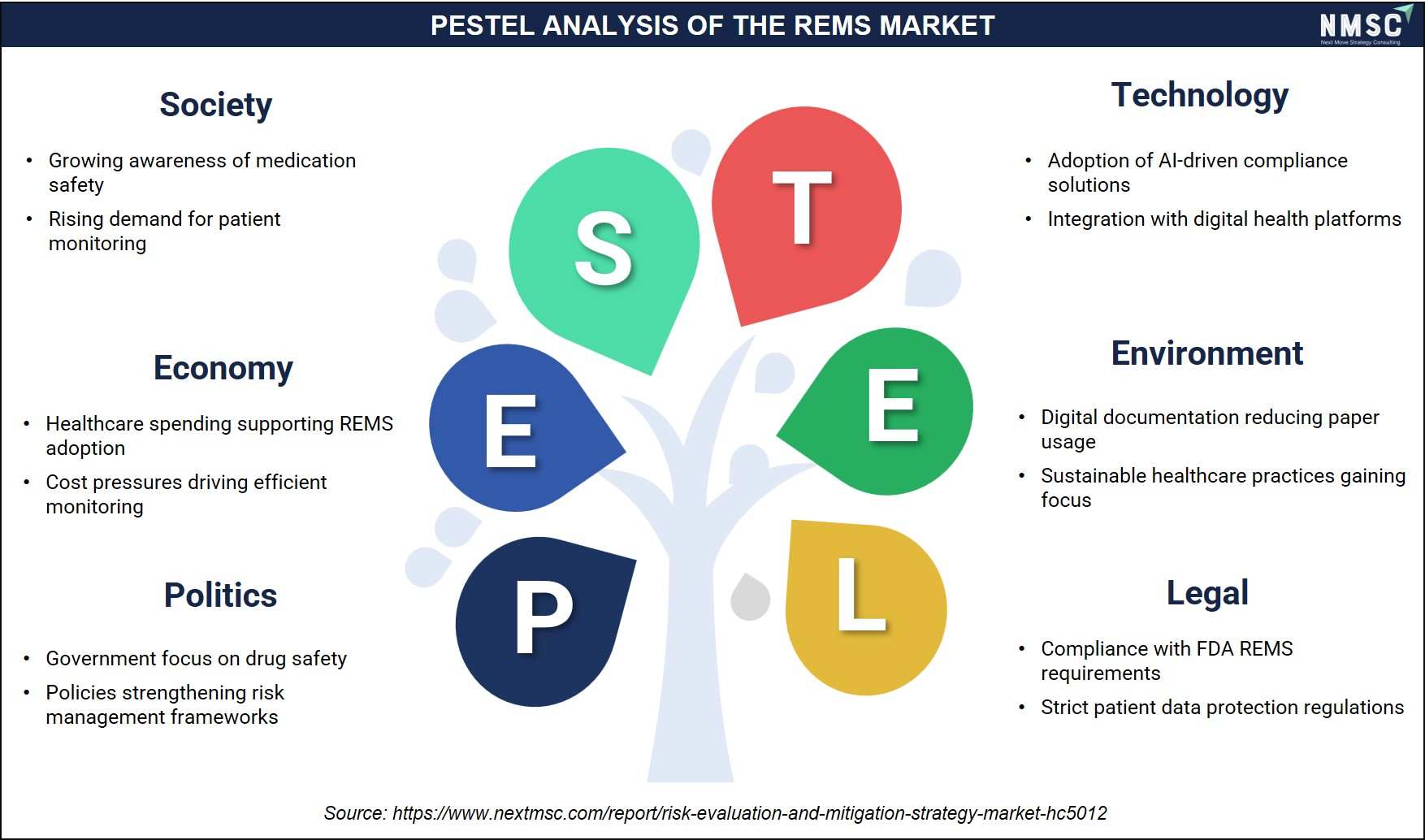
The above infographic presents a PESTEL analysis of the sustainable packaging logistics market. Government incentives and trade policies are encouraging green logistics and circular economy innovations, while growing consumer demand for eco-friendly packaging is shaping social acceptance. At the same time, smart packaging and automation are enabling greater supply chain efficiency, all within a legal framework of packaging waste regulations and extended producer responsibility. Looking ahead, we observed that these interconnected factors collectively shape the market's growth across the industry.
|
Key Takeaways |
|
By offering, Reusable Packaging Products dominated the Sustainable Packaging Logistics Market with a 60.0% revenue share at USD 55.44 billion in 2025, reflecting the large installed base of pooled pallets, crates, totes, and bulk containers operating across global food, beverage, and automotive supply chains. |
|
Asset Management and Digital Services is the fastest-growing offering segment in the Sustainable Packaging Logistics Market at a CAGR of 17.5% from 2026 to 2035, advancing from USD 9.24 billion in 2025 to USD 43.01 billion by 2035, driven by IoT tracking, pool management software, and sustainability reporting platform adoption across global enterprise customers. |
|
By material type, Plastic dominated the Sustainable Packaging Logistics Market with a 38.0% revenue share at USD 35.13 billion in 2025, reflecting the broad deployment of plastic pallets, reusable plastic containers, and totes across hygienic, temperature-controlled, and high-frequency supply chain applications globally. |
|
Other Materials is the fastest-growing material type in the Sustainable Packaging Logistics Market at a CAGR of 17.2% from 2026 to 2035, reflecting rapid adoption of advanced composite and bio-based material innovations in specialty packaging formats requiring premium mechanical or sustainable performance attributes. |
|
By asset format, Pallets dominated the Sustainable Packaging Logistics Market with a 29.0% revenue share at USD 26.79 billion in 2025, reflecting the foundational role of pallet pooling programs anchored by Brambles Limited (CHEP), PECO Pallet, and LOSCAM across retail grocery, food manufacturing, and consumer goods supply chains. |
|
Dunnage Systems represent the fastest-growing asset format in the Sustainable Packaging Logistics Market at a CAGR of 15.6% from 2026 to 2035, advancing from USD 2.77 billion in 2025 to USD 10.77 billion by 2035, driven by automotive sector expansion of reusable engineered dunnage programs replacing single-use foam and corrugated packaging in assembly plant supply chains. |
|
By distribution channel, Pooling Contracts dominated the Sustainable Packaging Logistics Market with a 33.0% revenue share at USD 30.49 billion in 2025, reflecting the subscription-based pallet and container pool model operated by major platform providers that deliver asset utilization, logistics, and compliance services under long-term commercial agreements. |
|
Service Contracts is the fastest-growing distribution channel in the Sustainable Packaging Logistics Market at a CAGR of 15.6% from 2026 to 2035, advancing from USD 6.47 billion in 2025 to USD 24.75 billion by 2035, reflecting growing operator preference for bundled wash, inspect, repair, and track service agreements replacing transactional asset purchase models. |
|
By end use, Food and Beverage dominated the Sustainable Packaging Logistics Market with a 22.0% revenue share at USD 20.33 billion in 2025, underpinned by regulatory hygiene standards, stringent supply chain traceability requirements, and large-volume pooled crate and tray programs operated by IFCO Systems and Tosca Services for fresh produce and grocery retail customers. |
|
E-Commerce is the fastest-growing end-use industry in the Sustainable Packaging Logistics Market at a CAGR of 15.5% from 2026 to 2035, advancing from USD 9.24 billion in 2025 to USD 33.69 billion by 2035, reflecting rapid adoption of reusable totes, bins, and last-mile returnable transit packaging by online grocery, direct-to-consumer, and fulfillment center operators globally. |
|
Asia-Pacific dominated the Sustainable Packaging Logistics Market with a 33.0% revenue share at USD 30.49 billion in 2025, anchored by China's large manufacturing and food supply chains, India's growing organized retail and e-commerce sector, Japan's established automotive reusable dunnage programs, and Southeast Asian agricultural and fresh produce packaging initiatives. |
|
The United States is the largest country market in the Sustainable Packaging Logistics Market at USD 22.18 billion in 2025, representing approximately 80% of North American revenue, anchored by the world's most developed pallet pooling industry, extensive CHEP and PECO pool infrastructure, and growing retailer mandates for reusable packaging across grocery and consumer goods supply chains. |
|
India is the fastest-growing major country market in the Sustainable Packaging Logistics Market at a CAGR of 15.5% from 2026 to 2035, advancing from USD 4.62 billion in 2025 to USD 17.33 billion by 2035, driven by organized retail expansion, pharmaceutical packaging compliance mandates, e-commerce logistics network development, and growing awareness of reusable packaging economics. |
Key Emerging Trends in the Sustainable Packaging Logistics Market
How Is the European Packaging and Packaging Waste Regulation Reshaping the Sustainable Packaging Logistics Market?
The European Commission's Packaging and Packaging Waste Regulation, adopted in 2024, establishes binding reuse targets across transport, e-commerce, and food service packaging categories, creating the most consequential regulatory demand event in the history of the Sustainable Packaging Logistics Market. From our research, we found that PPWR mandates reuse rates of 10% for transport packaging by 2030 and 50% for e-commerce outer packaging by 2040, directly driving enterprise procurement of reusable packaging systems and pooling contract adoption across European supply chains. Brambles Limited and IFCO Systems are publicly aligning strategic investment in European pool capacity expansion with PPWR compliance timelines, signalling a multi-year demand acceleration across the regional market.
How Is IoT-Enabled Asset Tracking Transforming Pool Efficiency in the Sustainable Packaging Logistics Market?
IoT and RFID-based asset tracking deployment is fundamentally changing pool management economics in the Sustainable Packaging Logistics Market by reducing asset loss rates, improving utilization visibility, and enabling data-driven pool rebalancing across multi-node supply chain networks. NMSC's analysis indicates that Brambles Limited's CHEP Digital platform, integrating RFID and barcode tracking across its global pallet pool, has materially improved asset dwell time visibility and pool balancing efficiency for enterprise customers. Through our market assessment, we observed that IoT Tracking is the fastest-growing asset tracking sub-segment, as operators move beyond periodic scan-based barcode systems toward continuous sensor-based monitoring of asset location, condition, and environmental status across the full closed-loop logistics cycle.
How Is E-Commerce Growth Creating New Demand Patterns Within the Sustainable Packaging Logistics Market?
The structural growth of e-commerce and direct-to-consumer logistics is creating new packaging format requirements and distribution network configurations that are expanding the addressable scope of the Sustainable Packaging Logistics Market beyond traditional grocery and automotive pooling. Our findings suggest that online grocery operators including Ocado, Amazon Fresh, and Instacart-partnered retailers, are deploying reusable tote and bin systems for last-mile home delivery, replacing single-trip corrugated boxes and polybags. E-Commerce is the fastest-growing end-use industry in the Sustainable Packaging Logistics Market at a 15.5% CAGR through 2035, advancing from USD 9.24 billion in 2025 to USD 33.69 billion by 2035, with the returnable transit packaging sector increasingly central to sustainable last-mile logistics strategy.
How Are Corporate Science-Based Targets Accelerating Adoption of the Sustainable Packaging Logistics Market?
Corporate Scope 3 emissions reporting obligations and Science Based Targets initiative commitments are creating structured enterprise procurement mandates for reusable packaging systems across consumer goods, retail, pharmaceutical, and food manufacturing supply chains. Our assessment indicates that major corporations, including Nestlé, Unilever, Walmart, and L'Oréal, have publicly committed to packaging sustainability targets that require measurable reductions in single-use packaging, directly generating demand for Reusable Packaging Products and Logistics Services within the Sustainable Packaging Logistics Market. The GHG Protocol's Scope 3 Accounting Standards, governing corporate value chain emissions reporting, are creating verifiable sustainability disclosure requirements that position pooled reusable packaging as a quantifiably superior alternative to single-trip options across multiple supply chain tiers globally.
What Are the Key Market Drivers, Breakthroughs, and Investment Opportunities That Will Shape the Sustainable Packaging Logistics Industry in the Next Decade?
|
Drivers / Trends / Restraints |
(+/-) % Impact on CAGR Forecast |
Geographic Relevance |
Impact Timeline |
|
EU Packaging and Packaging Waste Regulation (PPWR) Mandatory Reuse Targets |
+2.5% |
Europe |
2025–2030 |
|
Corporate ESG Commitments and Science-Based Targets Driving Reusable Packaging Adoption |
+2.2% |
Global |
2025–2035 |
|
E-Commerce Expansion Generating New Returnable Packaging Demand |
+1.8% |
Asia-Pacific, North America, Europe |
2025–2035 |
|
IoT and RFID Asset Tracking Improving Pool Economics and Utilization |
+1.5% |
Global |
2025–2032 |
|
Pharmaceutical and Healthcare Sector Compliance Mandating Validated Packaging |
+1.2% |
North America, Europe, APAC |
2026–2035 |
|
Growing Fresh Produce and Grocery Retail Crate Pooling Programs in Asia-Pacific |
+1.0% |
Asia-Pacific |
2025–2035 |
|
High Upfront Capital Requirements for Reusable Asset Pool Deployment |
-0.8% |
All regions |
Ongoing |
|
Complex Multi-Party Reverse Logistics Infrastructure Requirements |
-0.6% |
Emerging Markets |
Ongoing |
|
Consumer Goods and FMCG Sector Single-Use Packaging Transition Investment |
+0.9% |
Global |
2026–2035 |
|
Automotive Reusable Dunnage Adoption in Electric Vehicle Manufacturing |
+0.8% |
North America, Europe, APAC |
2025–2035 |
|
Pooling Platform Expansion into Middle Eastern and African Markets |
+0.6% |
MEA |
2026–2035 |
What Are the Growth Drivers of the Sustainable Packaging Logistics Market?
How Is Extended Producer Responsibility Legislation Driving Reusable Packaging Demand in the Sustainable Packaging Logistics Market?
Extended producer responsibility regulations mandating producers to finance the collection, sorting, and recovery of packaging at the end of life are creating powerful incentives for brand owners to shift from single-use to reusable packaging systems that reduce EPR fee liability. Our analysis shows that the European Commission's PPWR establishes quantified packaging reuse targets that make reusable packaging systems a compliance instrument rather than a purely voluntary ESG choice. The U.S. EPA's 2021 National Recycling Strategy established a framework supporting EPR adoption at the state level, with mandatory programs active in California, Oregon, Maine, and Colorado, progressively expanding corporate incentives to adopt Reusable Packaging Products within domestic supply chains to reduce recyclable material exposure and EPR cost burden.
How Is the Growth of Food and Fresh Produce Pooled Packaging Programs sustaining the Sustainable Packaging Logistics Market Demand?
Fresh produce and perishable food supply chains represent the most structurally robust demand base within the Sustainable Packaging Logistics Market, anchored by the operational economics of reusable plastic crates and trays that deliver superior hygiene, product protection, and supply chain efficiency versus single-trip corrugated alternatives. Based on NMSC's research, we found that IFCO Systems, the world's largest fresh produce RPC pool operator, manages over 300 million reusable plastic containers in circulation globally, serving major retailers and fresh food distributors across North America, Europe, and Asia-Pacific. The Food and Agriculture Organization's data on global food system losses confirms that hygienic reusable packaging reduces fresh produce damage during transit, creating a productivity benefit complementing the environmental performance advantages of pooled systems.
How Is Pharmaceutical Sector Packaging Compliance Driving Sustainable Packaging Logistics Market Growth?
The pharmaceutical and healthcare industry's stringent packaging validation requirements are creating a premium, high-growth demand segment within the Sustainable Packaging Logistics Market, where reusable validated packaging systems offer both regulatory compliance and total cost of ownership advantages over validated single-use alternatives. Through our market assessment, we observed that GDP (Good Distribution Practice) guidelines enforced by the European Medicines Agency and FDA 21 CFR Part 211 regulations in the United States mandate controlled-environment packaging and chain-of-custody documentation that reusable validated packaging systems with integrated IoT tracking are well-positioned to deliver. Pharmaceuticals is growing at a CAGR of 14.8% within the Sustainable Packaging Logistics Market through 2035, advancing from USD 5.54 billion in 2025 to USD 20.09 billion by 2035.
What Are the Growth Inhibitors of the Sustainable Packaging Logistics Market?
How Do High Capital Requirements and Complex Reverse Logistics Infrastructure Constrain the Sustainable Packaging Logistics Market?
The Sustainable Packaging Logistics Market faces a fundamental structural constraint in the high upfront capital investment required to establish functional closed-loop asset pools, including initial packaging asset procurement, washing and inspection facility establishment, transportation network development, and asset tracking technology deployment, which create significant barriers to entry for new pool operators and slow adoption among smaller enterprises without access to established pooling platform services. Our assessment indicates that the World Bank's Logistics Performance Index highlights infrastructure quality disparities between high-income and emerging economies that directly constrain reverse logistics network efficiency in developing market geographies where pool recovery economics are challenging to sustain at a commercial scale.
How Do Multi-Party Supply Chain Coordination Challenges Limit Sustainable Packaging Logistics Market Adoption?
Reusable packaging system deployment requires behavioural and operational coordination across multiple independent supply chain parties, including manufacturers, distributors, retailers, logistics service providers, and pool operators, creating implementation complexity that slows adoption relative to single-use alternatives that require no return logistics coordination. NMSC's analysis indicates that trading partner alignment on pool return compliance, asset condition reporting, and loss liability allocation represents a significant operational friction factor, particularly in fragmented supply chains involving large numbers of small and medium suppliers without established reusable packaging competencies. The International Federation of Freight Forwarders Associations has noted that multi-party coordination complexity across international trade lanes amplifies the adoption challenge for global reusable packaging pool programs.
What Are the Growth Opportunities in the Sustainable Packaging Logistics Market?
How Does the Electric Vehicle Manufacturing Expansion Create New Reusable Dunnage Opportunities Within the Sustainable Packaging Logistics Market?
The global expansion of electric vehicle manufacturing is creating a structurally new and fast-growing demand segment for engineered reusable dunnage systems within the Sustainable Packaging Logistics Market, as EV battery module and component supply chains require precision-engineered returnable packaging to protect sensitive, high-value components during inbound and outbound logistics operations. Our findings suggest that EV manufacturing operations established by Tesla, BYD, BMW, and Volkswagen's EV platform are deploying large-scale reusable dunnage programs for battery cell packs, power electronics, and motor assemblies, requiring custom-engineered Textile Dunnage and Plastic Dunnage solutions from suppliers including Nefab Group AB and Georg Utz Holding AG. The International Energy Agency confirmed that global EV sales exceeded 17 million units in 2024, with continued expansion creating a sustained component packaging demand pipeline through 2035.
How Does Digital Pooling Platform Expansion in Asia-Pacific Present Growth Opportunities for the Sustainable Packaging Logistics Market?
Asia-Pacific's rapid urbanization, organized retail expansion, and growing regulatory packaging waste reduction mandates are creating a transformational market entry opportunity for digital pooling platform operators seeking to replicate North American and European pooling model success in the world's highest-growth Sustainable Packaging Logistics Market region. Based on our market evaluation, we noticed that LOSCAM International Holdings, already operating established pallet pool programs across Australia, China, South Korea, and Southeast Asia, is positioned as the leading platform for Asia-Pacific market penetration. India's Government e-Marketplace and National Logistics Policy, together with China's Green Packaging Action Plan, are creating policy environments actively supporting reusable packaging infrastructure investment across Asia-Pacific's major manufacturing and retail logistics corridors.
How Is Sustainability Reporting and ESG Disclosure Technology Creating New Value Layers in the Sustainable Packaging Logistics Market?
The emergence of mandatory ESG disclosure frameworks, including IFRS S1 and S2 sustainability reporting standards, the EU Corporate Sustainability Reporting Directive (CSRD), and SEC climate disclosure rules, is creating a new digital services revenue layer within the Sustainable Packaging Logistics Market, as enterprises require quantified, auditable packaging carbon footprint data integrated into corporate sustainability reports. Our assessment indicates that Brambles Limited's CHEP platform generates automated Life Cycle Assessment-based carbon savings documentation for pool customers, positioning sustainability reporting platform capabilities as a competitive differentiation tool that increases customer retention and switching costs. Asset Management and Digital Services, including Sustainability Reporting Platforms and Compliance Management Platforms, is the fastest-growing offering segment at a CAGR of 17.5% through 2035.
How Is the Sustainable Packaging Logistics Market Segmented, and What Are the Key Insights from the Segmentation Analysis?
Which Offering Category Dominates the Sustainable Packaging Logistics Market and Why?
|
Offering |
2025 (USD Bn) |
2035 (USD Bn) |
CAGR % (2026–2035) |
|
Reusable Packaging Products |
55.44 |
143.17 |
10.0% |
|
Logistics Services |
27.72 |
83.36 |
12.6% |
|
Asset Management & Digital Services |
9.24 |
43.01 |
17.5% |
From our research, we found that the Sustainable Packaging Logistics Market offering segmentation is structurally led by Reusable Packaging Products at 60.0% revenue share and USD 55.44 billion in 2025, encompassing pallets, crates, totes, trays, bulk containers, IBCs, drums, tanks, and dunnage systems that form the physical asset foundation of closed-loop packaging programs. Logistics Services, encompassing collection, transportation, washing, inspection, repair, reconditioning, and end-of-life recycling, represent a 30.0% share at USD 27.72 billion, growing at 12.6% CAGR as operators shift to fully outsourced pool management. Asset Management and Digital Services is the fastest-growing offering at 17.5% CAGR, advancing from USD 9.24 billion to USD 43.01 billion by 2035, driven by IoT Tracking, Pool Management Software, Sustainability Reporting Platforms, and Compliance Management Platform adoption.
How Does Material Selection Define Value Positioning and Performance in the Sustainable Packaging Logistics Market?
|
Material Type |
2025 (USD Bn) |
2035 (USD Bn) |
CAGR % (2026–2035) |
|
Plastic |
35.13 |
94.34 |
11.0% |
|
Wood |
18.48 |
46.70 |
10.0% |
|
Metal |
11.09 |
28.31 |
10.3% |
|
Composite |
10.16 |
34.00 |
13.0% |
|
Textile |
7.39 |
25.18 |
14.0% |
|
Foam |
4.62 |
16.17 |
14.5% |
|
Other Materials |
5.53 |
24.84 |
17.2% |
Through our market assessment, we observed that the Sustainable Packaging Logistics Market material type segmentation is dominated by Plastic at 38.0% revenue share and USD 35.13 billion in 2025, reflecting the prevalence of HDPE and PP-based reusable plastic containers, pallets, and crates across hygienic food and pharmaceutical supply chains where wash and sanitization compatibility, lightweight performance, and durability under automated handling are critical requirements. Wood remains the second-largest material at 20.0% share, sustaining its role in the pallet pool sector, though growing at the slowest CAGR of 10.0%. Composite and Textile are the fastest-growing conventional materials at 13.0% and 14.0% CAGRs, respectively, driven by automotive dunnage engineering and EV component packaging requirements. Other Materials, including bio-based polymers and advanced engineering materials, lead growth at 17.2% CAGR, reflecting innovation investment in next-generation sustainable packaging formats.
Which Asset Formats Are Generating the Most Revenue in the Sustainable Packaging Logistics Market?
|
Asset Format |
2025 (USD Bn) |
2035 (USD Bn) |
CAGR % (2026–2035) |
|
Pallet |
26.79 |
72.42 |
11.2% |
|
Reusable Plastic Container |
18.48 |
56.66 |
13.2% |
|
Crate |
11.09 |
30.78 |
11.5% |
|
Tote |
8.32 |
23.73 |
11.9% |
|
Bin |
6.47 |
17.91 |
11.5% |
|
Tray |
5.54 |
15.35 |
11.5% |
|
Bulk Container |
4.62 |
14.01 |
13.2% |
|
Intermediate Bulk Container |
3.70 |
13.48 |
15.2% |
|
Drum |
2.77 |
8.09 |
12.7% |
|
Tank |
1.85 |
6.34 |
14.4% |
|
Dunnage System |
2.77 |
10.77 |
15.6% |
Our analysis shows that the Sustainable Packaging Logistics Market asset format segmentation is led by Pallets at 29.0% revenue share and USD 26.79 billion in 2025, reflecting the foundational role of pooled pallet programs in global grocery, consumer goods, and industrial supply chains operated by CHEP, PECO, and LOSCAM. Reusable Plastic Containers (RPCs) hold a 20.0% share, growing at 13.2% CAGR, reflecting fresh produce pooling expansion in Asia-Pacific and the Americas. Dunnage Systems represent the fastest-growing asset format at a 15.6% CAGR, advancing from USD 2.77 billion to USD 10.77 billion by 2035, as automotive and electronics manufacturers replace single-use foam packaging with engineered reusable dunnage for component supply chains globally. IBCs and Tanks are growing rapidly at 15.2% and 14.4% CAGRs, respectively, driven by chemical and pharmaceutical liquid product reusable packaging demand.
How Does Distribution Channel Structure Reflect the Sustainable Packaging Logistics Market's Commercial Evolution?
|
Distribution Channel |
2025 (USD Bn) |
2035 (USD Bn) |
CAGR % (2026–2035) |
|
Direct Sales |
23.10 |
63.35 |
11.2% |
|
Pooling Contracts |
30.49 |
83.35 |
11.2% |
|
Distributor Sales |
18.48 |
51.21 |
11.5% |
|
Enterprise Agreements |
13.86 |
46.88 |
13.5% |
|
Service Contracts |
6.47 |
24.75 |
15.6% |
NMSC's analysis indicates that the Sustainable Packaging Logistics Market distribution channel segmentation is led by Pooling Contracts at 33.0% revenue share and USD 30.49 billion in 2025, reflecting the dominant commercial model of major platform operators including Brambles Limited, IFCO Systems, and LOSCAM, who supply reusable packaging assets under subscription-based contracts combining asset provision, logistics services, and compliance reporting. Service Contracts represent the fastest-growing channel at a 15.6% CAGR, advancing from USD 6.47 billion to USD 24.75 billion by 2035, driven by enterprise operator preference for fully bundled wash, inspect, repair, and track service agreements that convert capital expenditure into operating cost. Enterprise Agreements are growing at 13.5% CAGR, reflecting multi-year, multi-site commercial frameworks adopted by large FMCG, pharmaceutical, and automotive supply chain operators.
Which End Use Industries Are Creating the Most Durable Demand in the Sustainable Packaging Logistics Market?
|
End Use Industry |
2025 (USD Bn) |
2035 (USD Bn) |
CAGR % (2026–2035) |
|
Food and Beverage |
20.33 |
54.98 |
11.0% |
|
Fresh Produce |
9.24 |
25.26 |
11.5% |
|
Grocery Retail |
7.39 |
19.24 |
10.7% |
|
Consumer Goods |
6.47 |
18.34 |
11.5% |
|
E-Commerce |
9.24 |
33.69 |
15.5% |
|
Automotive |
8.32 |
22.32 |
11.3% |
|
Industrial Manufacturing |
6.47 |
17.33 |
11.4% |
|
Chemicals |
4.62 |
13.48 |
12.6% |
|
Pharmaceuticals |
5.54 |
20.09 |
14.8% |
|
Healthcare |
3.70 |
14.01 |
15.5% |
|
Electronics |
4.62 |
16.17 |
14.5% |
|
Agriculture |
2.77 |
10.24 |
14.8% |
|
Other Industries |
3.69 |
4.39 |
1.9% |
Based on our market evaluation, we noticed that the Sustainable Packaging Logistics Market end-use industry segmentation is led by Food and Beverage at 22.0% revenue share and USD 20.33 billion in 2025, anchored by large-volume crate, tray, and pallet pool programs operated for grocery manufacturers, fresh food processors, and beverage companies globally. E-Commerce is the fastest-growing end use at 15.5% CAGR, advancing from USD 9.24 billion to USD 33.69 billion by 2035, as returnable transit packaging adoption in online grocery and direct-to-consumer logistics expands. Pharmaceuticals and Healthcare are growing at 14.8% and 15.5% respectively, reflecting validated packaging compliance requirements. Automotive at USD 8.32 billion maintains a significant 9.0% share, anchored by established returnable container and dunnage programs across global original equipment manufacturer supply chains.
Regional Outlook
Geographic Performance Snapshot
|
Region |
2025 (USD Bn) |
2035 (USD Bn) |
CAGR % |
Key Driver |
|
North America |
27.72 |
75.47 |
11.2% |
EPR legislation, pallet pool maturity, e-commerce returnable packaging |
|
Europe |
23.10 |
62.00 |
11.0% |
PPWR mandates, Renovation Wave, green logistics standards |
|
Asia-Pacific |
30.49 |
101.33 |
13.2% |
China food logistics, India e-commerce, ASEAN retail expansion |
|
MEA |
6.47 |
20.87 |
13.9% |
GCC construction, pharma logistics, Vision 2030 supply chain |
|
Latin America |
4.62 |
9.87 |
8.8% |
Brazil grocery retail, Colombia pharma, Chile food export logistics |
North America Sustainable Packaging Logistics Market
Based on our engagements with North American sustainable logistics market participants, the region's Sustainable Packaging Logistics Market is valued at USD 27.72 billion in 2025 and is forecast to reach USD 75.47 billion by 2035 at a CAGR of 11.2%. North America hosts the world's most mature pallet pooling ecosystem, anchored by Brambles Limited's CHEP network and PECO Pallet's competitive platform serving major grocery and consumer goods supply chains. State-level EPR legislation in California, Oregon, Maine, and Colorado is accelerating reusable packaging adoption. Technology adoption is advanced, with IoT tracking and pool management software integration standard among major pooling platform operators serving Fortune 500 supply chain operators.
U.S. Sustainable Packaging Logistics Market
Based on our engagements, the United States represents approximately 80.0% of the North American Sustainable Packaging Logistics Market revenue at USD 22.18 billion in 2025, growing to USD 60.38 billion by 2035 at a CAGR of 11.2%. The U.S. market benefits from the world's most developed pallet and RPC pooling infrastructure, with CHEP, PECO, ORBIS Corporation, and Rehrig Pacific Company competing across grocery, foodservice, and consumer goods supply chains. The EPA's National Recycling Strategy and expanding state EPR mandates are creating enterprise-level reusable packaging adoption requirements. E-commerce returnable packaging demand from Amazon, Walmart, and Kroger is generating new asset format demand beyond traditional pallet and crate categories.
Canada Sustainable Packaging Logistics Market
Through our analysis, Canada's Sustainable Packaging Logistics Market is valued at USD 3.70 billion in 2025 and is projected to reach USD 10.24 billion by 2035 at a CAGR of 11.5%. Canada's grocery retail and food manufacturing supply chains are the primary demand base, with CHEP and PECO operating established pallet pool networks serving Loblaw, Sobeys, and Metro distribution infrastructure. Health Canada's packaging regulations for pharmaceutical products and Environment and Climate Change Canada's extended producer responsibility framework are both expanding reusable packaging adoption. Technology adoption is advancing through RFID pallet tracking and digital pool management platform deployment by major food and consumer goods manufacturers across Canadian distribution networks.
Mexico Sustainable Packaging Logistics Market
From our assessment, Mexico's Sustainable Packaging Logistics Market is valued at USD 1.84 billion in 2025 and is projected to reach USD 4.85 billion by 2035 at a CAGR of 10.8%. Mexico's food and beverage manufacturing sector and automotive supply chain represent the primary demand sources. Mexico's Ley General para la Prevención y Gestión Integral de los Residuos (LGPGIR) provides the regulatory framework for packaging waste management, with progressive alignment with North American sustainability standards driving reusable packaging adoption. Nearshoring manufacturing investment from U.S. and European companies establishing Mexico-based supply chain operations is creating new institutional demand for reusable dunnage and industrial packaging systems throughout the forecast period.
Europe Sustainable Packaging Logistics Market
Through our analysis, the Europe Sustainable Packaging Logistics Market is valued at USD 23.10 billion in 2025 and is forecast to reach USD 62.00 billion by 2035 at a CAGR of 11.0%. Europe's market is structurally shaped by the world's most advanced regulatory environment for reusable packaging, centered on the EU PPWR's mandatory reuse targets, the Waste Framework Directive, and national EPR schemes in France, Germany, the Netherlands, and Austria. Brambles CHEP, IFCO Systems, IPL Schoeller Group, and Craemer Holding GmbH serve established pooling networks. Technology adoption is at the frontier, with digital pool management, carbon footprint reporting, and compliance management platform integration standard among major operators.
UK Sustainable Packaging Logistics Market
Based on our engagements, the UK Sustainable Packaging Logistics Market is valued at USD 3.24 billion in 2025 and is projected to reach USD 8.09 billion by 2035 at a CAGR of 10.5%. The UK's Plastic Packaging Tax, effective from April 2022, and the Extended Producer Responsibility for Packaging Regulations are compelling brand owners to shift toward reusable packaging to reduce taxable single-use plastic volume. CHEP UK and IFCO serve major grocery retail supply chains, including Tesco, Sainsbury's, and ASDA. Technology adoption includes IoT-enabled pallet tracking and digital platform services. Competitive intensity is high, with established global pooling operators competing for long-term supply agreements with major UK grocery and consumer goods manufacturers.
Germany Sustainable Packaging Logistics Market
Through our analysis, Germany's Sustainable Packaging Logistics Market is the largest in Europe at USD 4.62 billion in 2025 and is projected to reach USD 12.13 billion by 2035 at a CAGR of 10.7%. Germany's Verpackungsgesetz (Packaging Act) extended producer responsibility framework, and EU PPWR compliance obligations are driving enterprise adoption of reusable packaging programs. Knauf's automotive packaging division, SSI Schäfer Group, and Craemer Holding GmbH serve the German industrial and automotive reusable packaging segments. CHEP and IFCO operate major grocery pallet and RPC pool programs. Technology adoption is advanced, with BIM-integrated packaging tracking and automated pool management software standard in large German manufacturing and retail supply chains.
France Sustainable Packaging Logistics Market
From our assessment, France's Sustainable Packaging Logistics Market is valued at USD 3.70 billion in 2025 and is projected to reach USD 9.12 billion by 2035 at a CAGR of 10.5%. France's loi AGEC (Anti-Gaste pour une Économie Circulaire) mandates progressive elimination of single-use plastics and promotion of reusable packaging systems, creating a strong legislative driver. CHEP France and IFCO serve major grocery and food processing supply chains. The French government's fonds économie circulaire supports investment in reusable packaging infrastructure. Technology adoption includes pool management platforms and carbon footprint reporting tools. Competitive intensity involves global pooling leaders competing with domestic reusable packaging specialists serving the French retail and industrial sectors.
Italy Sustainable Packaging Logistics Market
Based on our engagements, Italy's Sustainable Packaging Logistics Market is valued at USD 2.77 billion in 2025 and is projected to reach USD 7.26 billion by 2035 at a CAGR of 10.7%. Italy's food processing, fresh produce, and automotive manufacturing sectors are primary demand drivers. The Italian Ministry of Environment's PNRR-aligned circular economy programs support reusable packaging infrastructure investment. CHEP Italy and IFCO operate established pool services. Fassa S.r.l. participates in industrial packaging solutions. Technology adoption is advancing through RFID tracking in fresh produce crate pools and automotive returnable packaging programs. Competitive intensity reflects pan-European pooling operator competition alongside Italian regional packaging specialists serving SME food manufacturers and agricultural sector exporters.
Spain Sustainable Packaging Logistics Market
Through our analysis, Spain's Sustainable Packaging Logistics Market is valued at USD 1.85 billion in 2025 and is projected to reach USD 5.33 billion by 2035 at a CAGR of 11.6%, one of the highest growth rates in Western Europe. Spain's fresh produce export sector, one of Europe's largest, generates substantial reusable plastic crate demand through IFCO's established tomato, pepper, citrus, and stone fruit pool programs. Spain's Ley de Residuos y Suelos Contaminados establishes EPR frameworks supporting reusable packaging. Competitive intensity involves CHEP, IFCO, and Schoeller Allibert competing in the Spanish market. Technology adoption is advancing in fresh produce pool tracking and automated sorting at regional distribution centers.
Sweden Sustainable Packaging Logistics Market
From our assessment, Sweden's Sustainable Packaging Logistics Market is valued at USD 0.92 billion in 2025 and is projected to reach USD 2.53 billion by 2035 at a CAGR of 11.4%. Sweden's stringent environmental regulations, carbon neutrality targets, and mature circular economy policy framework create a supportive Sustainable Packaging Logistics Market environment. CHEP and IFCO serve major Swedish grocery and FMCG supply chains. Nefab Group AB, headquartered in Sweden, serves industrial and electronics packaging segments globally from its Swedish manufacturing base. Technology adoption is sophisticated, with digital lifecycle management and sustainability accounting platforms integrated into Swedish enterprise supply chain operations. Competitive dynamics reflect Nordic regional consolidation with pan-European pooling operators.
Denmark Sustainable Packaging Logistics Market
Based on our engagements, Denmark's Sustainable Packaging Logistics Market is valued at USD 0.74 billion in 2025 and is projected to reach USD 2.02 billion by 2035 at a CAGR of 11.3%. Denmark's world-leading circular economy policies and carbon neutrality commitments create a structurally supportive environment for reusable packaging adoption across food, consumer goods, and industrial sectors. Danish retail operators including Salling Group and Coop Danmark are active participants in CHEP pallet pool programs. Technology adoption includes advanced pool analytics and sustainability reporting. Denmark's strong seafood and food export sector generates specialized reusable crate and tray demand for cold chain and fresh produce supply chain applications throughout the European market.
Finland Sustainable Packaging Logistics Market
Through our analysis, Finland's Sustainable Packaging Logistics Market is valued at USD 0.55 billion in 2025 and is projected to reach USD 1.52 billion by 2035 at a CAGR of 11.4%. Finland's circular economy roadmap and producer responsibility regulations are driving reusable packaging adoption in the retail, food manufacturing, and industrial sectors. CHEP serves Finnish grocery retail and manufacturing supply chains. Finland's wood processing and paper industry expertise informs material innovation in the reusable packaging product development landscape. Technology adoption is advancing through digital pool management and IoT-enabled tracking systems integrated into Finnish food and consumer goods distribution networks. Competitive dynamics involve pan-European pool operators serving a concentrated Finnish market with sophisticated environmental compliance requirements.
Netherlands Sustainable Packaging Logistics Market
From our assessment, the Netherlands' Sustainable Packaging Logistics Market is valued at USD 1.38 billion in 2025 and is projected to reach USD 3.71 billion by 2035 at a CAGR of 10.8%. The Netherlands' role as Europe's primary logistics hub, with Rotterdam Port and Schiphol Airport as central distribution nodes, creates concentrated Sustainable Packaging Logistics Market demand from international supply chains transiting Dutch warehousing and distribution infrastructure. The Dutch extended producer responsibility scheme and EU PPWR compliance requirements drive corporate reusable packaging adoption. Schoeller Allibert B.V., headquartered in the Netherlands, is a leading European reusable plastic container producer serving Dutch and European food, retail, and industrial customers with a comprehensive product range.
Rest of Europe Sustainable Packaging Logistics Market
Based on NMSC's research, we found that the Rest of Europe Sustainable Packaging Logistics Market is valued at USD 3.33 billion in 2025 and is projected to reach USD 10.29 billion by 2035 at a CAGR of 13.2%, the highest in the European sub-regional breakdown. This sub-segment encompasses Poland, Austria, Belgium, Switzerland, the Czech Republic, Romania, Portugal, and other European nations where EU PPWR compliance obligations are accelerating reusable packaging adoption from lower base levels. Poland's growing organized retail sector and large food processing industry represent the most significant demand concentration. International pooling operators, including CHEP and IFCO, are expanding service network coverage across Eastern and Central European markets to capture growing PPWR compliance-driven demand.
Asia-Pacific Sustainable Packaging Logistics Market
From our research, we found that Asia-Pacific leads the Sustainable Packaging Logistics Market with a 33.0% revenue share and USD 30.49 billion in 2025, projected to reach USD 101.33 billion by 2035 at the highest regional CAGR of 13.2%. The region's structural leadership reflects China's vast food and beverage manufacturing supply chain, India's rapidly growing organized retail and pharmaceutical sectors, Japan's established automotive reusable packaging culture, and Southeast Asian nations' accelerating adoption of sustainable logistics practices. Regulatory drivers, including China's Green Packaging Action Plan, India's Plastic Waste Management Rules, and ASEAN-level packaging waste reduction commitments, are progressively embedding reusable packaging requirements across the region's supply chain infrastructure.
China Sustainable Packaging Logistics Market
Based on our engagements, China's Sustainable Packaging Logistics Market is the largest nationally at USD 12.01 billion in 2025 and is projected to reach USD 42.00 billion by 2035 at a CAGR of 14.8%. China's National Development and Reform Commission's circular economy policies and the Ministry of Ecology and Environment's Green Packaging Action Plan are mandating reusable packaging adoption in grocery retail, e-commerce, and food manufacturing supply chains. Major e-commerce platforms, including Alibaba, JD.com, and Pinduoduo, are deploying large-scale returnable packaging programs for last-mile grocery delivery. LOSCAM and China National Building Material Group serve domestic pooling demand. Technology adoption includes IoT tracking integrated with domestic supply chain management platforms serving China's massive manufacturing and retail logistics ecosystem.
India Sustainable Packaging Logistics Market
Through our analysis, India's Sustainable Packaging Logistics Market is the fastest-growing major country market at a CAGR of 15.5%, advancing from USD 4.62 billion in 2025 to USD 17.33 billion by 2035. India's Ministry of Environment, Forest and Climate Change's Plastic Waste Management (Amendment) Rules 2022 mandate expanded producer responsibility and promote reusable packaging adoption. India's rapidly expanding organized grocery retail, driven by Reliance Retail, DMart, and BigBasket, is creating new pooled crate and pallet demand. The pharmaceutical sector's compliance with Schedule M Good Manufacturing Practice requirements generates validated reusable packaging demand. Technology adoption is advancing through digital pool management platforms from CHEP India and IFCO India, serving organized retail and food manufacturing supply chain customers.
Japan Sustainable Packaging Logistics Market
From our assessment, Japan's Sustainable Packaging Logistics Market is valued at USD 3.70 billion in 2025 and is projected to reach USD 10.24 billion by 2035 at a CAGR of 11.5%. Japan has one of the world's most advanced automotive reusable dunnage cultures, with Toyota, Honda, and Nissan operating comprehensive returnable container and dunnage programs across their tiered supplier networks. The Ministry of the Environment's Act for Promotion of Sorted Collection and Recycling of Containers and Packaging drives reusable packaging adoption. Japan's food and grocery sector, served by CHEP Japan and LOSCAM Japan, deploys established pallet and crate pool programs. Technology adoption includes precision RFID tracking and automated sorting systems at Toyota's and Honda's logistics centers.
South Korea Sustainable Packaging Logistics Market
Based on our engagements, South Korea's Sustainable Packaging Logistics Market is valued at USD 2.31 billion in 2025 and is projected to reach USD 6.08 billion by 2035 at a CAGR of 11.3%. South Korea's Act on the Promotion of Saving and Recycling of Resources mandates EPR compliance for packaging producers, driving reusable packaging adoption across retail and manufacturing sectors. Samsung, Hyundai, and LG operate reusable packaging programs within their global supply chains. LOSCAM serves the South Korean pallet pooling demand. The Ministry of Environment's circular economy roadmap is progressively expanding reusable packaging mandates. Technology adoption is sophisticated, with South Korean enterprise supply chains deploying integrated barcode, RFID, and IoT tracking across distribution center and last-mile operations.
Taiwan Sustainable Packaging Logistics Market
Through our analysis, Taiwan's Sustainable Packaging Logistics Market is valued at USD 1.38 billion in 2025 and is projected to reach USD 3.71 billion by 2035 at a CAGR of 11.4%. Taiwan's electronics manufacturing supply chain, serving TSMC, Foxconn, and ASE Group, requires precision-engineered reusable packaging for semiconductor wafers, PCBs, and component logistics. The Environmental Protection Administration's Resource Recycling Act provides the regulatory framework for packaging material responsibility. Technology adoption is advanced in electronics packaging, with custom-engineered reusable trays and carriers from suppliers including Georg Utz Holding AG serving Taiwan's semiconductor and electronics manufacturing supply chains. Competitive intensity reflects specialized electronics packaging supplier competition alongside pan-Asian pooling operators serving broader retail and food sectors.
Indonesia Sustainable Packaging Logistics Market
From our assessment, Indonesia's Sustainable Packaging Logistics Market is valued at USD 1.85 billion in 2025 and is projected to reach USD 5.08 billion by 2035 at a CAGR of 11.4%. Indonesia's agricultural and fresh produce export sector, palm oil supply chain, and growing organized retail industry represent the primary demand sources for reusable packaging systems. Indonesia's Ministry of Environment and Forestry's packaging waste reduction regulations are progressively driving reusable packaging adoption across the archipelago's logistics networks. Technology adoption is advancing through IoT-enabled tracking systems deployed by international pooling operators serving Indonesia's expanding food manufacturing and retail distribution infrastructure.
Vietnam Sustainable Packaging Logistics Market
Based on our engagements, Vietnam's Sustainable Packaging Logistics Market is valued at USD 0.92 billion in 2025 and is projected to reach USD 3.24 billion by 2035 at a CAGR of 14.8%. Vietnam's Ministry of Natural Resources and Environment's Extended Producer Responsibility Regulations, effective from 2024 under Circular 02/2022, mandate reusable and recyclable packaging adoption by producers and importers. Vietnam's rapidly growing food export sector, electronics manufacturing for Samsung and LG, and expanding domestic e-commerce logistics are all creating new Sustainable Packaging Logistics Market demand. LOSCAM Vietnam serves pooling demand in organized retail and manufacturing. Technology adoption is growing, with multinational manufacturers establishing reusable dunnage programs at Vietnam-based assembly operations.
Australia Sustainable Packaging Logistics Market
Through our analysis, Australia's Sustainable Packaging Logistics Market is valued at USD 1.85 billion in 2025 and is projected to reach USD 5.08 billion by 2035 at a CAGR of 11.4%. Australia's 2025 National Packaging Targets committed to making all packaging reusable, recyclable, or compostable, creating a supportive policy environment for Reusable Packaging Products adoption. CHEP Australia and LOSCAM Australia operate major pallet pool networks serving Woolworths, Coles, and IGA distribution supply chains. IFCO's fresh produce RPC network serves Australian horticulture supply chains. Technology adoption includes RFID pallet tracking and automated pool management platforms. Competitive intensity involves CHEP and LOSCAM competing for major grocery retail supply chain pallet pooling contracts across Australian distribution networks.
Philippines Sustainable Packaging Logistics Market
From our assessment, the Philippines' Sustainable Packaging Logistics Market is valued at USD 0.55 billion in 2025 and is projected to reach USD 1.85 billion by 2035 at a CAGR of 14.3%. The Philippine Republic Act 9003 (Ecological Solid Waste Management Act) and growing corporate sustainability commitments from local and multinational FMCG companies are creating demand for reusable packaging solutions. The expanding grocery retail sector (SM Retail, Robinsons, Puregold) and growing pharmaceutical manufacturing industry generate incremental demand for pooled pallet and crate systems. LOSCAM Philippines serves the market. Technology adoption is at an early but growing stage, with multinational supply chains deploying barcode tracking as the primary asset management tool in Philippine operations.
Malaysia Sustainable Packaging Logistics Market
Based on our engagements, Malaysia's Sustainable Packaging Logistics Market is valued at USD 0.55 billion in 2025 and is projected to reach USD 1.85 billion by 2035 at a CAGR of 14.3%. Malaysia's National Single Use Plastics Roadmap and the Ministry of Environment and Water's circular economy priorities are driving reusable packaging adoption. Malaysia's electronics manufacturing sector (Penang industrial zone) and food export industry generate reusable packaging demand for component and fresh food logistics. LOSCAM Malaysia serves grocery and manufacturing pallet pool demand. Technology adoption is advancing through RFID and barcode tracking systems deployed by multinational electronics and consumer goods manufacturers at Malaysian distribution and logistics operations. Competitive intensity involves established Asian pooling operators serving a growing Malaysian market.
Rest of Asia-Pacific Sustainable Packaging Logistics Market
Through our analysis, the Rest of Asia-Pacific Sustainable Packaging Logistics Market is valued at USD 0.75 billion in 2025 and is projected to reach USD 3.61 billion by 2035 at a CAGR of 17.1%, the highest growth rate in the APAC sub-regional breakdown. This segment covers Thailand, Bangladesh, Sri Lanka, New Zealand, Cambodia, Myanmar, and other Asia-Pacific nations with emerging Sustainable Packaging Logistics Market adoption. Thailand's automotive and food export industries generate reusable packaging demand, while Bangladesh's garment sector is exploring reusable transit packaging for export logistics. New Zealand's packaging waste reduction targets and food export sector crate pooling requirements contribute to demand. Technology adoption varies widely, with multinational operations typically at the leading edge of reusable packaging integration.
Middle East and Africa Sustainable Packaging Logistics Market
According to evaluation of regional supply chain investment trends, the Middle East and Africa Sustainable Packaging Logistics Market is valued at USD 6.47 billion in 2025 and is forecast to reach USD 20.87 billion by 2035 at a CAGR of 13.9%. Gulf Cooperation Council nations' Vision 2030 economic diversification programs are attracting food manufacturing, pharmaceutical, and logistics investment that generates reusable packaging demand. Egypt's food export sector and Turkey's packaging manufacturing industry contribute to MEA market volume. Sub-Saharan African demand is led by South Africa's organized retail sector and Nigeria's growing consumer goods market. Technology adoption varies widely across the MEA region, from frontier digital logistics operations in the UAE and Saudi Arabia to developing infrastructure in Sub-Saharan African markets.
Saudi Arabia Sustainable Packaging Logistics Market
Based on our engagements, Saudi Arabia's Sustainable Packaging Logistics Market is valued at USD 1.38 billion in 2025 and is projected to reach USD 4.62 billion by 2035 at a CAGR of 14.3%. Vision 2030's national industrial and food security programs are driving investment in domestic food manufacturing, pharmaceutical production, and logistics infrastructure that generates reusable packaging demand. SASO (Saudi Standards, Metrology and Quality Organization) standards for packaging and logistics products govern product specifications. Major retail operators including Panda and Carrefour Saudi Arabia are deploying pooled pallet and crate programs. Technology adoption is advancing, with Saudi Aramco's supply chain digitization and Vision 2030-aligned smart logistics investment creating new digital pool management opportunity in the Kingdom.
UAE Sustainable Packaging Logistics Market
Through our analysis, the UAE's Sustainable Packaging Logistics Market is valued at USD 0.92 billion in 2025 and is projected to reach USD 3.24 billion by 2035 at a CAGR of 14.8%. The UAE Ministry of Climate Change and Environment's plastic reduction initiatives and Dubai Municipality's food safety standards are driving reusable packaging adoption in fresh food, pharmaceutical, and food service supply chains. Jebel Ali Free Zone's role as a regional logistics hub concentrates Sustainable Packaging Logistics Market demand. Major food distributors and pharmaceutical logistics operators are deploying validated reusable packaging systems. Technology adoption is at the regional frontier, with IoT-enabled asset tracking and digital pool management platforms deployed by international operators serving the UAE market from Dubai-based regional headquarters.
Egypt Sustainable Packaging Logistics Market
From our assessment, Egypt's Sustainable Packaging Logistics Market is valued at USD 0.55 billion in 2025 and is projected to reach USD 1.52 billion by 2035 at a CAGR of 11.9%. Egypt's food processing and fresh produce export sectors generate reusable crate and tray demand for supply chains serving European retail markets. The Ministry of Environment's regulations on packaging waste and extended producer responsibility are creating initial corporate reusable packaging adoption incentives. Egypt's pharmaceutical manufacturing sector, growing under industrial development programs, creates validated reusable packaging demand. Technology adoption is primarily at a barcode tracking level among organized sector operators, with RFID adoption concentrated in multinational company operations establishing Egyptian manufacturing bases.
Israel Sustainable Packaging Logistics Market
Based on our engagements, Israel's Sustainable Packaging Logistics Market is valued at USD 0.28 billion in 2025 and is projected to reach USD 0.74 billion by 2035 at a CAGR of 11.4%. Israel's high-technology agricultural export sector, pharmaceutical manufacturing industry, and advanced defense electronics supply chains generate specialized reusable packaging demand. The Ministry of Environmental Protection's extended producer responsibility regulations provide the compliance framework. Israel's grocery retail sector (Shufersal, Rami Levy) deploys pooled crate and pallet systems for domestic supply chains. Technology adoption is sophisticated in the technology sector, with RFID and IoT tracking standard in pharmaceutical and electronics packaging supply chain operations, reflecting Israel's broader deep technology ecosystem capabilities.
Turkey Sustainable Packaging Logistics Market
Through our analysis, Turkey's Sustainable Packaging Logistics Market is valued at USD 1.38 billion in 2025 and is projected to reach USD 4.33 billion by 2035 at a CAGR of 13.5%. Turkey is both a significant consumer and producer of reusable packaging systems, with domestic companies including Aytas Alci A.S. and Matanat A Company serving regional markets. Turkey's food and beverage export sector, automotive manufacturing for Ford, Fiat, and Toyota, and growing organized retail generate reusable packaging demand. The Ministry of Environment, Urbanization and Climate Change's packaging waste regulations are progressively mandating reusable packaging adoption. Turkey's position as a regional packaging manufacturing hub creates competitive supply chain integration opportunities for European pooling operators seeking cost-effective asset production.
Nigeria Sustainable Packaging Logistics Market
From our assessment, Nigeria's Sustainable Packaging Logistics Market is valued at USD 0.37 billion in 2025 and is projected to reach USD 0.92 billion by 2035 at a CAGR of 10.5%, reflecting a developing but structurally growing market. Nigeria's National Environmental Standards and Regulations Enforcement Agency (NESREA) plastic waste management framework and consumer goods sector expansion are creating initial reusable packaging demand. The organized retail sector, led by Shoprite Nigeria, Spar, and FMCG manufacturers including Nestlé Nigeria and Unilever Nigeria, represents the primary demand base for pooled crate and pallet systems. Technology adoption is primarily at basic barcode scanning level among organized sector operators, with multinational company operations implementing more sophisticated pool management practices at Nigerian manufacturing facilities.
South Africa Sustainable Packaging Logistics Market
Based on our engagements, South Africa's Sustainable Packaging Logistics Market is valued at USD 0.55 billion in 2025 and is projected to reach USD 1.38 billion by 2035 at a CAGR of 10.7%. South Africa's organized grocery retail sector, led by Shoprite, Pick n Pay, Woolworths, and SPAR South Africa, operates established pallet and crate pool programs through CHEP South Africa. The Extended Producer Responsibility Regulations (EPR), effective January 2021, mandate producer compliance for packaging placed on the South African market, progressively incentivizing reusable packaging adoption. South Africa's pharmaceutical manufacturing and fresh produce export industries generate additional specialized demand. Technology adoption is advancing through RFID pallet tracking in major retailer distribution center operations.
Rest of MEA Sustainable Packaging Logistics Market
Through our analysis, the Rest of MEA Sustainable Packaging Logistics Market is valued at USD 1.04 billion in 2025 and is projected to reach USD 4.12 billion by 2035 at a CAGR of 15.5%, the highest growth rate among MEA country sub-segments. This segment encompasses Kuwait, Qatar, Oman, Bahrain, Jordan, Morocco, Kenya, Ethiopia, Ghana, and other MEA nations with emerging Sustainable Packaging Logistics Market adoption. Qatar's food security programs, Kuwait's retail expansion under Vision 2035, and Morocco's growing automotive and aerospace manufacturing sector, producing components for Renault and Airbus supply chains, represent the most significant demand concentrations. Kenya's organized retail and Ethiopia's growing horticultural export sector provide Sub-Saharan African demand growth anchors.
Latin America Sustainable Packaging Logistics Market
From our research, we found that the Latin America Sustainable Packaging Logistics Market is valued at USD 4.62 billion in 2025 and is forecast to reach USD 9.87 billion by 2035 at a CAGR of 8.8%, the slowest regional CAGR reflecting macroeconomic constraints in key markets. Brazil dominates at a 46.0% regional share, anchored by its large organized retail, food manufacturing, and pharmaceutical sectors. Colombia and Chile are the fastest-growing country markets within the region at CAGRs of 10.5% and 10.0% respectively, reflecting organized retail expansion and pharmaceutical logistics compliance investment. CHEP Brazil and IFCO serve the major regional pooling demand. Technology adoption is advancing in multinational company supply chain operations while domestic SME adoption remains at earlier stages.
Brazil Sustainable Packaging Logistics Market
Based on our engagements, Brazil's Sustainable Packaging Logistics Market is the largest in Latin America at USD 2.12 billion in 2025 and is projected to reach USD 4.62 billion by 2035 at a CAGR of 9.2%. Brazil's Política Nacional de Resíduos Sólidos (PNRS) and Resolução CONAMA on packaging waste provide the regulatory framework supporting reusable packaging adoption. CHEP Brazil and IFCO serve major retail supply chains including Pão de Açúcar, Carrefour Brazil, and Atacadão. Brazil's extensive fresh produce export sector generates RPC pool demand for citrus, grape, and tropical fruit logistics. Technology adoption is advancing through RFID pallet tracking and digital pool management platforms. Competitive intensity is high between CHEP and regional operators for major grocery retail pooling contracts.
Argentina Sustainable Packaging Logistics Market
Through our analysis, Argentina's Sustainable Packaging Logistics Market is valued at USD 0.70 billion in 2025 and is projected to reach USD 1.38 billion by 2035 at a CAGR of 7.9%, reflecting a market constrained by economic volatility. Argentina's food processing and wine export sectors, served by CHEP Argentina, represent the primary demand base for pooled pallets. The Ley de Residuos de Envases y Envases packaging legislation provides an EPR framework. Macroeconomic currency instability constrains capital investment in reusable packaging infrastructure and slows adoption relative to regional peers. Technology adoption is primarily at barcode tracking level, with RFID deployment concentrated in multinational company operations managing Argentine supply chain assets within international logistics networks.
Chile Sustainable Packaging Logistics Market
From our assessment, Chile's Sustainable Packaging Logistics Market is valued at USD 0.55 billion in 2025 and is projected to reach USD 1.30 billion by 2035 at a CAGR of 10.0%. Chile's Ley REP (Responsabilidad Extendida del Productor), Law 20.920, mandates extended producer responsibility for packaging, creating compliance-driven demand for reusable packaging systems. Chile's fresh fruit and wine export sectors generate significant reusable crate and pallet demand for cold chain export logistics to European and North American retail markets. CHEP Chile serves major grocery retail supply chains. Technology adoption is advancing through RFID pool tracking in export fresh produce operations. Competitive dynamics involve CHEP competing with regional logistics operators for Chilean organized retail and agri-export supply chain pooling contracts.
Colombia Sustainable Packaging Logistics Market
Based on our engagements, Colombia's Sustainable Packaging Logistics Market is valued at USD 0.46 billion in 2025 and is projected to reach USD 1.14 billion by 2035 at a CAGR of 10.5%. Colombia's Resolución 1407 de 2018 extended producer responsibility framework for packaging is expanding corporate reusable packaging adoption incentives. Colombia's pharmaceutical manufacturing sector, growing under government industrial development programs, generates validated reusable packaging demand. The Bogotá Metro construction and growing organized retail sector (Éxito, D1, Ara) are expanding formal supply chain infrastructure that supports pooled packaging adoption. Technology adoption is primarily at the barcode level in organized sector operations. International pooling operators are establishing Colombian market presence to serve growing organized retail and pharmaceutical logistics demand through 2035.
Rest of Latin America Sustainable Packaging Logistics Market
Through our analysis, the Rest of Latin America's sustainable packaging logistics market is valued at USD 0.79 billion in 2025 and is projected to reach USD 1.43 billion by 2035 at a CAGR of 6.8%. This sub-segment encompasses Peru, Mexico (covered separately in North America), Ecuador, Paraguay, Uruguay, Bolivia, Venezuela, Panama, and Central American nations. Peru's mining and agri-export sectors generate industrial and fresh produce reusable packaging demand. Ecuador's banana and floral export industries create specialized reusable packaging requirements for cold chain export logistics. Uruguay's organized retail sector (Tienda Inglesa, Devoto) deploys pooled pallet systems. Economic constraints and limited formal retail infrastructure in several regional markets temper near-term Sustainable Packaging Logistics Market growth relative to the global average trajectory.
Strategic Analysis of the Sustainable Packaging Logistics Market
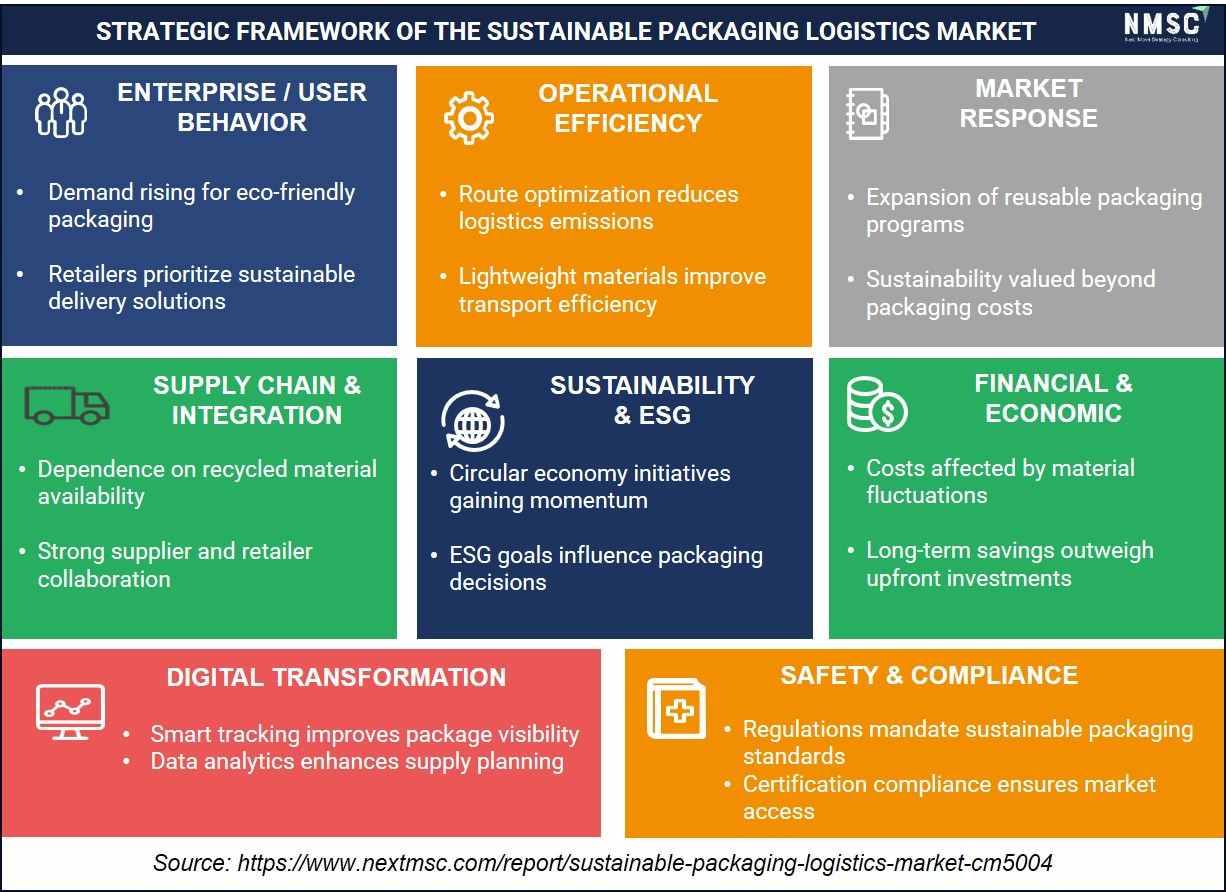
The above infographic presents a strategic framework of the sustainable packaging logistics market. We observed that the rising demand for eco-friendly packaging is driving retailers to prioritize sustainable delivery, while route optimization and lightweight materials are reducing emissions. Further, reusable packaging programs are expanding, though supply chains depend on recycled materials. ESG goals are influencing decisions, and long-term savings are prioritized over upfront costs. Looking ahead, smart tracking and data analytics enhance visibility, all backed by regulatory compliance and certification standards.
Competitive Landscape
Competitive Dynamics and M&A Landscape
|
Key Takeaways |
Details |
|
Market Structure |
Moderately concentrated. Brambles Limited (CHEP), IFCO Systems GmbH, Tosca Services, and LOSCAM International collectively account for an estimated 40–45% of global Sustainable Packaging Logistics Market revenue. A broader ecosystem of specialist RPC producers, industrial packaging companies, and regional pooling operators serves niche segments and emerging geographies. |
|
Innovation Focus |
IoT and RFID pool tracking technology, pool management software platform development, sustainability reporting and LCA automation, composite and bio-based reusable packaging material development, and AI-driven pool optimization algorithms represent primary innovation investment priorities across leading Sustainable Packaging Logistics Market participants. |
|
M&A Activity |
Consolidation through acquisition of regional pooling operators to expand geographic coverage, purchase of digital pool management software companies, and integration of specialist reusable packaging product manufacturers. Brambles Limited's IPP (International Pool Partners) acquisition and IFCO's capacity expansion investments exemplify strategic consolidation in the Sustainable Packaging Logistics Market. |
How Do Companies Compete in the Sustainable Packaging Logistics Market?
The Sustainable Packaging Logistics Market's competitive structure features a tiered architecture of global platform operators, specialist product manufacturers, and regional service providers competing across product, service, and technology dimensions. NMSC's analysis indicates that Brambles Limited's CHEP business competes through the world's largest pallet and crate pool network scale, generating recurring subscription revenue from long-term pooling contracts with major retail and consumer goods operators. IFCO Systems competes through fresh produce RPC pool specialization and strong European and North American retail customer relationships. Innovation investment is concentrated in digital platform capabilities, including IoT tracking, pool management software, and automated sustainability reporting, that enhance customer value propositions beyond physical asset provision.
Which Kind of Companies Dominate the Sustainable Packaging Logistics Market?
The Sustainable Packaging Logistics Market is led by specialized pooling platform companies that have built proprietary multi-billion-dollar asset pools and logistics service networks over decades of capital investment. Brambles Limited, publicly listed on the ASX with operations in over 60 countries through CHEP, represents the largest and most geographically diversified pool operator globally. IFCO Systems, backed by Triton Investment Management, operates the world's largest fresh produce RPC pool with over 300 million containers under management. Tosca Services and ORBIS Corporation lead North American food and consumer goods reusable packaging programs, while LOSCAM International is the dominant Asian pooling operator, establishing a competitive geographic duopoly with CHEP across Asia-Pacific pallet and crate pooling markets.
AI-Native Differentiation and Open Standards Drive Market Success in the Sustainable Packaging Logistics Market
Artificial intelligence and machine learning integration is emerging as a structural differentiator in the Sustainable Packaging Logistics Market, enabling pool operators to optimize asset repositioning, predict maintenance requirements, reduce asset loss rates, and automate sustainability performance calculation across multi-node closed-loop supply chain networks. Based on NMSC's research, we found that leading operators, including Brambles Limited, are investing in AI-driven pool optimization platforms that analyze real-time asset location data from IoT sensors to predict supply and demand imbalances across the global pool network. Open data standards for packaging asset identification, condition reporting, and carbon accounting are simultaneously becoming procurement requirements among large enterprise customers, raising the technical baseline for all Sustainable Packaging Logistics Market participants.
Market Players to Opt for Merger and Acquisition Strategies to Expand Their Presence in the Sustainable Packaging Logistics Market
Strategic M&A is a primary growth lever in the Sustainable Packaging Logistics Market, driven by the need to acquire regional pool infrastructure, digital capability, and specialist product expertise that would take years to develop organically. Brambles Limited's acquisition of IPP (International Pool Partners) in 2023 expanded its European pallet pool network. IFCO's capacity expansion and potential consolidation with regional fresh produce packaging operators demonstrate continued M&A appetite in the food supply chain segment. Our assessment indicates that future M&A activity in the Sustainable Packaging Logistics Market will target pharmaceutical validated packaging specialists, e-commerce returnable packaging technology companies, and Asia-Pacific regional pooling operators as the fastest-growing demand concentrations attract acquirer investment at premium valuations.
Who Are the Key Market Players in the Sustainable Packaging Logistics Market?
-
Brambles Limited
-
IFCO Systems GmbH
-
Tosca Services, LLC
-
IPL Schoeller Group
-
ORBIS Corporation
-
Myers Industries, Inc.
-
Rehrig Pacific Company
-
SCHÜTZ GmbH & Co. KGaA
-
Mauser Packaging Solutions Holding Company
-
Cabka N.V.
-
Nefab Group AB
-
Loscam International Holdings Co., Ltd.
-
PECO Pallet, Inc.
-
Craemer Holding GmbH
-
SSI SCHAEFER Group
-
Buckhorn Inc.
-
Schoeller Allibert B.V.
-
Georg Utz Holding AG
-
TranPak Inc.
-
Monoflo International, Inc.
What Are the Latest Developments in the Sustainable Packaging Logistics Market?
|
Date |
Event |
|
June 2025 |
FITT partnered with Movopack to introduce reusable packaging for selected e-commerce shipments. The initiative combines reusable shipping packaging with a reverse-logistics system that enables package return and multiple reuse cycles. |
|
April 2025 |
DS Smith introduced the GoChill Cooler, a 100% recyclable and reusable corrugated-board cooler designed as an alternative to plastic and Styrofoam coolers used in food and beverage transportation. |
Expert Insights
 “Never underestimate the role of packaging in creating a sustainable fresh grocery supply chain. With a circular model for packaging, you can boost sustainability and address multiple common supply chain inefficiencies at the same time”
— Jonathan Brooks, Vice President Retail Sales North America at IFCO
Statement made while discussing the role of reusable packaging solutions in reducing food waste.
Market Interpretation
The comment highlights the growing recognition of packaging as a critical component of sustainable logistics rather than merely a protective material. Reusable transport packaging solutions are increasingly being adopted to reduce food waste, improve transportation efficiency, lower packaging-related emissions, and support circular supply chain models. As retailers and food distributors pursue sustainability targets and operational efficiencies, demand for reusable and environmentally responsible logistics packaging systems is expected to accelerate across the fresh grocery sector.
What Are the Investment Opportunities in the Sustainable Packaging Logistics Market?
Capital Inflows Supporting Sustainable Packaging Logistics Market Growth
The Sustainable Packaging Logistics Market is attracting accelerating institutional capital inflows driven by the convergence of regulatory compliance demand, ESG investment mandates, and the recurring revenue profile of pooling contract business models that appeal to infrastructure and private equity investors. Our assessment indicates that Brambles Limited's market capitalization exceeding USD 20 billion on the Australian Securities Exchange reflects institutional investor recognition of the Sustainable Packaging Logistics Market's recurring revenue dynamics and ESG credentials. The World Bank and International Finance Corporation's Circular Economy investment programs are directly funding reusable packaging infrastructure in emerging markets, creating government-backed capital deployment alongside private institutional capital in the Sustainable Packaging Logistics Market's fastest-growing regions.
Infrastructure Investments in Digital Pool Management Creating Long-Term Value
Infrastructure investment in digital pool management platforms, IoT sensor networks, and automated wash and inspection facilities represents the primary capital deployment priority for scale-oriented Sustainable Packaging Logistics Market participants seeking to build defensible competitive positions. Based on NMSC's research, we found that Brambles Limited's annual capital expenditure on pool expansion, automation, and digital platform development consistently exceeds USD 1 billion globally, indicating the scale of infrastructure investment required to sustain competitive leadership. Pool automation investment in washing, inspection, and sorting facilities reduces per-unit service cost and improves asset quality consistency, delivering economics that support the pricing and margin targets of long-term pooling contract structures.
ESG Investment Criteria Driving Capital Toward the Sustainable Packaging Logistics Market
The Sustainable Packaging Logistics Market is uniquely positioned within ESG investment frameworks as a directly measurable contributor to packaging waste reduction, carbon emission avoidance, and circular material economy advancement, making it a prime candidate for green bond financing, impact investment, and sustainability-linked loan structures. Our findings suggest that Brambles Limited's sustainability-linked financing arrangements and IFCO Systems' ESG reporting frameworks reflect the growing importance of sustainability credentials in accessing institutional capital at competitive rates. The Global Reporting Initiative's packaging waste accounting standards and Science Based Targets initiative validation of reusable packaging carbon savings claims provide the credible impact measurement infrastructure that ESG-focused investors require before committing capital to Sustainable Packaging Logistics Market opportunities.
Private Equity and Venture Capital Activity Shaping Innovation Investment
Private equity and venture capital investment in the Sustainable Packaging Logistics Market is accelerating through two primary channels: PE acquisition of established regional pooling operators to build scale through consolidation, and VC investment in digital pool management software startups and next-generation reusable packaging material companies. Through our market assessment, we observed that Triton Investment Management's ownership of IFCO Systems represents a major PE investment in the Sustainable Packaging Logistics Market, with active portfolio development through capacity expansion and geographic market penetration. VC investment is targeting IoT-enabled pool tracking startups, AI-driven pool optimization platforms, and bio-based material innovators developing commercially viable alternatives to conventional plastic reusable packaging for food-contact and pharmaceutical applications.
Key Benefits for Stakeholders
For Pool Operators and Service Providers
Pool operators and service providers gain access to comprehensive market intelligence covering asset formats, service models, end-use industries, and regional demand patterns across the Sustainable Packaging Logistics Market. Segment-level revenue forecasts and competitive landscape analysis support fleet expansion planning, pricing optimization, customer acquisition strategies, and geographic market prioritization. The study also highlights emerging opportunities in reusable packaging pooling and reverse logistics services.
For Enterprise Supply Chain Managers
Enterprise supply chain managers benefit from detailed insights into reusable packaging adoption trends, regulatory compliance requirements, and logistics network developments across key industries. The analysis supports procurement decision-making, supplier evaluation, and packaging standardization initiatives by providing a structured assessment of total cost of ownership, operational efficiency benefits, and sustainability performance metrics within the Sustainable Packaging Logistics Market.
For Investors and Financial Analysts
Investors and financial analysts receive a data-driven assessment of market size, growth potential, competitive positioning, and long-term industry outlook through 2035. Revenue forecasts, CAGR analysis, and market share assessments provide a reliable framework for capital allocation decisions, valuation modeling, merger and acquisition screening, and ESG-focused investment evaluations across the Sustainable Packaging Logistics Market ecosystem.
For Technology Providers
Technology providers gain actionable intelligence on demand trends for digital solutions supporting reusable packaging operations, including IoT-enabled tracking systems, pool management platforms, asset visibility tools, and sustainability reporting technologies. The analysis identifies the fastest-growing technology adoption areas, enabling companies to prioritize product development, partnership strategies, and commercialization efforts aligned with customer requirements.
For Policy Makers and Regulators
Government agencies, policymakers, and regulatory authorities gain insights into the market impact of Extended Producer Responsibility (EPR) frameworks, reuse mandates, packaging waste regulations, and circular economy initiatives. The study supports evidence-based policy formulation by assessing how regulatory measures influence reusable packaging adoption, supply chain transformation, waste reduction objectives, and sustainability outcomes across global markets.
For Manufacturers and Brand Owners
Manufacturers and brand owners gain a comprehensive understanding of reusable packaging adoption patterns across industries, applications, and geographic regions. The analysis supports sustainability strategy development, regulatory compliance planning, packaging portfolio optimization, and supply chain decarbonization initiatives by identifying high-growth opportunities and emerging best practices within the Sustainable Packaging Logistics Market.
Key Market Segments
By Offering
- Reusable Packaging Products
-
Pallets
-
Wooden Pallets
-
Plastic Pallets
-
Composite Pallets
-
Metal Pallets
-
-
Crates
-
Beverage Crates
-
Produce Crates
-
Industrial Crates
-
Specialty Crates
-
-
Totes and Bins
-
Attached Lid Containers
-
Stackable Containers
-
Nestable Containers
-
Foldable Containers
-
-
Trays
-
Bakery Trays
-
Meat Trays
-
Produce Trays
-
Industrial Trays
-
-
Bulk Containers
-
Foldable Bulk Containers
-
Sleeve Pack Containers
-
Rigid Bulk Containers
-
-
Intermediate Bulk Containers
-
Drums and Barrels
-
Reusable Dunnage Systems
-
Plastic Dunnage
-
Foam Dunnage
-
Textile Dunnage
-
Engineered Dunnage
-
-
Other Products
-
- Logistics Services
-
Collection and Retrieval
-
Transportation and Repositioning
-
Washing and Sanitization
-
Inspection and Sorting
-
Repair and Refurbishment
-
Reconditioning
-
Asset Recovery
-
End-of-Life Recycling
-
- Asset Management & Digital Services
-
Asset Tracking
-
RFID Tracking
-
Barcode Tracking
-
IoT Tracking
-
-
Pool Management Software
-
Inventory Visibility Platforms
-
Network Optimization Platforms
-
Sustainability Reporting Platforms
-
Compliance Management Platforms
-
By Material Type
-
Wood
-
Plastic
-
Metal
-
Composite
-
Textile
-
Foam
-
Other Materials
By Asset Format
-
Pallet
-
Reusable Plastic Container
-
Crate
-
Tote
-
Bin
-
Tray
-
Bulk Container
-
Intermediate Bulk Container
-
Drum
-
Tank
-
Dunnage System
By Distribution Channel
-
Direct Sales
-
Pooling Contracts
-
Distributor Sales
-
Enterprise Agreements
-
Service Contracts
By End Use Industry
-
Food and Beverage
-
Fresh Produce
-
Grocery Retail
-
Consumer Goods
-
E-Commerce
-
Automotive
-
Industrial Manufacturing
-
Chemicals
-
Pharmaceuticals
-
Healthcare
-
Electronics
-
Agriculture
-
Other Industries
By Region
-
North America: U.S., Canada, and Mexico.
-
Europe: UK, Germany, France, Italy, Spain, Sweden, Denmark, Finland, the Netherlands, and the rest of Europe.
-
Asia Pacific: China, India, Japan, South Korea, Taiwan, Indonesia, Vietnam , Australia, Philippines, Malaysia and the rest of APAC.
-
Middle East & Africa (MEA): Saudi Arabia, UAE, Egypt, Israel, Turkey, Nigeria, South Africa, and the rest of MEA.
-
Latin America: Brazil, Argentina, Chile, Colombia, and the rest of LATAM.
Conclusion and Recommendations
Long-Term Outlook
The Sustainable Packaging Logistics Market is positioned for exceptional decade-long growth, advancing from USD 92.40 billion in 2025 to USD 269.54 billion by 2035 at a CAGR of 11.3%, one of the highest sustained growth rates among logistics market segments globally. The market's multi-driver growth architecture, anchored by regulatory compliance demand from the EU PPWR, corporate ESG commitments, e-commerce packaging transformation, and pharmaceutical supply chain compliance, ensures structural demand resilience across economic cycles. NMSC's analysis indicates that the long-term outlook is further strengthened by the recurring revenue economics of pooling contract models and the expanding digital services revenue layer created by IoT and AI-enabled pool management platform adoption.
Strategic Positioning Recommendations
Market participants are advised to prioritize digital pool management platform investment as the foundational competitive differentiation requirement, given the 17.5% CAGR leadership of Asset Management and Digital Services and growing enterprise procurement requirements for real-time asset visibility and automated sustainability reporting. Geographic expansion into India, Southeast Asia, and MEA markets, growing at 15.5%, 14.4%, and 13.9% respectively, should be prioritized through local manufacturing partnerships, regional joint ventures, and government logistics program participation aligned with national content requirements. E-commerce returnable packaging capability development is recommended as the highest-growth incremental market segment at a CAGR of 15.5%, requiring specialized tote, bin, and last-mile returnable packaging product formats distinct from traditional pallet and crate pool offerings.
Investment Attractiveness Assessment
The Sustainable Packaging Logistics Market presents a high investment attractiveness profile anchored by regulatory-mandated demand growth, recurring revenue business model structures, and strong ESG alignment credentials that position it favourably in both infrastructure fund and impact investment portfolios. The market's 11.3% CAGR is supported by multiple independent structural drivers, legislative mandates, corporate ESG commitments, supply chain efficiency economics, and digital transformation, reducing single-factor risk concentration. Private equity interest in established pooling operators is validated by Triton Investment Management's IFCO Systems ownership. Venture capital targets in IoT pool tracking, AI pool optimization, and bio-based reusable material innovation represent the highest-risk but highest-potential-return investment profiles within the broader Sustainable Packaging Logistics Market ecosystem.
Key Market Risks
The Sustainable Packaging Logistics Market faces several material risk factors that investors and operators must monitor. Policy timeline uncertainty, particularly potential delays in EU PPWR implementation or weakening of state EPR mandates in the United States under changing political environments, would moderate compliance-driven demand acceleration. High upfront capital requirements for pool establishment in emerging markets create execution risk for geographic expansion strategies in the Asia-Pacific and MEA. Multi-party supply chain coordination complexity limits adoption velocity among fragmented supplier bases. Material cost inflation for plastics and composite materials, driven by energy price volatility, could compress product manufacturing margins. Emerging alternative materials, such as bio-based packaging, could substitute conventional pool assets if cost parity is achieved sooner than anticipated.
Growth Pathways
The highest-probability growth pathways in the Sustainable Packaging Logistics Market over the 2025–2035 forecast period encompass digital platform leadership through IoT and AI pool management investment; e-commerce returnable packaging product and service development; Asia-Pacific pooling network establishment through strategic partnerships; pharmaceutical and healthcare validated packaging capability building; EV automotive dunnage program expansion; and EU PPWR compliance service contract development for European brand owners requiring turnkey reusable packaging adoption solutions. Companies integrating physical asset excellence with digital lifecycle intelligence, geographic network breadth, and measurable ESG impact documentation will capture disproportionate Sustainable Packaging Logistics Market revenue and margin expansion through the forecast decade.
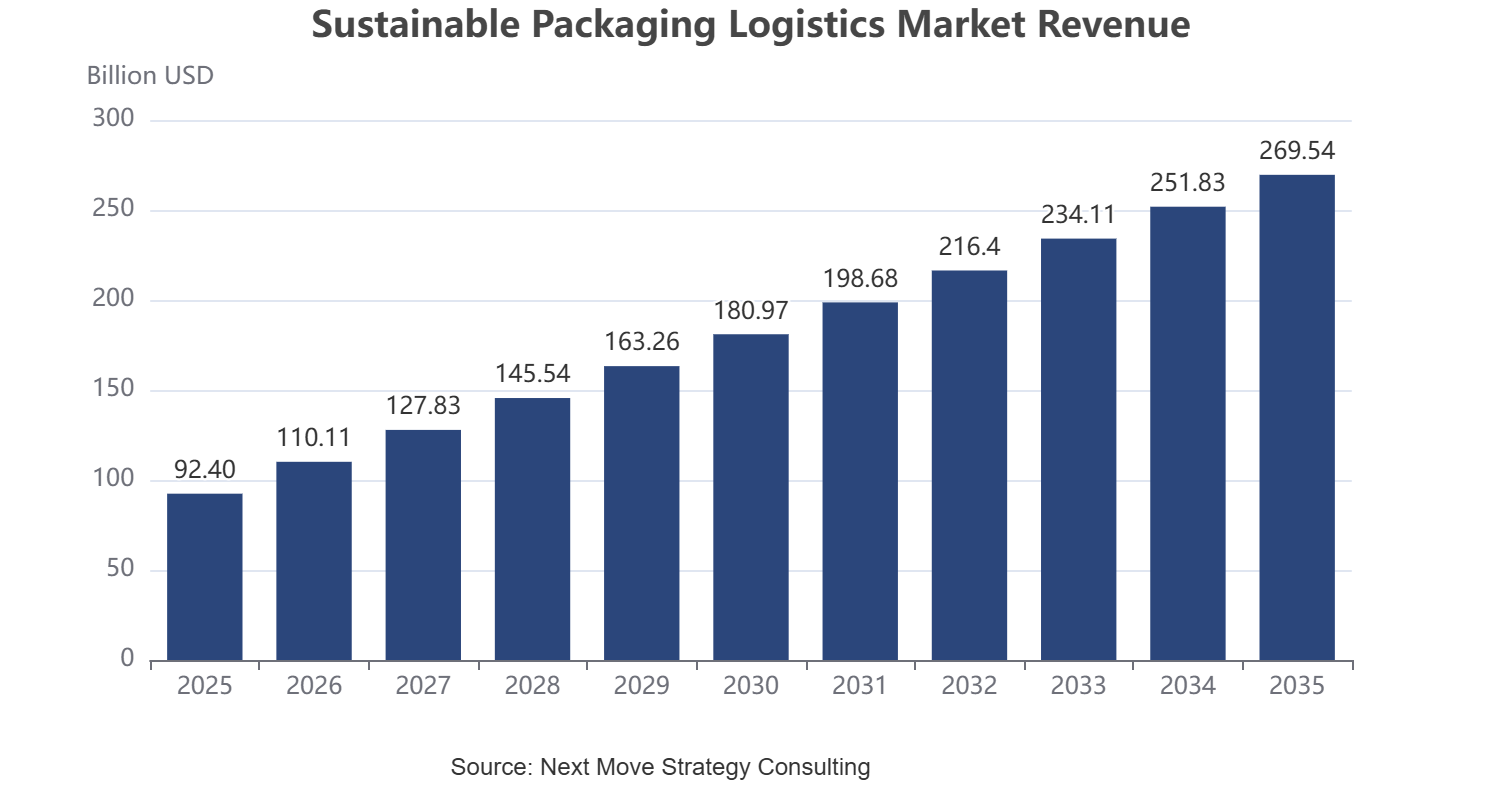
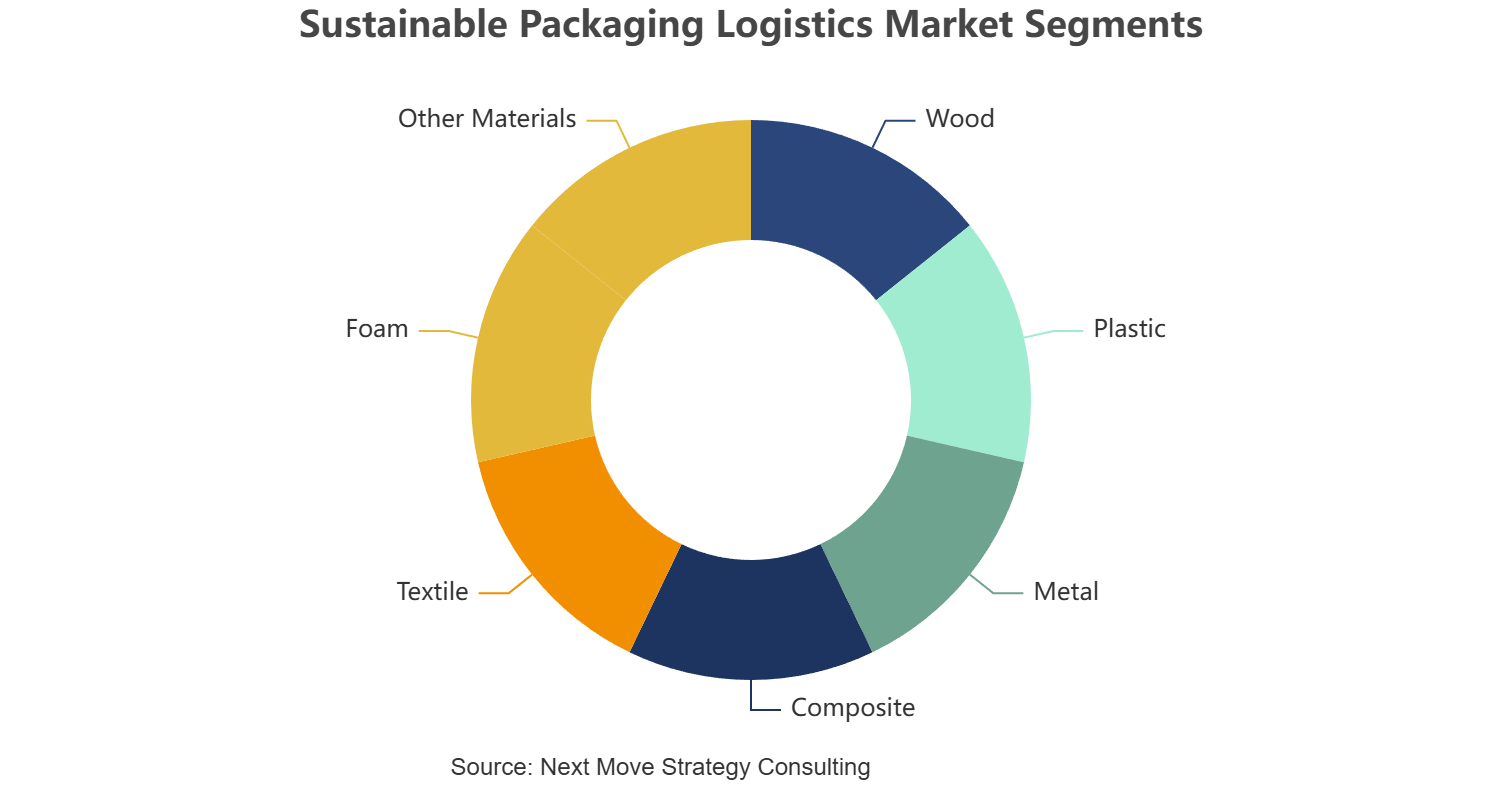
About the Author
 Mayurima Roy
— Mayurima Roy is Research Analyst at Next Move Strategy Consulting, where she has spent 4 years working across the firm's full industry coverage rather than a single fixed vertical. Her work centers on structured research, ongoing trend tracking, competitive assessment, and insight-led content development, translating complex market data into clear, decision-ready narratives that support informed client decision-making across diverse global industries, market sectors, and world regions every day.
Mayurima Roy
— Mayurima Roy is Research Analyst at Next Move Strategy Consulting, where she has spent 4 years working across the firm's full industry coverage rather than a single fixed vertical. Her work centers on structured research, ongoing trend tracking, competitive assessment, and insight-led content development, translating complex market data into clear, decision-ready narratives that support informed client decision-making across diverse global industries, market sectors, and world regions every day.
About the Reviewer
 Supradip Baul
— Supradip Baul is an accomplished business consultant and strategist with over a decade of rich experience in market intelligence, strategy, technology, and business transformation. His work has included rigorous qualitative and quantitative analysis across multiple industries, helping clients shape investment decisions and long-term roadmaps. Earlier in his career, he was associated with Gartner, where he contributed to industry-leading reports and market share analyses. He has worked with leading global companies and holds an MBA with a dual specialization in Marketing and Finance.
Supradip Baul
— Supradip Baul is an accomplished business consultant and strategist with over a decade of rich experience in market intelligence, strategy, technology, and business transformation. His work has included rigorous qualitative and quantitative analysis across multiple industries, helping clients shape investment decisions and long-term roadmaps. Earlier in his career, he was associated with Gartner, where he contributed to industry-leading reports and market share analyses. He has worked with leading global companies and holds an MBA with a dual specialization in Marketing and Finance.
At Next Move Strategy Consulting, we understand that insightful market research is the cornerstone of successful business decisions. That's why we employ a robust and multifaceted approach, combining various methodologies to deliver the most accurate and actionable data for our clients.

Research Landscape
We navigate the world of research with two primary approaches:
Qualitative Approach
Our qualitative research methodologies involve immersive techniques such as in-depth interviews, focus groups, and observational studies. By engaging directly with individuals and stakeholders, we uncover valuable insights that quantitative data alone may overlook.

Quantitative Research
In tandem with qualitative methodologies, NMSC leverages the power of Quantitative Research to provide a robust foundation of numerical insights. Through systematic data collection and analysis, we quantify patterns, preferences, and market trends, offering a comprehensive view of the business landscape.
Our quantitative research approach employs diverse tools, including surveys, experiments, and statistical modelling. These methodologies enable us to gather data from a large and representative sample, ensuring the statistical significance of our findings. By employing structured questionnaires and standardized data collection methods, we guarantee the reliability and validity of the information we present to our clients.
Quantitative research is particularly effective in measuring the prevalence of trends, assessing market size, and gauging the impact of various factors on consumer behavior. The numerical precision attained through this approach equips our clients with actionable insights, facilitating data-driven decision-making and strategy formulation.


Our Specialized Toolbox for Industry-Specific Market Research
We deploy a specialized arsenal of techniques tailored to meet your unique requirements. Here's a glimpse into our comprehensive toolbox:

Information Procurement
The stage entails acquiring market data or relevant information through various sources and methodologies.


Market Research Approach
We utilize both top-down and bottom-up approaches in market research analysis to achieve a comprehensive understanding of the market dynamics, leveraging the broad perspective of industry trends and macroeconomic factors alongside detailed insights from specific segments and individual companies.

Porters Five Forces Analysis
We conduct Porter's Five Forces analysis to evaluate the competitive landscape of an industry, providing us with insights into factors that affect profitability and strategic positioning.

SWOT Analysis

Forecasting
We utilize a forecasting model to predict future consumption by considering parameters like population, economics, regulations, market competition, drivers, constraints, technology, and pricing. We also employ statistical techniques such as multilinear regression, exponential smoothing, moving average, ARIMA, and Monte Carlo simulations for accurate predictions. In econometric forecasting, we analyzed short-term and long-term event impacts, attributing values based on regulatory frameworks, economic factors, and market events.





 Speak to Our Analyst