Tabletop Audio Conferencing Endpoints Market By Product Type {USB Speakerphones (Wired USB Only, USB with Wireless, and Others), Bluetooth Speakerphones, and Others}, By Room Size (Huddle, Small, Medium, Large), By Application (Internal Collaboration, External Communication, and Others), By Sales Channel (Direct to Expense, Distribution Partners, and Others), By End User (Corporate, SMB, Government, and Others) – Global Analysis & Forecast, 2025–2035
Industry: ICT & Media | Publishing Date: June 5, 2026 | Last Updated: September 30, 2026 | No of Pages: N/A | No. of Tables: N/A | No. of Figures: N/A | Format: PDF | Report Code: IC4605
Industry Outlook
The global Tabletop Audio Conferencing Endpoints Market size was valued at USD 1.62 billion in 2025 and is expected to be valued at USD 1.73 billion by the end of 2026. The industry is projected to grow, hitting USD 3.08 billion by 2035, with a CAGR of 6.62% between 2026 and 2035.
Tabletop Audio Conferencing Endpoints Market Size & Forecast
|
Parameters |
Details |
|
Market Size in 2026 |
USD 1.73 Billion |
|
Revenue Forecast in 2035 |
USD 3.08 Billion |
|
Growth Rate |
CAGR of 6.62% from 2026 to 2035 |
|
Analysis Period |
2025–2035 |
|
Base Year Considered |
2025 |
|
Forecast Period |
2026–2035 |
|
Market Size Estimation |
Billion (USD) |
|
Companies Profiled |
20 |
|
Countries Covered |
33 |
|
Market Share |
Available for 10 companies |
Based on NMSC’s primary research, we observed that the global tabletop audio conferencing endpoints market is witnessing steady growth, driven by the structural shift toward hybrid work, increasing reliance on unified communication platforms, and the need for high-quality audio experiences in meeting environments. Tabletop endpoints, including speakerphones and integrated microphone systems, are increasingly adopted across corporate offices, co-working spaces, and small-to-medium meeting rooms to enable seamless collaboration. Our interviews with enterprise IT teams and AV integrators indicates that advancements in AI-driven noise suppression, beamforming microphones, and echo cancellation significantly improve meeting clarity and user experience. Hardware continues to account for the majority of revenue contribution, while software integration and device management platforms are emerging as critical differentiators. North America and Europe lead adoption, supported by mature enterprise IT infrastructure and widespread deployment of collaboration platforms.
Moreover, through evaluation of enterprise deployments and AV integration projects across North America, Europe, and Asia-Pacific, we found that adoption is strongly influenced by room size standardization, platform compatibility, and ease of deployment. North America benefits from early adoption of hybrid work models and standardized meeting room solutions, while Europe emphasizes interoperability and compliance with enterprise communication standards. Asia-Pacific demonstrates rapid growth, driven by expanding enterprise infrastructure and increasing digital workplace investments, particularly in markets such as India and Southeast Asia. Key market players, including Cisco, HP, Logitech, and Jabra, compete through platform-certified devices, AI-enhanced audio processing, and integrated ecosystem solutions. Recent product developments, such as AI-powered speaker tracking, adaptive voice levelling, and centralized device management platforms, reflect ongoing innovation, while bundled hardware-software offerings and subscription-based device management models improve scalability and long-term operational efficiency, strengthening reliability and enterprise trust.
What Are the Key Trends in the Tabletop Audio Conferencing Endpoints Market?
How Is Acoustic Fencing Redefining Audio Quality in Open Collaboration Environments?
Based on our analysis, we observed that acoustic fencing capabilities are improving audio precision in open and dynamic workplace environments where background noise is difficult to control. Through our engagements with enterprise IT teams and AV integrators, we identified a growing preference for solutions that capture only in-room conversations while minimizing surrounding interference. In this context, devices establish defined audio pickup zones that restrict microphone range to intended participants. Moreover, this approach enhances clarity in huddle spaces and shared collaboration areas. At the same time, reduced ambient noise improves meeting efficiency by limiting disruptions and repetition. As open office layouts continue to expand, acoustic control features position tabletop endpoints as more precise and context-aware communication tools.
How Is Daisy-Chaining Enabling Flexible Meeting Room Coverage?
From our evaluation of enterprise deployments, we found that multi-microphone daisy-chaining enables organisations to move beyond rigid audio configurations toward more adaptable meeting environments. Modern offices require solutions capable of supporting non-linear layouts such as L-shaped tables and flexible seating arrangements. In response, daisy-chained systems allow multiple microphones to operate cohesively, delivering consistent audio pickup across varied configurations. In addition, our analysis revealed that this modularity reduces the need for permanent infrastructure and allows organisations to scale audio coverage as requirements evolve. Furthermore, uniform voice capture improves remote participant engagement, particularly in larger or irregular meeting spaces. As workspace designs become increasingly fluid, scalable microphone architectures enable organisations to future-proof their collaboration environments with greater efficiency and adaptability.
How Is Touch-Controller Integration Transforming Tabletop Endpoints?
Based on our market analysis, we observed that tabletop endpoints are evolving into multifunctional interfaces through integration with touch-surface room controllers. In our evaluation of enterprise implementations, we identified that organisations adopt devices that combine audio capabilities with intuitive control systems, enabling users to manage meetings and room settings from a single interface. This shift reflects a broader emphasis on simplifying user interaction while reducing reliance on multiple disconnected systems. Furthermore, our discussions with IT administrators indicate that centralized control enhances operational efficiency by streamlining meeting initiation, scheduling, and environmental adjustments. Users benefit from a more intuitive experience, which reduces setup delays and improves overall meeting flow. Looking ahead, this convergence positions tabletop endpoints as intelligent control hubs, supporting more seamless, responsive, and user-centric collaboration environments across modern workplaces.
Ecosystem Analysis of the Tabletop Audio Conferencing Endpoints Market
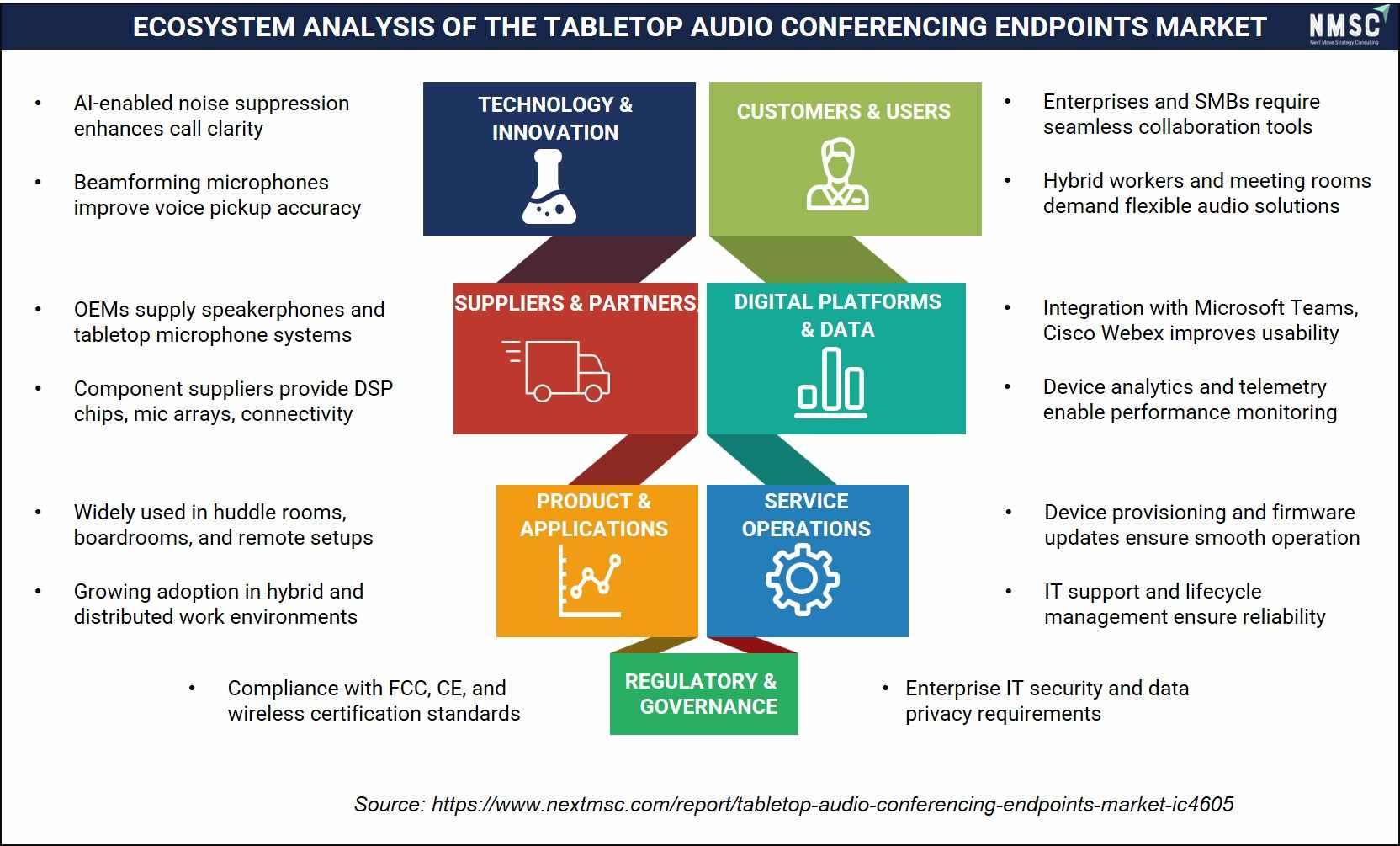
Our assessment indicates that the tabletop audio conferencing endpoints market is evolving rapidly, driven by hybrid work adoption and rising demand for seamless collaboration. Technology advancements such as AI-enabled noise suppression and beamforming microphones are improving audio clarity, while integration with leading UC platforms enhances usability. Moreover, OEMs and component suppliers are strengthening the ecosystem, supported by expanding distribution channels and device management capabilities. At the same time, compliance with certification standards and enterprise security requirements ensures reliability and wider enterprise adoption.
What Are the Key Market Drivers, Breakthroughs, and Investment Opportunities That Will Shape the Tabletop Audio Conferencing Endpoints Market in the Next Decade?
Growth Catalyst & Risk Assessment Matrix
|
DRIVERS / TRENDS / RESTRAINTS |
(+/–) % IMPACT ON CAGR FORECAST |
GEOGRAPHIC RELEVANCE |
IMPACT TIMELINE |
|
Formalization of meeting equity initiatives increasing demand for high-quality audio solutions |
+1.4% |
North America, Europe, India, Australia |
Medium term (2–5 years) |
|
Shift toward open-plan and huddle-based workspaces driving demand for flexible audio endpoints |
+1.2% |
North America, Europe, Asia-Pacific |
Medium to long term (3–6 years) |
|
Rising adoption of UCaaS-certified and BYOM-compatible devices accelerating replacement cycles |
+1.0% |
Global (strong in North America, Europe) |
Medium term (2–4 years) |
|
Integration of AI-driven audio processing and edge analytics enhancing device value proposition |
+0.9% |
North America, Japan, South Korea, Europe |
Medium to long term (3–6 years) |
|
Convergence with touch-based room controllers enabling centralized meeting management |
+0.8% |
North America, Europe, China |
Long term (4–7 years) |
|
Rapid adoption of integrated video bar solutions reducing demand for standalone tabletop endpoints |
-1.3% |
North America, Europe, China |
Medium term (2–5 years) |
Based on our evaluation of enterprise collaboration and workplace transformation trends, we observed that the tabletop audio conferencing endpoints market is experiencing steady growth, driven primarily by the widespread adoption of hybrid work models, increasing emphasis on meeting equity, and continuous advancements in audio intelligence technologies. Our interactions with AV integrators and workplace strategists indicate that organisations increasingly adopt advanced audio endpoints as a long-term solution to enhance communication quality and ensure consistent collaboration experiences across distributed teams.
Advancements in AI-driven noise suppression, beamforming microphones, and edge-based audio processing expand device capabilities, enabling reliable performance in open and acoustically complex environments. However, our assessment also indicates that the rapid adoption of integrated video bar solutions and pricing pressure from low-cost alternatives constrain demand for standalone tabletop devices in certain use cases. At the same time, the integration of audio-to-text analytics and intelligent device management capabilities creates new growth opportunities by enhancing functionality and supporting more data-driven, scalable collaboration ecosystems.
Growth Drivers:
How Is the Formalization of Meeting Equity Initiatives Driving Tabletop Audio Conferencing Endpoints Market Demand?
NMSC’s analysis indicates that the formalization of meeting equity initiatives is shaping enterprise investment in tabletop audio conferencing endpoints. In our interactions with enterprise IT leaders and workplace strategists, we observed a clear shift as organizations increasingly prioritize technologies that ensure equal participation for both in-room and remote attendees. According to the Chartered Institute of Personnel and Development 2025, around three-quarters of organizations have adopted some form of hybrid working, highlighting the widespread normalization of distributed work models and reinforcing the need for consistent and high-quality meeting infrastructure. In this context, legacy systems fall short, as they fail to capture distributed voices effectively. Furthermore, our evaluation indicates that advanced endpoints with beamforming microphones and AI-driven noise suppression deliver more balanced audio experiences. At the same time, improved voice clarity enhances collaboration efficiency. As hybrid work becomes standard, meeting equity continues to influence procurement decisions, positioning high-performance audio endpoints as essential collaboration tools.
How Is the Shift Toward Open-Plan and Huddle-Based Workspaces Expanding Tabletop Audio Conferencing Endpoints Market Growth?
From our evaluation of workplace transformation trends, we found that the shift toward open-plan and huddle-based workspaces is expanding demand for flexible audio solutions. Modern offices prioritise collaboration, leading to smaller and informal meeting spaces. According to the European Commission, 2025, 52.9% of EU enterprises conducted remote meetings, highlighting the widespread adoption of hybrid collaboration, which is driving organisations to redesign office spaces toward more flexible and collaboration-oriented environments. As a result, organisations require compact and reliable devices for acoustically dynamic settings. In addition, open layouts introduce ambient noise, increasing reliance on localized audio capture. Consequently, tabletop endpoints enable clearer communication without complex installations. Moreover, scalable and plug-and-play solutions align with evolving workspace configurations. As office designs continue to evolve, adaptable audio solutions support efficient and seamless collaboration.
Growth Inhibitor:
How Is the Rapid Adoption of Integrated Video Bar Solutions Limiting Market Growth?
Based on our analysis, we observed that the rapid adoption of integrated video bar solutions is limiting demand for standalone tabletop audio endpoints. Enterprises increasingly prefer all-in-one devices that combine camera, microphone, and speaker functionalities, simplifying deployments According to StatRanker and ITU Telecommunication Core Databases 2025, median fixed broadband speeds reached approximately 410.06 Mbps in leading digital hubs, while the global median across 156 monitored countries and territories remained at 86.97 Mbps, highlighting substantial infrastructure disparities that constrain the seamless deployment of high-performance tabletop audio conferencing endpoints. At the same time, these solutions reduce hardware complexity and streamline installation. Furthermore, centralized management and ease of use strengthen their adoption. As organisations prioritise efficiency and scalability, integrated systems continue to replace multi-device setups, reducing the need for standalone audio endpoints.
Growth Opportunity:
How Is the Integration of Audio-to-Text Edge Analytics Unlocking New Growth Opportunities for the Market?
From our market analysis, we identified that audio-to-text edge analytics is creating new growth opportunities for tabletop endpoints. Organisations increasingly seek to convert meeting interactions into structured insights According to the Federal Reserve Board’s 2026 AI Economic Adoption Index, around 54% of the active U.S. corporate labor force operated within firms using Large Language Models (LLMs) in daily workflows, highlighting the rapid enterprise adoption of AI-driven analytical systems that support demand for real-time audio-to-text processing and intelligent conferencing endpoints with localized edge analytics capabilities. In this context, edge-based analytics enables real-time transcription while improving data privacy. Moreover, enterprises prioritise solutions that reduce reliance on cloud infrastructure, particularly for sensitive discussions. At the same time, automated transcription enhances productivity and knowledge retention. As demand for intelligent collaboration tools grows, edge analytics strengthens the value proposition of tabletop endpoints.

The chart illustrates the rising number of IoT-connected devices globally, reflecting the rapid expansion of smart and digitally connected workplace ecosystems. This growth directly supports the tabletop audio conferencing endpoints market trends, as modern conferencing devices increasingly integrate with IoT-enabled office infrastructure, cloud collaboration platforms, and centralized device management systems. As enterprises adopt smart meeting rooms and hybrid work environments, demand for connected tabletop conferencing endpoints with remote monitoring, AI-driven audio optimization, and seamless interoperability continues to increase. The upward trend therefore indicates a broader technological shift toward intelligent and connected enterprise communication environments.
Pain Point Analysis of the Tabletop Audio Conferencing Endpoints Market
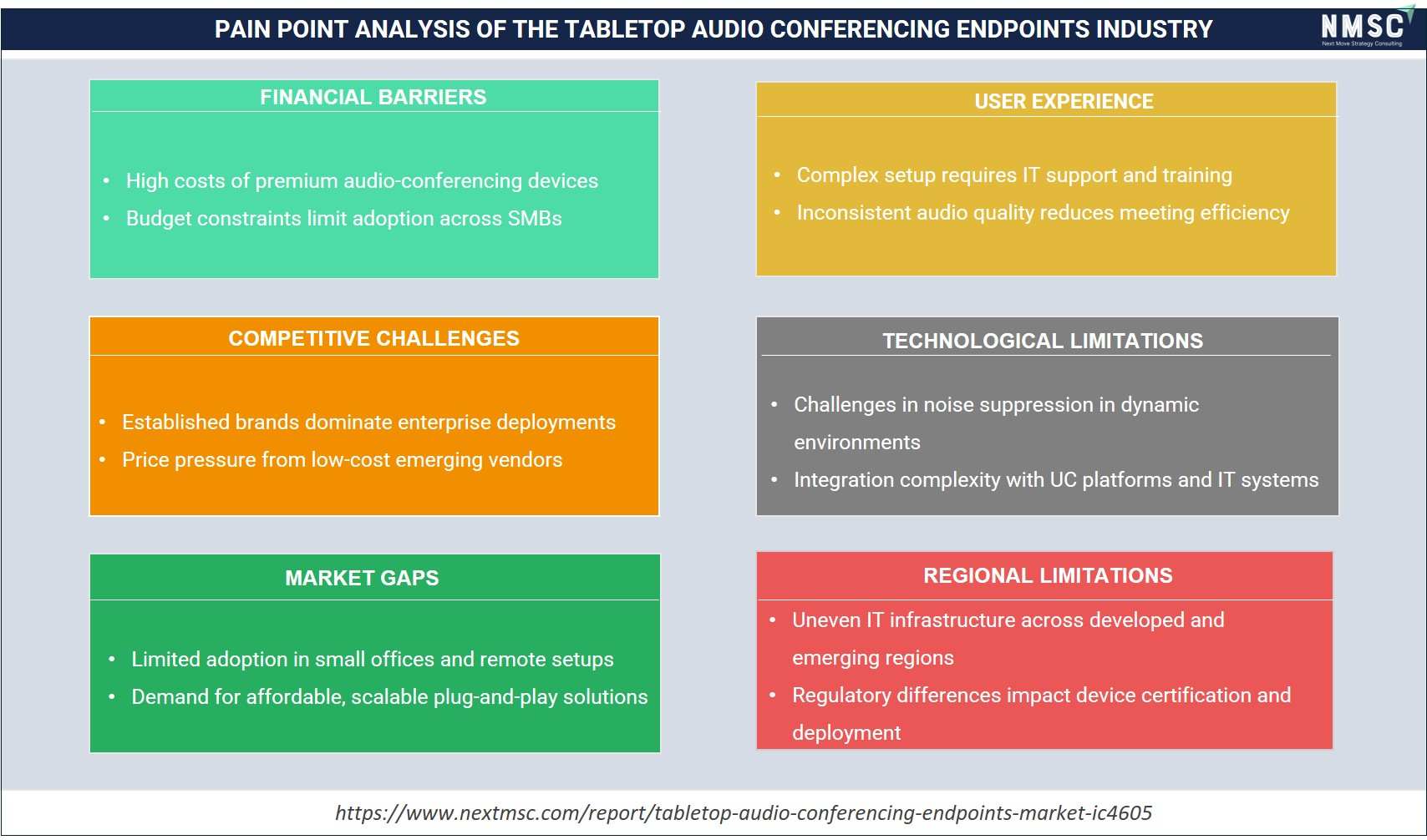
Our assessment indicates cost sensitivity and usability challenges continue to impact tabletop audio conferencing endpoints market adoption. High device costs, particularly for premium solutions, limit penetration among SMBs, while complex setup and inconsistent audio performance reduce user satisfaction. In addition, integration challenges with UC platforms and IT systems create deployment inefficiencies. Competitive pressure from low-cost vendors further compresses margins. Meanwhile, gaps remain in affordable, scalable solutions, especially in smaller offices and emerging regions, where infrastructure limitations and regulatory differences continue to hinder widespread adoption.
How Is the Tabletop Audio Conferencing Endpoints Market Segmented in This Report, And What are the Key Insights from the Segmentation Analysis?
Market Highlights & Strategic Insights – Tabletop Audio Conferencing Endpoints Market:
|
Segments |
Key Takeaways |
|
Product Type |
USB and Bluetooth speakerphones dominate due to ease of use, plug-and-play functionality, and compatibility with modern conferencing platforms. IP conference phones remain relevant in enterprise environments in the Tabletop Audio Conferencing Endpoints Market requiring dedicated communication systems, while DECT and proprietary wireless devices are used in specific office setups. Expansion-enabled devices are gaining traction as organizations seek scalable solutions for larger rooms. |
|
Room Size |
Huddle and small rooms drive the majority of demand, supported by the shift toward flexible workspaces and hybrid work environments. Medium and large rooms require advanced devices with expansion capabilities to ensure clear audio coverage and scalability. |
|
Application |
Internal collaboration is the primary use case, driven by daily team meetings and hybrid work models. External communication is also significant as organizations engage with clients and partners remotely. Training, education, and telehealth applications are expanding with increased reliance on virtual communication. |
|
Sales Channel |
Direct to enterprise and distribution partners dominate, supported by enterprise procurement and system integration requirements. E-commerce platforms are gaining traction for SMB purchases, while telecom bundles are used to offer integrated communication solutions. Retail plays a limited role in professional deployments. |
|
End User |
Corporate enterprises represent the largest user base due to widespread adoption of unified communication tools. SMBs are increasingly adopting cost-effective solutions, while government, education, and healthcare sectors are expanding usage for remote communication and service delivery. |
By Product Type Insights
Which Product Types Drive Demand in the Tabletop Audio Conferencing Endpoints Market?
Based on our analysis of product configurations, we observed that the tabletop audio conferencing endpoints market share is segmented into USB speakerphones, Bluetooth speakerphones, IP conference phones, PSTN conference phones, DECT conference phones, proprietary wireless conference phones, and other tabletop audio endpoints, with each category further differentiated by connectivity and expansion capabilities.
From our evaluation of usage trends, we found that USB and Bluetooth speakerphones drive the majority of demand due to their plug-and-play functionality and seamless compatibility with modern conferencing platforms. At the same time, expansion-enabled variants are gaining traction as organizations equip medium and large rooms with scalable audio solutions. Meanwhile, IP and PSTN conference phones continue to serve enterprise environments requiring dedicated communication infrastructure. Furthermore, wireless and DECT-based solutions are being adopted in flexible office setups where mobility and ease of deployment are critical. Overall, demand is shifting toward versatile, platform-agnostic devices that balance simplicity, scalability, and integration.

By Room Size Insights
Which Room Size Are Driving Adoption of Tabletop Audio Conferencing Endpoints Solutions?
Based on our assessment on the basis of room size, we observed that the tabletop audio conferencing endpoints market is segmented into huddle (1–4 participants), small (5–8 participants), medium (9–12 participants), and large (13+ participants) room sizes.
From our analysis of workplace trends, we found that huddle and small rooms account for the majority of deployments, driven by the rise of hybrid work and increasing need for quick, informal collaboration spaces. Meanwhile, medium rooms are seeing steady adoption as organizations standardize meeting room infrastructure. In addition, large rooms require advanced endpoints with expansion capabilities to ensure consistent audio coverage across larger participant groups. Furthermore, device selection is increasingly influenced by room acoustics, user density, and integration with video conferencing systems. In parallel, room size is a key determinant of device complexity, with smaller spaces favoring simplicity and larger environments requiring scalable and high-performance solutions.

By Application Insights
Which Applications Are Driving Usage of Tabletop Audio Conferencing Endpoints?
Based on our analysis of use cases, we observed that the tabletop audio conferencing endpoints market is segmented into internal collaboration, external communication, training and education, telehealth delivery, and other applications.
From our evaluation of usage patterns, we found that internal collaboration remains the primary application, supported by daily team interactions and hybrid work environments. At the same time, external communication is critical as organizations engage with clients and partners remotely. In addition, training and education applications are expanding with the growth of virtual learning and corporate training programs. Furthermore, telehealth delivery is gaining traction as healthcare providers increasingly rely on remote consultations. Overall, application demand is broadening across industries, driven by the increasing reliance on real-time digital communication.
Regional Outlook:
Geographic Performance Snapshot:
|
Region |
Key Takeaways |
|
North America |
North America represents a mature and enterprise-driven tabletop audio conferencing endpoints market, supported by widespread hybrid work adoption and advanced IT infrastructure. Organizations prioritize standardized meeting room solutions, platform compatibility, and centralized device management, driving consistent demand for tabletop conferencing endpoints. |
|
Europe |
Europe demonstrates a compliance-driven adoption profile, shaped by data security regulations and enterprise communication standards. Demand is supported by multinational organizations seeking interoperable and standardized collaboration solutions across distributed operations. |
|
Asia-Pacific |
Asia-Pacific emerges as the fastest-growing region, driven by expanding enterprise infrastructure, digital workplace investments, and increasing hybrid work adoption. Cost-effective and scalable solutions gain traction across diverse enterprise environments. |
|
Latin America |
Latin America shows gradual adoption supported by enterprise digitalization and growing demand for collaboration tools. Organizations prioritize affordability, ease of deployment, and scalable solutions, with channel partners playing a key role in market expansion. |
|
Middle East & Africa |
The Middle East & Africa market reflects a dual growth pattern, with advanced adoption in Gulf countries and emerging demand across Africa. Enterprise expansion, government investments, and improving digital infrastructure support long-term adoption of conferencing solutions. |
The tabletop audio conferencing endpoints market is geographically studied across North America, Europe, Asia Pacific, Latin America and Middle East & Africa and each region is further studied across countries.
Tabletop Audio Conferencing Endpoints Market in North America
The tabletop audio conferencing endpoints industry in North America reflects a mature and standardization-led environment, anchored in widespread hybrid work adoption and advanced enterprise IT ecosystems. From our deployment-level assessments, we found that organizations increasingly formalize meeting room configurations using tabletop speakerphones and integrated microphone arrays to deliver consistent collaboration experiences. Moreover, adoption extends across corporate offices, technology firms, and institutional environments, reinforcing baseline demand. At the same time, field validation suggests that platform interoperability, rapid deployment, and centralized device governance shape procurement decisions. In addition, enterprises actively align device selection with leading unified communication platforms such as Microsoft Teams to streamline operations. As a result, this structured approach reduces integration complexity while strengthening vendor alignment and accelerating lifecycle-based procurement maturity.
Tabletop Audio Conferencing Endpoints Market in the United States
Based on our enterprise engagements and system integrators, we identified that the United States operates as a scale-intensive and ecosystem-driven system integrators loop, shaped by deep IT maturity and standardized hybrid work frameworks. In particular, organizations deploy plug-and-play tabletop conferencing endpoints at scale to maintain uniform audio performance across distributed meeting environments. Furthermore, adoption remains closely tied to seamless integration with platforms such as Zoom and Microsoft Teams, ensuring continuity across enterprise workflows. Our deployment audits indicate strong dependence on certified device ecosystems and centralized procurement structures. At the same time, remote device management capabilities streamline operational control. Consequently, vendors differentiate through AI-enabled audio optimization and service-layer integration, reinforcing bundled offerings and long-term enterprise lock-in.
Tabletop Audio Conferencing Endpoints Market in Canada
Canada shows stable and structurally balanced growth in the tabletop audio conferencing endpoints market, supported by enterprise digitalization and distributed workforce models. From our interactions with system integrators and enterprise users, we observed steady demand across corporate offices, government institutions, and educational organizations. Moreover, organizations prioritize reliability, ease of deployment, and long-term service support when selecting tabletop conferencing devices. In addition, demand continues to strengthen for plug-and-play speakerphones and integrated audio systems, particularly in mid-sized meeting environments. At the same time, buyers emphasize durability and extended lifecycle performance, encouraging vendors to deliver comprehensive support and maintenance services. As a result, this approach enables predictable procurement cycles and reinforces sustained vendor engagement.
Tabletop Audio Conferencing Endpoints Market in Europe
The tabletop audio conferencing endpoints market in Europe presents a regulation-aligned and interoperability-centric landscape, shaped by stringent enterprise communication standards and structured IT governance frameworks. From our regional analysis, we identified a clear emphasis on standardized collaboration environments across multinational organizations, ensuring operational consistency. Moreover, adoption remains closely linked to compliance requirements, data security protocols, and certified platform compatibility. In addition, evidence from enterprise procurement cycles suggests that buyers favour solutions aligned with platforms such as Microsoft Teams to maintain cross-border uniformity. At the same time, regional variations influence deployment approaches and system expectations. As a result, these conditions elevate entry barriers while reinforcing vendor credibility and long-term deployment stability.
Tabletop Audio Conferencing Endpoints Market in the United Kingdom
NMSC’s research indicates that the United Kingdom exhibits a well-established and steadily evolving tabletop audio conferencing endpoints market, supported by widespread hybrid work adoption and mature enterprise IT ecosystems. From our observations, organizations increasingly deploy tabletop conferencing endpoints across standardized meeting rooms to maintain consistent communication experiences. Furthermore, demand remains concentrated across corporate offices, financial institutions, and public sector entities. In addition, buyers prioritize ease of deployment, platform certification, and lifecycle support. At the same time, system integrators and IT teams play a central role in ensuring seamless installation and device management. Consequently, the market continues to shift toward bundled hardware-software solutions, enhancing scalability, operational efficiency, and long-term vendor alignment.
Tabletop Audio Conferencing Endpoints Market in Germany
Germany reflects a structured and engineering-led adoption environment, supported by strong enterprise infrastructure and emphasis on system reliability. From our research, we observed that organizations consistently prioritize high-performance tabletop audio devices with certified interoperability and stable output quality. Moreover, demand is evident across corporate headquarters, industrial offices, and technology-driven enterprises. In addition, buyers focus on precision, durability, and long-term vendor support when selecting solutions. At the same time, enterprises rely on experienced system integrators to ensure seamless deployment and performance optimization. As a result, this disciplined approach supports high-value implementations and strengthens long-term trust in vendor capabilities.
Tabletop Audio Conferencing Endpoints Market in France
France shows a steadily expanding tabletop audio conferencing endpoints market, supported by enterprise modernization and evolving workplace collaboration practices. From our market interactions, we found increasing adoption across corporate offices, public institutions, and service sectors. Moreover, organizations emphasize compliance with communication standards, data handling transparency, and intuitive user interfaces. In addition, demand remains strong in urban business environments where hybrid work adoption is well established. At the same time, buyers prefer solutions that offer seamless integration alongside localized technical support. Consequently, vendors that combine usability with strong service capabilities achieve deeper market penetration and sustained customer relationships.
Tabletop Audio Conferencing Endpoints Market in Italy
The tabletop audio conferencing endpoints market in Italy evolves through gradual enterprise digitalization and workplace communication upgrades. From our analysis, we noticed growing adoption across corporate offices, SMEs, and service-oriented industries. Moreover, demand is shaped by the need for flexible and easy-to-deploy conferencing solutions in varied office environments. In addition, organizations prioritize cost-effective devices that deliver reliable performance and straightforward integration. At the same time, system integrators play a key role in enabling customized deployment strategies. As a result, vendors offering modular and scalable solutions with localized support achieve stronger acceptance and consistent market traction.
Tabletop Audio Conferencing Endpoints Market in Spain
Based on our engagements with enterprise users and channel partners, we observed that Spain demonstrates accelerating adoption of tabletop audio conferencing endpoints, driven by workplace digitalization and increasing hybrid work penetration. Moreover, organizations seek solutions that balance affordability with performance across corporate offices and service sectors. In addition, ease of deployment and scalability remain central decision factors. At the same time, demand for plug-and-play devices continues to grow as enterprises simplify IT operations. Consequently, vendors that provide user-friendly solutions with reliable integration capabilities gain traction and expand their presence across the Spanish market.
Tabletop Audio Conferencing Endpoints Market in the Nordics
The Nordics region, comprising of Norway, Sweden, Denmark and Finland demonstrates a quality-driven and digitally advanced market environment, supported by high enterprise technology adoption and progressive workplace practices. From our regional observations, we noticed that organizations prioritize efficient and intuitive tabletop conferencing solutions to support seamless collaboration. Moreover, demand is reinforced by widespread hybrid work models across corporate and public sector environments. In addition, buyers emphasize reliability, ease of integration, and consistent audio performance. At the same time, enterprises favour solutions aligned with standardized communication platforms and centralized IT management. As a result, vendors focusing on durable products and strong lifecycle support secure sustained adoption and long-term customer retention.
Tabletop Audio Conferencing Endpoints Market in Asia-Pacific
Based on our regional analysis, we observed that Asia-Pacific represents a fast-growing and diverse market, driven by expanding enterprise infrastructure and increasing digital workplace investments. Moreover, adoption continues to accelerate across corporate offices, IT services firms, and co-working environments. In addition, organizations prioritize scalable and cost-effective tabletop conferencing solutions to address evolving collaboration needs. At the same time, demand patterns vary, with developed markets emphasizing advanced, AI-enabled devices, while emerging markets focus on affordability and deployment simplicity. Government-led digital initiatives further support adoption momentum. Consequently, vendors that combine competitive pricing, strong distribution networks, and integration capabilities achieve broader regional expansion.
Tabletop Audio Conferencing Endpoints Market in China
The tabletop audio conferencing endpoints market in China reflects a large-scale and cost-efficient ecosystem, supported by strong domestic manufacturing capabilities and rapid enterprise digitization. From our research, we found that adoption is concentrated across corporate offices, technology firms, and large meeting environments. Moreover, demand is driven by the need for scalable and affordable communication solutions. In addition, local vendors play a significant role in shaping pricing structures and product availability. At the same time, enterprises prioritize compatibility with widely used platforms such as Tencent Meeting to ensure seamless collaboration. Consequently, vendors that align with local ecosystems and optimize distribution strategies achieve faster penetration and sustained growth.
Tabletop Audio Conferencing Endpoints Market in India
India represents a high-growth and scale-sensitive tabletop audio conferencing endpoints market, shaped by rapid enterprise expansion, a strong IT services base, and accelerating hybrid work adoption. Based on our market interactions, we identified that organizations prioritize cost-efficient tabletop conferencing solutions that are deployed quickly across diverse office environments. Moreover, adoption is particularly visible across IT services firms, co-working operators, and large corporate campuses. In addition, validation from channel partners indicates that affordability, ease of installation, and compatibility with platforms such as Microsoft Teams remain critical decision factors. At the same time, increasing digital maturity encourages gradual uptake of AI-enabled audio solutions in premium segments. Consequently, vendors that balance pricing, scalability, and distribution reach are better positioned to capture volume-driven growth while maintaining performance reliability.
Tabletop Audio Conferencing Endpoints Market in Japan
Japan demonstrates a stable and quality-focused tabletop audio conferencing endpoints market, supported by advanced enterprise infrastructure and high expectations for communication performance. From our field research, we observed that organizations prioritize precision, reliability, and seamless user experience in conferencing environments. Moreover, demand is evident across corporate offices, institutional settings, and technology-driven enterprises. In addition, buyers value consistent performance, long-term durability, and strong after-sales support. At the same time, enterprises prefer solutions that integrate smoothly with existing IT systems and standardized platforms. As a result, vendors that deliver dependable performance and strong service capabilities achieve sustained adoption and long-term engagement.
Tabletop Audio Conferencing Endpoints Market in South Korea
South Korea demonstrates an advanced and technology-driven market environment, supported by high digital infrastructure and rapid adoption of workplace technologies. From our engagements with enterprise users and integrators, we identified strong demand for high-performance tabletop conferencing devices. Moreover, organizations prioritize seamless connectivity, superior audio clarity, and integration with unified communication platforms. In addition, adoption is reinforced by a strong ecosystem of local technology providers and system integrators. At the same time, enterprises actively adopt solutions with AI-driven audio enhancement and centralized device management. Consequently, vendors that offer innovation, interoperability, and efficient deployment models secure strong competitive positioning.
Tabletop Audio Conferencing Endpoints Market in Taiwan
Taiwan shows a technology-oriented and steadily evolving market, supported by its strong electronics and enterprise ecosystem. From our analysis, we observed increasing adoption across corporate offices, manufacturing enterprises, and business service providers within the tabletop audio conferencing endpoints market. Moreover, organizations emphasize system reliability, interoperability, and consistent performance. In addition, buyers prioritize solutions that integrate smoothly with existing IT infrastructure and communication platforms. At the same time, pilot deployments and phased rollouts are commonly used to evaluate performance and return on investment. As a result, vendors that provide flexible deployment options and strong technical support achieve efficient market penetration.
Tabletop Audio Conferencing Endpoints Market in Indonesia
Indonesia represents an early-stage but rapidly developing tabletop audio conferencing endpoints market, driven by expanding enterprise activity and improving digital infrastructure. From our regional assessment, we found that adoption is concentrated in urban corporate offices and growing business hubs. Moreover, organizations seek affordable and easy-to-deploy conferencing solutions to support evolving collaboration needs. In addition, demand is primarily driven by plug-and-play speakerphones and scalable tabletop devices. At the same time, enterprises prioritize simplicity, mobility, and minimal IT complexity. Consequently, vendors that focus on cost efficiency, strong channel partnerships, and user-friendly designs are well positioned to capture emerging opportunities.
Tabletop Audio Conferencing Endpoints Market in Australia
Based on our engagements with enterprise IT teams and AV integrators, we observed that Australia demonstrates a stable and efficiency-focused market environment, supported by high workplace digitalization and distributed office networks. Moreover, organizations actively deploy tabletop conferencing endpoints across corporate offices and institutional settings. In addition, buyers prioritize reliability, ease of deployment, and strong lifecycle support. At the same time, demand is reinforced by the need to manage collaboration across geographically dispersed teams. Enterprises increasingly adopt integrated solutions aligned with platforms such as Microsoft Teams. As a result, vendors offering bundled solutions and long-term service models achieve stronger adoption and sustained revenue visibility.
Tabletop Audio Conferencing Endpoints Market in Latin America
Latin America evolves as a demand-building market, where enterprise digitalization and hybrid work adoption gradually shape purchasing behavior. From our regional assessments, we noticed that adoption concentrates within corporate offices, retail enterprises, and service-driven industries seeking to enhance communication efficiency. Moreover, market development remains strongly influenced by affordability constraints and infrastructure variability. As a result, organizations prefer plug-and-play tabletop solutions that minimize complexity. In addition, insights from distributor networks highlight the importance of flexible deployment models and channel-led expansion strategies. At the same time, buyers demonstrate sensitivity to upfront costs while valuing scalability. Consequently, vendors that align with regional pricing expectations and strengthen local partnerships establish stronger footholds and enable progressive market maturation.
Tabletop Audio Conferencing Endpoints Market in the Middle East & Africa
Based on our regional analysis, we identified that the Middle East & Africa market presents a dual-structured growth landscape, shaped by varying levels of enterprise maturity and infrastructure development. Moreover, demand in the Middle East is driven by large-scale corporate offices and government-led projects adopting advanced conferencing solutions. In contrast, Africa demonstrates emerging adoption supported by improving connectivity and enterprise digitalization. In addition, organizations across the region prioritize ease of deployment, reliability, and cost efficiency. At the same time, enterprises increasingly explore scalable tabletop devices to support evolving collaboration needs. Consequently, vendors that adopt region-specific strategies are better positioned to capture long-term growth opportunities.
SWOT Analysis of the Tabletop Audio Conferencing Endpoints Market
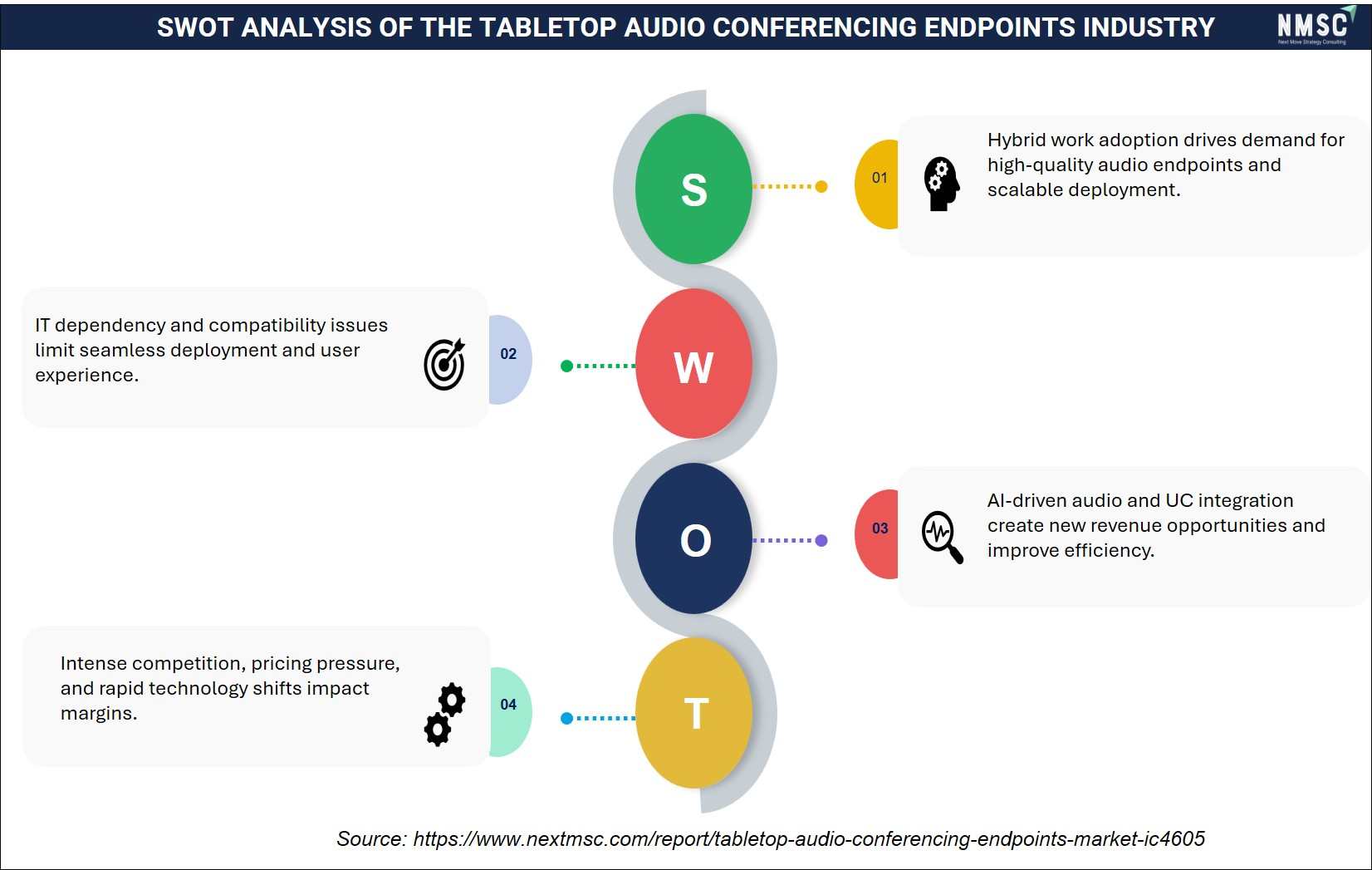
Our assessment indicates that strong demand driven by hybrid work models remains a key growth driver, supporting scalable deployment of audio endpoints. However, dependency on IT infrastructure and compatibility challenges limit seamless user experience. On the other hand, advancements in AI-driven audio and deeper UC integration are creating new revenue opportunities and enhancing efficiency. Nevertheless, increasing competition, pricing pressure, and rapid technological changes continue to impact profitability, while evolving standards introduce uncertainty in long-term product compatibility and differentiation in the tabletop audio conferencing endpoints market.
Competitive Landscape
Competitive Dynamics & M&A Landscape:
|
Key Takeaways |
|
The global tabletop audio conferencing endpoints market is shaped by a mix of large enterprise collaboration providers and specialized audio technology companies. Major players such as HP Inc., Cisco Systems, Inc., Logitech International S.A., GN Store Nord A/S, and Yealink Network Technology Co., Ltd. leverage strong enterprise relationships, platform-certified portfolios, and global distribution networks to sustain market leadership. Meanwhile, audio-focused and conferencing specialists including Yamaha Corporation, Shure Incorporated, Sennheiser electronic SE & Co. KG, and Biamp Systems, LLC strengthen competition through acoustic expertise, premium audio engineering, and differentiated product performance. |
|
From our assessment of competitive strategies, we found companies increasingly prioritize AI-driven audio processing, platform interoperability, and seamless integration with unified communication ecosystems. In addition, centralized device management, plug-and-play deployment, and hybrid work optimization continue shaping product innovation and enterprise adoption. Vendors are also expanding portfolios with bundled hardware-software solutions to enhance user experience and lifecycle value. |
|
Recent market developments indicate a strategic shift toward ecosystem consolidation and service-led models. Partnerships with collaboration platform providers, expansion of channel networks, and integration of analytics-driven device management solutions enable companies to strengthen enterprise penetration. At the same time, portfolio expansion across small, medium, and large meeting room solutions supports broader addressable market coverage and reinforces long-term competitive positioning. |
Which Companies Dominate the Tabletop Audio Conferencing Endpoints Market and How Do They Compete?
Based on our analysis, we found that the tabletop audio conferencing endpoints market is led by established enterprise collaboration providers alongside specialized audio technology firms. Cisco Systems, Inc., HP Inc., Logitech International S.A., GN Store Nord A/S, and Yealink Network Technology Co., Ltd. consistently lead large-scale enterprise deployments where platform compatibility, reliability, and global support capabilities are critical decision factors. From our implementation reviews, we found that these vendors are frequently selected for standardized meeting room rollouts requiring seamless integration with unified communication platforms such as Microsoft Teams and Zoom. Companies including Avaya LLC and Mitel Networks Corporation further strengthen their positions through enterprise telephony integration and communication ecosystems. Competition at this level is primarily driven by ecosystem compatibility, device certification, and enterprise-scale deployment capabilities.
Market Dominated by Tabletop Audio Conferencing Endpoints Giants and Specialists
From our observations, we identified that the competitive landscape is further shaped by audio-focused and conferencing specialists such as Yamaha Corporation, Shure Incorporated, Sennheiser electronic SE & Co. KG, and Biamp Systems, LLC. Our customer engagements and system integrators indicate that these companies gain traction through superior acoustic engineering, advanced microphone array technologies, and premium audio performance. In particular, solutions featuring beamforming microphones, noise suppression, and echo cancellation are widely preferred in high-quality conferencing environments. At the same time, companies such as AudioCodes Ltd. and AVer Information Inc. expand competition by offering cost-effective and flexible communication devices. In practice, enterprise leaders drive large-scale standardization, while specialists enhance performance differentiation through audio innovation and targeted use-case optimization.
Innovation and Adaptability Drive Market Success
Innovation remains a key determinant of competitive advantage in the tabletop audio conferencing endpoints market, as identified through our assessments of enterprise deployments and AV integration projects. Leading players such as Cisco Systems, Inc., HP Inc., Logitech International S.A., and AVer Information Inc. continue to advance AI-driven audio processing, adaptive voice tracking, and intelligent noise filtering capabilities. From our assessment of enterprise deployments, we found that vendors investing in centralized device management platforms, cloud-based monitoring, and firmware-driven upgrades are better positioned to scale across enterprise environments. Moreover, seamless interoperability with unified communication ecosystems enhances deployment efficiency and user experience. These developments reflect deep expertise in acoustic engineering, software integration, and enterprise IT alignment, enabling vendors to adapt to evolving hybrid work requirements.
Market Players to Opt for Merger & Acquisition Strategies to Expand Their Presence
Based on our research, we found that partnerships, acquisitions, and ecosystem expansion are key strategic levers in the tabletop audio conferencing endpoints market. Companies increasingly collaborate with platform providers, system integrators, and channel partners to strengthen deployment capabilities and expand market reach. A recent example is ACCO Brands Corporation, which acquired EPOS in March 2026 to expand its presence in enterprise audio and conferencing solutions. This reflects a broader trend of portfolio expansion through targeted acquisitions. In addition, vendors prioritize integration with unified communication platforms and enterprise IT ecosystems to enhance interoperability and user experience. Consequently, ecosystem-driven strategies continue to strengthen competitive positioning and support long-term enterprise adoption.
List of Key Tabletop Audio Conferencing Endpoints Companies
-
Logitech International S.A.
-
GN Store Nord A/S
-
Yealink Network Technology Co., Ltd.
-
ACCO Brands Corporation
-
Yamaha Corporation
-
Shure Incorporated
-
VTech Holdings Limited
-
Avaya LLC
-
Crestron Electronics, Inc.
-
AudioCodes Ltd.
-
AVer Information Inc.
-
Mitel Networks Corporation
-
Fanvil Technology Co., Ltd.
-
Biamp Systems, LLC
-
ALE International SAS
-
Sennheiser electronic SE & Co. KG
-
Guangzhou Shirui Electronics Co., Ltd.
-
Anker Innovations Co., Ltd.
What Are the Latest Key Industry Developments?
-
April 2026 – Fanvil expanded its LINKVIL professional audio portfolio by launching four new headsets (DH301D, DH301D Pro, DH301B, and DH401B) designed specifically for high-performance hybrid collaboration.
-
April 2026 – Cisco released an update for its Webex Suite, including enhanced AI Assistant search integration with Amazon Q and support for macOS 26.
-
April 2026 – Avaya LLC launched Avaya LLC Infinity, a unified Customer Experience (CX) platform that utilizes the Model Context Protocol (MCP) for open-architecture AI orchestration across cloud and on-premises deployments.
-
April 2025 – MAXHUB (CVTE) pre-launched an industry-leading 92" Microsoft Teams Rooms Interactive Display at ISE 2025, targeting high-end corporate conferencing environments.
Expert Insights
 “Distance Zero can only be accomplished with powerful AI, bringing the rich, human interaction happening into the meeting room into the virtual space.”
— Snorre Kjesbu, Executive Vice President, Cisco Systems, Inc.
Statement published in Cisco’s 2024 technology predictions discussing the future of AI-enhanced hybrid collaboration experiences and intelligent meeting environments.
Market Interpretation
The insight reflects the increasing importance of AI-powered conferencing technologies in reducing communication gaps between physical and remote participants. This trend accelerates adoption of tabletop audio conferencing endpoints equipped with intelligent voice tracking, spatial audio optimization, adaptive microphones, and noise suppression capabilities. Vendors increasingly differentiate products through immersive collaboration experiences that improve engagement and meeting effectiveness across hybrid workplaces.
What Are the Key Factors Influencing Investment Analysis & Opportunities in the Tabletop Audio Conferencing Endpoints Market?
Investment activity in the tabletop audio conferencing endpoints market is increasingly shaped by a shift toward ecosystem-driven and service-led models, rather than standalone hardware-focused strategies. Based on our evaluation of recent partnerships, acquisitions, and product expansion initiatives, we identified that investors and strategic players favour vendors with recurring value streams derived from device management platforms, software integration, and lifecycle services. Companies demonstrating strong interoperability with unified communication platforms, scalable enterprise deployments, and centralized device control capabilities consistently attract higher strategic interest.
Moreover, investment concentration is directed toward AI-driven audio processing, intelligent noise suppression, and cloud-based device management solutions that enhance user experience and operational efficiency. In particular, solutions addressing hybrid work complexity, multi-room standardization, and remote device monitoring gain stronger traction. Strategic investments increasingly outweigh purely financial funding, as collaboration platform providers, IT ecosystem players, and enterprise solution vendors seek tighter integration and greater ecosystem control. For investors, the most compelling opportunities emerge in companies combining acoustic innovation, software-driven differentiation, and proven enterprise deployment capabilities with long-term scalability.
Key Benefits for Stakeholders:
Next Move Strategy Consulting (NMSC) presents a comprehensive analysis of the tabletop audio conferencing endpoints market, covering historical developments from 2020 to 2025 and providing forward-looking forecasts through 2035. Our study evaluates the market at global, regional, and country levels, delivering quantitative outlooks alongside qualitative insights into key growth drivers, adoption barriers, technology advancements, and investment trends across all major tabletop audio conferencing endpoint segments.
From our observation, we found that the tabletop audio conferencing endpoints market delivers measurable value to a broad stakeholder base. Investors benefit from recurring revenue opportunities enabled by device management platforms, subscription-based services, and lifecycle-driven deployment models. Enterprises and workplace operators gain improved communication efficiency, reduced meeting friction, and enhanced collaboration experiences through reliable, high-quality audio solutions. In addition, IT teams and system integrators benefit from standardized deployments, centralized device control, and ongoing service and upgrade opportunities. By aligning audio innovation with enterprise collaboration needs and scalable deployment models, the market supports long-term operational efficiency, improved user experience, and sustained value creation across modern digital workplaces.
|
Parameters |
Details |
|
Customization Scope |
Free customization (equivalent to up to 80 analyst-working hours) after purchase. Addition or alteration to country, regional & segment scope. |
|
Pricing and Purchase Options |
Avail customized purchase options to meet your exact research needs. |
|
Approach |
In-depth primary and secondary research; proprietary databases; rigorous quality control and validation measures. |
|
Analytical Tools |
Porter's Five Forces, SWOT, value chain, and Harvey ball analysis to assess competitive intensity, stakeholder roles, and relative impact of key factors. |
Tabletop Audio Conferencing Endpoints Market Key Segments
By Product Type
-
USB Speakerphones
-
Wired USB Only
-
USB with Secondary Wireless
-
USB with Expansion
-
-
Bluetooth Speakerphones
-
Standalone Bluetooth
-
Bluetooth with Wired Fallback
-
Bluetooth with Expansion
-
-
IP Conference Phones
-
SIP Native
-
IP with USB
-
IP with Wireless Expansion
-
-
PSTN Conference Phones
-
PSTN Standalone
-
PSTN with Digital Interface
-
-
DECT Conference Phones
-
Standalone DECT
-
DECT with Expansion
-
-
Proprietary Wireless Conference Phones
-
Standalone Proprietary Wireless
-
Proprietary Wireless with Expansion
-
-
Other Tabletop Audio Endpoints
By Room Size
-
Huddle (1–4)
-
Small (5–8)
-
Medium (9–12)
-
Large (13+)
By Application
-
Internal Collaboration
-
External Communication
-
Training & Education
-
Telehealth Delivery
-
Other Applications
By Sales Channel
-
Direct to Enterprise
-
Distribution Partners
-
Retail
-
E-commerce Platforms
-
Telecom Bundles
-
Other Channels
By End User
-
Corporate Enterprise
-
SMB
-
Government
-
Education
-
Healthcare
-
Other End Users
Geographical Breakdown
-
North America: U.S., Canada, and Mexico.
-
Europe: UK, Germany, France, Italy, Spain, Sweden, Denmark, Finland, the Netherlands, and the Rest of Europe.
-
Asia Pacific: China, India, Japan, South Korea, Taiwan, Indonesia, Vietnam, Australia, Philippines, Malaysia and the rest of APAC.
-
Middle East & Africa (MEA): Saudi Arabia, UAE, Egypt, Israel, Turkey, Nigeria, South Africa, and the rest of MEA.
-
Latin America: Brazil, Argentina, Chile, Colombia, and the rest of LATAM.
Conclusion & Recommendations
This report provides stakeholders, service providers, investors, and consultants with actionable insights to capitalise on the structural transformation underway in the market. By combining rigorous data-driven analysis with proven strategic frameworks, NMSC’s Tabletop Audio Conferencing Endpoints Market Report serves as a critical decision-support resource for navigating an increasingly hybrid and collaboration-driven workplace landscape. The market is positioned for sustained expansion, supported by rising hybrid work adoption, increasing enterprise digitalization, and growing demand for seamless, high-quality communication experiences. Key strategic insights highlight the increasing importance of platform-centric ecosystems, AI-enabled audio processing, and integration with unified communication platforms such as Microsoft Teams, as these capabilities strengthen usability and long-term value. Vendors that prioritize modular device architectures, intelligent audio features, and flexible deployment models consistently achieve stronger enterprise adoption and recurring service opportunities.
For executives and investors, capturing value requires focusing on high-growth use cases such as small and medium meeting room standardization, remote collaboration enablement, and enterprise-wide device deployment strategies. At the same time, continued investment in software integration, device management platforms, and ecosystem partnerships remains critical. Expanding presence in high-growth regions, particularly Asia-Pacific and emerging enterprise markets, unlocks additional demand potential. Scalability, ease of deployment, and consistent user experience further enhance vendor credibility and accelerate adoption, creating durable value across the global collaboration technology ecosystem.


About the Author
 Saista Faiyaz
— Saista Faiyaz is Research Associate at Next Move Strategy Consulting, where she has covered consumer markets and healthcare technologies for 3 years. Her work includes primary interview review, secondary-source validation, market sizing, and structured analysis of company and industry data. She supports research by comparing evidence across sources, organizing findings into market narratives, and documenting assumptions used in analysis. Her scope includes cross-market benchmarking, and reports.
Saista Faiyaz
— Saista Faiyaz is Research Associate at Next Move Strategy Consulting, where she has covered consumer markets and healthcare technologies for 3 years. Her work includes primary interview review, secondary-source validation, market sizing, and structured analysis of company and industry data. She supports research by comparing evidence across sources, organizing findings into market narratives, and documenting assumptions used in analysis. Her scope includes cross-market benchmarking, and reports.
About the Reviewer
 Supradip Baul
— Supradip Baul is an accomplished business consultant and strategist with over a decade of rich experience in market intelligence, strategy, technology, and business transformation. His work has included rigorous qualitative and quantitative analysis across multiple industries, helping clients shape investment decisions and long-term roadmaps. Earlier in his career, he was associated with Gartner, where he contributed to industry-leading reports and market share analyses. He has worked with leading global companies and holds an MBA with a dual specialization in Marketing and Finance.
Supradip Baul
— Supradip Baul is an accomplished business consultant and strategist with over a decade of rich experience in market intelligence, strategy, technology, and business transformation. His work has included rigorous qualitative and quantitative analysis across multiple industries, helping clients shape investment decisions and long-term roadmaps. Earlier in his career, he was associated with Gartner, where he contributed to industry-leading reports and market share analyses. He has worked with leading global companies and holds an MBA with a dual specialization in Marketing and Finance.
At Next Move Strategy Consulting, we understand that insightful market research is the cornerstone of successful business decisions. That's why we employ a robust and multifaceted approach, combining various methodologies to deliver the most accurate and actionable data for our clients.

Research Landscape
We navigate the world of research with two primary approaches:
Qualitative Approach
Our qualitative research methodologies involve immersive techniques such as in-depth interviews, focus groups, and observational studies. By engaging directly with individuals and stakeholders, we uncover valuable insights that quantitative data alone may overlook.

Quantitative Research
In tandem with qualitative methodologies, NMSC leverages the power of Quantitative Research to provide a robust foundation of numerical insights. Through systematic data collection and analysis, we quantify patterns, preferences, and market trends, offering a comprehensive view of the business landscape.
Our quantitative research approach employs diverse tools, including surveys, experiments, and statistical modelling. These methodologies enable us to gather data from a large and representative sample, ensuring the statistical significance of our findings. By employing structured questionnaires and standardized data collection methods, we guarantee the reliability and validity of the information we present to our clients.
Quantitative research is particularly effective in measuring the prevalence of trends, assessing market size, and gauging the impact of various factors on consumer behavior. The numerical precision attained through this approach equips our clients with actionable insights, facilitating data-driven decision-making and strategy formulation.


Our Specialized Toolbox for Industry-Specific Market Research
We deploy a specialized arsenal of techniques tailored to meet your unique requirements. Here's a glimpse into our comprehensive toolbox:

Information Procurement
The stage entails acquiring market data or relevant information through various sources and methodologies.


Market Research Approach
We utilize both top-down and bottom-up approaches in market research analysis to achieve a comprehensive understanding of the market dynamics, leveraging the broad perspective of industry trends and macroeconomic factors alongside detailed insights from specific segments and individual companies.

Porters Five Forces Analysis
We conduct Porter's Five Forces analysis to evaluate the competitive landscape of an industry, providing us with insights into factors that affect profitability and strategic positioning.

SWOT Analysis

Forecasting
We utilize a forecasting model to predict future consumption by considering parameters like population, economics, regulations, market competition, drivers, constraints, technology, and pricing. We also employ statistical techniques such as multilinear regression, exponential smoothing, moving average, ARIMA, and Monte Carlo simulations for accurate predictions. In econometric forecasting, we analyzed short-term and long-term event impacts, attributing values based on regulatory frameworks, economic factors, and market events.





 Speak to Our Analyst