Taiwan Aluminum Market By Type (Primary, Secondary, Scrap), By Product Type (Flat-Rolled, Casting, Extrusions, Forgings, Powder & Paste, Billets, Wire Rods, Foundry Alloys, Aluminium Silicon Alloy, Others), By Alloy Series (1xxx–7xxx), By Distribution Channel (OEM Direct, Distributors, Aftermarket, E-commerce, Scrap Traders), By End User (Transportation, Consumer Goods, Machinery & Equipment, Construction, Packaging, Electrical Engineering, Others) – Analysis & Forecast, 2025–2035
Industry: Materials and Chemical | Latest Edition: June 12, 2026 | No of Pages: 243 | No. of Tables: 122 | No. of Figures: 112 | Format: PDF | Report Code: MC1363
Taiwan Aluminum Market Size & Forecast
|
Parameters |
Details |
|
Market Size in 2026 |
USD 3.01 Billion |
|
Revenue Forecast in 2035 |
USD 5.26 Billion |
|
Growth Rate |
CAGR of 6.39% from 2026 to 2035 |
|
Market Volume in 2026 |
1.40 Million Tons |
|
Volume Forecast in 2035 |
2.22 Million Tons |
|
Growth Rate |
CAGR of 5.28% from 2026 to 2035 |
|
Analysis Period |
2025–2035 |
|
Base Year Considered |
2025 |
|
Forecast Period |
2026–2035 |
|
Market Size Estimation |
Billion (USD) |
|
Companies Profiled |
15 |
|
Market Share |
Available for 10 companies |
Industry Outlook
The Taiwan Aluminum Market size was valued at USD 2.64 billion in 2025 and is expected to reach USD 3.01 billion by 2026. Looking ahead, the industry is projected to expand significantly, reaching USD 5.26 billion by 2035, registering a CAGR of 6.39% from 2026 to 2035. In terms of volume, the market recorded 1.23 Million Tons in 2025, with forecasts indicating growth to 1.40 Million Tons by 2026 and further to 2.22 Million Tons by 2035, reflecting a CAGR of 5.28% over the same period.
What Are the Key Market Drivers, Breakthroughs, and Investment Opportunities That Will Shape the Aluminum Industry in the Next Decade?
Growth Catalyst & Risk Assessment Matrix
|
DRIVERS / TRENDS / RESTRAINTS |
(+/–) % IMPACT ON CAGR FORECAST |
GEOGRAPHIC RELEVANCE |
IMPACT TIMELINE |
|
Electronics manufacturing growth driving demand for precision aluminum in housings, frames, and thermal components |
+1.9% |
Hsinchu, Taichung, Tainan, major semiconductor and electronics clusters |
Short to medium term (1–3 years) |
|
Green manufacturing focus increasing adoption of recycled and low-emission aluminum materials |
+1.7% |
Nationwide export-oriented industrial zones |
Medium term (2–5 years) |
|
Infrastructure modernization and industrial upgrades supporting aluminum use in machinery and structural systems |
+1.6% |
Taipei, Kaohsiung, Taichung industrial regions |
Medium term (2–5 years) |
|
Trade tensions and geopolitical risks disrupting procurement, pricing stability, and export demand visibility |
-1.9% |
Export-driven industrial hubs, cross-border supply chains |
Short to medium term (1–3 years) |
|
Precision extrusion and heat-treatment capabilities enabling high-value applications and OEM partnerships |
+1.8% |
Hsinchu, Tainan, advanced manufacturing clusters |
Medium to long term (3–7 years) |
Our analysis indicates that the Taiwan aluminum market is being supported by a combination of technology-led demand and industrial modernization trends. Expanding electronics production across semiconductors, servers, networking devices, and consumer hardware is sustaining consumption of precision aluminum used in housings, connectors, and cooling assemblies. In addition, the growing shift toward green manufacturing is also strengthening demand for recycled inputs, low-emission processing, and traceable supply chains as exporters align with global sustainability requirements. Our market analysis suggests that infrastructure upgrades, factory modernization, and replacement cycles for machinery are further supporting demand for profiles, plates, structural products, and engineered components across industrial applications.
The market outlook also reflects future gains from precision extrusion, heat-treatment, CNC finishing, and anodising services linked to telecom hardware, EV electronics, and automation systems requiring higher-specification aluminum solutions. As a result, these value-added capabilities improve customer retention and create stronger participation in specialized supply chains. Our findings reveal that trade tensions, tariff uncertainty, export controls, and broader geopolitical disruptions remain the principal constraints, as they affect raw material sourcing, pricing visibility, and order continuity for export-oriented manufacturers.
Growth Drivers:
How Is the Increasing Production of Electronics Driving Aluminum Consumption in Taiwan?
Our analysis indicates that Taiwan’s electronics manufacturing ecosystem is creating sustained demand for lightweight, conductive, and thermally efficient aluminum inputs used in housings, frames, connectors, and cooling assemblies. Specifically, the Taiwan aluminum market benefits from procurement cycles linked to semiconductors, servers, networking devices, and consumer electronics, where precision tolerances and surface quality are critical. Producers supplying value-added rolled and extruded formats are positioned to align with high-specification industrial requirements.
How Is the Growing Focus on Green Manufacturing Fueling in Taiwan Aluminum Market Growth i?
Based on our assessment, we found that sustainability targets across manufacturing supply chains are accelerating interest in recycled metal content, energy-efficient processing, and low-emission materials. In particular, the Taiwan aluminum market is supported by aluminum’s recyclability, long service life, and compatibility with circular production models used by exporters serving global customers. Buyers increasingly evaluate suppliers on environmental performance, traceability systems, and scrap recovery capabilities when awarding contracts or renewing sourcing agreements.
How are Infrastructure Modernization and Industrial Equipment Upgrades Supporting Aluminum Demand in Taiwan?
Our market analysis suggests that factory modernization, utility upgrades, and commercial development are strengthening demand for corrosion-resistant and fabrication-friendly aluminum products. In addition, the Taiwan aluminum sector gains from applications in structural systems, cable management, HVAC equipment, transport components, and industrial machinery where weight reduction and maintenance efficiency influence material choice. Replacement cycles for older assets also support orders for standardized profiles, plates, and engineered components.
Growth Inhibitor:
How Are Trade Tensions Affecting Expansion Prospects Across the Market?
Our review of developments highlights that shifting tariff frameworks, export controls, and geopolitical trade frictions disrupt procurement planning for smelter feedstock, semi-finished products, and downstream components. As a result, the Taiwan aluminum sector faces margin pressure when buyers delay commitments or diversify sourcing in response to uncertain landed costs. Contract renegotiations become more frequent, while inventory buffers increase working capital needs for processors and distributors managing cross-border exposure.
Through our examination, we observed that trade tensions also influence customer investment timing in electronics, machinery, and export-oriented manufacturing sectors that consume fabricated aluminum inputs. In addition, the market may encounter uneven order visibility when overseas clients reassess production footprints or redirect supply chains. Producers with concentrated customer bases faces utilization swings, making operational planning more complex and reducing efficiency gains from stable production schedules.
Growth Opportunity:
How Can Precision Extrusion and Heat-Treatment Capabilities Shape Future Expansion?
Our findings reveal that advanced extrusion paired with controlled heat-treatment services creates differentiated supply pathways for compact electronics enclosures, battery casings, thermal frames, and heat-dissipation assemblies. In particular, the aluminum market is well aligned with customers requiring dimensional accuracy, machinability, and repeatable metallurgical performance. This moves suppliers beyond commodity conversion toward specification-led partnerships with OEMs and contract manufacturers.
Demand for denser computing systems, telecom hardware, EV electronics, and industrial automation equipment is increasing the need for engineered thermal management components. Furthermore, our strategic review shows that Taiwan’s aluminum market capture additional value by integrating finishing, CNC machining, anodising, and rapid prototyping around extrusion programs. Shorter development cycles and localized technical support are likely to strengthen customer retention and raise qualification opportunities.
Ecosystem Analysis of the Taiwan Aluminum Market
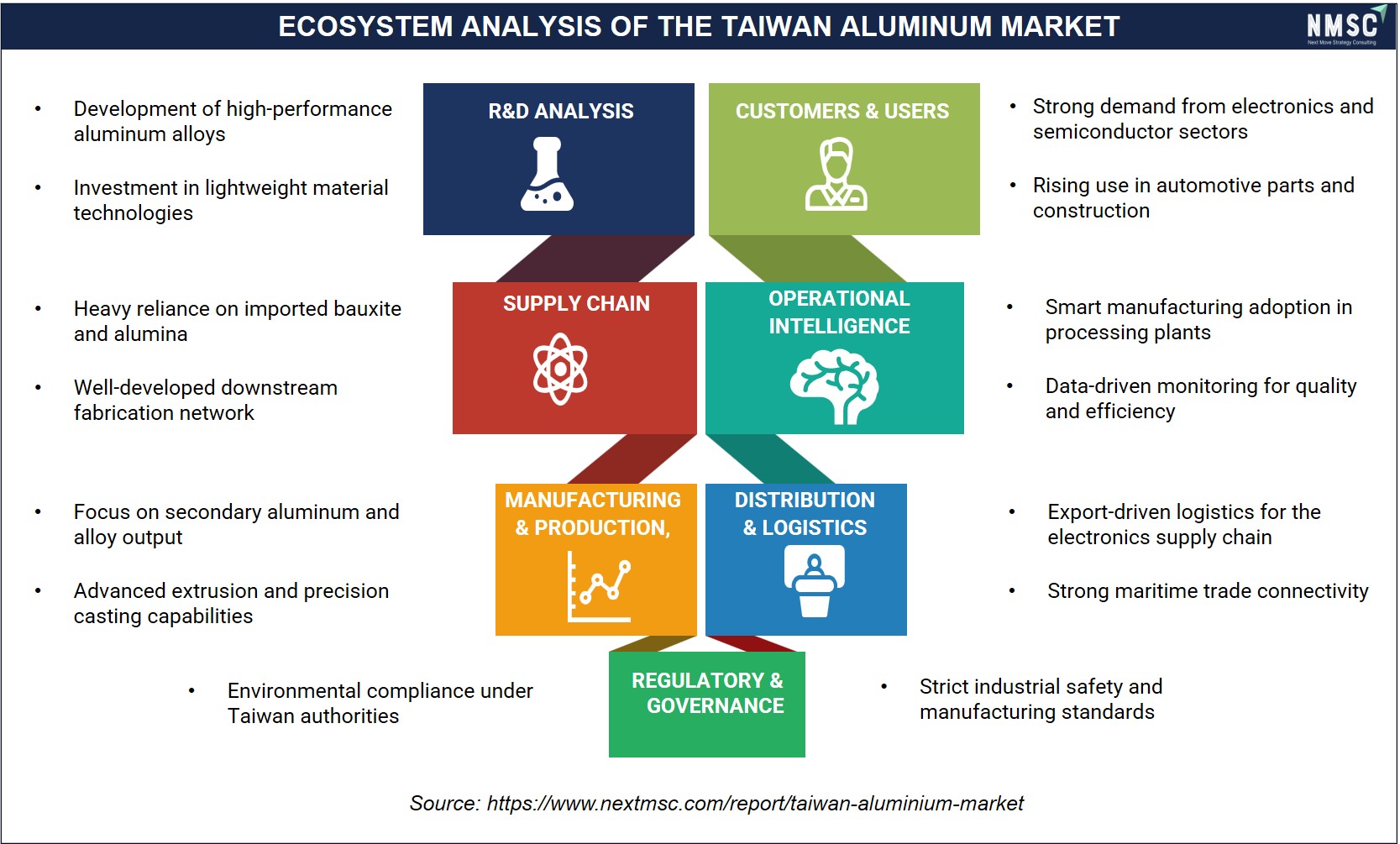
Our analysis indicates that the ecosystem of the Taiwan aluminum market represents an interconnected industrial system where innovation, production, demand, and regulation collectively shape performance. Research and development enable advanced alloys, lightweight materials, and efficient processing for electronics, transportation, and industrial uses, while customer requirements influence specifications across the value chain. Supply chain activities include sourcing, conversion, and downstream manufacturing, supported by automation and process optimization. Manufacturing remains the core layer producing sheets, extrusions, and castings for domestic and export markets. Furthermore, distribution, logistics, and regulatory governance strengthen export efficiency and ensure long-term market stability through coordinated ecosystem interactions.
How Is the Taiwan Aluminum Market Segmented in This Report, and What Are the Key Insights From the Segmentation Analysis?
By Type
How Does Type-Based Segmentation Structure Supply Pathways in The Taiwan Aluminum Market?
Based on Type, the market is categorized into Primary Aluminum and Secondary (Recycled) Aluminum, which includes Industrial Scrap, Post-Consumer Scrap, and Remelted Secondary Production.
From our review, we found that secondary aluminum is commercially relevant where cost efficiency, sustainability targets, and circular sourcing strategies influence procurement planning across manufacturing industries. Industrial Scrap offers comparatively cleaner and more predictable feedstock streams because it originates from controlled fabrication waste, while Post-Consumer Scrap supports broader recovery ecosystems linked to packaging, transport parts, and consumer products. Remelted Secondary Production is used in castings and selected semi-fabricated outputs where specification ranges permit recycled inputs. In addition, purchasing teams in the Taiwan aluminum market increasingly evaluate energy footprint, alloy consistency, refining capability, and logistics reliability when allocating volumes between primary and recycled sources. This creates demand for suppliers that provide traceability, stable chemistry control, and flexible delivery programs.
By Product Form
How Does Product-Form Segmentation Influence Commercial Demand in The Taiwan Aluminum Market?
Based on Product Form, the market is categorized into Flat-Rolled products such as Sheet, Coil, Plate, Foil, and Can-Stock, along with Casting, Extrusions including Profiles and Tubes and Pipes, Forgings, Powder and Paste, Billets, Wire Rods, Foundry Alloys, Aluminium Silicon Alloy, and Other Products, representing a broad industrial processing and fabrication ecosystem.
Our expert analysis points to Flat-Rolled products serving enclosure panels, heat shields, structural covers, and packaging formats where dimensional consistency and surface finish are key purchasing criteria. Similarly, extrusions remain relevant for Profiles and Tubes & Pipes used in machinery frames, architectural systems, transport structures, and thermal management assemblies requiring lightweight strength. Casting materials support component manufacturing where design complexity and production efficiency are priorities. In addition, billets function as critical feedstock for downstream converters, while Wire Rods are used in electrical and industrial transmission applications. Procurement trends across the Taiwan aluminum market increasingly favor shorter lead times, custom dimensions, alloy flexibility, finishing support, and suppliers capable of machining, anodizing, slitting, or fabrication services alongside material supply.
Competitive Landscape
Based on NMSC’s evaluation of the Taiwan aluminum industry, we observe that the competitive landscape is moderately consolidated, with a balanced mix of established domestic manufacturers, export-oriented processors, and specialized downstream fabricators. Key regional and national players such as Ta Chen International, Inc., C.S. Aluminium Corporation, Kainan Metals Industries Co., Ltd., Great Well Aluminium Corp., Ltd., and Yuan-Cheng Aluminium Co., Ltd. maintain a strong presence through extrusion systems, sheets, profiles, and industrial aluminum processing capabilities. At the same time, companies including Ye Fong Aluminium Industrial Ltd., Longi Aluminum Co., Ltd., Alumax Industrial Co., Ltd., Taiwan Hodaka Technology Co., Ltd., and Magic Precision Inc. contribute through engineered components, precision manufacturing, and customized aluminum solutions tailored for electronics, transport, machinery, and construction sectors.
Smaller and niche participants such as Hau Chang Enterprise Co., Ltd., Pyramids Technology Corporation, Fengxin Aluminum Co., Ltd., AmSpec Group, and Schüco International KG further enhance market competition by serving application-specific and project-based requirements. Overall, the Taiwan aluminum market is characterized by strong manufacturing integration, precision processing expertise, and increasing emphasis on high-value downstream applications, making it technology-driven and export-linked.
Strategic Developments:
-
September 2025 – Toyota Tsusho announced an investment of USD 46.65 million in Taiwan’s Ta Chen Stainless Pipe Co., Ltd. through a third-party share allocation. The deal is aimed at securing a long-term aluminum supply chain for North America, especially for EV battery components. The partnership also plans to develop aluminum recycling and closed-loop material systems.
-
January 2025 – C.S. Aluminium Corporation achieved recertification under the ASI Performance Standard V3 for its Kaohsiung, Taiwan facility. The certification covers production of aluminium plates, rolls, sheets, and foil. It reflects the company’s compliance with updated sustainability and responsible production standards.
SWOT Analysis of the Taiwan Aluminum Market:
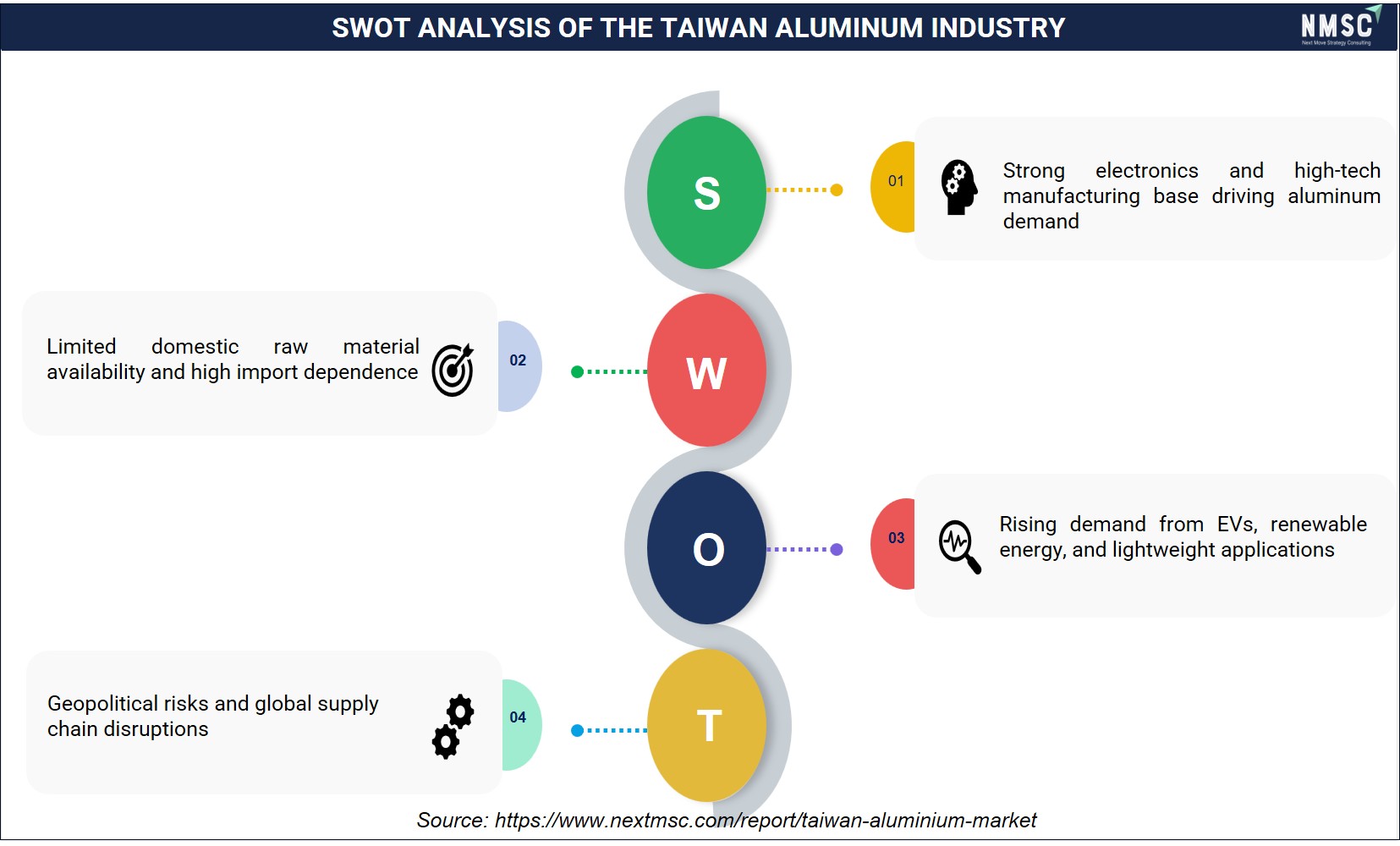
The SWOT analysis of the Taiwan aluminum market shows a sector supported by strong demand from electronics, semiconductors, consumer devices, and precision manufacturing industries requiring high-quality aluminum with strict technical standards. Our analysis indicates that this industrial base promotes specialized, high-value applications rather than commodity dependence. However, limited domestic raw material availability increases reliance on imported bauxite and alumina, exposing the market to price volatility, freight costs, and supply risks. Rising demand from EVs, renewable energy, and lightweight transport creates growth opportunities. Additionally, geopolitical tensions, trade restrictions, and logistics disruptions remain key threats, making supply chain resilience and sourcing diversification essential for stability.
Key Players
-
Kainan Metals Industries Co., Ltd.
-
Great Well Aluminium Corp., Ltd.
-
Yuan-Cheng Aluminium Co., Ltd.
-
AmSpec Group
-
Schüco International KG
-
Ye Fong Aluminium Industrial Ltd.
-
Taiwan Hodaka Technology Co., Ltd.
-
Longi Aluminum Co., Ltd.
-
Alumax Industrial Co., Ltd.
-
Magic Precision Inc.
-
Hau Chang Enterprise Co., Ltd.
-
Pyramids Technology Corporation
-
Fengxin Aluminum Co., Ltd.
Our analysis indicates that competitive dynamics in the Taiwan aluminum market are increasingly shaped by production efficiency, low-carbon manufacturing capabilities, and value-added downstream product innovation rather than primary metal capacity alone. Moreover, we observe that leading suppliers are actively investing in recycling infrastructure, advanced rolling and extrusion technologies, and energy-efficient smelting processes to address rising demand for sustainable and lightweight materials across transportation, construction, packaging, and aerospace applications. The growing preference for recycled and secondary aluminum, in our view, reflects end-user focus on cost optimization, emission reduction, and circular supply chain strategies.
Additionally, we also identified that market leaders are strengthening their positions through domestic capacity expansions, localized supply chains, and long-term contracts with automotive, beverage packaging, and industrial customers. These strategies enable stronger market penetration while reducing exposure to import volatility, logistics disruptions, and trade policy uncertainty. Overall, we expect sustained investment in recycling capacity, fabrication technologies, and customer-specific alloy development to remain the key determinant of competitive positioning in the Taiwan aluminum market.
Taiwan Aluminum Market Key Segments
By Type
-
Primary Aluminum
-
Secondary (Recycled) Aluminum
-
Industrial Scrap
-
Post-Consumer Scrap
-
Remelted Secondary Production
-
By Product Form
-
Flat-Rolled
-
Sheet
-
Coil
-
Plate
-
Foil
-
Can-Stock
-
-
Casting
-
Extrusions
-
Profiles
-
Tubes & Pipes
-
-
Forgings
-
Powder & Paste
-
Billets
-
Wire Rods
-
Foundry Alloys
-
Aluminium Silicon (AlSi) Alloy
-
Other Products
By Alloy Series
-
1xxx Series
-
2xxx Series
-
3xxx Series
-
4xxx Series
-
5xxx Series
-
6xxx Series
-
7xxx Series
By Distribution Channel
-
OEM Direct
-
Distributors
-
Aftermarket
-
E-commerce
-
Scrap Traders
By End User
-
Transportation
-
Aerospace
-
Automotive
-
Marine
-
Rail
-
-
Consumer Goods
-
Machinery & Equipment
-
Construction
-
Packaging
-
Food & Beverage
-
Cosmetics
-
Others
-
-
Electrical Engineering
-
Other End Users
Key Benefits for Stakeholders:
Next Move Strategy Consulting (NMSC) presents a comprehensive analysis of the Taiwan aluminum market, covering historical developments from 2020 to 2025 and providing forward-looking forecasts through 2035. The study assesses the market at regional levels, combining quantitative market sizing with qualitative insights into key growth drivers, supply-demand dynamics, pricing trends, sustainability transitions, technology evolution, and investment activity across major aluminum product categories and end-use industries.
From our analysis, the Taiwan aluminum market delivers strong value across the industrial ecosystem. Manufacturers benefit from lightweight, durable, and recyclable materials that improve product performance and production efficiency. Investors gain exposure to long-term growth supported by infrastructure development, electric vehicle expansion, packaging demand, and rising adoption of recycled aluminum. Fabricators, processors, and technology providers benefit from recurring opportunities through value-added product development, recycling capacity expansion, and long-term supply agreements. Overall, the market supports industrial competitiveness, supply chain resilience, and Taiwan’s broader manufacturing transformation, reinforcing its strategic importance in the country’s industrial landscape.
|
Parameters |
Details |
|
Customization Scope |
Free customization (equivalent to up to 80 analyst-working hours) after purchase. |
|
Pricing and Purchase Options |
Avail customized purchase options to meet your exact research needs. |
|
Approach |
In-depth primary and secondary research; proprietary databases; rigorous quality control and validation measures. |
|
Analytical Tools |
Porter's Five Forces, SWOT, value chain, and Harvey ball analysis to assess competitive intensity, stakeholder roles, and relative impact of key factors. |


About the Author
 Tushmi Dutta
— Tushmi Dutta is a focused researcher specializing in detailed analysis and insight-driven research across diverse business landscapes. She supports strategic initiatives through structured data interpretation, thorough validation, and clear communication of findings that aid informed decision-making. With a strong interest in writing, she enjoys presenting research insights in an engaging and accessible manner. Beyond work, she enjoys traveling, reading, painting, and continuously learning new skills that contribute to her creative and professional growth.
Tushmi Dutta
— Tushmi Dutta is a focused researcher specializing in detailed analysis and insight-driven research across diverse business landscapes. She supports strategic initiatives through structured data interpretation, thorough validation, and clear communication of findings that aid informed decision-making. With a strong interest in writing, she enjoys presenting research insights in an engaging and accessible manner. Beyond work, she enjoys traveling, reading, painting, and continuously learning new skills that contribute to her creative and professional growth.
About the Reviewer
 Supradip Baul
— Supradip Baul is an accomplished business consultant and strategist with over a decade of rich experience in market intelligence, strategy, technology, and business transformation. His work has included rigorous qualitative and quantitative analysis across multiple industries, helping clients shape investment decisions and long-term roadmaps. Earlier in his career, he was associated with Gartner, where he contributed to industry-leading reports and market share analyses. He has worked with leading global companies and holds an MBA with a dual specialization in Marketing and Finance.
Supradip Baul
— Supradip Baul is an accomplished business consultant and strategist with over a decade of rich experience in market intelligence, strategy, technology, and business transformation. His work has included rigorous qualitative and quantitative analysis across multiple industries, helping clients shape investment decisions and long-term roadmaps. Earlier in his career, he was associated with Gartner, where he contributed to industry-leading reports and market share analyses. He has worked with leading global companies and holds an MBA with a dual specialization in Marketing and Finance.
At Next Move Strategy Consulting, we understand that insightful market research is the cornerstone of successful business decisions. That's why we employ a robust and multifaceted approach, combining various methodologies to deliver the most accurate and actionable data for our clients.

Research Landscape
We navigate the world of research with two primary approaches:
Qualitative Approach
Our qualitative research methodologies involve immersive techniques such as in-depth interviews, focus groups, and observational studies. By engaging directly with individuals and stakeholders, we uncover valuable insights that quantitative data alone may overlook.

Quantitative Research
In tandem with qualitative methodologies, NMSC leverages the power of Quantitative Research to provide a robust foundation of numerical insights. Through systematic data collection and analysis, we quantify patterns, preferences, and market trends, offering a comprehensive view of the business landscape.
Our quantitative research approach employs diverse tools, including surveys, experiments, and statistical modelling. These methodologies enable us to gather data from a large and representative sample, ensuring the statistical significance of our findings. By employing structured questionnaires and standardized data collection methods, we guarantee the reliability and validity of the information we present to our clients.
Quantitative research is particularly effective in measuring the prevalence of trends, assessing market size, and gauging the impact of various factors on consumer behavior. The numerical precision attained through this approach equips our clients with actionable insights, facilitating data-driven decision-making and strategy formulation.


Our Specialized Toolbox for Industry-Specific Market Research
We deploy a specialized arsenal of techniques tailored to meet your unique requirements. Here's a glimpse into our comprehensive toolbox:

Information Procurement
The stage entails acquiring market data or relevant information through various sources and methodologies.


Market Research Approach
We utilize both top-down and bottom-up approaches in market research analysis to achieve a comprehensive understanding of the market dynamics, leveraging the broad perspective of industry trends and macroeconomic factors alongside detailed insights from specific segments and individual companies.

Porters Five Forces Analysis
We conduct Porter's Five Forces analysis to evaluate the competitive landscape of an industry, providing us with insights into factors that affect profitability and strategic positioning.

SWOT Analysis

Forecasting
We utilize a forecasting model to predict future consumption by considering parameters like population, economics, regulations, market competition, drivers, constraints, technology, and pricing. We also employ statistical techniques such as multilinear regression, exponential smoothing, moving average, ARIMA, and Monte Carlo simulations for accurate predictions. In econometric forecasting, we analyzed short-term and long-term event impacts, attributing values based on regulatory frameworks, economic factors, and market events.





 Speak to Our Analyst