Telehandler Market Size, Share, Trends and Growth Analysis, By Product Type (Standard (Non-Rotating), Rotating, Compact, and Specialized (Container Handlers and Rough-Terrain)), By Lift Capacity (Light-Duty, Medium-Duty, and Heavy-Duty), By Propulsion (Diesel/ICE, Electric (BEV), Hybrid, and Alternative Fuels), By End-Use Industry, By Business Model, By Distribution Channel, and Region – Global Industry Report and Forecast, 2026–2035
Industry: Construction & Manufacturing | Publishing Date: July 28, 2026 | Last Updated: September 30, 2026 | No of Pages: N/A | No. of Tables: N/A | No. of Figures: N/A | Format: PDF | Report Code: CM473
What Is the Telehandler Market Size?
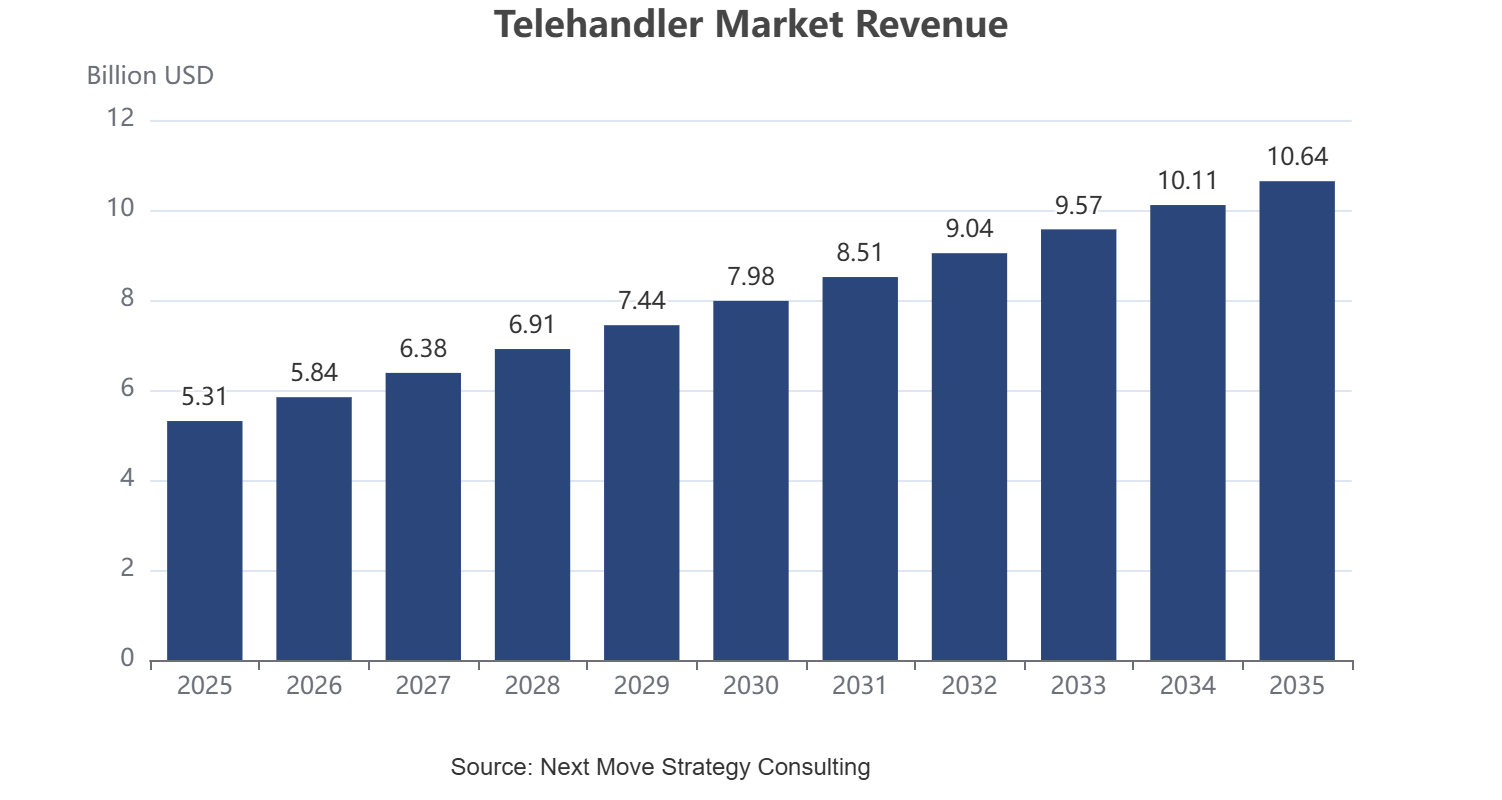
The global telehandler market size was valued at USD 5.31 billion in 2025 and is estimated at USD 5.69 billion in 2026, forecast to reach USD 10.64 billion by 2035, expanding at a 7.2% CAGR between 2026 and 2035. North America leads with approximately 39% share, while standard non-rotating telehandlers dominate all other product types with approximately 52% share.
We observed that growth is broad-based across every segmentation axis, with battery electric propulsion and warehousing and logistics applications driving the dominant structural shifts through 2035.
|
Key Takeaways |
|
By Product Type: Standard (Non-Rotating) held the largest share of approximately 52% (USD 2.76 Billion) in 2025; Specialized is the fastest-growing sub-segment at 9.1% CAGR from 2026–2035. |
|
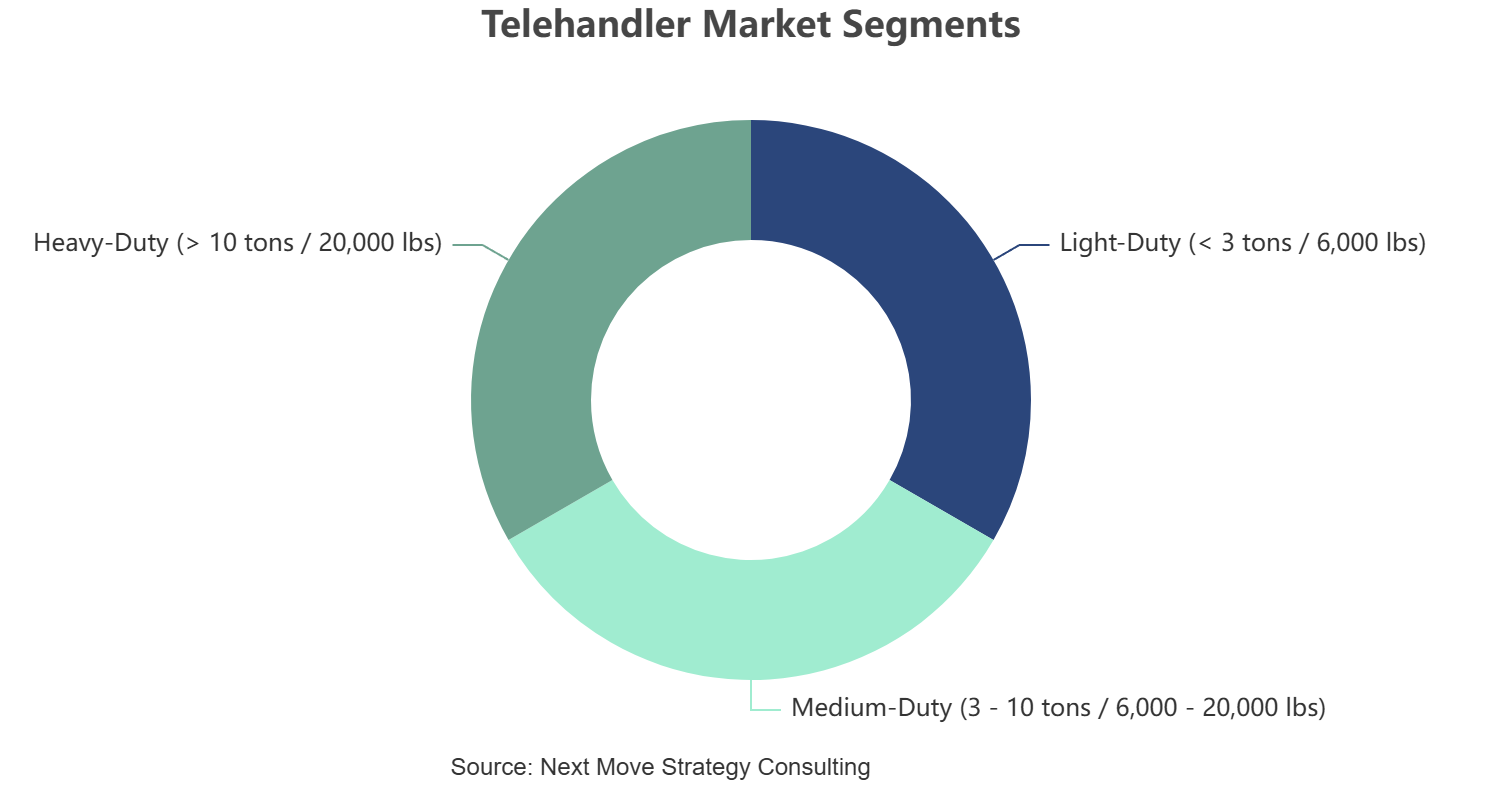
By Lift Capacity: Medium-Duty (3 - 10 tons / 6,000 - 20,000 lbs) held the largest share of approximately 54% (USD 2.87 Billion) in 2025; Heavy-Duty (> 10 tons / 20,000 lbs) is the fastest-growing sub-segment at 8.1% CAGR from 2026–2035. |
|
By Propulsion: Diesel / ICE (Internal Combustion Engine) held the largest share of approximately 79% (USD 4.20 Billion) in 2025; Electric (BEV) (Battery Electric Vehicle) is the fastest-growing sub-segment at 16.1% CAGR from 2026–2035. |
|
By End-Use Industry: Construction held the largest share of approximately 41% (USD 2.18 Billion) in 2025; Warehousing & Logistics is the fastest-growing sub-segment at 9.8% CAGR from 2026–2035. |
|
By Business Model: New Equipment Sales held the largest share of approximately 58% (USD 3.08 Billion) in 2025; Rental/Leasing is the fastest-growing sub-segment at 8.9% CAGR from 2026–2035. |
|
By Distribution Channel: Authorized Dealer Network held the largest share of approximately 46% (USD 2.44 Billion) in 2025; Online Marketplaces & Brokers is the fastest-growing sub-segment at 12.1% CAGR from 2026–2035. |
|
Dominant Region: North America dominated with approximately 39% revenue share (USD 2.07 billion) in 2025. |
|
Fastest-Growing Region: Asia-Pacific is expected to register the highest CAGR of 9.8% during 2026–2035. |
|
Dominant Country: U.S. led with approximately USD 1.68 billion in 2025. |
|
Fastest-Growing Country: India is the fastest-growing country at approximately 14.1% CAGR from 2026–2035. |
Market Opportunity: The telehandler market is expected to create an absolute dollar opportunity of USD 4.95 billion between 2026 and 2035, presenting significant investment potential across the material handling and construction equipment value chain.
According to Next Move Strategy Consulting analysis, rental fleet operators are increasingly specifying electric and hybrid telehandler models to meet job-site emissions restrictions, a shift that favors OEMs with diversified propulsion portfolios over diesel-only manufacturers as urban construction and warehousing operators tighten sustainability procurement criteria through 2035.
What Does the Telehandler Market Encompass?
The market encompasses telescopic handlers used to lift, place, and transport materials across construction, agriculture, mining, warehousing, and industrial sites, functioning as a versatile alternative to cranes and forklift trucks in applications requiring extended reach and rough-terrain mobility. Our assessment indicates that the scope spans standard non-rotating, rotating, compact, and specialized telehandlers supplied to owner-operators, rental companies, and fleet buyers across construction, agriculture, ports, and warehousing end markets worldwide.
Regulatory frameworks such as U.S. Occupational Safety and Health Administration equipment safety standards and European Union non-road mobile machinery emissions regulations shape telehandler design and certification requirements, while urban construction emissions restrictions increasingly influence propulsion specification. We observed that technology adoption is shifting toward battery electric and hybrid propulsion alongside telematics-enabled fleet management. Next Move Strategy Consulting's analysis indicates that this structural shift, combined with rising rental fleet electrification mandates, is redefining procurement criteria across the telehandler market.
|
Field |
Details |
|
Market Size in 2025 |
USD 5.31 Billion |
|
Market Size in 2026 |
USD 5.69 Billion |
|
Revenue Forecast in 2035 |
USD 10.64 Billion |
|
Growth Rate |
CAGR of 7.2% from 2026 to 2035 |
|
Analysis Period |
2025–2035 |
|
Base Year Considered |
2025 |
|
Forecast Period |
2026–2035 |
|
Market Size Estimation |
USD Billion |
|
Companies Profiled |
15 |
|
Countries Covered |
33 |
|
Market Share |
Available for Top 10 Companies |
Key Emerging Trends
Based on research conducted by Next Move Strategy Consulting, we found that four structural trends are reshaping equipment design, fleet adoption, and stakeholder engagement across the industry.
How Is Battery Electric Propulsion Transforming Compact Telehandler Design?
Battery electric propulsion is transforming compact telehandler design as manufacturers introduce zero-emission models for noise- and emissions-restricted job sites. We observed that Manitou launched its MTA 519e, the company's first 100% electric fixed-boom telescopic handler, featuring a 33 kWh lithium-ion battery that reduces maintenance by 56% compared to its diesel counterpart. Rental fleet operators and urban construction contractors are adopting similar battery electric vehicle platforms to meet tightening job-site emissions restrictions.
Why Are Manufacturers Expanding Heavy-Duty Outrigger Configurations?
Manufacturers are expanding heavy-duty outrigger configurations to increase lifting capacity at mid-range working heights for demanding construction applications. Our findings suggest that Manitou's MTA 1242 Max and MTA 1242 Max E74 models, launched with new heavy-duty outriggers, increase lifting capacity between 2,500 and 4,000 pounds at common mid-range reach. This trend is elevating demand for heavy-duty lift capacity telehandlers among rental businesses and construction fleet managers seeking versatile, high-capacity equipment.
How Is Telematics Integration Reshaping Fleet Management?
Telematics integration is reshaping how rental companies and fleet owners monitor telehandler utilization, maintenance schedules, and operator safety. We observed that JLG Industries updated its SkyTrak 8042 model with a hydrostatic transmission and electric-over-hydraulic joystick, reflecting broader industry investment in precision control and data-connected operation. Independent rental companies and fleet purchase buyers are adopting similar connected platforms to reduce downtime and optimize multi-site equipment deployment.
What Role Does Rapid-Deployment Safety Equipment Play in Product Differentiation?
Rapid-deployment safety equipment is becoming a differentiator as manufacturers standardize enhanced operator protection features across product lines. Our analysis shows that JLG Industries launched its Rapid Replaceable Platform as standard equipment on select boom lift models in North America, reflecting a broader push toward serviceable, safety-focused component design. This trend, while originating in adjacent aerial equipment, is influencing telehandler cab and platform design as manufacturers compete on total cost of ownership.
Supply Chain Structure of the Telehandler Market
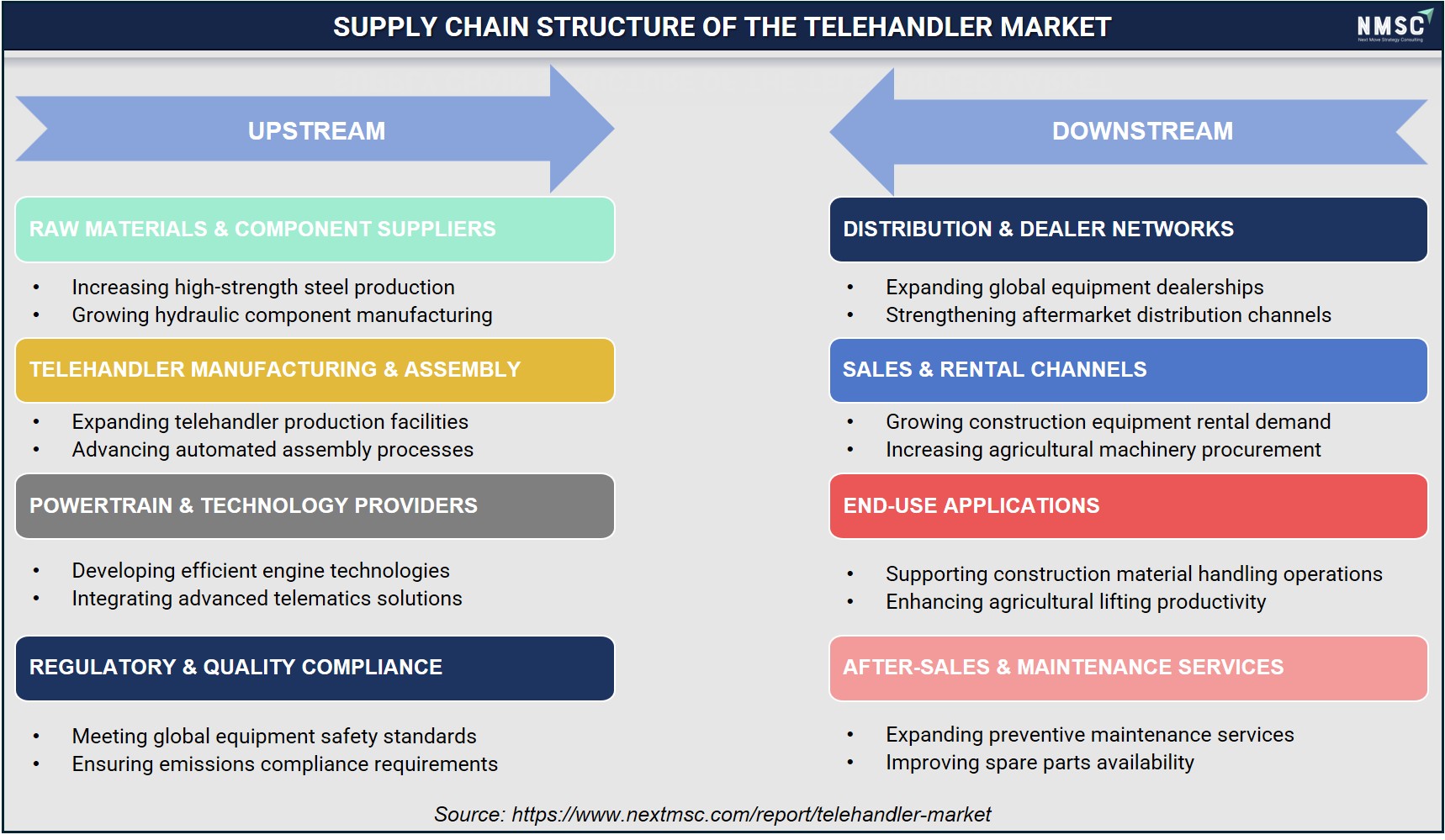
The market supply chain begins with raw material suppliers providing high-strength steel, hydraulic systems, and critical components, followed by manufacturers integrating advanced powertrain technologies and automated assembly processes while complying with stringent safety and emissions regulations. Downstream, equipment is distributed through dealer and rental networks, serving construction and agriculture sectors. After-sales services, including preventive maintenance and spare parts support, ensure equipment reliability, maximise uptime, and strengthen long-term customer relationships.
Growth Drivers and Restraints
Growth Catalyst and Risk Assessment Matrix
|
Factors |
Type |
(+/−) % Impact on CAGR |
Geographic Relevance |
Impact Timeline |
|
Rising infrastructure and non-residential construction investment |
Driver |
+2.1% |
Global |
2026–2035 |
|
Expanding warehousing and logistics facility construction |
Driver |
+1.7% |
North America, Asia-Pacific |
2026–2035 |
|
Growing rental fleet electrification and emissions compliance mandates |
Driver |
+1.4% |
North America, Europe |
2026–2035 |
|
Rising agricultural mechanization in emerging economies |
Driver |
+1.1% |
Asia-Pacific, Latin America |
2026–2032 |
|
Expanding port and terminal container handling capacity |
Driver |
+0.9% |
Asia-Pacific, Middle East & Africa |
2026–2035 |
|
Government infrastructure spending programmes |
Driver |
+0.7% |
Global |
2026–2035 |
|
High upfront cost of electric and hybrid telehandler models |
Restraint |
−0.9% |
Global |
2026–2035 |
|
Cyclical sensitivity of construction equipment demand to interest rates |
Restraint |
−0.7% |
North America, Europe |
2026–2032 |
|
Limited charging infrastructure at remote construction and agricultural sites |
Restraint |
−0.5% |
Global |
2028–2035 |
What Is the Primary Growth Driver of the Telehandler Market?
Rising infrastructure and non-residential construction investment is the primary driver of the market. U.S. Census Bureau construction spending data continues to track sustained non-residential construction outlays, supporting steady telehandler fleet replacement and expansion demand. We observed that this construction investment pace, reinforced by warehousing and logistics facility development, continues to anchor baseline demand for standard and rotating telehandlers across developed and emerging economies alike.
How Is Warehousing Expansion Driving Telehandler Market Growth?
Expanding warehousing and logistics facility construction is accelerating market growth toward compact and medium-duty telehandler categories. U.S. Bureau of Labor Statistics data continues to document growth in warehousing and storage sector employment, reflecting underlying facility expansion. Our assessment indicates that this warehousing buildout, combined with e-commerce-driven distribution center construction, is compressing adoption timelines for telehandlers within the warehousing and logistics end-use segment across North America and Asia-Pacific.
What Is Restraining Telehandler Market Expansion?
High upfront cost of electric and hybrid telehandler models restrains adoption among cost-sensitive owner-operators and smaller rental fleets. Industry equipment financing data continues to document elevated capital costs for zero-emission construction equipment relative to diesel counterparts. We found that rental and leasing business models are beginning to offset this restraint by lowering the barrier to electric equipment access, though full adoption beyond regulation-driven urban markets remains gradual.
Segmentation Analysis
Segment Sizing: By Product Type
|
Segment |
2025 (USD) |
2035 (USD) |
CAGR% (2026–2035) |
|
Standard (Non-Rotating) |
USD 2.76 Billion |
USD 5.20 Billion |
6.5% |
|
Rotating |
USD 1.01 Billion |
USD 2.18 Billion |
8.1% |
|
Compact |
USD 0.90 Billion |
USD 1.76 Billion |
6.9% |
|
Specialized |
USD 0.64 Billion |
USD 1.50 Billion |
9.1% |
|
Total |
USD 5.31 Billion |
USD 10.64 Billion |
7.2% |
Which Product Type Segment Dominates the Telehandler Market?
Standard (Non-Rotating) telehandlers led the market with USD 2.76 billion in 2025, supported by their versatility and lower cost relative to rotating and specialized configurations across general construction and agricultural applications. We observed that Specialized telehandlers, including container handlers and rough-terrain variants, are the fastest-growing product type, expanding at a 9.1% CAGR from 2026 to 2035, as ports and mining operators seek purpose-built equipment for demanding site conditions.
Segment Sizing: By End-Use Industry
|
Segment |
2025 (USD) |
2035 (USD) |
CAGR% (2026–2035) |
|
Construction |
USD 2.18 Billion |
USD 4.08 Billion |
6.4% |
|
Agriculture |
USD 1.01 Billion |
USD 1.80 Billion |
5.8% |
|
Mining & Quarrying |
USD 0.48 Billion |
USD 0.95 Billion |
7.1% |
|
Warehousing & Logistics |
USD 0.58 Billion |
USD 1.45 Billion |
9.8% |
|
Ports & Terminals |
USD 0.32 Billion |
USD 0.74 Billion |
8.9% |
|
Industrial & Manufacturing |
USD 0.37 Billion |
USD 0.79 Billion |
7.9% |
|
Rental |
USD 0.27 Billion |
USD 0.62 Billion |
9.1% |
|
Other (Municipal, Landscaping, Utilities) |
USD 0.11 Billion |
USD 0.21 Billion |
6.9% |
|
Total |
USD 5.31 Billion |
USD 10.64 Billion |
7.2% |
Which End-Use Industry Leads Telehandler Market Demand?
Construction remained the leading end-use industry, valued at USD 2.18 billion in 2025 as the largest and most established application for telehandler equipment across residential and non-residential job sites. Based on research conducted by Next Move Strategy Consulting, we found that Warehousing & Logistics is the fastest-growing end-use industry at a 9.8% CAGR from 2026 to 2035, reflecting rising distribution center construction and material handling automation investment.
Segment Sizing: By Propulsion
|
Segment |
2025 (USD) |
2035 (USD) |
CAGR% (2026–2035) |
|
Diesel / ICE (Internal Combustion Engine) |
USD 4.20 Billion |
USD 6.67 Billion |
4.5% |
|
Electric (BEV) (Battery Electric Vehicle) |
USD 0.64 Billion |
USD 2.62 Billion |
16.1% |
| Hybrid (ICE + Battery Assist) | USD 0.32 Billion | USD 0.96 Billion | 12. 1% |
|
Alternative Fuels (CNG, LPG, Hydrogen) |
USD 0.16 Billion |
USD 0.39 Billion |
9.8% |
|
Total |
USD 5.31 Billion |
USD 10.64 Billion |
7.2% |
Which Propulsion Type Leads Telehandler Market Adoption?
Diesel / ICE propulsion remained dominant, reaching USD 4.20 billion in 2025 due to its established fueling infrastructure, higher power density, and lower upfront cost across most job-site applications. Our findings suggest that Electric (BEV) propulsion is the fastest-growing category at a 16.1% CAGR from 2026 to 2035, reflecting rising urban emissions restrictions and rental fleet electrification commitments among compact and light-duty telehandler buyers.
Growth Opportunities
Our analysis shows that three forward-looking opportunities stand out for stakeholders positioning within the market over the 2026–2035 forecast period.
How Can Warehouse-Integrated Telehandlers Unlock Value for Logistics Operators?
Warehouse-integrated telehandler deployment presents a whitespace opportunity for manufacturers targeting logistics operators seeking to consolidate yard and dock material handling equipment. Suppliers that design telehandlers compatible with broader warehouse automation workflows stand to capture recurring fleet replacement revenue as distribution center operators standardize equipment across yard management and indoor-outdoor material transfer tasks.
Where Does Online Marketplace Distribution Create New Demand?
Small and mid-sized contractors seeking simplified used and new equipment procurement represent an underpenetrated opportunity for vendors distributing through online marketplaces and brokers. Suppliers that list telehandler inventory on established digital procurement platforms can secure faster sales cycles and broader geographic reach, benefiting from buyer preference for transparent pricing and equipment comparison tools.
How Can Rental Fleet Partnerships Benefit Emerging Market Distributors?
Emerging market construction and agricultural mechanization creates an opportunity for distributors structuring rental fleet partnerships tailored to buyers with limited capital access. Early movers that offer flexible rental and leasing terms can differentiate with independent rental companies and fleet purchase buyers pursuing equipment access in Asia-Pacific and Latin America markets without full ownership commitment.
PESTEL Analysis of the Telehandler Market
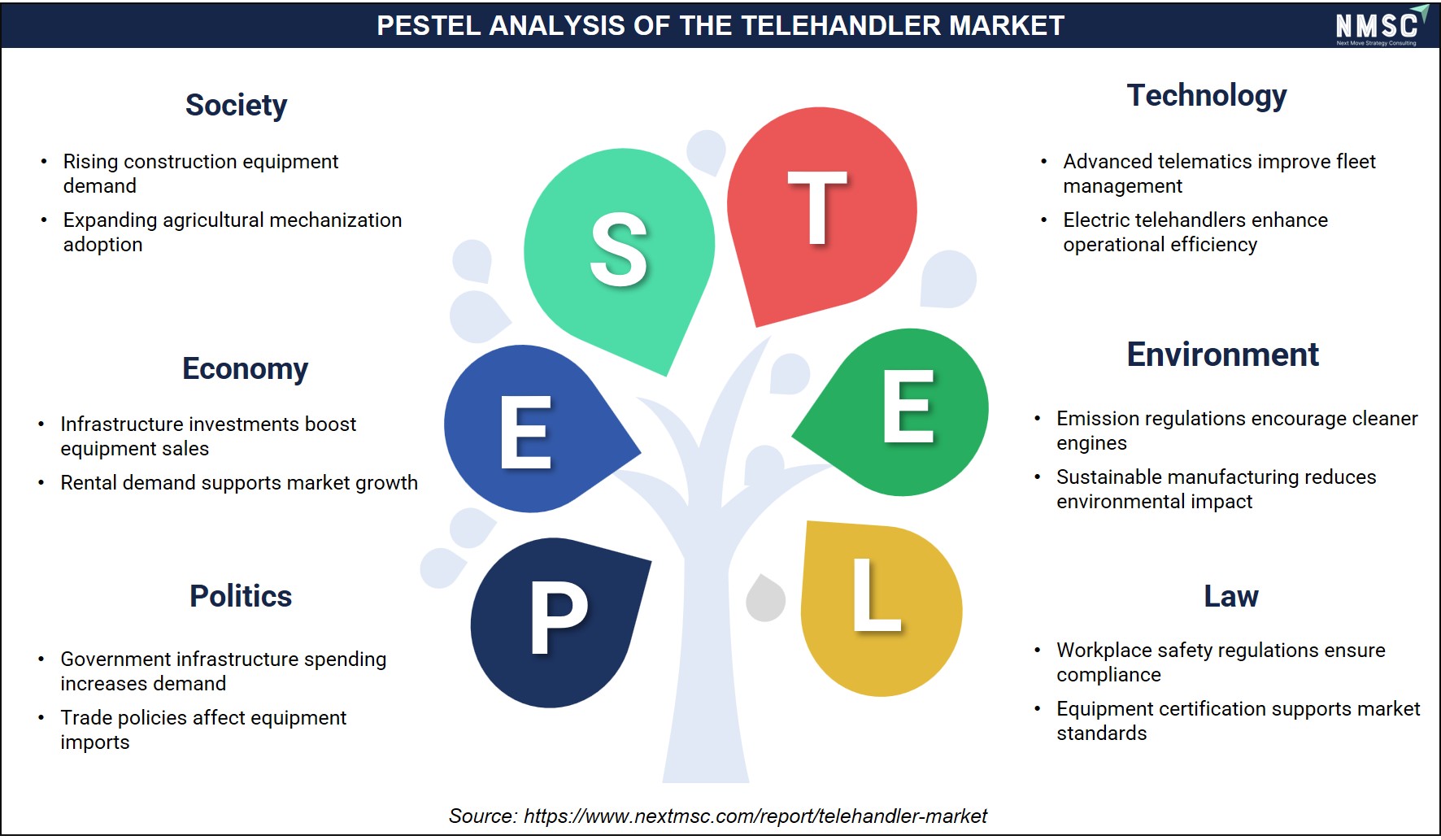
The PESTEL analysis highlights the key external factors shaping the market. Political investments in infrastructure, economic growth in construction and agriculture, and labour shortages drive demand. Technological advancements, including electrification, telematics, and automation, enhance equipment performance. Environmental regulations encourage low-emission machines, while evolving legal and safety standards influence product design, manufacturing, and operational compliance across global markets.
Regional Outlook
Geographic Performance Snapshot
|
Region |
2025 (USD) |
2035 (USD) |
CAGR% (2026–2035) |
Key Driver |
|
North America |
USD 2.07 Billion |
USD 3.78 Billion |
6.1% |
Sustained non-residential construction investment and rental fleet scale |
|
Europe |
USD 1.54 Billion |
USD 2.81 Billion |
6.1% |
Non-road mobile machinery emissions regulation and construction modernization |
|
Asia-Pacific |
USD 1.01 Billion |
USD 2.51 Billion |
9.8% |
Expanding infrastructure investment and rising warehousing construction |
|
Middle East & Africa |
USD 0.42 Billion |
USD 0.98 Billion |
8.9% |
Vision-linked infrastructure development and port capacity expansion |
|
Latin America |
USD 0.27 Billion |
USD 0.56 Billion |
7.9% |
Growing agricultural mechanization and infrastructure investment |
|
Total |
USD 5.31 Billion |
USD 10.64 Billion |
7.2% |
— |
North America Telehandler Market Outlook
North America leads the telehandler market with the largest established rental fleet base and sustained non-residential construction investment. We observed that U.S. Census Bureau construction spending data continues to support steady equipment replacement demand, while rental companies increasingly specify telematics-enabled models. Technology adoption remains advanced, with electric and hybrid propulsion expanding across the region's construction and warehousing sectors.
Europe Telehandler Market Outlook
Europe's telehandler market reflects a mature but regulation-intensive landscape shaped by European Union non-road mobile machinery emissions standards. Our findings suggest that manufacturers across Germany, France, and the UK are accelerating electric and hybrid model development to satisfy urban construction emissions restrictions. Technology adoption favors compact, low-emission telehandlers, supported by regional manufacturers headquartered in France and Italy driving product innovation.
Asia-Pacific Telehandler Market Outlook
Asia-Pacific is the fastest-growing telehandler market region, propelled by expanding infrastructure investment in China and India alongside rising warehousing and logistics facility construction. We found that regulatory frameworks remain less harmonized than in Europe, giving equipment manufacturers flexibility to scale standard diesel models rapidly. Technology adoption is accelerating as regional manufacturers, including several China-based producers, expand telehandler production to serve growing domestic infrastructure demand.
Middle East & Africa Telehandler Market Outlook
The telehandler market in Middle East & Africa is expanding as Gulf Cooperation Council economies invest in infrastructure development and port capacity expansion. Our analysis shows that Saudi Arabia and the UAE are attracting telehandler fleet investment tied to Vision 2030-linked construction and logistics diversification. Regulatory influence remains moderate, while technology adoption is gradually shifting toward heavy-duty and specialized telehandlers as regional developers pursue large-scale infrastructure projects.
Latin America Telehandler Market Outlook
Latin America's telehandler market is supported by growing agricultural mechanization in Brazil and Argentina and expanding infrastructure investment. We observed that regulatory frameworks are less stringent than in North America or Europe, though multinational construction and agricultural operators are introducing standardized fleet specifications. Technology adoption remains centered on authorized dealer distribution, with competitive intensity increasing as regional distributors partner with global equipment manufacturers.
U.S. Telehandler Market
Based on our estimates, the U.S. market was valued at approximately USD 1.68 billion in 2025, projected to reach USD 2.93 billion by 2035 at a 5.6% CAGR. Demand structure is anchored by the largest established rental fleet base and sustained non-residential construction investment. Technology penetration favors telematics-enabled and electric models, and competitive intensity remains high among established global manufacturers and rental companies serving national construction and warehousing accounts.
Canada Telehandler Market
The market in Canada was valued at approximately USD 0.25 billion in 2025 and is projected to reach USD 0.45 billion by 2035, growing at a 6.1% CAGR. Demand is reflecting demand patterns similar to the U.S. market, while provincial infrastructure investment shapes fleet replacement timelines. Technology penetration is rising as rental companies request telematics-equipped models, with competitive intensity moderate given reliance on cross-border equipment supply from U.S.-based distributors.
UK Telehandler Market
As per our estimate, the UK market was valued at approximately USD 0.28 billion in 2025, projected to reach USD 0.49 billion by 2035 at a 5.8% CAGR. Demand structure is driven by post-Brexit infrastructure investment and growing non-road mobile machinery emissions compliance requirements. Regulatory influence from UK construction equipment standards is significant, technology penetration favors compact, low-emission telehandlers, and competitive intensity remains steady among domestic and European manufacturers.
Germany Telehandler Market
According to our analysis, the Germany market was valued at approximately USD 0.35 billion in 2025, projected to reach USD 0.65 billion by 2035 at a 6.1% CAGR. Demand structure is benefiting from a strong domestic construction and agricultural equipment manufacturing base pursuing emissions compliance under EU regulation. Germany's non-road mobile machinery standards drive regulatory influence, while technology penetration favors electric and hybrid models among leading rental fleet operators.
France Telehandler Market
Based on our estimates, the France market was valued at approximately USD 0.29 billion in 2025, projected to reach USD 0.51 billion by 2035 at a 5.6% CAGR. Demand structure is supported by France's role as home to leading telehandler manufacturers and a mature domestic rental market. Regulatory influence from French and EU emissions standards is notable, and competitive intensity remains high given the concentration of premium equipment manufacturers headquartered domestically.
China Telehandler Market
The market in China was valued at approximately USD 0.33 billion in 2025 and is projected to reach USD 0.92 billion by 2035, growing at a 11.1% CAGR. Demand is fueled by expanding domestic infrastructure investment and a dense base of regional equipment manufacturers. Regulatory influence is increasing gradually, technology penetration is accelerating through production capacity expansion, and competitive intensity remains elevated among numerous China-based manufacturers.
India Telehandler Market
As per our estimate, the India market was valued at approximately USD 0.20 billion in 2025, projected to reach USD 0.71 billion by 2035 at a 14.1% CAGR. Demand structure is the fastest among covered countries, reflecting rapid infrastructure investment growth and expanding warehousing construction. Regulatory influence remains developing, while technology penetration is rising quickly as multinational manufacturers localize telehandler production to serve India's growing construction and logistics sectors.
Japan Telehandler Market
According to our analysis, the Japan market was valued at approximately USD 0.13 billion in 2025, projected to reach USD 0.28 billion by 2035 at a 7.9% CAGR. Demand structure is supported by Japan's precision-engineered construction equipment heritage and established dealer network infrastructure. Regulatory influence is well established, technology penetration is advanced, and competitive intensity remains high among long-standing domestic and global equipment distributors.
South Korea Telehandler Market
Based on our estimates, the South Korea market was valued at approximately USD 0.10 billion in 2025, projected to reach USD 0.25 billion by 2035 at a 9.8% CAGR. Demand structure is benefiting from the country's globally influential construction equipment manufacturing base and rising infrastructure investment. Technology penetration is high, with domestic distributors supplying advanced telehandler models, and competitive intensity remains pronounced amid rapid product innovation cycles.
Australia Telehandler Market
The market in Australia was valued at approximately USD 0.10 billion in 2025 and is projected to reach USD 0.24 billion by 2035, growing at a 9.1% CAGR. Demand is supported by a well-established mining and construction sector and growing government-backed infrastructure investment. Regulatory influence stems from Australia's workplace safety standards, while technology penetration favors imported heavy-duty telehandlers amid moderate competitive intensity.
UAE Telehandler Market
As per our estimate, the UAE market was valued at approximately USD 0.12 billion in 2025, projected to reach USD 0.29 billion by 2035 at a 9.8% CAGR. Demand structure is shaped by the UAE's role as a regional construction and logistics hub attracting infrastructure investment. Regulatory influence remains moderate, technology penetration is improving through imported specialized formats, and competitive intensity is rising as distributors expand portfolios to serve Gulf construction markets.
Saudi Arabia Telehandler Market
According to our analysis, the Saudi Arabia market was valued at approximately USD 0.13 billion in 2025, projected to reach USD 0.34 billion by 2035 at a 10.4% CAGR. Demand structure is driven by Vision 2030-linked infrastructure diversification and rising construction and port investment. Regulatory influence is developing under national construction safety guidelines, and technology penetration is advancing as domestic distributors scale telehandler fleet availability.
South Africa Telehandler Market
Based on our estimates, the South Africa market was valued at approximately USD 0.06 billion in 2025, projected to reach USD 0.13 billion by 2035 at a 7.9% CAGR. Demand structure is reflecting a growing formal construction and mining sector that continues to drive investment in telehandler equipment. Regulatory influence is moderate, technology penetration favors imported standard and heavy-duty formats, and competitive intensity is increasing as regional distributors expand product breadth.
Brazil Telehandler Market
The market in Brazil was valued at approximately USD 0.12 billion in 2025 and is projected to reach USD 0.28 billion by 2035, growing at a 8.9% CAGR. Demand is supported by growing agricultural mechanization and expanding infrastructure investment. We observed that regulatory frameworks are less stringent than in North America or Europe, though multinational construction and agricultural operators are introducing standardized fleet specifications across major metropolitan and rural markets.
Argentina Telehandler Market
As per our estimate, the Argentina market was valued at approximately USD 0.04 billion in 2025, projected to reach USD 0.09 billion by 2035 at a 7.6% CAGR. Demand structure is reflecting rising agricultural mechanization demand amid gradual infrastructure investment growth. Regulatory influence remains developing, technology penetration is gradually increasing through imported standard telehandler formats, and competitive intensity is moderate among regional distributors serving construction and agricultural accounts.
Competitive Landscape
We observed that the telehandler market remains moderately consolidated among diversified global construction equipment manufacturers, with specialized European producers competing for premium rotating and heavy-duty segments.
|
Field |
Details |
|
Market Structure |
Moderately consolidated, led by diversified global construction and agricultural equipment manufacturers |
|
Innovation Focus |
Battery electric propulsion, heavy-duty outrigger design, and telematics-enabled fleet management |
|
M&A Activity |
Moderate, concentrated in dealer network expansion and rental fleet partnership agreements |
How Do Companies Compete in the Telehandler Market?
Companies compete primarily on lift capacity range, dealer network reach, and propulsion portfolio breadth across the industry. Global manufacturers such as Caterpillar Inc. and CNH Industrial N.V. leverage broad construction and agricultural equipment distribution to cross-sell telehandlers, while specialized European producers such as Manitou BF SA and Merlo S.p.A. Industria Metalmeccanica compete on rotating telehandler engineering depth and premium product positioning.
Which Competitive Archetypes Dominate the Telehandler Market?
Two archetypes dominate the market: diversified global construction equipment manufacturers offering telehandlers alongside broader machinery portfolios, and specialized European producers focused on telehandler engineering leadership. Caterpillar Inc. and J.C. Bamford Excavators Limited exemplify the diversified archetype through combined construction equipment and telehandler distribution, while Manitou BF SA and Dieci S.r.l. exemplify the specialized archetype through dedicated rotating and compact telehandler innovation.
How Are Companies Differentiating Through Innovation in Telehandlers?
Innovation and differentiation strategy increasingly center on electrification and precision control features. Manitou's MTA 519e electric compact telehandler and JLG's SkyTrak 8042 hydrostatic transmission update both target operators seeking lower maintenance and emissions-compliant operation. Our analysis shows that manufacturers unable to offer electric or hybrid variants risk losing rental fleet contracts to competitors with diversified propulsion portfolios in emissions-restricted urban markets.
What M&A and Expansion Activity Is Shaping the Telehandler Market?
Dealer network expansion and product line broadening continue to shape competitive positioning within the industry. Manitou's launch of the MTA 1242 Max and MTA 1242 Max E74 heavy-duty models, alongside JLG's standardization of its Rapid Replaceable Platform safety equipment across North American product lines, illustrates how manufacturers are expanding addressable rental and construction fleet segments through targeted product portfolio investment.
Key Market Players
Our assessment indicates that the following 15 companies are actively shaping product innovation, dealer network expansion, and commercial strategy within the global telehandler market.
-
J.C. Bamford Excavators Limited
-
Caterpillar Inc.
-
Liebherr-International AG
-
Manitou BF SA
-
JLG Industries, Inc.
-
Terex Corporation
-
Merlo S.p.A. Industria Metalmeccanica
-
Bobcat Company
-
SANY Heavy Industry Co., Ltd.
-
XCMG Construction Machinery Co., Ltd.
-
Dieci S.r.l.
-
Haulotte Group SA
-
CLAAS KGaA mbH
-
CNH Industrial N.V.
-
Deere & Company
Latest Developments
We found that recent activity within the telehandler market is concentrated on electrification launches and heavy-duty product line expansion, reflecting the industry's response to emissions regulation and rental fleet demand.
|
Date |
Event |
|
March 2026 |
Manitou launched the MTA 519e, its first 100% electric fixed-boom telescopic handler for the construction industry, featuring a 33-kWh lithium-ion battery and universal skid steer attachment mount. |
Investment Opportunities
What Capital Inflows Are Targeting the Telehandler Market?
Capital inflows into the telehandler market are increasingly directed toward manufacturers expanding electric and hybrid product portfolios. Manitou's continued investment in compact electric models and JLG's precision control upgrades illustrate how established manufacturers are funding propulsion diversification to retain rental fleet contracts. We observed that investors favor equipment manufacturers demonstrating validated total cost of ownership advantages, viewing maintenance cost reduction data as a proxy for long-term rental fleet retention.
How Is Infrastructure Investment Supporting Telehandler Market Growth?
Infrastructure investment is expanding construction and warehousing facility development that directly drives telehandler fleet demand. Our findings suggest that sustained U.S. non-residential construction spending and expanding Asia-Pacific infrastructure programmes are supporting steady equipment replacement and fleet expansion cycles, reinforcing manufacturer investment in production capacity and dealer network development to meet growing regional demand.
What ESG Considerations Are Shaping Telehandler Investment Decisions?
Environmental, social, and governance considerations are increasingly relevant to investment decisions across the industry, with job-site emissions reduction and operator safety as key criteria. European Union non-road mobile machinery emissions regulations continue to inform manufacturer compliance disclosures. We found that investors increasingly favor manufacturers with validated electric and hybrid product roadmaps, treating emissions compliance as a governance indicator alongside operator safety certification standards.
Key Benefits for Stakeholders
How Does This Report Benefit Enterprise and Industry Leaders?
Enterprise and industry leaders gain access to validated segmentation, competitive benchmarking, and regional demand forecasts that support fleet investment and procurement decisions across the telehandler industry. Our analysis shows that detailed product type, lift capacity, and propulsion breakdowns help fleet managers align equipment investment with job-site requirements while identifying underserved end-use industry segments for expansion.
How Does This Report Benefit Investors and Financial Analysts?
Investors and financial analysts benefit from consistent, single-point market size and CAGR estimates that support valuation and capital-allocation decisions across the telehandler market supply chain. We observed that the report's regional and segment-level growth differentials help identify which manufacturers and rental companies are best positioned to capture above-market growth in electric propulsion and warehousing end-use categories through 2035.
How Does This Report Benefit Technology Vendors and Product Teams?
Technology vendors and product teams gain insight into emerging design requirements, including battery electric propulsion, telematics integration, and heavy-duty outrigger engineering, that are reshaping the industry. Our findings suggest that this analysis helps R&D teams prioritize development roadmaps around electrification and precision control features that are increasingly required by rental fleet and construction procurement processes.
Key Market Segments
By Product Type
-
Standard (Non-Rotating)
-
Rotating
-
Compact
-
Specialized
-
Container Handlers
-
Rough-Terrain
-
By Lift Capacity
-
Light-Duty (< 3 tons / 6,000 lbs)
-
Medium-Duty (3 - 10 tons / 6,000 - 20,000 lbs)
-
Heavy-Duty (> 10 tons / 20,000 lbs)
By Propulsion
-
Diesel / ICE (Internal Combustion Engine)
-
Electric (BEV) (Battery Electric Vehicle)
-
Hybrid (ICE + Battery Assist)
-
Alternative Fuels (CNG, LPG, Hydrogen)
By End-Use Industry
-
Construction
-
Agriculture
-
Mining & Quarrying
-
Warehousing & Logistics
-
Ports & Terminals
-
Industrial & Manufacturing
-
Rental (Considered an end-user for fleet purchase)
-
Other (Municipal, Landscaping, Utilities)
By Business Model
-
New Equipment Sales
-
Direct Purchase (Owner-Operators)
-
Fleet Purchase (Rental Companies)
-
-
Used Equipment Sales
-
Rental/Leasing (Pay-per-use or operational leasing)
By Distribution Channel
-
OEM Direct Sales
-
Authorized Dealer Network
-
Independent Rental Companies
-
Online Marketplaces & Brokers
By Region
-
North America: U.S., Canada, Mexico
-
Europe: UK, Germany, France, Italy, Spain, Sweden, Denmark, Finland, Netherlands, Rest of Europe
-
Asia-Pacific: China, India, Japan, South Korea, Taiwan, Indonesia, Vietnam, Australia, Philippines, Malaysia, Rest of APAC
-
Middle East & Africa: Saudi Arabia, UAE, Egypt, Israel, Turkey, Nigeria, South Africa, Rest of MEA
-
Latin America: Brazil, Argentina, Chile, Colombia, Rest of LATAM
Conclusion and Recommendations
What Is the Long-Term Outlook for the Telehandler Market?
The long-term outlook for the market remains steady, with global revenue projected to roughly double from USD 5.31 billion in 2025 to USD 10.64 billion by 2035 at a 7.2% CAGR. We observed that sustained construction and warehousing investment, expanding rental fleet electrification, and infrastructure spending will continue underpinning demand across construction, agriculture, and logistics applications through the forecast period.
What Strategic Positioning Should Telehandler Suppliers Pursue?
Suppliers should prioritize electric and hybrid propulsion portfolios while pursuing telematics-enabled fleet management capability to secure long-term rental and construction fleet contracts. Our assessment indicates that manufacturers investing early in heavy-duty specialized configurations and dealer network expansion will be best positioned to capture premium pricing within the telehandler market.
How Attractive Is the Telehandler Market for New Investment?
The telehandler industry presents a steady investment case, supported by a USD 4.95 billion absolute dollar opportunity between 2026 and 2035 and above-average growth in Asia-Pacific and electric propulsion categories. We found that investment attractiveness is highest for manufacturers combining diversified propulsion portfolios with established dealer networks, positioning them to serve both cost-sensitive and regulation-driven fleet customers simultaneously.
What Market Shifts and Key Risks Should Stakeholders Monitor?
Stakeholders should monitor construction demand cyclicality, high upfront electric equipment costs, and limited charging infrastructure at remote sites as key risks to the telehandler market. Our analysis shows that manufacturers unable to adapt to expanding emissions regulation risk losing rental fleet contracts to competitors with validated electric and hybrid platforms, particularly within Europe's increasingly compliance-driven procurement environment.
What Are the Key Growth Pathways for the Telehandler Market?
Key growth pathways include expanding electric and hybrid propulsion adoption, scaling online marketplace distribution, and deepening penetration into warehousing and logistics and ports and terminals end-use industries. Next Move Strategy Consulting's analysis indicates that suppliers pursuing these pathways while maintaining cost competitiveness in standard diesel categories will be best positioned to capture the telehandler market's projected growth through 2035.
About the Author
 Liza Phukan
— Liza Phukan is Research Associate at Next Move Strategy Consulting, where she has covered emerging industries and market research across sectors for 3.5 years. Her work includes analyzing industry developments, validating market data, and developing structured business content from research findings. She uses secondary research and data-validation practices to turn complex market information into clear decision-useful market analysis for business audiences and support report development and B2B.
Liza Phukan
— Liza Phukan is Research Associate at Next Move Strategy Consulting, where she has covered emerging industries and market research across sectors for 3.5 years. Her work includes analyzing industry developments, validating market data, and developing structured business content from research findings. She uses secondary research and data-validation practices to turn complex market information into clear decision-useful market analysis for business audiences and support report development and B2B.
About the Reviewer
 Supradip Baul
— Supradip Baul is an accomplished business consultant and strategist with over a decade of rich experience in market intelligence, strategy, technology, and business transformation. His work has included rigorous qualitative and quantitative analysis across multiple industries, helping clients shape investment decisions and long-term roadmaps. Earlier in his career, he was associated with Gartner, where he contributed to industry-leading reports and market share analyses. He has worked with leading global companies and holds an MBA with a dual specialization in Marketing and Finance.
Supradip Baul
— Supradip Baul is an accomplished business consultant and strategist with over a decade of rich experience in market intelligence, strategy, technology, and business transformation. His work has included rigorous qualitative and quantitative analysis across multiple industries, helping clients shape investment decisions and long-term roadmaps. Earlier in his career, he was associated with Gartner, where he contributed to industry-leading reports and market share analyses. He has worked with leading global companies and holds an MBA with a dual specialization in Marketing and Finance.
At Next Move Strategy Consulting, we understand that insightful market research is the cornerstone of successful business decisions. That's why we employ a robust and multifaceted approach, combining various methodologies to deliver the most accurate and actionable data for our clients.

Research Landscape
We navigate the world of research with two primary approaches:
Qualitative Approach
Our qualitative research methodologies involve immersive techniques such as in-depth interviews, focus groups, and observational studies. By engaging directly with individuals and stakeholders, we uncover valuable insights that quantitative data alone may overlook.

Quantitative Research
In tandem with qualitative methodologies, NMSC leverages the power of Quantitative Research to provide a robust foundation of numerical insights. Through systematic data collection and analysis, we quantify patterns, preferences, and market trends, offering a comprehensive view of the business landscape.
Our quantitative research approach employs diverse tools, including surveys, experiments, and statistical modelling. These methodologies enable us to gather data from a large and representative sample, ensuring the statistical significance of our findings. By employing structured questionnaires and standardized data collection methods, we guarantee the reliability and validity of the information we present to our clients.
Quantitative research is particularly effective in measuring the prevalence of trends, assessing market size, and gauging the impact of various factors on consumer behavior. The numerical precision attained through this approach equips our clients with actionable insights, facilitating data-driven decision-making and strategy formulation.


Our Specialized Toolbox for Industry-Specific Market Research
We deploy a specialized arsenal of techniques tailored to meet your unique requirements. Here's a glimpse into our comprehensive toolbox:

Information Procurement
The stage entails acquiring market data or relevant information through various sources and methodologies.


Market Research Approach
We utilize both top-down and bottom-up approaches in market research analysis to achieve a comprehensive understanding of the market dynamics, leveraging the broad perspective of industry trends and macroeconomic factors alongside detailed insights from specific segments and individual companies.

Porters Five Forces Analysis
We conduct Porter's Five Forces analysis to evaluate the competitive landscape of an industry, providing us with insights into factors that affect profitability and strategic positioning.

SWOT Analysis

Forecasting
We utilize a forecasting model to predict future consumption by considering parameters like population, economics, regulations, market competition, drivers, constraints, technology, and pricing. We also employ statistical techniques such as multilinear regression, exponential smoothing, moving average, ARIMA, and Monte Carlo simulations for accurate predictions. In econometric forecasting, we analyzed short-term and long-term event impacts, attributing values based on regulatory frameworks, economic factors, and market events.





 Speak to Our Analyst