Tethered Drones Market Global Industry Analysis and Forecast (2026–2035)

The global Tethered Drones Market size was valued at USD 460.0 million in 2025 and is estimated at USD 530.0 million in 2026, with the market forecast to reach USD 1,810.0 million by 2035, expanding at a 14.7% CAGR from 2026 to 2035. Key drivers include rising defense modernization spending and expanding border and homeland security investment, with North America leading the global market.

Download Free Sample PDF
Base Year (2025)
$460.0 Million
Forecast (2035)
$1,810.0 Million
CAGR (2026-2035)
14.7%
Top Region
North America

What Is the Tethered Drones Market Size?

The global tethered drones market size was valued at USD 460.0 million in 2025 and is estimated at USD 530.0 million in 2026, with the market forecast to reach USD 1,810.0 million by 2035, expanding at a 14.7% CAGR between 2026 and 2035. North America leads with approximately 39% share, while surveillance and monitoring dominate all other applications with approximately 40% share.

We observed that growth is broadening beyond defense procurement, with commercial infrastructure and disaster-response operators emerging as important demand centers through 2035.

Tethered Drones Market Global Industry Analysis and Forecast (2026–2035) Revenue Forecast

Values in USD Million

2025 $460.0 Million
2025
2026 $527.6 Million
2026
2027 $605.2 Million
2027
2028 $694.1 Million
2028
2029 $796.2 Million
2029
2030 $913.2 Million
2030
2031 $1,047.5 Million
2031
2032 $1,201.4 Million
2032
2033 $1,378.1 Million
2033
2034 $1,580.6 Million
2034
2035 $1,810.0 Million
2035

Key Takeaways

By Platform Type: Multi-Rotor Tethered Drones held the largest share of approximately 63% (USD 290.0 million) in 2025; Hybrid Tethered Drones are the fastest-growing sub-segment at 17.2% CAGR from 2026–2035.

By Application: Surveillance and Monitoring held the largest share of approximately 40% (USD 180.0 million) in 2025; Disaster Management and Emergency Response is the fastest-growing sub-segment at 17.5% CAGR from 2026–2035.

By End User: Military and Defense held the largest share of approximately 45% (USD 210.0 million) in 2025; Commercial and Industrial Enterprises is the fastest-growing sub-segment at 16.4% CAGR from 2026–2035.

Dominant Region: North America dominated with approximately 39% revenue share (USD 180.0 million) in 2025.

Fastest-Growing Region: Asia-Pacific is projected to register the highest CAGR of 17.8% during 2026–2035.

Dominant Country: U.S. led with approximately USD 150.0 million in 2025.

Fastest-Growing Country: India is the fastest-growing country at approximately 19.5% CAGR from 2026–2035.

What Does the Tethered Drones Market Encompass?

The tethered drones market encompasses unmanned aerial platforms that remain physically connected to a ground station through a power-and-data tether, eliminating onboard battery constraints and enabling continuous, uninterrupted flight for hours or days at a fixed altitude. Our assessment indicates that the scope spans multi-rotor, fixed-wing, and hybrid tethered airframes supplied to military branches, homeland security agencies, and commercial operators across surveillance, communication relay, and infrastructure-monitoring missions. The category has evolved from a niche military overwatch tool into a broader public-safety and industrial platform, driven by escalating border-security budgets, disaster-response modernization, and demand for persistent situational awareness that free-flying drones cannot sustain.
Regulatory frameworks such as the U.S. Federal Aviation Administration's Part 107 provisions for tethered operations and the U.S. Department of Defense's Blue UAS Cleared List shape procurement eligibility, while the European Union Aviation Safety Agency's U-space regulation increasingly governs tethered flight authorizations near controlled airspace. We observed that technology adoption is shifting toward lightweight, high-strength tether cables and hybrid power-tether architectures that extend altitude and payload capacity. Next Move Strategy Consulting's analysis indicates that this structural shift, combined with rising demand for domestically sourced, NDAA-compliant components, is redefining sourcing criteria across the tethered drones market.

Pain Point Analysis of the Tethered Drones Industry

Pain Point Analysis of the Tethered Drones Industry
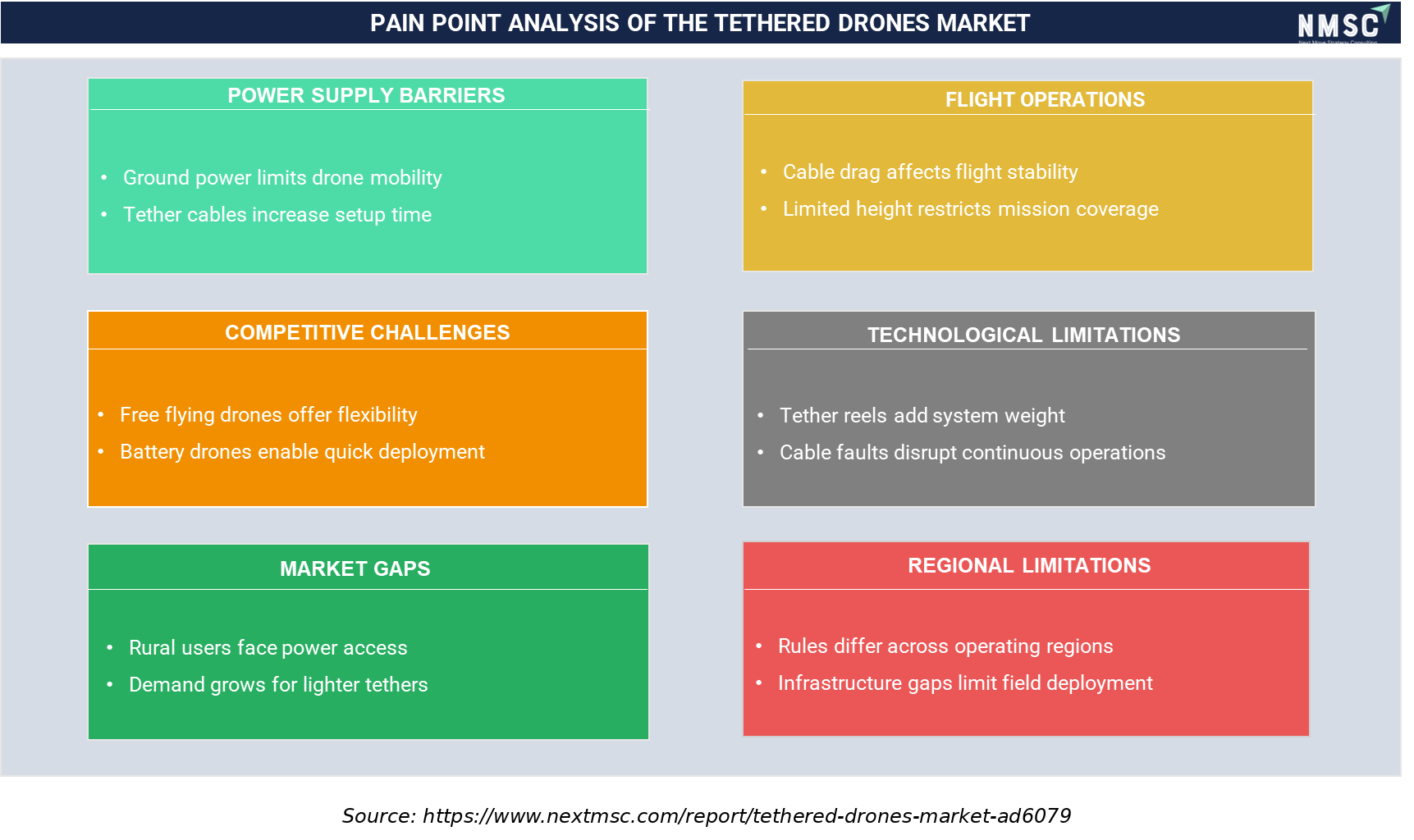
NMSC's findings suggest that ground power constraints and setup complexity create significant operational barriers in the Tethered Drones Industry. Furthermore, cable drag affects flight stability, while tether reel weight and cable faults disrupt continuous mission coverage. Concurrently, flexible free-flying drones present competitive challenges, whereas rural infrastructure gaps and regional regulatory disparities limit widespread field deployment, spurring demand for lighter tether systems across the Tethered Drones Industry.

Market Drivers & Dynamics

Interactive Dataset
Rising defense modernization and ISR budgets driver +2.4% Global 2026-2035
Expanding border-security and homeland-security procurement driver +1.9% North America, Asia-Pacific, MEA 2026-2035
Growing demand for persistent disaster-response surveillance driver +1.5% Global 2026-2033
NDAA-compliant domestic component sourcing mandates driver +1.2% North America 2026-2032
Rising adoption of counter-UAS integrated tethered platforms driver +1.0% Europe, North America 2026-2035
Expansion of critical-infrastructure and utility inspection programs driver +0.8% Global 2026-2035
High upfront cost versus free-flying drone alternatives restraint -1.1% Global 2026-2035
Limited operational altitude and mobility range restraint -0.7% Global 2026-2032
Export-control and airspace-authorization complexity restraint -0.5% Europe, Asia-Pacific 2028-2035
Source: Next Move Strategy Consulting

Growth Drivers

What Is the Primary Growth Driver of the Tethered Drones Market?

Rising defense modernization spending is the primary driver of the market. The U.S. Department of War's July 10, 2025 implementing memorandum on unmanned systems commits the department to bolstering the domestic drone manufacturing base and arming units with low-cost unmanned platforms. We observed that this policy shift, reinforced by the Pentagon's Replicator 2 initiative referenced in the Department's fiscal year 2026 management priorities, continues to anchor procurement of persistent ISR and counter-UAS-capable tethered platforms across the U.S. and allied defense establishments.

How Is Border and Homeland Security Spending Driving Growth in the Tethered Drones Market?

Expanding border-security and homeland-security budgets are accelerating tethered drone procurement outside traditional battlefield use. The U.S. Coast Guard's fiscal year 2026 budget request funds the continued implementation of its Unmanned Systems strategy to improve maritime surveillance and border-integrity operations. Our assessment indicates that this institutional demand, combined with newly formed joint task forces coordinating counter-small-UAS efforts, is compressing adoption timelines for tethered platforms among law-enforcement and homeland-security agencies across North America and allied regions.

Growth Inhibitors

What Is Restraining Expansion of the Tethered Drones Market?

The high upfront cost of tethered systems relative to conventional free-flying drones restrains adoption among budget-constrained commercial and municipal operators. Fixed ground-station infrastructure, tether-cable maintenance, and specialized power electronics add capital and lifecycle expense that free-flying platforms avoid. We found that smaller regional integrators face particular exposure, as limited scale reduces their ability to absorb these fixed costs compared with larger, vertically integrated defense and industrial system providers.

What Are the Growth Opportunities?

How Can Vehicle-Integrated Tethered Systems Unlock Value for Defense OEMs?

Vehicle-mounted tethered drone kits present a whitespace opportunity for defense OEMs supplying next-generation combat and support vehicles. Suppliers that engineer compact, ruggedized tether-and-winch systems for tactical vehicle integration stand to capture recurring payload sales as militaries prioritize on-the-move ISR and communications-relay capability, particularly among land-systems programs seeking persistent situational awareness without dedicated aerostat infrastructure.

Where Does Critical-Infrastructure Monitoring Create New Commercial Demand?

Utility, port, and energy operators represent an underpenetrated opportunity for tethered platforms engineered for continuous perimeter and asset monitoring. Manufacturers that develop cost-optimized, easy-deployment tethered systems for industrial sites can secure long-term service contracts with commercial and industrial end users, benefiting from recurring inspection-cycle revenue tied to infrastructure-protection and safety-compliance programs.

How Can NDAA-Compliant Component Manufacturing Benefit Domestic Suppliers?

Domestic component suppliers have an opportunity to capture share as defense buyers shift away from foreign-origin propulsion, avionics, and tether hardware. Early movers that secure Blue UAS and Green UAS qualification for tethered-specific components can differentiate with U.S. and allied defense integrators pursuing onshored, verified supply chains across their tethered platform procurement programs.

Segmentation Analysis

2025 (USD Million)
2035 (USD Million)
Multi-Rotor Tethered Drones 2025: $290.0 Million | 2035: $980.0 Million
Multi-Rotor
Fixed-Wing Tethered Drones 2025: $100.0 Million | 2035: $470.0 Million
Fixed-Wing T
Hybrid Tethered Drones 2025: $70.0 Million | 2035: $360.0 Million
Hybrid Tethe
Multi-Rotor Tethered Drones $290.0 Million $980.0 Million 13.1%
Fixed-Wing Tethered Drones $100.0 Million $470.0 Million 16.6%
Hybrid Tethered Drones $70.0 Million $360.0 Million 17.2%

Which Platform Type Segment Dominates the Tethered Drones Market?

Multi-Rotor Tethered Drones led the market with USD 290.0 million in 2025, supported by vertical takeoff simplicity and compatibility with existing ground-station tether infrastructure across defense and public-safety fleets. We observed that Hybrid Tethered Drones are the fastest-growing platform type, expanding at a 17.2% CAGR from 2026 to 2035, as operators seek extended altitude ceilings and heavier payload capacity that pure multi-rotor tethered designs cannot support.

2025 (USD Million)
2035 (USD Million)
Surveillance
Communicatio
Border and P
Disaster Man
Broadcasting
Segment Item 2025 (USD Million) 2035 (USD Million) CAGR
Surveillance and Monitoring $10.0 USD Million $40.0 USD Million 25.0%
Communication Relay and Networking $17.1 USD Million $51.1 USD Million 11.0%
Border and Perimeter Security $24.2 USD Million $62.2 USD Million 25.0%
Disaster Management and Emergency Response $31.3 USD Million $73.3 USD Million 11.0%
Broadcasting and Event Coverage $38.4 USD Million $84.4 USD Million 16.0%

Segment-wise data is locked

Unlock complete segment-wise numbers for By Application.

Unlock Full Data

Which Application Segment Leads Demand in the Tethered Drones Market?

Surveillance and Monitoring remained the leading application, valued at USD 180.0 million in 2025 on sustained defense overwatch and public-safety observation demand. Our findings suggest that Disaster Management and Emergency Response is the fastest-growing application, registering a 17.5% CAGR from 2026 to 2035, as civil-protection agencies increasingly specify tethered platforms for wildfire detection and prolonged incident-response coverage that battery-limited drones cannot sustain.

2025 (USD Million)
2035 (USD Million)
Military and
Homeland Sec
Commercial a
Government a
Media and Br
Segment Item 2025 (USD Million) 2035 (USD Million) CAGR
Military and Defense $10.0 USD Million $40.0 USD Million 27.0%
Homeland Security and Law Enforcement $17.1 USD Million $51.1 USD Million 9.0%
Commercial and Industrial Enterprises $24.2 USD Million $62.2 USD Million 19.0%
Government and Public Safety Agencies $31.3 USD Million $73.3 USD Million 17.0%
Media and Broadcasting Organizations $38.4 USD Million $84.4 USD Million 18.0%

Segment-wise data is locked

Unlock complete segment-wise numbers for By End User.

Unlock Full Data

Which End User Segment Leads the Tethered Drones Market?

Military and Defense remained the dominant end user, valued at USD 210.0 million in 2025, reflecting sustained ISR, force-protection, and base-defense procurement worldwide. Based on research conducted by Next Move Strategy Consulting, we found that Commercial and Industrial Enterprises represent the fastest-growing end-user category at a 16.4% CAGR from 2026 to 2035, as utilities, ports, and event operators adopt tethered platforms for continuous infrastructure monitoring and site security.

Growth Opportunities

Our analysis shows that three forward-looking opportunities stand out for stakeholders positioning within the tethered drones industry over the 2026-2035 forecast period.

How Can Vehicle-Integrated Tethered Systems Unlock Value for Defense OEMs?

Vehicle-mounted tethered drone kits present a whitespace opportunity for defense OEMs supplying next-generation combat and support vehicles. Suppliers that engineer compact, ruggedized tether-and-winch systems for tactical vehicle integration stand to capture recurring payload sales as militaries prioritize on-the-move ISR and communications-relay capability, particularly among land-systems programs seeking persistent situational awareness without dedicated aerostat infrastructure.

Where Does Critical-Infrastructure Monitoring Create New Commercial Demand?

Utility, port, and energy operators represent an underpenetrated opportunity for tethered platforms engineered for continuous perimeter and asset monitoring. Manufacturers that develop cost-optimized, easy-deployment tethered systems for industrial sites can secure long-term service contracts with commercial and industrial end users, benefiting from recurring inspection-cycle revenue tied to infrastructure-protection and safety-compliance programs.

How Can NDAA-Compliant Component Manufacturing Benefit Domestic Suppliers?

Domestic component suppliers have an opportunity to capture share as defense buyers shift away from foreign-origin propulsion, avionics, and tether hardware. Early movers that secure Blue UAS and Green UAS qualification for tethered-specific components can differentiate with U.S. and allied defense integrators pursuing onshored, verified supply chains across their tethered platform procurement programs.

Regional Outlook

2025 (USD Million)
2035 (USD Million)
North Americ
Europe
Asia-Pacific
Middle East
Latin Americ
Region 2025 (USD Million) 2035 (USD Million) CAGR (%)
North America $10.0 USD Million $40.0 USD Million 9.0%
Europe $17.1 USD Million $51.1 USD Million 27.0%
Asia-Pacific $24.2 USD Million $62.2 USD Million 25.0%
Middle East & Africa $31.3 USD Million $73.3 USD Million 23.0%
Latin America $38.4 USD Million $84.4 USD Million 12.0%

Regional data is locked

Unlock complete regional numbers for this market.

Unlock Full Data

Supply Chain Structure of the Tethered Drones Industry

Supply Chain Structure of the Tethered Drones Industry
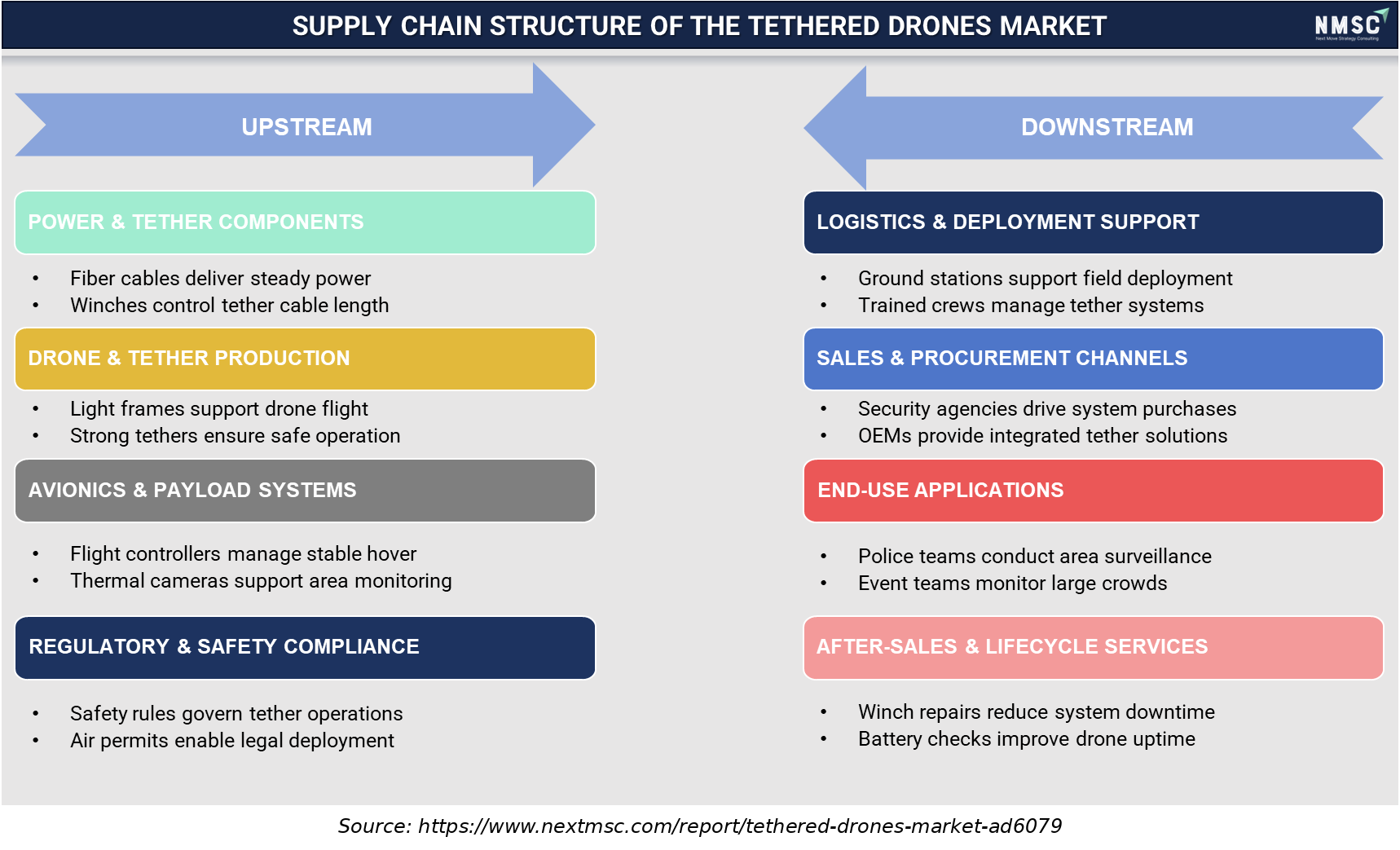
Our assessment indicates that the supply chain structure of the Tethered Drones Industry integrates power-delivering fiber cables, winch controls, lightweight airframes, and thermal camera payloads with ground support stations. Downstream, procurement channels supply law enforcement and event management teams for continuous crowd surveillance. Ultimately, winch repairs, battery maintenance, and strict adherence to aviation safety permits ensure reliable lifecycle performance and legal deployment across the Tethered Drones Industry.

Competitive Landscape

We observed that the tethered drones market remains moderately fragmented, with defense-focused specialists competing alongside diversified aerospace primes and regional integrators.

Dimension Description
Dimension Assessment
Market Structure Moderately fragmented, with a small group of specialist manufacturers accounting for a majority of defense-related revenue alongside diversified aerospace and electronics companies
Innovation Focus Tether-cable miniaturization, hybrid power-tether architectures, multi-sensor payload integration, and NDAA-compliant domestic component sourcing.
M&A Activity Component-supply partnerships and strategic investment rounds, including defense-sector minority investment in tethered-platform specialists.

How Do Companies Compete in the Tethered Drones Market?

Competition centers on tether-power efficiency, flight endurance, payload versatility, and qualification status with defense procurement bodies. We observed that specialist manufacturers differentiate through proprietary tether-cable and ground-station technology, while diversified aerospace companies leverage existing defense relationships and manufacturing scale. Pricing strategies vary by end user, with defense contracts favoring long-term sustainment agreements over one-time platform sales.

Which Competitive Archetypes Dominate the Tethered Drones Market?

Two archetypes dominate the market: defense-focused tethered-platform specialists and diversified aerospace and electronics primes offering tethered systems as part of broader unmanned-systems portfolios. Our findings suggest that specialists such as Elistair and Hoverfly Technologies compete on tether-endurance performance and rapid-deployment design, while diversified players compete on system integration, sensor fusion, and existing government relationships that shorten procurement cycles.

What Innovation and Differentiation Strategies Define the Market?

Manufacturers are differentiating through hybrid power architectures, multi-payload configurations, and domestically sourced, certification-ready components. Our analysis shows that companies pursuing Blue UAS and Green UAS qualification gain preferential access to U.S. defense procurement, while European manufacturers emphasize NATO interoperability standards and rapid-deployment field kits to differentiate within allied procurement programs.

What M&A and Partnership Activity Is Shaping the Market?

Strategic partnerships and minority investments are shaping competitive positioning more than outright acquisitions in this still-consolidating market. We found that Hoverfly Technologies' partnership with Korea Robot Manufacturing to establish domestic propulsion manufacturing, alongside defense-sector investment in tethered-platform specialists, signals continued cross-border collaboration aimed at securing resilient, NDAA-compliant supply chains for tethered drone components.

Key Market Players

Based on research conducted by Next Move Strategy Consulting, we found that the following companies represent the most significant participants in the global tethered drones market, ranked by market-specific scale of operations.

Elistair SAS Hoverfly Technologies Inc. Perspective Robotics AG (Fotokite) Lockheed Martin Corporation AeroVironment, Inc. Teledyne Technologies Incorporated SZ DJI Technology Co., Ltd. Bharat Electronics Limited COMSovereign Holding Corp. Dragonfly Pictures, Inc. Novadem SAS (independently reporting UAV subsidiary) Embention Sistemas Inteligentes S.L. SPH Engineering SIA Easy Aerial, Inc. Acecore Technologies B.V. Mistral Solutions Pvt. Ltd. Menet Aero LLC Flyfocus sp. z o.o. Aerial IQ Zebu Intelligent Systems Private Limited

Latest Developments

We observed that recent company activity underscores the shift toward domestic component sourcing, counter-UAS integration, and expanded civil-protection deployment across the tethered drones industry.

Date Event
July 2026 Elistair partnered with Exail to integrate its automated Khronos tethered DroneBox onto Exail’s DriX unmanned surface vessel. The system provides persistent aerial surveillance while underway, with autonomous deployment and follow-me capability, extending maritime situational awareness beyond surface sensors in demanding operational environments.
December 2025 Hoverfly announced that its tethered drones were officially whitelisted on AeroVironment’s AV_Halo command-and-control ecosystem. The integration provides native support for Hoverfly systems within the AI-enabled software environment, enabling immediate deployment and control alongside other unmanned systems and mission capabilities.
November 2025 Elistair introduced a Khronos Dual Payload configuration combining a Silvus StreamCaster 4200P tactical radio with a Nextvision DragonEye2 EO camera. The configuration turns the tethered DroneBox into a multi-mission aerial mast capable of simultaneously supporting secure communications relay and persistent intelligence, surveillance, and reconnaissance.
August 2025 Hoverfly launched NEXUS, a network-extension capability demonstrated during Tough Stump Rodeo 2025. The solution extends MANET radio command-and-control networks and the operating range of uncrewed systems, supporting situational awareness, ISR, targeting, and other battlefield functions through tethered aerial network infrastructure.
June 2025 Hoverfly and Australian partner Maser Defence delivered a Sentry Tethered Unmanned Aerial System to an Australian government customer for trial and evaluation. The system was scheduled for demonstrations during major Australian Defence Force exercises in 2025, carrying either a radio payload or ISR camera to approximately 200 feet.

Expert Insights

Pete Amenda

Pete Amenda

CEO | Menet Aero

"We are at an exciting point in the evolution of tethered UAS technologies, and the accelerated integration with other leading-edge systems and complex payloads is exponentially increasing the reach and value of tethered UAS systems to military, municipal and commercial customers."

Analyst Interpretation

The comment highlights the increasing importance of advanced system integration and payload capabilities in the development of the tethered drones market. As tethered UAS platforms incorporate more sophisticated sensors, communications systems and mission-specific payloads, their potential applications can expand beyond conventional surveillance toward a wider range of military, municipal and commercial requirements. This broader functionality can support greater adoption of tethered drones across multiple end-use sectors and contribute to the diversification of market demand.

Investment Opportunities

What Capital Inflows Are Supporting Tethered Drone Development?

Private and strategic capital continues to flow into tethered-platform specialists as defense demand accelerates. We observed that Hoverfly Technologies raised a Series B funding round backed by defense-sector strategic investors in 2025, supporting expanded domestic manufacturing capacity. Investors are prioritizing companies with established Blue UAS or Green UAS certification, as regulatory qualification increasingly determines eligibility for large government procurement contracts.

How Is Infrastructure Investment Shaping the Tethered Drones Market?

Infrastructure investment in domestic manufacturing capacity is reshaping the competitive landscape as component suppliers expand U.S.-based production. Our findings suggest that partnerships establishing propulsion and electronics manufacturing on U.S. soil, such as Hoverfly Technologies' collaboration with Korea Robot Manufacturing, reflect broader capital deployment toward resilient, tariff-insulated supply chains supporting tethered platform production.

What ESG Considerations Are Relevant to Tethered Drone Investment?

Environmental, social, and governance considerations increasingly factor into tethered drone investment decisions, particularly regarding disaster-response and public-safety applications that deliver measurable community-safety benefits. Our analysis shows that platforms supporting wildfire detection and emergency-response coordination, such as deployments backing the Hellenic Fire Service, align with investor interest in technologies that demonstrably reduce disaster-response times and protect civilian infrastructure.

Key Benefits for Stakeholders

How Does This Report Benefit Defense and Industry Leaders?

Defense program managers and industry leaders gain a validated view of segment-level demand, competitive positioning, and regulatory drivers shaping procurement decisions. Our analysis, data, and forecasts support planning across platform-type selection, sourcing strategy, and geographic expansion, helping stakeholders align procurement roadmaps with structural trends including counter-UAS integration and domestic sourcing requirements identified throughout this report.

How Does This Report Benefit Investors and Financial Analysts?

Investors and financial analysts gain access to segment-level revenue forecasts, growth-driver quantification, and competitive-landscape analysis that inform capital-allocation decisions. Our findings on funding activity, M&A patterns, and regional growth differentials support due-diligence processes for parties evaluating tethered-platform specialists or diversified manufacturers positioned to benefit from expanding defense and commercial demand through 2035.

How Does This Report Benefit Technology Vendors and Product Teams?

Technology vendors and product teams gain strategic insight into emerging platform architectures, payload-integration trends, and end-user requirements across defense, homeland-security, and commercial segments. Our segmentation analysis and regional outlook support product-roadmap prioritization, helping vendors align development resources with the fastest-growing application and platform-type categories identified in this report.

Conclusion & Recommendations

The long-term outlook for the market remains favorable, with revenue projected to grow from USD 460.0 million in 2025 to USD 1,810.0 million by 2035 at a 14.7% CAGR. We observed that sustained defense modernization, expanding disaster-response adoption, and rising commercial infrastructure-monitoring demand collectively support durable growth well beyond the current forecast window, positioning the market for continued expansion into the next decade.

What Strategic Positioning Should Manufacturers Pursue?

Manufacturers should pursue Blue UAS and Green UAS qualification to secure preferential access to defense procurement while simultaneously developing cost-optimized commercial variants for infrastructure-monitoring buyers. Our assessment indicates that companies balancing defense-grade certification with commercial affordability are best positioned to capture demand across both the fastest-growing commercial end-user segment and the still-dominant military and defense category.

How Attractive Is the Tethered Drones Market for Investment?

The market presents an attractive, if still-maturing, investment opportunity, supported by a USD 1,280.0 million absolute dollar opportunity between 2026 and 2035 and a 14.7% CAGR that outpaces broader aerospace and defense benchmarks. Our findings suggest that investors prioritizing domestically certified suppliers and disaster-response-oriented product lines stand to benefit from both defense-budget resilience and expanding civil-protection procurement.

What Market Shifts and Key Risks Should Stakeholders Monitor?

Stakeholders should monitor export-control complexity, airspace-authorization delays, and the high upfront cost of tethered systems relative to free-flying alternatives, all of which restrain near-term adoption in cost-sensitive markets. We found that continuing-resolution-driven budget uncertainty within U.S. defense appropriations represents an additional risk factor that could delay procurement timelines for tethered platform programs during the forecast period.

What Are the Key Growth Pathways for the Tethered Drones Market?

Key growth pathways include vehicle-integrated tethered systems for next-generation combat platforms, critical-infrastructure monitoring contracts with utility and energy operators, and expanded disaster-response deployment among civil-protection agencies. Our analysis shows that companies that diversify beyond core military ISR into these adjacent application areas are best positioned to sustain growth as the market matures through 2035.

FAQs

Key Market Segments Evaluated

By Platform Type

  • Multi-Rotor Tethered Drones
  • Fixed-Wing Tethered Drones
  • Hybrid Tethered Drones

By Application

  • Surveillance and Monitoring
  • Communication Relay and Networking
  • Border and Perimeter Security
  • Disaster Management and Emergency Response
  • Broadcasting and Event Coverage
  • Industrial and Infrastructure Inspection
  • Other Applications

By End User

  • Military and Defense
  • Homeland Security and Law Enforcement
  • Commercial and Industrial Enterprises
  • Government and Public Safety Agencies
  • Media and Broadcasting Organizations

About the Author

Saista Faiyaz

Saista Faiyaz

Saista Faiyaz is Research Associate at Next Move Strategy Consulting, where she has covered consumer markets and healthcare technologies for 3 years. Her work includes primary interview review, secondary-source validation, market sizing, and structured analysis of company and industry data. She supports research by comparing evidence across sources, organizing findings into market narratives, and documenting assumptions used in analysis. Her scope includes cross-market benchmarking, and reports.

About the Reviewer

Supradip Baul

Supradip Baul

Supradip Baul is an accomplished business consultant and strategist with over a decade of rich experience in market intelligence, strategy, technology, and business transformation. His work has included rigorous qualitative and quantitative analysis across multiple industries, helping clients shape investment decisions and long-term roadmaps. Earlier in his career, he was associated with Gartner, where he contributed to industry-leading reports and market share analyses. He has worked with leading global companies and holds an MBA with a dual specialization in Marketing and Finance.

Download Free Sample

Amos Chang

AMOS CHANG

Strategy Consultant

Kardex Group

I have bought the intralogistics market reports from NMSC two times so far. Joseph and his team are always very helpful and flexible in responding to any customization requirements on the report. Their expertise in market reports really helps us steer the day-to-day business. I will definitely recommend and come back myself whenever there is a need.

Nishant Awate

NISHANT AWATE

Business Development Global Sales

Zehnder Group Deutschland GmbH

Our experience working with Next Move Strategy Consulting was positive. The team was responsive, professional, and open to incorporating our specific requirements throughout the project. The India AHU market study was comprehensive and well structured, covering market value and volume forecasts, product and application segments, and key industry trends. The inclusion of both AHU and residential MVHR market insights made the study particularly relevant for our strategic market assessment. Overall, the report provides a solid foundation for evaluating market potential, identifying priority segments, and supporting business-development decisions in India.

Mohit Agarwal

MOHIT AGARWAL

Chief Manager

DryChem India Pvt. Ltd.

Next Move Strategy Consulting is an amazing team of consultants. We required a market study report for our investors on top priority and the team went above and beyond our expectations to deliver the same with ample supporting data within a short time span enabling us to secure the investments and keep our project timeline maintained. Their professionalism, attention to detail, and timely delivery of actionable recommendations have left a lasting impression on our organization.

Rishabh Jogani

RISHABH JOGANI

Strategy Analyst

Accenture Japan

We are incredibly impressed with the market report on the real estate market in India provided by Next Move Strategy Consulting. The report was thorough, insightful, and well-structured, offering deep analysis and actionable recommendations. It not only captured the current trends and dynamics but also provided a forward-looking perspective that has been invaluable for our strategic planning. Their team demonstrated exceptional professionalism, attention to detail, and a profound understanding of the industry. The data-driven insights and clarity of presentation exceeded our expectations, making complex market trends easy to understand. We highly recommend Next Move Strategy Consulting to anyone looking for reliable and comprehensive market research services. Their expertise has given us the confidence to navigate the complexities of the Indian real estate market with clarity and foresight.

Robert Sean Trevino

ROBERT SEAN TREVINO

Sr. Director, Head of Strategic Insights & Analytics

Foundation Medicine

I realized that it was a reliable source of information. These days, there are many people who are looking for authentic data, and this is one of the only sources that can offer them with what they need;

Custom Market Research Services

We will customize the research for you if the listed report does not fully match your requirements.

Get 30% Free Customization

Select License

This website uses cookies to ensure you get the best experience on our website. Learn more

✖