Target Drones Market Global Industry Analysis and Forecast (2026–2035)

The global Target Drones Market size was valued at USD 4.1 billion in 2025 and is estimated at USD 4.4 billion in 2026, forecast to reach USD 8.9 billion by 2035, expanding at an 8.1% CAGR from 2026 to 2035. Key drivers include rising missile defense testing demand amid advanced cruise missile proliferation and sustained naval and air force full-rate production orders, with North America leading the global market.
Download Free Sample PDF
Base Year (2025)
$4.10 Billion
Forecast (2035)
$8.90 Billion
CAGR (2026-2035)
8.1%
Top Region
North America

What Is the Target Drones Market Size?

The global Target Drones Market size was valued at USD 4.1 Billion in 2025 and is estimated at USD 4.4 Billion in 2026, forecast to reach USD 8.9 Billion by 2035, expanding at an 8.1% CAGR between 2026 and 2035. North America leads with approximately 43% share, while under platform type, Fixed-Wing Target Drones dominates with approximately 56% share.

We observed that growth is steady across every segmentation axis, with missile defense testing demand, hypersonic threat replication, and expendable target procurement driving the dominant structural shifts through 2035.

Target Drones Market Global Industry Analysis and Forecast (2026–2035) Revenue Forecast

Values in USD Billion

2025 $4.10 Billion
2025
2026 $4.43 Billion
2026
2027 $4.79 Billion
2027
2028 $5.18 Billion
2028
2029 $5.60 Billion
2029
2030 $6.05 Billion
2030
2031 $6.54 Billion
2031
2032 $7.07 Billion
2032
2033 $7.65 Billion
2033
2034 $8.26 Billion
2034
2035 $8.90 Billion
2035

Key Takeaways

By Platform Type: Fixed-Wing Target Drones held the largest share of approximately 56% (USD 2.3 Billion) in 2025; Sub-Scale Aerial Targets is the fastest-growing sub-segment at 11.3% CAGR from 2026–2035.

By Application: Air Defense Training held the largest share of approximately 46% (USD 1.9 Billion) in 2025; Missile Defense Testing is the fastest-growing sub-segment at 9.8% CAGR from 2026–2035.

By Speed Class: Subsonic held the largest share of approximately 56% (USD 2.3 Billion) in 2025; Hypersonic is the fastest-growing sub-segment at 19.2% CAGR from 2026–2035.

By Recovery Mode: Recoverable Target Drones held the largest share of approximately 67% (USD 2.75 Billion) in 2025; Expendable Target Drones is the fastest-growing sub-segment at 10.3% CAGR from 2026–2035.

By End User: Air Force held the largest share of approximately 51% (USD 2.1 Billion) in 2025; Defense Research Agencies is the fastest-growing sub-segment at 10.3% CAGR from 2026–2035.

Dominant Region: North America dominated with approximately 43% revenue share (USD 1.75 Billion) in 2025.

Fastest-Growing Region: Asia-Pacific is expected to register the highest CAGR of 10.0% during 2026–2035.

Dominant Country: U.S. led with approximately USD 1.55 Billion in 2025.

Fastest-Growing Country: India is the fastest-growing country at approximately 12.8% CAGR from 2026–2035.

Between 2026 and 2035, the Target Drones Market is set to generate an absolute dollar opportunity of USD 4.5 Billion, positioning expendable target production and hypersonic threat simulation platforms as a compelling area for capital allocation.

According to NMSC analysis, sustained live-fire missile defense testing demand is compressing production lead times for surface-launched subsonic and supersonic targets, prompting defense agencies to shift toward multi-year, full-rate production contracts rather than incremental annual orders.

What Does the Target Drones Market Encompass?

The Target Drones Market encompasses fixed-wing, rotary-wing, missile-form, towed, and sub-scale unmanned aerial systems built to replicate enemy aircraft, cruise missiles, and other airborne threats for military training and weapons test and evaluation. Our assessment indicates that the market's scope spans recoverable and expendable platforms operated by air force, navy, and army branches to exercise surveillance radars, fire control sensors, and interceptor systems under realistic threat conditions. The category has evolved from simple towed and propeller-driven targets into jet-powered, radar cross-section-tunable systems capable of replicating modern sea-skimming and supersonic threats.

Regulatory and procurement frameworks established by national defense ministries and multinational alliances increasingly shape sponsor selection of qualified target drone suppliers. We observed that technology adoption is shifting toward reconfigurable, multi-mission target platforms that replicate a broader range of threat profiles within a single airframe. NMSC's analysis indicates that this shift, combined with intensifying missile defense testing requirements, is redefining sourcing criteria across the Target Drones Market.

Market Drivers & Dynamics

Interactive Dataset
Rising missile defense testing demand amid advanced cruise missile proliferation driver +1.9% North America, Europe, Asia-Pacific 2026–2035
Sustained naval fleet training requirements for anti-ship threat replication driver +1.6% North America, Asia-Pacific 2026–2035
Growing multinational co-procurement of standardized target platforms driver +1.2% North America, Europe, Asia-Pacific 2026–2033
Rising defense budgets across Asia-Pacific supporting indigenous target programs driver +1.0% Asia-Pacific, Middle East & Africa 2026–2035
Increasing demand for hypersonic and high-speed threat simulation capability driver +0.7% North America, Europe 2026–2032
Expanding full-scale target conversion demand for advanced fighter replication driver +0.5% North America 2026–2030
Long qualification and testing cycles delaying new target platform introduction restraint −0.7% Global 2026–2032
High per-unit cost of expendable supersonic and full-scale targets restraint −0.5% Global 2026–2032
Budget-driven procurement volatility tied to annual defense appropriations cycles restraint −0.4% North America, Europe 2026–2035
Source: Next Move Strategy Consulting

Growth Drivers

What Is the Primary Growth Driver of the Target Drones Market?

Rising missile defense testing demand amid advanced cruise missile proliferation is the primary driver of the Target Drones Market. The U.S. Department of Defense continues to fund full-rate production of subsonic and supersonic aerial targets to validate shipboard and land-based missile defense systems under realistic threat conditions. We observed that this sustained testing requirement, combined with allied nations co-procuring standardized target platforms, continues to anchor multi-year production contracts across leading manufacturers.

How Is Full-Rate Production Driving Market Growth?

Sustained naval and air force full-rate production orders are accelerating market growth toward multi-year, guaranteed-volume supply agreements. Kratos Defense & Security Solutions, Inc.'s February 2026 contract modification for full-rate production of 70 BQM-177A targets illustrates how defense agencies are locking in production capacity years in advance. Our assessment indicates that this shift, combined with allied nations including Japan and South Korea co-procuring target systems, is compressing lead times for new production commitments.

Growth Inhibitors

What Is Restraining Target Drones Market Expansion?

Long qualification and testing cycles restrain the pace of new target platform introduction across the market. National defense procurement authorities require extensive live-fire and reliability testing before certifying new target platforms for operational use, a process that commonly extends development timelines by several years. We found that smaller manufacturers face particular exposure, as established platforms with proven qualification histories continue to dominate new production contract awards over unproven entrants.

Regulatory Framework Impacting the Target Drones Market
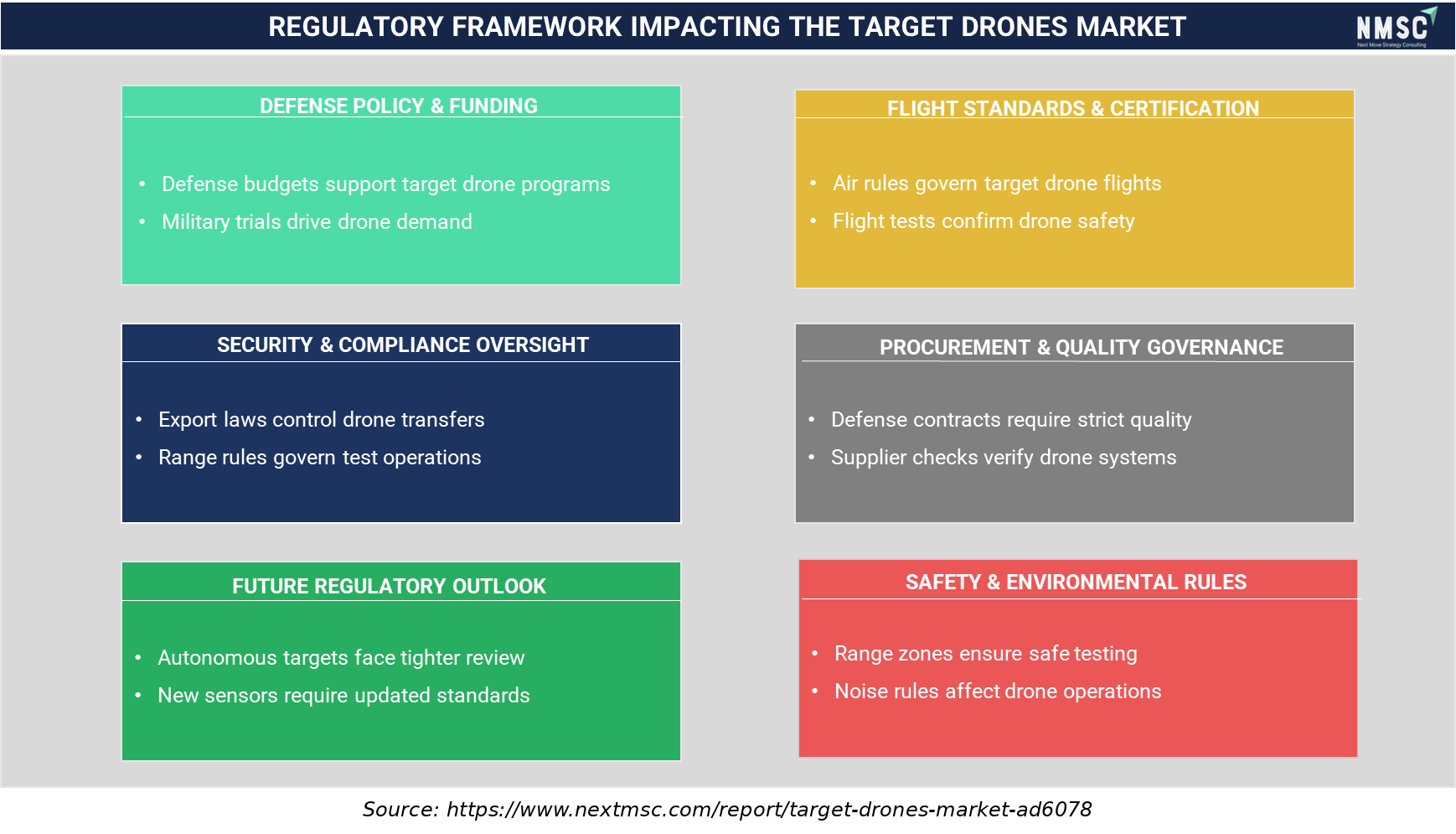
The target drones market is shaped by defense policies, funding priorities, flight standards, security controls, and procurement requirements. Regulations governing airspace, exports, testing, and supplier quality ensure operational reliability and compliance. Looking ahead, autonomous capabilities and advanced sensors are expected to face tighter regulatory scrutiny as authorities strengthen safety, environmental, and performance standards.

Segmentation Analysis

2025 (USD Billion)
2035 (USD Billion)
Fixed-Wing Target Drones 2025: $2.30 Billion | 2035: $4.75 Billion
Fixed-Wing T
Rotary-Wing Target Drones 2025: $550.00 Billion | 2035: $1.25 Billion
Rotary-Wing
Aerial Target Missiles 2025: $750.00 Billion | 2035: $1.75 Billion
Aerial Targe
Towed Aerial Targets 2025: $330.00 Billion | 2035: $650.00 Billion
Towed Aerial
Sub-Scale Aerial Targets 2025: $170.00 Billion | 2035: $500.00 Billion
Sub-Scale Ae
Fixed-Wing Target Drones $2.30 Billion $4.75 Billion 7.5%
Rotary-Wing Target Drones $550.00 Billion $1.25 Billion 8.6%
Aerial Target Missiles $750.00 Billion $1.75 Billion 8.9%
Towed Aerial Targets $330.00 Billion $650.00 Billion 7.1%
Sub-Scale Aerial Targets $170.00 Billion $500.00 Billion 11.3%

Which Platform Type Dominates the Target Drones Market?

Fixed-Wing Target Drones led the market with USD 2.3 Billion in 2025, supported by sustained naval and air force demand for jet-powered platforms replicating cruise missile and fighter aircraft threat profiles. We observed that Sub-Scale Aerial Targets is the fastest-growing platform type, expanding at an 11.3% CAGR from 2026 to 2035, as defense agencies seek lower-cost, high-volume platforms for routine air defense gunnery and short-range training exercises.

2025 (USD Billion)
2035 (USD Billion)
Air Defense
Missile Defe
Weapons Syst
Electronic W
Radar Cross-
Segment Item 2025 (USD Billion) 2035 (USD Billion) CAGR
Air Defense Training $10.0 USD Billion $40.0 USD Billion 18.0%
Missile Defense Testing $17.1 USD Billion $51.1 USD Billion 16.0%
Weapons System Evaluation $24.2 USD Billion $62.2 USD Billion 22.0%
Electronic Warfare Training $31.3 USD Billion $73.3 USD Billion 12.0%
Radar Cross-Section Testing $38.4 USD Billion $84.4 USD Billion 19.0%

Segment-wise data is locked

Unlock complete segment-wise numbers for By Application.

Unlock Full Data
2025 (USD Billion)
2035 (USD Billion)
Subsonic
Transonic
Supersonic
Hypersonic
Segment Item 2025 (USD Billion) 2035 (USD Billion) CAGR
Subsonic $10.0 USD Billion $40.0 USD Billion 12.0%
Transonic $17.1 USD Billion $51.1 USD Billion 26.0%
Supersonic $24.2 USD Billion $62.2 USD Billion 8.0%
Hypersonic $31.3 USD Billion $73.3 USD Billion 14.0%

Segment-wise data is locked

Unlock complete segment-wise numbers for By Speed Class.

Unlock Full Data
2025 (USD Billion)
2035 (USD Billion)
Recoverable
Expendable T
Segment Item 2025 (USD Billion) 2035 (USD Billion) CAGR
Recoverable Target Drones $10.0 USD Billion $40.0 USD Billion 26.0%
Expendable Target Drones $17.1 USD Billion $51.1 USD Billion 16.0%

Segment-wise data is locked

Unlock complete segment-wise numbers for By Recovery Mode.

Unlock Full Data
2025 (USD Billion)
2035 (USD Billion)
Air Force
Navy
Army
Defense Rese
Segment Item 2025 (USD Billion) 2035 (USD Billion) CAGR
Air Force $10.0 USD Billion $40.0 USD Billion 26.0%
Navy $17.1 USD Billion $51.1 USD Billion 16.0%
Army $24.2 USD Billion $62.2 USD Billion 18.0%
Defense Research Agencies $31.3 USD Billion $73.3 USD Billion 8.0%

Segment-wise data is locked

Unlock complete segment-wise numbers for By End User.

Unlock Full Data

Which End User Segment Leads Target Drones Market Demand?

Air Force remained the dominant end user, reaching USD 2.1 Billion in 2025 due to sustained air defense gunnery and pilot training requirements across major defense forces. Based on research conducted by NMSC, we found that Defense Research Agencies represent the fastest-growing end user at a 10.3% CAGR from 2026 to 2035, reflecting expanding hypersonic and next-generation threat simulation research programs.

2025 (USD Billion)
2035 (USD Billion)
North Americ
Canada
Mexico
Europe: UK
Germany
Segment Item 2025 (USD Billion) 2035 (USD Billion) CAGR
North America: U.S. $10.0 USD Billion $40.0 USD Billion 10.0%
Canada $17.1 USD Billion $51.1 USD Billion 8.0%
Mexico $24.2 USD Billion $62.2 USD Billion 18.0%
Europe: UK $31.3 USD Billion $73.3 USD Billion 8.0%
Germany $38.4 USD Billion $84.4 USD Billion 15.0%

Segment-wise data is locked

Unlock complete segment-wise numbers for By Region.

Unlock Full Data

Growth Opportunities

Our analysis shows that three forward-looking opportunities stand out for stakeholders positioning within the Target Drones Market over the 2026-2035 forecast period.
How Is Hypersonic Threat Simulation Creating Opportunities for Advanced Target Developers? Hypersonic target platforms present a whitespace opportunity for manufacturers seeking to support next-generation missile defense testing programs. Developers that commercialize validated hypersonic target systems stand to capture premium contracts as defense agencies expand testing programs against emerging hypersonic threats.
Why Is Multinational Co-Procurement Emerging as a Growth Opportunity for Established Manufacturers? Allied nations standardizing target systems across partner fleets present an underpenetrated opportunity for manufacturers with proven, export-qualified platforms. Vendors that secure foreign military sales approvals can establish durable, multi-country production contracts as allied navies and air forces harmonize training and testing protocols.
How Is Reconfigurable Payload Technology Unlocking Opportunities for Multi-Mission Target Platforms? Reconfigurable payload technology creates an opportunity for manufacturers seeking to replicate multiple threat profiles from a single airframe. Early movers that develop modular electronic countermeasure and radar augmentation payloads can differentiate with defense customers pursuing cost efficiency across diverse training and testing requirements.

Regional Outlook

2025 (USD Billion)
2035 (USD Billion)
North Americ
Europe
Asia-Pacific
Middle East
Latin Americ
Region 2025 (USD Billion) 2035 (USD Billion) CAGR (%)
North America $10.0 USD Billion $40.0 USD Billion 9.0%
Europe $17.1 USD Billion $51.1 USD Billion 27.0%
Asia-Pacific $24.2 USD Billion $62.2 USD Billion 25.0%
Middle East & Africa $31.3 USD Billion $73.3 USD Billion 23.0%
Latin America $38.4 USD Billion $84.4 USD Billion 12.0%

Regional data is locked

Unlock complete regional numbers for this market.

Unlock Full Data

Competitive Landscape

We observed that the Target Drones Market features a moderately consolidated competitive landscape, with established defense manufacturers competing on qualification history, platform reliability, and multi-mission reconfigurability.

Dimension Description
Market Structure Moderately consolidated; a small number of qualified manufacturers hold long-running sole-source production programs with major defense agencies, limiting near-term entry by new competitors.
Innovation Focus Reconfigurable multi-mission payloads, supersonic and hypersonic threat replication, and full-scale target conversion dominate current innovation pipelines across leading manufacturers.
M&A Activity Selective, exemplified by QinetiQ Group plc's earlier acquisition of Meggitt PLC's target systems business, which established its current Banshee target drone franchise.

How Do Companies Compete in the Target Drones Market?

Companies compete primarily on qualification history, production reliability, and demonstrated AI in military anddefense and payload integration capability across the Target Drones Market. Established manufacturers such as Kratos Defense & Security Solutions, Inc. and Northrop Grumman Corporation leverage decades-long sole-source production programs to secure recurring full-rate production contracts, while QinetiQ Group plc competes on cumulative platform production scale and multinational qualification credentials.

Which Competitive Archetypes Dominate the Target Drones Market?

Two archetypes dominate the market: specialized target drone manufacturers whose core business centers on aerial target systems, and diversified defense primes offering target drones alongside broader missile and aircraft portfolios. Kratos Defense & Security Solutions, Inc. and QinetiQ Group plc exemplify the specialized archetype through dedicated target systems divisions, while Northrop Grumman Corporation and The Boeing Company exemplify the diversified archetype leveraging broader missile and aircraft engineering expertise.

How Are Companies Differentiating Through Innovation in Target Drones?

Innovation and differentiation strategy increasingly center on reconfigurable payloads and expanded speed envelope capability. Northrop Grumman Corporation's continued production of the GQM-163A Coyote supersonic sea-skimming target illustrates how manufacturers are sustaining specialized high-speed threat replication capability that few competitors can match. Our analysis shows that manufacturers unable to demonstrate qualified high-speed or full-scale conversion capability risk exclusion from advanced missile defense testing program shortlists.

What M&A and Expansion Activity Is Shaping the Target Drones Market?

Consolidation activity in the Target Drones Market has historically centered on established manufacturers acquiring specialized target systems businesses to enter the category. QinetiQ Group plc's earlier acquisition of Meggitt PLC's target systems division established its current Banshee franchise and enabled its subsequent entry into the U.S. market as a prime contractor for Army aerial target systems. This transaction illustrates how acquisition of qualified, in-service platforms remains the primary pathway for new entrants given lengthy qualification cycles.

Key Market Players

Our assessment indicates that the following 17 companies represent the validated competitive set actively shaping product innovation, capacity expansion, and strategic positioning within the global Target Drones Market.

Northrop Grumman Corporation QinetiQ Group plc The Boeing Company Leonardo S.p.A. Israel Aerospace Industries Ltd. Elbit Systems Ltd. Airbus SE Textron Inc. Griffon Aerospace, Inc. Denel SOC Ltd. Hindustan Aeronautics Limited EMT Ingenieurbüro Penzberg GmbH Korean Air Lines Co., Ltd. Turkish Aerospace Industries, Inc. Saab AB ST Engineering Ltd.

PESTEL Analysis of the Target Drones Market

PESTEL Analysis of the Target Drones Market
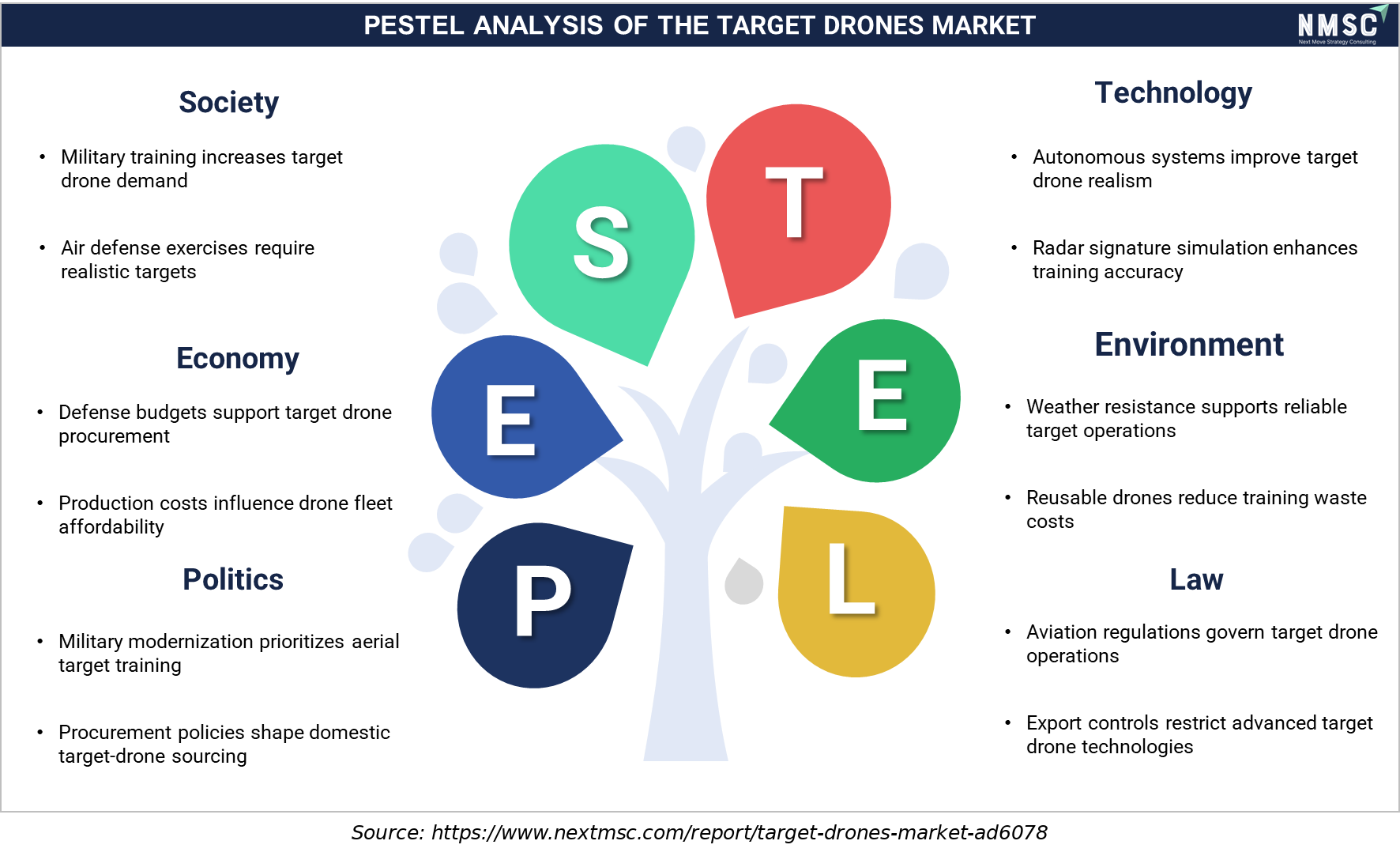
A PESTEL perspective highlights the external forces influencing the target drones market. Political and economic conditions affect defense spending and procurement, while social factors shape acceptance and operational needs. Technological advances drive autonomy and sensing capabilities, whereas environmental and legal considerations increasingly emphasize safety, emissions, airspace compliance, and responsible drone deployment.

Latest Developments

We found that recent production contracts and program milestones within the Target Drones Market are concentrated on full-rate production scale-up and multinational co-procurement.

Date Event
July 9, 2026 Airbus is evolving the Do-DT25 target-drone airframe into Bird of Prey, a reusable autonomous interceptor. In March 2026, Bird of Prey successfully demonstrated autonomous search, detection and classification of a one-way attack drone before engaging it with a Mark I missile from Frankenburg Technologies, demonstrating the rapid adaptation of a target-drone platform for counter-UAS roles.
April 21, 2026 Kratos completed the initial flight series of its J85-powered Firejet configuration, adding a higher-performance propulsion option to the existing Firejet target system. Kratos says the new configuration increases range, endurance, speed and climb rate while supporting threat-representation requirements for the U.S. Army and allied customers.
March 26, 2026 Korean Air completed the system requirements review for South Korea’s domestic subsonic unmanned-target-drone program four months after winning the government-led project. The planned drone can reach approximately Mach 0.6, incorporates AI-enabled swarm control and mission autonomy, and uses an open, modular architecture. Prototype production and maiden flight are targeted for the end of 2027.

Investment Opportunities

What Capital Inflows Are Targeting the Target Drones Market?

Capital inflows into the market are increasingly directed toward manufacturers with qualified, in-service target platforms and proven production track records. Sustained U.S. Navy and Air Force full-rate production contracts, including Kratos Defense & Security Solutions, Inc.'s USD 61.1 Million February 2026 award, reflect continued government capital commitment to target drone production capacity. We observed that investors favor manufacturers demonstrating multi-year contract backlogs, viewing production visibility as a proxy for long-term revenue stability.

How Is Infrastructure Investment Supporting Target Drones Deployment?

Infrastructure investment in production facilities and rocket-assisted launch equipment is expanding the operational foundation required for sustained target drone output. Manufacturers continue to expand production capacity across established U.S. and European facilities to meet multi-year full-rate production commitments. This infrastructure investment reflects broader industry recognition that qualified production capacity is a prerequisite for securing long-term defense agency supply agreements.

What ESG Considerations Are Shaping Target Drones Investment Decisions?

Environmental, social, and governance considerations intersect with Target Drones Market investment decisions primarily through governance and export compliance rather than environmental impact, given the market's defense procurement nature. Manufacturers operating under strict national export control and foreign military sales regulations continue to emphasize compliance governance in investor disclosures. We found that investors increasingly favor manufacturers with transparent regulatory compliance records, treating export control governance as a proxy for long-term contract eligibility across allied markets.

Key Benefits for Stakeholders

How Does This Report Benefit Enterprise and Industry Leaders?

Enterprise and industry leaders gain access to validated segmentation, competitive benchmarking, and regional demand forecasts that support production planning and procurement decisions across the Target Drones Market. Our analysis shows that detailed platform type, end-user, and regional breakdowns help defense agency procurement teams align specifications with testing and training requirements while identifying underserved platform categories for portfolio expansion.

How Does This Report Benefit Investors and Financial Analysts?

Investors and financial analysts benefit from consistent, single-point market size and CAGR estimates that support valuation and capital-allocation decisions across the Target Drones Market manufacturer landscape. We observed that the report's regional and segment-level growth differentials help identify which manufacturers are best positioned to capture above-market growth in supersonic and hypersonic target categories through 2035.

How Does This Report Benefit Technology Vendors and Product Teams?

Technology vendors and product teams gain insight into emerging design requirements, including reconfigurable payloads, expanded speed envelopes, and multi-mission threat replication, that are reshaping the Target Drones Market. Our findings suggest that this analysis helps R&D teams prioritize development roadmaps around qualification pathways and production scalability increasingly required by defense agency procurement processes.

Key Market Segments Evaluated

By Platform Type

  • Fixed-Wing Target Drones
  • Rotary-Wing Target Drones
  • Aerial Target Missiles
  • Towed Aerial Targets
  • Sub-Scale Aerial Targets

By Application

  • Air Defense Training
  • Missile Defense Testing
  • Weapons System Evaluation
  • Electronic Warfare Training
  • Radar Cross-Section Testing

By Speed Class

  • Subsonic
  • Transonic
  • Supersonic
  • Hypersonic

By Recovery Mode

  • Recoverable Target Drones
  • Expendable Target Drones

By End User

  • Air Force
  • Navy
  • Army
  • Defense Research Agencies

By Region

  • North America
  • Europe
  • Asia-Pacific
  • Middle East & Africa
  • Latin America

Conclusion & Recommendations

The long-term outlook for the Target Drones Market remains steadily positive, with global revenue projected to more than double from USD 4.1 Billion in 2025 to USD 8.9 Billion by 2035 at an 8.1% CAGR. We observed that sustained missile defense testing demand, combined with expanding multinational co-procurement, will continue underpinning demand across fixed-wing, missile-form, and sub-scale platform categories through the forecast period.

What Strategic Positioning Should Target Drones Vendors Pursue?

Vendors should prioritize qualification credentials and multi-year production scalability while pursuing reconfigurable payload capability to secure long-term defense agency contracts. Our assessment indicates that companies investing early in hypersonic threat simulation and full-scale conversion capability will be best positioned to capture premium pricing within the Target Drones Market.

How Attractive Is the Target Drones Market for New Investment?

The market presents a moderately attractive investment case, supported by a USD 4.5 Billion absolute dollar opportunity between 2026 and 2035 and above-average growth in Asia-Pacific and hypersonic target categories. We found that investment attractiveness is highest for manufacturers combining proven qualification history with expanding speed envelope capability, positioning them to serve both established naval and emerging missile defense testing programs simultaneously.

What Market Shifts and Key Risks Should Stakeholders Monitor?

Stakeholders should monitor lengthy qualification cycles, high per-unit expendable target costs, and defense budget procurement volatility as key risks to the Target Drones Market. Our analysis shows that manufacturers unable to sustain qualified production status risk losing multi-year contract renewals to established competitors with longer operational track records.

What Are the Key Growth Pathways for the Target Drones Market?

Key growth pathways include expanding full-rate production capacity for subsonic and supersonic platforms, scaling hypersonic threat simulation capability, and deepening penetration into allied co-procurement programs across Asia-Pacific. NMSC's analysis indicates that vendors pursuing these pathways while maintaining qualified production status will be best positioned to capture the market's projected growth through 2035.

FAQs

About the Author

Mihul Sharma

Mihul Sharma

Mihul Sharma is Research Associate at Next Move Strategy Consulting, where he has covered technology, industrial, and healthcare markets for 3 years. His work applies structured business research, market analysis, and secondary-source review to assess market trends, competitive developments, and growth opportunities. He supports report development by fully synthesizing industry data, company information, and market signals into concise findings for strategy and investment-focused research teams.

About the Reviewer

Supradip Baul

Supradip Baul

Supradip Baul is an accomplished business consultant and strategist with over a decade of rich experience in market intelligence, strategy, technology, and business transformation. His work has included rigorous qualitative and quantitative analysis across multiple industries, helping clients shape investment decisions and long-term roadmaps. Earlier in his career, he was associated with Gartner, where he contributed to industry-leading reports and market share analyses. He has worked with leading global companies and holds an MBA with a dual specialization in Marketing and Finance.

Download Free Sample

Kevin Coker

KEVIN COKER

Founder, CEO and Board Diector

Proxima Clinical Research

I have been using Next MSC reports for product positioning in a new geography for a long time. They have by far the best reports I have found and the price is reasonable too!

Gaurav Jaiswal

GAURAV JAISWAL

Founder & CEO

Yano Charge Private Limited

The EV Charging market research report provided by the NextMSC was exceptionally detailed and insightful. It offered a comprehensive analysis that proved to be a game-changer for our strategic planning. Truly a testament to the NextMSC’s expertise and thoroughness in EV market landscape & analysis.

Henri Knyphausen

HENRI KNYPHAUSEN

Partner at Singulier [Ex-BCG]

Singulier

I recently engaged NEXTMSC.com for a commercial due diligence project within the intralogistics sector, and I am pleased to provide a reference based on my experience. In utilizing NEXTMSC.com's services, I found their report to offer valuable insights into market dynamics and key industry players. The initial report provided a solid foundation for our analysis. However, as we were investigating a smaller target in the market, and I had specific customization requests requiring additional research. These requests included detailed information on product portfolios of various players and sub-market sizes, both inclusive and exclusive of certain product categories. NEXTMSC.com demonstrated commendable responsiveness and agility in accommodating these customization requests. Within a timeframe of 1-2 weeks, they delivered a revised report that met our specific needs. Furthermore, they were receptive to my follow-up inquiries, ensuring clarity and understanding of the data provided. The final deliverable significantly contributed to our due diligence efforts. One of NEXTMSC.com's notable strengths lies in their qualitative research capabilities. However, for future engagements, I would recommend the inclusion of a quantified market model in Excel format. Such a model would offer the ability to conduct in-depth analyses and explore various market segments, including country-specific data and subcomponent breakdowns. Based on my positive experience, I would not hesitate to work with NEXTMSC.com again. Their responsiveness, willingness to accommodate customization requests, and commitment to delivering actionable insights make them a reliable partner for commercial research projects.

Rishabh Jogani

RISHABH JOGANI

Strategy Analyst

Accenture Japan

We are incredibly impressed with the market report on the real estate market in India provided by Next Move Strategy Consulting. The report was thorough, insightful, and well-structured, offering deep analysis and actionable recommendations. It not only captured the current trends and dynamics but also provided a forward-looking perspective that has been invaluable for our strategic planning. Their team demonstrated exceptional professionalism, attention to detail, and a profound understanding of the industry. The data-driven insights and clarity of presentation exceeded our expectations, making complex market trends easy to understand. We highly recommend Next Move Strategy Consulting to anyone looking for reliable and comprehensive market research services. Their expertise has given us the confidence to navigate the complexities of the Indian real estate market with clarity and foresight.

Amos Chang

AMOS CHANG

Strategy Consultant

Kardex Group

I have bought the intralogistics market reports from NMSC two times so far. Joseph and his team are always very helpful and flexible in responding to any customization requirements on the report. Their expertise in market reports really helps us steer the day-to-day business. I will definitely recommend and come back myself whenever there is a need.

Custom Market Research Services

We will customize the research for you if the listed report does not fully match your requirements.

Get 30% Free Customization

Select License

This website uses cookies to ensure you get the best experience on our website. Learn more

✖